Nollywood rising: Low cost, high volume film industry entertains Africa

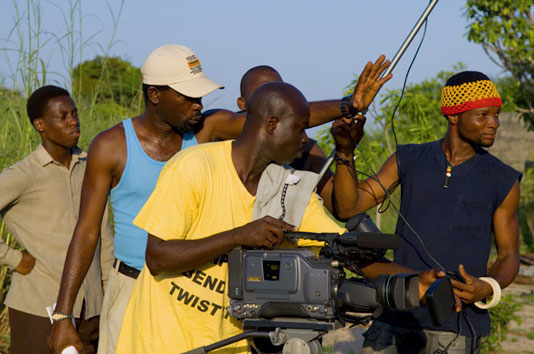
Lights, camera...budget action! Image courtesy 'This Is Nollywood'
Here’s a general knowledge question: Everyone knows India’s Bollywood is the world’s largest producer of movies (by number). Which country’s movie industry comes second?

If you said Hollywood, that’s a dated answer. America’s movie industry used to be the second largest in the world — until an unlikely contender turned up from…Nigeria!

India remains the world’s leading film producer but Nigeria is closing the gap after overtaking the United States for second place, according to a global cinema survey conducted by the UNESCO Institute for Statistics (UIS).

Bollywood produced 1,091 feature-length films in 2006 compared to 872 productions (in video format) from Nigeria’s film industry, commonly referred to as Nollywood. In contrast, the United States produced 485 major films.

The three heavyweights were followed by eight countries that produced more than 100 films: Japan (417), China (330), France (203), Germany (174), Spain (150), Italy (116), South Korea (110) and the United Kingdom (104).

Nigerian filmmakers rely on video instead of film to reduce production costs. And as the survey points out, Nigeria has virtually no formal cinemas. About 99% of screenings occur in informal settings, such as “home theatre”.
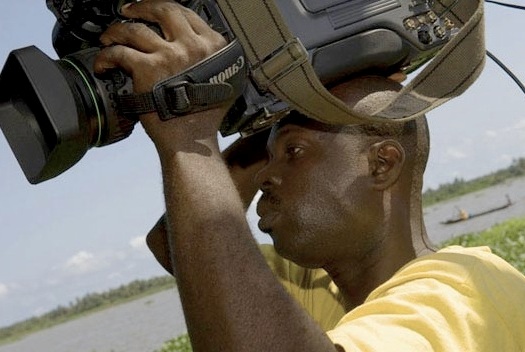
This is Nollywood
This is Nollywood
The UNESCO survey reveals another key element of the Nigerian success story: multilingualism. About 56% of Nollywood films are produced in Nigeria’s local languages, namely Yoruba (31%), Hausa (24%) and Igbo (1%). English remains a prominent language, accounting for 44%, which may contribute to Nigeria’s success in exporting its films.

Nollywood’s rising has been chronicled in a 2007 documentary by Franco Sacchi and Robert Caputo. Called This is Nollywood, it tells the story of the Nigerian film industry – a revolution enabling Africans with few resources to tell African stories to African audiences. Despite all odds, Nigerian directors produce between 500 and 1,000 movies a year. The disks sell wildly all over the continent – Nollywood actors have become stars from Ghana to Zambia.

Says Zambia-born director Franco Sacchi: “When I first read about Nigerian directors producing hundreds of feature-length films with digital cameras, a week, and a few thousand dollars, I found the subject irresistible. Here was not only a rare positive story about Africa, but one that embodied the egalitarian promise of digital technology—anybody can make a movie. And Nollywood was virtually unknown.”

This is Nollywood takes us behind the sets and scenes in one Nigerian movie being made on the cheap — and fast. Acclaimed director Bond Emeruwa sets out to make a feature-length action film in just nine days. Armed only with a digital camera, two lights, and about $20,000, Bond faces challenges unimaginable in Hollywood and Bollywood.

Emeruwa says: “We are telling our own stories in our own way, our Nigerian way, African way. I cannot tell the white man’s story. I don’t know what his story is all about. He tells me his story in his movies. I want him to see my stories too.”

Watch This is Nollywood: Movie Trailer

I then came across this TED Talk by Franco Sacchi, where he takes us through Nollywood (at the time he gave his talk, the world’s third largest and now second only to Bollywood). He talks about ‘guerrilla film-making’ and brilliance under pressure from crews that can shoot a full-length feature in a week.

Welcome to Nollywood is another 2007 documentary film, directed by Jamie Meltzer, that looked at the Nigerian film industry. Its findings were similar to those of This is Nollywood. Traveling to the country’s chaotic capitol, Lagos, Meltzer spent ten weeks following three of Nigeria’s hottest directors, each different in personality and style, as they shot their films about love, betrayal, war, and the supernatural.

At around US$250 million per year (and rising), Nollywood’s capital outlay is far below that of Hollywood and Bollywood. For perspective, that’s a bit less than what it cost to make Spiderman 3 in 2007 (budget: US$ 258 million) — the second most expensive film made. See list of most expensive Hollywood films.

Telling their own stories....
But what it lacks in capital, Nollywood more than makes up in numbers and mass appeal. As the Wikipedia notes, Nigerian directors adopt new technologies as soon as they become affordable. Bulky videotape cameras gave way to their digital descendents, which are now being replaced by HD cameras. Editing, music, and other post-production work is done with common computer-based systems.

As Colin Freeman wrote in the Daily Telegraph, UK: “While the likes of Serpent in Paradise and Evil Finger may not be as slick as their Hollywood counterparts, they offer one thing that the likes of George Clooney and Brad Pitt can never provide: characters and stories with which an African audience can identify.”

And according to The Economist, it all started in 1992, when Kenneth Nnebue, a Nigerian trader based in Onitsha, was trying to sell a large stock of blank videocassettes he had bought from Taiwan. He decided that they would sell better with something recorded on them, so he shot a film called “Living in Bondage” about a man who achieves power and wealth by killing his wife in a ritualistic murder, only to repent later when she haunts him. The film sold more than 750,000 copies, and prompted legions of imitators.

The rest, as they say, is now Nollywood history.

Read my August 2007 blog post: “If we don’t tell our stories, no one else will”

Tabloid science maybe imperfect, but it’s still better than no science coverge!

WCSJ London

Raised on popular culture, I have always been an admirer of tabloid journalism – which means using popular formats to reach out to a mass audience in newspapers or broadcasting. There’s nothing inherently wrong with this: we might even argue that the tabloid approach is the only way to achieve truly mass media (with all else being niche media reaching to smaller demographic groups).

So I was delighted to be on a panel with two leading British tabloid journalists and a popular radio host from South Africa during the 6th World Conference of Science Journalists held in London from June 30 – July 2, 2009.

We had to address this question: Does science coverage in the media need to be highbrow?

My own, personal answer is NO — it need not be! And I’ve spent a good part of my two decades of work in the media experimenting and showing that communicating science can be fun — both for us communicators and our audiences.

But I pointed out that science is still being covered in sections of Asian media in the more traditional, classical way, just like science itself is still an elitist pursuit in many of our societies.

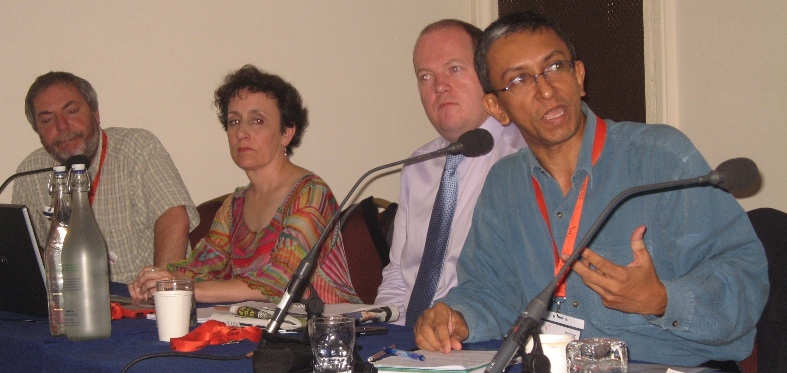
L to R: Paul Sutherland, space correspondent of The Sun, UK; Christina Scott, radio and web journalist, South Africa; David Derbyshire, Environment editor, The Daily Mail, UK; Nalaka Gunawardene, Director/CEO, TVE Asia Pacific

I said: “We might call this coverage ‘broadsheet approach’ in print; or ‘bluechip documentary’ format on television. And they are both unsustainable! They are also endangered in these hard times for the mainstream media in most economies.

“So going the tabloid path is a practical and pragmatic way to deliver science stories and science information to a mass audience or readership. We’re doing it in different ways in the Asian media!”

In my remarks, I gave some examples where science is jazzed up (rather than dumbed down) for popular consumption on Asian television. For example, how solar and lunar eclipses provide fodder for endless stories on our numerous news channels. Such coverage, fleeting and superficial as it might often be, takes the wonders of science and Nature to more people than anyone else can.

I argued that the path to the mass audiences in Asia is through news, sports and entertainment programming. We have our own niche, factual channels – Discovery, National Geographic, Animal Planet and their local equivalents. They have a loyal but small audience. They do excellent work. But where numbers are concerned, they cannot – yet! – compete with the outreach and appeal of broadcast radio, TV and newspapers. Neither can the online and mobile media, even though their outreach is growing fast.

Things don’t always go right, however. Doing wall-to-wall coverage of news demands producers and reporters to tackle a variety of topics and subjects — including specialised science stories. Some handle this better than others. In their race for ratings and revenue, a few ‘dress up’ the stories a bit too much.

Television science: aspiration or reality?
A good example was how some Indian news channels handled the so-called ‘Big Bang experiment’ in September 2008, when the Large Hadron Collider (LHC) was commissioned. The mega-science experiment was interesting in its own right, but it wasn’t apparently exciting enough for at least two channels — Aaj Tak and India TV. Their coverage running up to the event speculated about its “catastrophic effect on the world” – effectively end of the world.

Their coverage caused panic, which led to at least one attributable death. This prompted the Indian Ministry of Information and Broadcasting to caution the channels for spreading “misinformation, fear and horror” among viewers. It advised the channels to exercise restraint in presenting such issues.

I call this the ’24/7 TV Deficit’ in Asian broadcasting. The long term response to this is to invest in training and capacity building of journalists and producers already working in the media. For the most part, they learn on the job, making mistakes on the air. This is far from ideal.

Here’s how I summed up: ‘Tabloid science coverage’ – in print or broadcast – may be imperfect in some ways. But our choice is either that, or nothing. Our challenge is to make the process and product better as we go along.

We urgently need to unleash scientific knowledge and understanding in matters of public interest and public policy. We can’t afford the ALL or NOTHING approach.

Communicating disasters on film: Experts, please don’t cross this line!

Global Platform bannerExperts should let film-makers produce professional films in simple terms that are more appropriate for public audiences, instead of trying to produce films that have little chance of being broadcast or distributed in other ways. There is a role for technical experts – but that’s not in the crafting and directing of films, but in providing the knowledge, clarifications and guidance to film-makers and journalists who are professionals in communicating complex issues to non-specialist publics.

Self-evident as it may be, these home truths are well worth reiterating every now and then — especially to experts and officials who keep forgetting them (sometimes with disastrous and expensive results!). So I was very glad to read that these points were emphatically made at a ‘film debate’ held in Geneva last week.

The occasion was a panel discussion, ambitiously titled ‘The role of film-makers in promoting climate change adaptation and disaster risk reduction stories’. It was held on 17 June 2009 as part of the Second Session of the Global Platform for Disaster Risk Reduction in Geneva.

Moderated by the well known journalist, writer and producer Edward Girardet, from Media21, Geneva, it involved five panelists drawn from media/communication sector and the disaster/humanitarian sectors. Among the panelists was my colleague Robert Lamb, director of One Planet Pictures, UK, and consultant producer with dev.tv, Switzerland.

The debate’s premise was simple: So far much of the thrust of the film industry, NGOs, UN organizations and media in portraying disasters and climate change has focused on outcome – which is more visually stimulating – rather than showcasing vital prevention and adaptation solutions. This is necessary, but not sufficient. What can be done to improve the interaction between the film/news industry and leading organizations dealing with disaster risk management and climate change adaptation on a daily basis?

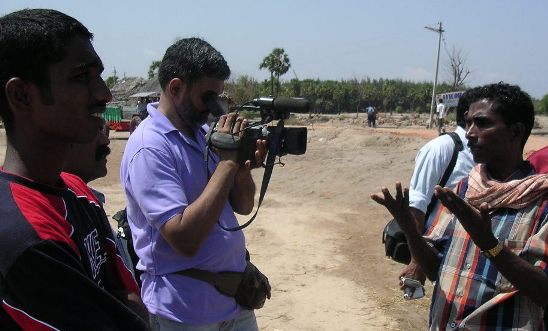
Interviewing tsunami survivor in Tamil Nadu, India - image from TVEAP
This was similar to the approach we had in TVE Asia Pacific’s Communicating Disasters project in Asia (2006-2007). We too explored the common ground for these two sectors, with their distinctive needs, and asked how the two can support each other without stepping on each others’ toes.

The same discussion continued in Geneva. I’ve limited information on what actually transpired during the debate, and am hoping someone will soon write it up. For now, here’s a summary adapted from UN-ISDR daily coverage (the official language is theirs, not mine):

“More than 150 participants attended a thought-provoking film debate. The five panelists discussed how to enhance the interaction between the film/news industry and leading organizations dealing with climate change adaptation (CCA) and disaster management to increase CCA visibility which is very limited today in film productions.

“Eight short films were presented during the session, among them a short trailer of ‘An Inconvenient Truth’ and a CCA film shot in Burkina Faso produced by Christian Aid. After identifying a number of challenges due to their formats and audiences, film-makers and experts agreed it was important to work more closely to make more films on the solutions offered by CCA.

“Film-makers suggested that experts should let them produce professional films in simple terms that are more appropriate to their audiences and focus on bringing expert knowledge to enrich the content of their current productions instead of producing films that have little chance to be broadcast or distributed.”

All this reminds me of a discussion we had around an earlier blog post where I asked: Anyone can make video film, right? So why do we need professionals?

Wanted, urgent: Reporters Sans Labels!

DW GMF 2009
A top European Union official recently cautioned against the concept of ‘peace journalism‘, under which journalists actively promote peace as part of their coverage of conflicts. His views resonated much with my own reservations about this particular brand of journalism.

Javier Solana, EU High Representative for the Common Foreign and Security Policy, made the remarks in a written contribution to the Deutsche Welle Global Media Forum, held in Bonn, Germany, from 3 to 5 June 2009. I wasn’t there in person, but have been reading up some of the presentations and media coverage of the event.

Javier Solana
Javier Solana
In his wide-ranging talk, on ‘Conflict prevention in the multi-media age – The EU’s role in the world‘, Solana asked: should we incorporate peace journalism into our conflict prevention strategies? Yes, he said, “if this means striving to give as much impartial, quality information as possible to the press and media, in all their forms”.

The Spanish physicist-turned-politician added: “We all want to promote peace, reconciliation and conflict resolution and we want the media to help us in this. The best way in which they can do this is to inform us. This is the journalist’s fundamental task.”

He then sounded a word of caution: “The reporter is there to report. We should be careful not to weigh down the media with additional responsibilities over and above their primary task of providing information. A healthy media environment is diverse and plural; it is there to explain but not take sides. The profession of journalism needs no justification and no sophisticated qualification.”

Solana also referred to the early notion of ‘development journalism’ that was promoted in the 1970s, which called upon journalists in the developing countries to always support their governments’ development efforts. Such uncritical cheer-leading, which resulted in many ‘sunshine stories’ that glossed over problems, eventually did a lot more harm than good: development journalists became mere propagandists for governments pursuing wrong development models that squandered natural resources and brought misery to millions.

In fact, after having been part of the media and communications profession for over two decades, I no longer like to box myself into any category. For some years during my first decade of working life, I proudly called myself an ‘environmental journalist’. I still cover environmental issues with the same interest and passion, but now question whether the growth of environmental journalism as a media specialisation has, inadvertently, ghettoised environmental issues within the editorial considerations of media organisations. I also feel that at one point we became too ‘green’ for our own good.

Show things as they are!
This is not to argue against journalists specialising in environment or other sectors such as health, gender, peace or human rights. As issues become more complicated, journalists require a great deal of background knowledge, sustained interest and context to do their job well. But it’s poor strategy to leave sustainable development issues entirely in the hands of ‘environmental journalists’. Or coverage of conflict to ‘peace journalists’.

At best, such specialist journalists can only weave part of the much-nuanced, multi-faceted tapestry of sustainable development. To grasp that bigger picture, and to communicate it well, we need the informed and active participation of the entire media industry -– from reporters, feature writers and producers to editors, managers and media owners.

What we lack – and urgently need – is plain good journalism that covers development, conflict and other issues as an integral part of human affairs. Noble intentions of saving the planet, or making world peace, sound good at beauty pageants. But these catch-all lines don’t give anyone the license to engage in shoddy journalism that lacks accuracy, balance and credibility – the core tenets of the profession. It applies equally to mainstream and citizen journalists.

So it’s time to take a few steps back, grasp the bigger picture ourselves, and then show it as is to our audiences. We need Reporters Without Labels.

The only label worth aspiring to is a good journalist. May their tribe increase!

Hitchhiker’s (Rough) Guide to the Media: Who wants a free ride?

If you got a message, hitch a ride...

How can research institutes and advocacy groups use the mainstream media effectively to communicate their findings and analyses?

What is the secret of some researchers receiving more media attention and coverage than others? Why are some ‘media darlings’?

Are there ways to secure quality coverage for public interest content without having to pay high rates for media space or air time?

TVE Asia Pacific (TVEAP) addresses these important questions in a new framework to engage the mass media for communicating for influence and social change. We call it a Hitchhiker’s (Rough) Guide to the Media.

The framework, building on a dozen years of TVEAP experience in working with television broadcasters and other media outlets across the Asia Pacific region, guides individuals and institutions to get the best out of the media. One key to success is building sustained relationships with media professionals and their gatekeepers (the bosses at media organisations who decide what content to publish or broadcast).

We introduced the framework to a group of ICT researchers drawn from across Asia who came together for a two-day workshop in Hyderabad, India, on 1 – 2 December 2008. The workshop aimed to build their capacity to use different communication frameworks and tools to engage policy makers, various other stake-holders and the wider public.

Workshop participants were all drawn from various action research projects on ICT or ICT for development supported by the Pan Asia Networking programme of the International Development Research Institute (IDRC) of Canada.

Our friends at IDRC have recently edited highlights of our presentation into a short video, which mixes excerpts from an interview they filmed with me. It can be watched here:

More about the workshop is found on a dedicated blog.

Read more about our framework on TVEAP website.

“Development” is seen as a hard sell in the increasingly commercialised media in the Asia Pacific. Researchers, activists and educators engaged in development work often complain that they are blocked out of the print and broadcast media. Yet they fail to understand a basic truth about the media: there is no quota of print space or air time set aside for development. Information and opinions on development topics must compete with other areas of human endeavour for the limited space and time available.

It is unrealistic to expect any legally or otherwise guaranteed space or time for development content. Even if there were, that can only apply on the media owners and media professionals. There can be no guarantee that media audiences will accept such content.

I get rather weary when well-meaning development players complain about the airwaves being full of entertainment, as if that airtime is something they have been deprived of. There is nothing intrinsically wrong with entertainment. The world will be a very dull place if the broadcasters listened to development people and packed every minute of air time with ‘information and education’.

Hitch a hike, but don't expect to get in the driver's seat...

This is the big challenge to the development community — how to get that delicate balance right, and learn to co-exist with other forms of media products catering to the wide and varied human interests. Hitch-hiking with the media avoids confrontation, looks for the common ground and tries to nurture collaboration for mutual benefit.

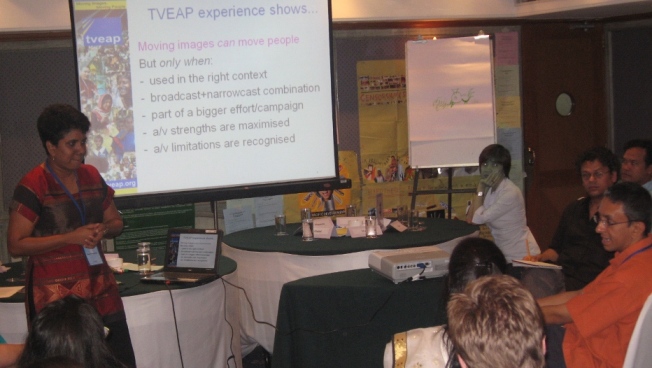
As my colleague Manori Wijesekera (presenting in the photo above) told the Hyderabad workshop: “Researchers and activists are a good source of information and opinions for the media, who need a constant supply of these. This can be a win-win situation for both parties, but we have to remember that we are hitching a ride with the media. So we can’t get into the driving seat or demand too much at once!”

So here’s our commercial: TVEAP conducts short, customised training sessions and workshops for researchers and civil society groups to enhance their media skills. These offer guidance on how to build and sustain ‘bridges’ with the media, and receive quality coverage that go well beyond publicity and public relations. If interested, get in touch with us!

Photos courtesy TVEAP Image Archive

Now on MediaChannel.org: Good communications to combat swine flu?

They turn the spotlight inwards...

MediaChannel.org has just published my latest op ed essay titled: Good communications to combat swine flu?

7 May 2009: New Age newspaper in Bangladesh has reprinted the essay

24 May 2009: The Hindu newspaper in India has reprinted the essay in its Sunday Magazine

In this essay, I have expanded some points originally made in two recent blog posts, on 30 April and 1 May 2009.

Here’s an excerpt:

“Flu shots, quarantine measures and hospital care alone cannot counter the current flu outbreak. While medical doctors and researchers spearhead the public health response, we need the mass media and other communicators to mount the public awareness response. Ideally, they should reinforce each other.

“For the first time in history, we now have the technological means to quickly reach out to most of humanity. More than four billion mobile phones are in use, a majority of them in the developing world. Nearly a quarter of the world population (over 1.5 billion people) have access to the web, even if at varying levels of bandwidth. Thousands of radio and TV channels saturate the airwaves – these still are the primary source of news and information for billions.

“Can these information and communication technologies (ICTs) help disseminate the right kind of flu awareness? How fast can we mobilise 24/7 media outlets and telecom networks to inspire preventive and curative action? What can the blogging, texting and twittering new media activists do in such efforts?”

Stop the virus, but not the news!
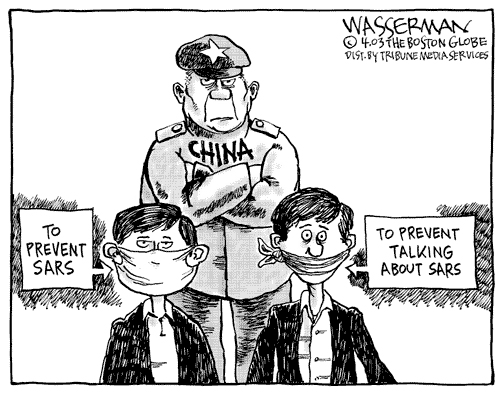
Looking for models of communicating against an infectious epidemic, I recall the Asian experience with Severe Acute Respiratory Syndrome (SARS) . I summarise in this essay the public interest roles played by Asian media during the SARS crisis, which has been studied and analysed in considerable detail.

I then return to one of my favourite points about communicating disasters and crises: the need for credible messages and credible messengers. This was a core theme in the Asian book on Communicating Disasters that I co-edited in 2007. I also highlighted it in this interview given to APC in early 2008.

Here’s how my essay ends: “Whether it is SARS, HIV or tsunami, many Asian governments have suffered from a credibility gap in managing information about emergencies. For example, the initially slow and guarded media reporting on SARS allowed the virus to spread quickly in China, with devastating results. We cannot afford to repeat these mistakes with the latest flu pandemic.

“Nearly a century ago, British author H G Wells talked about human history being a race between education and catastrophe. In the coming weeks, we would find out if humanity has what it takes to outrun and outsmart a stubborn virus.

Read the full essay at MediaChannel.org

Read my op ed essay in SciDev.net in Dec 2005: A Long Last Mile: The lesson of the Asian tsunami

MediaChannel have published my op ed essays before. They were the first to publish, in June 2006, my global call for the broadcast industry to recognise poverty as a copyright free zone. And when Al Jazeera English channel was launched at the end of 2006, MediaChannel carried my essay on ethical news gathering as the biggest challenge for the new global TV network.

My latest essay is a humble birthday present to MediaChannel.org as it completes 10 years. Unique among websites, MediaChannel.org holds the rest of the media accountable with the best of the world’s media criticism and analysis — offering news, diverse global perspectives, and commentaries tracking international news flows. They cover breaking controversies, showcase change-makers, trends and cutting edge issues that you need to know about – produced by journalists for journalists and citizens.

MediaChannel’s co-founder Danny Schechter is one of my media heroes – he was Moving Images Person of the Year 2008.

“Our survival alone is a cause for celebration – a decade of growth and impact is impressive in ‘Internet years’,” wrote the website’s founders in a special 10th anniversary message. They added: “Over the past 10 years, we have survived financial crises and organized hack attacks. We have managed to remain relevant and on the cutting edge in a quickly evolving online landscape when many other sites and organizations have come… and gone.”

The team is making an urgent appeal for donations to keep this excellent service going. I’m very happy to amplify this – few services can deliver better value for money, and our troubled times and troubled media sure need the soul-searching constantly provided by MediaChannel.org

Ten years of kicking ass!

Mosquito SPLAT: New Facebook game to support malaria research

I just killed a few dozen ‘girls’ before breakfast. It wasn’t always easy or pleasant, and after a while there was blood all over the place. But I feel good about getting them – and I saved an innocent baby in the process, and even helped a researcher doing good work!

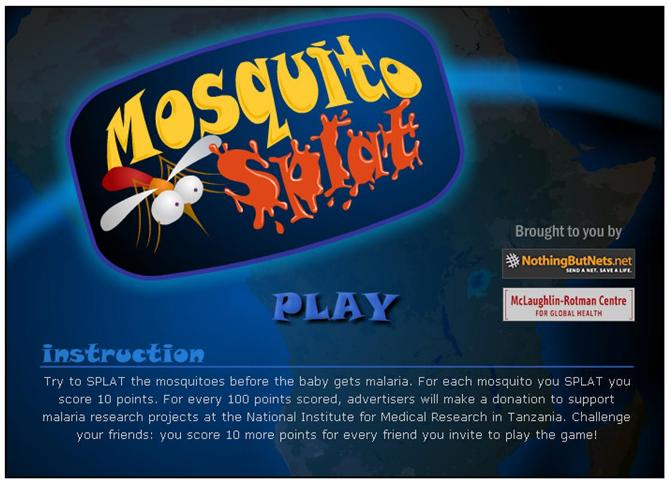
The ‘girls’ are malaria carrying mosquitoes, and I was playing a new Facebook game called Mosquito SPLAT that was released this week to mark World Malaria Day 2009.

Now online: a game we have played over millennia against 'em blood suckers...

The aim of the game is to use the fly squatter to SPLAT mosquitoes before the baby gets malaria. For each mosquito you SPLAT, you score 10 points. For every 100 points scored, advertisers will make a donation to support malaria research projects at the National Institute for Medical Research in Tanzania. We also score 10 points for everyone we invite to play the game – plus there’s a link taking us to an online donation page in case we want to support the research directly.

“It’s quick, easy and fun, and a great way to do your part for one of the most serious global health problems in the developing world,” say the game’s promoters.

Indeed. Nearly 500 million cases of malaria occur each year, resulting in over one to three million deaths (figures online vary enormously on this). Malaria is particularly devastating in Africa where it is a leading killer of children. Every 30 seconds a child in Africa dies from malaria.

The fact is, malaria deaths are entirely preventable with modest investment and spread of knowledge that mosquitoes spread malaria (not everyone knows this, and as I wrote in another blog post, that’s a challenge that educators and broadcasters are now working on).

McLaughlin-Rotman Center for Global Health: Taking anti-malaria campaign online
But more needs to be done to engage the Digital Natives in this global public health challenge. It’s not just the exposed people in malaria-prevalent parts of Africa, Asia and Latin America who are at risk. As development economist Jeffrey Sachs has been reminding us eloquently, malaria reduces productivity, increases poverty, weakens people’s bodies and makes them vulnerable to other diseases. In a globalised world, such massive suffering in some parts of the world would quickly manifest in different ways all over the planet.

Mosquito SPLAT is a partnership between the McLaughlin-Rotman Center for Global Health at the University Health Network and the University of Toronto and the UN Foundation’s Nothing But Nets campaign. The Mosquito SPLAT game is part of Malaria Engage, an initiative to enlist people directly in the anti-malaria battle by supporting malaria research projects in the developing world.

Click here to engage your Facebook friends to support malaria research.

Little biology lesson: Usually, people get malaria by being bitten by an infective female Anopheles mosquito. Only Anopheles mosquitoes can transmit malaria, and they must have been infected through a previous blood meal taken on an infected person. When a mosquito bites an infected person, a small amount of blood is taken, which contains microscopic malaria parasites. About one week later, when the mosquito takes its next blood meal, these parasites mix with the mosquito’s saliva and are injected into the person being bitten.

Buzz and Bite: PSA campaign against relentless malaria

We tried DDT for half a century. Now try PSA...

Today is World Malaria Day. It’s a day to reflect on an ancient disease that continues to kill and sicken so many people in the majority (developing) world.

Malaria accounts for one death every 30 seconds. Malaria kills more than 1 million people every year. Each year, between 350 million and 500 million people are infected with malaria.

Malaria plagued Europe and North America as recently as 60 years ago. Simple public health measures were crucial to eliminating the disease and helping those regions achieve growth, prosperity and stability. Many countries in Africa, Asia and Latin America have yet to achieve this level of control.

Public health officials have been trying to contain and control malaria for decades, most measures targeting the malaria vector mosquitoes. In recent years, educators have joined hands — for stopping malaria begins with awareness on how it spreads and what simple measures can be taken to prevent it.

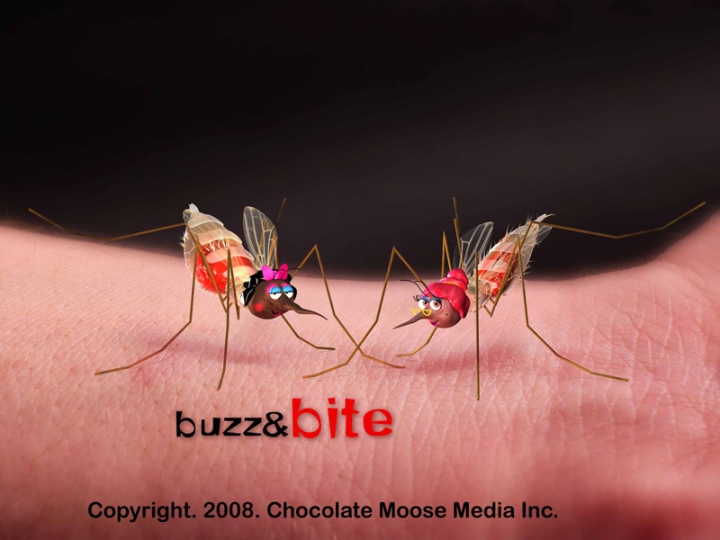
The Buzz and Bite Campaign is one such awareness tool launched a year ago on World Malaria Day 2008. It consists of a series of 30 animated shorts and 5 audio shorts called Public Service Announcements (PSAs).

The Buzz and Bite Campaign is the creation of Canadian animation producer and director Firdaus Kharas, working with a team of skilled professionals. Firdaus earlier took on another public health challenge, HIV/AIDS, through his highly popular animation series The Three Amigos.

Watch a sample Buzz and Bite Spot (in English, British Accent)

According to the Buzz and Bite website, PSAs have so far been produced in 22 languages, and are being adapted into more. “The goal is to enable a potential reach of 80% of the world’s malaria at-risk population or over 5 billion people in their own language.”

See all language versions on Buzz and Bite channel on YouTube

The PSAs are available to any television broadcaster, radio station, NGO, hospital, doctor, community group, university, school, educator or other user, free of charge, anywhere in the world.

The campaign is strongly supported by Nobel Laureate Archbishop Desmond M. Tutu.

Malaria has been eradicated in many parts of the world but continues to thrive and even grow in other parts, especially in tropical areas. “This anti-malaria campaign focuses on sub-Saharan Africa (where up to 90 per cent of all malaria fatalities occur), on South America, and on South and South-East Asia, where the rates of malaria are alarmingly high,” says the website, adding: “Malaria is preventable. The easiest and cheapest way to prevent malaria infection is through the use of long-lasting insecticide-treated bed-nets (LLINs) which can last up to 5 years. This campaign promotes the use of nets.”

You heard the buzz...Now get ready for bite!

Images and video courtesy Buzz and Bite campaign

Syeda Rizwana Hasan: Keeping a sharp eye when ships come to die…

Syeda Rizwana Hasan: Goldman Prize winner 2009
In Greek legend, Helen of Troy was the ‘face that launched a thousand ships’. Now meet Syeda Rizwana Hasan, a determined environmental activist who keeps dozens of ships from coming to die on the beaches of her native Bangladesh.

Rizwina is an environmental lawyer who is working hard to reduce the impact of Bangladesh’s exploitative and environmentally-devastating ship breaking industry. She has spearheaded a legal battle resulting in increased government regulation and heightened public awareness about the dangers of ship breaking. For this, she has just been honoured as the Asia winner of the prestigious Goldman Environmental Prize 2009.

Ship breaking is a lucrative yet highly hazardous business. Decommissioned ships from around the world are sent to Bangladesh, where they are dismantled by hand on the beaches by unskilled workers who are often paid less than one dollar per day. Lacking in sufficient mineral deposits for metal mining, Bangladesh relies on the iron and other materials from the ships for some of its metal. The scrap metal, along with other parts of the ships — including sinks, toilets, beds, appliances, and light bulbs — are resold in huge open markets lining the roads of Chittagong, the main ship breaking region.

Ship-breaking is done by around 20,000 workers – mostly young men, some as young as 14, who come from the northern parts of Bangladesh. They are paid very little, housed in the most basic of shelters, and provided with little or no medical care. It is estimated that, on average, one ship breaking worker dies at the yards in Bangladesh every week and every day one worker is injured.

Read the full profile on Rizwana Hasan on the Goldman Prize website

Watch short video film on Rizwana Hasan:

Rizwana Hasan, 40, is a lawyer and Executive Director of the Bangladesh Environmental Lawyers Association (BELA), a public interest law firm. Growing up in a politically-engaged family, Hasan committed herself to public service and, after receiving her master’s degree in law at age 24, joined BELA. She soon became one of the country’s leading voices for the environment. Today, she manages six offices with nearly 60 staff and is one of the leading young lawyers enrolled with the Supreme Court of Bangladesh.

The Goldman Environmental Prize, now in its 20th year, is awarded annually to grassroots environmental heroes from each of the world’s six inhabited continental regions and is the largest award of its kind with an individual cash prize of $150,000. This year’s prizes were awarded in San Francisco on 20 April 2009.

The 2009 Goldman Environmental Prize recipients are a group of fearless grassroots leaders taking on government and corporate interests and working to improve the environment for people in their communities. Other winners this year came from Gabon, Indonesia, Russia, Suriname and USA.

Watch all prize winners profiled on video

Photo and video courtesy of the Goldman Environmental Prize

Somali pirates: Part of the story mainstream media hasn’t told us!

Do they have a story to tell? Who is listening?
Piracy has a chequered history, and even the Wikipedia offers a carefully qualified definition. One person’s pirate can be another person’s defender. There’s an argument that the European colonial powers rode on the backs of their pirates or buccaneers. And I’m writing this in English language possibly because the English were more successful in their overseas piracy than other nations!

Piracy is all over the news again, due to increased activity off Somalia. But in the past few weeks, we’ve started hearing another side of the Somali piracy story — one that the mainstream media didn’t tell us.

Johann Hari, a columnist for the London Independent, posted an op ed in Huffington Post on 13 April 2009 that took a different look at Somali pirates. His main argument: “In 1991, the government of Somalia – in the Horn of Africa – collapsed. Its nine million people have been teetering on starvation ever since – and many of the ugliest forces in the Western world have seen this as a great opportunity to steal the country’s food supply and dump our nuclear waste in their seas.”

In recent days, two interesting short videos have been posted by two activist groups to support the same point of view. I haven’t investigated this story myself, but am intrigued by their take on a widely reported topic…especially because it’s an angle that we don’t read or see in the mainstream media!

The Media Is Lying to You About Pirates

The IFC Media Project’s “News Junkie” deconstructs the mainstream media’s half-baked coverage of Somali Pirates.


Are They Really “Pirates”?

This film from Awareness Unfolds highlights the fact that the media is lying about the so called “pirates” of Somolia. According to the blurb: “They (media) choose not to tell you about the toxic waste dumping going on by American, European, and Asian countries that have lead to the death of many Somolian citizens.”

As Johann Hari says at the end of his article: “The story of the 2009 war on piracy was best summarised by another pirate, who lived and died in the fourth century BC. He was captured and brought to Alexander the Great, who demanded to know “what he meant by keeping possession of the sea.” The pirate smiled, and responded: “What you mean by seizing the whole earth; but because I do it with a petty ship, I am called a robber, while you, who do it with a great fleet, are called emperor.” Once again, our great imperial fleets sail in today – but who is the robber?”

Johann Hari has reported from Iraq, Israel/Palestine, the Congo, the Central African Republic, Venezuela, Peru and the US, and his journalism has appeared in publications all over the world. In 2007 Amnesty International named him Newspaper Journalist of the Year. In 2008 he became the youngest person ever to win Britain’s leading award for political writing, the Orwell Prize.