Cory Aquino (1933 – 2009): Unleashed People Power, still haunting tyrants worldwide

The remains of former Philippine president Corazon Aquino passes through the historical EDSA road with some 300,000 supporters waving to pay their last respect. The road is remembered in 1986 as then anonymous Cory and some 2 million people rallied out the streets to fight a 20-year government dictatorship through peaceful people power revolution. Photo by Arwin Doloricon/ Voyage Film

I know this post appears rather late, but I couldn’t let Cory Aquino’s death on 1 August 2009 pass without comment. The original inspiration for People Power that toppled one of the worst tyrants of the 20th Century, she would now turn the Patron Saint of peaceful democratic struggles everywhere.

Last week, I was reduced to tears reading two links that my Filipino friend Ruth Villarama, who runs Voyage Films in Manila, sent me of new comments posted on their website.

In the first post, A housewife, a leader, an angel in yellow (3 August 2009), Joan Rae Ramirez wrote: “Her death at 3 AM on August 1 has stopped a nation from its apathetic works to once again remember what was once fought by this ordinary housewife. It is on these rarest moments where the oligarchs came down from their kingdoms to pay their respect and mingle with the people who truly represent the real state of the Philippine nation.”

Karen Lim, who works with Voyage Films as a producer and project coordinator, wrote a more personalised piece titled The Famous Anonymous.

It opened with these words: “I see her on TV. In some instances I even covered her for a story. Our relationship did not go deeper than the reporter-subject, or the audience and the watched. Yet I feel a certain affinity to the most revered President. And when she died I got sad, a strange feeling of sadness where the source is unknown.”

Karen was too young to have remembered much of those heady days of the People Power Revolution of February 1986 — a series of nonviolent and prayerful mass street demonstrations in the Philippines that eventually toppled the 20-year autocracy of Ferdinand Marcos. Indeed, a whole generation of Filipinos has been born since. But that doesn’t stop them from relating to the monumental events that unfolded at at Epifanio de los Santos Avenue, known more commonly by its acronym EDSA, in Quezon City, Metropolitan Manila and involved over 2 million ordinary Filipinos as well as several political, military and religious figures.

As Karen wrote in her tribute: “Cory’s life became ours too. We watched her, sometimes we joined her. We experienced her highs and lows. We are her “Mga minamahal kong kababayan”(my beloved fellowman). She did what no stranger did in my family – unite us in prayer for the country, unite us in laughter amidst the uncertainties of those times. I had no personal connection to this lady, but I have now every reason to mourn her passing.”

Woman of the Year 1986
I can only echo her Karen’s words. As a politically curious 19-year-old, I had followed with much interest the daring gamble and eventual triumph of People Power unfolding thousands of kilometres away from my Colombo home. In the pre-Internet era, and before satellite TV channels provided 24/7 coverage across Asia, my sources were daily newspapers, evening news bulletins on local TV and, once every few weeks, the second-hand copies of Time magazine passed on to me by an uncle. The housewife in yellow ended up becoming Time Woman of the Year for 1986, with Pico Iyer writing a suitably reflective piece.

In the years since the return of democracy – with all its imperfections and idiosyncrasies – I have stood at EDSA more than once, and wondered what it must have been like to mobilise millions of ordinary, concerned people in the days before email, Internet and mobile phones — communication tools that today’s political activists, and indeed everyone else, take for granted. There is a thin line between a non-violent struggle and a passionate yet violent mob that, ultimately, works against their own interests. I am amazed that Cory and her activists didn’t cross the line, despite provocations and 20 years of repression.

Of course, it wasn’t just the human numbers that turned the tide in EDSA. Cory Aquino’s charismatic leadership and moral authority persuaded other centres of power – including the Catholic church and sections of the military – to align with the struggle to restore democracy. It was this combination, and the sudden change of mind by the Americans who had backed Marcos all along, that enabled People Power to triumph.

Elsewhere in Asia, where these elements didn’t align as forcefully and resolutely in the years that followed, the outcome was not as dramatic or positive. We’ve seen that, for example, in places as diverse as Tiananmen Square in China (1989), Burma (2007) and most recently, in the streets of Tehran, Iran. In contrast, it did indeed work and ushered in regime change in places like Nepal, even though it entailed more protracted struggles.

What interests me, in particular, is the role played by information and communication technologies (ICTs) in such People Power movements. Alex Magno, a political analyst and professor of sociology in Manila, sees clear links between new communications technologies and political agitation. Interviewed on the Canadian documentary Seeing Is Believing: Handicams, Human Rights and the News (2002), he said: “In the last two decades or so, most of the political upheavals had some distinct link to communications technology. The (1979) Iranian Revolution was closely linked to the audio cassette. The first EDSA uprising in the Philippines was very closely linked to the photocopying machine and so we called it the ‘Xerox Revolution’. Tiananmen, the uprising that failed in China, was called the ‘Fax Revolution’, because the rest of the world was better informed than the rest of the neighbourhood because of the fax machine. The January (2002) uprising in the Philippines represents a convergence between electronic mail and text messaging. And that gave that uprising its specific characteristics.”

Mobile phones' role in People Power II acknowledged in a Manila mural
But it was People Power II in the Philippines that is perhaps the best known example of ICTs fuelling and sustaining a revolution. The ability to send short text messages on cell phones helped spawn that political revolution in early 2001, a full decade and a half after the original wave that swept Cory Aquino into office.

President Estrada was on trial facing charges of bribery, corruption and breach of the public trust. Despite mounting evidence against him, the President was let off the hook. That was the turning point. According to Ramon Isberto, a vice-president at Smart Telecom in the Philippines: “People saw it on television, and a lot of people were revolted. They started text messaging each other, sending each other messages over the Internet, and that thing created a combustion.”

Because of texting and email, within two hours over 200,000 people converged in the main street of Manila demanding the president’s resignation. The vigil lasted for four days and four nights, until President Estrada finally got the message and stepped down. It ended with Gloria Macapagal-Arroyo taking her oath of office in the presence of the crowd at EDSA, becoming the 14th president of the Philippines.

Those events have been documented, analysed and interpreted by many people from various angles. The Cold War had ended and the geopolitical map of the world had been redrawn. By this time, 24/7 satellite television was commonplace in Asia and the mobile phone was already within ordinary people’s reach. Gloria was no Cory, and Estrada wasn’t Marcos. But the forces and elements once again aligned on EDSA, and with history-making results. The role that the humble mobile phone played is acknowledged, among other places, in a mural in Manila.
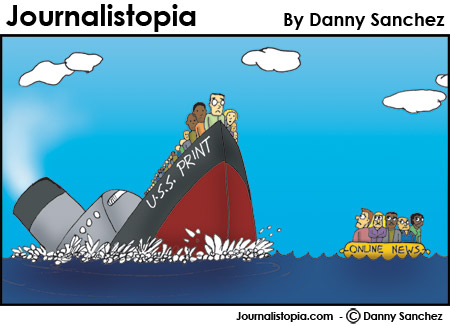

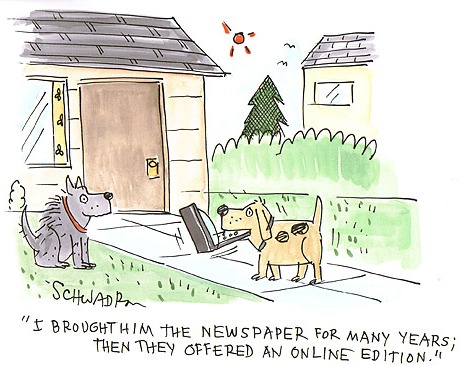
Saving MSM Titanic – or is it lifeboat time for its passengers?

Unthinkable? Not any more...
What is to be done? The innocuous question has probably been asked by so many individuals throughout history. Lenin famously asked it in 1901, and then spent the next few years cooking up a revolution that changed history (for better or worse, depends on where you come from).

What is to be done? I popped this same, unoriginal yet useful question during my recent presentation to an assembled group of media tycoons and senior journalists in Colombo, at the Sri Lanka launch of Asia Media Report 2009.

The context was not sparking revolution, but coping with evolution: how to survive and adapt at a time when mainstream media (MSM) is under siege from technological change, loss of public confidence and economic recession.

Why do I care? Unlike my new media activist friends, who cannot wait to see the MSM ‘mediasaurus’ die, I see value and utility in this ‘species’ that has evolved for over 500 years. Yes, there is much that is not right with them – including greed, arrogance and narcissism. But MSM’s outreach still remains unmatched in many parts of developing Asia, where we simply cannot wait until the online/mobile media to evolve, scale up and establish themselves to completely serve the public interest. I will thus engage the dinosaurs as long as they remain useful…

Besides, not all members of the mediasaurus clan are ferocious and carnivorous; there are also many gentle, ‘vegetarian’ ones among them who have always been empathetic and caring. I see merit in the adaptation of these better MSM, if only so that we don’t have to put all our eggs in the online/mobile media basket…

So I spent part of my talk asking aloud how the MSM – under siege – can adapt fast and increase their survival chances. The overall suggestion was that they move out of denial or resistance, and instead try to ‘exploit the inevitable’ (a pragmatic policy if ever there was one!).

Here are some initial thoughts I offered:
• Prepare for coming calamity, by taking advantage of the likely delay in its arrival in our region and our island.
• Consider it a ‘cleansing’ process, a new beginning to do things better.
• Decide what’s really worth saving, and let go of everything else that is no longer useful or relevant.

Let’s remember, too, that the very term ‘media’ is a plural. That means:
• One size doesn’t fit all; one solution won’t help/save everyone.
• Different ‘lifeboats’ can be found for different media outlets.
• You will only find out what works by trying out a few alternatives.
• No solution is fail-proof or ‘unsinkable’.

In some ways, mainstream media has behaved with the same kind of arrogance of those who built and operated RMS Titanic, and in this instance, the iceberg has already been spotted. At this stage, should MSM be re-arranging furniture on the ship’s deck — or discussing rescue plans?

Big Ben at 150: Who'd build one like this today?
When the maritime tragedy happened nearly a century ago, on 14 April 1912, it dominated headlines around the world for many days. But MSM was in such nascent stages at the time, newspapers being the sole dominant mass medium. Radio communication had just been discovered, but radio broadcasting still lay a few years in the future.

To adapt and survive, MSM can also learn from how other industries faced vast challenges. For example, take the time-keeper industry:
• A century ago: people had to go to a post office, railway station or another public place to find the time. Clock Towers and public clocks announced time for all.
• Then came personal clocks (elaborate time pieces) that the wealthy people carried around in pockets or handbags.
• This was followed by wrist watches – personalised, affordable and portable.
• Now, mobile phones tell us the date, time and lot else!

Clock tower makers went out of business, and no one misses them now. Watch makers have adapted with the times, and are still competing with mobile makers. The parallels with the media industry are clear enough.

Back to the ‘unsinkable’ Titanic, I find others have played on this metaphor. Michelle Tripp wrote a particularly insightful commentary in April 2009 – she has no patience for MSM and can’t wait for the troubled ship to sink.

Somebody writing as ‘Global1’ has commented about how the Titanic‘s Band played on to the very end (and went down playing). S/he asks: Could This Be Analogy To The Modern Day MSM? In this analogy, MSM is the band, and their ‘music’ is the news…

Incidentally, the centenary of the Titanic‘s sinking is coming up shortly, in 2012. It would be interesting to see how the MSM/Titanic analogy plays out in the next few years…

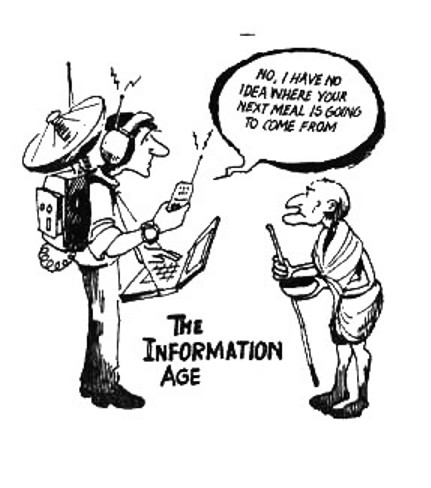
Hurtling towards Information Society at the speed of light – with nobody in charge?

Who can crack this web 2.0 challenge? Image courtesy i4d magazine
As the 19th Century was drawing to a close, the newspaper publisher William Randolph Hearst (later immortalised in Citizen Kane) cabled a leading astronomer of the day: ‘Is there life on Mars? Please cable one thousand words’.

The scientist replied: ”Nobody knows” – written 500 times.

This would be my answer today, if a modern-day media tycoon were to ask me a different, yet equally compelling question: where are we headed with the bewildering developments in information and communication technologies, in which the mainstream media are a part?

And that would be the easiest 1,000 words I’d have written. But being me, I laboured a lot more in addressing that question in my talk to an assembled group of media tycoons and senior journalists in Colombo earlier this week, at the Sri Lanka launch of Asia Media Report 2009.

If I was too reflective on media futures, I can probably blame it on the venue: the Galle Face Hotel, Colombo’s oldest and grandest, where only a dozen years ago Sir Arthur C Clarke wrote the final chapters of his novel, 3001: The Final Odyssey. A bust of Sir Arthur still stands in the hotel’s lobby.

So, with the Indian Ocean lashing gently on the rocky beach only a few feet away, and under the slightly bemused gaze of Sir Arthur, I took my audience on a quick and rough tour of the near future — the one no one about which nobody is an expert!

Here are some excerpts:

Two waves that started separately have combined to radically change how people generate, access, store and share information: the rolling out of broadband internet, and the phenomenal spread of mobile phones.

The headline figures are impressive. For the first time in history, we now have the technological means to quickly reach out to most of humanity:
More than 4.1 billion mobile phones were in use by end 2008, a majority of them in the developing world.
Nearly a quarter of the world population (over 1.5 billion people) has access to the web, at varying levels of bandwidth.
• Thousands of radio and TV channels saturate the airwaves – these still are the primary source of news and information for billions.

Many of us don’t realise that even the basic mobile phone in use today packs more processing power than did the entire Apollo 11 spaceship that took astronauts to the Moon 40 years ago.

Where this growth in processing power and proliferation of devices might lead us, we can only guess — no one really knows. This can be both exhilarating for some — and very disconcerting for entities that were previously in control of the free flow of information, such as governments, academics – and dare I say it – the mainstream media!

Is that your final answer? Surely not...?
They may not accept this, individual governments, and their collective known as the United Nations, don’t have full control over what is going on. But the ‘information genie’ is now firmly out of the bottle, and evolving by the day that it’s impossible to put it back inside. This is both fascinating and frightening.

If it offers any comfort, even big corporations like Microsoft, Apple or Google are all learning by doing. Everything seems to be permanently in experimental — or beta — mode…

What would emerge from the current chaos? The best brains on the planet are trying to come up with plausible answers.

There is talk about the ‘post-media age’. In the broadcast circles that I move in, they now acknowledge, quietly, that the post-broadcasting age is already dawning.

Is what we hear the death cry of the Old Order…or birth pangs of a new Information Society? Or perhaps both?

And how inclusive is that information society? As Asia Media Report 2009 reminds us, not everyone is invited to the party. Large sections of Asian society are left out.

But don’t expect such people to remain excluded for too long. Armed with mobile phones and other ICT tools, they are going to crash the party, whether we like it or not.

Encounters with Mediasaurus: Telling media tycoons what is missing in their media!

I have just been very lucky. I addressed a select gathering of media owners, publishers, editors and senior journalists — almost all of them working in the mainstream print or broadcast media in Sri Lanka — and virtually called them dinosaurs, and compared their industry to the supposedly unsinkable Titanic.

The nice people they all were, they actually let me get away with it! The occasion was the Sri Lanka launch of Asia Media Report 2009, held at the now-renovated Galle Face Hotel in Colombo.

Shining a light at a spot rarely probed...
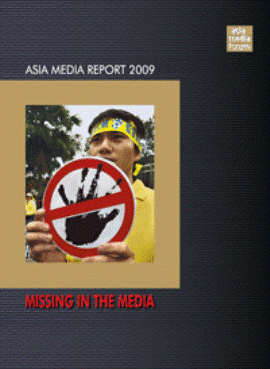
Coordinated, produced and published by the Asia Media Forum with the assistance of Actionaid, the report is a quick survey of the state of media in 20 Asian countries, written mostly by working journalists and broadcasters. It focuses on how the media throughout Asia reports on marginalised people and communities in their respective societies, from the very poorest countries to the richest.

‘Missing in the Media’ is the theme of Asia Media Report 2009, and I used this as the point of departure for my talk, illustrated with many cartoons some of which have appeared on this blog. I fully agreed with the editor and contributors of the report – six of whom I know – that there are many elements missing or lacking in Asia’s mainstream media today. But instead of adding to that list, I asked a more fundamental question: at a time when the mass media as we know it is under threat of mass extinction, how do we save and nurture at least a few good things that we hold dear?

In that process, I had to do some plain speaking and tell my audience that they cannot continue business as usual and expect to remain relevant, or even solvent for too long. I referred to the famous mediasaurus essay by Michael Crichton, and traced what happened since its appearance in 1993. I also compared the media’s arrogance to that of the Titanic‘s builders, who believed the ship was unsinkable.

I will be sharing highlights of my talk in the coming days through one or more blogposts. For now, I’m still grateful that my remarks were received with good grace and cordiality. (For more, read post on ICT revolution, and post on greater collaboration between mainstream media and citizen journalism.)

I don’t do this kind of big picture talk too often, and mind my own business most of the time (which is a hands full these days). In fact, the last two occasions I spoke my mind to assorted worthies of the Sri Lankan media, the reaction was much harsher.

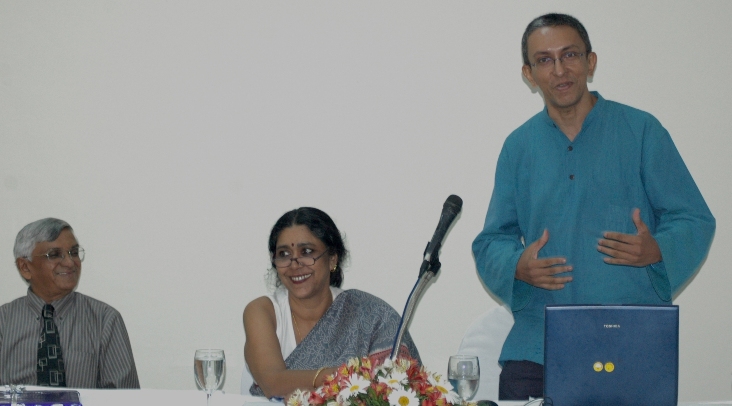
The Coming Ka-Boom? L to R: Vijitha Yapa and Sharmini Boyle seem to be amused as Nalaka Gunawardene speaks
First was when I talked about the press freedom in the digital age to large gathering of Sri Lankan journalists and editors was the World Press Freedom Day Colombo observance in 2001. When I referred to the potential of new communications technologies – especially the (then still emergent) Internet and mobile phones – for safeguarding media freedoms, I was practically shouted down by a section of the audience. They felt I was talking about ‘western trends’ and ‘concerns too far removed from their bread-and-butter issues and survival issues’. Yet, the past few years have amply proved that if anything, I was too conservative in what I anticipated as technology’s role in promoting media freedom.

The second occasion was in mid 2004, when I was asked to speak at a Colombo meeting to mark the launch of a scholarly volume (in Sinhala) looking back at the first 25 years of television broadcasting in Sri Lanka. I was one of two dozen contributors, from diverse backgrounds of culture, science and journalism, who were brought together by the Catholic Media Centre of Sri Lanka which has a (secular) media monitoring programme. Having expressed my reflective views in the book chapter, in my speech I discussed my aspirations for the next 25 years — hoping there would be greater innovation and experimentation in an industry that seemed to be running short of both. This irked a certain local pioneer of television, who spoke after me and spent half of his given time attacking me personally and ideologically. Talk about pioneer’s syndrome. That definitely was a mediasaurus breathing fire, and I don’t want to meet one of these beasts on a dark night…

On both occasions, the event organisers apologised to me for the hostile reactions, but I was cool. By now, I’m used to reactions of all kinds in the public sphere. Given this history, yesterday’s encounter was far more reassuring that there still are good people even in an industry that is under siege in more ways than one.

I’m so fortunate to be welcomed by both media practitioners and media researchers across Asia. I’m no longer a card-carrying member of either group (if I ever was!), but I have great fun hobnobbing with both, occasionally telling them some home truths. This is what Irish journalist-cum-academic Conor Cruise O’Brien once called ‘having a foot in both graves’!

Tabloid science maybe imperfect, but it’s still better than no science coverge!

WCSJ London

Raised on popular culture, I have always been an admirer of tabloid journalism – which means using popular formats to reach out to a mass audience in newspapers or broadcasting. There’s nothing inherently wrong with this: we might even argue that the tabloid approach is the only way to achieve truly mass media (with all else being niche media reaching to smaller demographic groups).

So I was delighted to be on a panel with two leading British tabloid journalists and a popular radio host from South Africa during the 6th World Conference of Science Journalists held in London from June 30 – July 2, 2009.

We had to address this question: Does science coverage in the media need to be highbrow?

My own, personal answer is NO — it need not be! And I’ve spent a good part of my two decades of work in the media experimenting and showing that communicating science can be fun — both for us communicators and our audiences.

But I pointed out that science is still being covered in sections of Asian media in the more traditional, classical way, just like science itself is still an elitist pursuit in many of our societies.

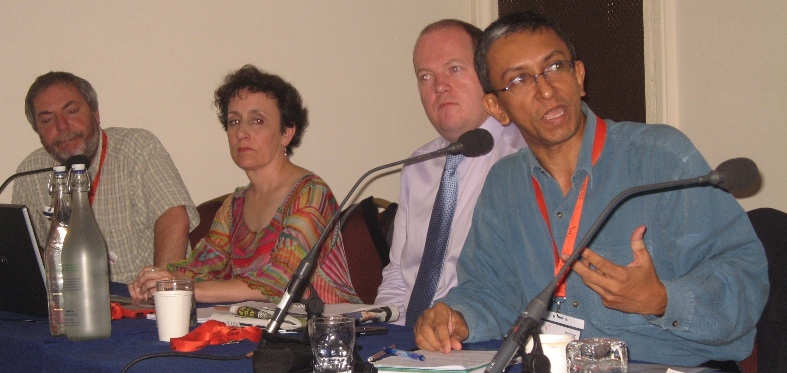
L to R: Paul Sutherland, space correspondent of The Sun, UK; Christina Scott, radio and web journalist, South Africa; David Derbyshire, Environment editor, The Daily Mail, UK; Nalaka Gunawardene, Director/CEO, TVE Asia Pacific

I said: “We might call this coverage ‘broadsheet approach’ in print; or ‘bluechip documentary’ format on television. And they are both unsustainable! They are also endangered in these hard times for the mainstream media in most economies.

“So going the tabloid path is a practical and pragmatic way to deliver science stories and science information to a mass audience or readership. We’re doing it in different ways in the Asian media!”

In my remarks, I gave some examples where science is jazzed up (rather than dumbed down) for popular consumption on Asian television. For example, how solar and lunar eclipses provide fodder for endless stories on our numerous news channels. Such coverage, fleeting and superficial as it might often be, takes the wonders of science and Nature to more people than anyone else can.

I argued that the path to the mass audiences in Asia is through news, sports and entertainment programming. We have our own niche, factual channels – Discovery, National Geographic, Animal Planet and their local equivalents. They have a loyal but small audience. They do excellent work. But where numbers are concerned, they cannot – yet! – compete with the outreach and appeal of broadcast radio, TV and newspapers. Neither can the online and mobile media, even though their outreach is growing fast.

Things don’t always go right, however. Doing wall-to-wall coverage of news demands producers and reporters to tackle a variety of topics and subjects — including specialised science stories. Some handle this better than others. In their race for ratings and revenue, a few ‘dress up’ the stories a bit too much.

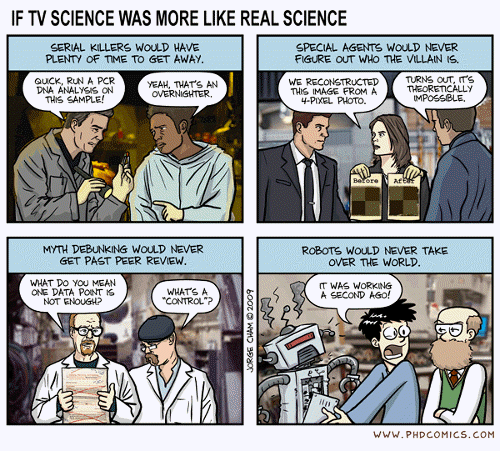
Television science: aspiration or reality?
A good example was how some Indian news channels handled the so-called ‘Big Bang experiment’ in September 2008, when the Large Hadron Collider (LHC) was commissioned. The mega-science experiment was interesting in its own right, but it wasn’t apparently exciting enough for at least two channels — Aaj Tak and India TV. Their coverage running up to the event speculated about its “catastrophic effect on the world” – effectively end of the world.

Their coverage caused panic, which led to at least one attributable death. This prompted the Indian Ministry of Information and Broadcasting to caution the channels for spreading “misinformation, fear and horror” among viewers. It advised the channels to exercise restraint in presenting such issues.

I call this the ’24/7 TV Deficit’ in Asian broadcasting. The long term response to this is to invest in training and capacity building of journalists and producers already working in the media. For the most part, they learn on the job, making mistakes on the air. This is far from ideal.

Here’s how I summed up: ‘Tabloid science coverage’ – in print or broadcast – may be imperfect in some ways. But our choice is either that, or nothing. Our challenge is to make the process and product better as we go along.

We urgently need to unleash scientific knowledge and understanding in matters of public interest and public policy. We can’t afford the ALL or NOTHING approach.

Media extinction postponed in Asia…or last hurrah of ‘mediasaurus’?

WCSJ London

Journalists always love a crisis for its news value. But they’d prefer such crises to be happening to someone else, and not to themselves. Right now, however, mainstream media (MSM) are hit by their own crisis – one that threatens their very survival. Their old business models are crumbling in the face of online media, and their advertisers are moving away as fast as their audiences do.

This crisis dominated many discussions at the 6th World Conference of Science Journalists held in London from June 30 – July 2, 2009. No less than the editor of the Scientific American cautioned that a mass extinction event was imminent – one that can wipe out many MSM players large and small.

The crisis is real, no doubt — but it’s not evenly spread across the media or around the world. Despite being a world conference, what we heard most frequently and emphatically was the version of the western, mainly English language media. So when I had a chance to talk — during a session on Does science need to be highbrow? — I spent a couple of minutes giving the other side of the news.

Here’s part of what I said:

All news is not doom and gloom...
We’ve heard a lot of doom and gloom at this conference about the state of mainstream media. We empathise with our journalist colleagues affected by both economic downturn and audience migration to online media. The situation is somewhat different in many parts of Asia, where there is still vibrancy in newspapers, radio and television industries. I realise this is a sweeping generalisation, but the media industry’s statistics suggest this.

According to the World Association of Newspapers (WAN):
• 8 of the world’s 10 largest circulating, paid-for daily newspapers are in Asia.
• The largest national newspaper markets are in China, India and Japan — the United States is a distant fourth.
• While readers are abandoning newspapers in North America and Europe, paid-subscriptions in Asia’s grew by nearly 5% in 2008.
• In India alone, 11.5 million new newspaper readers were added in 2008.

Some say Asia is enjoying what may be the world’s last great newspaper boom. This is fuelled by a confluence of factors – among them:
• growing literacy rates and rising educational levels;
• rising middle classes many of who consider buying a daily newspaper at home as a sign of prosperity; and
• media reforms in some countries which have liberalised the sector, allowing local and foreign companies to enter the media market.

Similar trends are seen in radio and television broadcasting, where there has been an explosion of channel numbers in the past two decades. All this presents challenges AND opportunities for covering science.

What does all this mean? Is the Asian media boom the exception that does not prove the rule? Or is the mass extinction of mainstream media going to hit Asia just a bit later? In that case, are we now seeing the last hurrah of the mediasaurus — to use a term that was first coined by the American writer Michael Crichton, best known for his novel Jurassic Park? He anticipated the current crisis in the media back in 1993, in an essay he wrote in Wired magazine, titled “Mediasaurus“.

Adapting to survive?
Naturally, the industry does not like to acknowledge it is doomed. Predicting the death of newspapers “seems to have reached the level of a new sport,” says Gavin O’Reilly, President of the World Association of Newspapers. He told the ‘Power of Print’ Conference in Barcelona, Spain, in May 2009: “That this doom and gloom about our industry has largely gone unanswered is, to me, the most bizarre case of willful self-mutilation ever in the annals of industry. And it continues apace, with commentators failing to look beyond their simple rhetoric and merely joining the chorus that the future is online, online, online, almost to the exclusion of everything else. This is a mistake. This oversimplifies a rather complex issue.”

It’s complex alright, and what happens to the larger media industry would determine how and where science can be covered in the media. In our session, I went on to discuss the prospects for covering science and technology in the currently numerous – and very cacophonous! – media in South and Southeast Asia. A separate blog post covers that part of my remarks.

Post-war Sri Lanka: Can we dial up a better future?

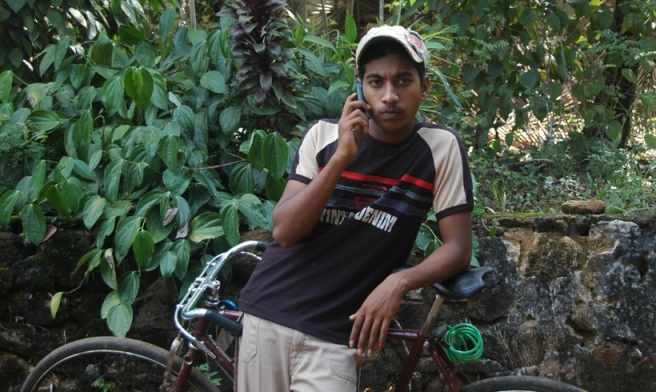
Chamara Pahalawattage: At 18, he is already using his 6th mobile (Photo by Niroshan Fernando, TVEAP)

When many able-bodied young men and women of his age were joining the armed forces in large numbers, Sri Lankan school-leaver Chamara Pahalawattage chose differently. He decided to try his luck with odd jobs at construction sites.

That, by itself, was nothing unusual. Tens of thousands of young men and women like Chamara join the labour market every year. Schools don’t equip them with attitudes or skills for self employment, so most would idle years away looking for regular jobs in Sri Lanka’s public and private sectors. Frustration would prompt some to take to political agitation, or worse.

Chamara is at such crossroads in his own life, but he is unlikely to go astray. The enterprising young man has boosted his chances of part-time work by getting himself a mobile phone.

“After buying a phone, I get calls asking me to come for work. The phone makes it so easy,” he says. “Otherwise people will have to come looking for me…or I have to go to them.”

If a skilled mason or carpenter takes him on as an assistant, Chamara gets a daily wage of LKR 700 (US$ 6 approx) plus a mid-day meal. That income augments the modest LKR 4,000 a month (US$35) his mother makes cooking meals at a nearby factory.

In February 2009, we filmed a day in the life of Chamara, a resident of Gonapola, in Sri Lanka’s western province. This was part of a profiling of telephone users at the bottom of the (income) pyramid – or BOP – in emerging Asian economies, undertaken by TVE Asia Pacific on behalf of the regional ICT research organisation LIRNEasia.

Watch our short video profile of Chamara Pahalawattage:

Going by his household income, Chamara is BOP at the moment – but his aspirations extend above and beyond. An only child raised by his widowed mother, Chamara developed an interest in mobiles while still in his mid teens. He bought his first mobile two years ago, when in Grade 11 at school.

“Almost everyone had phones, so I also wanted one,” he recalls. “From then on, I got used to having a phone!”

And has he been keeping up with technology! He buys second-hand phones for better features: he currently owns his sixth phone in just over two years. He had paid LKR 7,500 (US$ 65) for his latest phone at the beginning of 2009.

Besides voice and SMS (texting), his phone supports MP3, video recording, song downloading, voice recording and some other functions. After a hard day’s work, he unwinds listening to the radio, or swapping songs with friends — all using their mobiles.

Chamra spends an average of US$3 to 4.50 per month on phone use, and – like all other BOP telephone users we interviewed in India, Philippines and Thailand – he is thrifty with value added services that cost extra. This is something that has been confirmed by LIRNEasia’s Teleuse@BOP 2008 survey.

“Some of my friends access the internet through their phones and download songs,” he says. “I then get these songs from them. My phone has bluetooth. I use it to transfer songs from my friends’ phones.”

Chamara has every intention of moving up the labour market – someday, he wants to hold a more regular job, with an assured monthly income. Right now, in spite of being connected, he can’t predict how many days a month he’d find work.

Hello, can you hear our dreams?
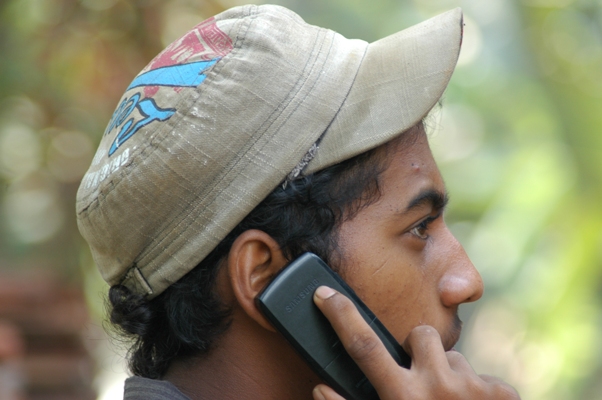
Hello, can you hear our dreams? Photo by Niroshan Fernando, TVEAP
“I don’t check newspapers for jobs. Instead I ask the people I know…mostly my friends,” he says. This probably indicates another shift from a wide-spread habit among literate Sri Lankans scanning newspapers for recruitment notices.

LBO 9 March 2009: Sri Lankan low income customers can use mobiles more for business: study

The official end of the 30-year-long war should be good news for Chamara and millions of other tech-savvy, eager youth like him. Like me, they can once again start dreaming of better tomorrows.

Telecommunications would be a good place to start. For several years, it has been the fastest growing sector in the Sri Lankan economy — one that has not only connected people across distances and cultures, but also been a ‘social leveller’.

The telephone subscriber base grew by 35.5% in 2008 (and 47% in 2007). The country’s tele-density (number of telephones per 100 persons) jumped to 71.9 in 2008, from 53.4 in 2007 -– thanks largely to the phenomenal spread of mobile phones.

As I noted last year: “It is not by accident that telecom has remained the fastest growing sector in the economy for a decade. This was triggered and sustained by the far-reaching policy and regulatory reforms which ended the then fully state-owned telecom operator’s monopoly, and allowed the entry of new players, technologies and business models.”

Of course, improved telecommunications are necessary, but not sufficient by itself, for us to evolve into an inclusive information society. Building on technology and systems, we must become discerning creators and users of information. Knowledge – not paranoia or rhetoric – needs to form the basis of policy and actions that propel us to the future.

Photos courtesy Niroshan Fernando, TVE Asia Pacific

‘Can you hear us now?’ India’s bottom millions connect to information society

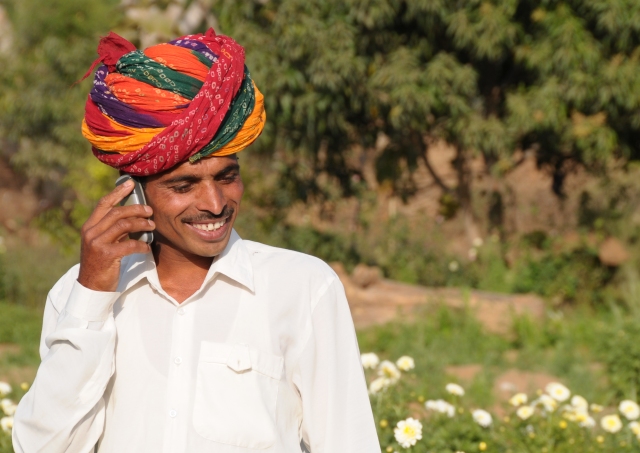
Mobile champion: farmer Sayar Singh in Rajasthan, India - photo by Suchit Nanda for TVEAP
At the end of the world’s largest general election that lasted nearly a month, Indians have just re-elected the Congress Party to govern over the world’s largest democracy for another five year term.

It’s too early to discuss what role, if any, the recently enhanced telecommunications services played in this outcome. But there is no doubt that access to telephones – especially mobiles – has revolutionised the life of the billion plus Indians in the past few years.

Farmer Sayar Singh epitomises this change. Earlier this year, we filmed a day in the life of Sayar, a resident of Pushkar Nala in India’s Rajasthan state. This was part of a profiling of telephone users at the bottom of the (income) pyramid – or BOP – in emerging Asian economies, undertaken by TVE Asia Pacific on behalf of LIRNEasia.

Sayar is definitely BOP: growing wheat and flowers on his ancestral land, he makes around INR 6,000 (USD 115) a month – on which income he sustains an extended family that comprises his wife, four children, elderly father and an unmarried sister. Life isn’t easy for this 33-year-old, but his spirit of enterprise is as abundant as his praise for his newly acquired mobile phone.

He only bought a mobile in mid 2008, but eight months later, that investment had definitely improved business and social life for him. So much so that his life’s narrative is clearly divided as Before Mobile and After Mobile.

“Our life before the mobile phone was hard,” he says. “I took two days to do what I can now do in a day. Now I can get in touch immediately and all my work happens faster and more easily!”

He now tracks market prices and moves his produce quickly for better profits. With workload reduced and income doubled, Sayar has reaped dual benefits from his mobile.

Watch our short profile of Sayar Singh, ardent promoter of mobile phones in rural India:

This isn’t Sayar’s first experience with owning a telephone. Earlier, he was frustrated with a fixed phone that didn’t work half the time. The service was so bad that he gave up the phone after a while.

He recalls: “Phone wires in our village were often faulty. They used to be out of order for 2 or 4 days, sometimes even half a month! All my work was affected. I couldn’t talk to my brothers and sisters. Call charges were also high. When my phone line was down, I had to call from STD booths or neighbours’ phones.”

In our interview, Sayar kept referring to his fixed phone connection as ‘government phone’ – a reflection of the state-owned former monopoly. It was a reminder of just how bad telecom services were in India until only a few years ago.

As Shashi Tharoor, the former UN Undersecretary General – who, incidentally, has just been elected into Indian Parliament from his native Kerala state – has remarked, India had possibly the worst telephone penetration rates in the world.

He wrote in 2007: “Bureaucratic statism committed a long list of sins against the Indian people, but communications was high up on the list; the woeful state of India’s telephones right up to the 1990s, with only eight million connections and a further 20 million on waiting lists, would have been a joke if it wasn’t also a tragedy — and a man-made one at that.”

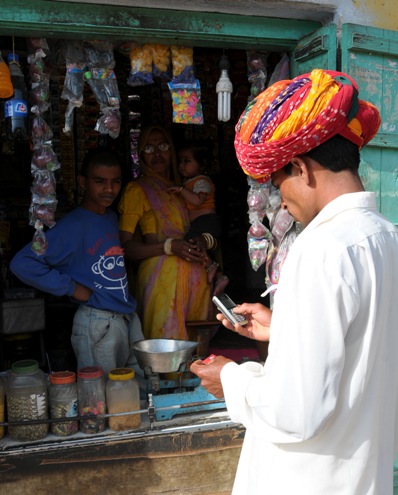
Connected and contented: Sayar Singh by Suchit Nanda for TVEAP
Tharoor recalled the infamous words of Prime Minister Indira Gandhi’s communications minister in the 1970s, C.M. Stephen. In response to questions decrying the rampant telephone breakdowns in the country, the minister declared in Parliament that telephones were a luxury, not a right. He added that ‘any Indian who was not satisfied with his telephone service could return his phone’ — since there was an eight-year waiting list of people seeking this supposedly inadequate product.

According to Tharoor, Mr Stephen’s statement captured perfectly everything that was wrong about the government’s attitude: ignorant, wrong-headed, unconstructive, self-righteous, complacent, unresponsive and insulting. “It was altogether typical of an approach to governance in the economic arena which assumed that the government knew what was good for the country, felt no obligation to prove it by actual performance and didn’t, in any case, care what anyone else thought.”

All this didn’t change overnight, and as Tharoor reflects, the key contribution of the government was ‘in getting out of the way’ — in cutting license fees and streamlining tariffs, easing the overly complex regulations and restrictions that discouraged investors from coming in to the Indian market, and allowing foreign firms to own up to 74 per cent of their Indian subsidiary companies. “The Telecom Regulatory Authority of India (TRAI) has also been a model of its kind, a regulatory agency that saw its role as facilitating the growth of the business it was regulating, rather than stifling it with rules and restrictions.”

It still took time for this revolution to be felt at the bottom of the pyramid. As LIRNEasia says: “Just five years ago, the Indian telecom industry’s massive momentum barely included the poor. The country had slightly over seven access paths (fixed and mobile connections) per 100 people, but in rural India 100 people were served by only 1.5 access paths. Even in urban India, the poor were unconnected.”

Then things started changing rapidly. According to LIRNEasia’s latest teleuse@BOP survey, 45 per cent of Indian BOP teleuser households had a phone in late 2008: 37% had a mobile only; 5% had a fixed phone only; and 3% had both. This is massive progress from the 19 percent of BOP homes with a phone just two years ago. Read more about BOP telephone penetration and use in India.

Tharoor has called this the “mobile miracle” — one that has accomplished something socialist policies talked about but did little to achieve: empowering the less fortunate. Rapid mobile penetration in my native Sri Lanka has had a comparable social transformation – in a commentary last year, I called the ubiquitous mobile ‘Everyman’s new trousers’.

Of course, the mobile revolution is far from over. There are many more millions yet to be connected, and those already connected expect affordable, reliable and value-added services.

“Indian BOP is still in the mobile 1.0 mode using mainly voice and missed calls functionality. Messaging is being used by only a third of the BOP population. Mobile payment and government services use is almost non-existent,” Rohan Samarajiva, chairman and CEO, LIRNEasia, was quoted as saying soon after the latest study was presented in India in February 2009.

How far and how much value added mobile services can penetrate the BOP remains to be seen. Sayar Singh, for example, currently spends US$ 8.6 to 9.5 a month on phone services – over 8% of his enhanced monthly income.

“I haven’t subscribed to any services like cricket news or astrological forecasts. I don’t need them…and I don’t want to spend on them,” he said in our interview.

But mobile telephony is an area where the boldest projections have been exceeded – so never say never.

Photos by Suchit Nanda for TVE Asia Pacific

Cellphones and the Economic Modernization of India: Listen to Shashi Tharoor at Asia Society, NY, in 2007:

Hitchhiker’s (Rough) Guide to the Media: Who wants a free ride?

If you got a message, hitch a ride...

How can research institutes and advocacy groups use the mainstream media effectively to communicate their findings and analyses?

What is the secret of some researchers receiving more media attention and coverage than others? Why are some ‘media darlings’?

Are there ways to secure quality coverage for public interest content without having to pay high rates for media space or air time?

TVE Asia Pacific (TVEAP) addresses these important questions in a new framework to engage the mass media for communicating for influence and social change. We call it a Hitchhiker’s (Rough) Guide to the Media.

The framework, building on a dozen years of TVEAP experience in working with television broadcasters and other media outlets across the Asia Pacific region, guides individuals and institutions to get the best out of the media. One key to success is building sustained relationships with media professionals and their gatekeepers (the bosses at media organisations who decide what content to publish or broadcast).

We introduced the framework to a group of ICT researchers drawn from across Asia who came together for a two-day workshop in Hyderabad, India, on 1 – 2 December 2008. The workshop aimed to build their capacity to use different communication frameworks and tools to engage policy makers, various other stake-holders and the wider public.

Workshop participants were all drawn from various action research projects on ICT or ICT for development supported by the Pan Asia Networking programme of the International Development Research Institute (IDRC) of Canada.

Our friends at IDRC have recently edited highlights of our presentation into a short video, which mixes excerpts from an interview they filmed with me. It can be watched here:

More about the workshop is found on a dedicated blog.

Read more about our framework on TVEAP website.

“Development” is seen as a hard sell in the increasingly commercialised media in the Asia Pacific. Researchers, activists and educators engaged in development work often complain that they are blocked out of the print and broadcast media. Yet they fail to understand a basic truth about the media: there is no quota of print space or air time set aside for development. Information and opinions on development topics must compete with other areas of human endeavour for the limited space and time available.

It is unrealistic to expect any legally or otherwise guaranteed space or time for development content. Even if there were, that can only apply on the media owners and media professionals. There can be no guarantee that media audiences will accept such content.

I get rather weary when well-meaning development players complain about the airwaves being full of entertainment, as if that airtime is something they have been deprived of. There is nothing intrinsically wrong with entertainment. The world will be a very dull place if the broadcasters listened to development people and packed every minute of air time with ‘information and education’.

Hitch a hike, but don't expect to get in the driver's seat...

This is the big challenge to the development community — how to get that delicate balance right, and learn to co-exist with other forms of media products catering to the wide and varied human interests. Hitch-hiking with the media avoids confrontation, looks for the common ground and tries to nurture collaboration for mutual benefit.

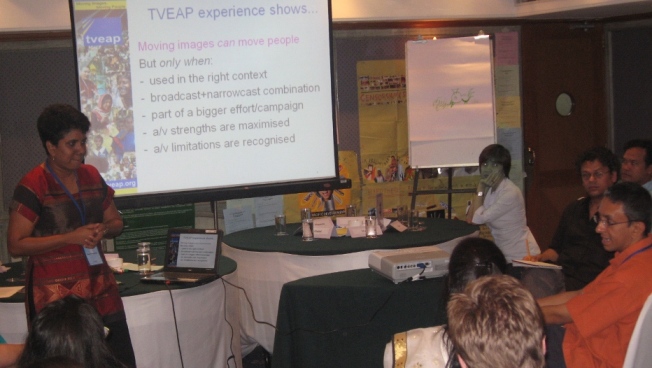
As my colleague Manori Wijesekera (presenting in the photo above) told the Hyderabad workshop: “Researchers and activists are a good source of information and opinions for the media, who need a constant supply of these. This can be a win-win situation for both parties, but we have to remember that we are hitching a ride with the media. So we can’t get into the driving seat or demand too much at once!”

So here’s our commercial: TVEAP conducts short, customised training sessions and workshops for researchers and civil society groups to enhance their media skills. These offer guidance on how to build and sustain ‘bridges’ with the media, and receive quality coverage that go well beyond publicity and public relations. If interested, get in touch with us!

Photos courtesy TVEAP Image Archive

Now on MediaChannel.org: Good communications to combat swine flu?

They turn the spotlight inwards...

MediaChannel.org has just published my latest op ed essay titled: Good communications to combat swine flu?

7 May 2009: New Age newspaper in Bangladesh has reprinted the essay

24 May 2009: The Hindu newspaper in India has reprinted the essay in its Sunday Magazine

In this essay, I have expanded some points originally made in two recent blog posts, on 30 April and 1 May 2009.

Here’s an excerpt:

“Flu shots, quarantine measures and hospital care alone cannot counter the current flu outbreak. While medical doctors and researchers spearhead the public health response, we need the mass media and other communicators to mount the public awareness response. Ideally, they should reinforce each other.

“For the first time in history, we now have the technological means to quickly reach out to most of humanity. More than four billion mobile phones are in use, a majority of them in the developing world. Nearly a quarter of the world population (over 1.5 billion people) have access to the web, even if at varying levels of bandwidth. Thousands of radio and TV channels saturate the airwaves – these still are the primary source of news and information for billions.

“Can these information and communication technologies (ICTs) help disseminate the right kind of flu awareness? How fast can we mobilise 24/7 media outlets and telecom networks to inspire preventive and curative action? What can the blogging, texting and twittering new media activists do in such efforts?”

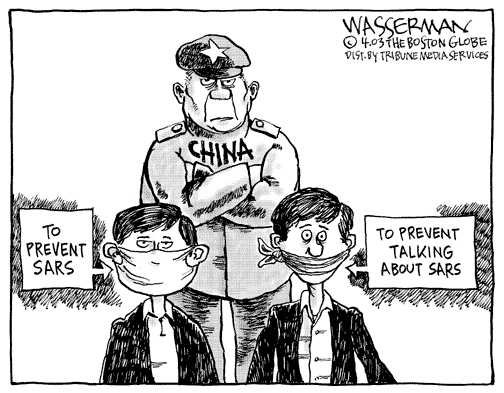
Stop the virus, but not the news!
Looking for models of communicating against an infectious epidemic, I recall the Asian experience with Severe Acute Respiratory Syndrome (SARS) . I summarise in this essay the public interest roles played by Asian media during the SARS crisis, which has been studied and analysed in considerable detail.

I then return to one of my favourite points about communicating disasters and crises: the need for credible messages and credible messengers. This was a core theme in the Asian book on Communicating Disasters that I co-edited in 2007. I also highlighted it in this interview given to APC in early 2008.

Here’s how my essay ends: “Whether it is SARS, HIV or tsunami, many Asian governments have suffered from a credibility gap in managing information about emergencies. For example, the initially slow and guarded media reporting on SARS allowed the virus to spread quickly in China, with devastating results. We cannot afford to repeat these mistakes with the latest flu pandemic.

“Nearly a century ago, British author H G Wells talked about human history being a race between education and catastrophe. In the coming weeks, we would find out if humanity has what it takes to outrun and outsmart a stubborn virus.

Read the full essay at MediaChannel.org

Read my op ed essay in SciDev.net in Dec 2005: A Long Last Mile: The lesson of the Asian tsunami

MediaChannel have published my op ed essays before. They were the first to publish, in June 2006, my global call for the broadcast industry to recognise poverty as a copyright free zone. And when Al Jazeera English channel was launched at the end of 2006, MediaChannel carried my essay on ethical news gathering as the biggest challenge for the new global TV network.

My latest essay is a humble birthday present to MediaChannel.org as it completes 10 years. Unique among websites, MediaChannel.org holds the rest of the media accountable with the best of the world’s media criticism and analysis — offering news, diverse global perspectives, and commentaries tracking international news flows. They cover breaking controversies, showcase change-makers, trends and cutting edge issues that you need to know about – produced by journalists for journalists and citizens.

MediaChannel’s co-founder Danny Schechter is one of my media heroes – he was Moving Images Person of the Year 2008.

“Our survival alone is a cause for celebration – a decade of growth and impact is impressive in ‘Internet years’,” wrote the website’s founders in a special 10th anniversary message. They added: “Over the past 10 years, we have survived financial crises and organized hack attacks. We have managed to remain relevant and on the cutting edge in a quickly evolving online landscape when many other sites and organizations have come… and gone.”

The team is making an urgent appeal for donations to keep this excellent service going. I’m very happy to amplify this – few services can deliver better value for money, and our troubled times and troubled media sure need the soul-searching constantly provided by MediaChannel.org

Ten years of kicking ass!