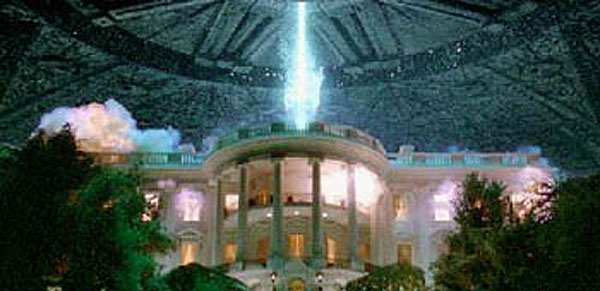
Why waste all that energy when there are smarter ways? Image courtesy movie 'Independence Day'
It’s time to come clean: I have a fascination with alien invasions of our planet.
As a kid, I was an avid listener of radio (my only electronic medium, as I grew up in a land without television, and in a time before the Internet) — and expected the regular transmissions to be interrupted any moment to break the news of an alien invasion underway. The spoilsports shattered my childhood dreams everyday.
Now slightly older, I keep looking for the perfect moments for that history-shattering event. A widely reproduced op ed essay I wrote in July 2010 opened with these words:
“If you’re an alien planning to invade the Earth, choose July 11. Chances are that our planet will offer little or no resistance. Today, most members of the Earth’s dominant species – the nearly 7 billion humans – will be preoccupied with 22 able-bodied men chasing a little hollow sphere. It’s only a game, really, but what a game: the whole world holds its breath as the ‘titans of kick’ clash in the FIFA World Cup Final…”
The careless aliens didn’t heed my advice, but I live in hope. I keep looking for the strategic moments and smart ways to take over the planet — with as little violence as possible. After all, I’m a peace-loving person (even if I’m unhappy with the planet’s current management).
I’m not alone in this noble quest. Science fiction writers have been at it for decades, and future Earth invaders are well advised to first study these useful instructions masquerading as popular literature. In an op ed essay published today, I highlight one such story by Sir Arthur C Clarke.
Click on this ONLY if you're a prude...I wrote WikiLeaks, Swiss Banks and Alien invasions with my tongue in my cheek about half the time (go figure!). I’ve been following the WikiLeaks cablegate saga for several weeks, and was intrigued to read that other critically sensitive secrets — that have nothing to do with garrulous American diplomats — were also reaching this online platform for assorted whistle-blowers.
I describe how PLAYBOY Magazine used the story as a basis for a psychedelic comic strip illustrated by the American underground cartoonist Skip Williamson. That appeared in their issue for May 1972 — and I’m still trying to locate that story. All in the interests of pop culture, of course.
My DIY as POY: Famous at last?“All I can hear I me mine, I me mine, I me mine.
Even those tears I me mine, I me mine, I me mine.
No-one’s frightened of playing it
Ev’ryone’s saying it,
Flowing more freely than wine,
All thru’ your life I me mine…”
When George Harrison sang those words in the 1970 Beatles song ‘I-Me-Mine’, he was in two minds about expressing in the first person (or ego). He wasn’t alone: mainstream journalism has long had reservations about where ‘I’ fit in journalistic narratives.
“Never bring yourself into what you write,” we were told in journalism school 20 years ago. Journalists, as observers and chroniclers of events, write the first drafts of history – and without the luxury of time or perspective that historians and biographers take for granted. We often have to package information and provide analysis on the run. Bringing ourselves into that process would surely distort messages and confuse many, it was argued. We had to keep our feelings out of our reportage lest it affects our ‘objectivity’.
In other words, we were simply mirrors reflecting (and recording) the events happening around us. Mirrors can’t – and shouldn’t — emit light of their own.
Occasionally, if we felt the urge to express how we personally felt about such trends and events, we were allowed the luxury of an op-ed or commentary piece. Of course, as long as we ensured that it was a measured and guarded expression. And if we really wanted to bring ourselves into the narrative, we could use the archaic phrase ‘this writer…’ to refer to ourselves.
But never use I-Me-Mine! That would surely sour, taint and even contaminate good journalism – right?
Well, it used to be the ‘norm’ for decades — but mercifully, not any longer. Thanks largely to the new media revolution triggered by the Internet, writing in the I-Me-Mine mode is no longer frowned upon as egotistic or narcissistic. It sometimes is one or both these, but hey, that’s part of cultural diversity that our information society has belatedly learnt to live with…
We journalists are late arrivals to this domain. The first person narrative was always valued in other areas of creative arts such as literary fiction, poetry and the cinema. In such endeavours, their creators are encouraged to tell the world exactly how they feel and what they think.
Of course, some writers ignored orthodoxy and wrote in the first person all along. One example I know personally is the acclaimed writer of science fiction and science fact, Sir Arthur C Clarke. Shortly after I’d started working with him in 1987, Sir Arthur encouraged me to fearlessly use the first person narrative even in technical and business writing. A lot of writing ended up being too dull and dreary, he said, because their writers were afraid of speaking their minds.
Yet we had to wait for the first decade of the Twenty First Century to see I-Me-Mine being widely accepted in the world of journalism. Did the old guard finally cave in, or (as sounds more likely) did Generation Me just redefine the rules of the game?
Whatever it is, I-Me-Mine is now very much in vogue. And not a moment too soon!
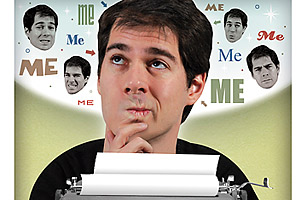
Joel Stein (Photo-illustration by John Ueland for TIME)As Time columnist Joel Stein, who often writes with his tongue firmly in his cheek, noted in a recent column: “All bloggers write in first person, spending hours each day chronicling their anger at their kids for taking away their free time. Every Facebook update and tweet is sophomoric, solipsistic, snarky and other words I’ve learned by Googling myself.”
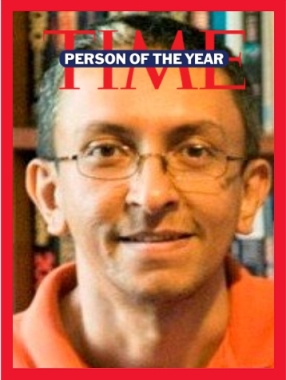
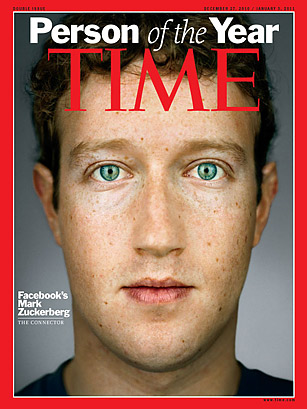
And look at what Time just tempted me to do: put myself on their cover, as the Person of the Year (POY), no less. While designating Facebook’s founder Mark Zuckerberg as its POY 2010, Time teamed up with the social media network to introduce a new application that allows anyone to become POY with just a few key strokes. Provided you have a Facebook account, of course.
Joel Stein quotes Jean M Twenge, professor of psychology at San Diego State University, as saying that we are living in the Age of Individualism, a radical philosophical shift that began with Sigmund Freud. It has exploded during the past decade with reality television, Facebook and blogging. “You’re supposed to craft your own image and have a personal brand. That was unheard of 10 years ago,” Twenge says.
What a difference a decade can make. Although trained in the pre-me era, I was never convinced as to why I had to keep myself out of what I write. However, my use of I-Me-Mine was done sparingly in the late 1980s (when I started my media work) and during the 1990s. It was only in the 2000s that I finally found both the freedom to speak my mind – and the ideal platforms for doing so: blogging and tweeting.
As my regular readers know, I blog about my family, friends, pet, travels, writing and conference speaking. I liberally sprinkle photographs of myself doing various things. I tell you more than you really want to know about my life. Ah yes, I’m self-referential too.
And not just on this blog. I’ve also been writing op ed essays for various mainstream media outlets for much of the past decade, and have never hesitated in expressing what I think, feel and even dream about. (Isn’t that what opinion pieces are meant to be?)
But the Digital Immigrant that I am, all my writing is shaped by my pre-Internet training. Even for a blog post or tweet, I still gather information, marshal my thoughts and agonise over every word, sentence and paragraph.
As my own editor and publisher on the blog, I don’t have gatekeepers who insist on any of this. My readers haven’t complained either. Yet I write the way I do for a simple reason. I may indulge in a lot of I-Me-Mine, but I don’t write just for myself. You, gentle reader, are the main reason why I strive for coherence and relevance.
(OK, if you really must know, it also ensures a joyful read when I occasionally go back and read my own writing…)
The Face of Facebook
“For connecting more than half a billion people and mapping the social relations among them, for creating a new system of exchanging information and for changing how we live our lives, Mark Elliot Zuckerberg is TIME’s 2010 Person of the Year,” TIME magazine’s editors announced on 15 December 2010.
As if to support their choice, their profile of Facebook’s co-founder added: “One out of every dozen people on the planet has a Facebook account. They speak 75 languages and collectively lavish more than 700 billion minutes on Facebook every month. Last month the site accounted for 1 out of 4 American page views. Its membership is currently growing at a rate of about 700,000 people a day.”
As usual, TIME’s selection was eagerly awaited, and the most popular choice online was WikiLeaks founder Julian Assange. He ended as a runner-up as the next four newsmakers of 2010 — perhaps it was too controversial a choice for TIME’s editors considering the heavy polarisation of views at home about WikiLeaks?
I first read about this selection on Twitter. By coincidence, I was just finishing my latest essay, which was more about the challenges of living in the WikiLeakable world that we now find ourselves in. But Mark Zuckerberg and Facebook get honourable mentions in there.
“I’m not so sure what you might have made of this thing called Facebook. With more than 500 million active members, the social networking website is the largest of its kind (well ahead of its nearest rival Myspace, owned by your friend Rupert).
“Going by the sheer numbers, Facebook is behind only China and India in population terms. But those who compare it to a major league country don’t imagine far enough — it’s really becoming another planet…
An essential survival skill in this Info Age...“While Facebook’s high numbers are impressive, not everyone is convinced of its usefulness and good intentions. Can we trust so much power in the hands of a few very bright (and by now, very rich) twentysomethings? How exactly is Facebook going to safeguard our privacy when we (wittingly or unwittingly) reveal so much of our lives in there?
“I raise these concerns not only as a long-time ICT-watcher, but also as the father of a teenager who is an avid Facebooker. I once called Facebook co-founder Mark Zuckerberg a ‘Digital Pied Piper’: might we someday see Hamelin the sequel?”
PS: On 1 Oct 2010, when the movie The Social Network (based on the Facebook story) opened, I tweeted: “www.thesocialnetwork-movie.com Story of da world’s biggest Pied Piper. And his 500 million+ rats!”
“In the struggle for freedom of information, technology — not politics — will be the ultimate decider.”
These words, by Sir Arthur C Clarke, have been cited in recent days and weeks in many debates surrounding WikiLeaks, secrecy and the public’s right to know.
I invoke these words, and many related reflections by the late author and futurist, in a 2,250-word essay I have just written. Titled Living in the Global Glass House, it is presented in the form of an Open Letter to Sir Arthur C Clarke. It has just been published by Groundviews.org
This is my own attempt to make sense of the international controversy – and confusion – surrounding WikiLeaks. Taking off from the current concerns, I also look at what it means for individuals, corporations and governments to live in the Age of Transparency that has resulted from the Information Society we’ve been building for years.
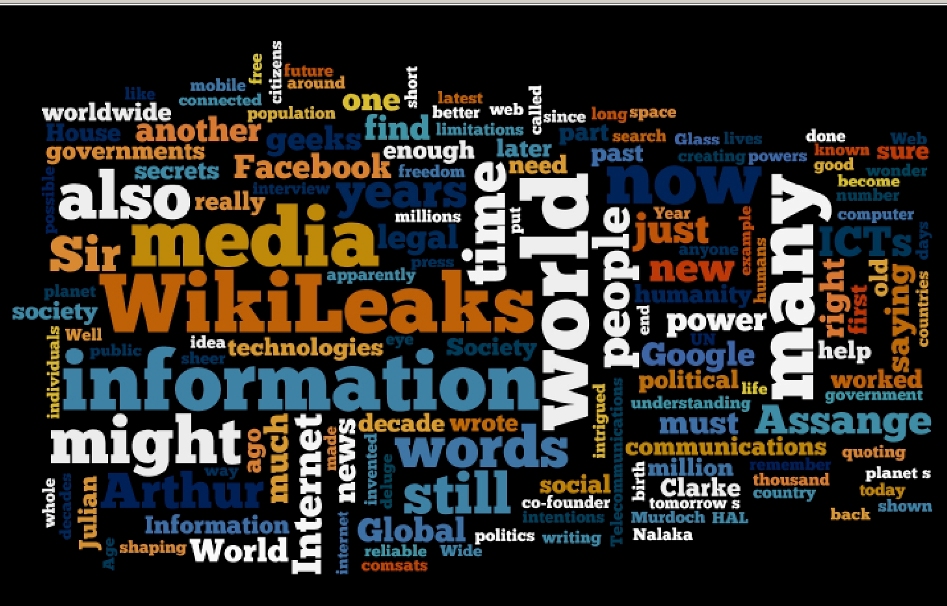
Sir Arthur foresaw these developments year or decades ago, and wrote perceptively and sometimes in cautionary terms about how we can cope with these developments. As a research assistant and occasional co-author to Sir Arthur from 1987 to 2008, I had the rare privilege of sharing his views firsthand. In this essay, I distill some of the best and most timely for wider dissemination. The above Wordle graphic illustrates the keywords in my essay.
The essay was also prompted by recent experiences. Here’s that story behind the story:
By happy coincidence, I arrived in London on 28 November 2010, the very day the WikiLeaks Cablegate erupted all over the web, beginning to spill out what would eventually be over 250,000 secret international ‘cables’ within the US diplomatic corps.
The Guardian UK that day published an interactive map-based visualization of the leaks. By moving the mouse over the map, readers can find key stories and a selection of original documents by country, subject or people
During the week I spent in London, I experienced not only uncharacteristically early and intense snow storms, but a mounting international storm on the web over the leaked cables. WikiLeaks’ co-founder and chief editor Julian Assange was also somewhere in the UK, playing cat and mouse at the time with the Swedish police and Interpol. (He later turned himself in to the British authorities.)
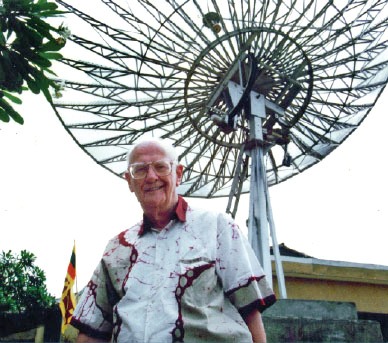
Sir Arthur Clarke: The legacy continues...On December 1, the British Interplanetary Society invited me to join their annual Christmas get-together where they were remembering their founder member and past chairman Arthur C Clarke. They talked mostly about the man’s contribution to space exploration, but listening to those fond memories against the wider backdrop of WikiLeaks very likely inspired me to write this essay.
Soon after I returned to Colombo, Transparency International Sri Lanka asked me to speak at a workshop on the right to information they had organised for journalists. Given my reputation as a geek-watcher and commentator on the Information Society, they asked to talk about what WikiLeaks means for investigative journalism. Two days later, the Ravaya newspaper did a lengthy interview with me on the same topic which they have just published in their issue for 19 December 2010.
All these elements and experiences combined in writing this essay. Being confined to home by a nasty cold and cough also helped! In fact, on 16 December when Sir Arthur’s 93rd Birth Anniversary was marked, I was too weak to even step out of the house to visit his gravesite. In the end, I finished writing this Open Letter to him on the evening of that day.
My daughter Dhara and I would normally have taken flowers to Sir Arthur’s grave on his birth anniversary. This year, instead, I offer him 2,250 words in his memory. The fine writer would surely appreciate this tribute from a small-time wordsmith.
As an avid watcher of ICTs and the Information Society they help create, I have always been interested in how new technologies are perceived and adopted by different individuals and communities.
In the wake of WikiLeaks, there is renewed interest in the free flow of information. Governments and large corporations are naturally anxious about their secrets being leaked. Journalists and activists are working overtime to produce coherent stories or advocacy positions out of the massive volumes of hitherto classified information being released by WikiLeaks. And the rest of society is bewildered on just how to make sense of it all.
Can humanity survive the deluge of information unleashed by ICTs?
This is the question I posed to Sir Arthur C Clarke in a wide-ranging interview I did on the eve of the first World Summit on the Information Society (WSIS) in December 2003. The full exchange was published on OneWorld.net, where it is still archived.
Here’s the relevant Q&A:
Q: So you are confident that humanity will survive the current deluge of information?
A: Undoubtedly. There are many who are genuinely alarmed by the immense amount of information available to us through the Internet, television and other media. To them, I can offer little consolation other than to suggest that they put themselves in the place of their ancestors at the time the printing press was invented. ‘My God,’ they cried, ‘now there could be as many as a thousand books. How will we ever read them all?’
Strangely, as history has shown, our species survived that earlier deluge of information, and some say, even advanced because of it. I am not so much concerned with the proliferation of information as the purpose for which it is used. Technology carries with it a responsibility that we are obliged to consider.
Paper paper shining bright...but for how long? Cartoon by Mike Luckovich
My regular readers know my deep interest in political satire, and fascination with cartoons of all kinds including those political. On this blog, we’ve also discussed the worldwide decline in mainstream journalism.
“Political satire is nothing new: it has been around for as long as organised government, trying to keep the wielders of power in check. Over the centuries, it has manifested in many oral, literary or theatrical traditions, some of it more enduring — such as Gulliver’s Travels and Animal Farm. And for over a century, political cartoonists have also been doing it with such brilliant economy of words. Together, these two groups probably inspire more nightmares in tyrants than anyone or anything else.
“Today, political satire has also emerged as a genre on the airwaves and in cyberspace, and partly compensates for the worldwide decline in serious and investigative journalism. Many mainstream media outlets have become too submissive and subservient to political and corporate powers. Those who still have the guts often lack the resources and staff to pursue good journalism.
“If Nature abhors a vacuum, so does human society — and both conjure ways of quickly filling it up. Into this ‘journalism void’ have stepped two very different groups of people: citizen journalists, who take advantage of the new information and communications technologies (ICTs), and political satirists who revive the ancient arts of caricaturisation and ego-blasting…”
Don't run races with me...
I’m a slow reader. Let me qualify that: I’m a slow reader of books.
I can read fast when I need to — and I do that with newspapers, magazines, websites and many other displays of text that surrounds us. It’s almost an essential survival skill for today’s information society.
But when it comes to books, I take my time. Especially with good books (and I try to discern). Books are not to be rushed through; they are to be taken slowly, one page and one chapter at a time. I savour books as I savour a good meal. (And unlike with a meal, I regurgitate good books, which further slows me down.)
As a writer myself, I enjoy good writing by others. I can appreciate how hard it is to produce readable and enjoyable prose out of an alphabet of 26 letters (I write only in English) and a handful of punctuation marks. If a fellow writer went to all that trouble to create something out of nothing, the least I can do is to absorb and digest it well. (I should also add: I’m ruthlessly discerning in what I choose to read.)
Those around me are sometimes amused and puzzled by this. They know my capacity to marshal information and ideas, so they can’t figure why I don’t read books fleetingly. My friends as exasperated by another trait: how I read several books at the same time, progressing through multiple titles by switching between them. I guess this means I have Attention Deficit Disorder (ADD). Ah, well…
I was delighted to discover recently that there are others who cherish slow, reflective reading. There is, in fact, a slow reading movement — an eclectic group of academics and writers who want us to switch off our computers every so often and rediscover both the joy of personal engagement with physical texts, and the ability to process them fully.
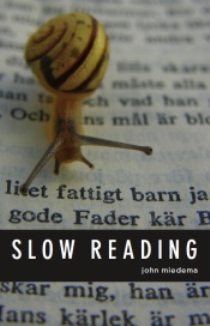
Read a book, lately?“Readers make choices in the kinds of attention they give to texts–from scanning, skimming and speed reading to deep reading and rereading,” says Professor Catherine L Ross, Faculty of Information & Media Studies, University of Western Ontario when reviewing a recent book, Slow Reading by John Miedema.
Miedema, a technology specialist at IBM in Ottawa, Ontario, draws on both his personal reading experience and the extensive research literature on reading to make a powerful case for the deep pleasures of engaged, reflective reading.
He likens the slow reading movement to the Slow Food movement, which was founded in Italy in the mid 1980s as a backlash against American-style fast food. Both movements encourage increased mindfulness in the conduct of routine activity. As he says: “It’s not just about students reading as slowly as possible. Slow reading is about bringing more of the person to bear on the book.”
In a recent essay in Newsweek, Malcolm Jones asked if slow reading is antidote for a fast world. As he wrote: “…But it doesn’t take a rocket scientist to realize that we are all reading too much too fast these days. Yes, we’re drowning in information, but, clearly, reading faster and faster is not the way out of the deep end.”
It’s from this article that I found out there is now an International Day of Slowness, June 21. The Canadians, reflective and thoughtful people as they’ve always been, are giving leadership to it. By the time I read about it (slowly, of course), the day had already passed. But there’s always next year…
Another article, in The Guardian a few days ago, posed related questions: Has endlessly skimming short texts on the internet made us stupider? The writer, Patrick Kingsley, summed up recent research suggesting that an increasing number of experts think so. He came to the same conclusion as Miedema: it’s time to slow down…
Here’s part of the book’s promotional blurb: “Slow Reading brings attention to emerging ideas in technology and culture. The traditional technologies of print and the book have persisted as part of our information ecology because of the need for slow reading and deep comprehension. The theme of locality in the Slow Movement provides insight into the importance of physical location in our relationship with information. Most of all, Slow Reading represents a rediscovery of the pleasure of reading for its own sake.”
I want to read this book — but not online. I’ll get hold of it and meander slowly through it, as I do with any good book. This particular writer would expect nothing less.
“If you’re an alien planning to invade the Earth, choose July 11. Chances are that our planet will offer little or no resistance.
“Today, most members of the Earth’s dominant species – the nearly 7 billion humans – will be preoccupied with 22 able-bodied men chasing a little hollow sphere. It’s only a game, really, but what a game: the whole world holds its breath as the ‘titans of kick’ clash in the FIFA World Cup Final.
“Played across 10 venues in South Africa, this was much more than a sporting tournament. It’s the ultimate celebration of the world’s most popular sport, held once every four years. More popular than the Olympics, it demonstrates the sheer power of sports and media to bring together – momentarily, at least – the usually fragmented and squabbling humanity.”
This is the opening of my latest op ed essay, which appears in several print and online outlets this weekend. It’s timed for the finals of the FIFA World Cup 2010 – the most widely followed sporting event in the world, which will be played in Soccer City, Johannesburg, South Africa today, 11 July 2010. The Netherlands will meet Spain in this culmination of international football that has been distracting a good part of humanity for a month.
This sporting event is tipped to be the most-watched television event in history. Hundreds of broadcasters are transmitting the World Cup to a cumulative TV audience that FIFA estimates to reach more than 26 billion people. Some TV channels offer high definition (HD) or 3-D quality images to enhance the mass viewing experience.
The essay was written a few days ago, after the FIFA World Cup 2010 had reached the semi-finals stage. To be honest, I’m not an ardent football fan. But as an observer of popular culture, I’ve gladly allowed myself to be caught up in the current football frenzy. I just love to watch people who watch the game…
It’s a light piece written to suit the current global mood, but I acknowledge that the World Cup is really more than just a ball game. The basic thrust of my essay is to comment on the powerful mix of fooball and live coverage: “For the past month, the winning formula for unifying the Global Family seemed to be: international football + live broadcasts + live coverage via the web and mobile phones.”
United Colours of Football, courtesy FIFAThe essay builds on themes that I’ve already explored on this blog – for example, how President Nelson Mandela used the 1995 World Cup Rugby championship to unite his racially divided nation, as told in the movie Invictus.
Here’s my parting thought, on which I invite reader comment: “On second thoughts, those invading aliens don’t need to worry too much about the Earth’s political leaders or their armies. Without firing a single shot, the globalised media have quietly taken over our Global Village — and now it’s too late to resist! We can argue on its merits and demerits, but the facts are indisputable.”
If one acronym has dominated the world’s media and public minds in the past month, it must be FIFA.
It stands for the International Federation of Association Football, and is derived from the original French name, Fédération Internationale de Football Association. It’s the global governing body of association football, founded in 1904 and with its headquarters in Zürich, Switzerland.
FIFA is responsible for the organisation and governance of football’s major international tournaments — most notably the FIFA World Cup, held once every four years since 1930. The current World Cup, being held in South Africa from 11 June to 11 July 2010, is the 19th edition. The next will be hosted by Brazil in 2014.
As a global body with substantial financial resources, FIFA has had its own share of controversies and been criticised for its lack of transparency and internal democracy. It’s true that FIFA controls the media rights to key international games with an iron fist (which inspired the above cartoon). They are not alone: the International Olympic Committee (IOC) has its own detractors and allegations on similar considerations.
Who's got the soft power?But there is little argument on how far and wide the influence of these global sports bodies extend. In an op ed essay being published this weekend, I contend: “FIFA, with its 208 member associations, is probably more influential — and certainly better known — than the United Nations, with its 192 member states. The difference is in media outreach. It signifies the rise of soft power in our always-connected information society.”
Indeed, the UN itself is well aware of this. In one of the most memorable op ed essays he’s written, the former UN Secretary General Kofi Annan acknowledged in 2006 (during the previous FIFA World Cup): “The World Cup makes us at the UN green with envy. As the pinnacle of the only truly global game, played in every country by every race and religion, it is one of the few phenomena as universal as the UN. But there are better reasons for our envy.”
He continued: “This is an event in which everybody knows where their team stands, and what it did to get there. They know who scored and how and in what minute of the game; they know who saved the penalty. I wish we had more of that sort of competition in the family of nations. Countries vying for the best standing in the table of respect for human rights, and trying to outdo one another in child survival rates or enrolment in secondary education. States parading their performance for all the world to see. Governments being held accountable.”
Of course, FIFA’s domination over the global public mind will wane after the FIFA World Cup 2010 ends. But how many other global bodies can claim to hold billions of people so engaged for a month? And in this era of 24/7 information society, that’s formidable soft power indeed.
What can we call the wielder of such soft power? How about Super-soft-power?
And can this kind of power also intoxicate and even corrupt its wielders? We’ve seen how power manipulations work in other centres of soft power, such as Hollywood and Bollywood. The challenge for FIFA — and all others who are connected to it through the love of football and/or media’s outreach — is to watch out that this concentration of soft power doesn’t corrupt.
The very same media that helps FIFA attain the status of a soft-super-power needs to keep an eye on how this power is being used. Perhaps that’s the ultimate game in the media-saturated 21st Century: Emperors of Eyeballs vs. Titans of Kick.





 Open Minds!