Despite the recent International Year of Chemistry (2011), chemicals don’t get good press in Sri Lanka. If at all they make it to the news, or become a current affairs topic, that is usually as a bad story: a chemical spill, water contamination or suspected pesticide residues in our food.
All these happen, and we should be concerned. But chemicals are everywhere in our modern lives — reducing drudgery, protecting us from disease and overall improving the quality of life. It’s all a question of balancing risks with benefits. Also discerning what we really need as opposed to what we want.
Focusing on bad news is the media’s typical approach, and demonising science and technology is common in many sections of our print and broadcast media. Such posturing also fits well into the prevailing narrative of the ‘whole world being out to undermine, destabilise and destroy us’. So chemical industries must be part of that ‘conspiracy’, no?
Many of Lanka’s environmental activists don’t allow facts and analysis to get in the way of a good scare story. Uncritical journalists and their editors often peddle their half-baked arguments and conspiracy theories unsupported by any evidence. Very few scientists speak out for science and reason.
So when the Centre for Environmental Justice (CEJ), a moderate advocacy group, invited me to talk to a group of journalists and broadcasters at a media workshop, I welcomed the opportunity.
I based my talk on five scientists each of who took on once-revered chemicals and formidable industry interests, all in the public interest. By showcasing these champions of public science, I wanted to show that there are honest, diligent scientists who engage in evidence-based advocacy. Not all scientists are part of some global conspiracy to poison us…
The five are those who worked tirelessly and left their mark in their discipline, and in how we look at chemical and environmental management: Rachel Carson (1907 – 1964) Alice Hamilton (1869 – 1970) Sherwood Rowland (1927 – 2012) Theo Colborn (1927 – ) Anil Agarwal (1947 – 2002)
I ended by urging journalists to look for credible and moderate scientists who are led by evidence, not conjecture or prejudice. Amplifying their voices is something we in the media are well positioned to do, but don’t do nearly enough.
Presentation to Media workshop on scientific reporting on chemical issues, organised by Centre for Environmental Justice in Colombo, 25 September 2012:
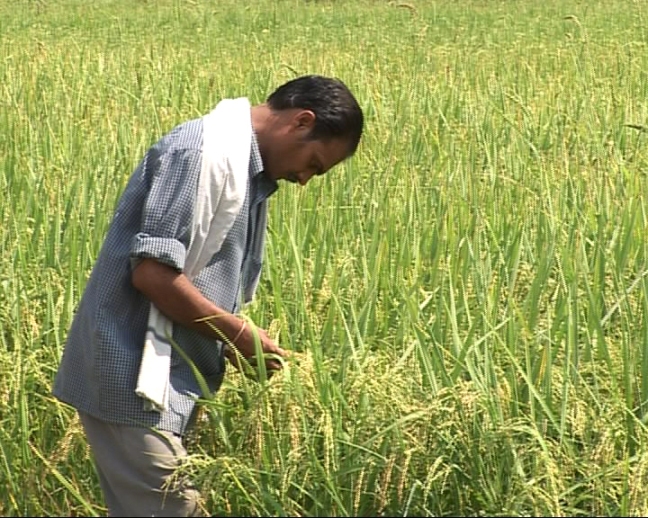
The chronic kidney disease (CKDu) that has already affected thousands in its heartland of farming, has brought into sharp focus some serious environmental concerns that ecologists have long highlighted. These stem from our farmers’ high reliance on inorganic (chemical) fertilisers.
While some fertiliser is needed to sustain soil fertility when growing crops repeatedly on the same land, the ‘Green Revolution’ from the 1960s urged Lankan farmers to use large volumes of fertiliser, provided to them on massive state subsidies. That, in turn, led to indiscriminate use and waste — and higher agricultural runoffs.
Farmers aren’t thrifty because they get fertiliser at a fraction of the market price. In this week’s Ravaya column (in Sinhala, on 2 September 2012), I look at what this national addiction to chemical fertiliser is doing to both our economy and ecology. I also look at organic alternatives and probe why they are not being adopted more widely.
CKDu was first reported in the early 1990s from a single Province in our heartland of farming, but it has now spread across approximately 17,000 sq km (a quarter of the island), which is home to around 2.5 million people. Several thousand have already died; the exact number is not clear. Over 15,000 people are kept alive with regular kidney dialysis.
Investigating causes of this ailment — still not pinned down to a particular cause or factor — has been contentious with scientists, nationalists and politicians trying to hijack the issue for their own agenda setting. Some journalists have added fuel to the fire with sensationalist reporting and fear-mongering. In this column, I ask everyone to focus on the prolonged suffering of those already affected and their families.
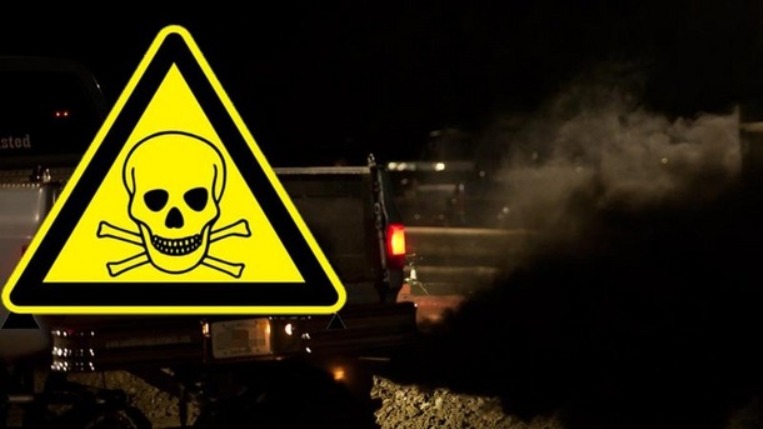
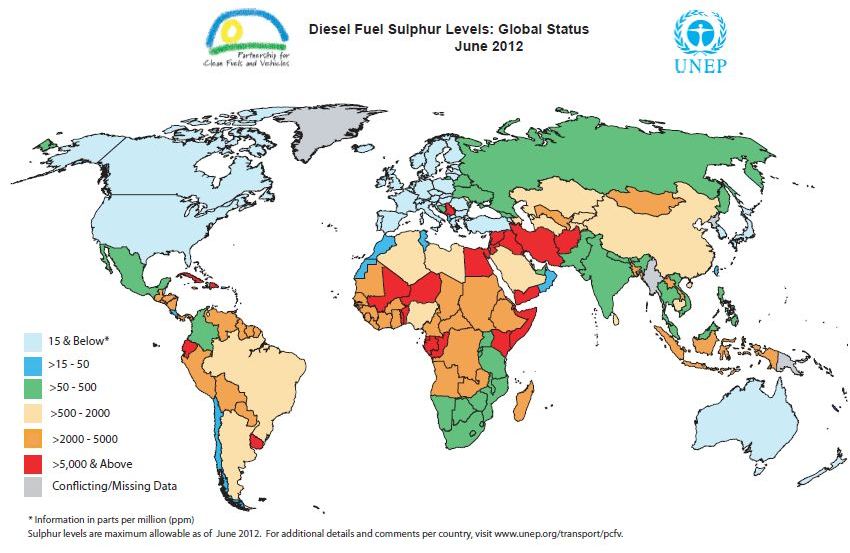
In this week’s Ravaya column (in Sinhala), I look back at the scientific, legal and policy struggles in Sri Lanka that finally god rid of lead additives in petrol (gasoline) in 2002. It is a success story in safeguarding public health and combating environmental pollution that holds valuable lessons in a new challenge that confronts us: how to reduce sulphur content in the diesel distributed in Sri Lanka that currently contains one of the highest sulphur levels in Asia. This is now urgent and important with WHO confirming diesel fumes cause lung causer.
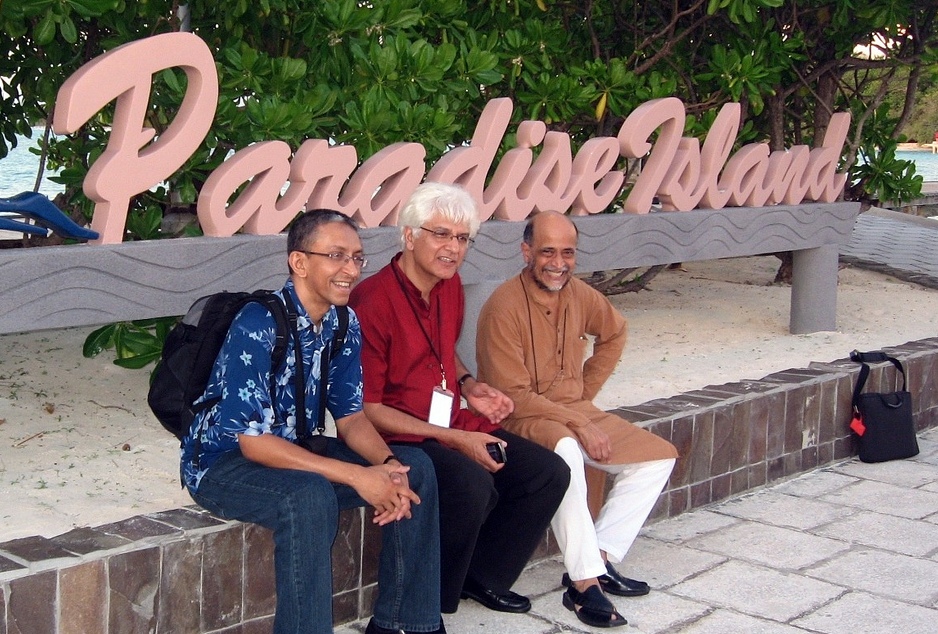
To keep up with the silly season, here’s another photo taken in July 2011 in…well, read the sign behind us.
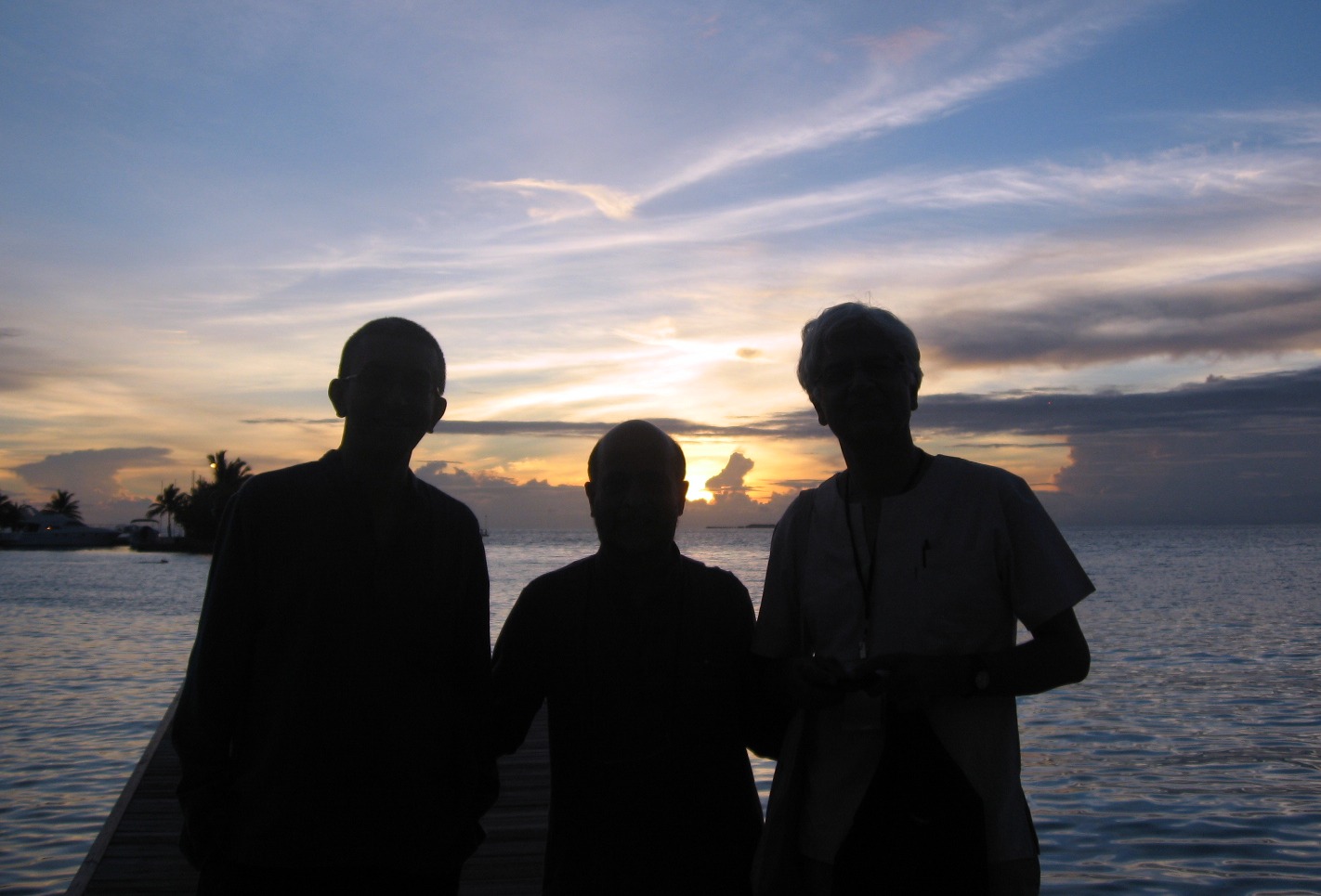
Waiting to be let in – surely they know our bylines? L to R – Nalaka Gunawardene, Kunda Dixit, Darryl D’Monte – Maldives, May 2011
PS: It’s actually in the Maldives, where fellow journalists Kunda Dixit, Darryl D’Monte and I were working hard to earn an honest living at a regional meeting on ozone and climate. Yes, we were let in — and we liked the salubrious settings…
L to R – Nalaka Gunawardene, Darryl D’Monte & Kunda Dixit in Paradise, May 2011
In this week’s Sunday column in Ravaya (22 July 2012, in Sinhala), I discuss the far-reaching public health implications of the World Health Organisation (WHO)’s recent assessment that diesel engine fumes do certainly cause cancer, especially lung cancer, in humans.
This week’s Ravaya column (in Sinhala) is a preview of a key challenge being taken up at the UN Conference on Sustainable Development being held in Rio de Janeiro, Brazil, this month. I raise the question: how can Sri Lanka transform its economy into a green economy in pursuit of sustainable development?
This was the title of a talk I gave to Sri Lanka Rationalists’ Association (SLRA) in Colombo, Sri Lanka, on 7 June 2012 — two days after World Environment Day.
In this, I shared my observations on how attempts aimed at environmental conservation and sustainable resource use in Sri Lanka are often hindered by many misconceptions and myths about natural resources and our impact on them.
I invoked the words of George Monbiot, journalist/columnist, The Guardian, UK: “One of the most widespread human weaknesses is our readiness to accept claims that fit our beliefs and reject those that clash with them. We demand impossible standards of proof when confronted with something we don’t want to hear — but will believe any old cobblers if it confirms our prejudices…”
At the outset, I proposed a basic categorization of eco-myths as myths of the first, second and third kind – the last one being the most pervasive and harmful. Drawing on my 25 years of experience as a science writer and journalist, I cite several examples from air pollution, biodiversity and climate change.
There is also the mother of all eco-myths that Lankan nationalists never tire of repeating: romanticising the ‘good old days’ before modernisation and colonisation. Ah, if only real life were that simple…
I acknowledged that scientific knowledge and understanding on some ecological matters are evolving so have to keep an open, inquisitive mind: science does not have all the answers, but provides a framework in which to ask the right questions and to go in search of answers supported by evidence.
I also conceded that many individuals – and their societies – are not always rational. Governments (at least in democracies) take their cue from the people, and so…irrationality feeds on itself.
The bottomline: it’s a free world and individuals may cling on to any fantasy or belief. As long as it doesn’t harm others around the believer, and/or affects collective thinking. When it does, the good of the many must outweigh the good of one.
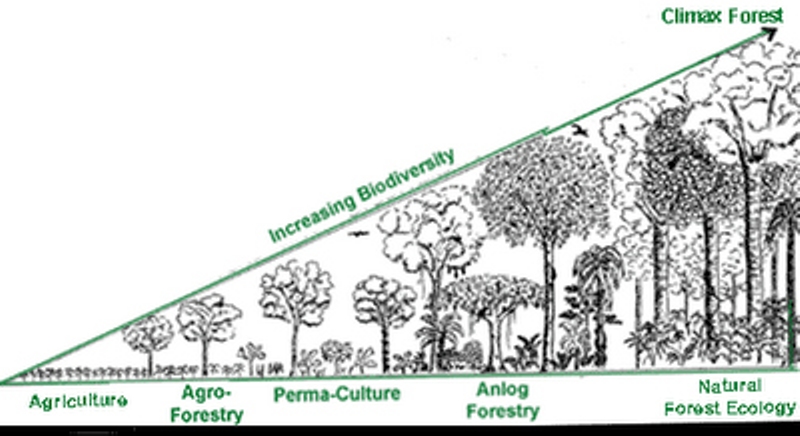
In this week’s Ravaya column (in Sinhala), I write about Analog Forestry, a Lankan innovation that is now adopted in many tropical countries in Africa, Asia and Latin America.
Analog Forestry is a system of planned, managed forests that are designed to mimic the function and ecology of the pre-existing climax vegetation for the area, and are also designed to provide economic benefits.







 Open Minds!