‘Climate change is the greatest market failure the world has ever seen,’ said the Stern Review on the Economics of Climate Change that the UK government published in November 2006. This 579-page assessment on the economics of climate change was headed by Sir Nicholas Stern, a former chief economist at the World Bank. The report warned that the world economy will suffer a serious blow if action to slow down climate change was not taken soon. According to Stern,’There is still time to avoid the worst impacts of climate change, if we take strong action now.’
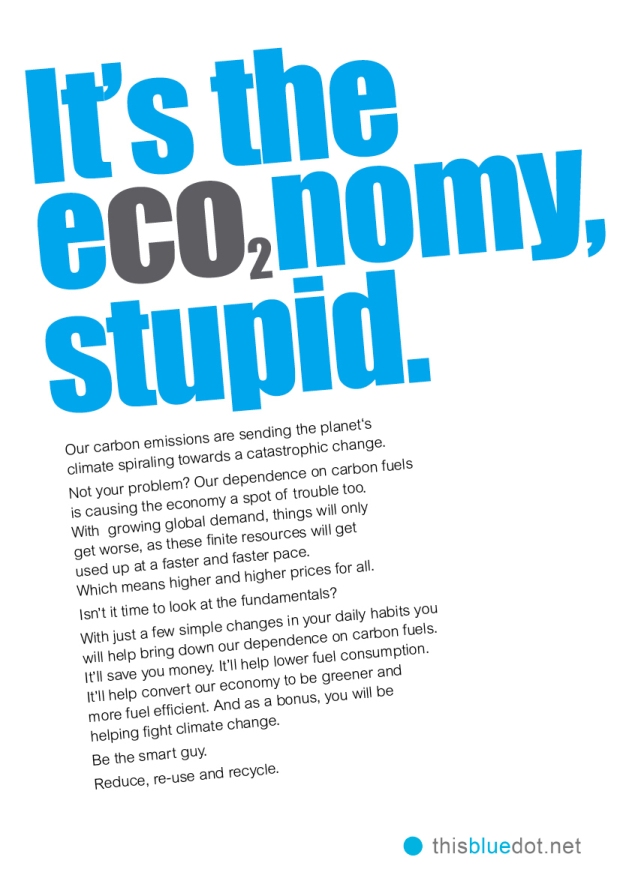
Though not in the same league, this interesting call to action just caught my eye – it reminds us of a slogan that rode Bill Clinton to office in the 1990s, but takes on a whole new meaning now on a warming planet.
The reference given, http://www.palebluedot.net, did not have a working website as at today, 27 March 2010.
The Stern Review is the most comprehensive, rigorous and terrifying report published todate by a finance ministry. It points out that carbon emissions have already increased global temperatures by more than 0.5°C and that with no action to cut greenhouse gases, we will warm the planet another 2 to 3°C within the next 50 years. This will transform the physical geography of the planet and the way we live, with floods, disease, storms and water shortages becoming more frequent.
Stern and his team – no crying-wolf greenies, them – cautioned that the effects of climate change could cost the world between 5% and 20% of GDP, prompting the worst recession since the 1920s. Action to reduce greenhouse gas emissions and the worst of global warming, on the other hand, would cost 1% of global GDP.
A few days ago, commenting on cartoons on climate change, I wrote: “So how do we capture climate change’s multiplicity in visual forms? Photographers go for the evidence and authenticity. Film makers work on both current impacts and future scenarios…”
Now here comes a chance for photographers everywhere to bear witness to the climate crisis slowly unfolding all around us.
As the website says, “Hot Shots is…designed to create a visual record of these personal impressions by and for people around the world. The focus is not only on spectacular events, but also on climate change from people’s own, personal perspective.”
I tried to come up with an answer, and couldn’t think of a single woman cartoonist who works for a print or online media outlet in Sri Lanka. That, despite my long association with the media and also being a great admirer (and collector) of good cartoons.
Later that day, at the awards ceremony for winning and commended climate cartoonists, I posed the same question to leading Lankan cartoonists Wasantha Siriwardena, Winnie Hettigoda and Dharshana Karunatilleke. They too couldn’t name one immediately; later, a single name was mentioned but it’s not one I recognised.
Clearly, cartooning is still a very male dominated profession — but that might soon change, going by the active participation of young women in the climate change cartoon contest.
Shamanthi RajasinghamIn fact, the first and third prize winners were both women — respectively Shamanthi Rajasingham and W M D Nishani. They beat close to 200 other contestants to get there.
Additionally, there were 6 women among the 22 commended cartoonists, and one woman among those 11 who were highly commended — judged on four criteria. See all winning and commended entries.
W M D NishaniOkay, the four judges were all male (among us, two professional cartoonists). But during this entire judging process, the identity of artists was withheld and we only knew each entry by a number. In fact, we discovered the names (and gender) of artists only at the awards ceremony.
This would be encouraging news to Dhara and all other aspiring young girls and women who want to pursue careers in media. Let’s hope at least some of the women contestants in the climate cartoons contest would end up being more than just hobby cartoonists…
Meanwhile, it’s not just Sri Lanka that has a shortage of women engaged in cartooning, and awareness of their contribution is lacking. A quick Google search brought up a book titled “The Great Women Cartoonists” by Trina Robbins (Watson-Guptill Publications, 2001). Reviewing it in TIME, Andrew D Arnold wrote: “Name three women cartoonists who worked from 1900 to 1950. Okay, just name one. Couldn’t do it? Neither could I until reading a new, invaluable book…”
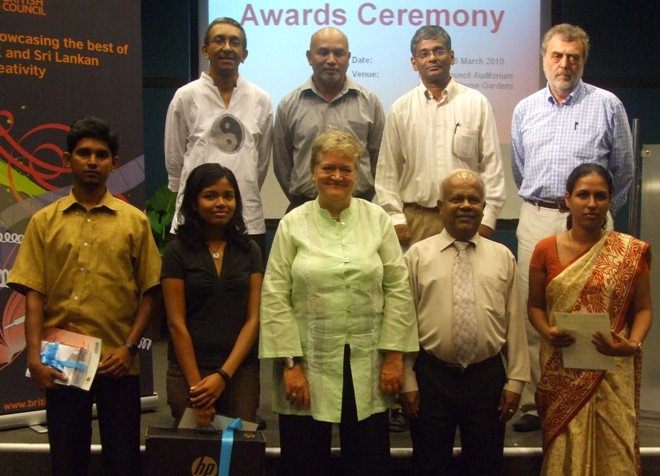
Cartoon contest top prize winners with British Council director and chief guest (all front row) and four judges (all back row) at awards ceremony, Colombo 6 March 2010
Man-made climate change is a complex planetary phenomenon. It has multiple causes and effects – not all of it immediately evident. Different areas of the world are going to be impacted differently and unevenly. Human response to the climate challenge has been patchy, and is mired in so much denial, rhetoric and political posturing.
So how do we capture this multiplicity in visual forms? Photographers go for the evidence and authenticity. Film makers work on both current impacts and future scenarios. What about cartoonists – who have to do their visual metaphors in a limited space that is static and two-dimensional? How much of climate change’s nuance and complexity can they really grasp and convey?
The short answer is: a great deal. On this blog, I’ve written that when it comes to cartoons, less is definitely more. Take, for example, many millions of printed words and probably thousands of minutes of airtime generated around the (over-hyped and under-performing) Copenhagen climate conference in Dec 2009. As I noted in blog posts on 17 Dec, 18 Dec and 21 Dec 2009, it was assorted cartoonists from around the world who summed it all up in a few perceptive strokes. This is why I keep saying that when it comes to commenting on our topsy-turvy times, no one can beat cartoonists for their economy of words.
In late 2009, the British Council and the Ken Sprague Fund of UK organised a cartoon contest on climate change which was open to all Lankan citizens from 18 to 35 years. They offered attractive prizes for anyone who could be ‘seriously funny’ about this global crisis. The participants could submit entries under 6 themes: drought and water shortage; deforestation and rain forest destruction; melting of the ice caps; role of industry in polluting the atmosphere; devastation of our seas and disappearance of marine life; and climate change in an urban environment.
Some 400 entries were received from 175 contestants (each person could submit up to 5 entries) – which surprised and delighted the organisers. During the past few weeks, I have been involved in judging these cartoons to select the top winners and commended entries. Joining me in this enjoyable task were nationally recognised professional cartoonist Wasantha Siriwardena and environmentalist Nimal Perera. We worked with a British counterpart, top cartoonist Michal Boncza Ozdowski.
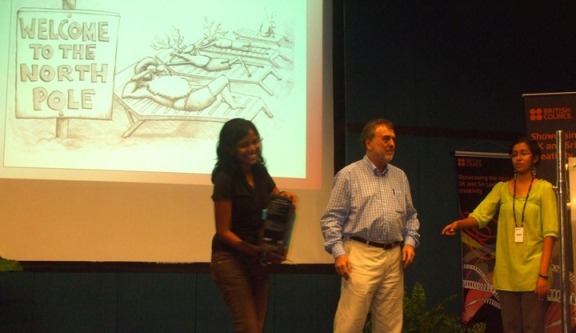
Michal Boncza Ozdowski (L) and Wasantha Siriwardena conducting cartoon workshopThe winners were announced, with awards and certificates, on 6 March 2010. It coincided with a half-day workshop on cartooning conducted by Michal and Wasantha. The chief guest at the ceremony was Camillus Perera, the seniormost Lankan cartoonist still professionally active.
As national judges, we looked at close to 200 cartoon entries that conformed with the contest’s published rules for eligibility. Since comparative ranking of creative works is never easy, we first agreed on four criteria for assessing the very diverse entries: cartoon value and humour; subject relevance to climate change (defined broadly); how effectively the climate related message was being communicated; and clarity and artistic merit of the entry.
Our initial judging coincided with the climate circus in Copenhagen, when we narrowed it down to a shortlist of 40 entries. We then individually scored these cartoons for each of our four criteria. We sometimes had to discuss and demarcate how far the scope of the contest could stretch. For example, when is an entry a good work of art but not a cartoon (more like a poster)? And what are the acceptable limits in the thematic or subject coverage of a vast topic like climate change?
The British Council later shared the full shortlist with Michal Ozdowski, who provided his own rankings and comments. We met again in February 2010 to discuss and reconcile our rankings — and found that our separately done rankings broadly agreed! (Note: During this entire judging process, the identity of artists was withheld and we only knew each entry by a number. In fact, we judges discovered the names only on the day of the awards ceremony, to which all shortlisted contestants were invited.)
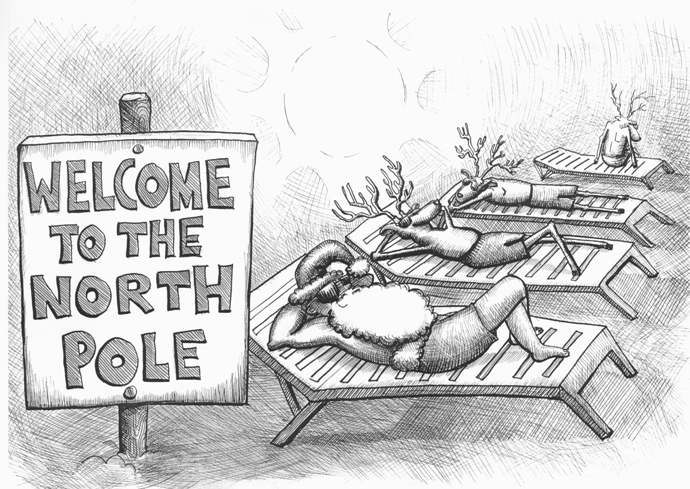
First prize: Welcome to the North Pole! By by Shamanthi Rajasingham First prize winning climate cartoon - by Shamanthi Rajasingham
Citation for first prize: It is uncomplicated – a great advantage when satirising. Its composition is strong and imaginative, the draughtsmanship confident.
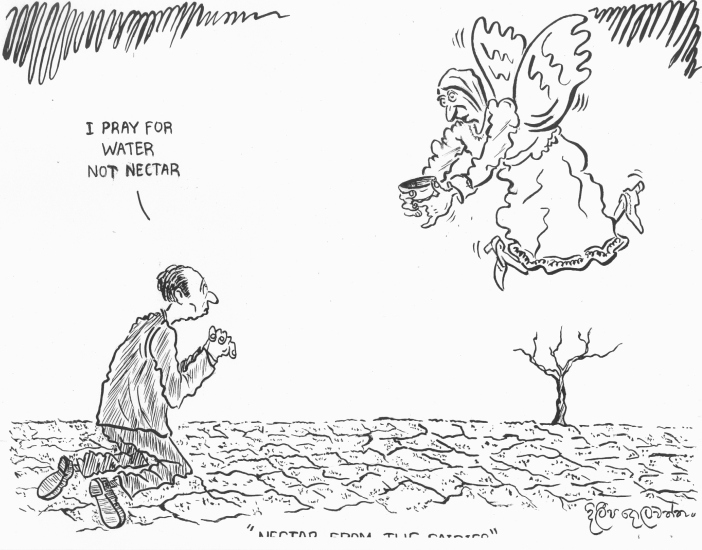
Second Prize: “I pray for water, not nectar” by Dileepa Dolawatte Second prize winning climate cartoon by Dileepa Dolawatte
Citation for second prize: Apart from the vibrant and highly accomplished draughtsmanship, it lampoons brilliantly the fairy’s naivety – a funny eye-opener. Incorporates very cleverly traditional beliefs and myths. Here we are truly past the dodgy miracles stage in the climate change battles…
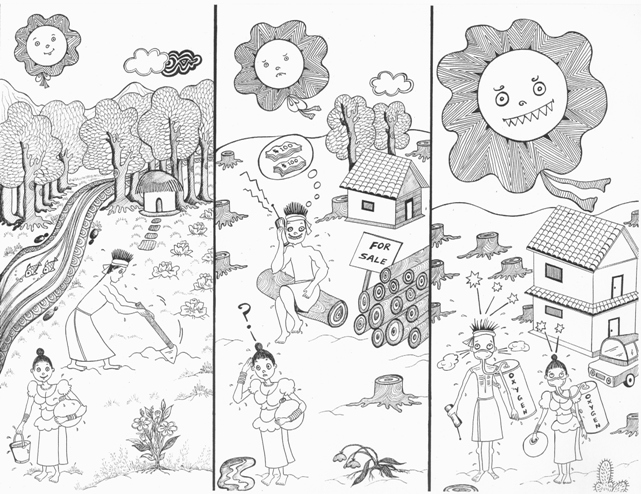
Third Prize: Theme – Drought and water shortage, by W M D Nishani Third prize winning climate cartoon by W M D Nishani
Citation for third prize: An eloquent, if over-didactic, strip cartoon – could be quite effective in women’s publications. Coherent draughtsmanship catalogues effectively the woes of a ‘get-rich-quick’ development.
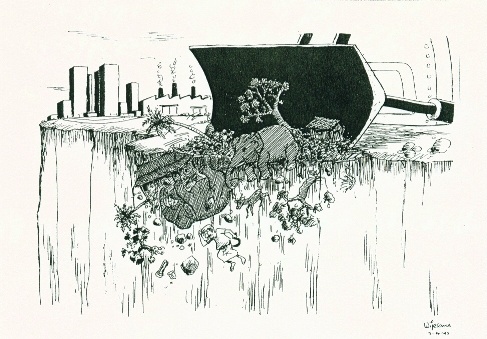
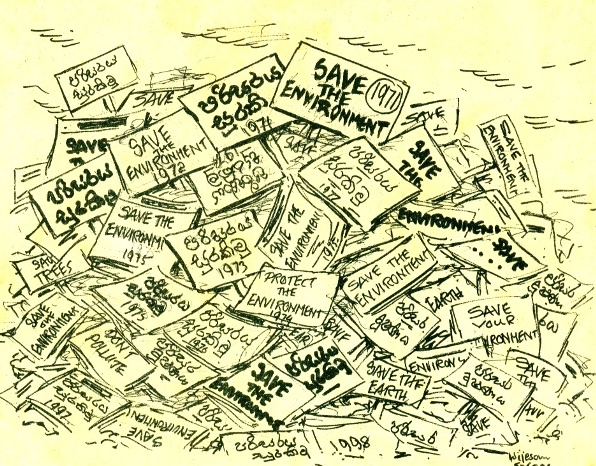
Price of Development, as seen by Cartoonist W R Wijesoma, 1993
Environmental activist and communicator Piyal Parakrama’s sudden death last week, of a heart attack, jolted Sri Lanka’s closely-knit green community. The activist community may bicker and argue endlessly among themselves, but there is also strong kinship among its cacophonous members. Many of them are still trying to come to terms with the loss.
As indeed am I – even if I’m not quite a certified member of the activist community, I consider myself a fellow traveler. I turn to words – either reflective prose or verse – when I want to make sense of something, and over the last weekend I wrote a new essay. It runs into 1,800 words and, as with all my tributes to public figures, this one is also social commentary laced in anecdotal reminiscence. It expands on initial thoughts that first appeared on this blog .
Here’s an excerpt where I talk about challenges faced by Sri Lanka’s environmental activists:
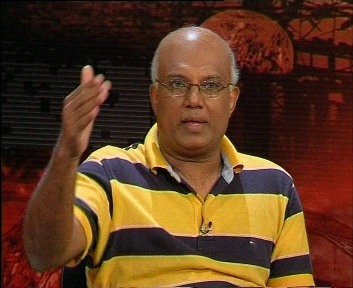
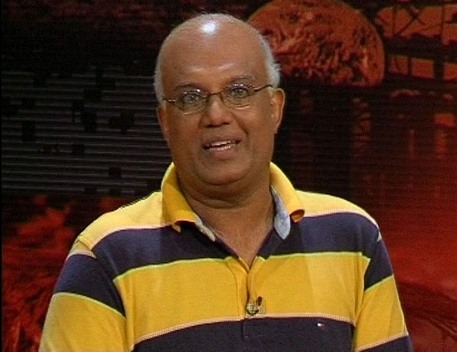
Piyal Parakrama on Sri Lanka 2048 TV showDuring the past three decades, Piyal and fellow activists have taken up the formidable challenges of conserving Sri Lanka’s biodiversity, long under multiple pressures such as growing human numbers, rising human aspirations, and gaps in law enforcement. Adding to the sense of urgency was the 1999 designation of Sri Lanka as one of the world’s biodiversity hotspots, where high levels of endemic species (found nowhere else in the wild) were threatened with extinction. Public and media attention is disproportionately focused on a few charismatic mega-fauna like elephants and leopards; in reality, dozens of other animal and plant species are being edged out.
In search of viable solutions for entrenched conservation problems, Piyal collaborated with scientists, educators, journalists and grassroots activists. Some industrialists and investors hated his guts, but he was much sought after by schools, universities and community groups across the country. Concerned researchers and government officials sometimes gave him sensitive information which he could make public in ways they couldn’t.
Some eco-protests grew into sustained campaigns. Among them were the call to save the Buona-Vista reef at Rumassala and struggles against large scale sugarcane plantations in Bibile. A current campaign focuses on the Iran-funded Uma Oya multipurpose project, which involves damming a river for irrigation and power generation purposes.
While environmentalists ultimately haven’t block development projects, their agitations helped increase environmental and public health safeguards. Occasionally, projects were moved to less damaging locations – as happened in mid 2008, when Sri Lanka’s second international airport was moved away from Weerawila, next to the Bundala National Park.
The hard truth, however, is that our green activists have lost more struggles than they have won since the economy was liberalized in 1977. They have not been able to stand up to the all-powerful executive presidency, ruling the country since 1978 — most of that time under Emergency regulations. In that period, we have had ‘green’ and ‘blue’ parties in office, sometimes in coalitions with the ‘reds’. But their environmental record is, at best, patchy. In many cases, local or foreign investors — acting with the backing of local politicians and officials — have bulldozed their way on promises of more jobs and incomes. Environmentalists have sometimes been maligned as anti-development or anti-people. In contemporary Sri Lanka, that’s just one step away from being labeled anti-national or anti-government.
At the end of the essay, I try to sum up the multiple challenges faced by ALL activists in Sri Lanka today:
“Activism is not an easy path anywhere, anytime, and especially so in modern day Sri Lanka. All activists – whether working on democracy, governance, social justice or environment – are struggling to reorient themselves in the post-conflict, middle-income country they suddenly find themselves in. Their old rhetoric and strategies no longer seem to motivate the people or influence either the polity or policy. Many of them haven’t yet crossed the Other Digital Divide, and risk being left behind by the march of technology.”
After all, I want our activists to be effective and successful as society’s conscience. My suggested author intro for this latest essay, somehow now included in the published version, read: “Science writer Nalaka Gunawardene dreams of becoming an activist one day, but for now, he remains a ‘critical cheer-leader’ of those who are more courageous.”
Piyal Parakrama died so suddenly and unexpectedly on the night of March 3 that it’s hard to believe that he is no longer among us. Another public-spirited individual has left the public space all too soon.
Piyal combined the roles of environmentalist, educator, researcher and media personality. He was also a colleague who became a friend, and a fellow traveller for many years.
In a public career spanning 30 years, he wore multiple hats, among them: Executive Director of the Centre for Environmental and Nature Studies, founder President of the Nature Conservation Group (NatCog), President of the Green Party of Sri Lanka, and consultant to various state and academic institutions. He also worked for the now-defunct Sri Lanka Environmental Congress (SLEC) and now dormant Sri Lanka Environmental Television Project (SLETP).
But Piyal Parakrama was more than an amalgamation of these parts: he was his own distinctive brand — admired, trusted or feared by different sections of society. Even his ardent detractors (and he had a few) would readily agree that he gave far more to the public good than he took back personally.
Piyal’s forte was biodiversity. His interest and knowledge were nurtured first at the Young Zoologists Association (YZA) – where he remained a volunteer for 30 years – and later at the Lumumba Friendship University in Russia, where he studied biology from 1983 to 1986.
In searching for viable solutions for entrenched conservation problems, Piyal collaborated with scientists, educators, journalists, school children and local activists. Some industrialists and investors simply hated his guts, while concerned researchers and government officials sometimes gave him sensitive information which he could make public in ways they couldn’t.
Given our common interests in development issues and the media, Piyal and I moved in partly overlapping circles. Our paths crossed frequently, and we shared public platforms, newspaper space and broadcast airtime. We even worked together for a few months in the late 1990s at the SLETP. His communications skills were invaluable in rendering a number of international environmental films into Sinhala.
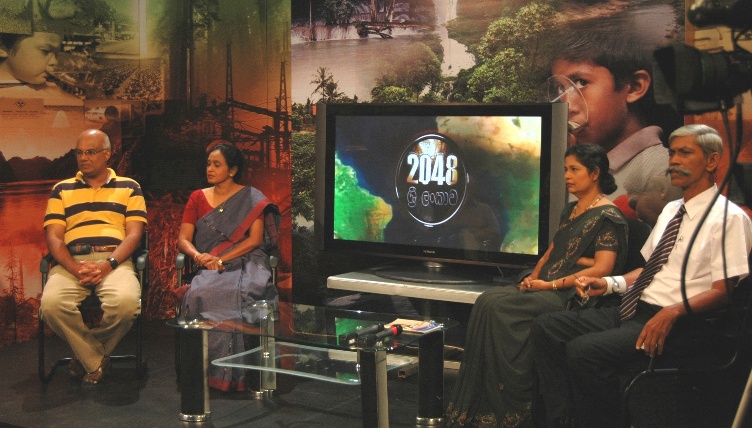
Piyal Parakrama (left) on the set of Sri Lanka 2048 - debate on Water Management
The last time we collaborated was in such a media venture. In mid 2008, Piyal joined an hour-long TV debate we produced as part of the Sri Lanka 2048 series. The show discussed the various choices and trade-offs that had to be made today to create a more sustainable Sri Lanka over the next 40 years. Taking such a long term view is rare in our professional and media spheres preoccupied with the challenges of now and here (or restricted in vision by short-termism).
Piyal could speak authoritatively on several topics we covered in the 10-part series, but I invited him to the one on managing freshwater, one of Sri Lanka’s once abundant but now threatened natural resources. With his deep knowledge and understanding of traditional water and soil conservation systems, he was truly in his element in that debate. He was also the ‘star’ among the diverse panel and studio audience we had carefully assembled.
I’m working on a longer tribute where I try to position Piyal’s role in Sri Lanka’s conservation movement. Watch this space…
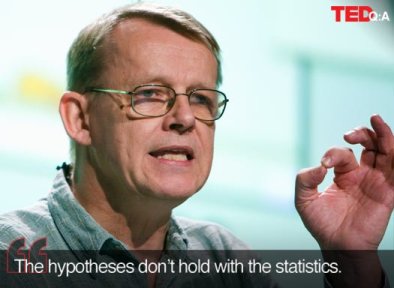
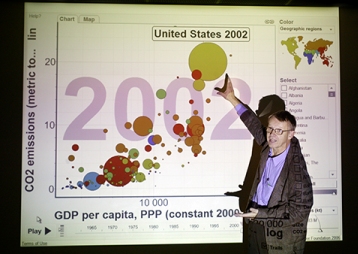
Hans Rosling: Information WizardIf you thought Al Gore was a data-happy geek, you should see Hans Rosling in action.
The Swedish medical researcher has a way with numbers. He brings heavy and dreary statistics into life using a combination of animated graphics and equally animated presentations. With the drama and urgency of a sportscaster, he uses a new presentation tool called Gapminder to debunk various myths about world – economic development, disparities and how well (or poorly) we share our planet’s resources.
Hans Rosling is Professor of International Health at Karolinska Institutet (which awards the Nobel Prize in medicine), but it’s his other role – as Director of the Gapminder Foundation – that he plays ‘statistics guru’ to the whole world. If you’re perplexed by lots of numbers, he’s the man who can make sense of it all.
In some ways, Rosling and Gapminder present in live action – and on video – what the Atlas of the Real World attempted to do in 2D maps: show the world as it is, with little or no distortion or misconceptions. That effort, published in late 2008, uses software to depict the nations of the world, not by their physical size, but by their demographic importance on a range of subjects.
I’ve watched a number of Rosling talks on video online. He makes no attempt to conceal his Scandinavian accent, and his English grammar is not always perfect. But it doesn’t matter: the guy has such mastery over his ideas and statistics, and a great stage presence too. He’s profound and funny at the same time, without being condescending that most experts and especially professors are.
Here’s an example of Rosling at his best: recorded in February 2006 in Monterrey, California:
No more boring data: TEDTalks
Rosling’s quest to use numbers to shatter stereotypes of rich and poor countries has brought him global prominence. He was one of the world’s “100 most important global thinkers” of 2009, according to Foreign Policy Magazine.
Look, no magic here!Rosling was honored at #96 on the list for “boggling our minds with paradigm-shattering data“. The list is topped by (1) Ben Bernanke, the chairman of US Federal Reserve for his actions to turn the US depression and (2) President Barack Obama for “for reimagining America’s role in the world.”
Foreign Policy noted: “Rosling is well known for his energetic lectures, in which he narrates mind-blowing statistics on development and public health — as they literally move across a screen. Imagine x-y axes filled with data points, each representing a country. As time passes, the dots move, realigning to show changes in child mortality, percentage of paved roads, unemployment rates, or pretty much any other metric you can imagine.”
Here are some more examples of Rosling magic:
200 years that changed the world (with Hans Rosling)
For the first time, Gapminder can now visualize change in life expectancy and income per person over the last two centuries. In this Gapminder video, Hans Rosling shows you how all the countries of the world have developed since 1809 – 200 years ago.
Hans Rosling on HIV: New facts and stunning data visuals
Hans Rosling unveils new data visuals that untangle the complex risk factors of one of the world’s deadliest (and most misunderstood) diseases: HIV. He argues that preventing transmissions — not drug treatments — is the key to ending the epidemic.
Hans Rosling: Asia’s rise — how and when
This is one of the funniest Rosling talks I’ve watched online so far. Speaking at TEDIndia in November 2009, Rosling recalled how he was a young guest student in India when he first realized that Asia had all the capacities to reclaim its place as the world’s dominant economic force. He graphs global economic growth since 1858 and predicts the exact date that India and China will outstrip the US.
Note:
Rosling and Gapminder developed the Trendalyzer software that converts international statistics into moving, interactive and enjoyable graphics. The aim is to promote a fact-based world view through increased use and understanding of freely accessible public statistics. His lectures using Gapminder graphics to visualise world development have won awards by being humorous yet deadly serious. The interactive animations are freely available from the Foundation’s website. In March 2007 Google acquired the Trendalyzer software with the intention to scale it up and make it freely available for public statistics. Google has since made available as Motion Chart, a Google Gadget.
This is no Avatar: It's Real!A few days ago, reviewing the blockbuster movie Avatar, I wrote: “Film critics and social commentators around the world have noticed the many layers of allegory in the film. Interestingly, depending on where you come from, the movie’s underlying ‘message’ can be different: anti-war, pro-environment, anti-Big Oil, anti-mining, pro-indigenous people, and finally, anti-colonial or anti-American. Or All of the Above…”
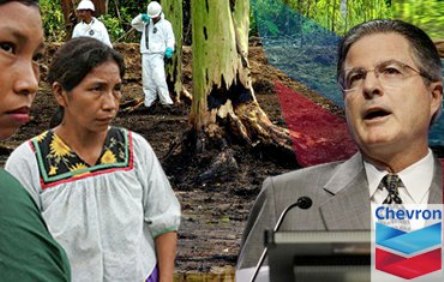
Indeed, an Avatar-like struggle is unfolding in the Amazon forest right now. The online campaigning group Avaaz have called it a ‘Chernobyl in the Amazon’. According to them: “Oil giant Chevron is facing defeat in a lawsuit by the people of the Ecuadorian Amazon, seeking redress for its dumping billions of gallons of poisonous waste in the rainforest.”
From 1964 to 1990, Avaaz claims, Chevron-owned Texaco deliberately dumped billions of gallons of toxic waste from their oil fields in Ecuador’s Amazon — then pulled out without properly cleaning up the pollution they caused.
In their call to action, they go on to say: “But the oil multinational has launched a last-ditch, dirty lobbying effort to derail the people’s case for holding polluters to account. Chevron’s new chief executive John Watson knows his brand is under fire – let’s turn up the global heat.”
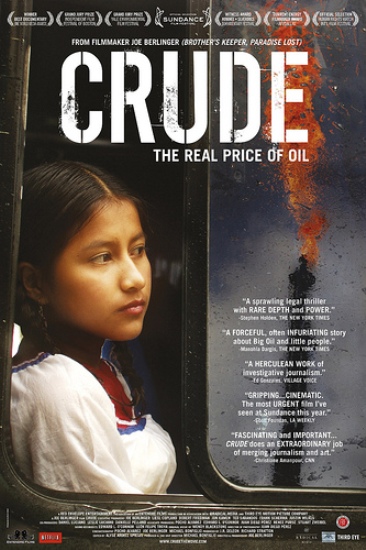
Others have been highlighting this real life struggle for many months. Chief among them is the documentary CRUDE: The Real Price of Oil, made by Joe Berlinger.
The award-winning film, which had its World Premiere at the 2009 Sundance Film Festival, chronicles the epic battle to hold oil giant Chevron (formerly Texaco) accountable for its systematic contamination of the Ecuadorian Amazon – an environmental tragedy that experts call “the Rainforest Chernobyl.”
Here’s the official blurb: Three years in the making, this cinéma-vérité feature from acclaimed filmmaker Joe Berlinger is the epic story of one of the largest and most controversial legal cases on the planet. An inside look at the infamous $27 billion Amazon Chernobyl case, CRUDE is a real-life high stakes legal drama set against a backdrop of the environmental movement, global politics, celebrity activism, human rights advocacy, the media, multinational corporate power, and rapidly-disappearing indigenous cultures. Presenting a complex situation from multiple viewpoints, the film subverts the conventions of advocacy filmmaking as it examines a complicated situation from all angles while bringing an important story of environmental peril and human suffering into focus.
Watch the official trailer of Crude: The Real Price of Oil
According to Amazon Watch website: “With key support from Amazon Watch and our Clean Up Ecuador campaign, people are coming together to promote (and see) this incredible film, and then provide ways for viewers to support the struggle highlighted so powerfully by the film.”
They go on to say: “A victory for the Ecuadorian plaintiffs in the lawsuit will send shock waves through corporate boardrooms around the world, invigorating communities fighting against injustice by oil companies. The success of our campaign can change how the oil industry operates by sending a clear signal that they will be held financially liable for their abuses.”
While Avatar‘s story unfolds in imaginary planet Pandora — conjured up by James Cameron’s imagination and created, to a large part, with astonishing special effects, the story of Crude is every bit real and right here on Earth. If one tenth of those who go to see Avatar end up also watching Crude, that should build up much awareness on the equally brutal and reckless conduct of Big Oil companies.
Civilisation's ultimate addiction?
Others have been making the same point. One of them is Erik Assadourian, a Senior Researcher at Worldwatch Institute, whom I met at the Greenaccord Forum in Viterbo, Italy, in November 2009.
He recently blogged: “The Ecuadorians aren’t 10-feet tall or blue, and cannot literally connect with the spirit of the Earth (Pachamama as Ecuadorians call this or Eywa as the Na’vi call the spirit that stems from their planet’s life) but they are as utterly dependent—both culturally and physically—on the forest ecosystem in which they live and are just as exploited by those that see the forest as only being valuable as a container for the resources stored beneath it.”
Erik continues: “Both movies were fantastic reminders of human short-sightedness, one as an epic myth in which one of the invading warriors awakens to his power, becomes champion of the exploited tribe and saves the planet from the oppressors; the other as a less exciting but highly detailed chronicle of the reality of modern battles—organizers, lawyers, and celebrities today have become the warriors, shamans, and chieftains of earlier times.”
“Pictures are for entertainment, messages should be delivered by Western Union.”
Those words by American film producer and studio founder Sam Goldwyn (1879-1974) sum up Hollywood’s attitude to movie-making for the past many decades.
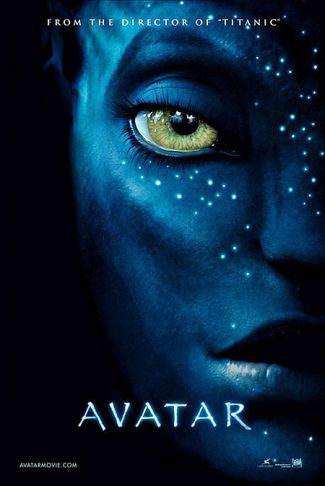
As I watched James Cameron’s latest blockbuster movie Avatar, I kept wondering how the master film maker managed to subvert this so completely. Beneath the 3D, special effects and riot of other worldly colours, the movie is one long (2 hrs 40 mins) and powerful commentary on why might is not right when it comes to exploiting resources — belonging to other countries, people, or as in this case, other worlds.
This is not just another worthy indie movie made by an idealistic movie maker defiant of Hollywood traditions and big money. James Cameron is one of the most commercially successful directors in the mainstream film industry – and perhaps one of the very few who can get away with this kind of stunt. At a budget of over US$ 300 million , Avatar is one of the most expensive films ever made, and the costliest ever for 20th Century Fox.
The big gamble is certainly paying off. On 26 January 2010 came the news that Avatar has surpassed Titanic as the highest-grossing movie worldwide. According to the studio, worldwide box office total for Avatar at that point stood at US$1.859 billion, beating the US$1.843 billion racked up by Cameron’s romantic drama in 1997-98. Avatar broke that record in a little over six weeks.
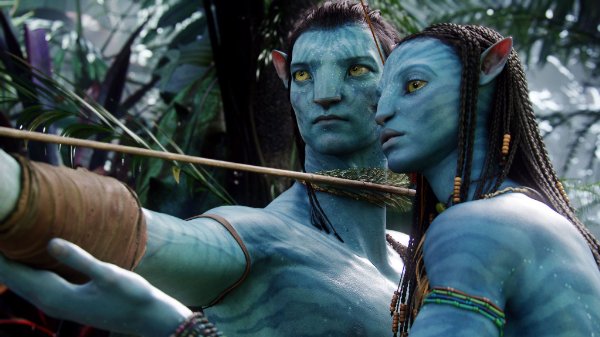
Part of the reason for such appeal is the extraordinary special effects: it’s an action-packed thriller where good and evil battle it out on another planet. The strange landscapes give it a video game like feel, but no small screen can match the theatrical experience, especially if you watch it in IMAX 3D (I didn’t). And for a change, this time the aliens inhabiting planet Pandora are benign, while it’s the humans who are ruthless invaders and brutal killers. Well, at least most of the time…
Here’s the official blurb: “Avatar takes us to a spectacular world beyond imagination, where a reluctant hero embarks on an epic adventure, ultimately fighting to save the alien world he has learned to call home. James Cameron, the Oscar-winning director of Titanic, first conceived the film 15 years ago, when the means to realize his vision did not exist yet. Now, after four years of production, AVATAR, a live action film with a new generation of special effects, delivers a fully immersive cinematic experience of a new kind, where the revolutionary technology invented to make the film disappears into the emotion of the characters and the sweep of the story.”
And here’s AVATAR – Official International Launch Trailer (HD)
Film critics and social commentators around the world have noticed the many layers of allegory in the film. Interestingly, depending on where you come from, the movie’s underlying ‘message’ can be different: anti-war, pro-environment, anti-Big Oil, anti-mining, pro-indigenous people, and finally, anti-colonial or anti-American. Or All of the Above…
It looks as if Cameron has made the ultimate DIY allegory movie: he gives us the template into which any one of us can add our favourite injustice or underdog tale — and stir well. Then sit back and enjoy while good triumphs over evil, and the military-industrial complex is beaten by ten-foot-tall, blue-skinned natives brandishing little more than bows and arrows (and with a little help from Ma Nature). If only it works that way in real life…
But the multi-purpose allegory is apparently working well. Take these two from opposite sides of the planet:
Thomas Eddlem wrote in The New American: “Avatar, is a visually stunning epic that is a perfect allegory for any of a dozen or more Indian wars in American history. From King Philip’s War in New England to Tippecanoe in Indiana to Horseshoe Bend in Alabama — and all the way across the American continent, for that matter — the story was the same. Colonists simply take land from the natives, as the Sully explains: ‘This is how it’s done. When people are sitting on something that you want, you make them your enemy so that you can drive them out.’
Mayank Shekhar wrote in The Hindustan Times newspaper: “Between a green worldview and the globe’s war over a natural resource, James Cameron’s twin analogies of present-day politics are fairly complete. They lend his science fiction ‘event picture’ a certain soul, even if not much of a story line.”
So did Cameron set out trying to send a message? Or was it all an incidental byproduct? Listen to the director himself in these two online video stories:
James Cameron’s Vision Featurette
CBS Interview with James Cameron: From Titanic to Avatar
The most compelling social commentary on Avatar I have so far read comes from Naomi Wolf, the American political activist, author and social critic. In an op ed essay written for Project Syndicate, she sees two revealing themes in Avatar: “the raw, guilty template of the American unconscious in the context of the ‘war on terror’ and late-stage corporate imperialism, and a critical portrayal of America – for the first time ever in a Hollywood blockbuster – from the point of view of the rest of the world.”
She adds: “In the Hollywood tradition, of course, the American hero fighting an indigenous enemy is innocent and moral, a reluctant warrior bringing democracy, or at least justice, to feral savages. In Avatar , the core themes highlight everything that has gone wrong with Americans’ view of themselves in relation to their country’s foreign policy.”
And is Avatar the most expensive piece of info-tainment or edu-tainment ever made, just like the Lord of the Rings trilogy was one long (even if unintended) commercial for the breathtaking sights and sounds of New Zealand?
Certainly, mixing messages with entertainment is such a difficult and delicate art that most people who dabble in it fall between the two stools. The entertainment value of Cameron’s latest flick is not in question. Granted, it’s not as heart-breaking as Titanic, and the storyline is oh-so-predictable. But 3D and SFX magic alone can’t hold today’s audiences gripped for 160 long minutes. And if the underlying story starts movie-goers thinking and talking about many parallels between the fictional world of Pandora and our own Earth, he’s certainly getting somewhere.
As Naomi Wolf says: “Ironically, Avatar will probably do more to exhume Americans’ suppressed knowledge about the shallowness of their national mythology in the face of their oppressive presence in the rest of the world than any amount of editorializing, college courses, or even protest from outside America’s borders. But I am not complaining about this. Hollywood is that powerful. But, in the case of Avatar , the power of American filmmaking has for once been directed toward American self-knowledge rather than American escapism.”
Perhaps this wasn’t part of the script, but would the executives at 20th Century Fox care as they laugh all the way to their bank?
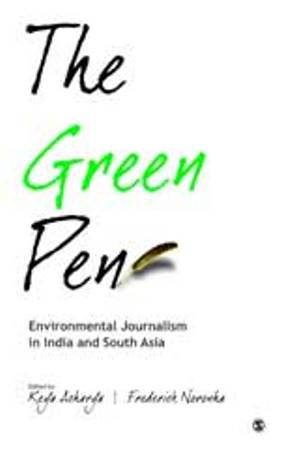
The process of producing and distributing TVE Asia Pacific’s educational TV series, The Greenbelt Reports, is showcased in a new book on environmental journalism in South Asia, just published by Sage, a globally operating company that specialises in bringing out academic and professional books.
Arranged in 10 sections, the book brings together contributions from three dozen journalists, broadcasters and film makers in South Asia. It opens with a foreword by Darryl D’Monte, one time editor of The Times of India and Chair, Forum of Environmental Journalists of India (FEJI).
I co-wrote the chapter titled ‘Dispatches from the Frontline: Making of The Greenbelt Reports’ with my colleague Manori Wijesekera, TVEAP’s Regional Programme Manager. I was researcher and script writer of the 12-part, 4-country series that we made in 2006, in which Manori was series producer. The series looked at the environmental lessons of the 2004 Indian Ocean tsunami.
The title reflects the lingering print bias in media related discussions: in our case, the content we produced was disseminated on broadcast television, narrowcast DVD and online. We wielded cameras rather than pens, but are still very glad to share our experience in this book.
Keya Acharya (left) and Fred NoronhaThe publisher’s blurb says: “This collection of essays by some of the most prominent environmental journalists in Indian and South Asia gives deep insights into their profession and its need and relevance in society. It looks at this ‘specialisation’ of journalism both in the past and the present. Underlying almost all the essays is the changing nature of media in the region and the dilemmas facing environmental journalists. The varied background of the writers ensures the showcasing of a wide range of realities and experiences from the field. Contributions include essays by Darryl D’Monte, the late Anil Agarwal and Sunita Narain, among others.”
“This is the first book of its kind on environmental journalism, which would be an excellent resource to aid the future evolution of the enterprise in the region. Apart from essays from India, there are contributions from Pakistan, Bangladesh, Sri Lanka, Nepal and the Maldives. The book will interest a wide readership, any informed reader, besides journalists and environmentalists.”
It’s an honour to be part of a book which features the work of respected seniors like Anil, Darryl and Sunita – all of who have influenced my own career and I’m privileged to count among my friends (alas, Anil is no longer with us). In fact, I have either met, worked with or am friends with more than half the three dozen contributing authors of this book.







 Open Minds!