Tiananmen literally means Gate of Heavenly Peace...hmmm
I spent several hours at the Tian’anmen Square in Beijing, China, this week, while attending a media conference. I was returning to this landmark, now a key tourist attraction in modernised and assertive China, after nearly a decade. And much has changed…
Measuring 880 metres by 500 metres, and covering a total area of 440,000 square metres, the Tiananmen Square is the largest city square in the world. But mere superlatives don’t impress me. It’s what goes on behind the claims, labels and stereotypes that interest me.
I’ve been to the square on a couple of previous Beijing visits. The first was in October 1996, during my very first visit to China. I was also taken in a group tour on a later visit. If I remember right, my last sighting of the Square was in 2002 – just before I acquired my first digital camera. (That makes a difference, because Before Digital, my analog photographs on travel were sparingly taken…and my own memory is not a very reliable storage medium.)
Day or night, he keeps vigil over Tiananmen Square...and 1.3 billion people
This time, I was armed with my digital camera and ample digital memory — and, it seemed, so were most other visitors! There were the obviously foreign tourists (including the loud and uninformed Americans), but it seemed most people thronging to the square were Chinese…many from out of town. For some, a visit to this centre of power is a rare occasion to be cherished and recorded.
I was impressed by just how many people were clicking away, using either digital cameras or mobile phone cameras. I shouldn’t be surprised by this, for China is the country with the largest number of mobile phones in use: by March 2010, there were some 780 million mobile subscribers, accounting for 58.5 per cent of all people in China.
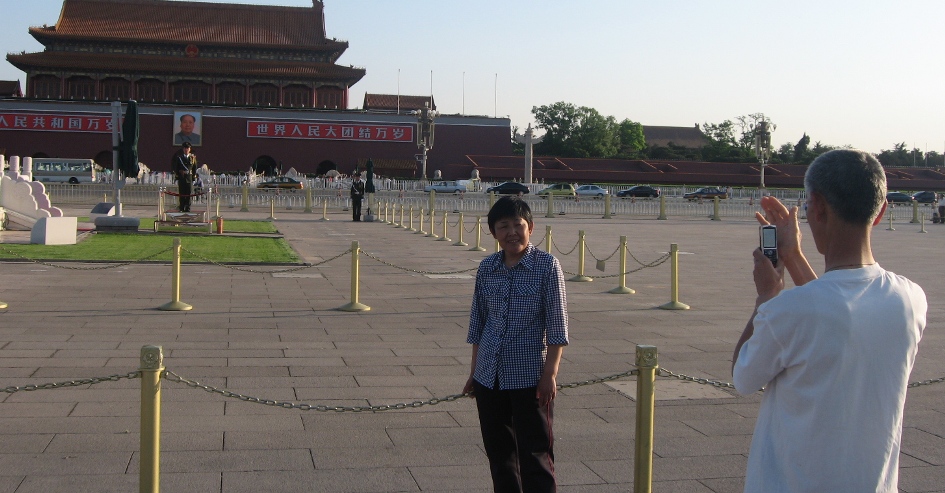
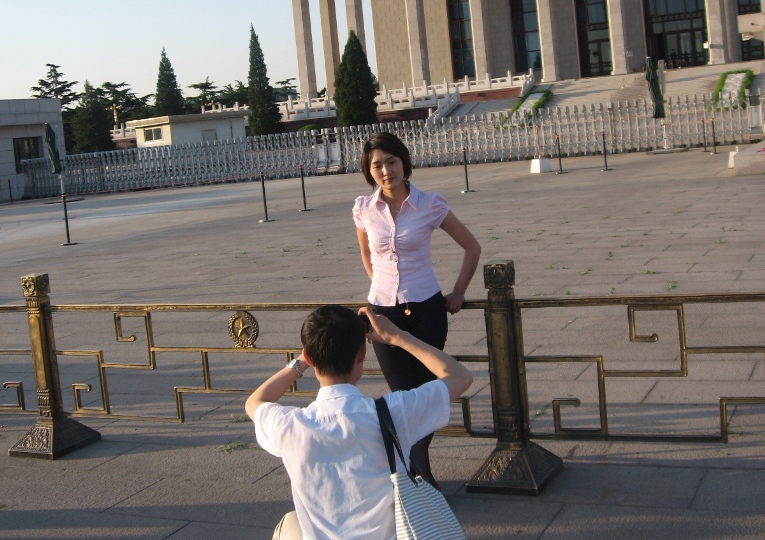
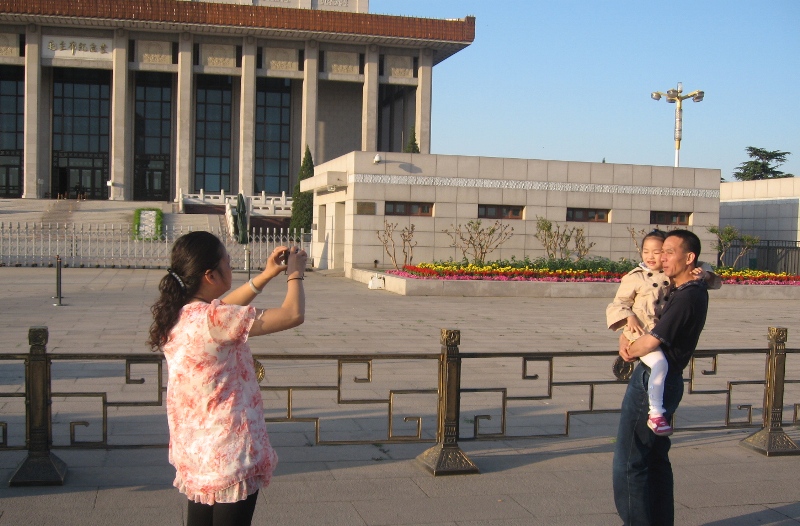
Keen to capture different scenes under varying kinds of daylight and night lights, I made three visits to the Square – including one at 5.30 in the morning to catch daybreak at the Gate of Heavenly Peace (literal meaning of Tiananmen). So here’s a sampling of my several dozen photos – this selection has a bias on people shooting each other, digitally speaking (a far cry from the kind of shooting that took place here 20 years ago).
Look serious, man - he's watching!Now bring out your best smiles, all!People milling about with Great Hall of the People in the backgroundClicking away at Monument to the People's Heroes
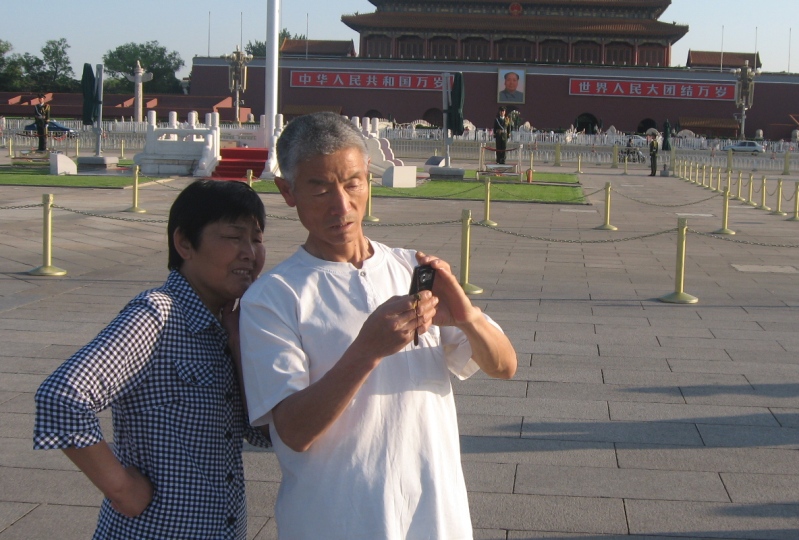
One of the most striking moments I captured was of this elderly couple, very dignified and sprightly in their outlook, as they were taking a stroll on the square early morning and capturing memories on their mobile phone. They are old enough to have known another reality, but this was now and here…
This Square, and we, have seen and heard much in our time...Did we get it alright?
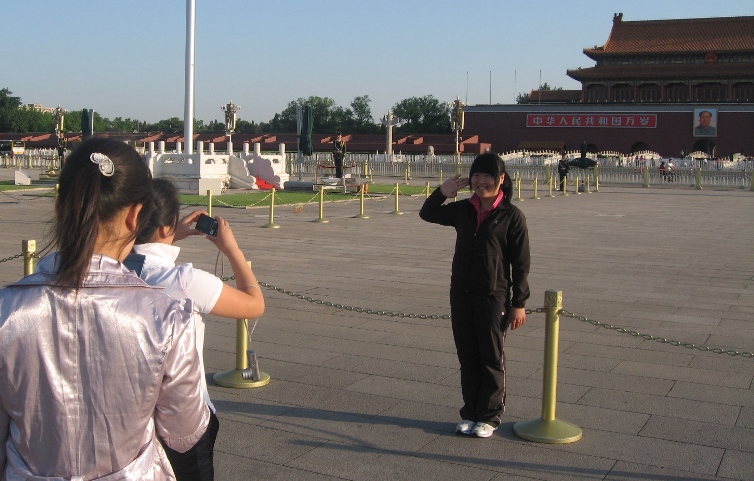
I also noticed how the younger visitors were clearly at ease with digital technologies, just like their fellow Digital Natives elsewhere in the world. There is also a discernible easing up (not only among unknown people in public places, but also noticeable among older and younger Chinese friends I have): maybe it’s the exuberance of youth, but the NextGen Chinese don’t seem to be as somber and serious as their parents.
Or perhaps the younger people in China today just have more things to smile about?
Would Chairman Mao approve this pose, eh?Heaven is in the eye of the beholder...Digital Natives capturing memories for the Next Gen
It was a rushed visit of four nights and three days, so all my impressions are fleeting. They don’t begin to do justice to the nuanced complexity that is modern China. But they tell me one thing: even in a land with a proud history of over 5,000 years, ten years can still make a difference.
Bye for now: I take only photos, and leave only shadows behind...
Note: All photos were taken touristically for my own memory and personal archives, with no other intention.
I haven’t been blogging much during April. One reason is that I’ve been travelling across space — and time.
I was in London for 10 days, and with its lovely Spring weather, I had every reason to be offline. I’ve also been spending a good deal of time back in 1966-67, and having a great deal of fun doing so. (The 1960s had a charm of their own that’s never been repeated…)
Let me explain. I’ve been watching the digitally remastered original Star Trek episodes, which had their first broadcast in that now far-away year — the same year I was born. And what an exhilerating experience to go back to these superbly crafted stories: they offer me both timeless mental stimulation and a sentimental journey to my own childhood/boyhood.
I’d heard of the digitally remastered DVDs’ release a couple of years ago, and was delighted when I found the last copy of Season 2 in a DVD store in Amsterdam in late March. The remastered episodes look and sound crisp, thanks to digitally restored imagery and audio. But the more daring work involved updating the shows’ visual effects with CGI to bring them more in line with the look and quality of later Trek efforts. That’s proving to be a real treasure – well worth waiting for…
As the promotional blurb reads on Amazon.com: “Star Trek, the NBC series that premiered on 6 September 1966, has become a touchstone of international popular culture. It struggled through three seasons that included cancellation and last-minute revival, and turned its creator, Gene Roddenberry, into the progenitor of an intergalactic phenomenon. Eventually expanding to encompass five separate TV series, an ongoing slate of feature films, and a fan base larger than the population of many third-world countries, the Star Trek universe began not with a Big Bang but with a cautious experiment in network TV programming. Even before its premiere episode (“The Man Trap”) was aired, Star Trek had struggled to attain warp-drive velocity, barely making it into the fall ’66 NBC lineup.”
To boldly go where no man has gone before...
As I’ve said before, I’m as old as Star Trek: we were born a few months apart in 1966 (I’m older by seven months). But because we grew up on opposite sides of planet Earth in the pre-Internet era, our worlds didn’t collide until we were both well into our teens.
I have vivid memories of that delightful first encounter, which changed the course of my life forever. In mid or late 1982, Sri Lanka’s newly launched national TV channel Rupavahini started airing a space adventure series called Star Trek. Although I was already familiar with Star Wars movies (of which two had been made by then), I’d not heard about Star Trek until the publicity accompanying the local broadcast.
Star Trek (the original series, now abbreviated as TOS) aired on my local TV – we had just two channels back then – on Wednesdays from 7 to 8 pm, which was prime time just before the evening news at 8. I remember the series ran for at least a year, during which time around 50 episodes were broadcast. I managed to watch most of them.
That wasn’t as easy as it sounds. Our household didn’t yet have a television set, so I had to go across to my aunt’s house next door to watch Star Trek. My school teacher parents took a long time to warm up to the new medium – we didn’t acquire a TV set until early 1983, almost four years after TV was introduced to Sri Lanka in April 1979. And because they placed such emphasis on studies, I was allowed only an hour of television per week. I have absolutely no regrets that while it lasted, I devoted my entire weekly TV quota for Star Trek.
So every week at the appointed time, the United Star Ship Enterprise and its intrepid crew took my young mind roaming around the universe, providing me a welcome escape from the dull and monotonous routine of my teenhood. Even today, hundreds of movies and many thousands of TV hours later, I can just close my eyes and instantly replay in my mind the evocative theme narration and music of Star Trek TOS:
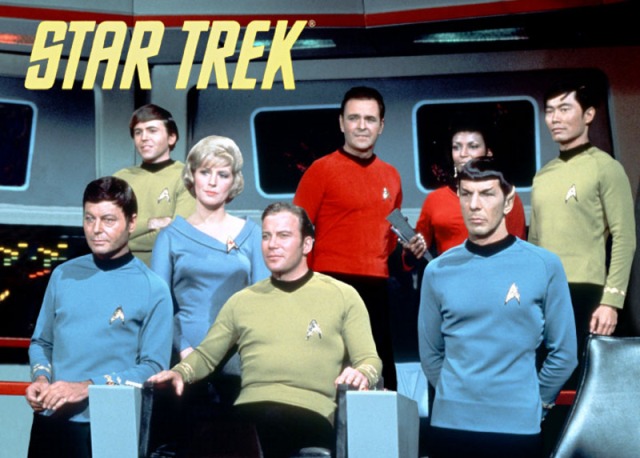
I sat awestruck by the adventures of Captain James T Kirk (played by William Shatner), First Officer Spock (Leonard Nimoy), chief engineer Lieutenant Commander Montgomery Scott (James Doohan), Dr. Leonard “Bones” McCoy (DeForest Kelley), Communications Officer Uhura (Nichelle Nichols) and others. The stories appealed to me as much for insights into the infinite possibilities (and combinations) of life, technology and power at a cosmic scale, as for the glimpses of the near-Utopian human society in the 23rd century.
The series was already 15 years old, and it was showing signs of age. It had the faded Technicolor look and feel of films and TV programmes made in the 1960s and 1970s. The sets were basic and special effects appeared simple — computer-generated images (CGI) was not yet invented. On such technical merits, Star Trek TOS appears elementary when compared to the original Star Wars movie that would roll out just a decade later, in 1977. (A decade is a very long time in the entertainment industry.)
But what the series lacked in looks, the show more than made up in its brilliant story lines and rich imagination. Inadequacies in production values didn’t really matter to me — or to millions of other ‘Trekkies‘ scattered across the planet. The storylines were entertaining and mind-stretching, frequently carrying concepts distilled from the finest in science fiction literature (in fact, some of the genre’s accomplished writers were involved in writing stories for the series, e.g. Robert Bloch, Normal Spinrad, Harlan Ellison and Theodore Sturgeon). The characters were strong, diverse and played by actors who soon developed global fan clubs of their own.
And now, I can relive those journeys again — this time at my leisure, packing as many, or as few, into my private screening schedule. No broadcaster or parent holds me captive any more.
Here’s how the digitally remastered version of the same series opens (aficionados, please spot the differences):
And here are a couple of comparisons between the old and remastered versions that fans have done and released on YouTube:
Of course, remastering a series held in such awe and regard by millions of fans worldwide was a calculated risk.
As Wired noted in a December 2008 story: When Star Trek designer Mike Okuda began remastering the original Star Trek episodes for a series of DVD releases, there was a chance that the show’s more devoted fans would want him beamed to a Klingon prison planet for altering the 1960s classic. To guard against this, Okuda insisted that the new effects would have to be closely based on the originals to retain the visual spirit of the ’60s series.
This is one of my favourite photos in media and development. It was taken by Reza Deghati, the renowned Iranian-French photojournalist (who works under the name Reza). I don’t know the story behind this photo, but even without a single word of annotation, it says a great deal.
I like this photo partly because it symobolises the enduring appeal of broadcast television in much of the developing world. For long years, the old-fashioned, boxy TV set used to be the top-selling consumer electronic item in the world — until the mobile phone came along. But even now, the much-maligned idiot box hasn’t lost its appeal to a significant section of humanity, never mind what the jaded academics and geeks might say.
So I was intrigued to read, in the latest issue of TIME Magazine, development economist Charles Kenny, reminding us that television is still the most influential medium around. In this gizmo-ridden new media age, it takes much courage to say so in public.
In a powerful short essay titled ‘TV Will Save the World’, he writes: “Forget Twitter and Facebook, Google and the Kindle. Forget the latest sleek iGadget. Television is still the most influential medium around. Indeed, for many of the poorest regions of the world, it remains the next big thing — poised, finally, to attain truly global ubiquity. And that is a good thing, because the TV revolution is changing lives for the better.”
Across the developing world, he says, some 60% of the households had their own TV set in 2005 — up from 45% in 1995. He adds: “Five million more households in sub-Saharan Africa will get a TV over the next five years. In 2005, after the fall of the Taliban, which had outlawed TV, 1 in 5 Afghans had one. The global total is another 150 million by 2013 — pushing the numbers to well beyond two-thirds of households.”
He ends his essay with these words that strongly resonate with me: “Too much TV has been associated with violence, obesity and social isolation. But TV is having a positive impact on the lives of billions worldwide, and as the spread of mobile TV, video cameras and YouTube democratize both access and content, it will become an even greater force for humbling tyrannical governments and tyrannical husbands alike.”
As Sir Arthur C Clarke, inventor of the communications satellie whose second death anniversary we mark this week, told me in a 2003 interview: “I’m not impressed by the attacks on television because of some truly dreadful programmes. I believe that every TV programme has some educational content. The cathode ray tube – and now the plasma screen – is a window to the world. Often it may be a very murky window, but I’ve slowly come to the conclusion that, on balance, even bad TV is preferable to no TV at all.”
Image courtesy Foreign PolicyThe TIME essay is a much compacted version of what he wrote in November 2009 issue of Foreign Policy magazine, titled Revolution in a Box. That article noted the continuing global spread of television sets and an explosion of viewer choice driven by cable, satellite and digital technologies. It suggested this is a good thing, pointing to evidence that access to competitive television can improve womens’ standing in the home, increase girls schooling, reduce fertility rates, lower drug use, improve governance and (possibly) help foster global peace.
The editors of Foreign Policy ran the following blurb: “It’s not Twitter or Facebook that’s reinventing the planet. Eighty years after the first commercial broadcast crackled to life, television still rules our world. And let’s hear it for the growing legions of couch potatoes: All those soap operas might be the ticket to a better future after all.”
The full essay is well worth a careful read. At a time when I have been questioning many of the founding premises of my own work at TVE Asia Pacific, he has provided conceptual clarity and sharper focus.
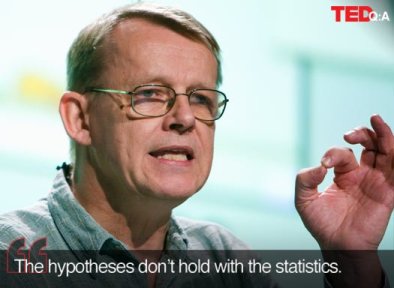
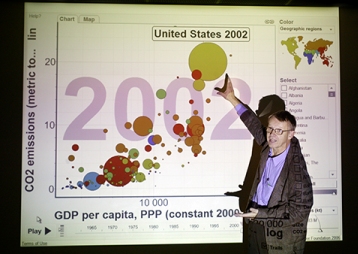
Hans Rosling: Information WizardIf you thought Al Gore was a data-happy geek, you should see Hans Rosling in action.
The Swedish medical researcher has a way with numbers. He brings heavy and dreary statistics into life using a combination of animated graphics and equally animated presentations. With the drama and urgency of a sportscaster, he uses a new presentation tool called Gapminder to debunk various myths about world – economic development, disparities and how well (or poorly) we share our planet’s resources.
Hans Rosling is Professor of International Health at Karolinska Institutet (which awards the Nobel Prize in medicine), but it’s his other role – as Director of the Gapminder Foundation – that he plays ‘statistics guru’ to the whole world. If you’re perplexed by lots of numbers, he’s the man who can make sense of it all.
In some ways, Rosling and Gapminder present in live action – and on video – what the Atlas of the Real World attempted to do in 2D maps: show the world as it is, with little or no distortion or misconceptions. That effort, published in late 2008, uses software to depict the nations of the world, not by their physical size, but by their demographic importance on a range of subjects.
I’ve watched a number of Rosling talks on video online. He makes no attempt to conceal his Scandinavian accent, and his English grammar is not always perfect. But it doesn’t matter: the guy has such mastery over his ideas and statistics, and a great stage presence too. He’s profound and funny at the same time, without being condescending that most experts and especially professors are.
Here’s an example of Rosling at his best: recorded in February 2006 in Monterrey, California:
No more boring data: TEDTalks
Rosling’s quest to use numbers to shatter stereotypes of rich and poor countries has brought him global prominence. He was one of the world’s “100 most important global thinkers” of 2009, according to Foreign Policy Magazine.
Look, no magic here!Rosling was honored at #96 on the list for “boggling our minds with paradigm-shattering data“. The list is topped by (1) Ben Bernanke, the chairman of US Federal Reserve for his actions to turn the US depression and (2) President Barack Obama for “for reimagining America’s role in the world.”
Foreign Policy noted: “Rosling is well known for his energetic lectures, in which he narrates mind-blowing statistics on development and public health — as they literally move across a screen. Imagine x-y axes filled with data points, each representing a country. As time passes, the dots move, realigning to show changes in child mortality, percentage of paved roads, unemployment rates, or pretty much any other metric you can imagine.”
Here are some more examples of Rosling magic:
200 years that changed the world (with Hans Rosling)
For the first time, Gapminder can now visualize change in life expectancy and income per person over the last two centuries. In this Gapminder video, Hans Rosling shows you how all the countries of the world have developed since 1809 – 200 years ago.
Hans Rosling on HIV: New facts and stunning data visuals
Hans Rosling unveils new data visuals that untangle the complex risk factors of one of the world’s deadliest (and most misunderstood) diseases: HIV. He argues that preventing transmissions — not drug treatments — is the key to ending the epidemic.
Hans Rosling: Asia’s rise — how and when
This is one of the funniest Rosling talks I’ve watched online so far. Speaking at TEDIndia in November 2009, Rosling recalled how he was a young guest student in India when he first realized that Asia had all the capacities to reclaim its place as the world’s dominant economic force. He graphs global economic growth since 1858 and predicts the exact date that India and China will outstrip the US.
Note:
Rosling and Gapminder developed the Trendalyzer software that converts international statistics into moving, interactive and enjoyable graphics. The aim is to promote a fact-based world view through increased use and understanding of freely accessible public statistics. His lectures using Gapminder graphics to visualise world development have won awards by being humorous yet deadly serious. The interactive animations are freely available from the Foundation’s website. In March 2007 Google acquired the Trendalyzer software with the intention to scale it up and make it freely available for public statistics. Google has since made available as Motion Chart, a Google Gadget.
I sometimes wish Life came with its own progress bar. [tweetmeme]
You know, that now familiar indicator on computer screens that shows how much of a task is done, and estimates what more remains — and for how long.
Wouldn’t it be interesting to know how much of our life is still left?
I’m not alone in this wish. In fact, whole cottage industries – such as astrology and palmistry – thrive on this universal curiosity to know what’s next, and what’s round the corner for ourselves.
Yet there is no known system of knowledge, or a proven technology, that can give us a customised, accurate answer. Everything that claims to do this is nothing better than a clever guess. Often, it’s not even that and only a complete rip-off…
The Undiscovered Country...Then again, do we really want to know when we’re going to reach the end of the line (whether or not the mission is accomplished)?
Years ago, I watched a Star Trek episode that involved a world where everyone died at the same age. So all living persons knew how much time they had left, allowing them to sort their lives before it was too late.
I don’t think I’d want to live there. Not knowing how much of my life is left, and what’s in store for me in that remainder, makes living more interesting. Besides, I doubt if the chaos theory and randomness of the universe will ever allow such precise advance knowledge of anyone’s future…
As I turn 44 years today, I Googled for ‘progress bar + life’. Just for the heck and kick of it. I didn’t really expect to find an exact match, but I did. That’s the wonder of the web…
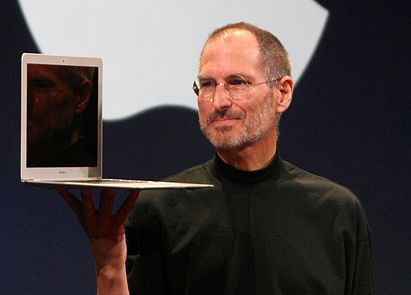
Always in a hurry?Perhaps the inspiration came from Top Geek Steve Jobs, who is quoted on this website as saying: “Remembering that I’ll be dead soon is the most important tool I’ve ever encountered to help me make the big choices in life”
Still in the realm of marginally useful web apps, I also discovered timeanddate.com some weeks ago: it allows counting down or counting between any two dates. The result can be in days, hours, minutes or – for those who prefer such precision in their lives – even in seconds.
They tell me that I am exactly 16,071 days old today. Not a neat round figure as being 44 years, but there we are. (I somehow thought I’d lived for more days than that, but a quick manual calculation showed they are right.)
These counts are all very abstract anyway: our days and years are peculiar to the Earth — these measurements have no meaning beyond our home planet. Planetary rotation defines a day, while its revolution around the local star (in our case, the Sun) defines a ‘year’.
Another website, maintained by San Francisco’s excellent Exploratorium, allows me to calculate how old I would be if I lived on other planets of the Solar System where the rotation and revolution are different.
According to them, if I were to travel to the two planets closest to ours, I would be aged: 71.5 Venusian years on Venus; and 23.3 Martian years on Mars.
And if I want to melt my years away, I have to travel further to the outer planets: on Jupiter, I will be 3.7 Jovian years, and I’ll not even be 2 in Saturnian years! Wow…
On second thoughts, I think I’ll just stay on here.
“Pictures are for entertainment, messages should be delivered by Western Union.”
Those words by American film producer and studio founder Sam Goldwyn (1879-1974) sum up Hollywood’s attitude to movie-making for the past many decades.
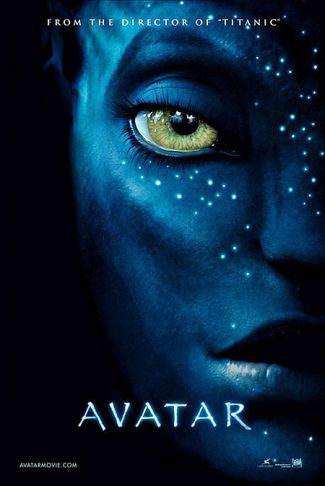
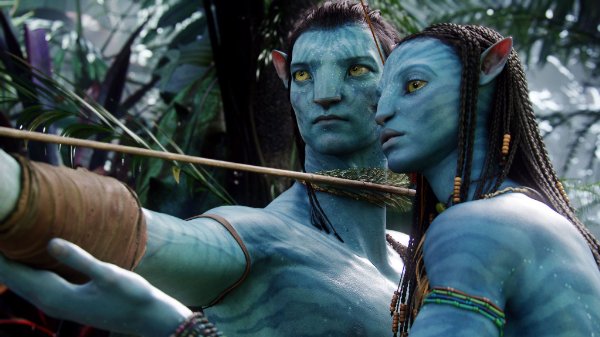
As I watched James Cameron’s latest blockbuster movie Avatar, I kept wondering how the master film maker managed to subvert this so completely. Beneath the 3D, special effects and riot of other worldly colours, the movie is one long (2 hrs 40 mins) and powerful commentary on why might is not right when it comes to exploiting resources — belonging to other countries, people, or as in this case, other worlds.
This is not just another worthy indie movie made by an idealistic movie maker defiant of Hollywood traditions and big money. James Cameron is one of the most commercially successful directors in the mainstream film industry – and perhaps one of the very few who can get away with this kind of stunt. At a budget of over US$ 300 million , Avatar is one of the most expensive films ever made, and the costliest ever for 20th Century Fox.
The big gamble is certainly paying off. On 26 January 2010 came the news that Avatar has surpassed Titanic as the highest-grossing movie worldwide. According to the studio, worldwide box office total for Avatar at that point stood at US$1.859 billion, beating the US$1.843 billion racked up by Cameron’s romantic drama in 1997-98. Avatar broke that record in a little over six weeks.
Part of the reason for such appeal is the extraordinary special effects: it’s an action-packed thriller where good and evil battle it out on another planet. The strange landscapes give it a video game like feel, but no small screen can match the theatrical experience, especially if you watch it in IMAX 3D (I didn’t). And for a change, this time the aliens inhabiting planet Pandora are benign, while it’s the humans who are ruthless invaders and brutal killers. Well, at least most of the time…
Here’s the official blurb: “Avatar takes us to a spectacular world beyond imagination, where a reluctant hero embarks on an epic adventure, ultimately fighting to save the alien world he has learned to call home. James Cameron, the Oscar-winning director of Titanic, first conceived the film 15 years ago, when the means to realize his vision did not exist yet. Now, after four years of production, AVATAR, a live action film with a new generation of special effects, delivers a fully immersive cinematic experience of a new kind, where the revolutionary technology invented to make the film disappears into the emotion of the characters and the sweep of the story.”
And here’s AVATAR – Official International Launch Trailer (HD)
Film critics and social commentators around the world have noticed the many layers of allegory in the film. Interestingly, depending on where you come from, the movie’s underlying ‘message’ can be different: anti-war, pro-environment, anti-Big Oil, anti-mining, pro-indigenous people, and finally, anti-colonial or anti-American. Or All of the Above…
It looks as if Cameron has made the ultimate DIY allegory movie: he gives us the template into which any one of us can add our favourite injustice or underdog tale — and stir well. Then sit back and enjoy while good triumphs over evil, and the military-industrial complex is beaten by ten-foot-tall, blue-skinned natives brandishing little more than bows and arrows (and with a little help from Ma Nature). If only it works that way in real life…
But the multi-purpose allegory is apparently working well. Take these two from opposite sides of the planet:
Thomas Eddlem wrote in The New American: “Avatar, is a visually stunning epic that is a perfect allegory for any of a dozen or more Indian wars in American history. From King Philip’s War in New England to Tippecanoe in Indiana to Horseshoe Bend in Alabama — and all the way across the American continent, for that matter — the story was the same. Colonists simply take land from the natives, as the Sully explains: ‘This is how it’s done. When people are sitting on something that you want, you make them your enemy so that you can drive them out.’
Mayank Shekhar wrote in The Hindustan Times newspaper: “Between a green worldview and the globe’s war over a natural resource, James Cameron’s twin analogies of present-day politics are fairly complete. They lend his science fiction ‘event picture’ a certain soul, even if not much of a story line.”
So did Cameron set out trying to send a message? Or was it all an incidental byproduct? Listen to the director himself in these two online video stories:
James Cameron’s Vision Featurette
CBS Interview with James Cameron: From Titanic to Avatar
The most compelling social commentary on Avatar I have so far read comes from Naomi Wolf, the American political activist, author and social critic. In an op ed essay written for Project Syndicate, she sees two revealing themes in Avatar: “the raw, guilty template of the American unconscious in the context of the ‘war on terror’ and late-stage corporate imperialism, and a critical portrayal of America – for the first time ever in a Hollywood blockbuster – from the point of view of the rest of the world.”
She adds: “In the Hollywood tradition, of course, the American hero fighting an indigenous enemy is innocent and moral, a reluctant warrior bringing democracy, or at least justice, to feral savages. In Avatar , the core themes highlight everything that has gone wrong with Americans’ view of themselves in relation to their country’s foreign policy.”
And is Avatar the most expensive piece of info-tainment or edu-tainment ever made, just like the Lord of the Rings trilogy was one long (even if unintended) commercial for the breathtaking sights and sounds of New Zealand?
Certainly, mixing messages with entertainment is such a difficult and delicate art that most people who dabble in it fall between the two stools. The entertainment value of Cameron’s latest flick is not in question. Granted, it’s not as heart-breaking as Titanic, and the storyline is oh-so-predictable. But 3D and SFX magic alone can’t hold today’s audiences gripped for 160 long minutes. And if the underlying story starts movie-goers thinking and talking about many parallels between the fictional world of Pandora and our own Earth, he’s certainly getting somewhere.
As Naomi Wolf says: “Ironically, Avatar will probably do more to exhume Americans’ suppressed knowledge about the shallowness of their national mythology in the face of their oppressive presence in the rest of the world than any amount of editorializing, college courses, or even protest from outside America’s borders. But I am not complaining about this. Hollywood is that powerful. But, in the case of Avatar , the power of American filmmaking has for once been directed toward American self-knowledge rather than American escapism.”
Perhaps this wasn’t part of the script, but would the executives at 20th Century Fox care as they laugh all the way to their bank?
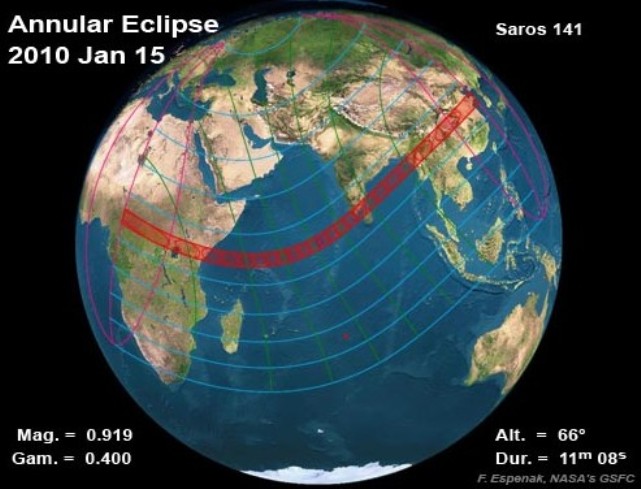
Where the island of Sri Lanka was concerned, it was the first solar eclipse of the broadband internet era — and that showed.
The last solar eclipse seen in Sri Lanka was two generations ago, on 20 June 1955. That was almost pre-historic in mass media terms. The newly independent Ceylon had a single, state-owned radio station and a handful of newspapers. There was no television, and the internet was not even conceived.
Yet, paradoxically, the media’s influence over the 8 million people then living on the island seem to have been greater at the time. As astronomer Dr Kavan Ratnatunga recalled: “A quack physician cum astrologer, recommended that women wanting to become fair and lovely should drink a decoction of which the main ingredient was “Vada Kaha” (Sweet Flag or Acorus Calamus) at the time of the total eclipse, preferably unseen by others. Many who took his advice ended up in hospital.”
Solar eclipse on 15 Jan 2010 seen in Anuradhapura, north-central Sri Lanka - photos by ReutersIn contrast, in 21st Century Sri Lanka, the January 15 eclipse was not much of a news story. I don’t claim to have done a systematic analysis, but my impressions are drawn from scanning the major newspaper websites in English and Sinhala, and surfing the dozen or more terrestrial (free-to-air, not cable) TV channels that were on the air during the three hours or so of the eclipse. (Sorry: I missed out radio, and I’m not proficient in Tamil.)
Broadcast television was my biggest disappointment. Solar eclipses are a visual spectacular, and literally heaven-sent for live television. Yet, not a single Lankan TV channel carried a live broadcast of the event, either from northern Sri Lanka where it was best seen (in its annular form, with ‘ring of fire’ effect), or from elsewhere on the island as a partial eclipse.
It seemed as if the Colombo-based media were completely preoccupied with the intense build-up to the presidential election scheduled for 26 January 2010 — a case of politics eclipsing the solar eclipse?
Jaffna school children view the solar eclipse - Photo courtesy Virakesari
But there were a couple of honourable exceptions – and thank heavens for that! One was the leading Tamil daily Virakesari, which sponsored an expedition to Jaffna, in northern Sri Lanka, by a group of professional and amateur astronomers from SkyLk.com. According to one member of this expedition, Thilina Heenatigala, this newspaper provided the widest and most uptodate coverage of the annular eclipse from Jaffna.
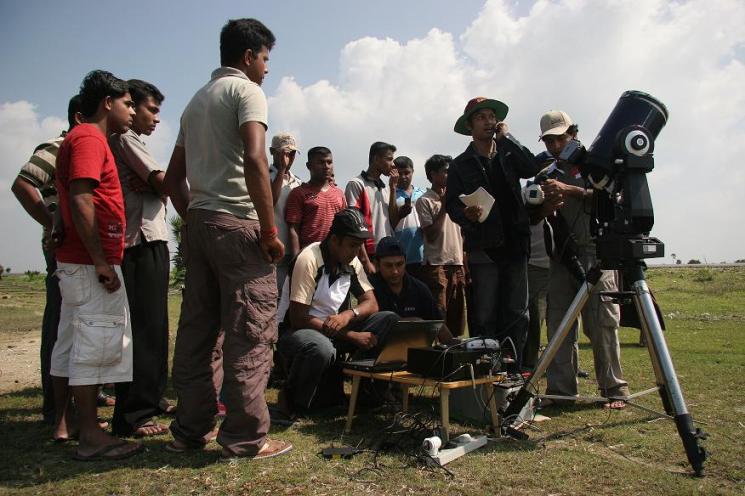
SkyLk.com collaborated with the Hindu College in Jaffna, whose playground was converted into an open air observation camp. Thilina says over 2,000 people – including school children and adults – had converged to witness the event. A large screen was set up on to which the live image from a telescope was projected.
Not far from there, a group of engineering students and teachers from the University of Moratuwa was doing a more scientific observation. Later that day, team leader Dr Rohan Munasinghe reported in an email: “We have recorded the solar eclipse from Kayts (lat 9d,37m N, Long 79d,58 E), the biggest island off Jaffna Sri Lanka. We have timestamped the video with GPS (Garmin 18) accuracy.”
University of Moratuwa team observing the clipse - photo courtesy Dr Rohan Munasinghe
Elsewhere across the island of Sri Lanka, there was plenty of interest among the people from all walks of life — as seen from the thousands who stepped out during mid-day to take a peek at the celestial phenomenon. Not all of them followed the safety precautions to prevent eye damage, disseminating which the media had done a good job in the preceding days.
Clearly, this high level of public interest was not reflected in how the rest of Lankan mainstream media covered the eclipse. But if the mainstream media’s gaze was firmly fixed on the gathering election storm on the ground, the new media created opportunities for others to step into that void. Citizen scientists joined hands with citizen journalists to capture and share the eclipse with each other — and the world. These unpaid enthusiasts used commonly available digital tools and online platforms for this purpose.
Some of them uploaded dozens of photos for public viewing on image sharing sites like Flickr. A good example is what Shehal Joseph and Romayne Anthony did. There were many others.
SkyLk.com group was more ambitious: they actually webcast the eclipse live online from their public observation camp at Hindu College grounds. Stuck in Colombo with its sub-optimal viewing conditions for this eclipse, this was the best chance for people like myself to catch the annular part of the phenomenon.
“We were struggling with bandwidth limitations most of the time,” Thilina Heenatigala says. “We used a Dialog HSPA modem to connect to the web, and line speeds kept fluctuating. We were not the only ones uploading still photos or video to the web from different locations in northern Sri Lanka — and apparently all of us were slowing down each other.”
Being the tech-savvy planner he is, Thilina had alerted Dialog telecom company about the likely peaking of bandwidth demand. But he is not sure if any temporary enhancing was done, even though Dialog currently claims to be the ‘first and best’ to offer telecom coverage in the north. Certainly, the live eclipse webcast was not of uniform quality — it’s a small miracle it happened at all: until a few months ago, this was part of the theatre of war in northern Sri Lanka.
In fact, SkyLk.com had used the web to build up public awareness and interest using video trailers on YouTube. Here is one of several simulations they had up from December, thus one for Anuradhapura, Sri Lanka (simulation):
In the end, however, SkyLk.com became a victim of its own success. The live webcast was followed by hundreds, and then thousands of online visitors from different parts of the world. This apparently overshot the usual allocations provided by the offshore hosting company (in the US), which suspended the account. Right now SkyLk.com website is not accessible (as at 16 January 2010, 15:00 UTC/GMT).
Within hours of the eclipse, several individuals and groups also uploaded highlights of their eclipse videos on to the YouTube. Here are the most striking ones I came across in a quick search:
Solar Eclipse 2010 Sri Lanka Scientific Record – by University of Moratuwa
Scientific recording of the annular solar eclipse on 15 January 2010 was carried out from the Island Kayts (Lat +09d 37m North and Long +79d 58m East) of Sri Lanka.
Orion Video’s coverage from Nallur, Jaffna:
Not in the same league as the above two videos, this was Nishan Perera’s personal observations from Ratnapura, south-western Sri Lanka:
It’s too early to draw firm conclusions from this random evidence, but in all likelihood, we passed thresholds in both citizen journalism and citizen science with this eclipse. Clearly, the mainstream media’s monopoly/domination over reporting of such an event has been shattered: their indifference will no longer stand in the way of information and images being disseminated.
Perhaps just as important, it is no longer possible for a couple of self-appointed ‘public astronomers’ to dominate the public information channels on an occasion like this, mostly for shameless self-promotion. As Dr Kavan Ratnatunga, President of the Sri Lanka Astronomical Association, noted in an article: “I am amazed as to how many who have never even seen a Solar Eclipse, will gladly talk about it to an equally ignorant journalist, resulting in some totally misleading and sometimes hilarious information being published in both the English and Sinhala media. In a nation which believes in pseudo astrology, I am sure it is just a matter of time before quacks start using it to predict influence on local events and politics. However, there is absolutely no influence on any person by any of these celestial events.”
At the end of the day, however, astronomy aficionados are emphatic that no amount of media coverage can really substitute the experience of being there and experiencing it ourselves. As Kavan says: “A solar Eclipse is event which must be experience and observed. No video can do justice to that experience. It can also become addictive. In the modern age when the Internet and TV can bring events to your home, one may wonder why some Eclipse chasers travel round the world to see an Eclipse of the Sun.”
The next solar eclipse visible from Sri Lanka will be on 26 December 2019. I wonder what kind of media and ICT landscape would cover that event…
We all have a bad day every now and then. Each one has different ways of coping with it – some curse the government, others blame their karma, and still others just play sport or music to soothe the mind.
This past Season, two astronomically inclined friends showed me a new way of coping with the assorted problems of our imperfect world and unfair life.
First, Rex I de Silva – diver, naturalist and amateur astronomer who was a citizen scientist before the term was invented – sent me this clever piece of animation that originated in Australia. He wrote: “It’s so very well done that most folks don’t realize how much info is being shared! Just click on the link below….but with your computer’s speakers on. We are on quite a ride….It’s not over till it asks if you want to view again.”
Then, Thilina Heenatigala – one of the most active astronomy and space enthusiasts in Sri Lanka – informed me that the original Galaxy Song was sung by Eric Idle from Monty Python’s Meaning of Life (1983), with graphics from NASA of flying through the universe.
So here it is, the film version from YouTube:
If the real images are not awe-inspiring enough, here’s an animated version of the same song that I discovered on my own while exploring that rapidly expanding online video galaxy – it features ‘Pinhead’ from RProduction13’s animated short series, “The Four”.
Whenever life gets you down, Mrs. Brown,
And things seem hard or tough,
And people are stupid, obnoxious or daft,
And you feel that you’ve had quite eno-o-o-o-o-ough…
Just remember that you’re standing on a planet that’s evolving
And revolving at nine hundred miles an hour,
That’s orbiting at nineteen miles a second, so it’s reckoned,
A sun that is the source of all our power.
The sun and you and me and all the stars that we can see
Are moving at a million miles a day
In an outer spiral arm, at forty thousand miles an hour,
Of the galaxy we call the “Milky Way”.
Our galaxy itself contains a hundred billion stars.
It’s a hundred thousand light years side to side.
It bulges in the middle, sixteen thousand light years thick,
But out by us, it’s just three thousand light years wide.
We’re thirty thousand light years from galactic central point.
We go ’round every two hundred million years,
And our galaxy is only one of millions of billions
In this amazing and expanding universe.
(Animated calliope interlude)
The universe itself keeps on expanding and expanding
In all of the directions it can whizz
As fast as it can go, at the speed of light, you know,
Twelve million miles a minute, and that’s the fastest speed there is.
So remember, when you’re feeling very small and insecure,
How amazingly unlikely is your birth,
And pray that there’s intelligent life somewhere up in space,
‘Cause there’s bugger all down here on Earth.
Composers: Eric Idle & John Du Prez
Author: Eric Idle
Singer: Eric Idle
From the ‘Meaning of Life’ album, MCA Records MCA 6121
I have no idea who Mrs Brown is, but it sure works for me too!
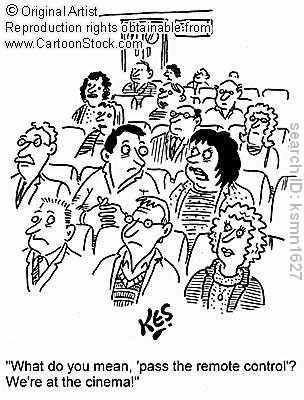
Going to the movies has been a shared cultural activity for at least four generations. In that time, technology has marched forward in leaps and bounds — but the core experience remains the same. And we still keep going to the movies, at the cinema, even though we now have other ways of seeing the same films. Why?
On the penultimate day of 2009, I went to the local cinema to see 2012, Roland Emmerich’s latest depiction of the mother of all disasters. For 158 gripping minutes, I willingly suspended disbelief and allowed the myth-makers of Hollywood to thoroughly scare me out of my wits. As did, it seemed, the few hundred other people watching it on wide screen with surround sound. There is no way the literally earth-shattering scenes of this movie would seem and feel remotely realistic anywhere else…
But cinemas are far from perfect – for instance, we had put up with a bunch of screaming brats whose parents had unwisely brought them for the wrong kind of movie. I’ve sat through far more noisy and boorish behaviour at cinemas: notable among them is watching Titanic at a massive, packed cinema in downtown Mumbai sometime in 1998 — and discovering how ‘interactive’ Indian movie-goers can get. (After the initial irritation wears off, I became almost oblivious to the distractions, thanks to James Cameron’s superb story telling.)
I just refuse to see such blockbusters on a small screen. (Ok, I might watch movies on long flights when I get tired of reading, but I have never been able to bring myself to watching a movie on an ipod…)
In fact, the movie industry is as much caught up in the digital wave as all other aspects of media. As Manohla Dargis of the New York Timesnoted in a perceptive essay this week: “How much our world of moving-image entertainment has changed in the past decade! We now live in a world of the 24-Hour Movie, one that plays anytime and anywhere you want (and sometimes whether you want it to or not). It’s a movie we can access at home by pressing a few buttons on the remote (and agreeing to pay more for it than you might at the local video store) or with a few clicks of the mouse. The 24-Hour Movie now streams instead of unspools, filling our screens with images that, more and more, have been created algorithmically rather than photographically.”
Yet, unlike in other media experiences, the changes in the movie industry have gone largely unnoticed by ordinary viewers. As Dargis writes: “Film is profoundly changing — or, if you believe some theorists and historians, is already dead — something that most moviegoers don’t know. Yet, because the visible evidence of this changeover has become literally hard to see, and because the implications are difficult to grasp, it is also understandable why the shift to digital has not attracted more intense analysis outside film and media studies.”
Dargis is probably right: by adapting and evolving with the times, the cinema has survived for over a century. As Donald Clarke noted in The Irish Times at the beginning of December 2009: “Television failed to kill movies. Video failed to kill movies. Internet piracy – not to mention all the other diversions available online – has also failed to annihilate this most stubbornly resilient of art forms. Film-makers will, it is true, tell you that it is now more difficult than ever to negotiate financing for movies that cost between $3 million and $15 million. But you couldn’t say that the current recession has crippled the movie business.”
All this makes me wonder what movie-going might be like in another decade or two. 3D and IMAX are no longer so uncommon or special, and the entertainment industry is working hard to relate to not just our seeing and hearing, but other senses as well. (Did you know that, as long ago as 1960, they tried to introduce smelling movies? Smell-O-Vision was a system that released odors during the projection of a film so that the viewer could “smell” what was happening in the movie. The technique injected 30 different smells into a movie theater’s seats when triggered by the film’s soundtrack. For some reason, it never caught on…)
Perhaps it’s not simply a matter of money or technology. There is also a whole sociology of movie going and movie watching – many of us go to the cinema (not nearly often enough in my case) not just for the personal sensory experience of a celluloid dream, but also for the shared experience of it. I like bumping into friends at cinemas. At a premiere or special screening, I also get to steal a few glimpses of the glitterati of the film world.
Have you been to a film musical and had the uncontrollable urge to burst into song? London’s Prince Charles Cinema not only allows, but encourages viewers to do just this — though only on certain days of the month. Their most famous offering is Sing-a-long-a Sound of Music: a few years ago, I joined several hundred other assorted ‘nuns’, von Trapp family members and Julie Andrews look-a-likes in such a memorable experience. I have the digitally remastered DVD of the 1965 movie, an ever-green title in my household. But watching it at home can’t compare with the sense of community that one feels when the lyrics for all the songs appear on the movie screen, giving the audience every reason to sing their hearts out…
I’m not sure how popular (or even acceptable) such community movie watching would be in different cultures. But going to the movies retains its charm and appeal in this digital age, even if we have come a long way since the glorious days of movie going as captured in this wonderful and memorable song from the musical Annie (1982) – Let’s Go To The Movies
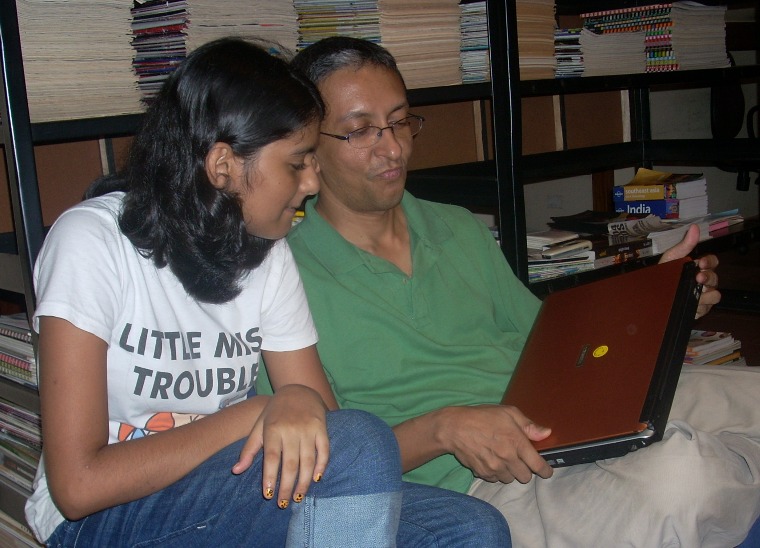
Dhara and Nalaka with their old faithful Toshiba, 24 Dec 2009 - Photo by Niroshan Fernando
For many of us, computers have become essential silicon extensions of our carbon selves — and we can’t imagine how we managed our work and leisure before their arriva. In my case, the attachment to my laptop goes beyond professional: it’s also my constant companion and travel partner.
So it’s akin to a death in the family when the old faithful finally goes the way of…all silicon. In 20 years of laptop use, I have mourned six: the average productive lifespan seems to be between three and four years. (Confession time: I have a cabinet full of very tired and fully expired laptops, mostly Toshiba.)
The latest calamity happened in early December, pushing me into a few days of digital turbulence just when I was trying to tie up various loose ends in what has been another hectic year. Fortunately, no data were lost, and I eventually managed a fairly orderly transfer.
It didn’t come entirely as a surprise. My Toshiba Satellite Pro (model A100) had been showing signs of wear and tear for a few months. The laptop screen is usually the first to develop problems of old age, but switching to a new machine is such a chore (and expense) that I was willing to live with an occasionally misbehaving display. But when bigger and deeper problems manifested – which our IT Manager Indika found were due to a malfunctioning motherboard – it was time to let go…
When I bought my latest Toshiba in mid 2006, I didn’t immediately like its metallic orange colour. I’d been using laptops with silver or electric blue coloured exteriors, and this was a clear departure from that range. But my female colleagues thought orange was rather ‘cool’. I didn’t easily warm up to this colour shift — until I realised the potential for some harmless fun.
Every few weeks, someone would ask me – inevitably, in the ICT circles that I move — whether I used Apple (the geekdom’s ultimate standard). For the past three and a half years, my honest yet confounding answer has been: ‘No, I’m perfectly happy with my Orange!’
Of course, my affection for the laptop was a lot more than skin deep. It has been an integral part of much of what I did professionally and personally in the past three and half years, both online and offline. My substantial volume of published output (op ed essays, book chapters, reviews and film scripts, etc.) took shape within it before flowing out in many and varied directions. I also generated a good deal of unpublished material, all of which is safely stored but not yet ready to see the light of day…
It has travelled the world with me, going through hundreds of airports and keeping me much needed company in endless hotel rooms, conferences and meetings.
It has been my confidante in times of crisis – and the past 1,300 days have been among the most tumultuous in my personal and professional lives. While I’m not a social recluse, and cherish the company of my few close (human) friends, it’s sometimes nice to just pour my heart out to someone who listens, doesn’t judge and never resorts to wisecracks or amateur psychology…
Assigning a gender isn’t that simple when I wasn’t the only regular user of the recently departed Toshiba. That is also another good reason why I was more attached to the last laptop than any of its predecessors: it’s the first machine that connected my Digital Native daughter Dhara to the internet. It arrived within days of her 10th birthday, and I finally ran out of excuses why she shouldn’t go online and get a digital life. (As I reported a few weeks ago, she has since made rapid progress.)
So it was rather apt that Dhara should come up with the perfect epitaph for our beloved, sorely missed silicon companion. It isn’t quite original, but sums up our shared sentiments very well: RIP: Rust In Peace…
PS: Rust in Peace is also the title of an interesting collection that New York magazine recently published of everyday stuff rendered obsolete in the first decade of this century. Among the 17 items listed are the fax machine, audio cassette, answering machine, cathode ray tube TV and incandescent bulb…
















 Open Minds!