Op-ed essay originally published by the Communications Initiative (CI) on 12 Dec 2013 and reprinted in Ceylon Today newspaper on 17 Dec 2013.
Image courtesy – ICTD Cape Town 2013 website
Nelson Mandela was not only an effective communicator, but also a champion of communication for development.
He spoke and wrote with conviction and empathy, which in turn enhanced his credibility and appeal. He changed history with his careful choice of words and images delivered with the right degree of passion. Social communicators can learn much from him.
However, his communications prowess extended beyond thoughtful prose and skillful oratory. He also understood the power of mass media in today’s information society — and used it well for nation building.
When they are in office, many political leaders of the majority world tend to overuse or misuse the media, for example by forcing public broadcasters to peddle ruling party propaganda. During his term as South Africa’s president, Mandela carefully avoided such excesses.
Instead, he strategically tapped the country’s pluralistic broadcast media to unify the divided nation. Clint Eastwood’s 2009 movie Invictus re-enacted a highlight of that approach.
As a policy maker, Mandela grasped the role of communication in development – both the concepts and delivery tools.
The International Telecommunications Union (ITU), the UN agency promoting and tracking the progress of information society, recently saluted Mandela for having been a firm supporter of ICTs as a catalyst for social change and economic development.
At the same time, Mandela’s vision went beyond mere gadgets and telecom networks. Speaking at the ITU Telecom World in Geneva in 1995, he underlined the importance of communication and access to information to human beings. He called for eliminating the divide between information-rich and information-poor countries.
Three years later, while hosting ITU Telecom Africa in Johannesburg, President Mandela said: “As the information revolution gathers yet more pace and strikes deeper roots, it is already redefining our understanding of the world. Indeed, the speed of technological innovation could bring the ideal of the global village sooner than we thought possible. For the developing world, this brings both opportunity and challenge.”
Lofty statements like these are common at policy gatherings. But Mandela went further – and believed that communication should be seen as a basic human need. That set him apart from many members in the development community who have long considered it a secondary need.
Although it has been discussed for centuries, there is no universally accepted definition of basic human needs. During the 1970s, basic needs emerged as a key topic in development debates. Various studies — catalysed by UN agencies and the Club of Rome – tried to define it.
In 1976, the International Labour Organisation (ILO) prepared a report that identified basic needs as food, clothing, housing, education and public transportation. It partially drew on ILO’s country reports on Columbia, Kenya and Sri Lanka.
Since then, different development agencies have adopted variations of the original ILO list. National planners have used the concept to benchmark economic growth.
The ground reality has changed drastically since those heady days. About a year ago, I asked Frank La Rue, the UN Special Rapporteur on Freedom of Opinion and Expression, if communication should be considered a basic human need. He welcomed the idea, especially in view of rapid evolution of information society.
I soon found that Mandela had thought of it years earlier. Perhaps because he had such limited access to communication during his long years in prison, he appreciated its central value to all human beings.
That remark, made while opening a mobile telecom network, was rather perceptive. At the time, less than 1 per cent of all Africans had access to a fixed phone, and there were only around one million mobile phones on the continent of 800 million.
Since then, mobile phones and other low-cost digital tools have spread phenomenally, transforming lives and livelihoods across the majority world. Sullivan calls it an external combustion engine: “a combination of forces that is sparking economic growth and lifting people out of poverty in countries long dominated by aid-dependent governments.”
While the market and society have marched ahead, many development professionals are still stuck in obsolete development paradigms. That is probably why some worry that there are more mobile phones than toilets in India. (So what? Mobiles are personal devices; toilets are a shared household amenity. Comparing their numbers is meaningless.)
It’s high time we revisited basic human needs and redefined them to suit current realities. The development community must finally catch up with Nelson Mandela.
Science journalist and development communicator Nalaka Gunawardene has been following social and cultural impacts of ICTs for over 20 years.
Can Development Community Catch up with Nelson Mandela – Ceylon Today, 17 Dec 2013
My Sunday (Sinhala) column in Ravaya this week was on impressions of the National Media Summit 2012 held at the University of Kelaniya, Sri Lanka, on 24-25 May 2012. My own talk at the Summit, during a session New Media policies for Sri Lanka, was titled New Media, Old Minds: A Bridge Too Far?.
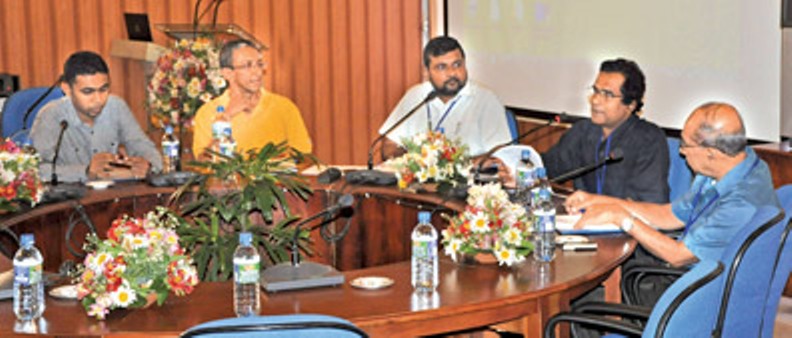
National Media Summit 2012 at University of Kelaniya, 25 May 2012 New Media, Old Minds: A Bridge Too Far?
This was the title of a presentation I made at National Media Summit 2012, at University of Kelaniya, Sri Lanka, this morning. I was asked to talk about New Media and policies for Sri Lanka.
In my audience were academics and researchers on journalism and mass communication drawn from several universities of Sri Lanka. I was told the biennial event is to help frame new research frameworks and projects.
Now, I’m not a researcher in the conventional sense of that term, and am fond of saying I don’t have a single academic bone in my body. Despite this, occasionally, universities and research institutes invite me to join their events as speaker, panelist or moderator.
University of Kelaniya, a state university in Sri Lanka, has the island’s oldest mass communication department, started in the late 1960s.
Perhaps inertia and traditions weigh down such places — while I had a patient hearing, I found our ensuing discussion disappointing. The historical analogies, policy dilemmas and coping strategies I touched on in my presentation didn’t get much comment or questions.
Instead, rather predictably, the ill-moderated discussion meandered on about the adverse social and cultural impacts of Internet and mobile phones and the need to ‘control’ everything in the public interest (where have I heard that before?).
And much time was wasted on debating on what exactly was new media and how to define and categorise it (I’d argued: it all depends on who answers the question!).
Part of the confusion arose from many conflating private, closed communications online (e.g. Facebook) with the open, more public interest online content (e.g. news websites). Similarly, the critical need for common technical standards (to ensure inter-operability) was mistaken by some as the need for dull and dreary orthodoxy in content!
Concepts like Citizen Journalism, user-generated content, privacy, right to information were all bandied around — but without clarity, focus or depth. Admittedly we couldn’t cover everything under the Sun. But we didn’t even discuss what options and choices policy makers have when confronted with rapidly evolving new media types.
Half anticipating this, I had included a line in my talk that said: “Academics must research, analyse & advise (policy makers). But are Lankan academics thought-leaders in ICT?”
I was being a polite guest by not explicitly answering my own question (but as a helpful hint, I mentioned dinosaurs a few times!). In the end, my audience provided a clear (and sadly, negative) answer: far from being path-finders or thought-leaders, they are mostly laggards who don’t even realise how much they have to catch up!
And some of them are framing Lankan media policy and/or advising government on information society issues. HELP!
Don’t take my word for it. Just try to find ANY online mention of National Media Summit 2012 that just ended a few hour ago. Google indexes content pretty fast these days — but there is NONE that I can find on Google as May 25 draws to an end (except my own PPT on SlideShare!).
Phoning each other during personal or shared emergencies is one of the commonest human impulses. Until recently, technology and costs stood in the way. No longer.
We now have practically all grown-ups (and some young people too) in many Asian countries carrying around phones or having easy, regular access to them. For example, Sri Lanka’s tele-density now stands at 106.1 phones 100 people (2011 figures).
What does this mean in times of crisis caused by disasters or other calamities? This is explored in a short video I just made for LIRNEasia:
Synopsis:
With the spread of affordable telecom services, most Asians now use their own phones to stay connected. Can talking on the phone help those responding to emergencies to be better organised? How can voice be used more efficiently in alerting and reporting about disasters? Where can computer technology make a difference in crisis management?
These questions were investigated in an action research project by LIRNEasia in partnership with Sarvodaya, Sri Lanka’s largest development organisation. Experimenting with Sahana disaster management software and Freedom Fone interactive voice response system, it probed how voice-based reporting can fit into globally accepted standards for sharing emergency data. It found that while the technology isn’t perfect yet, there is much potential.
In December 2003, on the eve of the World Summit on the Information Society (WSIS), I did a wide-ranging interview with Sir Arthur Clarke on satellite TV, internet, censorship and other challenges of emerging information societies. It was published in One World South Asia on 5 December 2003.
I adapted into Sinhala parts of that interview for my Ravaya Sunday newspaper column last week (18 Dec 2011),making the point that much of what he said about satellite TV at the time is now equally relevant to the rapid spread of the Internet.
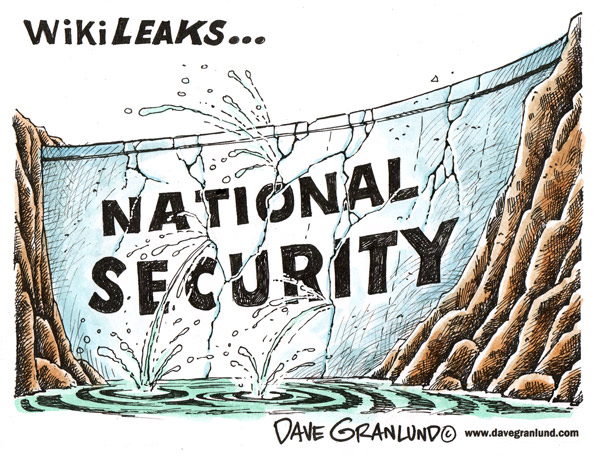
For this week’s column, appearing in the print edition for 25 Dec 2011, I have adapted more segments of that interview covering topics such as: violence in society and media’s role; educational potential of television; does satellie TV spread cultural imperialism; and how technology – not politicians or generals – now determine the free flow of information across borders. This cartoon, drawn by David Granlund a year ago, aptly captures that last point!
A welcome dam breach, this one! - cartoon by Dave Granlund
Who’s Afraid of Online Journalists? This was the provocative title of my presentation to a national media conference on media self-regulation in Colombo in September 2011, organised by Sri Lanka Press Institute. Speaking in the session devoted to online media, I argued that SLPI was ill-equipped to tackle online news content when it lacked even full representation of the mainstream print media in Sri Lanka, and had no representation whatsoever from the radio and TV broadcasters whose outreach far outstrips that of print.
This is the Sinhala text of my weekly column in Ravaya newspaper of 20 Nov 2011. This week, I continue our discussion on Internet freedom: what can – and must – be regulated online, and how regulation is fundamentally different from control and censorship. I insist that conceptual clarity is as important as technical understanding of how the Internet works.
Have smartphone, will travel...Just how many Internet users are there in Sri Lanka?
Looks like a simple question, but there’s no simple answer. Trust me, I’ve been looking.
Oh sure, it’s not possible to calculate such numbers precisely because there always are more users than are subscribers. But official and industry sources usually have a good idea. In Sri Lanka’s case, their figures vary considerably.
The Telecommunications Regulatory Commission of Sri Lanka (TRCSL) is the official data collector. It used to publish a quarterly compendium of telecom industry related statistics.
The last such report, for December 2010, cites these cumulative figures for the whole of Sri Lanka by end 2010:
• Mobile phone subscribers: 17,359,312
• Fixed phone subscribers: 3,578,463
• Internet & Email Subscribers – fixed: : 280,000 (provisional figure)
• Mobile Broadband Subscribers: 294,000 (provisional figure)
Although for the same point in time (Dec 2010), it doesn’t tally. TRCSL’s own data, when we add up fixed and mobile subscribers of Internet, comes to 574,000.
Both these state entities seem to be hooked on “email users” — a throw-back to the early dial-up days when some subscribers simply signed up for email facility and didn’t want web browsing as the latter was more costly. As far as I know, that demarcation disappeared years ago. But I may be wrong.
Even if we take the highest case scenario, of a total 574,000 Internet subscribers (fixed and mobile), it still comes to less than 3 per cent of Sri Lanka’s total population of 20 million (exactly how many people live on the island will be known after the latest census is taken in December 2011).
That’s the number of subscribers. The number of users is usually higher. Assuming an average 3 users per subscription, we can imagine around 1.72 million (approx 8 per cent of population) getting online. This calculation brings us closer to the number given for Sri Lanka in the Internet World Stats website. It lists for Sri Lanka: “1,776,200 Internet users as of Jun/10, 8.3% penetration, per ITU.”
The ITU focal point in Sri Lanka is the TRCSL, whose own published data is mentioned above. What am I missing here?
A researcher friend who had access to Wireless Intelligence, a subscription only service containing well over 5 million individual data points on 940 operators (across 2,200 networks) and 55 groups in 225 countries, found yet another statistic.
According to WI, Sri Lanka by end 2010 had:
• 1,971,018 mobile broadband subscribers
• 213,000 fixed broadband subscribers
This produced a total of 2,184,018 — which takes the percentage of population to almost 11%. And if we apply the same average number of 3 users, it could give us 30% of population accessing and using the Internet. But is that assumption of 3 users per subscription equally applicable to mobile devices? I’m not sure. I’ll wait for industry experts to clarify.
In fact, neither industry sources and researchers have a reliable figure of how many smartphones are in use in Sri Lanka. Because a significant number comes in through private channels (via returning travellers or Lankan expatriates), the looking simply at the import figures could be misleading. A conservative estimate is that at least one million smartphones with Internet access capability are in use. The number keeps growing.
Exactly how many such smartphone users go online on a regular basis? What kind of info do they look up? How long on average do they stay online per session?
If you know the answers, or have reflected on these, please share.
Let’s hope more reliable data would emerge from the 2011 countrywide census of population. An early report (July 2010) said: “Information will also be collected for the first time on people’s communication methods.”
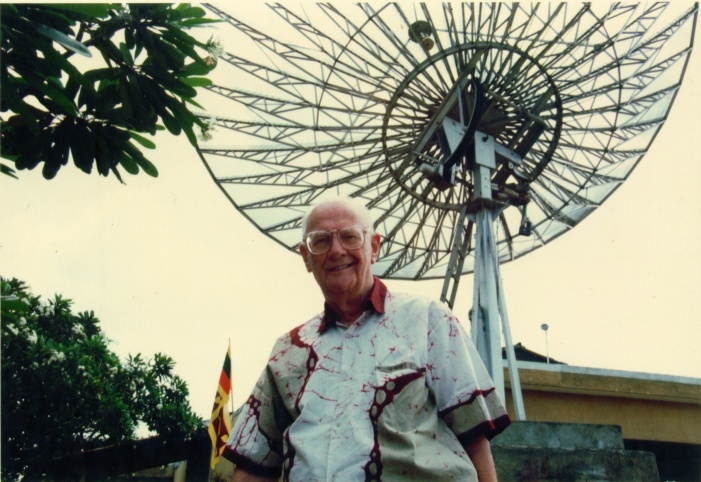
Sir Arthur C Clarke at the ACCIMT in better times For many years, I’ve been explaining and clarifying to everyone that I worked with the late Sir Arthur C Clarke in his personal office in Colombo, which was completely separate from a government entity named the Arthur C Clarke Institute for Modern Technologies in Moratuwa, Sri Lanka. This is not just an institutional demarcation; the latter body set up by the government of Sri Lanka in 1984 and sustained since then with public funding has completely under-served its founding ideals and remains mediocre and unproductive after a quarter century. I have no wish to be associated, even mistakenly, with such an entity.
I remained quiet about this for as long as Sir Arthur was alive, as it was not tactful for me – as part of his team – to criticise a state entity named in his honour. A year after his death, I broke that silence and wrote a media article which was published in the current affairs magazine Montage in April 2009.
That elicited some strange ‘reader comments’ on the magazine’s website — several of which alleged that I was a ‘traitor’ who was out to discredit the hard-working (‘Sinhala Buddhist’) engineers and managers of this institute! I could not fathom how and why the staff’s ethnicity or religious faith was relevant.
Beyond such vitriol, these pseudonymous ‘readers’ never once responded to my specific questions about the public-funded institute’s scientific productivity and public accountability.
Unfortunately, Montage went out of publication and its website, which was located at http://www.montagelanka.com, is also no longer available online. So in the public interest, I’m reproducing my article below, unedited as it appeared in print in April 2009. Alas, I never saved the online comments so those are probably lost forever…
As always, this blog is open to a rational discussion of the core issues raised below, as all the concerns still remain valid. And there are no ‘sacred cows’ in my book!
Monument for Sir Arthur C Clarke: Time to ask some tough questions
By Nalaka Gunawardene
As the first death anniversary of Sir Arthur C Clarke approaches, Lankans are still debating how best to cherish the memory of the celebrated author and visionary who called the island his home for more than half a century.
Ours is a land where private individuals — and governments –- just love to put up ostentatious and often superfluous structures to honour the departed. We typically don’t assess their cost-effectiveness or utility. Neither do we pause to ask how the person being honoured would have felt about it.
The Telecommunications Regulatory Commission of Sri Lanka (TRCSL) recently announced plans to launch the country’s first satellite, which is to be named after Sir Arthur. According to news reports, it will be launched into low earth orbit (LEO) at an estimated cost around US$ 20 million.
Would naming Sri Lanka’s first satellite be a fitting tribute to Sir Arthur, universally acclaimed as inventor of the communications satellite (comsat)? Or should a monument to this ‘one man cheering squad for Sri Lanka’ be more rooted in the Lankan soil, where people can see and feel its presence everyday? And, by the way, what about the state technical institute in Moratuwa that already bears the Arthur Clarke name?
Sir Arthur, with whom I worked closely for 21 years as an aide and a decade as spokesman, would surely have wanted an open and frank debate on this matter. He opted for rational, evidence-based decisions based on cost-benefit analysis. He frowned upon grandiose plans made for their own sake, whether their implementation was going be paid for by public or private funds.
Besides, he already had an asteroid, dinosaur species and a geostationary comsat named after him during his lifetime. Topping that without going over the top would be a challenge indeed.
A living legacy
The tussle for the Clarke legacy started within hours of his death on 19 March 2008. He had left clear written instructions for his funeral to be held on a strictly secular and austere basis. He didn’t want any decorations, and explicitly disallowed official involvement by British or Lankan governments.
As this news spread, it fell on me to explain to government officials why offers of a state funeral and other types of state patronage could not be accommodated. This raised some eyebrows and dashed hopes of some who wanted to turn the sombre event into a carnival. In the end, the state appealed for a symbolic radio silence of two minutes to coincide with the funeral.
In the weeks and months that followed, many have asked me what kind of monument was being planned in Sir Arthur’s memory. The answer, as far as the Arthur Clarke Estate is concerned, is none –- and this seems to surprise many.
Yet it is entirely consistent with Sir Arthur’s personality and vision: he never sought personal edifices in his honour or memory. When a journalist once asked him about a monument, he said: “Go to any well-stocked library, and look around…”
That evokes memories of the well known epitaph for Sir Christopher Wren, one of the greatest architects of all time, who significantly changed London’s skyline: “Lector, Si Monumentum Requiris Circumspice”(“Reader, if you seek his monument, look around”). It also begs the question why Sir Arthur chose not to make any mention of the physical entity that already bore his name: the Arthur C Clarke Institute for Modern Technologies (ACCIMT).
Indeed, the ACCIMT is today a perfect example of a good idea gone astray, becoming a disgrace to the very man it was meant to honour. How did things go wrong to the point where Sir Arthur Clarke distanced himself from the Arthur Clarke Institute in the last few years of his life? These thorny questions need to be asked now that we are discussing matters of legacy.
The world was very different, and aspirations were very high, when ACCIMT was established in 1984 by an Act of Parliament to help transfer and adopt modern technologies in five areas: computers, telecommunications, energy, robotics and space technology. The Institute, initially called the Arthur Clarke Centre, was to undertake research and development as well as train technical professionals in ways that would accelerate economic development and advance the quality of life.
Several leading Lankan professionals were associated with its creation. Among them were civil servant (later Minister) Dr Sarath Amunugama and diplomat (now academic) Dr Naren Chitty. In 1985, President J R Jayewardene appointed the eminent biochemist (and his science advisor) Professor Cyril Ponnamperuma as its founder director.
As patron, Sir Arthur had no executive functions or responsibilities, but generously provided advice, guidance and some funding to the fledgling institute. He donated US$ 35,000 received for the 1982 Marconi Fellowship. Just as importantly, he mobilised his far-flung network of international contacts in scientific, technological and engineering circles. The Arthur Clarke ‘fan club’ stretched far and wide -– from the White House to the Kremlin, and from elite academia to geeky Silicon Valley. Carrying this unique calling card, ACCIMT had access to a global reservoir of goodwill, partnerships and external funding.
Tragically, despite this head start and advantages, the Institute reaped little benefit. While it did show some early promise, it has failed to consolidate itself as a credible and productive technical institute. Its founding aim of becoming a centre of excellence for the developing world also flopped. When assessed using universally accepted measures of scientific productivity -– such as research publications in refereed international journals, peer citations and patents for innovation — it shows a dismally poor track record.
For sure, it has been dabbling with a few everyday technologies such as traffic lights, telephone locks and domestic gas leak alarms. Useful as these applications are in specific situations, they cannot justify 25 years of substantial investment of Lankan tax payer money as well as international donor funds.
March of ICTs
Perhaps an institute with this kind of lofty mandate could have been more influential at the apex policy level. The past 25 years have seen Sri Lanka adopting many new information and communication technologies or ICTs (e.g. mobile telephony in 1989, commercial internet connectivity in 1995). There has been an unprecedented and phenomenal growth in the coverage of telecom services. These developments have thrown up many policy and regulatory challenges for the state and private sector players.
Alas, ACCIMT has not kept up with the rapid evolution of information society, and failed to carve out a clear niche for itself even as Sri Lanka engages the Global Village through a multitude of ICTs. Its voice is neither heard nor heeded in key debates on bridging the digital divide, and on how best to prepare our youth to ‘exploit the inevitable’ in a globalised marketplace. These concerns were very dear to Sir Arthur, who continued to talk and write perceptively about them to the very end of his life. But ACCIMT is still stuck in the obsolete analog concerns of the 1980s.
Peer acceptance and recognition are indicators of any technical institute’s standing. ACCIMT would struggle to demonstrate its worth on these criteria. It is routinely bypassed by state policy making mechanisms and agencies. It is curious how the telecom industry regulator is spearheading the government’s newly announced satellite project. Why is ACCIMT, with a statutory mandate in this subject, not playing a more prominent role in such plans and discussions?
When the rest of government ignores the institute, it’s not surprising that technology-based industries don’t turn to it for advice either. The institute’s principal activity these days is conducting training courses in electronics — useful, no doubt, but for which purpose there already are several dedicated vocational training centres.
For much of its 25 years, the Arthur Clarke institute has taken cover behind its famous patron to avoid adequate public scrutiny. Large sections of society, including many in the media, harboured a misconception that Sir Arthur Clarke was personally involved in its management and research; in practice, he had none.
Early sparks
Things didn’t always look this bleak. For a while, it seemed as if the institute would live up to its founders’ expectations. For example, it was the first to downlink and relay CNN broadcasts in Sri Lanka. CNN founder Ted Turner‘s respect for Sir Arthur made this possible. The institute was also involved designing low-cost dish antennae for households to directly capture satellite TV transmissions in the 1980s when only two terrestrial channels were available. March of technology and commerce later made these services redundant.
One far-sighted activity that Professor Ponnamperuma started was the Science for Youth programme. On a national and competitive basis, 25 of the brightest high school leavers were selected and introduced to modern technologies over six consecutive weekends. Out of that exercise eventually emerged the Young Astronomers’ Association and Computer Society of Sri Lanka, the latter now a professional body.
As part of the 1986 batch, I can personally vouch for the insights and inspiration Science for Youth gave me in those pre-Internet days. I was especially fascinated by the outspoken views of inventor and aviator Ray Wijewardene. The friendship I formed with him has lasted for over two decades and enriched me enormously. Later, as a young science journalist, I used to cover the institute’s public events hosting of visiting tech pioneers and Russian cosmonauts. For a while, ACCIMT was a ‘happening place’.
Then, sometime in the 1990s, the institute abandoned most of its public engagement and outreach activities. This inward looking attitude didn’t change even after the government decided to locate the country’s largest optical telescope (donated by Japan) at the institute. I remember how exasperated Sir Arthur was to hear schools being told that they may visit and look at the telescope during the working hours from 9 am to 5 pm!
But by then, he was not going to intervene. After he turned 80 in 1997, Sir Arthur adopted a policy of ‘benign neglect’ towards the institute on which he had pinned such high hopes only years earlier. Ever conscious of his ‘resident guest’ status, he chose not to criticise the institute in public, although he shared his dismay and disappointment in private.
As we debate how best to preserve Sir Arthur’s illustrious legacy, we cannot afford to continue such ‘benign neglect’ on the publicly-funded Arthur Clarke Institute. A good starting point would be to belatedly ask tough questions and engage in some serious introspection.
Sir Arthur would have expected nothing less.
About the writer: Science writer Nalaka Gunawardene worked for Sir Arthur Clarke’s personal office, which was totally separate from the Arthur Clarke Institute. The views in this article are entirely those of the author.
Photographs courtesy Rohan de Silva, Arthur C Clarke Estate.
I once saw a sports car on the narrow streets of Malé, capital of the Maldives (total population 350,000). Nothing unusual about it — except that the whole of Malé is about two square km: we can WALK the length and breadth of the crowded capital in 10 or 15 minutes. The other 1,200 islands that make up the Indian Ocean archipelago are even smaller.
That reality didn’t stop an optimistic Maldivian from investing in a fast vehicle – after all, a car (especially a sports model) is more just a means of transport.
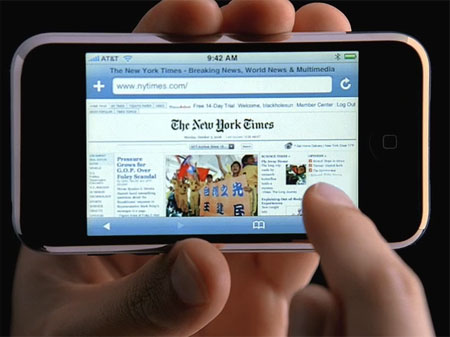
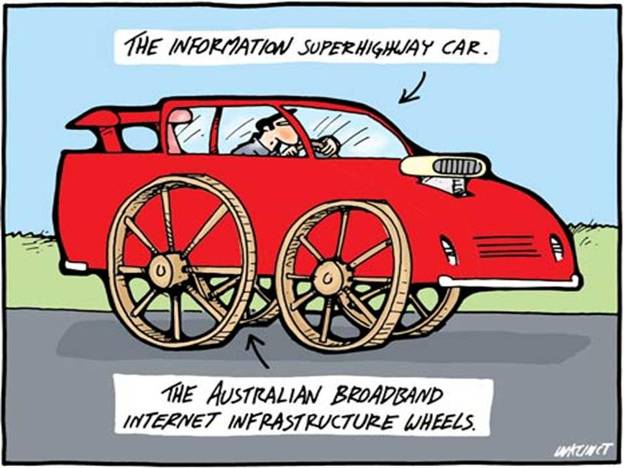
Something akin to this plays out in the virtual world everyday in many parts of developing Asia. Many Internet users have state of the art access devices — ranging from the latest laptops and high-speed desk tops to ipads and internet-enabled mobile phones. But most of the time the users and devices are held up by poor quality internet connections. I mean patchy, uneven, really S-L-O-W ones.
So part of the time — how often and how long depends on where you are, and who your internet service provider or ISP is — we are all like that Maldivian sports car owner. Dressed up and rearing to go, but not really going very far. Because our network is overloaded.
What can you do when your broadband internet connectivity slows down, making some web applications tedious or impossible? How can you measure and compare the quality of broadband service within the same telecom network or across different service providers?
As consumers, we have limited options. We can grin and bear, and be grateful that we are among the 2 billion (and counting) human beings who regularly access the Internet. We can grumble and rant, and even complain to our ISP. But chances are that they’ll plead it was a system fluke, an exception to the norm.
Now there’s another option. The Ashoka-Tissa method, a simple and free software developed by LIRNEasia and IIT Madras, enables just that: with it, you can gather evidence before taking it up with telecom operators.
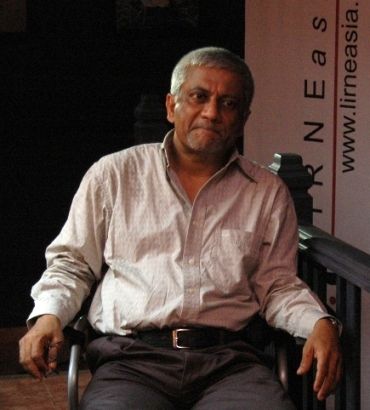
Rohan Samarajiva: Fraudband-buster?At TVE Asia Pacific , we have just produced a short video in which LIRNEasia — a regional ICT policy and regulation think tank active across the Asia Pacific — sums up their experience in developing a user-friendly method to measure broadband quality of service experience. It also shows how they engaged telecom operators and regulators in South and Southeast Asia from 2007 t0 2010.
“256 kbps up and down is the minimum definition (of broadband),” says Dr Rohan Samarajiva, LIRNEasia’s Chair and CEO. “There are various people debating about it: whether it should be 2Mbps and so on, but I will give an acceptable minimum definition…Our research shows that, in fact, many broadband products that say they are giving 2Mbps don’t even meet this minimum rate.”
The former Sri Lankan telecom regulator adds: “Then of course there is this whole story of companies promising all kinds of things. 2Mbps up, 2Mbps down and various other things being promised and giving not even 256kbps. So there is almost like a dishonesty factor here. As one of my friends says, this is not broadband; this is fraudband!”
PS: While writing this blog post, I was frustrated by the poor quality of my own supposedly high-speed broadband connection, provided by Sri Lanka’s oldest telecom operator.

 In a 2007 book titled You Can Hear Me Now: How Microloans and Cell Phones are Connecting the World’s Poor to the Global Economy, US writer Nicholas Sullivan quotes Mandela saying in a 1995 speech: “The desire to be in touch lies deep within us. It is a basic need.”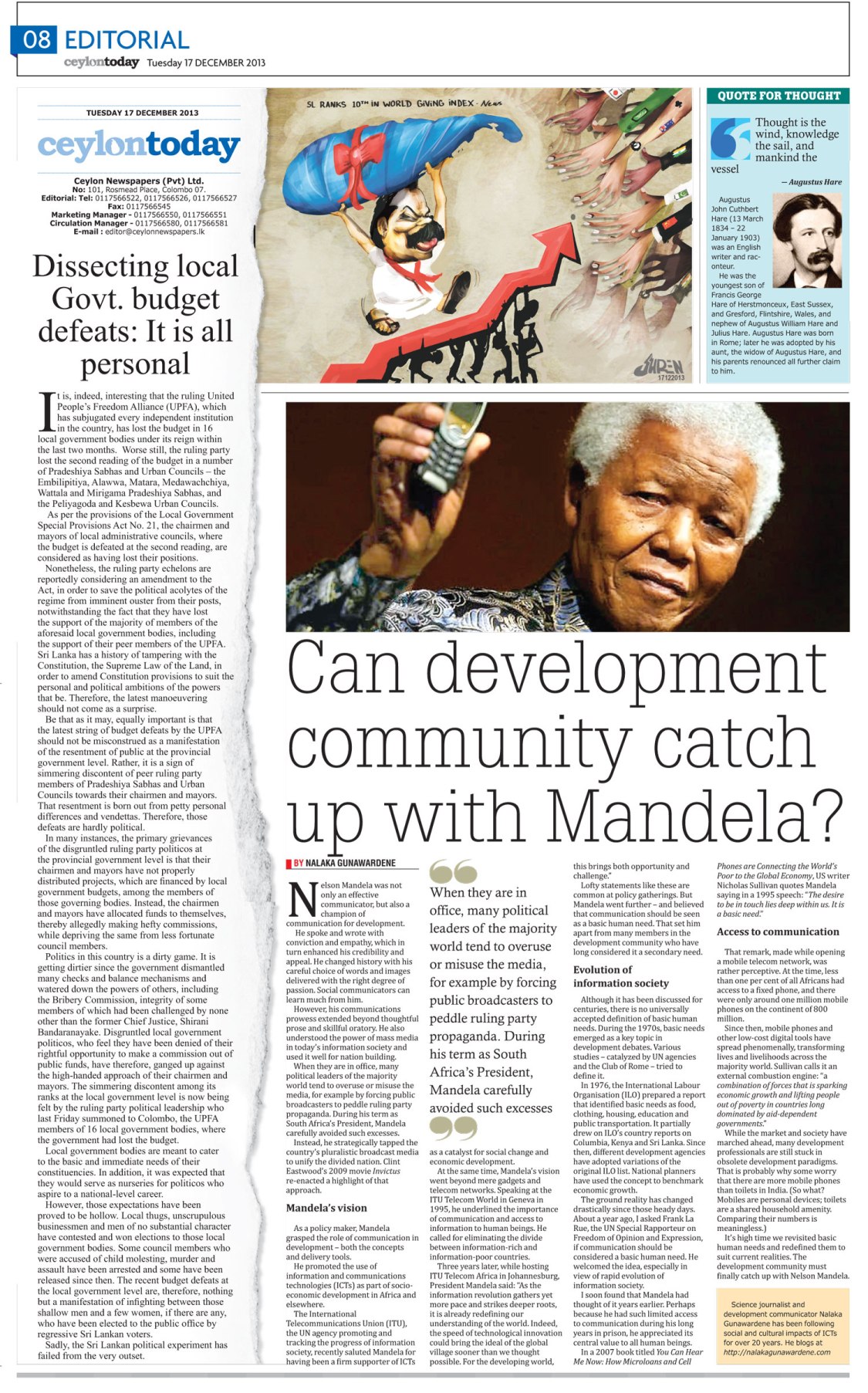

 Open Minds!