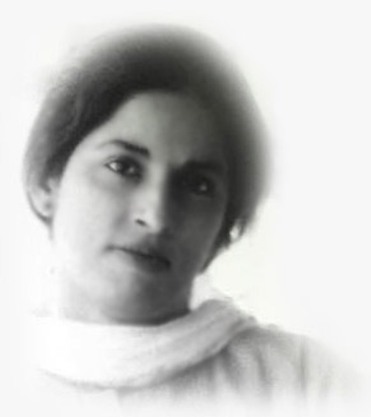
Karunaratne Abeysekera (1930–1983) was one of Sri Lanka’s most accomplished Sinhala broadcasters. He was also a poet and lyricist — one who had great talent to combine words and phrases in ways that soothed and energised a whole nation.
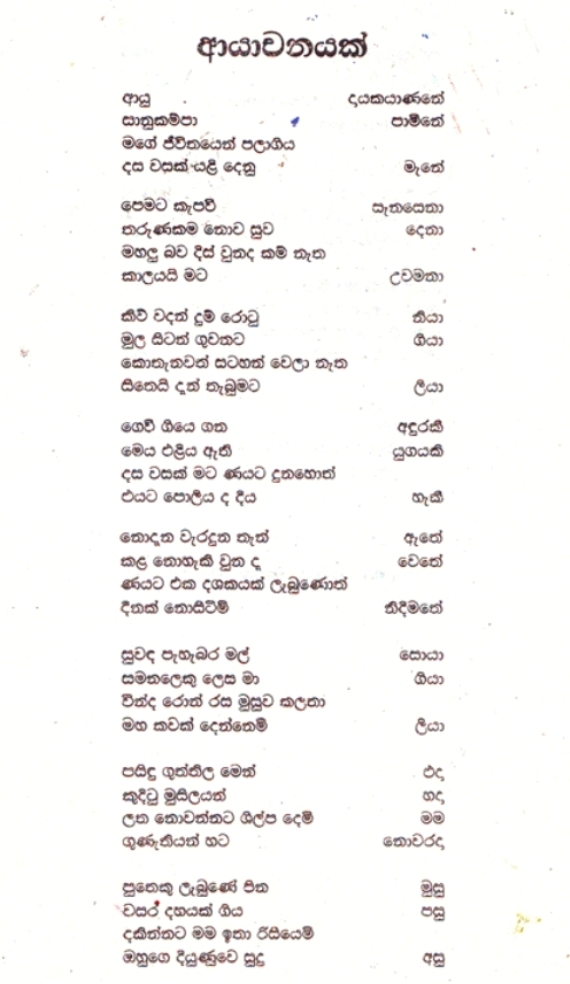
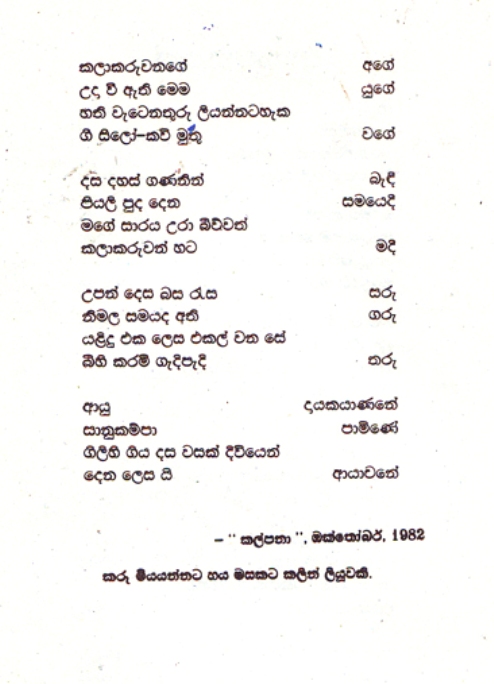
In October 1982, Karu (as he was affectionately called by friends and fans alike) wrote an especially moving and memorable Sinhala poem in the then popular Sinhala monthly magazine Kalpana. I first read this poem as a school boy in October 1982, and it left a deep impression that the first few lines stuck in my mind for decades.
In this poem, which opens with the words ආයු දායකයාණනේ, සානුකම්පා පාමිනේ…, Karu asks the giver-of-life (unspecified, and not alluding to any religious or superhuman entity) to grant him 10 more years of life so that he can…do more good, and do things he’s somehow not been able to do yet in his life. (He says it much more beautifully.)
Alas, that was not to be. Six months after this poem appeared in print, Karu was gone: he died in April 1983 aged 53.
As we enter a New Year, I borrow Karu’s evocative words and make them my own personal wish — or plea, if you like. I thank Karu’s son Dileepa Abeysekera for helping locating the full words. He calls it a little “time bomb” of the mind that his father has left behind…
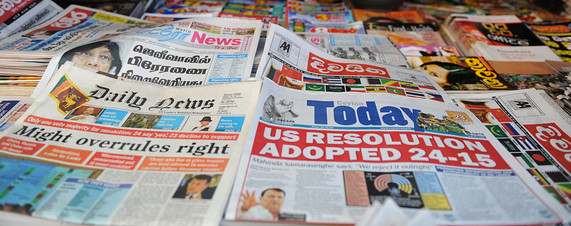
“Sri Lanka’s newspaper history dates back to Colombo Journal (1832) which apparently had a short but feisty life before it invoked the ire of the British Raj. Nearly two centuries and hundreds of titles later, the long march of printer’s ink — laced with courage and passion – continues.
“How long can this last?
Print journalism’s business models are crumbling in many parts of the world, with decades old publications closing down or going entirely online. This trend is less pronounced in Asia, which industry analysts say is enjoying history’s last newspaper boom. Yet, as I speculated three years ago when talking to a group of press barons, we’ll be lucky to have a decade to prepare for the inevitable…”
These are excerpts from a short essay I originally wrote last week to mark the first anniversary of Ceylon Today newspaper, where I’m a Sunday columnist. It was printed in their first anniversary supplement on 18 Nov 2012.
Groundviews.org has just republished it today, making it easily available to a much wider audience. Read full essay:
Another excerpt: “In the coming years, waves of technology, demographics and economics can sweep away some venerable old media along with much of the deadwood that deserves extinction. The adaptive and nimble players who win audience trust will be the ones left to write tomorrow’s first drafts of history.”
Vidusara at 25 – web banner from Facebook Group
The weekly Sinhala science magazine Vidusara, a publication of Upali Newspapers Limited of Sri Lanka, completes 25 years this week.
Sustaining any publication for that long is no mean accomplishment, so everyone involved – journalists, editors, publishers – deserve congratulations.
The current editor has done an interview with me for the 25th anniversary issue, which is out today. In it, I discuss the challenges faced by all science communicators, but especially by science journalists working in the developing world. The interview is in Sinhala. Here it is, in pdf, in parts 1 and 2.
I had a marginal involvement in Vidusara at its very inception, in late 1987, which was within a few months of my entering journalism. I take no credit for what the publication has accomplished, and am sometimes exasperated when long-standing readers associate me with it. But after clarifying such nuances for years, I now accept the inevitable association!
As reader comments warranted, I responded as follows:
Vidusara 25th anniversary issue – cover 7 Nov 2012“Vidusara was launched in 1988 [correction: it really was in Nov 1987] by Upali Newspapers Limited as an experiment in popular science communication. I was at the time working as a science correspondent for that company’s English daily, The Island, and the managing director asked me to advise and guide the new publication. I welcomed this as I was a bilingual writer (Sinhala and English). However, the founder editor of Vidusara was extremely apprehensive about my association with his project and went out of his way to exclude me. I have never tried to understand or analyse the reasons for this; such insecure and insular mindsets are far too common in Sinhala language journalism, even today.
“All in all, I must have written no more than 10 – 12 Sinhala science articles to Vidusara during its first few months of publication in 1988. When I compare that to the several hundred I’ve published in The Island (1986-1995: none of it available online) and many dozens for other English language media outlets – print, broadcast and online – over the years, my writing in Vidusara represents only a very small proportion of my combined media output. However, I must have done a few things well in those articles for discerning readers to remember and refer to it more than two decade later. I’m naturally pleased with such reader recollections.
“It also reminds me that we who work in the public space don’t get to choose how we are remembered. Our audiences will form their own impressions, and select their own memories.”
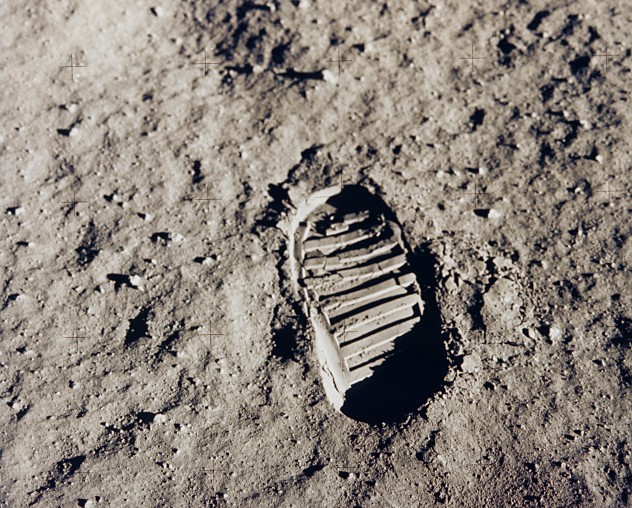
This footprint in the sand will stand the test of time and elements….
In her debut novel The Moon in the Water (2009), Lankan author Ameena Hussein uses a memorable line to describe her protagonist’s many dilemmas: “Her generation had the burden of being the link between the old world and the new. Between pre-man in the moon and post. Between letters and email.”
I’m as much a part of that in-between generation as her character Khadeeja. Rather than being a burden, however, I find it an extremely privileged vantage point to have been. There will never be another generation like ours that straddled two worlds…
For many of us who experienced it, the Apollo 11 ‘Moon shot’ will be among our most indelible memories. Among the various labels I can choose from those tumultuous times, I consider myself a Child of Apollo.
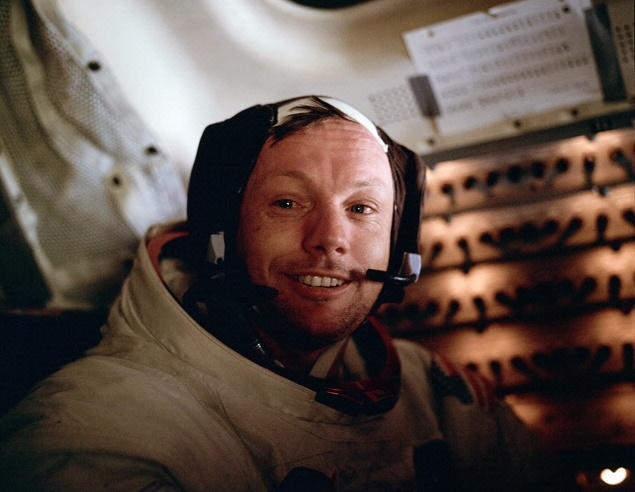
And the boyish, blue-eyed Neil Armstrong (already 39 when he went to the Moon) was my first hero.
These are excerpts from my personalised tribute to Armstrong, who signed off for good on 25 August 2012. In it, I reflect on how the first Moon Landing influenced me personally at the tender age of 3, and recall the very different times in which we lived our lives on the other side of the planet from where Apollo missions were taking off.
It’s a light-hearted, nostalgic and essentially personal tribute, not at all an academic or polemical discussion of the Cold War politics that inspired the Great Space Race. But I do touch on what it meant to be part of history’s first Big Media Moment that was shared in real time by 600 million TV viewers and another few dozen million radio listeners worldwide.
If Neil was originally a hero to me for riding atop the world’s greatest fireworks machine and taking that Giant Leap for Mankind, he is a hero for me now for what he chose to do with his life upon his return.
O voyagers, O seamen,
You who came to port, and you whose bodies
Will suffer the trial and judgement of the sea,
Or whatever event, this is your real destination.”
So Krishna, as when he admonished Arjuna
On the field of battle.
Not fare well,
But fare forward, voyagers.
– T. S. Eliot
Neil Armstrong – Driven by a sense of wonder, did his job quietly and well
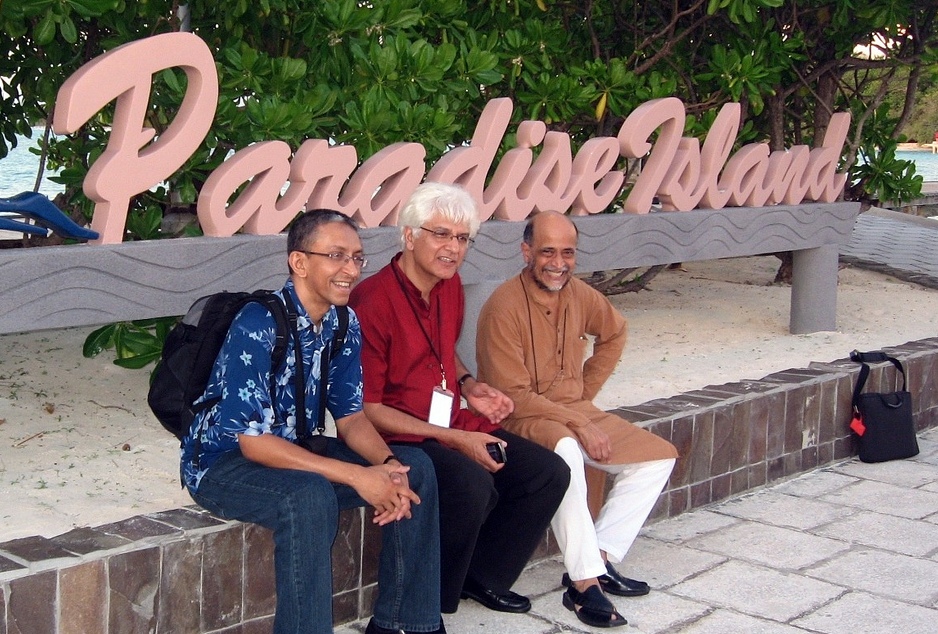
To keep up with the silly season, here’s another photo taken in July 2011 in…well, read the sign behind us.
Waiting to be let in – surely they know our bylines? L to R – Nalaka Gunawardene, Kunda Dixit, Darryl D’Monte – Maldives, May 2011
PS: It’s actually in the Maldives, where fellow journalists Kunda Dixit, Darryl D’Monte and I were working hard to earn an honest living at a regional meeting on ozone and climate. Yes, we were let in — and we liked the salubrious settings…
L to R – Nalaka Gunawardene, Darryl D’Monte & Kunda Dixit in Paradise, May 2011
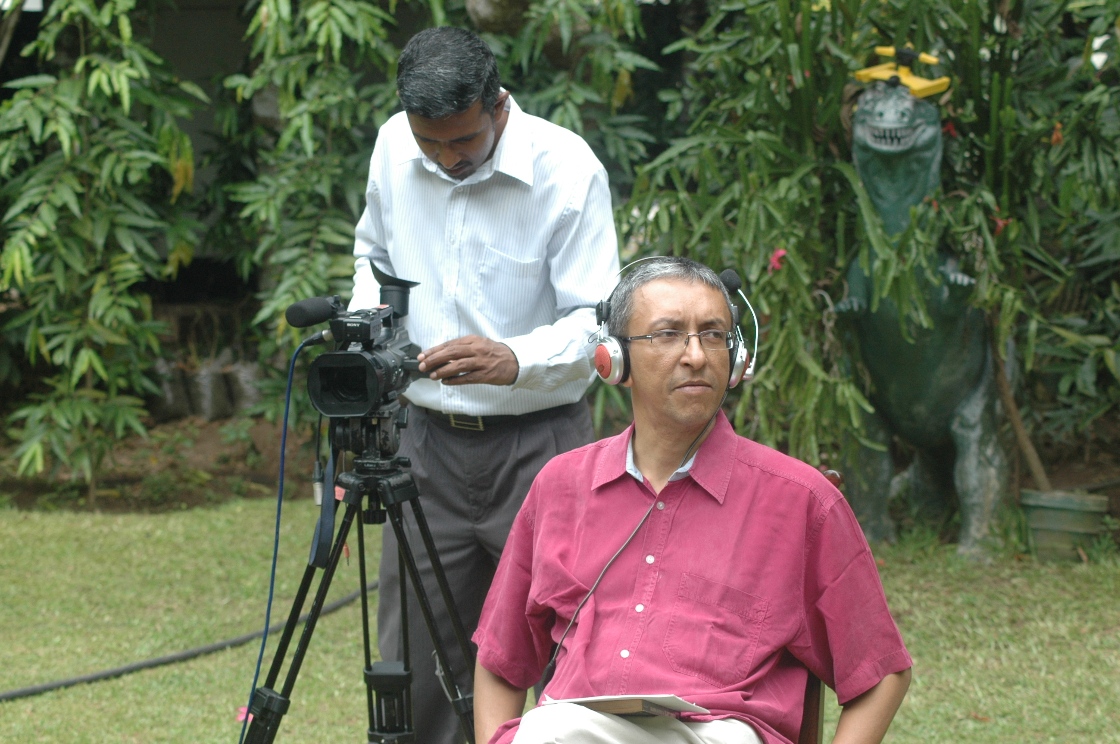
Location: Garden of Leslie’s House, Barnes Place, Colombo 7, Sri Lanka — where Sir Arthur C Clarke lived for 35 years until his death in March 2008
My colleague Janaka Sri Jayalath had taken this photo more than a year ago while we were filming an interview. But I’ve only just taken a closer look, and realised just what he’d captured…:)
The Last Filming – Preoccupied with their work, neither man had any idea what fate was about to befall them…
Caption says it all. Thanks, Gary Larson, for inspiration…
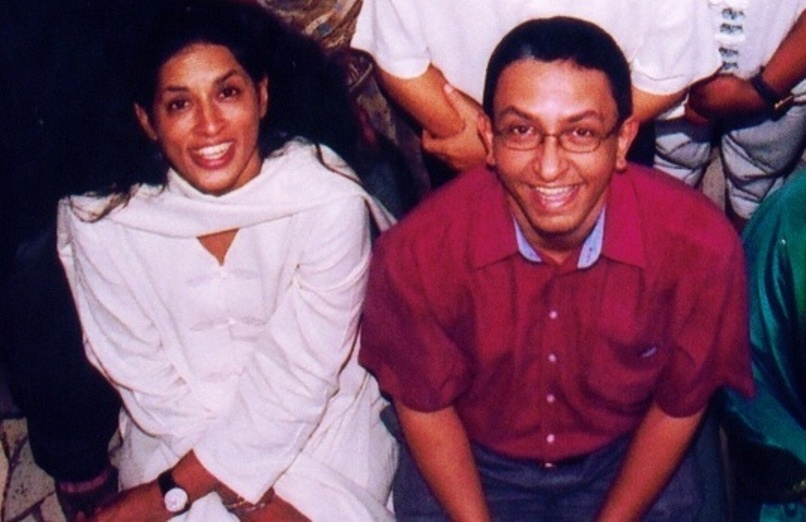
On 20 April 2012, we marked seven years since Saneeya Hussain left us. Journalist and activist Saneeya suffered a needless and tragic death at when she ran out of fresh air in South Asia and was caught up in the urban traffic congestion of Sao Paulo.
In this week’s Ravaya Sunday column, I remember Saneeya’s legacy and plight and discuss the latest dimensions of outdoor air pollution in Sri Lanka that threatens fellow asthma sufferers like myself. The same information is covered in English at: Gasping for Fresh Air, Seeking More Liveable Cities in South Asia
Saneeya Hussain & Nalaka Gunawardene: Singapore, Nov 2002
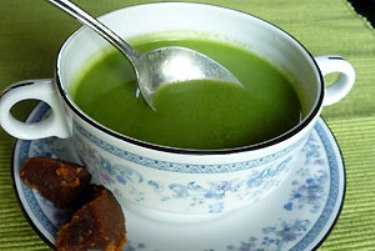
Kola Kenda - herbal porridge, Lankan style Have a Kola Kenda and a Smile!
That was the – not very original – slogan I coined 30 years ago as a school boy to promote and popularise kola kenda, the Lankan version of herbal porridge.
I’ve always been an ardent eater of green leaves and veggies (isn’t everybody?). So I didn’t need any special persuasion to drink kola kenda.
Most of my peers didn’t share this enthusiasm. They didn’t mind the taste, but the whole thing seemed too old fashioned. Self-respecting teenagers shouldn’t be seen drinking a favourite of their grandparents, they argued.
As often happened, I disagreed. Not only did I take delight in partaking my kola kenda, but also kept trying to convince my peers that, hey, kola kenda was cool.
First I tried the rational, evidence-based approach. I found out as much as I could about kola kenda and distilled it into a few non-technical, non-preachy lines. I wrote about in our school magazine, spoke about it at the school assembly, and seized every other opportunity to plug the green stuff.
I must have been around 15 or 16 years old at the time, but even then, I realised kola kenda had an image problem. So — following the golden advice, “Don’t just sit there; do something!” — I tried to improve it.
I abbreviated kola kenda to KK. I designed a stylish logo for it, independent of any corporate branding. Adapting a popular tag-line for Coca Cola at the time, I even came up with the slogan, “Have a KK – and a smile!”
None of this really worked; after six months, I gave up being the kola kenda evangelist. But that campaign earned me an inevitable nickname: kola-kendaya.
I was proud of it then as I’m now.
Years later, when I started running my own household, I realized making kola kenda is a tedious process. So, despite being a life-long kola-kendaya, I don’t make it too often.
I’m all for modernising traditional recipes: retaining the nutrition and taste, while reducing the drudgery. That’s just what CBL have done. It comes in five flavours too: gotukola, welpenela, haathawariya, karapincha and mixed herbs.
At LKR 50 (less than US$ 50 cents) per pack of 3 servings, it’s good value for money.
I’m now working on my resident teenager to try it sometime. She’s not yet convinced. I’m hoping that this 21st Century Girl would prove smarter than those ignorant boys who turned their backs to KK 30 years ago…
Doyen of Sri Lankan cartoonists, Wijesoma, saw it all coming (courtesy: The Island)
In this Sinhala language column, published in Ravaya issue of 12 Feb 2012, I look at the state of Television Broadcasting in Sri Lanka. While TV was introduced in urban areas in April 1979, it was on 15 Feb 1982 that countrywide TV broadcasts commenced with national TV channel Rupavahini. A full generation has grown up with TV, but the Lankan TV industry hasn’t yet matured — there is no impartial history, no conservatory for TV programmes, and no proper TV awards festival that covers all 3 languages and various genres of TV. Now that we have 18 terrestrial channels (6 state owned and the rest, privately owned), and many more cable channels, how can we enhance the quality of programming and the industry as a whole? I raise this as someone who has been associated with all the major TV stations in Sri Lanka and has been appearing on TV for 30 years.
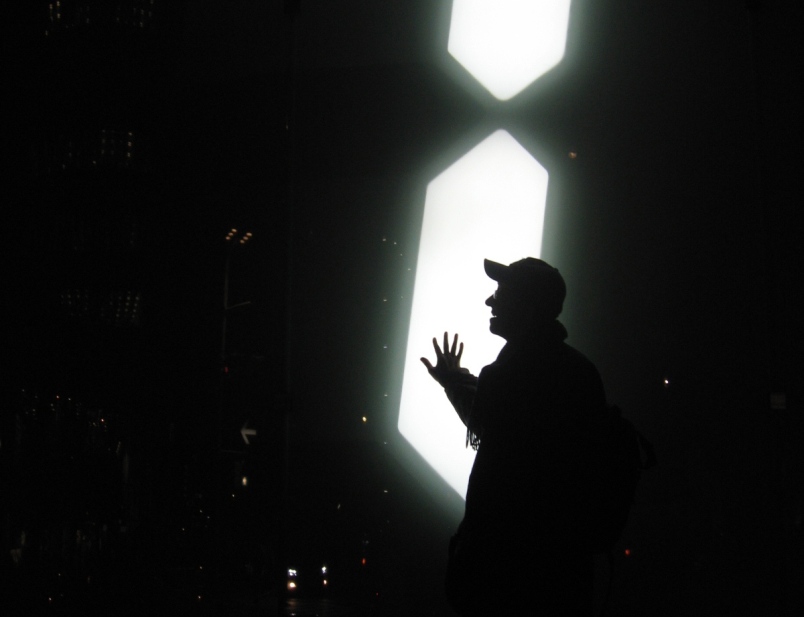
Nalaka G at a giant digital clock in Tokyo: Wandering everywhere with a sense of wonder...
This is the Sinhala text of my weekly column published in Ravaya newspaper for 5 February 2012. Here, I look back at one year of weekly columns and reflect on some reader feedback and their participation in my efforts to make sense of the world in turmoil that is all around me. I say ‘Thank You’ to the few writer friends and public intellectuals who have advised and guided me. I reaffirm my commitment to keep asking questions, connecting dots and following my own simple language style with none of the intellectual pretensions common in Sinhala newspaper writing.



 Open Minds!