Feature published in Ceylon Today Sunday newspaper, 30 March 2014
To Go Where No Lankan Movie has Gone Before…
By Nalaka Gunawardene
Photos courtesy Dreams & Magic Entertainment
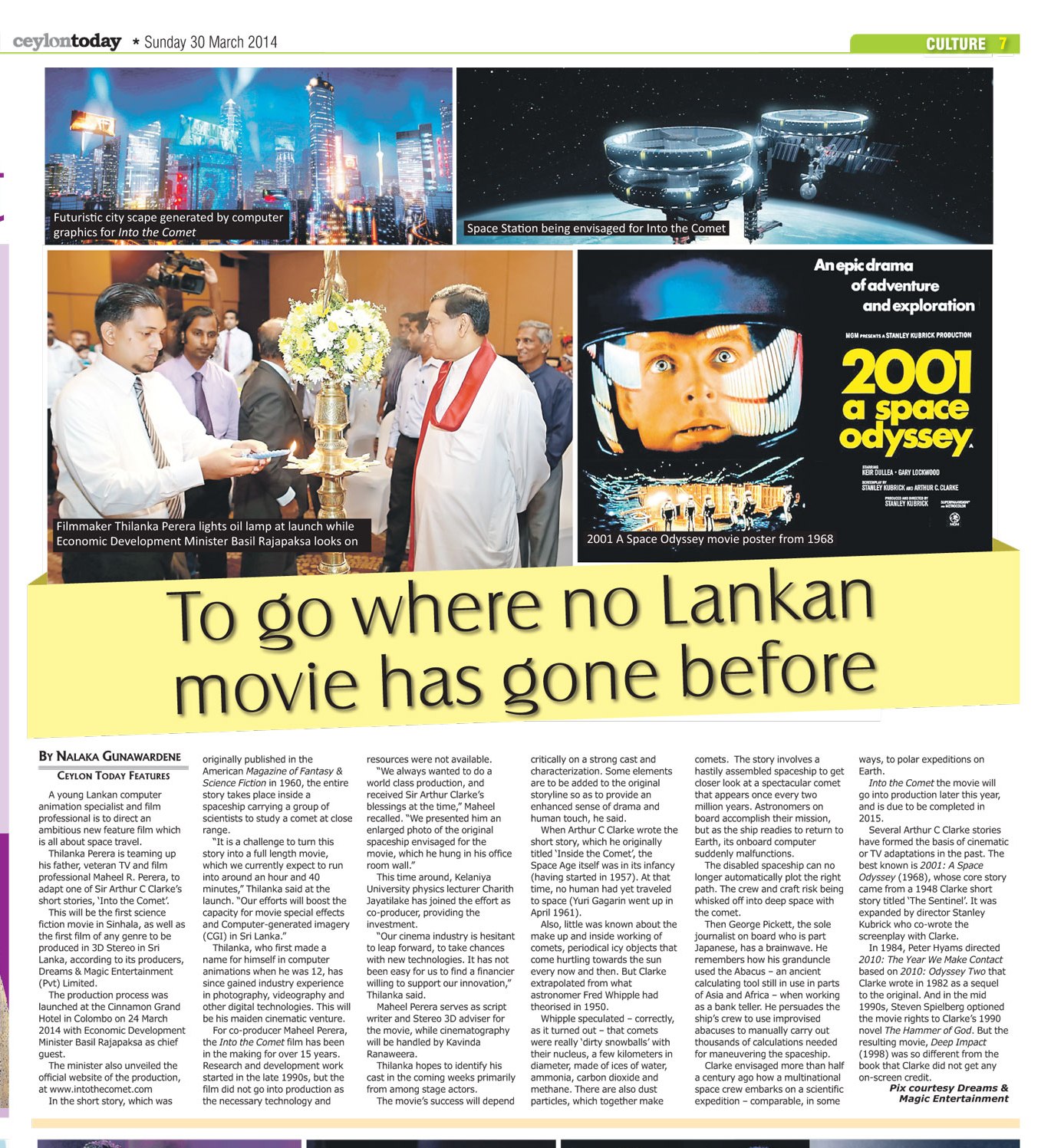
Space Station being envisaged for ‘Into the Comet’ Sinhala science fiction feature film by Thilanka Perera
A young Lankan computer animation specialist and film professional is to direct an ambitious new feature film which is all about space travel.
Thilanka Perera is teaming up his father, veteran TV and film professional Maheel R Perera, to adapt one of Sir Arthur C Clarke’s short stories, “Into the Comet”.
This will be the first science fiction movie in Sinhala, as well as the first film of any genre to be produced in 3D Stereo in Sri Lanka, according to its producers, Dreams & Magic Entertainment (Pvt) Limited.
The production process was launched at the Cinnamon Grand Hotel in Colombo on 24 March 2014 with Economic Development Minister Basil Rajapaksa as chief guest.
In the short story, which was originally published in the American Magazine of Fantasy & Science Fiction in 1960, the entire story takes place inside a spaceship carrying a group of scientists to study a comet at close range.
“It is a challenge to turn this story into a full length movie, which we currently expect to run into around an hour and 40 minutes,” Thilanka said at the launch. “Our efforts will boost the capacity for movie special effects and Computer-generated imagery (CGI) in Sri Lanka.”
Thilanka, who first made a name for himself in computer animations when he was 12, has since gained industry experience in photography, videography and other digital technologies. This will be his maiden cinematic venture.
For co-producer Maheel Perera, ‘Into the Comet’ film has been in the making for over 15 years. Research and development work started in the late 1990s, but the film did not go into production as the necessary technology and resources were not available.
“We always wanted to do a world class production, and received Sir Arthur Clarke’s blessings at the time,” Maheel recalled. “We presented him an enlarged photo of the original spaceship envisaged for the movie, which he hung in his office room wall.”
This time around, Kelaniya University physics lecturer Charith Jayatilake has joined the effort as co-producer, providing the investment.
“Our cinema industry is hesitant to leap forward, to take chances with new technologies. It has not been easy for us to find a financier willing to support our innovation,” Thilanka said.
Maheel Perera serves as script writer and Stereo 3D adviser for the movie, while cinematography will be handled by Kavinda Ranaweera.
Thilanka hopes to identify his cast in the coming weeks primarily from among stage actors.
The movie’s success will depend critically on a strong cast and characterization. Some elements are to be added to the original storyline so as to provide an enhanced sense of drama and human touch, he said.
When Arthur C Clarke wrote the short story, which he originally titled “Inside the Comet”, the Space Age itself was in its infancy (having started in 1957). At that time, no human had yet traveled to space (Yuri Gagarin went up in April 1961).
Also, little was known about the make up and inside working of comets, periodical icy objects that come hurtling towards the sun every now and then. But Clarke extrapolated from what astronomer Fred Whipple had theorised in 1950.
Whipple speculated — correctly, as it turned out — that comets were really ‘dirty snowballs’ with their nucleus, a few kilometers in diameter, made of ices of water, ammonia, carbon dioxide and methane. There are also dust particles, which together make comets spectacular phenomena when they approach the sun.
The story involves a hastily assembled spaceship to get closer look at a spectacular comet that appears once every two million years. Astronomers on board accomplish their mission, but as the ship readies to return to Earth, its onboard computer suddenly malfunctions.
The disabled spaceship can no longer automatically plot the right path. The crew and craft risk being whisked off into deep space with the comet.
Then George Pickett, the sole journalist on board who is part Japanese, has a brainwave. He remembers how his granduncle used the Abacus – an ancient calculating tool still in use in parts of Asia and Africa – when working as a bank teller. He persuades the ship’s crew to use improvised abacuses to manually carry out thousands of calculations needed for maneuvering the spaceship…
Futuristic city scape generated by computer graphics for movie Into the Comet
Clarke envisaged more than half a century ago how a multinational space crew embarks on a scientific expedition – comparable, in some ways, to polar expeditions on Earth.
“Into the Comet” the movie will go into production later this year, and is due to be completed in 2015.
Several Arthur C Clarke stories have formed the basis of cinematic or TV adaptations in the past. The best known is 2001: A Space Odyssey (1968), whose core story came from a 1948 Clarke short story titled ‘The Sentinel’. It was expanded by director Stanley Kubrick who co-wrote the screenplay with Clarke.
In 1984, Peter Hyams directed 2010: The Year We Make Contact based on 2010: Odyssey Two that Clarke wrote in 1982 as a sequel to the original. And in the mid 1990s, Steven Spielberg optioned the movie rights to Clarke’s 1990 novel The Hammer of God. But the resulting movie, Deep Impact (1998) was so different from the book that Clarke did not get any on-screen credit.
Indian filmmaker Satyajit Ray (1921-1992) was keen to make India’s first science fiction movie, and in 1967 wrote a script for a film to be called The Alien, based on his own short story “Bankubabur Bandhu” (“Banku Babu’s Friend”). The story was about an alien spaceship that landed in rural Bengal, carrying a highly intelligent and friendly alien being with magical powers.
Ray’s friend Arthur C Clarke recommended and introduced him to Hollywood, but the film never reached production. In this week’s Ravaya column (in Sinhala), I continue the story of what happened to The Alien.
Thanks to writer and film historian Richard Boyle for sharing excerpts from his as-yet unpublished manuscript on this topic, which is one of the greatest might-have-beens in the history of the cinema.
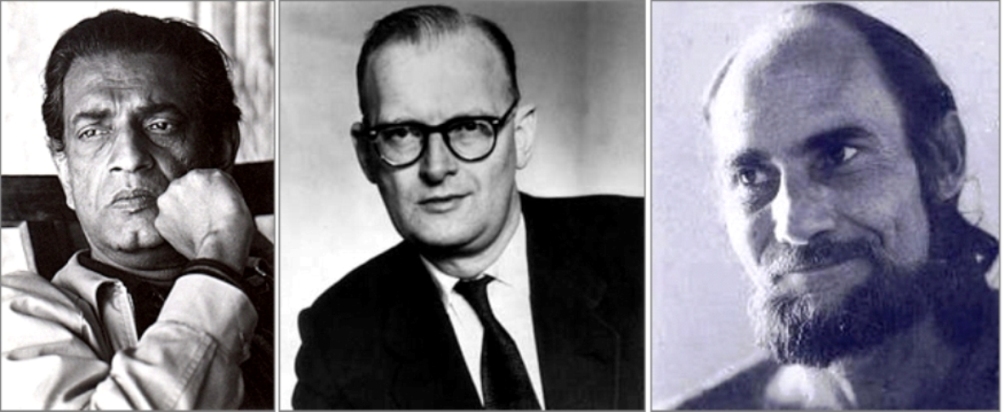
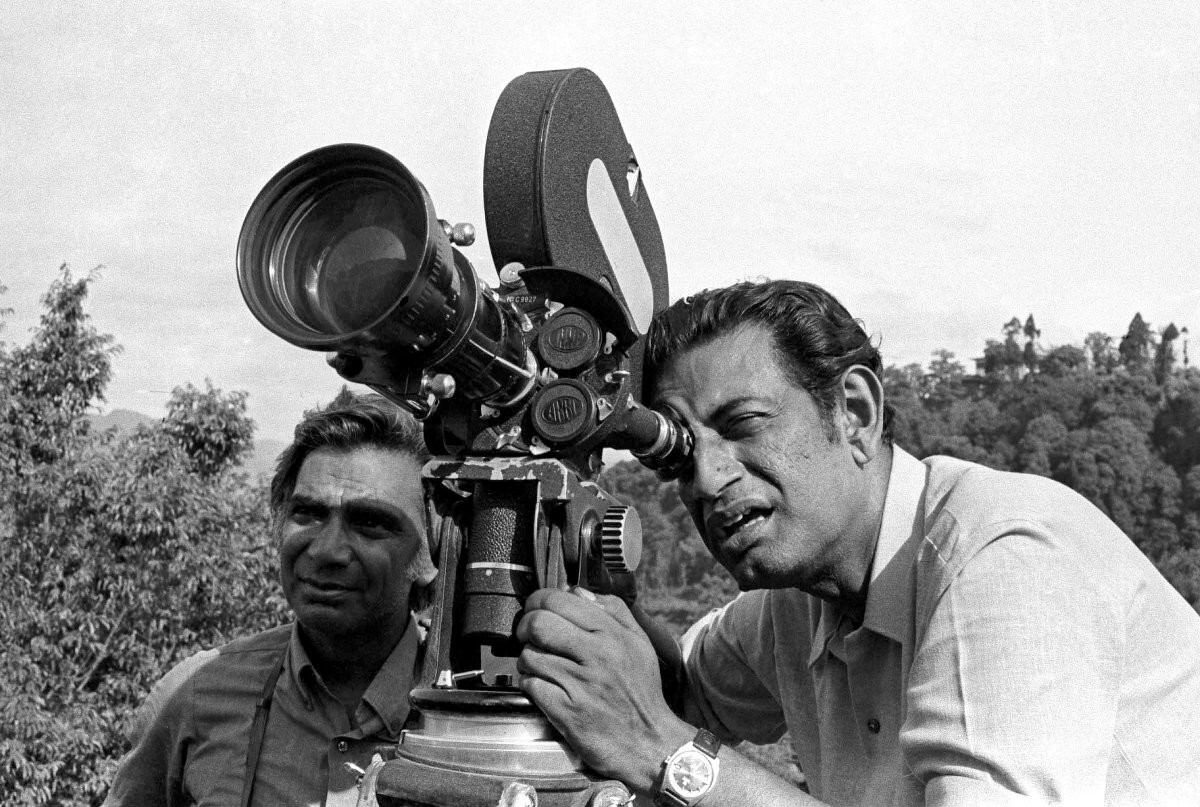
Renowned Indian filmmaker Satyajit Ray (1921-1992) directed 36 films, including feature films, documentaries and shorts. He was also a fiction writer, publisher, illustrator, calligrapher, graphic designer and film critic.
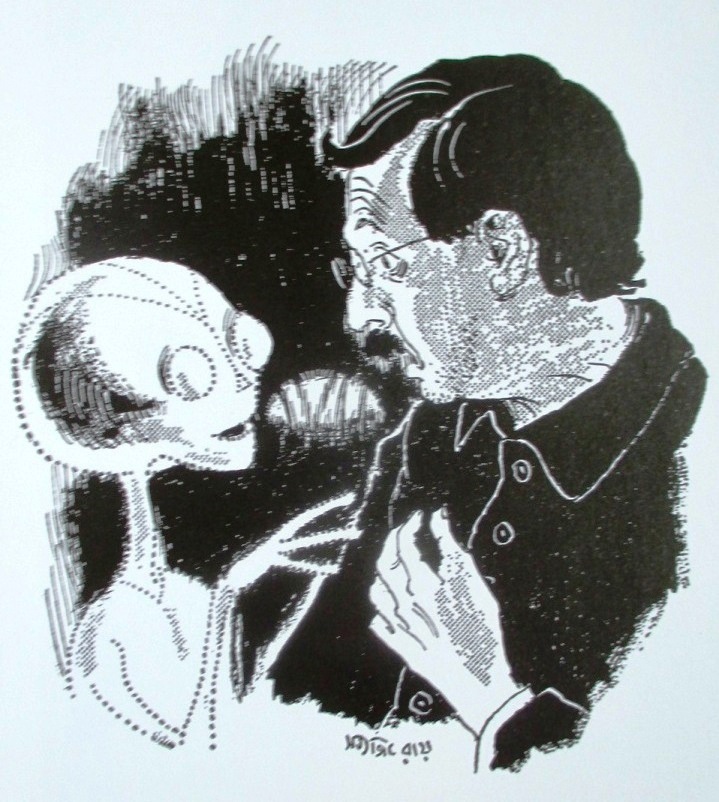
In 1967, Ray wrote a script for a film to be called The Alien, based on his own short story “Bankubabur Bandhu” (“Banku Babu’s Friend”) which had appeared in Sandesh, the Ray family magazine, in 1962. The story was about an alien spaceship that landed in a pond in rural Bengal, carrying a highly intelligent and friendly alien being with magical powers and best capable of interacting with children.
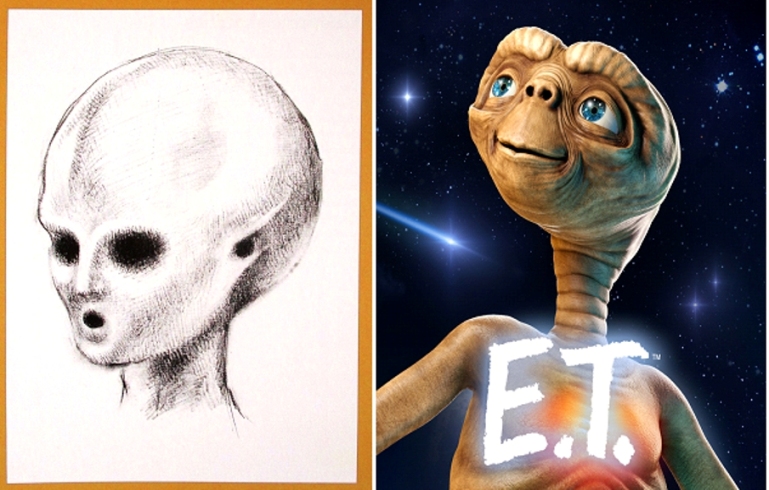
Ray was keen to collaborate with Hollywood for making this movie that required special effects and a higher budget than his other movies. His friend Arthur C Clarke recommended and introduced him to Hollywood, but the film never reached production. Years later, when Steven Spielberg made ET, Ray and his friends noticed remarkable similarities between the two stories. Coincidence?
In this week’s Ravaya column (in Sinhala), I relate the story behind the story of what happened to The Alien. This is reconstructed from Ray’s own published account, Ordeals of The Alien. I’m grateful to writer and film historian Richard Boyle for sharing excerpts from his as-yet unpublished manuscript on this topic, one of the greatest might-have-beens in the history of the cinema.
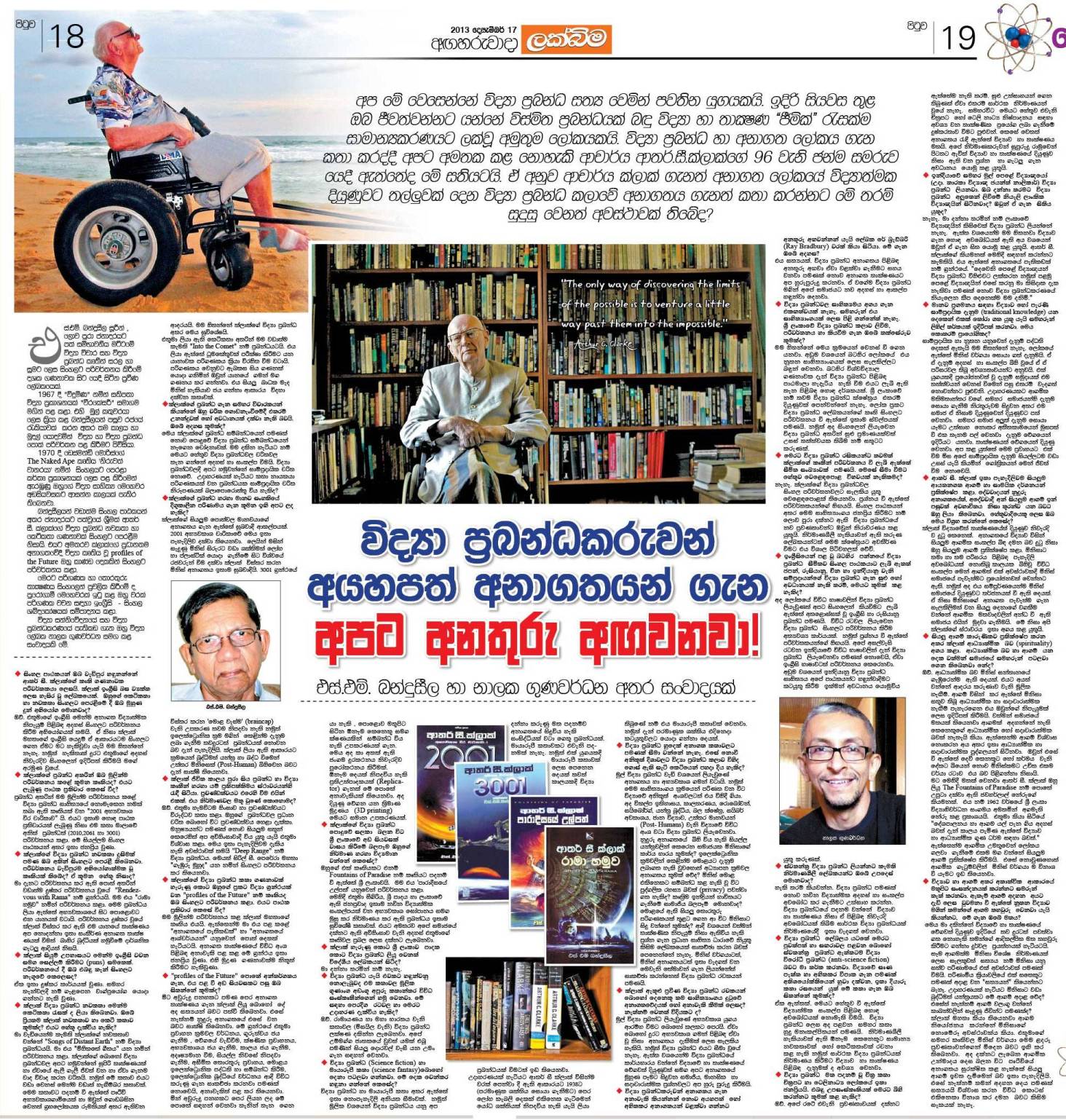
Lakbima Sinhala daily newspaper has just published my long interview with S M Banduseela who is widely recognised as Sri Lanka’s foremost translator of science and science fiction. He is best known as Arthur C Clarke’s Lankan translator.
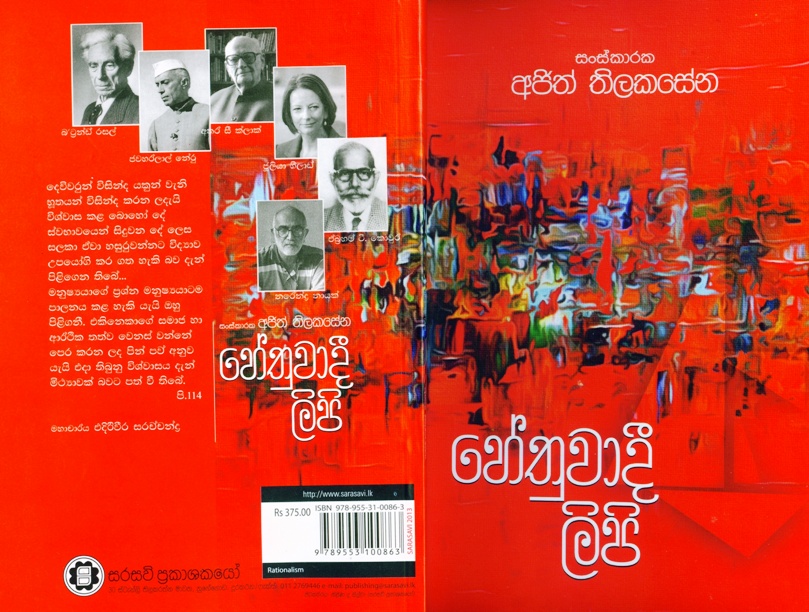
Those segments are not repeated here. Lakbima has also carried my questions related to Clarke’s views on traditional knowledge, and on religion. Banduseela answers them in his capacity as a leading rationalist and free thinker in Sri Lanka.
As he often said: “One of the great tragedies of mankind is that morality has been hijacked by religion. So now people assume that religion and morality have a necessary connection. But the basis of morality is really very simple and doesn’t require religion at all. It’s this: “Don’t do unto anybody else what you wouldn’t like to be done to you.” It seems to me that that’s all there is to it.”
S M Banduseela is widely recognised as Sri Lanka’s foremost translator of science and science fiction. Beginning in 1970, when he translated into Sinhala language The Naked Ape by zoologist and ethologist Desmond Morris, Banduseela has introduced Sinhala readers to over two dozen world acclaimed titles.
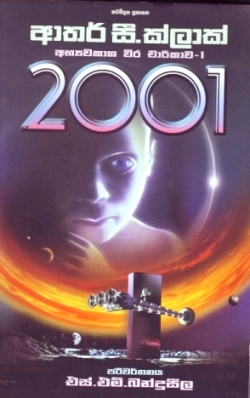
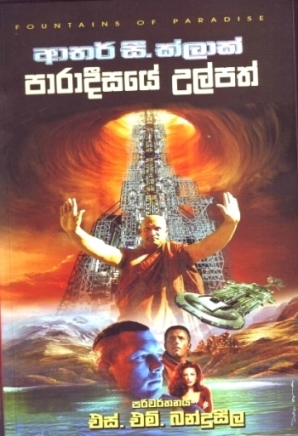
He is best known as Arthur C Clarke’s Lankan translator. In the mid 1970s, he translated Clarke’s landmark 1962 volume Profiles of the Future, which was well received. Encouraged, Banduseela took to translating Clarke’s key science fiction novels beginning with 2001: A Space Odyssey. Over the years, he rendered into Sinhala all four Odyssey novels, as well as other works like The Fountains of Paradise, Rendezvous with Rama and The Hammer of God.
In this wide ranging interview, published in the Sinhala Sunday newspaper Ravaya (24 Nov 2013), I discuss with Banduseela various aspects of science fiction in the Lankan context: the niche readership for this literary genre; its enduring appeal among Sinhala readers; and prospects of original science fiction in Sinhala. He also recalls the challenges he faced translating Clarke’s technically complex and philosophically perceptive novels. I ask him why Sinhala readers have yet to discover the rich worlds of science fiction written in countries like Russia, Japan, China and India.
Who is a citizen journalist? Does everyone who blogs and tweets automatically become one? If not, who qualifies? Who judges this on what criteria? And what niche in media and public sphere do citizen journalists fill when compared with salaried journalists working for more institutionalised or mainstream media?
These have been debated for years, and there is no global consensus. They are belatedly being asked and discussed in Sri Lanka, and form the basis of my latest Ravaya column (in Sinhala).
My views were summed up sometime ago in this comment I left on a blog:“Just as journalism is too important to be left solely to full-time, salaried journalists, citizen journalism is too important to be left simply to irresponsible individuals with internet access who may have opinions (and spare time) without the substance or clarity to make those opinions count.”
Text and photos by Nalaka Gunawardene
In San Diego, California
As a science fiction writer and scientific visionary, Sir Arthur C Clarke was widely respected and acclaimed for his perceptive reflections on humanity’s near and far futures. From his exceptional imagination stemmed over 80 books and hundreds of short stories and essays.
This week, the University of California San Diego and the Arthur C. Clarke Foundation launched a new Arthur C Clarke Centre for Human Imagination (ACCCHI) to study and understand human imagination in all its many forms and dimensions.
The centre, located at UC San Diego campus, will work across a wide range of disciplines such as technology, education, engineering, health, science, environment, entertainment and the arts. It will seek to bridge science and arts in trying to harness imagination for human progress.
Officially, the new centre’s mission is to develop, catalyze and be a global resource for innovative research, education and leading edge initiatives drawing upon the under-utilized resources of human imagination.
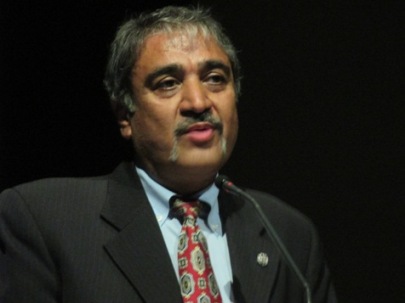
UC San Diego Chancellor Pradeep K Khosla
“We are pleased to create the first and only Arthur C. Clarke Center for Human Imagination,” UC San Diego Chancellor Pradeep K Khosla said at the public opening of the new centre on May 20.
“At UC San Diego, innovation plays an integral role in our education and research, so our campus is ideally suited to launch and grow a major center to better understand, enhance and enact the gift of human imagination,” he added.
The creation of the new centre is the culmination of a decade long process that the Arthur C Clarke Foundation (ACCF), when the non-profit organization set out looking for the best way to celebrate the legacy of legendary author.
Clarke personally endorsed the initiative before he passed away in March 2008. A series of public events and activities at UC San Diego throughout this month pay tribute to his many literary and scientific achievements.
Tedson Meyes, Chairman, Arthur C Clarke Foundation
Tedson Meyers, ACCF Chairman of the Board, said several excellent US universities had responded to a call for proposals to host the Arthur C Clarke Centre for Human Imagination. Among them, UC San Diego had made the most compelling case.
He explained: “UC San Diego and its faculty provide both a practical as well as theoretical framework to put imagination under a microscope, to find its historic limits and go beyond them, and to promote its positive use in education, commerce, science, social change and more. Clearly, ACCCHI will also put Sir Arthur’s spirit back to work in a significant way.”
Meyers also suggested a slogan for both the Foundation and the new Centre: “Science forges fiction into function”.
“The Clarke Center will be a focal point for active collaboration on current and future research and an intersection of disciplines for the purpose of identifying and advancing creative and innovative solutions for the challenges of contemporary and future societies,” said Sandra Brown, the university’s vice chancellor for research.
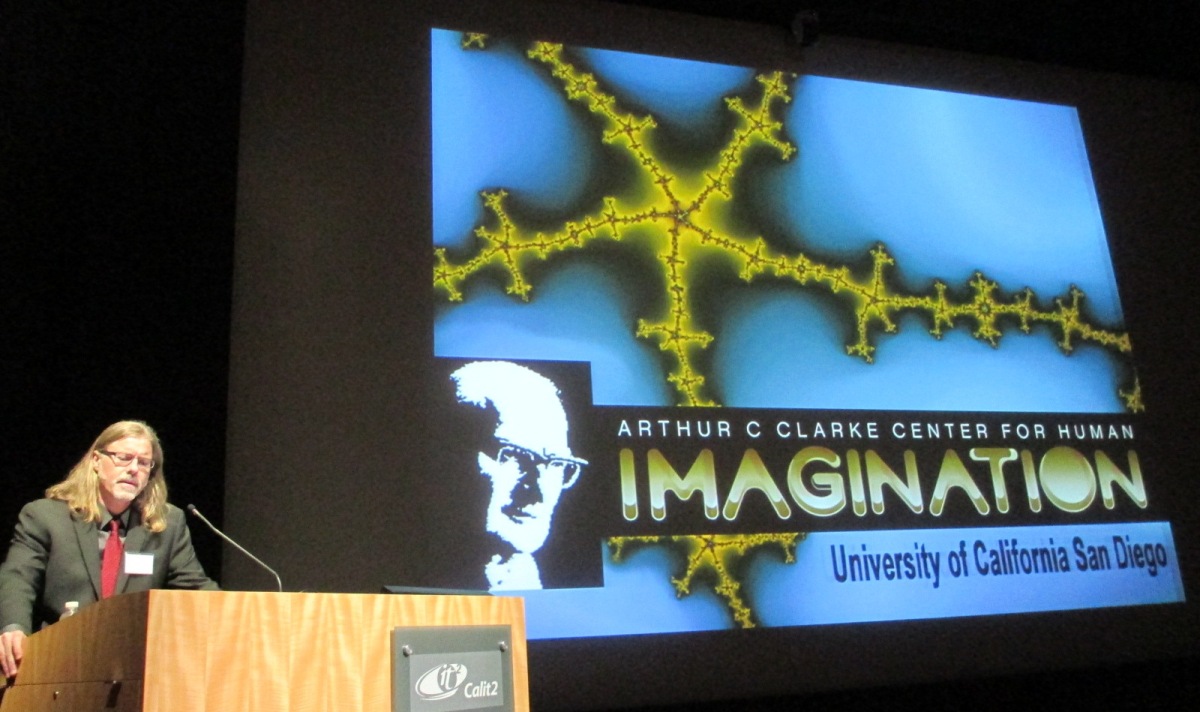
The new centre is being headed by Sheldon Brown, a professor of media arts in the Department of Visual Arts in UC San Diego’s Division of Arts and Humanities. For him and team, this week’s public launch came after two years of planning and ground laying work.
“In our proposal for the new centre, we brought together connections from all divisions of the campus to show how the subject of imagination could be pursued through an engagement of the arts, literature, sciences, medicine and technology,” he said.
Understanding the brain will be a key plank in the new centre’s multidisciplinary and interdisciplinary work. Among the big questions the new centre will address are: what is the neurological basis for imagination and creativity? How does imagination occur in human societies? And does it vary from culture to culture?
The impetus for probing and understanding human imagination came from cultural research, Brown added. In recent years, the University has regularly brought science fiction writers and scientists together in a series of meetings that explored the interface between science, technology and society.
According to UC San Diego sources, it has produced more science fiction writers than any other university in the United States, many of who are already involved in developing the new centre.
Seth Lerer, Dean of Arts and Humanities, described UC San Diego as the ‘campus of possibility’. He quoted Arthur C Clarke’s famous Second Law: “The only way of discovering the limits of the possible is to venture a little way past them into the impossible.”
Sheldon Brown, Director of Arthur C Clarke Centre for Human Imagination, speaks at opening on May 20
Director Sheldown Brown said he wants to develop international collaborations in exploring myriad ways in which human cultures and societies respond to a fundamental question that is at the root of imagination: “What if?”
As part of the launch events, the centre hosted a two-day “Starship Century Symposium”. It was a scientific meeting devoted to discussing a ‘big idea’ of developing an inter-stellar ‘starship’ in the next 100 years. Space scientists, astronomers, science fiction writers and other experts explored the challenges and opportunities for humanity’s long-term future in space.
Among the speakers were physicist Freeman Dyson, futurist Peter Schwartz, and science fiction authors Neal Stephenson, Allen Steele, Joe Haldeman, Gregory Benford, Geoffrey Landis and David Brin.
Other events included an exhibition of Arthur C Clarke books, book cover paintings and signed photographs, as well as a public screening of the 1997 BBC documentary on him titled ‘The Man Who Saw the Future’.
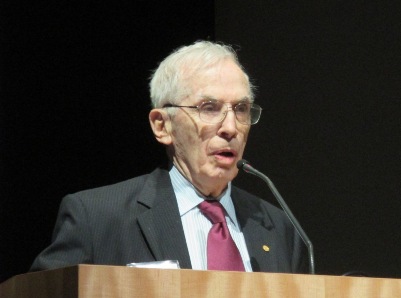
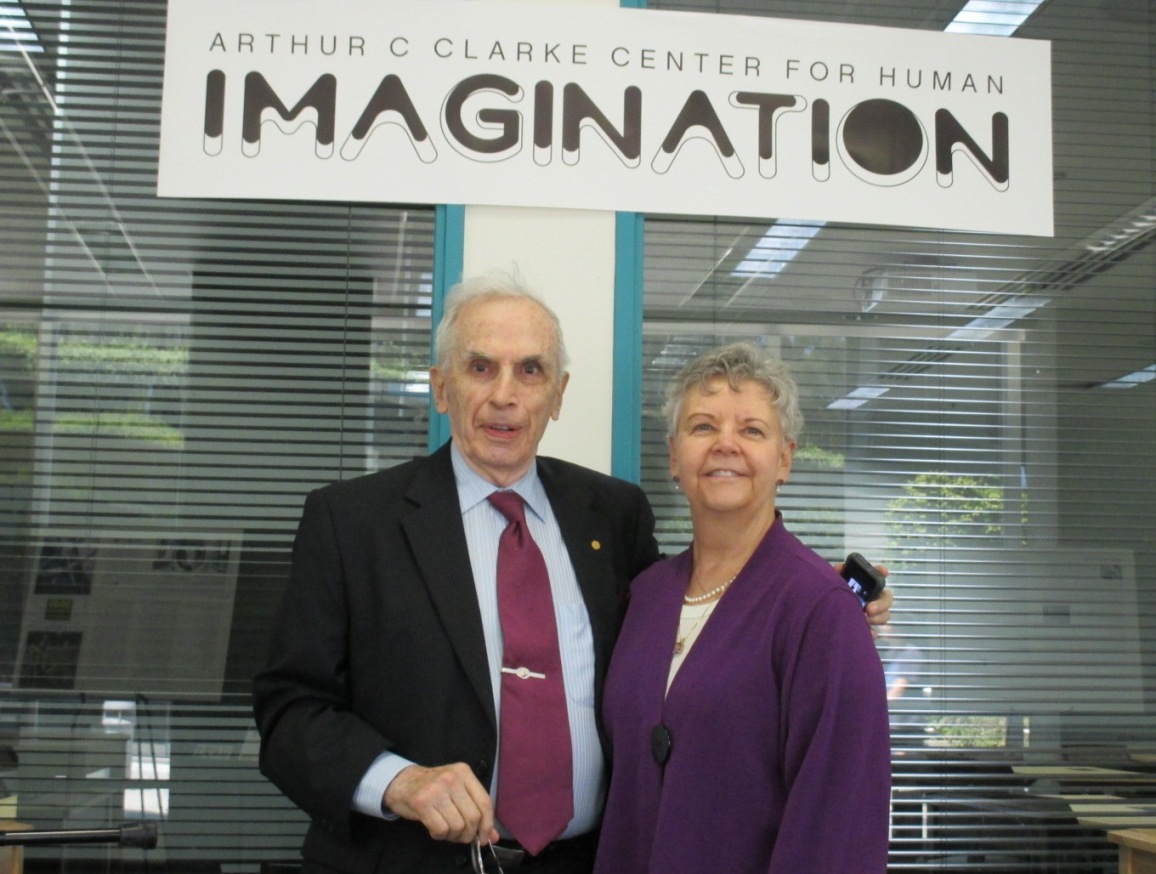
Tedson Meyers, Chairman,and Monica Morgan, Executive Director of Arthur C Clarke Foundation
How did Arthur C Clarke write acclaimed science fiction? Did he just dream up all his stories, or was there a meticulous research and development process? (The latter was closer to the truth.)
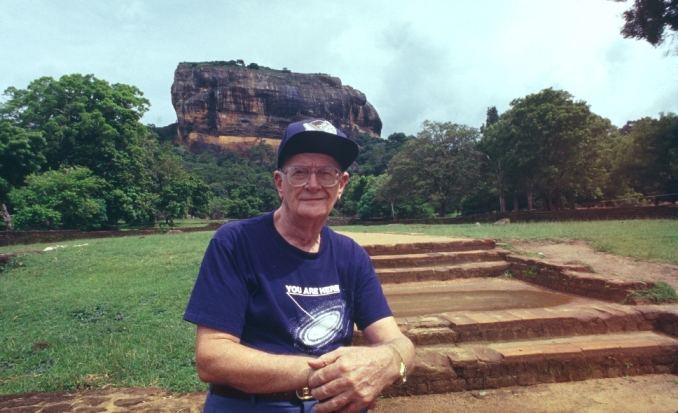
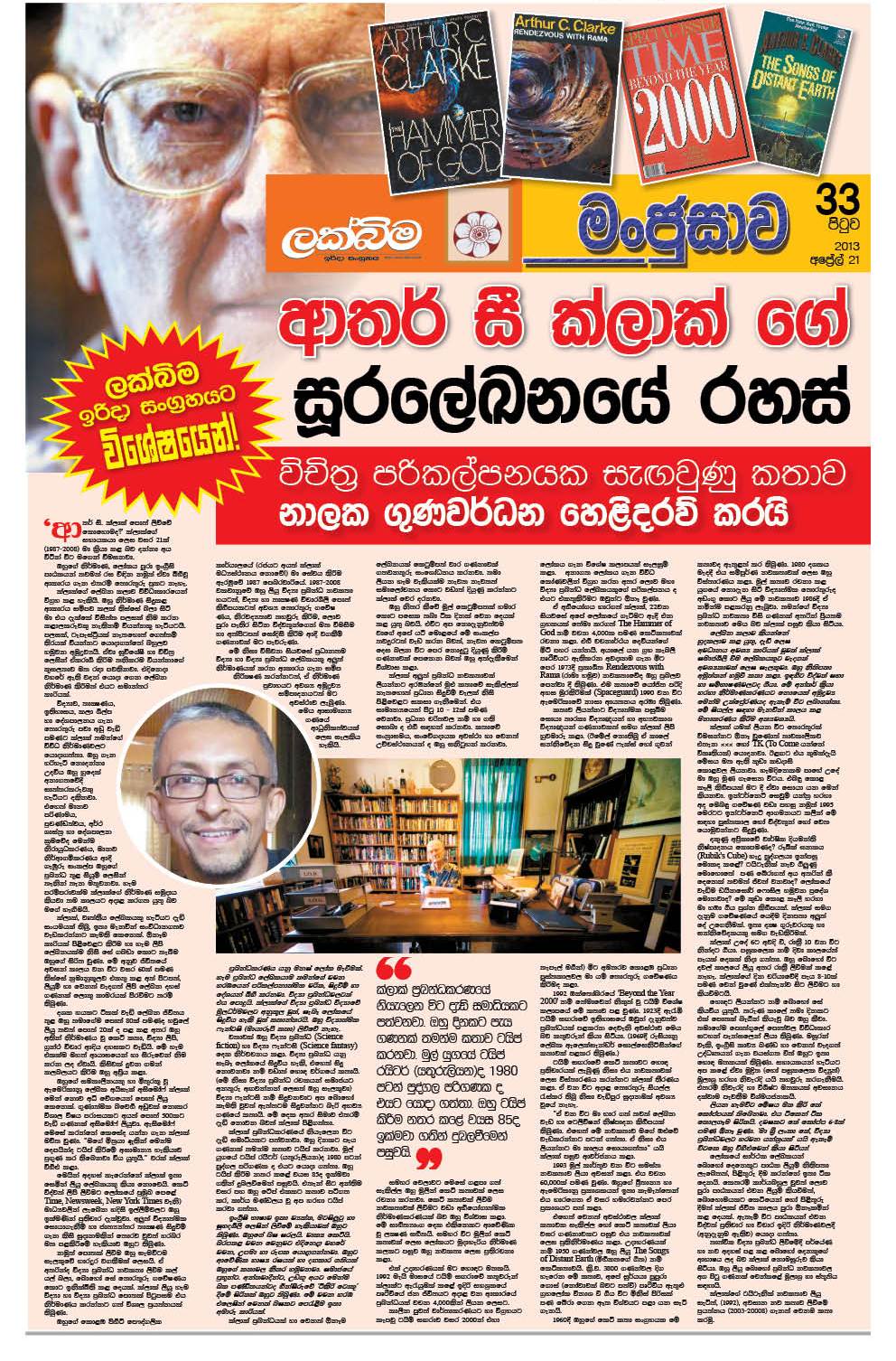
But there is limited awareness of the man and his creative accomplishments in Sri Lanka, his adopted home for over half a century. I wrote a book (in Sinhala) last year introducing Arthur C Clarke’s scientific ideas and visions for the future. This year, I have started chronicling how he wrote science fiction.
The first such article appeared in Sunday Lakbima, a popular Sinhala broadsheet newspaper, on 21 April 2013. Here is that text, which is not easy to locate online as they (and many other Lankan newspapers) use mini-blackholes to publish their web editions…











 Open Minds!