Drawing from my recent interactions with the IGF Academy, as well as several academic and civil society groups, I position the current public debates on web’s socio-cultural impacts in the context of freedom of expression.
With 30 per cent of our population now using the Internet, it is no longer a peripheral pursuit. Neither is it limited to cities or rich people. So we urgently need more accurate insights into how society and economy are being transformed by these modern tools.
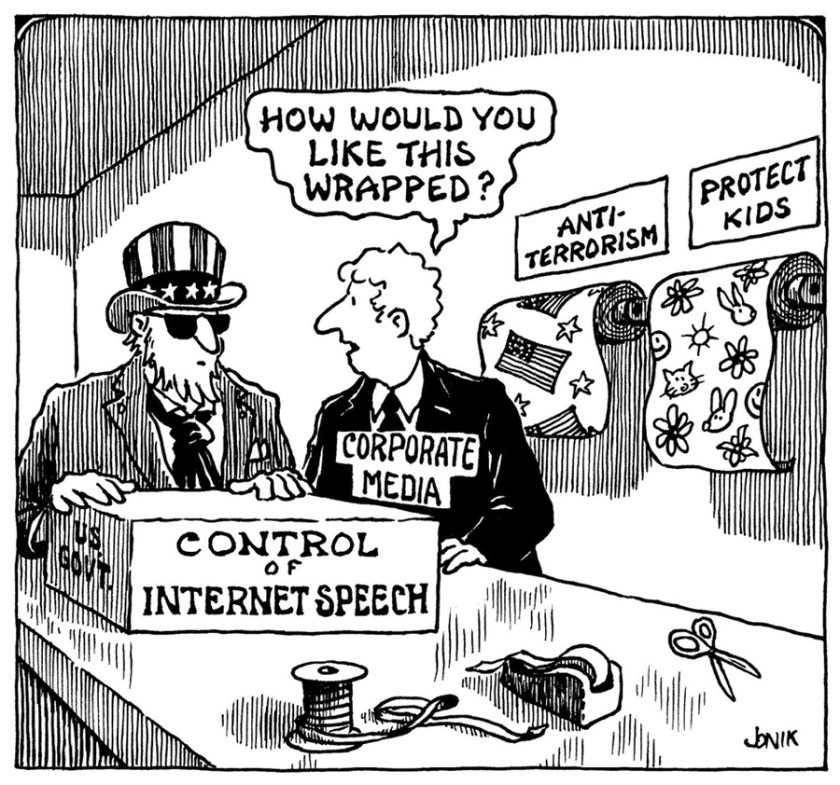
My basic premise: many well-meaning persons who urge for greater regulation of the web and social media overlook that governments in Sri Lanka have a terrible track record in stifling dissent in the name of safeguarding the public.
Cartoon by John Jonik
I argue: “As a democracy recovering from a decade of authoritarianism, we need to be especially careful how public sentiments based on fear or populism can push policymakers to restrict freedom of expression online. The web has become the last frontier for free speech when it is under pressure elsewhere.
“When our politicians look up to academics and researchers for policy guidance, the advice they often get is control or block these new media. Instead, what we need is more study, deeper reflection and – after that, if really required – some light-touch regulation.”
I acknowledge that there indeed are problems arising from these new technologies – some predictable, and others not. They include cyber-bullying, hate speech, identity theft through account hijacking, trolling (deliberately offensive or provocative online postings) and sexting (sending and receiving sexually explicit messages, primarily via mobile phones).
I cite some research findings from the work done by non-profit groups or media activists. These findings are not pretty, and some of them outright damning. But bans, blocks and penalties alone cannot deal with these or other abuses, I argue.
I end with these words: “We can and must shape the new cyber frontier to be safer and more inclusive. But a safer web experience would lose its meaning if the heavy hand of government or social orthodoxy tries to make it a sanitized, lame or sycophantic environment at the same time. We sure don’t need a cyber nanny state.”
In this week’s Ravaya column (appearing in the print issue of 21 August 2016), I take a critical look at the Sri Lanka government’s new ‘Toxin-Free Nation” effort. Announced in 2015, it is a three year programme (2016-2018) “to convert Sri Lanka into a green nation and enable its citizens to enjoy foods free of chemicals and agro-toxins”.
Curiously, the programme is being implemented by a state entity called the Strategic Enterprise Management Agency (SEMA), set up in 2004 originally to monitor and support state owned enterprises. The century old and widely experienced Department of Agriculture is not involved (and apparently fully excluded).
Toxin free country – SEMA image
According to the official programme document, available on SEMA website, “the aim of the program is to replace import driven agrochemical based agriculture with organic, sustainable natural agro-culture.”
[Quoted verbatim: not sure why they insist on using the term agro-culture instead of agriculture.]
The document claims, without citing any references or sources, that Sri Lanka spends LKR 300 billion a year “to import milk products, sugar, agrochemicals, seeds, etc., while farmer subsidies account for a further Rs.30 billion a year” (p12).
It further says, on p23, “As a long-term strategy for toxin-free agriculture, it is anticipated that indigenous rice varieties will significantly replace the improved varieties that are presently grown by farmers. According to the plan, 30% of rice produced in Sri Lanka would be indigenous varieties at the end of the three year plan. Further, organic, natural, biological fertilizers and pest repellants will replace the agrochemicals used to cultivate these improved varieties and it is anticipated that these toxins will be completely eradicated from Sri Lankan soil by the third year of the program.”
The document is full of uncorroborated claims and seemingly unrealistic goals. In 2014, organically farmed land accounted for less than one percent of the total cultivated land in Sri Lanka.
The exact methodology of going from under 1 percent to 33% in three years is not clear. On p15, the document says: “A toxin-less agro-culture is a system geared to obtain the required “plant-food” from the air, the land and the immediate environment. Multicropping, soil conservation, water and irrigation management, promoting the presence of agrofriendly fauna and flora as well as mechanical systems for pest control are all part of these systems.”
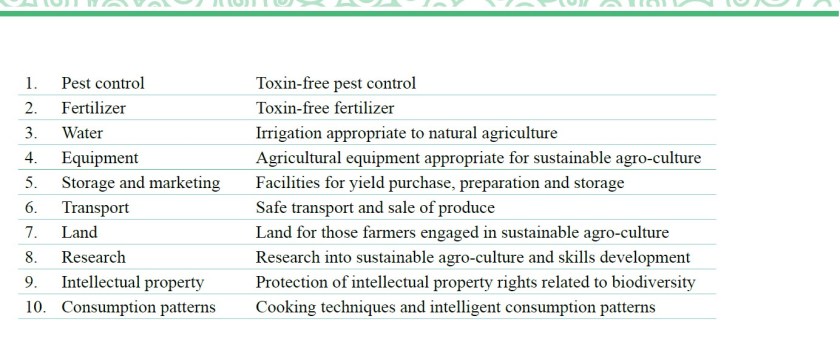
The plan lists a 10 point, multi-pronged approach as follows:
The plan does make some sense when it takes stock of organically grown food available in the market today. “In 2015, the price of organics was two or three times that of foods produced with the application of agrochemicals. Therefore, only the middle upper and upper income bracket of consumer could afford them leaving the common citizen of the country no choice but to purchase and consume toxin laced alternatives.” (p13).
I have been saying this for years. As I wrote in August 2014: “Despite their appeal, organics will remain a niche market, albeit a growing one, for years to come. Nobody wants to eat food laced with agrochemical residues (for which no safe upper limits have been set in Sri Lanka). But when organics typically cost 50% or more than non-organics, how many can really afford it? Unless this gap is narrowed, organics will remain beyond reach for many.”
As a long standing watcher and commentator on conservation farming (which is bigger than organics), I have been seeking clarity on this Toxin-Free Nation plan of Sri Lanka, being spearheaded by President Maithripala Sirisena himself. But his staff involved in promoting and implementing the programme have opted not to respond to specific queries in the public media and scientific forums.
Worse, they have shown high levels of intolerance towards critics — sometimes vilifying critics as ‘agents of chemical farming’ or ‘promoters of agrochemical companies’! This utter failure to engage is inconsistent with good governance policies of the President and government. The Department of Agriculture being excluded from the whole process is also a matter for grave concern: this means there now are TWO parallel structures for farming policy and promotion in Sri Lanka!
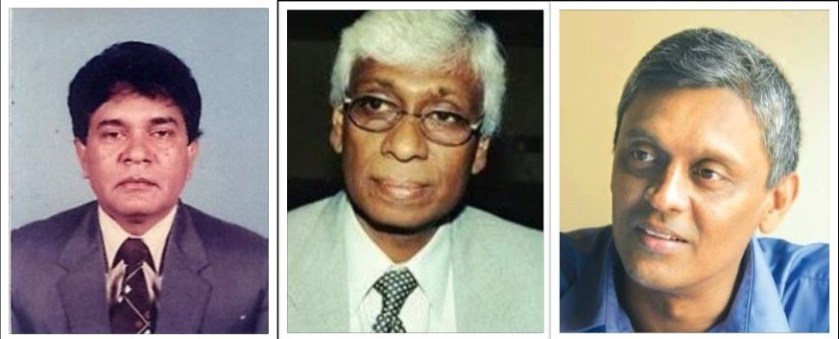
In this column, I call for a dispassionate, rational discussion of this politically driven national programme for toxin-free farming. I also refer to three outstanding Lankan scientists who have advocated conservation farming for decades – but they have done so without the intellectual arrogance and confrontational politics of the current effort. These pathfinders are: late Dr Ray Wijewardene, Dr Lionel Weerakoon and Dr Parakrama Waidyanatha.
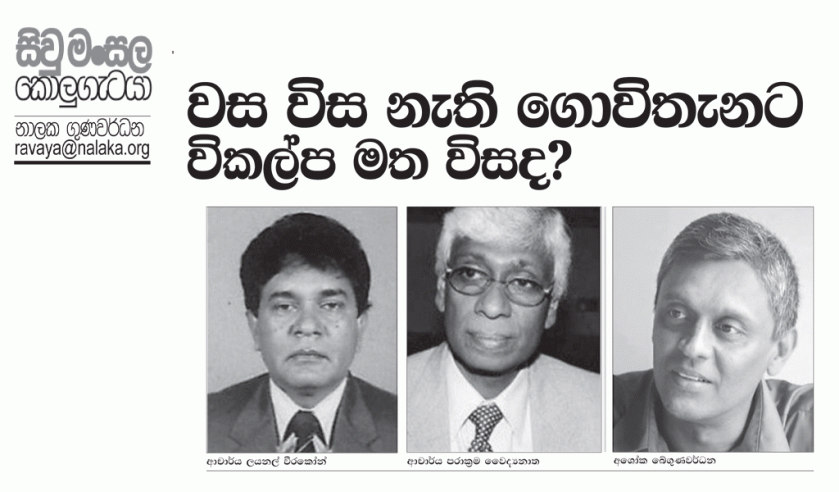
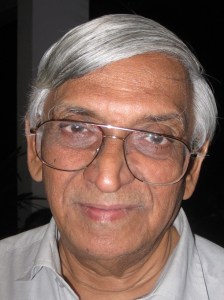
L to R – Dr Lionel Weerakoon, Dr Parakrama Waiyanatha, Asoka Abeygunawardena
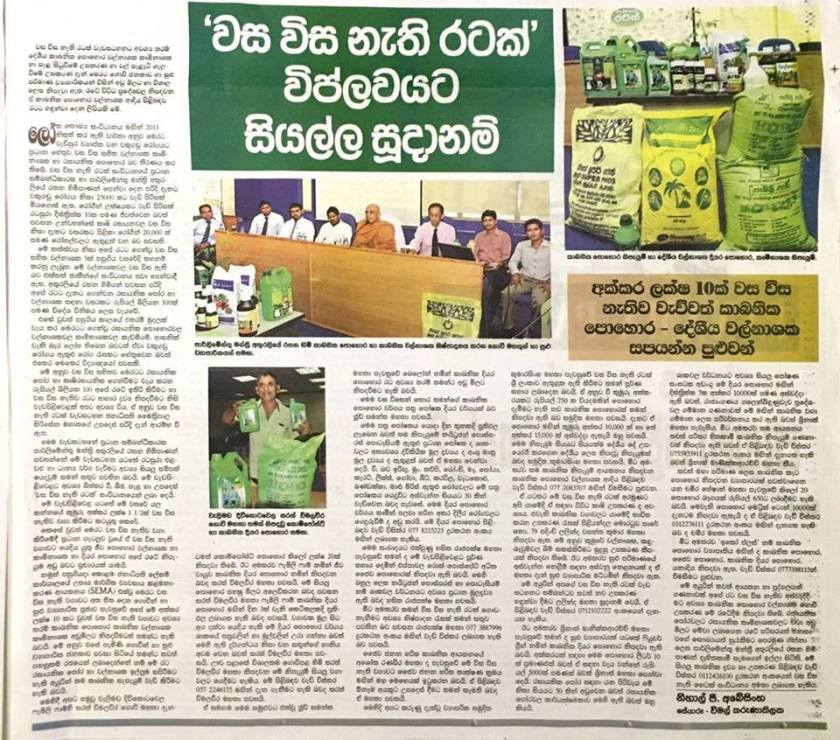
Uncritical media reporting (such as this one in state media) leaves the Toxin-Free Nation Programme unchallenged even when its claims and plans don’t add up…
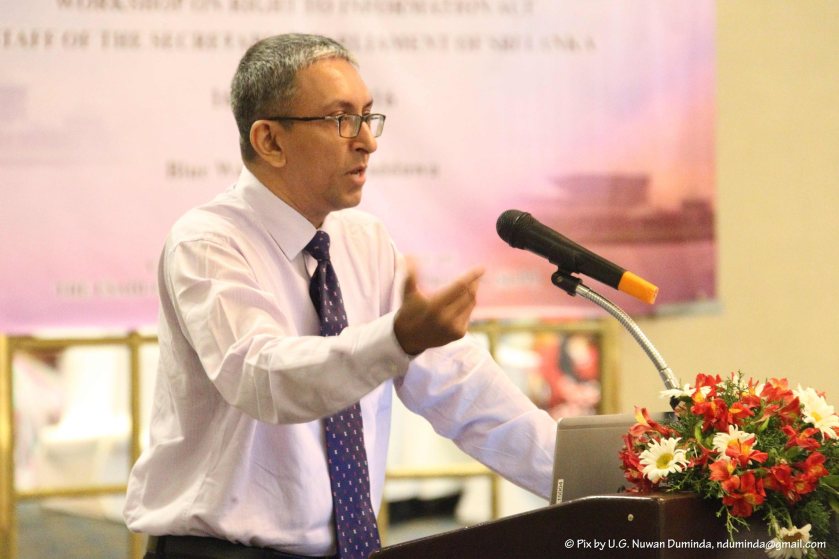
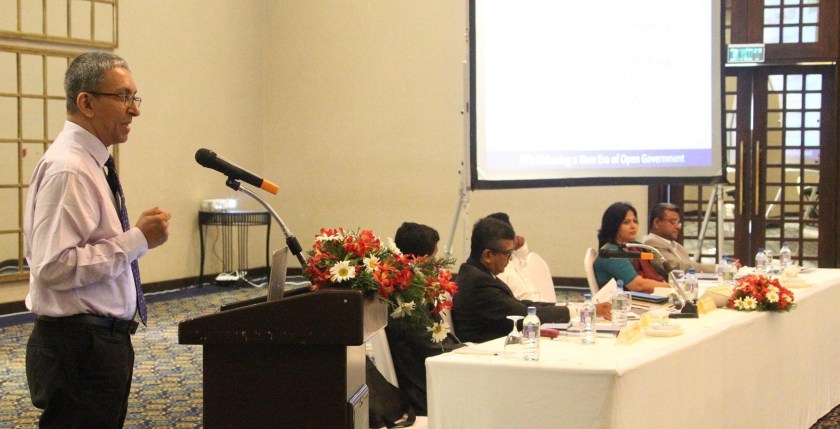
Nalaka Gunawardene speaks at RTI Seminar for Sri Lanka Parliament staff, 16 Aug 2016
On 16 August 2016, I was invited to speak to the entire senior staff of the Parliament of Sri Lanka on Right to Information (RTI) – South Asian experiences.
Sri Lanka’s Parliament passed the Right to Information (RTI) law on 24 June 2016. Over 15 years in the making, the RTI law represents a potential transformation across the whole government by opening up hitherto closed public information (with certain clearly specified exceptions related to national security, trade secrets, privacy and intellectual property, etc.).
This presentation introduces the concept of citizens’ right to demand and access public information held by the government, and traces the evolution of the concept from historical time. In fact, Indian Emperor Ashoka (who reigned from c. 268 to 232 Before Christ) was the first to grant his subjects the Right to Information, according to Indian RTI activist Venkatesh Nayak, Coordinator, Commonwealth Human Rights Initiative (CHRI). Ashoka had inscribed on rocks all over the Indian subcontinent his government’s policies, development programmes and his ideas on various social, economic and political issues — including how religious co-existence.
Nalaka Gunawardene speaks at RTI Seminar for Parliament staff, Sri Lanka – 16 Aug 2016
Therefore, adopting an RTI law signifies upholding a great Ashokan tradition in Sri Lanka. The presentation looks at RTI good practices and implementation experiences in India, Nepal, Bangladesh, Pakistan and Maldives – all these South Asian countries passed an RTI law before Sri Lanka, and there is much that Sri Lanka can learn from them.
The presentation ends acknowledging the big challenges in implementing RTI in Sri Lanka – reorienting the entire public sector to change its mindset and practices to promote a culture of information sharing and transparent government.
This column originally appeared in Echelon business magazine, March 2014 issue. It is being republished here (without change) as part of a process to archive all my recent writing in one place – on this blog.
Image courtesy Echelon magazine
Balancing Broadband and Narrow Minds
By Nalaka Gunawardene
Are we cyber-stunted?
I posed this question some weeks ago at Sri Lanka Innovation Summit 2013 organised by Echelon and News 1st. We were talking about how to harness the web’s potential for spurring innovation.
We cannot innovate much as a society when our broadband is stymied by narrow minds. How many among the (at least) 3.5 million Lankans who regularly access the web have the right mindset for making the best use of the medium, I asked.
We didn’t get to discuss it much there, but this bothers me. Sri Lanka has now had 19 years of commercial Internet connectivity (the first ISP, Lanka Internet Services, started in April 1995). That’s a long time online: we have gone past toddler years and childhood (remember dial-up, anyone?) and been through turbulent ‘teen years’ as well.
Technology and regulation have moved on, imperfect though the latter maybe. But psychologically, as a nation we have yet to find our comfort level with the not-so-new medium.
There are various indicators for this. Consider, for example, the widespread societal apprehensions about social media, frequent web-bashing by editorialists in the mainstream media, and the apparent lack of public trust in e-commerce services. These and other trends are worth further study by social scientists and anthropologists.
Another barometer of cyber maturity is how we engage each other online, i.e. the tone of comments and interactions. This phenomenon is increasingly common on news and commentary websites; it forms the very basis of social media.
Agree to disagree?
‘Facts are sacred, comment is free’ is a cherished tenet in journalism and public debates. But expressing unfashionable opinions or questioning the status quo in Lankan cyber discussions can attract unpleasant reactions. Agreeing to disagree rarely seems an option.
Over the years, I have had my share of online engagement – some rewarding, others neutral and a few decidedly depressing. These have come mostly at the multi-author opinion platforms where I contribute, but sometimes also through my own blogs and twitterfeed.
One trend seems clear. In many discussions, the ‘singer’ is probed more than the ‘song’. I have been called unkind names, my credentials and patriotism questioned, my publishers’ bona fides doubted, and my (usually moderate) positions attributed to personality disorders or genetic defects! There have been a few threats too (“You just wait – we’ll deal with traitors soon!”).
I know those who comment on mainstream political issues receive far more invective. Most of this is done under the cover of anonymity or pseudonymity. These useful web facilities – which protect those criticising the state or other powerful interests – are widely abused in Lankan cyberspace to malign individuals expressing uncommon views.
There are some practical reasons, too, why our readers may misunderstand what we write, or take offence needlessly.
Poor English comprehension must account for a good share of web arguments. Many fail to grasp (or appreciate) subtlety, intentional rhetoric and certain metaphors. Increasingly, readers react to a few key words or phrases in longer piece — without absorbing its totality.
A recent example is my reflective essay ‘Who Really Killed Mel Gunasekera?’. I wrote it in early February shortly after a highly respected journalist friend was murdered in her suburban home by a burglar.
I argued that we were all responsible, collectively, for this and other rising incidents of violence. I saw it as the residual product of Lankan society’s brutalisation during war years, made worse by economic marginalisation. Rather than barricading ourselves and living in constant fear, we should tackle the root causes of this decay, I urged.
The plea resonated well beyond Mel’s many friends and admirers. But some readers were more than miffed. They (wrongly) reduced my 1,100 words to a mere comparison of crime statistics among nations.
I aim to write clearly, and also probe beyond headlines and statistics. But is such nuance a lost art when many online readers merely scan or speed-read what we labour on? In today’s fast-tracked world, can reflective writing draw discerning readers and thoughtful engagement any longer? I wonder.
Too serious
Then there is the humour factor – or the lack of it. Many among us don’t get textual satire, as Groundviews.org discovered with its sub-brand called Banyan News Reporters (BNR). Their mock news items and spoofs were frequently taken literally – and roundly condemned.
The web is a noisy place, but some stand out in that cacophony because of their one-tracked minds. They are those who perceive and react to everything through a pet topic or peeve. That ‘lens’ may be girls vs boys, or lions vs tigers, or capitalism vs socialism or something else. No matter what the topic, such people will always sing same old tune!
Tribal divisions are among the most entrenched positions, and questioning matters of faith assures a backlash. It seems impossible to discuss secularism in Sri Lanka without seemingly offending all competing brands of salvation! (The last time I tried, they were bickering among themselves long after I quietly left the platform…)
Oh sure, everybody is entitled to a bee or two in her bonnet. But what to do with those harbouring an entire bee colony — which they unleash at the slightest provocation?
I just let them be (well, most of the time). I used to get affected by online abuse from cloaked detractors but have learnt to take it with equanimity. This is what economist and public intellectual W A Wijewardena also recommends.
“You must treat commentators as your own teachers; some make even the most stupid comment in the eyes of an intelligent person, but that comment teaches us more than anything else,” he wrote in a recent Facebook discussion.
He added: “Individual wisdom and opinions are varied and one cannot expect the same type of intervention by all. I always respect even the most damaging comment made by some on what I have written!”
Moderating extreme comments is a thankless and challenging job for those operating opinion platforms. If they are too strict or cautious, they risk diluting worthwhile public debates for which space is shrinking in the mainstream media. At the same time, hate speech peddlers cannot be allowed free license in the name of free speech.
Where to draw the line? Each publisher must evolve own guidelines.
Groundviews.org, whose vision is to “enable civil, progressive and inclusive discussions on democracy, rights, governance and peace in Sri Lanka” encourages “a collegial, non-insulting tone” in all contributors. It also reminds readers that “comments containing hate speech, obscenity and personal attacks will not be approved.”
Colombo Telegraph, another popular opinion and reporting website, “offers a right to reply for any individual or organisation who feels they have been misreported”. Sadly, this courtesy is not available in many online news and commentary websites carrying Lankan content.
In the end, even the most discerning publishers and editors can do only so much. As more Lankans get online and cyber chatter increases, we have to evolve more tolerant and pluralistic ways of engagement.
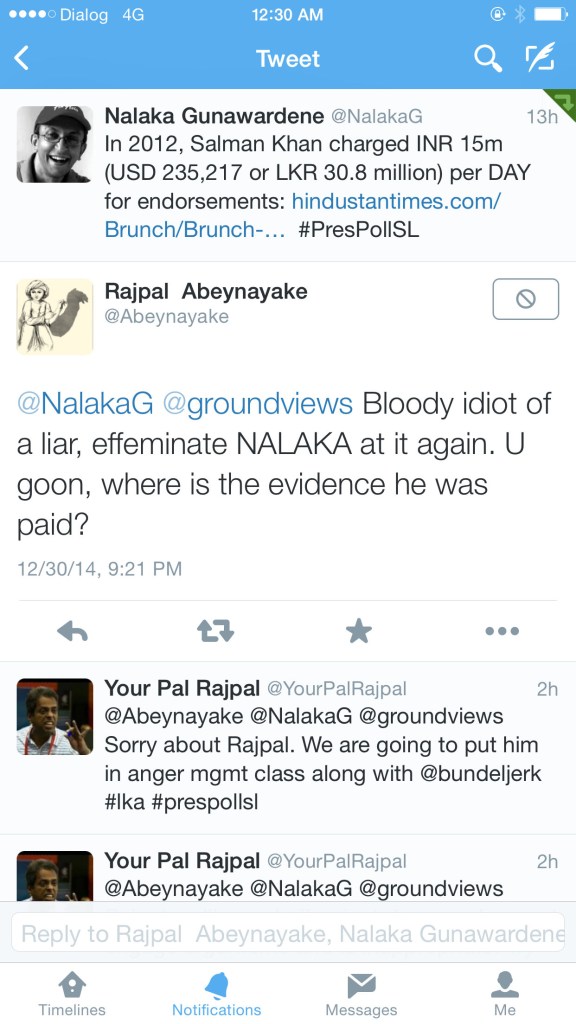
An example of cyber intolerance and name-calling from December 2014, during the campaign for Sri Lanka’s Presidential Election (when Bollywood’s Salman Khan was brought to Sri Lanka to promote then incumbent Mahinda Rajapalksa’s election campaign)
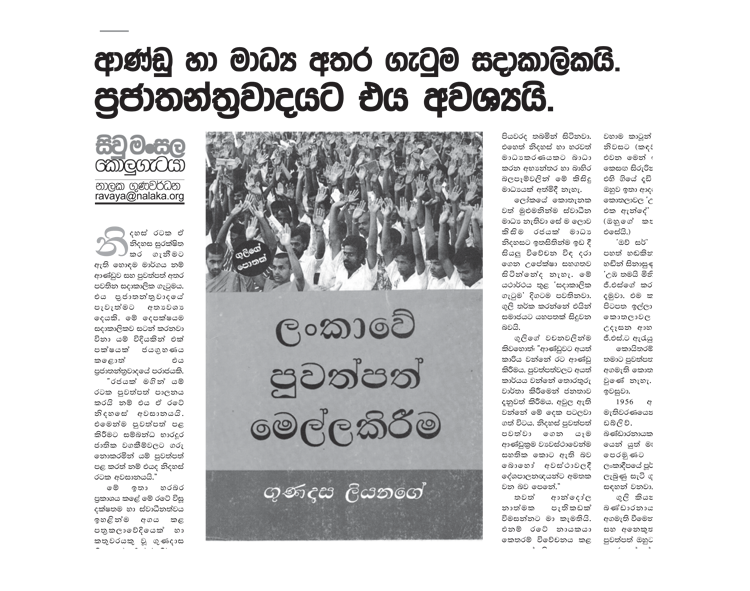
Sivu Mansala Kolu Getaya column by Nalaka Gunawardene, Ravaya 14 Aug 2016
In this week’s Ravaya column (appearing in the print issue of 14 August 2016), I take a close look at the perennial tension between governments and the media.
I open with an extract from late Gunadasa Liyanage (1930-1997), one of Sri Lanka’s most accomplished and respected editors of the 20th century. In his 1993 book on ‘Taming the Press in Sri Lanka’ (in Sinhala), he argued that the never-ending confrontation between the government and media is, in fact, a protection for democratic freedoms. If either party wins, it is a set back for democracy.
“If a government controls the media that marks the end of human freedoms in that country. On the other hand, if the media behaves without any responsibility, that too threatens freedoms in society,” he wrote.
So the tension between these two continues in 21st century Sri Lanka, even as we recover from a Decade of Darkness (2005-2014) under the authoritarian rule of Mahinda Rajapaksa. As the government elected in 2015 tries to balance media freedoms with economic growth and political reforms, it faces some familiar challenges.
How much can or should the government allow ultra-nationalists and other political opportunists to exploit media freedom? What are the sane and safe limits to which media houses should accommodate partisan agendas and vitriolic messages emanating from sections of the (serving and retired) military, clergy and electorally defeated political parties?
This column also quotes Vijitha Yapa, one of Sri Lanka’s most senior journalists who was founder editor of The Island, The Sunday Island and the (revived) Sunday Times – all of which positions he quit when he could no longer operate with editorial independence.
I also raise a related point: how far can the President and Prime Minister be criticized in the media?
‘ලංකාවේ පුවත්පත් මෙල්ල කිරීම’ – Taming the Press in Sri Lanka, by Gunadasa Liyanage (1993)
In this week’s Ravaya column (appearing in the print issue of 7 August 2016), I discuss the history of Chinese space programme through the life story of its most important founder.
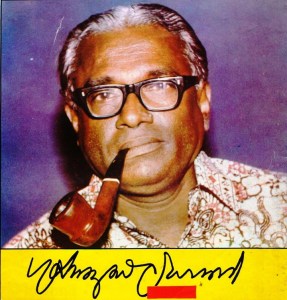
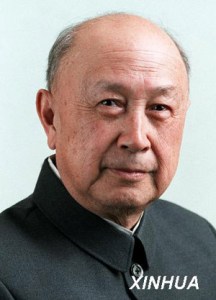
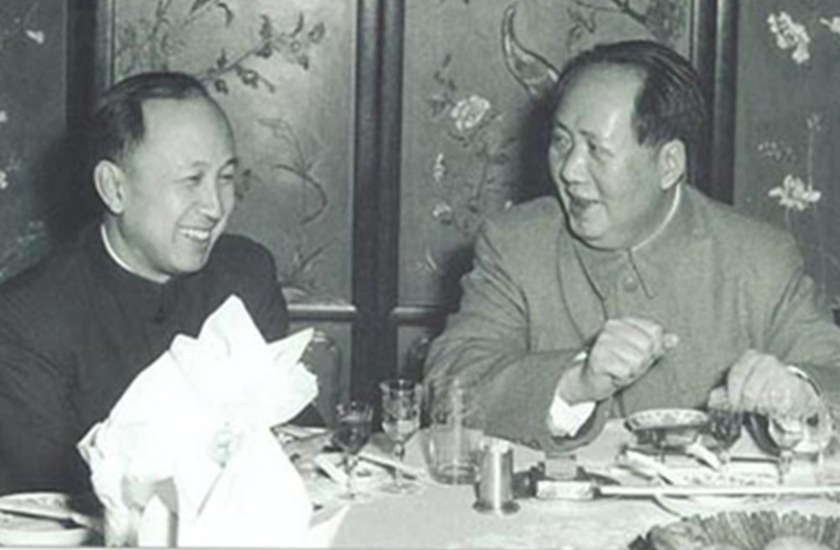
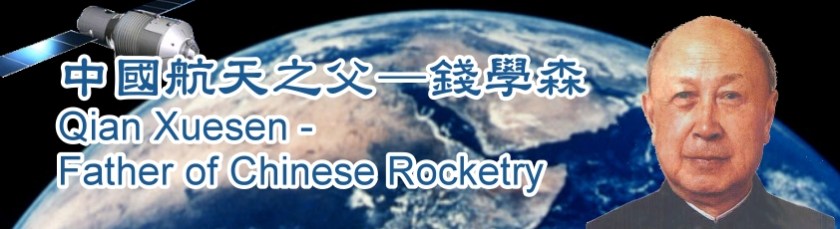
Qian Xuesen (1911 – 2009) was one of the greatest Chinese scientists of the modern era and is widely regarded as the father of China’s space and strategic rocket programme.
One of twentieth century’s most brilliant engineers, Qian was widely honoured in China for his “eminent contributions to science”. He was credited with leading China to produce and launch weather and reconnaissance satellites, as well as its own intercontinental ballistic missiles and anti-ship missiles.
His pioneering efforts also helped China to send a human to Earth orbit in 2003 using its own rockets – the third nation to do so after the (former) Soviet Union and the United States.
In 2008, China Central Television (CCTV) named Qian as one of the eleven most inspiring people in China. He died on 31 October 2009, aged 97, having seen China become one of the world’s leading space-faring nations.
Qian Xuesen – Father of China’s space and strategic rocket programme [image courtesy CCTV]සමාජ මාධ්යවල මා කරන ප්රකාශ මත පදනම් වී සමහරුන් අසන්නේ මා උග්ර චීන විරෝධියකු ද කියායි.
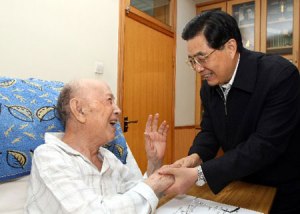
Chinese President Hu Jintao (R) visits renowned scientist and founder of China’s space technology Qian Xuesen in Beijing, January 19, 2008. (Xinhua Photo by Lan Hongguang)
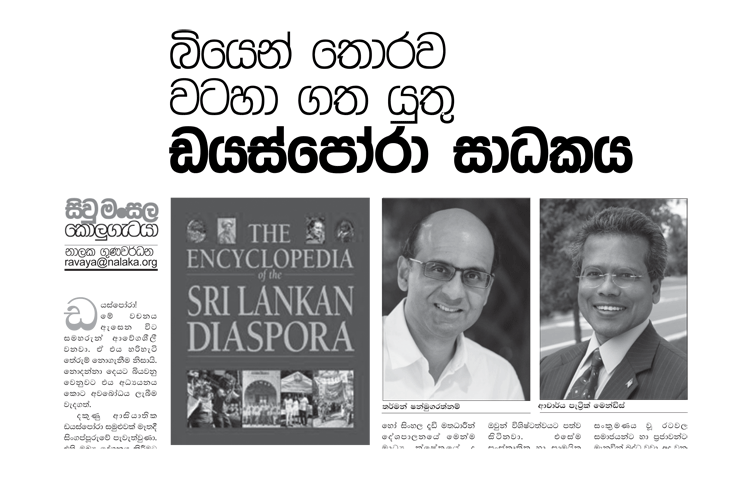
In this week’s Ravaya column (appearing in the print issue of 31 July 2016), I explore the many faceted phenomenon called the Sri Lankan diaspora.
I emphasize why it is very important for everyone in Sri Lanka to understand the diaspora factor in all its nuances and complexity. Simplistic perceptions have dominated public discourse for too long, and we owe ourselves a more informed approach to this topic
Most media outlets narrowly and negatively interpret the term ‘diaspora’ mean only a section of oversease Lankans of Tamil ethnicity who supported terrorism. This is not merely a case of semantics, as diaspora engagement for national reconciliation is hampered by these persistent misconceptions.
I point out that sympathisers of Tamil Eelam were/are only a small part of the spectrum that includes people of ALL ethnicities, social backgrounds and professional skills originating from Sri Lanka who have spread to different parts of the world for over 150 years.
The latter report’s opening para says: “With nearly three million Sri Lankans living across the world (approximately fourteen percent of the country’s population) Sri Lanka’s diaspora-to-population ratio is known as one of the highest in the South Asian region. This ratio is the product of different waves of migrations that are mainly attributed to: post-colonial developments, the need for better economic prospects, political instability – including the JVP insurrection and the 30-year civil war, and education opportunities. As such, the Sri Lankan diaspora is by nature not considered to be homogenous as it represents the many social, political, ethnic and religious ideologies and experiences that exists in Sri Lanka.”







![Qian Xuesen - Father of China's space and strategic rocket programme [image courtesy CCTV]](https://nalakagunawardene.com/wp-content/uploads/2016/09/qian-xuesen-image-courtesy-cctv.jpg?w=840)






 Open Minds!