Living with diversity: Salad or soup, asks Mallika Sarabhai

Standing up for a pluralistic society

The recently concluded general election in India saw thousands of candidates contest to enter the Indian Parliament. Among the candidates I watched closely were writer Shashi Tharoor (who ran on the Congress ticket and was elected from Kerala state) and dancer Mallika Sarabhai (who ran as an independent candidate in the Gujarat state and didn’t win).

The classical dancer turned social activist had one of the more colourful campaigns in the world’s largest election: her public rallies included dance numbers, and her website (UPDATE in March 2013: no longer online) – featuring interactive elements like blogging, flickr images and online fund raising – was ranked the best by a communication research agency.

But where Mallika – whose performances I have enjoyed watching on successive visits to her home town of Ahmedabad – really stood out was in whom she opposed. She was the independent candidate from Gandhinagar, one of India’s most high-profile constituencies, a state capital that has been polarized along Hindu-Muslim lines since riots in 2002. Her opponent was Lal Krishna Advani, the prime ministerial candidate of the BJP.
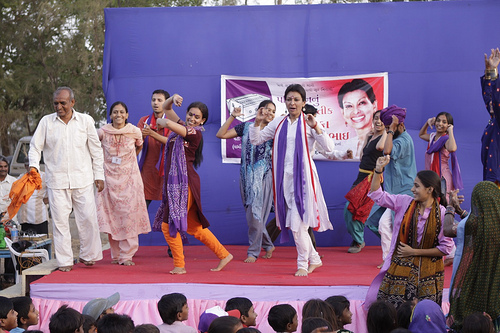
Mallika Sarabhai dances during campaign trail
The two candidates couldn’t have been more different. The 82-year-old veteran politician epitomised Hindu nationalism and majority hegemony with its attendant intolerance of minorities. Mallika, hailing from an upper class Indian family of freedom fighters, industrialists and intellectuals (her father Vikram Sarabhai was father of the Indian space programme), stood for pluralism, non-violence and tolerance. When she entered the fray in March 2009, she described her candidature as a Satyagraha against the politics of hatred.

She didn’t win the election, but lost with grace and dignity. Within days, she wrote in Outlook magazine one of the most remarkable pieces coming out of the cacophonous Indian election. She made it into an open letter addressed it to L K Advani, her main opponent.

“As a proud Hindu and a proud Indian, I feel vilified by you,” she wrote. “You have reduced the great Sanatana philosophy to a Taliban-style Hindutva. As an Indian, you have tried to reduce my identity to a single factor—Hindu or not. You let your goons, saffron-clad terror units wielding lathis and worse, terrorise us and live above the laws of this country.”

For me, the most insightful paragraph is this where she takes on what it means to live with the huge cultural, social and political diversity that makes up India: “I am a post-Independence Indian. I was brought up to value and treasure my unique Indianness, to value our Constitution, which gives equal rights to all Indians, irrespective of belief, culture, practice or language. I learnt to revel in the differences that made us a rainbow country. We are a salad-like melange of cultures and not a soup where all variations get reduced to a homogeneous pulp—this, to me, is our greatest strength.”

Read full text of Dear Shri Advani by Mallika Sarabhai
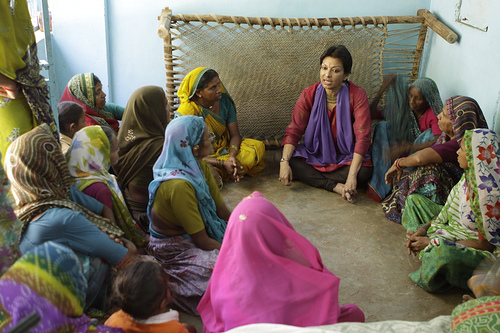
Eschewing grand speeches, microphones, banners and slogans, she just listened to voters
Salad or soup – that’s an interesting way of framing the challenge. And not just in the delightful melting pot that is India, but in many other mixed-up, tossed up cultures and societies of today…not the least in my native Sri Lanka, where we have seen the primitive forces of tribalism over-ride all other considerations in recent years. One released, it’s very hard to put this genie back in the bottle.

And how I wish our own privileged upper middle classes would take to the rough and dirty game of politics, if only to stand up against the peddlers of hatred and hegemony. If only…

Mallika could easily have continued her cultural work through the Darpana Academy of Performing Arts and her social activism. She decided to take the plunge this year because she thought the time had come to get into active politics. She was encouraged by her friends, mainly social activists, united under the banner of Friends of Democracy. Mallika is one of the several petitioners demanding justice in the post-Godhra riot cases. She was quoted in The Times of India as saying she decided not to join any party as she believed that there was no party free of corruption, criminalization and horse-trading.

As the Washington Post reported during her campaign trail: “Sarabhai, one of a handful of professional people running as independents in the upcoming elections, rejects the standard Indian political appeals to caste, religion and linguistic ethnicity, and speaks of empowering voters to unseat corrupt and ineffective politicians. Her campaign, she said, seeks to reclaim the shrinking space left for ordinary people’s voices in a democracy dominated by political parties that too often rely on mudslinging, muscle-flexing and money power.”

She and other courageous Indians have miles to go before they can sleep. Encouragingly, she has pledged that her campaign will continue.

As she says signing off her essay in Outlook: “I may have lost this election, but I will continue to work for the disadvantaged and dispossessed, and to ensure that their voice shall be silenced no more.”

Images courtesy Mallika Sarabhai campaign website and Friends of Democracy Flickr account
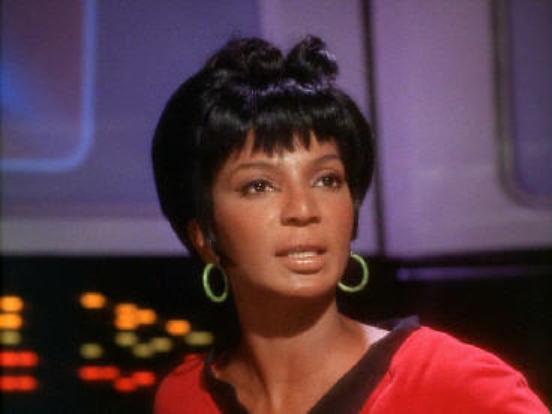
From Nyota Uhura to Michelle Obama: The inspiration continues!

Inspiration across generations...

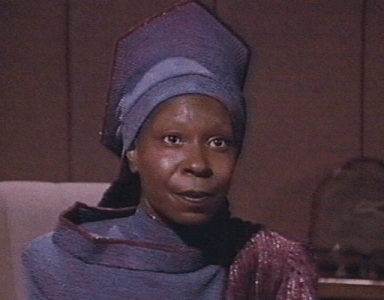
Actress Whoopi Goldberg was a child of 10 when the original series of Star Trek started its first broadcast on NBC in the US in September 1966. The futuristic science fiction series – about a spaceship travelling across space and time in the 23rd century in search of new civilisations – was to leave a lasting impression on many members of her generation.

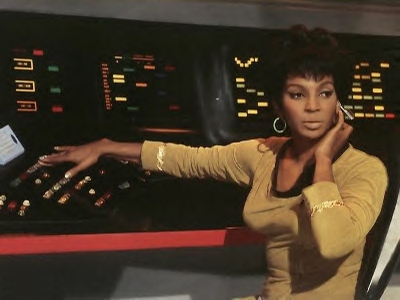
In Whoopi’s case, it went beyond just general inspiration. Something in the show seemed incredible to the African-American child growing up in a land where colour and race were still divisive factors. She recalls running around the house, screaming: “Hey mom, look! There’s a negro woman on TV — and she ain’t cooking dinner!”.

‘That woman’ was the character Nyota Uhura, played by Nichelle Nichols. This anecdote is captured in the 1997 documentary Trekkies, which explored the global fandom inspired by the show, which has gone on to become a franchise covering several TV series, 11 feature films (including the latest ‘origins’ film released on 8 May 2009), an animation series, as well as numerous books, video games and computer games. As Forbes magazine once noted, the allure is comparable only to that of Star Wars.

Sometimes, less is more!
Uhura featured as the communications officer on board the USS Enterprise in Star Trek: The Original Series, Star Trek: The Animated Series, and the first six Star Trek films. She is significant as one of the first major black characters on an American television series and for engaging in a then-taboo interracial kiss with Captain James T. Kirk (William Shatner). In the 2009 film, a younger Uhura is portrayed by actress Zoë Saldana.

The inclusion of Uhura, a black woman, in a critical technical position was certainly idealistic in the mid 1960s when the American civil rights movement was still agitating for equal rights for African Americans. She one of the first black women featured in a major television series not playing a servant; her prominent supporting role as a female black bridge officer was unprecedented.

As I’ve just noted in another blog post: “At a time when there were few non-white or foreign roles in American television dramas, Gene Roddenberry created a multi-ethnic crew for the Enterprise, including an African woman, a Scotsman, a Japanese American, and—most notably—an alien, the half-Vulcan Spock. In the second season, reflecting the contemporaneous Cold War, Roddenberry added a Russian crew member.”

But was the character, donning a sexy mini skirt uniform, somewhat tokenistic? Perhaps. But it still had considerable inspirational value – which is never to be under-estimated.

In fact, after the first season of Star Trek, Nichols had become frustrated at her relative lack of lines. At one point, she considered quitting the show, but was talked out of this decision by the civil rights leader Dr Martin Luther King, Jr.. MLK told her that a show that depicted a black woman working alongside whites in a position of importance was important for the goal of racial equality.

Another version of the story has MLK telling Nichols that he was a big fan of the series, and she “could not give up” since she was playing a vital role model for black children and young women across the country. It is also often reported that Dr. King added that “Once that door is opened by someone, no one else can close it again.”

After NBC executives cancelled Star Trek in 1969, Nichols went on to star in other roles — and also worked for NASA in a campaign to encourage African Americans to join the space service. Among those she helped recruit was Dr. Mae Jemison, the first African-American woman to fly aboard the Space Shuttle, in September 1992. Jemison has cited Star Trek as an influence in her decision to pursue a career in space.

Goldberg: From inspiration to a regular role
Meanwhile, things came full circle for actress Whoopi Goldberg, who was to get her own regular role in Star Trek: The Next Generation whose original run lasted from 1987 to 1994. In this successor series, she played the recurring El-Aurian female character Guinan.

Things have also moved on in the real world, where Barack Obama is now the President of the United States, with Michelle Obama as one of the most influential – if not powerful – women in the world. On 28 April 2009, CNN ran a story titled Why Michelle Obama inspires women around the globe. It noted: “Those who focus on Michelle Obama’s impact on America are underestimating her reach. The first lady is inspiring women of color around the globe to look at themselves, and America, in fresh ways.”

There is no linear link between Nyota Uhura and Michelle Obama, and the real world has very far to go to reach the utopian ideals of Star Trek. But the very fact that we have the Obamas where they are is an assurance that things can slowly move towards Gene Roddenberry’s grand vision.

Missing Mothers: How acronyms and jargon can kill innocent women

iwd_5“This year alone, more than 500,000 women will die during pregnancy or childbirth. That’s one woman missing every minute of every day. We call these women ‘missing’ because their deaths could have been avoided. In fact, 80 per cent of maternal deaths could be averted if women had access to essential maternal health services.

“We know where and how these women are dying, and we have the resources to prevent these deaths. Yet, maternal mortality is still one of the most neglected problems internationally.”

This sobering message from Unicef is worth reflecting upon as we mark another International Women’s Day.

Unfortunately, critical issues like these often don’t make the news – or worse, are relegated to the background as inevitable. As Joseph Stalin said in a different context, one death is a tragedy; a million deaths a mere statistic.

The challenge to the development community is to go beyond simply counting deaths in cold, clinical terms. UNICEF has recently released a two minute video, “Missing Mothers” as a tool for international development professionals to use in raising awareness of the issue of mothers dying needlessly.

Having a baby is both a very natural process and a joyous occasion for the parents and extended family concerned. Yet having a baby still remains one of the biggest health risks for millions of women worldwide.

Time to make missing women count...
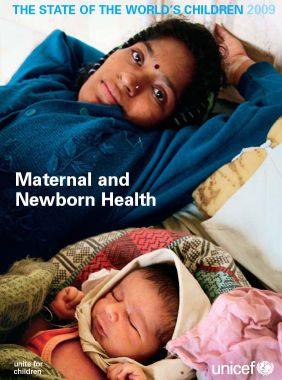
As Unicef’s 2009 State of the World’s Children report reminded us recently, 1,500 women die every day in the world due to complications arising during pregnancy and childbirth. The chances of a woman in developing countries dying before or during childbirth are 300 times greater than for a woman in an industrialised country like the United States. Such a gap does not exist in any other social indicator.

The largest number of maternal deaths in the world is in South Asia. In India alone, an estimated 141,000 women die each year during pregnancy or childbirth. Recently, my Indian journalist friend Kalpana Sharma wrote a perceptive column on this topic in The Hindu newspaper.

She noted: “The solution has been known for years. The problem is the will to make it work. We also know that the solution would benefit everyone, not just women. Yet, affordable and accessible health care, for instance, has not received the thrust that is needed.”

The Missing Women video suggests to activists and campaigners that action can start with five steps: 1. Educate girls, young women and yourself; 2. Respect their rights; 3. Empower them to participate; 4. Invest in maternal health; 5. Protect against violence and abuse. The Unicef website, meanwhile, lists 10 ways in which concerned individuals can make a difference.

All very commendable and necessary — but not sufficient. With all the good intentions in the world, Unicef’s experts and officials come across as, well, detached and geeky. They don’t connect well enough to the real world people whose needs and interests they are genuinely trying to serve. Their messages are lost somewhere in their precise terms, jargon and endless acronyms.

Just take, for example, the very phrase of maternal mortality itself. Precise but also very stiff and dry. Who outside the medical and development circles uses such terms in conversation? When I write or make films about the issue, I prefer to call it ‘mothers dying needlessly while having babies’. Yes, it’s more wordy and perhaps less exacting. But most ordinary people would get what I’m talking about.

If the jargon-ridden language reads dry in text, it completely puts off people when they watch such words being spoken on video. Such films may pander to the Narcissism of Unicef mandarins, but they completely flop in terms of public communication and engagement.

This is the same point I made in October 2008 when commenting on the Unicef-inspired first Global Handwashing Day: “Passion used to be the hallmark of UNICEF during the time of its legendary executive director James Grant, who strongly believed in communicating messages of child survival and well-being. He gave UNICEF a head start in working with the media, especially television.”

Jim Grant’s deputy, journalist Tarzie Vittachi, who came over to the UN children’s agency after a stint at the UN population fund, used to say: “Governments don’t have babies; people do”. We might extend that to: inter-governmental agencies don’t have babies; real women do. That may be why Unicef insists on delivering its life-saving messages so riddled in politically and scientifically correct, but so sterile language.

Unicef’s YouTube channel has a number of short videos related to what they insist on calling maternal mortality. Here’s an example where Unicef’s Chief of Health Dr. Peter Salama says it’s really an unconscionable number of deaths, and a human tragedy on a massive scale:


MDG5: Save Our Moms!
Reducing by three quarters the number of mothers dying needlessly while having babies is one of the Millennium Development Goals or MDGs, the holy grail in international development since the United Nations adopted these in 2000, setting 2015 as the target date.

We have now passed the half way mark, but progress has been patchy and unimpressive. And it will remain so as long as the UN agencies and other development players insist on peddling jargon and acronyms. Considering the issues of life and death involved here, we must view bad communication as a killer — joining the ranks of unsafe drinking water and violence against women and girls.

Writing an editorial for SciDev.Net in September 2005, I noted: “All development workers and UN officials should take a simple test: explain to the least technical person in your office the core message and relevance of your work. Many jargon-using, data-wielding, acronym-loving development workers would probably fail this test. But unless development-speak is translated into simpler language, the MDGs will remain a buzzword confined to development experts and activists.”

I don’t believe in ghosts, but it’s time to bring back the spirits of Jim Grant and Tarzie Vittachi to Unicef to again humanise the agency so mired in its own ‘geekspeak’. The intellectual rigours of evidence-based, scientific analysis must be balanced with clarity and accessibility. It’s fine to be informed by science, but learn to say it simply, clearly and concisely.

The lives of half a million women and millions of children depend on it.

Go ahead, just say the word: Condom! Now say it again…

not an easy task...
Acting out condoms in broad daylight in India: not an easy task...

Condom!

No one is certain how or where the word originated, but it has become one of those ubiquitous items in modern society.

It’s a two syllable word, fairly easy to pronounce. Then how come so many people – at least in South Asia, home to a fifth of humanity – get their tongues tied or twisted in saying it?

That’s because it’s to do with sex! That’s not a subject that many South Asians still feel comfortable in talking about, in public or even private.

Sex may be a very private matter, but individuals’ sexual behaviour has direct and serious public health implications. Especially today when the world is still struggling to contain and overcome the spread of HIV that causes AIDS.

Condoms originally came into wide use to help prevent unwanted pregnancies and the spread of sexually transmitted diseases (STDs). In the past quarter century, condoms have become a major weapon against HIV.

Despite this, condoms still remain a hush-hush topic among many grown ups, even as the younger generation warms up to them. Across South Asia, we still have some hurdles to clear in normalising condoms – or making it socially and culturally acceptable for people to talk about condom use, and to go out and buy them without fear or shame.

They come in all colours and shapes!

This is the challenge that various communication groups have taken up, especially in India. According to a 2007 survey by UNAIDS and India’s National AIDS Control Organisation (NACO), at least 2.5 million people live with the HIV virus in India, placing the country third in the world after South Africa and Nigeria. However, AIDS prevention in the country is not an easy job. Many people, especially in rural areas, cling on to preconceived taboos about sex — and are often hesitant to use condoms.

In recent weeks, I’ve heard from two campaigns that are trying to change this. One is the BBC World Service Trust working with Indian broadcasters and other partners to normalise condom use through a campaign. I’ll be writing a separate blog post on that effort.

Last month, I received en email from someone called ‘Spread Word for a Better World’, who shared with me web links on a socio-cultural group based in Hyderabad, who are using the performing arts to promote condom awareness.

For over a decade, the Nrityanjali Academy has been singing and dancing their way to the glorification of condom use. They see it as a crucial fight in their central region, where 2 per cent of the population is HIV positive.

P Narsingh Rao, director of Nrityanjali, recently told France 24 online: “Our main target groups are people vulnerable to the HIV virus like sex workers, transsexuals or truck drivers. We tour villages in mobile video vans to show the film. The screening is followed by a question and answer session about condom use and sexually transmitted diseases.”

He added: “We also encourage the use of female condoms, a relatively new concept. We tell the women to negotiate the use of female condoms with their male partners: for men with little sex education, the insertion of the female condom in the vagina can in itself be an erotic act.”

Here are some YouTube videos showcasing their work:

This is an entertaining and educational video in Telugu language on Condom usage, to prevent from sexually transmitted infections and HIV:

A more instructional video on how to use condoms properly:

And finally, an HIV/AIDS song in Telugu – with all the fast-beat music, gyrating and riot of colours we typically associate Bollywood movies and songs with:

The videos speak for themselves. They are matter of fact, engaging and presented by ordinary people (trained entertainers) rather than by jargon-totting medical doctors or health workers. There is none of the awkwardness typically associated with conversations of this subject. No one is tip-toeing around perceived or real cultural taboos. They just get on with it.

Importantly, they involve both men and women, both in performances and in their audiences.

Training young men on just how to do it right...

Related blog posts:

July 2007: The Three Amigos: Funny condoms with a serious mission

April 2007: Beware of Vatican Condoms – and global warming!

Images courtesy France 24’s The Observers.

Children of Heaven: Appreciating the sound of silence

Courtesy Wikipedia

What’s it with children and shoes? Those who have none dream of owning their first pair. Those who have one, or some, still dream about a better, or perfect, pair. Shoes are worth dreaming about, crying (even fighting?) over, and running races for.

Like Ali did, in Majid Majidi’s superbly crafted 1997 movie Children of Heaven. For 90 minutes this afternoon, my team and I ran the race with little boy Ali, sharing his dreams, sorrows and eventual (albeit bitter-sweet) triumph.

I had seen this film before, but this time around, the experience felt even better than I remembered it. I already knew the story, but I was spell-bound by the film’s culmination – the children’s race where Ali wanted to come third, but ended up winning. I followed the last few minutes with tears in my eyes and the heart beating faster.

This is what good story telling is all about.

Read Children of Heaven synopsis on Wikipedia

Of course, Majid Majidi didn’t work this miracle alone. The superb cinematography of Parviz Malekzaade was well packaged by its editor Hassan Hassandoost. His work is uncluttered and elegant: the story flows in a simple, linear manner with no flashbacks or flash-forwards; no special effects to jazz things up; and the scenes are so seamlessly meshed together with hardly a second being wasted.

And the soundtrack played a vital part in shaping the whole experience. It’s not just the music. As my colleague Buddhini remarked, it also made clever, strategic use of silence.

We might call it the sound of silence – and never underestimate its power in the right place.

All this reminded me of what our Australian film-maker colleague Bruce Moir often said when we worked with him: “We’ve got to remember that film appeals to people’s hearts more than their minds. The way to people’s heads is through their hearts, from the chest upwards — and not the other way round.”

A year ago, I invited him as my special guest to a talk I gave at the University of Western Sydney in Australia – in his home city. There, he once again made the point: “Our fundamental job is to tell a story – one that holds an audience’s interest and moves their heart, regardless of language, cultural context or subject….I have always believed that film achieves its optimal impact by aiming to ‘get at the audience’s head via their heart’…”

April 2007 blog post: Moving images moving heart first, mind next

As I then wrote, I hope this was an ‘Aha!’ moment to some in our largely academic and activist audience. Many who commission films or even a few who make films tend to overlook this. Especially when they set out trying to ‘communicate messages’.

Bruce never tires of saying: “Film is a lousy medium to communicate information. It works best at the emotional level.”

Children of Heaven is living proof of this. It has no lofty agenda to deliver information or communicate messages of any kind. Yet, by telling a universal story set in modern day Iran, it brings up a whole lot of development related issues that can trigger hours of discussion: not just the rich/poor or rural/urban disparities, but other concerns like how a country like Iran is portrayed in the western news media.

As a colleague remarked after today’s film, she had no idea of this aspect of life in Iran — the version we constantly hear is of an oil-rich, nuke-happy, terror-sponsoring theocracy that, to the incumbent US president at least, is part of the ‘axis of evil‘. And the Al Jazeera International channel, packed with BBC discards or defectors, has done little to change this popular perception.

We watched the movie as part of our monthly screening of a feature film. We are lining up critically acclaimed films from different cinematic traditions of the world. And then we discuss its artistic, technical and editorial aspects.

As for me, I totally agree with the famous movie critic Roger Ebert, who wrote in the Chicago Sun-Times at the time of the movie’s first US release: “Children of Heaven is very nearly a perfect movie for children, and of course that means adults will like it, too. It lacks the cynicism and smart-mouth attitudes of so much American entertainment for kids and glows with a kind of good-hearted purity. To see this movie is to be reminded of a time when the children in movies were children and not miniature stand-up comics.”

As he summed it up: “Children of Heaven is about a home without unhappiness. About a brother and sister who love one another, instead of fighting. About situations any child can identify with. In this film from Iran, I found a sweetness and innocence that shames the land of Mutant Turtles, Power Rangers and violent video games. Why do we teach our kids to see through things, before they even learn to see them?”

Note: The film, originally made in Persian, was named Bacheha-Ye aseman . It was nominated for an Academy (Oscar) Award for the best foreign film in 1998, but lost out to a worthy competitor, Roberto Benigni’s Life is Beautiful.

Women on the Frontline: Reporting from the battlefront at…home!

“Violence against women threatens the lives of more young women than cancer, malaria or war. It affects one in three women worldwide. It leaves women mentally scarred for life — and it is usually inflicted by a family member.”

With these words, Annie Lennox, the British singer and social activist, presents a new global series of investigative television documentaries called Women on the Frontline that begins on the global satellite TV channel BBC World today, 18 April 2008.

The seven half-hour films shine a light on violence against women and girls in different parts of the world – East and West, North and South. The series takes the front to homes, villages and cities of our world where a largely unreported war against females is being waged.

Read my Feb 2008 blog post: Half the sky, most of the suffering…

The films cover Nepal, where thousands of women are trafficked each year; Turkey, where killing in the name of honour continues; Morocco, where women political activists who have survived torture and imprisonment testify before a government truth and reconciliation commission; the DRC, where women bear the brunt of a 10-year war in the eastern provinces; Colombia, where women have been tortured in the shadow of a guerilla war; Mauritania, where women who have been raped may go to prison; and Austria, where, under a new law, perpetrators of domestic violence are forced to leave home.

Here’s the line up of depressing reports in this series, produced by Geneva-based dev tv and London-based One Planet Pictures – both international partners of TVE Asia Pacific.

Nepal: A Narrow Escape
Turkey: Killing in the Name of Honour
Morocco: Never Again
Democratic Republic of Congo: Find a Word for It
Austria: Showing the Red Card
Mauritania: No film name known yet
Colombia: Justice in the Region of Death

Check dev tv website for broadcast times on BBC World

On the Frontline… is a ‘vehicle’ for independent producers to tell compelling stories about the people who uphold civil society where it is most at threat. The strand started with the 2006 pilot series Doctors on the Frontline, a profile of Medecins Sans Frontieres (MSF) field doctors made by Dev TV film-makers.

Since then, the series has covered villages battling desertification and land degradation, nurses and para-medics on humanitarian missions in hot spots of the world, and children living with social and environmental disintegration.

On the Frontline has gone behind the lines with rebels and filmed among violent street gangs but this time we’ve taken the frontline mostly into the home, where even after 20 years in production, I’m still shocked to see how many obstacles lie between women and equality, and the violence they must still endure,” said Robert Lamb, Executive Director of the series.

A number of UN agencies, including UNFPA and UNIFEM, donor countries such as Austria, non-governmental organizations and other partners provided information and support for the latest series of Women on the Frontline.

Soon after its initial run on BBC World, the series will be distributed in the Asia Pacific region by TVE Asia Pacific.

Read official brochure of Women on the Frontline TV series

March 2008 blog post: Unseen women, unheard voices

Mallika Wanigasundara: Trail-blazer in issue-based journalism

I seem to be writing many obituaries and tributes these days. Following the several I wrote on Sir Arthur C Clarke and the blog post I did on Cambidian photojournalist Dith Pran, I want to share this tribute I wrote today on a senior Sri Lankan journalist who embarked on her final voyage this weekend.


Mallika Wanigasundara:
Trail-blazer in issue-based journalism

Mallika Wanigasundara, who passed away on 4 April 2008 aged 81, was a talented and sensitive Sri Lankan journalist who went in search of causes and process that shape the everyday news headlines. In doing so, she blazed new trails in issue-based journalism, covering topics ranging from health and environment to children, women and social justice.

It was only last year that the Editors Guild of Sri Lanka and the Sri Lanka Press Institute presented her the Lifetime Achievement Gold Medal for Excellence in Journalism.

Mallika was associated with the Sri Lankan media in one capacity or another for over half a century. Starting her professional career in 1956 with the Sinhala evening daily Janatha, she later moved on to English language journalism at Lake House where she worked first in The Observer and then at Daily News. It was as Features Editor of this oldest English daily that she played a key role in practising and nurturing development journalism. She helped evolve the genre to new levels of professionalism, liberating it from the typecast of politically motivated, sometimes fabricated ‘sunshine’ stories that had been forced on the state-owned Lake House newspapers during the 1970s.

Mallika also helped put Sri Lanka on the world map of development journalism. Beginning in the early 1980s, she contributed Sri Lankan stories to Depthnews, published by the Press Foundation of Asia based in Manila, and to Panos Features, syndicated globally by the Panos Institute in London. In those pre-web days, these services – when printed in newspapers and magazines – were among the most dependable sources for ground level reporting from far corners of the world. (Alas, both services have since gone the way of the Dodo – not to mention Asiaweek, South and Gemini.)

Although I grew up in the 1980s reading her writing in Daily News, my own contacts with Mallika were few and far between. The first was indirect and happened in the late 1980s, when as an eager young reporter I started contributing to Panos Features, syndicated from London to several hundred newspapers around the world. Mallika remained the Panos Sri Lanka correspondent and I was merely a stringer. Donatus de Silva, then head of programmes at Panos London, somehow found a clear niche for both of us. At the time, Mallika and I exchanged occasional communications.

As a novice, I studied Mallika’s approach and style, and emulated them both. Hers was an easy, reader-friendly prose: it brought in both expert views and grassroots insights, but with none of the technicality or pomposity – and very little editorialising. Although she was fully supportive of the various social and environmental causes, she didn’t allow activist rhetoric to dominate her journalism. She also ventured beyond the predictable ‘green’ issues to cover many ‘brown’ issues. Two decades after the Brundtland Commission on Environment and Development (1987) that thrust sustainable development into the global agenda, it’s precisely this kind of journalism that’s needed to make sense of our fast-moving, slowly-baking, topsy-turvy world.

Mallika continued to be an active freelancer after she retired from Lake House. She seemed more prolific in retirement – she continued to chronicle the rise of the environmental movement in Sri Lanka, which emerged from citizen campaigns to save the Sinharaja rain forest from state-sponsored logging and evolved through crises and protests in the 1980s and beyond.

In 1990, she was selected by the United Nations Environment Programme for the Global 500 award that recognised environmental achievements of individuals and organisations. She was the first Sri Lankan journalist to be thus honoured, and one of only four Sri Lankans to be inducted into this global roll of honour that eventually included over 600 persons or entities worldwide.

At the time, I was hosting a weekly TV quiz show on Rupavahini (national TV) and decided to set one of my questions on Mallika receiving the Global 500. I phoned her to offer my congratulations and asked for a photo that we may use on the TV show. She was happy to be the basis of a question, but declined giving a photo, saying: ‘I don’t look good in photos or on TV’.

It was characteristic of many accomplished journalists of her generation that they remained mostly in the background, shaping news coverage and analysis. Some even didn’t nurture a personal by-line, writing under pseudonyms or simply not signing their names on their work. What a contrast with the image-conscious, in-your-face radio and TV journalism of today, where even respected newspaper editors eagerly pursue parallel careers as talk show hosts or TV pundits.

Read my essay on environmental journalism 20 years after Brundtland, published in SciDev.Net in April 2007

Unseen women, unheard agonies

In January 2008, I wrote about Lakshmi and Me, a recent Indian documentary that portrayed a domestic worker woman whom my friend Kalpana Sharma aptly called an invisible superwoman.

A colleague who read my piece reminded me about a series of five short films on working women in Sri Lanka that I had executive produced in 1999-2000. Produced originally in Sinhala for a national audience, the series was titled Oba Nodutu Eya (The Unseen Woman). In fact, it featured not one but several women workers in two different sectors in the country’s informal economy: the coconut husk (coir) industry in the south and agricultural settlements in the Dry Zone in the north-central areas of the island.

The following is adapted from a story I wrote about this series for a book that TVE Asia Pacific published in 2002. I have not gone back to my sources to check how much – or how little – has changed in the past several years.

yasawathie-from-a-voice-without-a-sound.jpg

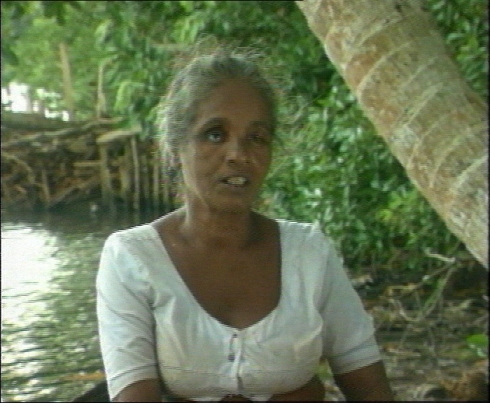
This is Yasawathie. She has suffered physical and mental abuse most of her adult life. Her alcoholic husband beat her regularly for years, but she dared not complain for fear of reprisal.

“He injured my head, stabbed me and once fractured my arm” she says, showing a scar of a healed wound.

As if this suffering was not enough, she lost sight in one eye a few years ago in a bizarre hospital accident. She had gone to the government hospital seeking treatment for a chest ailment. There were more patients than beds, so she was forced to sleep on the floor. While sleeping, a nurse carelessly dropped a saline stand on to Yasawathie’s face.

The entire incident was hushed up, and the poor woman was intimidated into silence. “Sometimes patients even die at our hands,” the nurse told her threateningly.

Injured by the healthcare system, battered by her own husband and pressurised by her family circles to keep quiet about, this middle aged Sri Lankan woman has run out of options. She was not aware she could claim damages for the accidental loss of her eye. She does not realise there is legal redress for domestic violence – her family and in laws wouldn’t allow it in any case.

Sadly, Yasawathie is not alone. There are tens of thousands of women like her who live on the margins of society, and whose suffering goes largely unnoticed. The island nation is often cited as a South Asian success story: its women were the first in Asia to vote; female literacy is nearly universal; and a higher percentage of girls and young women are in school than boys.

But hidden beneath these national accomplishments, there are huge gender-based disparities and gaps, especially in economic, labour, family and property related matters. Studies have found that many women, particularly the poorer ones, don’t know their human and legal rights.

And even women who do know their civil and political rights often do not assert their right to safeguard themselves from domestic violence or gender-based discrimination in family and society.

Yasawathie’s story was one of several that were featured in a television documentary series that probed how Sri Lankan women’s economic and legal rights operate in the real world. Produced in 1999-2000 by TVE Asia Pacific in collaboration with the Sri Lanka Environmental Television Project (SLETP), the series went beyond the oft-repeated claim of women’s emancipation in Sri Lanka. It uncovered a shocking reality of wide spread rights denial, physical abuse and gender-based violence.

The series used a mixture of short drama segments, interviews and background commentary. “These films don’t offer comprehensive surveys of the situation, but they provide useful glimpses of how economic and legal rights apply at the grassroots for women,” said accomplished fim-maker Inoka Satyangani, who directed the series. “We raise broader concerns, and point out changes that society needs to make to ensure that women can assert their rights.”

Violence against women is both a public and private matter in Sri Lanka, says the Committee on the Elimination of Discrimination against Women (CEDAW), a body of global experts which monitors whether governments are honouring their commitments to the 1981 United Nations’ Women’s Convention. Although violence affects women of every class and ethnicity, it is seldom reported.

In recent years, human rights abuses in Sri Lanka’s conflict ridden north and the east have received international scrutiny; both the government forces and Tamil Tiger rebels have committed atrocities. But violence against women is not confined to the war or the conflict-affected areas: as one rights activist has remarked, “everyone becomes part of the larger system of brutality”.

CEDAW has stressed that Sri Lanka needs specific legislation to address violence behind closed doors.

from-oba-nodutu-eya-tv-series.jpg

The TV series also found how women get paid less than men for agricultural manual labour, and how government-driven land development schemes favour men to inherit state land distributed among the landless. Government agricultural extension programmes help male farmers to obtain skills training, credit and subsidies while women farmers are constantly ignored. Women interviewed had stories that shattered the myth of women’s liberation and equality in Sri Lanka.

Read individual synopses of the five films in The Unseen Woman series

Read recent blog post: Half the sky, most of the suffering and seeking everyone’s attention

Half the sky, most of the suffering…and seeking everyone’s attention!

What’s one of the biggest reasons for suffering from violence?

Is it War? Racism? Extremism?

Or simply being born a woman?

One in 3 women is a victim of violence.

This is the powerful message in this one-minute-long public service announcement (PSA), which can be viewed here:

It was produced by the London-based advertising agency Leo Burnett for UNIFEM, the United Nations Development Fund for Women. With a striking series of images, it reveals that violence against women is one of the most common forms of violence in the world.

This PSA is part of a new global campaign on this scourge.

As UNIFEM says: “Violence against women and girls is a problem of pandemic proportions. At least one out of every three women around the world has been beaten, coerced into sex, or otherwise abused in her lifetime — with the abuser usually someone known to her. Perhaps the most pervasive human rights violation that we know today, it devastates lives, fractures communities, and stalls development.”

The campaign has elements on awareness raising as well as a call to action. The latter includes an online signature campaign that seeks to collect at least 100,000 signatures from those who oppose violence against women.

The online ‘signature book’ opened for signatures on 26 November 2007 with an appeal from actress and UNIFEM Goodwill Ambassador Nicole Kidman. She called the violence many women worldwide face “an appalling human rights violation that can be stopped”, and asked everyone to add their names to a growing number of supporters saying “NO” to violence against women at http://www.saynotoviolence.org.

She added: “The more names we collect, the stronger our case to make ending violence against women a top priority for governments everywhere.”

Watch her appeal on YouTube:

The UN Trust Fund to End Violence against Women , established in 1996, will receive US$ 100,000 from the United Nations Foundation for 100,000 signatures

I have just signed up, on this leap day 29 February 2008. Three months since the campaign was launched in New York, it has so far gathered a little over 58,500 signatures.

It’s certainly commendable – but not nearly enough, and still more than 40,000 needed to reach the modest target of 100,000.

Not that it’s just a numbers game, of course. The quality and sincerity of commitment matter a great deal. At the same time, UNIFEM and other UN agencies trying to engage the public through online interactive methods should study how successful activist groups do the same — with much better and faster results.

Avaaz.org is a leader among these. It is a new global web movement with a simple democratic mission: to close the gap between the world we have, and the world most people everywhere want. Set up in early 2007, it has quickly evolved into online community through which hundreds of thousands of concerned people are taking action together on urgent issues like climate change, poverty, human rights and the crises in the Middle East and Burma.

In October 2007, I joined Avaaz in its signature campaign to focus global attention on the political violence and gross abuse of human rights in Burma. In just four days, thousands of Avaaz members donated over $325,000 online to support the Burmese people’s efforts to peacefully promote political change and tell the world about their struggle.

The Burmese junta may not care for millions of people protesting or donating online, but the leaders of the democratic world – pondering their response to the atrocities in Burma – would find it hard to ignore this surge of public concern.

But it’s a long leap from Burma to the bed room or backyard. A major difficulty faced by those campaigning to focus on violence against women: they are countering actions that are widely distributed, pervasive and sustained over time. Much of it happens at personal and family level, necessarily beyond the public and media’s glare. Incidents flare up only occasionally to spill over to the public space to become news events or talking points.

So, as in many similar instances, out of sight often means out of mind.

The big challenge is how to raise public awareness on a wide-spread issue of violence that happens, to a large extent, in private. The facts and figures are compelling as they are alarming and depressing. The campaigners have lined up some of the biggest celebrities (like Nicole Kidman) and enlisted big guns like UN Secretary General Ban Ki-Moon.

All necessary, but not sufficient.

The campaign needs more than just star power or the UN’s clout to galvanize mass action. For a start, UN agencies need to get out of their fondness for coining and using endless acronyms. Even with my regular forays into the development community’s acronym jungle (read my post on the alphabet soup), I was recently puzzled when a film-maker colleague referred to GBV in an email without explaining it. It took me full five minutes to realise that she meant gender-based violence.

And some imaginative ways of raising the public profile would also help. Browsing on YouTube, I came across this video from Ireland. As one article described it:
“The ghosts and spirits of the millions of women who have been murdered, violated, oppressed, excluded, driven into exile, denied freedom of speech, denied participation in any decisions concerning their lives, because of war, religion, race, culture, age, disability, sexuality, poverty, bonded slavery, domestic violence or bureaucracy, glided in and out of the shoppers of Galway on 7 December 2007.”

Lakshmi and Me: Filming an invisible superwoman

Seen but never noticed?
It’s so clichéd to say that behind every successful man stands a woman. With so many women being successful in so many spheres of activity on their own terms, this assertion is not particularly relevant or sensitive any longer.

But who stands behind some of these successful women? Writing in her regular Sunday column in The Hindu newspaper, my friend Kalpana Sharma suggests an answer: the unsung, unappreciated and often poorly paid housemaids or domestic workers.

Here’s how Kalpana opens her column, aptly titled ‘Invisible women’:

“They flit in and out of our homes like ghosts in the night. They sweep and swab, wash and cook, look after our children, care for the elderly. Yet we know little about them. Most of us just about know their first names. We don’t know where they ’re from, where they live, whether they are married, how many children they have, how many other homes they work in, what they earn — how they survive. They are virtually invisible.

“We usually wake up to their existence when they don’t turn up for work. And the first response is annoyance, because of the inconvenience caused to us. Many professional women don the title of being superwomen because they manage jobs and homes — work life balance. But in fact the real superwomen are these silent workers, without whom few professional women in India would be able to function. Yet, while those in formal employment get sick leave, casual leave, privileged leave and weekends, our domestic help is not entitled to any of this. If she rests too long, she’s lazy. If she doesn’t turn up for work, she’s a shirker. It would appear that these women don’t have the right to relax, to fall sick, to have some fun. And of course, no one acknowledges that when they’re done with our homes, they still have their own homes where they have to do the very same jobs, sweep and swab, wash clothes, cook and take care of children and elderly.

With this, Kalpana introduces a recently made Indian documentary, Lakshmi and Me (Nishtha Jain 59′, India, USA, Finland, Denmark, 2007), where the middle class film maker turns her camera on her 21-year-old part-time maid Lakshmi.

Superwoman at work...but who can see her?
As Kalpana says: “Nishtha Jain, a Mumbai-based documentary filmmaker has done what all of us need to do. She has not just acknowledged that this silent worker in her home has a name, but she’s followed her life so that we see the person behind the name — a person just like any of us. And instead of viewing the woman from a distance, the filmmaker has bravely placed herself in the frame, honestly dissecting her own relationship as an employer. “Lakshmi and Me” is a remarkably honest documentary about 21-year-old Lakshmi and the filmmaker, Nishtha.”

I haven’t yet seen the film, and after reading Kalpana’s review, I quite look forward to catching it. I hope it goes beyond the clichéd approach of offering glimpses of how the other half lives, which afflicts many documentaries of this kind made by well-meaning middle class film-makers who can’t quite break free from their own social framework.

Watch the trailer for Lakshmi and Me on IDFA festival website

About the film-makers: Nishtha Jain and Smriti Nevatia

Kalpana Sharma Column in The Hindu: 30 December 2007: Invisible Women

Director’s Note by Nishtha Jain, writer and director of Lakshmi and Me

Lakshmi and Me film website

Kalpana Sharma blog

Photos courtesy Lakshmi and Me film