Sheri Liao: From ‘Time for Environment’ to TIME Hero of the Environment 2009

Sheri Liao photographed for TIME by Elisa Haberer

Copyright infringement – or piracy – in video, film and software is a highly contentious issue. I have good friends on both sides of the divide: film maker friends who insist on protecting all their rights to their creations, and open source advocates who want everything to be free and accessible in the public domain.

I can appreciate both points of view, but my own attitude to anyone copying any video films I have helped make or am distributing is: just sit back and enjoy it! After all, the kind of films I make and/or distribute through TVE Asia Pacific are all issue-based and in the public interest. If anyone pirates them, that can only peddle our content and messages to more people…

It’s a pragmatic response to a reality that I can do little to change anyway. Five of the world’s top 10 countries for video piracy are found in the Asia Pacific region, with China at No 2 and India at No 5. If you can’t beat ’em, cheer ’em — and even join ’em!

That’s just what I did in mid 1996, when we received first reports of a Chinese TV presenter making unauthorised use of environmental programming being broadcast on BBC World, the global TV channel. I was then the head of Asia Pacific programme for the non-profit foundation producing Earth Report series, which first aired on BBC and then offered to other TV channels and networks around the world.

Further investigations revealed that the person involved was a woman named Sheri (Xiaoyi) Liao, a former researcher at the Chinese Academy of Social Sciences who had formed an environmental group called Global Village of Bejing, and was presenting a weekly TV show called ‘Time for Environment’. To bring environmental news and views from other parts of the world, she was using Chinese dubbed extracts of Earth Reports recorded straight off the BBC World satellite channel.

By happy coincidence, I was visiting Beijing – for the first time – for a few days in October 1996, to participate in an international conference of rocket scientists (not my usual orbit, but fortuitous in this instance!). I managed to contact Sheri Liao, and one evening I escaped from the conference to meet this woman who was fast becoming the environmental face of Chinese television.
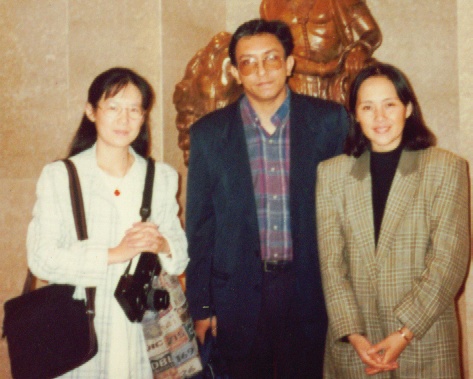
L to R Dr Li Hao, Nalaka Gunawardene & Sheri Liao, Beijing Oct 1996
Sheri Liao came to meet me with Dr Li Hao, a Chinese biologist who had recently returned from Germany and teamed up with Global Village in its quest to raise environmental awareness in China.

In a long chat over drinks and dinner, I found out Sheri had been a visiting scholar on International Environmental Politics at the University of North Carolina, but returned to her homeland to found the Global Village of Beijing earlier that year. She was keen to introduce responsible environmental conduct by Chinese citizens at every level. And early on, she realised the massive power of broadcast television to reach China’s one billion plus people. She approached her work with an obsession bordering on missionary zeal: in that process, she was even willing to ‘pirate’ foreign TV content – all for a good cause.

Soon after that encounter, I negotiated for Sheri Liao to make authorised use of Earth Report films in China. Instead of catching it off the airwaves, she soon started receiving proper master tapes and scripts, so a more professional versioning into Chinese could be done. My then British colleagues, who were initially peeved that a Chinese woman was pirating their programmes, soon became her ardent supporters.

That was also the beginning of many years of my engagement with environmental education and communication work in China. (Li Hao later left Global Village to establish her own non-profit, Beijing Earthview Environment Education and Research Centre).

All this is a long way of saying how delighted I am to see Sheri Liao being named as a Hero of the Environment by TIME Magazine earlier this month. She is one of several Asian leaders, researchers and activists included in this year’s roll call of men and women who are fighting on behalf of our beleaguered plant. Read full list here.
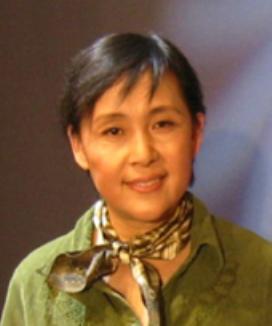
Sheri Liao: Greening the Airwaves of China...
Chronicling her close association with China’s rising levels of environmental awareness and activism, TIME noted: “Liao was helped by the fact that the birth of GVB coincided with China’s economic takeoff in the mid-’90s. The group became active in Beijing neighborhoods, raising environmental awareness on the local level. But in recent years it has expanded its work across the country, and it is now involved in everything from promoting plastic-recycling to encouraging building managers to reduce electricity consumption.”

Our paths have crossed a few times since that first meeting in the Fall of 1996. We have been in workshops and conferences together, where I saw Sheri in action – always intense, with a sense of urgency and resolve.

She has been recognised before. In 2002, she was awarded one of the ‘Ten Outstanding Women in China’ by the magazine Chinese Women. She was also honored as the ‘Green Guide’ by China National Planting Tree Committee in 2003 and became one of the ‘Ten National Outstanding Women’ in 2004. In 2005, she won the ‘Annual Economic Figure Social Commonwealth Award’ by China Central Television (CCTV). In 2006, she was honored Green Chinese Annual Figure.

Sheri also continues to be an unofficial bridge between China and the rest of the world. She works with UN agencies, foreign universities and charities like the Clinton Global Initiative – which honoured her with one of its Global Citizen Awards 2008.

China’s road to environmental salvation is a long and hard one. As TIME noted, “Environmental groups continue to run afoul of the Chinese government, which is wary of any power not concentrated in the hands of the Communist Party. But Liao is well connected — she served as an environmental adviser on the Beijing Organizing Committee for the 2008 Olympic Games — and in China’s tricky political landscape, those who walk a prudent line often travel furthest.”
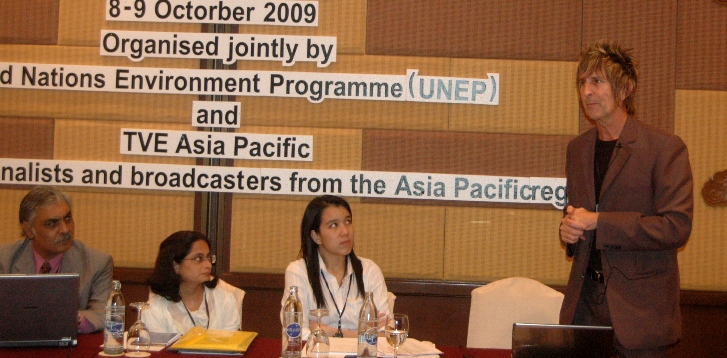
Douglas Varchol: Secret of keeping ‘perfectly cool’ in a warming world…

Douglas Varchol (standing, extreme right) speaking at Ozone Media Roundable, 8 Oct 2009

With his wild hair and trendy suits, Douglas J Varchol can pass for a rock star. He is actually an accomplished independent film-maker, currently operating out of Bangkok, Thailand, covering a variety of science and environmental stories in Asia.

Last week, he participated in the Ozone Media Roundtable that TVE Asia Pacific and UNEP organised in Chiang Mai, northern Thailand. After showing his latest documentary film on ozone, titled Earth Report: Perfectly Cool, which was first broadcast on BBC World News in September 2009, he talked about his experience in making the film.

Perfectly Cool is a 22 minute film looking at the challenges faced in trying to phase out a chemical called Hydrochlorofluorocarbons (HCFCs for short), a coolant gas used in air conditioners across the developing world. As chemicals go, it’s a double hazard: this ozone depleting substance also contributes to climate change by acting as a greenhouse gas.

But non-specialist viewers watch broadcast television for good stories, not science lessons. The challenge for journalists and film makers is to ‘sugarcoat’ the technicalities by wrapping it up in human interest stories. Douglas recalled how he did this: combining imagination, hard work and luck.

First, here’s the official synopsis of the film which sums up the story:
Air conditioners are damaging the environment. One widely used coolant gas, HCFC, damages the ozone layer. With booming sales of domestic ACs around the world, the problem has grown in recent years, despite vigorous international efforts to reduce ozone depleting chemicals. Under the international agreement known as the Montreal Protocol, HCFC will be phased out worldwide by 2030. An ozone-friendly replacement gas – HFC – is now used in Europe, but that gas is a potent greenhouse gas — which means it contributes to global warming. However, an answer may be at hand. Earth Report travels to China, centre of the global AC industry, to investigate the cost of cool and meets the industry representatives working on a solution – and Sa DingDing, a musician with extreme views on air conditioners.

Watch the first 4 mins of Earth Report – Perfectly Cool

Humanising science stories is hard enough, and when the subject is something people can’t see or feel, it becomes harder. As I wrote a few days ago, the Ozone Layer – located between 10 and 50 kilometres above the Earth, and invisible to the naked eye – is not something tangible like cuddly animals or endangered plants. Moving ordinary people to care for something they can’t see or touch is tough, even if all life on Earth depends critically on it (the Ozone Layer absorbs most of the Sun’s harmful ultra-violet days).

Douglas had his work cut out for him. Throw into this mix the fact that the editorially independent film was being made pooling funds from six development agencies – each with their own agenda – and that the story was filmed in China where filming permission still involve a lot of paperwork, it’s a small miracle Perfectly Cool was completed. And as we saw, Douglas tells a good story without compromising accuracy or balance.

So did he keep perfectly cool during the making of this film, I asked. He revealed that there were moments of panic and despair, although in the end everything fell into place. While the editors at BBC World were satisfied with the film, some technical specialists consulted for the script had felt it was over-simplified.

Ah, I do know that feeling! When I made a film on ozone in 2006 (Return of the Ozone Layer: Are We There Yet?) it took us 18 months to finish, and went through endless revisions. The UN system seems to just love making films by committee…

With his film, Douglas faced additional hurdles. For example, he takes us inside the Gree company‘s factory producing air conditioners. In 2004, Gree became the largest AC manufacturer in the world, but they had never before allowed television cameras inside their plant. That took lots of time and effort to set up.

Sometimes, things not going according to plans actually helps. When on location, Douglas serendipitously came across elements that were not in the original story treatment but enhanced the human interest: for example, a modern day wedding where the new couple gifted reusable chop sticks to all their guests. That was good environmental conduct – but then they headed off to choose air conditioners for their new apartment…

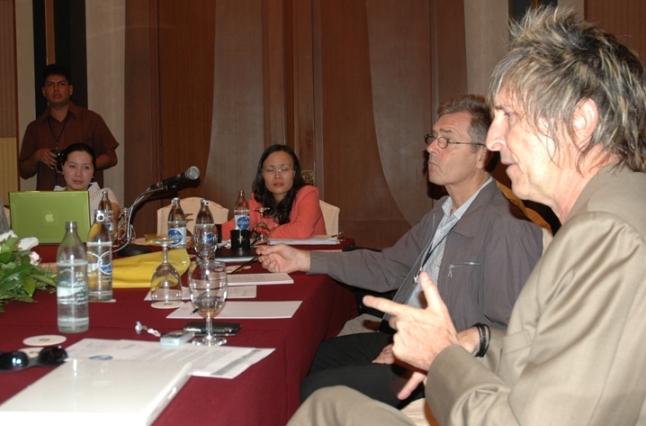
Douglas Varchol (extreme right) makes a point during Ozone Media Roundtable

Douglas paid a tribute to his Chinese researcher Lihong Shi and crew, without whose local knowledge and contacts he couldn’t have made the film.

In the end, Douglas pulls it off. Despite its seemingly esoteric and complex subject, Perfectly Cool is perfectly watchable — and not just for science buffs like myself.

Douglas, who once worked with Wired Science making science programmes for American PBS, said he set out to make a film on HCFCs that even his mom (a high school teacher) could understand. I can’t speak for her, but those of us who watched it in Chiang Mai were enthralled.

One minute to midnight — or just one minute to save the world?

How much can you pack into 60 seconds?

How much can you pack in to one minute, or 60 seconds? That’s a lot of air time, as broadcasters and advertisers know very well.

One Minute to Midnight‘ has been a favourite metaphor of dooms-dayers – and is the title of a 2008 book. It was widely used in relation to the world drawing closer to nuclear war during the second half of the 20th century.

Now, as global climate change surpasses fears of global nuclear war, we are given just one minute to save the world.

One Minute to Save the World is an international short film competition to raise awareness of climate change. Entries are currently being sought from professionals and amateurs, with 31 October 2009 as the deadline. There is also a category for under 18s and for entries shot on mobile phones.

The idea is to enable anyone, anywhere, to deliver a short but powerful message to the world on climate change. The winning films will be sent around the world in November as an online campaign to raise awareness of the Copenhagen Climate Conference in December 2009.

Good planets are hard to find...
British TV presenter and adventurer Bruce Parry, a founder of the competition, says: “Together we will be looking for films that convey a powerful message about how climate change affects you and those around you. Were you a flood victim? Have you seen a change in the plants and wildlife in your garden? How has your world been affected and how can we address it?

He adds: “So, we hope you’ll all get thinking and shooting – whether you’re a seasoned pro or just someone who cares. Your planet needs you and your talents. One minute might not seem like a long time but it’s actually longer than many advertisers spend hundreds of thousands of pounds on. It’s also an easy length of time to hold people’s attention. And that is one of the things we urgently need to do if we’re going to turn things around for our planet before it’s too late.”

The winning entries will be judged by an international panel that includes Parry himself, award-winning director and climate change activist Shekhar Kapur; Franny Armstrong, director of Age of Stupid and The Guardian‘s environment editor John Vidal.

The website will become an online film festival which requires no travel or celebrity status to attend – all you need is access to a computer. “And as everyone knows, the power of the net can make the most unexpected video attract the attention of millions globally,” says Bruce Parry.

Read Bruce Parry on One Minute to Save the World

One Minute to Save the World competition rules and more info

Watch entries on YouTube

Calling All Climate Films: Engage the world with EngageMedia!

May a million Al Gores rise to this challenge!

Exactly this time last year, in early October 2008, I spoke to a group of Asian broadcasters and film-makers gathered in Tokyo on what it takes to stand on Al Gore’s shoulders.

Whatever we might think about the artistic and technical merits of his climate film An Inconvenient Truth, it has settled with a resounding ‘yes’ one question: can a single film make a difference in tipping public opinion about a matter of global importance?

But the climate crisis that confronts us is so formidable that we need many more Al Gores to come up with as many moving images creations as they can.

EngageMedia, a video sharing site about social justice and environmental issues in the Asia Pacific, has put out a call for video/TV films on climate crisis, climate action, climate justice and climate solutions. They plan to ‘put the best stories on a DVD and in an online package to be screened and distributed before, during and after the United Nations Framework Convention on Climate Change (UNFCCC) Summit meeting in Copenhagen in December 2009.

Their call out for all climate films says: “This December thousands of delegates, decision makers, stakeholders and activists will converge on Copenhagen. To be part of this EngageMedia is putting together a compilation of Asia-Pacific climate films to be screened and distributed at the event and around the world. Submit your film to EngageMedia and be part of the action. Global action is urgent and essential – the time for debate is over.”

TVE Asia Pacific
, already a partner on EngageMedia platform, is submitting all its recently produced climate change films.

Read the full text of Climate Crisis Video Call-Out: Time for Reel Action!

Breathing Hope into Kabul: Prince Mostapha Zaher, TIME Hero of the Environment 2009

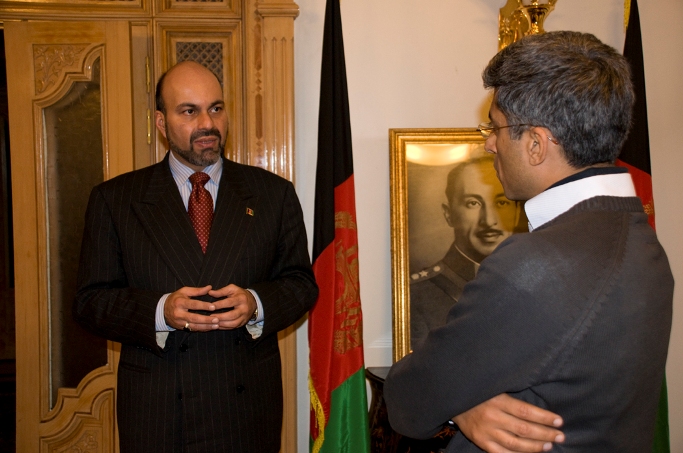
Prince Mostapha Zaher (left) with Indian film-maker Rohit Gandhi in Kabul
Prince Mostapha Zaher (left) with Rohit Gandhi in Kabul

I haven’t yet met Prince Mostapha Zaher in person, but feel almost as if I have. That’s because he features prominently in a short documentary film we released earlier this year on the environmental problems in Kabul, the capital of Afghanistan — where he is now the environmental chief, and where his grandfather was Afghanistan’s last king, Mohammed Zahir Shah (1914-2007).

In January 2009, I was watching a rough edit of the film (Breathing Life into Kabul) in Delhi, where Indian film-maker Rohit Gandhi was putting it together. In the interview, Mostapha Zaher came across as authoritative and resolute.

And does he have formidable challenges to deal with! Since the Taliban regime fell in 2001, people have been returning to Afghanistan after years in neighbouring countries. This massive influx is exerting pressure on the resources and infrastructure of the capital Kabul. Among the effects are high levels of air and water pollution, massive shortages of electricity and mounting problems waste.

Addressing these and other environmental issues is made that much more difficult because Afghanistan is one of the poorest countries in Asia, where large parts of the country are still engulfed in a prolonged conflict with extremists and the Taliban.

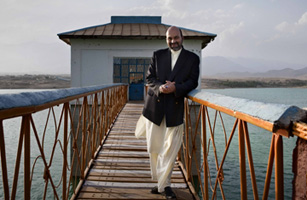
Prince Mostapha Zaher, photographed for TIME
For staying the course in this daunting task, Prince Mostapha Zaher has just been named as one of TIME Magazine’s Heroes of the Environment 2009. He is among ‘Leaders and Visionaries’ from around the world selected by the editors of the international news magazine. The list includes President Mohamed Nasheed of the Maldives, Hollywood star Cameron Diaz, and Indian film maker Mike Pandey.

TIME describes how Zaher gave up his comfortable post as ambassador to Italy to take up the job of director of Afghanistan’s newly formed Afghanistan’s National Environmental Protection Agency (NEPA) in 2004.

Says TIME: “Since then he has worked to rewrite the nation’s environmental laws, enshrining in the constitution an act that declares it the responsibility of every Afghan citizen to “protect the environment, conserve the environment and to hand it over to the next generation in the most pristine condition possible.” In a country ravaged by 25 years of war, it was an extraordinary feat.”

TVE Asia Pacific’s short film looks at how the United Nations Environment Programme (UNEP) is working with NEPA to develop environmental laws, policies and standards.

Watch Breathing hope into Kabul (10 mins):


Read full profile of Prince Mostapha Zaher in TIME Heroes of the Environment 2009


TVEAP News: New film documents environmental restoration in Afghan capital

Rising from the Ashes: The Ayta’s struggle to preserve their heritage

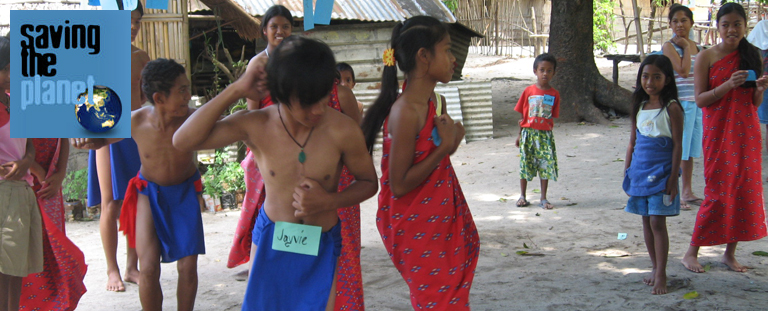
Rising from the Ashes, teh Ayta struggle to keep their traditions alive
Rising from the Ashes, the Ayta struggle to keep their traditions alive

This weekend, Tropical Storm Ketsana triggered the worst flooding in decades in the Philippine capital Manila and nearby provinces.

The Philippines, an archipelago nation comprising some 7,000 islands, is one of the world’s most disaster-prone countries. It leads a World Bank list of nations most in danger of facing frequent and more intense storms because of climate change. In 2008, it was one of three countries that experienced the most disasters, according to the Brussels-based Centre for Research on the Epidemiology of Disasters.

Apart from the typhoons that blow in from the Pacific Ocean, the Philippines also sits on the Pacific Rim of Fire where periodic earthquakes occur, and active volcanoes are found.

Disasters not only kill or injure people and cause property damage; they also disrupt livelihoods and cultural practices. That’s what happened when the volcanic Mount Pinatubo erupted in 1991, its lava and ashes destroyed many surrounding villages – including the traditional homeland of the Ayta, indigenous people descending from the first inhabitants of the Philippines. They had fled to the hills from the lowlands during the protracted Spanish conquest of the Philippines which first commenced in 1565.

Today, resettled elsewhere on Luzon island, the Ayta are trying to preserve their traditional culture and community integrity through education and theatre. These efforts are supported by the Ayta organisation PBAZ, part of the Education for Life Foundation. Going back to the abandoned village is one way of keeping memories alive.

This is the story of Rising from the Ashes, one film in Saving the Planet, TVE Asia Pacific’s new regional TV series showcasing Asian communities thinking globally and acting locally.

Passing the buck or passing the planet? Saving the Planet is everybody’s business!

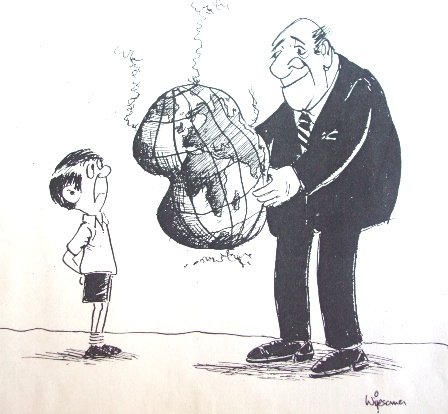
Passing the buck? Cartoon by W R Wijesoma
This was one of the most memorable cartoons drawn by W.R. Wijesoma, Sri Lanka’s pre-eminent political cartoonist (and my one-time colleague). If I remember right, it first appeared sometime in the late 1980s in ‘Mihikatha’, Sri Lanka’s first all-environmental newspaper.

Alas, both Mihikatha and Wijesoma are no more among us. But the message in this cartoon is more timely than ever before.

“Is this what we are going to hand over to our future generations? Please……no!” was the emphatic message from Yugratna Srivastava, a 13-year-old Indian girl who addressed over 100 world leaders gathered at the United Nations headquarters on 22 September 2009 for the historic Summit on Climate Change.

Passing the ball – or buck – is something that governments are good at. Most governments are so narrowly focused on the now and here, and sometimes rightfully so, that they have neither the time nor interest for medium to long term scenarios. As I wrote earlier this week, “it’s going to take many more meetings, bickering and hard bargaining before the leaders begin to think in terms of the next generation.”

This is where citizen action comes in. Governments are not going to save this planet from environmental catastrophes; if at all, it would be the ordinary people. This is the premise of TVE Asia Pacific’s latest Asian TV series, Saving the Planet.

Where does the buck stop?

Governments, experts and big corporations alone cannot solve all these problems. Real change requires changing how each and every human being lives and works. Education becomes the biggest key to achieving environmentally sustainable development at local and global levels.

Filmed in six countries in South and Southeast Asia, Saving the Planet profiles groups working quietly and relentlessly to spread knowledge, understanding and attitudes that inspire action that will help humans to live in harmony with the planet. They often work without external funding and beyond the media spotlight. They have persisted with clarity of vision, sincerity of purpose and sheer determination. Their stories inspire many others to pursue grassroots action for a cleaner and safer planet.

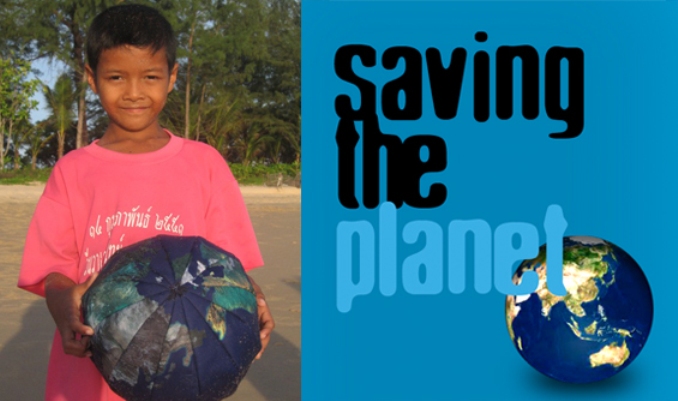
We tried out a creative idea for the series opening sequence (20 seconds), an extended version of which became the series trailer (see below). It was planned and filmed in all the six countries where the stories came from — Cambodia, India, Laos, Nepal, the Philippines and Thailand. In each country, our roving director-producers filmed different individuals – young and old, men and women, in all their Asian diversity – passing around an inflated ball made to look like planet Earth.

I know my colleagues had fun filming these sequences, and back in our studio, it was also great fun to mix and match these various shots to create the apparently seamless passing around of our planet in peril. (Who said planet saving cannot be fun?)

Watch Saving the Planet trailer (1 minute):

Now it can be revealed: our original inspiration came from an unexpected source: the world’s largest media corporation, Google! In one brainstorming, our then production coordinator Buddhini Ekanayake remembered an open challenge that Google had made online just before introducing their email service, GMail. Google asked people to “imagine how an email message travels around the world” using a video camera.

In all, Google received over 1,100 clips from fans in more than 65 countries around the world — each one of them a different creative idea, playing with the iconic Gmail M-velope.

“The clips you submitted were amazing and it was hard to choose selections for the final video,” Google said when releasing the outcome of this collaborative video project.

See Gmail: Behind the Scenes (Final Cut)

Read more about the GMail collaborative video on Google’s blog

Watch all submissions Google received for its GMail promo video.

As Oscar Wilde once said, “Talent borrows. Genius steals.” You can decide which of these we have done!

Radio Sagarmatha: Voice of a Valley and Hope of a nation

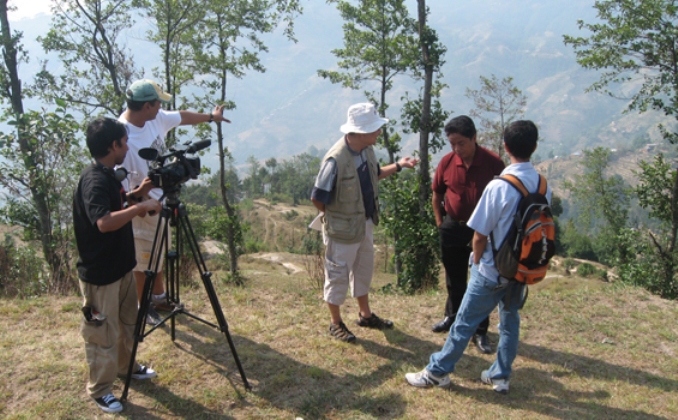
Location filming Saving the Planet in Nepal

I have written more than once in this blog about Radio Sagarmatha of Nepal, the first independent community broadcasting station in South Asia.

In May 2007, on the occasion of their 10th anniversary, I called it Kathmandu Valley’s beacon of hope. I have known and admired the Nepali friends who are running the award-winning, public-spirited radio station.

I’m delighted, therefore, to be able to make a short film about one facet of Radio Sagarmatha: their contribution to education for sustainable development, ESD for short.

Radio Sagarmatha’s path-breaking work in the resort town of Nagarkot is the story in one film of Saving the Planet, TVE Asia Pacific’s new regional TV series showcasing communities thinking globally and acting locally.

The six-episode series, which was 18 months in the making, features outstanding efforts in education for sustainable development in South and Southeast Asia.

It goes in search of answers to these key questions: Can ordinary people help save our planet under siege from multiple environmental crises? How can everyone change attitudes and lifestyles to consume less and generate less waste?

Here’s the official synopsis of the Nepal story, titled Voice of a Valley:

Tourism generates incomes, jobs and markets for the people of Nagarkot, a popular resort close to the Nepali capital Kathmandu. But it had a bumpy start when hoteliers initially bypassed local communities. These tensions were diffused by Radio Sagarmatha, the country’s first independent public radio station, which brought all interested parties together on the air. This example shows how media can do more than just report. By inspiring discussion and debate, media can help communities to find the best solutions or compromises for their development needs.

Watch Saving the Planet: Voice of a Valley

Many thanks to friends at the Nepal Forum of Environmental Journalists (NEFEJ), for their help in making this short film about one of their most outstanding efforts.

Find the full credits of the film here

XYZ Show controversy: Kenyan politicians forgetting ‘Hakuna matata’?

Politics no longer a laughing matter?

“The trouble with political jokes is that they keep getting elected!”

Ayesha, a regular reader of this blog, left that one-liner comment in response to my blog post of 13 August 2009 on an interesting experiment in political satire on Kenyan television that ended its first season on 9 August 2009.

It’s a show called the XYZ Show, broadcast weekly on Kenya’s Citizen TV. Started in mid May 2009, the first season introduced Kenyan viewers to a new form of satire television, with life-sized puppets made to resemble famous persons, mostly politicians.

Now comes the report that the show has riled some Kenyan politicians – surprise, surprise! I have only just come across this Citizen TV news report, broadcast a couple of weeks ago:

Controversy Over The XYZ Show

The satirical puppet show XYZ on Citizen Television every Sunday night, has attracted the attention of non other than the Public Service Minister Dalmas Otieno. The Minister says the caricature show is depicting politicians in bad light. The Director of Communication Ezekiel Mutua avers that, the show is representative of just how free the media is, in Kenya.

Well, what can we say? We thought politicians in general had thicker skins. Perhaps some Kenyan politicians are in danger of forgetting that timeless piece of Swahilian advice: Hakuna matata!

Hakuna matata is a Swahili phrase that is literally translated as “There are no worries”. It is sometimes translated as “no worries”, although is more commonly used similarly to the English phrase “no problem”.

‘Saving the Planet’ new Asian TV series is ready for release!

It's planet saving time...and everybody is invited!

Can ordinary people help save our planet?

What does it take to change their attitudes and lifestyles to consume and waste less?

For over two years, my team at TVE Asia Pacific and I have been working on a new TV series, modestly called Saving the Planet. It will be released at a regional conference in Tokyo, Japan, on 22 August 2009.

In this Asian series, produced in partnership with Asia Pacific Cultural Centre for UNESCO (ACCU), we profile successful initiatives that combine knowledge, skills and passion to create cleaner and healthier environments.

It was filmed in six countries in South and Southeast Asia: Cambodia, India, Laos, Nepal, the Philippines and Thailand.

The groups profiled in Saving the Planet often work without external funding and beyond the media spotlight. They have persisted with clarity of vision, sincerity of purpose and sheer determination. Their stories inspire many others to pursue grassroots action for a cleaner and safer planet.

Watch the series trailer here:

The dedicated website has just been revamped for the launch.

Watch out for more updates!