Goodbye, Lasantha Wickramatunga – and long live Siribiris!

No discussion or debate...
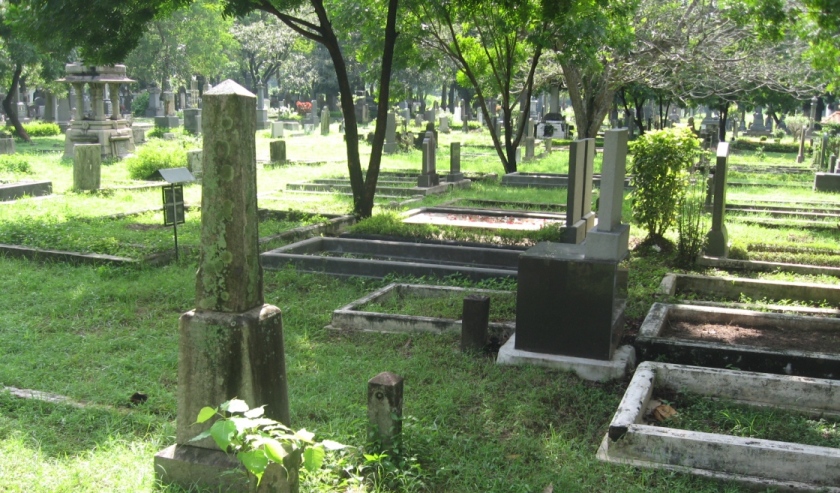
Colombo General Cemetery: No discussion or debate...

This is a view of Colombo’s main cemetery, the final resting place for many residents of Sri Lanka’s capital and its suburbs. I took this photo less than a month ago, when I visited a grave on a quiet morning.

The late Bernard Soysa, a leading leftist politician and one time Minister of Science and Technology, once called it ‘the only place in Colombo where there is no discussion or debate’.

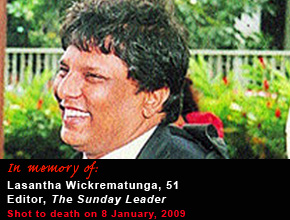
This afternoon, family, friends and many sorrowful admirers of Lasantha Wickramatunga, the courageous Sri Lankan newspaper editor who was brutally slain last week in broad daylight, took him there — and left him behind amidst the quiet company.

But not before making a solemn pledge. All thinking and freedom-loving people would continue to resist sinister attempts to turn the rest of Sri Lanka into a sterile zombieland where there is no discussion and debate. In other words, rolling out the cemetery to cover the rest of the island.
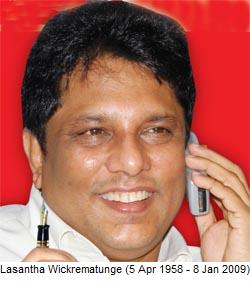
The last laugh?
The last laugh?
Silencing Lasantha was the clear aim of cowardly gunmen who intercepted him on his way to work and shot him at pointblank. Tarzie Vittachi, the first Lankan newspaper editor to be forced into exile 50 years ago for freely expressing his views on politically sensitive issues, once called such attacks ‘censorship by murder’. (Alas, since Tarzie uttered those words in 1990, shooting the messenger has become increasingly common in Sri Lanka.)

Rex de Silva, the first editor that Lasantha worked for (at the now defunct Sun newspaper) in the late 1970s, has just cautioned that Lasantha’s murder is the beginning of ‘the sound of silence’ for the press in Sri Lanka. Can this sound of silence be shattered by the silent, unarmed majority of liberal, peace-loving Lankans who were represented at the funeral service and the Colombo cemetery today?

And would they remember for all time Edmund Burke’s timeless words: “All that is necessary for the triumph of evil is that good men do nothing”?

How many would actually read, absorb and heed the deeply moving words of Lasantha’s one last editorial, copies of which were distributed at the cemetery and the religious service before that?

That editorial, which appeared in The Sunday Leader on 11 January 2009, embodies the best of Lasantha Wickrematunga’s liberal, secular and democratic views.

As I wrote in another tribute published today by Himal Southasian and Media Helping Media: “I have no idea which one – or several – of his team members actually penned this ‘Last Editorial’, but it reads authentic Lasantha all over: passionate and accommodating, liberal yet uncompromising on what he held dear. I can’t discern the slightest difference in style.”

“And there lies our hope: while Lasantha at 51 lies fallen by bullets, his spirit and passion are out there, continuing his life’s mission. That seems a good measure of the institutional legacy he leaves behind. If investigative journalism were a bug, the man has already infected at least a few of his team members…”

Read the full story of The Sunday Leader team’s courage under fire

Read The Sunday Leader‘s tribute to its founding editor on 11 January 2009: Goodbye Lasantha

Much has been written and broadcast in the past 100 or so hours since Lasantha’s journey was brutally cut short by as-yet-unidentified goons who have no respect for the public interest or have no clue how democracies sustain public discussion and debate. I’m sure more will be written – some in outrage and others in reflection – in the coming days and weeks.
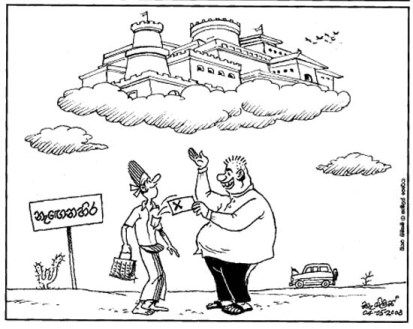
puncturing egos for 40 years
Siribiris (left): puncturing egos for 40 years
As we leave Lasantha to his rest, I remember Siribiris. For those unfamiliar with the name, Siribiris is an iconic cartoon character created by Camillus Perera, a veteran Sri Lankan political cartoonist who has been in the business as long as I have been alive.
Siribiris represents Everyman, who is repeatedly hoodwinked and taken for granted by assorted politicians and businessmen who prosper at the common man’s expense. The only way poor, unempowered Siribiris can get back at them is to puncture their egos and ridicule them at every turn. And boy, does he excel in that!

It’s no surprise that Lasantha – the bête noire of shady politicians and crooked tycoons – was very fond of Siribiris. Perhaps he saw his own life’s work as extending that of Siribiris in the complex world of the 21st century. That he did it with aplomb and gusto – and had great fun doing it, sometimes tongue stuck out at his adversaries – will be part of Lasantha’s enduring legacy. (As his last editorial reminded us, in 15 years of investigative journalism on a weekly basis, no one has successfully sued the newspaper for defamation or damages.)

So Goodbye, Lasantha. And Long live Siribiris!
Daily Mirror, Sri Lanka
Cartoon by Gihan de Chickera, Courtesy: Daily Mirror, Sri Lanka

Lasantha Wickramatunga: In Memoriam

Read blog post of 12 January 2009: Goodbye Lasantha – and long live Siribiris!

Farewell & fare forward...
Saluting the memory of courageous newspaper editor, fearless investigative journalist, jovial human being and my former colleague Lasantha Wickramatunga, Editor in Chief of The Sunday Leader, Sri Lanka, shot dead by four gunmen within sight of his newspaper office. Today, we lost the real Leader of the Opposition.

RSF: Outrage at fatal shooting of newspaper editor in Colombo
Daily Mirror, Sri Lanka, news coverage: Lasantha shot dead
Dying for Journalism: TIME pays tribute to its reporter in Sri Lanka

Himal Southasian tribute: Unbowed and Unafraid

For once, I’m at a loss for words. When prose fails, we must turn to verse which is always more potent.
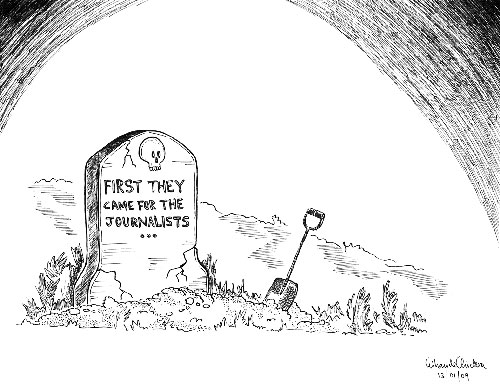
I remember Martin Niemoeller (image, below).
I remember Niyi Osundare (text, below).
I remember Adrian Mitchell.

This is the second time I have had to cite this poem in this dreadful week
This is the second time I have had to cite this poem in this deadful week

Not My Business
by Niyi Osundare

They picked Akanni up one morning
Beat him soft like clay
And stuffed him down the belly
Of a waiting jeep.

What business of mine is it
So long they don’t take the yam
From my savouring mouth?

They came one night
Booted the whole house awake
And dragged Danladi out,
Then off to a lengthy absence.

What business of mine is it
So long they don’t take the yam
From my savouring mouth?

Chinwe went to work one day
Only to find her job was gone:
No query, no warning, no probe –
Just one neat sack for a stainless record.

What business of mine is it
So long they don’t take the yam
From my savouring mouth?

And then one evening
As I sat down to eat my yam
A knock on the door froze my hungry hand.

The jeep was waiting on my bewildered lawn
Waiting, waiting in its usual silence.

Remembering the Children of Tsunami, four years later…

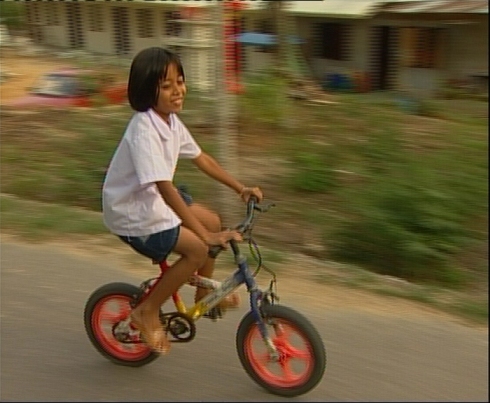
Jantakarn Thep-Chuay, known as Beam

For many weeks, Jantakarn Thep-Chuay — nicknamed Beam -– did not understand why her father was not coming home. The eight-year-old girl, in Takuapa in Thailand’s southern district of Phang Nga, had last seen him go to work on the morning of 26 December 2004.

“On that Sunday, the day there was a wave, my dad wore his tennis shoes,” she recalls as she gets into his pair of sandals. “My dad didn’t have to do much work — he just walked around looking after workers.”

Beam’s father Sukaroak –- a construction supervisor at a new beach resort in Khao Lak –- was one of thousands of Thais and foreign tourists killed when the Asian Tsunami hit without warning. His body was never found.

For months, Beam would draw pictures of her family. These, and family photos of happier times, helped her to slowly come to terms with what happened.

The first year was long and hard for the family Sukaroak left behind: Beam, her two-year-old brother Boom, and mother Sumontha, 28. The determined young widow struggled to keep home fires burning -– and to keep her troublesome in-laws at bay.

As if that were not enough, she also had to engage assorted bureaucracies: even obtaining an official death certificate for her late husband entailed much effort.

Just a few weeks after the disaster, the local authorities approached Sumontha suggesting that she gives away one or both her children for adoption. Apparently a foreigner was interested. She said a firm ‘No’.

“Her dad wanted Beam to become an architect. He was hoping for a day when he could build something she draws,” says Sumontha. “If I am still alive, I want to raise my own children. I am their mother. For better or worse, I want to raise them myself.”

The Tsunami destroyed Beam’s school, but she continued to attend a temporary school set up with local and foreign help. Before the year ended, she moved to a brand new ‘Tsunami School’ that the King of Thailand built to guarantee education for all children affected by the disaster.

Sumontha, Beam and Boom are three ordinary Asians who have shown extraordinary courage, resilience and resourcefulness as they coped with multiple challenges of rebuilding their lives after the Tsunami. Theirs is one of eight families that we followed throughout 2005, under our empathetic communication initiative called Children of Tsunami: Rebuilding the Future.

It was a multi-country, multi-media project that tracked how ordinary Asians rebuilt their lives, livelihoods and futures after one of the biggest disasters in recent years. We at TVE Asia Pacific documented on TV, video and web the personal recovery stories of eight affected families in India, Indonesia, Sri Lanka and Thailand for a year after the disaster. Our many media products — distributed on broadcast, narrowcast and online platforms -– inspired wide ranging public discussion on disaster relief, recovery and rehabilitation. In that process, we were also able to demonstrate that a more engaged, respectful kind of journalism was possible when covering post-disaster situations.

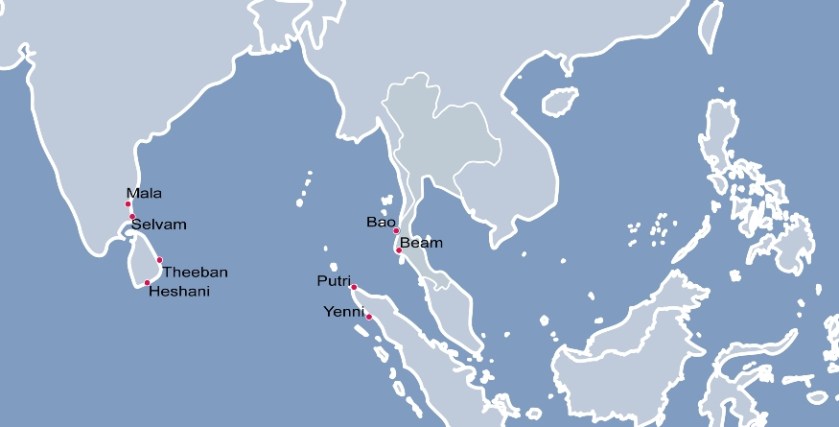
where Children of Tsunami stories were filmed for much of 2005
Four countries, eight locations: where Children of Tsunami stories were filmed for much of 2005

Meet the Children of Tsunami

They have never met each other. Yet they were united first in grief, then in survival. Five girls and three boys, between 8 to 16 years of age, living in eight coastal locations in four countries. Their families were impacted by the Asian Tsunami in different ways. Some lost one or both parents -– or other family members. Some had their homes or schools destroyed. Others found their parents thrown out of a job. During the year, these families faced many hardships and challenges in rebuilding their futures.

These remarkable children were our personal heroes for 2005:
Selvam, 13, Muzhukkuthurai, Tamil Nadu state, India
Mala, 11, Kottaikkadu, Tamil Nadu state, India
Putri, 8, Lampaya, Aceh province, Indonesia
Yenni, 15, Meulaboh, Aceh province, Indonesia
Heshani, 13, Suduwella, southern Sri Lanka
Theeban, 14, Karaitivu, eastern Sri Lanka
Bao, 16, Kuraburi, Phang Nga district, Thailand
Beam, 8, Takuapa, Phang Nga district, Thailand

With their trust and cooperation, we captured their unfolding realities unscripted and unprompted.

Read and experience much more on the Children of Tsunami dedicated website

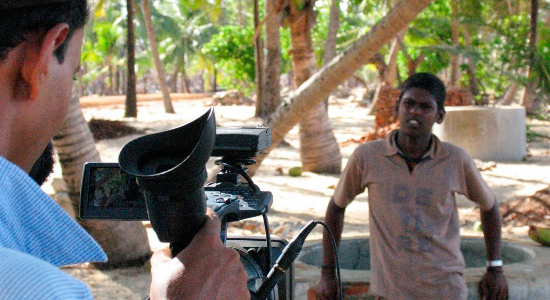
Filming with Theeban in eastern Sri Lanka...now only a memory

As I recalled in early 2007, when we tragically lost one of eight survivor children – Theeban – to Sri Lanka’s civil war: As journalists, we have been trained not to get too attached to the people or subjects we cover, lest they affect our judgment and dilute our objectivity. The four production teams involved in Children of Tsunami initially agreed to follow this norm when we met in Bangkok in early 2005 for our first (and only) planning meeting. We also resolved not to reward our participating families in cash or kind, as they were all participating voluntarily with informed consent.

“But the ground reality was different. 2005, Asia’s longest year, wore on. As survivors slowly patched their lives together again, our film teams found themselves becoming friends of families or playing Good Samaritan. Sometimes our teams would find a survivor family close to starvation and — acting purely as human beings, not journalists — they would buy dry rations or a cooked meal. At other times, finding the children restless or aimless, they would buy them a football, kite or some other inexpensive toy that would produce hours of joy and cheer.

“As commissioners and publishers of Children of Tsunami stories, we didn’t object to these acts of kindness. Journalism with empathy was far preferable to the cold detachment that textbooks recommend.

In 2007, my colleague Manori Wijesekera – who served as production manager of this challenging effort – and I wrote up our definitive account of the project for Communicating Disasters: An Asia Pacific Resource Book. That chapter can be read online here.

Children of Tsunami: The Journey Continues
(25mins) was the end-of-year film that captured the highlights and ‘lowlights’ of our families’ first year following the disaster. It can be viewed online at the Children of Tsunami website.

Children of Tsunami: No More Tears (25 mins) was the shorter version of the end-of-year film that captured the highlights and ‘lowlights’ of our families’ first year following the disaster. We co-produced it with the Singapore-based regional broadcaster Channel News Asia.

Watch the first few minutes on YouTube:

All images courtesy TVE Asia Pacific

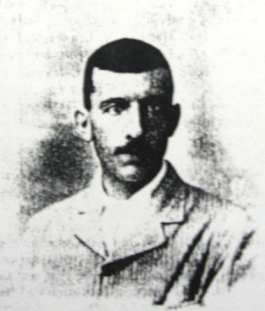
From Trincomalee to Mars: The fascinating journey of Percy B Molesworth

Percy B Molesworth
Percy B Molesworth
It was Sir Arthur C Clarke who first told me, nearly a quarter of a century ago, about a forgotten Ceylonese astronomer who has a Martian crater named after him. His name was Percy Molesworth, and I was fascinated by the story of this man who lived and died in a world so different from ours…and the trails he blazed.

Christmas Day 2008 marks the hundredth death anniversary of this remarkable man who pioneered astronomical observations in colonial Ceylon (now Sri Lanka). Most people in the land of his birth have never heard of him, and therein hangs a sad tale of how the country neglects its intellectual and scientific heritage.

By profession, Percy Braybrooke Molesworth (1867 – 1908) was a major in corps of Royal Engineers, but he is better remembered as one of the world’s leading amateur astronomers at the beginning of the Twentieth Century. From his personal observatory in Trincomalee, on Ceylon’s east coast, Molesworth both observed the night sky and photographed celestial bodies, the results of which he shared with leading astronomical groups in the west. Armed only with a basic telescope, a sharp eye and good drawing skills, he made significant contributions to advancing our knowledge of the heavens at the time.

To revive memories and introduce Molesworth to a new generation a century after his death, I have just written an article in The Sunday Times newspaper, Colombo, which prints it today.

Read the published version of my article: Immortalised on Mars, but hardly known in land of birth

Read full length article, with additional illustrations, on Thilina’s Cafe, the blog of young Sri Lankan astronomer Thilina Heenatigala, a modern-day follower of Molesworth’s steps

In these articles, I weave together material gleaned from a dozen different sources, including obituaries of Molesworth published by the British Astronomical Association (BAA) and Royal Astronomical Society (RAS), and later papers and reviews of the formidable body of work that Molesworth left behind after a short but highly productive life of 41 years.

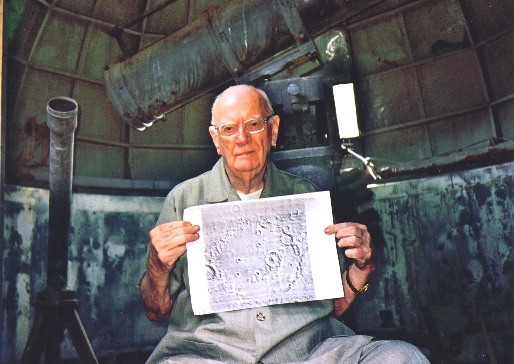
Sir Arthur Clarke, sitting next to the historic telescope, shows a photo of Crater Molesworth
One of my principal sources is Sir Arthur C Clarke, another astronomically-inclined Englishman who was to settle down in Ceylon decades later, and with whom I worked for over 20 years as a research assistant. Molesworth combined in him several elements that resonated with Sir Arthur -– Ceylon, Trincomalee, night sky observations and Mars. In the years that followed my introduction to Molesworth, Sir Arthur allowed me unrestricted access to his library and archives where I read more about Molesworth, principally from BAA and RAS journals and newsletters.

I also had the privilege of associating the late Herschel Gunawardena, who co-founded the Ceylon Astronomical Association (CAA) with Arthur Clarke in 1959, and served as its first secretary and later president. Herschel told me details of his personal quest for Molesworth, which he had chronicled in an article he wrote in the CAA journal, Equatorial, in 1971.

Others who gave me information or insights into this story include the late Dr V K Samaranayake, who played a part in restoring the telescope in the 1960s, and Fr Dr Mervyn Fernando, a keen amateur astronomer who continues to promote the subject in the local languages through the Subodhi Astronomy and Space Study Centre.

Crater Molesworth
Crater Molesworth
My own connection with Molesworth happened over 20 years ago. In early 1988, while Sri Lanka was engulfed in a brutal southern insurgency, vandals looted the Colombo University dome – by then housing the Molesworth telescope – and removed several parts purely for their metallic value. I covered that incident as a young science journalist working for The Island newspaper, and later wrote a feature article titled ‘The death of an observatory’ (published on 26 March 1988).

Given the political turmoil at the time, it barely made any ripples. I still remember being ridiculed by some for reviving the memory of a long dead man at a time when hundreds of innocent, non-combatant lives were being lost every week due to extra-judicial killings.

Indeed, for much of the past 30 years, Trincomalee has been affected by Sri Lanka’s long-drawn civil war in the country’s north and east. I had planned to visit Trincomalee this year to personally find out the current status of the Molesworth bungalow and tombstone. But that didn’t happen due to the pressure of work and other distractions. I might well do that in 2009, now designated the International Year of Astronomy.

Naming celestial objects is a serious business, carried out by the International Astronomical Union (IAU) through a careful process. There are hundreds of thousands of craters on Mars, but only some of them have names. The Wikipedia has a list of Martian craters which are by convention named after famous scientists and science fiction authors, or if less than 60 km in diameter, after towns on Earth.

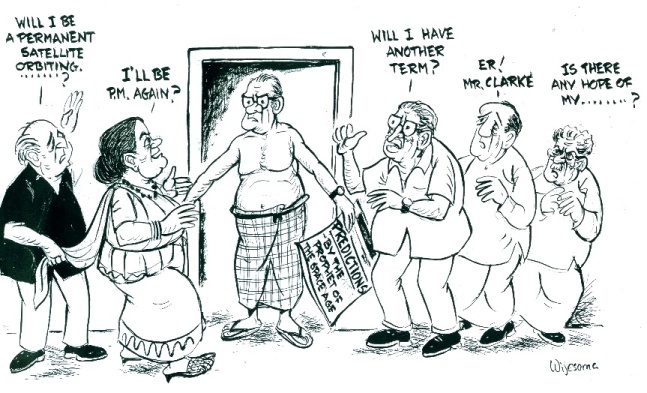
Remembering Arthur C Clarke, the public intellectual

Cartoon by W R Wijesoma in The Observer (Sri Lanka)
Space prophet mobbed by anxious politicians: Cartoon by W R Wijesoma in The Observer (Sri Lanka)

This cartoon is nearly as old as myself! It was drawn by Sri Lanka’s leading political cartoonist W R Wijesoma and appeared in The Observer newspaper of Colombo sometime in the late 1960s (I haven’t been able to ascertain the exact date).

It shows science fiction writer (later Sir) Arthur C Clarke, already settled down in Ceylon (later Sri Lanka) and ‘Serendipitised’ enough to sport the native attire of sarong, being mobbed by the island’s leading politicians — all of them now departed — each wanting to know what he can foresee or foretell about their personal political futures.

Sir Arthur, whose 91st birth anniversary falls today, took pains to explain that science fiction writers like himself were not soothsayers with powers to predict the future. He was fond of quoting fellow SF writer Ray Bradbury’s famous saying: “People ask me to predict the future, when all I want to do is prevent it.”

But that kind of reason never deterred politicians of every colour and hue, who are always anxious to know just when they can get elected – or return – to high office and all the trappings of power that go with it.

To mark the birth anniversary – the first since his death in March 2008 – I have just published an op ed essay, titled Sir Arthur C Clarke: A life-long public intellectual, on Groundviews website. In this essay I explore, briefly, some of his life-long pursuits for more rational discussion and debate in public policy. I also wonder how and why he lost his struggle against Sri Lankans’ obsession with astrology.

Here’s an excerpt:

But even half a century of Arthur C Clarke could not shake Sri Lankans off their deep obsession with astrology — the unscientific belief that human destinies are somehow shaped and controlled by celestial bodies millions of kilometres away. A life-long astronomy enthusiast, he repeatedly invited astrologers to rationally explain the basis of their calculations and predictions. This challenge was craftily avoided by astrologers who continue to exercise much influence over politics, public policy, business and everyday life in Sri Lanka.

Despite his broad-mindedness, Clarke couldn’t understand how so many highly educated Sri Lankans practised astrology with a faith bordering on the religious (another topic on which he held strong views). Ironically, even the government-run technical institute named after him used astrologically chosen ‘auspicious times’ for commissioning its new buildings. In later years, Clarke would only say, jokingly: “I don’t believe in astrology; but then, I’m a Sagittarius — and we’re very sceptical.”

On a personal note, I’m truly privileged to have known and worked with both Sir Arthur Clarke and his cartoonist W R Wijesoma (who was my senior colleague at The Island newspaper which he joined at its inception in 1981). I know how much Sir Arthur liked this cartoon, the original of which he obtained from Wijesoma and preserved among dozens of other souvenirs and mementos.

Alas, Wijesoma left us in January 2006 — or he might just have drawn another brilliant cartoon to send off Sir Arthur on his final journey. In fact, a worthy follower of Wijesoma’s cartoon tradition did just that earlier this year – see this blog post of mine from March 2008: Arthur C Clarke autographing all the way to the Great Beyond….?

Read the full essay on Groundviews citizen journalism website.

Palitha Perera: The man who refused to be His Master’s Voice

The Island)
Doyen of Sri Lankan cartoonists, Wijesoma, saw it all coming (courtesy: The Island)

This cartoon is more than a quarter of a century old. It was drawn by W R Wijesoma, the doyen of Sri Lankan political cartoonists, in March 1982 — barely a month after Sri Lanka’s national television broadcaster Rupavahini commenced its transmissions.

I was a school boy in my mid teens when this happened, but I remember the story behind the cartoon. It was Sri Lanka’s first executive president J R Jayewardene who inaugurated the national TV station, which was donated to Sri Lanka by the Japanese government as part of its large package of aid to the island nation. At the inauguration, JR (as everyone called him) made this lofty speech, where he expressed his hope that Rupavahini would also be a satyavahini (meaning: the picture tube should also dispense the truth).

In practice, that presidential wish never had a chance. JR was in office from 1978 to 1989, and Rupavahini’s fledgling years coincided with his second term. Despite his ideals, his own government misused the new medium from almost day one for blatant, partisan propaganda. In the event, it was my old colleague Wijesoma’s vision of a ‘party-vahini’ (a propaganda vehicle for party in office) that became our sad, stark reality. Some have also called it pacha-vahini (dispenser of lies).

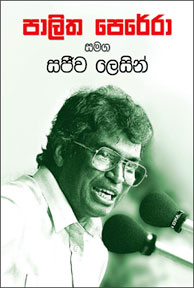
I recall all this on World Television Day, 21 November, because I’ve been reading a very interesting book by a remarkable man who was associated with Rupavahini’s inauguration. His name is Palitha Perera, and he is one of the most senior and respected radio and TV broadcasters in Sri Lanka today. Among other feats, Palitha holds the distinction of having been the inaugural announcer on two Sri Lankan TV channels – Rupavahini (15 February 1982) and TNL TV (21 July 1993).

Live with Palitha Perera
Palitha has recently penned his first book, titled Palitha Perera Samaga Sajeeva Lesin (Live with Palitha Perera; Surasa Books, Colombo; 2008). It’s not written in the ‘been-there, done-that’ style of self importance. True, it has a rich sprinkling of autobiographical details expressed in Palitha’s lucid, entertaining writing style. But in recalling men and matters, and his own multiple roles in shaping events, he is both modest and moderate -– hallmarks of his professional career.

As I note in a book review published today on Groundviews.org: “His reminiscences provide some unique insights into our broadcasting history for nearly half a century. He chronicles little known facts and praises unsung heroes. In doing so, he offers a ringside account of the progress — and decline — of state broadcasting in Sri Lanka from the early 1960s to the present.”

Palitha is one of the few broadcasters who successfully moved from radio to television broadcasting. Many other announcers, interviewers and producers of the radio era failed to make that leap, for the two media are different.

In fact, Palitha has been in broadcasting longer than I’ve been alive. I grew up in the 1970s listening to Palitha’s deep, clear and friendly voice. He was Sri Lanka’s pioneering cricket commentator in Sinhala and that’s how he has had the greatest impact on our culture and society.

As I say in the review: “Here we have, straight from the original source, the story of how cricket became the de facto national past-time, if not our national addiction or religion! Like it or hate it, cricket is an integral part of our popular culture. Radio (and later TV) cricket commentaries take much of the credit (or blame, in some people’s view) for building up this uncommon fervour that occasionally unites our otherwise utterly and bitterly divided nation.”

Palitha has also made his name as the country’s foremost interviewer on both radio and television. In his time, Palitha has interviewed dozens of public figures from Presidents and prime ministers to social activists and trade unionists. He is always prepared and well informed. He remains calm and friendly at all times, yet is dogged in his questioning. This style has exposed many a hypocrite and charlatan.

It was said that boxer Mohammad Ali used to ‘float like a butterfly and sting like a bee’. I would say Palitha Perera floats like a butterfly and stings like a butterfly. It never hurts his interviewee personally, but he is piercing and penetrative all the same.

Unlike many other broadcasters who have cheer-led governments prostituting the airwaves, a public property, Palitha Perera never lost sight of who his real masters were: the audience.

Read my full review on Groundviews

Meet the new Pied Pipers of our Global Village: the Media!

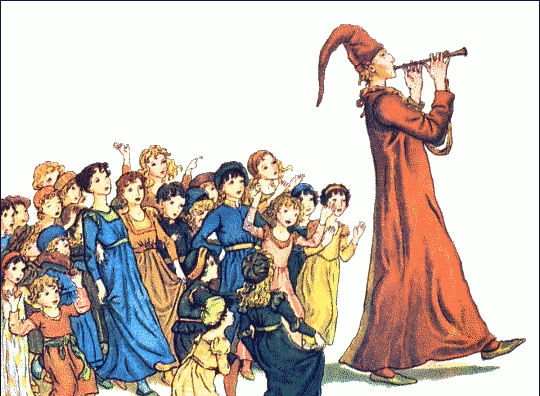
In the well known legend, the pied pier of Hamelin played his musical pipe to lure all the rats into the nearby Weser river. When the town reneged on the promised fee, he played a different tune to entice all its children away from the town.

Modern-day pied pipers use smooth talk and convincing images instead of hypnotic musical tunes to lead people astray. And they achieve much greater coverage today — thanks to the modern media.

When the media amplify pied piper tunes, how responsible are they for the resulting damage?

Then and now, we like to follow a tune...

This is the question I raise – and try to answer – in an op ed essay published this week by the Asian website Eye on Ethics.

‘When media amplify pied piper tunes…’ was inspired by a current experience in my native Sri Lanka. For the past few weeks, Sri Lankans have been shocked and dismayed to learn how thousands of middle-class adults have been hoodwinked by a confidence trickster who used paid advertisements in newspapers and on television to boost his image.

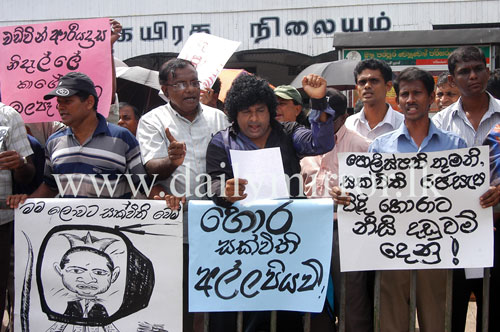
Sakvithi Ranasinghe, a populist tutor of English turned businessman, fled the country in mid-September 2008 after duping thousands of unsuspecting people to deposit money in an Ponzi-style investment scheme that offered abnormally high returns.

After the scandal broke, the media have been giving it a great deal of coverage. But most of it falls into follow-the-victim, blame-the-authorities style of journalism.

The main point of my essay: “Amidst the finger-pointing, arm-waving and name-calling, few have noticed the role of the media in promoting Ponzi schemes in the first place. Wittingly or otherwise, the media have helped amplify the mesmerizing tunes of pied pipers, and quietly collected substantial advertising revenue from such racketeers.”

Sakvithi's investment victims protest in Colombo - photo courtesy Daily Mirror

I also comment in this essay the blurring of what used to be a sacred divide in the media – between editorial content and paid advertising. Here’s an excerpt:

“Many people experience media products as a whole, and lack the media literacy to separate news, commentary and paid commercials. Besides, the once clear demarcations have blurred in recent years.

“Television’s seamless blending of news, entertainment and commercials can leave even the most media-literate people somewhat perplexed. News bulletins are sponsored variously by sellers of insurance, milk food or detergents, while current affairs shows are branded by various commercial products or services.

“In newspapers, the steady rise of ‘advertorials’—product promotions neatly dressed up as editorial content—makes it harder to discern where one ends and the other begins.”

Read and comment on my full essay at Eye on Ethics website

Encounter with Anpanman: A superman made of bread!

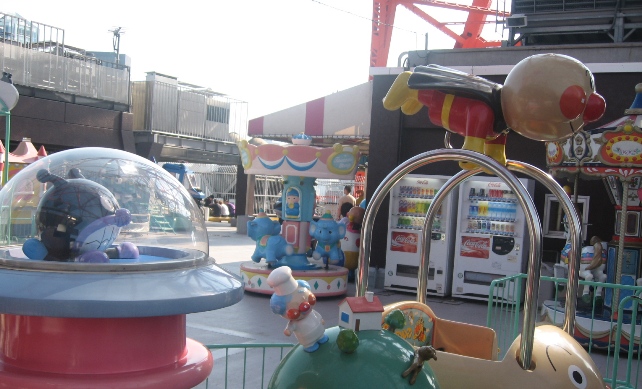
Anpanman is one of the most popular anime cartoon series in Japan

Last month, on my way to the Tokyo headquarters of NHK, Japan’s public broadcaster, I stopped at the Tokyo Tower for a bit of sight-seeing.

A communications tower located in Shiba Park, Minato, Tokyo, the Tokyo Tower is 332.6 meters (1,091 ft) tall – which makes it the tallest self-supporting steel structure in the world. Built in 1958, this Eiffel Tower-like structure supports an antenna that broadcasts television and radio signals for important Japanese media outlets including NHK, TBS and Fuji TV.

At the base of the tower, I had an unexpected encounter with an old friend. I know him as Gnana Katha Malliya, the name given to him in the Sinhalese adaptation that I watch on Sri Lankan television.

But everyone in Japan knows him by his original name: Anpanman. He is one of the most popular anime cartoon series (manga) in Japan. It is produced by Nippon Television Network Corporation.

Anpanman is the creation of Takashi Yanase, a Japanese writer of children’s stories. Each animated cartoon is approximately 24 minutes long, split into 2 episodes of approximately 12 minutes each.

Yanase has been writing Anpanman since 1968. He became inspired by the idea of Anpanman while struggling to survive as a soldier in World War II. He had frequently faced the prospect of starvation which made him dream about eating a bean-jam filled pastry called Anpan.

Anpanma is indeed a superman made by a baker. His head is a bun made by Jam Ojisan, a kind-hearted baker. He was created when a shooting star landed in Jam Ojisan’s oven while he was baking.

Anpanma’s name comes from the fact that he is a man with a head made of bread that is filled with bean jam called an anpan. His weakness is water or anything that makes his head dirty. He regains his health and strength when Jam Ojisan bakes him a new head and it is placed on his shoulders. Anpanman’s damaged head, with Xs in his eyes, flies off his shoulders once a new baked head lands.

The most endearing attribute of Anpanman is his sense of sacrifice. When he comes across a starving creature or person, he lets the unfortunate creature or person eat part of his head. Jam Ojisan has to keep baking an endless supply of heads for our hero.

And it gives a whole new meaning to the phrase ‘eat my head off’.

Baikinman is the villain in the stories. He comes from the “Germ World” and is the leader of the viruses. His name means “Germ Man”, and his ambition is to destroy Anpanman and turn the planet into another “Germ World”.

Read about other characters in Anpanma

Anpanman (R) and Baikinman at the Tokyo Tower

According to the Wikipedia, as of September 2006, Anpanman’s books had collectively sold over 50 million copies in Japan.

The Anpanman television series is called Soreike! Anpanman (meaning ‘Go! Anpanman’) – it has been on the air in Japan since 1988. More than 800 episodes have been made to date. There are also 18 cinematic films featuring the characters.

According to the Japanese toy company Bandai, Anpanma is the most popular fictional character from age 0 to 12 years in Japan.

As I found out, Anpanman is such a cultural icon in Japan that his images adorn railway carriages, and there is an Anpanman museum opened in Yokohama in 2007.

Anpanman is also popular in many countries across Asia. He has a large following in China and Korea, where the comics and TV series have been a popular Japanese cultural export for years.

And, as it turns out, I’d been enjoying his exploits on Sri Lankan television for years without even knowing his original Japanese name! This reinforces the point I made in Feb 2008, writing about another favourite character Madeline – originally French, but whom I encountered on a visit to Manila and Los Banos in January this year.

I wrote: “It’s becoming impossible to discern or define what is ‘local’ anymore in this rapidly globalising and integrating world. Sociologists and communication researchers who split hairs about preserving ‘local content’ have a romanticised notion that is hard to find in the real world.”


Read my Feb 2008 blog: What’s local in our mixed up, globalised world?


Watch a sample story: Anpanman to Hamigakiman

Sleeping easy along the shore: Going the Last Mile with hazard warnings

creating-disaster-resilience-everywhere.jpg

October 8 is the International Day for Disaster Reduction. The United Nations system observes the day ‘to raise the profile of disaster risk reduction, and encourage every citizen and government to take part in building more resilient communities and nations’.

Disaster risk reduction (abbreviated as DRR) is the common term for many and varied techniques that focus on preventing or minimising the effects of disasters. DRR measures either seek to reduce the likelihood of a disaster occurring, or strengthen the people’s ability to respond to it.

DRR is not just another lofty piece of developmentspeak. Unlike many other development measures that are full of cold statistics and/or hot air, this one directly (and quietly) saves lives, jobs and properties.

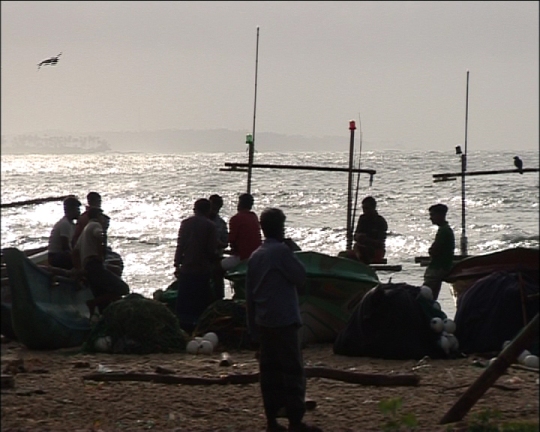
And it gives people peace of mind – we can’t put a value on that. That was the point I made in a blog post written in December 2007, on the third anniversary of the Indian Ocean Tsunami. Taking the personal example of J A Malani, an ordinary Sri Lankan woman living in Hambantota, on the island’s southern coast, I talked about how she has found peace of mind from a DRR initiative.

‘Evaluating Last Mile Hazard Information Dissemination Project’ (HazInfo project for short) was an action research project by LIRNEasia to find out how communication technology and training can be used to safeguard grassroots communities from disasters. It involved Sarvodaya, Sri Lanka’s largest development organisation, and several other partners including my own TVE Asia Pacific. It was supported by International Development Research Center (IDRC) of Canada.

Recently, IDRC’s inhouse series ‘Research that Matters’ has published an article about the project. Titled “For Easy Sleep Along the Shore: Making Hazard Warnings More Effective” its blurb reads: “In Sri Lanka, a grassroots pilot study combines advanced communication technologies with local volunteer networks to alert coastal villages to danger coming from the sea.”

The article has adapted a lot of the information and quotes I originally compiled for a project introductory note in April 2006.

The outcome of the project’s first phase, which ended in mid 2007, is well documented. My own reflective essay on this project is included as a chapter in our book Communicating Disasters: An Asia Pacific Resource Book, published by TVE Asia Pacific and UNDP in December 2007.

TVE Asia Pacific also made a short video film in late 2007. Called The Long Last Mile , it can be viewed on YouTube in two parts:

The Long Last Mile, part 1 of 2:

The Long Last Mile, part 2 of 2:

The recent IDRC article ends with this para: “A related challenge concerns the shortness of any society’s attention span. In the absence of frequent crises and alerts, how can a nation — or even a village — sustain the continuing levels of preparedness essential to ensure that, when the next big wave comes rolling in and the sirens sound, its people will have the motivation and the capacity to act? The follow-up project seeks to address this worry by preparing the hotels and villages to respond to different types of hazards, rather than only to the relatively rare tsunamis.”

Watch this space.

Download pdf of IDRC’s Research That Matters profile on Last Mile Hazard Warning Project

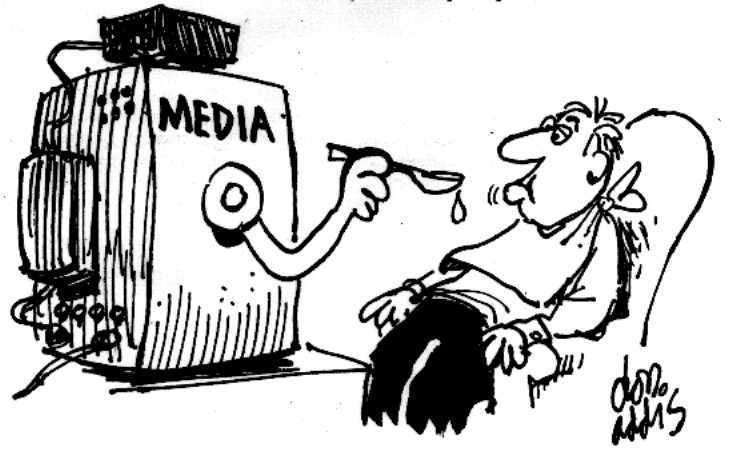
Do you believe everything you see on TV? Some do!

It's easy to be lulled by TV...

“I invested Rs. 2 million (US$ 18,550) of my money after seeing him on TV. I basically believe what I see on the TV and so was misled.”

I read this remark, by a hapless woman victim of an investment scam, in a Sri Lankan newspaper report last week. It got me thinking: where is our media literacy?

Sakvithi Ranasinghe, a populist tutor of English turned millionaire businessman, had just fled the country after duping thousands of unsuspecting people to deposit their life’s savings in his investment firm. Media reports have variously placed the number of victims between 1,500 and 4,000 — and some estimates place the total worth of his loot to be a whopping Rs. Nine billion (over USD 83.5 million).

This local scam may seem insignificant in the current global context when established and well respected banks and financial houses are collapsing one after the other in capitalism’s biggest crisis in decades. But for the several thousand victims, the effects are devastating.

The woman quoted in the news report is not an isolated case. Too many people, it seems, were mesmerised into parting with their money due to a deviously persuasive media campaign. For several years, Sakvithi ran English teaching programmes on Sri Lanka’s national television and other channels. On the guise of teaching English (which he didn’t do very well), Sakvithi manufactured a larger than life image for himself. He also ran regular newspaper advertisements in the highest circulating weekend newspapers. Some were in full colour, occupying an entire broadsheet page. These too reinforced his image as a benevolent, enterprising young Sinhala businessman doing social good.

Not everyone, it seems, heeds the common sense advice, ‘Don’t believe everything you read/hear in the media’. Indeed, the Sakvithi scandal once again brings into sharp focus the media’s — especially television’s — perceived role as the great authenticator of our times.

I have just written an op ed essay for the citizen journalism website Groundviews, where I suggest that the mainstream media outlets that repeatedly sold airtime or newspaper space to this man must now share part of the blame for misleading the public. I also argue that besides timely regulatory action and proper law enforcement, we also need greater vigilance by the media, and higher levels of media literacy in everyone to safeguard society from this kind of media manipulation.

Media illiteracy creates this!

Here’s an extract:

“I find it more than a tad ironic that the same media outlets are now peddling the tales of woe of the thousands of men and women tricked by their former, big-time customer. Knowingly or otherwise, these media have amplified the mesmerising tune of this pied piper of Nugegoda who lulled thousands into parting with their money.

“Their journalists would no doubt protest innocence, reminding us of the divide between editorial and advertising operations. And they are right: media practitioners and editorial gatekeepers don’t have much (or any) control over what fills up the commercially sold advertising space. But how many of their readers or viewers can distinguish the difference?

“Most people experience media products as a whole, and lack even the basic media literacy to separate news, commentary and paid commercials. Besides, with the rise of ‘advertorials’ — product promotions neatly dressed up as editorial content — it’s becoming harder to discern which is which.

Read the full essay on Groundviews.