‘Thank you for warming the planet (good for business)’ — Africa’s malaria mosquitoes

Nelly Damaris Chepkoskei: Voice of Hope
Malaria still claims over a million lives every year, most of them in Africa. This is not simply a public health statistic for Nelly Damaris Chepkoskei – she lost a daughter to the ancient scourge that continues to outsmart human attempts to control it.

“It was very sad when my daughter died of malaria at the age of four,” she recalls. What makes it especially tragic is the fact that malaria is a new arrival in her area.

Nelly, 51, is a farmer living in Kenya’s Kericho District. Located high in the mountains, Kericho’s cold weather has kept mosquitoes at bay for centuries. But not any longer: global warming has raised the area’s average temperature, and mosquitoes have appeared in recent years, bringing malaria with them.

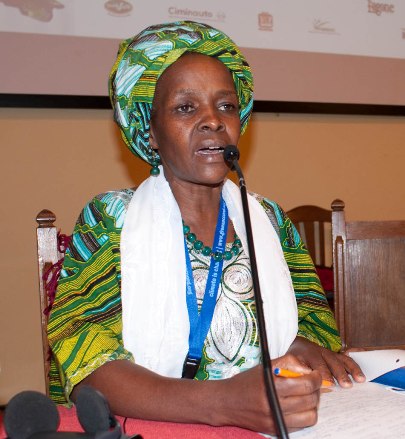
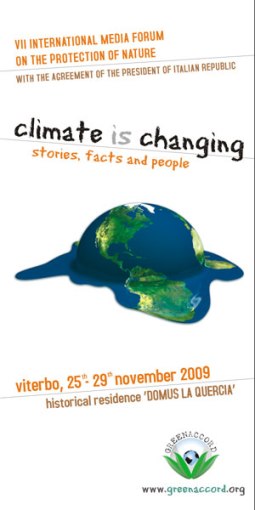
“I had never seen a mosquito until I was 20 years old. But now they are everywhere – people are even dying of malaria, something that was virtually unheard of 20 or 30 years ago,” Nelly told the 7th Greenaccord International Media Forum on the Protection of Nature, being held in Viterbo, Italy, 25 – 29 November 2009.

The theme this year is ‘Climate is changing: stories, facts and people’. Nelly Chepkoskei is one of 10 Climate Witnesses who travelled to the historic city from far corners of the world to share their stories of ground level changes induced by climate change.

Climate Witness is a global programme by WWF International to enable grassroots people to share their story of how climate change affects their lives and what they are doing to maintain a clean and healthy environment. All Climate Witness stories have been authenticated by independent scientists.

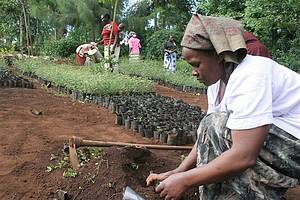
Married with five children, Nelly grows maize and tea, and keeps a few cows – the pride and joy of Kenyan farmers. Lacking faith in politicians and government, she is working with women in her community to pursue their own development.

Life was never easy, but climate change is making it even harder.
“Rainfall patterns have changed drastically in recent decades,” she says. “In the Kericho district, we used to have rain throughout the year. I remember clearly that my family celebrated Christmas when it was raining heavily. But today, Christmas is usually dry.”

Unlike 20 years ago, the dry season is now hotter, drying up all the grass. In the past, the grass would remain green throughout the year.

“This means there isn’t enough fodder for my cows, leading to a drop in milk production and my income,” she explains. “The soils are also left bare during the dry season, which means more erosion when rains come in.”

With higher temperatures, more pests have turned up to damage crops. This prompts farmers to use more pesticides, increasing production costs and polluting the environment with hazardous chemicals.

Nelly turned out to be the most outspoken Climate Witness in Viterbo. In a frank exchange with an audience of 130 journalists, activists and scientists drawn from 55 countries, she exclaimed: “Don’t talk to politicians – they are the same everywhere! I can’t understand why journalists always follow politicians and are so keen to talk to them!”

She continued: “There is so many good things happening in Africa, but we don’t see it reported in the local and international media. You only hear about fighting, famine and corruption. So we continue to be seen and known as the Dark Continent.”

In her view, what Africa needs more than anything else is education. She firmly believes that higher levels of literacy and education would reduce the incidence of conflict and plunder.

Nelly herself is a high school drop out, and places a very high value on education to empower all Africans, especially women.

“There is a big gap between Kenyan intellectuals and the ordinary people. Knowledge is not where and how it is needed,” she says.
I asked her what she thought of foreign aid to Kenya and rest of Africa. This elicited a passionate and emphatic response: “If you want to spoil and corrupt Africa more, then keep giving aid to our governments. Aid money mostly ends up in the wrong hands, or buying guns to fight each other.”

She added: “We do need help, but don’t give aid to our governments. Instead, support NGOs who are better in delivering to the grassroots.”

Nelly and her network of women are digitally empowered. They refer the web to find out information on what aid and opportunities are available and then pursue them with all available means. Armed with the latest data, they lobby local and provincial governments to ensure that aid pledged from international donors reach the intended communities.

Nelly may not be Wangari Maathai, the Kenyan environmentalist and women’s right activist, but she admits to being a Wangaari in spirit. And having listened to the first African woman to win the Nobel Peace Prize at a previous Greenaccord forum, I readily agree: women like Nelly are a beacon of hope not just for Africa, but to the entire Majority World.

If only the mosquitoes could spread their passion and concern for the land and people…

Read WWF report on climate change impacts in East Africa

Images courtesy Greenaccord and WWF

Taste the Waste: Uncovering a crime against humanity and Nature

Opening the lid...

“How can we explain the fact that one sixth of humanity goes to bed hungry every night, when the world already produces enough food for all?

“The short answer is that there are serious anomalies in the distribution of food. Capricious and uncaring market forces prevent millions of people from having at least one decent meal a day, while others have an abundance of it. For the first time in history, the number of severely malnourished persons now equals the number suffering from over-consumption: about a billion each!”

That was the opening of an article on the future of food, co-authored by Sir Arthur Clarke and myself in 2000. It was circulated by the UN Food and Agriculture Organisation (FAO) to mark World Food Day that year, and was reproduced in 2008 in The Hindu newspaper, India.

Nearly a decade after we wrote those words, the situation hasn’t really improved. There still are a billion people for whom chronic hunger is a grim fact of life. About 25,000 people die of hunger every day. Meanwhile, at the other end of the spectrum, the number of obese people has grown to 1.5 billion.

Talk about a world of contrast and disparity!

Here’s more shocking news: we routinely throw away half of all food produced in this world. Between plough and plate, or from farms to homes, we waste almost as much food as we eat.

Eyes Wide Shut?
Many countries don’t have the slightest idea how much is wasted. Britain made an effort to measure the waste pile and came to a staggering 15 million tons of food a year. This includes 484 million unopened tubs of yoghurt, 1.6 billion untouched apples, bananas worth £370 million and 2.6 billion slices of bread.

In his recent book Waste: Uncovering the Global Food Scandal, Tristram Stuart documented the extent of waste in the food industry worldwide.

Taste the Waste is a new documentary film linked to an online campaign that shows us what is being thrown away: where, why, when and by whom.

The film maker turned campaigner, Valentin Thurn, has come up with one more reason why we should stem this callous waste: “Cutting food waste is an easy solution to reduce climate emissions and hunger,” he says.

Reducing food waste means a big opportunity to reduce greenhouse gas emissions – if we threw away only half of the avoidable waste, the consequences for the climate would be the same as taking one out of five cars off our roads.

It would also help the hungry, because they also depend on the global food cycle. Cash crops from all over the world are traded on the stock exchange. The agricultural resources on this planet are limited. The farmland taken up to produce the food that we throw away could instead be producing food for them.

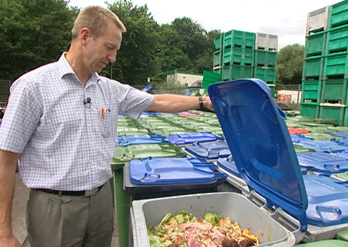
Young activists protest against this situation by rescuing the wasted food. People eating rubbish – a habit that sounds disgusting until you see the loads of perfectly edible food in the bins of your supermarket or sandwich shop around the corner.

Thurn’s call to action: “We need your help! Go out, look around and tell us about the food in the bins where you live. Send texts, photos, videos, and help to reveal the huge scandal of how we are wasting food.”

Watch the film’s trailer on YouTube:


According to the latest FAO figures, there are more hungry people in the Asia Pacific (642 million) than all other regions combined. This is followed by Sub-Saharan Africa (265 million), Latin America and the Caribbean (53 million), and the Near East and North Africa (42 million). Sub-Saharan Africa has the highest percentages of people living in hunger, while the Middle East and North Africa saw the most rapid growth in the number of hungry people (13.5%) during 2008.

The UN’s definition of hunger is based on the number of calories consumed. Depending on the relative age and gender ratios of a given country, the cutoff varies between 1,600 and 2,000 calories a day.

Starting in 2008, activist groups worldwide observe 16 October as World Foodless Day. Their argument: World Food Day is a mockery and is much better named World Foodless Day.

It’s a day of global action on the crises that beleaguer the people. The objectives are to: “create public awareness and media attention on the root causes of the food crisis; provide policy recommendations and organize meetings with government officials, opinion makers and leaders; organise activities to raise our voices against neoliberal policies and their impact; and highlight people’s recommendations to respond to the world food crisis.”

Watch PAN-Asia Pacific’s video for World Foodless Day 2008:


Read an excellent review of Tristram Stuart’s book: Watching our wasteline, By Darryl D’Monte

BigShot: A little camera with a Big potential — inspired by a film!

BigShot: Inspiration with every click?
“Build a better mousetrap, and the world will beat a path to your door.” This remark is attributed to one of my favourite essayists and philosophers, Ralph Waldo Emerson.

That was probably true for the 19th century in which he lived and died, but it takes a bit more than a mousetrap to generate a buzz these days. But simple and elegant inventions are still the best. BigShot is one of these.

It’s still in testing stage, but already being hailed as “a camera that could improve the way children learn about science and one another”.

BigShot is an innovation by Indian-born Shree K. Nayar, now the T. C. Chang Professor of Computer Science at Columbia University in New York, USA.

As his university’s newspaper reports: “He came up with a prototype as sleek as an iPod and as tactile as a Lego set: the Bigshot digital camera. It comes as a kit, allowing children as young as eight to assemble a device as sophisticated as the kind grown-ups use—complete with a flash and standard, 3-D and panoramic lenses—only cooler. Its color palette is inspired by M&Ms, a hand crank provides power even when there are no batteries and a transparent back panel shows the camera’s inner workings.”

With the BigShot, Nayar wants to not only empower children and encourage their creative vision, but also get them excited about science. Each building block of the camera is designed to teach a basic concept of physics: why light bends when it passes through a transparent object, how mechanical energy is converted into electrical energy, how a gear train works.

Watch Professor Shree Nayar talk about the purpose and development of the Bigshot camera project.

Nayar would like to roll out the camera, now in prototype form, along the lines of the One Laptop Per Child campaign: For each one sold at the full price of around $100, several would be donated to underprivileged schools in the United States and abroad. He will soon begin looking for a partner—a company or nonprofit—to help put Bigshot into production.

Life inspires innovation...
Wired magazine wrote in a recent review: “(It) is a super-simple digicam from the Computer Vision Lab at Columbia University. It comes in parts, ready to be assembled (by kids, but I can’t wait to get my hands on one), and teaches you along the way how these things work. It’s not quite the transparent view you get from making an old analog camera, where you can see how everything works, but it’s as close as you can get from a machine that uses circuit boards.”

Interestingly, the initial inspiration for BigShot came from a documentary: Born into Brothels (85 mins, 2004), a film about the children of prostitutes in Sonagachi, Kolkata’s red light district. The widely acclaimed film, written and directed by Zana Briski and Ross Kauffman, won a string of accolades including the Academy Award for Documentary Feature made in 2004.

I saw that film during the AIDS Film Festival I helped organise in Bangkok in July 2004. In this film, the film maker, British photographer Zana Briski, gave 35 mm film cameras to eight children and watched as those cameras transformed their lives.

“The film reaffirmed something I’ve believed for a long time, which is that the camera, as a piece of technology, has a very special place in society,” says Nayar. “It allows us to express ourselves and to communicate with each other in a very powerful way.”

Watch an overview of Born into Brothels, featuring the film makers:

The Toilet is still a luxury for 2.5 billion people worldwide…

No laughing matter, this...

It had to happen sooner or later: a world day dedicated to, ahem, toilets. When all sorts of public interest causes are claiming the 365 days of our year, it was only a matter of time.

19 November is World Toilet Day – a day to celebrate the humble, yet vitally important, toilet and to raise awareness of the global sanitation crisis. It was established in 2001 by the World Toilet Organization (the other WTO!), a global non- profit organization committed to improving toilet and sanitation conditions worldwide.

The World Toilet Day promotes the importance of toilet sanitation and each person’s right to a safe and hygienic sanitary environment.

Did you know, for instance:
* 2.5 billion people do not have somewhere safe, private or hygienic to go to the toilet?
* One gram of faeces can contain 10 million viruses, one million bacteria, 1,000 parasite cysts and 100 parasite eggs?

Here’s a cool viral video that WaterAid have produced to mark the event:

A third of the world’s population lacks any toilets. The rest of us who do have a toilet don’t always make the most efficient use of it – when we typically use 10 litres of water to flush away one litre of urine, that’s not very thrifty, is it?

On this day, I came across an interesting essay by Debra Shore, Commissioner, Metropolitan Water Reclamation District of Greater Chicago, in The Huffington Post. She writes: “Using freshwater in toilets is not smart and it is not sustainable. I believe the homes of the future will be designed to use “grey” water — the water from our washing machines and dishwashers, the water from our showers and from rain captured in barrels and cisterns — to flush our toilets. This kind of redesign of water use, both residential and industrial, will be one of the growth industries of coming decades.”

She adds: “So, on World Toilet Day, here is my plea: monitor your water use. Think about ways to conserve water. And consider how lucky we are.”

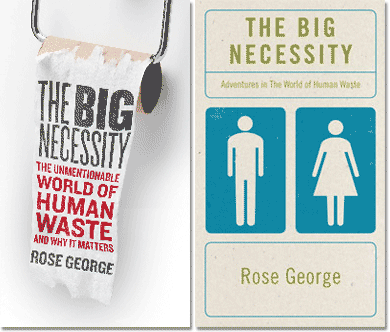
Rose George, author of The Big Necessity: The Unmentionable World of Human Waste and Why It Matters says toilets are a privilege that nearly half the world still lacks. At least 2.6 billion people around the planet have no access to a toilet — and that doesn’t just mean that they don’t have a nice, heated indoor bathroom. It means they have nothing — not a public toilet, not an outhouse, not even a bucket. They defecate in public, contaminating food and drinking water, and the disease toll due to unsanitized human waste is staggering. George notes that 80% of the world’s illnesses are caused by fecal matter.

Read more: Toilet Tales: Inside the World of Waste, by Bryan Walsh in TIME, Nov 2008

Calculate your water footprint

Blog post in July 2007: A Silent Emergency: More television sets than toilets!

Blog post in July 2007: Faecal Attraction: There’s no such thing as a convenient flush…

Satinder Bindra: It’s the message, stupid (and never mind the UN branding)!

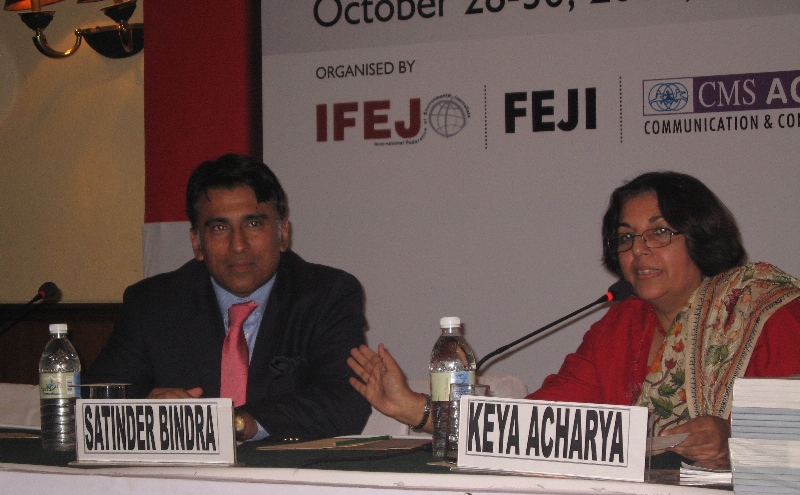
Satinder Bindra (left) and Keya Acharya
Satinder Bindra (left) and Keya Acharya at IFEJ 2009 Congress

Satinder Bindra left active journalism a couple of years ago when he joined the UN Environment Programme (UNEP) as its Director of the Division of Communications and Public Information (DCPI) based at UNEP Headquarters in Nairobi. But thank goodness he still thinks and acts like a journalist.

Satinder, whom I first met in Paris in the summer of 2008 soon after he took up the new post, gave a highly inspiring speech to the latest congress of the International Federation of Environmental Journalists (IFEJ), held at India Habitat Centre in New Delhi from 28 to 30 October 2009.

We have gone beyond the cautionary stage of climate change, and are now acting out ‘Part II’ where we have to focus on what people can do, he said. “Climate change is no longer in doubt, and if anything, the IPCC’s scenarios are turning out to be under-estimates.”

He was referring to the IFEJ congress theme, “Bridging North-South Differences in Reporting Climate Change: Journalists’ role in Reaching an Ambitious Agreement at COP15 in Copenhagen”.

Satinder sounded emphatic when he said: “We have a limited time in which to reach as many people as possible. Environment is the single biggest challenge we face in the world today, and we as journalists have a tremendous responsibility in providing the latest, accurate information to our audiences.”

He added: “There is still a debate among journalists on whether or not we should be advocates for the environment. We should not be scared to push the best science, even if we don’t choose to engage in advocacy journalism.”

Satinder mentioned the “Paris Declaration on Broadcast Media and Climate Change,” adopted by delegates at the first UNESCO Broadcast Media and Climate Change conference held in Paris on 4-5 September 2009. It resolved to “strengthen regional and international collaboration, and encourage production and dissemination of audiovisual content to give a voice to marginalized populations affected by climate change”.

Satinder, who was a familiar face on CNN as its South Asia bureau chief until 2007, acknowledged that the media landscape was evolving faster than ever before. “Thanks to the web and mobile media, our distribution modes and business models are changing. YouTube has emerged as a key platform. Viral is the name of the game.”

His message to broadcasters, in particular, was: “You may be rivals in your work, but when it comes to saving the planet, put those differences aside.”

Copy of Seal the Deal
A call to the whole planet...
Satinder is spearheading, on behalf of UNEP, the UN-wide Seal the Deal Campaign which aims to galvanize political will and public support for reaching a comprehensive global climate agreement in Copenhagen in December.

To me at least, the most important part of Satinder’s speech was when he said that he was not seeking to promote or position the UNEP or United Nations branding. His open offer to all journalists and broadcasters: “If you need to use the hundreds of UNEP films, or make use of our footage in your own work, go right ahead. We want you to make journalistic products. There’s no need or expectation to have the UN branding!”

Wow! This is such a refreshing change — and a significant departure — from most of his counterparts at the other UN agencies, who still think in very narrow, individual agency terms. They just can’t help boxing the lofty ideals of poverty reduction, disaster management, primary health care and everything else within the agenda setting and brand promotion needs of their own agencies.

I have serious concerns about this which I have shared on a number of occasions on this blog. See, for example:
May 2007: Feeding Oliver Twists of the world…and delivering UN logos with it!
August 2007: ‘Cheque-book Development’: Paying public media to deliver development agency logos
October 2007: The many lives of PI: Crisis communication and spin doctors
July 2009: Why can’t researchers just pay the media to cover their work?

In a widely reproduced op ed essay published originally on MediaChannel.org in August 2007, I wrote:

“As development organisations compete more intensely for external funding, they are increasingly adopting desperate strategies to gain higher media visibility for their names, logos and bosses.

“Communication officers in some leading development and humanitarian organisations have been reduced to publicists. When certain UN agency chiefs tour disaster or conflict zones, their spin doctors precede or follow them. Some top honchos now travel with their own ‘embedded journalists’ – all at agency expense.

“In this publicity frenzy, these agencies’ communication products are less and less on the issues they stand for or reforms they passionately advocate. Instead, the printed material, online offerings and video films have become ‘logo delivery mechanisms’.”

Let’s sincerely hope that the pragmatic and passionate Satinder Bindra will be able to shake up the communication chiefs and officers of the UN system, and finally get them to see beyond their noses and inflated egos. It’s about time somebody pointed out that vanity does not serve the best interests of international development.

See also April 2007 blog post: MDG: A message from our spin doctors?

Breathing Hope into Kabul: Prince Mostapha Zaher, TIME Hero of the Environment 2009

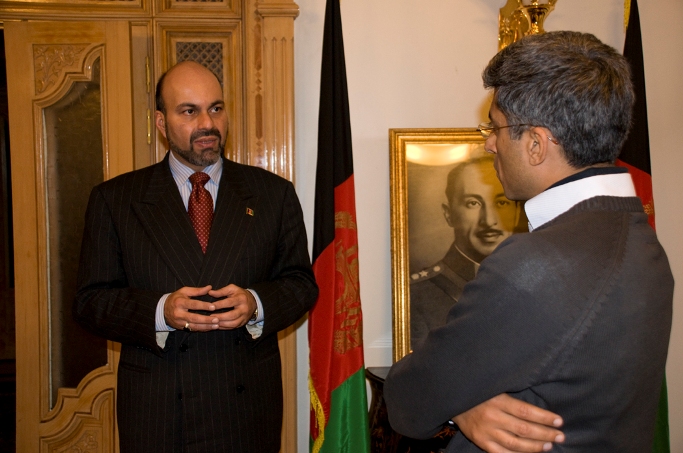
Prince Mostapha Zaher (left) with Indian film-maker Rohit Gandhi in Kabul
Prince Mostapha Zaher (left) with Rohit Gandhi in Kabul

I haven’t yet met Prince Mostapha Zaher in person, but feel almost as if I have. That’s because he features prominently in a short documentary film we released earlier this year on the environmental problems in Kabul, the capital of Afghanistan — where he is now the environmental chief, and where his grandfather was Afghanistan’s last king, Mohammed Zahir Shah (1914-2007).

In January 2009, I was watching a rough edit of the film (Breathing Life into Kabul) in Delhi, where Indian film-maker Rohit Gandhi was putting it together. In the interview, Mostapha Zaher came across as authoritative and resolute.

And does he have formidable challenges to deal with! Since the Taliban regime fell in 2001, people have been returning to Afghanistan after years in neighbouring countries. This massive influx is exerting pressure on the resources and infrastructure of the capital Kabul. Among the effects are high levels of air and water pollution, massive shortages of electricity and mounting problems waste.

Addressing these and other environmental issues is made that much more difficult because Afghanistan is one of the poorest countries in Asia, where large parts of the country are still engulfed in a prolonged conflict with extremists and the Taliban.

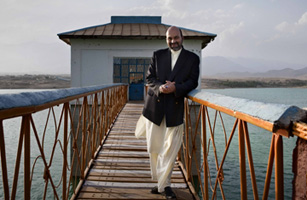
Prince Mostapha Zaher, photographed for TIME
For staying the course in this daunting task, Prince Mostapha Zaher has just been named as one of TIME Magazine’s Heroes of the Environment 2009. He is among ‘Leaders and Visionaries’ from around the world selected by the editors of the international news magazine. The list includes President Mohamed Nasheed of the Maldives, Hollywood star Cameron Diaz, and Indian film maker Mike Pandey.

TIME describes how Zaher gave up his comfortable post as ambassador to Italy to take up the job of director of Afghanistan’s newly formed Afghanistan’s National Environmental Protection Agency (NEPA) in 2004.

Says TIME: “Since then he has worked to rewrite the nation’s environmental laws, enshrining in the constitution an act that declares it the responsibility of every Afghan citizen to “protect the environment, conserve the environment and to hand it over to the next generation in the most pristine condition possible.” In a country ravaged by 25 years of war, it was an extraordinary feat.”

TVE Asia Pacific’s short film looks at how the United Nations Environment Programme (UNEP) is working with NEPA to develop environmental laws, policies and standards.

Watch Breathing hope into Kabul (10 mins):


Read full profile of Prince Mostapha Zaher in TIME Heroes of the Environment 2009


TVEAP News: New film documents environmental restoration in Afghan capital

Hurtling towards Information Society at the speed of light – with nobody in charge?

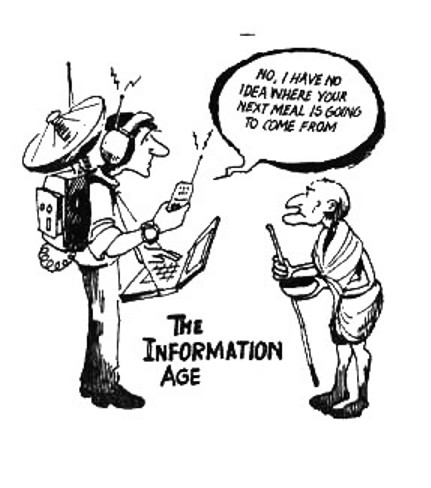
Who can crack this web 2.0 challenge? Image courtesy i4d magazine
As the 19th Century was drawing to a close, the newspaper publisher William Randolph Hearst (later immortalised in Citizen Kane) cabled a leading astronomer of the day: ‘Is there life on Mars? Please cable one thousand words’.

The scientist replied: ”Nobody knows” – written 500 times.

This would be my answer today, if a modern-day media tycoon were to ask me a different, yet equally compelling question: where are we headed with the bewildering developments in information and communication technologies, in which the mainstream media are a part?

And that would be the easiest 1,000 words I’d have written. But being me, I laboured a lot more in addressing that question in my talk to an assembled group of media tycoons and senior journalists in Colombo earlier this week, at the Sri Lanka launch of Asia Media Report 2009.

If I was too reflective on media futures, I can probably blame it on the venue: the Galle Face Hotel, Colombo’s oldest and grandest, where only a dozen years ago Sir Arthur C Clarke wrote the final chapters of his novel, 3001: The Final Odyssey. A bust of Sir Arthur still stands in the hotel’s lobby.

So, with the Indian Ocean lashing gently on the rocky beach only a few feet away, and under the slightly bemused gaze of Sir Arthur, I took my audience on a quick and rough tour of the near future — the one no one about which nobody is an expert!

Here are some excerpts:

Two waves that started separately have combined to radically change how people generate, access, store and share information: the rolling out of broadband internet, and the phenomenal spread of mobile phones.

The headline figures are impressive. For the first time in history, we now have the technological means to quickly reach out to most of humanity:
More than 4.1 billion mobile phones were in use by end 2008, a majority of them in the developing world.
Nearly a quarter of the world population (over 1.5 billion people) has access to the web, at varying levels of bandwidth.
• Thousands of radio and TV channels saturate the airwaves – these still are the primary source of news and information for billions.

Many of us don’t realise that even the basic mobile phone in use today packs more processing power than did the entire Apollo 11 spaceship that took astronauts to the Moon 40 years ago.

Where this growth in processing power and proliferation of devices might lead us, we can only guess — no one really knows. This can be both exhilarating for some — and very disconcerting for entities that were previously in control of the free flow of information, such as governments, academics – and dare I say it – the mainstream media!

Is that your final answer? Surely not...?
They may not accept this, individual governments, and their collective known as the United Nations, don’t have full control over what is going on. But the ‘information genie’ is now firmly out of the bottle, and evolving by the day that it’s impossible to put it back inside. This is both fascinating and frightening.

If it offers any comfort, even big corporations like Microsoft, Apple or Google are all learning by doing. Everything seems to be permanently in experimental — or beta — mode…

What would emerge from the current chaos? The best brains on the planet are trying to come up with plausible answers.

There is talk about the ‘post-media age’. In the broadcast circles that I move in, they now acknowledge, quietly, that the post-broadcasting age is already dawning.

Is what we hear the death cry of the Old Order…or birth pangs of a new Information Society? Or perhaps both?

And how inclusive is that information society? As Asia Media Report 2009 reminds us, not everyone is invited to the party. Large sections of Asian society are left out.

But don’t expect such people to remain excluded for too long. Armed with mobile phones and other ICT tools, they are going to crash the party, whether we like it or not.

Asia’s Other Eclipse: The one that doesn’t make TV news!

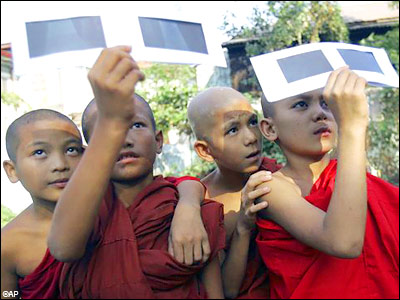
This multiple exposure image shows the various stages of the total solar eclipse in Baihata village, 30 kms from Guwahati, the capital city of the northeastern state of Assam on July 22, 2009. The longest solar eclipse of the 21st century cast a shadow over much of Asia, plunging hundreds of millions into darkness across the giant land masses of India and China. AFP PHOTO/ Biju BORO

This century’s longest solar eclipsed moved across Asia on 22 July 2009, wowing scientists and the public alike. Asia’s multifarious media covered the solar eclipse with great enthusiasm and from myriad locations across the vast continent.

The path of the eclipse’s totality –- where the sun was completely obscured by the Moon for a few astounding minutes –- started in northern India. It then crossed through Nepal, Bangladesh, Bhutan, Myanmar and China, before heading out to the Pacific Ocean. Those who were lucky enough to be at the right place at the right time saw one of Nature’s most spectacular phenomena. It was certainly a sight to behold, capture on film, and cherish for a lifetime.

But many along the path missed this chance as clouds obscured the Sun. It’s the rainy season in much of Asia, where the delayed monsoon is finally delivering much-needed rain.

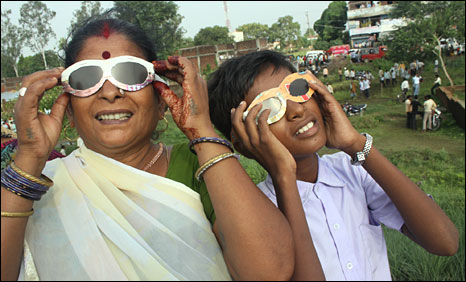
Eclipse watching in Taregna, Bihar, India - Photo: Prashant Ravi, BBC Online
That’s what happened in Taregna, in the eastern Indian state of Bihar. The media had dubbed it the ‘epicentre’ of the solar eclipse, and estimated totality to be visible for at least three minutes and 38 seconds. Thousands who flocked to the village were disappointed when the clouds refused to budge. Nature doesn’t follow our scripts.

That didn’t deter some affluent Indians -– if the eclipse won’t come to them, they just went after it. They chartered an airplane to fly above the rain clouds to catch the once-in-a-lifetime eclipse. Each seat cost US Dollars 1,650.

It’s rarely that totality crosses through countries with such high human numbers as China and India. This time around, millions of people and thousands of journalists took advantage.

Some travelled long distances hoping to get the best view from the 200-km wide path of totality. Others watched it one of Asia’s many and cacophonous 24/7 TV news channels. The event had all the elements of a perfect television story: mass anticipation, eager experts and enthusiasts, occasional superstitions, uncertainties of weather and, finally, a stunning display of Nature’s raw power.

‘Darkness at Dawn!’ screamed a popular headline, referring to the eclipse causing a sudden ‘nightfall’ after the day had begun. Other superlatives like ‘Spectacle of the century’ and ‘A sight never to be missed’ were also widely used.

Myanmar Buddhist novices watch solar eclipse through the filters, in Yangon, Myanmar
Solar eclipses are indeed a marvel of Nature, and the media’s excitement was justified. For once, it was good to see them devoting a great deal of airtime and print/web space for something that was not violent, depressing or life-threatening.

How I wish Asia’s media took as much interest in another kind of ‘eclipse’ that surrounds and engulfs us! One that does not end in minutes, but lasts for years or decades, and condemns millions to lives of misery and squalor.

Stories of poverty, social disparity and economic marginalisation are increasingly ‘eclipsed’ in Asia by stories of the region’s growing economic and geopolitical might.

The mainstream media in Asia –- as well as many outlets in the West — never seem to tire of carrying reports of Asia rising. Indeed, that is a Big Story of our times: many Asian economies have been growing for years at impressive rates. Thanks to this, over 250 million Asians have moved out of poverty during this decade alone. According to the UN’s Asian arm ESCAP, this is the fastest poverty reduction progress in history.

We see evidence of increased prosperity and higher incomes in many parts of developing Asia. Gadgets and gizmos –- from MP3 to mobile phones — sell like hot cakes. More Asians are travelling for leisure than ever before, crowding our roads, trains and skies. Lifestyle industries never had it so good. Even the current recession hasn’t fully dampened this spending spree.

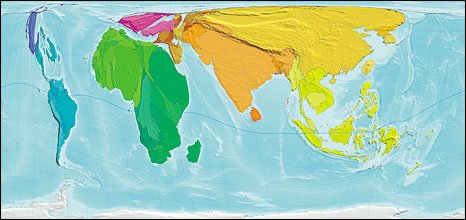
World map proportionate to number of poor people in each country/region - from Atlas of the Real World

But not everyone is invited to the party. Tens of millions of people are being left behind. Many others barely manage to keep up -– they must keep running fast just to stay in the same place.

National governments, anxious to impress their own voters and foreign investors, often gloss over these disparities. The poor don’t get more than a token nod in Davos. National statistical averages of our countries miss out on the deprivations of significant pockets of population.

For example, despite recent gains, over 640 million Asians were still living on less than one US Dollar a day in 2007 according to UN-ESCAP. Three quarters of the 1.9 billion people who lack safe sanitation are in Asia — that’s one huge waiting line for a toilet!

On the whole, the UN cautions that the Asia Pacific region is in danger of missing out the 2015 target date for most Millennium Development Goals – the time-bound and measurable targets for socio-economic advancement that national leaders committed to in 2000.

The plight of marginalised groups is ignored or under-reported by the cheer-leading media. For the most part, these stories remain forever eclipsed. Except, that is, when frustrations accumulate and blow up as social unrest, political violence or terrorism. Even then, the media’s coverage is largely confined to reporting the symptoms rather than the underlying social maladies.

Indonesian children look up through x-ray film sheets to watch a solar eclipse in the sky in Anyer Beach, Banten province, Indonesia
“Half the children in South Asia go to bed hungry every night, but the covers of our news magazines are about weight loss parlors,” says Kunda Dixit, Chief Editor of The Nepali Times.

As he noted in a recent essay: “Maternal mortality in parts of Nepal is nearly at sub-Saharan levels, but we are obsessed with politics. Hundreds of cotton farmers in India commit suicide every year because of indebtedness, but the media don’t want to cover it because depressing news puts off advertisers. Reading the region’s newspapers, you would be hard-pressed to find coverage of these slow emergencies.”

P N Vasanti, Director of the Delhi-based Centre for Media Studies which monitors the leading newspapers and news channels in India, laments how “development” issues such as health, agriculture and education are not even on the radar of popular news sources. Her conclusion is based on a content analysis of the six major Indian news channels during the run-up to the recent general election in India.

I have come across similar apathy in my travels across Asia trying to enhance television broadcasters’ coverage of development and poverty issues. As one Singaporean broadcast manager, running a news and entertainment channel in a developing country, told me: “I don’t ever want to show poor people on my channel.”

Don’t get me wrong. Trained as a science journalist, I can fully appreciate the awe and wonder of a solar eclipse. For years, I have cheered public-spirited scientists who join hands with the media to inform and educate the public on facts and fallacies surrounding these celestial events.

But there are more things in heaven and earth, than are dreamt of in our mainstream media’s breathless coverage of the march of capital. Journalists and their gate-keepers should look around harder for the many stories that stay eclipsed for too long.

* * * * * *

Shorter version of the above comment was published by Asia Media Forum on 23 July 2009

Full length version appeared on OneWorld.Net on 23 July 2009

Reprinted in The Nepali Times, 24 July 2009

Waiting for his long eclipse to end...

Post-war Sri Lanka: Can we dial up a better future?

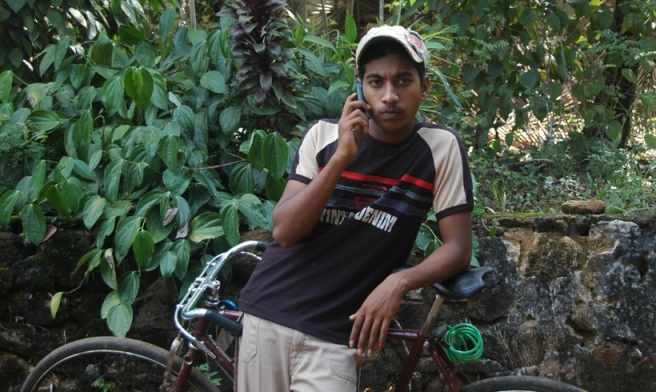
Chamara Pahalawattage: At 18, he is already using his 6th mobile (Photo by Niroshan Fernando, TVEAP)

When many able-bodied young men and women of his age were joining the armed forces in large numbers, Sri Lankan school-leaver Chamara Pahalawattage chose differently. He decided to try his luck with odd jobs at construction sites.

That, by itself, was nothing unusual. Tens of thousands of young men and women like Chamara join the labour market every year. Schools don’t equip them with attitudes or skills for self employment, so most would idle years away looking for regular jobs in Sri Lanka’s public and private sectors. Frustration would prompt some to take to political agitation, or worse.

Chamara is at such crossroads in his own life, but he is unlikely to go astray. The enterprising young man has boosted his chances of part-time work by getting himself a mobile phone.

“After buying a phone, I get calls asking me to come for work. The phone makes it so easy,” he says. “Otherwise people will have to come looking for me…or I have to go to them.”

If a skilled mason or carpenter takes him on as an assistant, Chamara gets a daily wage of LKR 700 (US$ 6 approx) plus a mid-day meal. That income augments the modest LKR 4,000 a month (US$35) his mother makes cooking meals at a nearby factory.

In February 2009, we filmed a day in the life of Chamara, a resident of Gonapola, in Sri Lanka’s western province. This was part of a profiling of telephone users at the bottom of the (income) pyramid – or BOP – in emerging Asian economies, undertaken by TVE Asia Pacific on behalf of the regional ICT research organisation LIRNEasia.

Watch our short video profile of Chamara Pahalawattage:

Going by his household income, Chamara is BOP at the moment – but his aspirations extend above and beyond. An only child raised by his widowed mother, Chamara developed an interest in mobiles while still in his mid teens. He bought his first mobile two years ago, when in Grade 11 at school.

“Almost everyone had phones, so I also wanted one,” he recalls. “From then on, I got used to having a phone!”

And has he been keeping up with technology! He buys second-hand phones for better features: he currently owns his sixth phone in just over two years. He had paid LKR 7,500 (US$ 65) for his latest phone at the beginning of 2009.

Besides voice and SMS (texting), his phone supports MP3, video recording, song downloading, voice recording and some other functions. After a hard day’s work, he unwinds listening to the radio, or swapping songs with friends — all using their mobiles.

Chamra spends an average of US$3 to 4.50 per month on phone use, and – like all other BOP telephone users we interviewed in India, Philippines and Thailand – he is thrifty with value added services that cost extra. This is something that has been confirmed by LIRNEasia’s Teleuse@BOP 2008 survey.

“Some of my friends access the internet through their phones and download songs,” he says. “I then get these songs from them. My phone has bluetooth. I use it to transfer songs from my friends’ phones.”

Chamara has every intention of moving up the labour market – someday, he wants to hold a more regular job, with an assured monthly income. Right now, in spite of being connected, he can’t predict how many days a month he’d find work.

Hello, can you hear our dreams?
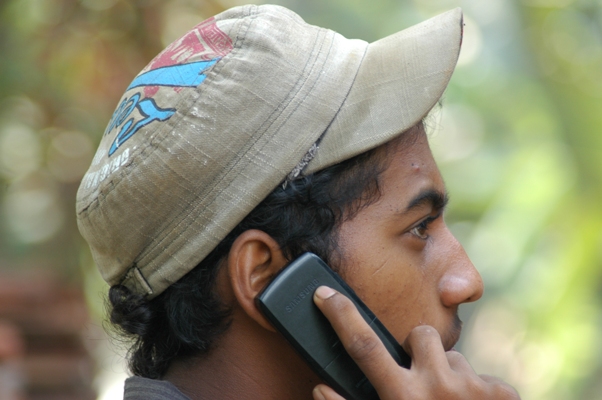
Hello, can you hear our dreams? Photo by Niroshan Fernando, TVEAP
“I don’t check newspapers for jobs. Instead I ask the people I know…mostly my friends,” he says. This probably indicates another shift from a wide-spread habit among literate Sri Lankans scanning newspapers for recruitment notices.

LBO 9 March 2009: Sri Lankan low income customers can use mobiles more for business: study

The official end of the 30-year-long war should be good news for Chamara and millions of other tech-savvy, eager youth like him. Like me, they can once again start dreaming of better tomorrows.

Telecommunications would be a good place to start. For several years, it has been the fastest growing sector in the Sri Lankan economy — one that has not only connected people across distances and cultures, but also been a ‘social leveller’.

The telephone subscriber base grew by 35.5% in 2008 (and 47% in 2007). The country’s tele-density (number of telephones per 100 persons) jumped to 71.9 in 2008, from 53.4 in 2007 -– thanks largely to the phenomenal spread of mobile phones.

As I noted last year: “It is not by accident that telecom has remained the fastest growing sector in the economy for a decade. This was triggered and sustained by the far-reaching policy and regulatory reforms which ended the then fully state-owned telecom operator’s monopoly, and allowed the entry of new players, technologies and business models.”

Of course, improved telecommunications are necessary, but not sufficient by itself, for us to evolve into an inclusive information society. Building on technology and systems, we must become discerning creators and users of information. Knowledge – not paranoia or rhetoric – needs to form the basis of policy and actions that propel us to the future.

Photos courtesy Niroshan Fernando, TVE Asia Pacific

‘Can you hear us now?’ India’s bottom millions connect to information society

Mobile champion: farmer Sayar Singh in Rajasthan, India - photo by Suchit Nanda for TVEAP
At the end of the world’s largest general election that lasted nearly a month, Indians have just re-elected the Congress Party to govern over the world’s largest democracy for another five year term.

It’s too early to discuss what role, if any, the recently enhanced telecommunications services played in this outcome. But there is no doubt that access to telephones – especially mobiles – has revolutionised the life of the billion plus Indians in the past few years.

Farmer Sayar Singh epitomises this change. Earlier this year, we filmed a day in the life of Sayar, a resident of Pushkar Nala in India’s Rajasthan state. This was part of a profiling of telephone users at the bottom of the (income) pyramid – or BOP – in emerging Asian economies, undertaken by TVE Asia Pacific on behalf of LIRNEasia.

Sayar is definitely BOP: growing wheat and flowers on his ancestral land, he makes around INR 6,000 (USD 115) a month – on which income he sustains an extended family that comprises his wife, four children, elderly father and an unmarried sister. Life isn’t easy for this 33-year-old, but his spirit of enterprise is as abundant as his praise for his newly acquired mobile phone.

He only bought a mobile in mid 2008, but eight months later, that investment had definitely improved business and social life for him. So much so that his life’s narrative is clearly divided as Before Mobile and After Mobile.

“Our life before the mobile phone was hard,” he says. “I took two days to do what I can now do in a day. Now I can get in touch immediately and all my work happens faster and more easily!”

He now tracks market prices and moves his produce quickly for better profits. With workload reduced and income doubled, Sayar has reaped dual benefits from his mobile.

Watch our short profile of Sayar Singh, ardent promoter of mobile phones in rural India:

This isn’t Sayar’s first experience with owning a telephone. Earlier, he was frustrated with a fixed phone that didn’t work half the time. The service was so bad that he gave up the phone after a while.

He recalls: “Phone wires in our village were often faulty. They used to be out of order for 2 or 4 days, sometimes even half a month! All my work was affected. I couldn’t talk to my brothers and sisters. Call charges were also high. When my phone line was down, I had to call from STD booths or neighbours’ phones.”

In our interview, Sayar kept referring to his fixed phone connection as ‘government phone’ – a reflection of the state-owned former monopoly. It was a reminder of just how bad telecom services were in India until only a few years ago.

As Shashi Tharoor, the former UN Undersecretary General – who, incidentally, has just been elected into Indian Parliament from his native Kerala state – has remarked, India had possibly the worst telephone penetration rates in the world.

He wrote in 2007: “Bureaucratic statism committed a long list of sins against the Indian people, but communications was high up on the list; the woeful state of India’s telephones right up to the 1990s, with only eight million connections and a further 20 million on waiting lists, would have been a joke if it wasn’t also a tragedy — and a man-made one at that.”

Connected and contented: Sayar Singh by Suchit Nanda for TVEAP
Tharoor recalled the infamous words of Prime Minister Indira Gandhi’s communications minister in the 1970s, C.M. Stephen. In response to questions decrying the rampant telephone breakdowns in the country, the minister declared in Parliament that telephones were a luxury, not a right. He added that ‘any Indian who was not satisfied with his telephone service could return his phone’ — since there was an eight-year waiting list of people seeking this supposedly inadequate product.

According to Tharoor, Mr Stephen’s statement captured perfectly everything that was wrong about the government’s attitude: ignorant, wrong-headed, unconstructive, self-righteous, complacent, unresponsive and insulting. “It was altogether typical of an approach to governance in the economic arena which assumed that the government knew what was good for the country, felt no obligation to prove it by actual performance and didn’t, in any case, care what anyone else thought.”

All this didn’t change overnight, and as Tharoor reflects, the key contribution of the government was ‘in getting out of the way’ — in cutting license fees and streamlining tariffs, easing the overly complex regulations and restrictions that discouraged investors from coming in to the Indian market, and allowing foreign firms to own up to 74 per cent of their Indian subsidiary companies. “The Telecom Regulatory Authority of India (TRAI) has also been a model of its kind, a regulatory agency that saw its role as facilitating the growth of the business it was regulating, rather than stifling it with rules and restrictions.”

It still took time for this revolution to be felt at the bottom of the pyramid. As LIRNEasia says: “Just five years ago, the Indian telecom industry’s massive momentum barely included the poor. The country had slightly over seven access paths (fixed and mobile connections) per 100 people, but in rural India 100 people were served by only 1.5 access paths. Even in urban India, the poor were unconnected.”

Then things started changing rapidly. According to LIRNEasia’s latest teleuse@BOP survey, 45 per cent of Indian BOP teleuser households had a phone in late 2008: 37% had a mobile only; 5% had a fixed phone only; and 3% had both. This is massive progress from the 19 percent of BOP homes with a phone just two years ago. Read more about BOP telephone penetration and use in India.

Tharoor has called this the “mobile miracle” — one that has accomplished something socialist policies talked about but did little to achieve: empowering the less fortunate. Rapid mobile penetration in my native Sri Lanka has had a comparable social transformation – in a commentary last year, I called the ubiquitous mobile ‘Everyman’s new trousers’.

Of course, the mobile revolution is far from over. There are many more millions yet to be connected, and those already connected expect affordable, reliable and value-added services.

“Indian BOP is still in the mobile 1.0 mode using mainly voice and missed calls functionality. Messaging is being used by only a third of the BOP population. Mobile payment and government services use is almost non-existent,” Rohan Samarajiva, chairman and CEO, LIRNEasia, was quoted as saying soon after the latest study was presented in India in February 2009.

How far and how much value added mobile services can penetrate the BOP remains to be seen. Sayar Singh, for example, currently spends US$ 8.6 to 9.5 a month on phone services – over 8% of his enhanced monthly income.

“I haven’t subscribed to any services like cricket news or astrological forecasts. I don’t need them…and I don’t want to spend on them,” he said in our interview.

But mobile telephony is an area where the boldest projections have been exceeded – so never say never.

Photos by Suchit Nanda for TVE Asia Pacific

Cellphones and the Economic Modernization of India: Listen to Shashi Tharoor at Asia Society, NY, in 2007: