In this essay, I have expanded some points originally made in two recent blog posts, on 30 April and 1 May 2009.
Here’s an excerpt:
“Flu shots, quarantine measures and hospital care alone cannot counter the current flu outbreak. While medical doctors and researchers spearhead the public health response, we need the mass media and other communicators to mount the public awareness response. Ideally, they should reinforce each other.
“For the first time in history, we now have the technological means to quickly reach out to most of humanity. More than four billion mobile phones are in use, a majority of them in the developing world. Nearly a quarter of the world population (over 1.5 billion people) have access to the web, even if at varying levels of bandwidth. Thousands of radio and TV channels saturate the airwaves – these still are the primary source of news and information for billions.
“Can these information and communication technologies (ICTs) help disseminate the right kind of flu awareness? How fast can we mobilise 24/7 media outlets and telecom networks to inspire preventive and curative action? What can the blogging, texting and twittering new media activists do in such efforts?”
I then return to one of my favourite points about communicating disasters and crises: the need for credible messages and credible messengers. This was a core theme in the Asian book on Communicating Disasters that I co-edited in 2007. I also highlighted it in this interview given to APC in early 2008.
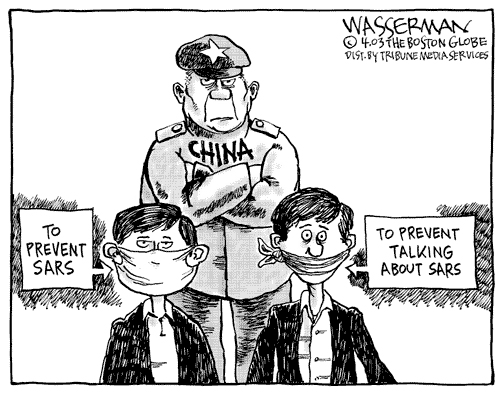
Here’s how my essay ends: “Whether it is SARS, HIV or tsunami, many Asian governments have suffered from a credibility gap in managing information about emergencies. For example, the initially slow and guarded media reporting on SARS allowed the virus to spread quickly in China, with devastating results. We cannot afford to repeat these mistakes with the latest flu pandemic.
“Nearly a century ago, British author H G Wells talked about human history being a race between education and catastrophe. In the coming weeks, we would find out if humanity has what it takes to outrun and outsmart a stubborn virus.”
Read the full essay at MediaChannel.org
My latest essay is a humble birthday present to MediaChannel.org as it completes 10 years. Unique among websites, MediaChannel.org holds the rest of the media accountable with the best of the world’s media criticism and analysis — offering news, diverse global perspectives, and commentaries tracking international news flows. They cover breaking controversies, showcase change-makers, trends and cutting edge issues that you need to know about – produced by journalists for journalists and citizens.
“Our survival alone is a cause for celebration – a decade of growth and impact is impressive in ‘Internet years’,” wrote the website’s founders in a special 10th anniversary message. They added: “Over the past 10 years, we have survived financial crises and organized hack attacks. We have managed to remain relevant and on the cutting edge in a quickly evolving online landscape when many other sites and organizations have come… and gone.”
The team is making an urgent appeal for donations to keep this excellent service going. I’m very happy to amplify this – few services can deliver better value for money, and our troubled times and troubled media sure need the soul-searching constantly provided by MediaChannel.org
Today, 3 May, is once again World Press Freedom Day. It is recognised by the UN, and observed by media professionals and media activists worldwide to ‘draw attention to the role of independent news and information in society, and how it is under attack’.
By happy coincidence, today also marks the 90th birthday of Pete Seeger, American folk singer and a pioneer of protest music. Since media freedom is inseparable from the democratic rights to dissent and protest, I will devote this blog post to salute Pete and his many decades of music for worthy causes — ranging from the American civil rights movement and opposing the Vietnam war to saving the environment and nuclear disarmament.
Pete is a hero for at least three generations of music lovers and freedom lovers around the world who believe in human rights, human dignity and democratic freedoms. Armed with nothing more than his banjo and melodious voice, and driven by the courage of his conviction, this small, gentle man has stood up to mighty leaders, generals and officials.
Never underestimate the power of one determined man...Pete is celebrated as much for his artistic and cultural achievements as for standing resolutely for his political beliefs and for lending his voice and music in support of causes be believed in. In 1955, he was called before the now infamous House Un-American Activities Committee, but refused to name personal and political associations on the grounds that this would violate his First Amendment rights. He said: “”I am not going to answer any questions as to my association, my philosophical or religious beliefs or my political beliefs, or how I voted in any election, or any of these private affairs. I think these are very improper questions for any American to be asked, especially under such compulsion as this.”
This defiance resulted in sustained harassment, persecution and professional isolation. As his recent PBS biography noted, “Standing strong for deeply-held beliefs, Seeger went from the top of the pop charts to the top of the blacklist and was banned from American commercial television for more than 17 years. This determined singer/songwriter made his voice heard and encouraged the people of the world to sing out along with him.”
‘If you love your country, you’ll find ways to somehow to speak out, to do what you think is right,” Pete says in this powerful documentary looking back at over half a century of activist singing and music.
Watch opening segment of PBS AMERICAN MASTERS series: Pete Seeger: The Power of Song, directed by Jim Brown and first aired in February 2008
Having pleaded under the First Amendment during the communist witch days of the 1950s, Pete repeatedly paid tribute to the far-sighted American pioneers who introduced the First Amendment guaranteeing the freedom of speech.
“As some judge said, if there is any fixed star in our firmament, that is the First Amendment,” he says in a talk-cum-performance at the Ford Hall Forum. In this audio-only piece, he talks the privilege of living under the First Amendment. He recalls his experience being questioned by the House Unamerican Activities Committee, encounters with censorship, and his relationship with fellow singer Woody Guthrie. It runs for nearly an hour, but is worth every second.
For someone like Pete Seeger who sang alongside Dr Martin Luther King, Jr., and other civil rights movement leaders and activists, it must have been deeply moving to be able to sing at the concert to mark President Barack Obama’s inauguration on 20 January 2009 at the Lincoln Memorial.
Watch Bruce Springsteen sing along with Pete Seeger on Woody Guthrie’s “This Land Is Your Land”. As he often does, Pete invites the euphoric audience to sing along!
One of my favourite Pete Seeger songs is “Turn! Turn! Turn! (to Everything There is a Season)”, often abbreviated to “Turn! Turn! Turn!”. It’s a song adapted entirely from the the Book of Ecclesiastes in the Bible (with the exception of the last line) and composed to music by Pete Seeger in 1959. Seeger waited until 1962 to record it,
Pete Seeger tells how he came to write “Turn Turn Turn.”
I have always believed that we have to get creative and resourceful when the basic freedoms of conscience and freedom of expression are under siege from despotic rulers and fanatical extremists. When we are not allowed to express in factual prose, we must turn to creative prose. And when prose fails, we still have verse, lyrics, satire and drama — the possibilities are only limited by our imagination. This is why I celebrate activist artistes like Pete Seeger, and invoke the memory of activist-poets like Adrian Mitchell and Ken Saro-wiwa. When the barbarians are at our gates and we feel surrounded by the unrelenting forces of hatred, intolerance and tribalism, they remind us that Another World is Possible — but we have to believe in it, stay the course and find ways to sing, dance and laugh our way out of gloom.
And here’s Pete singing another one of my personal favourites, a song that powered the civil rights movement and has since inspired and sustained struggles for social justice around the world: We Shall Overcome.
“All things are connected. Whatever befalls the earth befalls the sons of the earth. Man does not weave the web of life; he is merely a strand of it. Whatever he does to the web, he does to himself.
“What is man without the beasts? If all the beasts were gone, man would die from a great loneliness of the spirit. For whatever happens to the beasts, soon happens to man. All things are connected.”
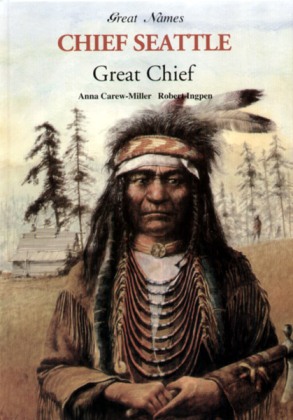
These words resonate very well in the environmental community, and are in fact considered to be something like a gospel of the greens. They are part of a moving speech that native American Chief Seattle is said to have given in January 1854. Read the full text here.
So these would be just the right sentiments to invoke on another Earth Day, right? Yes — except that Chief Seattle never uttered those words. They were, in fact, written by a screen writer in 1971 for a film about pollution and the plight of the Earth, called Home.
Tell that to thousands of die-hard greens who swear by Chief Seattle. By now, a couple of generations of people have been moved by the “speech.” Chief Seattle societies have formed in Europe. The supposed remarks have been reprinted widely and authoritatively cited in serious books on environmental issues, and quoted in high level speeches. Hundreds of teachers use extracts in environmental courses.
The man was real; the speech wasn't his
There’s absolutely no doubt that the words pack a great deal of traditional wisdom, poetic expression and what researchers like to call ‘indigenous knowledge’. This is how it ends: “Continue to contaminate your bed and you will one night suffocate in your own waste. When the buffalo are all slaughtered, the wild horses all tamed, the secret corners of the forest heavy with the scent of many men, and the view of the ripe hills blotted by talking wires. Where is the thicket? Gone. Where is the eagle? Gone. And what is to say good-bye to the swift and the hunt; the end of living and the beginning of survival.”
The value, modern-day relevance and power of the speech are not in doubt. But the problem is in its attribution: the wrong man is being credited worldwide for coming up with these oh-so-quotable words. And the misconception originated with a film script, where creative liberties are allowed and often exercised!
“Yes, Chief Seattle (more correctly Seathl) did give a speech in 1854 to Isaac Stevens, Pacific Northwest Commissioner of Indian Affairs. Dr. Henry Smith translated the speech from the original Lushotseed. Smith knew it to be special and that much was lost in his first oral translation. He supposedly visited the Chief many times in the following decades to get the words right in English. He published his translation in 1887 in the Seattle Sunday Star. According to Smith, the Chief spoke of his sadness about the grave injustice being visited upon the Indians by the European invaders and the absurdity, in the Chief’s view, of claiming land as one’s own and of not respecting ancestral ground.
“It was in the Victorian oratorical style of the time, and was soon forgotten. Professor William Arrowsmith, who taught classic literature at the University of Texas, came across the Smith version and modernized it in Arion in 1969. He changed it to reflect the protest-style of the 1960s. On the first Earth Day in 1970, Arrowsmith read his modified text before a large crowd.
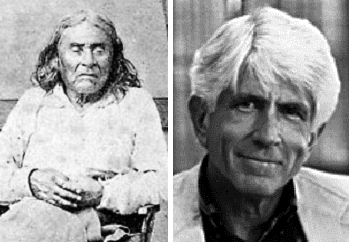
Chief Seattle (left) and actual speech writer Ted Perry
“In that crowd was Ted Perry, a professor of film, who had been retained by the Southern Baptist Television Commission to draft a script for a film about pollution and the plight of the Earth, called Home. In a third execution of literary license, Smith turned it into a speech about poisoning the planet and human indifference to it. Perry’s concept was to transport Chief Seattle into the modern world and imagine what he would say.”
The documentary film on ecology, scripted by Ted Perry, was produced by the Southern Baptist Radio and Television Commission, and later ran on network television. But not before the original script was edited for being more Christian, and some references to God were added.
John Scull, specialising in eco-psychology, has traced the evolution of the Seattle myth in an interesting essay. He notes: “The Perry speech, in spite of its Christian editing and its many historical inaccuracies, anachronisms and inconsistencies, was widely distributed and was seen as authentic by many…The text’s lack of authenticity was finally described in 1987, and documented in articles in both Omni and Newsweek in 1992.”
In April 1991, the New York Times ran a front-page expose of the Chief Seattle myth, saying: “A number of historians say Chief Seattle never said most of what he is supposed to have said.”
NYT quoted historian David Buerge as saying: “Chief Seattle is probably our greatest manufactured prophet,” and described him as ‘one of the scholars frustrated that their work has failed to stop the myth from spreading around the world.’
In his analysis, John Scull poses the query: Why are environmentalists so eager to continue to attribute these words to Chief Seattle instead of to their author, Ted Perry?
Perry, now a professor of film studies at Middlebury University, has tried repeatedly to set the record straight. Moreover, he thinks that the myth is pernicious. “Why are we so willing to accept a text like this if it’s attributed to a Native American?” he asks. “It’s another case of placing Native Americans up on a pedestal and not taking responsibility for our own actions.”
This 1991 book built on the Chief Seattle fable
The myth of Seattle’s speech has been so pervasive that the Washington State Library issued a pamphlet in 1993 stating the facts. “The most important fact to note is that there is NO VERBATIM TRANSCRIPT IN EXISTENCE. All known texts are second-hand,” Nancy Zussy, State Librarian, said in that note.
That note listed four different versions of the speech. The most widely known of all, it said, was written by Texas professor Ted Perry as part of a film script. “The makers of the film took a little literary license, further changing the speech and making it into a letter to President Franklin Pierce, which has been frequently reprinted. No such letter was ever written by or for Chief Seattle.”
So is there anything authentic left of poor Chief Seattle? There’s no doubt the man cared deeply for his people and the environment, even if he was nowhere near as eloquent as modern-day environmentalists want us to believe. Sadly, we don’t even know what the old boy really looked like.
According to a story by Malcolm Jones Jr. and Ray Sawhill, appearing in Newsweek of 4 May 1992: “Even the one known photograph of him has been doctored repeatedly. In the original, his eyes were closed. Subsequent version were retouched so that his eyes looked open. In some versions, he carries a cane, but not always. And in the most revisionist makeover, his head has been grafted onto the body of another man.”
So is it just historical accuracy at stake here, in our setting the record straight about Seattle as scripted by Perry? Does it really matter whether or not the Indian chief actually said it as long as his alleged words continue to inspire environmental commitment?
I share Dr John Scull’s views when he says: “The world is in an environmental crisis and needs help, but a mythical Indian chief from the last century is not going to ride over the hill and save it from the industrial cavalry in some reversal of the Hollywood western — all of us are going to have to work together to save it ourselves. Recognizing that at least some of the answers lie within mainstream contemporary culture might be a good place to start.”
A film to reveal what the old media didn't show...When Barack Obama and his running made Joe Biden won the US Presidential Election held on 4 November 2008, they not only beat the Republican duo McCain-Palin but also a host of other also-rans. It’s too soon to tell, but that date might also mark the beginning of the end for the old media, also called the mediasaurus, who have been dominating the public’s access to news, information and commentary for over a century.
But how did it all happen? Who can tell us the real story as it happened, and why, without filters and biases so rampant among the mediasaurus?
On this blog, we have watched with deep interest and some fascination the rise of Barack Obama from relative obscurity to become the President of the United States. On 6 November 2008, soon after the election results were confirmed, we noted how Obama had just been elected ‘President of the New Media world’. I explained: “Obama’s rise has epitomised change in many ways. Among other things, he is the first elected leader of a major democracy who shows understanding and mastery over the New Media World, which is radically different from the old media order.”
On 20 January 2009, when he was inaugurated, we wrote: “For four or eight years, Obama’s every move, word and gesture will be captured, dissected and debated to exhaustion by admirers and detractors alike. And his administration will be under scrutiny by thousands of citizen journalists who don’t share much except the digital platforms and social networks on which they post their impressions. Welcome to the New Media Presidency. The hard work – and real fun – begin now!”
And now, one of the world’s leading new media activists, Danny Schechter, is about to release a new documentary on how the Obama campaign rode the new media wave to the White House — and more importantly, how the same new media can help the American public to keep Obama Administration accountable.
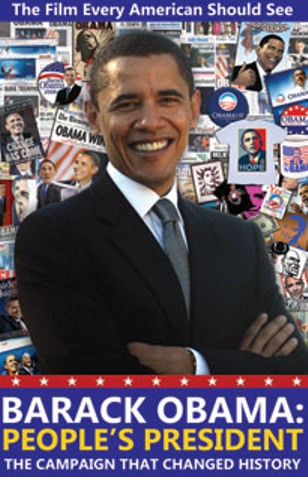
The film “Barack Obama, People’s President”, (slated for DVD release later this month by ChoiceMedia.net), documents the online and on the ground techniques that were used to win the highest office in the land.
As the film’s advance promo blurb says: The one story that most TV outlets didn’t tell in the 2008 election was the most important one -how did a young and relatively unknown candidate become President? If you voted for Barack Obama or not, this is a story you will want to know because it shows how the face of presidential politics changed forever. Barack Obama used techniques never seen before in a nationwide election — his grassroots mobilization and use of the internet was unprecedented, inspiring and effective. You have seen the rest of the coverage — now see the real story.
The film goes inside the official and unofficial campaign to show how Barack Obama was turned into a political brand to appeal to young first time voters. It shows how social networking on the internet — blogs, Facebook, texting and other techniques — were used carry the message to the masses and to raise tens of millions of dollars for the campaign. Popular online videos such as “Obama Girl”, along with those created by regular yet passionate supporters to engage their own communities, became one of the most important tools in the campaign’s success.
Watch the trailer of “Barack Obama, People’s President” directed by Danny Schechter:
Emmy award winning film-maker Danny Schechter, who is also blogger-in-chief at MediaChannel.org that keeps a critical eye on the media, just wrote this explaining why he made this film:
“It is hard to remember that two years earlier Obama was barely known, registering on the radar screen for just 10% of voters. He was also hardly a brand name as a first term Senator who spent more time in state politics in Illinois than on the national stage. Moreover, he was young and a man of color — not qualities that usually prevail in a presidential arena which tends to draw far older, far whiter, and far more centrist candidates. The thought that he would beat frontrunner Hillary Clinton in the primaries was, quite frankly, unthinkable to most of the elite.
“And yet he prevailed, as he used a phrase appropriated from labor organizer and Latino legend Caesar Chavez. Obama turned the farm workers Spanish language slogan “Si Se Puede” into “Yes We Can.” Rather than focus on specific political issues, he built a campaign on the promise of “Hope.” Rather than just rely on traditional fundraising — although by the end, he was plush with it — he reached out over the internet for smaller donations from millions of donors.
Perils of the New Media Generation...“Few in the major media gave him a chance, but he was not discouraged because he had created his own grassroots media operation using sophisticated organizing and social networking techniques to build a bottom-up movement, not the usual top-down apparatus. While his campaign ran the show, he encouraged independent initiatives including citizen-generated media, music videos, personalized websites, twittering and texting, etc..
“This is the new direction our politics has taken. It is a story that may be somewhat threatening to old media – and older activists – who prefer a one to many approach to communication, as opposed to forging a more interactive empowering platform. There is no question that young people — especially those mobilized by Obama — prefer online media and that choice is making it harder and harder for traditional outlets to sustain their influence and, in some cases, even their organizations. Old media may be on the way out.
“This is why our film is, in my mind, so important, not just as a record of how Obama won and what happened in 2008, but in what will happen, can happen, and is happening in the future. This is why I believe its critical for Americans to see it — and others in the world as well — to recognize how Obama represents more than just another politician, but a whole new approach to politics. That old adage is worth remembering: “It’s not the ship that makes the wave, it’s the motion of the ocean.”
“Obama, for all his shortcomings, which are becoming more obvious by the day, has pioneered the way change must be won — not by people on the top, but by all of us. It remains for “us” to hold him accountable. We live in a culture of amnesia – it is important to learn the lessons of the recent past.”
Read the full comment: New Film Tells Unreported Story of Obama’s Election on MediaChannel.org
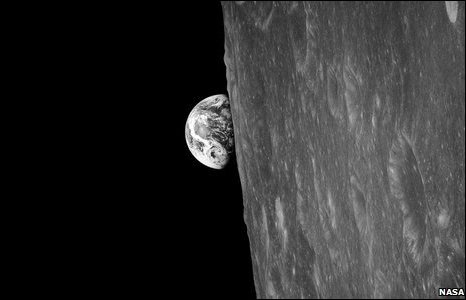
Earthrise: Apollo 8's enduring legacy (image courtesy NASA)
I can never have enough of this photo — the first ever snapshot of Earth.
This photo of “Earthrise” over the lunar horizon was taken by the Apollo 8 crew on Christmas eve 1968, showing Earth for the first time as it appears from deep space. It forever changed how humans look at – and feel about – their home planet.
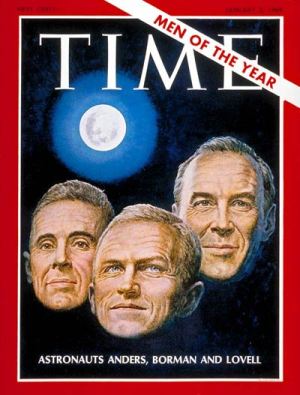
And here’s the best part: this image was captured by accident! In all the meticulous planning for the Apollo 8 mission, no one had anticipated or thought about it. All attention was on the Moon itself, which humans would be viewing at such close range for the first time. None of the astronauts on board Apollo 8 – Mission Commander Frank Borman, Command Module Pilot James Lovell and Lunar Module Pilot William Anders – were ready for the opportunity to witness their own Earthrise.
And if they had stuck to the mission plan, and not acted spontaneously, this image might never have been captured at the time it was.
Earth's photographers frozen in TIME... As Apollo historian and film-maker Dr Christopher Riley recalled on the 40th anniversary of this remarkable event a few days ago:
For the first three orbits, preoccupied by the Moon and their latest TV broadcast, the spacecraft was not orientated to give them a chance to see the Earth. But as Apollo 8 nosed its way back from the far side of the Moon for the fourth time, one of the crew spotted the view by chance from a window, his reaction captured by the on board tape recorder.
“Oh, my God! Look at that picture over there!” he exclaimed. “Isn’t that something…”
After a quick joke about the fact that it was not in their flight plan to photograph it, the crew abandoned protocol and scrambled to get a snap of the occasion with their stills camera.
The Hasselblad only had a black and white film magazine in, resulting in the image (below) – the first photograph of Earthrise taken by a human as he watched it happen.
The first Earthrise ever photographed; a colour photograph followed minutes later
But this first historic picture is rarely reproduced. Not content with this first monochromatic image, the astronauts rushed to find a colour film, and Bill Anders managed to snap two more frames which became the choice of photo editors for the rest of history.
Apollo 8 was an important prelude to actually landing on the Moon (which took place in July 1969). It achieved many firsts — including the first manned launch from NASA’s new Moonport, first manned mission to leave the earth’s gravitational field and reenter the earth’s atmosphere at tremendous speeds, first pictures taken by humans of the Earth from deep space, and first live TV coverage of the lunar surface. A Christmas Eve reading from the book of Genesis from Apollo 8 was heard by an estimated 2 billion people, the biggest TV audience in history.
Some might consider Apollo 8 as no more than a technological rehearsal to the eventual landing on the Moon, by astronauts of Apollo 11, but the images of Earthrise have had far-reaching implications. The rise of the global environmental movement in the 1970s was partly inspired by this new perspective of our planet. In his Oscar-award winning film An Inconvenient Truth, Al Gore acknowledges this as he sets the stage with a series of images of Earth in space, helping us to appreciate the beauty and fragility of our planet in distress.
In an op ed essay to mark the 40th anniversary, Oliver Morton wrote in the New York Timeson 24 December 2008: “The photograph of that earthrise by the astronaut Bill Anders forms part of the Apollo program’s enduring legacy — eclipsing, in many memories, any discoveries about the Moon or renewed sense of national pride. It and other pictures looking back at the Earth provided a new perspective on the thing that all humanity shares. As Robert Poole documents in his history, ‘Earthrise: How Man First Saw the Earth‘, that perspective had deep cultural effects, notably in the emotional resonance it offered the growing environmental movement. Seen from the Moon, the Earth seemed so small, so isolated, so terribly fragile.”
He goes on to argue that the planet is not as fragile or vulnerable as some suggest. But he ends with these words: ““Earthrise” showed us where we are, what we can do and what we share. It showed us who we are, together; the people of a tough, long-lasting world, shot through with the light of a continuous creation.”
The lessons of Earthrise images have been on other people’s minds as the anniversary passed. On his informative blog Dot Earth, New York Times reporter Andrew C. Revkin recently asked his readers to share what the Earthrise images meant to them. He has received a wide range of comments from people as diverse as former astronauts, scientists, school teachers and children.
Watch Jim Lovell & Apollo 8: Christmas Eve Heard Round the World – WGN (Chicago)’s producer Pam Grimes takes a look back at the 1968 Apollo mission through the eyes of astronaut Jim Lovell:
And here is how NASA Television looked back at their historic mission, 40 years later. In this video Astronauts Frank Borman, James Lovell and Bill Anders recount man’s first voyage around the moon:
One final comment: The world is grateful to NASA, America’s space agency, for adopting from the early days of space exploration a far-sighted, public spirited policy that all its space images are made available free of copyrights to anyone, anywhere on the planet. This is what enables me to use space images on my blog – and keeps tens of thousands of such images in the public domain. Space agencies of other countries, also funded by tax-payer money, have been far less generous when it comes to sharing copyrights. The Heavens may be free, but some images of it are not.
Read my October 2007 blog post: No copyright on this planet – thank Heavens (and NASA) for that!
Danny Schechter: Moving Images Person of the Year 2008
As 2008 – clearly an Annus horribilis for tens of millions around the world – draws to an end, we announce the Moving Images Person of the Year 2008: Danny Schechter.
Nicknamed “The News Dissector,” Danny is a television producer, independent filmmaker, blogger and media critic who writes and lectures frequently about the media in the United States and worldwide.
He has worked in print, radio, local news, cable news (CNN and CNBC), network news magazines (ABC) and as an independent filmmaker and TV producer with the award-winning independent company Globalvision. He is a blogger and editor of Mediachannel.org, a web and blog site that watches and critiques the print and broadcast media.
Another way to introduce Danny is to recall the scary headlines and TV news images that have dominated 2008 – of reputed banks going bust, leading stock markets crashing and these events triggering a global financial meltdown that, for now, has been slowed but not completely averted by unprecedented governmental intervention…by the very governments of the industrialised countries who should have kept a sharper eye on what was going on in their free market economies.
As the carnage on Wall Street and other global financial centres continued, some hard questions were asked: Did anyone see this coming? If so, why weren’t they listened to? What is the real cause of all this chaos? Where was the news media and why weren’t they doing their job of sounding the alarm?
Well, one man who saw it coming and tried very hard to raise the alarm was Danny Schechter. In 2006, as part of this effort, he made a documentary film called In Debt We Trust. In this, he was the first to expose Wall Street’s connection to subprime loans and predicted the global economic crisis.
This hard-hitting documentary investigated why so many Americans – college and high school students in particular – were being strangled by debt. Zeroing in on how the mall has replaced the factory as America’s dominant economic engine, Emmy Award-winning former ABC News and CNN producer Danny Schechter showed how college students were being forced to pay higher interest on loans while graduating, on average, with more than $20,000 in consumer debt.
An inconvenient truth that America ignored for too long...
The film empowers as it enrages, delivering an accessible and fascinating introduction to what former Reagan advisor Kevin Phillips has called “Financialization” — or the “powerful emergence of a debt-and-credit industrial complex.”
Danny and his film have done for global financial meltdown what Al Gore did for global warming with his own film: investigate rigorously, gather and present the evidence of a gathering storm, sound the alarm — and keep badgering until the warnings were heard. In both cases, the inconvenient truths they presented were ignored for too long — and we are paying the massive price for such indifference.
Watch the Trailer of In Debt We Trust:
Deborah Emin, writing in OpEdNews in October 2008, noted: “In Debt We Trust…brought Schechter a lot of grief. Rather than being seen as a prophet of doom, which in and of itself was not so terrible, he should have been lauded for sounding the alarm when it would have been in time. It is truly an amazing fact of American life that the powers that be can so disastrously determine what information we are able to see based on their subjective judgment of what is too negative or too harsh a view of a specific topic. From this perspective, we should judge all these gatekeepers as those on the Titanic who did not want to alarm the passengers that the ship was going down.”
Watch an extract from In Debt We Trust: How did we get into this mess?
So here’s the trillion-dollar question: if this film was made in 2006, and has since been running to packed houses scaring a lot of thinking and caring people, why was its message not heard in the corridors of power in Washington DC — and elsewhere in the G8 countries’ capitals?
The short answer could be that there have been no thinking and caring people running the American government for the past eight years.
Read all about it!The long answer is found in a book that Danny published in mid 2008. Titled Plunder: Investigating Our Economic Calamity and the Subprime Scandal, it’s an outgrowth of – and update on – his 2006 film. It documents with shocking evidence how debt has restructured the American economy and put Americans under a burden that many will never overcome.
Plunder also offers an analysis based on current events, going behind the scenes, identifying the key players and culprits, challenging the financial industry, government deregulation — and the financial and most sections of the mainstream media who have been cheer-leading the financiers as the latter took ever larger risks. Danny also argues that this has been a criminal enterprise — a point only touched on in most media coverage — and of global significance, given the globalization of markets.
Read my Sep 2008 blog post: Financial Meltdown: Putting pieces together of a gigantic whodunnit
On a personal note, I have been a great admirer of Danny Schechter and his work since I first met him 13 years ago. In the Fall of 1995, he gave an inspiring and provocative talk to a group of journalists and producers from the developing world who were on a UN-organised media fellowship in New York. As part of our tour of media and development agencies in the US East Coast, we visited Danny’s GlobalVision productions.
Danny introduced himself as a ‘network refugee’ — one who had worked for the mainstream network television in the US and had left in disgust. From outside, he was trying to find alternative ways of speaking truth to power — the original mandate of the mass media which many corporatised media companies had abandoned, knowingly or otherwise.
In that pre-Internet era, Danny engaged in his media activism through independent filmmaking, through which he supported and often participated in struggles for social justice in his native United States as well as in places like apartheid-ridden South Africa and strife-torn Palestine.
http://www.newsdissector.comDanny was one of the early media activists to take advantage of the web. In 2000, he co-founded with Rory O’Connor MediaChannel.org, the first media and democracy supersite on web. Operating on shoe-string budgets, it has sustained critical spotlight on the mainstream media (MSM) for 8 years in which the MSM landscape has been completely transformed. While its scrutiny and chronicling of the political economy of the media is more crucial than ever, and veterans like Walter Cronkite whole-heartedly endorse the effort, the non-profit effort struggles for survival.
Now in his 60s, Danny is simply indefatigable. Besides running MediaChannel and GlobalVision, he blogs every few hours, writes a regular column on Huffington Post, lectures on media, writes books and still has time to make investigative films. He is extremely well informed, witty, funny and completely irreverent. He writes and speaks with justified outrage but no malice. That’s a tough balance to maintain.
Danny visits Wall Street on 20 September 2007 – typical of his funny, incisive reporting:
I was delighted to catch up with Danny in May 2008 when we both participated in Asia Media Summit in Kuala Lumpur. He and I were in a small minority of participants who were familiar with the inner works of the mainstream media and transformational potential of the new media. In characteristic style, Danny stirred things up, livening the usually staid proceedings, and I did my best to back him up from the audience. We both enjoyed asking irritating – if not outright annoying – questions from the 400+ media mandarins and press barons who’d come together for the Summit.
One evening, Danny and I had a drink with Malaysiakini’s CEO and leading new media activist Prem Chandran where we talked about the slow but inevitable decline of the mainstream media dinosaurs — or what Michael Crichton called Mediasaurus. The trouble with mediasaurus, we agreed, was that they are taking a long time going extinct and for now, they still command significant numbers of eyeballs and the dollars that follow.
After Prem left, Danny and I continued our chat into the evening. Over a spicy Indian meal, Danny gave me a crash course on subprime crisis (or sub-crime as he calls it) and how that was going to have a domino effect on markets everywhere. I listened with growing comprehension — and deep admiration for the man’s ability to communicate complexities without oversimplification.
Events in the weeks and months that followed have shown how remarkably prescient Danny Schechter was. And what a monumental, global scale mistake it was not to have heeded this man’s cautions in his blogs, films, columns and elsewhere.
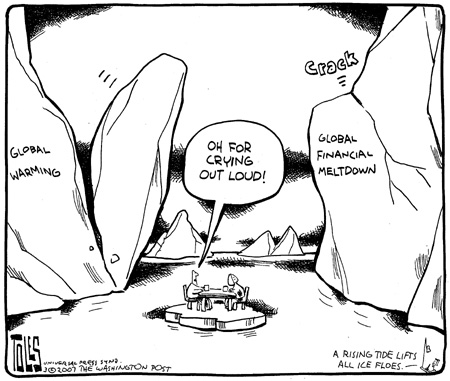
We end 2008 with my cartoon of the year. As I said in a blog post in September 2008: “This cartoon by Pulitzer prize winning Tom Toles first appeared in the Washington Post in 2007 – it brilliantly anticipated the global financial meltdown that we’re now experiencing. Coming in the wake of confirmed global warming, it is a double whammy. Meltdown 2
A miracle substance to get smarter?One of the earliest video films I helped distribute at TVE Asia Pacific, soon after it was set up in 1996, was called Ending Hidden Hunger.
This 20 minute film, made in 1992 by Bedford Films of UK and narrated by Sir Peter Ustinov, described how the UN children’s agency UNICEF was working toward eliminating micronutrient deficiencies from iron, vitamin A and iodine in different parts of the developing world. Examples are taken from Africa and Asia to both illustrate the extent of the problem as well as steps being taken to reduce these deficiencies that cause mass-scale disability and death.
The main premise of the film was simple: those lacking micro-nutrients in their regular diet often don’t show immediate signs of starvation. This deprivation builds up over time and causes slow – sometimes irreparable – damage.
Nicholas KristofI was reminded of this film — and its still very relevant message — when reading an excellent essay by Nicholas Kristof in International Herald Tribune a few days ago. He is a columnist for the New York Times who travels the world reporting from the various frontlines of survival and struggle.
In Raising the World’s I.Q., dispatched from Rawalpindi, Pakistan, Kristof was talking about ‘a miracle substance that is cheap and actually makes people smarter’: iodised salt.
Here’s the context, as he put it:
“Almost one-third of the world’s people don’t get enough iodine from food and water. The result in extreme cases is large goiters that swell their necks, or other obvious impairments such as dwarfism or cretinism. But far more common is mental slowness.
“When a pregnant woman doesn’t have enough iodine in her body, her child may suffer irreversible brain damage and could have an I.Q. that is 10 to 15 points lower than it would otherwise be. An educated guess is that iodine deficiency results in a needless loss of more than 1 billion I.Q. points around the world.”
In nearly all countries, the best strategy to control iodine deficiency is iodisation of salt — one of the most cost-effective ways to contribute to economic and social development. Especially in these hard times, development professionals are looking for smart ways to get the biggest bang for their limited (and still shrinking) bucks. Investing in micronutrients – such as iodine – can provide some of the biggest bangs possible.
UNICEF Report 2008In June 2008, UNICEF published Sustainable elimination of iodine deficiency, a new report on progress since 1990 when the world’s governments set the target to eliminate iodine-deficiency disorders worldwide.
In October 2008, The Lancet, one of the world’s leading medical journals, published a report that noted: “Iodine deficiency is the most common cause of preventable mental impairment worldwide.”
The medical, public health and development communities have known and talked about iodine and other micronutrients for over 30 years. Significant progress has been made – for example, UNICEF says by 2006, more than 120 countries were implementing salt iodisation programmes, and 34 countries had managed to get rid of iodine deficiency among their people through this smart strategy.
But there still are major gaps — which continue to cause preventable damage to tens of millions of people including children.
Nicholas Kristof navigates through the heavy, jargon-ridden developmentspeak and churns out an eminently readable, accessible piece. It’s written in first person narrative from a part of the world where illiteracy, superstition – and their erstwhile companion, religious fanaticism – are trying to prevent people at risk from using iodised salt. This is science writing at its finest: anecdotal, personalised and purposeful.
And he’s absolutely right when he says iodised salt lacks glamour, doesn’t have too many stars or starlets singing its praise and (almost) no one writing about it despite its potential to improve lives for so many people.
I should know: one of the earliest topics I tackled as a young science reporter – getting started in the late 1980s – was salt iodisation. I struggled to put together a readable, engaging piece — which I then had to push through jaded editors who wondered what all this fuss was about.
I have only one (minor) bone to pick with Kristof. He pokes fun at Canada for hosting and supporting the Micronutrient Initiative, “an independent, not-for-profit organization committed to promoting simple cost-effective solutions for hidden hunger and developing innovative new solutions where needed.”
He calls Canada “earnest and dull, just like micronutrients themselves”. It’s a personal view – perhaps expressed with his tongue firmly in his cheek. Having travelled a fair amount in North America, and having good friends in both countries, I think that the nation north of the US-Canada border is a tad more civilised, certainly more caring and better engaged with the rest of the world.
But then, that too is a personal view. I’m darn lucky that I get enough iodine in my diet so that I can think for myself, keep asking lots of annoying questions…and occasionally even get some answers right.
President Obama and the call at 3 am... “Congratulations for restoring sanity and intelligence to Washington…and giving the world its first President. Real hard work begins now. Look after him!”
This was my brief message to American friends soon after they elected Barack Obama as the 44th President of the United States of America.
It was entirely appropriate that I sent this message via mobile phone text (SMS). For Obama’s trail-blazing campaign to the White House used the new media innovatively while also using the old media (such as broadcast television) in a complementary manner.
Obama’s rise has epitomised change in many ways. Among other things, he is the first elected leader of a major democracy who shows understanding and mastery over the New Media World, which is radically different from the old media order.
As AFP reported in a story titled ‘Obama surfs the web to the White House‘: “Social networks and Twitter messages may have helped but analysts agree it was the Democrat’s impressive online organization and Internet fund-raising that fueled his victory over Republican John McCain in Tuesday’s election.”
It quoted Julie Germany, director of George Washington University’s Institute for Politics Democracy & the Internet, as saying: “No one’s going to say Obama won the election because of the Internet but he wouldn’t have been able to win without it. From the very beginning the Obama campaign used the Internet as a tool to organize all of its efforts online and offline. It was like the central nervous system of the campaign.”
Both Obama and McCain campaigns had slick websites and TV campaigns. But additionally, Obama inspired thousands of web-savvy volunteers to extend his message way beyond the official outreach. Doing so risked diluting the campaign or losing tight control, but that gamble paid off.
Al Gore, US vice president from 1992 to 2000, also understood the potential of new media, especially the transformative nature of the Internet. But at the time he was in office, the new media tools were not being used by sufficiently large numbers of people for it to make a difference in political campaigning or citizen engagement.
Both the timing and technologies favoured Obama, who successfully tapped into Digital Natives — those relatively younger people who have grown up with digital technology such as computers, the Internet, mobile phones and MP3. (In contrast, Digital Immigrants are those individual who grew up without digital technology and adopted it later.)
But as many commentators are pointing out, the real fight has just begun. It remains to be seen how Obama and his team use New Media tools, platforms and potential to deliver the promise of change.
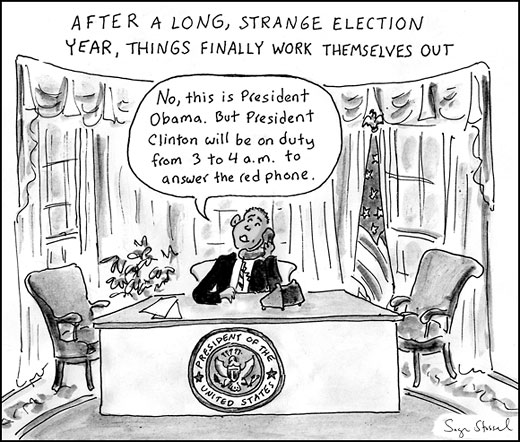
Meanwhile, my own favourite cartoon of Obama election is the one above – and funnily enough, it concerns a piece of old technology: the good old fixed phone. If you recall, in long-drawn campaign for Obama to secure Democratic Party nomination, his rival Hillary Clinton ran this TV commercial which peddled her credentials for being familiar with the corridors of power.
It’s 3 AM and your children are safe and asleep. But there’s a phone in the White House and it’s ringing.
Something’s happening in the world. Your vote will decide who answers that call…
Hillary’s original ad:
Obama’s official response:
There were various unofficial spoofs created by Digital Natives who love to play with new media tools. Just run a search for ‘3 am’ or ‘red phone’ on YouTube and you can watch many of these online!
By the way, isn’t it time that the old-fashioned Red Phone in the White House – the American President’s Hotline to save the world – was replaced with a more modern looking instrument? One more thing for the New Media President Obama…
November 4 is already here in Asia – and the day will dawn a few hours later in the United States. Today is the day Americans go to the polls to choose their next President.
Whatever the outcome of today’s election, one thing is for sure: a little campaign video by a relatively little known actress and model changed the face of Campaign 2008.
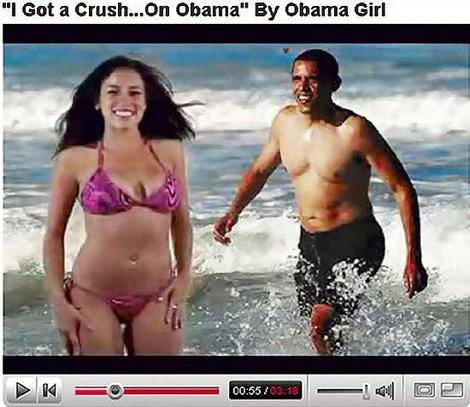
“I Got a Crush… on Obama” is an internet viral video, first posted on YouTube in June 2007 featuring a young woman seductively singing of her love for Illinois Senator and presidential candidate Barack Obama.
Produced by BarelyPolitical.com, a website for funny political videos, it featured actress and model Amber Lee Ettinger who lip-synched the song which was actually sung by Leah Kauffman (of “My Box in a Box” fame).
This video was named biggest web video of 2007 by People magazine…the AP…Newsweek…and AOL. It certainly helped to project Obama as a cool and hip candidate.
As we wait for democracy to take its course, here’s that history-making viral video, which has been watched on YouTube more than 10 million times…and counting:
These are the principal credits:
Created by: Ben Relles
Starring: Amber Lee Ettinger
Vocals: Leah Kauffman
Music Producer: Rick Friedrich
Directed by: Larry Strong and Kevin Arbouet.
And finally, if any of you feel anything at all for the incumbent who is about to be relegated to the dustbin of history, here’s a wicked video from the same creators called: Lil’ Bush Girl…Meet Obama Girl
(Caution: it’s not for the prim and proper, but then readers of this blog aren’t!).
This cartoon by Pulitzer prize winning Tom Toles first appeared in the Washington Post in 2007 – it brilliantly anticipated the global financial meltdown that we’re now experiencing. Coming in the wake of confirmed global warming, it is a double whammy.
America has been hit hard by the sub-prime crisis. The social and human cost of financial failure has been enormous. An epidemic of home repossessions has left thousands of houses abandoned and boarded-up: whole suburbs are falling into disrepair and dereliction.
Financial institutions in America and in Britain had poured billions into investments backed by these mortgages. As more and more people have defaulted on their mortgage repayments, financial markets have collapsed, causing a crisis that has rippled across the Atlantic, sending the City of London into turmoil and pulling the plug on one now infamous British bank.
Some call it a financial tsunami not been seen since the Great Depression in the 1930s….a crisis that has forced the US government to step in and save the financial system after trillions were wiped off global stock markets and once revered institutions were swept off the face of Wall Street. Is the US intervention too little, too late to save the economy?
In fact, just a few days ago, the People’s Daily of China warned that a “financial tsunami” was approaching, which recalled the Great Depression in the US. It said: “As the contemporary economy has been integrated globally, American consumption and currency exchange rates will directly influence countries dependent on the US as the main export destination for economic growth and employment”.
The Chinese Communist Party organ complained that the US had unleashed financial “weapons of mass destruction” on the world economy in the form of subprime debts and related financial derivatives.
The world’s media have been scrambling to cover these rapidly unfolding events. In fact, many have been caught napping, or worse, been uncritical cheerleaders of the march of capital and credit. Most of them – even the respected financial journals – just didn’t see the crisis building up…or ignored the tell-tale signs that constituted an inconvenient truth.
Danny Schechter - wasn't crying wolf!“This didn’t just happen in the course of a usual business cycle,” insists the American investigative journalist and media analyst Danny Schechter, who has been tracking this issues for many months on his influential News Dissector blog and the MediaChannel that watches and critiques the media.
In his new book, aptly titled Plunder, Danny offers an in-depth investigation into the decline of the economy that’s causing millions to lose jobs and face foreclosures and across-the-board price hikes.
He says: “You wouldn’t know it by relying on our media, but the subprime scandal masks massing looting by Wall Street firms using carefully calculated predatory lending schemes enabled by regulators who don’t regulate and a media that looked the other way. We have lost trillions and dislocated millions with no relief in sight. Every American is paying for the greed of our financiers in the grocery store, gas pump and unemployment line. Bank robberies are not new — but banks doing the robbing is.”
In 2007, his film IN DEBT WE TRUST was the first to expose Wall Street’s connection to subprime loans, predicting the economic crisis that this book investigates.
I have been watching various news media analysis of the current crisis and want to share two that stood out from the rest: Inside Story by Al Jazeera English, and Dispatches by UK’s Channel 4.
In a special show from New York, Inside Story looks at the financial turbulence that rocked the US last week. Will the emergency measures by the US government be enough to stabilise the markets or has the financial system in the US been changed forever? The introductory report from AJE’s Washington correspondent Reynolds is particularly illuminating – he also writes the story for their website.
Inside Story – The US financial crisis – 21 Sep 2008 – Part 1
Inside Story – The US financial crisis – 21 Sep 2008 – Part 2
From the other side of the Atlantic comes a more investigative, one-hour special that was produced and broadcast in March 2008, when the early signs of the banking crisis were beginning to show – for anybody who cared to notice.
As Channel 4 introduces it: “This is a story about the destructive power of finance: what happens when banks are driven by short-termism; when bankers are rewarded with vast bonuses, free to operate under inadequate regulatory supervision, and with the complicity of a government too in awe of big business to step in.”
Dispatches: How The Banks Bet Your Money UK & US – part 1
In this edition of Dispatches, private equity financier Jon Moulton delivers a stinging rebuke to the banks for causing this financial meltdown and explains why the British taxpayer will now pay the price.
Dispatches: How The Banks Bet Your Money UK & US – part 2
Dispatches: How The Banks Bet Your Money UK & US – part 3
Dispatches: How The Banks Bet Your Money UK & US – part 4
Dispatches: How The Banks Bet Your Money UK & US – part 5















 Open Minds!