Asia’s Other Eclipse: The one that doesn’t make TV news!

This multiple exposure image shows the various stages of the total solar eclipse in Baihata village, 30 kms from Guwahati, the capital city of the northeastern state of Assam on July 22, 2009. The longest solar eclipse of the 21st century cast a shadow over much of Asia, plunging hundreds of millions into darkness across the giant land masses of India and China. AFP PHOTO/ Biju BORO

This century’s longest solar eclipsed moved across Asia on 22 July 2009, wowing scientists and the public alike. Asia’s multifarious media covered the solar eclipse with great enthusiasm and from myriad locations across the vast continent.

The path of the eclipse’s totality –- where the sun was completely obscured by the Moon for a few astounding minutes –- started in northern India. It then crossed through Nepal, Bangladesh, Bhutan, Myanmar and China, before heading out to the Pacific Ocean. Those who were lucky enough to be at the right place at the right time saw one of Nature’s most spectacular phenomena. It was certainly a sight to behold, capture on film, and cherish for a lifetime.

But many along the path missed this chance as clouds obscured the Sun. It’s the rainy season in much of Asia, where the delayed monsoon is finally delivering much-needed rain.
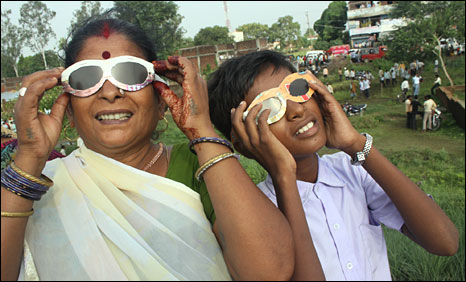
Eclipse watching in Taregna, Bihar, India - Photo: Prashant Ravi, BBC Online
That’s what happened in Taregna, in the eastern Indian state of Bihar. The media had dubbed it the ‘epicentre’ of the solar eclipse, and estimated totality to be visible for at least three minutes and 38 seconds. Thousands who flocked to the village were disappointed when the clouds refused to budge. Nature doesn’t follow our scripts.

That didn’t deter some affluent Indians -– if the eclipse won’t come to them, they just went after it. They chartered an airplane to fly above the rain clouds to catch the once-in-a-lifetime eclipse. Each seat cost US Dollars 1,650.

It’s rarely that totality crosses through countries with such high human numbers as China and India. This time around, millions of people and thousands of journalists took advantage.

Some travelled long distances hoping to get the best view from the 200-km wide path of totality. Others watched it one of Asia’s many and cacophonous 24/7 TV news channels. The event had all the elements of a perfect television story: mass anticipation, eager experts and enthusiasts, occasional superstitions, uncertainties of weather and, finally, a stunning display of Nature’s raw power.

‘Darkness at Dawn!’ screamed a popular headline, referring to the eclipse causing a sudden ‘nightfall’ after the day had begun. Other superlatives like ‘Spectacle of the century’ and ‘A sight never to be missed’ were also widely used.
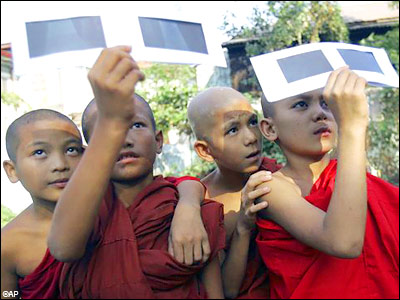
Myanmar Buddhist novices watch solar eclipse through the filters, in Yangon, Myanmar
Solar eclipses are indeed a marvel of Nature, and the media’s excitement was justified. For once, it was good to see them devoting a great deal of airtime and print/web space for something that was not violent, depressing or life-threatening.

How I wish Asia’s media took as much interest in another kind of ‘eclipse’ that surrounds and engulfs us! One that does not end in minutes, but lasts for years or decades, and condemns millions to lives of misery and squalor.

Stories of poverty, social disparity and economic marginalisation are increasingly ‘eclipsed’ in Asia by stories of the region’s growing economic and geopolitical might.

The mainstream media in Asia –- as well as many outlets in the West — never seem to tire of carrying reports of Asia rising. Indeed, that is a Big Story of our times: many Asian economies have been growing for years at impressive rates. Thanks to this, over 250 million Asians have moved out of poverty during this decade alone. According to the UN’s Asian arm ESCAP, this is the fastest poverty reduction progress in history.

We see evidence of increased prosperity and higher incomes in many parts of developing Asia. Gadgets and gizmos –- from MP3 to mobile phones — sell like hot cakes. More Asians are travelling for leisure than ever before, crowding our roads, trains and skies. Lifestyle industries never had it so good. Even the current recession hasn’t fully dampened this spending spree.
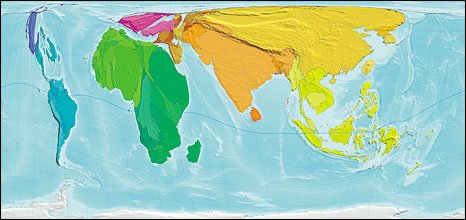
World map proportionate to number of poor people in each country/region - from Atlas of the Real World

But not everyone is invited to the party. Tens of millions of people are being left behind. Many others barely manage to keep up -– they must keep running fast just to stay in the same place.

National governments, anxious to impress their own voters and foreign investors, often gloss over these disparities. The poor don’t get more than a token nod in Davos. National statistical averages of our countries miss out on the deprivations of significant pockets of population.

For example, despite recent gains, over 640 million Asians were still living on less than one US Dollar a day in 2007 according to UN-ESCAP. Three quarters of the 1.9 billion people who lack safe sanitation are in Asia — that’s one huge waiting line for a toilet!

On the whole, the UN cautions that the Asia Pacific region is in danger of missing out the 2015 target date for most Millennium Development Goals – the time-bound and measurable targets for socio-economic advancement that national leaders committed to in 2000.

The plight of marginalised groups is ignored or under-reported by the cheer-leading media. For the most part, these stories remain forever eclipsed. Except, that is, when frustrations accumulate and blow up as social unrest, political violence or terrorism. Even then, the media’s coverage is largely confined to reporting the symptoms rather than the underlying social maladies.

Indonesian children look up through x-ray film sheets to watch a solar eclipse in the sky in Anyer Beach, Banten province, Indonesia
“Half the children in South Asia go to bed hungry every night, but the covers of our news magazines are about weight loss parlors,” says Kunda Dixit, Chief Editor of The Nepali Times.

As he noted in a recent essay: “Maternal mortality in parts of Nepal is nearly at sub-Saharan levels, but we are obsessed with politics. Hundreds of cotton farmers in India commit suicide every year because of indebtedness, but the media don’t want to cover it because depressing news puts off advertisers. Reading the region’s newspapers, you would be hard-pressed to find coverage of these slow emergencies.”

P N Vasanti, Director of the Delhi-based Centre for Media Studies which monitors the leading newspapers and news channels in India, laments how “development” issues such as health, agriculture and education are not even on the radar of popular news sources. Her conclusion is based on a content analysis of the six major Indian news channels during the run-up to the recent general election in India.

I have come across similar apathy in my travels across Asia trying to enhance television broadcasters’ coverage of development and poverty issues. As one Singaporean broadcast manager, running a news and entertainment channel in a developing country, told me: “I don’t ever want to show poor people on my channel.”

Don’t get me wrong. Trained as a science journalist, I can fully appreciate the awe and wonder of a solar eclipse. For years, I have cheered public-spirited scientists who join hands with the media to inform and educate the public on facts and fallacies surrounding these celestial events.

But there are more things in heaven and earth, than are dreamt of in our mainstream media’s breathless coverage of the march of capital. Journalists and their gate-keepers should look around harder for the many stories that stay eclipsed for too long.

* * * * * *

Shorter version of the above comment was published by Asia Media Forum on 23 July 2009

Full length version appeared on OneWorld.Net on 23 July 2009

Reprinted in The Nepali Times, 24 July 2009

Waiting for his long eclipse to end...

Lights, Camera, Apollo: Did NASA and Hollywood co-produce Moon Landings?

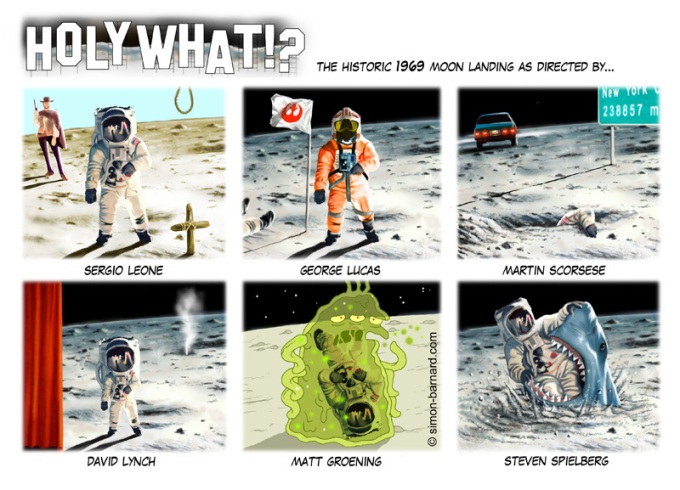
Is this how it really happened? Just kidding!
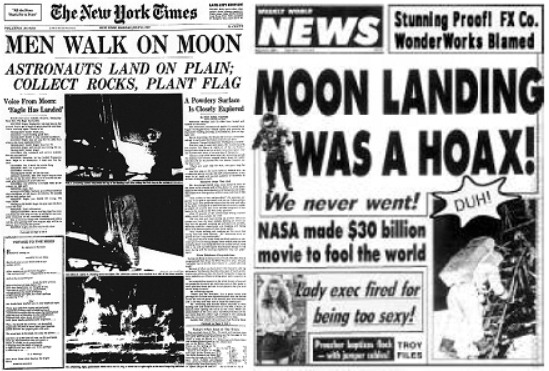
When NASA announced last week that they were working with a leading digital imaging company in Hollywood to remaster the original Apollo 11 Moon walk video footage, I told myself: that’s one more cannon to the conspiracy theorists!

Everyone would welcome a quality improvement in those murky, grainy moving images capturing humanity’s grand achievement. But the choice of Lowry Corporation, best known for restoring old Hollywood films, could fuel the fire of conspiracy theorists who argue that the entire Moon landing was faked by NASA with the connivance and participation of Hollywood. They believe that the entire Apollo programme – that landed people on the moon six times between 1969 and 1972 – was staged on a movie set or secret military base.

This link didn’t bother Richard Nafzger, the NASA engineer who oversaw television processing at the ground-tracking sites during the Apollo 11 mission, and now involved in their restoration. “This company is restoring historic video. It mattered not to me where the company was from,” Nafzger was quoted as saying.

Technically and officially, NASA is right. The US space agency has always dismissed the conspiracy theorists, and not spent much time discussing the outrageous idea. As it says on NASA website: “The Apollo Moon landings were among the most completely documented and observed events in history. Moon rocks have been examined by scientists from all over the world, not just the U.S. Video special effects were in their infancy in the late 60’s so that faking a landing on the Moon would probably have been more difficult than actually going there, and it seems highly unlikely that the hundreds or even thousands of people who would have had to be involved in such a conspiracy would have kept it a secret for so long.”

In another place, NASA website says Moon rocks and common sense prove Apollo astronauts really did visit the Moon.

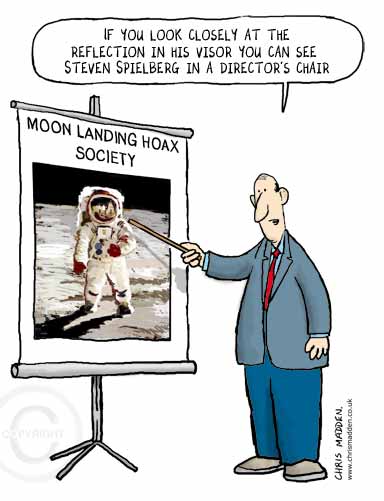
Err, Wasn't Spielberg only 23 at the time...?
Independent scientists point out that it would be impossible for tens of thousands of NASA employees and Apollo contractors to keep such a whopping secret for almost four decades. Tell that to those who are deeply suspicious of anything to do with governments, who historically don’t have the best record for transparency and full disclosure!

So the conspiracy theory lingers. Like many other crazy ‘theories’, it has spread rapidly with the growth of the Internet. It’s really an old one: even at the time Apollo astronauts landed on the Moon, a few people refused to believe it as it apparently conflicted with their religious beliefs.

The Moon Hoax, as it’s popularly called, accuses NASA of manufacturing, destroying, or tampering with evidence — including photos, telemetry tapes, transmissions, and rock samples; and that the deception continues to this day. These theorists concede that the Apollo launches did take place. But instead of going to the Moon, which they say was technologically impossible at the time, the astronauts just orbited the Earth for a few days while NASA carefully fed the media with manufactured images. And then they returned to a heroes’ welcome!

Before we proceed, let’s agree that there is independent, verifiable and irrefutable evidence that the Moon landings did take place. Here are a few online sources for details:
Bad Astronomy website by Phil Plaits
Did We Really Land on the Moon? Suggestions for Science Teachers from Rational Inquiry
Wikipedia entry: collaborative discussion with multiple sources cited
Clavius.org website

My curiosity in conspiracy theories stems from my interest in popular culture. In this instance, I’m intrigued to note how moving images have fuelled the Moon Hoax theory in a number of ways. A cornerstone in the doubters’ argument is that NASA’s photos and videos from the moon contained ‘suspicious anomalies’ (all of which, by the way, have been satisfactorily explained by scientists.)

Superb entertainment, but it was just that...
Some believe that these theories inspired the 1978 movie Capricorn One, where NASA fakes a Mars landing on a military base on Earth, and then goes to desperate lengths to cover it up. It’s entirely possible that some people can’t discern fact from fiction. Or why allow facts to get in the way of a damn good story?

In 1980, the Flat Earth Society was one of the first to accuse NASA of faking the Moon landings, arguing that these events were actually staged in Hollywood studios and based on a script written by Arthur C. Clarke! Another group suggested that acclaimed film director Stanley Kubrick, who co-wrote with Clarke the classic movie 2001: A Space Odyssey, was strong-armed into shooting much of the Apollo footage.

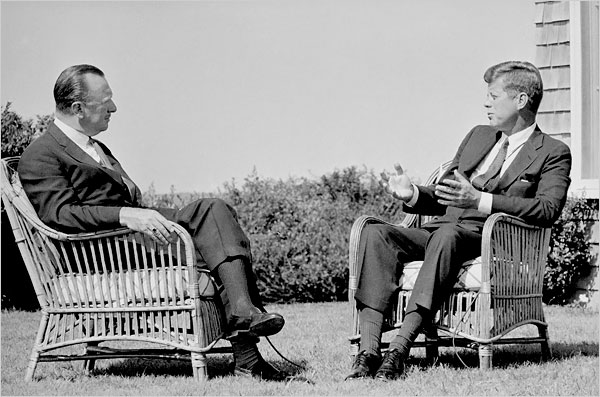
Sir Arthur Clarke, with whom I worked for over 20 years, used to laugh these off. He’d enjoyed a ring side seat when he joined Walter Cronkite in covering Apollo 11 and later missions for CBS News.

At one point in the early 1990s, he wrote to the NASA Administrator, with his tongue firmly in his cheek, saying: “Dear Sir, On checking my records, I see that I have never received any payment for this work. Could you please look into this matter with some urgency? Otherwise, you will be hearing from my solicitors, Messrs Geldsnatch, Geldsnatch and Blubberclutch.”

Of course, he never received – nor expected – a reply. But when media reports about this appeared, some with no sense of humour considered it further ‘proof’ of a cover-up!

And here’s another connection: Peter Hyams, who directed Capricorn One, went on to direct the movie adaptation of Arthur C Clarke’s 2010: Odyssey Two, which was released in 1984.

More seriously, in later years Sir Arthur was concerned that at one point a few years ago, millions of Americans harboured doubts whether the Moon landings actually took place. That indicated a failure of the education system to produce people with critical thinking abilities, he said.

The conspiracies received a boost when, on 15 February 2001, the Fox News TV network aired
Conspiracy Theory: Did We Land on the Moon?. Hosted by X-Files actor Mitch Pileggi, this hour-long, sensational documentary peddled what it called eerie “inconsistencies” in NASA’s Apollo images and TV footage. Among them: no blast craters are visible under the landing modules; shadows intersect instead of running parallel, suggesting the presence of an unnatural light source; and a planted American flag appears to ripple in a breeze although there’s no wind on the moon.

It concluded that the whole Apollo Moon landings were faked in the Nevada desert because, cccording to the conspiracy theorists, NASA did not have the technical capability of going to the Moon, but pressure due to the Cold War with the Soviet Union forced them to fake it. Fox TV did preface the programme with a notice saying: “The following programme deals with a controversial subject. The theories expressed are not the only possible interpretation. Viewers are invited to make a judgement based on all available information.” But skeptics felt Fox didn’t do enough to provide a minimum level of balance in their discussion.

Warning: This is a funny cartoon and not meant to be taken seriously
The documentary’s ‘evidence’ has since been refuted point by point. NASA has also dismissed the documentary’s claims. It prompted Sir Arthur Clarke to protest to his long-time friend Rupert Murdoch, owner of the Fox TV network, for peddling unscientific nonsense.

Rather than being a ‘true believer’, Fox TV may have been trying to boost its audience ratings. But others in the moving images industry apparently take the matter very seriously. Among them is the film-maker Bart Sibrel. His aggressive interview tactics once provoked astronaut Buzz Aldrin (second man to walk on the Moon) to punch him in the face in a 2002 encounter.

“I don’t want to call attention to the individuals who are trying to promote and shuffle off this hoax on people,” Aldrin told CNN in a recent interview. “I feel sorry for the gullible people who’re going to go along with them. I guess it’s just natural human reaction to want to be a part of ‘knowing something that somebody doesn’t know.’ But it’s misguided. It’s just a shame.”

One of the strongest rebuttals of the Moon hoax on TV has come from the Mythbusters series of popular science programmes produced by Beyond Television Productions, originally for the Discovery Channel. The series features special effects experts Adam Savage and Jamie Hyneman, who use basic elements of the scientific method to test the validity of various rumors, myths, movie scenes, internet videos and news stories in popular culture.

In August 2008, they tackled a number of pervasive myths associated with the Moon landing, debunking them one by one. To film the episode, Adam, Jamie and the rest of the Mythbusters team visited the NASA Marshall Space Flight Center in Alabama. A team of Marshall scientists helped the Mythbusters with several of their tests. Here are two excerpts:

Mythbusters probe the ‘Moonlanding photo hoax’

Mythbusters investigate ‘Moonwalk hoax’:


Read Space.com coverage about how Mythbusters busted the Moon Hoax.

Read Popular Mechanics coverage on the Mythbusters exposure

As the 40th anniversary of the first Moon landing passes, the scientific community and rationalists will have to make some hard choices. How much more time and energy must they expend countering such wildly fanciful theories and fantasies? In a world that still has a (dwindling?) number of people who believe in more ancient concepts like the Flat Earth theory, is it really surprising that the Space Age would inspire its own share of modern-day myths?

No matter what the scientists say and how overwhelming the evidence is, conspiracy theories will always believe what they want. Often their convictions border on a blind faith – and as Arthur C Clarke was fond of saying (in relation to religions), one definition of faith is ‘believing in what you know isn’t true!’.

In a pluralistic world, people choose what to believe in
Then there is simple demographics. The total world population in 1969 was 3.6 billion. Today, it has surpassed 6.7 billion. This means nearly half of the people alive today were not even born when Neil and Buzz stepped on to the Moon. At 43, even I have only a headline memory of Apollo 11, even if it’s a strong one.

NASA itself is well aware of this. “As the number of people who were not yet born at the time of the Apollo program increases, the number of questions [about the moon landings] also may increase,” NASA said in a statement on the eve of the anniversary. “Conspiracy theories are always difficult to refute because of the impossibility of proving a negative.”

Perhaps what the Moon Hoax debate really needs is what Sir Arthur Clarke once proposed as a response to the obsession with UFOs and alien abductions: a decade or so of benign neglect. Conspiracy theorists and myth-makers thrive on counter-arguments and debate. When they don’t get it for long enough, they’ll probably run out of steam.

Meanwhile, networks like Fox News should stick to making entertainment programming that is labeled as such. Who can find fault with creations like The Simpsons?

‘Live from the Moon’…and then Lost on Earth: Story of Apollo broadcasts

Apollo still photos were much better than broadcast images: how come?

In theory, it can happen to anyone recording moving images on tape or digital media: absent-mindedly or carelessly re-use the recording media, and thus lose the original content. If no copy exists, such an accident means an irrevocable loss.

But if the images were the most expensively shot in the whole of human history — literally costing billions of dollars and involving the genius and labour of half a million people over several years — we would expect these to be archived and preserved with great care, right?

Well, not necessarily — if the custodian is a government agency. On eve of the 40th anniversary of the first Moon landing by Apollo 11, the US space agency NASA dropped a bombshell: it admitted that the original recordings of that historic moment were accidentally erased years later.

One British newspaper called it “the scientific equivalent of recording an old episode of EastEnders over the prized video of your daughter’s wedding day”.

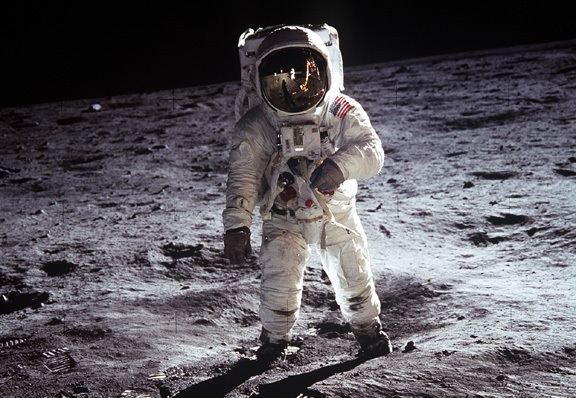
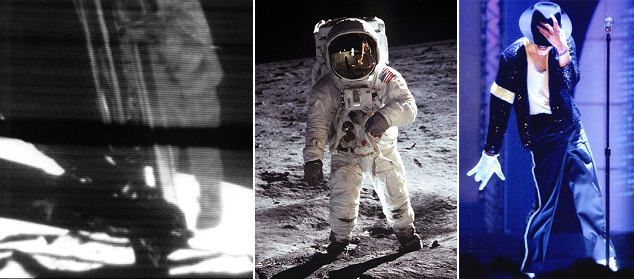
Can you see the men on the Moon? Well, only just...
Can you see the Moon on the Moon? Well, only just...
The loss became public when the Sydney Morning Herald broke the story in August 2096. “A desperate search has begun amid concerns the tapes will disintegrate to dust before they can be found,” it said.

While the media rushed with oops-style headlines like ‘One giant blunder for mankind’, NASA quietly investigated what really happened. Last week, they revealed the hard truth: the tapes were part of a batch of 200,000 that were degaussed – or magnetically erased — and re-used. It was a standard money-saving measure at NASA in those pre-digital days to reuse the 14-inch tape reels after several years in storage. Agency officials fear that the original Apollo 11 tapes were buried among an estimated 350,000 that were recycled in the 1970s and 1980s and the data was lost for ever.

But the historic visuals are not entirely lost: luckily, broadcasters who used NASA’s expensively obtained footage had archived their transmissions for posterity. For many months, NASA has worked with a leading digital imaging company in Hollywood to restore good copies of the Apollo 11 broadcast found in the archives of CBS News and some recordings called kinescopes found in film vaults at Johnson Space Center.

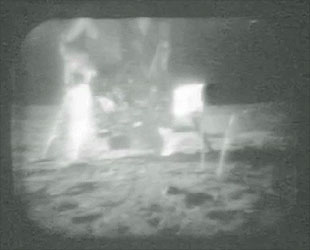
On 16 July 2009, NASA released the first glimpses of a complete digital make-over of the original landing footage that looked decidedly sharper and clearer than the blurry and grainy images of Neil Armstrong and Buzz Aldrin walking on the Moon.

And we have to admit, the new video is definitely better than the ones we’ve seen for 40 years!

Raw Video: Restored Video of Apollo 11 Moonwalk

Another montage of digitally restored Apollo 11 mission highlights:

The full set of recordings, being cleaned up by Burbank, California-based Lowry Digital, are to be released in September 2009.

Read technical details of how Lowry Digital is restoring NASA’s original footage of the Apollo 11 mission

I had often wondered why the original images from the Moon were so grainy: it wasn’t typical even for that time. And if NASA spent between US$ 22 to 25 billion on landing men on the Moon, surely they’d have harnessed the best available technology to capture and share their moments of triumph, I assumed.

Actually, the video coverage that was broadcast around the world — to an estimated audience of 500 to 750 million people — and has since been endlessly redistributed was not quite what came from the Moon. It was a diluted version. Stanley Lebar, the NASA engineer in charge of developing the lunar camera, now calls a “bastardized” version of the actual footage.

Here is the “as-it-happened” broadcast from CBS News that day, with the legendary Walter Cronkite anchoring to the biggest TV audience the world had known. (Footnote: You’ll see the first electronic “character generators” in use.)

The story is technically complex, but here’s the essence: live images from the Moon couldn’t be fed directly to the American TV networks using the NTSC broadcast standard. Audiences worldwide would be holding their breath that a delayed broadcast, even by a few minutes, would not have been as effective as ‘live from the Moon’. Under such time pressures, no conversions could be attempted. So a regular TV camera was pointed at the huge wall monitor at mission control in Houston.

This is known as kinescope, or telerecording: a recording of a television program made by filming the picture from a video monitor. That resulted in the grayish, blotchy images that everyone saw on their home TV sets. In other words, It was a copy of a copy, with significant quality losses in that process!

And what is now lost, permanently, are the tapes containing the original Slow-Scan Television (SSTV) tapes. Digitally remastering the CBS broadcast tapes is now offering us better images than we’ve been used to for 40 years, for sure, but they stem from an already adulterated source.

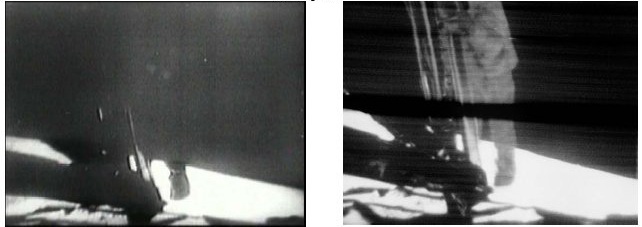
Scan-converted broadcast image of Armstrong descending the lunar module ladder taken at Goldstone tracking station. This was the image the world saw of the first human on the Moon. But a Polaroid picture of the Slow-Scan television image of Armstrong coming down the ladder reveals far greater detail. Image Courtesy: John Sarkissian/CSIRO Parkes Radio Observatory

A new documentary, released in January 2009, offers new insights into one of the most challenging feats in international live broadcasting – how those images from the Moon were delivered to TV audiences around the world. Produced by Spacecraft Films and directed by Mark Gray Live from the Moon: The Story of Apollo Television

It tells how for the first time in history millions of people could share, in real time, the experience of frontier exploration.

The story behind the camera...finally!
“Placing a man on the moon and returning him safely to the Earth was hard enough in 1969,” says Gray. “‘Live From The Moon’ tells the story of how television, still a technological toddler, was developed for space flight, and examines the impact of the iconic passages that were returned.”

Here’s an excerpt from Space.com that reviewed the film:

To tell that story, Gray literally circled the Earth, shooting interviews at the deep space communication stations in California and Australia, as well as at space facilities and museums in Houston, Baltimore, Los Angeles, Princeton, Kennedy Space Center, Huntsville, Ala., Washington, DC and Weatherford, Oklahoma.

Along the way, he interviewed astronauts, flight directors, mission controllers, tracking station operators, historians and those who built the television cameras for the space program…. “Live from the Moon” is told with the insight of moonwalker Alan Bean; Apollo 10 commander Tom Stafford; flight director Chris Kraft; Neil Mason, who drove the Parkes Telescope; Westinghouse camera team leader Stan Lebar; and the voice of mission control Jack King, among others.

“Every single one of them believed that the TV was one of the most important legacies of Apollo. And many of them admitted candidly that they didn’t give the TV much thought during the actual missions,” recalled Gray.

No Moon, please – we’re Ceylonese: How Sri Lanka lost the Moon…

We came in peace for all makind...

When Apollo 11 astronauts landed on the Moon 40 years ago this week, they were more than just Americans taking that historic first step on to another celestial body.

Yes, they planted the US flag there – after all, it was the American tax payers who financed the massive operation. But they left on the Moon other items that signified the universal nature of their mission.

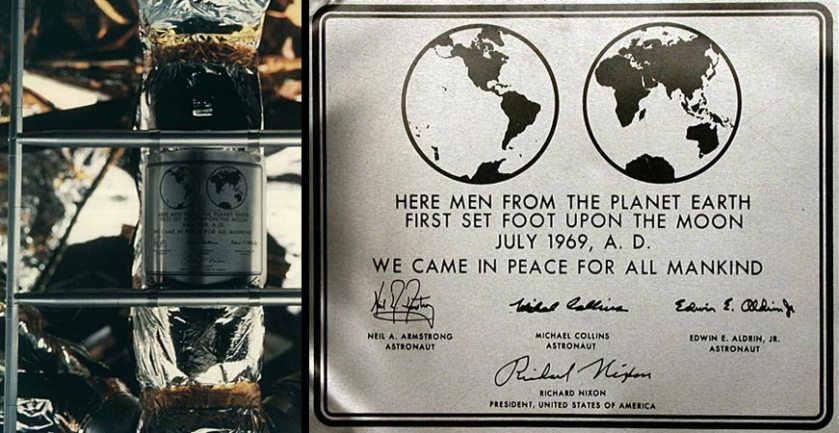
One was a plaque (photo, above) saying “Here men from the Planet Earth first set foot upon the Moon, July 1969 A.D. We came in peace for all mankind.” It bore the signature of the three astronauts –- Neil Armstrong, Edwin (Buzz) Aldrin, Jr., and Michael Collins –- and then US President Richard Nixon. Another was a golden olive branch.

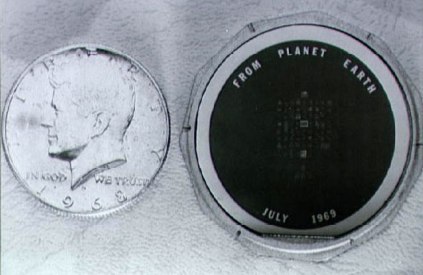
The astronauts also left behind a silicon disc, which is one of the most important and symbolic items taken to the Moon. Etched on to that disc, about the size of a half US dollar coin, are miniaturised messages of goodwill and peace from 73 heads of state or government around the world.

The silicon disc (right) next to a US 50 cents coin for comparison of size
These letters were received by NASA during the final weeks running up to the launch on 16 July 1969, yet this disc helped turn the Apollo 11 mission into an international endeavour.

It was only in June 1969 that the US State Department authorised NASA to solicit messages of goodwill from world leaders to be left on the Moon. This triggered a minor diplomatic frenzy, with invitations going out from Thomas O Paine, the NASA Administrator.

In all, 116 countries were contacted through their embassies in Washington DC, but only 73 responded in time. Sri Lanka, then Ceylon, responded. But for some unknown and unexplained reason, then Prime Minister Dudley Senanayake declined to send a message to the Moon.

When I first heard about it about 18 months ago, I was both intrigued and curious. Was it some misplaced geopolitical considerations, or simple diplomatic arrogance that led to Ceylon’s negative decision? After all these years, we might never find out.

I have now written this up in an article titled ‘How Sri Lanka Missed the Moon’, which appears this weekend in the mainstream media and online in two different versions.

The Sunday Leader newspaper has printed the compact version in its issue for 19 July 2009. Citizen journalism website Groundviews carries the more detailed version, where an interesting reader discussion is evolving…

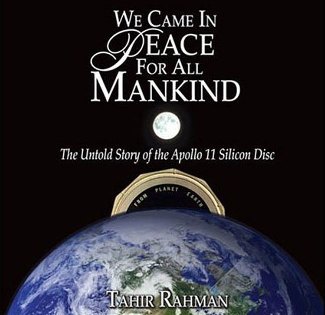
The story is based largely on a book that came out in 2007. Titled We Came In Peace For All Mankind: The Untold Story Of The Apollo 11 Silicon Disc, it was authored by Tahir Rahman, a Kansas-based physician and space historian.

Uncovering forgotten history
The book documents the full story behind this little known facet of the very widely covered Apollo 11 mission. It also reproduces each of the 73 goodwill messages, as well as those which were received too late for inclusion on the disc.

“I was amazed at how NASA and the State Department rushed to get these messages before launch,” says Rahman. He took two months to locate from the Library of Congress the boxes in which NASA Administrator Paine had preserved the full correspondence.

While researching for this article, I contacted Rahman hoping for some additional insights, but he replied: “I do not have any information about why Sri Lanka did not send an Apollo 11 goodwill message.”

Sir Arthur C Clarke, with whom I worked for over 20 years, was also intrigued by Ceylon’s decision, which he didn’t know about until Rahman’s book reprinted the official letter. His only remark: “Mysterious are the ways governments think and work.”

Reading the messages, whose English translations are available online, is like entering a time capsule. Only two of the world leaders are still holding office (Queen Elizabeth II of Britain, and King of Thailand); most of them are dead. Some countries have since changed names. Others have been subsumed by neighbours, or broken into two or more independent states. Geopolitical map of the world has been completely redrawn.

The story of the Apollo 11 silicon disc is more a history and politics lesson, and less a science story. But I’m glad that I found a little known facet of the very widely covered Apollo missions to write about on its 40th anniversary.

Watch Tahir Rahman interviewed on Fox News network:

Walter Cronkite (1916 – 2009): And that’s the way it was…

Walter Cronkite (1916 - 2009): The man who ruled American airwaves

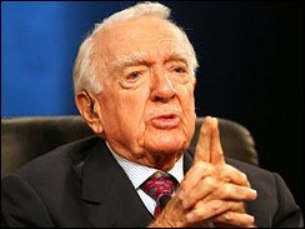
Walter Cronkite, the broadcast journalist and newscaster who redefined television news of his generation, has just signed off for the very last time. A leading light in the history of moving images is gone. What a light…and what a voice.

The New York Times reported the loss as its front page lead: “Walter Cronkite, who pioneered and then mastered the role of television news anchorman with such plain-spoken grace that he was called the most trusted man in America, died Friday at his home in New York. He was 92.”

Cronkite was best known as anchorman for the CBS Evening News for 19 years (1962–81). He was at the helm at a time when television became the dominant news medium of the United States. His influence spread well beyond one network, one medium and one generation.

America's favourite uncle...
Danny Schechter, the News Dissector and head of MediaChannel.org, said in a tribute: “He figuratively held the hand of the American public during the civil rights movement, the space race, the Vietnam war, and the impeachment of Richard Nixon.”

His own former network, CBS, noted in a tribute: “Known for his steady and straightforward delivery, his trim moustache, and his iconic sign-off line – ‘That’s the way it is’ – Cronkite dominated the television news industry during one of the most volatile periods of American history. He broke the news of the Kennedy assassination, reported extensively on Vietnam and Civil Rights and Watergate, and seemed to be the very embodiment of TV journalism.”

The New York Times report added: “On the day President John F. Kennedy was assassinated, Mr. Cronkite briefly lost his composure in announcing that the president had been pronounced dead at Parkland Memorial Hospital in Dallas. Taking off his black-framed glasses and blinking back tears, he registered the emotions of millions.”

Walter Cronkite announces death of President John F Kennedy: 22 November 1963

He is especially remembered for publicly opposing the Vietnam War. In 1968, he traveled to Vietnam, where he called the war a stalemate and advocated a negotiated peace. “If I’ve lost Cronkite, I’ve lost middle America,” President Lyndon B. Johnson said after seeing the broadcast, according to Bill Moyers, an aide to the president at the time.

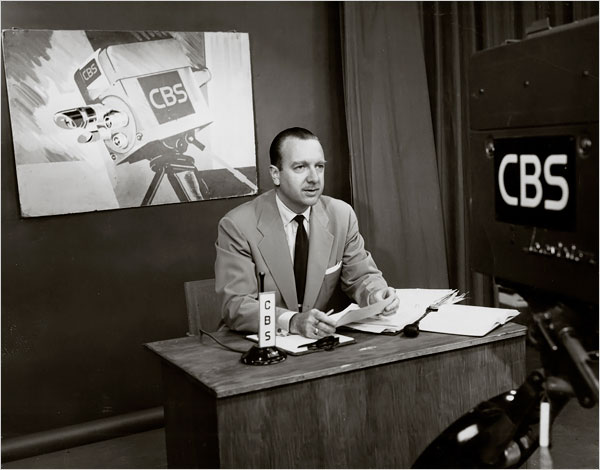
In July 1969, Cronkite anchored the historic 32-hour CBS broadcast that covered the first Moon landing, which became the most widely watched live broadcast event worldwide up to that time. When Neil Armstrong stepped on the moon, Cronkite exclaimed, “Oh, boy!” — another rare show of emotion for the leading anchorman of his era who chose to keep his opinions separate from the news he covered and presented.

Cronkite missed the 40th anniversary of Apollo only by a few days. He will be sadly missed when astronauts and space buffs mark the event.

In this excerpt from for a 4-hour interview filmed for the Archive of American Television in 1998, Cronkite explains the origin of “That’s the way it is”– his signature sign-off:

New York Times has compiled some of his most memorable TV News moments.

The true professional he was, he never retired. Long after leaving CBS News, he remained fully active, engaged and supportive of good journalism in the United States and around the world. He lent his name to educational and charitable causes nurturing investigative journalism.

Danny Schechter writes in his blog: “In his later years, Walter Cronkite abandoned the pretense of only being above the fray and started speaking out as an internationalist for arms control and world federalism, and on many other global issues. He supported progressive causes but never too blatantly. He was very conscious of his image and reputation and identification with the media and power elite. He lived up the street from the United Nations and was often a speaker at UN events.”

Reproduced in full below is the endorsement Walter Cronkite gave our friends at MediaChannel.org, an online media activist group that keeps the spotlight on the media. In the dark during our own war, and in the days since the war ended, I have often found solace, inspiration and courage in his words.

* * * * * *

Walter Cronkite On The Media­ And The MediaChannel.


Good evening, I’m Walter Cronkite. I really wanted to be with you in person tonight for Globalvision New Media’s launch of the new Internet site the Media Channel, but unfortunately I was called out of the country. Yet the issues that led to the creation of this unique global resource, and the crisis that’s facing all of us who work in and care about journalism and the media, are so profound that I simply felt compelled to tape this message so that you would know that I am with you in spirit at least.

As you know, I’ve been increasingly and publicly critical of the direction that journalism has taken of late, and of the impact on democratic discourse and principles. Like you, I’m deeply concerned about the merger mania that has swept our industry, diluting standards, dumbing down the news, and making the bottom line sometimes seem like the only line. It isn’t and it shouldn’t be.

We report, you decide...
At the same time, I’m impressed that so many other serious and concerned people around the world are also becoming interested in holding media companies accountable and upholding the highest standards of journalism.

The Media Channel will undoubtedly be worth watching and taking part in. I am intrigued by its potential, and its global reach. The idea that so many leading groups and individuals around the whole world have come together to share resources and information about a wide range of media concerns is very promising, and I urge you to make the Media Channel your media ‘bookmark’ and your portal to the Internet.

I’m particularly excited about one aspect of the Media’s Channel’s work: its encouragement to people inside the media to speak up ­to speak out about their own experiences. Corporate censorship is just as dangerous as government censorship, you know, and self-censorship can be the most insidious form of pulling punches. Pressures to go along, to get along, or to place the needs of advertisers or companies above the public’s need for reliable information distort a free press and threaten democracy itself.

I’m pleased that the Media Channel opens an immediately available resource for media whistle-blowers. Anonymity will be protected, of course­ if their stories check out, of course. And, of course, are backed up with the facts.

We have all been supportive for years of dissidents around the world who take great risks to stand up for what they believe in. But here at home, in our own industry, we need to make it possible for people to speak out when they feel they’ve been wronged, even if it means shaming newsrooms to do the right thing. Journalists shouldn’t have to check their consciences at the door when they go to work for a media company. It ought to be just the reverse.

As I’ve said on other occasions, the strength of the American system is possible and can be nurtured only if there is lively and provocative dissent. In a healthy environment dissent is encouraged and considered essential to feed a cross-fertilization of ideas and thwart the incestuous growth of stultifying uniformity.

We need to encourage and support those among us who face either overt or covert threats­ or even a more subtle absence of encouragement to search out the truth. We all know that economic pressures and insecurities within news organizations have reduced the scope and range of investigative reporting. Sometimes projects are spiked with just a simple phrase: “It’s not for us.”

We’re always ready to speak out when journalists are at risk. But today we must speak out because journalism itself is at risk. That’s why I’m speaking out and reaching out to you tonight, to tell you that I like the idea of the Media Channel and want to encourage your participation.

And that’s the way it is.

Walter Cronkite interviews President Kennedy - Photo courtesy Associated Press

Michael Jackson: A tale of two moonwalks (and a ‘Thank You’ from the Ayatollahs)

While Apollo astronauts conquered the Moon, Michael Jackson took over the Earth...

What a pity that Michael Jackson missed the 40th anniversary of the first Apollo moonwalk by only a few weeks.

He was only 10 when Apollo 11’s Neil Armstrong took that historic first lunar step on July 20, 1969 and was probably among the 500 million people — the largest TV audience the world had known at that time — who watched it live. Fourteen years later, Jackson would invent his own kind of ‘moonwalk’.

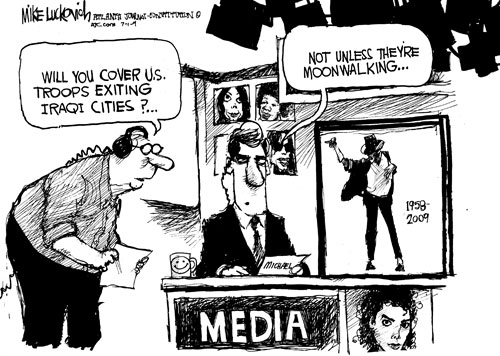
First performed for his song ‘Billie Jean’ on a U.S. TV show in March 1983, Jackson’s dance technique that gives the illusion of the dancer stepping forward while actually moving backward gained worldwide popularity and became his signature move.

Like that historic ‘moonwalk’ 40 years ago, Jackson’s untimely death on June 25, 2009 created ripples that was felt worldwide. News of his sudden death crashed some news or social networking websites, and stalled others. Even the mighty Google, now the world’s largest media operation, slowed down; Google News was inaccessible for a while.

This is the opening of my latest op ed essay, inspired by the media and public reactions to Michael Jackson’s sudden death. Titled ‘King of Pop Moonwalks to Online Immortality’, it has just been published by the Asian Media Forum website.

I must admit that I’m more a fan of the original Apollo moonwalk than Michael’s version. I was three and a half years when the first Moon landing happened, which remains my earliest childhood memory that can be traced to a specific date.

Moonwalking all over the news - Cartoon © 2009 Creators Syndicate
All the same, as an observer of media and popular culture trends, I have always been interested in the Michael Jackson phenomenon. The crux of my new essay is captured in this para: “He was not the world’s first mega-star — in the zenith of their careers, the Beatles and Elvis Presley were similar globalised cultural icons. But two waves of communication technology, arriving in quick succession, propelled Jackson to unprecedented heights in popular culture: satellite television and the Internet.”

I look back at how these twin technologies transformed far-away Jackson into a local icon across Asia. I also recall a 2001 documentary named Michael Jackson Comes to Manikganj. Directed by Indian journalist Nupur Basu, it probed how far and wide satellite television was influencing and impacting culture, society and even politics of South Asia. (Full disclosure: I was interviewed on the film, along with nearly two dozen other South Asians.)

Read Nupur Basu’s own recent recollections of how she came across Michael Jackson in remote parts of South Asia, courtesy satellite TV.

The essay ends noting how Jackson could not quite ride the Internet wave the way he did the satellite TV wave. I share my thoughts on how the world’s online population — now over 1.5 billion people according to one estimate — reacted to the news that King of Pop was no more.

The news created a data tsunami of its own on the web, which incidentally – and half the world away – provided a much need respite for the Ayatollahs of Iran…Read the full essay and find out why!

Read earlier blog post: 26 June 2009: Michael Jackson (1958-2009): Mixed celebrity, entertainment and good causes

Tabloid science maybe imperfect, but it’s still better than no science coverge!

WCSJ London

Raised on popular culture, I have always been an admirer of tabloid journalism – which means using popular formats to reach out to a mass audience in newspapers or broadcasting. There’s nothing inherently wrong with this: we might even argue that the tabloid approach is the only way to achieve truly mass media (with all else being niche media reaching to smaller demographic groups).

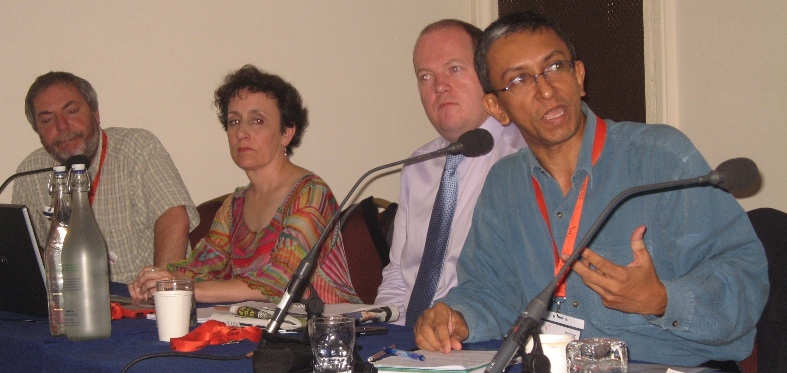
So I was delighted to be on a panel with two leading British tabloid journalists and a popular radio host from South Africa during the 6th World Conference of Science Journalists held in London from June 30 – July 2, 2009.

We had to address this question: Does science coverage in the media need to be highbrow?

My own, personal answer is NO — it need not be! And I’ve spent a good part of my two decades of work in the media experimenting and showing that communicating science can be fun — both for us communicators and our audiences.

But I pointed out that science is still being covered in sections of Asian media in the more traditional, classical way, just like science itself is still an elitist pursuit in many of our societies.

L to R: Paul Sutherland, space correspondent of The Sun, UK; Christina Scott, radio and web journalist, South Africa; David Derbyshire, Environment editor, The Daily Mail, UK; Nalaka Gunawardene, Director/CEO, TVE Asia Pacific

I said: “We might call this coverage ‘broadsheet approach’ in print; or ‘bluechip documentary’ format on television. And they are both unsustainable! They are also endangered in these hard times for the mainstream media in most economies.

“So going the tabloid path is a practical and pragmatic way to deliver science stories and science information to a mass audience or readership. We’re doing it in different ways in the Asian media!”

In my remarks, I gave some examples where science is jazzed up (rather than dumbed down) for popular consumption on Asian television. For example, how solar and lunar eclipses provide fodder for endless stories on our numerous news channels. Such coverage, fleeting and superficial as it might often be, takes the wonders of science and Nature to more people than anyone else can.

I argued that the path to the mass audiences in Asia is through news, sports and entertainment programming. We have our own niche, factual channels – Discovery, National Geographic, Animal Planet and their local equivalents. They have a loyal but small audience. They do excellent work. But where numbers are concerned, they cannot – yet! – compete with the outreach and appeal of broadcast radio, TV and newspapers. Neither can the online and mobile media, even though their outreach is growing fast.

Things don’t always go right, however. Doing wall-to-wall coverage of news demands producers and reporters to tackle a variety of topics and subjects — including specialised science stories. Some handle this better than others. In their race for ratings and revenue, a few ‘dress up’ the stories a bit too much.

Television science: aspiration or reality?
A good example was how some Indian news channels handled the so-called ‘Big Bang experiment’ in September 2008, when the Large Hadron Collider (LHC) was commissioned. The mega-science experiment was interesting in its own right, but it wasn’t apparently exciting enough for at least two channels — Aaj Tak and India TV. Their coverage running up to the event speculated about its “catastrophic effect on the world” – effectively end of the world.

Their coverage caused panic, which led to at least one attributable death. This prompted the Indian Ministry of Information and Broadcasting to caution the channels for spreading “misinformation, fear and horror” among viewers. It advised the channels to exercise restraint in presenting such issues.

I call this the ’24/7 TV Deficit’ in Asian broadcasting. The long term response to this is to invest in training and capacity building of journalists and producers already working in the media. For the most part, they learn on the job, making mistakes on the air. This is far from ideal.

Here’s how I summed up: ‘Tabloid science coverage’ – in print or broadcast – may be imperfect in some ways. But our choice is either that, or nothing. Our challenge is to make the process and product better as we go along.

We urgently need to unleash scientific knowledge and understanding in matters of public interest and public policy. We can’t afford the ALL or NOTHING approach.

24/7 TV Deficit: When more (channels) gives us less (news)…

WCSJ London

When Cable News Network – or CNN – was launched in June 1980, it became the first network to provide 24-hour television news coverage, and the first all-news television network in the United States. Most people didn’t believe it would last for long, for they could hardly believe that there was enough news to fill all hours of the day and night.

They had reasons to be skeptical: at the time all major TV channels and networks in North America, Europe and elsewhere carried an hour or two of well-packaged and well-presented news bulletins per day. Viewers looked forward to these bulletins, when able and amiable anchors like Walter Cronkite – ‘the most trusted man in America’ – entered their living rooms for an update and reflection on the day’s events. A leader had to be assassinated or men had to walk on the Moon for this routine to be broken…

CNN founder Ted Turner changed all that. He proved the skeptics wrong, and blazed a new trail in broadcast journalism. In his wake, dozens and now hundreds of all-news channels have emerged, providing a cacophony of coverage and punditry as never before seen.

Saturated with news on TV? Reach out for this relief!

One of the early, unofficial expansions of CNN was ‘covering news needlessly’. This was sometimes necessary to fill 24 hours a day (or 1,440 minutes) and 7 days a week (or 168 hours). The channels say repetition is meant to give the chance for any viewer to catch up on the news whatever time she tunes in. But the question remains: is there so much news to fill not only 24/7 but hundreds of such channels?

The answer is both yes – and no. It all depends on the definition of news, and what each channel considers to be in the public interest. We won’t get into that big debate here. But the fact remains that, at least where the numerous all-news channels in Asia are concerned, they often struggle to fill their air time – and not always very successfully.

And do we have an abundance of such channels. India alone now has more than 60 all-news channels catering to a billion+ audience in dozens of languages…and more keep popping up. Elsewhere in countries such as the Philippines, Pakistan and Thailand, there have been similar channel explosions in recent years. This is partly triggered by media liberalisation which allowed local and foreign private companies to enter the broadcast sector that earlier remained a state monopoly.

Aryn Baker of TIME
Aryn Baker of TIME
But more channels has not necessarily meant better coverage of news. There was a perceptive observation by Time magazine’s Aryn Baker in a recent essay she wrote in June 2009 about the state of Pakistan’s media. In her essay titled Casualty of War, she noted: “In 2002, the then President, General Pervez Musharraf, permitted private TV stations to broadcast news instead of just the state-owned Pakistan Television Corp. At the time, Musharraf’s deregulation was hailed as a significant step for the nascent free-press movement; indeed, today there are more than 30 nongovernment TV stations in the country. As TV stations proliferated, I argued that increased competition would force the emergence of a strong, ethical and responsible media corps. But there simply aren’t enough well-trained and -informed local journalists to supply the dramatically greater number of media outlets. I also assumed that consumers would gravitate toward truth. Instead the bulk of readers and viewers seem comfortable with sensationalism and xenophobia — as reflected by an April poll conducted by Gallup Pakistan revealing that 76% of Pakistanis “believe Pakistani media [are] unbiased to a great or somewhat extent.” In other words, Pakistanis like their media the way they are.

Baker cites examples where the print and broadcast media in Pakistan regularly rumour and peddle conspiracy theories as news. She ends with a strong plea: “Pakistan’s press needs to take a hard look at itself and its level of professionalism. Only then will it live up to its potential, and only then will Pakistan get the media it deserves.”

Shooting the news...
I couldn’t agree more. Having cheered the collapse of state broadcasting monopolies across Asia in the 1990s, I have very much felt the same way about news channels across the region (here I’m talking about the English language channels only, which are outnumbered in most markets by local language channels). While there are a few news channels that stand above the rest, a majority would come close to what Aryn Baker describes for Pakistan.

Speaking at the 6th World Conference of Science Journalists held in London in early July, I called this the ’24/7 TV Deficit’ in Asia’s broadcast media. In summary, it is this: In the developed world, all-news channels like CNN evolved over time, building capacity and experience along the way. In emerging Asia, news channel explosion hasn’t allowed time for such evolution – so skills and resources are spread too thin. There are genuine limitations of competence and capacity. Sometimes this leads to sensationalism or distortion.

I said: “The long term response to this is to invest in training and capacity building of journalists and producers already working in the media. For the most part, they learn on the job, making mistakes on the air. This is far from ideal.”

Communicating disasters on film: Experts, please don’t cross this line!

Global Platform bannerExperts should let film-makers produce professional films in simple terms that are more appropriate for public audiences, instead of trying to produce films that have little chance of being broadcast or distributed in other ways. There is a role for technical experts – but that’s not in the crafting and directing of films, but in providing the knowledge, clarifications and guidance to film-makers and journalists who are professionals in communicating complex issues to non-specialist publics.

Self-evident as it may be, these home truths are well worth reiterating every now and then — especially to experts and officials who keep forgetting them (sometimes with disastrous and expensive results!). So I was very glad to read that these points were emphatically made at a ‘film debate’ held in Geneva last week.

The occasion was a panel discussion, ambitiously titled ‘The role of film-makers in promoting climate change adaptation and disaster risk reduction stories’. It was held on 17 June 2009 as part of the Second Session of the Global Platform for Disaster Risk Reduction in Geneva.

Moderated by the well known journalist, writer and producer Edward Girardet, from Media21, Geneva, it involved five panelists drawn from media/communication sector and the disaster/humanitarian sectors. Among the panelists was my colleague Robert Lamb, director of One Planet Pictures, UK, and consultant producer with dev.tv, Switzerland.

The debate’s premise was simple: So far much of the thrust of the film industry, NGOs, UN organizations and media in portraying disasters and climate change has focused on outcome – which is more visually stimulating – rather than showcasing vital prevention and adaptation solutions. This is necessary, but not sufficient. What can be done to improve the interaction between the film/news industry and leading organizations dealing with disaster risk management and climate change adaptation on a daily basis?

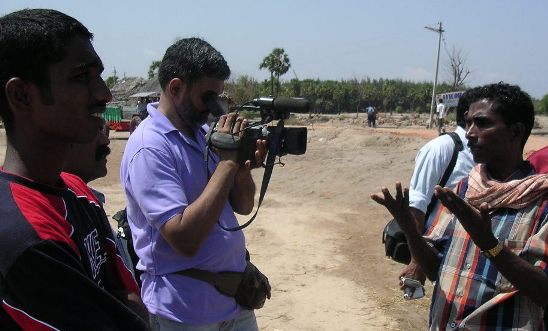
Interviewing tsunami survivor in Tamil Nadu, India - image from TVEAP
This was similar to the approach we had in TVE Asia Pacific’s Communicating Disasters project in Asia (2006-2007). We too explored the common ground for these two sectors, with their distinctive needs, and asked how the two can support each other without stepping on each others’ toes.

The same discussion continued in Geneva. I’ve limited information on what actually transpired during the debate, and am hoping someone will soon write it up. For now, here’s a summary adapted from UN-ISDR daily coverage (the official language is theirs, not mine):

“More than 150 participants attended a thought-provoking film debate. The five panelists discussed how to enhance the interaction between the film/news industry and leading organizations dealing with climate change adaptation (CCA) and disaster management to increase CCA visibility which is very limited today in film productions.

“Eight short films were presented during the session, among them a short trailer of ‘An Inconvenient Truth’ and a CCA film shot in Burkina Faso produced by Christian Aid. After identifying a number of challenges due to their formats and audiences, film-makers and experts agreed it was important to work more closely to make more films on the solutions offered by CCA.

“Film-makers suggested that experts should let them produce professional films in simple terms that are more appropriate to their audiences and focus on bringing expert knowledge to enrich the content of their current productions instead of producing films that have little chance to be broadcast or distributed.”

All this reminds me of a discussion we had around an earlier blog post where I asked: Anyone can make video film, right? So why do we need professionals?

Tiananmen + 20: Tribute to Tank Man, or the Unknown Rebel

One man vs. the mighty Red Army
One man vs. the mighty Red Army - photo by Jeff Widener for Associated Press

This is of the most famous photos of modern times. The official caption, given by Associated Press, reads: “An anti-government protester stands in front of artillery tanks in Beijing’s Tiananmen Square on June 5, 1989, at the height of the pro-democracy protests.”

It’s a moment deeply etched in the consciousness of our media-saturated world. The solitary, unarmed man was standing up against not just a brute of a tank, but the might of the entire Chinese Red Army, which had just cracked down ruthlessly on pro-democracy student protests.

It was on the morning of June 5 that the Tank Man appeared from nowhere. A line of 18 tanks were pulling out of Tiananmen Square and driving east along the Avenue of Eternal Peace. The previous day, the square had been cleared of students and much blood had been spilled. The streets were now empty except for soldiers.

Suddenly a man in a white shirt and black trousers, with a shopping bag in each hand, steps out on to the road and stands waiting as the tanks approach. The lead vehicle halts, assessing its options.

It moves right to go around him. The man waves the shopping bag in his right hand then dances a few steps to the left to block the tank again. The tank swerves back left to avoid him. The man waves the bag again and stepps to the right. Then both stop. The tank even turned off its engine.

Then more things happened.
Watch a video montage of this breathtaking standoff, captured by western journalists filming from a safe distance:

Watch first few minutes of the 2006 PBS documentary on the Tank Man incident and aftermath:

Twenty years on, the identify of the Tank Man remains a mystery. There are conflicting reports on who he was, and what happened to him after that single, defining act of defiance. Practically all we know is that he wasn’t run down by the tanks, and was instead arrested a few minutes later by the Chinese authorities. Naturally, there are few official comments on the incident or the Tank Man.

But during those few minutes, when individual soldiers hesitated and refrained from running him over, the Unknown Rebel secured his worldwide fame. He probably wasn’t doing it for any notion of posterity – in all likelihood, he was horrified bystander who’d seen the carnage in the preceding days and felt, as we do from time to time, that enough was enough.

And unlike most of us, he decided to risk his life to register his protest. In April 1998, Time magazine included the “Unknown Rebel” in its feature entitled Time 100: The Most Important People of the Century.

Charlie Cole, a Newsweek photographer who captured the moment, says: “Personally I think the government most likely executed him. It would have been in the government’s interest to produce him to silence the outcry from most of the world. But, they never could. People were executed at that time for far less than what he did.”

He adds: “I think his action captured people’s hearts everywhere, and when the moment came his character defined the moment rather than the moment defining him. He made the image, I just took the picture. I felt honoured to be there.” Read the full account by Charlie Cole

Read the recollections of the four photojournalists who captured this historic moment

A ground level view of Tank Man preparing for his showdown with tanks - photo by Terril Jones In early June 2009, a fifth photographer shared his own image of the incident – disclosing photos that had never before been circulated. Associated Press reporter Terril Jones revealed a photo he took showing the Tank Man from ground level, a different angle than all of the other known photos. (Tank Man is the second from left, in the background.) Jones initially didn’t realise what he had captured until a month later when printing his photos from that momentous week.

As we celebrate the memory of the Tank Man – and his defiance of brutal, oppressive use of state power to crush dissent – we must also salute the courage and resourcefulness of photojournalists and TV reporters who risked their own lives to capture this moment for posterity. Tank Man became iconic only because his act was frozen in time by those bearing witness. All too often, states – from Burma to Zimbabwe, and others in between – ensure that there is no one to bear such witness when they unleash the full force of police, armies and weapons on their own people.

There can be no doubt that Tank Man was not the first of his kind, nor would he be the last. Other ordinary men and women have found uncommon courage to stand up against injustice and state brutality wielded in the name of national security, law and order or anti-terrorist crackdown. But in the absence of witnesses – whether professional journalists or citizen journalists – the rest of the world will never know.