Memory is a curious phenomenon. Sometimes memories of our personal past are evoked in the most unexpected manner, reviving nostalgia for days that are forever lost in the sands of time.
I have never visited Poland, but it’s been on my mind in recent days. 1 September 2009 marked the 70th anniversary of the beginning of the Second World War – which was sparked off by Nazi Germany’s invasion of Poland.
That’s also the day when the Anglo-American poet W H Auden wrote his deeply evocative poem, September 1, 1939. He wrote it sitting in a New York bar and distraught by the clouds of hatred gathering over Europe. I’ve been reading and re-reading it this year as the war Sri Lanka – which lasted almost five times longer – officially ended in May 2009.
As I wrote at the time: “Almost 70 years later, at the end of my own 30-year-long war, I have been reading and re-reading September 1, 1939. I’m trying to make sense of what is happening around me. The near hysterical mass euphoria on one side, and bewildered dejection on the other.”
I have only just remembered that Poland in September 1939 holds another significance for me. It has to do with the Polish film Moja Wojna – Moja Milosc (My War-My Love, 1975), which I saw in the summer of 1979 at a Colombo cinema as a 13-year-old school boy.
Not only did I see the film, but I also wrote an essay reviewing it and entered it into a competition organised by the Embassy of Poland. Growing up in a country that didn’t have broadcast television until that very year, I had only seen a handful of movies up to that time. I was no movie critic, but my views on the film and its resonance with my own times must have struck a chord with the judges. For I won the second prize in the Sinhala essay competition.
Being runner-up was no big deal by itself, but this was the first time that my writing was competitively judged and ranked by anyone outside my immediate circles. My prize included a fountain pen, white polyester cloth for school uniforms, and an LP record of Polish music (yes, LPs were still in use, but on their way out at the time!).
From My War - My LoveI would go on to win many essay competitions during my teens, and one day earn an honest living as a wordsmith. But that movie review – long since lost in the mists of time – was my first success. My career in literary crime was thus forged…thanks to a Polish movie!
From the little that I can still remember, 30 summers later, My War-My Love wasn’t a pretty film. It is set during the week of the Nazi invasion of Poland in 1939. Daring 17-year-old schoolboy Marek (Piotry Lyjak), inspired by the example of the Sobieski cadets during 1831 insurrection, vows to take on Germans single-handedly. He devotes most of his energy to protecting a young girl who lost her mother during the invasion.
As one reviewer wrote, “My War-My Love could not, by its very nature, end altogether happily, but the film can be regarded as life-affirming.”
War has no place for innocence - then or now...That film was my first visual introduction to the horrors of war, a topic that was to dominate my own future for the next 30 years to come. In that Sri Lankan war, child soldiers several years younger than the film’s character Marek would play a prominent role.
At a far more personal level, I had never been in love when I saw My War-My Love. In the three decades to follow, I would fall in love three times — and lose out every time, though for very different reasons (none of which involved ‘my’ war). I must now carry the pain of these lost loves for the rest of my time. But that is another story…
Thanks to the wonders of Google, I’ve been able to track down some specifics about the film. It was directed by Janusz Nasfeter (1920 – 1998), a versatile Polish film maker whose career in writing and directing films spanned from the late 1940s to the early 1980s. He was 19 when the Germans came marching in.
It was one of many films that have used the Second World War as its backdrop. There have been several other Polish films that looked back on the Polish resistance, Poland Holocaust and Warsaw uprising of 1944 and other key events that left an indelible mark on the country. In fact, as this listing in Wikipedia shows, when Janusz Nasfeter made My War-My Love, the theme was pretty much covered by different Polish film makers in numerous ways.
I haven’t seen any of these other Polish films, and even My War-My Love is now only a distant memory. But as a moving image creation that moved my life in a certain direction, it would always have a special place in my heart.
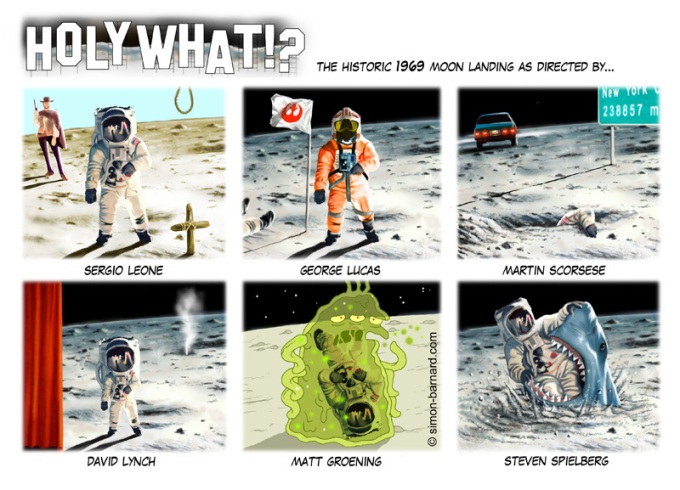
Is this how it really happened? Just kidding!When NASA announced last week that they were working with a leading digital imaging company in Hollywood to remaster the original Apollo 11 Moon walk video footage, I told myself: that’s one more cannon to the conspiracy theorists!
Everyone would welcome a quality improvement in those murky, grainy moving images capturing humanity’s grand achievement. But the choice of Lowry Corporation, best known for restoring old Hollywood films, could fuel the fire of conspiracy theorists who argue that the entire Moon landing was faked by NASA with the connivance and participation of Hollywood. They believe that the entire Apollo programme – that landed people on the moon six times between 1969 and 1972 – was staged on a movie set or secret military base.
This link didn’t bother Richard Nafzger, the NASA engineer who oversaw television processing at the ground-tracking sites during the Apollo 11 mission, and now involved in their restoration. “This company is restoring historic video. It mattered not to me where the company was from,” Nafzger was quoted as saying.
Technically and officially, NASA is right. The US space agency has always dismissed the conspiracy theorists, and not spent much time discussing the outrageous idea. As it says on NASA website: “The Apollo Moon landings were among the most completely documented and observed events in history. Moon rocks have been examined by scientists from all over the world, not just the U.S. Video special effects were in their infancy in the late 60’s so that faking a landing on the Moon would probably have been more difficult than actually going there, and it seems highly unlikely that the hundreds or even thousands of people who would have had to be involved in such a conspiracy would have kept it a secret for so long.”
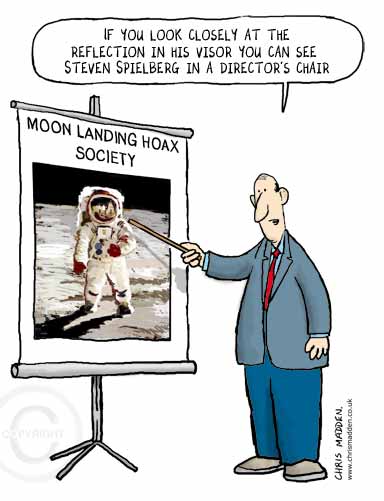
Err, Wasn't Spielberg only 23 at the time...?Independent scientists point out that it would be impossible for tens of thousands of NASA employees and Apollo contractors to keep such a whopping secret for almost four decades. Tell that to those who are deeply suspicious of anything to do with governments, who historically don’t have the best record for transparency and full disclosure!
So the conspiracy theory lingers. Like many other crazy ‘theories’, it has spread rapidly with the growth of the Internet. It’s really an old one: even at the time Apollo astronauts landed on the Moon, a few people refused to believe it as it apparently conflicted with their religious beliefs.
The Moon Hoax, as it’s popularly called, accuses NASA of manufacturing, destroying, or tampering with evidence — including photos, telemetry tapes, transmissions, and rock samples; and that the deception continues to this day. These theorists concede that the Apollo launches did take place. But instead of going to the Moon, which they say was technologically impossible at the time, the astronauts just orbited the Earth for a few days while NASA carefully fed the media with manufactured images. And then they returned to a heroes’ welcome!
My curiosity in conspiracy theories stems from my interest in popular culture. In this instance, I’m intrigued to note how moving images have fuelled the Moon Hoax theory in a number of ways. A cornerstone in the doubters’ argument is that NASA’s photos and videos from the moon contained ‘suspicious anomalies’ (all of which, by the way, have been satisfactorily explained by scientists.)
Superb entertainment, but it was just that...Some believe that these theories inspired the 1978 movie Capricorn One, where NASA fakes a Mars landing on a military base on Earth, and then goes to desperate lengths to cover it up. It’s entirely possible that some people can’t discern fact from fiction. Or why allow facts to get in the way of a damn good story?
At one point in the early 1990s, he wrote to the NASA Administrator, with his tongue firmly in his cheek, saying: “Dear Sir, On checking my records, I see that I have never received any payment for this work. Could you please look into this matter with some urgency? Otherwise, you will be hearing from my solicitors, Messrs Geldsnatch, Geldsnatch and Blubberclutch.”
Of course, he never received – nor expected – a reply. But when media reports about this appeared, some with no sense of humour considered it further ‘proof’ of a cover-up!
And here’s another connection: Peter Hyams, who directed Capricorn One, went on to direct the movie adaptation of Arthur C Clarke’s 2010: Odyssey Two, which was released in 1984.
More seriously, in later years Sir Arthur was concerned that at one point a few years ago, millions of Americans harboured doubts whether the Moon landings actually took place. That indicated a failure of the education system to produce people with critical thinking abilities, he said.
The conspiracies received a boost when, on 15 February 2001, the Fox News TV network aired Conspiracy Theory: Did We Land on the Moon?. Hosted by X-Files actor Mitch Pileggi, this hour-long, sensational documentary peddled what it called eerie “inconsistencies” in NASA’s Apollo images and TV footage. Among them: no blast craters are visible under the landing modules; shadows intersect instead of running parallel, suggesting the presence of an unnatural light source; and a planted American flag appears to ripple in a breeze although there’s no wind on the moon.
It concluded that the whole Apollo Moon landings were faked in the Nevada desert because, cccording to the conspiracy theorists, NASA did not have the technical capability of going to the Moon, but pressure due to the Cold War with the Soviet Union forced them to fake it. Fox TV did preface the programme with a notice saying: “The following programme deals with a controversial subject. The theories expressed are not the only possible interpretation. Viewers are invited to make a judgement based on all available information.” But skeptics felt Fox didn’t do enough to provide a minimum level of balance in their discussion.
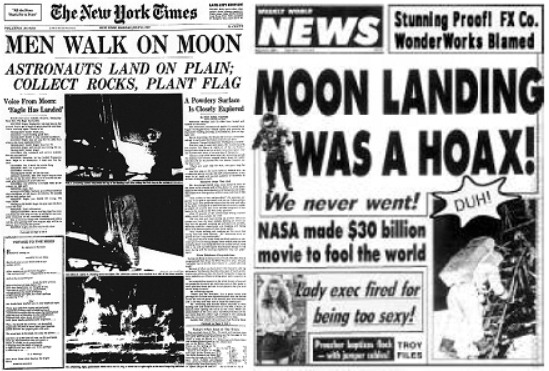
Warning: This is a funny cartoon and not meant to be taken seriouslyThe documentary’s ‘evidence’ has since been refuted point by point. NASA has also dismissed the documentary’s claims. It prompted Sir Arthur Clarke to protest to his long-time friend Rupert Murdoch, owner of the Fox TV network, for peddling unscientific nonsense.
Rather than being a ‘true believer’, Fox TV may have been trying to boost its audience ratings. But others in the moving images industry apparently take the matter very seriously. Among them is the film-maker Bart Sibrel. His aggressive interview tactics once provoked astronaut Buzz Aldrin (second man to walk on the Moon) to punch him in the face in a 2002 encounter.
“I don’t want to call attention to the individuals who are trying to promote and shuffle off this hoax on people,” Aldrin told CNN in a recent interview. “I feel sorry for the gullible people who’re going to go along with them. I guess it’s just natural human reaction to want to be a part of ‘knowing something that somebody doesn’t know.’ But it’s misguided. It’s just a shame.”
One of the strongest rebuttals of the Moon hoax on TV has come from the Mythbusters series of popular science programmes produced by Beyond Television Productions, originally for the Discovery Channel. The series features special effects experts Adam Savage and Jamie Hyneman, who use basic elements of the scientific method to test the validity of various rumors, myths, movie scenes, internet videos and news stories in popular culture.
In August 2008, they tackled a number of pervasive myths associated with the Moon landing, debunking them one by one. To film the episode, Adam, Jamie and the rest of the Mythbusters team visited the NASA Marshall Space Flight Center in Alabama. A team of Marshall scientists helped the Mythbusters with several of their tests. Here are two excerpts:
As the 40th anniversary of the first Moon landing passes, the scientific community and rationalists will have to make some hard choices. How much more time and energy must they expend countering such wildly fanciful theories and fantasies? In a world that still has a (dwindling?) number of people who believe in more ancient concepts like the Flat Earth theory, is it really surprising that the Space Age would inspire its own share of modern-day myths?
No matter what the scientists say and how overwhelming the evidence is, conspiracy theories will always believe what they want. Often their convictions border on a blind faith – and as Arthur C Clarke was fond of saying (in relation to religions), one definition of faith is ‘believing in what you know isn’t true!’.
In a pluralistic world, people choose what to believe inThen there is simple demographics. The total world population in 1969 was 3.6 billion. Today, it has surpassed 6.7 billion. This means nearly half of the people alive today were not even born when Neil and Buzz stepped on to the Moon. At 43, even I have only a headline memory of Apollo 11, even if it’s a strong one.
NASA itself is well aware of this. “As the number of people who were not yet born at the time of the Apollo program increases, the number of questions [about the moon landings] also may increase,” NASA said in a statement on the eve of the anniversary. “Conspiracy theories are always difficult to refute because of the impossibility of proving a negative.”
Perhaps what the Moon Hoax debate really needs is what Sir Arthur Clarke once proposed as a response to the obsession with UFOs and alien abductions: a decade or so of benign neglect. Conspiracy theorists and myth-makers thrive on counter-arguments and debate. When they don’t get it for long enough, they’ll probably run out of steam.
Meanwhile, networks like Fox News should stick to making entertainment programming that is labeled as such. Who can find fault with creations like The Simpsons?
She couldn't shatter the glass ceiling to space... Exactly 40 years ago, on 16 July 1969, Apollo 11 blasted off carrying three American astronauts to the Moon. Four days later, history was made when Neil Armstrong and Edwin (Buzz) Aldrin, Jr., become the first human beings to set foot on another celestial body, while their colleague Michael Collins circled the Earth.
When Armstrong stepped on the Moon, he said: “That’s one small step for man, one giant leap for mankind“. Man on the Moon was very much the news highlight of 1969, and at the time, the term ‘mankind’ was understood to include women as well. The more gender-neutral term ‘humankind’ would come into popular use some years later.
Beginning with Apollo 11, the Apollo programme landed a dozen astronauts on the Moon, all of who returned safely – as did the astronauts of the disaster-stricken mission, Apollo 13. Without exception, all of them were white and male. While they were all highly qualified, disciplined and trained men who had worked long and hard to earn their places in history, they did not fully represent the diversity of their nation, let along of the planet whose emissaries they were portrayed to be.
Women, celebrated across cultures as holding half the sky, took a long time to travel beyond the sky to outer space.
Although a Russian (Valentina Tereshkova) had become the first woman in space early on in 1963, it took the Americans another 20 years to have their first woman astronaut: Sally Ride, who traveled to Earth orbit on the Space Shuttle in June 1983.
A recent British documentary reveals how America could have sent a woman to the Moon during the Apollo programme. It reveals, belatedly, one of history’s great might-have-beens.
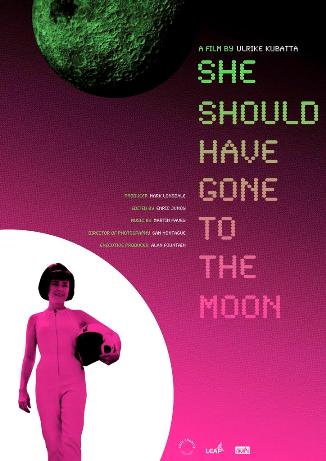
She Should Have gone To The Moon (58 mins, 2008), written and directed by Ulrike Kubatta isn’t quite story that the American space agency NASA would like to be reminded of as it marks Apollo 11’s 40th anniversary.
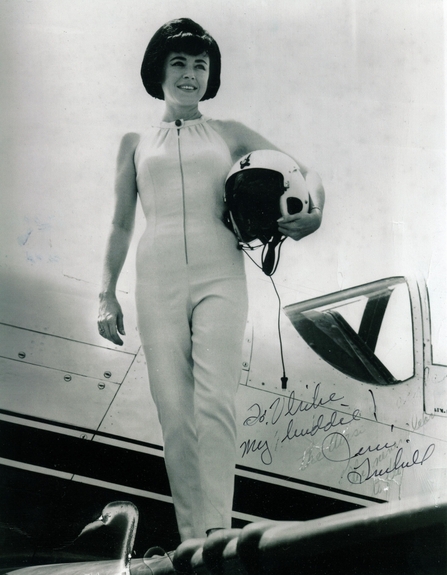
Jerri Truhill, astronaut in training: Not 'monkey enough' for men who ran NASA?The film tells the astonishing story of the pilot and pioneer, Jerri Truhill, who was trained in 1961, as part of NASA’s top secret Mercury 13 programme, to become on of the first woman astronauts. The documentary is a lyrical journey propelled by childhood aspirations, shattered dreams and a lifelong battle against female sterotypes and male prejudice.
Truhill tells how the women outperformed men in all the training tests (including water tank isolation) but how ultimately, the authorities, with the approval of President Johnson, stipulated that they would “rather send monkeys into space than a woman”.
In the film, the tough talking and sharp witted Jerri Truhill looks back at her compelling life via a phone call with the film-maker. This conversation becomes the catalyst for the director’s imagining of key events in Truhill’s potent narrative and inspires a journey to meet the heroine in Texas. Along the way the film-maker places herself in Truhill’s story, first wandering across the surreal landscape of White Sands and then suspended in zero gravity inside a water tank.
Included are staged scenes, dreamt-up moments from Truhill’s story, which evoke the popular melodrama of 1950s American cinema. These fictional moments bridge the gaps of time and distance between the filmmaker and her subject. Their stylised and dreamlike quality is counterpointed by shots from both Truhill’s and NASA’s film archive. The various strands produce the film’s heady timeline, as they circle through real and imagined spaces, past and present.
On LEEDVD.TV’s YouTube channel, I found this segment of another documentary named Rocket Girl, but Google does not bring up too much other info about this film.
Seven of the “Mercury 13” gathered at the Kennedy Space Center in 1995. In the photo below, from left to right, are: Gene Nora Jessen, Wally Funk, Jerrie Cobb, Jerri Truhill, Sarah Rutley, Myrtle Cagle and Bernice Steadman. They came to watch Eileen Collins become the first woman to pilot a space shuttle. NASA has come a long way.
Mercury 13 women reunion in 1995 - NASA image
As I wrote in May 2009, the path-breaking TV series Star Trek, which started airing on television in the US in September 1966, was way ahead of reality. When neither the mainstream television nor the space programme reflected America’s true diversity, Star Trek created a multi-ethnic crew for the Starship Enterprise, roaming the universe in the 23rd century. It included an African-American woman, a Scotsman, a Japanese American, and a super intelligent alien, the half-Vulcan Spock.
Reality took a long time catching up. It was only in August 1983 that Guion “Guy” Bluford, Jr., became the first black American astronaut. Another nine years passed before Dr. Mae Jemison became the first African-American woman to go to space, when she joined a Space Shuttle mission in September 1992. In fact, she cited Star Trek character Uhura as an influence in her decision to pursue a career in space.
Multi-cultural crews did not become commonplace until the late 1990s, when the International Space Station became operational. Space travel has yet to reach the utopian ideals of Star Trek.
Images related to ‘She should have gone to the Moon’ courtesy Ulrike Kubatta. Other images courtesy NASA
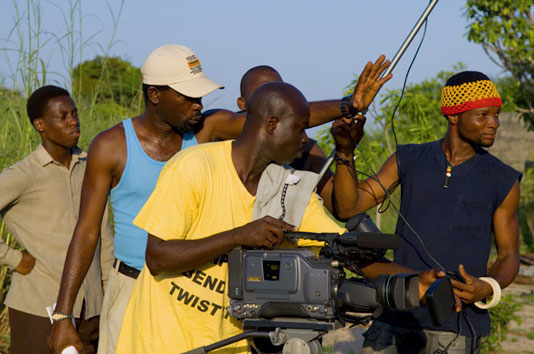
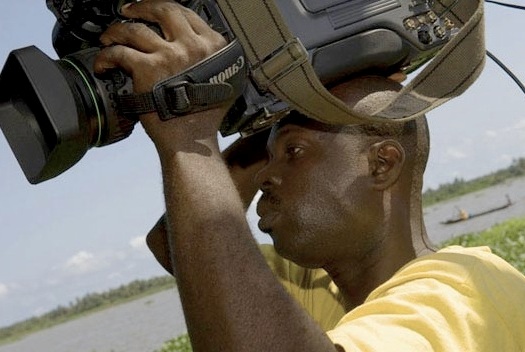
Lights, camera...budget action! Image courtesy 'This Is Nollywood'Here’s a general knowledge question: Everyone knows India’s Bollywood is the world’s largest producer of movies (by number). Which country’s movie industry comes second?
If you said Hollywood, that’s a dated answer. America’s movie industry used to be the second largest in the world — until an unlikely contender turned up from…Nigeria!
Bollywood produced 1,091 feature-length films in 2006 compared to 872 productions (in video format) from Nigeria’s film industry, commonly referred to as Nollywood. In contrast, the United States produced 485 major films.
The three heavyweights were followed by eight countries that produced more than 100 films: Japan (417), China (330), France (203), Germany (174), Spain (150), Italy (116), South Korea (110) and the United Kingdom (104).
Nigerian filmmakers rely on video instead of film to reduce production costs. And as the survey points out, Nigeria has virtually no formal cinemas. About 99% of screenings occur in informal settings, such as “home theatre”.
This is NollywoodThe UNESCO survey reveals another key element of the Nigerian success story: multilingualism. About 56% of Nollywood films are produced in Nigeria’s local languages, namely Yoruba (31%), Hausa (24%) and Igbo (1%). English remains a prominent language, accounting for 44%, which may contribute to Nigeria’s success in exporting its films.
Nollywood’s rising has been chronicled in a 2007 documentary by Franco Sacchi and Robert Caputo. Called This is Nollywood, it tells the story of the Nigerian film industry – a revolution enabling Africans with few resources to tell African stories to African audiences. Despite all odds, Nigerian directors produce between 500 and 1,000 movies a year. The disks sell wildly all over the continent – Nollywood actors have become stars from Ghana to Zambia.
Says Zambia-born director Franco Sacchi: “When I first read about Nigerian directors producing hundreds of feature-length films with digital cameras, a week, and a few thousand dollars, I found the subject irresistible. Here was not only a rare positive story about Africa, but one that embodied the egalitarian promise of digital technology—anybody can make a movie. And Nollywood was virtually unknown.”
This is Nollywood takes us behind the sets and scenes in one Nigerian movie being made on the cheap — and fast. Acclaimed director Bond Emeruwa sets out to make a feature-length action film in just nine days. Armed only with a digital camera, two lights, and about $20,000, Bond faces challenges unimaginable in Hollywood and Bollywood.
Emeruwa says: “We are telling our own stories in our own way, our Nigerian way, African way. I cannot tell the white man’s story. I don’t know what his story is all about. He tells me his story in his movies. I want him to see my stories too.”
Watch This is Nollywood: Movie Trailer
I then came across this TED Talk by Franco Sacchi, where he takes us through Nollywood (at the time he gave his talk, the world’s third largest and now second only to Bollywood). He talks about ‘guerrilla film-making’ and brilliance under pressure from crews that can shoot a full-length feature in a week.
Welcome to Nollywood is another 2007 documentary film, directed by Jamie Meltzer, that looked at the Nigerian film industry. Its findings were similar to those of This is Nollywood. Traveling to the country’s chaotic capitol, Lagos, Meltzer spent ten weeks following three of Nigeria’s hottest directors, each different in personality and style, as they shot their films about love, betrayal, war, and the supernatural.
At around US$250 million per year (and rising), Nollywood’s capital outlay is far below that of Hollywood and Bollywood. For perspective, that’s a bit less than what it cost to make Spiderman 3in 2007 (budget: US$ 258 million) — the second most expensive film made. See list of most expensive Hollywood films.
Telling their own stories....But what it lacks in capital, Nollywood more than makes up in numbers and mass appeal. As the Wikipedia notes, Nigerian directors adopt new technologies as soon as they become affordable. Bulky videotape cameras gave way to their digital descendents, which are now being replaced by HD cameras. Editing, music, and other post-production work is done with common computer-based systems.
As Colin Freeman wrote in the Daily Telegraph, UK: “While the likes of Serpent in Paradise and Evil Finger may not be as slick as their Hollywood counterparts, they offer one thing that the likes of George Clooney and Brad Pitt can never provide: characters and stories with which an African audience can identify.”
And according to The Economist, it all started in 1992, when Kenneth Nnebue, a Nigerian trader based in Onitsha, was trying to sell a large stock of blank videocassettes he had bought from Taiwan. He decided that they would sell better with something recorded on them, so he shot a film called “Living in Bondage” about a man who achieves power and wealth by killing his wife in a ritualistic murder, only to repent later when she haunts him. The film sold more than 750,000 copies, and prompted legions of imitators.
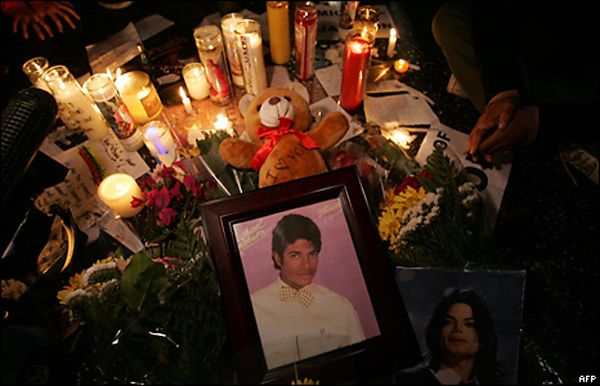
Michael Jackson, who has just died aged 50, has been called the Elvis Presley of our times. He certainly was a global cultural icon with an enormous following in the West and East, North and South. And he used this celebrity status for more than mere entertainment (which he did exceedingly well): he had a long-standing history of releasing socially conscious songs that spread public interest messages with great ease and power.
Mixing social messages with entertainment is a difficult and delicate art that only a few artistes manage to get right. Jackson was one of them — his mass appeal or sales didn’t suffer because he occasionally endorsed a worthy cause. He wasn’t overtly political like Pete Seeger, who turned 90 last month, but Jackson did it in his own unique way in songs like “We Are the World“, “Man in the Mirror” and “Heal the World“.
In fact, Michael Jackson’s biggest selling UK single ever was a song about the environment: Earth Song. Released in November 1995, it sold over a million copies and was at the top of the charts for six weeks.
Earth Song was the first of his songs that overtly dealt with the environment and animal welfare. Written and composed by Jackson himself, Earth Song opened with these words:
What about sunrise
What about rain
What about all the things
That you said we were to gain.. .
What about killing fields
Is there a time
What about all the things
That you said was yours and mine…
Did you ever stop to notice
All the blood we’ve shed before
Did you ever stop to notice
The crying Earth the weeping shores?
Jackson wanted to create a song that was lyrically deep yet melodically simple, so the whole world, particularly non-English-speaking fans, could sing along. He conceptualized a song that had an emotional message.
As he later recalled: “I remember writing Earth Song when I was in Austria, in a hotel. And I was feeling so much pain and so much suffering of the plight of the Planet Earth. And for me, this is Earth’s Song, because I think nature is trying so hard to compensate for man’s mismanagement of the Earth. And with the ecological unbalance going on, and a lot of the problems in the environment, I think earth feels the pain, and she has wounds, and it’s about some of the joys of the planet as well. But this is my chance to pretty much let people hear the voice of the planet. And this is ‘Earth Song’. And that’s what inspired it. And it just suddenly dropped into my lap when I was on tour in Austria.”
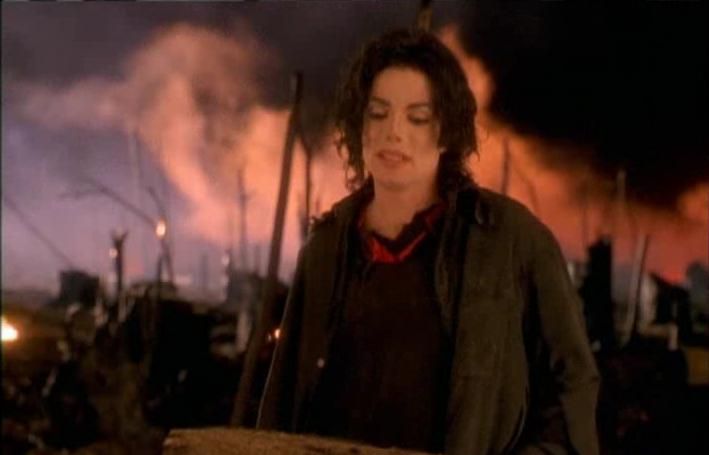
The video of the Earth Song was among the most expensive ever made – it was filmed in four geographic regions and involved scenes from the Amazon forest, Croatia, Tanzania and New York city, USA. It starts with a long tracking shot through a lush rain forest that then cuts to a scene showing Jackson walking through a scorched, desolate landscape. The environmental imagery then rolls on: dead elephants, evil loggers, belching smoke stacks, snared dolphins, seal clubbing, and hurricane winds. The video closes with a request for donations to Jackson’s Heal the World Foundation.
Watch Earth Song by Michael Jackson:
Although not as widely selling, ‘Will you be there‘ is my personal favourite among Jackson’s socially conscious songs. First released as a single in 1993, it was taken from the 1991 album Dangerous and also appeared on the soundtrack to Free Willy – the charming story of a boy befriending a killer whale.
The song won the MTV Movie Award for “Best Song in a Movie” in 1994. It was also included in the album All Time Greatest Movie Songs, released by Sony in 1999. Jackson also performed songs for the film’s two sequels.
Watch Michael Jackson’s ‘Will You Be There’ in Free Willy:
However, Earth Song had much wider and more lasting appeal, almost becoming an anthem for the global environmental movement in the past decade. But its real impact was not among the converted – with this song, Jackson took the green message to the heartland of the Facebook generation.
Few global figures commanded the audience he had – as the New York Times noted: “At the height of his career, he was indisputably the biggest star in the world; he has sold more than 750 million albums.”
“The song is a very rare thing: a hit record with a powerful message about our impact on the environment,” says Leo Hickman writing in The Guardian earlier today.
He adds: “What struck me today watching the video was how it is very much the product of an age before climate change had become a mainstream concern. The lyrics and imagery speak of over-fishing, deforestation, and smog. All of them are still huge and legitimate concerns, of course, but they have all now become somewhat dwarfed by climate change, the most compelling and over-arching environmental issue of our age.
“But that shouldn’t distract us from the song’s impact on its fans. Given its universal success and the repeated showing of its powerful video, it is highly likely that it was the spark that made many people – particularly young Michael Jackson fans, which, even in the mid-1990s, would have numbered many millions of people around the world – stop and think about environment for the first time.”
Experts should let film-makers produce professional films in simple terms that are more appropriate for public audiences, instead of trying to produce films that have little chance of being broadcast or distributed in other ways. There is a role for technical experts – but that’s not in the crafting and directing of films, but in providing the knowledge, clarifications and guidance to film-makers and journalists who are professionals in communicating complex issues to non-specialist publics.
Self-evident as it may be, these home truths are well worth reiterating every now and then — especially to experts and officials who keep forgetting them (sometimes with disastrous and expensive results!). So I was very glad to read that these points were emphatically made at a ‘film debate’ held in Geneva last week.
Moderated by the well known journalist, writer and producer Edward Girardet, from Media21, Geneva, it involved five panelists drawn from media/communication sector and the disaster/humanitarian sectors. Among the panelists was my colleague Robert Lamb, director of One Planet Pictures, UK, and consultant producer with dev.tv, Switzerland.
The debate’s premise was simple: So far much of the thrust of the film industry, NGOs, UN organizations and media in portraying disasters and climate change has focused on outcome – which is more visually stimulating – rather than showcasing vital prevention and adaptation solutions. This is necessary, but not sufficient. What can be done to improve the interaction between the film/news industry and leading organizations dealing with disaster risk management and climate change adaptation on a daily basis?
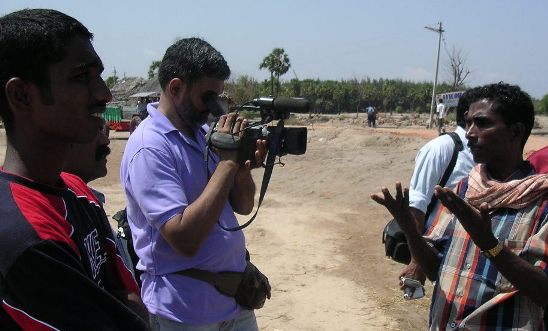
Interviewing tsunami survivor in Tamil Nadu, India - image from TVEAPThis was similar to the approach we had in TVE Asia Pacific’s Communicating Disasters project in Asia (2006-2007). We too explored the common ground for these two sectors, with their distinctive needs, and asked how the two can support each other without stepping on each others’ toes.
The same discussion continued in Geneva. I’ve limited information on what actually transpired during the debate, and am hoping someone will soon write it up. For now, here’s a summary adapted from UN-ISDR daily coverage (the official language is theirs, not mine):
“More than 150 participants attended a thought-provoking film debate. The five panelists discussed how to enhance the interaction between the film/news industry and leading organizations dealing with climate change adaptation (CCA) and disaster management to increase CCA visibility which is very limited today in film productions.
“Eight short films were presented during the session, among them a short trailer of ‘An Inconvenient Truth’ and a CCA film shot in Burkina Faso produced by Christian Aid. After identifying a number of challenges due to their formats and audiences, film-makers and experts agreed it was important to work more closely to make more films on the solutions offered by CCA.
“Film-makers suggested that experts should let them produce professional films in simple terms that are more appropriate to their audiences and focus on bringing expert knowledge to enrich the content of their current productions instead of producing films that have little chance to be broadcast or distributed.”
All this reminds me of a discussion we had around an earlier blog post where I asked: Anyone can make video film, right? So why do we need professionals?
Actress Whoopi Goldberg was a child of 10 when the original series of Star Trek started its first broadcast on NBC in the US in September 1966. The futuristic science fiction series – about a spaceship travelling across space and time in the 23rd century in search of new civilisations – was to leave a lasting impression on many members of her generation.
In Whoopi’s case, it went beyond just general inspiration. Something in the show seemed incredible to the African-American child growing up in a land where colour and race were still divisive factors. She recalls running around the house, screaming: “Hey mom, look! There’s a negro woman on TV — and she ain’t cooking dinner!”.
‘That woman’ was the character Nyota Uhura, played by Nichelle Nichols. This anecdote is captured in the 1997 documentary Trekkies, which explored the global fandom inspired by the show, which has gone on to become a franchise covering several TV series, 11 feature films (including the latest ‘origins’ film released on 8 May 2009), an animation series, as well as numerous books, video games and computer games. As Forbes magazine once noted, the allure is comparable only to that of Star Wars.
Sometimes, less is more!Uhura featured as the communications officer on board the USS Enterprise in Star Trek: The Original Series, Star Trek: The Animated Series, and the first six Star Trek films. She is significant as one of the first major black characters on an American television series and for engaging in a then-taboo interracial kiss with Captain James T. Kirk (William Shatner). In the 2009 film, a younger Uhura is portrayed by actress Zoë Saldana.
The inclusion of Uhura, a black woman, in a critical technical position was certainly idealistic in the mid 1960s when the American civil rights movement was still agitating for equal rights for African Americans. She one of the first black women featured in a major television series not playing a servant; her prominent supporting role as a female black bridge officer was unprecedented.
As I’ve just noted in another blog post: “At a time when there were few non-white or foreign roles in American television dramas, Gene Roddenberry created a multi-ethnic crew for the Enterprise, including an African woman, a Scotsman, a Japanese American, and—most notably—an alien, the half-Vulcan Spock. In the second season, reflecting the contemporaneous Cold War, Roddenberry added a Russian crew member.”
But was the character, donning a sexy mini skirt uniform, somewhat tokenistic? Perhaps. But it still had considerable inspirational value – which is never to be under-estimated.
In fact, after the first season of Star Trek, Nichols had become frustrated at her relative lack of lines. At one point, she considered quitting the show, but was talked out of this decision by the civil rights leader Dr Martin Luther King, Jr.. MLK told her that a show that depicted a black woman working alongside whites in a position of importance was important for the goal of racial equality.
Another version of the story has MLK telling Nichols that he was a big fan of the series, and she “could not give up” since she was playing a vital role model for black children and young women across the country. It is also often reported that Dr. King added that “Once that door is opened by someone, no one else can close it again.”
After NBC executives cancelled Star Trek in 1969, Nichols went on to star in other roles — and also worked for NASA in a campaign to encourage African Americans to join the space service. Among those she helped recruit was Dr. Mae Jemison, the first African-American woman to fly aboard the Space Shuttle, in September 1992. Jemison has cited Star Trek as an influence in her decision to pursue a career in space.
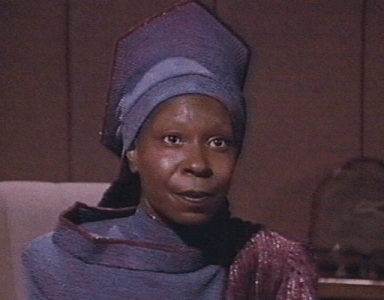
Goldberg: From inspiration to a regular roleMeanwhile, things came full circle for actress Whoopi Goldberg, who was to get her own regular role in Star Trek: The Next Generation whose original run lasted from 1987 to 1994. In this successor series, she played the recurring El-Aurian female character Guinan.
Things have also moved on in the real world, where Barack Obama is now the President of the United States, with Michelle Obama as one of the most influential – if not powerful – women in the world. On 28 April 2009, CNN ran a story titled Why Michelle Obama inspires women around the globe. It noted: “Those who focus on Michelle Obama’s impact on America are underestimating her reach. The first lady is inspiring women of color around the globe to look at themselves, and America, in fresh ways.”
There is no linear link between Nyota Uhura and Michelle Obama, and the real world has very far to go to reach the utopian ideals of Star Trek. But the very fact that we have the Obamas where they are is an assurance that things can slowly move towards Gene Roddenberry’s grand vision.
The power of three...to do good!Just imagine…
You do a favour that really helps someone, and tell him/her not to pay it back…
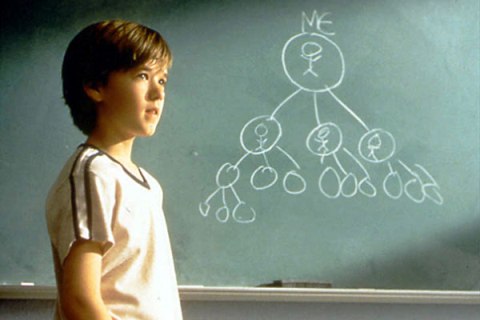
Instead, you ask that it be paid FORWARD to three other people who, in turn, must each pay it forward to three more…and so on.
Impossible? Well, not quite – if you believe (as I do) in the essential goodness of human beings, no matter what their class, race and other divisive factors are.
This idea is known as ‘Pay it forward’. It is really simple: it asks that a good turn be ‘repaid’ by having it done to others instead. Paying it forward has been around as a concept for more than two millennia, from the time of ancient Greece. It was rediscovered in modern times by Benjamin Franklin and later, by Ralph Waldo Emerson, one of my favourite essayists.
In his 1841 essay titled ‘Compensation’, Emerson wrote: “In the order of nature we cannot render benefits to those from whom we receive them, or only seldom. But the benefit we receive must be rendered again, line for line, deed for deed, cent for cent, to somebody.”
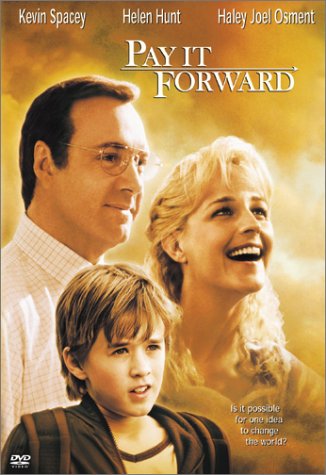
During the Twentieth Century, science fiction author Robert A Heinlein popularised the concept in his book Between Planets (1951). It formed the central theme of Pay It Forward (2000), a novel by Catherine Ryan Hyde, which was soon turned into a movie by the same name.
In that story, a thoughtful teacher challenges his seventh grade students with ‘an assignment to save the world’. One perceptive student devices a scheme where one has to carry out three good deeds for others as repayment of a good deed received. Such good deeds should be things that the beneficiaries cannot accomplish on their own.
It was through Pay It Forward the movie, made in 2000 and directed by Mimi Leder, that I first came cross the idea. It’s one of those simple and elegant ideas that packs so much power to change people and the world. Its implementation requires trust, honour and imagination, which most human beings can muster in sufficient quantity when challenged.
Then I realised that, without a conscious plan and not labelling it as such, I was already ‘paying it forward’ myself — and not just to three new people, but many. That was the least I could do for the many breaks, blessings and opportunities I had received in my professional life.
More about that in a minute. First, take a look at the official trailer for Pay it Forward:
And this is how it all started in the movie, with one thoughtful class teacher challenging his seventh grade pupils with ‘an assignment to save the world’:
Here’s an extended, unofficial trailer remixed by a fan using the official trailer, some scenes from the movie and a few interviews with the key stars:
Journalism – especially the industrialised, mainstream version of it – is by definition a highly collaborative business: newspapers, magazines, as well as TV/radio broadcasts are produced by several or many people working together, each playing a specified part.
And because the media are a mirror on our society and our times, the stories we journalists produce just won’t be possible unless our sources share their information, experiences and insights. This is why Bill Moyers, one of the most respected and credible voices in American broadcasting (a land where such professionals are endangered), says: “We journalists are simply beachcombers on the shores of other people’s knowledge, other people’s experience, and other people’s wisdom. We tell their stories.”
During the early years of my career as a science writer and journalist, I was enormously lucky in both respects. I had kind, indulgent, nurturing senior colleagues who showed me the ropes, expecting nothing in return except good stories. And I benefited much from the kindness and thoughtfulness of many accomplished men and women – mostly in the worlds of science, environment and development – who took the time and trouble to talk to me, clarify even basics to a rookie like myself, and allow me to attribute information or quotes them. I was a complete stranger to many of them, yet they cared enough in spite of busy schedules (there were also a few didn’t, but that’s only to be expected).
Then there were opportunities, some competitively earned, others bestowed on me. In those formative years, the opportunities for training, mentoring and other influences sharpened my skills and shaped my worldview. It was easy to grow up angry with the world and seeing conspiracies everywhere; it was much harder to acquire a balanced view of the world and to become a skeptical enquirer without turning into an incurable cynic.
Among those early influences were:
• Working with the Centre for Science and Environment (CSE) in India, under the late Anil Agarwal and his worthy successor Sunita Narain
• Regional and international training programmes, organised by various UN agencies and other entities such as the Abdus Salam International Centre for Theoretical Physics in Trieste, Italy
• Invaluable support from the International Science Writing Association (ISWA), which leverages far more benefits than its modest resources would indicate at first glance (again, the power of networking!)
• Editorial training and global syndication from Panos, which provided my first outlet to publish internationally through Panos Features (sadly, no more).
Then there was my mentor Sir Arthur C Clarke, who gave me the rare privilege of spending 21 years as his research assistant — a long and unique apprenticeship that enriched me so much.
These and others helped fill gaps in my formal training in science journalism. And such exposure was worth so much more in the days before commercial internet connectivity. There was no Google or YouTube, and early versions of email were just beginning to roll out.
Just do it, and hope others will keep doing it too...And now it’s my turn to ‘pay it forward’. It’s plain and simple; there’s no grand pledge or plan. No one asked me to sign up to any binding agreement. There is no spiritual or intellectual compulsion. I just do it, because that’s a good thing to do.
This is also why I spent a good part of my recent Easter/New Year holidays putting together a detailed response to a young script writer who is passionately promoting a film project related to climate change. I have never met him in person, and until a few weeks ago, I’d never heard of him. A cynical British colleague used to caution me that any crazy nut sitting under a banyan tree can write a letter (or more likely an email these days) claiming to be anything he wasn’t. There’s always that risk. But I’m taking my chances.
Years ago I stopped counting the favours I paid forward, and I no longer even keep track of the people that I give little nudges along the way. Being a secular rationalist with no absolutely religious belief of any kind, I don’t collect brownie points for any ‘next world account’. I just do these little good deeds to make this world a little better place.
If further justification were needed, I cannot say it better than Steven Grellet, a prominent French Quaker missionary who once said (and I quote him for its secular essence): “I expect to pass through this world but once; any good thing therefore that I can do, or any kindness that I can show to any fellow creature, let me do it now; let me not defer or neglect it, for I shall not pass this way again.”
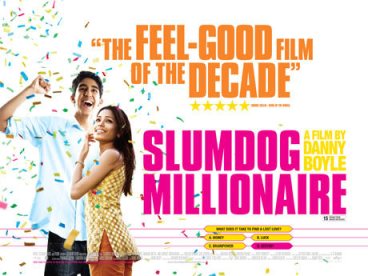
Few films in recent years have generated as much buzz as Slumdog Millionaire, the British-Indian film based in the slums of Mumbai. It has won five Critics’ Choice Awards, four Golden Globes and seven BAFTA Awards, and is nominated for ten Academy Awards, including Best Picture.
I just called to ask...Early on, film critic Ben Walters spotted this aspect. He asked in The Guardian on 9 December 2008: Is Slumdog Millionaire the first truly 21st-century film? Among his reasons: “Jamal works in a call centre decorated with London Underground paraphernalia and whose employees are kept up to date on EastEnders plotlines to improve their chances of successful small talk with their customers. Aptly enough, the customers are mobile phone users – another emblem of 21st-century connectivity – and a mobile plays a crucial part in the story’s climax.”
And now it turns out that a real life ICT experiment triggered the idea of the Slumdog story.
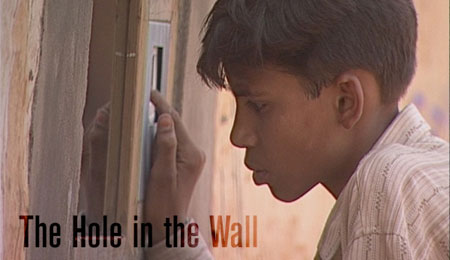
Indian author Vikas Swarup, on whose 2005 novel Q&A the movie is based, has recently revealed how he was inspired by the hole-in-the-wall project. This was an initiative by Dr. Sugata Mitra, chief scientist at NIIT, a leading computer software and training company in New Delhi. Mitra embedded a high-speed computer in a wall separating his firm’s headquarters from an adjacent slum, he discovered that slum children quickly taught themselves how to surf the net, read the news and download games and music. He then replicated the experiment in other locations. Each time the results were similar: within hours, and without instruction, the children began browsing the Internet.
Swarup told Indian Express in January 2009: “That got me fascinated and I realised that there’s an innate ability in everyone to do something extraordinary, provided they are given an opportunity. How else do you explain children with no education at all being able to learn to use the Internet. This shows knowledge is not just the preserve of the elite.”
Discover your world...Dr Mitra’s project was the subject of a 2002 documentary film, called Hole in the Wall, made by the New York based production company GlobalVision.
The film was introduced as follows: A revolution in information technology is redefining poverty, as how much you know is becoming just as important as how much you own. “The Hole in the Wall” examines one possible solution to the growing technological gap between rich and poor — the so-called ‘digital divide’ — that threatens to consign millions to an “information underclass.”
The film was made by Rory O’Connor and Gil Rossellini. An 8-min version was broadcast by PBS in October 2002 in their program Frontline/World. A 60-min version was screened at the United Nations in New York City in December 2002. The film has been widely screened, and won several awards.
Initiator of the Hole in the Wall project carries on his mission to adapt ICTs to serve the unmet needs of India’s poor. Watch Dr Sugata Mitra talk about his work in this TED Video:
In his long years of journalism in India, my friend Darryl D’Monte had faced all sorts of questions and situations. But this was one question that stunned and left him speechless for a while.
A visiting Canadian TV crew made this request in the 1970s, when Darryl was resident editor of The Times of
India. He was giving them some insights on the extent of poverty in his city of Bombay, since renamed as Mumbai. The crew had heard of the deliberate maiming of street children, before being employed as beggars. A disabled child would evoke more sympathy, increasing the daily collection for gangsters operating them from behind the scenes.
Darryl wasn’t willing to be associated with this ‘staging’. “Well, it’s going to happen anyway,” was the film crew’s cynical answer.
Now, fast forward 30 years to the present. At one point in the British-Indian movie Slumdog Millionaire, we see a young girl being blinded by a gangster who shelters and feeds a small army of children — all unleashed on Mumbai on a daily basis to tug at the heart strings of its teeming millions.
The film’s protagonist Jamal escapes the same fate by making a mad dash for freedom with his brother, Salim. But years later, they cross the gangster’s path again, with devastating results – for him.
Vikas Swarup: Look what I've started...Set and filmed in India, Slumdog Millionaire is the story of a young uneducated man from the slums of Mumbai who appears on the Indian TV’s version of Who Wants to Be a Millionaire? (Kaun Banega Crorepati) and does so well to reach the final question that the game show host and the police suspect him of cheating.
Some Indians feel their country’s ugly underbelly has been magnified by locating and filming part of the story in the slums of Mumbai. But director Danny Boyle, who sees his film as a Dickensian tale, says he shot in real, gritty locations “to show the beauty and ugliness and sheer unpredictability” of the city.
Indian diplomat Vikas Swarup, who wrote the 2005 novel Q and A on which the movie is based, has a similar view. “This isn’t social critique,” he told The Guardian in an interview. “It’s a novel written by someone who uses what he finds to tell a story. I don’t have firsthand experience of betting on cricket or rape or murder. I don’t know if it’s true that there are beggar masters who blind children to make them more effective when they beg on the streets. It may be an urban myth, but it’s useful to my story.”
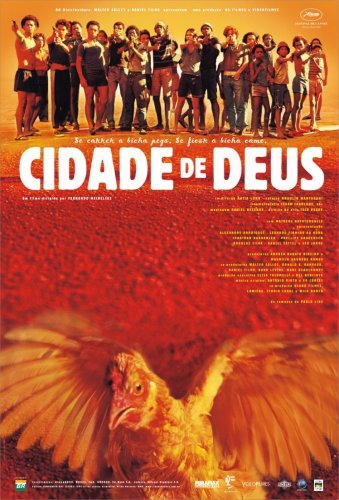
To me, Slumdog Millionaire feels like a cross between the acclaimed Brazilian slum movie City of God (Portuguese name: Cidade de Deus, 2002) and Quiz Show, the 1994 American historical drama film about TV quiz scandals in the 1950s.
City of God (2002) was filmed in the favelas of Rio de Janeiro
City of God is a Brazilian crime drama film directed by Fernando Meirelles and Kátia Lund, released in its home country in 2002 and worldwide in 2003. It was adapted by Bráulio Mantovani from the 1997 novel of the same name written by Paulo Lins.
The film’s depiction of narcotic drug rings, hold-ups, street violence and police corruption may not have been what the upper middle class Brazilians wanted to showcase to the rest of the world, but the film’s stark if grisly authenticity resonated with movie audiences around the world. Most of the actors were residents of favelas (slums) of Rio de Janeiro, such as Vidigal and the Cidade de Deus itself. City of God became one of the highest-grossing foreign films released in the United States up to that time.
The makers of Slumdog Millionaire adopted a similar approach. Its co-director Loveleen Tandan says she likes to get as close to reality as possible. This drove her to the slums of East Bandra to look for young children who resembled the protagonists in the story.
As she recalled in a recent interview with Tehelka: “I was very keen to get real slum kids, which is why I convinced them (producers) to do one-third of the scenes in Hindi. I made a scratch tape with real street kids. The team was surprised that Hindi actually made it brighter and more alive.”
Indeed, Slumdog doesn’t feel like a ‘foreign film’ despite it having a fair number of English subtitles, which only enhance the overall cinematic experience.
But how realistic should films try to become, before the local realities are distorted or local sensibilities are affected? Where does documentary end and drama begin? These questions will continue to be debated across India and elsewhere while Slumdog enthralls millions on its first theatrical release.
Feature film makers can exercise their creative license far more than factual film makers. I doubt if the creators of authentic, close-to-the-ground movies like City of God and Slumdog Millionaire set out with any specific social agenda. They are in the business of entertainment, and just happen to find plenty of drama in real life in places like urban slums. We might argue that in the right hands, dramatised movies can draw mass attention to development issues and challenges far more effectively than the often dull and dreary documentaries.
Kalpana Sharma: Eyes wide open“If through (the movie) the world gets a peek at an India inhabited by millions of people who continue to live their lives without clean water, sanitation or electricity, what is the problem?” asks another Indian friend and long-time Mumbai resident Kalpana Sharma.
In a perceptive essay titled Shantytowns of the Mind, written in The Indian Express in early January 2009 before she saw the film, Kalpana flagged important concerns: “Slumdog Millionaire’s success raises some deeper questions. How do we depict poverty as writers, filmmakers, journalists? Is it fair to expect us all the time to give a full, balanced, sensitive portrayal? Or is it inevitable that we write, film, for our audiences? And if, as a byproduct, people are sensitized, so be it. Also, if they are annoyed, so be it. If we are considered exploitative, so be it.”
Kalpana speaks with authority, and not just because she lives in the megacity of Mumbai (population: 13 million and rising) which, she points out, is half made up of slums. In 2000, she wrote a book titled Rediscovering Dharavi: Stories from Asia’s Largest Slum. Far from being a cold, clinical analysis of facts, figures and trends, it’s a book about the extraordinary people who live there, “many of whom have defied fate and an unhelpful State to prosper through a mix of backbreaking work, some luck and a great deal of ingenuity”.
Kalpana ends her essays with these words: “In the end you realise as a writer, a journalist or a filmmaker, that the best you can do is to shine a torch, a searchlight, on an entrenched problem. But the solution will not be found merely by that illumination. For that, there are many more steps to be taken.
“Slumdog Millionaire has focused its lens on the children of India’s slums through a work of fiction. What we do to change their future is the non-fiction that has yet to be written.”















 Open Minds!