FIFA: Empire of Football or a global super-soft power?

The Empire of kicking around

If one acronym has dominated the world’s media and public minds in the past month, it must be FIFA.

It stands for the International Federation of Association Football, and is derived from the original French name, Fédération Internationale de Football Association. It’s the global governing body of association football, founded in 1904 and with its headquarters in Zürich, Switzerland.

FIFA is responsible for the organisation and governance of football’s major international tournaments — most notably the FIFA World Cup, held once every four years since 1930. The current World Cup, being held in South Africa from 11 June to 11 July 2010, is the 19th edition. The next will be hosted by Brazil in 2014.

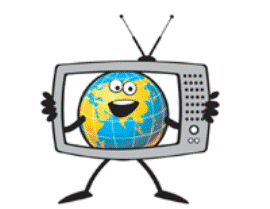
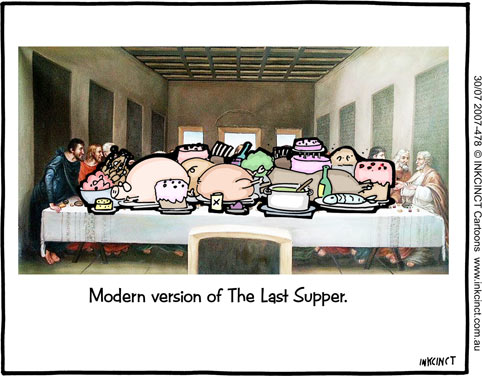
As a global body with substantial financial resources, FIFA has had its own share of controversies and been criticised for its lack of transparency and internal democracy. It’s true that FIFA controls the media rights to key international games with an iron fist (which inspired the above cartoon). They are not alone: the International Olympic Committee (IOC) has its own detractors and allegations on similar considerations.

Who's got the soft power?
But there is little argument on how far and wide the influence of these global sports bodies extend. In an op ed essay being published this weekend, I contend: “FIFA, with its 208 member associations, is probably more influential — and certainly better known — than the United Nations, with its 192 member states. The difference is in media outreach. It signifies the rise of soft power in our always-connected information society.”

Indeed, the UN itself is well aware of this. In one of the most memorable op ed essays he’s written, the former UN Secretary General Kofi Annan acknowledged in 2006 (during the previous FIFA World Cup): “The World Cup makes us at the UN green with envy. As the pinnacle of the only truly global game, played in every country by every race and religion, it is one of the few phenomena as universal as the UN. But there are better reasons for our envy.”

He continued: “This is an event in which everybody knows where their team stands, and what it did to get there. They know who scored and how and in what minute of the game; they know who saved the penalty. I wish we had more of that sort of competition in the family of nations. Countries vying for the best standing in the table of respect for human rights, and trying to outdo one another in child survival rates or enrolment in secondary education. States parading their performance for all the world to see. Governments being held accountable.”

Of course, FIFA’s domination over the global public mind will wane after the FIFA World Cup 2010 ends. But how many other global bodies can claim to hold billions of people so engaged for a month? And in this era of 24/7 information society, that’s formidable soft power indeed.

What can we call the wielder of such soft power? How about Super-soft-power?
And can this kind of power also intoxicate and even corrupt its wielders? We’ve seen how power manipulations work in other centres of soft power, such as Hollywood and Bollywood. The challenge for FIFA — and all others who are connected to it through the love of football and/or media’s outreach — is to watch out that this concentration of soft power doesn’t corrupt.

The very same media that helps FIFA attain the status of a soft-super-power needs to keep an eye on how this power is being used. Perhaps that’s the ultimate game in the media-saturated 21st Century: Emperors of Eyeballs vs. Titans of Kick.

Remember, you read it here first.
Twitterless in Beijing: Talking aspirationally about social media…

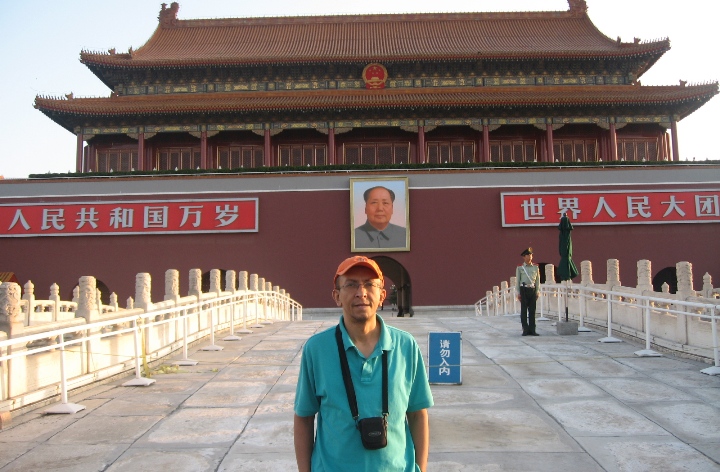
Under Chairman Mao's watchful eyes...

“Reading computer manuals without the hardware is as frustrating as reading sex manuals without the software!”

This is one of the less known, but more entertaining, dicta by Arthur C Clarke – he called it ‘Clarke’s 64th Law’, and I personally know he used to bring it up when meeting with particularly crusty or glum intellectuals. (Not all were amused.)

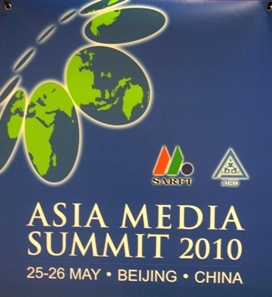
Clarke’s words kept turning in my mind as I moderated and spoke at a session on social media at Asia Media Summit 2010 held in Beijing China from 24 to 26 May 2010. The country with the world’s largest media market is not exactly the world’s most open or free – and certainly when it comes to social media, it’s a very different landscape to what we are used to…

These days, International visitors arriving in China discover quickly that access to YouTube, Twitter and Facebook is completely blocked. Apparently the brief ‘thaw’ in restrictions, seen before and during the 2008 Beijing Olympics, is now over — the current restrictions have been in place since the spring of 2009.

This doesn’t mean there is no social media in China. In fact, I heard from several Chinese friends and colleagues that there is a very large, dynamic and fast-evolving social media scene in China. For the most part, however, it’s not based on globally used and familiar platforms, and is happening in a digital universe of China’s own — under the watchful eye of the government.

Jump in...but some conditions apply!
For example, I found from this March 2010 blog post by Merritt Colaizzi that:
* 221 million people have blogs, largely in a diary-style.
* 176 million Chinese connect via social networking system (SNS) with their “real” friends and online networks.
* 117 million connect anonymously via bulletin board system (BBS). These interactive online message boards are the heart of social media in China. They’re where people go to find topic-based communities and where consumers talk about products and services.

There are lots of other blogs, mainstream media reports and research commentary on social media in China — just Google and see (now that’s another thing with limited – and uneven – access in China: Google itself is available, but search results come with lots of links that simply aren’t accessible). Much or all of this interaction happens in Chinese, of course. It’s a significant part of the web and social media landscapes, but if you’re in China on a short visit and want to stay connected to your own social media networks, that’s not at all helpful.

And, of course, it undermines one of the key attributes of a globally integrated information society: the interoperability of systems and platforms.

Luckily for me, perhaps, I can survive a few days without my social media fix: I have an appalling record of updating my Facebook account: days pass without me even going there. For the moment, at least, I’m also taking a break from regular blogging (well, sort of). But I’m more regular in my micro-blogging on Twitter, and visit YouTube at least once a day, sometimes more often. I could do neither during the few days in Beijing – and that was frustrating.

So imagine having to talk about social media as a new media phenomenon in such a setting. That’s only a tiny bit better than reading computer manuals without the hardware…But this is just what I did, with all the eagerness that I typically bring into everything I do. I planned and moderated a 90-minute session on Social Media: Navigating choppy seas in search of Treasures?

The session was part of the Asia-Pacific Media Seminar on Ozone Protection and Climate Benefit, so our context was how to use the social media to raise public awareness and understanding on the somewhat technical topics of ozone layer depletion and climate change (two related but distinctive atmospheric phenomena).

With access to key global social media platforms denied, we visitors and Chinese colleagues in the audience could speak mostly generically, theoretically and aspirationally. I didn’t want to place my hosts and seminar organisers in difficulty by harping on what was missing. Instead, we focused on what is possible and happening: how development communicators are increasingly social media networks and platforms to get their messages out, and to create online communities and campaigns in the public interest.

The thrust of my own opening remarks to the session was this: In the brave new world of social media, we all have to be as daring as Sinbad. Like the legendary sailor of Baghdad, we have to take our chances and venture into unknown seas. Instead of maps or GPS or other tools, we have to rely on our ingenuity, intuition and imagination.

More about the session itself in future blog posts.

For now, I want to share this TED Talk by American watcher of the Internet Clay Shirky on how cellphones, Twitter, Facebook can make history. Shirky shows how Facebook, Twitter and TXTs help citizens in repressive regimes to report on real news, bypassing censors (however briefly). The end of top-down control of news is changing the nature of politics.

PS: All this holds more than an academic interest for me, because there have been media reports in recent weeks that the Sri Lankan government is working with Chinese experts in formulating strategies for censoring internet access from Sri Lanka.

TV Will Save the World, says Charles Kenny in TIME’s ’10 ideas for next 10 years’

Photo by Reza Deghati

This is one of my favourite photos in media and development. It was taken by Reza Deghati, the renowned Iranian-French photojournalist (who works under the name Reza). I don’t know the story behind this photo, but even without a single word of annotation, it says a great deal.

I like this photo partly because it symobolises the enduring appeal of broadcast television in much of the developing world. For long years, the old-fashioned, boxy TV set used to be the top-selling consumer electronic item in the world — until the mobile phone came along. But even now, the much-maligned idiot box hasn’t lost its appeal to a significant section of humanity, never mind what the jaded academics and geeks might say.

So I was intrigued to read, in the latest issue of TIME Magazine, development economist Charles Kenny, reminding us that television is still the most influential medium around. In this gizmo-ridden new media age, it takes much courage to say so in public.

In a powerful short essay titled ‘TV Will Save the World’, he writes: “Forget Twitter and Facebook, Google and the Kindle. Forget the latest sleek iGadget. Television is still the most influential medium around. Indeed, for many of the poorest regions of the world, it remains the next big thing — poised, finally, to attain truly global ubiquity. And that is a good thing, because the TV revolution is changing lives for the better.”

Across the developing world, he says, some 60% of the households had their own TV set in 2005 — up from 45% in 1995. He adds: “Five million more households in sub-Saharan Africa will get a TV over the next five years. In 2005, after the fall of the Taliban, which had outlawed TV, 1 in 5 Afghans had one. The global total is another 150 million by 2013 — pushing the numbers to well beyond two-thirds of households.”

He ends his essay with these words that strongly resonate with me: “Too much TV has been associated with violence, obesity and social isolation. But TV is having a positive impact on the lives of billions worldwide, and as the spread of mobile TV, video cameras and YouTube democratize both access and content, it will become an even greater force for humbling tyrannical governments and tyrannical husbands alike.”

As Sir Arthur C Clarke, inventor of the communications satellie whose second death anniversary we mark this week, told me in a 2003 interview: “I’m not impressed by the attacks on television because of some truly dreadful programmes. I believe that every TV programme has some educational content. The cathode ray tube – and now the plasma screen – is a window to the world. Often it may be a very murky window, but I’ve slowly come to the conclusion that, on balance, even bad TV is preferable to no TV at all.”

Kenny’s essay is one of 10 ideas for the next 10 years that TIME has put together for its annual innovation issue.

Image courtesy Foreign Policy
The TIME essay is a much compacted version of what he wrote in November 2009 issue of Foreign Policy magazine, titled Revolution in a Box. That article noted the continuing global spread of television sets and an explosion of viewer choice driven by cable, satellite and digital technologies. It suggested this is a good thing, pointing to evidence that access to competitive television can improve womens’ standing in the home, increase girls schooling, reduce fertility rates, lower drug use, improve governance and (possibly) help foster global peace.

The editors of Foreign Policy ran the following blurb: “It’s not Twitter or Facebook that’s reinventing the planet. Eighty years after the first commercial broadcast crackled to life, television still rules our world. And let’s hear it for the growing legions of couch potatoes: All those soap operas might be the ticket to a better future after all.”

The full essay is well worth a careful read. At a time when I have been questioning many of the founding premises of my own work at TVE Asia Pacific, he has provided conceptual clarity and sharper focus.

So you want to help develop the media? Read this first!

Some weeks ago, I wrote a post about How to become a global publisher or broadcaster in just 100 minutes! That was compiled by my British media activist friend David Brewer , who showed how it could be done using free tools that can be downloaded and activated in minutes.

This week, David has brought out another handy guide — this time aimed at those involved in media development. UNESCO defines it in lofty, technocratic terms, but it basically means strengthening the media institutions, media people (practitioners and managers) and media consumers so that the media can best serve the public interest.

Everyone seems to have their own recipe for media development, and that’s part of the media’s huge diversity. Media Helping Media asked a number of people who have benefited from media development projects what they felt needs to change in the year ahead. The replies have so far come from The Russian Federation, Indonesia, Azerbaijan, Sri Lanka, Lebanon, Macedonia, Ukraine, Bhutan and Nepal. They make up a challenging list of tips for those who try to help media in need.

Its introduction says: “You have as much to learn as you have to give. That’s the message to those offering media assistance in transition and post-conflict countries from some of those on the receiving end.”

Here’s my own contribution to this interestingly crowd-sourced distillation. David had asked for three key points, but you can see below why I was never very good in arithmetic…

Media operate as a business, not charity: All media have a social responsibility, but that must be balanced with commercial viability. This is so with state, corporate or community owned media. Bankrupt media can’t serve any public interest.

‘Media’ is a plural: Media is a basket term for entities with enormous diversity and variability. One size does not fit all, no matter how well intended. It’s crucial to understand before engaging any media.

Follow the eyeballs: If you want the biggest bang for your limited buck, start with the mass market end of media such as FM radio, tabloid newspapers and music TV channels. Leave your broadsheet/classical prejudices out of investment decisions.

Take it easy: Audiences need entertainment as much as information and education. Supporting quality entertainment in the media is just as important for the public good as nurturing investigative journalism or advocating media freedom.

Sparks of hope: Real world is not an all-or-nothing game. Find oases of innovation and resilience, and nurture them to survive and grow in turbulent times. Back media underdogs of today who can become fierce watchdogs of tomorrow.

In responding to David’s request last month, I’d added this covering sentence which sums up my thinking: “All this is common sense that is often uncommon. I really wish media development organisations would listen and reflect more, and also step beyond their comfort zones and romanticised little bubbles.”

The entire collection is well worth reading, for it distills decades of ground level experience and insight. This guide will help many well-meaning organisations (UN agencies, philanthropic foundations, CSR arms of media companies and others) to be more focused, sensitive and ultimately more effective in developing the media.

Read the related 12 tips for international media trainers

Hans Rosling and Gapminder: Unraveling the Joy of Stats!

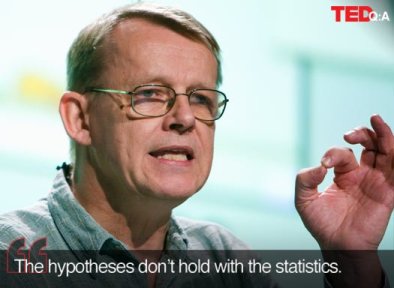
Hans Rosling: Information Wizard
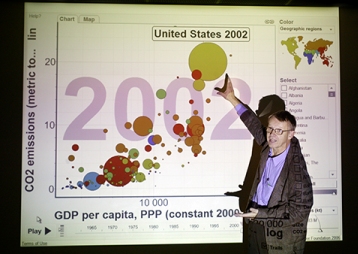
If you thought Al Gore was a data-happy geek, you should see Hans Rosling in action.

The Swedish medical researcher has a way with numbers. He brings heavy and dreary statistics into life using a combination of animated graphics and equally animated presentations. With the drama and urgency of a sportscaster, he uses a new presentation tool called Gapminder to debunk various myths about world – economic development, disparities and how well (or poorly) we share our planet’s resources.

Hans Rosling is Professor of International Health at Karolinska Institutet (which awards the Nobel Prize in medicine), but it’s his other role – as Director of the Gapminder Foundation – that he plays ‘statistics guru’ to the whole world. If you’re perplexed by lots of numbers, he’s the man who can make sense of it all.

In some ways, Rosling and Gapminder present in live action – and on video – what the Atlas of the Real World attempted to do in 2D maps: show the world as it is, with little or no distortion or misconceptions. That effort, published in late 2008, uses software to depict the nations of the world, not by their physical size, but by their demographic importance on a range of subjects.

I’ve watched a number of Rosling talks on video online. He makes no attempt to conceal his Scandinavian accent, and his English grammar is not always perfect. But it doesn’t matter: the guy has such mastery over his ideas and statistics, and a great stage presence too. He’s profound and funny at the same time, without being condescending that most experts and especially professors are.

Here’s an example of Rosling at his best: recorded in February 2006 in Monterrey, California:

No more boring data: TEDTalks

Rosling’s quest to use numbers to shatter stereotypes of rich and poor countries has brought him global prominence. He was one of the world’s “100 most important global thinkers” of 2009, according to Foreign Policy Magazine.

Look, no magic here!
Rosling was honored at #96 on the list for “boggling our minds with paradigm-shattering data“. The list is topped by (1) Ben Bernanke, the chairman of US Federal Reserve for his actions to turn the US depression and (2) President Barack Obama for “for reimagining America’s role in the world.”

Foreign Policy noted: “Rosling is well known for his energetic lectures, in which he narrates mind-blowing statistics on development and public health — as they literally move across a screen. Imagine x-y axes filled with data points, each representing a country. As time passes, the dots move, realigning to show changes in child mortality, percentage of paved roads, unemployment rates, or pretty much any other metric you can imagine.”

Here are some more examples of Rosling magic:

200 years that changed the world (with Hans Rosling)

For the first time, Gapminder can now visualize change in life expectancy and income per person over the last two centuries. In this Gapminder video, Hans Rosling shows you how all the countries of the world have developed since 1809 – 200 years ago.

Hans Rosling on HIV: New facts and stunning data visuals

Hans Rosling unveils new data visuals that untangle the complex risk factors of one of the world’s deadliest (and most misunderstood) diseases: HIV. He argues that preventing transmissions — not drug treatments — is the key to ending the epidemic.

Hans Rosling: Asia’s rise — how and when

This is one of the funniest Rosling talks I’ve watched online so far. Speaking at TEDIndia in November 2009, Rosling recalled how he was a young guest student in India when he first realized that Asia had all the capacities to reclaim its place as the world’s dominant economic force. He graphs global economic growth since 1858 and predicts the exact date that India and China will outstrip the US.

Note:
Rosling and Gapminder developed the Trendalyzer software that converts international statistics into moving, interactive and enjoyable graphics. The aim is to promote a fact-based world view through increased use and understanding of freely accessible public statistics. His lectures using Gapminder graphics to visualise world development have won awards by being humorous yet deadly serious. The interactive animations are freely available from the Foundation’s website. In March 2007 Google acquired the Trendalyzer software with the intention to scale it up and make it freely available for public statistics. Google has since made available as Motion Chart, a Google Gadget.

‘Avatar’ unfolds in the Amazon: Find out the Real Price of Oil!

This is no Avatar: It's Real!
A few days ago, reviewing the blockbuster movie Avatar, I wrote: “Film critics and social commentators around the world have noticed the many layers of allegory in the film. Interestingly, depending on where you come from, the movie’s underlying ‘message’ can be different: anti-war, pro-environment, anti-Big Oil, anti-mining, pro-indigenous people, and finally, anti-colonial or anti-American. Or All of the Above…”

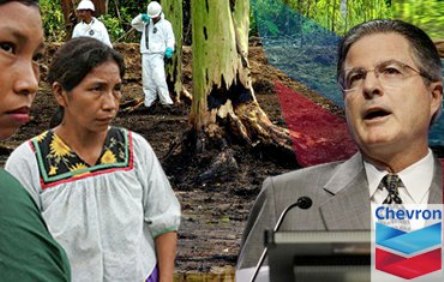
Indeed, an Avatar-like struggle is unfolding in the Amazon forest right now. The online campaigning group Avaaz have called it a ‘Chernobyl in the Amazon’. According to them: “Oil giant Chevron is facing defeat in a lawsuit by the people of the Ecuadorian Amazon, seeking redress for its dumping billions of gallons of poisonous waste in the rainforest.”

From 1964 to 1990, Avaaz claims, Chevron-owned Texaco deliberately dumped billions of gallons of toxic waste from their oil fields in Ecuador’s Amazon — then pulled out without properly cleaning up the pollution they caused.

In their call to action, they go on to say: “But the oil multinational has launched a last-ditch, dirty lobbying effort to derail the people’s case for holding polluters to account. Chevron’s new chief executive John Watson knows his brand is under fire – let’s turn up the global heat.”

Avaaz have an online petition urging Chevron to clean up their toxic legacy, which is to be delivered directly to the company´s headquarters, their shareholders and the US media. I have just signed it.

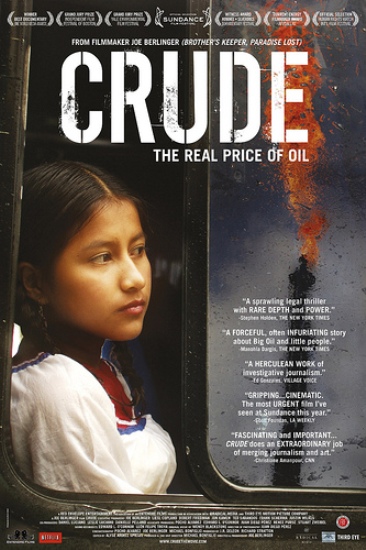
Others have been highlighting this real life struggle for many months. Chief among them is the documentary CRUDE: The Real Price of Oil, made by Joe Berlinger.

The award-winning film, which had its World Premiere at the 2009 Sundance Film Festival, chronicles the epic battle to hold oil giant Chevron (formerly Texaco) accountable for its systematic contamination of the Ecuadorian Amazon – an environmental tragedy that experts call “the Rainforest Chernobyl.”

Here’s the official blurb: Three years in the making, this cinéma-vérité feature from acclaimed filmmaker Joe Berlinger is the epic story of one of the largest and most controversial legal cases on the planet. An inside look at the infamous $27 billion Amazon Chernobyl case, CRUDE is a real-life high stakes legal drama set against a backdrop of the environmental movement, global politics, celebrity activism, human rights advocacy, the media, multinational corporate power, and rapidly-disappearing indigenous cultures. Presenting a complex situation from multiple viewpoints, the film subverts the conventions of advocacy filmmaking as it examines a complicated situation from all angles while bringing an important story of environmental peril and human suffering into focus.

Watch the official trailer of Crude: The Real Price of Oil

According to Amazon Watch website: “With key support from Amazon Watch and our Clean Up Ecuador campaign, people are coming together to promote (and see) this incredible film, and then provide ways for viewers to support the struggle highlighted so powerfully by the film.”

They go on to say: “A victory for the Ecuadorian plaintiffs in the lawsuit will send shock waves through corporate boardrooms around the world, invigorating communities fighting against injustice by oil companies. The success of our campaign can change how the oil industry operates by sending a clear signal that they will be held financially liable for their abuses.”

While Avatar‘s story unfolds in imaginary planet Pandora — conjured up by James Cameron’s imagination and created, to a large part, with astonishing special effects, the story of Crude is every bit real and right here on Earth. If one tenth of those who go to see Avatar end up also watching Crude, that should build up much awareness on the equally brutal and reckless conduct of Big Oil companies.

Civilisation's ultimate addiction?

Others have been making the same point. One of them is Erik Assadourian, a Senior Researcher at Worldwatch Institute, whom I met at the Greenaccord Forum in Viterbo, Italy, in November 2009.

He recently blogged: “The Ecuadorians aren’t 10-feet tall or blue, and cannot literally connect with the spirit of the Earth (Pachamama as Ecuadorians call this or Eywa as the Na’vi call the spirit that stems from their planet’s life) but they are as utterly dependent—both culturally and physically—on the forest ecosystem in which they live and are just as exploited by those that see the forest as only being valuable as a container for the resources stored beneath it.”

Erik continues: “Both movies were fantastic reminders of human short-sightedness, one as an epic myth in which one of the invading warriors awakens to his power, becomes champion of the exploited tribe and saves the planet from the oppressors; the other as a less exciting but highly detailed chronicle of the reality of modern battles—organizers, lawyers, and celebrities today have become the warriors, shamans, and chieftains of earlier times.”

Remembering Dr Cyril Ponnamperuma: Inspirational maverick of Sri Lankan science

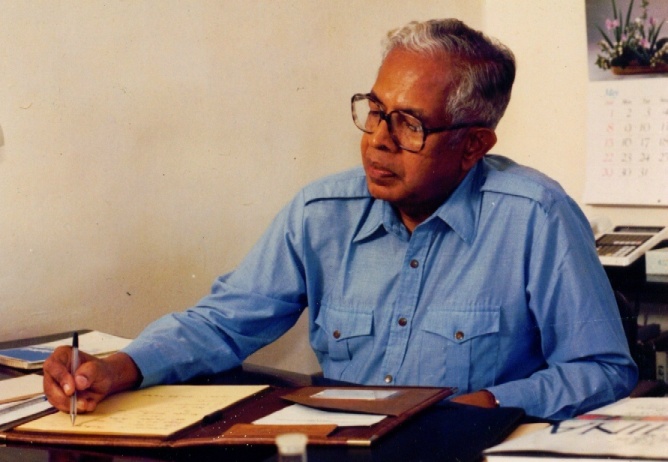
Dr Cyril Ponnamperuma: erudite, cultured and articulate

On 20 December 2009, we mark the 15th death anniversary of Professor Cyril Ponnamperuma, one of the best known scientists produced by Sri Lanka during the Twentieth Century.

I grew up reading about him in school text books as a living icon of modern science: a developing country scientist whose brilliance and hard work took him to the highest echelons of global science, and one who was respected in the West and East.

He was both an internationally recognised researcher on the origins of life on Earth, and an early promoter of science and technology for development. His interests and involvements transcended his own discipline and homeland. He worked closely with the Pakistani Nobel laureate Dr Abdus Salam to promote science and infrastructural facilities in developing countries.

I focus on the few years from 1984 to 1990, when he served as science and technology advisor to two Presidents of Sri Lanka. Concurrently, he served as director of the Institute of Fundamental Sciences (IFS) from 1984 to 1990, and was also founder director of the Arthur C Clarke Centre for Modern Technologies (ACCCMT) from 1984 to 1986. In these positions, he worked simultaneously on several fronts covering science policy, institutional building, fund raising, capacity building and public engagement.

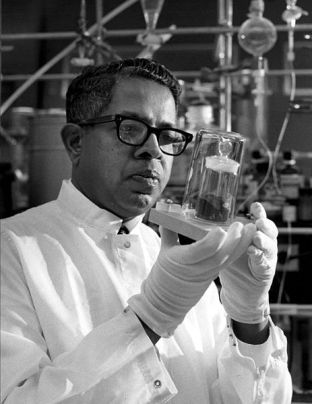
Dr Cyril Ponnamperuma analyzing a moon sample at NASA
I’ve just written a tribute, recalling my own interactions with him in the last 1980s, when he was dividing time between Sri Lanka and the US. It’s published online at Groundviews website.

As I note: “Erudite, cultured and articulate, Ponnamperuma was a journalist’s dream: he could sum up complex issues in simple and engaging terms and metaphors — but these were more than mere soundbites. He was full of insights and anecdotes that humanised both science and its practitioners.”

After looking back at his accomplishments and failures of his Sri Lanka years, I contend: “His biggest accomplishment — and lasting legacy — was not so much buildings, laboratories or institutions, but sparking off the interest in science among thousands of young people. That is much harder to achieve, and also impossible to quantify in Rupee or Dollar terms…”

In this essay, I recall both his accomplishments and failures. I ask why his passion for public science was not shared by many fellow scientists in Sri Lanka, who wanted to remain aloof of non-scientists and the community. Ponnamperuma’s tried to bridge this gap, and for this sin he was harassed and driven out of Sri Lanka and back to the United States where he returned to his research and teaching to the very end of his life.

“Chemistry is the ‘other woman’ in my life,” Ponnamperuma used to joke. It was while working at his university office in the US that he suffered cardiac arrest and rushed to a Washington hospital, where he passed away on 20 December 1994. He was 71. His sudden death came as a shock to all those whose lives and careers were touched, influenced and inspired by him.

Read my full essay:
Dr. Cyril Ponnamperuma (1923-1994): A Passionate Champion of Public Science

All You Need is Love: When the world sang one song for HIV…

We must love one another or die...

Our planet is one, but our world speaks and sings in a myriad tongues — and that’s part of our cherished cultural diversity. Once in a while, however, it’s good to see that cacophony morph into a symphony when the world shares a few moments — in awe, horror, love or happiness.

It happened last week when the world sang for an extremely good cause. On 7 December 2009 at 1:30pm GMT, Starbucks invited musicians from all over the world to sing together at the same time to raise awareness for HIV/AIDS in Africa. In one breathtaking moment, musicians from 156 countries played “All You Need is Love” together. The live participation of most nations together to sing this song became a Guinness world record.

Watch now, as musicians from all around the world come together and share a song.

My former colleague Buddhini Ekanayake joined this global production by coordinating the input from Sri Lanka. “Personally, I am really glad to take part in this event together with my team, on behalf of Watermelon Creatives,” she says on her blog, where she shares some info and images.

You can still join in by lending your own voice to the Starbucks Love Project.. Watch streaming video from countries around the world and then join in by singing All You Need is Love yourself. For each video submitted, Starbucks will make a contribution to the Global Fund to help fight against AIDS in Africa. You can also help increase the Starbucks contribution to the Global Fund by submitting a drawing to the Love Gallery.

The global sing-along is part of our continuing efforts to help fight AIDS in Africa. In just one year in partnership with (RED), Starbucks has generated money equivalent to more than 7 million days of medicine to help those living with HIV in Africa.

“All You Need Is Love” is a song written by John Lennon and credited to Lennon/McCartney. It has been associated with path-breaking initiatives before. It was first performed by The Beatles on Our World, the first live global television link. Watched by 400 million in 26 countries, the programme was broadcast via satellite on 25 June 1967.

Viterbo Memorandum by Greenaccord: Time to act on climate crisis is NOW!

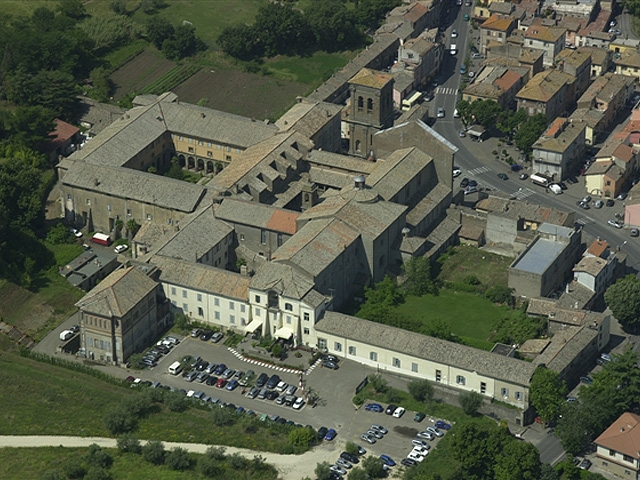
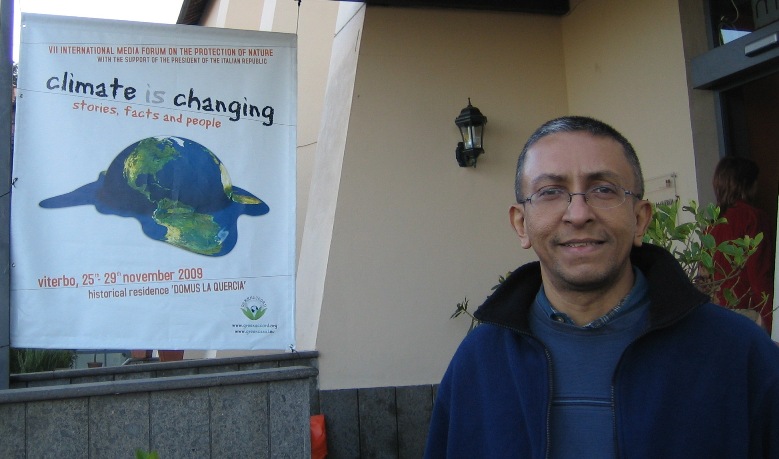
Renaissance period Domus La Quercia, venue of Greenaccord 2009 forum

“We know the climate is changing, probably as a result of humanity’s pollution; species are disappearing fast; deforestation is rampant; over-fishing is rife; water shortages are increasing; resource consumption is growing and so is the world’s population.

“…If this catastrophe unfolds, historians will look back and ask how that was allowed to happen with so little media debate. They may wonder what stories journalists were telling while the world was transformed around them.”

Those words are not new. In fact, they were part of the statement of concern issued at the end of the First International Media Forum organised by Greenaccord of Italy and held in Rapolano, Siena, Italy, in late 2003. I was one of 100+ journalists from all over the world who signed that original “Green Accord” for Journalists.

This year’s internationally acclaimed British climate film The Age of Stupid is based on a similar premise. This ambitious drama-documentary-animation hybrid features an old man living in the climate devastated world of 2055 AD, watching the ‘archive’ news footage from 2008 — and asking: “Why didn’t we stop climate change while we had the chance?”

The 7th Greenaccord international forum, held in the central Italian city of Viterbo from 25 – 29 November 2009, has just ended calling upon world leaders to “draw a road map being a binding agreement for a total de-carbonization of world economy before 2050”.

Addressed to the UN climate conference opening in Copenhagen in a few days’ time, the forum’s final document – called the Viterbo Memorandum – urged that no more time be lost.

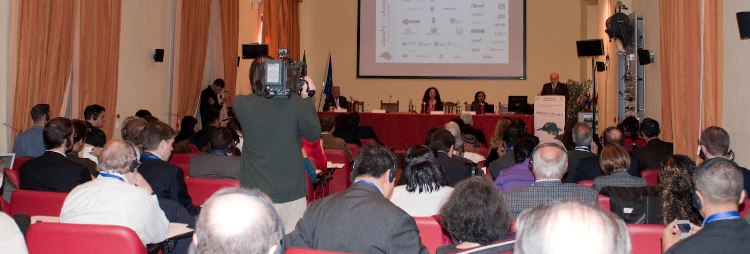
The Greenaccord forum’s theme this year was ‘Climate is changing: stories, facts and people’. Over five days, some 130 of us from 55 countries – drawn from all continents – stayed at the historic residence of Domus La Quercia in Viterbo, discussing and debating about the challenges faces by our warming planet, and how we as communicators can make a difference. It is what I recently called the Ultimate Race between education and catastrophe.

The Viterbo Memorandum pledged: “On their own side, they (journalists and scientists) vow to cooperate in order to spread correct information on the risk related to climate change and to make aware the public opinion on the need of individual contribution to the solution of problems by modifying their own life style.”

The Memorandum is to be delivered in early December 2009 to Dr Rajendra Pachauri, the Nobel Peace Prize winning Chairman of the UN’s climate panel, the IPCC.

Professor Andrea Masullo, President of Greenaccord’s Scientific Committee, said: “I don’t want our children and grandchildren, in 2050, finding themselves on a planet inhabited by more than 9 billion people and devastated by climate change, re-reading the scientific reports of today…to ask themselves what we were thinking and why we did not do anything when everything that was going to happen was clear.”

He added: ”In recent years the changes are progressing much faster than expected in the fourth IPCC report. Nevertheless, it seems that Copenhagen will not come again to a final agreement. Many governments feel they can take initiatives costly and complicated the current economic crisis. ”

Launched in 2003, the Greenaccord Forums have emerged as one of the largest annual gatherings of environmental journalists, broadcasters and activists at global level. As an organisation, Greenaccord aims to be an international “virtual table” open to all professionals in information and communication who want to deepen understanding about environment and its protection with their work.

I have been returning to Greenaccord’s annual forums the first one in 2003 – and always return with my knowledge updated and friendships renewed. This year was no exception.

Photos courtesy Yu-Tzu Chiu and Greenaccord

Nalaka Gunawardene at Greenaccord 2009 - Photo by Yu-Tzu Chiu

Taste the Waste: Uncovering a crime against humanity and Nature

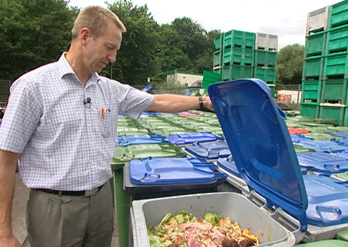
Opening the lid...

“How can we explain the fact that one sixth of humanity goes to bed hungry every night, when the world already produces enough food for all?

“The short answer is that there are serious anomalies in the distribution of food. Capricious and uncaring market forces prevent millions of people from having at least one decent meal a day, while others have an abundance of it. For the first time in history, the number of severely malnourished persons now equals the number suffering from over-consumption: about a billion each!”

That was the opening of an article on the future of food, co-authored by Sir Arthur Clarke and myself in 2000. It was circulated by the UN Food and Agriculture Organisation (FAO) to mark World Food Day that year, and was reproduced in 2008 in The Hindu newspaper, India.

Nearly a decade after we wrote those words, the situation hasn’t really improved. There still are a billion people for whom chronic hunger is a grim fact of life. About 25,000 people die of hunger every day. Meanwhile, at the other end of the spectrum, the number of obese people has grown to 1.5 billion.

Talk about a world of contrast and disparity!

Here’s more shocking news: we routinely throw away half of all food produced in this world. Between plough and plate, or from farms to homes, we waste almost as much food as we eat.

Eyes Wide Shut?
Many countries don’t have the slightest idea how much is wasted. Britain made an effort to measure the waste pile and came to a staggering 15 million tons of food a year. This includes 484 million unopened tubs of yoghurt, 1.6 billion untouched apples, bananas worth £370 million and 2.6 billion slices of bread.

In his recent book Waste: Uncovering the Global Food Scandal, Tristram Stuart documented the extent of waste in the food industry worldwide.

Taste the Waste is a new documentary film linked to an online campaign that shows us what is being thrown away: where, why, when and by whom.

The film maker turned campaigner, Valentin Thurn, has come up with one more reason why we should stem this callous waste: “Cutting food waste is an easy solution to reduce climate emissions and hunger,” he says.

Reducing food waste means a big opportunity to reduce greenhouse gas emissions – if we threw away only half of the avoidable waste, the consequences for the climate would be the same as taking one out of five cars off our roads.

It would also help the hungry, because they also depend on the global food cycle. Cash crops from all over the world are traded on the stock exchange. The agricultural resources on this planet are limited. The farmland taken up to produce the food that we throw away could instead be producing food for them.

Young activists protest against this situation by rescuing the wasted food. People eating rubbish – a habit that sounds disgusting until you see the loads of perfectly edible food in the bins of your supermarket or sandwich shop around the corner.

Thurn’s call to action: “We need your help! Go out, look around and tell us about the food in the bins where you live. Send texts, photos, videos, and help to reveal the huge scandal of how we are wasting food.”

Watch the film’s trailer on YouTube:


According to the latest FAO figures, there are more hungry people in the Asia Pacific (642 million) than all other regions combined. This is followed by Sub-Saharan Africa (265 million), Latin America and the Caribbean (53 million), and the Near East and North Africa (42 million). Sub-Saharan Africa has the highest percentages of people living in hunger, while the Middle East and North Africa saw the most rapid growth in the number of hungry people (13.5%) during 2008.

The UN’s definition of hunger is based on the number of calories consumed. Depending on the relative age and gender ratios of a given country, the cutoff varies between 1,600 and 2,000 calories a day.

Starting in 2008, activist groups worldwide observe 16 October as World Foodless Day. Their argument: World Food Day is a mockery and is much better named World Foodless Day.

It’s a day of global action on the crises that beleaguer the people. The objectives are to: “create public awareness and media attention on the root causes of the food crisis; provide policy recommendations and organize meetings with government officials, opinion makers and leaders; organise activities to raise our voices against neoliberal policies and their impact; and highlight people’s recommendations to respond to the world food crisis.”

Watch PAN-Asia Pacific’s video for World Foodless Day 2008:


Read an excellent review of Tristram Stuart’s book: Watching our wasteline, By Darryl D’Monte