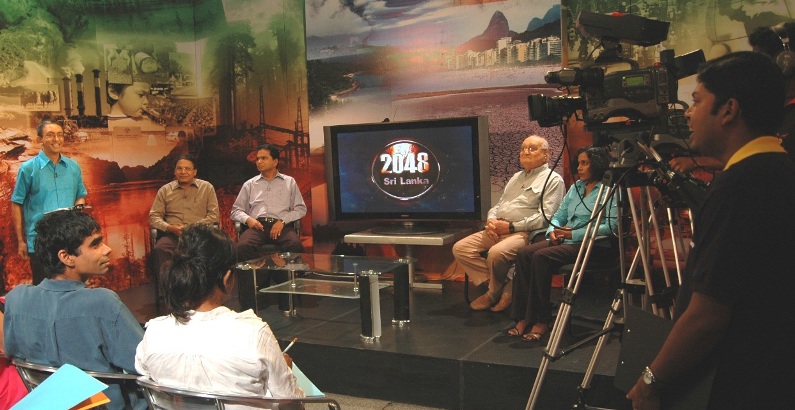
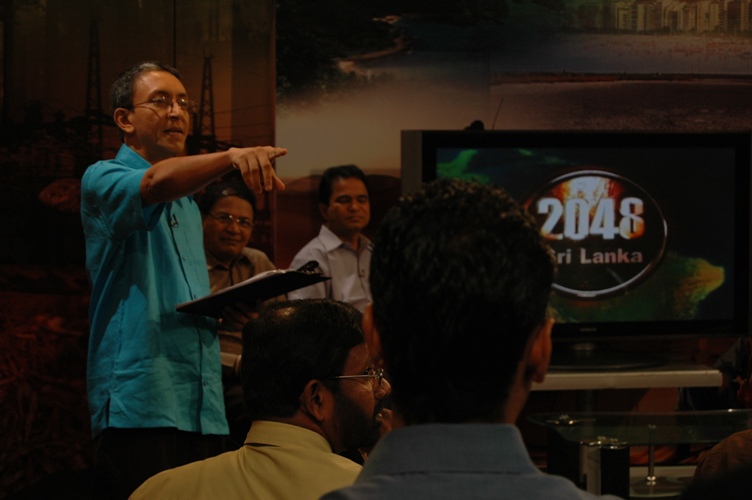
Encounters with Mediasaurus: Telling media tycoons what is missing in their media!

I have just been very lucky. I addressed a select gathering of media owners, publishers, editors and senior journalists — almost all of them working in the mainstream print or broadcast media in Sri Lanka — and virtually called them dinosaurs, and compared their industry to the supposedly unsinkable Titanic.

The nice people they all were, they actually let me get away with it! The occasion was the Sri Lanka launch of Asia Media Report 2009, held at the now-renovated Galle Face Hotel in Colombo.
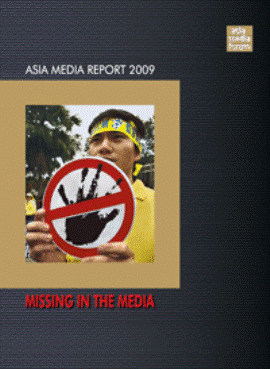
Shining a light at a spot rarely probed...
Coordinated, produced and published by the Asia Media Forum with the assistance of Actionaid, the report is a quick survey of the state of media in 20 Asian countries, written mostly by working journalists and broadcasters. It focuses on how the media throughout Asia reports on marginalised people and communities in their respective societies, from the very poorest countries to the richest.

‘Missing in the Media’ is the theme of Asia Media Report 2009, and I used this as the point of departure for my talk, illustrated with many cartoons some of which have appeared on this blog. I fully agreed with the editor and contributors of the report – six of whom I know – that there are many elements missing or lacking in Asia’s mainstream media today. But instead of adding to that list, I asked a more fundamental question: at a time when the mass media as we know it is under threat of mass extinction, how do we save and nurture at least a few good things that we hold dear?

In that process, I had to do some plain speaking and tell my audience that they cannot continue business as usual and expect to remain relevant, or even solvent for too long. I referred to the famous mediasaurus essay by Michael Crichton, and traced what happened since its appearance in 1993. I also compared the media’s arrogance to that of the Titanic‘s builders, who believed the ship was unsinkable.

I will be sharing highlights of my talk in the coming days through one or more blogposts. For now, I’m still grateful that my remarks were received with good grace and cordiality. (For more, read post on ICT revolution, and post on greater collaboration between mainstream media and citizen journalism.)

I don’t do this kind of big picture talk too often, and mind my own business most of the time (which is a hands full these days). In fact, the last two occasions I spoke my mind to assorted worthies of the Sri Lankan media, the reaction was much harsher.
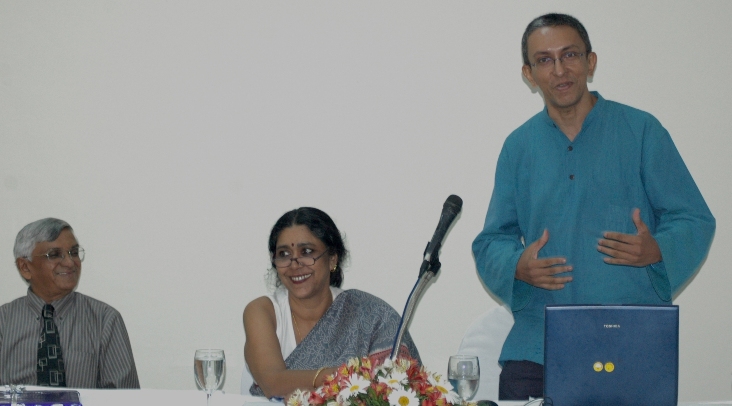
The Coming Ka-Boom? L to R: Vijitha Yapa and Sharmini Boyle seem to be amused as Nalaka Gunawardene speaks
First was when I talked about the press freedom in the digital age to large gathering of Sri Lankan journalists and editors was the World Press Freedom Day Colombo observance in 2001. When I referred to the potential of new communications technologies – especially the (then still emergent) Internet and mobile phones – for safeguarding media freedoms, I was practically shouted down by a section of the audience. They felt I was talking about ‘western trends’ and ‘concerns too far removed from their bread-and-butter issues and survival issues’. Yet, the past few years have amply proved that if anything, I was too conservative in what I anticipated as technology’s role in promoting media freedom.

The second occasion was in mid 2004, when I was asked to speak at a Colombo meeting to mark the launch of a scholarly volume (in Sinhala) looking back at the first 25 years of television broadcasting in Sri Lanka. I was one of two dozen contributors, from diverse backgrounds of culture, science and journalism, who were brought together by the Catholic Media Centre of Sri Lanka which has a (secular) media monitoring programme. Having expressed my reflective views in the book chapter, in my speech I discussed my aspirations for the next 25 years — hoping there would be greater innovation and experimentation in an industry that seemed to be running short of both. This irked a certain local pioneer of television, who spoke after me and spent half of his given time attacking me personally and ideologically. Talk about pioneer’s syndrome. That definitely was a mediasaurus breathing fire, and I don’t want to meet one of these beasts on a dark night…

On both occasions, the event organisers apologised to me for the hostile reactions, but I was cool. By now, I’m used to reactions of all kinds in the public sphere. Given this history, yesterday’s encounter was far more reassuring that there still are good people even in an industry that is under siege in more ways than one.

I’m so fortunate to be welcomed by both media practitioners and media researchers across Asia. I’m no longer a card-carrying member of either group (if I ever was!), but I have great fun hobnobbing with both, occasionally telling them some home truths. This is what Irish journalist-cum-academic Conor Cruise O’Brien once called ‘having a foot in both graves’!
Sri Lanka: Memories of War, Dreams of Peace

Sri Lanka: Island of suspended dreams has a second chance...

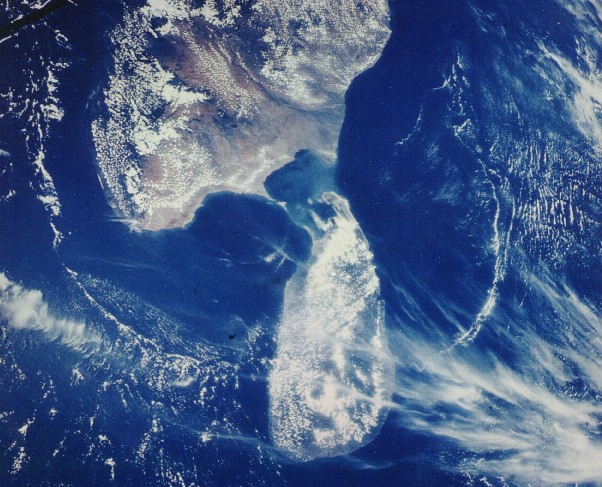
This is one of my favourite images. Showing southern part of India and my native Sri Lanka, it was captured by one of the early US space missions, nearly four decades ago.

Much has happened on the tear-drop shaped island since this image was taken: among other things, we’ve been through a civil war that lasted a generation, and robbed the dreams of at least two generations. That war officially ended on 18 May 2009.

The Day After, on 19 May 2009, I wrote a 1,500-word essay titled Memories of War, Dreams of Peace. The editor of Groundviews, Sri Lanka’s leading citizen journalism website, published it in full, and within minutes of my emailing the text to him.

I’m humbled and gratified that in the past few days, it has been widely read, commented on, quoted online and reproduced. Some have agreed with me; others have dismissed me as a naive dreamer. A writer cannot ask for more.

20 May 2009: MediaChannel.org (New York) reproduces the essay in full


24 May 2009: The Sunday Leader (Colombo) reprints the essay in full

I look back briefly on the brutal and tragic war – not in anger, but in great sadness. I then look forward in a wistful, dreamy mode. My premise was: “Now that the war is officially over, will this mark the beginning of real peace? I want to believe so. I want to audaciously dream of peace. The alternative is too dreadful to consider.”

This is not exactly what I’ve been trained to do. As a science writer and film-maker, I gather and analyse information, which I try to present in logical, coherent and accessible ways. In recent years, I’ve also been writing op ed essays in areas where I have some competence and experience. In writing this essay, I consciously departed from all that. I’m neither political scientist nor activist to engage in ideological or technocratic discussions, which others have already started in earnest. I wrote this at an emotional level, looking back and looking forward.

But my training did come in handy in framing the timely and necessary questions. My chosen ‘author intro’ for this essay thus reads: “Writer Nalaka Gunawardene has been a dreamer for all his 43 years. He asks more questions than he can answer.”

We've doused the flames of war, but much more needs to be done...
If my views come across as naive or idealistic, I shall plead guilty as charged. My emotions this week are best described as cautiously optimistic, but as some readers on Groundviews pointed out in their comments, our high hopes have been betrayed before. But can we afford not to dream privately and publicly at this juncture? I don’t think so. We have suspended our dreams for too long, and it’s time to start dreaming again.

There are as many kinds of dreamers as there are dreams. One of my favourite quotes comes from the British soldier and writer T E Lawrence (of Lawrence of Arabia fame): “All men dream, but not equally…the dreamers of the day are dangerous men, for they may act their dream with open eyes, to make it possible.”

From Nyota Uhura to Michelle Obama: The inspiration continues!

Inspiration across generations...

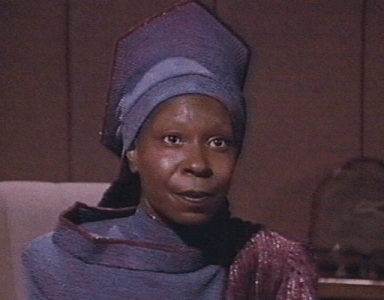
Actress Whoopi Goldberg was a child of 10 when the original series of Star Trek started its first broadcast on NBC in the US in September 1966. The futuristic science fiction series – about a spaceship travelling across space and time in the 23rd century in search of new civilisations – was to leave a lasting impression on many members of her generation.

In Whoopi’s case, it went beyond just general inspiration. Something in the show seemed incredible to the African-American child growing up in a land where colour and race were still divisive factors. She recalls running around the house, screaming: “Hey mom, look! There’s a negro woman on TV — and she ain’t cooking dinner!”.

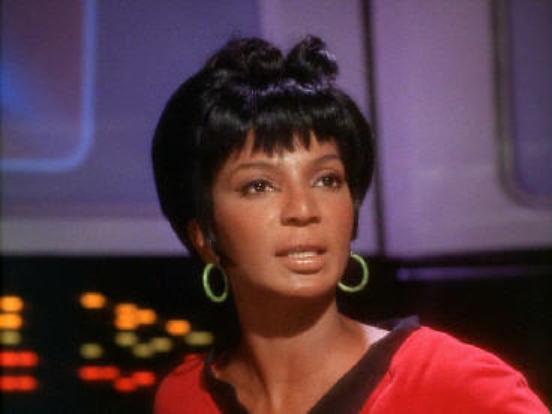
‘That woman’ was the character Nyota Uhura, played by Nichelle Nichols. This anecdote is captured in the 1997 documentary Trekkies, which explored the global fandom inspired by the show, which has gone on to become a franchise covering several TV series, 11 feature films (including the latest ‘origins’ film released on 8 May 2009), an animation series, as well as numerous books, video games and computer games. As Forbes magazine once noted, the allure is comparable only to that of Star Wars.

Sometimes, less is more!
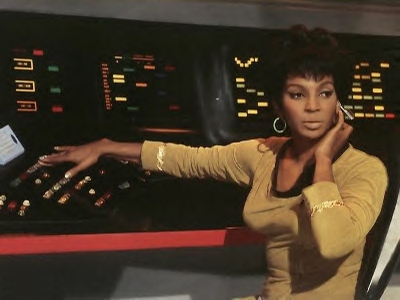
Uhura featured as the communications officer on board the USS Enterprise in Star Trek: The Original Series, Star Trek: The Animated Series, and the first six Star Trek films. She is significant as one of the first major black characters on an American television series and for engaging in a then-taboo interracial kiss with Captain James T. Kirk (William Shatner). In the 2009 film, a younger Uhura is portrayed by actress Zoë Saldana.

The inclusion of Uhura, a black woman, in a critical technical position was certainly idealistic in the mid 1960s when the American civil rights movement was still agitating for equal rights for African Americans. She one of the first black women featured in a major television series not playing a servant; her prominent supporting role as a female black bridge officer was unprecedented.

As I’ve just noted in another blog post: “At a time when there were few non-white or foreign roles in American television dramas, Gene Roddenberry created a multi-ethnic crew for the Enterprise, including an African woman, a Scotsman, a Japanese American, and—most notably—an alien, the half-Vulcan Spock. In the second season, reflecting the contemporaneous Cold War, Roddenberry added a Russian crew member.”

But was the character, donning a sexy mini skirt uniform, somewhat tokenistic? Perhaps. But it still had considerable inspirational value – which is never to be under-estimated.

In fact, after the first season of Star Trek, Nichols had become frustrated at her relative lack of lines. At one point, she considered quitting the show, but was talked out of this decision by the civil rights leader Dr Martin Luther King, Jr.. MLK told her that a show that depicted a black woman working alongside whites in a position of importance was important for the goal of racial equality.

Another version of the story has MLK telling Nichols that he was a big fan of the series, and she “could not give up” since she was playing a vital role model for black children and young women across the country. It is also often reported that Dr. King added that “Once that door is opened by someone, no one else can close it again.”

After NBC executives cancelled Star Trek in 1969, Nichols went on to star in other roles — and also worked for NASA in a campaign to encourage African Americans to join the space service. Among those she helped recruit was Dr. Mae Jemison, the first African-American woman to fly aboard the Space Shuttle, in September 1992. Jemison has cited Star Trek as an influence in her decision to pursue a career in space.

Goldberg: From inspiration to a regular role
Meanwhile, things came full circle for actress Whoopi Goldberg, who was to get her own regular role in Star Trek: The Next Generation whose original run lasted from 1987 to 1994. In this successor series, she played the recurring El-Aurian female character Guinan.

Things have also moved on in the real world, where Barack Obama is now the President of the United States, with Michelle Obama as one of the most influential – if not powerful – women in the world. On 28 April 2009, CNN ran a story titled Why Michelle Obama inspires women around the globe. It noted: “Those who focus on Michelle Obama’s impact on America are underestimating her reach. The first lady is inspiring women of color around the globe to look at themselves, and America, in fresh ways.”

There is no linear link between Nyota Uhura and Michelle Obama, and the real world has very far to go to reach the utopian ideals of Star Trek. But the very fact that we have the Obamas where they are is an assurance that things can slowly move towards Gene Roddenberry’s grand vision.

Star Trek: Advocating a world of equality, tolerance and compassion

Going where no trekkie has gone before?
I’m exactly as old as Star Trek: we were both born a few months apart in 1966 (I’m older by seven months). But because we grew up on opposite sides of planet Earth in the pre-Internet era, our worlds didn’t collide until we were both well into our teens. From then on, I’ve been a Trekkie/Trekker since.

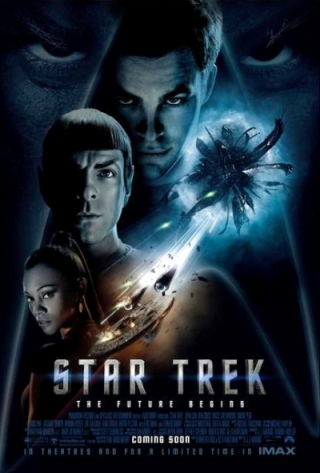
I can’t wait to see the latest (11th) Star Trek movie that opened on 8 May 2009. It’s an ‘origins’ movie – a chronicle of the early days of Captain James T. Kirk and his fellow USS Enterprise crew members. Read plot on Wikipedia.

Our world was very different when the one-time US Army pilot, screenwriter and TV producer Gene Roddenberry created Star Trek, the original series. It started airing on the US network NBC in September 1966. The Space Age was less than a decade old, and only a few men (and a couple of women) had made short trips to near Earth orbit. The great Space Race was in full swing, and NASA was spearheading the largest peace-time operation in history, aimed at landing men on the Moon and getting them safely back before the decade was out.

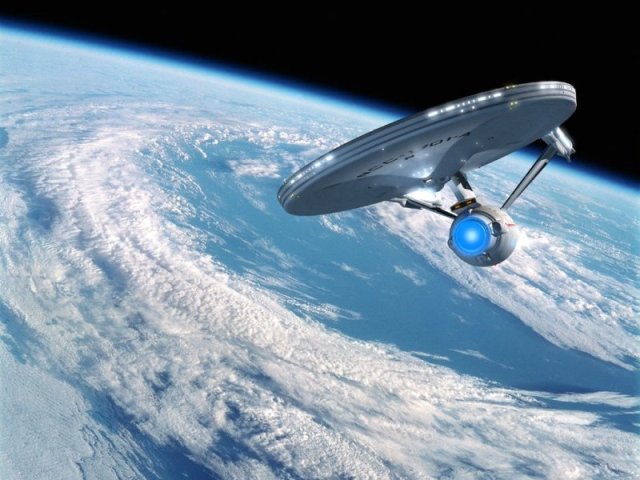
Star Trek, in contrast, offered ambition and hope. Every week at the appointed time, the United Star Ship Enterprise and its intrepid crew took viewers roaming around the universe. The stories appealed as much for insights into the infinite possibilities (and combinations) of life, technology, compassion and power at a cosmic scale, as for its glimpses of the near-Utopian human society in the 23rd century.

As Manohla Dargis, said this week reviewing the latest Star Trek movie (2009) in The New York Times: “Initially aired in 1966, Star Trek was a utopian fantasy of the first order, a vision of the enlightened future in which whites, blacks, Asians and one pokerfaced Vulcan are united by their exploratory mission (“to boldly go”), a prime directive (do no harm) and the occasional dust up.”

According to Dargis, the enduring appeal of Star Trek and the global cult following it inspired is “a testament to television’s power as myth-maker, as a source for some of the fundamental stories we tell about ourselves, who we are and where we came from.”

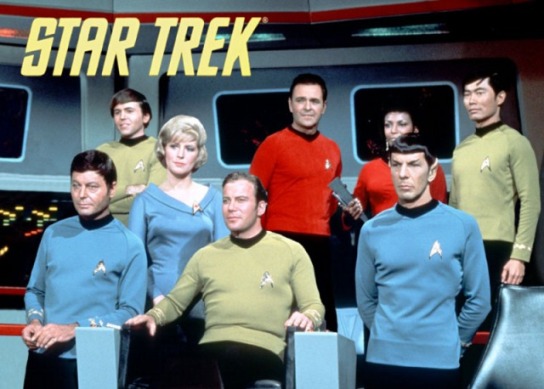
Star Trek Original SeriesAnd, we might add, where we are headed. The show was unique, for its time, for its portrayal of diversity and unity among the wider cast of characters. As the Wikipedia notes: “The show was unique, for its time, for its portrayal of diversity and unity among the wider cast of characters. As the Wikipedia notes: “At a time when there were few non-white or foreign roles in American television dramas, Roddenberry created a multi-ethnic crew for the Enterprise, including an African woman, a Scotsman, a Japanese American, and—most notably—an alien, the half-Vulcan Spock. In the second season, reflecting the contemporaneous Cold War, Roddenberry added a Russian crew member. “

This utopian scenario needs to be contrasted with the prevailing reality of the American Space Programme. No American had ventured beyond near Earth orbit in 1966, and NASA was struggling to catch up with the Russians. Yet, by the time Star Trek original series finished its initial run in September 1969, Neil Armstrong and Edwin Aldrin had returned safely and triumphantly from the Moon. In the event, the Apollo programme landed a dozen astronauts on the Moon, all of who returned safely – as did the astronauts of the disaster-stricken mission, Apollo XIII. Without exception, all of them were white and male.

The journey has only just begun...
It took many years for reality to catch up with Star Trek‘s vision, and then, only just. Although a Russian (Valentina Tereshkova) had become the first woman in space early on in 1963, it took the Americans another 20 years to have their first woman astronaut: Sally Ride, who traveled to Earth orbit on the Space Shuttle in June 1983. A few weeks later, in August that year, Guion “Guy” Bluford, Jr., became the first black American astronaut. Multi-cultural crews did not become commonplace until the late 1990s, when the International Space Station became operational.

It wasn’t just racial equality and harmony that Star Trek advocated in its subtext. While bringing intellectually stimulating entertainment, it also celebrated values like compassion and tolerance. In the Cold War world locked into Mutual Assured Destruction (MAD), Star Trek gently reminded viewers that mutual co-existence was a viable option…if only enough effort was invested in it.

As space visionary and science fiction grandmaster Sir Arthur C Clarke noted in a 40th anniversary tribute to the series in 2007: “Appearing at such a time in human history, Star Trek popularised much more than the vision of a space-faring civilisation. In episode after episode, it promoted the then unpopular ideals of tolerance for differing cultures and respect for life in all forms – without preaching, and always with a saving sense of humour.”

He then added, in characteristic style: “Over the years, the sophistication of storylines and special effects has certainly improved, but Star Trek retains its core values – still very much needed in our sadly divided and quarreling world.”

The Enterprise will be cruising the galaxy for centuries to come...

Return of (true) Mass Media: Let there be millions of sparkling conversations!

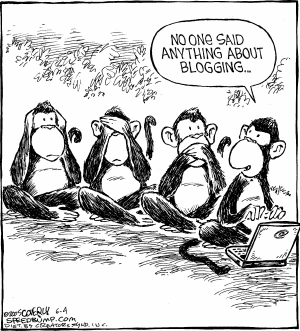
Being the fourth monkey?
“Historically, organised and commercialised mass media have existed only in the past five centuries, since the first newspapers — as we know them — emerged in Europe. Before the printing press was invented, all news was local and there were few gatekeepers controlling its flow. Having evolved highly centralised systems of media for half a millennium, we are now returning to a second era of mass media — in the true sense of that term. Blogs, wikis and citizen journalism are all signs of things to come.”

This is how Sir Arthur C Clarke and I summed up the transformative change that is currently taking place in the world of mass media, in an essay we co-wrote for the Indian news magazine Outlook in October 2005.

We’d given it the title ‘From Citizen Kane to Citizen Journalist’ – a formulation that I’m still proud of – but the editors changed it to ‘Arise, Citizen Journalist!’. Of course, our original title made evocative sense only for those who knew the popular culture reference to the movie Citizen Kane.

I recently had a chance to revisit these issues and explore them further in a half-hour, in-depth TV interview with media researcher/activist and fellow citizen journalist Sanjana Hattotuwa. This was part of The Interview series produced by Young Asia Television, and broadcast on two Sri Lankan TV channels, TNL and ETV during the second week of February 2009.

Sanjana covered a wide range in his questions. Starting with a brief reflection on my 21-year association with Sir Arthur Clarke, we moved on to the bewildering world of new media and its co-existence with the mainstream media. We discussed the fragmentation of audience and the concern that some current and would-be bloggers harbour: is anyone listening or reading?

And more importantly, how do we get conversations started and going. I look back on my own experience as an active blogger for almost two years, and assert that if we have something new and worthwhile to say, and know how to express it well, we can slowly build up an audience. There’s no blueprint or road map – everything is in ‘beta’ mode, and the name of the game is try-it-and-see!

Here’s that full interview on YouTube, broken into four parts:

Sanjana Hattotuwa talks to Nalaka Gunawardene – Part 1 of 4:

Sanjana Hattotuwa talks to Nalaka Gunawardene – Part 2 of 4:

Sanjana Hattotuwa talks to Nalaka Gunawardene – Part 3 of 4:

Sanjana Hattotuwa talks to Nalaka Gunawardene – Part 4 of 4:

Bill Gates and mosquitoes: World’s top geek now works for its meek

More bugs from Gates...
Bill Gates can’t seem to get enough of bugs.

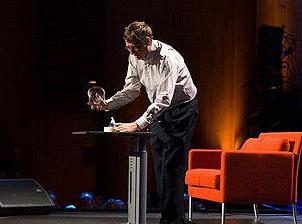
On 4 February 2009, he let loose a swarm of mosquitoes at the TED 2009 technology, entertainment and design conference in California to highlight the dangers of malaria.

“Malaria is spread by mosquitoes,” he reminded his audience of leading scientists, designers, researchers and entrepreneurs. Turning to an upturned jar on stage, he announced: “I brought some. Here…I’ll let them roam around. There is no reason only poor people should be infected.”

Luckily, the mosquitoes were not carrying the disease. But it had the intended effect. Wired editor Chris Anderson, curator of the show, suggested a headline: “Gates releases more bugs into the world”.

Watch Bill Gates’s mosquito moment:

Watch the full 20-minute video of Bill Gates at TED 2009

As stunts go, this one was pretty mild and harmless. There are many shocking ways in which the harsh daily realities of the world’s poor can be brought into gatherings of the rich and famous. They could be served glasses of the contaminated, sludgy (and often smelly) water that tens of millions drink everyday. Or all the toilets could be locked up and the keys thrown away – for good. Or electricity supply could be cut off, or frequent ‘black-outs’ or ‘brown-outs’ could be staged. You get the idea…

Of course, few event organisers would dare try any of these, if only for health and safety considerations. Reminds me of a rare exception: when he was director of information with the UN’s population agency (UNFPA), journalist-turned-UN official Tarzie Vittachi once hosted delegates of a high level meeting to lunch which consisted soley of a bread roll and a glass water. He told his guests: the meal was better more than what most poor people in the global South on any given day.

Bill to the rescue...
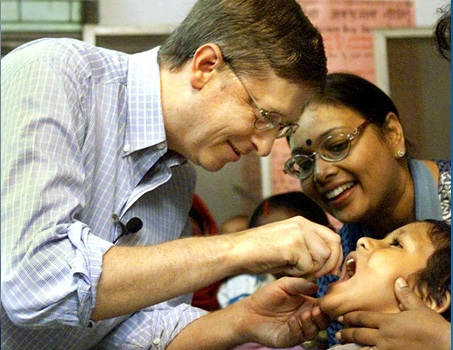
Meanwhile, billions of poor and needy – and not just those in the majority world – are glad that Bill Gates caught the ‘development bug’ and has switched his formidable creative energies (not to mention his billions) to address their survival issues. The Bill & Melinda Gates Foundation – which carefully manages the giving away of Gates wealth – operates on the belief that all lives have equal value. “We think all people deserve the chance to have healthy, productive lives”.

They have set priorities such as improving health and reducing extreme poverty in the developing world, and improving high school education in the United States.

The New York Times columnist Nicholas Kristof recently described it as a paradox: “In these brutal economic times, one of the leading advocates for the world’s poorest people is one of the richest.”

He noted: “Mr. Gates ended his full-time presence at Microsoft last July and since then has thrown himself into work at his foundation. He is now trying to do to malaria, AIDS, polio and lethal childhood diarrhea what he did to Netscape, and he just may succeed.”

In his TED talk, Bill Gates addressed two questions that occupy much of his time these days: How do we stop Malaria? How do you make a teacher great?

Look, no computers!
Look, no computers!
He said: “The market does not drive scientists, thinkers, or governments to do the right things. Only by paying attention and making people care can we make as much progress as we need to.”

He called for greater distribution of insect nets and other protective gear, and revealed that an anti-malaria vaccine funded by his foundation and currently in development would enter a more advanced testing phase in the coming months.

“I am an optimist; I think any tough problem can be solved,” he said. That’s the geek in him talking: marshall all information, analyse problems, respond strategically — and keep at it.

A friend who now works with the Gates Foundation confirms how the charity seeks evidence and rigour in all its social investments. This is no bleeding-heart do-gooding or ‘social work’ for its CSR value. The new wave of geeks lining up to serve the meek bring business acumen to the development sector long under-served by unimaginative aid agencies and self-serving UN organisations.

As Kristof wrote: “Gates ended his full-time presence at Microsoft last July and since then has thrown himself into work at his foundation. He is now trying to do to malaria, AIDS, polio and lethal childhood diarrhea what he did to Netscape, and he just may succeed.”

Gates has announced that despite the economic crisis the Gates Foundation will increase spending by US$500 million this year.

In late January 2009, the billionaire philanthropist released the first ‘Annual Letter from Bill Gates‘ where he discussed his work at the foundation and spoke candidly about what has gone well, what hasn’t.

He compared his earlier work at Microsoft with the challenges he now tackles at the charitable foundation. “What I’ve found now is that really those same key elements are there. The opportunity for big breakthroughs is absolutely just as great–now it’s vaccines, it’s seeds that have better yield, it’s ways of sharing teaching practices…they will take the same kind of patience that we had for software breakthroughs.”

Just ahead of the letter’s release, Nicholas Kristof talked with Bill Gates about why aid to developing countries is more important during the economic downturn and vaccine breakthroughs on the horizon. Watch the interview:

Read: Bill Gates’s Next Big Thing by Nicholas D Kristoff, published in the New York Times on 24 January 2009

Remembering Arthur C Clarke, the public intellectual

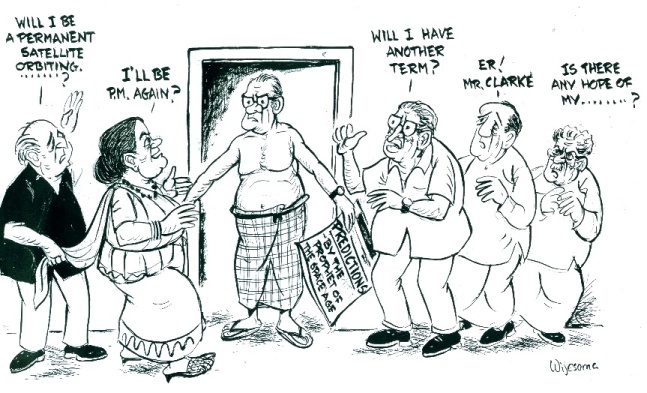
Cartoon by W R Wijesoma in The Observer (Sri Lanka)
Space prophet mobbed by anxious politicians: Cartoon by W R Wijesoma in The Observer (Sri Lanka)

This cartoon is nearly as old as myself! It was drawn by Sri Lanka’s leading political cartoonist W R Wijesoma and appeared in The Observer newspaper of Colombo sometime in the late 1960s (I haven’t been able to ascertain the exact date).

It shows science fiction writer (later Sir) Arthur C Clarke, already settled down in Ceylon (later Sri Lanka) and ‘Serendipitised’ enough to sport the native attire of sarong, being mobbed by the island’s leading politicians — all of them now departed — each wanting to know what he can foresee or foretell about their personal political futures.

Sir Arthur, whose 91st birth anniversary falls today, took pains to explain that science fiction writers like himself were not soothsayers with powers to predict the future. He was fond of quoting fellow SF writer Ray Bradbury’s famous saying: “People ask me to predict the future, when all I want to do is prevent it.”

But that kind of reason never deterred politicians of every colour and hue, who are always anxious to know just when they can get elected – or return – to high office and all the trappings of power that go with it.

To mark the birth anniversary – the first since his death in March 2008 – I have just published an op ed essay, titled Sir Arthur C Clarke: A life-long public intellectual, on Groundviews website. In this essay I explore, briefly, some of his life-long pursuits for more rational discussion and debate in public policy. I also wonder how and why he lost his struggle against Sri Lankans’ obsession with astrology.

Here’s an excerpt:

But even half a century of Arthur C Clarke could not shake Sri Lankans off their deep obsession with astrology — the unscientific belief that human destinies are somehow shaped and controlled by celestial bodies millions of kilometres away. A life-long astronomy enthusiast, he repeatedly invited astrologers to rationally explain the basis of their calculations and predictions. This challenge was craftily avoided by astrologers who continue to exercise much influence over politics, public policy, business and everyday life in Sri Lanka.

Despite his broad-mindedness, Clarke couldn’t understand how so many highly educated Sri Lankans practised astrology with a faith bordering on the religious (another topic on which he held strong views). Ironically, even the government-run technical institute named after him used astrologically chosen ‘auspicious times’ for commissioning its new buildings. In later years, Clarke would only say, jokingly: “I don’t believe in astrology; but then, I’m a Sagittarius — and we’re very sceptical.”

On a personal note, I’m truly privileged to have known and worked with both Sir Arthur Clarke and his cartoonist W R Wijesoma (who was my senior colleague at The Island newspaper which he joined at its inception in 1981). I know how much Sir Arthur liked this cartoon, the original of which he obtained from Wijesoma and preserved among dozens of other souvenirs and mementos.

Alas, Wijesoma left us in January 2006 — or he might just have drawn another brilliant cartoon to send off Sir Arthur on his final journey. In fact, a worthy follower of Wijesoma’s cartoon tradition did just that earlier this year – see this blog post of mine from March 2008: Arthur C Clarke autographing all the way to the Great Beyond….?

Read the full essay on Groundviews citizen journalism website.

2008: A Halloween Year – Prepare to get really scared…

Be scared...very scared!

Today, October 31, Halloween would be observed in several countries of the western world.

One Halloween custom is Trick-or-treating where children move from house to house in costumes, asking for treats such as sweets with the question: “Trick or treat?” The “trick” part of “trick or treat” is an idle threat to play a trick on the homeowners or their property if no treat is given.

2008 has been a highly turbulent year for most parts of the world. Oil and food prices went through the roof (and while oil has come down in recent weeks, food scarcities still loom large). Then came the global economic crisis, triggered by greedy bankers lending recklessly.

In such a year, what would it take to scare people on Halloween night? Or would Halloween be mild compared to the shocks and jolts we’ve been living through for much of the year?

Just when you think it can’t get any worse, it does. My favourite cartoon character Calvin had it figured out years ago:

Aren't you scared yet?

According to some analysts, the global economic crisis that we are living through at the moment just a harbinger of a much more dramatic global ecological collapse to come.

One of them is Patrik Etschmayer, who recently wrote an essay in Nachrichten, Switzerland, titled:
The Wall Street Crisis and the Coming Ecological Disaster”. His main point: the same people that got the world into the present crisis are driving the world over an ecological cliff.

Here’s an extract in translation: “What if this crisis was just a prelude – a precursor to a much greater threat – one that could possibly cost millions of lives? The current economic crises was based on the idea that we can live and consume based on credit – and the belief that we can continue to do so unabated as long as we steadfastly ignore the facts and spread the risks widely enough. That idea didn’t fly. Yet its seems that humanity still seems to believe that the things that have failed in the monetary economy, will, in the long run, still apply to the material reality of our world. Quite simply, because nature will not present us with a bill for the resources upon which we depend for our very survival.”

British journalist George Monbiot made the same point in his weekly environmental column. Writing in The Guardian on 14 Oct 2008, he said:

“As we goggle at the fluttering financial figures, a different set of numbers passes us by. On Friday, Pavan Sukhdev, the Deutsche Bank economist leading a European study on ecosystems, reported that we are losing natural capital worth between $2 trillion and $5 trillion every year, as a result of deforestation alone. The losses incurred so far by the financial sector amount to between $1 trillion and $1.5 trillion. Sukhdev arrived at his figure by estimating the value of the services – such as locking up carbon and providing freshwater – that forests perform, and calculating the cost of either replacing them or living without them. The credit crunch is petty when compared to the nature crunch.

“The two crises have the same cause. In both cases, those who exploit the resource have demanded impossible rates of return and invoked debts that can never be repaid. In both cases we denied the likely consequences. I used to believe that collective denial was peculiar to climate change. Now I know that it’s the first response to every impending dislocation.”

So the Halloween scares could be pretty mild compared to the scares of the real world. As the Hollywood copy writers used to say, we might as well: Get ready to be scared…really scared.

Calling Hydrocarbons Anonymous: Admitting my oil addiction…

Living with climate change
On the set of Sri Lanka 2048: Living with climate change

I have finally done it…and not a moment too soon!

There I was, moderating an hour-long TV debate on Saturday evening prime time television on Sri Lanka’s premier English language Channel One MTV. Our topic for this edition of Sri Lanka 2048 was living with climate change. After exploring its many facets, I was beginning to wind up.

But not before underlining the need for us to take personal responsibility for changing our lifestyles whose cumulative impact on the planet is significant.

The philosophical and political debates over climate change will continue for a long time, I said. Meanwhile, we have to live with climate change impacts that are already happening…and change how we use energy and resources so that we don’t make matters any worse.

This means we must consume less, share more, live simply and pursue smart solutions through green technologies. Of course, at the basis of all this is finding meaningful, practical ways of kicking our addiction to oil.

That’s when I put my hand up and admitted, on air, my own substance addiction: I am hooked on hydrocarbons, a.k.a. petroleum. I’m struggling to break free from it, but it’s not easy.

Of course, my individual addiction pales into insignificance when we look at how entire industries, sectors and countries are addicted to oil and stubbornly insist on continuing the status quo. But we must be the change we seek, so it’s never too late for me to work on my oil problem. When enough of us individuals do, countries and economies will follow.

But people with addictions often need expert guidance, as well as to keep the company of fellow addicts who are similarly trying to kick the habit. That’s why those having drinking problems find help in Alcoholics Anonymous.

We oil addicts could do with some organised help — environmental activist groups, please note. And Sir Arthur C Clarke has already suggested the perfect name for such a movement: Hydrocarbons Anonymous. Read his 2004 essay on Hydrocarbons Anonymous.

* * * * *

Race Against Time
Nalaka Gunawardene moderates Sri Lanka 2048: Race Against Time

Here’s what the promotional blurb for last weekend’s show said:

Sri Lanka 2048 looks at living with climate change: how challenges can become opportunities

Climate change is no longer a theory; it’s already happening. What awaits Sri Lanka – and how best can we adapt to live with extreme weather events, disrupted rainfall, sea level rise and other projected impacts? How can Sri Lanka play a meaningful role in mitigating further damage to the world’s climate?

These and related questions will be raised in this week’s Sri Lanka 2048, the series of TV debates exploring Sri Lanka’s prospects for a sustainable future in the Twenty First Century. The one-hour debate, in English, will be shown on Channel One MTV from 8 to 9 pm on Saturday, 26 July 2008.

Titled Race Against Time, this week’s debate brings together concerned Sri Lankans from academic, corporate, civil society and government backgrounds to discuss the many challenges of living with climate change. The debate looks at aspects such as promoting renewable energy to reduce our carbon emissions, and emerging opportunities for individuals, communities and businesses to adopt low carbon lifestyles and practices.

This week’s panel comprises: Dr. W. L. Sumathipala Director, National Ozone Unit, Ministry of Environment & Natural Resources; Dr. Suren Batagoda, CEO, Sri Lanka Carbon Fund; Dr Ray Wijewardene, Eminent engineer and specialist in renewable energies; and Darshani de Silva, Environmental Specialist, World Bank Office in Colombo. The debate is moderated by TVE Asia Pacific’s Director Nalaka Gunawardene.

The debate also seeks answers to questions such as: What niche can Sri Lanka occupy in the fast-growing global carbon market? How much money can we make from this market? What is the role of the recently established Sri Lanka Carbon Fund? Is the Clean Development Mechanism the right way forward?

The debate concludes with the recognition that climate Change is not just an environmental concern, but also has economic, social, political and security implications. While the philosophical and political debates over climate change will continue for a long time, everyone has to learn fast to live with it. This calls for consuming less, sharing more, living simply and pursuing smart solutions that reduce carbon emissions without compromising the quality of living.

Sri Lanka 2048 debates are co-produced by TVE Asia Pacific, an educational media foundation, and IUCN, the International Union for Conservation of Nature, in partnership with MTV Channel (Private) Limited. This editorially independent TV series is supported under the Raising Environmental Consciousness in Society (RECS) project, sponsored by the Government of the Netherlands.

Sri Lanka 2048
Sri Lanka 2048

Photos by Amal Samaraweera, TVE Asia Pacific

Al Gore’s challenge to America: kick the oil habit in a decade

Al Gore making Climate Challenge to America - courtesy New York Times

“There are times in the history of our nation when our very way of life depends upon dispelling illusions and awakening to the challenge of a present danger. In such moments, we are called upon to move quickly and boldly to shake off complacency, throw aside old habits and rise, clear-eyed and alert, to the necessity of big changes. Those who, for whatever reason, refuse to do their part must either be persuaded to join the effort or asked to step aside. This is such a moment. The survival of the United States of America as we know it is at risk. And even more – if more should be required – the future of human civilization is at stake.”

With these words, climate crusader Al Gore opened a powerful speech delivered in Washington DC on 17 July 2008, in which he issued what he called ‘A Generational Challenge to Repower America’ to take bold steps towards solving the climate crisis.

At one point he told fellow Americans: “We’re borrowing money from China to buy oil from the Persian Gulf to burn it in ways that destroy the planet. Every bit of that’s got to change.”

Having outlined the environmental, security and economic implications of America’s addiction to oil, Gore challenged his nation “to commit to producing 100 percent of our electricity from renewable energy and truly clean carbon-free sources within 10 years”.

I was immediately reminded of President Kennedy’s pledge to Congress on 25 May 1961 where he said:
“I believe that this nation should commit itself to achieving the goal, before this decade is out, of landing a man on the Moon and returning him back safely to the earth.”

In fact, later on in his speech Gore referred to this saying: “When President John F. Kennedy challenged our nation to land a man on the moon and bring him back safely in 10 years, many people doubted we could accomplish that goal. But 8 years and 2 months later, Neil Armstrong and Buzz Aldrin walked on the surface of the moon.”

Al Gore’s full speech, according to a video recording posted on YouTube, lasted 27 minutes — but the We Campaign has released the highlights of the speech running for 5 minutes:

Read the text of his full speech on the We Campaign website.

Read The New York Times coverage of Al Gore speech

The We Campaign is a project of The Alliance for Climate Protection — a nonprofit, nonpartisan effort founded by Nobel laureate and former Vice President Al Gore. Our ultimate aim is to halt global warming. Specifically we are educating people in the US and around the world that the climate crisis is both urgent and solvable.