Wildscreen comes to Colombo: Feb 12 – 14

Wildscreen comes to Colombo
Wildscreen, the world’s largest and most prestigious wildlife and environmental film festival, will be touring India and Sri Lanka in February 2009.

Nine wildlife or environmental filmmakers from the UK will be coming to India and Sri Lanka as part of this event, organized by the British Council. The festival will also see screenings of wildlife and environmental films from across the world, some of them winners of the Wildscreen festival’s Panda Awards, the environmental equivalent of the Oscars.

The Wildscreen Festival was founded by Sir Peter Scott in 1982. It has been organised every alternate year for the past 25 years, and is now considered to be the world’s largest and most prestigious wildlife and environmental film festival. Held in Bristol, UK, it attracts hundreds of delegates from around the globe who work in film, television and new media, as well as those involved in environmental conservation.

The Festival is coming to Sri Lanka for the first time. The programme, held at the British Council Colombo on 12 – 13 February 2009, will screen several award winning films on climate change and wildlife, showcasing the best of current environmental film making worldwide. On 14 February 2009, TVE Asia Pacific will present a selection of films on environment and sustainable development drawn from their global catalogue, which includes some Sri Lankan and South Asian titles.

Read full story here

Thai audiences in the dark about ‘Children of the Dark’

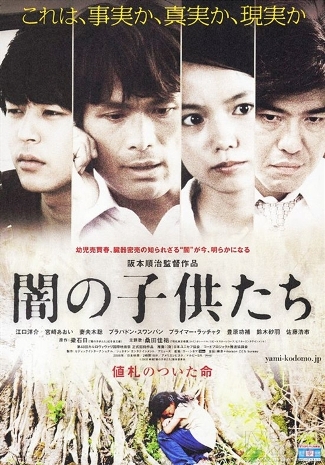
Yami no kodomotachi (Children of the Dark) movie poster

Human trafficking – peddling and trading of human beings for slavery, sexual exploitation and servitude – has grown to alarming proportions in recent years. It’s among the top five illicit trades in the world, whose net annual worth is believed to be between 9 billion and 42 billion US dollars. The truth is, nobody knows exactly how big it is, but human rights activists and development agencies agree the problem is pervasive.

Of the estimated 2.5 million persons trafficked worldwide, more than half are in the Asia Pacific. At the UN General Assembly for Children in August 2007, it was reported that about 1.8 million children became victims of commercial sex trade in 2000. About one million children in Southeast Asia are said to be involved – Thailand is one centre of this shady trade, drawing on misery in its rural hinterlands as well as poorer neighbouring countries like Burma, Cambodia and Laos.

So what happens when someone goes to the trouble of studying the issue in depth, and then pools talent and resources to make a feature film that exposes international connections that sustain the child sex industry in Thailand? Instead of being welcomed as part of the effort to counter this scourge, the film gets banned.

Yami no kodomotachi (Children of the Dark, 138 mins, original Japanese) is a Japanese-Thai film made in 2008 about child sex slavery. It has been banned in Thailand on the grounds that it was ‘inappropriate’ and touched on a ‘sensitive’ issue.

Watch the official trailer of the film (Japanese soundtrack, Thai captions):

I haven’t seen the film, but according to one reviewer who did, Junji Sakamoto‘s film is based on a novel by Yan Sogil and scripted by Sakamoto himself, shows, with a documentary-like directness, how children caught in the web of a Thai prostitution ring are exploited, abused and, in some cases, murdered when they are no longer sexually salable.

Mark Schilling, writing in The Japan Times in August 2008, noted: “…In being so visually graphic — particularly in the sex scenes in the Thai brothel — Sakamoto treads a dangerous line between hard-hitting social drama and stomach-turning exploitation. He takes care never to show his young actors (whose average age looks to be about 10) and their adult ‘clients’ in the same explicit shot, but he films them engaged in sexual acts or their aftermath. Sakamoto may defend these scenes in the name of realism, but could he have filmed similar ones in Japan, using Japanese children? The short answer is “no.”

The Thai ban prevented ‘Children of the Dark’ from being screened at the Bangkok International Film Festival, held in the Thai capital from 23 – 30 September 2008.

“The ban puts under the spotlight the country’s – or at least its higher-ups’ – seeming unwillingness to let go of the Film Act of 1930, when Thailand was still under absolute monarchy. That law gave a Board of Censors the power to impose cuts or to ban a film it deems inappropriate,” writes my friend and colleague Lynette Lee Corporal in an article just published on Asia Media Forum.

Thailand in denial about its Children of the Dark
She quotes my Thai colleague and documentary filmmaker Pipope Panitchpakdi as saying: “Authorities always think that viewers need to be protected and shielded from real issues. They still have that kind of sentiment that the media should function as a gatekeeper. That is, let the good stories in and the bad ones out. It’s okay in certain circumstances but not when talking about real, serious issues.”

Pipope adds: “This country has no problem with hypocrisy; we don’t see anything wrong with double standards. We have sex workers in corners of the city, but we can’t watch people kissing.”

A Bangkok-based journalist who calls himself Wise Kwai, writing in his blog, asks: “When will they (Thai authorities) learn that when they ban or censor a film, the ensuing stink that’s raised causes more problems than if the film had been allowed to quietly unspool? Perhaps if people had seen it, they might criticise it, but they’d also talk about the problems in society that allow children to be exploited.”

Read the full article: Film Censorship Leaves Viewers in the Dark by Lynette Lee Corporal

My Sep 2007 post: MTV Exit: Entertainment TV takes on human trafficking

Climate in Crisis and planet in peril – but we’re squabbling over copyrights!

Climate in Crisis - a global documentary

On my recent visit to Tokyo for a regional workshop on changing climate and moving images, I watched a number of excellent documentary films on the subject. One of them was Crude: The Incredible Journey of Oil, the excellent Australian film that I wrote about in March.

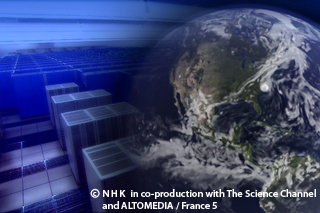
Another was Climate in Crisis, an outstanding global documentary in two parts (2 x 52 mins) co-produced in 2006 by Japan’s public broadcaster NHK together with The Science Channel and ALTOMEDIA/France 5.

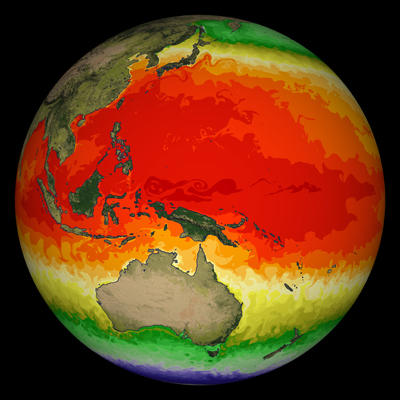
Directed by Fujikawa Masahiro, the film draws heavily on the Earth Simulator — one of the world’s most powerful supercomputers — which Japanese scientists used to project the climatic disasters in next 100 years. The system was developed in 1997 for running global climate models to evaluate the effects of global warming and problems in solid earth geophysics. It has been able to run holistic simulations of global climate in both the atmosphere and the oceans — down to a resolution of 10 km.

NEC Earth Simulator in Japan

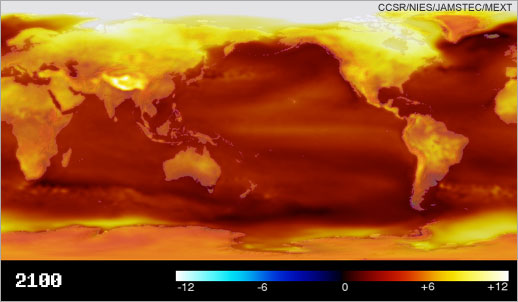
The results, captured in this documentary, are truly mind-boggling. Atmospheric temperatures may rise by as much as 4.2 degrees Celsius, more hurricanes may attack and deserts may spread from Africa to southern Europe, and half of the Amazon rainforest may be gone. Climate in Crisis shows a severe projection on environmental destruction based on rigorous scientific data and considers whether humankind can avoid this.

This film, made in the same year as Al Gore’s Oscar-winning film An Inconvenient Truth, has won several awards including the Earth Vision Award at the 15th Earth Vision Tokyo Global Environmental Film Festival.

I was curious why this excellent film – in my view, better made than Al Gore’s one – hasn’t been more widely seen, talked about and distributed. To be honest, I’d not even heard of this one until my Japan visit — and I try to keep myself informed on what’s new in my field of endeavour.

The reasons soon became apparent: copyright restrictions! The co-producers are keeping the rights so tight that only the highest bidders will be allowed to acquire it on a license fee.

This is a standard broadcast industry practice that didn’t surprise me. But I was taken aback by how jealously the rights are guarded. All other films that were part of our event, including high budget commercial productions like Crude, were screened to the public at the Parthenon in Tama New Town in Tokyo.

Not so with Climate in Crisis, which we – the overseas participants to the workshop – had to watch at a theatre inside NHK’s Tokyo headquarters. No public screening was possible. As we later heard, NHK itself was willing to allow a public screening (after all, it draws a good part of its income from the Japanese public), but their international co-producing partners, especially the Science Channel, would simply not agree to it. Wow.

Twenty centuries ago, emperor Nero fiddled while Rome burned. Today, some people are squabbling over copyrights while the whole planet is in peril.

Earth in 2100 - as seen by Earth Simulator

Our workshop participants came from solid backgrounds in broadcasting or independent film-making, and we are not naive activists asking hard-nosed broadcasters to let go of their precious rights which generates vital income. But we would have expected them to allow films such as Climate in Crisis to circulate a bit more freely in everybody’s interest.

This reminded me of correspondence I had last year with the Canadian producers of another outstanding climate film titled The Great Warming. The initial discussions with its director were promising, but when the distribution people started talking about ‘revenue optimising’, our negotiations stalled.

It also reminded me of similar experiences of other environment and natural history film makers, such as South Africa’s Neil Curry. He had a long struggle with the BBC to clear the non-broadcast use rights of his own film that he wanted to take back to the locations in Botswana where it was filmed.

Many broadcast and production companies in the west don’t realise that TV broadcasters in developing Asia operate on a very different basis. Talking about broadcast ‘pre-sales’ or ‘commissions’ loses meaning when many stations are operating on tiny budgets — or in some cases, no budgets — for factual content. Many are struggling to survive in tough, emerging economies.

Is this our future?
Is this our future?

TVE Asia Pacific operates a regional film distribution service that brings environment and development films within reach of such broadcasters. We operate without getting mired in license fees or royalties.

Our 2-day workshop called for climate change to be recognised as a ‘copyright free zone’. This would enable audio-visual media content on the subject to move freely across borders and to be used widely for broadcast and narrowcast purposes.

Here’s the full reference from our statement of concern:

“Prevailing copyright regimes prevent the sharing and wider use of outstanding TV programmes and video films on climate and development issues. We are deeply concerned that even content developed partly or wholly with public funding (government grants, donor funds or lottery funds) remain unfairly locked into excessive copyright restrictions. Sometimes film-makers and producers themselves are willing but unable to allow their creations to be used for non-commercial purposes by educational, civil society and advocacy groups. We appreciate the media industry’s legitimate needs for intellectual property management and returns on investment. At the same time, the climate crisis challenges us to adopt extraordinary measures, one of which can and should be recognising climate change as a ‘copyright free zone’. Such agreement would encourage media organisations and independent producers to share content across borders, and with entities outside the media industry engaged in climate education, advocacy and activism.”

Here’s the simple question I raised during the workshop, which is worth being posed to all those who hesitate to even discuss this issue:

Can anyone manage their intellectual property rights on a dead planet?

This is the real question!

Can Your Film Change the World? Find out on Pangea Day!

Here’s an extraordinary invitation to all who love to watch, create or critique moving images.

Either watch the above video, linked to PangeaDay YouTube channel, or (if your bandwidth does not allow easy playing of online video) read the text I have just transcribed off the video:

In this age
Images are powerful.
Powerful enough to divide…
…to spread fear…
…to remove hope.

Powerful enough to unite
to build trust, to inspire action.

Until now, images of the many
have been held in the hands of the few.

Finally, that is changing.

Millions of people around the world
are telling their own stories.

For the first time in history
we have a chance to see the world differently.
To see it through the eyes of each other.

Imagine if we could get inside
each other’s heads for a day!
What would we see?

We are about to find out.
A worldwide search has begun
to find films of unique power.

Films that provoke…
…entertain…
…inspire.

Films made by the world
for the world.

On May 10, 2008
millions of people across the globe
will gather to witness these films
in a spectacular event
broadcast live to the entire world.

Visionaries…
…and musicians
will join the celebration.

And it will continue afterwards in cyberspace
as a newly connected global community.

You can be part of it.

Pangea Day.

Here’s the blurb from the official website:

Pangea Day taps the power of film to strengthen tolerance and compassion while uniting millions of people to build a better future.

In a world where people are often divided by borders, difference, and conflict, it’s easy to lose sight of what we all have in common. Pangea Day seeks to overcome that – to help people see themselves in others – through the power of film.

On May 10, 2008 – Pangea Day – sites in Cairo, Dharamsala, Kigali, London, New York City, Ramallah, Rio de Janeiro, and Tel Aviv will be videoconferenced live to produce a 4-hour program of powerful films, visionary speakers, and uplifting music.

Lakshmi and Me: Filming an invisible superwoman

Seen but never noticed?
It’s so clichéd to say that behind every successful man stands a woman. With so many women being successful in so many spheres of activity on their own terms, this assertion is not particularly relevant or sensitive any longer.

But who stands behind some of these successful women? Writing in her regular Sunday column in The Hindu newspaper, my friend Kalpana Sharma suggests an answer: the unsung, unappreciated and often poorly paid housemaids or domestic workers.

Here’s how Kalpana opens her column, aptly titled ‘Invisible women’:

“They flit in and out of our homes like ghosts in the night. They sweep and swab, wash and cook, look after our children, care for the elderly. Yet we know little about them. Most of us just about know their first names. We don’t know where they ’re from, where they live, whether they are married, how many children they have, how many other homes they work in, what they earn — how they survive. They are virtually invisible.

“We usually wake up to their existence when they don’t turn up for work. And the first response is annoyance, because of the inconvenience caused to us. Many professional women don the title of being superwomen because they manage jobs and homes — work life balance. But in fact the real superwomen are these silent workers, without whom few professional women in India would be able to function. Yet, while those in formal employment get sick leave, casual leave, privileged leave and weekends, our domestic help is not entitled to any of this. If she rests too long, she’s lazy. If she doesn’t turn up for work, she’s a shirker. It would appear that these women don’t have the right to relax, to fall sick, to have some fun. And of course, no one acknowledges that when they’re done with our homes, they still have their own homes where they have to do the very same jobs, sweep and swab, wash clothes, cook and take care of children and elderly.

With this, Kalpana introduces a recently made Indian documentary, Lakshmi and Me (Nishtha Jain 59′, India, USA, Finland, Denmark, 2007), where the middle class film maker turns her camera on her 21-year-old part-time maid Lakshmi.

Superwoman at work...but who can see her?
As Kalpana says: “Nishtha Jain, a Mumbai-based documentary filmmaker has done what all of us need to do. She has not just acknowledged that this silent worker in her home has a name, but she’s followed her life so that we see the person behind the name — a person just like any of us. And instead of viewing the woman from a distance, the filmmaker has bravely placed herself in the frame, honestly dissecting her own relationship as an employer. “Lakshmi and Me” is a remarkably honest documentary about 21-year-old Lakshmi and the filmmaker, Nishtha.”

I haven’t yet seen the film, and after reading Kalpana’s review, I quite look forward to catching it. I hope it goes beyond the clichéd approach of offering glimpses of how the other half lives, which afflicts many documentaries of this kind made by well-meaning middle class film-makers who can’t quite break free from their own social framework.

Watch the trailer for Lakshmi and Me on IDFA festival website

About the film-makers: Nishtha Jain and Smriti Nevatia

Kalpana Sharma Column in The Hindu: 30 December 2007: Invisible Women

Director’s Note by Nishtha Jain, writer and director of Lakshmi and Me

Lakshmi and Me film website

Kalpana Sharma blog

Photos courtesy Lakshmi and Me film

Impressions of GK3: All geek but very little meek…and at what high cost?

I spent a good part of my last week (9 – 13 December 2007, both days inclusive) in the Malaysian capital of Kuala Lumpur participating in the Third Global Knowledge Conference or GK3.

GK3 was organised by a network called the Global Knowledge Partnership, as a platform for those interested in using information and communications technologies (ICTs) for the greater good – to solve real world problems of poverty, under-development, illiteracy and various other disparities that afflict our world.

Those within the GKP call it ICT for Development, abbreviated as ICT4D. I prefer the more catchy phrase ‘Geek2Meek’ (or using geeks’ tools/toys to serve the needs of the meek).

In the spirit of spawning endless acronyms and abbreviations that contribute to the Alphabet Soup, I will compress this as G2M.

GK3 was meant to showcase the best of G2M products, practices and processes in every area of human endeavour — education, health, natural resource management, poverty reduction, empowering youth and women, promoting enterprise, etc.
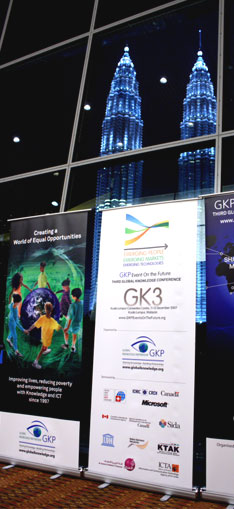
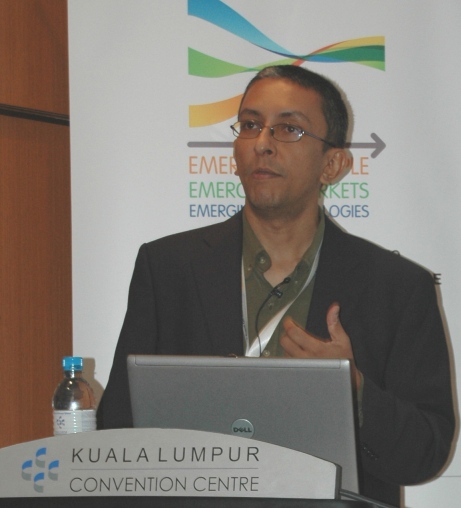
klcc-gk3-03.jpg nalaka-gunawardene-at-gk3.jpg

After spending a good deal of my time and energy sampling many of GK3’s offerings, my cumulative impression was: there was a lot of geek for sure, but very little of the meek.

And the nexus between geek (tools) and meek (needs) was hopelessly lost in the incredible volume of hype, PR and spin generated by the platform organisers. What a missed opportunity it was for everyone!

To be fair, GK3 was not a single conference, but a whole platform of events sharing the large physical space of the KL Convention Centre and spread through the week of 9 to 13 December 2007. During that time and using that space, various groups organised diverse events and activities — ranging from the usual talk sessions and workshops to training, exhibitions, quiz shows, a TV debate and a documentary film festival. There were also several social events that provided many hours networking among individuals and organisations.

Event platforms like GK3 mean very different things to different people. Some turn up mainly to show and tell (or share) what they are doing. Some attend simply to find out what’s going on. Others look for markets, partners or opportunities. With some planning and work, most participants get to take away something in the end.

All this certainly happened during GK3 to one extent or another. It brought together hundreds of people from all over the world who share an interest in G2M — according to official figures, a total of 1,766 registered participants from 135 countries, comprising 19% from public sector, 21% from private sector, 29% from civil society, 20% from international organisations, 5% from media and 6% from academia. Among them, 82% of participants were from developing countries. And half of all participants were from Asia, which was not surprising given their easier access to KL.

These participants — most of them eager, energetic and creative individuals — talked and mixed in a myriad combinations around the overall platform theme: how the threads of emerging people, markets and technologies will intertwine to deliver the future. There was discussion, debate, sharing and networking.

I myself did all of this. I attended part of the 3rd World Electronic Media Forum, joined the GKP’s 10th birthday celebration, sat through some plenary and parallel sessions and moderated two sessions myself. Some TVE Asia Pacific documentary films that I had scripted or directed were screened at the i4d film festival, a key side event. The week also saw the release of two Asian regional books that I was involved in creating (one I co-edited, and the other I wrote a chapter for).

But being the professional skeptic that I am, I don’t buy the GK3 secretariat’s post-event claim that “An overwhelming number of participants indicated that GK3 is the only event of its kind, is absolutely critical and worthwhile.” I have no doubt that a statistically higher number of people made nice and kind remarks about the week’s offerings, as many such people are wont to, especially if their participation was supported by travel scholarships. (I would be interested to know how many of the 1,700 people came on their own steam, as I did.)

In fact, style (and hype) over substance characterised the entire GK3 platform — the hype had actually started months before the event, with all registered participants being bombarded by endless promotional emails that I found simply intolerable. (And no, the organisers didn’t offer us the option of unsubscribing.) So much time, energy and donor funds were spent – nay, squandered – on dressing it up and inflating everything to the point of losing all credibility. If anyone was laughing all the way to their banks after GK3, it must be the assorted spin doctors!
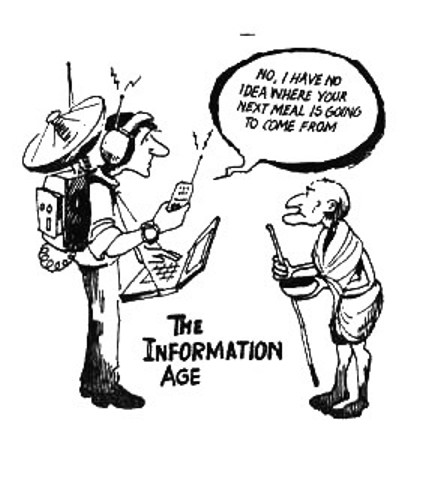
copy-of-all-inf-no-solutions.jpg
As I have written and spoken (for example in an op ed article in i4d magazine, June 2006), the gulf between the (expensive) hype and reality in ICT circles can be wide and shocking. What is worth investigating is the development effectiveness of this whole platform, and the value for money it delivered.

Take, for example, an email circular sent out by the GK3 organisers days after the platform ended. Under ‘key initial findings’, they list the following for emerging technologies, the area that interests me the most (verbatim reproduction here):

Four future-oriented outlook involving technologies were highlighted – media, cybersecurity, low cost devices, and green technologies.
* Increased convergence of different media allows single broadcasting (one to many) to be complemented by social broadcasting (many to many), and in turn increases interactivity in the exchange of information.
* Cybersecurity, cybercrimes and cyberwaste are becoming real dangers which deserve special attention.
* More new low cost devices are needed to facilitate affordable access to information, knowledge, communication and new forms of learning.
* Demand for innovative green technologies is welcomed and growing.

I don’t see how any of this can be labelled as ‘findings’ — these are not even articulate expressions of already known trends, conditions or challenges. Is this how the ‘Event of the Future’ going to be recorded for posterity? Surely, GK3 achieved more than this – probably below the radar of its spin doctors?

GK3 to me was more evidence of the disturbing and very unhealthy rise of spin in international development circles, where both development organisations and development donors are increasingly investing in propagandistic, narcissistic communications products and processes. While publicity in small doses does little harm, it is definitely toxic in the large volume doses that are being peddled whether in relation to MDGs or humanitarian assistance or, as with GK3, in relation to Geek2Meek. Full-page, full-colour paid advertisements in the International Herald Tribune don’t come cheap — but they come at the expense of the poor and marginalised.

I was also struck by how web 1.0 the GK3 organising effort was — all official statements, images and communication products (and even social events) were so carefully crafted, orchestrated, controlled. Whatever spontaneous action came not from the Big Brotherly organisers but from some free-spirited participants who seized the opportunity to express or experiment. The defining characteristics of web 2.0 – of being somewhat anarchic, highly participatory and interactive – were not the hallmarks of GK3. Again, a missed opportunity.

Then there was the ridiculously named Moooooooooooooo – sorry, it was actually MoO, an abbreviation for ‘Marketplace of Opportunities’, which GK3 was supposed to create or inspire for all those engaged in Geek2Meek work.

The MoO turned out to be just another exhibition where two or three dozen organisations put up their ware to show and tell (and a few did brag and sing, but that’s allowed at places like this). Strangely for an ICT gathering, there was so much paper floating around — posters, leaflets, booklets, books, postcards, you name it! And very few CDs, DVDs and electronic formats being distributed.

Oct 2007 Blog post: Say Moooooooooo – Mixing grassroots and iCT in KL

In the last hour of the final day, I walked around the MoO (I must admit I was half curious to see if the cows have come home!). I was stunned by the massive volumes of mixed up paper lying around everywhere. The week’s events were drawing to an end, and it was unlikely there would be too many more takers for all this paper. My colleague Manori captured on her mobile phone this image of an exasperated me surrounded by mountains of paper.
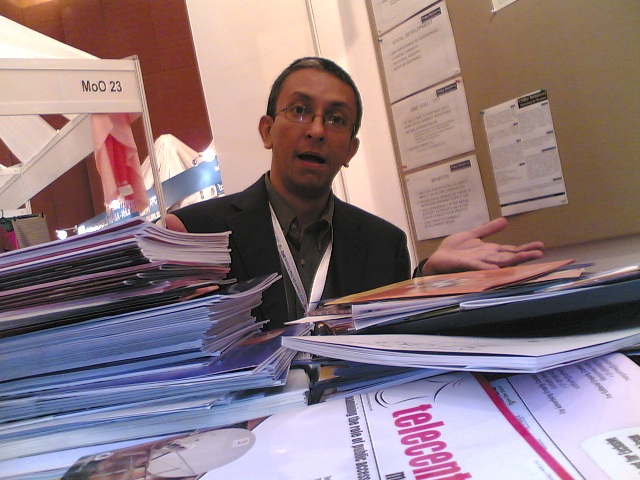
nalaka-gunawardene-sinking-in-a-sea-of-paper-at-gk3-dec-2007.jpg

The MoO exhibitors were not alone in their profligacy and wastefulness – the GK3 secretariat easily wins the prize for producing the greatest volume of glossy, expensive paper-based promotional material for at least a year preceding the event. These were often sent in multiple copies to heaven knows how many thousands of people all over the planet.

All this happened in a year (2007) when scientific confirmation of global climate change prompted governments, industry and civil society to realise that business as usual cannot continue, and more thrifty ways to consume energy and resources must be adopted. Ironically, GK3 was largely ignored by the world’s news media who focused much more attention on the UN Climate Change conference underway in neighbouring Indonesia’s Bali island.

I have commented separately on the missing link between KL and Bali. It is highly questionable what value-for-money benefit an ICT event like GK3 could derive from the abundance of paper-based materials produced to promote it. It’s revealing that the GKP’s oft-repeated claims of attracting 2,000 participants to GK3 were under-achieved despite excessive promotion.

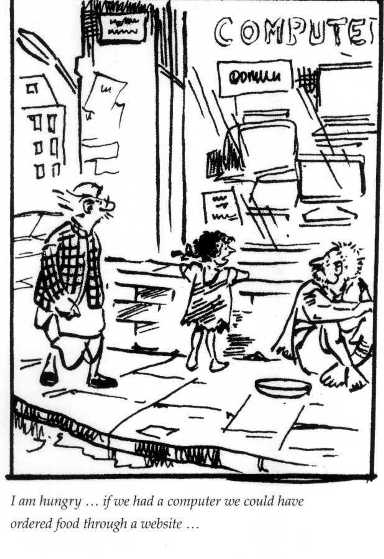
Writing in October 2007, I said: “An informed little bird saysGK3 has milked development donors well and truly for this 3-day extravaganza. I hope someone will calculate the cost of development aid dollars per ‘Mooo’…”
poor-hungry-boy-cartoon.jpg

Well, now is the time to ask those difficult questions. The donor agencies of several developed countries — and from Canada and Switzerland in particular — invested heavily in the GK3 extravaganza. These are public funds collected through taxes, given in trust to these agencies for rational and prudent spending. And it’s fair to say that most of this official development assistance (ODA) money is given with the noble aim of reducing poverty, suffering and socio-economic disparities in the majority world.

The GK3 organisers — that is, the GKP Secretariat — often talk in lofty terms about good governance, extolling the virtues of accountability and transparency. Here’s your chance to practise what you preach to the governments and corporations of the world: disclose publicly how much in total was collected for GK3 (from development donors, corporate sponsors, hefty registration fees), and how this money was spent. In sufficient detail, please!

We will then decide for ourselves whether GK3 provided value for money in the truest sense of that concept, and assess if GK3 was ‘absolutely critical and worthwhile’ as the organisers so eagerly claim.

It’s easy for like-minded people to become buddies and get cosy in international development networks. It’s also common to engage in self congratulatory talk and mutual back-slapping at and after gatherings like GK3. But too much manufactured (spun?) consensus and applause can blind our collective vision and lead us astray.

If we genuinely want to engage in Geek2Meek (or, ICT4D), we have to keep repeating the vital questions: what is the value addition that ICTs bring to the development process, and what is the value addition that mega-events like GK3 provide for turning geek tools to serve the meek? Answers must be honest, evidence-based and open to discussion (and dissension, if need be).

In not sharing the euphoria of GK3 organisers, I probably sound like that little boy who dared to point out that the mighty emperor had no clothes. If nobody talks these inconvenient truths and asks some uncomfortable questions, we would be going round and round in our cosy little grooves till the cows come home.

Did someone say Mooooooooooooo?

Read my November 2005 op ed essay written just after WSIS II: Waiting for pilots to land in Tunis

From KL to Bali: Why were ICT and climate change debates worlds apart?
Ram Bahadur Tamang: The face of Film South Asia

ram-bahadur-tamang.jpg ram-bahadur-tamang.jpg

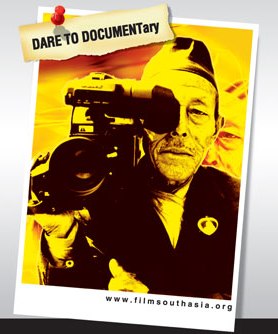
For ten years, this ordinary Nepali man’s photo has been a rallying call for documentary film-makers across South Asia, home to one fifth of humanity.

He has become the symbol, and the logo, of Film South Asia (FSA), a regional film festival organised every other year in Kathmandu since 1997. FSA, whose latest edition rolls out in the Nepali capital this week (11 – 14 October 2007) is the leading and most enduring film festival that brings together South Asian film-makers and film-lovers. It is a low-budget, high-energy festival organised by the non-profit Himal Association.

Having been associated with FSA from the beginning (I was on the first festival’s jury, and have hosted a couple of travelling festivals since), I was curious about who this old man was. On a visit to Kathmandu last month, I asked FSA Chairman and documentary champion Kanak Mani Dixit about it.

It turns out that the FSA logo is derived from this photo, taken of an ordinary Nepali called Ram Bahadur Tamang. Photocredit goes to Cory R Adams.

Courtesy Himal Southasian

Ram Bahadur belonged to the Tamang people, who are believed to have migrated to Nepal from Tibet. Today, the Tamangs reside mainly in the high hills north of Kathmandu.

Perhaps inspired by my query, Kanak has written up the story behind the photo/logo in his column On the Way Up in the latest issue of Himal Southasian which he edits.

He says: “The Tamang from Byabar served the Rana palaces as guards and porters. Ram Bahadur was one such. One day, he was caught by a photographer holding an early-model Sony video camera. He had a Sirdi Sai Baba badge on his left lapel. The image of Ram Bahadur is now the logo of the Film South Asia documentary film festival. He looks out over the world through his camera and his other, free, eye. The trophy given to the best film at the end of each FSA is known as the Ram Bahadur Trophy.”

Not much more is known about old Ram Bahadur. He had moved on shortly after this picture was taken. We don’t know, for example, if he ever actually used the Sony camera, or was just playing with what, at the time, seemed a high-tech curiosity. This was, after all, the early 1990s when video cameras were not quite ubiquitous.

Read Kanak Mani Dixit on Who’s Ram Bahadur Tamang in Himal South Asian October 2007

Read my July 2007 post: Himal Southasian – 20 years of celebrating South Asian diversity

“Can you help us to film a child’s leg being broken?”

“Can you help us to film a child’s leg being broken?”

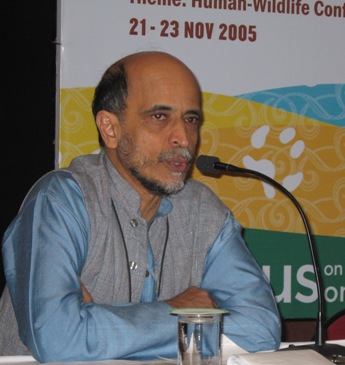
This question, posed by a visiting Canadian TV crew in the 1970s, startled my good friend Darryl D’Monte, one of the most senior journalists in India and former editor of the Times of India.

Darryl was having a chat with the crew, giving them some insights on the extent of poverty in his home city of Bombay, since renamed as Mumbai. It is routine for visiting journalists to have such chats with their local counterparts to get context and advice.

It was when the conversation turned to beggars, that this western TV crew asked if they could film the intentional breaking of a poor child’s leg — a brutal practice that was believed to exist so that maimed children could be employed as beggars. A disabled child would evoke more sympathy, and consequently, more alms.

darryl-dmonte-speaking-at-ifej-2005-congress.jpg

The articulate Darryl must have expressed his exasperation in strong terms. But even he couldn’t have anticipated the response.

“It’s going to happen anyway,” was how the film crew rationalised their bizarre request.

So why not be there, capture it on film, and get a great story out of it — which can be packaged as the brutal side of India’s poverty! This must have been the crew’s line of reasoning. Maybe their editors had exerted pressure to come back with something out of the ordinary.

I quoted this incident in my essay, Ethical newsgathering challenge for Al Jazeera International, published in November 2006. It was a plea for the newest entrant to international TV newsgathering to play by a different, and more ethical, set of rules.

These and worse practices are certainly not confined to India, or to TV crews originating from any single country. And sadly, these have not been abandoned after the 1970s. In fact, the emergence of 24/7 satellite news channels since the 1980s has inspired much more competition in the TV newsgathering industry, creating an alarming race to the bottom.

Such journalists’ only operating guideline seems to be: get the story, no matter what — or who gets hurt in that process.

In filming wildlife documentaries, film-makers sometimes have to make a choice: do they interfere in the processes of Nature, such as a predator setting on a hapless prey? There is an unwritten rule that things must be allowed to happen, with humans only capturing actuality on film.

But when it comes to filming wild life of our species in our cities and villages, the ethical dilemmas are not so easily resolved. This is why all journalists and film-makers, especially those in newsgathering, need a strong ethical framework for their work.

Journalists represent the public’s right to know, which is extremely important. Media coverage and exposes can trigger much needed aid, reform or public outcry on certain issues. But that is not a justification for getting the story by any means.

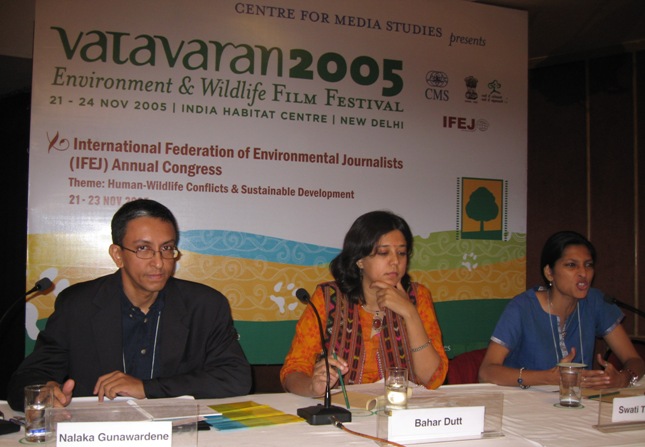
Darryl D’Monte shared the above story at panel discussion on ‘Does TV do a better job on environmental reporting?’ which I chaired during the annual congress of the International Federation of Environmental Journalists (IFEJ), held in New Delhi, India, in November 2005. That year it was part of the Vatavaran 2005, the national environmental film festival of India.

panel-discussion-at-ifej-2005-congress-new-delhi.jpg

I was reminded of this story because the 4th CMS Vatavaran film festival is round the corner: it will be in New Delhi from 12 to 16 September 2007. I won’t be there in person; my colleague Manori Wijesekera is representing TVEAP this time.

TVE Asia Pacific News: Environmental film-makers call for ethical framework

Read official report of IFEJ Congress in 2005

Related blog posts:

Al Jazeera: Looking hard for the promised difference

Wanted: Ethical sourcing of international TV news

Cheque-book Development: Paying public media to deliver development agency logos

Memories of Toyama: Japan Wildlife Film Festival

Image courtesy JWFF

The Japan Wildlife Film Festival opens today – 23 August 2007 – in Toyama, in eastern Japan.

As their website says: “Established in 1993, the Festival is held biennially. It started in the hope that by screening moving images of the wonders of wildlife and the co-existence of nature and people, we could help to increase understanding and awareness of the urgent need to protect and care for the natural world.”

The last Festival, in August 2005, received 331 film entries from 35 countries and some 30,000 people, including many school children, attended the public screenings staged throughout the Toyama region. This level of public participation is exceptional for an international film festival — and shows how well the organisers, the Nature Film Network, have engaged the local people.

International film-makers and broadcasters now know the Festival as one of the biggest of its kind in Asia.

I’m missing Toyama this year. I participated in the last two festivals and have fond memories — of watching great films, having excellent company and enjoying outstanding Japanese hospitality in the salubrious holiday city of Toyama.

In 2003, I was part of the festival’s international jury. Then at the 2005 festival, I was invited to give a talk about our Children of Tsunami media project, which at the time was documenting the personal recovery stories of eight families affected by the Asian Tsunami in India, Indonesia, Sri Lanka and Thailand.

In both years, a highlight of my experience was the opening evening reception, held at a traditional Japanese farm house restored by NFN and located a half-hour’s drive outside the city. There, the local people hosted us to food and beverages prepared at home. An evening of simple, unpretentious cultural exchange — with nothing ‘official’ about it!

That’s the character of NFN chairman Hirohisa Ota: a man of few words who leads by example and brings together a small but dynamic team of staff and volunteers to run the 4-day festival with clockwork precision.

The photo below shows international participants at JWFF 2005.

Photo from JWFF website

Image from JWFF website

List of finalist films competing in JWFF 2007

Read my earlier post on Toyama 2005: Lawyers who locked up the Butterfly Tree

AV against HIV: Recalling my own ‘Richard Gere moment’

The 8th International Conference on AIDS in Asia and the Pacific, or ICAAP8, opens in my home city of Colombo in a few days’ time. As I wrote in an earlier post, some of us have been blocked out of this important event by some arrogant members of the conference Secretariat. But our interest in HIV/AIDS advocacy will not be so easily deterred.

On a positive note, I have vivid memories of my active involvement in the XV International AIDS Conference, held in Bangkok, which attracted over 17,000 delegates to the Thai capital for a week full of events and activities. One of them was the official 2004 International AIDS Film Festival, which TVE Asia Pacific organised at the invitation of the Thai Ministry of Public Health and the International AIDS Society.

2004 AIDS Film Festival in Bangkok 2004 AIDS Film Festival in Bangkok 2004 AIDS Film Festival in Bangkok 2004 AIDS Film Festival in Bangkok

Over 4 days, we screened close to 50 TV and video films at three venues, drawing a total of more than 8,000 visitors. These films came from all over the world, in response to an open call that we had issued. We received a rich mix of genres: documentaries, docu-drama, current affairs programming, short television spots as well as entertainment formats — animation, dramas and reality television.

Films at this festival captured the kaleidoscope of emotions, challenges and contradictions presented by the AIDS pandemic. They were evidence of how TV and film professionals are covering HIV as a major development concern of our times.

That formidable task — which we summed up as ‘AV against HIV’ — received a boost when movie industry heavyweights joined in. We had documentaries narrated by Angelina Jolie, Will Smith and Glenn Close.

And while we were organising the festival, actor-activist Richard Gere sent the word saying he was interested in being associated with it. Of course we seized the offer, and had him open the film festival — hugely raising its profile in the Thai and international media.

2004 AIDS Film Festival banner by TVEAP Richard Gere arrives for 2004 AIDS Film Festival, Bangkok Richard Gere being welcomed by Thai children

After three years, I can still remember the moving speech that Richard Gere made at the opening ceremony in the Scala cinema in downtown Bangkok. Talking to an audience packed with diplomats, businessmen, journalists, activists and government officials, he said his experience with persons living with HIV had changed his life even more than his study of Tibetan Buddhism.

He recalled how he had lost a very close friend to HIV. “I don’t want anyone else to die like that,” he said, adding: “It (AIDS) has gone on too long, way too long.”

Then he did something simple yet very effective. He asked everyone who knew at least one person living with HIV to put their hands up. A few dozen hands went up in an audience of around 500.

Next, he said: hands up everyone who has lost at least one person to HIV. Some hands went down while three dozen remained held up.

I did not put my hands up for either call.

That was a moment of truth for myself. Until then, I hadn’t really, closely known anyone who was living with HIV (and disclosed that fact to me). I also had not lost anyone to HIV. Not knowingly anyway.

As the event progressed, I sat there asking myself:
• What kind of little comfort zone or cocoon am I living in?
• What kind of society do I live in, where very few people – if anyone – would dare to acknowledge they are living with HIV?
• And how can I remain authentic, communicating HIV from such a detached standpoint?

Richard Gere at XVI AIDS Conference in Toronto, 2006

I’ve been writing and speaking about HIV for almost two decades. In that time, I have touched on many aspects of HIV, including:
• The science of HIV/AIDS, as a science communicator;
• Public health aspects of the global pandemic as a feature writer;
• The human rights dimensions of HIV, as a development communicator; and
• Nexus between media and HIV, as a media watcher/researcher.

But I sat there in the Scala cinema wondering if it was sufficient for me to have done all that with the objectivity of a journalist, or the clinical detachment of a researcher.

I then realised that when it comes to HIV/AIDS, we have to suspend these ordinary frameworks and ‘conditioning’ of our training.

We have to:
• Stop thinking of it as someone else’s problem;
• Get away from the ‘us’ and ‘them’ mindset;
• Understand that no one is immune or buffered from the human immunodeficiency virus, HIV; and
• More than anything else — stop living in denial.

These apply to individuals, communities, society — and also governments.

That was my Richard Gere moment.

Read TVEAP news report on 2004 AiDS Film Festival

See more photos on 2004 AIDS Film Festival on TVEAP website

Photos by Jerome Ming and Indika Wanniarachchi for TVEAP