When I was in my early teens (back in the early 1980s), I developed a great interest in radio. Not just in listening to radio broadcasts, which I did regularly while growing up in a country that had no television, but also in building a radio that could both receive and transmit signals.
My school teacher father, who encouraged me in many of my diverse pursuits, bought transistors, condensers and other ‘building blocks’ for a basic radio set. With the help of an amateur radio handbook, and through trial and error, he and I actually built a functional transmitter. It was exhilarating to listen to local and shortwave broadcasts on a home-made radio set, but even more exciting to be able to transmit rudimentary signals.
Even as a kid, I was not contented in being a passive recipient of information; I wanted to give out as much as I received…
That particular fancy didn’t last long: I soon moved on to other challenges, and never persisted with being a serious amateur radio enthusiast (or ‘radio ham’), but it left a lasting impression. A few years later, after leaving high school, I became a regular freelancer at the local radio station. By age 23, I was hosting my own weekly show on national radio, and my association with the radio medium would last for much of my 20s.
The humble low tech that saved the day...My interest in amateur radio lay dormant — until five years ago, when I read reports about how radio hams helped revive emergency communications in the immediate aftermath of the Indian Ocean Tsunami.
The decades old practice was hailed as the ‘low tech’ miracle that literally helped save lives. Where electricity and telephone services — both fixed and mobile — had been knocked down, radio hams restored the first communication links. They were at the forefront of relief efforts, for example, in the Andaman and Nicobar Islands in India, and in Hambantota in southern Sri Lanka.
This intrigued Sir Arthur C Clarke, inventor of the communications satellite and long time resident of Sri Lanka. Shortly afterwards, he wrote in Wired magazine: “We might never know how many lives they saved and how many minds they put at ease, but we owe a debt to Marconi’s faithful followers.”
If Sir Arthur were alive, he would have been dismayed to find what has happened since. Notwithstanding their celebrated role after the tsunami, radio hams have been sidelined in Sri Lanka. Their very hobby is being frowned upon by the state on the grounds of…national security.
Looking back, it seems like the public-spirited radio hams were given their 15 minutes of fame and then soundly ignored. Worse, the short-lived prominence may have attracted new bureaucratic hurdles.
“As the applause died away, everything was forgotten,” I quote Victor Goonetilleke, one time President and current Secretary of the Radio Society of Sri Lanka, which networks amateur radio practitioners in the country.
One reason for this bureaucratic fear and negativity, I argue, may be simple ignorance of what amateur radio really is — reflecting the disturbingly low levels of media literacy in Sri Lanka.
Read the full essay, and join the conversation on Groundviews, or on this blog.
The wide-ranging interview was originally filmed in November 2005 in Bangkok, Thailand, by Thai journalist and film maker friend Pipope Panitchpakdi. He used excerpts at the time for a Thai documentary to mark the first anniversary of the tsunami. It remains one of the best media interviews I have given, for which all credit goes to Pipope.
The undersea quake that triggered the Indian Ocean tsunami on 26 December 2004 was so powerful that it was felt around the globe, as far away as Alaska. Likewise, the killer waves that hammered the coasts of South and Southeast Asia left such a trail of destruction that it was like a lasting, unceasing wave.
On the eve of the mega-disaster’s fifth anniversary, I’ve been busy writing, talking and reflecting on what it meant for me personally, and my media profession and fellow Asians in general. I recently filmed an interview for Thai Public Television (TPBS), where my friend Pipope Panitchpakdi is doing a tsunami+5 documentary.
He was in Sri Lanka at the time of the tsunami, and spent two weeks working as a freelance reporter covering the aftermath for the western media. His piece sums up the mixed bag of lessons and recovery efforts that Sri Lanka, one of the hardest hit countries, has accomplished in the half decade this that momentous day.
An excerpt: “Five years later, life in the affected countries has resumed, and the world has learned immensely valuable lessons about responding to catastrophe. But as with any human endeavor, some opportunities have also been lost.”
Earlier this week, United Nations Climate Change Conference 2009 (COP15) in Copenhagen opened with an apocalyptic video showing the world torn asunder from a variety of disasters.
As one reviewer wrote: “The portrayal sought to play up on the fears of the world should a worst case scenario develop from global warming. The entire video is reminiscent of the recent disaster movie blockbuster, 2012that was released in movie theatres in recent months.
I haven’t yet seen 2012, now showing in a theatre close to me, so I can’t comment on the comparison. But here’s the video, now playing on COP15 channel on YouTube:
In the video, a child goes to sleep peacefully but wakes to find herself in a desert wasteland. As she sets out to explore, the very land on which she stands begins to crack open and she flees. The girl doesn’t make it far before she looks up to see the world’s largest tornado tearing a city apart and flood waters approaching. The child leaps to a tree branch as the waters overtake her and she screams. It is then that she wakes from what is only a dream and decides to make a home video saying, “Please help the world.”
Will the bickering and myopic leaders of the world heed this call? We shall know in the next few days.
Meanwhile, here are the credits for this film:
Director: Mikkel Blaabjerg Poulsen
Producers: Stefan Fjeldmark and Marie Peuliche
Cinematographer: Dan Laustsen
Production designer: Peter de Neergaard
Editor: Morten Giese
Composer: Davide Rossi
Sound design: Carl Plesner
Production company: Zentropa RamBuk
Advisory consultants: Mogens Holbøll, Bysted A/S and Christian Søndergaard, Attention Film ApS.
Today, 7 December 2009, the latest UN-FCCC climate negotiations begin in Copenhagen, Denmark. It’s not just another environmental conference – this one can make or break the future of our world.
Recognising this, 56 newspapers from 45 countries across the world have up with common editorial and demanded that world leaders put aside their differences and step up to seal the deal. The text was drafted by a Guardian team during more than a month of consultations with editors from more than 20 of the papers involved. Like the Guardian most of the newspapers have taken the unusual step of featuring the editorial on their front page.
At Moving Images, we add our own modest echo to this call by reproducing the editorial in full, as is:
One World, One Climate, One Editorial...
Copenhagen climate change conference: ‘Fourteen days to seal history’s judgment on this generation’
This editorial calling for action from world leaders on climate change is published today by 56 newspapers around the world in 20 languages.
Today 56 newspapers in 45 countries take the unprecedented step of speaking with one voice through a common editorial. We do so because humanity faces a profound emergency.
Unless we combine to take decisive action, climate change will ravage our planet, and with it our prosperity and security. The dangers have been becoming apparent for a generation. Now the facts have started to speak: 11 of the past 14 years have been the warmest on record, the Arctic ice-cap is melting and last year’s inflamed oil and food prices provide a foretaste of future havoc. In scientific journals the question is no longer whether humans are to blame, but how little time we have got left to limit the damage. Yet so far the world’s response has been feeble and half-hearted.
Climate change has been caused over centuries, has consequences that will endure for all time and our prospects of taming it will be determined in the next 14 days. We call on the representatives of the 192 countries gathered in Copenhagen not to hesitate, not to fall into dispute, not to blame each other but to seize opportunity from the greatest modern failure of politics. This should not be a fight between the rich world and the poor world, or between east and west. Climate change affects everyone, and must be solved by everyone.
The science is complex but the facts are clear. The world needs to take steps to limit temperature rises to 2C, an aim that will require global emissions to peak and begin falling within the next 5-10 years. A bigger rise of 3-4C — the smallest increase we can prudently expect to follow inaction — would parch continents, turning farmland into desert. Half of all species could become extinct, untold millions of people would be displaced, whole nations drowned by the sea. The controversy over emails by British researchers that suggest they tried to suppress inconvenient data has muddied the waters but failed to dent the mass of evidence on which these predictions are based.
Few believe that Copenhagen can any longer produce a fully polished treaty; real progress towards one could only begin with the arrival of President Obama in the White House and the reversal of years of US obstructionism. Even now the world finds itself at the mercy of American domestic politics, for the president cannot fully commit to the action required until the US Congress has done so.
But the politicians in Copenhagen can and must agree the essential elements of a fair and effective deal and, crucially, a firm timetable for turning it into a treaty. Next June’s UN climate meeting in Bonn should be their deadline. As one negotiator put it: “We can go into extra time but we can’t afford a replay.”
At the deal’s heart must be a settlement between the rich world and the developing world covering how the burden of fighting climate change will be divided — and how we will share a newly precious resource: the trillion or so tonnes of carbon that we can emit before the mercury rises to dangerous levels.
Rich nations like to point to the arithmetic truth that there can be no solution until developing giants such as China take more radical steps than they have so far. But the rich world is responsible for most of the accumulated carbon in the atmosphere – three-quarters of all carbon dioxide emitted since 1850. It must now take a lead, and every developed country must commit to deep cuts which will reduce their emissions within a decade to very substantially less than their 1990 level.
Developing countries can point out they did not cause the bulk of the problem, and also that the poorest regions of the world will be hardest hit. But they will increasingly contribute to warming, and must thus pledge meaningful and quantifiable action of their own. Though both fell short of what some had hoped for, the recent commitments to emissions targets by the world’s biggest polluters, the United States and China, were important steps in the right direction.
Social justice demands that the industrialised world digs deep into its pockets and pledges cash to help poorer countries adapt to climate change, and clean technologies to enable them to grow economically without growing their emissions. The architecture of a future treaty must also be pinned down – with rigorous multilateral monitoring, fair rewards for protecting forests, and the credible assessment of “exported emissions” so that the burden can eventually be more equitably shared between those who produce polluting products and those who consume them. And fairness requires that the burden placed on individual developed countries should take into account their ability to bear it; for instance newer EU members, often much poorer than “old Europe”, must not suffer more than their richer partners.
The transformation will be costly, but many times less than the bill for bailing out global finance — and far less costly than the consequences of doing nothing.
Many of us, particularly in the developed world, will have to change our lifestyles. The era of flights that cost less than the taxi ride to the airport is drawing to a close. We will have to shop, eat and travel more intelligently. We will have to pay more for our energy, and use less of it.
But the shift to a low-carbon society holds out the prospect of more opportunity than sacrifice. Already some countries have recognized that embracing the transformation can bring growth, jobs and better quality lives. The flow of capital tells its own story: last year for the first time more was invested in renewable forms of energy than producing electricity from fossil fuels.
Kicking our carbon habit within a few short decades will require a feat of engineering and innovation to match anything in our history. But whereas putting a man on the moon or splitting the atom were born of conflict and competition, the coming carbon race must be driven by a collaborative effort to achieve collective salvation.
Overcoming climate change will take a triumph of optimism over pessimism, of vision over short-sightedness, of what Abraham Lincoln called “the better angels of our nature”.
It is in that spirit that 56 newspapers from around the world have united behind this editorial. If we, with such different national and political perspectives, can agree on what must be done then surely our leaders can too.
The politicians in Copenhagen have the power to shape history’s judgment on this generation: one that saw a challenge and rose to it, or one so stupid that we saw calamity coming but did nothing to avert it. We implore them to make the right choice.
Apart from the typhoons that blow in from the Pacific Ocean, the Philippines also sits on the Pacific Rim of Fire where periodic earthquakes occur, and active volcanoes are found.
Disasters not only kill or injure people and cause property damage; they also disrupt livelihoods and cultural practices. That’s what happened when the volcanic Mount Pinatubo erupted in 1991, its lava and ashes destroyed many surrounding villages – including the traditional homeland of the Ayta, indigenous people descending from the first inhabitants of the Philippines. They had fled to the hills from the lowlands during the protracted Spanish conquest of the Philippines which first commenced in 1565.
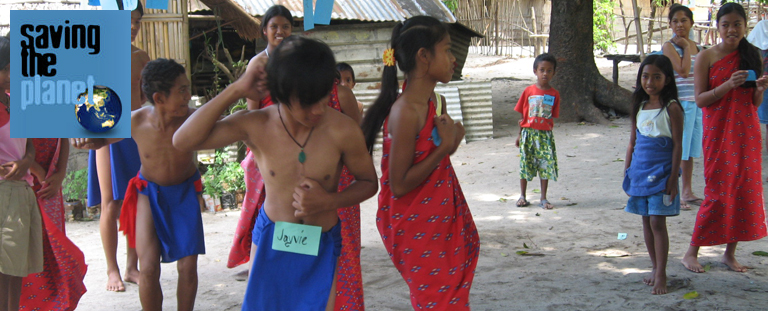
Today, resettled elsewhere on Luzon island, the Ayta are trying to preserve their traditional culture and community integrity through education and theatre. These efforts are supported by the Ayta organisation PBAZ, part of the Education for Life Foundation. Going back to the abandoned village is one way of keeping memories alive.
News by definition looks for the exception. What goes right, and according to plan, is hardly news. Deviations, aberrations and accidents hit the news.
It’s the same with disasters. Reducing a hazard or averting a disaster does not make the news; when that hazard turns into a disaster, that typically tops the news. Yet, as we discussed during a session at the 6th World Conference of Science Journalists held in London from June 30 – July 2, 2009, both aspects are important — and both present many challenges to journalists and the media.
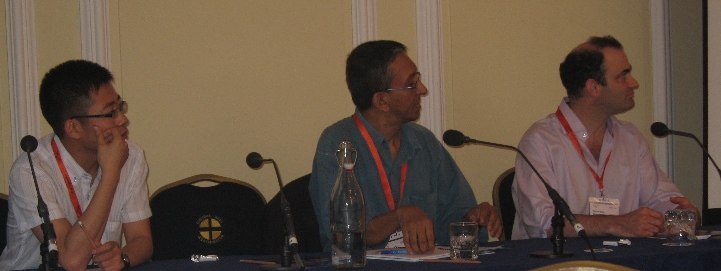
The session, titled Covering a disaster from Sichuan to Sri Lanka, saw three science journalists share their own experiences and insights in covering two major disasters in Asia. Richard Stone (Asia News Editor, Science) and Hujun Li (senior science writer with Caijing magazine, China) both spoke about covering the Sichuan earthquake that occurred on 12 May 2008. I spoke on my experiences in covering the Indian Ocean tsunami of 26 December 2004. The session was chaired by the veteran (and affable) British journalist Tim Radford, who has been The Guardian‘s arts editor, literary editor and science editor.
Covering a disaster from Sichuan to Sri Lanka: L to R: Hujun Li, Nalaka Gunawardene and Richard StoneI recalled the post-tsunami media coverage in two phases — breaking news phase (first 7 – 10 days) and the aftermath, which lasted for months. When the news broke on a lazy Sunday morning, ‘Tsunami’ was a completely alien term for most media professionals in Sri Lanka. In newspaper offices, as well as radio and TV studios, journalists suddenly had to explain to their audiences what had happened, where and how. This required journalists to quickly educate themselves, and track down geologists and oceanographers to obtain expert interpretation of the unfolding events. We than had to distill it in non-technical terms for our audiences.
My involvement in this phase was as a regular ‘TV pundit’ and commentator on live TV broadcasts of MTV Channels, Sri Lanka’s largest and most popular broadcast network. Night after night on live TV, we talked about the basics of tsunami and earthquakes, and summed up the latest information on what had taken place. We also acknowledged the limits of science -– for example, despite advances in science and technology, there still was no way of predicting earthquakes in advance.
One question we simply couldn’t answer was frequently raised by thousands of people who lost their loved ones or homes: why did it happen now, here — and to us? Was it an act of God? Was it mass scale karma? As science journalists, we didn’t want to get into these debates — we had to be sensitive when public emotions were running high.
There were enough topics during the breaking news phase that had a scientific angle. Clinically cold as it sounded, the mass deaths required the safe, proper and fast burial of bodies with identities established. The survivors had to be provided shelter, food, safe drinking water and counselling. And when rumours were spreading on the possibility of further tsunamis, both officials and public needed credible information from trusted, competent sources.
Tsunami waves lashing Kalutara beach on western Sri Lanka on 26 December 2004: satellite image courtesy DigitalGlobe Quickbird satellite, http://www.digitalglobe.com
After the breaking news phase passed, we had more time to pursue specific stories and angles related to the tsunami. As an environmentally sensitive journalist, I was naturally interested in how the killer waves had impacted coastal ecosystems. Then I heard some interesting news reports – on how some elements of Nature had buffered certain locations from Nature’s own fury.
Within days, such news emerged from almost all Tsunami-affected countries. They talked about how coral reefs, mangroves and sand dunes had helped protect some communities or resorts by acting as ‘natural barriers’ against the Tsunami waves. These had not only saved many lives but, in some cases, also reduced property damage. Scientists already knew about this phenomenon, called the ‘greenbelt effect’. Mangroves, coral reefs and sand dunes may not fully block out tsunamis or cyclones, but they can often reduce their impact.
Researching this led to the production of TVE Asia Pacific‘s regional TV series called The Greenbelt Reports, which was filmed at a dozen tsunami impacted locations in South and Southeast Asia. By the time we released the series in December 2006, sufficient time had passed for the affected countries to derive environmental lessons of the tsunami.
The other big story I closely followed was on early warnings for rapid on-set disasters like tsunamis. Some believed that the tsunami caught Indian Ocean rim countries entirely by surprise, but that wasn’t quite true. While the countries of South and Southeast Asia were largely unprepared to act on the tsunami, the Pacific Tsunami Warning Centre (PTWC) in Hawaii, who had detected the extraordinary seismic activity, did issued a tsunami warning one hour after the undersea quake off western Sumatra. This was received at Sri Lanka’s government-run seismological centre in good time, but went unheeded: no one reacted with the swiftness such information warranted. Had a local warning been issued, timely coastal evacuation could have saved thousands.
All this shows the many and varied science or development stories that journalists can find in the aftermath of disasters. Some of these are obvious and widely covered. Others need to be unearthed and researched involving months of hard work and considerable resources. Revisiting the scenes of disasters, and talking to the affected people weeks or months after the event, often brings up new dimensions and insights.
My own advice to science journalists was that they should leave the strictly political stories to general news reporters, and instead concentrate on the more technical or less self-evident facets in a disaster. During discussion, senior journalist Daniel Nelson suggested that all disaster stories are inherently political as they deal with social disparities and inequalities. I fully agreed that a strict separation of such social issues and science stories wasn’t possible or desirable. However, science journalists are well equipped to sniff out stories that aren’t obviously covered by all members of the media pack that descends on Ground Zero. Someone needs to go beyond body counts and aid appeals to ask the hard questions.
As Hujun Li said recalling the post-Sichuan quake experience, “Politics and science are like twins – we can’t separate the two. What we as science journalists can do is to gather scientific evidence and opinion before we critique official policies or practices.”
Another question we were asked was how journalists can deal with emotions when they are surrounded by so much death and destruction in disaster scenes. Reference was made to trauma that some reporters experience in such situations.
I said: “We are human beings first and journalists next, so it’s entirely normal for us to be affected by what is happening all around us. On more than one occasion in the days following the tsunami, I spoke on live television with a lump in my throat; I know of presenters who broke down on the air when emotions overwhelmed them.”
And now...the sequelsSumming up, Tim Radford emphasized the need for the media to take more interest in Disaster Risk Reduction (DRR), which basically means preventing disasters or minimising the effects of disasters.
“DRR is perhaps less ‘sexy’ for the media, as it involves lots of policies and practices sustained over time,” he said. “But the potential to do public good through these interventions is enormous.”
As Tim reminded us, disasters already exact a terrible and enduring toll on the poorest countries. This is set to get worse as human numbers increase and climate change causes extreme weather and creates other adverse impacts. Living with climate change would require sustained investments in DRR at every level.
The stories are out there to be captured, analysed and communicated. In the coming years, the best stories may well turn out to be on disasters averted or minimised
“There is soon going to be a mass extinction event for the media (as we know it) – it’s triggered by the spreading of online media, and accelerated by the economic recession. Very few media organisations will survive…”
John Rennie (photo courtesy Yale University)He added: “Only some very large media organisations and a few really small ones will be able to withstand this mass extinction.”
He then posed the critical question to the several hundred journalists, editors and broadcasters from all over the world: does the rest of us deserve to survive?
He wasn’t so sure – no media organisation, however large or prestigious it may be, and how deep its pockets are, can carry on business as usual amidst this transformative event. In other words, adapt fast – or go the way of the dinosaurs…
It’s probably time for editors to redefine what constitutes science news, he said. “We should move away from the current model of reporting the ‘big paper of the week’.”
Calling such news the ‘low-hanging fruit’, he challenged his peers: “We need to be better than that. Good bloggers can now match us in most of our routine work. So how and where do professional journalists add value?”
We can always depend on Rennie to sum up complex issues in an interesting soundbite or two. My blog post from the previous WCSJ in Melbourne, where he talked (joked) about Vatican condoms and global warming, has drawn consistently high levels of visitor interest since.
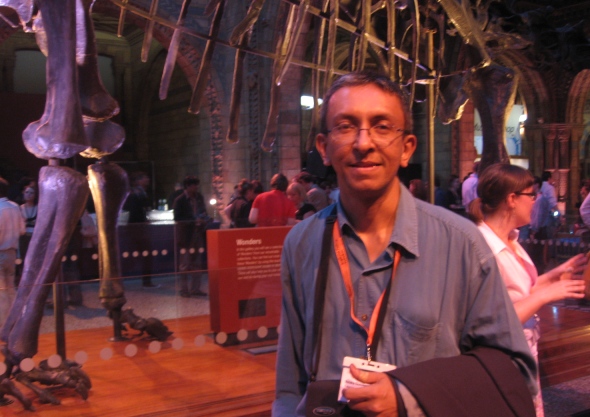
Strangely symbolic? WCSJ 2009 delegates were entertained at London's Natural History Museum...around the skeleton of a Diplodocus!
He didn’t actually use the term ‘mediasaurus’, but clearly his remarks tally with what the American writer Michael Crichton had anticipated as far back as 1993, in a landmark essay titled “Mediasaurus“. In this essay, written for the then newly launched Wired magazine, he prophesied the death of the mass media — specifically the New York Times and the American commercial TV networks.
“To my mind, it is likely that what we now understand as the mass media will be gone within ten years. Vanished, without a trace,” he wrote. Building on his credentials as the author of a best-seller on dinosaurs, Crichton called this endangered beast ‘mediasaurus’.
As later events showed, Crichton foresaw the trend ahead of most people, but didn’t get the timeline right. He was off by a few years — but only a few.
John Rennie is only the seventh editor in chief in the 164-year history of Scientific American magazine. Since his appointment in late 1994, he has been the executive force behind the modernization and reinvigoration of this great publishing institution. So it seems that he is at least trying to prepare his own publication for the coming mass extinction event…
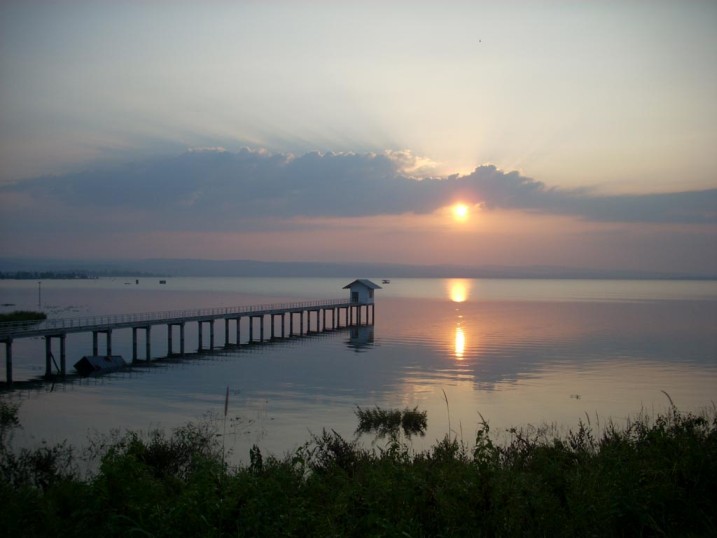
Calm now, turbulent tomorrow? View of Upper Mun Reservoir on the Mekong in northern Thailand: image courtesy TVE Asia PacificThe Greater Himalaya region is known as the water tower of Asia: the continent’s nine largest rivers emerging from its ice-capped mountains provide 1.5 billion people with water and 3 billion people with their food and power.
With more ice stored here than anywhere outside the Arctic and Antarctic, the region has even been called the earth’s third pole. But the ice fields of the Himalayas are melting, and at a faster pace than anywhere else on the planet.
A river that is going to be affected is the Mekong – one of Asia’s major rivers, and the twelfth longest in the world. TVE Asia Pacific has just produced a short film looking at how current and anticipated environmental changes could impact water users in the six countries of Southeast Asia which share its waters. We released it online this week, just in time for World Water Day 2009, March 22.
Mekong: Watch that River!
Along its journey of nearly 5,000 kilometres (3,000 miles), the Mekong nurtures a great deal of life in its waters – and in the wetlands, forests, towns and villages along its path. Starting in the Tibetan highlands, it flows through China’s Yunan province, and then across Myanmar, Thailand, Laos and Cambodia…before entering the sea from southern Vietnam.
The Mekong River Basin is the land surrounding all the streams and rivers that flow into it. This covers a vast area roughly the size of France and Germany combined. The basin supports more than 65 million people who share Mekong waters for drinking, farming, fishing and industry. Along the way, the river also generates electricity for South East Asia’s emerging economies.
The Mekong has sustained life for thousands of years. But growing human demands are slowly building up environmental pressures on the river. A new study, commissioned by the UN Environment Programme (UNEP), cautions that climate change could add to this in the coming years.
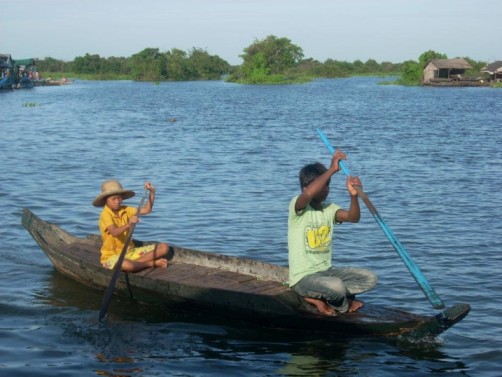
Fishing on the Tonle Sap lake in Cambodia: An 'ecological hot spot' on the MekongThe study, carried out under a project named “Vulnerability Assessment of Freshwater Resources”, was headed by Dr Mukand Babel at the Asian Institute of Technology (AIT) in Bangkok. It probed how climate change can impact the river from the highlands to the delta….affecting the survival and prosperity of millions.
Dr Babel says on the film: “Climate change would affect…the amount of rainfall which is received. Under climate change conditions, we expect less rainfall to be observed and that would bring less flows in the river which would affect the water users in the downstream areas.”
He adds: “At the same time, the sea level rise which is an associated impact of climate change, would bring more sea water intrusion into the river systems and groundwater systems in the delta in Vietnam.”
Salt water could go upstream by 60 to 70 kilometres, degrading the land and water in the Mekong delta. This would add to pressures already coming from growing human numbers, expanding economies and disappearing forests.
So the Mekong will be affected at both ends, by different processes that are triggered by climate change.
To find out how these changes could affect the Mekong’s millions, my colleagues filmed in two
‘ecological hot spots’ in the river basin identified by the study: the Upper Mun River, a tributary of the Mekong, and the Tonlé Sap lake in Cambodia.
The UNEP-AIT study recommends Mekong river countries to improve how they manage their water and land. This needs better policies, institutions and systems.
Dr. Young-Woo Park, Regional Director, UNEP, says on the film: “Countries sharing the Mekong river…have to act together and they have to develop the policies on how to conserve and how to conserve the Mekong river and also how to properly manage the Mekong river.”
The study found the Mekong river basin ‘moderately vulnerable’ to environmental changes. There aren’t any major water shortages in this river basin as yet. For now, the Mekong is holding up despite many pressures.
But all this can change if less water is flowing down the river and the demand for water keeps growing.
That’s why we named this film ‘Mekong: Watch that River!’
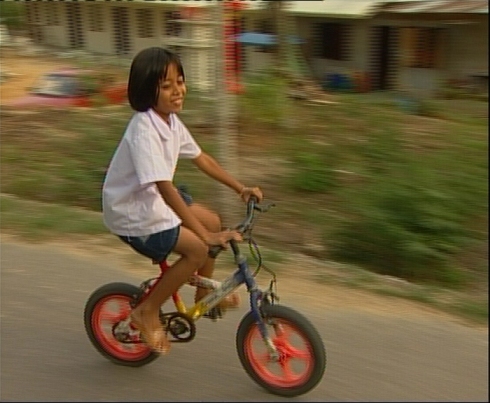
Jantakarn Thep-Chuay, known as Beam
For many weeks, Jantakarn Thep-Chuay — nicknamed Beam -– did not understand why her father was not coming home. The eight-year-old girl, in Takuapa in Thailand’s southern district of Phang Nga, had last seen him go to work on the morning of 26 December 2004.
“On that Sunday, the day there was a wave, my dad wore his tennis shoes,” she recalls as she gets into his pair of sandals. “My dad didn’t have to do much work — he just walked around looking after workers.”
Beam’s father Sukaroak –- a construction supervisor at a new beach resort in Khao Lak –- was one of thousands of Thais and foreign tourists killed when the Asian Tsunami hit without warning. His body was never found.
For months, Beam would draw pictures of her family. These, and family photos of happier times, helped her to slowly come to terms with what happened.
The first year was long and hard for the family Sukaroak left behind: Beam, her two-year-old brother Boom, and mother Sumontha, 28. The determined young widow struggled to keep home fires burning -– and to keep her troublesome in-laws at bay.
As if that were not enough, she also had to engage assorted bureaucracies: even obtaining an official death certificate for her late husband entailed much effort.
Just a few weeks after the disaster, the local authorities approached Sumontha suggesting that she gives away one or both her children for adoption. Apparently a foreigner was interested. She said a firm ‘No’.
“Her dad wanted Beam to become an architect. He was hoping for a day when he could build something she draws,” says Sumontha. “If I am still alive, I want to raise my own children. I am their mother. For better or worse, I want to raise them myself.”
The Tsunami destroyed Beam’s school, but she continued to attend a temporary school set up with local and foreign help. Before the year ended, she moved to a brand new ‘Tsunami School’ that the King of Thailand built to guarantee education for all children affected by the disaster.
Sumontha, Beam and Boom are three ordinary Asians who have shown extraordinary courage, resilience and resourcefulness as they coped with multiple challenges of rebuilding their lives after the Tsunami. Theirs is one of eight families that we followed throughout 2005, under our empathetic communication initiative called Children of Tsunami: Rebuilding the Future.
It was a multi-country, multi-media project that tracked how ordinary Asians rebuilt their lives, livelihoods and futures after one of the biggest disasters in recent years. We at TVE Asia Pacific documented on TV, video and web the personal recovery stories of eight affected families in India, Indonesia, Sri Lanka and Thailand for a year after the disaster. Our many media products — distributed on broadcast, narrowcast and online platforms -– inspired wide ranging public discussion on disaster relief, recovery and rehabilitation. In that process, we were also able to demonstrate that a more engaged, respectful kind of journalism was possible when covering post-disaster situations.
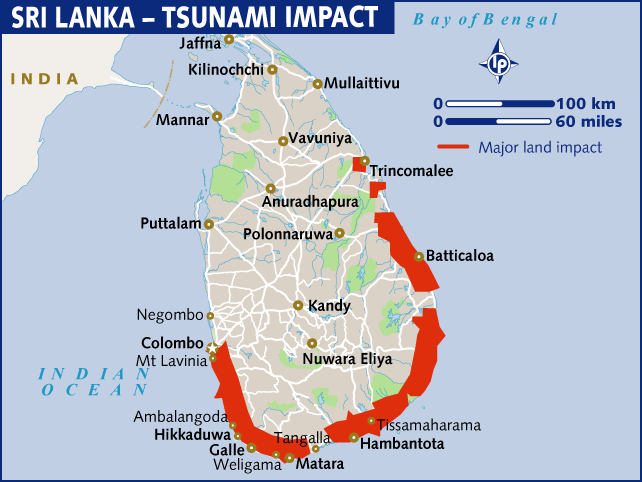
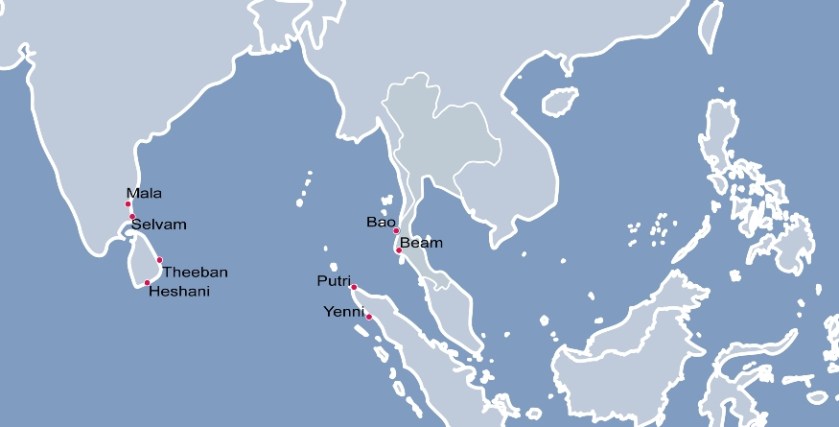
Four countries, eight locations: where Children of Tsunami stories were filmed for much of 2005
Meet the Children of Tsunami…
They have never met each other. Yet they were united first in grief, then in survival. Five girls and three boys, between 8 to 16 years of age, living in eight coastal locations in four countries. Their families were impacted by the Asian Tsunami in different ways. Some lost one or both parents -– or other family members. Some had their homes or schools destroyed. Others found their parents thrown out of a job. During the year, these families faced many hardships and challenges in rebuilding their futures.
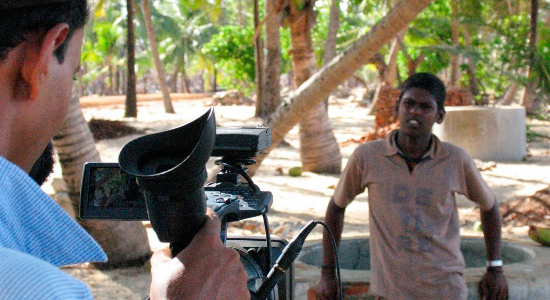
Filming with Theeban in eastern Sri Lanka...now only a memory
As I recalled in early 2007, when we tragically lost one of eight survivor children – Theeban – to Sri Lanka’s civil war: “As journalists, we have been trained not to get too attached to the people or subjects we cover, lest they affect our judgment and dilute our objectivity. The four production teams involved in Children of Tsunami initially agreed to follow this norm when we met in Bangkok in early 2005 for our first (and only) planning meeting. We also resolved not to reward our participating families in cash or kind, as they were all participating voluntarily with informed consent.
“But the ground reality was different. 2005, Asia’s longest year, wore on. As survivors slowly patched their lives together again, our film teams found themselves becoming friends of families or playing Good Samaritan. Sometimes our teams would find a survivor family close to starvation and — acting purely as human beings, not journalists — they would buy dry rations or a cooked meal. At other times, finding the children restless or aimless, they would buy them a football, kite or some other inexpensive toy that would produce hours of joy and cheer.
“As commissioners and publishers of Children of Tsunami stories, we didn’t object to these acts of kindness. Journalism with empathy was far preferable to the cold detachment that textbooks recommend.”
Children of Tsunami: No More Tears (25 mins) was the shorter version of the end-of-year film that captured the highlights and ‘lowlights’ of our families’ first year following the disaster. We co-produced it with the Singapore-based regional broadcaster Channel News Asia.
 When I was in my early teens (back in the early 1980s), I developed a great interest in radio. Not just in listening to radio broadcasts, which I did regularly while growing up in a country that had no television, but also in building a radio that could both receive and transmit signals.







 Open Minds!