“In the struggle for freedom of information, technology — not politics — will be the ultimate decider.”
These words, by Sir Arthur C Clarke, have been cited in recent days and weeks in many debates surrounding WikiLeaks, secrecy and the public’s right to know.
I invoke these words, and many related reflections by the late author and futurist, in a 2,250-word essay I have just written. Titled Living in the Global Glass House, it is presented in the form of an Open Letter to Sir Arthur C Clarke. It has just been published by Groundviews.org
This is my own attempt to make sense of the international controversy – and confusion – surrounding WikiLeaks. Taking off from the current concerns, I also look at what it means for individuals, corporations and governments to live in the Age of Transparency that has resulted from the Information Society we’ve been building for years.
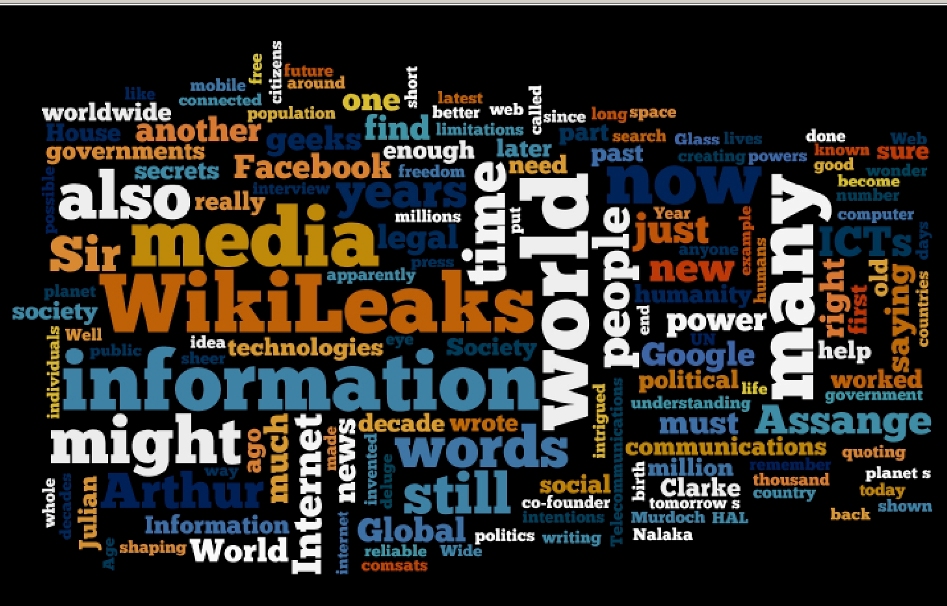
Sir Arthur foresaw these developments year or decades ago, and wrote perceptively and sometimes in cautionary terms about how we can cope with these developments. As a research assistant and occasional co-author to Sir Arthur from 1987 to 2008, I had the rare privilege of sharing his views firsthand. In this essay, I distill some of the best and most timely for wider dissemination. The above Wordle graphic illustrates the keywords in my essay.
The essay was also prompted by recent experiences. Here’s that story behind the story:
By happy coincidence, I arrived in London on 28 November 2010, the very day the WikiLeaks Cablegate erupted all over the web, beginning to spill out what would eventually be over 250,000 secret international ‘cables’ within the US diplomatic corps.
The Guardian UK that day published an interactive map-based visualization of the leaks. By moving the mouse over the map, readers can find key stories and a selection of original documents by country, subject or people
During the week I spent in London, I experienced not only uncharacteristically early and intense snow storms, but a mounting international storm on the web over the leaked cables. WikiLeaks’ co-founder and chief editor Julian Assange was also somewhere in the UK, playing cat and mouse at the time with the Swedish police and Interpol. (He later turned himself in to the British authorities.)
Sir Arthur Clarke: The legacy continues...On December 1, the British Interplanetary Society invited me to join their annual Christmas get-together where they were remembering their founder member and past chairman Arthur C Clarke. They talked mostly about the man’s contribution to space exploration, but listening to those fond memories against the wider backdrop of WikiLeaks very likely inspired me to write this essay.
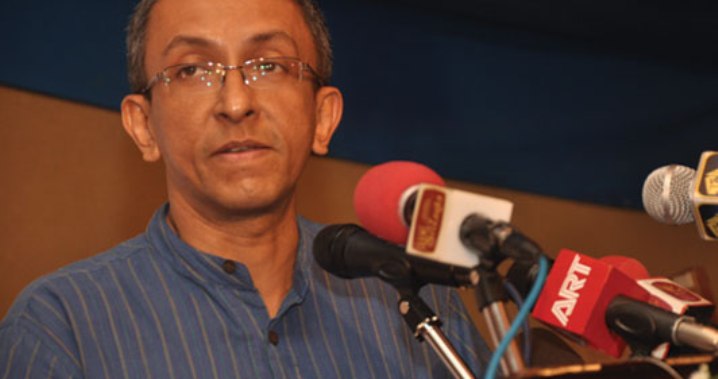
Soon after I returned to Colombo, Transparency International Sri Lanka asked me to speak at a workshop on the right to information they had organised for journalists. Given my reputation as a geek-watcher and commentator on the Information Society, they asked to talk about what WikiLeaks means for investigative journalism. Two days later, the Ravaya newspaper did a lengthy interview with me on the same topic which they have just published in their issue for 19 December 2010.
All these elements and experiences combined in writing this essay. Being confined to home by a nasty cold and cough also helped! In fact, on 16 December when Sir Arthur’s 93rd Birth Anniversary was marked, I was too weak to even step out of the house to visit his gravesite. In the end, I finished writing this Open Letter to him on the evening of that day.
My daughter Dhara and I would normally have taken flowers to Sir Arthur’s grave on his birth anniversary. This year, instead, I offer him 2,250 words in his memory. The fine writer would surely appreciate this tribute from a small-time wordsmith.
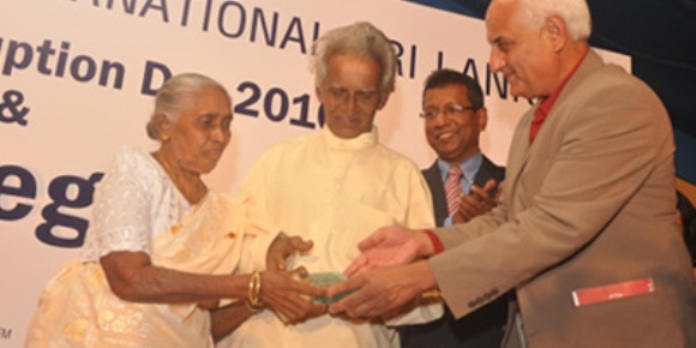
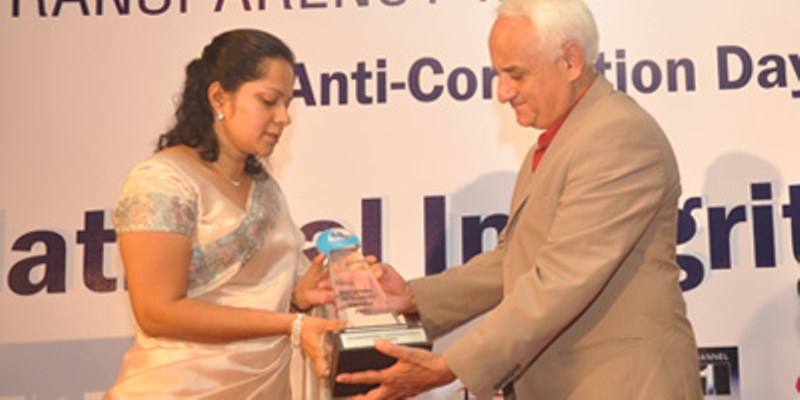
Poddala Jayantha's mother and father receiving award from Kanak Mani dixit (extreme R)
Two persons stood out among the several hundred people gathered at Sri Lanka National Integrity Awards ceremony on December 9 evening in Colombo. Dressed in off-white, the elderly couple looked dignified yet slightly bewildered by the pace of events at Colombo’s top conventions venue.
But when their moment arrived, the parents of investigative journalist Poddala Jayantha rose to the occasion: they accepted the Global Integrity Award presented to him by the anti-corruption watchdog Transparency International (TI).
Jayantha could not turn up in person because his is under threat and fled Sri Lanka for safety. In June 2009, he was abducted by unidentified persons and assaulted. The attack, one among many on journalists in Sri Lanka, left him permanently disabled in his legs. That’s the high price he had to pay for systematically exposing corruption and irregularities in government and corporate sector in Sri Lanka.
TI, which created this award to recognise the courage and determination of individuals and organisations fighting corruption around the world, commended Jayantha for his “dedication to exposing injustice in Sri Lanka”.
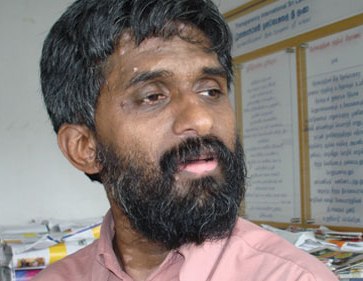
Poddala Jayantha“I am happy that I could fight against corruption and campaign for press freedom while working for the state media,” he told BBC Sinhala after the awards announcement. “But yes I had to leave the country as a result.”
I’ve long admired Poddala’s courage and meticulous research, and have been amazed that he managed to do so much while working in a state-owned media establishment like Lake House, where he was employed after leaving the independent Ravaya newspaper. Of course he was the exception to the rule, but what a refreshing exception that was — reminding us that even amidst all those sacred cows that state media journalists must tiptoe around, they can still serve the public interest if they want to…
Of course, there were also stories that he never got to write. In November 2008, I wrote about one such example in an essay commenting on the Lankan media’s shameful conduct in relation to our own Ponzi scheme and local Madoff called Sakvithi.
From aspiration to reality...looking for honest people who stand their ground
Sri Lanka’s National Integrity Award ceremony 2010 was held at BMICH, Colombo, on 9 December evening. This marked the culmination of weeks of work in reviewing nominations and verifying information. I was part of the three-member independent award committee that chose the winners.
The occasion was both solemn and quietly inspiring. It was telling that the winner of this year’s award has been dead for nine years – killed for being honest and forthright in his work.
The late Sujith Prasanna Perera, a former Assistant Superintendent of Customs, paid the price with his life standing up against corruption and promoting integrity in his own department. It was a moving moment when the wife accepted the award from my Nepali friend Kanak Mani Dixit, who was chief guest.
The audience stood up and observed two minutes silence as a mark of respect. Some people who never knew the winner in person were in tears.
Angela Perera, wife of late Sujith Prasanna Perera, receives the award from Kanak Dixit
A Maulavi (Muslim priest) from Kinniya in the Eastern Province, M Y Hathiyathullah won recognition with a Special Mention for his active involvement in anti-corruption activities.
“Having studied this year’s nominations, we feel that more work needs to done to enhance the public understanding of corruption. This cancer is not limited to isolated acts of bribery or influence peddling or subverting the rules. Indeed, these are merely the tip of the iceberg — and there are many other ways in which corruption and mal-governance erode our entire social fabric. When people can better recognise the many ugly heads and tentacles of corruption, we hope it would motivate more public-spirited individuals to counter them.
“In our view, the various legal, regulatory and other structural arrangements are all necessary – but not sufficient – to combat corruption. Corruption is deep rooted in human greed. The temptations and opportunities for corruption are greater today than ever before. Faced with these stark realities, we must find the bulwark of resistance in our individual and collective values.
“In the end, the journey to a cleaner, honest and more equitable society begins with each one of us – the man or woman in the mirror. Each one of us is corruptible. At the same time, each one of us also has the potential to counter corruption. In this era of mobile phones and WikiLeaks, the opportunities are only limited by our courage and imagination. No act is too small or too insignificant. And silently looking away is not an option.
“I would like to end by quoting the Malaysian social activist Anwar Fazal, whose words sum up what the National Integrity Award is all about. Begin quote ‘In a world that is increasingly violent, wasteful and manipulative, every effort at developing islands of integrity, wells of hope and sparks of action must be welcomed, multiplied and linked…’ End quote”
Who says environment is a ‘safe’ subject for journalists and broadcasters to cover?
Journalist colleagues who work on conflict, security and political topics often have an illusion that environmental reporting is a ‘cosy and comfortable beat’ – one that allows reporters to travel to exotic locations, see cuddly animals, relax in pristine environments and generally take things easy.
That might have been the case some years ago, in another century that’s now receding in our memories. But not any longer: there’s as much conflict, intrigue and complexity in many of today’s environmental topics, and covering them can often be hazardous to the courageous journalists who go after them.
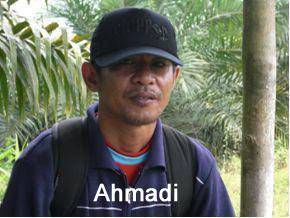
Ahmadi: Beaten up for exposeJust ask Ahmadi, a journalist working for Harian Aceh in Indonesia. Together with a fellow journalist, working for News Investigasi in Medan, he recently investigated a flood that had taken place in the Alapan district in April 2010. During their journey, they met some people cutting up logs. The journalists asked workers who owned these logs and were told that they belonged to the Alapan District Police Station and the Alapan Military Sub-District Command. Hmm…
When confronted with this information, a high ranking military officer reacted quickly and sharply: he wanted the whole story suppressed. In defiance, Harian Aceh published the story on 21 May 2010 — which resulted in Ahmadi being assaulted and threatened with death by the same officer.
“Ahmadi joins the long list of journalists who have been targeted for shedding light on deforestation, which is responsible for at least 18 per cent of the world’s greenhouse gas emissions,” says Reporters Without Borders (RSF), the international watchdog on media freedom.
It says attacks on journalists and bloggers who try to cover any kind of environmental damage are growing steadily all over the world. Among them, those who investigate industrial pollution or the destruction of forests are particularly at risk.
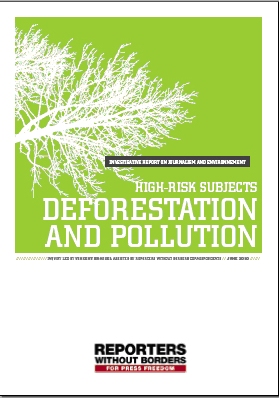
No longer a cosy beat...This week, on the eve of World Environment Day (5 June), RSF released a new report titled Deforestation and pollution: High-risk subjects. It makes grim reading for all of us who are committed to journalism as if the planet mattered.
It follows and echoes their call last year: “We must defend journalists who expose attacks on the environment”.
The new report, the second of its kind within just a few months from RSF, was prepared with the help of its worldwide network of correspondents. They gathered information about incidents in Indonesia, Argentina, El Salvador, Gabon, India, Azerbaijan, China and Morocco. Behind each of these threats and attacks, there were big corporations, criminal gangs or government officials who had been corrupted by money from mining or logging.
Asia features prominently in the report, which condemns the responsibility of the Vietnamese and Chinese governments in serious press freedom violations that deprive the public of crucial information about cases of pollution or deforestation.
The report describes, for example, the way the government in Hanoi has tried to suppress any debate about the environmental impact of bauxite mines being operated by a Chinese company. A field investigation in Argentina established that journalists are under pressure from both supporters and opponents of a mining project.
Mining companies (Aluminium Corp of China, China Metallurgical Group and the Canadian companies Yamana Gold and Pacific Rim), oil companies (Shell, Addax and Synopec), wood pulp companies (Sinar Mas and Riau Andalan Pulp and Paper) and two French multinationals (Bollor and Areva) are all identified in this report as having a direct or indirect role in cases of intimidation or censorship.
This is the second report that RSF has published on this subject. In September 2009, a report titled “The dangers for journalists who expose environmental issues.“, looked at 15 cases of journalists and bloggers who had been killed, attacked, jailed, threatened or censored for covering environmental problems in Russia, Cambodia, Bulgaria and Brazil.
RSF this week reiterated the appeal it launched during last December’s Copenhagen Summit: The media are needed to gather information and disseminate it to the public. Where climate change was concerned, it reminded everyone one, it was the media who helped to establish credible, independent diagnoses of the state of our planet. Their analyses continue to play a crucial role in helping decision-makers to adopt policies and rules that will lead to the desired changes.
On this blog, we have consistently highlighted the need for safeguarding journalists who pursue environmental stories that threaten vested interests within and across borders. For example:
In April 2007, we asked: Can journalists save the planet? Yes, they can be front-runners in the world’s attempts to save species, habitats and entire ecosystems. But only if the rest of society protects and stands by them. When our planetary house is on fire, shooting the messenger isn’t going to save anyone.
Nelly Damaris Chepkoskei: Voice of HopeMalaria still claims over a million lives every year, most of them in Africa. This is not simply a public health statistic for Nelly Damaris Chepkoskei – she lost a daughter to the ancient scourge that continues to outsmart human attempts to control it.
“It was very sad when my daughter died of malaria at the age of four,” she recalls. What makes it especially tragic is the fact that malaria is a new arrival in her area.
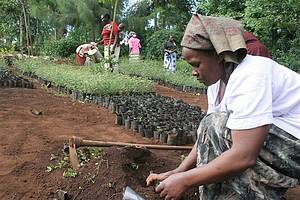
Nelly, 51, is a farmer living in Kenya’s Kericho District. Located high in the mountains, Kericho’s cold weather has kept mosquitoes at bay for centuries. But not any longer: global warming has raised the area’s average temperature, and mosquitoes have appeared in recent years, bringing malaria with them.
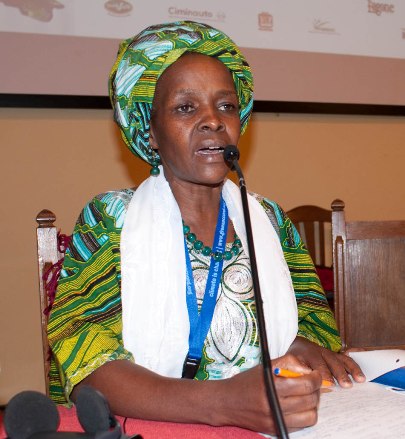
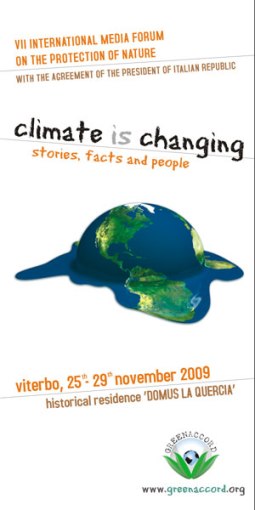
“I had never seen a mosquito until I was 20 years old. But now they are everywhere – people are even dying of malaria, something that was virtually unheard of 20 or 30 years ago,” Nelly told the 7th Greenaccord International Media Forum on the Protection of Nature, being held in Viterbo, Italy, 25 – 29 November 2009.
The theme this year is ‘Climate is changing: stories, facts and people’. Nelly Chepkoskei is one of 10 Climate Witnesses who travelled to the historic city from far corners of the world to share their stories of ground level changes induced by climate change.
Climate Witness is a global programme by WWF International to enable grassroots people to share their story of how climate change affects their lives and what they are doing to maintain a clean and healthy environment. All Climate Witness stories have been authenticated by independent scientists.
Married with five children, Nelly grows maize and tea, and keeps a few cows – the pride and joy of Kenyan farmers. Lacking faith in politicians and government, she is working with women in her community to pursue their own development.
Life was never easy, but climate change is making it even harder.
“Rainfall patterns have changed drastically in recent decades,” she says. “In the Kericho district, we used to have rain throughout the year. I remember clearly that my family celebrated Christmas when it was raining heavily. But today, Christmas is usually dry.”
Unlike 20 years ago, the dry season is now hotter, drying up all the grass. In the past, the grass would remain green throughout the year.
“This means there isn’t enough fodder for my cows, leading to a drop in milk production and my income,” she explains. “The soils are also left bare during the dry season, which means more erosion when rains come in.”
With higher temperatures, more pests have turned up to damage crops. This prompts farmers to use more pesticides, increasing production costs and polluting the environment with hazardous chemicals.
Nelly turned out to be the most outspoken Climate Witness in Viterbo. In a frank exchange with an audience of 130 journalists, activists and scientists drawn from 55 countries, she exclaimed: “Don’t talk to politicians – they are the same everywhere! I can’t understand why journalists always follow politicians and are so keen to talk to them!”
She continued: “There is so many good things happening in Africa, but we don’t see it reported in the local and international media. You only hear about fighting, famine and corruption. So we continue to be seen and known as the Dark Continent.”
In her view, what Africa needs more than anything else is education. She firmly believes that higher levels of literacy and education would reduce the incidence of conflict and plunder.
Nelly herself is a high school drop out, and places a very high value on education to empower all Africans, especially women.
“There is a big gap between Kenyan intellectuals and the ordinary people. Knowledge is not where and how it is needed,” she says.
I asked her what she thought of foreign aid to Kenya and rest of Africa. This elicited a passionate and emphatic response: “If you want to spoil and corrupt Africa more, then keep giving aid to our governments. Aid money mostly ends up in the wrong hands, or buying guns to fight each other.”
She added: “We do need help, but don’t give aid to our governments. Instead, support NGOs who are better in delivering to the grassroots.”
Nelly and her network of women are digitally empowered. They refer the web to find out information on what aid and opportunities are available and then pursue them with all available means. Armed with the latest data, they lobby local and provincial governments to ensure that aid pledged from international donors reach the intended communities.
Nelly may not be Wangari Maathai, the Kenyan environmentalist and women’s right activist, but she admits to being a Wangaari in spirit. And having listened to the first African woman to win the Nobel Peace Prize at a previous Greenaccord forum, I readily agree: women like Nelly are a beacon of hope not just for Africa, but to the entire Majority World.
If only the mosquitoes could spread their passion and concern for the land and people…
Standing up for a pluralistic society
The recently concluded general election in India saw thousands of candidates contest to enter the Indian Parliament. Among the candidates I watched closely were writer Shashi Tharoor (who ran on the Congress ticket and was elected from Kerala state) and dancer Mallika Sarabhai (who ran as an independent candidate in the Gujarat state and didn’t win).
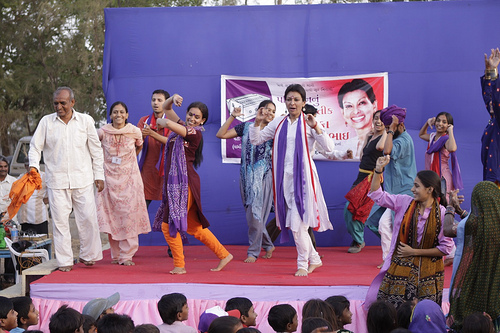
The classical dancer turned social activist had one of the more colourful campaigns in the world’s largest election: her public rallies included dance numbers, and her website (UPDATE in March 2013: no longer online) – featuring interactive elements like blogging, flickr images and online fund raising – was ranked the best by a communication research agency.
But where Mallika – whose performances I have enjoyed watching on successive visits to her home town of Ahmedabad – really stood out was in whom she opposed. She was the independent candidate from Gandhinagar, one of India’s most high-profile constituencies, a state capital that has been polarized along Hindu-Muslim lines since riots in 2002. Her opponent was Lal Krishna Advani, the prime ministerial candidate of the BJP.
Mallika Sarabhai dances during campaign trailThe two candidates couldn’t have been more different. The 82-year-old veteran politician epitomised Hindu nationalism and majority hegemony with its attendant intolerance of minorities. Mallika, hailing from an upper class Indian family of freedom fighters, industrialists and intellectuals (her father Vikram Sarabhai was father of the Indian space programme), stood for pluralism, non-violence and tolerance. When she entered the fray in March 2009, she described her candidature as a Satyagraha against the politics of hatred.
“As a proud Hindu and a proud Indian, I feel vilified by you,” she wrote. “You have reduced the great Sanatana philosophy to a Taliban-style Hindutva. As an Indian, you have tried to reduce my identity to a single factor—Hindu or not. You let your goons, saffron-clad terror units wielding lathis and worse, terrorise us and live above the laws of this country.”
For me, the most insightful paragraph is this where she takes on what it means to live with the huge cultural, social and political diversity that makes up India: “I am a post-Independence Indian. I was brought up to value and treasure my unique Indianness, to value our Constitution, which gives equal rights to all Indians, irrespective of belief, culture, practice or language. I learnt to revel in the differences that made us a rainbow country. We are a salad-like melange of cultures and not a soup where all variations get reduced to a homogeneous pulp—this, to me, is our greatest strength.”
Eschewing grand speeches, microphones, banners and slogans, she just listened to votersSalad or soup – that’s an interesting way of framing the challenge. And not just in the delightful melting pot that is India, but in many other mixed-up, tossed up cultures and societies of today…not the least in my native Sri Lanka, where we have seen the primitive forces of tribalism over-ride all other considerations in recent years. One released, it’s very hard to put this genie back in the bottle.
And how I wish our own privileged upper middle classes would take to the rough and dirty game of politics, if only to stand up against the peddlers of hatred and hegemony. If only…
Mallika could easily have continued her cultural work through the Darpana Academy of Performing Arts and her social activism. She decided to take the plunge this year because she thought the time had come to get into active politics. She was encouraged by her friends, mainly social activists, united under the banner of Friends of Democracy. Mallika is one of the several petitioners demanding justice in the post-Godhra riot cases. She was quoted in The Times of India as saying she decided not to join any party as she believed that there was no party free of corruption, criminalization and horse-trading.
As the Washington Post reported during her campaign trail: “Sarabhai, one of a handful of professional people running as independents in the upcoming elections, rejects the standard Indian political appeals to caste, religion and linguistic ethnicity, and speaks of empowering voters to unseat corrupt and ineffective politicians. Her campaign, she said, seeks to reclaim the shrinking space left for ordinary people’s voices in a democracy dominated by political parties that too often rely on mudslinging, muscle-flexing and money power.”
She and other courageous Indians have miles to go before they can sleep. Encouragingly, she has pledged that her campaign will continue.
As she says signing off her essay in Outlook: “I may have lost this election, but I will continue to work for the disadvantaged and dispossessed, and to ensure that their voice shall be silenced no more.”
Do they have a story to tell? Who is listening?Piracy has a chequered history, and even the Wikipedia offers a carefully qualified definition. One person’s pirate can be another person’s defender. There’s an argument that the European colonial powers rode on the backs of their pirates or buccaneers. And I’m writing this in English language possibly because the English were more successful in their overseas piracy than other nations!
Piracy is all over the news again, due to increased activity off Somalia. But in the past few weeks, we’ve started hearing another side of the Somali piracy story — one that the mainstream media didn’t tell us.
Johann Hari, a columnist for the London Independent, posted an op ed in Huffington Post on 13 April 2009 that took a different look at Somali pirates. His main argument: “In 1991, the government of Somalia – in the Horn of Africa – collapsed. Its nine million people have been teetering on starvation ever since – and many of the ugliest forces in the Western world have seen this as a great opportunity to steal the country’s food supply and dump our nuclear waste in their seas.”
In recent days, two interesting short videos have been posted by two activist groups to support the same point of view. I haven’t investigated this story myself, but am intrigued by their take on a widely reported topic…especially because it’s an angle that we don’t read or see in the mainstream media!
This film from Awareness Unfolds highlights the fact that the media is lying about the so called “pirates” of Somolia. According to the blurb: “They (media) choose not to tell you about the toxic waste dumping going on by American, European, and Asian countries that have lead to the death of many Somolian citizens.”
As Johann Hari says at the end of his article: “The story of the 2009 war on piracy was best summarised by another pirate, who lived and died in the fourth century BC. He was captured and brought to Alexander the Great, who demanded to know “what he meant by keeping possession of the sea.” The pirate smiled, and responded: “What you mean by seizing the whole earth; but because I do it with a petty ship, I am called a robber, while you, who do it with a great fleet, are called emperor.” Once again, our great imperial fleets sail in today – but who is the robber?”
Johann Hari has reported from Iraq, Israel/Palestine, the Congo, the Central African Republic, Venezuela, Peru and the US, and his journalism has appeared in publications all over the world. In 2007 Amnesty International named him Newspaper Journalist of the Year. In 2008 he became the youngest person ever to win Britain’s leading award for political writing, the Orwell Prize.
In his long years of journalism in India, my friend Darryl D’Monte had faced all sorts of questions and situations. But this was one question that stunned and left him speechless for a while.
A visiting Canadian TV crew made this request in the 1970s, when Darryl was resident editor of The Times of
India. He was giving them some insights on the extent of poverty in his city of Bombay, since renamed as Mumbai. The crew had heard of the deliberate maiming of street children, before being employed as beggars. A disabled child would evoke more sympathy, increasing the daily collection for gangsters operating them from behind the scenes.
Darryl wasn’t willing to be associated with this ‘staging’. “Well, it’s going to happen anyway,” was the film crew’s cynical answer.
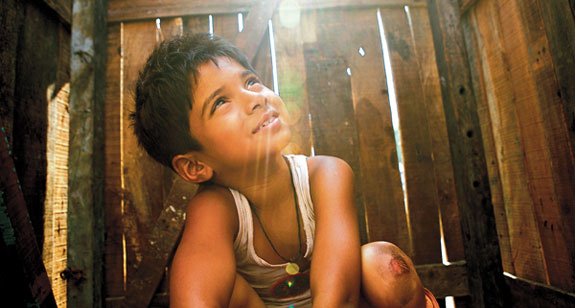
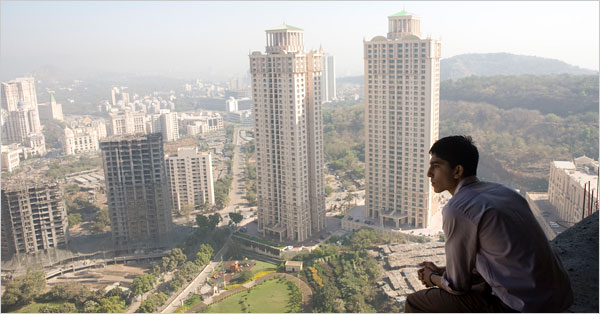
Now, fast forward 30 years to the present. At one point in the British-Indian movie Slumdog Millionaire, we see a young girl being blinded by a gangster who shelters and feeds a small army of children — all unleashed on Mumbai on a daily basis to tug at the heart strings of its teeming millions.
The film’s protagonist Jamal escapes the same fate by making a mad dash for freedom with his brother, Salim. But years later, they cross the gangster’s path again, with devastating results – for him.
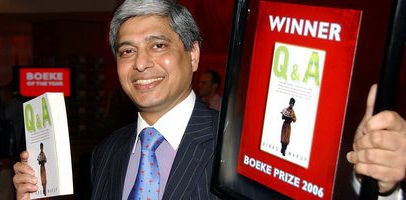
Vikas Swarup: Look what I've started...Set and filmed in India, Slumdog Millionaire is the story of a young uneducated man from the slums of Mumbai who appears on the Indian TV’s version of Who Wants to Be a Millionaire? (Kaun Banega Crorepati) and does so well to reach the final question that the game show host and the police suspect him of cheating.
Some Indians feel their country’s ugly underbelly has been magnified by locating and filming part of the story in the slums of Mumbai. But director Danny Boyle, who sees his film as a Dickensian tale, says he shot in real, gritty locations “to show the beauty and ugliness and sheer unpredictability” of the city.
Indian diplomat Vikas Swarup, who wrote the 2005 novel Q and A on which the movie is based, has a similar view. “This isn’t social critique,” he told The Guardian in an interview. “It’s a novel written by someone who uses what he finds to tell a story. I don’t have firsthand experience of betting on cricket or rape or murder. I don’t know if it’s true that there are beggar masters who blind children to make them more effective when they beg on the streets. It may be an urban myth, but it’s useful to my story.”
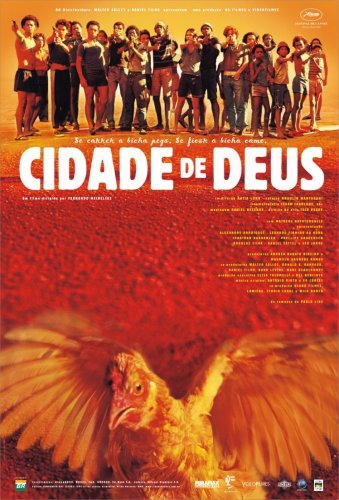
To me, Slumdog Millionaire feels like a cross between the acclaimed Brazilian slum movie City of God (Portuguese name: Cidade de Deus, 2002) and Quiz Show, the 1994 American historical drama film about TV quiz scandals in the 1950s.
City of God (2002) was filmed in the favelas of Rio de Janeiro
City of God is a Brazilian crime drama film directed by Fernando Meirelles and Kátia Lund, released in its home country in 2002 and worldwide in 2003. It was adapted by Bráulio Mantovani from the 1997 novel of the same name written by Paulo Lins.
The film’s depiction of narcotic drug rings, hold-ups, street violence and police corruption may not have been what the upper middle class Brazilians wanted to showcase to the rest of the world, but the film’s stark if grisly authenticity resonated with movie audiences around the world. Most of the actors were residents of favelas (slums) of Rio de Janeiro, such as Vidigal and the Cidade de Deus itself. City of God became one of the highest-grossing foreign films released in the United States up to that time.
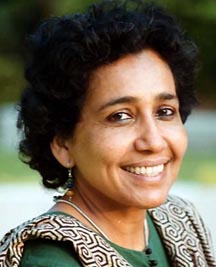
The makers of Slumdog Millionaire adopted a similar approach. Its co-director Loveleen Tandan says she likes to get as close to reality as possible. This drove her to the slums of East Bandra to look for young children who resembled the protagonists in the story.
As she recalled in a recent interview with Tehelka: “I was very keen to get real slum kids, which is why I convinced them (producers) to do one-third of the scenes in Hindi. I made a scratch tape with real street kids. The team was surprised that Hindi actually made it brighter and more alive.”
Indeed, Slumdog doesn’t feel like a ‘foreign film’ despite it having a fair number of English subtitles, which only enhance the overall cinematic experience.
But how realistic should films try to become, before the local realities are distorted or local sensibilities are affected? Where does documentary end and drama begin? These questions will continue to be debated across India and elsewhere while Slumdog enthralls millions on its first theatrical release.
Feature film makers can exercise their creative license far more than factual film makers. I doubt if the creators of authentic, close-to-the-ground movies like City of God and Slumdog Millionaire set out with any specific social agenda. They are in the business of entertainment, and just happen to find plenty of drama in real life in places like urban slums. We might argue that in the right hands, dramatised movies can draw mass attention to development issues and challenges far more effectively than the often dull and dreary documentaries.
Kalpana Sharma: Eyes wide open“If through (the movie) the world gets a peek at an India inhabited by millions of people who continue to live their lives without clean water, sanitation or electricity, what is the problem?” asks another Indian friend and long-time Mumbai resident Kalpana Sharma.
In a perceptive essay titled Shantytowns of the Mind, written in The Indian Express in early January 2009 before she saw the film, Kalpana flagged important concerns: “Slumdog Millionaire’s success raises some deeper questions. How do we depict poverty as writers, filmmakers, journalists? Is it fair to expect us all the time to give a full, balanced, sensitive portrayal? Or is it inevitable that we write, film, for our audiences? And if, as a byproduct, people are sensitized, so be it. Also, if they are annoyed, so be it. If we are considered exploitative, so be it.”
Kalpana speaks with authority, and not just because she lives in the megacity of Mumbai (population: 13 million and rising) which, she points out, is half made up of slums. In 2000, she wrote a book titled Rediscovering Dharavi: Stories from Asia’s Largest Slum. Far from being a cold, clinical analysis of facts, figures and trends, it’s a book about the extraordinary people who live there, “many of whom have defied fate and an unhelpful State to prosper through a mix of backbreaking work, some luck and a great deal of ingenuity”.
Kalpana ends her essays with these words: “In the end you realise as a writer, a journalist or a filmmaker, that the best you can do is to shine a torch, a searchlight, on an entrenched problem. But the solution will not be found merely by that illumination. For that, there are many more steps to be taken.
“Slumdog Millionaire has focused its lens on the children of India’s slums through a work of fiction. What we do to change their future is the non-fiction that has yet to be written.”
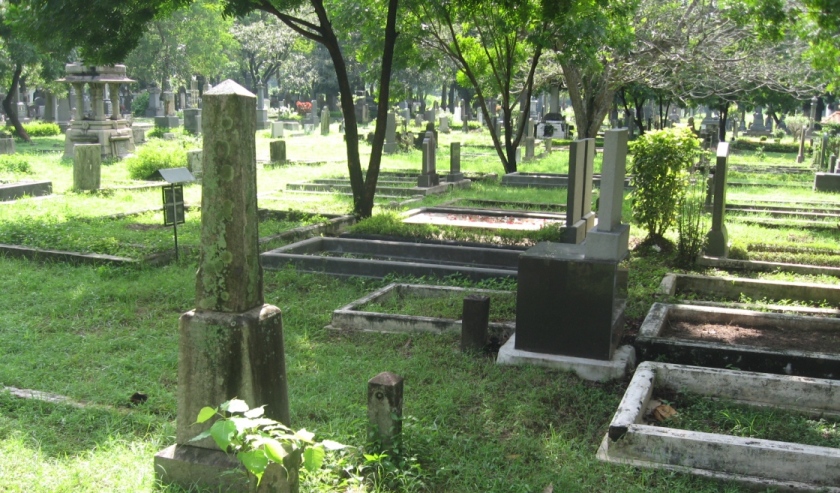
Colombo General Cemetery: No discussion or debate...
This is a view of Colombo’s main cemetery, the final resting place for many residents of Sri Lanka’s capital and its suburbs. I took this photo less than a month ago, when I visited a grave on a quiet morning.
The late Bernard Soysa, a leading leftist politician and one time Minister of Science and Technology, once called it ‘the only place in Colombo where there is no discussion or debate’.
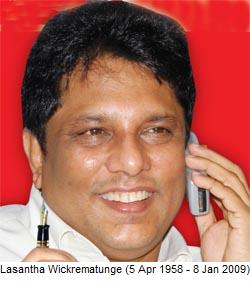
This afternoon, family, friends and many sorrowful admirers of Lasantha Wickramatunga, the courageous Sri Lankan newspaper editor who was brutally slain last week in broad daylight, took him there — and left him behind amidst the quiet company.
But not before making a solemn pledge. All thinking and freedom-loving people would continue to resist sinister attempts to turn the rest of Sri Lanka into a sterile zombieland where there is no discussion and debate. In other words, rolling out the cemetery to cover the rest of the island.
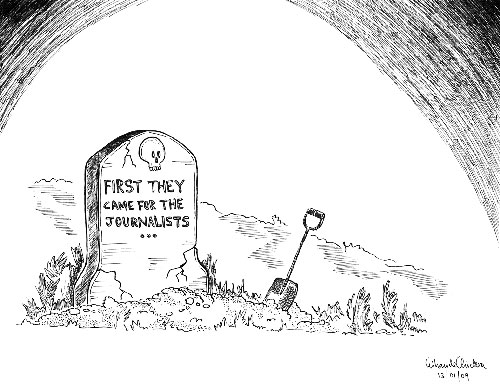
The last laugh?Silencing Lasantha was the clear aim of cowardly gunmen who intercepted him on his way to work and shot him at pointblank. Tarzie Vittachi, the first Lankan newspaper editor to be forced into exile 50 years ago for freely expressing his views on politically sensitive issues, once called such attacks ‘censorship by murder’. (Alas, since Tarzie uttered those words in 1990, shooting the messenger has become increasingly common in Sri Lanka.)
Rex de Silva, the first editor that Lasantha worked for (at the now defunct Sun newspaper) in the late 1970s, has just cautioned that Lasantha’s murder is the beginning of ‘the sound of silence’ for the press in Sri Lanka. Can this sound of silence be shattered by the silent, unarmed majority of liberal, peace-loving Lankans who were represented at the funeral service and the Colombo cemetery today?
And would they remember for all time Edmund Burke’s timeless words: “All that is necessary for the triumph of evil is that good men do nothing”?
How many would actually read, absorb and heed the deeply moving words of Lasantha’s one last editorial, copies of which were distributed at the cemetery and the religious service before that?
That editorial, which appeared in The Sunday Leader on 11 January 2009, embodies the best of Lasantha Wickrematunga’s liberal, secular and democratic views.
As I wrote in another tribute published today by Himal Southasian and Media Helping Media: “I have no idea which one – or several – of his team members actually penned this ‘Last Editorial’, but it reads authentic Lasantha all over: passionate and accommodating, liberal yet uncompromising on what he held dear. I can’t discern the slightest difference in style.”
“And there lies our hope: while Lasantha at 51 lies fallen by bullets, his spirit and passion are out there, continuing his life’s mission. That seems a good measure of the institutional legacy he leaves behind. If investigative journalism were a bug, the man has already infected at least a few of his team members…”
Much has been written and broadcast in the past 100 or so hours since Lasantha’s journey was brutally cut short by as-yet-unidentified goons who have no respect for the public interest or have no clue how democracies sustain public discussion and debate. I’m sure more will be written – some in outrage and others in reflection – in the coming days and weeks.
Siribiris (left): puncturing egos for 40 yearsAs we leave Lasantha to his rest, I remember Siribiris. For those unfamiliar with the name, Siribiris is an iconic cartoon character created by Camillus Perera, a veteran Sri Lankan political cartoonist who has been in the business as long as I have been alive.
Siribiris represents Everyman, who is repeatedly hoodwinked and taken for granted by assorted politicians and businessmen who prosper at the common man’s expense. The only way poor, unempowered Siribiris can get back at them is to puncture their egos and ridicule them at every turn. And boy, does he excel in that!
It’s no surprise that Lasantha – the bête noire of shady politicians and crooked tycoons – was very fond of Siribiris. Perhaps he saw his own life’s work as extending that of Siribiris in the complex world of the 21st century. That he did it with aplomb and gusto – and had great fun doing it, sometimes tongue stuck out at his adversaries – will be part of Lasantha’s enduring legacy. (As his last editorial reminded us, in 15 years of investigative journalism on a weekly basis, no one has successfully sued the newspaper for defamation or damages.)
So Goodbye, Lasantha. And Long live Siribiris!
Cartoon by Gihan de Chickera, Courtesy: Daily Mirror, Sri Lanka
“I invested Rs. 2 million (US$ 18,550) of my money after seeing him on TV. I basically believe what I see on the TV and so was misled.”
I read this remark, by a hapless woman victim of an investment scam, in a Sri Lankan newspaper report last week. It got me thinking: where is our media literacy?
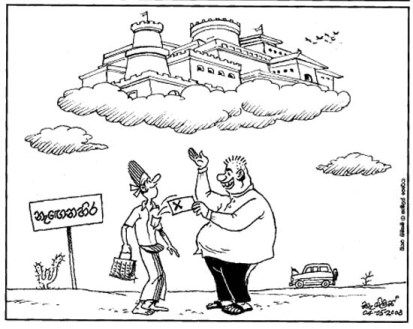
The woman quoted in the news report is not an isolated case. Too many people, it seems, were mesmerised into parting with their money due to a deviously persuasive media campaign. For several years, Sakvithi ran English teaching programmes on Sri Lanka’s national television and other channels. On the guise of teaching English (which he didn’t do very well), Sakvithi manufactured a larger than life image for himself. He also ran regular newspaper advertisements in the highest circulating weekend newspapers. Some were in full colour, occupying an entire broadsheet page. These too reinforced his image as a benevolent, enterprising young Sinhala businessman doing social good.
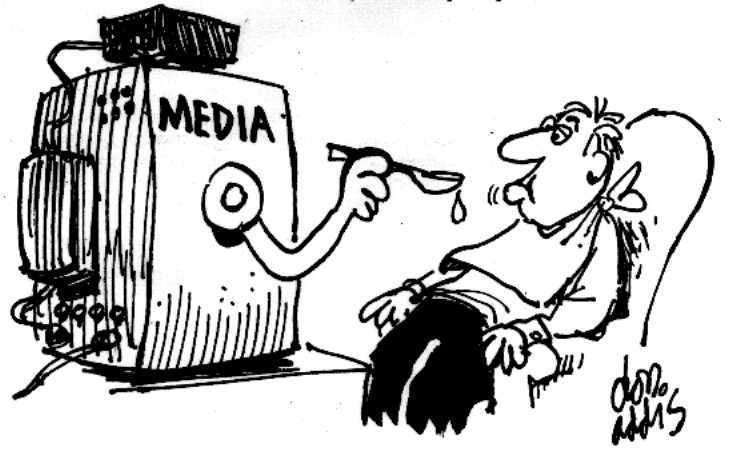
Not everyone, it seems, heeds the common sense advice, ‘Don’t believe everything you read/hear in the media’. Indeed, the Sakvithi scandal once again brings into sharp focus the media’s — especially television’s — perceived role as the great authenticator of our times.
I have just written an op ed essay for the citizen journalism website Groundviews, where I suggest that the mainstream media outlets that repeatedly sold airtime or newspaper space to this man must now share part of the blame for misleading the public. I also argue that besides timely regulatory action and proper law enforcement, we also need greater vigilance by the media, and higher levels of media literacy in everyone to safeguard society from this kind of media manipulation.
Media illiteracy creates this!
Here’s an extract:
“I find it more than a tad ironic that the same media outlets are now peddling the tales of woe of the thousands of men and women tricked by their former, big-time customer. Knowingly or otherwise, these media have amplified the mesmerising tune of this pied piper of Nugegoda who lulled thousands into parting with their money.
“Their journalists would no doubt protest innocence, reminding us of the divide between editorial and advertising operations. And they are right: media practitioners and editorial gatekeepers don’t have much (or any) control over what fills up the commercially sold advertising space. But how many of their readers or viewers can distinguish the difference?
“Most people experience media products as a whole, and lack even the basic media literacy to separate news, commentary and paid commercials. Besides, with the rise of ‘advertorials’ — product promotions neatly dressed up as editorial content — it’s becoming harder to discern which is which.
 This is my own attempt to make sense of the international controversy – and confusion – surrounding WikiLeaks. Taking off from the current concerns, I also look at what it means for individuals, corporations and governments to live in the Age of Transparency that has resulted from the Information Society we’ve been building for years.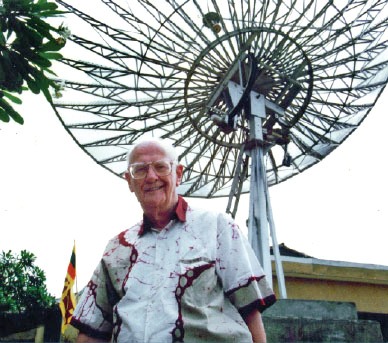



 Open Minds!