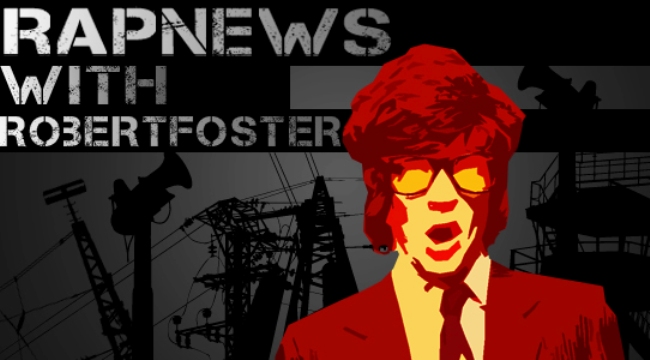
I’m delighted to highlight another commendable effort, this time on the web. It’s a website called The Juice Media, which presents news reports in, believe it or not, rap music! It has been online for a while, drawing rave reviews. One of them: “Like a mix of Eminem and Jon Stewart”.
TheJuiceMedia: Rap News is written and created by Hugo Farrant and Giordano Nanni in a home-studio/suburban backyard in Melbourne, Australia. In fact, Hugo appears as the amiable Rap News anchorman, Robert Foster.
Here are their latest three releases, which are hilariously serious.
Rap News 6 – Wikileaks’ Cablegate: the truth is out there
Rap News 5: Wikileaks & the war on journalism (ft. Julian Assange)
RAP NEWS 4: Wikileaks vs The Pentagon – the WWWAR on the Internet
Paper paper shining bright...but for how long? Cartoon by Mike Luckovich
My regular readers know my deep interest in political satire, and fascination with cartoons of all kinds including those political. On this blog, we’ve also discussed the worldwide decline in mainstream journalism.
“Political satire is nothing new: it has been around for as long as organised government, trying to keep the wielders of power in check. Over the centuries, it has manifested in many oral, literary or theatrical traditions, some of it more enduring — such as Gulliver’s Travels and Animal Farm. And for over a century, political cartoonists have also been doing it with such brilliant economy of words. Together, these two groups probably inspire more nightmares in tyrants than anyone or anything else.
“Today, political satire has also emerged as a genre on the airwaves and in cyberspace, and partly compensates for the worldwide decline in serious and investigative journalism. Many mainstream media outlets have become too submissive and subservient to political and corporate powers. Those who still have the guts often lack the resources and staff to pursue good journalism.
“If Nature abhors a vacuum, so does human society — and both conjure ways of quickly filling it up. Into this ‘journalism void’ have stepped two very different groups of people: citizen journalists, who take advantage of the new information and communications technologies (ICTs), and political satirists who revive the ancient arts of caricaturisation and ego-blasting…”
Smart but fleeting mobs?‘Smart mobs’ is an interesting term for like-minded groups that behave intelligently (or just efficiently) because of their exponentially increasing network links.
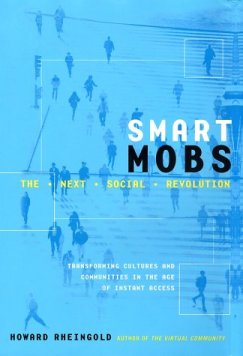
The idea was first proposed by author Howard Rheingold in his 2002 book, Smart Mobs: The Next Social Revolution. It deals with the social, economic and political changes implicated by developing information and communications technology. The topics range from text-messaging culture and wireless internet to the impact of the web on the marketplace.
In the eight years since the book first appeared, we’ve seen a proliferation and evolution of smart mobs, fuelled by the growth web 2.0 tools and, more recently, the many and varied social media. In fact, author Rheingold is credited with inventing the term virtual communities.
But the reality is that smart mobs can also be very fickle — their attention can be easily distracted. A smart mob can disperse just as fast as it forms, even while its original provocation remains.
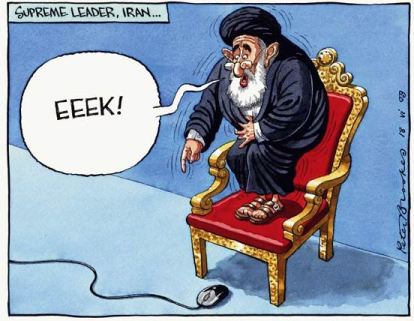
This was demonstrated in dramatic terms in June 2009. Following a hotly disputed presidential election in Iran, there was a surge of online support for pro-democracy activists there who launched a massive protest. A main point of convergence for online reporting and agitation was micro-blogging platform Twitter. Within a few days, mainstream media like TIME and Washington Post were all talking about this phenomenon in gushing terms.
As I wrote at the time: “I have no idea if the Ayatollahs are closet fans of Michael Jackson. But they must surely have thanked the King of Pop for creating a much-needed diversion in cyberspace precisely when the theocracy in Tehran needed it most.”
Other recent experiences have demonstrated how online interest can both build up and dissipate very fast. Staying with a single issue or cause seems hard in a world where news is breaking 24/7.
Here’s a current example. Following the massive oil spill in the Gulf of Mexico that started on 20 April 2010, local communities and environmental activists deployed various social media tools to track the unfolding disaster. BP, the giant oil company implicated in the disaster, has also tried to use social media to communicate its positions, but not too successfully. On Twitter, it was not BP’s official account but the satirical @BPGlobalPR that was dominating the online conversation. As one commentator wrote: “It is an object lesson in how social media can shape and control a company’s message during a crisis.”
Beyond PR?By early July 2010, however, there were already signs that online interest on the issue was already waning — even as the oil continued to leak from this largest offshore oil spill in US history. In a detailed analysis of main social media platforms’ coverage of the issue, Mashable noted last week: “An estimated 100 million gallons or more of oil have surged into the Gulf of Mexico…Yet on Twitter, Google, blogs and even YouTube, we’re already wrapping up our collective discussion of the oil spill and how to repair its damage.”
Riding the wave can be fun, but waves form and break quickly. Those who want to use social media tools for social activism still need to learn how to hitch a ride with the ocean current beneath the fickle waves.
“Reading computer manuals without the hardware is as frustrating as reading sex manuals without the software!”
This is one of the less known, but more entertaining, dicta by Arthur C Clarke – he called it ‘Clarke’s 64th Law’, and I personally know he used to bring it up when meeting with particularly crusty or glum intellectuals. (Not all were amused.)
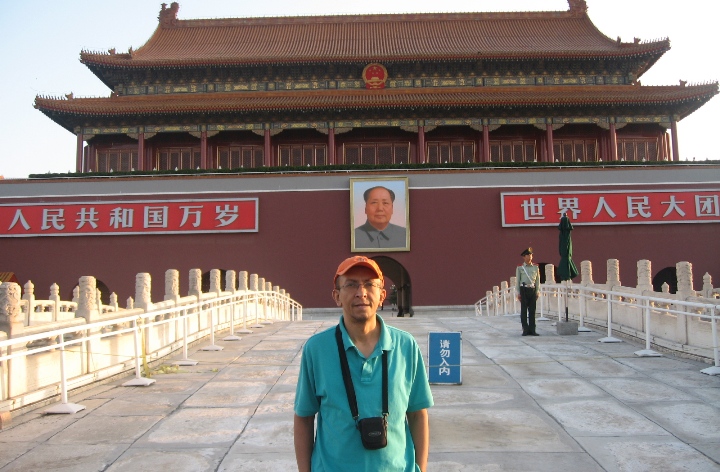
Clarke’s words kept turning in my mind as I moderated and spoke at a session on social media at Asia Media Summit 2010 held in Beijing China from 24 to 26 May 2010. The country with the world’s largest media market is not exactly the world’s most open or free – and certainly when it comes to social media, it’s a very different landscape to what we are used to…
These days, International visitors arriving in China discover quickly that access to YouTube, Twitter and Facebook is completely blocked. Apparently the brief ‘thaw’ in restrictions, seen before and during the 2008 Beijing Olympics, is now over — the current restrictions have been in place since the spring of 2009.
This doesn’t mean there is no social media in China. In fact, I heard from several Chinese friends and colleagues that there is a very large, dynamic and fast-evolving social media scene in China. For the most part, however, it’s not based on globally used and familiar platforms, and is happening in a digital universe of China’s own — under the watchful eye of the government.
Jump in...but some conditions apply!For example, I found from this March 2010 blog post by Merritt Colaizzi that:
* 221 million people have blogs, largely in a diary-style.
* 176 million Chinese connect via social networking system (SNS) with their “real” friends and online networks.
* 117 million connect anonymously via bulletin board system (BBS). These interactive online message boards are the heart of social media in China. They’re where people go to find topic-based communities and where consumers talk about products and services.
There are lots of other blogs, mainstream media reports and research commentary on social media in China — just Google and see (now that’s another thing with limited – and uneven – access in China: Google itself is available, but search results come with lots of links that simply aren’t accessible). Much or all of this interaction happens in Chinese, of course. It’s a significant part of the web and social media landscapes, but if you’re in China on a short visit and want to stay connected to your own social media networks, that’s not at all helpful.
And, of course, it undermines one of the key attributes of a globally integrated information society: the interoperability of systems and platforms.
Luckily for me, perhaps, I can survive a few days without my social media fix: I have an appalling record of updating my Facebook account: days pass without me even going there. For the moment, at least, I’m also taking a break from regular blogging (well, sort of). But I’m more regular in my micro-blogging on Twitter, and visit YouTube at least once a day, sometimes more often. I could do neither during the few days in Beijing – and that was frustrating.
So imagine having to talk about social media as a new media phenomenon in such a setting. That’s only a tiny bit better than reading computer manuals without the hardware…But this is just what I did, with all the eagerness that I typically bring into everything I do. I planned and moderated a 90-minute session on Social Media: Navigating choppy seas in search of Treasures?
With access to key global social media platforms denied, we visitors and Chinese colleagues in the audience could speak mostly generically, theoretically and aspirationally. I didn’t want to place my hosts and seminar organisers in difficulty by harping on what was missing. Instead, we focused on what is possible and happening: how development communicators are increasingly social media networks and platforms to get their messages out, and to create online communities and campaigns in the public interest.
The thrust of my own opening remarks to the session was this: In the brave new world of social media, we all have to be as daring as Sinbad. Like the legendary sailor of Baghdad, we have to take our chances and venture into unknown seas. Instead of maps or GPS or other tools, we have to rely on our ingenuity, intuition and imagination.
More about the session itself in future blog posts.
For now, I want to share this TED Talk by American watcher of the Internet Clay Shirky on how cellphones, Twitter, Facebook can make history. Shirky shows how Facebook, Twitter and TXTs help citizens in repressive regimes to report on real news, bypassing censors (however briefly). The end of top-down control of news is changing the nature of politics.
Where the island of Sri Lanka was concerned, it was the first solar eclipse of the broadband internet era — and that showed.
The last solar eclipse seen in Sri Lanka was two generations ago, on 20 June 1955. That was almost pre-historic in mass media terms. The newly independent Ceylon had a single, state-owned radio station and a handful of newspapers. There was no television, and the internet was not even conceived.
Yet, paradoxically, the media’s influence over the 8 million people then living on the island seem to have been greater at the time. As astronomer Dr Kavan Ratnatunga recalled: “A quack physician cum astrologer, recommended that women wanting to become fair and lovely should drink a decoction of which the main ingredient was “Vada Kaha” (Sweet Flag or Acorus Calamus) at the time of the total eclipse, preferably unseen by others. Many who took his advice ended up in hospital.”
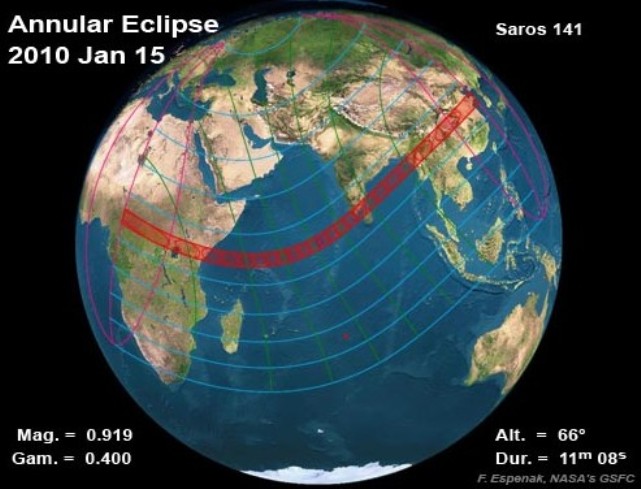
Solar eclipse on 15 Jan 2010 seen in Anuradhapura, north-central Sri Lanka - photos by ReutersIn contrast, in 21st Century Sri Lanka, the January 15 eclipse was not much of a news story. I don’t claim to have done a systematic analysis, but my impressions are drawn from scanning the major newspaper websites in English and Sinhala, and surfing the dozen or more terrestrial (free-to-air, not cable) TV channels that were on the air during the three hours or so of the eclipse. (Sorry: I missed out radio, and I’m not proficient in Tamil.)
Broadcast television was my biggest disappointment. Solar eclipses are a visual spectacular, and literally heaven-sent for live television. Yet, not a single Lankan TV channel carried a live broadcast of the event, either from northern Sri Lanka where it was best seen (in its annular form, with ‘ring of fire’ effect), or from elsewhere on the island as a partial eclipse.
It seemed as if the Colombo-based media were completely preoccupied with the intense build-up to the presidential election scheduled for 26 January 2010 — a case of politics eclipsing the solar eclipse?
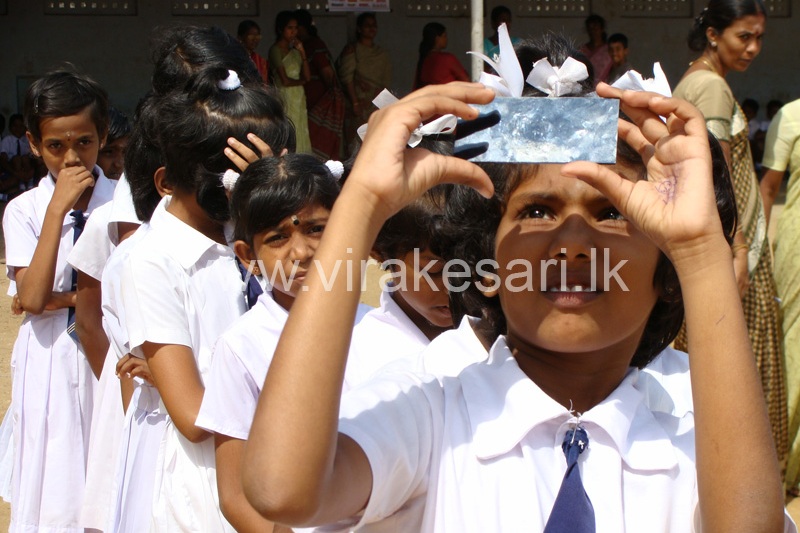
Jaffna school children view the solar eclipse - Photo courtesy Virakesari
But there were a couple of honourable exceptions – and thank heavens for that! One was the leading Tamil daily Virakesari, which sponsored an expedition to Jaffna, in northern Sri Lanka, by a group of professional and amateur astronomers from SkyLk.com. According to one member of this expedition, Thilina Heenatigala, this newspaper provided the widest and most uptodate coverage of the annular eclipse from Jaffna.
SkyLk.com collaborated with the Hindu College in Jaffna, whose playground was converted into an open air observation camp. Thilina says over 2,000 people – including school children and adults – had converged to witness the event. A large screen was set up on to which the live image from a telescope was projected.
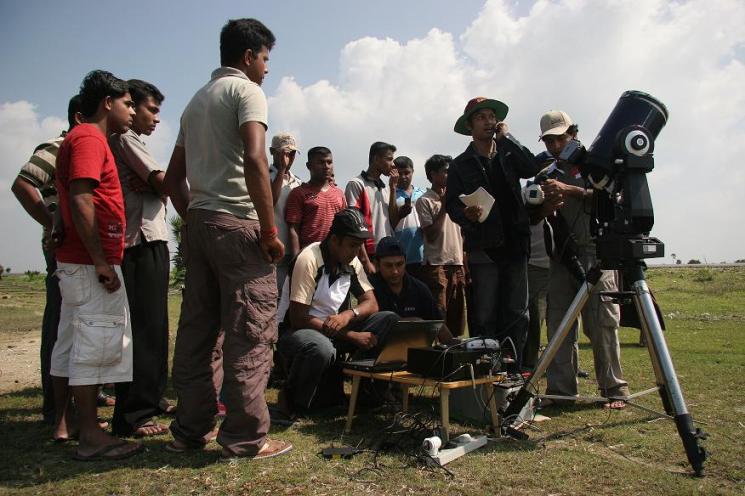
Not far from there, a group of engineering students and teachers from the University of Moratuwa was doing a more scientific observation. Later that day, team leader Dr Rohan Munasinghe reported in an email: “We have recorded the solar eclipse from Kayts (lat 9d,37m N, Long 79d,58 E), the biggest island off Jaffna Sri Lanka. We have timestamped the video with GPS (Garmin 18) accuracy.”
University of Moratuwa team observing the clipse - photo courtesy Dr Rohan Munasinghe
Elsewhere across the island of Sri Lanka, there was plenty of interest among the people from all walks of life — as seen from the thousands who stepped out during mid-day to take a peek at the celestial phenomenon. Not all of them followed the safety precautions to prevent eye damage, disseminating which the media had done a good job in the preceding days.
Clearly, this high level of public interest was not reflected in how the rest of Lankan mainstream media covered the eclipse. But if the mainstream media’s gaze was firmly fixed on the gathering election storm on the ground, the new media created opportunities for others to step into that void. Citizen scientists joined hands with citizen journalists to capture and share the eclipse with each other — and the world. These unpaid enthusiasts used commonly available digital tools and online platforms for this purpose.
Some of them uploaded dozens of photos for public viewing on image sharing sites like Flickr. A good example is what Shehal Joseph and Romayne Anthony did. There were many others.
SkyLk.com group was more ambitious: they actually webcast the eclipse live online from their public observation camp at Hindu College grounds. Stuck in Colombo with its sub-optimal viewing conditions for this eclipse, this was the best chance for people like myself to catch the annular part of the phenomenon.
“We were struggling with bandwidth limitations most of the time,” Thilina Heenatigala says. “We used a Dialog HSPA modem to connect to the web, and line speeds kept fluctuating. We were not the only ones uploading still photos or video to the web from different locations in northern Sri Lanka — and apparently all of us were slowing down each other.”
Being the tech-savvy planner he is, Thilina had alerted Dialog telecom company about the likely peaking of bandwidth demand. But he is not sure if any temporary enhancing was done, even though Dialog currently claims to be the ‘first and best’ to offer telecom coverage in the north. Certainly, the live eclipse webcast was not of uniform quality — it’s a small miracle it happened at all: until a few months ago, this was part of the theatre of war in northern Sri Lanka.
In fact, SkyLk.com had used the web to build up public awareness and interest using video trailers on YouTube. Here is one of several simulations they had up from December, thus one for Anuradhapura, Sri Lanka (simulation):
In the end, however, SkyLk.com became a victim of its own success. The live webcast was followed by hundreds, and then thousands of online visitors from different parts of the world. This apparently overshot the usual allocations provided by the offshore hosting company (in the US), which suspended the account. Right now SkyLk.com website is not accessible (as at 16 January 2010, 15:00 UTC/GMT).
Within hours of the eclipse, several individuals and groups also uploaded highlights of their eclipse videos on to the YouTube. Here are the most striking ones I came across in a quick search:
Solar Eclipse 2010 Sri Lanka Scientific Record – by University of Moratuwa
Scientific recording of the annular solar eclipse on 15 January 2010 was carried out from the Island Kayts (Lat +09d 37m North and Long +79d 58m East) of Sri Lanka.
Orion Video’s coverage from Nallur, Jaffna:
Not in the same league as the above two videos, this was Nishan Perera’s personal observations from Ratnapura, south-western Sri Lanka:
It’s too early to draw firm conclusions from this random evidence, but in all likelihood, we passed thresholds in both citizen journalism and citizen science with this eclipse. Clearly, the mainstream media’s monopoly/domination over reporting of such an event has been shattered: their indifference will no longer stand in the way of information and images being disseminated.
Perhaps just as important, it is no longer possible for a couple of self-appointed ‘public astronomers’ to dominate the public information channels on an occasion like this, mostly for shameless self-promotion. As Dr Kavan Ratnatunga, President of the Sri Lanka Astronomical Association, noted in an article: “I am amazed as to how many who have never even seen a Solar Eclipse, will gladly talk about it to an equally ignorant journalist, resulting in some totally misleading and sometimes hilarious information being published in both the English and Sinhala media. In a nation which believes in pseudo astrology, I am sure it is just a matter of time before quacks start using it to predict influence on local events and politics. However, there is absolutely no influence on any person by any of these celestial events.”
At the end of the day, however, astronomy aficionados are emphatic that no amount of media coverage can really substitute the experience of being there and experiencing it ourselves. As Kavan says: “A solar Eclipse is event which must be experience and observed. No video can do justice to that experience. It can also become addictive. In the modern age when the Internet and TV can bring events to your home, one may wonder why some Eclipse chasers travel round the world to see an Eclipse of the Sun.”
The next solar eclipse visible from Sri Lanka will be on 26 December 2019. I wonder what kind of media and ICT landscape would cover that event…
All journalism is subjective; it’s just that some of us are better at disguising it! As we head for the end of 2009, we at Moving Images blog take one last fleeting, impressionistic, judgemental and, yes, darn too opinionated look at the past 365 days. That Was The Year That Was…and here’s our list of superlatives!
Best news and biggest relief (national): Sri Lanka’s nearly three decades long and brutal civil war finally ended in mid May 2009 – and not a moment too soon. It rightly created headlines around the world, and also made it to TIME’s top 10 news of the year. Within 24 hours of that much-awaited news, I wrote and published one of my most emotionally charged essays ever, Memories of War, Dreams of Peace. I probably spoke for a whole generation of Lankans: “As we stand on the threshold of peace, I am overwhelmed with memories of our collective tragedy. I hope we can once again resume our long suspended dreams for a better today and tomorrow.” With the hindsight of seven months, I still want to believe every word…although it’s become increasingly hard to cling on to such ideals.
Biggest disappointment (national): Ending the Lankan war entailed tremendous effort, cost and sacrifice, and we all knew that consolidating peace and restoring normalcy were going to be even harder – delivering peace dividends is no mean task. As weeks became months, our cautious optimism slowly turned into disappointment and dismay: it became clear that the triumphalist government was treating the historic ‘open moment’ simply as as blank cheque to do pretty much what it wanted. My May 19 essay on Dreams of Peace had ended with a question that resonated with millions: “Would our leaders now choose the Mandela Road or the Mugabe Road for the journey ahead?” Can we please ask that question again…? Hello, anybody listening?
Most evocative piece of writing: Without competition, that distinction goes to The Last Editorial by Lasantha Wickrematunga, the courageous investigative journalist (and de facto leader of the political opposition) in Sri Lanka, who was brutally slain on January 8 while on his way to work. That editorial, which appeared post-humously in his newspaper The Sunday Leader on 11 January 2009, embodies the best of Lasantha’s liberal, secular and democratic views. Nearly a year after the dastardly daylight crime, his killers have not been caught and independent media remains under siege even in post-war Sri Lanka.
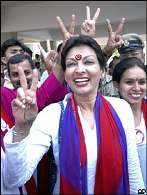
Most memorable quote: While people like Lasantha articulated our cherished dreams for a truly pluralistic society, our billion+ neighbours in India have been building it for over six decades. It’s still a work in progress, and the ideals need occasional reiteration. This is precisely what classical dancer Mallika Sarabhai did when she ran as an independent candidate when India conducted the world’s largest democratic election in April-May. She lost, but wrote one of the most insightful pieces on what it means to live amidst the huge cultural, social and political diversity in India: “We are a salad-like melange of cultures and not a soup where all variations get reduced to a homogeneous pulp—this, to me, is our greatest strength.” (She inspired my own essay: Sri Lanka – Spice Island or Bland Nation?)
Biggest disappointment (global):
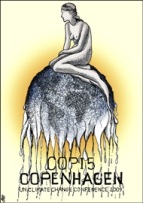
The UN climate conference in Copenhagen, held in December and officially dubbed COP15, ended up in what many activists felt was a cop-out. Greenpeace echoed the frustration of many when they said at the end of what was, at its start, billed as the ’14 days to seal seal history’s judgment on this generation‘: “Don’t believe the hype, there is nothing fair, ambitious or legally binding about this deal. The job of world leaders is not done. Today they shamefully failed to save us all from the effects of catastrophic climate change.” I was glad I wasn’t part of the mega event — I’ve burnt enough aviation fuel this year, but almost all events I participated in on three continents were more productive than the Danish debacle…
Biggest Under-achiever: If the world laboured a mountain and delivered a mouse in Copenhagen, the mid-wife of that process must surely have been the current UN chief Ban Ki Moon. More secretary than general, Ban is, in his own admission, the UN’s Invisible Man. All the top speech writers and PR agents in the world can’t animate this the perennially dull and dour diplomat. Not ideal change-maker when the world is racing against catastrophe. Kofi Annan, we miss you!
Most moving work of moving images: The world’s rich are having a party, and millions living in poverty are the ones footing the bill. This is the premise of Indian journalist and activist Pradip Saha’s latest film, MEAN Sea Level, which looks at the impact of climate change on the inhabitants of Ghoramara and Sagar islands in the the Sundarban delta region in the Bay of Bengal. I found it both deeply moving and very ironic. With minimal narration, he allows the local people to tell their own story. As it turned out, these testimonies were lost on the bickering politicians in Copenhagen…
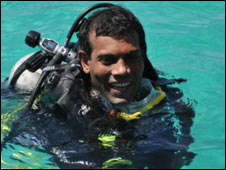
Best media stunts: We are a bit divided here. At a time of ever-shrinking attention spans, it takes much creativity and guts to grab the cacophonous media’s attention, especially for a good cause. Two very different men succeeded where many have failed. In February Bill Gates, the world’s top geek now working for its meek, released some mosquitoes at the TED 2009 conference to highlight the continuing grip that malaria has on the developing world, especially Africa. In October, climate crusader President Mohamed Nasheed of the Maldives held the world’s first underwater cabinet meeting to remind everyone of the watery future that awaits low lying island nations like his when climate change rises sea levels.
Biggest Irony: NASA announced in November that an unmanned space probe that was intentionally crashed on the Moon had discovered the presence of ‘significant amounts’ of water there. That bit of scientific evidence cost US$79 million to obtain…and was not the most comforting news for a planet that rapidly running short of usable freshwater. In the wake of the Apollo Moon landings in the late 1960s, misguided voters in Sri Lanka elected a government that promised ‘to bring rice even from the Moon’. When might we hear politicians promise us water from the Moon?
Well, that’s it folks — the highs and lows of 2009 according to the Blogger-in-Chief and his team of elves here at the Moving Images Media Empire. We’ve waded through our several dozen blog posts to come up with the above, and make no claims for being fair, balanced or comprehensive…
Indeed, we hope you don’t agree with all our picks, and invite you to express alternative – even dissenting – views. All comments that are not outright libellous or blatantly self-promotional will be published.
We take this opportunity to thank each and everyone who read our posts over the year — and especially those who left comments, sometimes radically disagreeing with our views. We also reiterate our pledge to frustrate those few persistent detractors who keep demanding to see our nationalistic, religious or other credentials…
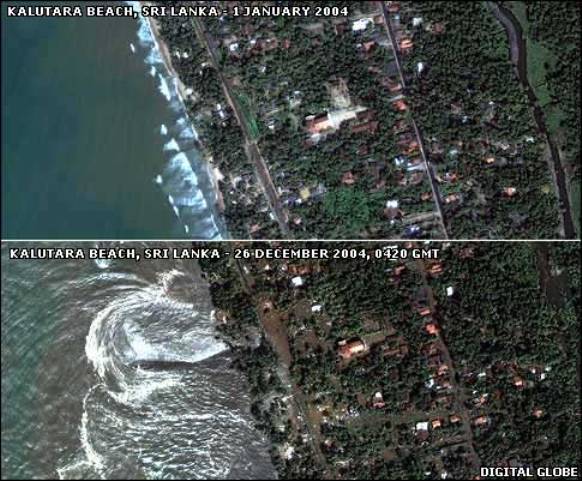
Kalutara beach in south-western Sri Lanka before & during the 2004 tsunami - Satellite image courtesy Digital Globe
This montage of satellite images was taken by the DigitalGlobe Quickbird satellite. It shows a portion of the south-western coast of Sri Lanka, in Kalutara, some 40km south of the capital Colombo. The lower image was taken on Sunday 26 December 2004, at 10.20 am local time, shortly after the moment of impact of the Indian Ocean tsunami that wreaked havoc in South and Southeast Asia that day. For comparison, we have an image of the same location on a normal day a few months earlier.
For many of us in the media and communication sectors, this was the biggest story of our lives. Because the killer waves hit numerous coastal locations in several countries, this disaster’s ‘Ground Zero’ was scattered far and wide. Not even the largest news organisations could see, hear and capture everything. Everyone had to choose.
And not just geographically, but thematically too, the tsunami’s impact was felt across sectors, issues and concerns. That provided both ample scope and many challenges for journalists, aid workers and others who rushed to the multiple scenes of disaster.
But there was a downside. Because the tsunami’s scale was so vast and its effects spread so wide, no single individual or organisation could comprehend the full picture for months. For many of us in the Indian Ocean rim, culturally unfamiliar with tsunamis, it was as if a Godzilla had stomped through our coasts. Grasping the full, strange phenomenon was hard.
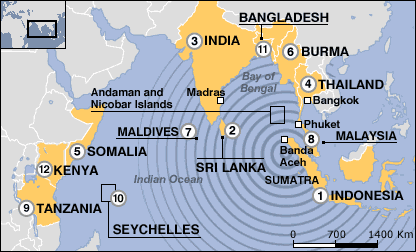
Countries affected by 2004 Dec tsunami - map courtesy BBCJournalists, professionally trained to hastily produce ‘first drafts of history’, found it a bit like being close to a huge tapestry still being woven: we all absorbed parts of the unfolding complexity. We reported or analysed those elements that held our interest. But we were too close, and too overwhelmed, for much perspective.
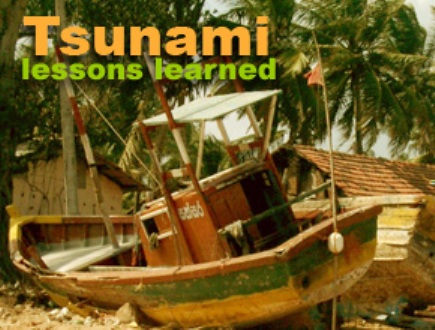
Five years on, we can ‘zoom out’ more easily to see the bigger picture. When I do, one overarching factor stands out as the most important and lasting lesson of the tsunami: the need for better governance.
The absence of good governance was at the root of most major stories about the tsunami. It cut across every level in our societies — politics, public institutions, corporate sector, humanitarian agencies, academia and civil society.
This is the thrust of my latest op ed essay, written in time for the tsunami’s fifth anniversary being marked today. I briefly recall three aspects of the tsunami that I covered as a journalist — early warnings, deluge of aid and environmental lessons — to show how the absence of governance aggravated matters in each case.
The lesson is not simply one of academic interest: it holds many practical, survival level implications. I end by quoting Maldivian President Mohamed Nasheed, who argues that democracy and good governance are also the most important elements in climate change adaptation.
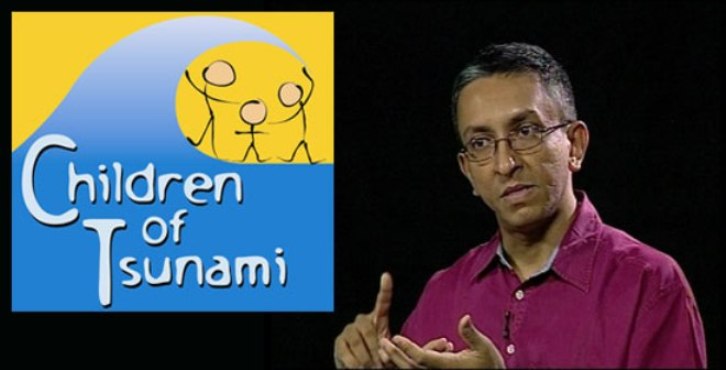
The wide-ranging interview was originally filmed in November 2005 in Bangkok, Thailand, by Thai journalist and film maker friend Pipope Panitchpakdi. He used excerpts at the time for a Thai documentary to mark the first anniversary of the tsunami. It remains one of the best media interviews I have given, for which all credit goes to Pipope.
As I later heard, some in my audience had mistakenly believed that I was advocating everything going entirely online. Actually, I wasn’t. I like to think that both the physical and virtual media experiences enrich us in their own ways. Real world is never black and white; it’s always a mix or hybrid of multiple processes or influences.
So I’ve just revisited the topic. I adapted part of the talk, and included more personalised insights, and wrote an essay titled ‘Confessions of a Digital Immigrant‘, which has just been published on Groundviews, the path-breaking citizen journalism initiative.
It opens with these words:
“My daughter Dhara, 13, finds it incredible that I had never seen a working television until I had reached her current age — that’s when broadcast television was finally introduced in Sri Lanka, in April 1979. It is also totally inconceivable to her that my entire pre-teen media experience was limited to newspapers and a single, state-owned radio station.
“And she simply doesn’t believe me when I say — in all honesty and humility — that I was already 20 when I first used a personal computer, 29 when I bought my first mobile phone, and 30 when I finally got wired. In fact, my first home Internet connectivity — using a 33kbps dial-up modem — and our daughter arrived just a few weeks apart in mid 1996. I have never been able to decide which was more disruptive…
“Dhara (photographed above, in mid 2007) is growing up taking completely for granted the digital media and tools of our time. My Christmas presents to her in the past three years have been a basic digital camera, an i-pod and a mobile phone, each of which she mastered with such dexterity and speed. It amazes me how she keeps up with her Facebook, chats with friends overseas on Skype and maintains various online accounts for images, designs and interactive games. Yet she is a very ordinary child, not a female Jimmy Neutron.
“Despite my own long and varied association with information and communication technologies (ICTs), I know I can never be the digital native that Dhara so effortlessly is. No matter how well I mimic the native ‘accent’ or how much I fit into the bewildering new world that I now find myself in, I shall forever be a digital immigrant.”
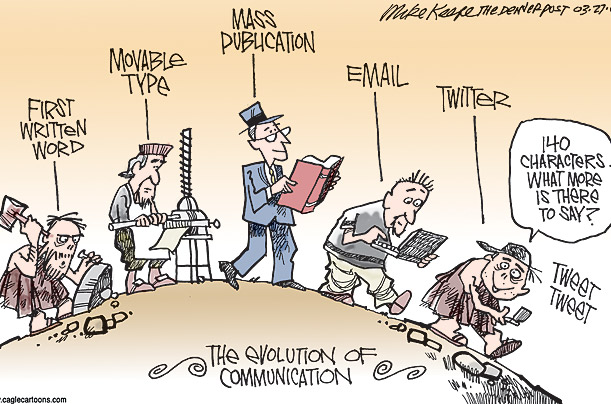
Evolution or revolution?
I was born three years before the Internet (which turned 40 a few weeks ago), and raised entirely on newspapers and radio in a country where broadcast television didn’t arrive until I was 13.
From the time I could read and write, I always wanted to be a media publisher. In that pre-history of the Personal Computer and Internet, my choices were pretty limited: I published a hand-written household newspaper and was its editor, reporter, printer and distributor all rolled into one. But I was obsessive in my work even then, and the newspaper lasted a couple of years in which over two dozen issues were released (all of them now mercifully lost).
My school teacher parents were my first patrons, supplying me with plenty of paper, pencils and ink. But there must have times when they rather wished that I didn’t indulge in my own brand of independent journalism. I loved to criticise and lampoon the ‘management’ in my editorials — even as a kid, I was already critical of the establishment!
Fortunately for me, the ‘management’ left me alone and to my own devices, but most independent editors in history haven’t been so lucky. As the American journalist A.J. Leibling (1904 -1963) once said, “Freedom of the press is guaranteed only to those who own one.” In his time, this was perfectly true.
There was a time, until recently, when press barons and media moguls led, and the rest of society followed. In our topsy-turvy times, however, the reverse is increasingly true.
In theory, at least, anyone can be a global broadcaster and publisher in less than two hours using free tools that can be downloaded and activated in minutes.
David Brewer (photo from http://www.i-m-s.dk)My British media activist friend David Brewer has just published an online guide on how to become a publisher or broadcaster in 100 minutes. (Okay, the non-geeks among us might need a bit longer than that, but still, you can be in business in just a few hours.)
David Brewer’s journalistic and managerial experience spans newspapers, radio, television, and online, and he now runs Media Ideas International Ltd, a media strategy consultancy with clients in Europe, the Balkans, the CIS, the Middle East, Asia, Africa and Central America.
David has worked with what I like to call the A-B-C of global broadcasting. He was the launch managing editor of BBC News Online in 1997, and moved to CNN, as managing editor, to set up CNN.com Europe, Middle East and Africa and CNNArabic.com. He was an editorial consultant for the launch of Al Jazeera English in 2006 and continues to work with Al Jazeera English as a new media consultant.
In his spare time, he runs Media Helping Media , a network and online resource to support media in areas where freedom of expression is under threat.









 Open Minds!