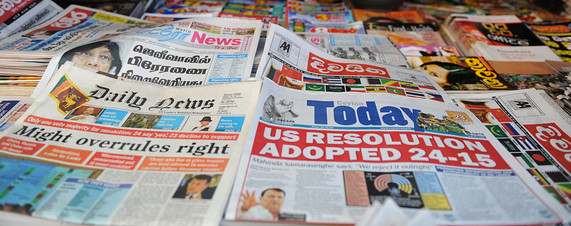
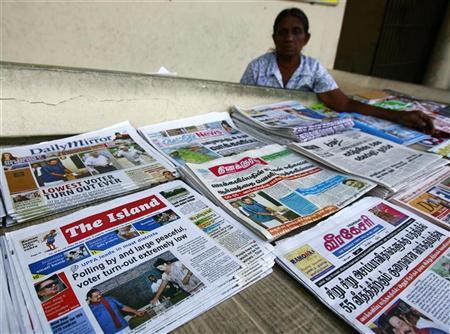
“Sri Lanka’s newspaper history dates back to Colombo Journal (1832) which apparently had a short but feisty life before it invoked the ire of the British Raj. Nearly two centuries and hundreds of titles later, the long march of printer’s ink — laced with courage and passion – continues.
“How long can this last?
Print journalism’s business models are crumbling in many parts of the world, with decades old publications closing down or going entirely online. This trend is less pronounced in Asia, which industry analysts say is enjoying history’s last newspaper boom. Yet, as I speculated three years ago when talking to a group of press barons, we’ll be lucky to have a decade to prepare for the inevitable…”
These are excerpts from a short essay I originally wrote last week to mark the first anniversary of Ceylon Today newspaper, where I’m a Sunday columnist. It was printed in their first anniversary supplement on 18 Nov 2012.
Groundviews.org has just republished it today, making it easily available to a much wider audience. Read full essay:
Another excerpt: “In the coming years, waves of technology, demographics and economics can sweep away some venerable old media along with much of the deadwood that deserves extinction. The adaptive and nimble players who win audience trust will be the ones left to write tomorrow’s first drafts of history.”
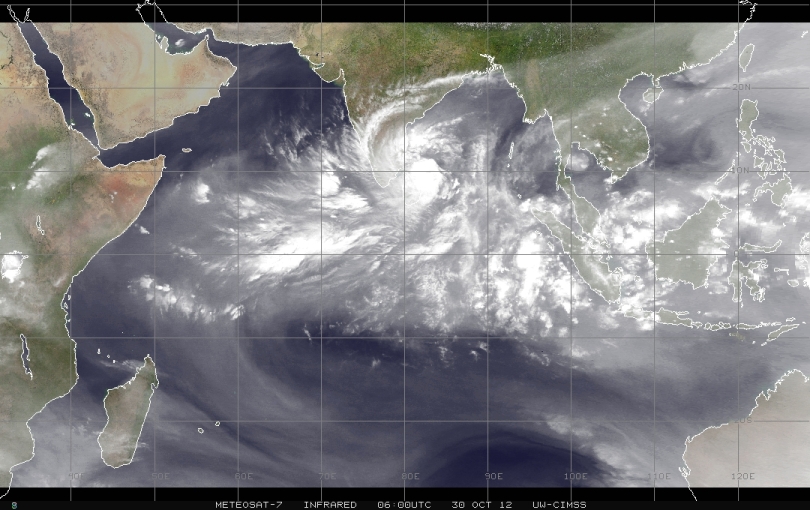
Meteosat 7 weather satellite image of the Indian Ocean – 30 Oct 2012 at 6 UTC As Hurricane Sandy hammered the US East Coast earlier this week, we had our own meteorological worries. A tropical cyclone — belatedly named Neelam — swept past parts of Sri Lanka’s North and East. It then headed to southern India.
The two atmospheric turbulences were not comparable. Sandy was far more ferocious. But Neelam caused enough disruption as well — it wasn’t just a passing gust of wind.
As I followed the two disasters through print, TV and web media reporting, I wondered: how come we had more about Sandy in our own media than on Neelam?
Is it because, as some argue, the global media were so preoccupied with Sandy, and provided saturation coverage? Or are our own media outlets unable, or unwilling, to cover a local weather anomaly with depth and clarity?
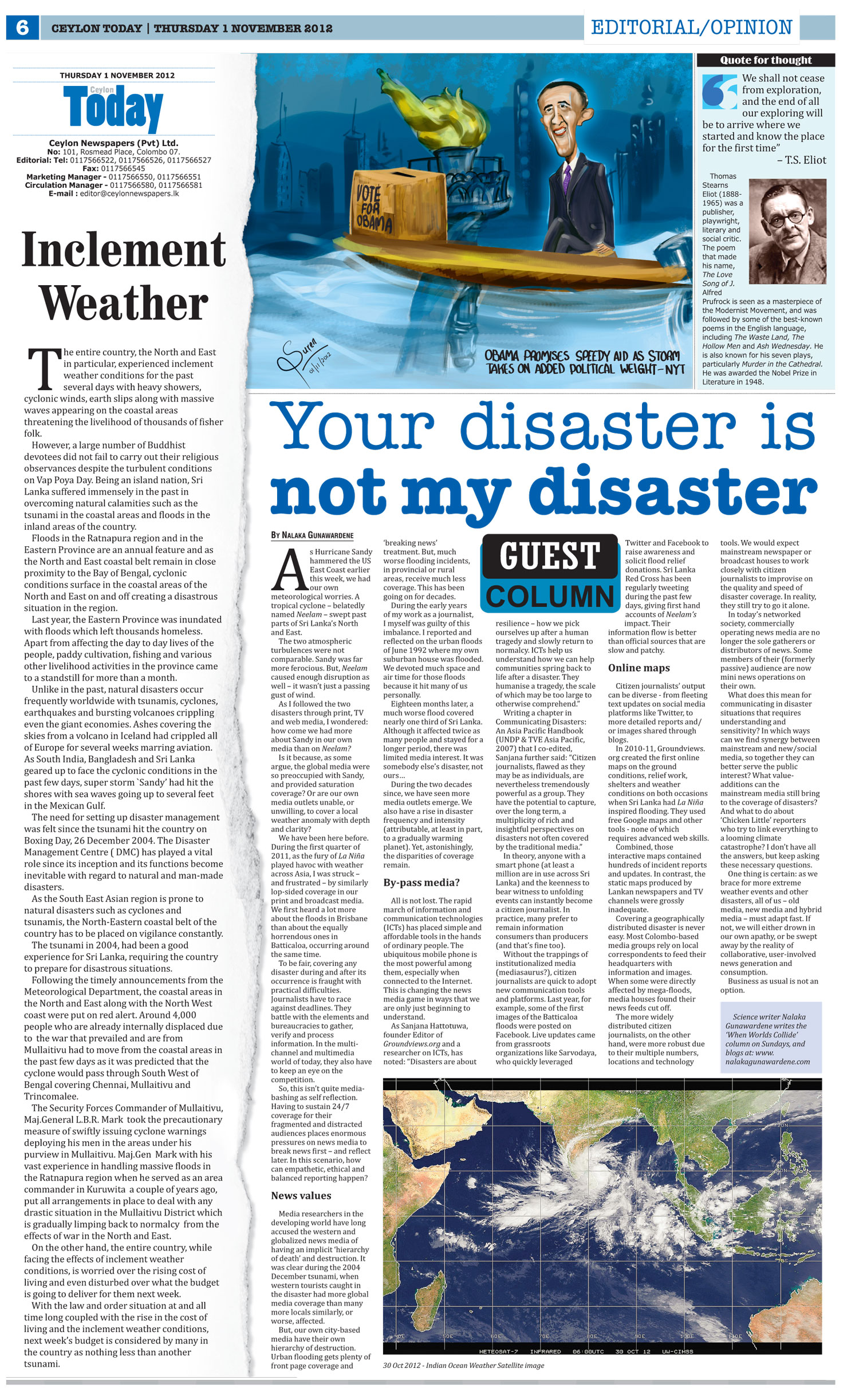
This is the opening of my latest op-ed essay, Your Disaster is Not My Disaster, published in Ceylon Today newspaper, 1 Nov 2012.
Another excerpt:
“In today’s networked society, commercially operating news media are no longer the sole gatherers or distributors of news. Some members of their (formerly passive) audience are now mini news operations on their own.
“What does this mean for communicating in disaster situations that requires understanding and sensitivity? In which ways can we find synergy between mainstream and new/social media, so together they can better serve the public interest? What value-additions can the mainstream media still bring to the coverage of disasters? And what to do about ‘Chicken Little’ reporters who try to link everything to a looming climate catastrophe? I don’t have all the answers, but keep asking these necessary questions.”
Here’s the full text, saved from the e-paper:
Your Disaster is not My Disaster – by Nalaka Gunawardene, Ceylon Today 1 Nov 2012
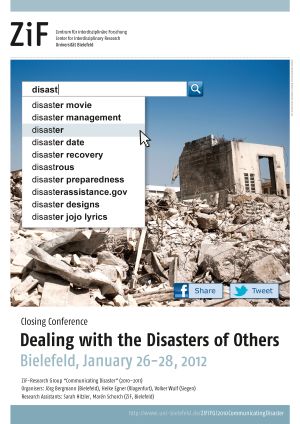
Communicating Disasters: ZiF Conference in BielefeldHow do we cope with a warming planet while living in an increasingly WikiLeakable world? Exactly one year ago, I explored this in my talk given at the University of Colombo during the LEAF Conference.
As I reflected then: “We live in a crisis-ridden world where we have to cope with multiple emergencies unfolding at the same time, impacting us on different fronts. This illustration captures three of them: crisis in biodiversity, man-made climate change, and the new reality of living in a rapidly WikiLeakable world — what I called the Global Glass House.”
I also built on ideas initially discussed in my 2007 book, Communicating Disasters, which was part of the reference material used during th ZiF research project.
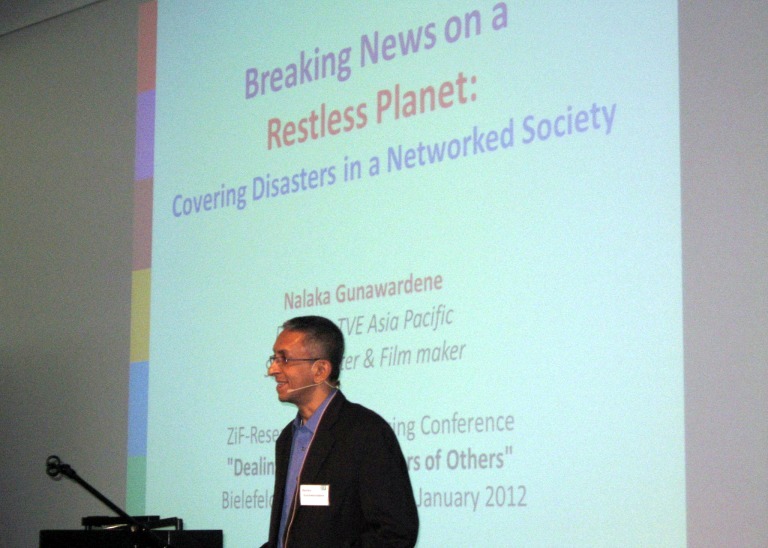
Nalaka Gunawardene speaks at ZiF Conference on Communicating Disasters, Bielefeld, Germany: 27 Jan 2012
Here’s the Summary (Abstract) of my talk. PowerPoint slides below.
Breaking News on a Restless Planet: Covering Disasters in a Networked Society
by Nalaka Gunawardene
Science Writer, Blogger & Columnist; Director – TVE Asia Pacific (TVEAP)
Communicating disasters — before, during and after they happen — is fraught with many challenges. The increased volume and flow of information, enabled by the proliferation of information and communication technologies (ICTs), fills some gaps — but not all. Other critical elements such as institution building, training and awareness raising are needed at all levels to create societies that are better informed and prepared.
The news media, driven by their quest for what is new, true and interesting, can be useful allies for disaster managers. But the nexus between these two groups has always been contentious, and the acceleration of the news cycle has made it more so. Having to sustain 24/7 coverage for their fragmented and distracted audiences places enormous pressures on news media to break news first — and reflect later. In this scenario, how can empathetic, ethical and balanced reporting happen?
As disasters increase in frequency and intensity partly due to climate change, mainstream media practitioners across Asia struggle to keep up. Disasters are more drawn out (e.g. Pakistan floods, 2010 & Thailand floods, 2011), geographically scattered (Indian Ocean tsunami, 2004) and economically devastating (Tohoku/Fukushima, 2011) than before. This stretches the capacities and resources of many news organisations. Saturation coverage of unfolding disasters can also cause ‘compassion fatigue’ and apathy in audiences.
In today’s networked society, news media are no longer the sole gatherers or distributors of news. Without the trappings and inertia of the institutionalised media, citizen journalists are quick to adopt ICT tools and platforms. What does this mean for communicating disasters that requires care and sensitivity? In which ways can we find synergy between mainstream and new/social media to better serve the public interest on a warming planet? What value-additions can the mainstream media still offer to the coverage of disasters near and far?
We examine these and other larger questions with reference to recent disasters in Asia.
This is the Sinhala text of my Ravaya column published on 13 Nov 2011, where I continue my discussion on the future of newspapers. I look at the last newspaper boom currently on in Asia, and caution that good times won’t last for long: take advantage of it to prepare for the coming (and assured) turbulence in the mainstream media!
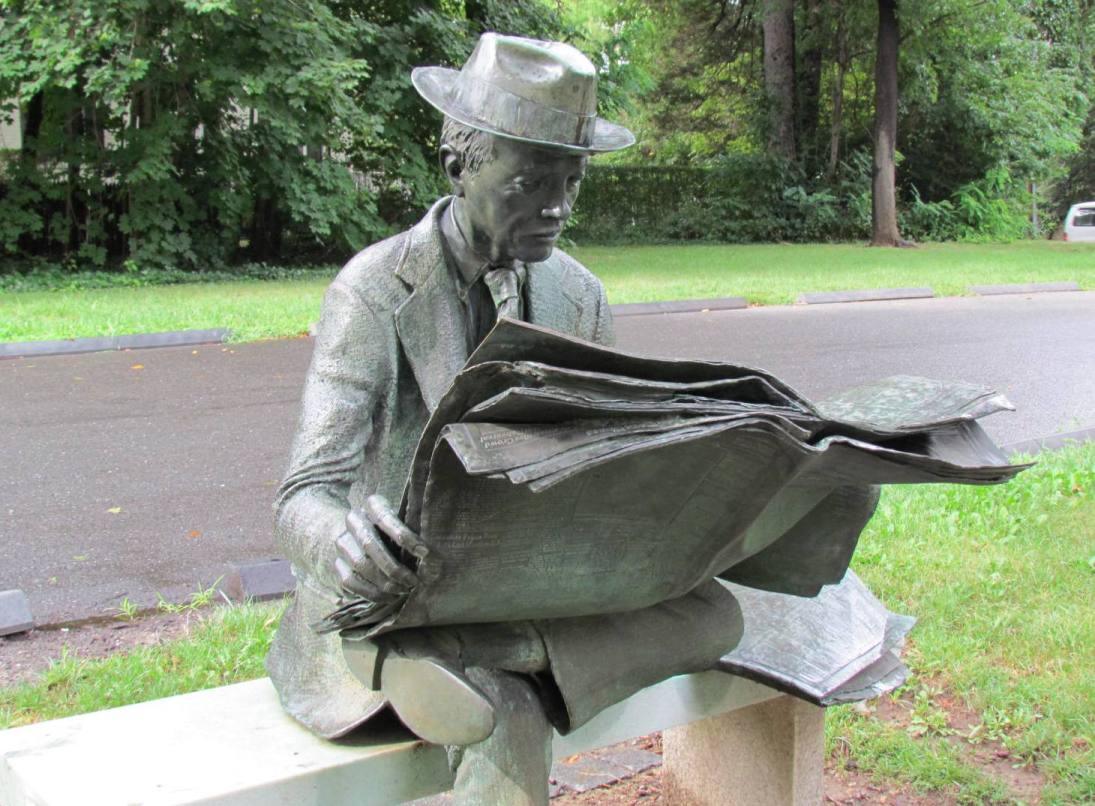
J Seward Johnson's statue of Newspaper Reader - at Princeton University garden
Text of my weekly column, printed in Ravaya newspaper on 4 September 2011. This week I take off from the role of social media in fuelling, as well as countering the recent London riots – and discuss how governments, telecom operators and law enforcement authorities should respond to the always on, pervasive connectivity now enabled by mobile phones and other devices.
Asking questions. Connecting the dots. Explaining matters.
These actions sum up what I have been doing in the spheres of communication and development for over 20 years. They form the cornerstone in my attempts to make sense of our globalised world and heady times.
As a journalist, I was trained to look for what’s New, True and Interesting (‘NTI Test’). Early on, I went beyond just reporting events, and probed the underlying causes and processes. With experience, I can now offer my audiences something more: perspective and seasoned opinion.
I look back (slightly) and look around (a lot) in a half-hour, in-depth TV interview with media researcher/activist and fellow citizen journalist Sanjana Hattotuwa. This was part of The Interview (third series) produced by Young Asia Television, and broadcast on two Sri Lankan TV channels, TNL and ETv on May 8 (with repeats).
Watch the full interview online: Sanjana Hattotuwa talks to Nalaka Gunawardene
I have always worn multiple ‘hats’, and dabbled in multiple pursuits rather than follow narrow paths of enquiry. I see myself continuing to oscillate between the ‘geeks’ and greens, and where possible, bridging their worlds.
I sometimes feel a strange kinship with the ancient Greeks, who first asked some fundamental questions about the universe. They didn’t always get the answers right, and neither do I.
But it’s very important that we question and critique progress – I do so with an open mind, enthusiasm and optimism.
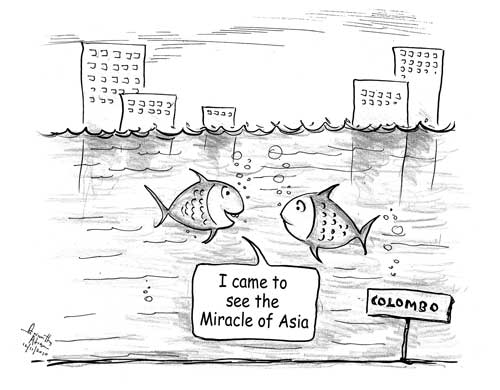
Cartoon in Daily Mirror, Sri Lanka, on 12 November 2010
Why do movie audiences in this part of the world cheer every time they see alien invaders blow up the White House? For a long time I thought it had something to do with anti-American sentiments; then I heard that many US audiences react the same way. Perhaps some among us get a kick out of seeing overbearing governments in trouble?
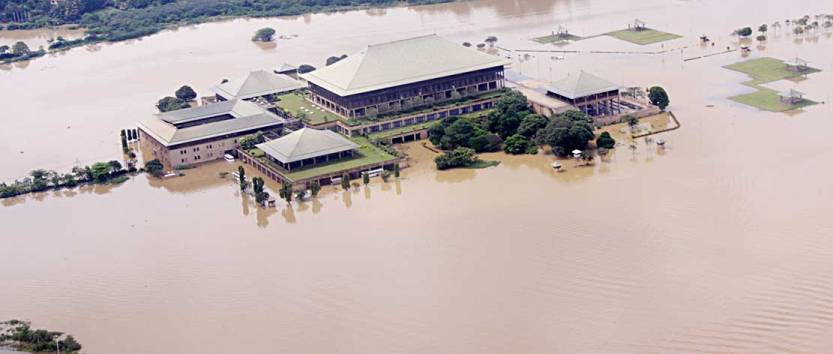
That might explain the gleeful tone with which the Colombo media reported the Sri Lankan Parliament being flooded after torrential rains in mid-November. Newspapers and television channels repeatedly showed images of the Parliamentary complex – built three decades ago on a marshland – completely marooned. The hapless people’s representatives were ferried across the expanse by the military, to take part in a brief session to extend Emergency Regulations. The symbolism was inescapable.
When the trapped rainwater engulfed many areas in and around Colombo, thousands of affected people groaned, but no one was really surprised. By now Sri Lankans know this is almost an annual routine. As I sat knee-deep in my own flooded office, I had a strong sense of déjà vu.
This is the opening of an op ed essay I’ve just written for Himal Southasian magazine, whose March issue carries a cover story on disasters in South Asia.
My essay, titled Drowning in media indifference, takes a personalised look at how the Lankan media have covered different disasters in the past two decades.
“Once again, the mainstream media in Sri Lanka has proven itself irrelevant in reporting and responding to catastrophic flooding,” says the intro — and that pretty much sums it up.
Sri Lankan Parliament flooded after torrential rains in mid-November 2010. The complex, built on a marshland, was completely marooned.
I recall how, back in 1992-93, the then media (fewer in number, with broadcasting still a state monopoly) provided saturation coverage for a major flood in the capital Colombo while under-reporting an even worse flood in the provinces a few months later.
“Fast forward to the present – and how little things have changed! During the past three months, as the fury of the formidable little girl (La Niña, the global weather anomaly) played havoc on the island, I have been struck by the similarly lop-sided coverage in the country’s mainstream print and broadcast media. Urban flooding once again received ample front-page coverage and ‘breaking news’ treatment. Everyone, from cartoonists and editorialists to talk-show hosts and radio DJs, ranted about what was taking place. Yet the much worse flooding, once again in the north, east and centre of the country, received proportionately much less attention. There were a few honourable exceptions, but by and large the 1992-93 disparity was repeated wholesale.”
I have been both an insider and outsider in this issue. I consider myself to be part of the extended mass media community in Sri Lanka for over two decades: I have worked for newspapers, magazines, radio and TV stations. At the same time, I retain the ability – and independence – to steps back and take a more critical and objective look at the media industry and community.
My interest in how disasters are covered and communicated go back to the time when my own house was flooded in mid 1992. I have since researched and commented extensively on this issue, and co-edited the 2007 book Communicating Disasters: An Asia Pacific Resource Book (TVEAP/UNDP).
In this latest essay, I reiterate an argument I’ve been making for sometime: “Media researchers have long accused the Western and globalised news media of having an implicit ‘hierarchy’ of death and destruction, in terms of how they report disasters in developing countries. But Sri Lanka’s own media’s indifference is equally appalling – the story of a quarter-million displaced people languishing in squalid conditions for weeks on end did not constitute front-page news. A starlet entering hospital after a domestic brawl excites news editors more than thousands of flood-affected provincial people starving while waiting for relief.”
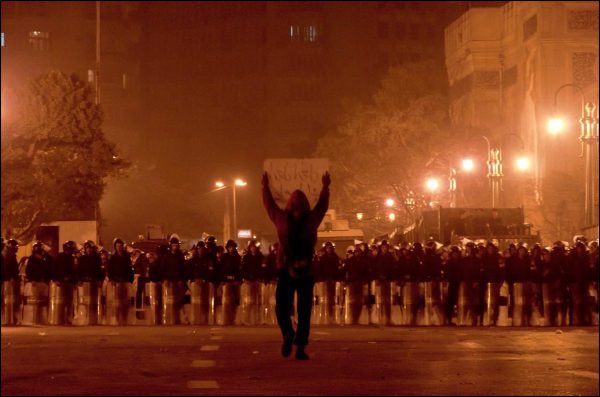
Their blurb: “Violent clashes between police and demonstrators as over ten thousand gather on the streets of Cairo. The Egyptian people have endured a tyrant’s rule for far too long, millions struggle each day to find where their next meal is coming from. January 25th, 2011 marks the day when the people rise and take back what’s rightfully there’s. This isn’t the end, but hopefully the beginning to a long awaited regime change! Send to everyone and let them know.”
Song: “Into the Fire” – Thirteen Senses
Thanks to the following news sources for their footage
Daily News Egypt
The Guardian
CNN
New York Times
Al Masry Al Youm
My DIY as POY: Famous at last?“All I can hear I me mine, I me mine, I me mine.
Even those tears I me mine, I me mine, I me mine.
No-one’s frightened of playing it
Ev’ryone’s saying it,
Flowing more freely than wine,
All thru’ your life I me mine…”
When George Harrison sang those words in the 1970 Beatles song ‘I-Me-Mine’, he was in two minds about expressing in the first person (or ego). He wasn’t alone: mainstream journalism has long had reservations about where ‘I’ fit in journalistic narratives.
“Never bring yourself into what you write,” we were told in journalism school 20 years ago. Journalists, as observers and chroniclers of events, write the first drafts of history – and without the luxury of time or perspective that historians and biographers take for granted. We often have to package information and provide analysis on the run. Bringing ourselves into that process would surely distort messages and confuse many, it was argued. We had to keep our feelings out of our reportage lest it affects our ‘objectivity’.
In other words, we were simply mirrors reflecting (and recording) the events happening around us. Mirrors can’t – and shouldn’t — emit light of their own.
Occasionally, if we felt the urge to express how we personally felt about such trends and events, we were allowed the luxury of an op-ed or commentary piece. Of course, as long as we ensured that it was a measured and guarded expression. And if we really wanted to bring ourselves into the narrative, we could use the archaic phrase ‘this writer…’ to refer to ourselves.
But never use I-Me-Mine! That would surely sour, taint and even contaminate good journalism – right?
Well, it used to be the ‘norm’ for decades — but mercifully, not any longer. Thanks largely to the new media revolution triggered by the Internet, writing in the I-Me-Mine mode is no longer frowned upon as egotistic or narcissistic. It sometimes is one or both these, but hey, that’s part of cultural diversity that our information society has belatedly learnt to live with…
We journalists are late arrivals to this domain. The first person narrative was always valued in other areas of creative arts such as literary fiction, poetry and the cinema. In such endeavours, their creators are encouraged to tell the world exactly how they feel and what they think.
Of course, some writers ignored orthodoxy and wrote in the first person all along. One example I know personally is the acclaimed writer of science fiction and science fact, Sir Arthur C Clarke. Shortly after I’d started working with him in 1987, Sir Arthur encouraged me to fearlessly use the first person narrative even in technical and business writing. A lot of writing ended up being too dull and dreary, he said, because their writers were afraid of speaking their minds.
Yet we had to wait for the first decade of the Twenty First Century to see I-Me-Mine being widely accepted in the world of journalism. Did the old guard finally cave in, or (as sounds more likely) did Generation Me just redefine the rules of the game?
Whatever it is, I-Me-Mine is now very much in vogue. And not a moment too soon!
Joel Stein (Photo-illustration by John Ueland for TIME)As Time columnist Joel Stein, who often writes with his tongue firmly in his cheek, noted in a recent column: “All bloggers write in first person, spending hours each day chronicling their anger at their kids for taking away their free time. Every Facebook update and tweet is sophomoric, solipsistic, snarky and other words I’ve learned by Googling myself.”
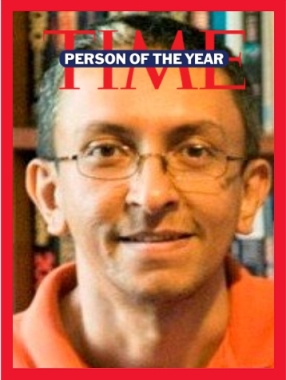
And look at what Time just tempted me to do: put myself on their cover, as the Person of the Year (POY), no less. While designating Facebook’s founder Mark Zuckerberg as its POY 2010, Time teamed up with the social media network to introduce a new application that allows anyone to become POY with just a few key strokes. Provided you have a Facebook account, of course.
Joel Stein quotes Jean M Twenge, professor of psychology at San Diego State University, as saying that we are living in the Age of Individualism, a radical philosophical shift that began with Sigmund Freud. It has exploded during the past decade with reality television, Facebook and blogging. “You’re supposed to craft your own image and have a personal brand. That was unheard of 10 years ago,” Twenge says.
What a difference a decade can make. Although trained in the pre-me era, I was never convinced as to why I had to keep myself out of what I write. However, my use of I-Me-Mine was done sparingly in the late 1980s (when I started my media work) and during the 1990s. It was only in the 2000s that I finally found both the freedom to speak my mind – and the ideal platforms for doing so: blogging and tweeting.
As my regular readers know, I blog about my family, friends, pet, travels, writing and conference speaking. I liberally sprinkle photographs of myself doing various things. I tell you more than you really want to know about my life. Ah yes, I’m self-referential too.
And not just on this blog. I’ve also been writing op ed essays for various mainstream media outlets for much of the past decade, and have never hesitated in expressing what I think, feel and even dream about. (Isn’t that what opinion pieces are meant to be?)
But the Digital Immigrant that I am, all my writing is shaped by my pre-Internet training. Even for a blog post or tweet, I still gather information, marshal my thoughts and agonise over every word, sentence and paragraph.
As my own editor and publisher on the blog, I don’t have gatekeepers who insist on any of this. My readers haven’t complained either. Yet I write the way I do for a simple reason. I may indulge in a lot of I-Me-Mine, but I don’t write just for myself. You, gentle reader, are the main reason why I strive for coherence and relevance.
(OK, if you really must know, it also ensures a joyful read when I occasionally go back and read my own writing…)
“In the struggle for freedom of information, technology — not politics — will be the ultimate decider.”
These words, by Sir Arthur C Clarke, have been cited in recent days and weeks in many debates surrounding WikiLeaks, secrecy and the public’s right to know.
I invoke these words, and many related reflections by the late author and futurist, in a 2,250-word essay I have just written. Titled Living in the Global Glass House, it is presented in the form of an Open Letter to Sir Arthur C Clarke. It has just been published by Groundviews.org
This is my own attempt to make sense of the international controversy – and confusion – surrounding WikiLeaks. Taking off from the current concerns, I also look at what it means for individuals, corporations and governments to live in the Age of Transparency that has resulted from the Information Society we’ve been building for years.
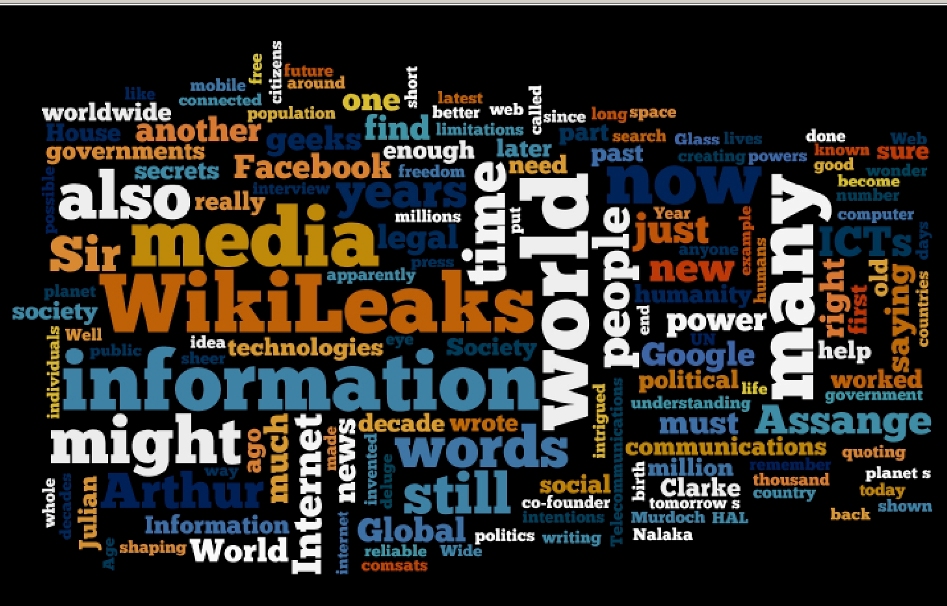
Sir Arthur foresaw these developments year or decades ago, and wrote perceptively and sometimes in cautionary terms about how we can cope with these developments. As a research assistant and occasional co-author to Sir Arthur from 1987 to 2008, I had the rare privilege of sharing his views firsthand. In this essay, I distill some of the best and most timely for wider dissemination. The above Wordle graphic illustrates the keywords in my essay.
The essay was also prompted by recent experiences. Here’s that story behind the story:
By happy coincidence, I arrived in London on 28 November 2010, the very day the WikiLeaks Cablegate erupted all over the web, beginning to spill out what would eventually be over 250,000 secret international ‘cables’ within the US diplomatic corps.
The Guardian UK that day published an interactive map-based visualization of the leaks. By moving the mouse over the map, readers can find key stories and a selection of original documents by country, subject or people
During the week I spent in London, I experienced not only uncharacteristically early and intense snow storms, but a mounting international storm on the web over the leaked cables. WikiLeaks’ co-founder and chief editor Julian Assange was also somewhere in the UK, playing cat and mouse at the time with the Swedish police and Interpol. (He later turned himself in to the British authorities.)
Sir Arthur Clarke: The legacy continues...On December 1, the British Interplanetary Society invited me to join their annual Christmas get-together where they were remembering their founder member and past chairman Arthur C Clarke. They talked mostly about the man’s contribution to space exploration, but listening to those fond memories against the wider backdrop of WikiLeaks very likely inspired me to write this essay.
Soon after I returned to Colombo, Transparency International Sri Lanka asked me to speak at a workshop on the right to information they had organised for journalists. Given my reputation as a geek-watcher and commentator on the Information Society, they asked to talk about what WikiLeaks means for investigative journalism. Two days later, the Ravaya newspaper did a lengthy interview with me on the same topic which they have just published in their issue for 19 December 2010.
All these elements and experiences combined in writing this essay. Being confined to home by a nasty cold and cough also helped! In fact, on 16 December when Sir Arthur’s 93rd Birth Anniversary was marked, I was too weak to even step out of the house to visit his gravesite. In the end, I finished writing this Open Letter to him on the evening of that day.
My daughter Dhara and I would normally have taken flowers to Sir Arthur’s grave on his birth anniversary. This year, instead, I offer him 2,250 words in his memory. The fine writer would surely appreciate this tribute from a small-time wordsmith.




 Open Minds!