Low Carbon, High PrioritySome 100 world leaders are due to gather at the United Nations headquarters in New York this week for the highest level summit meeting on climate change ever convened.
As the New York Times reported: “In convening the meeting, the United Nations is hoping that collectively the leaders can summon the will to overcome narrow nationalinterests and give the negotiators the marching orders needed to cut at least the outline of a deal.”
Recognising climate change as one of the greatest social, economic, political and environmental challenges facing our generation, the British Council has launched the Low Carbon Futures project. It has focus on mitigating the effects of climate change in an urban environment. It is part of the British Council’s major global climate security project and India is, along with China, one of the top two priority countries for this work. Sri Lanka, with less than 2% of India’s population and correspondingly lower carbon emissions, is a lower priority.
One strand in the Low Carbon Futures project is to engage communications professionals – journalists, writers and film makers to help them better understand the issues around mitigation and get across key messages to readers/viewers more effectively.
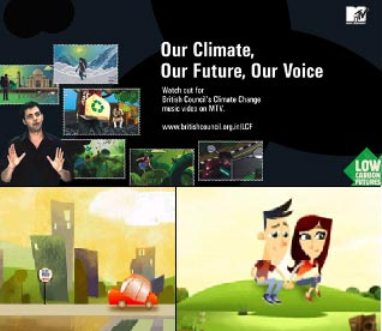
As part of this project, the British Council collaborated with Music Television (MTV) to produce a music video and two viral video animations on climate friendly, low-carbon lifestyles.
British Council’s first Music Video on Climate Change produced by MTV features VJ Cyrus Sahukar. Combining animation, lyrics and melody, the video talks about how small individual actions can help conserve natural resources and save the climate. MTV VJs have a cult following and the video ends with Cyrus Sahukar, MTV’s face in India, encouraging young people to take that first step. The video was launched in New Delhi on 1 June 2009 in the presence of 50 International Climate Champions from across India & Sri Lanka.
According to the British Council India website, “The video has created a flutter and there is growing demand to screen the video on various institutional networks across India and even outside fulfilling higher level objectives of impacting young urban aspirants. Young Indians are an emerging generation who are ambitious and internationally minded with the potential to be future leaders. The MTV video aims to influence this influential group.”
The Low Carbon Futures project has also released two short, powerful, animated messages that are ‘tongue-in-cheek’- making use of everyday events with a touch of humour. “We are hoping that the messages will be seen as creative, funny and innovative to tempt the recipient to forward it to their peer group. As the virus spreads, so will the message. The British High Commission and the The Energy and Resources Institute (TERI) are also promoting these virals to spread the message amongst the staff members and their external audiences,” says the project website.
The first viral video animation is called Green Journey, and shows a little known benefit of car pooling. Its blurb reads, simply: Meet 3 Mr Rights on the wrong side of the road!
The second viral video animation is called Play Cupid, and gives us one more reason to plant more trees! Blurb: Lets leave the young couples in peace and solitude of nature!
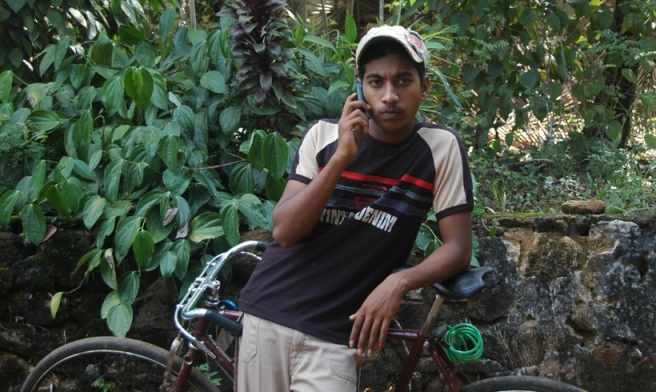
Chamara Pahalawattage: At 18, he is already using his 6th mobile (Photo by Niroshan Fernando, TVEAP)
When many able-bodied young men and women of his age were joining the armed forces in large numbers, Sri Lankan school-leaver Chamara Pahalawattage chose differently. He decided to try his luck with odd jobs at construction sites.
That, by itself, was nothing unusual. Tens of thousands of young men and women like Chamara join the labour market every year. Schools don’t equip them with attitudes or skills for self employment, so most would idle years away looking for regular jobs in Sri Lanka’s public and private sectors. Frustration would prompt some to take to political agitation, or worse.
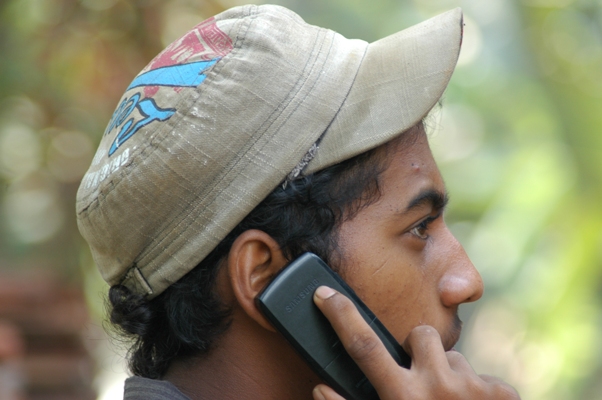
Chamara is at such crossroads in his own life, but he is unlikely to go astray. The enterprising young man has boosted his chances of part-time work by getting himself a mobile phone.
“After buying a phone, I get calls asking me to come for work. The phone makes it so easy,” he says. “Otherwise people will have to come looking for me…or I have to go to them.”
If a skilled mason or carpenter takes him on as an assistant, Chamara gets a daily wage of LKR 700 (US$ 6 approx) plus a mid-day meal. That income augments the modest LKR 4,000 a month (US$35) his mother makes cooking meals at a nearby factory.
In February 2009, we filmed a day in the life of Chamara, a resident of Gonapola, in Sri Lanka’s western province. This was part of a profiling of telephone users at the bottom of the (income) pyramid – or BOP – in emerging Asian economies, undertaken by TVE Asia Pacific on behalf of the regional ICT research organisation LIRNEasia.
Watch our short video profile of Chamara Pahalawattage:
Going by his household income, Chamara is BOP at the moment – but his aspirations extend above and beyond. An only child raised by his widowed mother, Chamara developed an interest in mobiles while still in his mid teens. He bought his first mobile two years ago, when in Grade 11 at school.
“Almost everyone had phones, so I also wanted one,” he recalls. “From then on, I got used to having a phone!”
And has he been keeping up with technology! He buys second-hand phones for better features: he currently owns his sixth phone in just over two years. He had paid LKR 7,500 (US$ 65) for his latest phone at the beginning of 2009.
Besides voice and SMS (texting), his phone supports MP3, video recording, song downloading, voice recording and some other functions. After a hard day’s work, he unwinds listening to the radio, or swapping songs with friends — all using their mobiles.
Chamra spends an average of US$3 to 4.50 per month on phone use, and – like all other BOP telephone users we interviewed in India, Philippines and Thailand – he is thrifty with value added services that cost extra. This is something that has been confirmed by LIRNEasia’s Teleuse@BOP 2008 survey.
“Some of my friends access the internet through their phones and download songs,” he says. “I then get these songs from them. My phone has bluetooth. I use it to transfer songs from my friends’ phones.”
Chamara has every intention of moving up the labour market – someday, he wants to hold a more regular job, with an assured monthly income. Right now, in spite of being connected, he can’t predict how many days a month he’d find work.
Hello, can you hear our dreams? Photo by Niroshan Fernando, TVEAP“I don’t check newspapers for jobs. Instead I ask the people I know…mostly my friends,” he says. This probably indicates another shift from a wide-spread habit among literate Sri Lankans scanning newspapers for recruitment notices.
LBO 9 March 2009: Sri Lankan low income customers can use mobiles more for business: study
The official end of the 30-year-long war should be good news for Chamara and millions of other tech-savvy, eager youth like him. Like me, they can once again start dreaming of better tomorrows.
Telecommunications would be a good place to start. For several years, it has been the fastest growing sector in the Sri Lankan economy — one that has not only connected people across distances and cultures, but also been a ‘social leveller’.
The telephone subscriber base grew by 35.5% in 2008 (and 47% in 2007). The country’s tele-density (number of telephones per 100 persons) jumped to 71.9 in 2008, from 53.4 in 2007 -– thanks largely to the phenomenal spread of mobile phones.
As I noted last year: “It is not by accident that telecom has remained the fastest growing sector in the economy for a decade. This was triggered and sustained by the far-reaching policy and regulatory reforms which ended the then fully state-owned telecom operator’s monopoly, and allowed the entry of new players, technologies and business models.”
Of course, improved telecommunications are necessary, but not sufficient by itself, for us to evolve into an inclusive information society. Building on technology and systems, we must become discerning creators and users of information. Knowledge – not paranoia or rhetoric – needs to form the basis of policy and actions that propel us to the future.
Photos courtesy Niroshan Fernando, TVE Asia Pacific
I just killed a few dozen ‘girls’ before breakfast. It wasn’t always easy or pleasant, and after a while there was blood all over the place. But I feel good about getting them – and I saved an innocent baby in the process, and even helped a researcher doing good work!
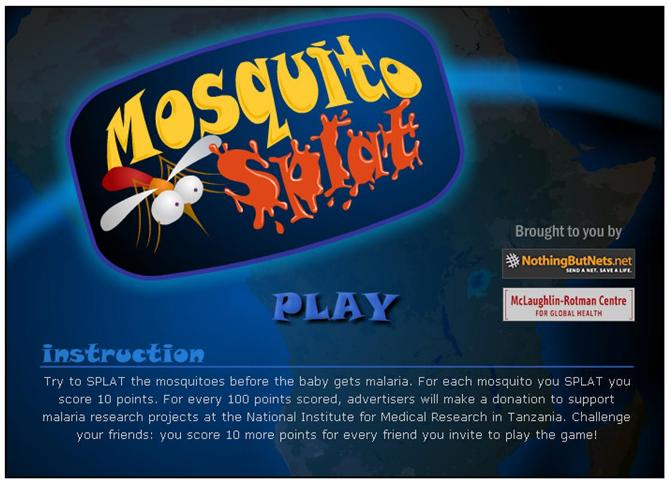
Now online: a game we have played over millennia against 'em blood suckers...
The aim of the game is to use the fly squatter to SPLAT mosquitoes before the baby gets malaria. For each mosquito you SPLAT, you score 10 points. For every 100 points scored, advertisers will make a donation to support malaria research projects at the National Institute for Medical Research in Tanzania. We also score 10 points for everyone we invite to play the game – plus there’s a link taking us to an online donation page in case we want to support the research directly.
“It’s quick, easy and fun, and a great way to do your part for one of the most serious global health problems in the developing world,” say the game’s promoters.
Indeed. Nearly 500 million cases of malaria occur each year, resulting in over one to three million deaths (figures online vary enormously on this). Malaria is particularly devastating in Africa where it is a leading killer of children. Every 30 seconds a child in Africa dies from malaria.
The fact is, malaria deaths are entirely preventable with modest investment and spread of knowledge that mosquitoes spread malaria (not everyone knows this, and as I wrote in another blog post, that’s a challenge that educators and broadcasters are now working on).
McLaughlin-Rotman Center for Global Health: Taking anti-malaria campaign onlineBut more needs to be done to engage the Digital Natives in this global public health challenge. It’s not just the exposed people in malaria-prevalent parts of Africa, Asia and Latin America who are at risk. As development economist Jeffrey Sachs has been reminding us eloquently, malaria reduces productivity, increases poverty, weakens people’s bodies and makes them vulnerable to other diseases. In a globalised world, such massive suffering in some parts of the world would quickly manifest in different ways all over the planet.
Little biology lesson: Usually, people get malaria by being bitten by an infective female Anopheles mosquito. Only Anopheles mosquitoes can transmit malaria, and they must have been infected through a previous blood meal taken on an infected person. When a mosquito bites an infected person, a small amount of blood is taken, which contains microscopic malaria parasites. About one week later, when the mosquito takes its next blood meal, these parasites mix with the mosquito’s saliva and are injected into the person being bitten.
I’m a bit anxious about impending teenhood. No, not my own, thank you, but my kid’s.
As a single parent raising a 12-year-old who will soon turn 13, I keep reading and hearing all kinds of advice these days on how best to cope with a teenager in the house — that phase in growing up that everyone predicts will involve some turbulence.
On top of all else that comes with hormones-on-legs, there’s now the worry of Teenage Affluenza. It’s a condition that affects millions of teenagers around the world. Most of them live in the developed countries, but in this topsy-turvey, globalised world, there’s no stopping the rapid spread of such conditions all over the majority world.
Look carefully, and you can see the symptoms of TA - image courtesy WorldVision Australia
I belatedly came across this campaign video called Teenage Affluenza, made by the charity WorldVision Australia in mid 2007. It was first made for a promotion kit for the 40 Hour Famine, to be used in Australian schools. World Vision media staff worked with Rohan Zerna Films, Melbourne, who had worked on previous spots for World Vision. The team decided to take the route of irony, providing a spoof feel. The budget wasn’t high. A family friend of the producer starred as the Melbourne teenager. The voice-over was donated by a regular with World Vision promotions. Overseas footage, already held by World Vision Australia, was spliced into the story.
Read news story in The Age newspaper, Australia, on 2 July 2007
Erin is a fifteen year old girl living deep in the South Eastern suburbs of Melbourne, Australia. She is at risk from teenage affluenza, like five million children and teenagers in her country. She still sleeps in the wooden colonial bed her parents bought her when she was ten. Although meals, travel and education are readily available to girls like Erin, many are forced to live on less than $40 pocket money each week. Erin’s iPod only holds 1 GB.
And so the satirical commentary continues. Juxtaposed with Erin’s ‘tragic life’ is the reality faced by children and teenagers in Vietnam, Sudan and other countries affected by famine and the long term impact of civil war. The video ends with the message “Do something else. Do something real. Do something.”
Teenage Affluenza is Spreading Fast: From WorldVision Australia
The video has attracted thousands of responses on YouTube’s online-comments section, including some honest self-analysis from teenagers, while others started a discussion about who is to blame – corrupt governments or first-world greed.
Meanwhile, WorldVision US has released another version of the video, slightly shorter and featuring American teeangers. If anything, the condition is more prevalent there.
Teenage Affluenza: from WorldVision United States
The message to parents is clear: we’re the ones who can prevent our teenagers from contracting Affluenza. All it takes is thoughtful and sustained action. When teens say gimme-gimme-gimme, we have to known when it’s really needed and when it’s wanted. Easier said than done. I know, because teenages seem to arrive in pre-teens these days.
We the parents would certainly welcome reinforcements from any sensible source. WorldVision Australia runs an interesting website called Stir, which tries to engage youth on issues of development and global justice. As a direct intervention charity, WorldVision doesn’t leave it to governments, but urges people to get involved — and do something.
The legend lives on: Arthur C Clarke (1917 - 2008) - photos by Rohan de Silva
Today we mark the first death anniversary of Sir Arthur C Clarke. Exactly one year ago, when he passed away aged 90, I was thrust into a media frenzy. I’d been Sir Arthur’s research assistant and, in later years, his media spokesman and in the hours and days following his death, the family asked me to continue that role.
This blog recorded my experiences and emotions as they happened (see several posts in the latter half of March 2008). A year later, all of us who worked closely with him still miss Sir Arthur, but I can now take a more detached, longer-term view. And that’s what I’ve just done.
In an op ed essay published today in Groundviews website, I argue that sparking imagination and nurturing innovation are the best ways in which Sri Lanka can cherish Sir Arthur’s memory in the land he called home for half a century.
Despite his well known ego, Sir Arthur never sought personal edifices to be put up in his honour or memory. When a visiting journalist once asked him about monuments, he said: “Go to any well-stocked library, and just look around…”
In the weeks and months following Sir Arthur’s death, many have asked me what kind of monument was being planned in his memory. As far as the Arthur C Clarke Estate is concerned, there is none –- and that seems to surprise many.
Yet it is fully consistent with the man of ideas, imagination and dreams that Sir Arthur Clarke was. Monuments of brick and mortar — or even of steel and silicon — seem superfluous for a writer who stretched the minds of millions. Commemorative lectures or volumes cannot begin to capture the spirit and energy of the visionary who invented the communications satellite and inspired the World Wide Web.
A life of no regrets...except for a minor complaint In my essay, I suggested: “Instead of dabbling in these banalities, Sri Lanka should go for the ‘grand prize’: nurturing among its youth the intellectual, cultural and creative attributes that made Arthur C Clarke what he was. In other words, we must identify and groom the budding Arthur Clarkes of the 21st century!”
Easier said than done. In fact, in a country like Sri Lanka that is still partly feudal, insular and stubbornly clinging on to the past instead of facing the present and future, this becomes formidable. This is why I noted: “But can imagination and innovation take root unless we break free from the shackles of orthodoxy? For transformative change to happen, we will need to rethink certain aspects of our education, bureaucracy, social hierarchies and culture. Are we willing and able to attempt these?”
I then discuss some of the key challenges involved in nurturing imagination and innovation. I end my essay with these words: “Let’s not kid ourselves: sparking imagination and innovation is much harder than launching a gleaming new satellite in Sir Arthur’s name. But the rewards would also be greater: if we get it right this time, Sri Lanka can finally take its rightful place in the 21st century.”
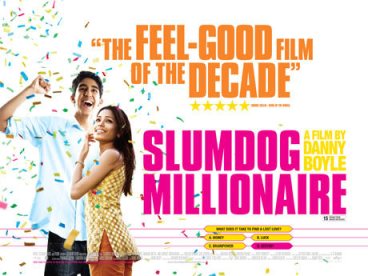
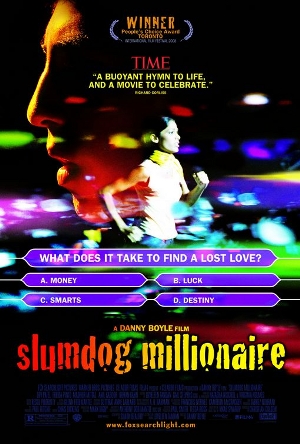
Few films in recent years have generated as much buzz as Slumdog Millionaire, the British-Indian film based in the slums of Mumbai. It has won five Critics’ Choice Awards, four Golden Globes and seven BAFTA Awards, and is nominated for ten Academy Awards, including Best Picture.
I just called to ask...Early on, film critic Ben Walters spotted this aspect. He asked in The Guardian on 9 December 2008: Is Slumdog Millionaire the first truly 21st-century film? Among his reasons: “Jamal works in a call centre decorated with London Underground paraphernalia and whose employees are kept up to date on EastEnders plotlines to improve their chances of successful small talk with their customers. Aptly enough, the customers are mobile phone users – another emblem of 21st-century connectivity – and a mobile plays a crucial part in the story’s climax.”
And now it turns out that a real life ICT experiment triggered the idea of the Slumdog story.
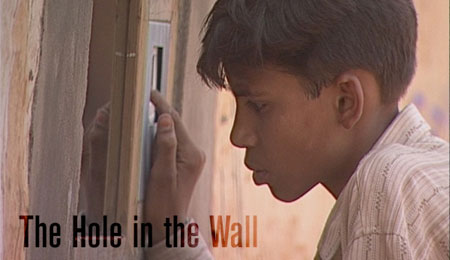
Indian author Vikas Swarup, on whose 2005 novel Q&A the movie is based, has recently revealed how he was inspired by the hole-in-the-wall project. This was an initiative by Dr. Sugata Mitra, chief scientist at NIIT, a leading computer software and training company in New Delhi. Mitra embedded a high-speed computer in a wall separating his firm’s headquarters from an adjacent slum, he discovered that slum children quickly taught themselves how to surf the net, read the news and download games and music. He then replicated the experiment in other locations. Each time the results were similar: within hours, and without instruction, the children began browsing the Internet.
Swarup told Indian Express in January 2009: “That got me fascinated and I realised that there’s an innate ability in everyone to do something extraordinary, provided they are given an opportunity. How else do you explain children with no education at all being able to learn to use the Internet. This shows knowledge is not just the preserve of the elite.”
Discover your world...Dr Mitra’s project was the subject of a 2002 documentary film, called Hole in the Wall, made by the New York based production company GlobalVision.
The film was introduced as follows: A revolution in information technology is redefining poverty, as how much you know is becoming just as important as how much you own. “The Hole in the Wall” examines one possible solution to the growing technological gap between rich and poor — the so-called ‘digital divide’ — that threatens to consign millions to an “information underclass.”
The film was made by Rory O’Connor and Gil Rossellini. An 8-min version was broadcast by PBS in October 2002 in their program Frontline/World. A 60-min version was screened at the United Nations in New York City in December 2002. The film has been widely screened, and won several awards.
Initiator of the Hole in the Wall project carries on his mission to adapt ICTs to serve the unmet needs of India’s poor. Watch Dr Sugata Mitra talk about his work in this TED Video:
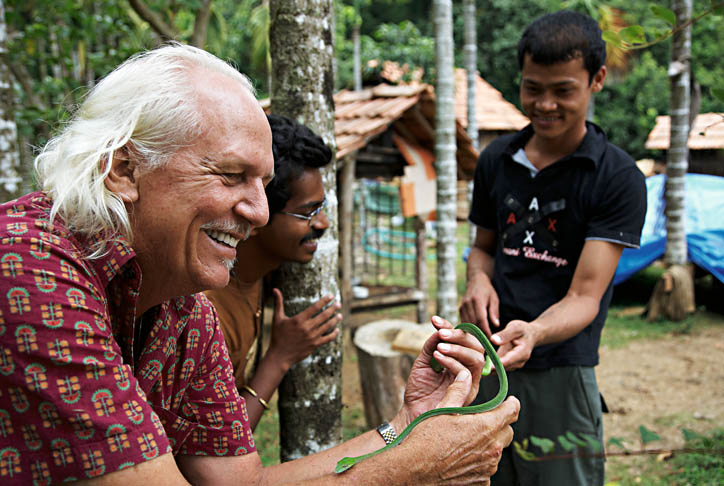
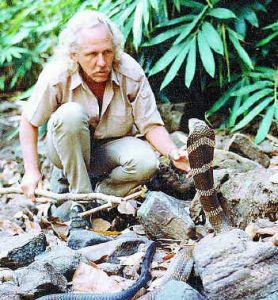
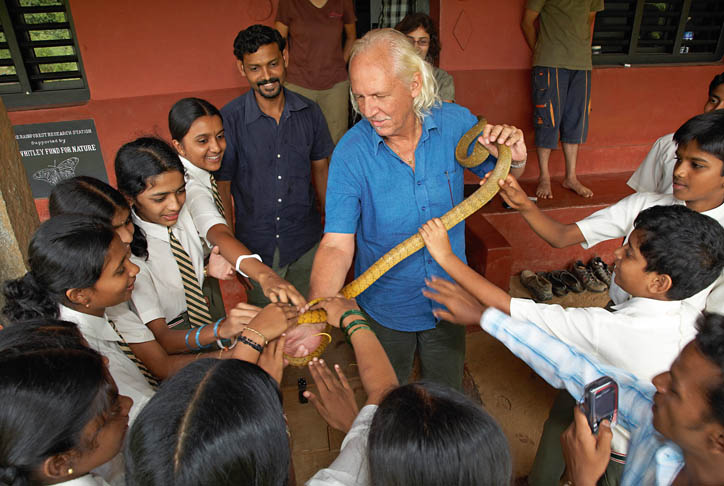
Romulus Whitaker introduces a young volunteer to a snake at Agumbe research station, Tamil Nadu, India – photo courtesy Rolex Awards
“I haven’t had to do a nine-to-five job ever in my life, and that is a very envious situation to be in if you like the wild. Life has been much like a river in that it picks you up and carries you along. I have got into things as they come towards me.”
That’s how Romulus Whitaker, reptile and amphibian specialist, conservationist and filmmaker sums up his long, eventful and illustrious career. At 65, he is full of zest for life, ready to take on new challenges in protecting India’s forests and wildlife.
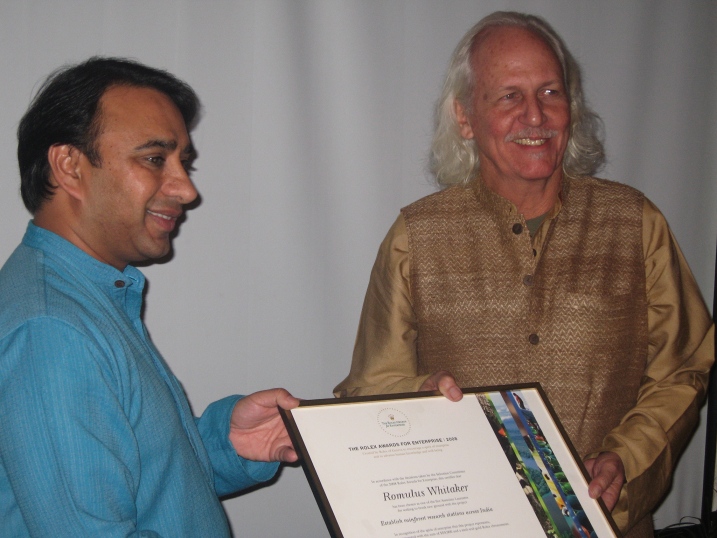
I caught up with this American-born, naturalised Indian citizen a few days ago when he and fellow Indian Moji Riba were presented with their Rolex awards at a ceremony in New Delhi.
Of course, I’d heard about Romulus (Rom) Whitaker for years and seen some of his natural history films. In some ways, his style was a bit like that of ‘The Crocodile Hunter’ Steve Irwin — putting himself in the picture, sometimes in daring encounters with potentially dangerous animals…all in the name of bringing nature a bit closer to us in our living rooms.
But such similarities go only so far. Rom takes a less dramatic and more philosophical approach to humans’ relationship with Nature. For him, television is only a means to an end. As Rolex award profile put it, “the combination of a foreign name, mildly Viking looks inherited from his Swedish mother, an unexpected fluency in local Indian dialects and a thoroughly irreverent attitude” makes him “a highly unconventional yet effective conservationist in a country far from his birthplace”.
To catch a glimpse of this remarkable man, watch this ‘Incredible India’ PSA featuring Romulus Whitaker:
Rom was the founder director of the Snake Park in Chennai. The park was established in 1972 ‘to preserve the endangered reptile species in the sub continent’.
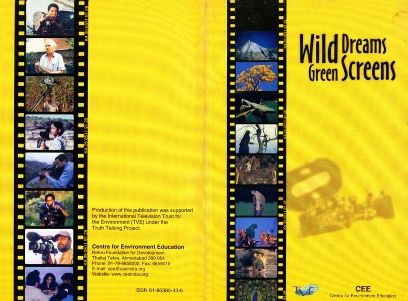
Rom’s career in film making was a byproduct of his life-long desire to bring people and Nature closer. He chronicled his venture into the world of television and film in a chapter he wrote for a book published by India’s Centre for Environment Education and TVE Asia Pacific in 2002. In that book, titled Wild Dreams, Green Screens, eight leading Indian film-makers shared insights about their careers, including how and when they decided to get involved in this field. They also talked about some of the exciting — and frustrating — experiences they have had while filming nature and wildlife.
From dreams to screen…
In the early 1970s, Rom worked with a Russian film crew who turned up to do a sequence on snakes for a film based on the famous Kipling story, Rikki Tikki Tavi. “It was fun for me to help them figure out how to film a snake stealing an egg from a bird’s nest – and it took a whole week to do it. I was impressed by their patience and persistence,” Rom recalled in the book.
After that, every few months, some film crew would show up to do either a short news story on the Snake Park, or a short film on Indian snakes for foreign audiences. India’s stereotyped reputation as a land of snakes and snake-charmers partly fueled this interest.
Rom continues: “By the 1980s, I started thinking I knew something about making wildlife films – even though I didn’t have a TV, and there weren’t really very many such documentaries screened anywhere in India. I was aware that films could show and teach people about my beloved reptiles like nothing else. Surely the Snake Park with nearly a million visitors a year could make good use of such films, and I knew the visitors would go away with a new awareness of how beautiful, graceful and interesting reptiles are. A single broadcast on a TV channel and 20 million people would be able to see it all at once!”
Determined to do his own films, Rom teamed up with two school friends John and Louise Riber, and Shekar Dattatri, to make a film on India’s snakebite problem. They had a tiny budget (Indian Rupees 50,000, which is approximately US$ 1,000 today), an old Arri camera and ‘a lot of enthusiasm’.
One thing led to another. “‘Snakebite’ turned out to be a good little half-hour film which was translated into several Indian languages… Amazingly, this little film won a first prize at a festival in the United States, and was awarded the Golden Eagle by the American Movie and Television Federation. Lo and behold, I was a filmmaker!”
Vikram Akula (left) presents Rolex Awards certificate to Romulus Whitaker in Delhi, 22 January 2009
We missed Shekar at the Delhi event – he couldn’t make it due to scheduling difficulties. But as Rom has written, the Whitaker-Dattatri partnership continued for several years while they struggled with ‘very crude equipment’ and tiny budgets. Films like ‘Seeds of Hope’ (on tree planting) and ‘A Cooperative for Snake Catchers’ followed.
Rom further writes in his chapter: “We worked hard on these films, learning as we went along month after month, working with really good people like the tree planters of Auroville and the Palni Hills Conservation Council, and, of course, the fantastic Irula tribals. We did have a few narrow escapes with snakes, but we always felt we were in much more danger driving down National Highway 45, than from any of our venomous subjects!”
Rom’s film making in the past two decades has taken him not only to the far corners of India, but to other biodiversity hotspots of the world – such as Indonesia. As the years passed, his enhanced reputation attracted big names in wildlife films, such as National Geographic, Discovery/Animal Planet and BBC Natural History. Combining his conservation knowledge with public education skills, Rom has also been presenter of several films.
The King (Cobra) and I
These multiple involvements have earned him a string of awards – his documentary King Cobra made for National Geographic won him an Emmy award, considered the television equivalent of the Oscars.
Despite the rigorous demands of film making (and the occasional lure of television medium), Rom has remained active in conservation circles both within India and at global level. While many conservationists in India focus their attention on charismatic megafauna like tigers and elephants, Rom has stayed faithful to his chosen field of reptiles and amphibians. Years ago he realized that his beloved species cannot survive unless their natural habitats do. So, like many others, he evolved from naturalist to conservationist.
“A lot of us get wrapped up in our own little special animal and then we wake up and start thinking it has got to be habitat and it has to be eco-development that involves people and, now, in my case, it has crystallized into the whole idea of water resources,” he says.
Rom’s colourful career has itself become a subject for other filmmakers. In 2007, he was featured in a critically-acclaimed documentary produced by PBS, under their “Nature” banner, on “super-sized” crocodiles and alligators, which was filmed in India, East Africa and Australia.
And in January 2009, Whitaker returned to the small screen in another “Nature” documentary on real-life reptiles such as Komodo dragons and Dracos that inspired tales of dragons.
The man who turned to moving images in the 1980s to move people’s minds towards conservation is still engaged in that business. He is a conservationist who puts a premium on public engagement, and especially on working with children and young people.
He says: “We are doing a lot of work with young people, bringing them to the forest and showing them what happens here and why it matters. It can be very difficult to change adult attitudes, but with the young, it is easier to get across the knowledge that what we are doing to the forests we are doing to ourselves.”
In Romulus Whitaker\’s hands, snakes become educational tools for children and icons of nature conservation. Photo courtesy Rolex Awards
Who wants to be a Slumdog Millionaire?“All the world is a quiz, and all the men and women merely players.” That’s how the late Magnús Magnússon, iconic host of BBC TV’s long-running quiz Mastermind, once described the scope for his line of work.
These words came to my mind as I watched the new Danny Boyle movie Slumdog Millionaire in New Delhi on its opening night on 23 January 2009. For two hours, it held me spellbound and transported me, alternately, to the rough world of Mumbai slums and the glitzy world of television quizzing in Bollywood.
It’s a feel-good, rags-to-riches story about Jamal Malik, an 18 year-old orphan from the slums of Mumbai who goes on to win a staggering 20 million Indian Rupees (a little over US$ 400,000) on India’s version of the popular TV game show Who Wants To Be A Millionaire?. The story, adapted from an award-winning novel Q&A(2005) by Indian diplomat Vikas Swarup, resonated strongly with me given my own, long-standing association with the overlapping worlds of quizzing and TV hosting.
As the story unfolds, we find out how and why Jamal – who has had little or no formal schooling and lacks ambition to win the quiz – got on the show: for a very personal reason. Through a series of amazing coincidences, well known in the movies that often ask us to suspend disbelief, the answer to each question he faces is deeply etched in his memory from his tumultuous past.
When the show breaks for the night, Jamal is only one question away from winning the show’s grand prize, which can make him a multi-millionaire. But the show’s organisers just can’t believe that an uneducated street kid (or a ‘slum dog’) has made it thus far on his own. So they call in the police.
As the police inspector says: “Doctors… Lawyers… never get past 60 thousand rupees. He’s on 6 million.” The question for everyone is: how does he do it?
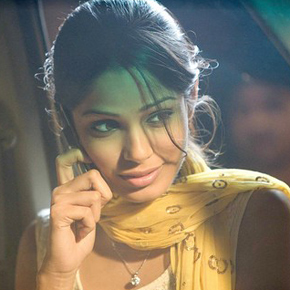
Jamal is arrested on suspicion of cheating, and police torture him overnight to find out how. Desperate to prove his innocence, Jamal tells the story of his life in the slum where he and his brother Salim grew up, of their adventures together on the road, of vicious encounters with local gangs, and of Latika, the girl he loved and lost. Each chapter of his story reveals the key to the answer to one of the game show’s questions…
Watch the official movie trailer for Slumdog Millionaire:
Jamal returns the next evening – straight from police custody – to face the final question. The right answer would earn him 20 million; giving the wrong answer would lose all his winnings so far. By this time, his meteoric rise to the final question has made news headlines and tens of millions of TV viewers across India are watching the show and cheering for him. Among them is the young woman for whom Jamal got on the show in the first place…
The dramatic story ends on a happy note, in true Bollywood style, when boy meets his long-lost girl. One of its sub-plots offers insights into the high adrenalin world of quiz shows, which are now being played for high stakes.
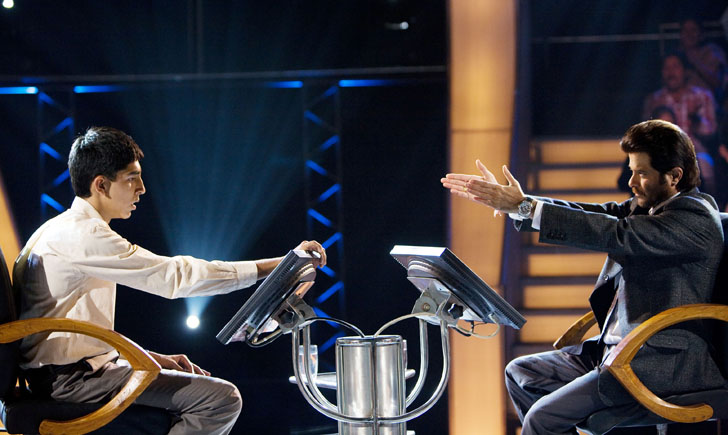
Is that your final answer?
The film uses the actual set of Kaun Banega Crorepati (KBC), the Indian version of the globally popular game show, Who Wants to be a Millionaire? which offers large cash prizes for correctly answering 15 (or in some countries, 12) consecutive multiple-choice questions of increasing difficulty. It represents the highly commercialised end of the quizzing world, which traditionally shunned cash rewards for performance. For example, the winner of BBC Mastermind receives nothing more than the coveted title.
I can’t remember exactly when I first took part in a general knowledge quiz — that is now buried too deep in the sediments of my memory. But I have been an active participant in the fascinating world of quizzing for at least three quarters of my 42 years, first as a quiz kid and then as a quiz master.
Slumdog Millionaire reinforces a point I have been making for years: not to equate knowledge with intelligence. Quizzes of every kind only test the general knowledge and quick recollection ability among participants — but not necessarily their intelligence. Measuring intelligence (that is, determining intelligence quotient, or IQ) is a specialised and complicated process. In any case, scientists acknowledge that such measurements are not always accurate because of cultural diversity and other variables. Although someone excelling in quiz would, in all likelihood, also have a high level of intelligence, quiz performance by itself is no measure of someone’s IQ.
Similarly, there is also no direct co-relation between the level of educational attainment and performance at general knowledge quizzes. While good quiz kids generally tend to be high achievers in their curriculum studies, that is not always so. I remember a London taxi driver once beating dozens of academics and professionals to become the overall winner in Brain of Britain, the BBC’s long-running radio quiz show. Apparently he used to read a great deal while waiting for hires.
Finally, I know of serious quiz enthusiasts who frown upon game shows like KBC as a dumbing down of the cerebral art. But there’s no denying that, by invoking popular culture, the new formats have hugely enhanced the audiences following quizzing on TV. For the true aficionados, there’s always Mastermind and other ‘pure’ forms of quizzing that remain above the fray of commerce. For the rest, there are shows that mix the quest for knowledge with the pursuit of happiness through material rewards.
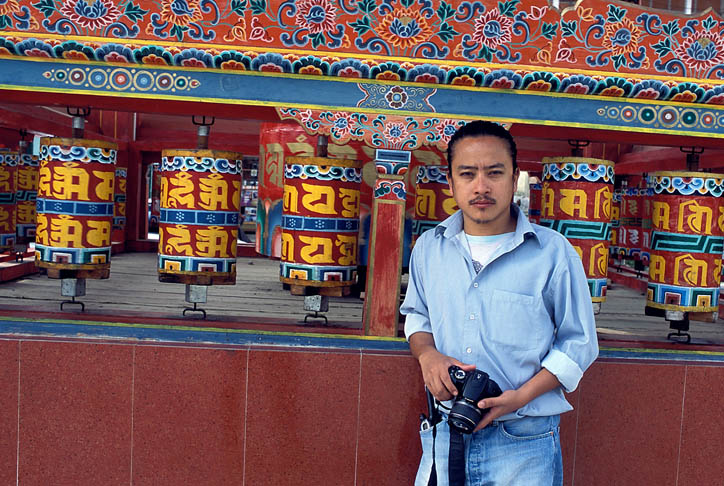
Moji Riba has been working since 1997 to document Arunachal Pradesh's rich cultural heritage. Image courtesy Rolex Awards
“I like to think of our heritage as an elastic band. I want to stretch this as much into the future generations as we can – till it reaches its edge and snaps. Each day I wake up and hope that this never happens. But that is sadly a finality we have to stare at – unless of course, there is a revolution of some kind!”
That’s how Moji Riba, Indian film-maker and cultural anthropologist, sums up the raison d’etre for his work.
He has reasons to worry. He lives and works in India’s north-eastern Arunachal Pradesh, which an isolated remote and sparsely populated part of the country that is home to 26 major tribal communities,. Each one has its own distinctive dialect, lifestyle, faith, traditional practices and social mores. They live side by side with about 30 smaller communities.
Today, a combination of economic development, improved communications, the exodus of the young and the gradual renunciation of animist beliefs for mainstream religions threatens Arunachal’s colourful traditions. “It is not my place to denounce this change or to counter it,” says Moji. “But, as the older generation holds the last link to the storehouse of indigenous knowledge systems, we are at risk of losing out on an entire value system, and very soon.”
Can anyone capture culture – a dynamic, hugely variable phenomenon – and preserve it in a museum or lab? Not quite. Preserving the communities as a living reservoir of culture is the best method. In addition, modern communication technologies can be used to record the myriad practices and memories – the indigenous knowledge and oral history of a people.
This is just what Moji Riba has been doing for over a decade. He founded and heads the Centre for Cultural Research and Documentation (CCRD) in Naharlagun, Arunachal Pradesh. The non-profit centre, established in 1997, focuses on audio-visual documentation of the folklore, ritual practices and oral histories of the diverse tribes that inhabit the north-eastern states of India and how the indigenous people are adapting to the processes of rapid change.
Moji, who holds a masters degree in mass communication from the prestigious Mass Communication Research Center (MCRC), Jamia Millia Islamia University, New Delhi, could easily have joined the exodus of talent from his state to the metropolitan centres in India. But he chosen to return to his roots with his enhanced skills and expanded worldview.
Over the past decade, he and the centre have made 35 documentaries for television stations and for government and non-governmental agencies. But the centre is more than just an archive or library: it is also a platform offering the tribal people an opportunity to voice their concerns and share experiences.
In 2004, Moji was instrumental in creating the diploma in mass communications at Itanagar’s Rajiv Gandhi University, to augment understanding of cultural values and local customs. He currently divides his time as head of the university’s communications department and running CCRD.
“CCRD has been using documentary films as a tool to document and understand the transitional tribal society and to share that experience through the medium of television,” says Moji. “In these 10 years, we have primarily produced television documentaries on linkages between issues of culture, environment and development and how one cannot be seen in isolation from the other.”
CCRD films have been showcased on Doordarshan, India’s national broadcaster, and various other national and international forums.
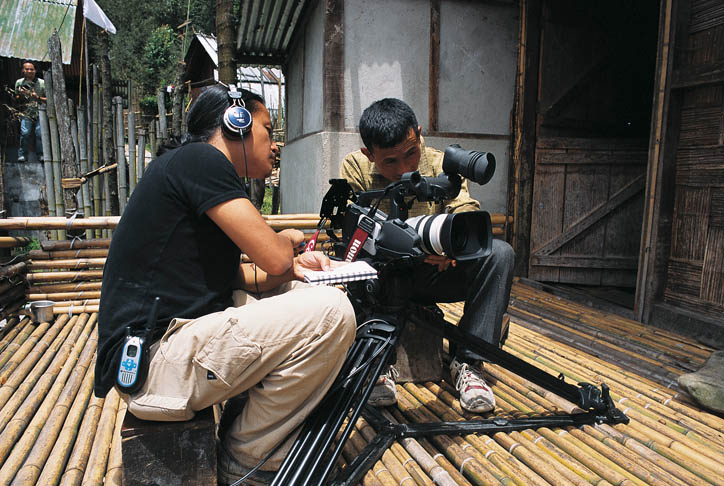
Riba teaches Hage Komo the basic camera skills that will allow the young Apatani to film an interview with his father and an animist priest, thus recording his tribe's oral history (Photo courtesy Rolex Awards)
Years of hard work and quiet persistence are beginning to pay off. Moji has just been selected as an Associate Laureate of Rolex Awards for Enterprise, a prestigious global honour. He is being recognised for ‘helping to preserve and document the rich cultural heritage of India’s Arunachal Pradesh tribes’.
I have known Moji for half a decade, in which time my admiration for him has continued to grow. We first met during a South Asian TV training workshop TVE Asia Pacific organised in Kathmandu in October 2003. Since then, Moji worked with us as a freelance film director and producer. In 2005, he directed Deep Divide, a half-hour, three-country documentary on the state of environmental justice in South Asia. In 2006, he filmed stories for TVEAP series Digita4Change (in Bhutan) and The Greenbelt Reports (in three locations in India).
Moji’s films have drawn the attention of film festivals and reviewers. My friend Darryl D’Monte, one of the most senior journalists in India, wrote in 2006 about one film titled When the Mist is Lifted: “As an insider, he (Moji) is able to draw out the contradiction between old and new lifestyles and practices. In remarks after the screening, he spoke about the difficulties of making films in the northeast, and understandably expressed his reluctance to make another film on Arunachal, which has been his staple over the years.”
With support from the Rolex Award, Moji and CCRD plan to implement in 2009 the Mountain Eye Project, an unconventional and ambitious initiative that aims to create a cinematic time capsule documenting a year in the life of 15 different ethnic groups. They will select and train young people from each community to do the filming. This gives him access to enough film-makers as well as access to people with an intimate understanding of village life.
According to Moji, the Mountain eye Project is the result of the learnings that have emerged from about a decade’s work on documentation of the folklore and cultural heritage of the tribal groups in northeast India. It seeks to involve local communities in extensively documenting the disappearing cultural practices and traditional knowledge and to build an audio-visual archive of this data.
It also proposes to activate a vast network of outreach activities through museums in order to inculcate in children and youth, an appreciation of traditional heritage and creating respect for cultural diversity.
Watch this space.
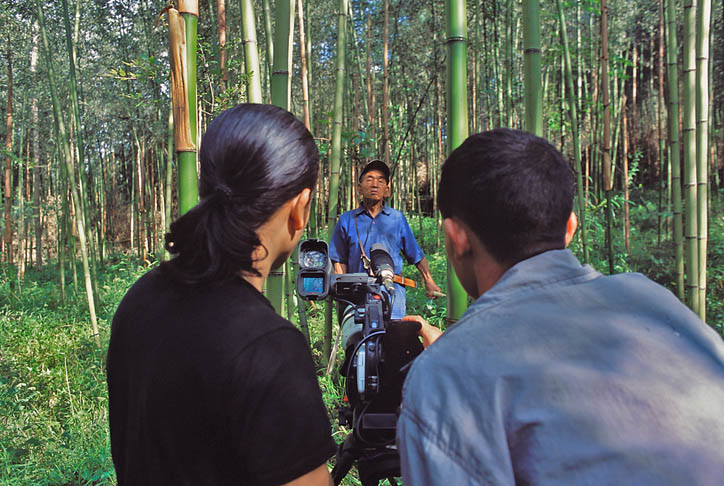
Hage Komo gets video instructions from Moji Riba, who is enlisting local young people to capture the oral histories, languages and rituals of their tribes for his project. Komo films his father gathering bamboo in a grove outside Hari Village. (Photo courtesy Rolex Awards)
October 15 was marked as the first Global Handwashing Day (GHD). It’s simple yet important mission was to promote the practice of handwashing with soap.
Washing hands can save lives. Washing hands with soap can save more lives. This is the simple message reinforced on this day with public campaigns focusing on schools and school children.
GHD is a Unicef-led initiative involving governments, civil society, volunteers and others around the world.
“Turning handwashing with soap before eating and after using the toilet into an ingrained habit could save more lives than any single vaccine or medical intervention, cutting deaths from diarrhea by almost half and deaths from acute respiratory infections by one-quarter,” says the GHD official website, explaining the background.
IYS 2008 logoTrying saying that aloud in one breath – I can’t. Evidently, the crusty technocrat who wrote that text wanted to pack all the rationale into one long, clumsy sentence.
But this message is too important to be spoilt by an inarticulate official. Washing hands with soap can prevent diahrroeal diseases and pneumonia, which together kill more than 3.5 million children under five every year. That’s 400 needless deaths every hour, round the clock.
Fortunately, the campaigning material that went out using moving images were better produced. Here are two good examples (and a bad one).
The popular Australian children’s musical entertainers, The Wiggles, produced and donated a song to mark the Global Handwashing Day. This simple and catchy tune “seeks to motivate millions of children around the world, to transform the simple act of handwashing with soap from an abstract and seldom practiced behaviour into an automatic and enjoyable habit”.
Meanwhile, in India, cricket star Sachin Tendulkar joined forces with UNICEF to get Indian children to improve their health and hygiene as part of GHD. Tendulkar features in a public service announcement (PSA) being broadcast this month in 14 languages across India. It will target students in more than 6 million schools.
And finally, here’s Unicef’s own news story posted this week on its YouTube channel telling us more on GHD. It’s technically well made, but absolutely lacks passion. The narrator delivers her script in such an indifferent, detached tone, and UNICEF Senior Adviser for Sanitation and Hygiene pontificates also in a tone that will not win her many followers. Scenes of senior UN officials washing their hands in a demonstration are laughable. The only saving grace in this story is when we see Hayley Westenra, the well known singer from New Zealand and youngest UNICEF Goodwill Ambassador, visiting water and sanitation projects in Ghana.
If only the rest of GHD promoters had the enthusiasm and passion that Hayley Westenra exudes! Passion used to be the hallmark of UNICEF during the time of its legendary executive director James Grant, who strongly believed in communicating messages of child survival and well-being. He gave UNICEF a head start in working with the media, especially television.
Alas, large UN agencies like UNICEF have little or no institutional memory for more than just a few years. Because if they did, GHD campaigns could have effectively used, at least in South Asia (where nearly half of all people lack access to toilets) an episode of the hugely popular Meena cartoon animation series.
Meena is the enchanting heroine of an animated film series produced by UNICEF in South Asia. The films are part of a package of communication materials promoting the status of the girl child in this region. UNICEF co-produced the series a decade ago with leading animators in the US and South Asia.
Meena's Three WishesIn Meena’s Three Wishes, Meena dreams of a magic genie that will grant her three wishes so that everyone would be healthy and never again get sick from poor sanitation and unsafe water. When Meena wakes up, she realizes that she must make her dream come true. With the help of her brother Raju, other children in the village, and Mithu, her pet parrot, Meena convinces people to build and use latrines, to use safe water and to wash their hands to stop the spread of germs and disease.
I don’t particularly enjoy it when UN agencies try to play nanny to the whole world, especially if they talk to us in such jargon-ridden, dispassionate terms. Their messages are tremendously important, and deserve wider dissemination — they can literally save lives.
That’s why public campaigns should be left in the hands of communication professionals who know how to reach out beyond the charmed development circle. For the rest of UNICEF, they should perhaps take a lesson or two in passionate communication from Hayley Westenra, The Wiggles – and their own little Meena!





 Open Minds!