Half the sky, most of the suffering…and seeking everyone’s attention!

What’s one of the biggest reasons for suffering from violence?

Is it War? Racism? Extremism?

Or simply being born a woman?

One in 3 women is a victim of violence.

This is the powerful message in this one-minute-long public service announcement (PSA), which can be viewed here:

It was produced by the London-based advertising agency Leo Burnett for UNIFEM, the United Nations Development Fund for Women. With a striking series of images, it reveals that violence against women is one of the most common forms of violence in the world.

This PSA is part of a new global campaign on this scourge.

As UNIFEM says: “Violence against women and girls is a problem of pandemic proportions. At least one out of every three women around the world has been beaten, coerced into sex, or otherwise abused in her lifetime — with the abuser usually someone known to her. Perhaps the most pervasive human rights violation that we know today, it devastates lives, fractures communities, and stalls development.”

The campaign has elements on awareness raising as well as a call to action. The latter includes an online signature campaign that seeks to collect at least 100,000 signatures from those who oppose violence against women.

The online ‘signature book’ opened for signatures on 26 November 2007 with an appeal from actress and UNIFEM Goodwill Ambassador Nicole Kidman. She called the violence many women worldwide face “an appalling human rights violation that can be stopped”, and asked everyone to add their names to a growing number of supporters saying “NO” to violence against women at http://www.saynotoviolence.org.

She added: “The more names we collect, the stronger our case to make ending violence against women a top priority for governments everywhere.”

Watch her appeal on YouTube:

The UN Trust Fund to End Violence against Women , established in 1996, will receive US$ 100,000 from the United Nations Foundation for 100,000 signatures

I have just signed up, on this leap day 29 February 2008. Three months since the campaign was launched in New York, it has so far gathered a little over 58,500 signatures.

It’s certainly commendable – but not nearly enough, and still more than 40,000 needed to reach the modest target of 100,000.

Not that it’s just a numbers game, of course. The quality and sincerity of commitment matter a great deal. At the same time, UNIFEM and other UN agencies trying to engage the public through online interactive methods should study how successful activist groups do the same — with much better and faster results.

Avaaz.org is a leader among these. It is a new global web movement with a simple democratic mission: to close the gap between the world we have, and the world most people everywhere want. Set up in early 2007, it has quickly evolved into online community through which hundreds of thousands of concerned people are taking action together on urgent issues like climate change, poverty, human rights and the crises in the Middle East and Burma.

In October 2007, I joined Avaaz in its signature campaign to focus global attention on the political violence and gross abuse of human rights in Burma. In just four days, thousands of Avaaz members donated over $325,000 online to support the Burmese people’s efforts to peacefully promote political change and tell the world about their struggle.

The Burmese junta may not care for millions of people protesting or donating online, but the leaders of the democratic world – pondering their response to the atrocities in Burma – would find it hard to ignore this surge of public concern.

But it’s a long leap from Burma to the bed room or backyard. A major difficulty faced by those campaigning to focus on violence against women: they are countering actions that are widely distributed, pervasive and sustained over time. Much of it happens at personal and family level, necessarily beyond the public and media’s glare. Incidents flare up only occasionally to spill over to the public space to become news events or talking points.

So, as in many similar instances, out of sight often means out of mind.

The big challenge is how to raise public awareness on a wide-spread issue of violence that happens, to a large extent, in private. The facts and figures are compelling as they are alarming and depressing. The campaigners have lined up some of the biggest celebrities (like Nicole Kidman) and enlisted big guns like UN Secretary General Ban Ki-Moon.

All necessary, but not sufficient.

The campaign needs more than just star power or the UN’s clout to galvanize mass action. For a start, UN agencies need to get out of their fondness for coining and using endless acronyms. Even with my regular forays into the development community’s acronym jungle (read my post on the alphabet soup), I was recently puzzled when a film-maker colleague referred to GBV in an email without explaining it. It took me full five minutes to realise that she meant gender-based violence.

And some imaginative ways of raising the public profile would also help. Browsing on YouTube, I came across this video from Ireland. As one article described it:
“The ghosts and spirits of the millions of women who have been murdered, violated, oppressed, excluded, driven into exile, denied freedom of speech, denied participation in any decisions concerning their lives, because of war, religion, race, culture, age, disability, sexuality, poverty, bonded slavery, domestic violence or bureaucracy, glided in and out of the shoppers of Galway on 7 December 2007.”

Governments, disasters and communication: Lead, follow or get out of the way!

The Association for Progressive Communications (APC) has just published a good review of the book I recently co-edited titled Communicating Disasters: An Asia Pacific Resource Book.

The review is written by two academics. Dr Malathi Subramanian is Former Principal, Daulat Ram College, University of Delhi, India, while Dr. Anupama Saxena is Head, Department of Political Science, Guru Ghasidas University, Bilaspur, Chhattisgarh, India.

As they remark: “The book has articles contributed by authors who do not engage in mere theoretical discussions. They draw on their rich and varied experiences working in either preparing disaster resilient communities or responding to humanitarian emergencies triggered by specific disasters in different parts of the globe.”

They add: “The eminently readable book provides first hand information about the real life situations of disaster, richly illustrated with case studies and use of professional images….The book is written in a manner that successfully sensitises the reader to the complexity of the issue of disaster management and its various nuances. After reading the book one is sure to echo the spirit of one of the contributors, Sanjana Hattotuwa: ‘We cannot prevent or predict all disasters. However, we can plan for, react to and learn from disasters when they do occur’.

In preparation of this review, Malathi and Anupama did an email interview with me where they posed half a dozen questions on some key issues we have addressed in the book. Here is the full interview, which brings out my personal views interspersed with those of some other contributors to our multi-author book.

Question: In developing countries the governments are considered to be the nodal agencies for disaster management. In this context do you think that there is a need to advocate the integration of the National disaster management policy with the national ICT Policy to exploit the potential of ICTs before, during and after a disaster?

Yes, that certainly is the ideal, desirable scenario. But I’m not sure how soon this can become a reality, given how many of our governments think of these sectors as separate compartments – or ‘silos’ – with little or no integration. In the real world, however, these are all mixed up: people who use ICTs are affected by various disasters and the first responders – including relief workers and journalists – use various ICT tools in their work. Increasingly, we are seeing disaster affected people themselves using ICTs, especially mobile phones, to communicate with family, friends, aid officials and others from the scenes of disaster. We have documented specific instances of all this in our book and pointed out that the typical hapless, uninformed affected person is being replaced by a digitally empowered one. So the integration of disaster management and ICTs has been happening on the ground for some time, whether or not policy-makers acknowledge it!

At policy and regulatory level, governments can play an enabling role by easing the various bottlenecks that currently hold back optimum use of ICTs in disaster preparedness, early warning or response. This is so lacking and badly needed in my own country Sri Lanka. One example: amateur radio enthusiasts played a key role in establishing emergency communication with some coastal areas badly hit by the 2004 tsunami. When everything was dead, short wave was alive. Yet, barely months later, the government blocked any new amateur radio equipment being brought into the country as someone felt it was a threat to national security!

But in my view, misguided policies are worse than no policies at all. That’s when I feel like quoting Rabindranath Tagore’s words which every southern government should heed: ‘If you can lead, lead. If you cannot, follow. If you can do neither, then get out of the way’.

tveap-image-archive.jpg

Question: Participatory Modes of communications form a very important part of a comprehensive strategy aiming at creating disaster resilient communities. What type of policies and frameworks the national governments should adopt to facilitate this?

Living with disasters – or developing resilience to disasters – is fast becoming a necessary strategy of day-to-day survival. Communication plays a role in this. In our book, we have an entire chapter on this written by Chin Saik Yoon, who has been researching and documenting participatory communication processes in development. He identifies communication as one of four necessary steps towards recovery from a disaster. Survivors need to maintain communication with family, friends, and counsellors in order to share their experiences. They need to tell their stories about the disaster, and listen to others as they tell theirs. This helps survivors to collectively release their stress.

To continue in his own words: “Participatory communication processes work best here. This is where survivors assume the role of both the ‘initiator’ as well as the ‘receiver’ of communication. No expert or government official should be there to decide what is to be discussed by the survivors. They need only facilitate the process. The participatory processes ensure that communication occurs at the pace that communities are comfortable with and address issues only when survivors are ready to deal with them.”

This makes eminent sense, but it is precisely this kind of thoughtful, sensitive approach that many governments are unable or unwilling to adopt. For too long, governments have been seen as the sole decider, provider and protector – and governments do have a responsibility in all these. But in today’s world, the role of government has to be reviewed and redefined. As Chin says, government officials may facilitate, but governments must get out of the historical habit and temptation of playing Big Mama (or worse, Big Brother!) by doing such communication themselves.

For our quest for disaster resilience to succeed, we need a transformation in governmental policies, attitudes and practices. In a world experiencing a growing number and intensity of multiple hazards, no government – however powerful or well intended – can reach out and protect every citizen. That illusion was shattered forever by hurricane Katrina. There is no need for such governmental omnipresence either! The smart option is to allow, encourage and empower individuals and communities to do part of it on their own. Governments, researchers, aid agencies and charities still have to be part of this – but first they have to break free from the ‘Let’s-Do-It-All-Ourselves’ mentality.

Question: It is evident from the many case studies in the book that participatory non-media modes of communications have been quite useful in dealing with disasters. Such efforts however, need constant involvement of a wider group of people on voluntary basis over a long period of time for creating resilience for disasters. How to develop this spirit and, more important, sustain it.

Yes, participatory communication efforts have to sustain the community engagement over weeks, months and sometimes years. As one of our contributing authors, Buddhi Weerasinghe, has written in the book: “The big challenge is to sustain disaster preparedness interventions over time. This is helped by the creation of informal leadership within the community through participatory action.”

Since no two communities are alike, it’s very hard to generalise on how to develop the necessary conditions and ‘spirit’, but some generic lessons can be drawn from documented examples. The right kind of community leadership helps, as does external help that is neither over-bearing nor fleeting. Assistance from aid agencies needs to be delivered at a pace the communities can absorb, integrate and use.

Disasters are often the latest (and highly disruptive) layer over existing multiple layers in a community. Even if a shared plight and grief temporarily unite a community, that alone cannot hold people together for too long, especially if there are deep divides in that community. So community cohesion and unity become very important factors in the success of participatory communication. There is no single formula that can work for everyone.

cartoon-noahs-doubters.gif

Question: The book describes many successful interventions based on non-media participatory mode of communications for disaster management. Which of these interventions do you think can be cited for the most optimal use of non media participatory mode of communications?

In our introduction to the book, Frederick Noronha and I wrote: “Media-based communication is vitally necessary, but not sufficient, in meeting the multiple information needs of disaster risk reduction and disaster management. Other forms of participatory, non-media communications are needed to create communities that are better prepared and more disaster resilient.”

These non-media communication methods range from basic inter-personal communication and small group discussions to participatory rural appraisal techniques. The methods are not new or unique; they are being customised to meet disaster preparedness and/or response needs.

It’s more than mere talk. Some methods involve experiential learning – or learning by doing. An example is participatory hazard mapping. First, community members are divided into a few groups and asked to map their neighbourhoods – they have to capture the roads, footpaths, rivers, hillocks, houses, schools, temples and other key landmarks. Then they mark the areas that have been affected historically with different disasters such as tsunami, floods or cyclones. This helps identify relatively safer areas as well as safety routes in case a new disaster demands quick evacuation. Admittedly this is communication plus social mobilisation, but that’s what it takes in the real world – communication is only part of the solution.

As Buddhi Weerasinghe has written in his chapter, “This exercise allows informal leaderships to emerge. Encouraging this leadership and recognizing their inputs can motivate them and enable sustainability of interventions. The process of hazard mapping also imparts a sense of ownership.”

Question: To what extent is it really practicable to achieve the ‘disaster resilience’ in communities?

Disasters are all about resilience – how we pick ourselves up after a tragedy and slowly return to normalcy. And also how we take repeated battering from a multitude of disasters and still carry on with living. There is no single recipe for success in building disaster resilient communities. Everyone needs to approach this with open and flexible minds, and see what works for whom under which conditions. Disaster resilience is not a slogan like halving poverty by 2015 or writing off majority world’s debt. It’s a long-drawn, incremental process and will always remain a work in progress because both community dynamics and the nature of hazards change over time.

In many cases, the community has information and insights that help achieve resilience, but it needs to be brought out – that’s where participatory communication helps. But let’s not romanticise matters too much – some communities need external guidance, and most can benefit from external facilitation in their quest for resilience.

In a chapter called ‘Bridging the Long Last Mile’, I have described the experience of a community-based disaster preparedness and early warning dissemination effort undertaken by Sarvodaya, LIRNEasia and other partners in Sri Lanka. The project studied which ICTs and community mobilisation methods could work effectively in disseminating information on hazards faced by selected coastal communities all of which were battered by the Indian Ocean tsunami of December 2004.

hazinfo-project-meeting-at-sarvodaya.jpg

Sri Lanka – Last Mile Hazard Info project planning meeting: Photo courtesy Sarvodaya

I would refer you to the chapter for details, but the key lessons may be summed up as follows:
• Trusted technology: Use ICTs that are reliable in performance, accessible at the local levels and trusted by the people.
• Complementary redundancy: Always have at least two different ICTs delivering information, to minimise transmission failures.
• Credible information: Tap only the most authentic sources of information at national and international level, reducing room for misinformation and rumour.
• Right mix: Achieve the appropriate combination of technology, training and institutional arrangements at the grassroots.
• Be prepared: Raise localised awareness and provide experiential training so community know what to do when crisis occurs.

book-cover-final.jpg

Engaging new media: prepare to lose control!

The development community never tires of talking about the value of participatory, two-way communication. Every workshop, report and discussion has a dose of this mantra sprinkled all over.

Yet when it comes to actually practising communication, most development agencies I know are so concerned with complete control – they want to edit endlessly, fine-tune their messages to the last letter and comma, and regulate how and where the message is disseminated.

There’s no harm in being organised and focused. But when communication officers are pushed into becoming publicity agents (or worse, spin doctors!) for their agencies, controlling the message becomes obsessive.

I’ve had more than my fair share of this. One example was when working on a documentary for a leading UN agency in Asia that my organisation, TVE Asia Pacific, was commissioned to produce. Now, films cannot be made by committees, but UN agencies never stop trying. At one point, over-zealous agency officials were tinkering with the post-shooting script so much that they edited even the interview clips included in the draft.

That only stopped when I pointed out that hey, those are transcribed verbatim from interviews we’d already filmed!

So imagine how hard it would be for such organisations to let go of the Complete Control over communications that they’ve aspired to perfect for so long.

And yet, as I told a small meeting convened by UNEP in Bangkok last week to plan their next ozone communication strategy for Asia Pacific, that’s not a choice, but an imperative with today’s new media.

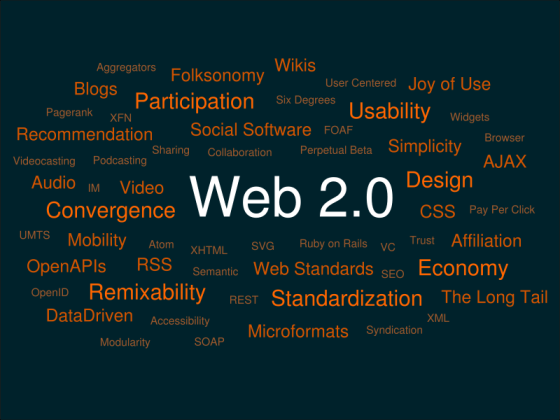
In the four years since we worked on the last ozone communication strategy and action plan for the Asia Pacific, we have seen the emergence of web 2.0 – which is really a catch-all term that covers many second generation, interactive platforms and opportunities that have emerged using the global Internet.

Among these are blogs, wikis, social networking sites (e.g. MySpace, Facebook), social bookmarking (e.g. del.icio.us), video exchange platforms (e.g. YouTube), online games and mobile applications.

These and other new media tools enable development communicators to reach out to, and engage, many people – especially the youth who make up more than half of all Asians.

web-20-illustrationsvg.png

But that’s part of the challenge, I said, referring to what I call the ‘Other Digital Divide’ – one that separates (most members of) the development community from ‘Digital Natives’, young people who have grown up taking these digital media and tools completely for granted.

I referred to my remarks at the IUCN Asia Conservation Forum in Kathmandu in September 2007, where I stressed the urgent need for the conservation and development communities to cross this divide if they want to reach out to the dominant demographic group in our vast region, home to half of humanity.

Engaging new media is not just setting up a Facebook account, taking a YouTube channel or opening a blog that’s infrequently updated. All that’s useful, for sure, but they represent only the tentative first steps to the wide and varied new media world.

As with the more established print and broadcast media, development organisations need to have a strategy and a plan based on some research, analysis and reflection.

And willing to let go of that control – so cherished by so many development professionals – is an essential part of that adjustment to the new media reality.

Failure to adjust can result in future shocks – and in the very near future! Perhaps I should also have drawn their attention to what I wrote in October 2007: New media tsunami hits global humanitarian sector; rescue operations now on

We didn’t spend too much time talking about new media at the Bangkok meeting, but I did caution that there is a lot of digital hype out there. I’m no expert on this (is anyone, really?) but my team at TVEAP and I keep trying new ways of doing things with the new media. So here are a few quick insights I offered the UNEP meeting:

• New media lot more interactive, which means they demand a lot of time and effort to engage the audience – which in turn generates huge capacity requirements for any development organisation venturing into such media.

• You can’t always control your messages on new media! This unnerves many development agencies and professionals who are so used to exercising such control – in the new media world, they just have to learn to let go!

• A core value is user-generated content (USG). You need to find creative ways to allow your audiences to generate part of the content. Control lost again!

• Citizen journalists have now established themselves online as text and/or video bloggers. Governments and corporations have acknowledged their presence — serious bloggers have recently been granted media accreditation to the UN. What does this mean for future ozone media training and journalists engagement?

• There are many companies and agencies claiming to have cracked the new media challenge – and don’t believe them! Everyone is learning, some admittedly faster than others, but there’s no substitute to actually doing it.

• And there’s no road map to the new media world, which is being created every day and night by an army of geeks and enthusiasts. There are only a few rough guides and travellers’ tales from some like ourselves who have ventured into this realm.

Note: I am grateful to my colleagues at TVE Asia Pacific who have developed and/or tested out some ideas in this blog post: Manori Wijesekera, Indika Wanniarachchi and Nadeeja Mandawala. I stand on their shoulders, hopefully lightly!

Release Ozzy Ozone held prisoner by brand guardians!

In September 2007, I wrote about Ozzy Ozone, an energetic, cheerful little ozone molecule – part of the ozone layer in the upper atmosphere that prevents the Sun’s harmful ultra-violet rays from coming through and causing skin cancer, cataract and other health problems.

Ozzy Ozone is part of a global public education effort by the UN Environment Programme (UNEP) to tell everyone how harmful UV rays are to our health, and how Ozzy and his fellow ozone molecules are literally protecting life on earth from being zapped out.

I called Ozzy the little molecule on a big mission — to tell all humans to soon phase out using certain chemicals that, when released to the air, go up and destroy his kind.

Last week, while attending a UNEP meeting in Bangkok to plan the next ozone communication strategy for Asia Pacific, I heard some disturbing news: little Ozzy has become a prisoner of his brand guardians. As a result, he is not as free as he could be to roam the planet, spreading the vital ozone message.

Anne Fenner, Information Officer of UNEP’s OzonAction Programme revealed how she routinely turns down requests to produce toys and other material using the popular character.

“I have had so many requests from companies, but we cannot allow commercial exploitation of this brand,” Anne said.

I was stunned. Here is one of the more popular communication products to emerge from the UN, not generally known for such successful engagement of popular culture. And there we were, brainstorming on ways to get the ozone message to large, scattered (and distracted) audiences.

Ozzy was created by a graphic artist in Barbados, as part of a government-supported campaign to raise public awareness on ozone layer thinning. This cartoon character served as a “mascot” and was very effective in raising awareness in Barbados. The cartoon series was printed in local newspapers. Additionally, promotional items produced for local public awareness and education campaigns using the Ozzy graphic include posters, key rings, rulers, erasers, refrigerator magnets, mouse pads, pens, pencils, stickers, and envelopes.

The character was so popular that UNEP struck a deal with Barbados to ‘globalize’ Ozzy. An animated video was produced, along with a dedicated website, comic strips and other media adaptations.

Ozzy has been a run-away success, giving UNEP a high profile, widely popular character — and a great deal of media coverage and interest. The kind of media engagement that is typically enjoyed by Unicef, the most media-savvy of all UN agencies.

But we now know that Ozzy’s brand guardians don’t allow him to go as far as he could. They may be playing by the rules, but do they realise that huge opportunities are being lost?

There we were, a small group of journalists, communicators, scientists and government officials discussing for three days how to get the biggest bang for our collectively limited buck where ozone messaging is concerned.

It was frustrating to know that the best brand ambassador has been locked up in brand integrity and copyright restrictions.

I suggested to Anne Fenner that protecting the brand integrity need not be so rigidly pursued. For example, careful franchising could be undertaken based on a set of guidelines — and the royalty could go into a trust fund that supports ozone communication work.

Indeed, the challenge for development communicators everywhere is to find the common ground between the public interest and the commercial interest. In this era of globalised media and CSR, the two interests are no longer mutually exclusive. Some might argue they never were.

The long-established copyright regimes themselves are being questioned, challenged and bypassed by a growing number of research, advocacy and activist groups. Many now publish their academic or artistic work under Creative Commons licenses, that enable their creators to be acknowledged and retain some control — and yet allow many types of uses without excessive restriction.

When TVE Asia Pacific recently released an Asian regional book called Communicating Disasters, our co-publisher UNDP Regional Centre in Bangkok proposed that the book be under Creative Commons Attribution 3.0 license. We were happy to go along.

UNEP has some catching up to do. Turning the pages of lavishly illustrated Ozzy Ozone comic story books (of which 3 titles have come out so far), I found that UNEP has the standard copyright restriction. However, they add a line: “This publication may be reproduced in whole or part and in any form for educational or non-profit purposes without special permission from the copyright holder, provided acknowledgement of the source is made.”

That’s encouraging – but not good enough. What happens if a commercially operated media organisation wants to use this content for public interest? Will they qualify under ‘educational or non-profit purposes’?

Probably not. And that’s when the dreaded copyright lawyers could come marching out.

It’s the assorted lawyers and over-cautious officials who are keeping Ozzy Ozone a virtual prisoner.

And sadly, little Ozzy is not alone. Everywhere in the publishing and media world, we can find many examples of how creative works are being held back – usually by over-protective lawyers or accountants. Sometimes that’s the case even if the artistes or media professionals themselves would much rather let go of the rights.

In July 2007, I wrote a blog post called ‘The lawyers who locked up the butterfly tree’ — which revealed how lawyers working for the publicly-funded BBC had systematically blocked a multi-award winning African documentary film from being used for environmental education, awareness and advocacy. All because the BBC had partly funded its production, and therefore had a claim on its copyright.

So here’s our plea to Ozzy’s brand guardians in UNEP: let him roam free, taking the vital message to millions. And while at it, let him make some money (from franchisees) which can suppot the rest of UNEP’s ozone communication work.

And if some spoilsport of a copyright lawyer gets in the way, tell him/her to take a beach vacation — without sunblock.

Related links:
Sep 2006: Make poverty a copyright free zone

May 2007: TVEAP renews call for poverty as a copyright free zone

Race to Save the Sky…by 2010

This is the opening segment of an Asian film that we at TVE Asia Pacific produced in 2006 for the UN Environment Programme (UNEP).

Called Return of the Ozone Layer: Are We There Yet? (30 mins, 2006), it tells the story of how the Asia Pacific – home to half of humanity – holds the key to saving the ozone layer…from man-made chemicals eating it up.

We presented it as a race…against time, and against many odds. Here’s how it opens.

You wouldn’t notice it even if you look carefully…but the Asia Pacific is running an important race.

It’s a race to phase out a group of chemicals used in industry, agriculture or consumer products.

When released to the atmosphere, these chemicals damage the Earth’s protective ozone layer. This ‘ozone shield’ protects all life from the Sun’s harmful ultraviolet rays.

These chemicals are used in refrigerators, air conditioners, fire fighting equipment, farming and a range of other products and processes.

The industrialised countries have already stopped producing these chemicals. This happened thanks to an international environmental treaty called the ‘Montreal Protocol on Substances that Deplete the Ozone Layer’. It was adopted in 1987 in response to the thinning of the ozone layer – or the ‘Ozone Hole’ –discovered two years earlier.

The Montreal Protocol sets time-bound, measurable targets for managing nearly 100 different chemicals.

These are closely tied to economic activity, public health and safety. Therefore, developing countries and economies in transition were given more time to reduce consumption — with the same goal of eventually phasing them out.

20 years on, the Montreal Protocol’s implementation has produced tremendous benefits to our health and environment.

But it’s a bit too early to celebrate.

Many challenges remain.

Developing countries now have to show they are making good use of the extra time and resources given to them.

It is the Asia Pacific that now produces and consumes most of the world’s Ozone Depleting Substances – or ODS. .

All production and use of CFCs in developing countries must stop in 2010.

But it’s easier said than done. The region has tens of thousands of small scale industries and farms that still use ozone damaging chemicals.

To accomplish the remaining phase-out targets, all
of them need to be engaged.

In this film, we look at key challenges the Asia Pacific region faces on the road to 2010. Meeting these challenges would ensure timely compliance of phase-out targets.

Clearly, governments alone cannot win this race. Millions of ordinary citizens have to join in.

Millions like the five we feature in this film.

Making this 30-minute documentary was a challenge. For a start, we had to grapple with complex scientific, economic and political issues and present them in a non-technical, accessible manner. We knew the average viewer was not interested in the intricacies of inter-governmental negotiations or atmospheric chemical reactions.

Talking about the ozone layer – which is out of sight, lying a few kilometers above the Earth’s surface – is never easy. It’s harder to get people to pay attention that sustained action is needed to remove man-made threats to the ozone layer.

Our challenge was to tell the story in a simple, engaging way — and UNEP wanted it to be different from many ozone layer documentaries already made. That’s when we decided to focus on five ordinary Asians who were doing their bit to save the ozone layer.

As our opening narration put it:

Five ordinary people, living and working in the Asia Pacific – the world’s largest and most diverse region.

Their actions will impact the future of life on our planet.

And there are millions more like them.

This is their story.

Watch the entire film (in several parts) on TVEAP’s YouTube channel.


September 2007 blog post: Ozzy Ozone: The Little molecule on a big mission

From KL to Bali: Why were ICT and climate change debates worlds apart?

The timing of the Third Global Knowledge Conference or GK3 last week just couldn’t have been worse in terms of international media attention and coverage.

Some 1,700 people from all over the world – representing academia, civil society, governments and industry – gathered in the Malaysian capital of Kuala Lumpur from 9 to 13 December 2007 for this platform of events meant for everyone interested in using information and communications technologies (ICTs) for the greater good – to solve real world problems of poverty, under-development, illiteracy and various other disparities that afflict our world.

The organisers, a network called the Global Knowledge Partnership, called it ‘Event on the Future’. They had worked for almost two years on planning the event, and spent a huge amount of development funding to drum up global interest in the event.

As things turned out, GK3 was a complete non-event for the world’s media, whose attention was much more engaged by another event that was crucial for the future of all life on this planet – the UN Climate Change conference taking place in neighbouring Indonesia’s Bali island.

pic-iht-ad.jpg

That coincidence of events was very unfortunate, especially since GK3 also discussed and debated important issues that shape our common future. Yes, the substance at GK3 was immersed in — and sometimes buried under — massive volumes of hype and spin, but for the discerning participants there were occasional gem stones amidst the numerous gravel.

I have written up my impressions of GK3 as a series of missed opportunities. In my view, the biggest missed opportunity was GK3’s failure to position itself as part of the smart response to global climate change that scientists now confirm is happening and is largely human-induced.

After 20 years working in the media, I can understand why the news media ignored GK3. Yes, bad timing was one factor. But the bigger lapse was that the GK3 organisers and participants failed to find and articulate their common ground with the bigger global process that was unfolding in Nusa Dua, Bali island.

In the real world, Bali is not all that far from KL. But sadly, the two were worlds apart as parallel processes took place with little confluence.

It need not have been that way. There is much that ICTs can do in reducing carbon emissions that are warming up the planet.

The biggest ‘digital dividend’ from ICTs is how they can help reduce needless travel. Dependent as we still are on fossil fuels of oil and coal for most of our transport, even a few percentage points of travel that we can realistically cut down can yield major savings in emissions of carbon dioxide.

In a blog post written in August 2007, I cited Sir Arthur C Clarke’s slogan that sums this up very well: Don’t commute; communicate!

I quoted from an essay Sir Arthur had written for the UK’s Climate Group in 2005, included as part of a global exhibit on climate issues, where he noted: “….Meanwhile, other technologies enable us to adjust our work and lifestyles. For example, mobile phones and the Internet have already cut down a lot of unnecessary travel – and this is only the beginning. We should revive a slogan I coined in the 1960s: ‘Don’t commute – communicate!’”

My friend and academic colleague Dr Rohan Samarajiva, who heads the regional ICT research organisation LIRNEasia, has given this some further thought.

More and easier use of telecom should theoretically lead to less need to travel. But nothing is ever that simple, he says. “It is not realistic to think that improved telecom-based connectivity will immediately lead to a reduction in demand for transport and a reduction in greenhouse gases. But it is clearly a necessary action that will yield good results over time.”

For telecom to make a real contribution to reducing demand for transport, Rohan says several things need to happen:
• Most people need to have easy and convenient access to telecom, for sending as well as receiving messages and for retrieving as well as publishing information;
• All offices and business establishments must be reachable through telecom;
• They must change their business processes to reduce the need for people to physically come to their locations; and
• The ancillary infrastructures such as energy, payment and delivery systems must change accordingly.

These, then, are important goals that are worth pursuing not only for the achieving information societies but also for saving the planet from the current slow baking. That’s the message that GK3ers failed to grasp or convey to Bali.

Instead, we heard from the movers and shakers of the IT and ICT companies how they are working to achieve greater energy efficiency in the manufacture and use of their products. Their sincerity and commitment were not in question. But I didn’t hear anyone emphatically make the point that helping people to avoid needless transport use is the biggest climate benefit ICTs can deliver. (I was yearning to stand up and say ‘It’s avoided transport, stupid!’ in one plenary but we ran out of time.)

The industry mandarins were not alone. Even the International Telecommunications Union (ITU), which sets standards and keeps an eye on ICT trends and conditions, missed this point. In a statement delivered to the Bali climate conference, ITU talked about lots of small contributions that ICTs can make to find solutions to the climate crisis.

To quote from their 12 December 2007 press release:

“ITU pointed out that the proliferation of ICT products in homes and offices, and their deployment throughout the world, places an increasingly heavy burden on energy consumption. The late night glow in homes and offices emanating from computers, DVD players, TVs and battery chargers is all too familiar. And the move to “always-on” services, like broadband or mobile phones on standby, has greatly increased energy consumption compared with fixed-line telephones, which do not require an independent power source. Energy demands caused by high-tech lifestyles in some countries are now being replicated in others.”

It’s always good to improve energy efficiency, if only to keep the bills in check. But can ICT industry and ITU please stop apologising for the relatively minor contribution their sector makes to global warming — and instead become a much bigger part of the solution? In other words, stop rearranging chairs on the Titanic’s deck, and instead get in the engine room to help steer the planetary Titanic from heading straight into that iceberg looming large.

We don’t need further studies, expert groups or conferences to deliver this category of carbon-saving, climate-friendly benefits: just keep rolling out telecom coverage worldwide and also make the services affordable and dependable. The markets will do the rest.

earth-at-night-off-website.jpg

This point was also lost in Bali. Obsessed as they were with a mechanism to succeed the imperfect Kyoto Protocol, the delegates failed to fully appreciate tried and tested solutions that can begin to roll out now and here. Let the diplomats and lobbysts bicker for years to come, but don’t ignore what markets can do in the meantime.

Even some champions of climate change have yet to realise the ICT potential for their planet-saving crusade. Al Gore, being both ICT-savvy and green, is an exception. Sir Nicholas Stern is not.

In October 2006, the UK government published a 579-page report on the economics of climate change by Sir Nicholas Stern, a former chief economist at the World Bank. Despite the massive size, scope and authority of the report, the Stern Report had no reference to the role that the ICT sector could play in helping to reduce energy demand, mitigate CO2 emissions and help to save the planet.

Fortunately, as I wrote in August 2007, telecom operators are begining to taking note. Among them is the European Telecommunications Network Operators’ Association (ETNO), which issued a report — incidentally, in the same month as the Stern Report — titled Saving the climate @ the speed of light: ICT for CO2 reductions.

It was a joint publication with the World Wide Fund for Nature, WWF. Its introduction read: “A wider usage of ICT-based solutions can play an important role in reducing CO2 emissions. This joint WWF-ETNO road map proposes a concrete way forward for a better consideration and inclusion of ICT’s in EU and national strategies to combat climate change.

Read the full report here.

So it seems that part of the climate response answer is literally in the air – or the airwaves. The emergence of information societies — where more electrons (carrying information) are moved than atoms (people, goods) — can help the pursuit of climate-neutral or, even better, climate friendly lifestyles. To use a currently fashionable UN term, that’s a co-benefit!

For these co-benefits to be appreciated and seized, it’s essential that we look at the bigger picture and not just work in individual sectors such as ICT and sustainable development. The ITUs and UNEPs of this world have to meet and talk more often — and also listen to each other more seriously.

I chose to attend the ICT event of GK3 in KL in spite of receiving three separate (and sponsored) invitations to join various activities in Bali. After last week, I have mixed feelings about that choice, but there’s no doubt at all in my mind about the massive potential that ICTs hold for mitigating the worsening of climate change.

But the ICT sector has to put its money where its mouth is, and practise what it advocates. It’s not good enough to endlessly meet and talk about all things ‘e’. Just as the world has to kick its serious addiction to oil and coal, we in the development sector have to wean ourselves away from our obsession with paper. Lots and lots of it.

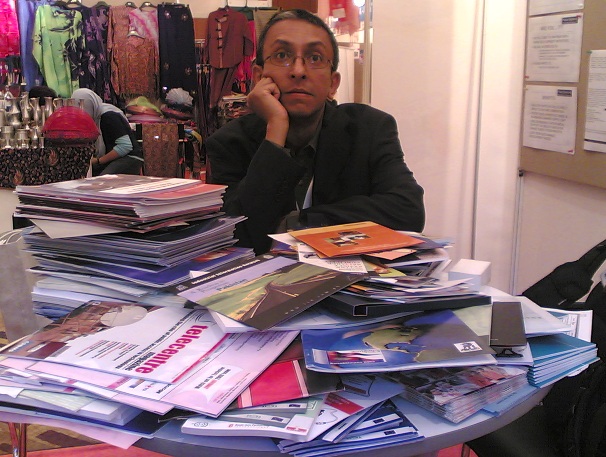
In the last hour of the final day, I walked around GK3’s exhibition area, with the ridiculous name MoO. I was stunned by the massive volumes of paper lying around everywhere. The week’s events were drawing to an end, and it was unlikely there would be too many more takers for all that paper. In that week, I saw very little digital media being used to peddle institutional messages or deliver their logos. It was 95% paper-based.

My colleague Manori captured on her mobile phone this image of an exasperated me surrounded by mountains of paper.

all-this-paper-at-the-end-of-an-ict-event.jpg

The MoO exhibitors were not alone in their profligacy and wastefulness – the GK3 secretariat easily wins the prize for producing the greatest volume of glossy, expensive paper-based promotional material for at least a year preceding the event.

Clearly both ICT and climate camps have some urgent rethinking to do. Together, we can find win-win, now-and-here solutions for slowing down processes of disruptive climate change already underway.

Or we can keep pushing bits of paper all around, all year round. The choice is ours – and the planet is at stake.

– Nalaka Gunawardene


Read my overall impressions of GK3: All geek but very little meek…and at what high cost?

Portraits of Commitment: New face of HIV/AIDS in Asia

Sabina Yeasmin Putul, photo by Shahidul Alam

Today, 1 December, is World AIDS Day — and this is the new face of HIV/AIDS in Asia.

Well, at least one of 50 faces that my friend Shahidul Alam captured during this year for a UNAIDS-published book titled ‘Portraits of Commitment: Why people become leaders in the AIDS response’.

It profiles men and women who are confronting HIV/AIDS in their lives, professions, work places and families in a variety of ways, each of them remarkable and courageous.

In August 2007, Shahidul held an exhibition in Colombo that featured the South Asians who were photographed for the book. Adorning the cover of the exhibition brochure was this 17-year-old Bangladeshi girl, Sabina Yeasmin Putul.

And this is what Karen Yap Lih Huey of Inter Press Service/TerraViva wrote about her and the exhibition:

Sabina Yeasmin Putul has a silent, determined look with her left fist clenched tight in front of her face – a vision of strength, grace, and resilience all in one.

The 17-year-old Bangladeshi has a lot going for her. Mature beyond her age, she had a good understanding of what she has been through, as a daughter of a sex worker, and of how society sees and judges her. And she probably doesn’t know this – that her struggles inspired respected Bangladeshi photographer, writer and activist Shahidul Alam.

“The way she tackles issues regarding her mother and the people around her is powerful. Of course, among other things, she did martial arts and I thought rather than showing child of a sex worker, I photographed her as this powerful woman who came across with powerful ideas,” said Alam, managing director and founder of the Dhaka-based Drik Photo Library.

Posters of her in a martial arts pose was the face for Shahidul’s photography exhibition, a project produced by a team from Pathshala, the South Asian Institute of Photography which is the education wing of the award-winning agency Drik.

Read the article in full on IPS/TerraViva

Read my Aug 2007 blog post on another Portrait of Courage: Rajiv Kafle of Nepal

Photograph by Shahidul Alam/Drik/Majorityworld

Road to Bali: Beware of ‘Bad weather friends’!

unfcccnew-c.jpg

All the environmental roads — well, actually flights — seem to lead to Bali in the coming days.

The Indonesian ‘Island of the Gods’, famed as a tourist resort, will play host to the 13th United Nations Climate Change Conference from 3 to 14 December 2007.

The Conference, hosted by the Government of Indonesia, brings together representatives of over 180 countries together with observers from inter-governmental and non-governmental organizations, and the media. The two week period includes the sessions of the Conference of the Parties to the UN Framework Convention on Climate Change (UNFCCC), its subsidiary bodies as well as the Meeting of the Parties of the Kyoto Protocol.

The Bali meeting will be a turning point in the global response to climate change, an issue which has moved above and beyond being a simple ‘green’ concern to one with economic, security and social implications. The annual meeting returns to Asia after five years, since New Delhi, India, hosted the 8th meeting in November 2002.

In the build up to Bali, a new report released on 19 November 2007 says that without immediate action, global warming is set to reverse decades of social and economic progress across Asia, home to over 60 per cent of the world’s population.

Up in Smoke? Asia and the Pacific – with a foreword by Dr Rajendra K Pachauri, Chairman of the Nobel prize-winning Inter-governmental Panel on Climate Change (IPCC) – is the most extensive and concluding chapter of a unique, four-year long exercise by the Up in Smoke coalition, an alliance of the UK’s major environment and development groups.

The report shows “how the human drama of climate change will largely be played out in Asia, where almost two thirds of the world’s population live, effectively on the front line of climate change.”

When our friends at the International Institute for Environment and Development (IIED) in London sent me the press release about the report last week, something caught my eye. Among the several accompanying quotes was this one concerning the media:

“In many Asian countries climate change stories don’t make it into the media, so the public are left out of the debate. The challenge for decision-makers and the media is to stimulate interest in their work and translate the complex issues into stories that capture the public’s imagination. Climate change above all requires the engagement of everyone in creating the changes required.”

This sweeping statement is attributed to Rod Harbinson, Head of Environment, Panos London.

I know Panos London well, and am surprised to read an official remark of this nature emerging from that organisation which, until recently, has tried to relate to the majority world media as a friend and supporter. In fact, the first time I had one of my own pieces internationally syndicated was by Panos Features, back in 1989.

Come to think of it, the second article I wrote for Panos Features concerned how the low-lying, Indian Ocean island nation of Maldives was preparing for adverse impacts of climate change. That was years before the web, so there’s no link I can provide.

As a development writer and journalist who has covered global climate change among other issues for two decades, I have problems with Mr Harbinson’s remark.
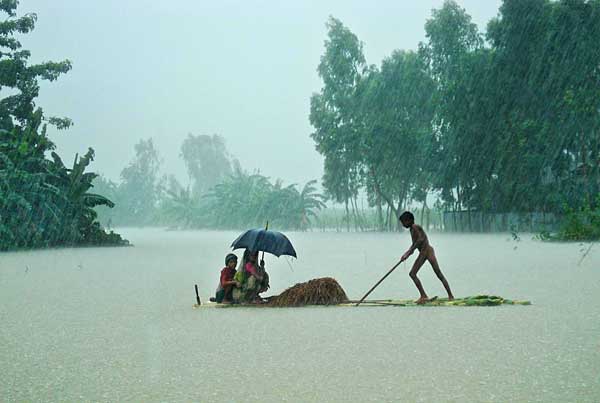
Drik/Majorityworld
Photo: A family looks for shelter using a raft made of banana trees during the last Monsoon: 31 July 2007: Gaibandha, Bangladesh © Quddus Alam/DrikNews Linked from Shahidul News

I’m in full agreement on the need to ‘translate the complex issues into stories that capture the public’s imagination’. There is also no argument that climate change requires the engagement of everyone.

But I would be very interested to know on what statistical or analytical basis he says “in many Asian countries climate change stories don’t make it into the media, so the public are left out of the debate’.

Asia, as Mr Harbinson should surely know, is not just China, India and Indonesia. It is large and highly diverse region, containing five sub-regions as defined by the UN. It is home to nearly two thirds of humanity, who live in over three dozen independent states or dependent territories.

Living in Asia and trying to work at regional level, I know how difficult it is to make any generalisations about this rich and constantly changing assortment of economies, cultures and societies branded as Asia (which, taken together with the small island nations of the South Pacific, is known as the Asia Pacific). In fact, it’s wise not to speak about Asia as a whole, for there is little in common, say, between Japan and Laos, or between China and Maldives.

The Asian media are as diverse as the region, and have been undergoing rapid change in recent years. Unshackled from the state’s crushing grip in most countries, the broadcast media (radio, TV) have proliferated and emerged as the primary source of information for a majority of Asians. New media – web, mobile devices and multimedia combinations – are now changing the way many Asia’s communicate and access information.

I have always been curious how Panos London, perched at its cosy home in London’s White Lion Street, assesses what goes on in the majority world. In this case, how much of Asia does Mr Harbinson know and is really familiar with? How many Asian media outlets has he or Panos monitored, assessed and sampled before coming to this sweeping and damning conclusion about the lack of climate change stories in the Asian media?

And how many of these outlets are radio and TV, and in languages other than English? I would really like to know.

If Panos London believes in evidence-based analysis, then it owes us in Asia an explanation as to on what basis its head of environment makes such statements about an entire continent, whose media output is predominantly in Asian languages, not English. And whose principal media are broadcast, not print.

And what constitutes a climate story? Tracking the endless array of inter-governmental babble in the name of working out some compromised partial solution to the major problem? Or reporting on campaigns to clean up polluting industries or sectors (such as transport) that generate most of the greenhouse gases? Or focusing on how humble communities in remote corners of the world are finding how their lifestyles and livelihoods are suddenly threatened by something they hardly understand?

To me, it’s all of the above — and a lot more. Climate change is akin to a prism through which many, many development issues and topics can be analysed. Just as HIV/AIDs long ago ceased to be a simple medical or health story, climate change has moved well beyond being an environmental story.

The more angles, perspectives and topics that are covered in the media, the better. And all of it need not be in that staid, cautiously balanced style of The Guardian or BBC that Panos London must be more familiar with.

Panos London, in its statement of beliefs, says ‘Freedom of information and media pluralism are essential attributes of sustainable development’. Surely, then, they realise that media pluralism includes speaking in a multitude of tongues, and analysing from many different perspectives — as happens in the Asian media 24/7, if Mr Harbinson and his colleagues care to spend more time in the region and keep their eyes and ears open.

But instead, they seem more like a group of well-meaning people with a solution in search of a problem. For the past many months, Panos London has been crying wolf about the allegedly poor coverage of climate issues in the majority world media.

That was the main thrust of a report they published in late 2005, titled Whatever the weather – media attitudes to reporting climate change.

According to Panos London website that I have accessed today, “…the survey found that there is little knowledge among journalists about these important choices and they are rarely discussed. The dramatic impacts of extreme weather events, for example, rarely feature in relation to climate change and the topic remains low on editors’ story sheets.”

The survey was based on ‘interviews conducted with journalists and media professionals in Honduras, Jamaica, Sri Lanka and Zambia’ and claimed to ‘give insights into the attitudes of journalists and the status of the media in these countries.’

Well, I was one of those majority world journalists covered by the survey — and I had major reservations about how they used my responses. Being cautious, I had used email (and not the phone) to respond to their survey questions – I therefore have a complete record of everything I said. When the draft report was shared on my request, I found some of my responses being distorted or taken out of context. I had to protest very strongly before some accuracy was restored. I later regretted having agreed to be part of this dubious survey.

It was flawed in many ways. The questionnaire was very poorly conceived and structured. I actually declined to answer some questions which were worded in such a way as to elicit just the kind of response that Panos London wanted — to make a case that journalists in the majority world are so incompetent that they need help.

A glaring omission in the final report was that it carried no list of journalists interviewed. I had to ask several times before I could even find out how many others participated in the survey (apparently some three dozen). But my requests for a list of other survey respondents were repeatedly declined by Panos London, who said it was privileged information. They later took the position that European data protection laws did not allow them to disclose this information!

In an email sent to Rod Harbinson on 22 Feb 2006, I said: “I would argue that Panos London had pre-conceived notions that it wanted to present in this report, and used superficial and largely unprofessional interview surveys with a few scattered journalists as a rubber-stamping exercise to publish what it wanted to say anyway. This is further borne out by the fact that some of my more outspoken responses have been completely ignored.”

I have seen or heard nothing since to change the above view. And the contents of Whatever the weather – media attitudes to reporting climate change are consistent with what Rod Harbinson says in the IIED press release that prompted me to make this comment.

Yes, climate change is the Big Issue of our times that needs everyone to rally around and search for ‘common but differentiated’ solutions and responses. But no issue or global threat is too big to warrant the willing suspension of time-honoured journalistic or academic values of honesty, integrity and balance. Issuing lop-sided ‘survey reports’ and making sweeping negative statements do not help the cause of improving public discussion and debate on climate change.

The road to Bali and beyond is going to be an arduous journey. On that treacherous road, we in the majority world need to beware of ‘bad weather friends’ who come bearing bad surveys and self-serving offers of ‘help’.

— Nalaka Gunawardene

Note: In the spirit of communication for development and media pluralism, I invite Panos London to respond to the above critique, and offer to publish their response in full.

I remain a critical cheer-leader of the global Panos family, and serve on the Board of Panos South Asia, an entirely independent entity that has excellent relations with Panos London. Like all families, we don’t always agree – and that’s part of media pluralism!

Related blog posts:

Nov 2007: True ‘People Power’ needed to fight climate change
Nov 2007: Beyond press release journalism: Digging up an environmental business story
Oct 2007: The Al and Pachy Show: Climate Change gains public momentum

Aug 2007: Arthur Clarke’s climate friendly advice: Don’t commute; communicate!
June 2007: Sex and the warming planet: A tip for climate reporters
April 2007: Can journalists save the planet?
April 2007: Beware of Vatican Condoms and global warming
April 2007: Pacific ‘Voices from the Waves’ on climate change
April 2007: Wanted – human face of climate change!

Bretton Woods on fire: Hard times ahead for World Bank and IMF

800px-deerfire_high_res.jpg

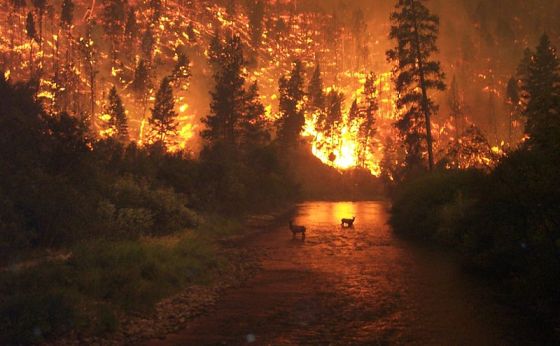
As the California forest fires raged over many days in October 2007, it dominated the US and some sections of the global media. Focus was on how the fires started and what factors contributed to their rapid spread.

Below the media’s radar, another kind of ‘fire’ has been building up over the past few months on the US East Coast. According to one leading intellectual-activist that I heard this week, this is a development whose reverberations will be felt right around the world, and for years to come.

The Bretton Woods are on fire. Actually, it’s the Bretton Woods institutions, namely the World Bank and International Monetary Fund (IMF).

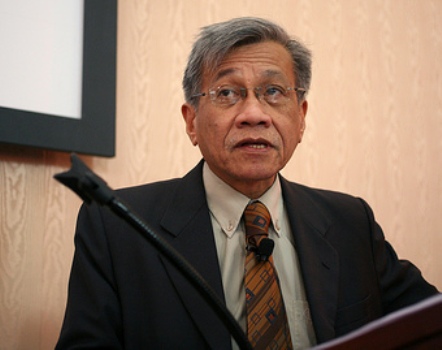
Speaking at the Greenaccord Media Forum in Rome on 10 November 2007, Walden Bello, Filipino academic and executive director of the Focus on Global South, suggested that the World Bank and IMF are headed for turbulent times as countries in the global South (majority world) assert themselves economically.

Preparing to rebuild the international economic system as World War II was still raging, 730 delegates from all 44 Allied nations gathered at the Mount Washington Hotel in Bretton Woods, New Hampshire for the United Nations Monetary and Financial Conference. The delegates deliberated upon and signed the Bretton Woods Agreements during July 1944. That marked the birth of the World Bank and IMF.

The World Bank and IMF are essentially lenders of money to governments for development purposes. If these lending institutions run short of borrowers, they will be out of business.

That hasn’t happened yet, but Bello (photo, below) identified several trends that must make the Bretton Woods duo worry about losing control.

professor-walden-bello.jpg

According to Bello, the resistance is led by countries of Latin America, a region where the twin lenders have long been controversial. In May 2007, Venezuela under President Hugo Chavez announced it would be leaving both the World Bank and IMF.

Venezuela has repaid its remaining debts to the World Bank five years ahead of schedule and paid off its debts to the IMF shortly after Mr Chavez first took office in 1999. Bello says the oil-rich country has sought to provide alternative forms of credit and financial support for countries in the region. One such project is the “Bank of the South”, which aims to financially help Latin American countries to pay off their IMF loans ahead of schedule.

In October 2007, Nobel prize-winning economist Joseph Stiglitz endorsed the Chávez plan to create a pan-regional bank for Latin America. Professor Stiglitz, a Washington insider and former World Bank chief economist, said the Bank of the South would benefit the region and give a welcome shakeup to western lending institutions.

Read March 2006 commentary by Mark Engler in Common Dreams: Latin America Unchained: Will the U.S. Lose its Influence Over Countries That Have Paid Off Their IMF Loans?

These trends, coupled with the rise of a new set of Southern countries willing and able to provide loans or grant aid to fellow countries of the South, are slowly but steadily eroding the domination and power the Bretton Woods twins have exercised for over half a century, Bello said.

Some of these alternative lenders are giving money with fewer conditions and restrictions. These include China, Saudi Arabia and Venezuela. This is what the editor of the influential US journal Foreign Policy called ‘rogue aid’ in an article he wrote in the journal’s March/April 2007 issue.

As the global South asserts itself and begins to exercise the power of their recent economic growth – which, ironically, is partly thanks to past borrowing from the Bretton Woods twins, the coming years will be crucial for the future World Bank and IMF.

The fire in the Bretton Woods is only just smouldering. But watch that smoke…

* * * * *

Walden Bello won the Right Livelihood Award (the Alternative Nobel) in 2003, for his decades of advocacy, activism and research. As the award foundation noted: “Walden Bello is one of the leading critics of the current model of economic globalisation, combining the roles of intellectual and activist. As a human rights and peace campaigner, academic, environmentalist and journalist, and through a combination of courage as a dissident, with an extraordinary breadth of published output and personal charisma, he has made a major contribution to the international case against corporate-driven globalisation.”

While campaigning on human rights he saw how the World Bank and IMF loans and grants were supporting the Marcos regime in power. To expose their role, he took the risk of breaking into the World Bank headquarters in Washington, and brought out 3,000 pages of confidential documents. These provided the material for his book Development Debacle (1982), which became an underground bestseller in the Philippines and contributed to expanding the citizen’s movement that eventually deposed Marcos in 1986.

Read full profile on Walden Bello on Right Livelihood Award website


Meeting photos courtesy Adrian Gilardoni’s Flickr account

Can somebody please update ‘The Development Set’ by Ross Coggins?

At the UN European Headquarters in Geneva this week, while attending a conference of humanitarian aid workers from around the world, I heard two of them compare the flat-beds in business class of two international airlines.

The conversation was more than just a passing one. They were passionately discussing the relative merits of different business class seats and perks.

I almost felt like butting in and saying that Singapore Airlines – the world’s finest airline, no argument – has just created a new product that they can now lust after: personal cabin suites in the air.

Coincidentally this week, on 25 October 2007, Singapore Airlines began operating the first commercial flights of the new Airbus380 double-decker super-jumbo.

Here are two images from the airlines’s website:

From Singapore Airlines

I’m all for humanitarian aid workers being well paid, well protected and well cared for. After all, they risk life and limb for the rescue, relief and recovery of large numbers of people caught in disasters or conflicts.

Perhaps I’m being naive, but there’s something incongruent about aid workers aspiring to flat-beds and space beds in the air.

Which reminds me, it’s about time somebody updated the well known poem, The Development Set, by Ross Coggins. First published in “Adult Education and Development” September 1976, it’s now more than 30 years old — the luxuries both in the air and on the ground have evolved a bit in that time.

Graham Hancock’s book “Lords of Poverty: The Power, Prestige, and Corruption of the International Aid Business” gleefully reprinted this poem in the 1980s.

I’m no poet, but there’s a need to update this to include GPS, satellite phones, four-wheel drives, and yes, business class beds.

If you are not familiar with the original poem, here it is:

The Development Set
by Ross Coggins

Excuse me, friends, I must catch my jet
I’m off to join the Development Set;
My bags are packed, and I’ve had all my shots
I have traveller’s checks and pills for the trots!

The Development Set is bright and noble
Our thoughts are deep and our vision global;
Although we move with the better classes
Our thoughts are always with the masses.

In Sheraton Hotels in scattered nations
We damn multi-national corporations;
injustice seems easy to protest
In such seething hotbeds of social rest.

We discuss malnutrition over steaks
And plan hunger talks during coffee breaks.
Whether Asian floods or African drought,
We face each issue with open mouth.

We bring in consultants whose circumlocution
Raises difficulties for every solution —
Thus guaranteeing continued good eating
By showing the need for another meeting.

The language of the Development Set
Stretches the English alphabet;
We use swell words like “epigenetic”
“Micro”, “macro”, and “logarithmetic”

It pleasures us to be esoteric —
It’s so intellectually atmospheric!
And although establishments may be unmoved,
Our vocabularies are much improved.

When the talk gets deep and you’re feeling numb,
You can keep your shame to a minimum:
To show that you, too, are intelligent
Smugly ask, “Is it really development?”

Or say, “That’s fine in practice, but don’t you see:
It doesn’t work out in theory!”
A few may find this incomprehensible,
But most will admire you as deep and sensible.

Development set homes are extremely chic,
Full of carvings, curios, and draped with batik.
Eye-level photographs subtly assure
That your host is at home with the great and the poor.

Enough of these verses – on with the mission!
Our task is as broad as the human condition!
Just pray god the biblical promise is true:
The poor ye shall always have with you.