Coping with a warming planet and WikiLeakable world: Common challenges

Time is ticking away...but crises also mean opportunities

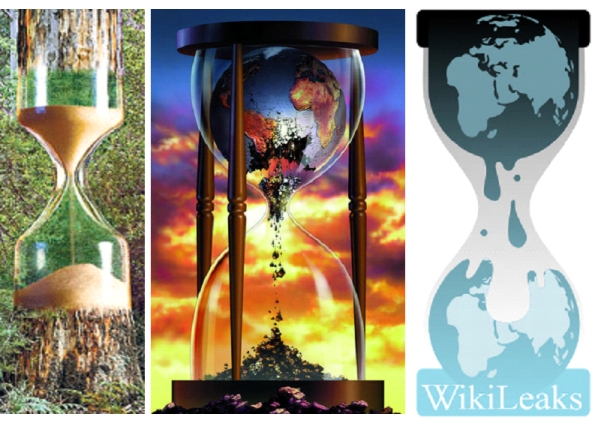
I like to think and speak in metaphors, especially visual metaphors. Sometimes I coin or design new ones. This illustration is the latest example.

Individual elements in this came from very different sources (thanks to them all). I just mixed them together to make two points during a talk I just gave at the Colombo University.

We live in a crisis-ridden world where we have to cope with multiple emergencies unfolding at the same time, impacting us on different fronts. This illustration captures three of them: crisis in biodiversity, man-made climate change, and the new reality of living in a rapidly WikiLeakable world — what I called the Global Glass House.

We don’t get to choose the timing, severity or duration of any challenge. But we do have some choice over how we respond: we can despair and grumble (blaming the Gods or karma if we believe in those); we can become really alarmist (a la Chicken Little); or we can be measured and smart in how we deal with the seemingly overwhelming situations.

Speaking at the Leaders in Environmental Advocacy Forum (LEAF) on Preserving the Past, Securing the Future on 22 January 2011 at the University of Colombo, I advocated this last option. I also pulled together a number of ideas mentioned on this blog over the past four years.

LEAF was a two-day summit held in Colombo, Sri Lanka, hosted by members of the Elon University’s Periclean Scholar Class of 2011, in partnership with the University of Colombo, the United States Embassy in Colombo, the National Science Foundation of Sri Lanka and Rainforest Rescue International.
My illustrated talk was titled “Telling Stories to Save Ourselves: Communicating on a Warming Planet” — I revisited an idea originally featured on this blog in mid 2007 (about Arabian Nights and their modern day relevance) and coupled that with a more recent proposal of mine: consider education and communication the third track of plank in humanity’s response to climate change (alongside climate mitigation and adaptation).

In fact, some challenges of living on a warming planet are comparable to coping with a WikiLeakable world: both demand quick adaptation to a new reality. In both cases, governments and society have to change mindset and practices on the go — business as usual is no longer an option. Denialism, or demonising the messenger, won’t take us forward. We need more measured, sometimes even pragmatic responses.

In that process, all-or-nothing is not a viable approach. Waiting for full knowledge and understanding is not feasible either. As I once described it, responding to the planet’s climate and other ecological crisis with partial scientific understanding is akin to many pages of our planet’s ‘operations manual’ being still completely blank — and yet we have to manage the planet to the best of our knowledge, intuition and common sense.

Many of the same principles apply to living in the modern networked info society, where no secrets can be kept that way for too long. The sooner we come to terms with this new reality and adapt, the better.

I’m delighted to see others are addressing these parallels. In my talk, I mentioned a recent essay titled Could climate science become open source? by Brendan Barrett and Sulayman K. Sowe, published earlier this month on the UN University’s Our World 2.0 website.

In their perceptive piece, the authors ask whether climate science would benefit by being more firmly grounded in the principles of openness, perhaps along the lines of the free and open source software communities and open content movements. “The concept of openness behind free and open source software describes a mode of creative knowledge production and sharing in which individuals and communities freely generate and adapt or remix resources (content or software) without licensing restrictions.”

They add: “Proposing a move to a new model of climate science in no way suggests that climate change is not a real and present threat or that we cannot rely on the integrity of our contemporary climate science institutions and scientists. Rather, the argument here is that learning from the way free and open source software projects and communities work may be an important way forward in engendering more effective global, national and local responses to climate change.”

I have always worn multiple ‘hats’, and dabbled in multiple pursuits rather than follow narrow paths of enquiry. I see myself continuing to oscillate between the ‘geeks’ and greens, and where possible, bridging their worlds. It’s really encouraging to see some others straddling the two spheres.


Statistics made simple: Global Village of 100 = World of 7 billion

The Earth is one, but the world is not...

As I wrote the other day, during 2011, human numbers will add up to 7 billion. That is 7,000,000,000 living and breathing people.

But how many of us can grasp such a large number? I can size up a gathering of a few hundred people, or at the most, a couple of thousand. After that, I lose count…and I’m not alone.

That’s why the idea of a Global Village of 100 is so very useful. It’s based on a simple yet profound premise: if we could reduce the world’s population to a village of precisely 100 people, with all existing human ratios remaining the same, what would it look like?

The idea was the brainchild of Donella Meadows, a pioneering American environmental scientist, teacher and writer. She is best known as lead author of the influential book The Limits to Growth (1972).

It was first published in May 1990 with the title “State of the Village Report”, and Meadows originally envisaged a village of one thousand people. This approach to showing the global disparities was so refreshing and accessible that it soon spread among educators, journalists and activists — in today’s Internet terms, we would call that ‘going viral’.

David Copeland, a surveyor and environmental activist, revised the report to reflect a village of 100 and single-handedly distributed 50,000 copies of a Value Earth poster at the 1992 Earth Summit in Rio de Janiero.
What happened after that is recounted in this brief history by Carolyn Jones, adapted by Bob Abramms.

The analogy has been revised every few years to reflect the changing demographics and global development trends. The practice is now sustained by the Miniature Earth Project, whose latest animated video version for 2010 runs as this:

There is also the 100 People Foundation (www.100people.org) which is “committed to simplifying and humanizing complex global statistics by looking at the world as a community of 100 people”. They provide media and educational tools to teachers around the world to help them teach a global view, and inspire their students to learn more about their global neighbors. Here’s their own video:

100 People: A World Portrait Trailer


Here’s another variation on the theme, set to John Lenon’s ‘Imagine’:

If the world were a village of 100 people…
This cartoon animation uses the same approach, but with emphasis on linguistic and cultural diversity.

Saving Biodiversity…from Evolution’s Most Dangerous Creature!

The United Nations designated 2010 as the International Year of Biodiversity (IYB). It is a celebration of biological diversity and its value for life on Earth, taking place around the world throughout the year 2010.

The 10th meeting of the Conference of the Parties (COP 10) of the Convention on Biological Diversity is being held in Nagoya, Aichi Prefecture, Japan, from 18 to 29 October 2010.

To mark these twin events, we feature some short videos on biodiversity found online.

Official video of the International Year of Biodiversity 2010

This video, produced by our friends at dev.tv in Geneva for the CBD Secretariat, is superbly crafted and engagingly presented. It visualises the core message of IYB 2010:
Biodiversity is life
Biodiversity is our life

Biodiversity Countdown 2010 video
In the puzzle of life each element is essential. Man has the power to do good, do bad, destroy or protect. What will you do?

Nature Our Precious Web: A photo montage

The exhibition is the result of a collaboration between Geo Magazine, GTZ, Countdown 2010, the Secretariat of the Convention on Biological Diversity and the United Nations Development Programme.

And finally, here’s an example of how not to produce a video on biodiversity. This 2006 film, made for the CBD Secretariat, has a good sound track and some excellent still photos. But it’s evidently been put together by a committee of UN agency officials and/or researchers who wanted to pack everything into 5 mins. The result – a wasted opportunity.

No Pressure, Just Plain Stupidity: UK climate film scores ‘own goal’ for campaigners

Still from No Pressure film: We do live in The Age of Stupid!
Shock therapy is known to work, when handled carefully. We can sometimes shock people out of apathy or indifference, for sure — but the same shock, if overdone, can also numb people or turn them off completely.

That’s certainly the case with a new climate advocacy video film called No Pressure, released on 1 October 2010 by the by the climate mitigation campaign named 10:10.

Written by Richard Curtis and Franny Armstrong (who made the acclaimed 2009 climate documentary, The Age of Stupid) and directed by Dougal Wilson, the film is a tragi-comic attempt to ridicule those who don’t share the same level of concern on global climate change as the climate activists do.

The four-minute film consists of a series of short scenes in which groups of people are asked if they are interested in participating in the 10:10 project to reduce carbon emissions. Those failing to show sufficient enthusiasm for the cause, including two schoolchildren, are gruesomely executed by being blown to pieces.

Well, see for yourself. Caution: this video contains violent scenes that can be offensive to most sensible people:

The normally balanced UK’s Guardian newspaper, which got the online exclusive, introduced the video on 30 September 2010 calling it “attention grabbing” and “pretty edgy.” There were a few others who found artistic or creative merit in the film, which has got high production values — no basement production, this.

But where it fails miserably is in winning any new friends for the climate cause, or at lease to influence people to change their high carbon lifestyles.

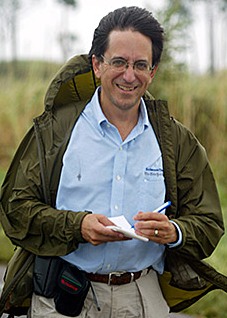
Amdrew Revkin
As Andrew Revkin, who writes the Dot Earth blog for the New York Times, wrote on 1 October: “If the goal had been to convince people that environmental campaigners have lost their minds and to provide red meat (literally) to shock radio hosts and pundits fighting curbs on greenhouse gases, it worked like a charm.”

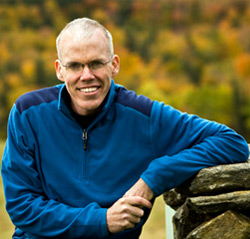
He isn’t alone. Bill McKibben, author, educator and environmentalist — who founded the serious climate group 350.org — wrote on the same day: “The climate skeptics can crow. It’s the kind of stupidity that hurts our side, reinforcing in people’s minds a series of preconceived notions, not the least of which is that we’re out-of-control and out of touch — not to mention off the wall, and also with completely misplaced sense of humor.”

His group, 350.org, issued a statement that emphatically said they had nothing to do with this misplaced British climate extremism. McKibben added, more reflectively: “What makes it so depressing is that it’s the precise opposite of what the people organizing around the world for October 10 are all about. In the first place, they’re as responsible as it’s possible to be: They’ll spend the day putting up windmills and solar panels, laying out bike paths and digging community gardens. And in the second place, they’re doing it because they realize kids are already dying from climate change, and that many many more are at risk as the century winds on. Killing people is, literally, the last thing we want.”

Bill McKibben
Now contrast such concern with the initial reaction from British film maker Franny Armstrong, who wrote a half-hearted, almost defiant apology on the 10:10 UK website, saying: “With climate change becoming increasingly threatening, and decreasingly talked about in the media, we wanted to find a way to bring this critical issue back into the headlines whilst making people laugh. We were therefore delighted when Britain’s leading comedy writer, Richard Curtis – writer of Blackadder, Four Weddings, Notting Hill and many others – agreed to write a short film for the 10:10 campaign. Many people found the resulting film extremely funny, but unfortunately some didn’t and we sincerely apologise to anybody we have offended.”

Adding gross insult to injury, Armstrong signed off saying: “As a result of these concerns we’ve taken it off our website. We won’t be making any attempt to censor or remove other versions currently in circulation on the internet.”

Both the 10:10 UK campaign and its sponsors Sony have been more unequivocal in their apologies in the days that followed. But that’s too little, too late. Enough damage done — climate activists and campaigners worldwide will take months, if not years, to live down this one.

And nothing really goes away on the web — this video will be lurking somewhere for a long time. YouTube currently carries the video in several places, with the warning: “This video or group may contain content that is inappropriate for some users, as flagged by YouTube’s user community.”

Andrew Revkins has posted comments from those who condemned as well as those who found some merit in the offensive climate video. Some of these comments take a dispassionate view, which is to be welcomed.

This incident teaches all of us engaged in environmental communication some important lessons. Environmentalists have over-stated their case before, and every time, that did them (and their causes) far more harm than good. Crying wolf, and ridiculing the non-believers, are never good tactics in winning friends or influencing people.

As Bill McKibben noted: “There’s no question that crap like this (video) will cast a shadow, for a time, over our efforts and everyone else who’s working on global warming. We’re hard at work, as always, but we’re doing it today with a sunk and sad feeling.”

One more thing: even in this age of globalised media, humour doesn’t travel well across cultures and borders. As mainstream corporate media companies have often found out, British humour sometimes doesn’t even cross the Atlantic very well — let alone to other parts of the world. Perhaps this is a key point that this all-British team of film makers and campaigners simply missed.

The world is a bit bigger — and more diverse — than your little island, Ms. Armstrong. By failing to grasp that, and with your crude display of insensitivity, you have really proved the premise of your good climate film.

We do live in the Age of Stupid.

PS: Marc Roberts says it all in this cartoon:

Et tu, Armstrong?

Exploring our crowded planet, One Square Mile at a time…

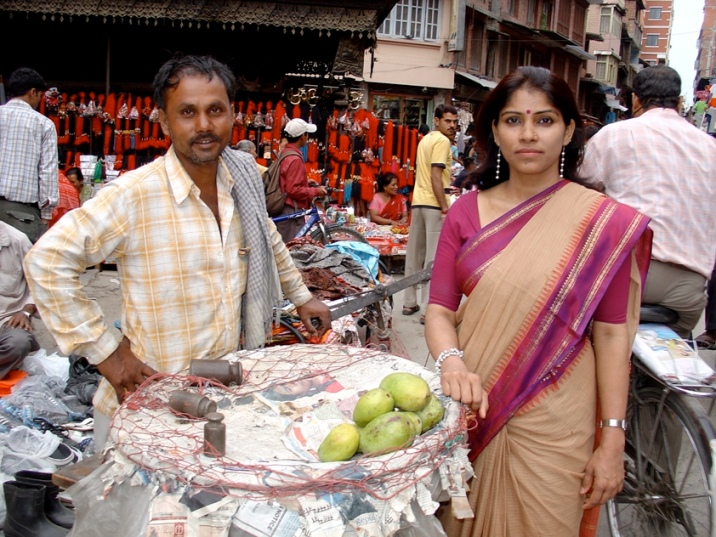
Vasanthi Hariprakash exploring One Square Mile in Kathmandu, Nepal

It’s funny how, more than a generation after most of the world adopted the metric system of measurements, relics of the earlier, ‘imperial’ units still linger in our language and popular culture.

Frequent flyers stlll accumulate air-miles, not kilometres. Disaster managers grapple with the challenges of communicating credible early warnings on that the crucial ‘last mile’ (it’s not yet the ‘last kilometre’). And many among us, including those who have grown up in a metric world, can better grasp a square mile than a square kilometre.

One Square Mile is also the name of an interesting new TV series produced by One Planet Pictures of the UK, and first airing this month on BBC World News. In this series, reporters visit a neighbourhood in different parts of the developing world and try and find out what the residents’ hopes and aspirations

Says its producer Robert Lamb: “One Square Mile is an experiment. So much in television is set up. In this series our reporters explore a small patch of a city with the aim of providing the viewer with an authentic slice of life.”

According to Robert, One Square Mile takes the lid off a neighbourhood. Reporters wander around a marked out section of a town and city and talk to the people they meet to find out what their everyday concerns are.

Of this months shows, two are presented by Zeinab Badawi . In one, she goes walkabout in Juba, capital of south Sudan which is on the verge of becoming an independent state. In the other, Badawi encounters murder on the streets in Guatemala City.

The other two are presented by my friend Vasanthi Hariprakash, whose day job is with India’s leading TV news network NDTV. These two are of particular interest to me as she travels to countries in Asia that are closer to me in distance and closer to my heart.

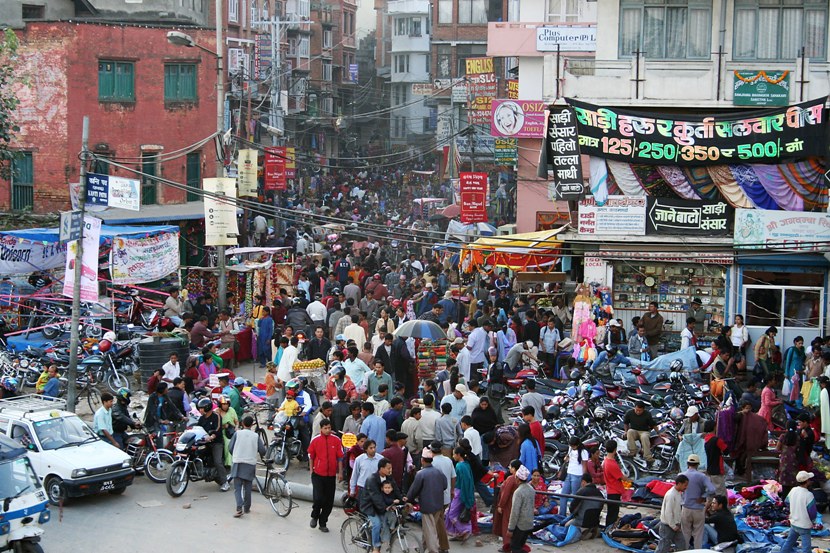
In one show, Vasanthi travels to Kathmandu, the capital of Nepal. The blurb says: “Despite a recent record of political instability that has seen a monarchy overthrown and an uneasy peace struck with the Maoist insurgents, reporter Vasanthi Hariprakash finds a city population surprisingly upbeat. But a long dawn queue outside the passport office tells a different story – young Nepali men are desperate to get out to find work in the Gulf and Southeast Asia.”

I’m familiar with that city having made multiple visits since 1995, and have shared the pains and anxieties of my Nepali friends as they went through political turmoil and a bloody insurgency. I saluted them when their ‘people power’ got rid of the despotic king in 2006.

Vasanthi did remarkably well in presenting her first-time appearance on a BBC-broadcast show. She came across as informed, eager and empathetic to the people and place she was exploring. Not once did I notice a hint of cynicism or condescension in her voice. This is quite in contrast to regular BBC reporters, many of who are far too judgemental and dismissive than good journalists should ever be. We can only hope vasanthi never aspires to those despicable professional levels…

Amidst political intrigue and uncertainties, life goes on in Kathmandu...

In her second show, Vasanthi travels to a small village in Laos next to the old Ho Chi Minh trail where the dominant concern is unexploded cluster bombs from the Vietnam war. The synopsis reads: “From the capital Vientiane it takes 10 hours for reporter Vasanthi Hariprakash to reach her square mile – a village next to the old Ho Chi Minh trail. Today it’s a peaceful highway for enterprising Vietnamese traders but during the war it was a target for the B 52 bombers with their deadly cargo of cluster bombs. 40% are live – called UXOs – Unexploded Ordinance – and Hariprakesh finds the villagers’ poverty leaves them no choice but to run the gauntlet of the unexploded munitions as they work in their paddy fields.”

This reminds me of a short film I saw in Cambodia many years ago about a poor, rural community who faced a similar dilemma living and working in a countryside littered with unknown and unexploded landmines. The Cold War conflicts in Southeast Asia may have ended decades ago, but local people still live in the shadow of their deadly legacies…

I can’t wait for more real-life stories in One Square Mile, and I hope Robert Lamb will send out his intrepid and charming reporters to far corners of the real world where real people are taking on life’s many challenges 24/7. These people’s resilience and resourcefulness inspire us all.

And that’s what good television is all about. Moving images, moving us all!

Ray Wijewardene: Passionate voice for small farmers and earthworms

Ray Wijewardene on the set of 'Sri Lanka 2048' TV show, June 2008: Cautiously optimistic about the future...
The small farmers, buffaloes and earthworms all over the world lost a true friend and spokesman this week when Lankan scientist Ray Wijewardene passed away.

Ray packed multiple interests and pursuits into his 86 years of life – including engineering, building and flying light aircraft, and Olympic-level competitive sailing. But he was happiest being a farmer and mechanic, and had strong opinions on the subject. He was vocal about misguided priorities in tropical farming his native Sri Lanka – and across the developing world.

He was especially passionate when speaking about small farmers in the developing world, with whom he worked many years of his international career as an expert on tropical farming systems.

Educated at Cambridge and Harvard universities, and with impeccable technical credentials, he was no stranger to the ways of academia. But he remained a sceptic about the efficacy and benefits of agricultural research — on which hundreds of millions of development funding is invested every year.

The main problem with agricultural research, he used to say, is that those who engaged in such studies and experimentation didn’t have to rely on farming for their sustenance. There was not enough self interest. In contrast, the small farmer had to eke out a meagre existence from whatever land, water and seeds or livestock she had. In her case — and a majority of small farmers around the world today are indeed women — it’s a stark choice of innovate or perish.

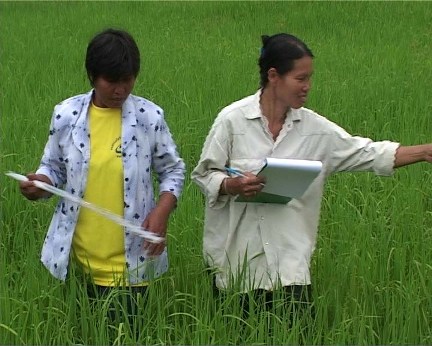
Thai researchers and farmers looking for field solutions (from Living Labs TV series)
The heroic efforts of small farmers were rarely recognised by the rest of humanity who consume their produce — and the farmers themselves are too busy planting crops or raising animals to speak on their own behalf. This is where Ray Wijewardene came in: with his education, exposure and talent, he made an outstanding spokesman for small farmers all over the tropics.

In the 1960s, as the inventor and promoter of the world’s first two-wheeled (Land Master) tractor, Ray travelled all over Asia, Africa and Latin America working with tropical farmers.

For half a century, Ray has championed the lot of the small farmer at national, regional and global levels with UN agencies, academic and research groups, corporate sector and governments. But in later years, he questioned the wisdom of trying to mechanise tropical farming, and considered that phase of his career a ‘big mistake’. He dedicated the rest of his life to researching and promoting ecologically sustainable agriculture, on which he co-wrote an authoritative book in 1984.

Ray had the rare ability to ask piercing questions without antagonizing his audiences. He was an activist in the true sense of the word, but one whose opinions were well informed and grounded in reality, not rhetoric.

This comes through very powerfully in an extensive media interview I did with Ray in 1995, which I released online this week as a tribute to Ray — who has been my mentor and friend for almost 25 years.

At the outset, Ray points out where the Green Revolutionists went astray: “All along in the Green Revolution, its promoters focused on maximizing yields through massive inputs. But they forgot that what the farmer wants is to maximize profits, not necessarily yields!”

We then talked about the particular challenges faced in tropical farming, and the mismatch of temperate farming systems promoted widely in the tropics where climatic and soil conditions are different. One of Ray’s main concerns was agriculture’s profligate use of water – more for weed control than to meet the strict biological needs of crop plants themselves!

Ray, a grandmaster in summing up complex technical issues in colourful terms, said at the time: “Water is rapidly becoming the most expensive herbicide in the world — and freshwater is increasingly scarce!” [A decade later, I would go on to script and executive produce a global TV series called Living Labs on just this issue: how to grow more food with less water, or get more crop per drop.]

Ray wasn’t fundamentally opposed to external, chemical inputs to boost soil fertility but he advocated a mix of natural and synthetic options. In our interview, he asked: “We have multinational companies supporting — directly or indirectly — the extensive use of chemical fertilizers. But who supports cow-dung? Who extols the virtues of the humble earthworm?”

He then added: “For us in Asia, these elements are far more important. Indians have recognized this, but we still haven’t. As long as our agricultural scientists are trained in the western mould of high external input agriculture, this (mindset) won’t change. Cow-dung and earthworms won’t stand a chance – until some western academic suddenly ‘re-discovers’ them…

It was Indian science writer and environmentalist Anil Agarwal who asked me, sometime in mid 1995, to interview Ray for Down to Earth, the science and environmental fortnightly magazine published by his Centre for Science and Environment. As Anil told me, “In Ray, you have not only one of the topmost agricultural experts in the developing world but one of its most original thinkers.”

By this time, I’d known Ray for almost a decade, and been exposed to several of his multiple facets. But each encounter with Ray was enriching for me, so I immediately seized the opportunity. The usually media-shy Ray already knew of and respected Anil, which helped.

Down to Earth is part of Anil Agarwal's legacy
The interview was audio taped over two long sessions, and I remember spending many hours transcribing it. I had to check some references with Ray, who cooperated wonderfully. I’ve been trained to observe the word limit set by editors, but in this instance, I sent in the full length Q&A, for it was so interesting. Down to Earth issue for 31 October 1995 carried a compact version, skillfully distilling the essence of that long exchange between Ray and myself — one of the most memorable interviews among hundreds I’ve done during 25 years of work in print and broadcast media.

How I wish the exchange was also preserved on audio tape! Indeed, it’s a small miracle that the original transcript survived for 15 years. The soft copy was lost in a hard drive crash of 1998, but fortunately I’d taken a full print-out. I’m grateful to a former colleague, Buddhini Ekanayake, for retyping the entire interview in mid 2008 when I considered releasing it in the wake of the global food crisis. That somehow didn’t work out, but the soft copy was ready at hand for me to rush to the editor of Groundviews on the day of Ray’s funeral. All I added was a new, 500-word introduction which tried to sum up the Ray Wijewardene phenomenon.

Read the full length interview with Ray Wijewardene, published for the first time, on Groundviews.org:
Who Speaks for Small Farmers, Earthworms and Cow Dung?

Celebrating Kalpana Sharma, a super-star of good journalism

My friend Kalpana Sharma just stepped down after serving on the Panos South Asia board for over a decade. The Executive Director A S Panneerselvan asked me to write a personalised piece felicitating her. Part of this was read at the annual meeting of the Board held in Dhaka last weekend. Here’s the full essay — a couple of mutual friends who read it say it isn’t too eulogistic! Now you can decide for yourself…

* * * * *

The Curious Ms Sharma of Mumbai

I knew Kalpana Sharma from her by-line long before I met her in person. Now, more than a dozen years after we became friends, she remains an inspiration and a role model.

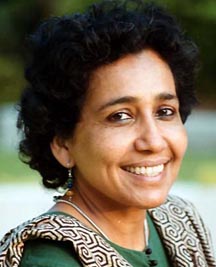
Kalpana Sharma
Kalpana has been a path-finder and trail-blazer in journalism that cares. She has set the gold standard in investigating and critiquing development in the Indian media. Today, she continues her nearly four decades of association with the Indian media as a respected columnist, journalist and writer. Her stock in trade is a mix of curiosity, sense of social justice, wanderlust and a deep passion for people and issues. She is living proof that quality journalism can be pursued even in these turbulent and uncertain times for the mainstream, corporatised media.

Kalpana has been covering the ‘other India’ that is largely ignored by the Indian media. Its denizens are some 456 million people living under the global poverty line of $1.25 per day — a third of the world’s poor. (If they declared independence, they would immediately become the world’s third most populous nation.) Kalpana’s reporting from the ‘Ground Zero’ of many disasters and conflict zones has highlighted the multiple deprivations of these people living on the margins of survival.

For many such communities, a headline-creating event is just the latest episode in their prolonged and silent suffering. The media pack that descends on them after a sudden development can’t seem very different from the assorted politicians who turn up periodically during election campaigns. For too long, the grassroots have been treated merely as a grazing ground for stories or votes.

Kalpana doesn’t hesitate to be part of the media pack when duty calls, but once in the field, she sees connections often missed by other journalists looking for a quick sound byte or dramatic image. Unlike some news hounds, she doesn’t exploit the misery of affected people (“Hands up who’s poor, speaks English – and looks good on TV!”). And she returns to the same locations months or years later to follow up.

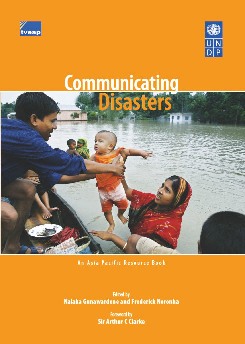
For all these reasons, Kalpana was our first choice to write the last chapter in a regional book on disasters and media that I co-edited with Indian journalist Frederick Noronha in 2007. Her 2,000-word reflective essay should be required reading for any journalist covering disasters and social disparity in South Asia.

Here is a passage that sums up her views on the subject: “Much of disaster reporting sounds and reads the same because the reporters only see what is in front of them, not what lies behind the mounds of rubble, figuratively speaking. What was this region before it became this disaster area? How were social relations between different groups? What was its history? What were its relations with the state government? Was it neglected or was it favoured? How important was it to the politics of the state?”

Kalpana has been asking such probing questions all her professional life. And it’s not just in the rural hinterland of India that Kalpana has travelled extensively listening and talking to people from all walks of life. Living in the world’s second most populous city Mumbai, she has been equally concerned with its burning issues of urban poverty, gender disparity, environmental mismanagement and governance.

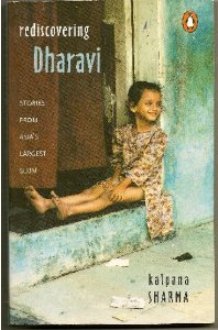
Kalpana once wrote an insightful book about the Dharavi slum in Mumbai, looking at both its social inequalities and the people’s remarkable resilience. Titled Rediscovering Dharavi: Stories from Asia’s largest slum (Penguin, 2000), it was called ‘a model of sane, human, down-to-earth writing’. All this was years before the Oscar-winning movie Slumdog Millionaire (2008) popularised the location through a dramatic tale.

In her quest for untold human stories, Kalpana has taken a particular interest in the plight of poor women. She has written many authentic and moving stories about women who struggle on the margins of the margin. A recurrent theme in her writing is how invisible ‘superwomen’ hold the social fabric together in much of India. Many communities and production systems –ranging from domestic work and child care to waste disposal and farming – would simply grind to a halt if these unseen and unsung women took even a single day off. In reality, of course, they just can’t afford such luxuries.

Kalpana’s column The Other Half, which started in The Indian Express and now appears in The Hindu, is a regular eye-opener. She takes a current topic – from politics, culture, sport or environment — and explores its gender dimensions. She does so by carefully blending facts, personal insights and opinion that makes her writing very different to the rhetorical shrill of gender activists.

Make no mistake: Kalpana is an activist in her own right, and one of the finest in modern India. It’s just that her approach is more subtle, rational and measured – and in the long run, wholly more effective. Long ago, she found how to balance public interest journalism with social activism. This is one more reason why I look up to her.

Partners in crime: Nalaka and Kalpana speaking at the Education for Sustainable Future conference in Ahmedabad, India, January 2005.

In her writing, television appearances and public speaking, Kalpana stays well within the boundaries of good, old-fashioned journalism based on its A, B and C: accuracy, balance and credibility. In my view, she enriches the mix by adding a ‘D’ and ‘E’: depth and empathy. Without these qualities, mere reporting is sterile and dispassionate.

And once we get to know her, we also discover the ‘F’ in Kalpana Sharma: she is a fun-loving, cheerful woman who doesn’t take herself too seriously. We can count on her to be adventurous, enthusiastic and endlessly curious.

Cultivating these attributes would certainly enrich any journalist. I can’t agree more when Kalpana says (in her chapter to a recent book on environmental journalism in South Asia): “Journalists are good or bad, professional or unprofessional. I am not sure if other labels, such as ‘environmental’ or ‘developmental’, ought to be tagged on to journalists.”

I hope Kalpana has no retirement plans. She has earned a break after a dozen years on the Board of Panos South Asia. But we want her to remain a guiding star – a bundle of energy that shines a light into the Darkness, and helps make sense of the tumult and frenzy that surrounds us.

WED 2010: Saving the Planet, one human mind at a time…

Race to save the Planetary Ark: How are we doing?

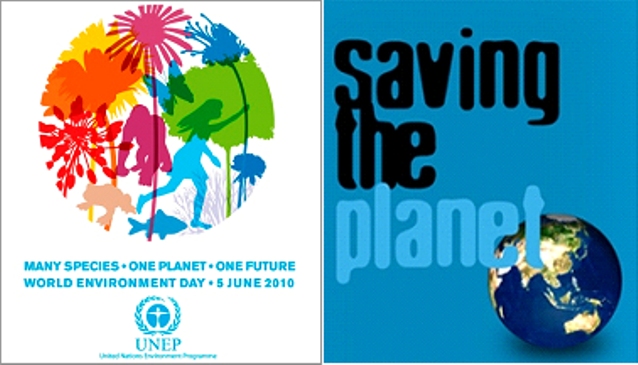
Today was World Environment Day (WED), and this year’s theme was biodiversity. The slogan read: Many Species, One Planet, One Future.

Different people observed the day in many and varied ways. Each one is valid, useful and purposeful.

I don’t believe in tokenistic tree planting. In fact, I’ve never planted more than a tree or two all my life – and honesty, I don’t know what happened to those hapless saplings after I deposited them gently and eagerly into a little hole in the ground…

Instead, I’m committed to a longer term effort: raising a single child as a single parent, trying to make her more caring for the planet, its limited natural resources and its people. I’m hoping that this would prove to be a lot more planet-friendly and worthwhile than a whole lot of trees planted and then abandoned…

As David Suzuki, the Canadian environmentalist and my favourite broadcaster, has said: “Our personal consumer choices have ecological, social, and spiritual consequences. It is time to re-examine some of our deeply held notions that underlie our lifestyles.”

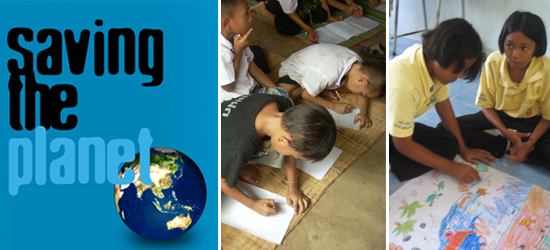
This is precisely the premise of Saving the Planet, the six-part, pan-Asian TV series we at TVE Asia Pacific produced and released in late 2009. It was among the compilation of environmental films that we screened at the British Council Colombo today to mark WED.

Filmed in six countries in South and Southeast Asia, Saving the Planet profiles groups working quietly and relentlessly to spread knowledge, understanding and attitudes that inspire action that will help humans to live in harmony with the planet.

Here are two stories that have a particular focus on biodiversity – all others have also been featured on this blog over the past few months (just run a search for ‘Saving the Planet’).

Cambodia: Floating the Future

The people of Prek Toal have always known how closely their lives and jobs are linked to the ebb and flow of the Tonlé Sap lake, the largest in Cambodia and linked to the Mekong River. Now, the conservation group Osmose is showing how they can benefit from the lake’s fish and other natural resources without killing off the very ecosystem that sustains them. One strategy that works: to reach out to grown-ups through their children.

Thailand: Smile Again!

Tourists are astounded by the richness and diversity of Thailand’s natural heritage. But many Thai children and youth are not connected with Nature – they are not familiar with plants and animals even in their own backyard. Concerned, the Thai Education Foundation launched a programme that links schools with their local community to learn about Nature through exposure and experience. We travel to Phang Nga province in southern Thailand to find out this works.

When green stories make some see red: who protects the reporters?

Who says environment is a ‘safe’ subject for journalists and broadcasters to cover?

Journalist colleagues who work on conflict, security and political topics often have an illusion that environmental reporting is a ‘cosy and comfortable beat’ – one that allows reporters to travel to exotic locations, see cuddly animals, relax in pristine environments and generally take things easy.

That might have been the case some years ago, in another century that’s now receding in our memories. But not any longer: there’s as much conflict, intrigue and complexity in many of today’s environmental topics, and covering them can often be hazardous to the courageous journalists who go after them.

Ahmadi: Beaten up for expose
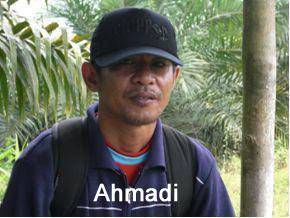
Just ask Ahmadi, a journalist working for Harian Aceh in Indonesia. Together with a fellow journalist, working for News Investigasi in Medan, he recently investigated a flood that had taken place in the Alapan district in April 2010. During their journey, they met some people cutting up logs. The journalists asked workers who owned these logs and were told that they belonged to the Alapan District Police Station and the Alapan Military Sub-District Command. Hmm…

When confronted with this information, a high ranking military officer reacted quickly and sharply: he wanted the whole story suppressed. In defiance, Harian Aceh published the story on 21 May 2010 — which resulted in Ahmadi being assaulted and threatened with death by the same officer.

“Ahmadi joins the long list of journalists who have been targeted for shedding light on deforestation, which is responsible for at least 18 per cent of the world’s greenhouse gas emissions,” says Reporters Without Borders (RSF), the international watchdog on media freedom.

It says attacks on journalists and bloggers who try to cover any kind of environmental damage are growing steadily all over the world. Among them, those who investigate industrial pollution or the destruction of forests are particularly at risk.

No longer a cosy beat...
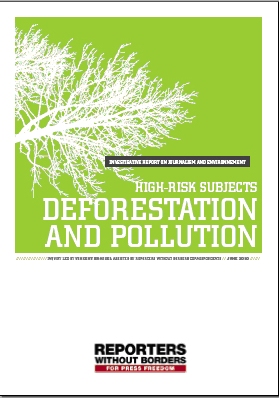
This week, on the eve of World Environment Day (5 June), RSF released a new report titled Deforestation and pollution: High-risk subjects. It makes grim reading for all of us who are committed to journalism as if the planet mattered.

It follows and echoes their call last year: “We must defend journalists who expose attacks on the environment”.

The new report, the second of its kind within just a few months from RSF, was prepared with the help of its worldwide network of correspondents. They gathered information about incidents in Indonesia, Argentina, El Salvador, Gabon, India, Azerbaijan, China and Morocco. Behind each of these threats and attacks, there were big corporations, criminal gangs or government officials who had been corrupted by money from mining or logging.

Asia features prominently in the report, which condemns the responsibility of the Vietnamese and Chinese governments in serious press freedom violations that deprive the public of crucial information about cases of pollution or deforestation.

The report describes, for example, the way the government in Hanoi has tried to suppress any debate about the environmental impact of bauxite mines being operated by a Chinese company. A field investigation in Argentina established that journalists are under pressure from both supporters and opponents of a mining project.

Mining companies (Aluminium Corp of China, China Metallurgical Group and the Canadian companies Yamana Gold and Pacific Rim), oil companies (Shell, Addax and Synopec), wood pulp companies (Sinar Mas and Riau Andalan Pulp and Paper) and two French multinationals (Bollor and Areva) are all identified in this report as having a direct or indirect role in cases of intimidation or censorship.

This is the second report that RSF has published on this subject. In September 2009, a report titled “The dangers for journalists who expose environmental issues.“, looked at 15 cases of journalists and bloggers who had been killed, attacked, jailed, threatened or censored for covering environmental problems in Russia, Cambodia, Bulgaria and Brazil.

RSF this week reiterated the appeal it launched during last December’s Copenhagen Summit: The media are needed to gather information and disseminate it to the public. Where climate change was concerned, it reminded everyone one, it was the media who helped to establish credible, independent diagnoses of the state of our planet. Their analyses continue to play a crucial role in helping decision-makers to adopt policies and rules that will lead to the desired changes.

On this blog, we have consistently highlighted the need for safeguarding journalists who pursue environmental stories that threaten vested interests within and across borders. For example:

September 2009: Who will protect journalists fighting for a better planet?

November 2007: Protect journalists who fight for social and environmental justice!

In April 2007, we asked: Can journalists save the planet? Yes, they can be front-runners in the world’s attempts to save species, habitats and entire ecosystems. But only if the rest of society protects and stands by them. When our planetary house is on fire, shooting the messenger isn’t going to save anyone.

Appeal to climate reporters everywhere: Don’t follow the Climate Circus!

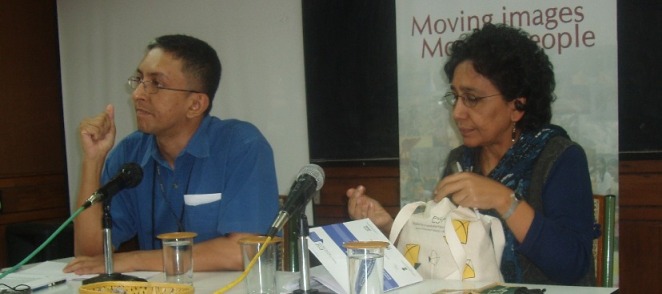
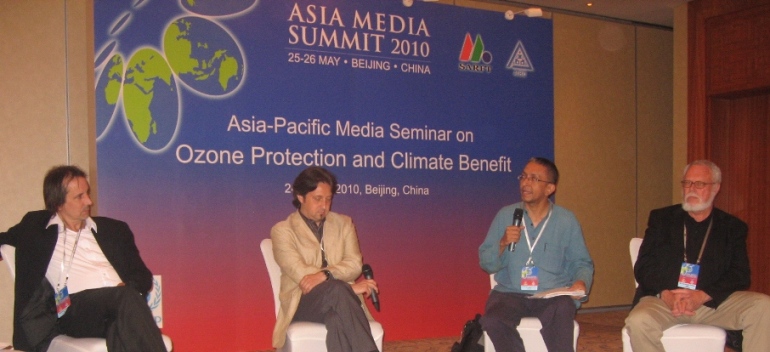
L to R: Sam Labudde (EIA); Eric Soulier (Canal France International); Nalaka Gunawardene (speaking); and Durwood Zaelke (IGSD)

Every year, a couple of weeks before Christmas, a big Climate Circus takes place. The venue city keeps changing, but the process is always the same: it attracts thousands of people – from government officials and scientists to activists and journalists – who huddle in various corners, chat endlessly and gripe often during two chaotic weeks. Then they disperse, rather unhappy with the process…only to return to more of the same a year later.

This is how I see the annual Conference of Parties (COP) of the UN Climate Convention, or UNFCCC. Their last big ‘circus’ was in Copenhagen, Denmark — when the world held its breath for a breakthrough in measures to reduce greenhouse gas emissions that warm up the planet. But, as with many previous conferences, Copenhagen over-promised and under-delivered.

The next COP is to take place in Cancún, Mexico, in December 2010. We can expect more of the same.

I’m not always this cynical. I’m certainly not a climate skeptic or climate change denialist. But I came to this conclusion after covering climate change stories for over 20 years, and having seen the kind of distraction the annual Climate Circus can produce on the media coverage and fellow journalists.

My contention: COPs were intended for treaty-signing governments to come together, bicker among themselves and make slow, painful and incremental progress on what needs to be done to address the massive problems of global climate change. While the core of these conferences remains just that, over the years they have gathered so much else — side events that now completely outweigh the political conference, and often overshadow it. I’m not convinced that this is where the real climate stories are, for discerning journalists.

I made these observations in some plain speaking done during a panel at the Asia Media Summit 2010 in Beijing, China, this week. The occasion was the Asia-Pacific Media Seminar on Ozone Protection and Climate Benefit, one of several pre-Summit events held on 24 May 2010 — and the only one on an environmental issue or topic.

I was on the last panel for the day, which looked at the next “hot” ozone and climate related stories. We were asked to give our views on: what are the great stories on the road to COP16 in Mexico at the end of the year?

Forget Cancun, I said. We already know how little it’s going to change the status quo. Why bother with that promises to be a non-event? Must we be this concerned with non-stories in our media coverage? In fact, I suggested: we should give the entire UNFCCC processes a couple of years of benign neglect. The real climate stories are not in the unmanageable chaos that the annual Climate Circuses have become. They are out there in the real world.

In the real world where frontline states and communities are already bearing the brunt of extreme weather…where green energy is making rapid advances…where communities and economies are trying to figure out how to live with climate change impacts even as they reduce their greenhouse gas emissions.

There are plenty of climate stories out there, covering the full range of journalistic interests: human interest, human enterprise, innovation, scientific research, community resilience and others. The challenge to journalists and other climate communicators is to go out there, unearth the untold stories, and bring them out in whatever media, forum or other platform.

I have nothing against climate COPs per se, and hope they can be restored to their original purpose of climate negotiations and working out acceptable, practical ways forward. (And this is certainly not a case of sour grapes: I’ve turned down all-expenses-paid invitations to COPs more than once.)

But we need to be concerned about the Climate Circus Effect on media, activist and educator groups, who seem to dissipate a good deal of their limited energies and resources in turning up at these mega-events. Copenhagen is said to have attracted over 17,000 persons (over 3,000 among them accredited journalists). How much of fruitful interaction and sharing can happen in such a setting? And when all the major news networks and wire services are covering the key negotiations and activities in considerable detail, what more can individual journalists capture and report to their home audiences?

Living as we do on a warming planet, we are challenged on many fronts to question old habits, and change our business-as-usual. The media pack has been running after the Climate Circus for over a dozen years. We need to pause, take stock and ask ourselves: is this the best way to cover the climate story?

And while at it, here’s something else for the UN, conveners of the annual Climate Circus. On World Environment Day 2008, whose theme was ‘CO2: Kick the Habit’, I asked the UN to kick its own CO2 habit. I suggested: “Adopt and strictly observe for a year or two a moratorium on all large UN gatherings (no matter what they are called – Summits, conferences, symposia, meetings, etc.) that involve more than 500 persons. In this day and age of advanced telecommunications, it is possible to consult widely without always bringing people physically together….Practising what you preach has a strong moral persuasive power — even if it goes against addictive habits formed for over 60 years of the UN’s history.”

PS: A global, comprehensive and legally-binding agreement on climate change is unlikely to be delivered at this year’s (Cancun) conference as well, the outgoing head of the UNFCCC, Yvo de Boer, was reported as saying on 27 May, just a few days after our Beijing seminar. See what I mean?