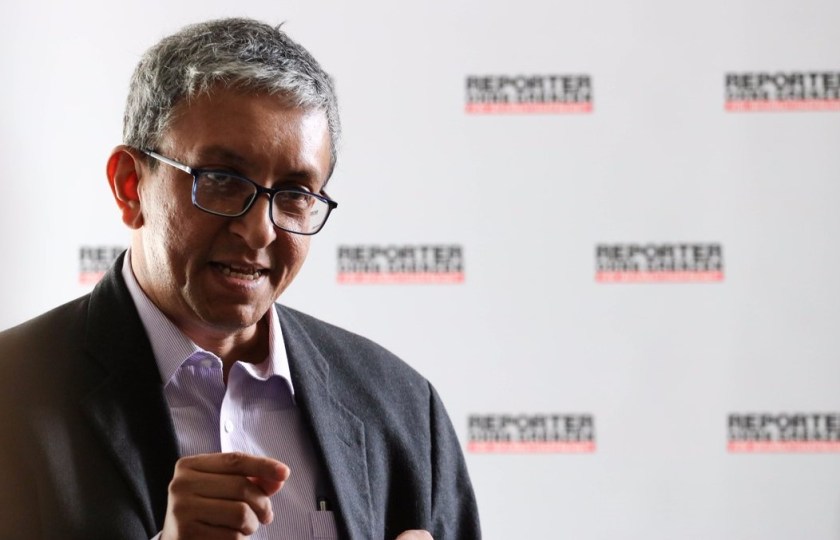
Nalaka Gunawardene speaks on media freedom and media professionalism in Sri Lanka at Germany’s Reporters without Borders (RSF, or Reporter ohne Grenzen) in Berlin, 17 Nov 2017
On a brief visit to Berlin, Germany, to speak at a media research and academic symposium, I was invited by Germany’s Reporters without Borders (RSF, or Reporter ohne Grenzen) to address a side event at their office that looked at media freedom status and media development needs of Sri Lanka.
It was a small gathering that involved some media rights activists, researchers and journalists in Germany who take an interest in media freedom and media development issues in Asia. I engaged in a conversation first with Anne Renzenbrink of RSF Germany (who covers Asia) and then with my audience.
I said the media freedoms have significantly improved since the change of government in Jan 2015 – journalists and activists are no longer living in fear of white vans and government goon squads when they criticise political leaders.
But the pre-2015 benchmarks were abysmally low and we should never be complacent with progress so far, as much more needs to be done. We need to institutionalise media freedoms AND media responsibilities. So our media reforms agenda is both wide ranging and urgent, I said (and provided some details).
I used my favourite metaphor: the media freedom glass in Sri Lanka is less than half full today, and we need to gradually fill it up. But never forget: there was no water, and not even a glass, before Jan 2015!
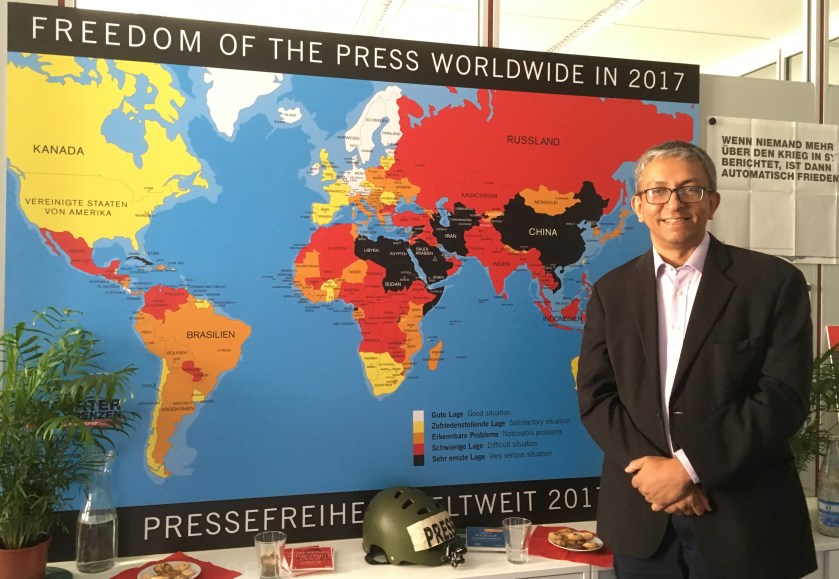
Sri Lanka has risen 24 points in the World Press Freedom Index that RSF compiles every year: 2016, we jumped up from 165th rank (in 2015, which reflected the previous year’s conditions) to 141st rank out of 180 countries assessed. The new ranking remained the same between 2016 and 2017. Sri Lanka is still marked as red on the world map of the Index, indicating ‘Difficult situation’. We still have a long way to go…
When asked how European partners can help, I said: please keep monitoring media freedom in Sri Lanka, provide international solidarity when needed, and support the journalists’ organisations and trade unions to advocate for both media rights and media professionalism.
I was also asked about slow progress in investigating past atrocities against journalists and media organisations; recent resumption of web censorship after a lull of two years; how journalists are benefitting from Sri Lanka’s new Right to Information law; the particular challenges faced by journalists in the North and East of Sri Lanka (former war areas); and the status of media regulation by state and self-regulation by the media industry.
I also touched on how the mainstream media’s monopoly over news gathering and analysis has been ended by social media becoming a place where individuals are sharing news, updates – as well as misinformation, thereby raising new challenges.
I gave candid and measured answers, all of which are on the record but too detailed to be captured here. My answers were consistent with what I have been saying in public forums (within and outside Sri Lanka), and publicly on Twitter and Facebook.
And, of course, I was speaking my personal views and not the views of any entity that I am working with.
Nalaka Gunawardene at RSF Germany office in Berlin, next to World Press Freedom Index 2017 map
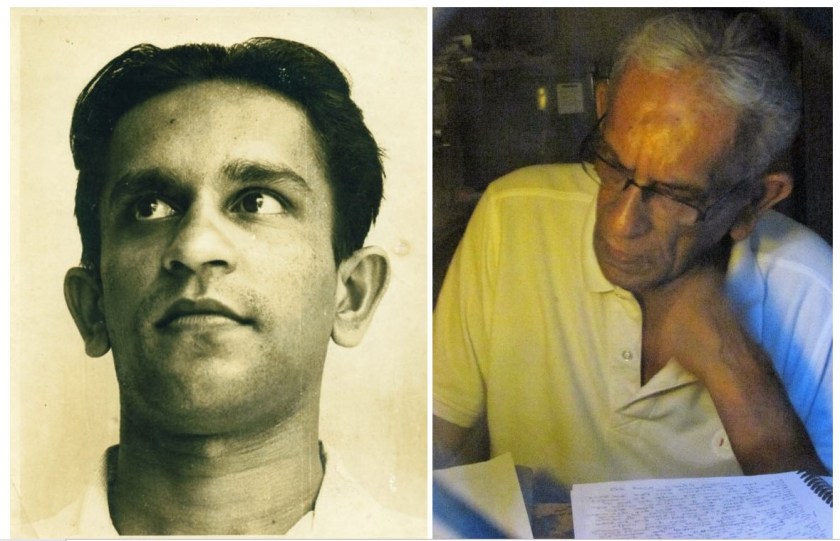
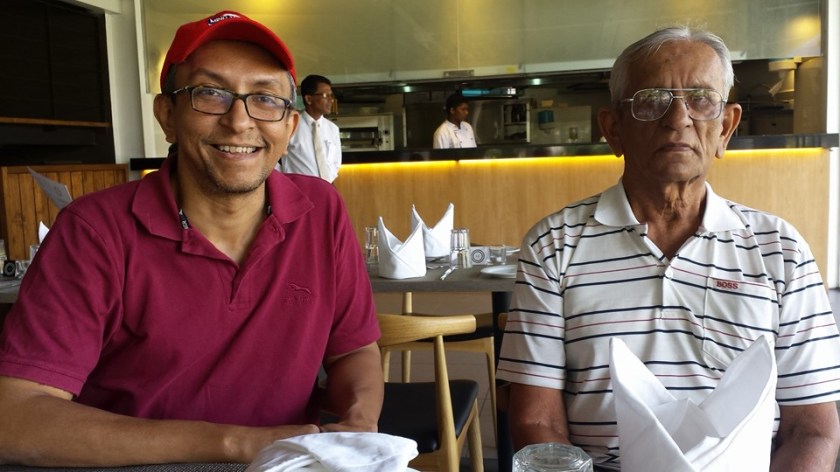
W D K (Kasturiratne) Gunawardene as a young man (left) and at 80
In this unusual Ravaya column, published on 24 September 2017, I salute my father W D Kasturiratne Gunawardene who passed away on September 13 aged 84.
His was a very ordinary life, mostly dedicated to education. But it was punctuated at various points by key events of his country and people. Tracing his life thus offers us some glimpses of his nation’s turbulent times for the past few decades – of our collective hopes, mistakes, tragedies and resilience.
W D K (Kasturiratne) Gunawardene as a young man (left) and at 80
Kasturi was born in another century in what now feels like an entirely different country. It was called Ceylon, a British colony, and the year was 1933.
Kasturi’s was a very ordinary life, which was mostly dedicated to education. But it was punctuated at various points by key events of his country and people. Tracing his life thus offers us some glimpses of his nation’s turbulent times.
At age two, he survived malaria during the major epidemic of 1933-35 which killed as estimated 80,000 to 100,000 Lankans. (He lived to see malaria being eradicated from Sri Lanka by 2016.)
At 15, as a schoolboy he walked to Colombo’s Torrington square to personally bear witness to Ceylon becoming independent (1948). The following day, he wrote the best essay in class in which he outlined high hopes and dreams for his now self-governing nation.
At 20, he entered the University of Ceylon and was among the first students to experience the newly established Peradeniya campus where he studied history and Sinhala language. From the scenic hills, he would see the political transformation of 1956, as well as the cultural revival heralded by Maname (landmark Sinhala drama) and Rekava (landmark Sinhala movie).
At 25, as a fresh graduate entering the world, he witnessed the 1958 ethnic riots that foreshadowed the Sinhala-Tamil ethnic conflict that consumed his nation for the next half century. Among much else, it evaporated young Kasturi’s dreams of an inter-racial marriage.
At 50, as a teacher and father, he saw the far worse anti-Tamil pogrom of 1983. For the next quarter century, he would watch in horror — and guilt — as his generation’s collective blunders consumed the next generation’s future.
At 76, as a senior citizen still active in social work and literacy circles, he saw Sri Lanka’s civil war being ended brutally (2009). He had the audacity to hope once more, even if only cautiously. And yet again, his and many others’ hopes were dashed as political opportunism and corruption soon trumped over true healing and nation building. The nation was polarised beyond recognition.
At 82, he voted for a common opposition candidate (January 2015) and for political parties (Aug 2015) who pledged good governance (yaha-palanaya). That was his last public gesture, after having voted at all national elections during his time, and having spent 25 years as a public servant. He played by all the rules, but was let down by the system.
At 84, as he coped with a corroding cancer, Kasturi watched in dismay the much-touted promise of yaha-palana being squandered and betrayed. On 13 September 2017, he departed as a deeply disappointed man who remained highly apologetic for many wrong-turns taken by his generation.
Kasturi isn’t a figment of my imagination. Neither is he a composite character. Until yesterday, Kasturi was all too real. He was my father, whom we returned to the Earth today at a simple funeral. – Nalaka Gunawardene
From time to time, certain Lankan academics make unsupported claims that the Sinhala language – spoken as native tongue by about 70% of Sri Lanka’s 21 million people – is in danger of ‘going extinct’. These claims are peddled without question by some journalists and on social media. I have been countering this for some time, going to authoritative global references that track the status of languages worldwide.
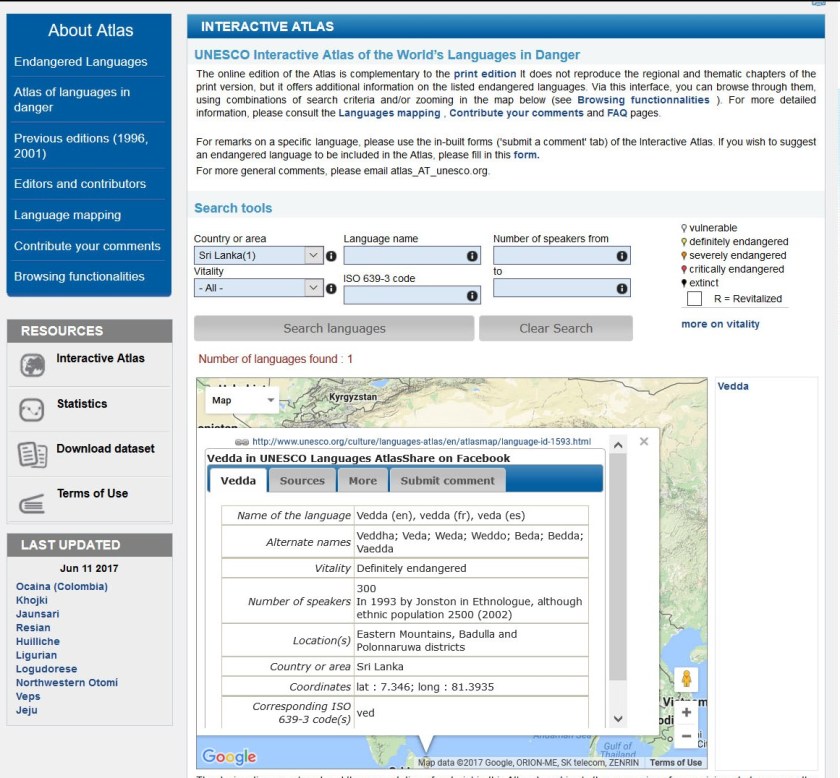
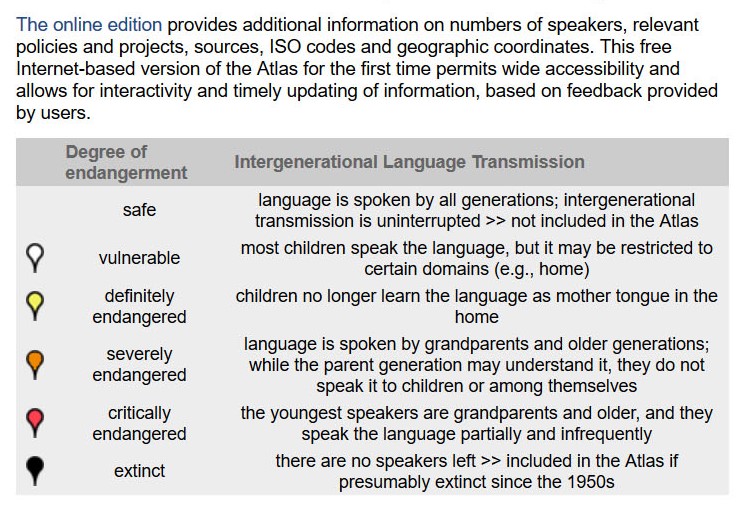
Key among them is the UNESCO Atlas of the World’s Languages in Danger. The latest edition of the Atlas (2010) lists about 2,500 languages (among which 230 languages extinct since 1950), approaching the generally-accepted estimate of some 3,000 endangered languages worldwide. Sinhala language is NOT among them. However, Sri Lanka does have one endangered language: spoken by the indigenous Veddah people, whose numbers are dwindling (below 500) due to cultural assimilation.
World Atlas of Languages in Danger, image captured on 11 June 2017
I have written about disaster early warnings on many occasions during the past decade (see 2014 example). I have likened it to running a relay race. In a relay, several runners have to carry the baton and the last runner needs to complete the course. Likewise, in disaster early warnings, several entities – ranging from scientific to administrative ones – need to be involved and the message needs to be identified, clarified and disseminated fast.
Good communications form the life blood of this kind of ‘relay’. Warnings require rapid evaluation of disaster situation, quick decision making upon assessing the risks involved, followed by rapid dissemination of the decision made. Disaster warning is both a science and an art: those involved have to work with imperfect information, many variables and yet use their best judgement. Mistakes can and do happen at times, leading to occasional false alarms.
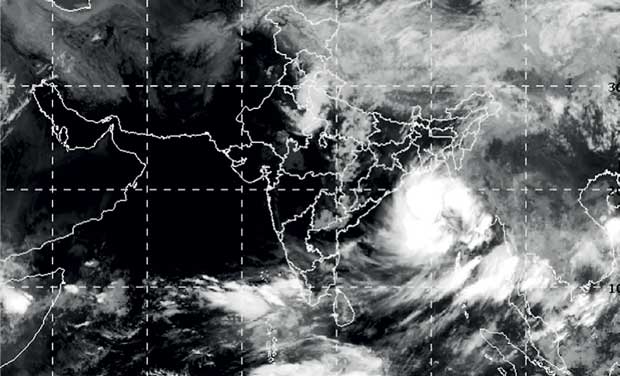
In the aftermath of the heavy monsoonal rains in late May 2017, southern Sri Lanka experienced the worst floods in 14 years. The floods and landslides affected 15 districts (out of 25), killed at least 208 and left a further 78 people missing. As of 3 June 2017, some 698,289 people were affected, 2,093 houses completely destroyed, and 11,056 houses were partially damaged.
Did the Department of Meteorology and Disaster Management Centre (DMC) fail to give adequate warnings of the impending hydro-meteorological hazard? There has been much public discussion about this. Lankadeepa daily newspaper asked me for a comment, which they published in their issue of 7 June 2017.
I was asked to focus on the use of ICTs in delivering disaster early warnings.
We as a nation collectively uttered these words as we raised our heads after the Indian Ocean tsunami of December 2004. That mega-disaster, which caught our government unawares and society unprepared, devastated many coastal areas, killing around 40,000 and displacing over a million people.
Even a 30 minute early warning could have saved many of those lost lives, by simply asking them to run inland, away from the waves. But there was no such warning.
Badly shaken by that experience, the then government reformed disaster related laws and institutions. Until then, dealing with disaster response was lumped under social services. The new system created a dedicated ministry for disaster management, with emphasis on disaster risk reduction (DRR).
Living amidst multiple hazards is unavoidable, but preparedness can vastly reduce impacts when disasters do occur. That is DRR in a nutshell.
But in immature democracies like ours, we must never say never again. Our political parties and politicians lack the will and commitment required to meet these long-term objectives. Our governance systems are not fully capable of keeping ourselves safe from Nature’s wrath.
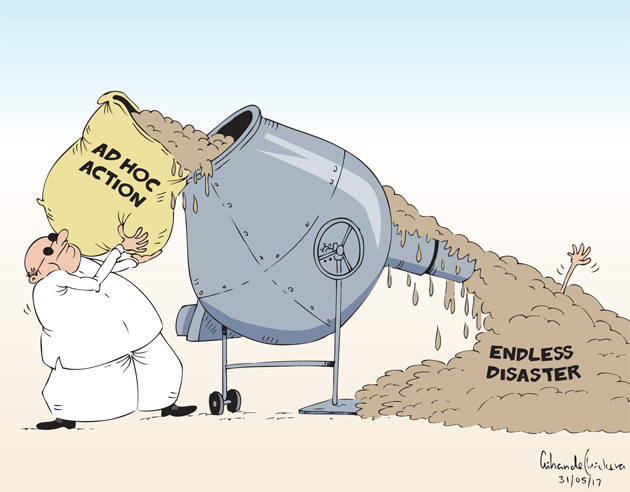
Disaster resilience is not a technocratic quick fix but the composite outcome of a myriad actions. Good governance is the vital ‘lubricant’ that makes everything come together and work well. Without governance, we risk slipping back into business as usual, continuing our apathy, greed and short-termism.
This big picture level reality could well be why disaster response has been patchy and uncoordinated in both May 2016 and last week.
Fundamental issues
As the flood waters recede in affected parts of Sri Lanka, familiar questions are being asked again. Did the government’s disaster management machinery fail to warn the communities at risk? Or were the hazard warnings issued but poorly communicated? And once disaster occurred, could the relief response have been better handled? Are we making enough use of technological tools?
Finger pointing won’t get us very far, even though public anger is justified where governmental lapses are evident. We need to move beyond the blame game to identify core issues and then address them.
In my view, two high level issues are climate resilience and improved governance.
DRR is easier said than done in the best of times, and in recent years human-made climate change has made it much harder. Global warming is disrupting familiar weather patterns and causing more frequent and intense weather. What used to be weather extremes occurring once in 25 or 50 years in the past now happens every few years.
Climate imperatives
The UN’s climate panel (IPCC) says that global average temperatures could rise by somewhere between 2 degree and 6 degrees Centigrade by 2100. This would trigger many disruptions, including erratic monsoons, the seasonal oceanic winds that deliver most of our annual rains.
That is more than two thirds of the total number of 646,500 people affected by floods and landslides in the South, as counted on June 1. But slowly-unfolding droughts never get the kind of press that floods inspire.
One thing is clear: disaster management can succeed today only if climate realities are factored in. And coping with climate change’s now inevitable impacts, a process known as climate adaptation, requires technical knowledge combined with proper governance of both natural resources and human systems.
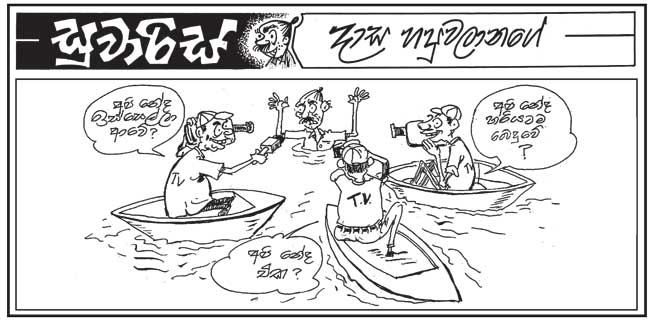
Sri Lanka: Not only oscillating between droughts and floods, but now also having both disasters at the same time. Cartoon by Gihan de Chickera
Adapt or Perish
Sri Lanka joined the UN Framework Convention on Climate Change (UNFCCC) in 1992. But 25 years on, climate considerations are not fully factored into our development planning and public investments. State agencies in charge of roads, railways, irrigation works and utilities don’t appear to realise the need to ‘insure’ their installations and operations from climate impacts.
Climate adaptation is not something that the disaster ministry and DMC alone can accomplish. It needs to be a common factor that runs across the entire government, from agriculture and health to power and transport. It needs to be the bedrock of DRR.
We need aware and empowered local communities matched by efficient local government bodies. This combination has worked well, for example, in the Philippines, now hailed as a global leader in DRR.
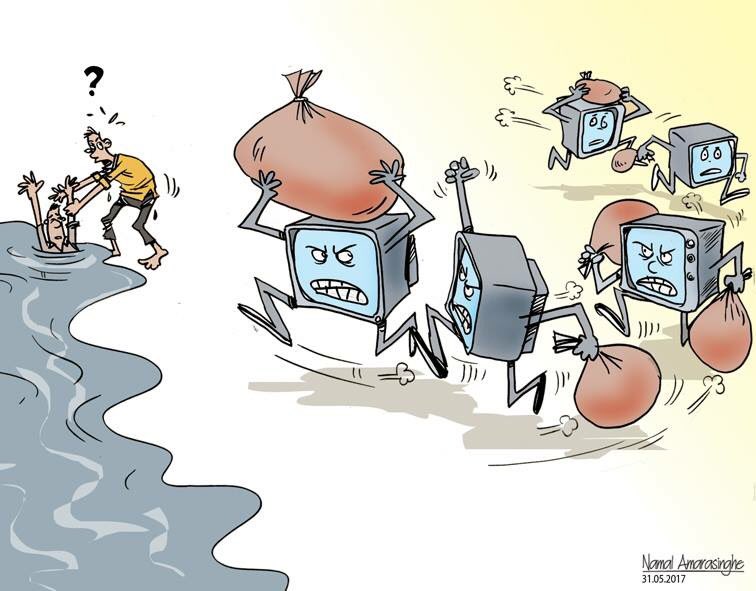
My comments (in Sinhala) on mass media’s role in disaster response, published by Ravaya broadsheet newspaper on 4 June 2017.
Summary: In the aftermath of all recent disasters in Sri Lanka, private broadcast media houses have been competing with each other to raise and deliver disaster relief. All that is well and good – except that news coverage for their own relief work often eclipses the journalistic coverage of the disaster response in general. In such a situation, where does corporate social responsibility and charity work end and opportunistic brand promotion begin? I argue that media houses must be free to embark on relief efforts, but ideally they should do so having fulfilled their primary responsibility of reporting on and critiquing the post-disaster realities. Sri Lanka’s media reporting of disasters is often superficial, simplistic and incident-driven, which needs to improve to become more investigative, reflective and sustained beyond the immediate news cycle of a disaster. Without fixing these deficiencies, media houses getting into aid collection and donation is a sign of wrong priorities.
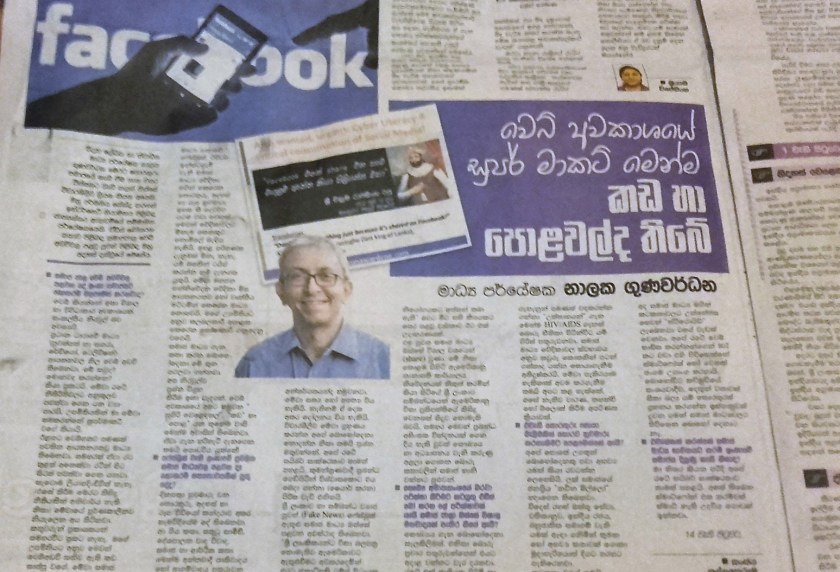
I have just given an interview to Sunday Lakbima, a broadsheet newspaper in Sri Lanka (in Sinhala) on social media in Sri Lanka – what should be the optimum regulatory and societal responses. The interviewer, young and digitally savvy journalist Sanjaya Nallaperuma, asked intelligent questions which enabled me to explore the topic well.
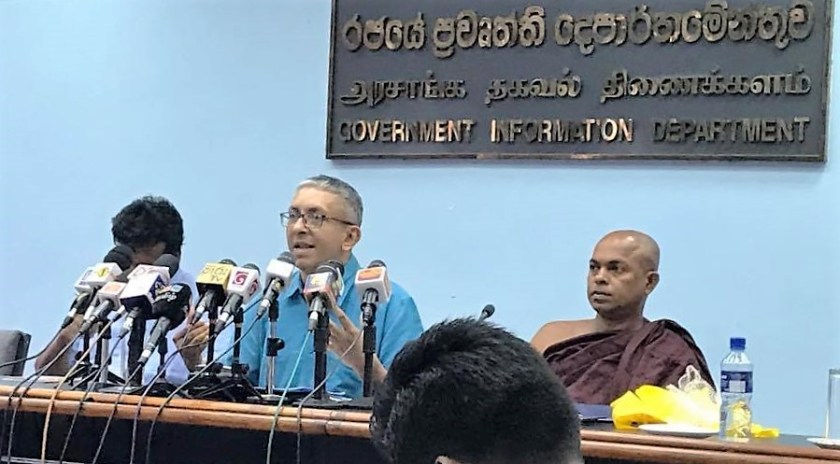
On 27 April 2017, I addressed a press conference at the Department of Government Information, Colombo, as a citizen concerned about waste management in Sri Lanka. I was joined by Ven Hadigalle Wimalarasa thero and Hemantha Withanage, Executive Director of Centre for Environmental Justice (CEJ) Sri Lanka, an advocacy group.
Nalaka Gunawardene (centre) addressing press conference of Lankan citizens concerned about waste management, at Dept of Govt Information, Colombo, 27 April 2017.
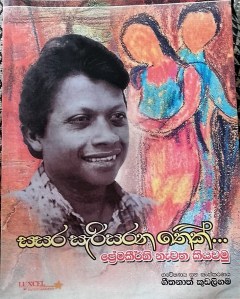 ගීතනාත් කුඩලිගම සංස්කරණය කළ ‘සසර සැරි සරන තෙක්: ප්රේමකීර්ති නැවත කියවමු’ (2014) කෘතියට පියාගේ ආවර්ජනාද හසු කර ගෙන තිබෙනවා. ප්රේමකීර්ති ද අල්විස් පියාගේ 1966 පන්තියේ සිටි, පොතේ වැඩට උනන්දු නොවූ එහෙත් අතිශයින් නිර්මාණශීලී සිසුවෙක්. පන්ති වේලාවේ කවි ලියා හසු වී පියාගෙන් දඬුවම් පවා ලැබ තිබෙනවා.





 Open Minds!