Small Islands, Big Impact: Film from the frontlines of climate change impact…

A short film, 20 years in the making...

Some films, like certain books, are in the making for years or decades. My latest film, Small Islands, Big Impact, just released online by TVE Asia Pacific, is quite short: slightly under 6 minutes long. But it has been forming in my mind for the past 20 years.

As a science journalist, I have been covering its story since 1989: how the Indian Ocean archipelago of the Maldives – Asia’s smallest country by area and population – is on the ‘frontline’ of climate change impact.

The Maldives packs 325,000 people into a combined land area just under 300 square kilometres spread over 1,192 islands and islets. With an average ground level of 1.5 metres (5 feet) above sea level, it is also the lowest country on the planet. When I first visited the Maldives in late 1988, they were still recovering from a massive storm surge in 1987. Although the damage was limited, the experience showed how vulnerable the Maldives can be to even a small rise in sea levels – this prompted the then President Maumoon Abdul Gayoom to take up the issue internationally. (It was President Gayoom who took up climate crusading at statesman level, well before Al Gore turned up on the scene.)

Interestingly, my first encounter with President Gayoom had nothing to do with climate – it concerned a celestial phenomenon: the Maldives was witnessing an annual solar eclipse and the President wanted to observe it in the company of amateur astronomers from their nearest neighbour, Sri Lanka. So he invited a couple of us over (I was active in the Young Astronomers’ Association of Sri Lanka at the time.)
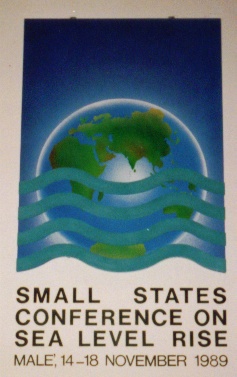
Small states conference on sea level rise logoI returned to the Maldives in November 1989, that time as a member of the international media covering the first ever small states conference on sea level rise. Held at the Kurumba island resort, it was one of the earliest international gatherings on climate impacts on low lying states, a topic that was to gain public interest and momentum in the years to come. Among the participants were delegates from practically all the small states in different parts of the world (defined as those with less than 1 million population), and scientists from disciplines such as oceanography, climatology, meteorology and geology.

This was one of the first international scientific events that I covered as an eager young science journalist. I was a foreign correspondent for Asia Technology, a monthly magazine on Asian science and technology published from Hong Kong (now defunct), and freelancing for The Island daily newspaper in Sri Lanka. (There’s nothing online from that coverage as it was in the pre-web era!)

The conference had technical sessions where experts debated scenarios and implications, and a political segment where delegations made their official statements. In the end, they issued the Malé Declaration on Global Warming and Sea Level Rise, which urged for inter-governmental action on the issue.

Our Maldivian hosts knew that scientists and officials alone couldn’t send out a powerful message to the world on what climate change meant for low lying islands of the world – many of them mere specks on the world map, barely registering in media’s radar. So on the last day of the conference, we were taken to the Maldivian capital of Malé, where a demonstration and public rally were held by school children and ordinary people.

That turned out to be the most striking moment of the whole week. I had been listening to experts and officials talk about impacts, scenarios and mitigation measures for several days, on which I’d filed several stories. But unless I go back to my personal archives, I can no longer remember those details. My lingering memories of this event are in a few photos I took, showing school children telling delegates – and the world – what it means to be living on the front lines of climate change impact.

This was the most striking photo – three more are found in an earlier blog post:
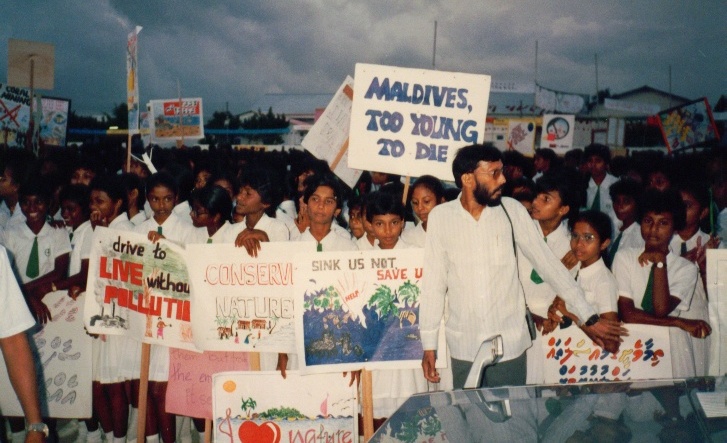
maldives-too-young-to-die-say-school-children-nov-1989.jpg

After 1989, I visited the Maldives on a couple of occasions for professional purposes during the 1990s. After I started working with TVE Asia Pacific in 1996, I was keen to return to the story of the Maldives and climate change – this time, in moving images – but I never had the chance until this year.

But I was covering the bigger story of climate change and its impact on the Asia Pacific from other locations. For example, in 2002, I commissioned and executive produced Voices from the Waves, the first-ever documentary on climate change in the South Pacific made by a native Pacific islander. Directed by Fijian film-maker Bernadette Masianini, the story revolved around two teenagers growing up on Fiji and Kiribati, each facing an uncertain future because of climate change.

In November 2007, the Maldives once again hosted representatives from small island states to discuss climate change. Eighteen years after the original meeting, the subject was no longer a fringe concern; it was now on everybody’s agenda. The meeting urged the the human dimension of global climate change to be included in the agenda of UN Climate Change Summit in Bali (December 2007), and sought the international community’s commitment “to protect people, planet and prosperity by taking urgent action to stabilize the global climate change”.

This time, the Male’ Declaration on the Human Dimension of Global Climate Change called for the UN High Commissioner for Human Rights to assess the human rights implications of climate change and “to conduct a study into the effects of climate change on the full enjoyment of human rights”. It also requested the UN Human Rights Council to convene a debate on human rights and climate change.

I wasn’t present at the 2007 meeting, but followed the process online. While climate change emerged as a major global concern, political change and reforms were underway in the Maldives. The country moved to a multi-party democracy, and in November 2008, the Maldivian Democratic Party‘s candidate Mohamed Nasheed won the presidential election.
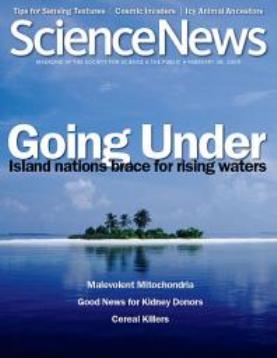
Science News cover - 28 Feb 2009
President Nasheed continues the climate advocacy that President Gayoom had sustained for nearly a quarter of a century. President Nasheed has emerged as an outspoken and pragmatic voice speaking on behalf of his and other small island states, grouped under the Alliance of Small Island States (AOSIS).

In early 2009, President Nasheed announced that the Maldives would become the world’s first fully carbon-neutral nation within a decade. To accomplish this, they would vigorously pursue renewable energies and green energy sources to replace current dependence on fossil fuels.

The final inspiration for Small Islands, Big Impact came in February 2009, when Science News magazine in the United States carried a cover feature on the challenges faced by Kiribati and the Maldives because of climate change. Written by senior science writer Cristine Russell, the article noted: “The Maldives and Kiribati highlight a hidden challenge for coping with climate change. It’s not just about slowing the emissions of greenhouse gases. It’s also about figuring out what to do for localities threatened with the possibility of extinction from rising ocean waters.”

My original plan was to film interviews with President Anote Tong of Kiribati, and President Nasheed. While sharing the same overall concerns, the two leaders (and their governments) have adopted somewhat different responses to the challenges posed by climate change. Unfortunately, the interview with President Tong did not come through in time, even though I had a Kiribati TV crew standing by to film it. So I decided to go ahead with the film focusing solely on the Maldives.
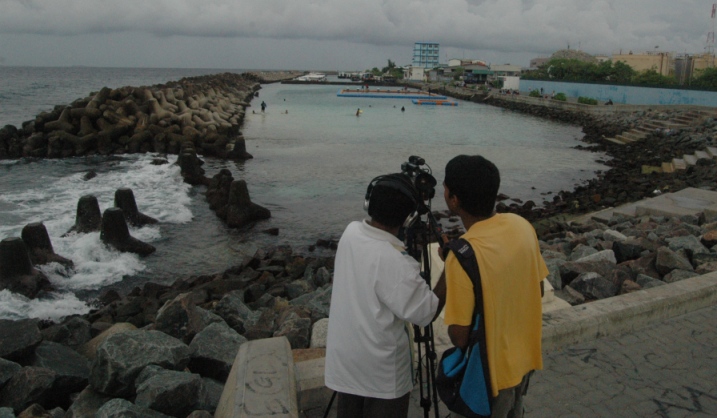
Location filming in Male - Hussein Makzoom (left) and Ibrahim Yasir

As with all TVEAP films, I was keen to make it with a local crew. Mariam Niuma, an engaging young Maldivian woman who had worked for nearly two years with us as an intern, helped me find a very capable crew in Ibrahim Yasir and his colleague Hussein Makzoom.

Niuma had been urging us to make a film about her country and was delighted that we were finally able to take it up. She helped us in numerous ways with local knowledge, introductions and advice. She also took time off her work with a local charity to show me around the Male’ island – which I was returning after a dozen years, in which time it had changed almost beyond recognition. (Male’ is one of the most crowded places on Earth – every one in four Maldivians lives on the tiny capital island.)

Small Islands, Big Impact was filmed on location over a few days in late August in Male’ and the nearby island of Vilingili. Our tiny production budget didn’t allow us to spend longer or venture further into the more remote islands and atolls (coral island formations, 26 of which make up the Maldives).
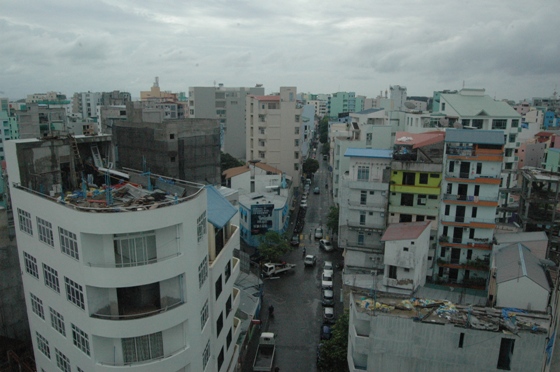
Overcrowded Malé, capital of the Maldives
The timing wasn’t ideal either – the Monsoon was still active, and rain often interrupted our filming. There was some irony that a climate film was being shot in inclement weather. Sometimes we filmed in spite of the rain – one ferry ride we took from Male’ to Vilingili island had to cross very choppy seas that made me (a land lubber!) quite nervous. For our Maldivian crew, however, it was all in a day’s work…

President Nasheed’s media team had been quick and supportive in accommodating our interview request, but when actually filming it, we faced an unexpected challenge which I’ve described in an earlier blog post. (Clue: In addition to inclement weather, we had to deal with a nasty influenza virus). With the month-long Ramadan fast period about to begin, which would significantly affect the pace of work in the 100% islamic Maldives, we had no choice but to persist with our filming, improvising as we went along.

I returned to Colombo with five camera tapes rich in footage, one of which contained a 15-minute interview with the amiable and technocratic President Nasheed. Over the next few weeks, I worked with our editor Umesha Fernando in distilling this material into a short, compact film less than six minutes. It took a good deal of time and effort — especially since I chose not to have any narration and to let President Nasheed tell the story in his own voice, interspersed with text-supported transitions.

Because of this style, soundtrack mattered a great deal, and we agonised over custom-composing the music. As I put everything this together, I kept recalling the wise words of senior Australian film-maker Bruce Moir: “Film is a lousy medium to communicate information. It works best at the emotional level.”

In the end, we barely met our self-imposed deadline: the film was released online just in time for the International Day of Climate Action. At the same time, I released the full interview (in text) on TVEAP website and the Groundviews citizen journalism website.

I can’t judge my own film, but I have tried hard to strike a balance between its intellectual and emotional appeal. My team and I set out to tell a compelling story about a country on the frontlines of climate impact. No less a person than its dynamic head of state stars in our modest effort, made on an incredibly tiny budget.

So here it is, a film that has been 20 years in the making – Small Islands, Big Impact!

Note: Small Islands, Big Impact was produced on an editorially independent basis by TVE Asia Pacific in collaboration with COM+ Alliance of Communicators for Sustainable Development. As with all other TVEAP productions, this series comes without license fees, where only copying and dispatch costs are payable. To order broadcast master tapes, please contact:

It may also be ordered in high resolution on DVD (without regional coding) from TVEAP’s e-shop.
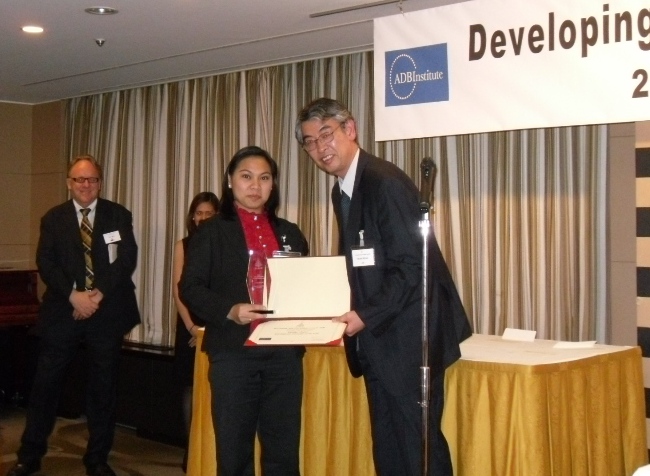
Imelda Abano: Asia’s Development Journalist of the Year 2009

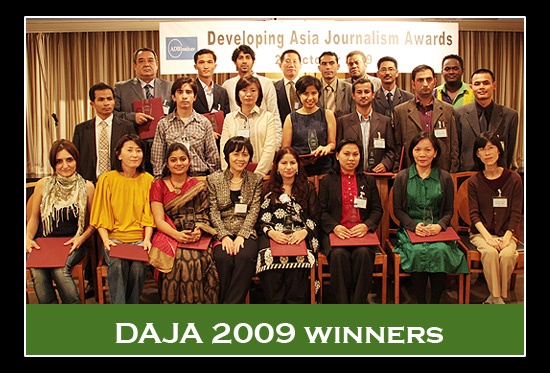
Imelda Abano receives her award in Tokyo, Oct 23

I was delighted to hear the news that Filipino science and environmental journalist Imelda Abano has just won the Developing Asia Journalism Awards (DAJA) for 2009.

“We are all winners,” said Imelda at the Awards ceremony organized by the Asian Development Bank Institute (ADBI) at the Foreign Correspondents’ Club of Japan. “We should continue writing compelling stories to make a difference.”

Imelda Abano, whom I have known and admired for several years, won one of two special awards for her story titled “Scorched Earth”, published on 19 May 2009, in the Business Mirror newspaper in the Philippines.

“Among all the articles, the judges were very impressed with the way Abaño’s article presented the
complex issues on climate change. It was a comprehensive and extra-ordinary piece that was made simple for the readers to understand,” said Monzurul Huq, one of the four judges and the president of the Foreign Correspondents’ Club of Japan.

“We judges were each very impressed by the overall high quality of entries for this year. The awards were meant to recognize the efforts made by Asian and Pacific journalists who provide high-quality coverage of issues affecting growth and development in developing countries,” said Anthony Rowley, presiding judge of the 2009 ADBI awards.

Imelda Abano was honored last year by the United Nations as the Gold Prize Winner for excellence in reporting on humanitarian and development affairs. She was also this year’s recipient of the 10 Young Leaders Award in the Philippines given out by the Philippines Graphic magazine for her reporting on development and environmental issues. In 2002, she won the Asian category of the Global Awards on Environmental Reporting organized by Reuters and IUCN.

The Developing Asia Journalism Awards (DAJA) scheme was launched in 2004 by the Asian Development Bank Institute in Tokyo, for journalists covering development issues in the Asia Pacific. It received around 200 entries this year, of which 22 journalists from 17 ADB developing nations were selected as finalists.

Supriya Khandekar from India won Young Development Journalist of the Year Award. Other winners are Sithav An from Cambodia for the Poverty Impact of the Global Financial Crisis category, Raknish Wijewardene from Sri Lanka for the Government Responses to the Global Financial Crisis category, Zhu Yan from China for the Infrastructure Development category and Moffat Ghala Mamu from the Solomon Islands for the Climate Change Adaptation category. Full list of winners

DAJA 2009 winners
DAJA 2009 winners

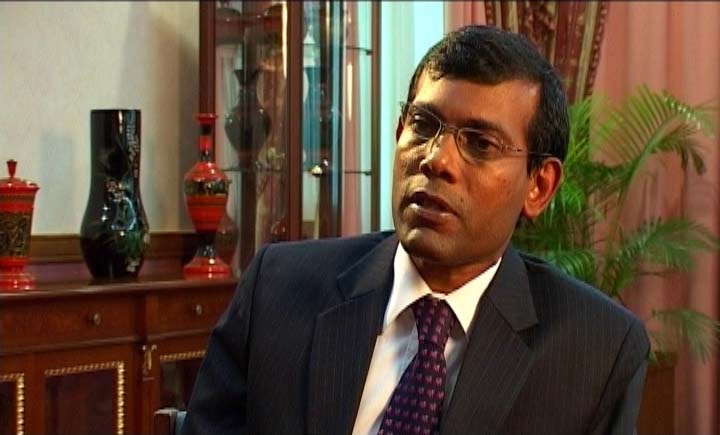
President Mohamed Nasheed: Encounter with a genial climate crusader…

President Mohamed Nasheed: Stop pointing fingers!

It had taken many days to set up the interview, but in the end we got only 15 minutes of the promised 30. President Mohamed Nasheed turned up more than an hour late, lagging behind in his day’s schedule. While waiting, his staff had repeatedly asked me to cut down the interview as the President was already late for a state function. I had nodded half-heartedly.

President Nasheed (known among his people as ‘Anni’) walked in, beaming and apologising for keeping us waiting for over a day. We had set up our lights and video camera the previous day, only to find that the President had cancelled all his appointments that day to be with his young daughter hospitalised with the ‘flu. As a father myself, I could fully understand – even if it affected our filming plans.

I introduced myself and crew, and asked how his sick daughter was doing. She is not in any danger, he said, and should be home soon. That was a relief.

I ushered President Nasheed to the simple chair we’d chosen for him to occupy during our interview, being filmed in the stately room where the President normally receives high level state guests. As the crew pinned up the mic and adjusted the lights, I quickly explained who we were, and what the interview was for – a short film that would be globally distributed highlighting the vulnerability of his island nation to climate change impact.

There was not an air of pomposity around him. He exchanged a few words in Divehi with my Maldivian film crew – Ibrahim Yasir and Hussein Makzoom. As I would soon find out in the interview, he was also very well informed, articulate and passionate. (I remembered interviewing former President Maomoon Abdul Gayoom nearly 20 years ago when I covered the Small States Conference on Sea Level Rise he convened in Nov 1989. Gayoom was expressive in his own way but had an air of scholarly superiority about him.)

In the 15 minutes that we had, I asked a total of 10 questions. I had sent in advance a baker’s dozen questions to his media staff. I don’t know if they briefed him, but clearly President Nasheed was in his element. He didn’t have any notes, and yet answered my questions perceptively, genuinely and always eagerly. The one-time journalist and human rights activist was very media savvy.

Read my full interview on TVE Asia Pacific website and on Groundviews citizen journalism website (where a discussion is unfolding)

He must have been asked some or most of these questions many times before. Yet with each answer, he found his comfort levels with me and by about the fifth minute, we were nicely chatting along. I had to keep reminding myself that I was really talking to one of Asia’s youngest heads of state. At that moment, he sounded every bit a chatty technocrat.

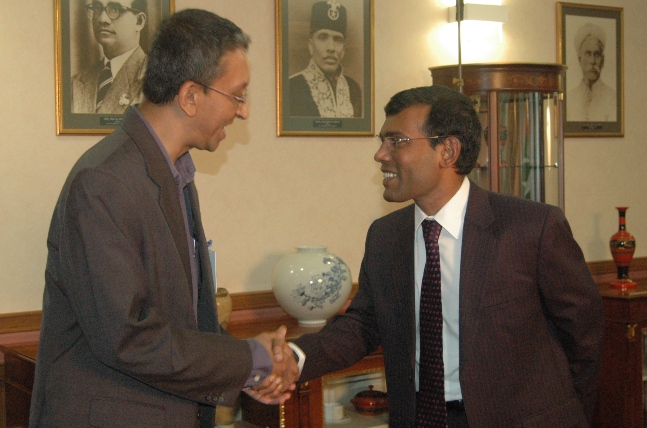
Nalaka Gunawardene (left) with President Mohamed Nasheed of the Maldives

President Nasheed had lot to say, and knew just how to say it. I had prepared for days, reading his recent speeches and op ed essays. I had figured out what to ask to elicit the kind of answers I was hoping for. He didn’t disappoint me. If his staff had not interrupted our interview, we could have easily gone on for half an hour or longer.

But I knew he had already given good ‘soundbites’ that we could excerpt in a short film. For example, how many heads of state would engage in plain talk like this when asked for his core message to the upcoming climate summit in Copenhagen: “In a nutshell, I’d like to say what has already been said: ‘Don’t be stupid!’. Going on and on about who did it is not going to save us. This is the time to realise that the deed is done. So let’s see how we may be able to proceed from here…

Earlier in the interview, he sounded grave when he outlined the prospects for his nation, the lowest-lying country on the planet, now on the frontline of climate change impact. “We will die if this goes on, and therefore, we have a fundamental right for life. If that is challenged, we have to link it be a human rights issue, and not just an environmental issue.”

The next minute, his tone became more resolute when talking on coping with massive changes already unfolding as a result of global warming. He stressed the value of democracy, good governance and people’s right to information as vital elements in adaptation – the difficult task of living with climate change.

Responding to my questions, President Nasheed talked about plans to make the Maldives carbon-neutral within a decade, and said the ‘sovereign wealth fund’ he announced soon after his election was already saving money “so that we will have something when the going gets very bad….”.

Sinking slowly in the East?
We also wanted to film President Nasheed at work, to establish him as an engaged political leader – the first democratically elected President of the Indian Ocean archipelago of 325,000 people. But there was no time. We then hoped to film his daily walk home after work. But the rain and delayed schedule meant he went home by car – and after dark. So we had to rely on stock footage instead.

The mix of democrat and technocrat in President Nasheed makes him an extraordinary personality and the world is taking note. The New York Times Magazine did a full length profile in May 2009 with the title ‘Wanted: A New Home for My Country’. A Hollywood film company is currently tracking the President as he travels the world, calling for urgent climate action that goes beyond mere words. (In fact, with my consent, they filmed me filming the President.)

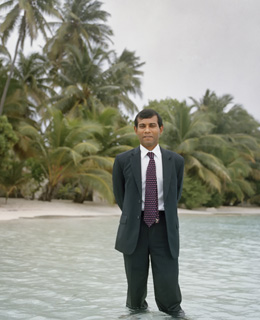
A month after my interview, TIME Magazine named him an Environmental Hero of 2009 – the only serving head of state so honoured this year. I was delighted to see this, but TIME’s chosen photograph made me very jealous. I had dearly wanted to shoot our interview outdoors, but a combination of bad weather and presidential schedule ruled that out. Evidently, TIME photographer Chiara Goia had better luck: President in full business suit standing about a foot deep in the calm, azure waters of the Maldives.

The same waters that he and his team are trying desperately hard to keep at bay, for as long as possible.

Read my full interview with President Mohamed Nasheed on TVEAP website and on Groundviews

Watch the short film, Small Islands, Big Impact:


Blog post January 2008: Little voices from the waves: Maldives too young to die!

Douglas Varchol: Secret of keeping ‘perfectly cool’ in a warming world…

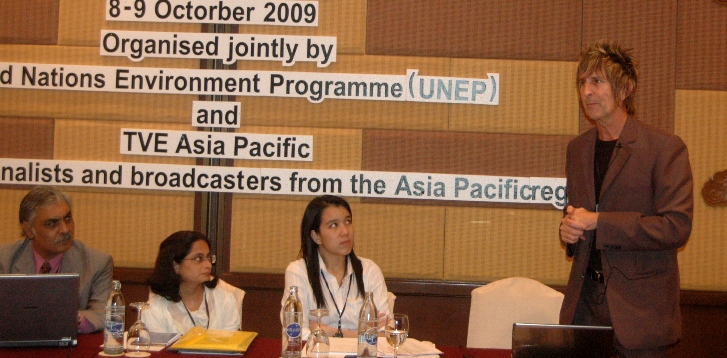
Douglas Varchol (standing, extreme right) speaking at Ozone Media Roundable, 8 Oct 2009

With his wild hair and trendy suits, Douglas J Varchol can pass for a rock star. He is actually an accomplished independent film-maker, currently operating out of Bangkok, Thailand, covering a variety of science and environmental stories in Asia.

Last week, he participated in the Ozone Media Roundtable that TVE Asia Pacific and UNEP organised in Chiang Mai, northern Thailand. After showing his latest documentary film on ozone, titled Earth Report: Perfectly Cool, which was first broadcast on BBC World News in September 2009, he talked about his experience in making the film.

Perfectly Cool is a 22 minute film looking at the challenges faced in trying to phase out a chemical called Hydrochlorofluorocarbons (HCFCs for short), a coolant gas used in air conditioners across the developing world. As chemicals go, it’s a double hazard: this ozone depleting substance also contributes to climate change by acting as a greenhouse gas.

But non-specialist viewers watch broadcast television for good stories, not science lessons. The challenge for journalists and film makers is to ‘sugarcoat’ the technicalities by wrapping it up in human interest stories. Douglas recalled how he did this: combining imagination, hard work and luck.

First, here’s the official synopsis of the film which sums up the story:
Air conditioners are damaging the environment. One widely used coolant gas, HCFC, damages the ozone layer. With booming sales of domestic ACs around the world, the problem has grown in recent years, despite vigorous international efforts to reduce ozone depleting chemicals. Under the international agreement known as the Montreal Protocol, HCFC will be phased out worldwide by 2030. An ozone-friendly replacement gas – HFC – is now used in Europe, but that gas is a potent greenhouse gas — which means it contributes to global warming. However, an answer may be at hand. Earth Report travels to China, centre of the global AC industry, to investigate the cost of cool and meets the industry representatives working on a solution – and Sa DingDing, a musician with extreme views on air conditioners.

Watch the first 4 mins of Earth Report – Perfectly Cool

Humanising science stories is hard enough, and when the subject is something people can’t see or feel, it becomes harder. As I wrote a few days ago, the Ozone Layer – located between 10 and 50 kilometres above the Earth, and invisible to the naked eye – is not something tangible like cuddly animals or endangered plants. Moving ordinary people to care for something they can’t see or touch is tough, even if all life on Earth depends critically on it (the Ozone Layer absorbs most of the Sun’s harmful ultra-violet days).

Douglas had his work cut out for him. Throw into this mix the fact that the editorially independent film was being made pooling funds from six development agencies – each with their own agenda – and that the story was filmed in China where filming permission still involve a lot of paperwork, it’s a small miracle Perfectly Cool was completed. And as we saw, Douglas tells a good story without compromising accuracy or balance.

So did he keep perfectly cool during the making of this film, I asked. He revealed that there were moments of panic and despair, although in the end everything fell into place. While the editors at BBC World were satisfied with the film, some technical specialists consulted for the script had felt it was over-simplified.

Ah, I do know that feeling! When I made a film on ozone in 2006 (Return of the Ozone Layer: Are We There Yet?) it took us 18 months to finish, and went through endless revisions. The UN system seems to just love making films by committee…

With his film, Douglas faced additional hurdles. For example, he takes us inside the Gree company‘s factory producing air conditioners. In 2004, Gree became the largest AC manufacturer in the world, but they had never before allowed television cameras inside their plant. That took lots of time and effort to set up.

Sometimes, things not going according to plans actually helps. When on location, Douglas serendipitously came across elements that were not in the original story treatment but enhanced the human interest: for example, a modern day wedding where the new couple gifted reusable chop sticks to all their guests. That was good environmental conduct – but then they headed off to choose air conditioners for their new apartment…

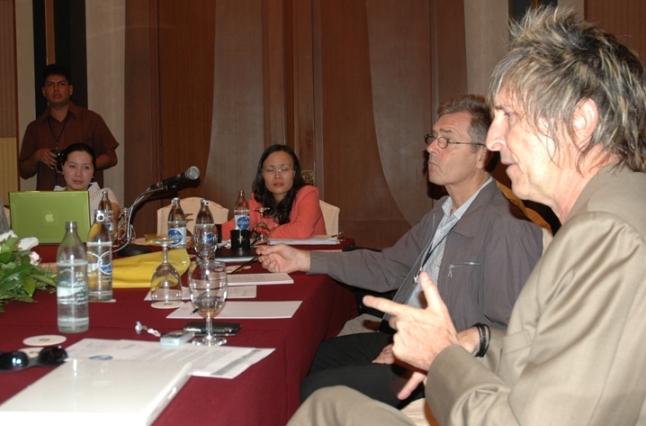
Douglas Varchol (extreme right) makes a point during Ozone Media Roundtable

Douglas paid a tribute to his Chinese researcher Lihong Shi and crew, without whose local knowledge and contacts he couldn’t have made the film.

In the end, Douglas pulls it off. Despite its seemingly esoteric and complex subject, Perfectly Cool is perfectly watchable — and not just for science buffs like myself.

Douglas, who once worked with Wired Science making science programmes for American PBS, said he set out to make a film on HCFCs that even his mom (a high school teacher) could understand. I can’t speak for her, but those of us who watched it in Chiang Mai were enthralled.

Internet at 40: Over the hill or real life begins from now?

Where does wireless come in?

When Apollo XI astronauts became the first humans to land on the Moon in July 1969, the whole world knew – and about a quarter of humanity actually watched it live on television. The 40th anniversary of that ‘giant leap for mankind’ was marked a few months ago.

Something else with far-reaching implications happened a few weeks later, but was not noted as significant outside the circles of nerds and geeks. On 2 September 1969, computer scientists at the University of California, Los Angeles, established a network connection between two computers — creating the very first node of what we now know as the Internet.

At the time, engineer and computer scientist Leonard Kleinrock and his colleagues were charged with developing the Advanced Research Projects Agency Network (or ARPANET), a US government-funded research project in global computer communications that eventually grew into the Internet.

Although some celebrated the Internet’s 40th birthday on 2 September 2009, others held that the network didn’t really have ‘life’ until 29 October 1969. On that day, a message was typed by Kleinrock and sent to the second node at Stanford Research Institute. That “was the first breath of life the Internet ever took,” says Kleinrock.

Given the complexity that the Internet has evolved to, it isn’t surprising that the actual birthday is hard to pin down and is the subject of endless discussion among geeks and wonks online. For the rest of us grateful users of the Internet — most of the 1.6 billion people estimated as connected — we can celebrate the Internet’s 40th birthday through the months of September and October 2009.

But as this recent AP story reminds us, goofy videos weren’t on the minds of Len Kleinrock and his team at UCLA when they began tests 40 years ago on what would become the Internet.

Associated Press story, 31 August 2009: Internet Creators Didn’t Foresee Today’s Web

So as the Internet turns 40 – is it downhill from now? Or does life actually begin at 40? (As someone who is three years older than the Internet, I would say yes!).

“The Internet has just reached its teenage years,” Kleinrock said in an interview with Computerworld recently. “It’s just beginning to flex its muscles. The fact that it’s just gotten into its dark side – with spam and viruses and fraud — means that it’s like an [unruly] teenager. That too will pass as it matures.”

British techno-historian and columnist John Naughton (author of ‘A Brief History of the Future: Origins of the Internet‘) describes the Internet as an attempt to answer the following question: How do you design a network that is “future proof”–that can support the applications that today’s inventors have not yet dreamed of? The solution was to devise a network of networks that would not be biased in favor of any particular application. The Internet’s creators didn’t want the network architecture–or any single entity–to pick winners and losers. Because it might pick the wrong ones. Instead, the Internet’s open architecture pushes decision-making and intelligence to the edge of the network–to end users, to the cloud, to businesses of every size and in every sector of the economy, to creators and speakers across the country and around the globe.

In the words of Tim Berners-Lee, the Internet is a “blank canvas”–allowing anyone to contribute and to innovate without permission. It was Berners-Lee, as a young computer scientist, who is credited with inventing the World Wide Web, making the first proposal for it in March 1989. So the web turns 20 this year as the Internet itself passes 40.

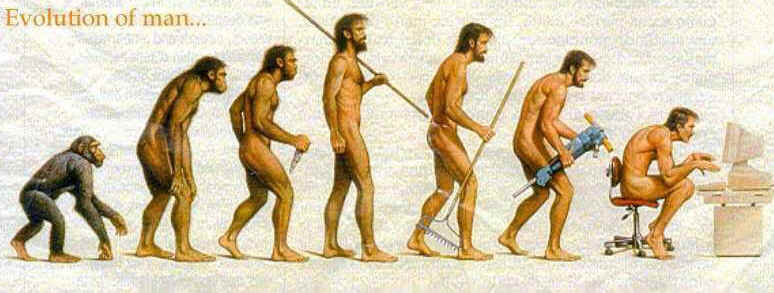
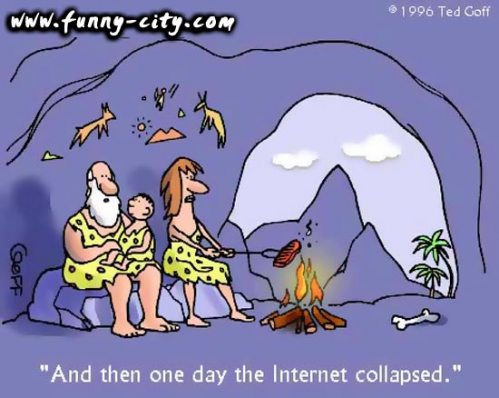
Anyone dares to predict what can happen in the next 20 years? Here’s one prophecy I hope will never come to pass…

Back to Year Zero?
Back to Year Zero?

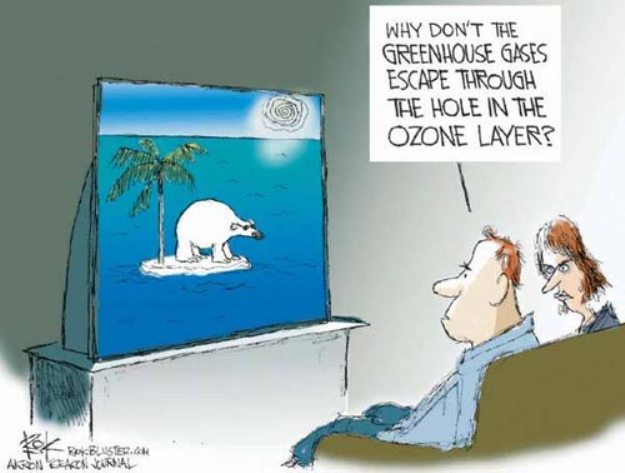
Why don’t the greenhouse gases escape through the Ozone Hole?

Can we blame him for the confusion?

Don’t laugh. The perception of the TV viewer in this cartoon (which first appeared a couple of years ago in the Akron Beacon Journal in Ohio, United States) is more common that you’d think. In recent years, as climate change rose up in the media’s news agenda and the public’s list of concerns, I have met a number of people – from across educational and cultural spectra – who harbour similar confusion about the two issues.

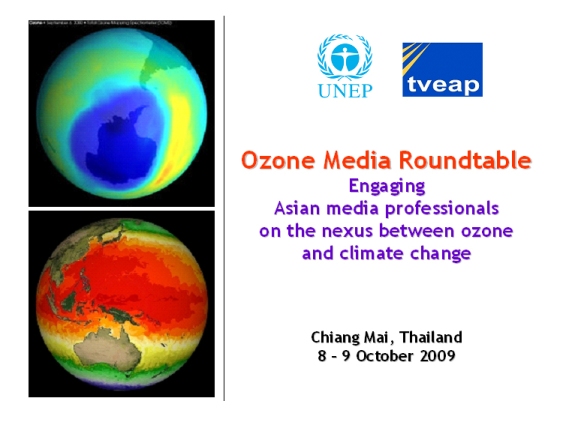
I showed this cartoon, and referred to the wide-spread confusion, in my opening remarks to the Ozone Media Roundtable, an event to engage Asian media professionals on the nexus between ozone depletion and climate change. The meeting, held in Chiang Mai, Thailand, on 8 – 9 October 2009, was organised jointly by the United Nations Environment Programme (UNEP) and TVE Asia Pacific for invited senior journalists and broadcasters from the Asia Pacific region.

Ozone layer depletion and climate change are linked in a number of ways, but ozone depletion is not a direct or major cause of climate change.

In fact, the relationship between ozone and climate is both complex and nuanced, which has prompted some experts to call it a ‘Tango in the Atmosphere’. Ozone affects climate, and climate affects ozone. The authoritative UNEP GRID Arendal website says: “Ozone depletion and climate change are two distinct problems but as they both modify global cycles, they cannot be totally separated. There are still many uncertainties concerning the relations between the two processes.”

Read more about this at the Ozone Hole website.

Since the late 1980s, Montreal Protocol on substances that deplete the ozone layer has successfully phased-out 97 per cent of 100 chemicals that damage the protective shield that filters out harmful ultra violet rays to the Earth.

In recent years, research has outlined that global efforts to protect the ozone layer has also delivered climate benefits as many of the chemicals that damage the ozone layer – such as chloroflurocarbons or CFCs – also cause global warming.

In 2007 a scientific paper calculated the climate mitigation benefits of the ozone treaty as totalling an equivalent of 135 billion tonnes of C02 since 1990 or a delay in global warming of seven to 12 years. That same year countries meeting in Canada, under the Montreal Protocol, agreed to an accelerated freeze and phase-out of Hydrochloroflurocarbons (HCFCs)—chemicals designed to replace the old, more ozone-damaging CFCs – in the main for the climate benefits.

Ozone: Once and Future Story? A tale of two images…

A tale of two iconic images...

I am in Chiang Mai, northern Thailand, conducting the Ozone Media Roundtable, a high level event to engage Asian media professionals on the nexus between ozone depletion and climate change. The meeting, held on 8 – 9 October 2009, is organised jointly by the United Nations Environment Programme (UNEP) and TVE Asia Pacific for invited senior journalists and broadcasters from the Asia Pacific region.

The past 22 years of implementing the Montreal Protocol, adopted in 1987, hold many relevant lessons and experiences for countries currently trying to negotiate a new multilateral environmental arrangement to succeed the Kyoto Protocol of the UN Framework Convention on Climate Change, UN-FCCC. These insights could be particularly helpful for the inter-governmental negotiations leading to, and during, the 15th conference of parties (COP15) of UN-FCCC in Copenhagen in December 2009.

TVE Asia Pacific and UNEP convened the roundtable meeting in Chiang Mai to explore the ozone/climate nexus from a communications perspective. We brought together a small group of senior journalists and broadcasters who have been covering ozone and/or climate issues. We also invited a few ozone and climate technical experts to discuss the close links between ozone layer protection and climate change mitigation.

I work with moving images, but I also know the power of still images — especially when they are highly symbolic. Looking for a good visual link between ozone depletion and climate change, I came up with two images of our planet, seen in different ways that represent the two global environmental challenges.

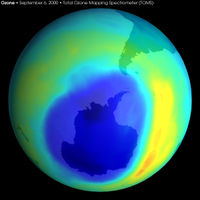
Largest ever Ozone hole, Sept 2000
The first image is better known, and is a colour enhanced satellite image of the Ozone Hole that was discovered in 1985 by British scientists Joesph Farman, Brian Gardiner and Jonathan Shanklin of the British Antarctic Survey. The ozone “hole” is really a reduction in concentrations of ozone high above the earth in the stratosphere. It is defined geographically as the area wherein the total ozone amount is less than 220 Dobson Units.

This discover was largely responsible for galvanising international attention and response to the threat of ozone depletion. After a series of inter-governmental meetings and negotiations, the Montreal Protocol on Substances that Deplete the Ozone Layer was finally agreed upon on 16 September 1987 at the headquarters of the International Civil Aviation Organization in Montreal.

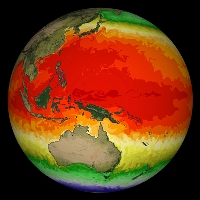
Temperature projection for Year 2100
The second image is not as widely known, but represents an even greater environmental calamity that is currently unfolding: global warming and rapid changes in climate it has triggered. The image is a colour enhanced image of the Earth’s temperatures in 2100 AD (less than a century from now), as projected by the Earth Simulator — one of the world’s most powerful supercomputers — which Japanese scientists use to project the climatic disasters in next 100 years.

The system was developed in 1997 for running global climate models to evaluate the effects of global warming and problems in solid earth geophysics. It has been able to run holistic simulations of global climate in both the atmosphere and the oceans — down to a resolution of 10 km.

Between these two images, we are looking at two of the biggest environmental challenges of our times. How the climate crisis can learn valuable lessons from the ozone crisis is what we discussed at the Ozone Media Roundtable.

More about the meeting’s outcome soon.

Asia’s Other Eclipse: The one that doesn’t make TV news!

This multiple exposure image shows the various stages of the total solar eclipse in Baihata village, 30 kms from Guwahati, the capital city of the northeastern state of Assam on July 22, 2009. The longest solar eclipse of the 21st century cast a shadow over much of Asia, plunging hundreds of millions into darkness across the giant land masses of India and China. AFP PHOTO/ Biju BORO

This century’s longest solar eclipsed moved across Asia on 22 July 2009, wowing scientists and the public alike. Asia’s multifarious media covered the solar eclipse with great enthusiasm and from myriad locations across the vast continent.

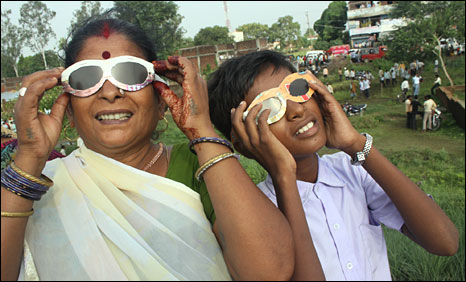
The path of the eclipse’s totality –- where the sun was completely obscured by the Moon for a few astounding minutes –- started in northern India. It then crossed through Nepal, Bangladesh, Bhutan, Myanmar and China, before heading out to the Pacific Ocean. Those who were lucky enough to be at the right place at the right time saw one of Nature’s most spectacular phenomena. It was certainly a sight to behold, capture on film, and cherish for a lifetime.

But many along the path missed this chance as clouds obscured the Sun. It’s the rainy season in much of Asia, where the delayed monsoon is finally delivering much-needed rain.

Eclipse watching in Taregna, Bihar, India - Photo: Prashant Ravi, BBC Online
That’s what happened in Taregna, in the eastern Indian state of Bihar. The media had dubbed it the ‘epicentre’ of the solar eclipse, and estimated totality to be visible for at least three minutes and 38 seconds. Thousands who flocked to the village were disappointed when the clouds refused to budge. Nature doesn’t follow our scripts.

That didn’t deter some affluent Indians -– if the eclipse won’t come to them, they just went after it. They chartered an airplane to fly above the rain clouds to catch the once-in-a-lifetime eclipse. Each seat cost US Dollars 1,650.

It’s rarely that totality crosses through countries with such high human numbers as China and India. This time around, millions of people and thousands of journalists took advantage.

Some travelled long distances hoping to get the best view from the 200-km wide path of totality. Others watched it one of Asia’s many and cacophonous 24/7 TV news channels. The event had all the elements of a perfect television story: mass anticipation, eager experts and enthusiasts, occasional superstitions, uncertainties of weather and, finally, a stunning display of Nature’s raw power.

‘Darkness at Dawn!’ screamed a popular headline, referring to the eclipse causing a sudden ‘nightfall’ after the day had begun. Other superlatives like ‘Spectacle of the century’ and ‘A sight never to be missed’ were also widely used.

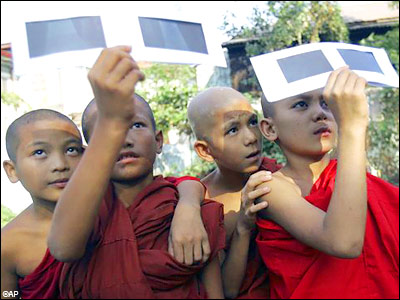
Myanmar Buddhist novices watch solar eclipse through the filters, in Yangon, Myanmar
Solar eclipses are indeed a marvel of Nature, and the media’s excitement was justified. For once, it was good to see them devoting a great deal of airtime and print/web space for something that was not violent, depressing or life-threatening.

How I wish Asia’s media took as much interest in another kind of ‘eclipse’ that surrounds and engulfs us! One that does not end in minutes, but lasts for years or decades, and condemns millions to lives of misery and squalor.

Stories of poverty, social disparity and economic marginalisation are increasingly ‘eclipsed’ in Asia by stories of the region’s growing economic and geopolitical might.

The mainstream media in Asia –- as well as many outlets in the West — never seem to tire of carrying reports of Asia rising. Indeed, that is a Big Story of our times: many Asian economies have been growing for years at impressive rates. Thanks to this, over 250 million Asians have moved out of poverty during this decade alone. According to the UN’s Asian arm ESCAP, this is the fastest poverty reduction progress in history.

We see evidence of increased prosperity and higher incomes in many parts of developing Asia. Gadgets and gizmos –- from MP3 to mobile phones — sell like hot cakes. More Asians are travelling for leisure than ever before, crowding our roads, trains and skies. Lifestyle industries never had it so good. Even the current recession hasn’t fully dampened this spending spree.

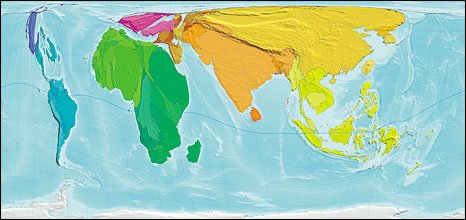
World map proportionate to number of poor people in each country/region - from Atlas of the Real World

But not everyone is invited to the party. Tens of millions of people are being left behind. Many others barely manage to keep up -– they must keep running fast just to stay in the same place.

National governments, anxious to impress their own voters and foreign investors, often gloss over these disparities. The poor don’t get more than a token nod in Davos. National statistical averages of our countries miss out on the deprivations of significant pockets of population.

For example, despite recent gains, over 640 million Asians were still living on less than one US Dollar a day in 2007 according to UN-ESCAP. Three quarters of the 1.9 billion people who lack safe sanitation are in Asia — that’s one huge waiting line for a toilet!

On the whole, the UN cautions that the Asia Pacific region is in danger of missing out the 2015 target date for most Millennium Development Goals – the time-bound and measurable targets for socio-economic advancement that national leaders committed to in 2000.

The plight of marginalised groups is ignored or under-reported by the cheer-leading media. For the most part, these stories remain forever eclipsed. Except, that is, when frustrations accumulate and blow up as social unrest, political violence or terrorism. Even then, the media’s coverage is largely confined to reporting the symptoms rather than the underlying social maladies.

Indonesian children look up through x-ray film sheets to watch a solar eclipse in the sky in Anyer Beach, Banten province, Indonesia
“Half the children in South Asia go to bed hungry every night, but the covers of our news magazines are about weight loss parlors,” says Kunda Dixit, Chief Editor of The Nepali Times.

As he noted in a recent essay: “Maternal mortality in parts of Nepal is nearly at sub-Saharan levels, but we are obsessed with politics. Hundreds of cotton farmers in India commit suicide every year because of indebtedness, but the media don’t want to cover it because depressing news puts off advertisers. Reading the region’s newspapers, you would be hard-pressed to find coverage of these slow emergencies.”

P N Vasanti, Director of the Delhi-based Centre for Media Studies which monitors the leading newspapers and news channels in India, laments how “development” issues such as health, agriculture and education are not even on the radar of popular news sources. Her conclusion is based on a content analysis of the six major Indian news channels during the run-up to the recent general election in India.

I have come across similar apathy in my travels across Asia trying to enhance television broadcasters’ coverage of development and poverty issues. As one Singaporean broadcast manager, running a news and entertainment channel in a developing country, told me: “I don’t ever want to show poor people on my channel.”

Don’t get me wrong. Trained as a science journalist, I can fully appreciate the awe and wonder of a solar eclipse. For years, I have cheered public-spirited scientists who join hands with the media to inform and educate the public on facts and fallacies surrounding these celestial events.

But there are more things in heaven and earth, than are dreamt of in our mainstream media’s breathless coverage of the march of capital. Journalists and their gate-keepers should look around harder for the many stories that stay eclipsed for too long.

* * * * * *

Shorter version of the above comment was published by Asia Media Forum on 23 July 2009

Full length version appeared on OneWorld.Net on 23 July 2009

Reprinted in The Nepali Times, 24 July 2009

Waiting for his long eclipse to end...

Lights, Camera, Apollo: Did NASA and Hollywood co-produce Moon Landings?

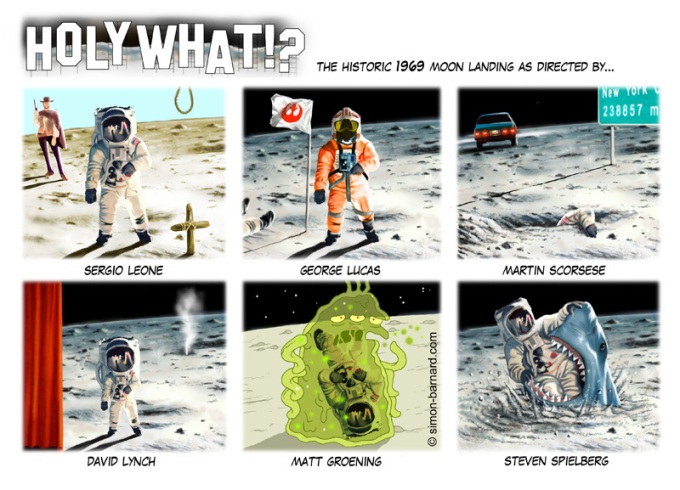
Is this how it really happened? Just kidding!
When NASA announced last week that they were working with a leading digital imaging company in Hollywood to remaster the original Apollo 11 Moon walk video footage, I told myself: that’s one more cannon to the conspiracy theorists!

Everyone would welcome a quality improvement in those murky, grainy moving images capturing humanity’s grand achievement. But the choice of Lowry Corporation, best known for restoring old Hollywood films, could fuel the fire of conspiracy theorists who argue that the entire Moon landing was faked by NASA with the connivance and participation of Hollywood. They believe that the entire Apollo programme – that landed people on the moon six times between 1969 and 1972 – was staged on a movie set or secret military base.

This link didn’t bother Richard Nafzger, the NASA engineer who oversaw television processing at the ground-tracking sites during the Apollo 11 mission, and now involved in their restoration. “This company is restoring historic video. It mattered not to me where the company was from,” Nafzger was quoted as saying.

Technically and officially, NASA is right. The US space agency has always dismissed the conspiracy theorists, and not spent much time discussing the outrageous idea. As it says on NASA website: “The Apollo Moon landings were among the most completely documented and observed events in history. Moon rocks have been examined by scientists from all over the world, not just the U.S. Video special effects were in their infancy in the late 60’s so that faking a landing on the Moon would probably have been more difficult than actually going there, and it seems highly unlikely that the hundreds or even thousands of people who would have had to be involved in such a conspiracy would have kept it a secret for so long.”

In another place, NASA website says Moon rocks and common sense prove Apollo astronauts really did visit the Moon.

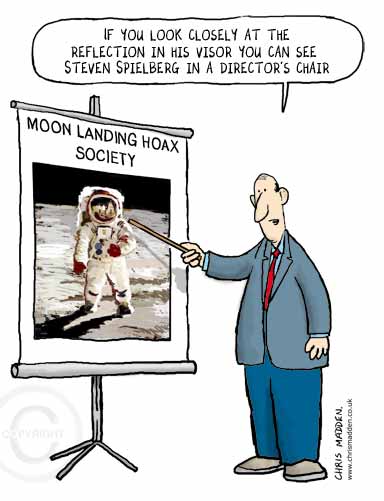
Err, Wasn't Spielberg only 23 at the time...?
Independent scientists point out that it would be impossible for tens of thousands of NASA employees and Apollo contractors to keep such a whopping secret for almost four decades. Tell that to those who are deeply suspicious of anything to do with governments, who historically don’t have the best record for transparency and full disclosure!

So the conspiracy theory lingers. Like many other crazy ‘theories’, it has spread rapidly with the growth of the Internet. It’s really an old one: even at the time Apollo astronauts landed on the Moon, a few people refused to believe it as it apparently conflicted with their religious beliefs.

The Moon Hoax, as it’s popularly called, accuses NASA of manufacturing, destroying, or tampering with evidence — including photos, telemetry tapes, transmissions, and rock samples; and that the deception continues to this day. These theorists concede that the Apollo launches did take place. But instead of going to the Moon, which they say was technologically impossible at the time, the astronauts just orbited the Earth for a few days while NASA carefully fed the media with manufactured images. And then they returned to a heroes’ welcome!

Before we proceed, let’s agree that there is independent, verifiable and irrefutable evidence that the Moon landings did take place. Here are a few online sources for details:
Bad Astronomy website by Phil Plaits
Did We Really Land on the Moon? Suggestions for Science Teachers from Rational Inquiry
Wikipedia entry: collaborative discussion with multiple sources cited
Clavius.org website

My curiosity in conspiracy theories stems from my interest in popular culture. In this instance, I’m intrigued to note how moving images have fuelled the Moon Hoax theory in a number of ways. A cornerstone in the doubters’ argument is that NASA’s photos and videos from the moon contained ‘suspicious anomalies’ (all of which, by the way, have been satisfactorily explained by scientists.)

Superb entertainment, but it was just that...
Some believe that these theories inspired the 1978 movie Capricorn One, where NASA fakes a Mars landing on a military base on Earth, and then goes to desperate lengths to cover it up. It’s entirely possible that some people can’t discern fact from fiction. Or why allow facts to get in the way of a damn good story?

In 1980, the Flat Earth Society was one of the first to accuse NASA of faking the Moon landings, arguing that these events were actually staged in Hollywood studios and based on a script written by Arthur C. Clarke! Another group suggested that acclaimed film director Stanley Kubrick, who co-wrote with Clarke the classic movie 2001: A Space Odyssey, was strong-armed into shooting much of the Apollo footage.

Sir Arthur Clarke, with whom I worked for over 20 years, used to laugh these off. He’d enjoyed a ring side seat when he joined Walter Cronkite in covering Apollo 11 and later missions for CBS News.

At one point in the early 1990s, he wrote to the NASA Administrator, with his tongue firmly in his cheek, saying: “Dear Sir, On checking my records, I see that I have never received any payment for this work. Could you please look into this matter with some urgency? Otherwise, you will be hearing from my solicitors, Messrs Geldsnatch, Geldsnatch and Blubberclutch.”

Of course, he never received – nor expected – a reply. But when media reports about this appeared, some with no sense of humour considered it further ‘proof’ of a cover-up!

And here’s another connection: Peter Hyams, who directed Capricorn One, went on to direct the movie adaptation of Arthur C Clarke’s 2010: Odyssey Two, which was released in 1984.

More seriously, in later years Sir Arthur was concerned that at one point a few years ago, millions of Americans harboured doubts whether the Moon landings actually took place. That indicated a failure of the education system to produce people with critical thinking abilities, he said.

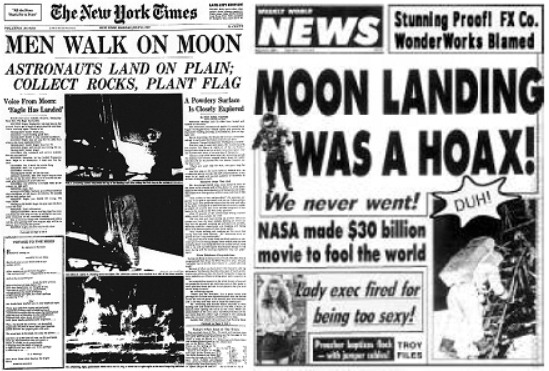
The conspiracies received a boost when, on 15 February 2001, the Fox News TV network aired
Conspiracy Theory: Did We Land on the Moon?. Hosted by X-Files actor Mitch Pileggi, this hour-long, sensational documentary peddled what it called eerie “inconsistencies” in NASA’s Apollo images and TV footage. Among them: no blast craters are visible under the landing modules; shadows intersect instead of running parallel, suggesting the presence of an unnatural light source; and a planted American flag appears to ripple in a breeze although there’s no wind on the moon.

It concluded that the whole Apollo Moon landings were faked in the Nevada desert because, cccording to the conspiracy theorists, NASA did not have the technical capability of going to the Moon, but pressure due to the Cold War with the Soviet Union forced them to fake it. Fox TV did preface the programme with a notice saying: “The following programme deals with a controversial subject. The theories expressed are not the only possible interpretation. Viewers are invited to make a judgement based on all available information.” But skeptics felt Fox didn’t do enough to provide a minimum level of balance in their discussion.

Warning: This is a funny cartoon and not meant to be taken seriously
The documentary’s ‘evidence’ has since been refuted point by point. NASA has also dismissed the documentary’s claims. It prompted Sir Arthur Clarke to protest to his long-time friend Rupert Murdoch, owner of the Fox TV network, for peddling unscientific nonsense.

Rather than being a ‘true believer’, Fox TV may have been trying to boost its audience ratings. But others in the moving images industry apparently take the matter very seriously. Among them is the film-maker Bart Sibrel. His aggressive interview tactics once provoked astronaut Buzz Aldrin (second man to walk on the Moon) to punch him in the face in a 2002 encounter.

“I don’t want to call attention to the individuals who are trying to promote and shuffle off this hoax on people,” Aldrin told CNN in a recent interview. “I feel sorry for the gullible people who’re going to go along with them. I guess it’s just natural human reaction to want to be a part of ‘knowing something that somebody doesn’t know.’ But it’s misguided. It’s just a shame.”

One of the strongest rebuttals of the Moon hoax on TV has come from the Mythbusters series of popular science programmes produced by Beyond Television Productions, originally for the Discovery Channel. The series features special effects experts Adam Savage and Jamie Hyneman, who use basic elements of the scientific method to test the validity of various rumors, myths, movie scenes, internet videos and news stories in popular culture.

In August 2008, they tackled a number of pervasive myths associated with the Moon landing, debunking them one by one. To film the episode, Adam, Jamie and the rest of the Mythbusters team visited the NASA Marshall Space Flight Center in Alabama. A team of Marshall scientists helped the Mythbusters with several of their tests. Here are two excerpts:

Mythbusters probe the ‘Moonlanding photo hoax’

Mythbusters investigate ‘Moonwalk hoax’:


Read Space.com coverage about how Mythbusters busted the Moon Hoax.

Read Popular Mechanics coverage on the Mythbusters exposure

As the 40th anniversary of the first Moon landing passes, the scientific community and rationalists will have to make some hard choices. How much more time and energy must they expend countering such wildly fanciful theories and fantasies? In a world that still has a (dwindling?) number of people who believe in more ancient concepts like the Flat Earth theory, is it really surprising that the Space Age would inspire its own share of modern-day myths?

No matter what the scientists say and how overwhelming the evidence is, conspiracy theories will always believe what they want. Often their convictions border on a blind faith – and as Arthur C Clarke was fond of saying (in relation to religions), one definition of faith is ‘believing in what you know isn’t true!’.

In a pluralistic world, people choose what to believe in
Then there is simple demographics. The total world population in 1969 was 3.6 billion. Today, it has surpassed 6.7 billion. This means nearly half of the people alive today were not even born when Neil and Buzz stepped on to the Moon. At 43, even I have only a headline memory of Apollo 11, even if it’s a strong one.

NASA itself is well aware of this. “As the number of people who were not yet born at the time of the Apollo program increases, the number of questions [about the moon landings] also may increase,” NASA said in a statement on the eve of the anniversary. “Conspiracy theories are always difficult to refute because of the impossibility of proving a negative.”

Perhaps what the Moon Hoax debate really needs is what Sir Arthur Clarke once proposed as a response to the obsession with UFOs and alien abductions: a decade or so of benign neglect. Conspiracy theorists and myth-makers thrive on counter-arguments and debate. When they don’t get it for long enough, they’ll probably run out of steam.

Meanwhile, networks like Fox News should stick to making entertainment programming that is labeled as such. Who can find fault with creations like The Simpsons?

No Moon, please – we’re Ceylonese: How Sri Lanka lost the Moon…

We came in peace for all makind...

When Apollo 11 astronauts landed on the Moon 40 years ago this week, they were more than just Americans taking that historic first step on to another celestial body.

Yes, they planted the US flag there – after all, it was the American tax payers who financed the massive operation. But they left on the Moon other items that signified the universal nature of their mission.

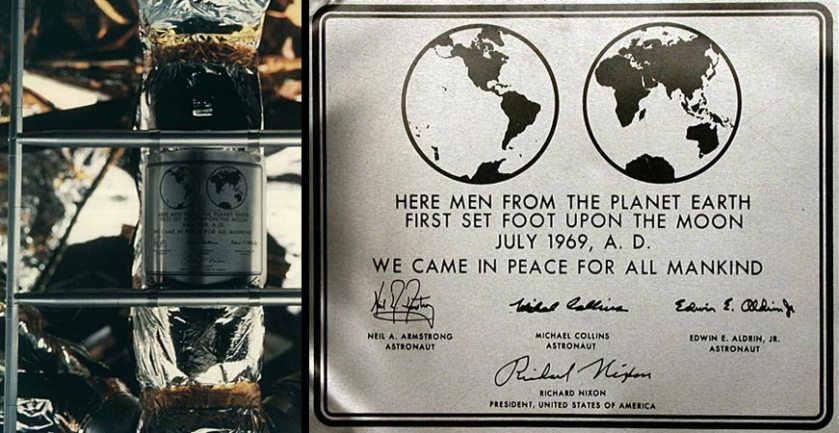
One was a plaque (photo, above) saying “Here men from the Planet Earth first set foot upon the Moon, July 1969 A.D. We came in peace for all mankind.” It bore the signature of the three astronauts –- Neil Armstrong, Edwin (Buzz) Aldrin, Jr., and Michael Collins –- and then US President Richard Nixon. Another was a golden olive branch.

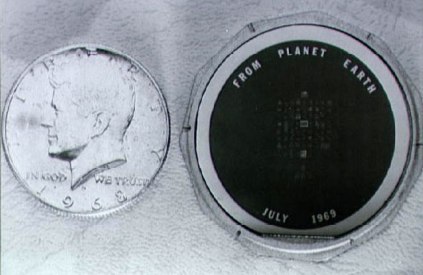
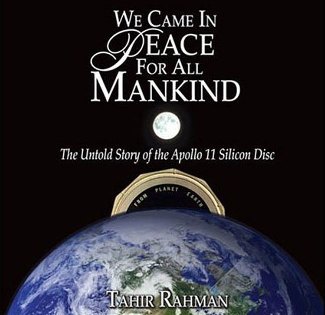
The astronauts also left behind a silicon disc, which is one of the most important and symbolic items taken to the Moon. Etched on to that disc, about the size of a half US dollar coin, are miniaturised messages of goodwill and peace from 73 heads of state or government around the world.

The silicon disc (right) next to a US 50 cents coin for comparison of size
These letters were received by NASA during the final weeks running up to the launch on 16 July 1969, yet this disc helped turn the Apollo 11 mission into an international endeavour.

It was only in June 1969 that the US State Department authorised NASA to solicit messages of goodwill from world leaders to be left on the Moon. This triggered a minor diplomatic frenzy, with invitations going out from Thomas O Paine, the NASA Administrator.

In all, 116 countries were contacted through their embassies in Washington DC, but only 73 responded in time. Sri Lanka, then Ceylon, responded. But for some unknown and unexplained reason, then Prime Minister Dudley Senanayake declined to send a message to the Moon.

When I first heard about it about 18 months ago, I was both intrigued and curious. Was it some misplaced geopolitical considerations, or simple diplomatic arrogance that led to Ceylon’s negative decision? After all these years, we might never find out.

I have now written this up in an article titled ‘How Sri Lanka Missed the Moon’, which appears this weekend in the mainstream media and online in two different versions.

The Sunday Leader newspaper has printed the compact version in its issue for 19 July 2009. Citizen journalism website Groundviews carries the more detailed version, where an interesting reader discussion is evolving…

The story is based largely on a book that came out in 2007. Titled We Came In Peace For All Mankind: The Untold Story Of The Apollo 11 Silicon Disc, it was authored by Tahir Rahman, a Kansas-based physician and space historian.

Uncovering forgotten history
The book documents the full story behind this little known facet of the very widely covered Apollo 11 mission. It also reproduces each of the 73 goodwill messages, as well as those which were received too late for inclusion on the disc.

“I was amazed at how NASA and the State Department rushed to get these messages before launch,” says Rahman. He took two months to locate from the Library of Congress the boxes in which NASA Administrator Paine had preserved the full correspondence.

While researching for this article, I contacted Rahman hoping for some additional insights, but he replied: “I do not have any information about why Sri Lanka did not send an Apollo 11 goodwill message.”

Sir Arthur C Clarke, with whom I worked for over 20 years, was also intrigued by Ceylon’s decision, which he didn’t know about until Rahman’s book reprinted the official letter. His only remark: “Mysterious are the ways governments think and work.”

Reading the messages, whose English translations are available online, is like entering a time capsule. Only two of the world leaders are still holding office (Queen Elizabeth II of Britain, and King of Thailand); most of them are dead. Some countries have since changed names. Others have been subsumed by neighbours, or broken into two or more independent states. Geopolitical map of the world has been completely redrawn.

The story of the Apollo 11 silicon disc is more a history and politics lesson, and less a science story. But I’m glad that I found a little known facet of the very widely covered Apollo missions to write about on its 40th anniversary.

Watch Tahir Rahman interviewed on Fox News network: