Go ahead, just say the word: Condom! Now say it again…

not an easy task...
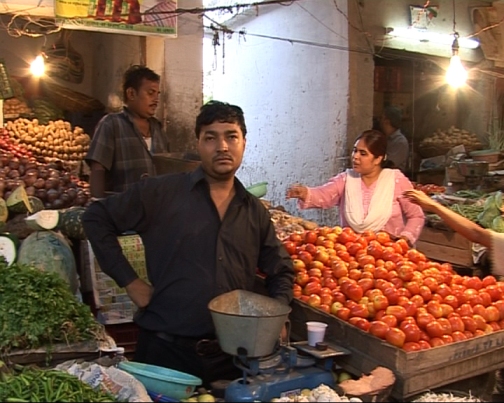
Acting out condoms in broad daylight in India: not an easy task...

Condom!

No one is certain how or where the word originated, but it has become one of those ubiquitous items in modern society.

It’s a two syllable word, fairly easy to pronounce. Then how come so many people – at least in South Asia, home to a fifth of humanity – get their tongues tied or twisted in saying it?

That’s because it’s to do with sex! That’s not a subject that many South Asians still feel comfortable in talking about, in public or even private.

Sex may be a very private matter, but individuals’ sexual behaviour has direct and serious public health implications. Especially today when the world is still struggling to contain and overcome the spread of HIV that causes AIDS.

Condoms originally came into wide use to help prevent unwanted pregnancies and the spread of sexually transmitted diseases (STDs). In the past quarter century, condoms have become a major weapon against HIV.

Despite this, condoms still remain a hush-hush topic among many grown ups, even as the younger generation warms up to them. Across South Asia, we still have some hurdles to clear in normalising condoms – or making it socially and culturally acceptable for people to talk about condom use, and to go out and buy them without fear or shame.

They come in all colours and shapes!

This is the challenge that various communication groups have taken up, especially in India. According to a 2007 survey by UNAIDS and India’s National AIDS Control Organisation (NACO), at least 2.5 million people live with the HIV virus in India, placing the country third in the world after South Africa and Nigeria. However, AIDS prevention in the country is not an easy job. Many people, especially in rural areas, cling on to preconceived taboos about sex — and are often hesitant to use condoms.

In recent weeks, I’ve heard from two campaigns that are trying to change this. One is the BBC World Service Trust working with Indian broadcasters and other partners to normalise condom use through a campaign. I’ll be writing a separate blog post on that effort.

Last month, I received en email from someone called ‘Spread Word for a Better World’, who shared with me web links on a socio-cultural group based in Hyderabad, who are using the performing arts to promote condom awareness.

For over a decade, the Nrityanjali Academy has been singing and dancing their way to the glorification of condom use. They see it as a crucial fight in their central region, where 2 per cent of the population is HIV positive.

P Narsingh Rao, director of Nrityanjali, recently told France 24 online: “Our main target groups are people vulnerable to the HIV virus like sex workers, transsexuals or truck drivers. We tour villages in mobile video vans to show the film. The screening is followed by a question and answer session about condom use and sexually transmitted diseases.”

He added: “We also encourage the use of female condoms, a relatively new concept. We tell the women to negotiate the use of female condoms with their male partners: for men with little sex education, the insertion of the female condom in the vagina can in itself be an erotic act.”

Here are some YouTube videos showcasing their work:

This is an entertaining and educational video in Telugu language on Condom usage, to prevent from sexually transmitted infections and HIV:

A more instructional video on how to use condoms properly:

And finally, an HIV/AIDS song in Telugu – with all the fast-beat music, gyrating and riot of colours we typically associate Bollywood movies and songs with:

The videos speak for themselves. They are matter of fact, engaging and presented by ordinary people (trained entertainers) rather than by jargon-totting medical doctors or health workers. There is none of the awkwardness typically associated with conversations of this subject. No one is tip-toeing around perceived or real cultural taboos. They just get on with it.

Importantly, they involve both men and women, both in performances and in their audiences.

Training young men on just how to do it right...

Related blog posts:

July 2007: The Three Amigos: Funny condoms with a serious mission

April 2007: Beware of Vatican Condoms – and global warming!

Images courtesy France 24’s The Observers.

Alexandr Solzhenitsyn (1918 – 2008): Writer as a second government

image courtesy New York Times
Alexandr Solzhenitsyn: image courtesy New York Times


“For a country to have a great writer … is like having a second government. That’s why no régime has ever loved great writers, only minor ones.”

The great Russian writer Aleksandr Solzhenitsyn, who died 3 August 2008 aged 89, made this remark 40 years ago, in The First Circle (written in the early 1960s, and first published in the West in 1968).

The mighty man, who stood up to one of the most tyrannical states in history – and outlived it by almost 20 years – was buried this week at the Donskoy Monastery, Moscow, as he had wished. That was a far more dignified and respectable departure than what the late, unlamented Soviet Union received when it disintegrated in 1989-90.

From the time his death was reported, post-Soviet Russia, and the rest of the reading and caring world, stood in solemn, grateful silence in awe of the living legend that Solzhenitsyn had become in his own life time. As a small-time writer of no consequence, I join them in my own personal salute.

As every writer – major and minor – who has ever heeded his or her conscience knows, standing up to governments is an extremely hazardous business, especially in a world where might often emerges as right, at least in the short term. In the twenty first century, governments may adopt more subtle methods of suppressing dissent, but their final effect is no less sinister than those brutal ones that Soviet Union followed at the height of the Cold War in the 1950s and 1960s.

I must admit here and now that I haven’t read any of Solzhenitsyn’s celebrated works. But that doesn’t diminish my admiration for him as one of the world’s best known writer-dissidents. Any man who stands up to Big Bad Governments defies all odds, and a man who employs only ideas and words in such a struggle is a greater hero in my mind than anyone else.

A high school teacher of mine, who was a great fan of Solzhenitsyn, once told us: “Never underestimate the power of well written and sincere words.” That was in the mid 1980s, when the writer was living in exile in the United States and the Soviet Union still seemed unshakable. But subsequent events have proved how prophetic those words were.

In a sense, many of us will never quite discover the true Solzhenitsyn. Unless we learn Russian at this stage in life, we can only read Solzhenitsyn through English translations — and as I have discovered this week by browsing widely online for writing by and about him, the quality of these translations vary considerably.

One of the more insightful, short autobiographical pieces is on the Nobel Prize website, where he talks about how he finally came to publish his writing:

“During all the years until 1961, not only was I convinced that I should never see a single line of mine in print in my lifetime, but, also, I scarcely dared allow any of my close acquaintances to read anything I had written because I feared that this would become known. Finally, at the age of 42, this secret authorship began to wear me down. The most difficult thing of all to bear was that I could not get my works judged by people with literary training. In 1961, after the 22nd Congress of the U.S.S.R. Communist Party and Tvardovsky’s speech at this, I decided to emerge and to offer One Day in the Life of Ivan Denisovich.

“Such an emergence seemed, then, to me, and not without reason, to be very risky because it might lead to the loss of my manuscripts, and to my own destruction. But, on that occasion, things turned out successfully, and after protracted efforts, A.T. Tvardovsky was able to print my novel one year later. The printing of my work was, however, stopped almost immediately and the authorities stopped both my plays and (in 1964) the novel, The First Circle, which, in 1965, was seized together with my papers from the past years. During these months it seemed to me that I had committed an unpardonable mistake by revealing my work prematurely and that because of this I should not be able to carry it to a conclusion.”

Thus, the 1960s was the turning point when hitherto obscure Solzhenitsyn burst into the literary landscape of his native country, and his uncompromising stand against the suffering of his people brought him worldwide attention.

Solzhenitsyn’s open letter to the Fourth Soviet Writers’ Congress, on 16 May 1967, was particularly outspoken and expressive of his views of the social responsibility of writers and artistes:
“Literature that is not the breath of contemporary society, that dares not transmit the pains and fears of that society, that does not warn in time against threatening moral and social dangers — such literature does not deserve the name of literature; it is only a façade. Such literature loses the confidence of its own people, and its published works are used as wastepaper instead of being read.”

By then under siege by the entire might of the USSR, and having only his formidable guts and wits as his defence, he already had a strong sense of destiny. In the same open letter, he added: “I am of course confident that I will fulfill my tasks as a writer in all circumstances — from my grave even more successfully and more irrefutably than in my lifetime. No one can bar the road to truth, and to advance its cause I am prepared to accept even death. But may it be that repeated lessons will finally teach us not to stop the writer’s pen during his lifetime? At no time has this ennobled our history.”

Solzhenitsyn’s global stature in the world of letters was reaffirmed in 1970 when he was awarded the Nobel Prize in Literature. But he could not receive the prize personally in Stockholm – he was afraid he would not be allowed back into the Soviet Union. He finally collected his prize only at the 1974 Nobel ceremony after he had been deported from the Soviet Union.

In his Nobel Prize Lecture (delivered to the Swedish Academy but never actually given as a lecture), I came across these words which epitomise the man and his views:
“Woe to that nation whose literature is disturbed by the intervention of power. Because that is not just a violation against ‘freedom of print’, it is the closing down of the heart of the nation, a slashing to pieces of its memory. The nation ceases to be mindful of itself, it is deprived of its spiritual unity, and despite a supposedly common language, compatriots suddenly cease to understand one another. Silent generations grow old and die without ever having talked about themselves, either to each other or to their descendants. When writers such as Achmatova and Zamjatin – interred alive throughout their lives – are condemned to create in silence until they die, never hearing the echo of their written words, then that is not only their personal tragedy, but a sorrow to the whole nation, a danger to the whole nation.”

Solzhenitsyn’s writing is studded with such gems that I’ve resolved to discover even if belatedly. After all, I’m now at the exact age (42) when he finally decided to start publishing his work — a monumental personal decision that has left its mark on history.

For now, my favourite Solzhenitsyn quote is one that resonates so well with my own current turmoils in life: “If one is forever cautious, can one remain a human being?

I think I know the answer.

Celebrating Nelson Mandela…and South Africa’s television revolution

Nelson Mandela

Nelson Mandela‘s long walk to freedom is an epic story of our times, one that continues to inspire millions everywhere who are deprived of that freedom by state tyranny or economic hardships.

As Mandela turns 90 years today, we join people all over the world to celebrate his life and reiterate his message.

Send your greetings to Nelson Mandela on his birthday!

And as Mandela himself reminded us in London during the June 2008 mega musical concert to celebrate his 90th birthday: “Even as we celebrate, let us remind ourselves that our work is far from complete. Where there is poverty and sickness, including AIDS, where human beings are being oppressed , there is more work to be done. Our work is for freedom for all.

American film-maker, social activist and blogger Danny Schechter — who filmed Mandela’s struggle to end apartheid and restore democracy in South Africa — has just remarked: He (Mandela) is one of those leaders who not only helped free his own country and people but became an icon and symbol for freedom in the world. At a time when darkness seems to be descending again, with the economy on the edge amidst protracted wars and pervasive abuses of powers, he is the one person that people the world over look to as a symbol of that saying that ‘another world is possible.’ He is not perfect – who is? He has taken great risks, and made his share of mistakes, but the love and adoration he inspires speaks to how special he is – even as he sees himself as part of a collective, a movement…

The Mandela story has been told many times by many film-makers, writers and journalists. Few other leaders have engaged the media’s attention and popular imagination — both in and out of office — as Mandela has, and with reason.

This is how the BBC in the UK reported the release of Nelson Mandela, by then the world’s most celebrated prisoner, on 11 February 1990.

I find it interesting to go back and watch TV coverage of important events as they unfolded. They say journalists write the first draft of history — that’s done on the run, without the benefit of hindsight or chance to reflect for too long.

In that sense, this BBC television reportage did reasonably well to capture the historic moment of Mandela’s release — the reporter and presenter couldn’t have known what lay ahead for South Africa.

In the report, available on YouTube, there’s a reference to South African television giving live coverage for Mandela’s release. That would have been perfectly logical from a ‘breaking news’ point of view — but there is something very significant and symbolic about that.

During the 1950s and 1960s, South Africa was the only wealthy country in the world that did not have a national television broadcasting service. In fact, despite being the most economically advanced country on the continent, South Africa was among the last in Africa to introduce television broadcasting. The main reason: television was viewed as potentially undermining the apartheid government’s ideology. The white minority regime saw it as a threat to its control of the broadcasting media, even though the state-controlled South African Broadcasting Corporation (SABC) had a virtual monopoly on radio broadcasting.

The minister of broadcasting, Albert Hertzog, simply refused to permit television. He said that TV would come to South Africa “over my dead body”. He denounced it as “a miniature bioscope [cinema] over which parents would have no control.” He also argued that “South Africa would have to import films showing race mixing; and advertising would make (non-white) Africans dissatisfied with their lot.”

Many white South Africans, including Afrikaners, didn’t share Hertzog’s views, and regarded the hostility towards what he called “the little black box” as absurd. When Neil Armstrong became the first man to walk on the moon in 1969, South Africa was one of the few countries unable to watch the event live, prompting one newspaper to remark that “The moon film has proved to be the last straw… The situation is becoming a source of embarrassment for the country.”

But Hertzog was adamant. A few months later, in an interview with The Cape Times on 1 Dec 1969, he admitted: “If, at the present time, you introduce television, you will pay for it with the end of the white man…”

That was an extremely perceptive remark. From the white minority regime’s point of view, the minister was right: if the pen is mightier than the sword, the camera can be mightier than both.

No wonder that most governments, whether liberal or otherwise, try to control – or manipulate – what appears on television, especially domestic transmissions that a majority of their people regularly watch. The power of the idiot box is not to be underestimated, even if it’s often dominated by….well, idiots.

As events turned out, the national and international media – especially television – did play a major role in the transformation of South Africa during the last two decades of the twentieth century.

And we now know: Albert Hertzog’s worst fears came true.

But the world’s worst fears of South Africa descending into utter chaos did not — thanks, largely, to the compassionate vision and leadership of Nelson Mandela.

Watch Nelson Mendela’s inauguration speech, when he was sworn in as the 11th President of South Africa on 27 April 1994:

Historical footnote from Wikipedia:
In 1971, the SABC was finally allowed to introduce a television service. Initially, the proposal was for two television channels, one in English and Afrikaans, aimed at white audiences, and another, known as TV Bantu, aimed at black viewers, but when television was finally introduced, there was only one channel. Experimental broadcasts in the main cities began on 5 May 1975, before nationwide service commenced on 5 January 1976.

The Mandela legacy continues, on air and off air, and more films are still being made about his remarkable life and times. The latest is a new documentary being released this month to mark his 90th birthday. SABC television will premiere it in 18 July during prime time – how times have changed!

Here’s part of the press release from the South African production company that made it:

Viva Madiba: A Hero For All Seasons, a feature length film produced by Anant Singh and Videovision Entertainment as a 90th Birthday Tribute to former president, Nelson Mandela, will have its World Premiere when it is broadcast on Friday, 18 July 2008 on SABC 2 at 21h00.

Viva Madiba: A Hero For All Seasons is a celebration of Nelson Mandela’s epic life and his status as an international icon. In this, the year of his 90th birthday, he remains a man at the centre of attention, not only in South Africa, but around the world as a moral leader, an elder statesman and an exceptional human being.

Viva Madiba: A Hero For All Seasons takes one on a journey behind the headlines and away from the public eye and looks at Madiba as a loyal friend, a dependable comrade, a trusted confidant, a respected mentor, and a man who has touched and transformed countless lives.

For the first time his complete story is being told – a life of struggle, humanity, destiny and greatness is recalled and celebrated by those who knew him best and who worked with him in the quest to break the chains of oppression, taking us beyond the political and into the personal. The programme features exclusive interviews with politicians, close friends and comrades of Madiba, among whom are Archbishop Desmond Tutu, Oliver Tambo, George Bizos, Ahmed Kathrada, Pik Botha, Dorothy Masuka, Nthato Motlana, Cyril Ramaphosa, Helen Suzman, Zolani Mkiva, Jessie Duarte, Francois Pienaar, Sydney Kentridge, Mac Maharaj, Christo Brand and Gill Marcus.

Read and watch Danny Schechter talk about his role supporting the making of Viva Madiba


TV Southasia: Nothing official about this, yipee!

TV South Asia

Nearly one year ago, I wrote a blog post titled: Channel South Asia? Yes and No!

My closing words at the time were:
“I, for one, am relieved that South Asian governments are unlikely to come together in such a venture – we’ve suffered long enough and hard enough with our state-owned, government-controlled, ruling party mouthpieces (both radio and TV) that pollute our airwaves (a public commons) every day and night. Euphemistically called ‘national television’, these conduits of governmental propaganda have progressively lost audience share — and influence — since private channels started operating in the early 1990s. They are today reduced to vanity channels for vane politicians and bureaucrats. The mass audience has long ago abandoned them. I’d rather take chances with a South Asian Murdoch, than with our unaccountable, selfish governments.”

Chevaan Daniel, head of Sri Lanka’s enterprising Channel One MTV, posted a comment soon afterwards, on 27 July 2007, saying: “Maharaja Channels have pioneered this for Sri Lanka, by joining together in an initiative involving media companies from India, Pakistan, Nepal and Bangladesh to launch ‘The SouthAsian’. This collaboration includes a weekly programme produced in Calcutta, aired at the same time in the region. The next step is indeed a SouthAsian Channel, which we are working towards.

Well, I’m delighted to find that over the past 12 months, they have indeed been investing time, creative effort and money in this venture. TV Southasia is now a reality!

It’s a collaborative venture of commercial broadcasters in five countries of South Asia, who have joined hands to produce and share content across their national borders. Mercifully, no governments are involved and certainly none of the state-owned broadcasters (Babu TVs) whose lack of vision and creativity is only matched by their depleting audiences these days.

TV Southasia

Indeed, there’s nothing official about TV Southasia (TVSA), and that’s to be celebrated on its own merit. And if they get it right, TVSA founders — Rtv of Bangladesh, TARANEWS of India, Image Channel of Nepal, Aaj TV of Pakistan and News 1st of Sri Lanka — can tap into an enviably large audience. Between them, their countries have more than 1.5 billion people, most of who have access to television.

TVSA founders are taking one step at a time, perhaps knowing very well that cross-border ventures in South Asia need to be nursed slowly and incrementally, while dealing with assorted historical hang-ups and tonnes of red tape (or these days the colour could well be saffron or khaki, depending on where you live!).

It all started when a group of broadcasters and activists from across South Asia came together in Kolkata in December 2006 and agreed to forge the Southasian initiative. They swapped content to start producing a half-hour magazine programme (containing news analysis, music, features and interviews) from April 2007. Called Southasian, it was produced by Taranewz drawing on content from the participating channels, who then broadcast it weekly and also made it available online.

Taking the next logical step, the five broadcasters decided in August 2007 to form a channel, branded as TV Southasia. It started being previewed on 19 April 2008.
Read more about TV Southasia on its own website

The channel is being distributed by Thailand’s ThaiCom5 satellite, and would be available through cable operators across South Asia. It’s an English language channel, based on the reality that English is the only link language shared and understood by all countries of South Asia.

TVSA says it’s concentrating on talk shows, interviews, lifestyle, music, short films, sports, cuisine and quiz — most of this content is already available through many national channels and occasionally from global channels too. But TVSA can bring in a trans-boundary, pan South Asian outlook which is largely missing in these channels. In fact, it would be refreshing to see a TV channel covering South Asia as a whole, without giving into the frequent pressures or temptations of national tribalism and geopolitical posturing that we see all the time on both BabuTVs and many commercial channels.

Click here for programme lineup on TV Southasia

I have so far only caught glimpses of their offering, when Channel One MTV shows the Southasian magazine show. Going by this limited exposure, I can confirm that the products of this collaboration are superior to what BabuTVs have been struggling to do for two decades through the very official (read: officious and unimaginative) framework of SAARC Audio-Visual Exchange, or SAVE.

Started in 1987, just two years after the South Asian governments formed the regional grouping called South Asian Association for Regional Cooperation or SAARC, SAVE brought together the so-called national broadcasters in radio and TV. Trapped in inter-governmental bureaucracies, they tried to share and carry each other’s broadcast content. The officially sanctioned programmes, often made by committees, completely failed to capture the diversity and vibrancy of what’s going on in each South Asian country that interests the rest of the sub-region. I have no idea if SAVE still exists, because I don’t watch BabuTV anymore (does anybody?). Even in its formative days, I could tell that SAVE was beyond saving…

TV Southasia

Enter TV Southasia – and not a moment too soon. As its website says: “It is for the first time in history that the private electronic media channels have come together and have formed a collaborative channel sharing the same view points on diversity, heritage, bondage and possibilities.”

Unlike many broadcast ventures, TVSA declares its agenda – and it’s a lofty one. It wants to promote highly desirable values like liberalism, scientific temperament, education, heritage and cultural diversity. Rather courageously, it also declares what it is explicitly opposed to, which includes superstition, fundamentalism, corruption, violence, cultural hegemony and communalism — the long and depressing list of evils that keeps hundreds of millions of South Asians in misery, fear and trapped at the bottom of the development ladder. Read TVSA’s vision, mission and ideals

This agenda resonates with the equally passionate, secular idealism of Ujala TV, another satellite broadcast venture aimed at beaming to South Asia since mid 2006. I have been cheering them from the beginning, while my organisation TVE Asia Pacific has been a regular supplier of factual programming for them. Read my July 2007 blog post on Ujala TV – Enriching South Asian airwaves

Well, we need as many idealists as we can find in South Asia. Encouragingly, TV Southasia has already involved Himal Southasian founder and editor Kanak Mani Dixit, a great champion of people-to-people collaboration in South Asia. Perhaps it’s due to Kanak’s influence that the brave new channel is spelling Southasia as one word, as Himal Southasian has been doing for some years now. It might seem an aberration in spelling to some, but in fact, it separates these entirely unofficial, people’s ventures from the many committees and initiatives of the official SAARC, which are endlessly meeting yet constantly failing to forge regional trust, cooperation and cohesion.

The official, officious and unproductive SAARC will be on parade once again at the next Summit due in late July 2008. My SAARCasm is shared by many journalists, intellectuals and activists across South Asia who have tracked the origins and evolution of this grouping since its founding in Dhaka in 1985. To put it charitably, at 23 years of age, SAARC has the mental development of a 3-year-old (if that). We only need to take a look at the People’s SAARC Declaration, adopted in Kathmandu in March 2007, to realise how much the official SAARC has failed to accomplish.

That’s in spite of its frequent and highly expensive meetings. Alas, this time they have chosen to meet in my city of Colombo, which means – after footing a massive Summit bill of LKR 2.8 billion (over USD 27 million) – we ordinary citizens will very likely be kept under virtual house arrest for its duration. All in the name of security, of course.

I hope I can catch a bit more of TV Southasia when the visiting SAARC-babus drive us off our own streets.

Photos and images all courtesy TV Southasia

Below – photos from TV Southasia launch

UNEP’s search for God: Here’s the way forward to save the planet!

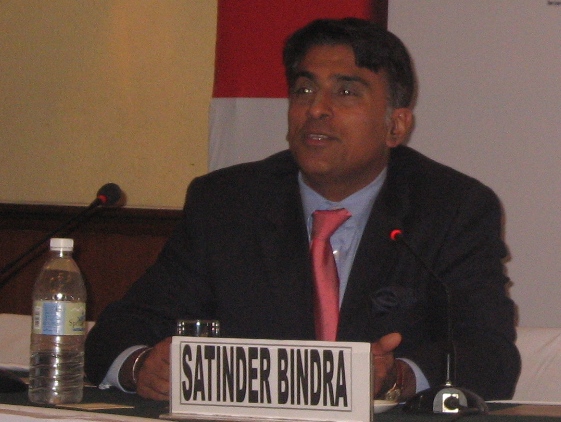
Satinder Bindra
Satinder Bindra: Voice of the Planet?

“Content is king — but distribution is God!”

With these words, UNEP’s newly appointed Director of Communications and Public Information, Satinder Bindra (photo, above), engaged my attention at a meeting in Paris earlier this week.

I almost jumped up in total agreement — this is just what we’ve been saying for years, especially to those who support information, education and communication activities in UN agencies.

Unlike many career UN officials, Satinder knows what he’s talking about. He comes to UNEP with over two decades of wide and varied experience in journalism and broadcasting – the last 10 years spent as a Senior International Correspondent/South Asia Bureau Chief for CNN based in New Delhi, India.

In the hard headed and hard nosed world of international news and current affairs television, distribution and outreach can make or break any content provider. This is something that the two leading news channels BBC World and CNN International know very well — and the more recent entrant Al Jazeera English is still finding out.

Satinder’s remark, in this instance, was more to do with how to get information and analysis on sustainable development out to as many people as possible in all corners of the planet. This is part of UNEP’s core mission since its founding in 1972 — and as chief of communication and public information, Satinder now takes on this formidable challenge.

In Paris, he was listening, taking notes and talking to everyone in the small group who’d come together for the annual partner meeting of the Com Plus Alliance of Communicators for Sustainable Development.

Com+ is a “partnership of international organizations and communications professionals from diverse sectors committed to using communications to advance a vision of sustainable development that integrates its three pillars: economic, social and environmental”. TVE Asia Pacific was admitted to the partnership a few months ago.

As I’m sure Satinder realises, at stake in his new assignment is a lot more than audience ratings, market share or revenue stream of a single broadcaster. Those are important too, but not in the same league as ensuring life on Earth – in all its diversity and complexity – continues and thrives.

Satinder struck me as a practical and pragmatic journalist who wants to get the job done efficiently. We can only hope the rest of UNEP will keep up with him — or at least they don’t get too much in his way!

As he finds his way around the globally spread, multidisciplinary and sometimes heavily bureaucratic UN organisation, Satinder will come across some incongruities, cynicism and institutional inertia all of which have held UNEP back from being the dynamic global leader in our pursuit of elusive sustainable development.

At the big picture level, communication at UNEP has often been defined narrowly as institutional promotion – delivering UNEP logo to the news media of the world, or boosting the image of its executive director and other senior officials. We don’t grudge anyone enjoying their 15 minutes of fame, but a technical agency like UNEP has so much more to offer — in terms of rigorous science, multiple perspectives, wide ranging consultation and bringing diverse players to a common platform.

The Nobel Peace Prize winning Inter-governmental Panel on Climate Change (IPCC), co-supported by UNEP and World Meteorological Organisation, is a good recent example of how solid science, communicated through the media, can inspire governments, industry and rest of society to find solutions to a major global challenge.

The 20-year success of the Montreal Protocol to save the ozone layer is another example. Again, UNEP was a key player in this accomplishment, and is still engaged in the race to phase out the use of a basket of chemicals that damage the protecting ozone layer in the upper atmosphere.

There’s a lot more good science and tons of good stories lurking inside UNEP — if only its experts know how to get these out, and if only its bean-counters won’t stand in the way.

Ironically, elsewhere in the same UNEP Paris building that we were having the Com Plus meeting, the adorable cartoon character Ozzy Ozone (below) was being holed up by excessive rules and regulations. He is one of the best known public communication products to come out of the organisation. Yet, as I wrote earlier this year, he is bottled up and kept captive by an unimaginative UN system.

Then there is the whole scandalous situation where UNEP-funded environmental films are released with needlessly excessive copyright restrictions. As I have been saying, this is the big mismatch in environment and development film-making: many films are made using donor (i.e. public or tax payer) funds, but due to the ignorance or indifference of funders, the copyrights are retained by private individuals or companies involved in the production.

In UNEP’s case, for years it has been commissioning (and sometimes funding) a London-based production company, with a charitable arm, to produce environmental films. That’s certainly a choice for UNEP if the agency feels it continues to get value for its money. But tragically, the producers jealously guard all the copyrights, releasing these only under rigid conditions to a select few.

Whatever outreach figures they might claim, these cannot match what the same films would achieve if the copyrights were not so restrictive. Freed from crushing rights, such environmental films – made with UNEP funding or blessings or both – could benefit thousands of groups engaged in awareness, advocacy, activism, education and training.

For sure, we’ve heard the arguments in favour of tight copyright regimes. Film-makers have every right to be acknowledged for their creative efforts, but public funded products must not be locked up by greedy lawyers and accountants — or even by selfish film-making charities. And millions of users around the world should be able to access such products without having to get through the eye of the copyright needle first.
July 2007 blog post: Lawyers who locked up the butterfly tree

Can Satinder Bindra overcome these hurdles that have for so long inhibited UNEP from reaching its potential? We just have to wait and see.

When he talks about distribution being God, we have to readily agree. But he will soon find some elements within UNEP – or in crony partnerships with UNEP – that stand between him and this God.

To be fair, there’s only so much that an inter-governmental agency like UNEP – beholden to its member governments – can really accomplish. That’s why it needs partners from corporate, civil society, activist and academic spheres. Some of us can easily say and do things that UNEP would, in all sincerity, like to — but cannot.

Satinder sounds like he can forge broad alliances that go beyond monopolist partnerships. Here’s wishing him every success….for everyone’s sake!

Photo courtesy UNEP Climate Neutral Network

Telecom Without Tears: Book Review

My review of the book, ICT Infrastructure in Emerging Asia: Policy and Regulatory Roadblocks, was printed in Financial Times on Sunday, Sri Lanka, on 18 May 2008.

The book, co-edited by Rohan Samarajiva (in photo, below) and Ayesha Zainudeen, is published jointly by Sage Books and Canada’s IDRC. It is based largely on the work of my friends and colleagues at LIRNEasia.

Although the book showcases recent telecom and ICT reform experiences in five economies in South and Southeast Asia (Bangladesh, India, Indonesia, Nepal and Sri Lanka), my review takes a closer look at the Sri Lankan situation partly because I live and work there, and because the review was intended more at a Sri Lankan readership.

Here’s my opening:

“In the early 1990s, I had to wait for nearly six years for my first (fixed) telephone – I refused to pay bribes or use ‘connections’ to bypass thousands of others on the notorious waiting list. Earlier this year, when I bought an extra mobile phone SIM from Dialog GSM, it took six hours for the company to connect it. I found that a bit too long.

“How things have changed! Connectivity without (social) connections, and practically off-the-shelf, is now possible in most parts of Sri Lanka. Telecommunications is the fastest growing sector in the economy, recording 47 per cent growth in 2007 (and 58 per cent in 2006). The country’s tele-density (number of telephones per 100 persons) jumped to 54 in 2007, from 36 at the end of 2006 -– thanks largely to the phenomenal spread of mobile phones, which now outnumber fixed phones by three to one.”

One quick – albeit a bit unfortunate – way to introduce this book is that it apparently scared some sections of Sri Lanka’s state bureaucracy. When copies arrived from the Indian publisher earlier this year, they were held up at Customs for over three months for no logical or coherent reason. The editors speculated whether it had something to do with one chapter (among 13) looking at telephone use in war-ravaged Jaffna during the ceasefire (which lasted from 2002 to 2008), but this was neither confirmed nor denied.

In my review, I make the point: “It was a stark reminder, if any were needed, of the turbulent settings and often paranoid times in which telecom liberalisation has been taking place in many parts of emerging Asia.”

And I return to the larger political reality in my conclusion, as follows:
“Now that the ICT genie has been set loose, it’s impossible to push it back into the dusty lamp of the monopolist past, even under that much-abused bogey of ‘national security’ (or its new, freshly squeezed version, ‘war against terror’). Despite this, the officialdom and its ultra-nationalist cohorts don’t give up easily. While this book was in ‘state custody’, Sri Lankans experienced the first government-sanctioned blocking of mobile phone SMS – ironically on the day marking 60 years of political independence.

Photo below shows several contributing authors at the book’s launch in Chennai in December 2007


Read the review online

Download the review as a pdf document (47kb)
telecom-without-tears-by-nalaka-gunawardene-may-2008

Read or download the book electronically from IDRC website

Burmese television: Meet Asia’s model public broadcaster!

Photo courtesy Associated Press

In the wake of Cyclone Nargis that wreaked havoc in Burma, the world has once again realised the brutality and ruthlessness of the military regime that runs the country.

And as the United Nations and aid agencies struggle with the incredibly uncaring Burmese bureaucracy to get much needed emergency relief for the affected Burmese people, the media outside Burma are having great difficulty accessing authentic information and images.

Despite the massive disaster and resulting tragedy, Burma remains closed to foreign journalists, especially the visual media. No doubt the memories of the monk-led pro-democracy protests of late 2007 are still fresh in the minds of the ruling junta and their propagandists. The few courageous foreign reporters who managed to get in at the time ran enormous personal risks, and Japanese photojournalist Kenji Nagai was shot dead by a Burmese soldier while filming demonstrations.

Unable to report from the multiple scenes of disaster, and lacking a wide choice of reliable local sources willing to go on the record, international news agencies and broadcasters have been forced to quote the government-owned Burmese television station, MRTV.

Global news leaders like Al Jazeera, BBC and CNN have all used MRTV visuals to illustrate their news and current affairs reportage. A recent example from Al Jazeera, posted on 8 May 2008:

The image monopoly by MRTV wouldn’t have mattered so much if they at least provided an accurate account of the unfolding events in its own country. But that seems far too much to expect of this mouthpiece of the Rangoon regime. In Burma’s darkest hour in recent memory, MRTV would much rather peddle the official propaganda – never mind the millions made homeless by the recent disaster.

Here’s an insight from the Inter Press Service, the majority world’s own news agency, reporting from their Asia Pacific headquarters in Bangkok, Thailand:

BURMA: Cyclone Nargis Exposes Junta’s Anti-People Attitude
By Larry Jagan, IPS

Worse, there is evidence emerging that the military authorities had ample warning of a storm brewing in the Bay of Bengal but chose to ignore, or even suppress, it.

The Indian Meteorological Department (IMD) which keeps a close track of geo-climatic events in the Bay of Bengal and releases warnings not only to provinces on the Indian east coast but also to vulnerable littoral countries said it warned Burmese authorities of Cyclone Nargis’ formation and possible approach as early as on Apr. 26.

“We continuously updated authorities in Myanmar (as Burma is officially called) and on Apr. 30 we even provided them a details of the likely route, speed and locations of landfall,’’ IMD director B.P. Yadav told IPS correspondent in New Delhi, Ranjit Devraj.

Burma’s meteorology department did post a warning on its official website on Apr. 27 but no effort was made to disseminate information to the people, much less to carry out evacuations along the coastline or from the islands on the Irrawaddy Delta.

By the time state-run media, which has been continuously spewing propaganda and exhorting the public to vote ‘yes’ to Saturday’s constitution referendum, issued its first cyclone alert on Friday afternoon it was too late for the hapless residents of Rangoon.

courtesy Reuters

Elsewhere in the report, IPS says:

Pictures of soldiers removing fallen trees and clearing roads in Rangoon on the state-run television have further infuriated many in the city. “This is pure propaganda and it’s far from the truth,” e-mailed a Burmese journalist, asking not to be identified for fear of the consequences. “Why do foreign broadcasters show them too –Burmese government propaganda is a disgrace enough to journalism,” he fumed.

“I saw some soldiers getting onto a truck yesterday,” said a 50-year-old resident. “They had no sweat on their shirts, despite what was shown on TV!”

“My wife saw three truckloads of soldiers parked in front of a fallen tree, none of them got down to remove it,” he added.

And here is what Dinyar Godrej has to say on the website of New Internationalist, another pro-South, liberal media outlet. In a post titled ‘Seeing but not believing’, he says:

“Burma is shut off from foreign journalists (unless they are invited in by the military regime to cover specific showpiece events). Western news channels have had to rely on state run television for their moving images.

“So while the death toll is now officially 22,000 (unofficially up to 50,000), with 40,000 people missing and a million homeless; and while the regime is coming in for bitter criticism for its foot-dragging over opening up to international aid and the utter incompetence of its own relief effort so far (which has reached only a tiny fraction of the people affected), we are watching on our television screens soldiers handing over food parcels. We can see nothing of the grief or rage of the people going hungry and thirsty (many water sources are too contaminated to use). They do not talk on camera. Instead they sit obediently in the state TV images, taking what’s given to them. And we watch them, while listening to the numbers and being told of the heightening crisis.”

Appalling as these revelations are, they don’t surprise us. Indeed, MRTV is not alone in this kind of shameless abuse and prostitution of the airwaves, a common property resource. A vast majority of the so-called ‘public’ broadcasters in Asia behave in exactly the same callous manner. This is why I don’t use the term ‘public broadcaster’ to describe these government propaganda channels – because, whatever lofty ideals their founding documents might have, most of them are not serving the public interest any more (if they ever did).

As I commented in Feb 2008: “In developing Asia, which lacks sufficient checks and balances to ensure independence of state broadcasters, the only thing public about such channels is that they are often a drain on public money collected through taxes. Their service and loyalties are entirely to whichever political party, coalition or military dictator in government. When the divide between governments and the public interest is growing, most ‘public’ channels find themselves on the wrong side. No wonder, then, that discerning views have abandoned them.”

Read Feb 2008 post: Why do development Rip van Winkles prefer ‘Aunties’ without eyeballs?

I don’t hold a grudge against the hapless staff of MRTV, who simply must remain their Masters’ Voice at all times to stay alive. Those working for government channels in countries with greater levels of democratic freedom can’t take refuge in this excuse. They must be held accountable for their continuing propagandising and the disgusting pollution of the airwaves.

And the incredibly naive and sycophantic UN agencies – especially UNESCO – also share the blame for their feeble yet persistent defence of the so-called public broadcasters. Years ago, I stopped attending meetings discussing public service broadcasting (PSB) in Asia, which these agencies equate with what the government channels are doing. I see yet another of these exercises in futility being lined up as part of the Asia Media Summit 2008 coming up in a few days in Kuala Lumpor.

As I wrote in February, if these development agencies are seriously interested in broadcasting that serves the public interest, they must engage the privately-owned, commercially operated TV channels, which are the market leaders in much of Asia.

Except, that is, in tightly controlled, closed societies like Burma, where government channels are the only terrestrial TV available for the local people.

Images courtesy AP and Reuters, as published by The New York Times online

Arthur C Clarke on the Future of Food: We need a smarter and kinder world

The leading Indian newspaper The Hindu has just published (on 4 May 2008) my article on the future of food, based on the views of Sir Arthur C Clarke. It can be found here.

I originally wrote this article in mid 2000, based on an interview with the late Sir Arthur Clarke. It was produced at the request of the UN Food and Agriculture Organisation (FAO), which included it in an information pack to mark World Food Day in October that year. No doubt they circulated it among the charmed development circle, but as far as I know (or Google can find), it never appeared in a public media outlet – until now.

I came across this in the weeks following Sir Arthur’s death on March 19, when I was going through manuscripts of our collaborative essays and my interviews with him over the years. The Hindu‘s Sunday Magazine, which earlier printed my essay on Sir Arthur’s views on nuclear weapons in South Asia, agreed to publish it, which they did on 4 May 2008.

The essay, written in Sir Arthur’s first person narrative, makes a number of points that are very relevant to discussions on today’s global food crisis. In fact, these points are more valid today than when they were first made eight years ago.

An extract:

“Meeting everybody’s basic nutritional needs requires a combined approach of the mind and heart – of intellect and compassion. How can we explain the fact that one sixth of humanity goes to bed hungry every night, when the world already produces enough food for all?

“The short answer is that there are serious anomalies in the distribution of food. Capricious and uncaring market forces prevent millions of people from having at least one decent meal a day, while others have an abundance. For the first time in history, the number of severely malnourished persons now equals the number suffering from over-consumption: about a billion each!

“To adapt a remark that my late friend Buckminster Fuller once made about energy: there is no shortage of food on this planet; there is, however, a serious shortage of intelligence. And, I might add, compassion.

Sir Arthur then runs up his famous ‘crystal ball’ to gaze at the near and far future on how humanity can feed itself without damaging the planet. He offers some useful lateral thinking and suggests some unlikely new sources of food.

But all these are short term solutions, he says, because “eventually, the matter will be resolved when we are able to synthesise all the food we ever need, thus no longer depending on other animals to satisfy our hunger.”

Towards the end of the essay, he takes the big picture view:

“Improved communications and the free flow of information will not, by themselves, eradicate either hunger or poverty — but they can be instrumental in the struggle to create a world without these. And when the world’s collective conscience finally succeeds in mobilising sufficient political will and resources to banish those twin scourges, we will be left with another, far more insatiable but far less destructive substitute — the hunger for knowledge and wisdom.”

Read the full essay: The future of food – Arthur C Clarke talks to Nalaka Gunawardene

Women on the Frontline: Reporting from the battlefront at…home!

“Violence against women threatens the lives of more young women than cancer, malaria or war. It affects one in three women worldwide. It leaves women mentally scarred for life — and it is usually inflicted by a family member.”

With these words, Annie Lennox, the British singer and social activist, presents a new global series of investigative television documentaries called Women on the Frontline that begins on the global satellite TV channel BBC World today, 18 April 2008.

The seven half-hour films shine a light on violence against women and girls in different parts of the world – East and West, North and South. The series takes the front to homes, villages and cities of our world where a largely unreported war against females is being waged.

Read my Feb 2008 blog post: Half the sky, most of the suffering…

The films cover Nepal, where thousands of women are trafficked each year; Turkey, where killing in the name of honour continues; Morocco, where women political activists who have survived torture and imprisonment testify before a government truth and reconciliation commission; the DRC, where women bear the brunt of a 10-year war in the eastern provinces; Colombia, where women have been tortured in the shadow of a guerilla war; Mauritania, where women who have been raped may go to prison; and Austria, where, under a new law, perpetrators of domestic violence are forced to leave home.

Here’s the line up of depressing reports in this series, produced by Geneva-based dev tv and London-based One Planet Pictures – both international partners of TVE Asia Pacific.

Nepal: A Narrow Escape
Turkey: Killing in the Name of Honour
Morocco: Never Again
Democratic Republic of Congo: Find a Word for It
Austria: Showing the Red Card
Mauritania: No film name known yet
Colombia: Justice in the Region of Death

Check dev tv website for broadcast times on BBC World

On the Frontline… is a ‘vehicle’ for independent producers to tell compelling stories about the people who uphold civil society where it is most at threat. The strand started with the 2006 pilot series Doctors on the Frontline, a profile of Medecins Sans Frontieres (MSF) field doctors made by Dev TV film-makers.

Since then, the series has covered villages battling desertification and land degradation, nurses and para-medics on humanitarian missions in hot spots of the world, and children living with social and environmental disintegration.

On the Frontline has gone behind the lines with rebels and filmed among violent street gangs but this time we’ve taken the frontline mostly into the home, where even after 20 years in production, I’m still shocked to see how many obstacles lie between women and equality, and the violence they must still endure,” said Robert Lamb, Executive Director of the series.

A number of UN agencies, including UNFPA and UNIFEM, donor countries such as Austria, non-governmental organizations and other partners provided information and support for the latest series of Women on the Frontline.

Soon after its initial run on BBC World, the series will be distributed in the Asia Pacific region by TVE Asia Pacific.

Read official brochure of Women on the Frontline TV series

March 2008 blog post: Unseen women, unheard voices

Mallika Wanigasundara: Trail-blazer in issue-based journalism

I seem to be writing many obituaries and tributes these days. Following the several I wrote on Sir Arthur C Clarke and the blog post I did on Cambidian photojournalist Dith Pran, I want to share this tribute I wrote today on a senior Sri Lankan journalist who embarked on her final voyage this weekend.


Mallika Wanigasundara:
Trail-blazer in issue-based journalism

Mallika Wanigasundara, who passed away on 4 April 2008 aged 81, was a talented and sensitive Sri Lankan journalist who went in search of causes and process that shape the everyday news headlines. In doing so, she blazed new trails in issue-based journalism, covering topics ranging from health and environment to children, women and social justice.

It was only last year that the Editors Guild of Sri Lanka and the Sri Lanka Press Institute presented her the Lifetime Achievement Gold Medal for Excellence in Journalism.

Mallika was associated with the Sri Lankan media in one capacity or another for over half a century. Starting her professional career in 1956 with the Sinhala evening daily Janatha, she later moved on to English language journalism at Lake House where she worked first in The Observer and then at Daily News. It was as Features Editor of this oldest English daily that she played a key role in practising and nurturing development journalism. She helped evolve the genre to new levels of professionalism, liberating it from the typecast of politically motivated, sometimes fabricated ‘sunshine’ stories that had been forced on the state-owned Lake House newspapers during the 1970s.

Mallika also helped put Sri Lanka on the world map of development journalism. Beginning in the early 1980s, she contributed Sri Lankan stories to Depthnews, published by the Press Foundation of Asia based in Manila, and to Panos Features, syndicated globally by the Panos Institute in London. In those pre-web days, these services – when printed in newspapers and magazines – were among the most dependable sources for ground level reporting from far corners of the world. (Alas, both services have since gone the way of the Dodo – not to mention Asiaweek, South and Gemini.)

Although I grew up in the 1980s reading her writing in Daily News, my own contacts with Mallika were few and far between. The first was indirect and happened in the late 1980s, when as an eager young reporter I started contributing to Panos Features, syndicated from London to several hundred newspapers around the world. Mallika remained the Panos Sri Lanka correspondent and I was merely a stringer. Donatus de Silva, then head of programmes at Panos London, somehow found a clear niche for both of us. At the time, Mallika and I exchanged occasional communications.

As a novice, I studied Mallika’s approach and style, and emulated them both. Hers was an easy, reader-friendly prose: it brought in both expert views and grassroots insights, but with none of the technicality or pomposity – and very little editorialising. Although she was fully supportive of the various social and environmental causes, she didn’t allow activist rhetoric to dominate her journalism. She also ventured beyond the predictable ‘green’ issues to cover many ‘brown’ issues. Two decades after the Brundtland Commission on Environment and Development (1987) that thrust sustainable development into the global agenda, it’s precisely this kind of journalism that’s needed to make sense of our fast-moving, slowly-baking, topsy-turvy world.

Mallika continued to be an active freelancer after she retired from Lake House. She seemed more prolific in retirement – she continued to chronicle the rise of the environmental movement in Sri Lanka, which emerged from citizen campaigns to save the Sinharaja rain forest from state-sponsored logging and evolved through crises and protests in the 1980s and beyond.

In 1990, she was selected by the United Nations Environment Programme for the Global 500 award that recognised environmental achievements of individuals and organisations. She was the first Sri Lankan journalist to be thus honoured, and one of only four Sri Lankans to be inducted into this global roll of honour that eventually included over 600 persons or entities worldwide.

At the time, I was hosting a weekly TV quiz show on Rupavahini (national TV) and decided to set one of my questions on Mallika receiving the Global 500. I phoned her to offer my congratulations and asked for a photo that we may use on the TV show. She was happy to be the basis of a question, but declined giving a photo, saying: ‘I don’t look good in photos or on TV’.

It was characteristic of many accomplished journalists of her generation that they remained mostly in the background, shaping news coverage and analysis. Some even didn’t nurture a personal by-line, writing under pseudonyms or simply not signing their names on their work. What a contrast with the image-conscious, in-your-face radio and TV journalism of today, where even respected newspaper editors eagerly pursue parallel careers as talk show hosts or TV pundits.

Read my essay on environmental journalism 20 years after Brundtland, published in SciDev.Net in April 2007