Something else with far-reaching implications happened a few weeks later, but was not noted as significant outside the circles of nerds and geeks. On 2 September 1969, computer scientists at the University of California, Los Angeles, established a network connection between two computers — creating the very first node of what we now know as the Internet.
At the time, engineer and computer scientist Leonard Kleinrock and his colleagues were charged with developing the Advanced Research Projects Agency Network (or ARPANET), a US government-funded research project in global computer communications that eventually grew into the Internet.
Although some celebrated the Internet’s 40th birthday on 2 September 2009, others held that the network didn’t really have ‘life’ until 29 October 1969. On that day, a message was typed by Kleinrock and sent to the second node at Stanford Research Institute. That “was the first breath of life the Internet ever took,” says Kleinrock.
Given the complexity that the Internet has evolved to, it isn’t surprising that the actual birthday is hard to pin down and is the subject of endless discussion among geeks and wonks online. For the rest of us grateful users of the Internet — most of the 1.6 billion people estimated as connected — we can celebrate the Internet’s 40th birthday through the months of September and October 2009.
But as this recent AP story reminds us, goofy videos weren’t on the minds of Len Kleinrock and his team at UCLA when they began tests 40 years ago on what would become the Internet.
Associated Press story, 31 August 2009: Internet Creators Didn’t Foresee Today’s Web
So as the Internet turns 40 – is it downhill from now? Or does life actually begin at 40? (As someone who is three years older than the Internet, I would say yes!).
“The Internet has just reached its teenage years,” Kleinrock said in an interview with Computerworld recently. “It’s just beginning to flex its muscles. The fact that it’s just gotten into its dark side – with spam and viruses and fraud — means that it’s like an [unruly] teenager. That too will pass as it matures.”
British techno-historian and columnist John Naughton (author of ‘A Brief History of the Future: Origins of the Internet‘) describes the Internet as an attempt to answer the following question: How do you design a network that is “future proof”–that can support the applications that today’s inventors have not yet dreamed of? The solution was to devise a network of networks that would not be biased in favor of any particular application. The Internet’s creators didn’t want the network architecture–or any single entity–to pick winners and losers. Because it might pick the wrong ones. Instead, the Internet’s open architecture pushes decision-making and intelligence to the edge of the network–to end users, to the cloud, to businesses of every size and in every sector of the economy, to creators and speakers across the country and around the globe.
In the words of Tim Berners-Lee, the Internet is a “blank canvas”–allowing anyone to contribute and to innovate without permission. It was Berners-Lee, as a young computer scientist, who is credited with inventing the World Wide Web, making the first proposal for it in March 1989. So the web turns 20 this year as the Internet itself passes 40.
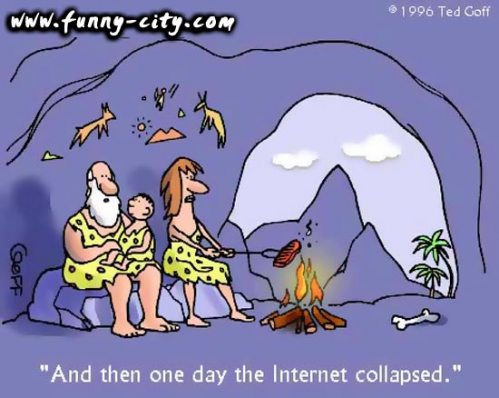
Anyone dares to predict what can happen in the next 20 years? Here’s one prophecy I hope will never come to pass…
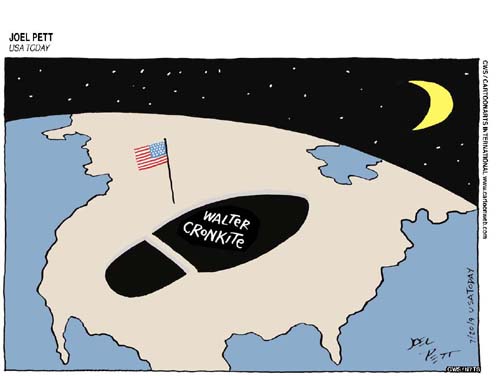
“What matters about Cronkite is that he knew when to stop being reassuring Uncle Walter and to challenge those who betrayed his audience’s trust. He had the guts to confront not only those in power but his own bosses. Given the American press’s catastrophe of our own day — its failure to unmask and often even to question the White House propaganda campaign that plunged us into Iraq — these attributes are as timely as ever.
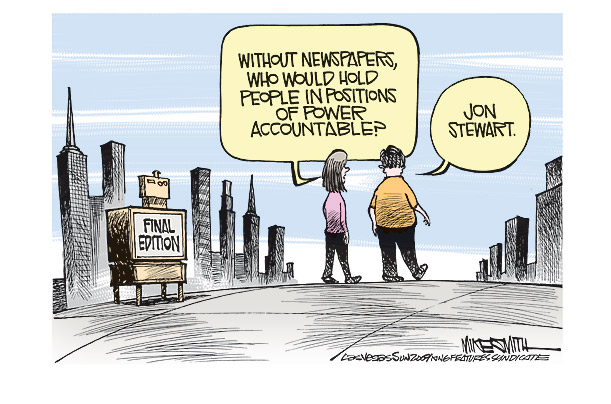
“That’s why the past week’s debate about whether there could ever again be a father-figure anchor with Cronkite’s everyman looks and sonorous delivery is an escapist parlor game. What matters is content, not style. The real question is this: How many of those with similarly exalted perches in the news media today — and those perches, however diminished, still do exist in the multichannel digital age — will speak truth to power when the country is on the line? This journalistic responsibility cannot be outsourced to Comedy Central and Jon Stewart.”
I cannot agree more with the premise and arguments in this essay, which is well worth a careful, slow read by everyone, everywhere who cares for good journalism — either as practitioners or consumers (and in this media saturated age, don’t we all fall into one or both categories?).
At the same time, without detracting from the value of — and the crying need for — investigative, reflective and ‘serious’ journalism, I believe comedy and especially political satire play a key role today in analysing and critiquing politicians, businessmen and others whose decisions and actions impact public policy and public life.
Anchor, anchor, burning bright...Political satire is nothing new: it’s been around for as long as organised government. Over the centuries, it has manifested in many oral, literary or theatrical traditions, some more memorable and enduring – such as Gulliver’s Travels and Animal Farm. And for over a century, political cartoonists have been doing it with brilliant economy of words – as I have said more than once on this blog, they are among the finest social philosophers of our times.
In the age of electronic media, it’s only natural that the tradition of satire thrives on the airwaves and online. In fact, there is a rich and diverse offering of politically sensitive and/or active satire in the mainstream and online media that we can consider it a genre of its own. Some of it is so clever, authentic and appealing that we might momentarily forget that we are experiencing a work of satire.
Purists might decry this blurring of traditional demarcations between information, commentary and entertainment — but does that really matter?
When we survey the media and cultural scenes in our globalised world, we see things getting hopelessly entangled and mixed up everywhere. Nothing is quite what they seem – or claim – to be anymore. Content that is explicitly labelled as pure news and current affairs is looking more and more like entertainment. My friend Kunda Dixit, who edits the Nepali Times, says this is inevitable when the same mega corporations own both cartoon networks and news channels.
No news is good news -- for whom?If the mainstream news organisations don’t quite live up to our expectations to gather, analyse and reflect on the current affairs of the day, we should at least be grateful that some comedians are stepping into that void. We must welcome, celebrate and wish their tribe would increase!
The rise and rise of political satire is also being chronicled and analysed. A new book tells us why we now have to take satire TV seriously — it turns out to be the bearer of the democratic spirit for the post-broadcast age. Titled Satire TV: Politics and Comedy in the Post-Network Era, the book is co-edited by Jonathan Gray, Jeffrey Jones and Ethan Thompson (NYU Press, April 2009).
Here’s the blurb introducing the book: “Satirical TV has become mandatory viewing for citizens wishing to make sense of the bizarre contemporary state of political life. Shifts in industry economics and audience tastes have re-made television comedy, once considered a wasteland of escapist humor, into what is arguably the most popular source of political critique. From fake news and pundit shows to animated sitcoms and mash-up videos, satire has become an important avenue for processing politics in informative and entertaining ways, and satire TV is now its own thriving, viable television genre. Satire TV examines what happens when comedy becomes political, and politics become funny.”
The book contains a series of original essays focus on a range of popular shows, from The Daily Show to South Park, Da Ali G Show to The Colbert Report, The Boondocks to Saturday Night Live, Lil’ Bush to Chappelle’s Show, along with Internet D.I.Y. satire and essays on British and Canadian satire. “They all offer insights into what today’s class of satire tells us about the current state of politics, of television, of citizenship, all the while suggesting what satire adds to the political realm that news and documentaries cannot.”
Let me summarise the news so far. Intentionally or otherwise, some news anchors and politicians are increasingly behaving like comedians. Meanwhile, a few professional comedians are talking serious politics and current affairs in a genre of media that is growing in popularity by the day.
Are you confused yet? Well, get used to it. This is the shape of things to come.
In such topsy-turvy times, we need more Jon Stewarts to puncture the bloated egos and images of not only elected and other public officials, but also of our larger-than-life news anchors, editors and media tycoons. I would any day have conscientious comedians doubling as social and political commentators than suffer shallow, glib newscasters trying to be entertainers. That’s what you call laughing for a good cause.
Parting thought: There is another dimension to satirising the news in immature democracies as well as in outright autocracies where media freedoms are suppressed or denied. When open dissent is akin to signing your own death warrant, and investigative journalists risk their lives on a daily basis, satire and comedy becomes an important, creative – and often the only – way to comment on matters of public interest. It’s how public-spirited journalists and their courageous publishers get around draconian laws, stifling regulations and trigger-happy goon squads. This is precisely what is happening right now in countries like Kenya and Sri Lanka, and it’s certainly no laughing matter. More about this soon.
Backgrounder: The news as you never saw it before...The Daily Show with Jon Stewart, is an American late night satirical television programme, airing on Comedy Central, a cable/satellite channel. The half-hour long show is presented as a (fake) newscast. In their own words, the Daily Show team “bring you the news like you’ve never seen it before — unburdened by objectivity, journalistic integrity or even accuracy.” It “takes a reality-based look at news, trends, pop culture, current events, politics, sports and entertainment with an alternative point of view.”
The show premiered in July 1996, and was initially hosted by Craig Kilborn. Jon Stewart took over as host in January 1999, and made it more strongly focused on politics. In each show, anchorman Jon Stewart and his team of correspondents, comment on the day’s stories, employing actual news footage, taped field pieces, in-studio guests and on-the-spot coverage of important news events.
This is what the Wikipedia says: “The program has grown in popularity since Jon Stewart took over hosting, with organizations such as the Pew Research Center claiming that it has become a primary source of news for many young people, an assertion the show’s staff have repeatedly rejected. Critics, including series co-creator Lizz Winstead, have chastised Stewart for not conducting hard-hitting enough interviews with his political guests, some of whom he may have previously lampooned in other segments; while others have criticized the show as having a liberal bias. Stewart and other Daily Show writers have responded to both criticisms by saying that they do not have any journalistic responsibility and that as comedians their only duty is to provide entertainment.”
OK, The Daily Show may not be intentionally serious journalism, anymore than mainstream news channels are intentionally funny. But a significant number of American TV viewers and TV critics, as well as media researchers, have found the analysis and commentary to be highly insightful and incisive. It has won many awards including an Emmy and Peabody Award. It’s been on the cover of Newsweek for its outstanding elections coverage and serious journalism. It’s not to be laughed off easily. After the Last Newspaper...
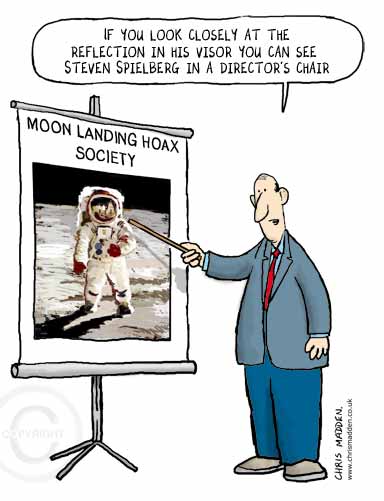
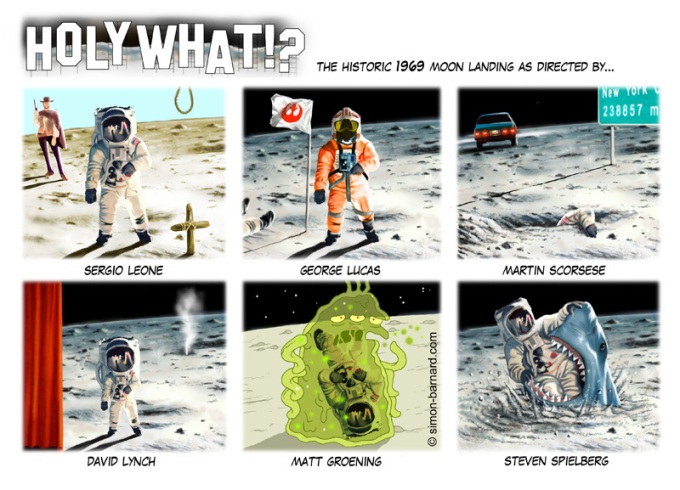
Is this how it really happened? Just kidding!When NASA announced last week that they were working with a leading digital imaging company in Hollywood to remaster the original Apollo 11 Moon walk video footage, I told myself: that’s one more cannon to the conspiracy theorists!
Everyone would welcome a quality improvement in those murky, grainy moving images capturing humanity’s grand achievement. But the choice of Lowry Corporation, best known for restoring old Hollywood films, could fuel the fire of conspiracy theorists who argue that the entire Moon landing was faked by NASA with the connivance and participation of Hollywood. They believe that the entire Apollo programme – that landed people on the moon six times between 1969 and 1972 – was staged on a movie set or secret military base.
This link didn’t bother Richard Nafzger, the NASA engineer who oversaw television processing at the ground-tracking sites during the Apollo 11 mission, and now involved in their restoration. “This company is restoring historic video. It mattered not to me where the company was from,” Nafzger was quoted as saying.
Technically and officially, NASA is right. The US space agency has always dismissed the conspiracy theorists, and not spent much time discussing the outrageous idea. As it says on NASA website: “The Apollo Moon landings were among the most completely documented and observed events in history. Moon rocks have been examined by scientists from all over the world, not just the U.S. Video special effects were in their infancy in the late 60’s so that faking a landing on the Moon would probably have been more difficult than actually going there, and it seems highly unlikely that the hundreds or even thousands of people who would have had to be involved in such a conspiracy would have kept it a secret for so long.”
Err, Wasn't Spielberg only 23 at the time...?Independent scientists point out that it would be impossible for tens of thousands of NASA employees and Apollo contractors to keep such a whopping secret for almost four decades. Tell that to those who are deeply suspicious of anything to do with governments, who historically don’t have the best record for transparency and full disclosure!
So the conspiracy theory lingers. Like many other crazy ‘theories’, it has spread rapidly with the growth of the Internet. It’s really an old one: even at the time Apollo astronauts landed on the Moon, a few people refused to believe it as it apparently conflicted with their religious beliefs.
The Moon Hoax, as it’s popularly called, accuses NASA of manufacturing, destroying, or tampering with evidence — including photos, telemetry tapes, transmissions, and rock samples; and that the deception continues to this day. These theorists concede that the Apollo launches did take place. But instead of going to the Moon, which they say was technologically impossible at the time, the astronauts just orbited the Earth for a few days while NASA carefully fed the media with manufactured images. And then they returned to a heroes’ welcome!
My curiosity in conspiracy theories stems from my interest in popular culture. In this instance, I’m intrigued to note how moving images have fuelled the Moon Hoax theory in a number of ways. A cornerstone in the doubters’ argument is that NASA’s photos and videos from the moon contained ‘suspicious anomalies’ (all of which, by the way, have been satisfactorily explained by scientists.)
Superb entertainment, but it was just that...Some believe that these theories inspired the 1978 movie Capricorn One, where NASA fakes a Mars landing on a military base on Earth, and then goes to desperate lengths to cover it up. It’s entirely possible that some people can’t discern fact from fiction. Or why allow facts to get in the way of a damn good story?
At one point in the early 1990s, he wrote to the NASA Administrator, with his tongue firmly in his cheek, saying: “Dear Sir, On checking my records, I see that I have never received any payment for this work. Could you please look into this matter with some urgency? Otherwise, you will be hearing from my solicitors, Messrs Geldsnatch, Geldsnatch and Blubberclutch.”
Of course, he never received – nor expected – a reply. But when media reports about this appeared, some with no sense of humour considered it further ‘proof’ of a cover-up!
And here’s another connection: Peter Hyams, who directed Capricorn One, went on to direct the movie adaptation of Arthur C Clarke’s 2010: Odyssey Two, which was released in 1984.
More seriously, in later years Sir Arthur was concerned that at one point a few years ago, millions of Americans harboured doubts whether the Moon landings actually took place. That indicated a failure of the education system to produce people with critical thinking abilities, he said.
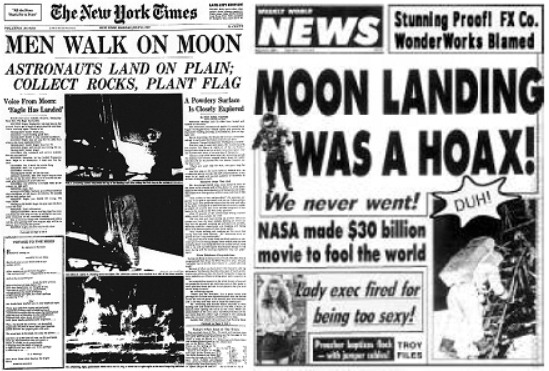
The conspiracies received a boost when, on 15 February 2001, the Fox News TV network aired Conspiracy Theory: Did We Land on the Moon?. Hosted by X-Files actor Mitch Pileggi, this hour-long, sensational documentary peddled what it called eerie “inconsistencies” in NASA’s Apollo images and TV footage. Among them: no blast craters are visible under the landing modules; shadows intersect instead of running parallel, suggesting the presence of an unnatural light source; and a planted American flag appears to ripple in a breeze although there’s no wind on the moon.
It concluded that the whole Apollo Moon landings were faked in the Nevada desert because, cccording to the conspiracy theorists, NASA did not have the technical capability of going to the Moon, but pressure due to the Cold War with the Soviet Union forced them to fake it. Fox TV did preface the programme with a notice saying: “The following programme deals with a controversial subject. The theories expressed are not the only possible interpretation. Viewers are invited to make a judgement based on all available information.” But skeptics felt Fox didn’t do enough to provide a minimum level of balance in their discussion.
Warning: This is a funny cartoon and not meant to be taken seriouslyThe documentary’s ‘evidence’ has since been refuted point by point. NASA has also dismissed the documentary’s claims. It prompted Sir Arthur Clarke to protest to his long-time friend Rupert Murdoch, owner of the Fox TV network, for peddling unscientific nonsense.
Rather than being a ‘true believer’, Fox TV may have been trying to boost its audience ratings. But others in the moving images industry apparently take the matter very seriously. Among them is the film-maker Bart Sibrel. His aggressive interview tactics once provoked astronaut Buzz Aldrin (second man to walk on the Moon) to punch him in the face in a 2002 encounter.
“I don’t want to call attention to the individuals who are trying to promote and shuffle off this hoax on people,” Aldrin told CNN in a recent interview. “I feel sorry for the gullible people who’re going to go along with them. I guess it’s just natural human reaction to want to be a part of ‘knowing something that somebody doesn’t know.’ But it’s misguided. It’s just a shame.”
One of the strongest rebuttals of the Moon hoax on TV has come from the Mythbusters series of popular science programmes produced by Beyond Television Productions, originally for the Discovery Channel. The series features special effects experts Adam Savage and Jamie Hyneman, who use basic elements of the scientific method to test the validity of various rumors, myths, movie scenes, internet videos and news stories in popular culture.
In August 2008, they tackled a number of pervasive myths associated with the Moon landing, debunking them one by one. To film the episode, Adam, Jamie and the rest of the Mythbusters team visited the NASA Marshall Space Flight Center in Alabama. A team of Marshall scientists helped the Mythbusters with several of their tests. Here are two excerpts:
As the 40th anniversary of the first Moon landing passes, the scientific community and rationalists will have to make some hard choices. How much more time and energy must they expend countering such wildly fanciful theories and fantasies? In a world that still has a (dwindling?) number of people who believe in more ancient concepts like the Flat Earth theory, is it really surprising that the Space Age would inspire its own share of modern-day myths?
No matter what the scientists say and how overwhelming the evidence is, conspiracy theories will always believe what they want. Often their convictions border on a blind faith – and as Arthur C Clarke was fond of saying (in relation to religions), one definition of faith is ‘believing in what you know isn’t true!’.
In a pluralistic world, people choose what to believe inThen there is simple demographics. The total world population in 1969 was 3.6 billion. Today, it has surpassed 6.7 billion. This means nearly half of the people alive today were not even born when Neil and Buzz stepped on to the Moon. At 43, even I have only a headline memory of Apollo 11, even if it’s a strong one.
NASA itself is well aware of this. “As the number of people who were not yet born at the time of the Apollo program increases, the number of questions [about the moon landings] also may increase,” NASA said in a statement on the eve of the anniversary. “Conspiracy theories are always difficult to refute because of the impossibility of proving a negative.”
Perhaps what the Moon Hoax debate really needs is what Sir Arthur Clarke once proposed as a response to the obsession with UFOs and alien abductions: a decade or so of benign neglect. Conspiracy theorists and myth-makers thrive on counter-arguments and debate. When they don’t get it for long enough, they’ll probably run out of steam.
Meanwhile, networks like Fox News should stick to making entertainment programming that is labeled as such. Who can find fault with creations like The Simpsons?
Apollo still photos were much better than broadcast images: how come?
In theory, it can happen to anyone recording moving images on tape or digital media: absent-mindedly or carelessly re-use the recording media, and thus lose the original content. If no copy exists, such an accident means an irrevocable loss.
But if the images were the most expensively shot in the whole of human history — literally costing billions of dollars and involving the genius and labour of half a million people over several years — we would expect these to be archived and preserved with great care, right?
Well, not necessarily — if the custodian is a government agency. On eve of the 40th anniversary of the first Moon landing by Apollo 11, the US space agency NASA dropped a bombshell: it admitted that the original recordings of that historic moment were accidentally erased years later.
One British newspaper called it “the scientific equivalent of recording an old episode of EastEnders over the prized video of your daughter’s wedding day”.
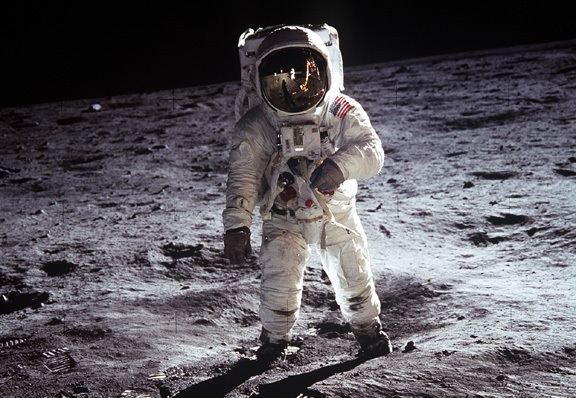
Can you see the Moon on the Moon? Well, only just...The loss became public when the Sydney Morning Herald broke the story in August 2096. “A desperate search has begun amid concerns the tapes will disintegrate to dust before they can be found,” it said.
While the media rushed with oops-style headlines like ‘One giant blunder for mankind’, NASA quietly investigated what really happened. Last week, they revealed the hard truth: the tapes were part of a batch of 200,000 that were degaussed – or magnetically erased — and re-used. It was a standard money-saving measure at NASA in those pre-digital days to reuse the 14-inch tape reels after several years in storage. Agency officials fear that the original Apollo 11 tapes were buried among an estimated 350,000 that were recycled in the 1970s and 1980s and the data was lost for ever.
But the historic visuals are not entirely lost: luckily, broadcasters who used NASA’s expensively obtained footage had archived their transmissions for posterity. For many months, NASA has worked with a leading digital imaging company in Hollywood to restore good copies of the Apollo 11 broadcast found in the archives of CBS News and some recordings called kinescopes found in film vaults at Johnson Space Center.
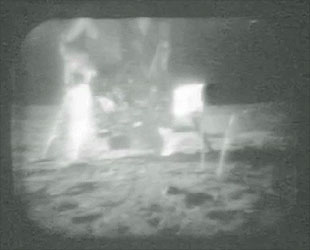
On 16 July 2009, NASA released the first glimpses of a complete digital make-over of the original landing footage that looked decidedly sharper and clearer than the blurry and grainy images of Neil Armstrong and Buzz Aldrin walking on the Moon.
And we have to admit, the new video is definitely better than the ones we’ve seen for 40 years!
Raw Video: Restored Video of Apollo 11 Moonwalk
Another montage of digitally restored Apollo 11 mission highlights:
The full set of recordings, being cleaned up by Burbank, California-based Lowry Digital, are to be released in September 2009.
I had often wondered why the original images from the Moon were so grainy: it wasn’t typical even for that time. And if NASA spent between US$ 22 to 25 billion on landing men on the Moon, surely they’d have harnessed the best available technology to capture and share their moments of triumph, I assumed.
Actually, the video coverage that was broadcast around the world — to an estimated audience of 500 to 750 million people — and has since been endlessly redistributed was not quite what came from the Moon. It was a diluted version. Stanley Lebar, the NASA engineer in charge of developing the lunar camera, now calls a “bastardized” version of the actual footage.
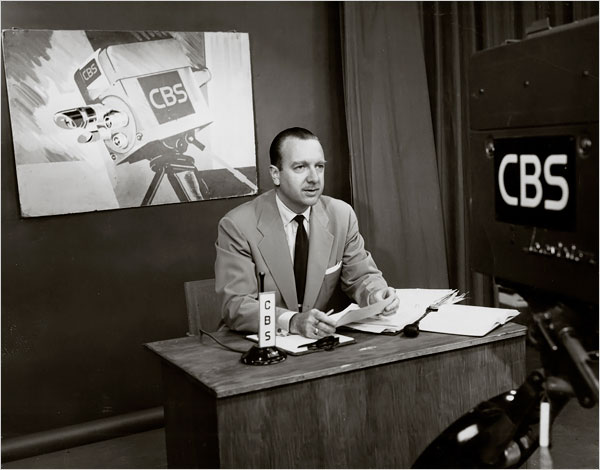
Here is the “as-it-happened” broadcast from CBS News that day, with the legendary Walter Cronkite anchoring to the biggest TV audience the world had known. (Footnote: You’ll see the first electronic “character generators” in use.)
The story is technically complex, but here’s the essence: live images from the Moon couldn’t be fed directly to the American TV networks using the NTSC broadcast standard. Audiences worldwide would be holding their breath that a delayed broadcast, even by a few minutes, would not have been as effective as ‘live from the Moon’. Under such time pressures, no conversions could be attempted. So a regular TV camera was pointed at the huge wall monitor at mission control in Houston.
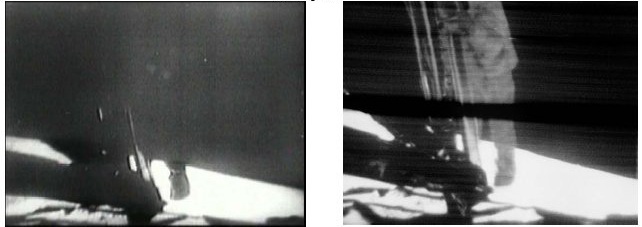
This is known as kinescope, or telerecording: a recording of a television program made by filming the picture from a video monitor. That resulted in the grayish, blotchy images that everyone saw on their home TV sets. In other words, It was a copy of a copy, with significant quality losses in that process!
Scan-converted broadcast image of Armstrong descending the lunar module ladder taken at Goldstone tracking station. This was the image the world saw of the first human on the Moon. But a Polaroid picture of the Slow-Scan television image of Armstrong coming down the ladder reveals far greater detail. Image Courtesy: John Sarkissian/CSIRO Parkes Radio Observatory
A new documentary, released in January 2009, offers new insights into one of the most challenging feats in international live broadcasting – how those images from the Moon were delivered to TV audiences around the world. Produced by Spacecraft Films and directed by Mark Gray Live from the Moon: The Story of Apollo Television
It tells how for the first time in history millions of people could share, in real time, the experience of frontier exploration.
The story behind the camera...finally!“Placing a man on the moon and returning him safely to the Earth was hard enough in 1969,” says Gray. “‘Live From The Moon’ tells the story of how television, still a technological toddler, was developed for space flight, and examines the impact of the iconic passages that were returned.”
To tell that story, Gray literally circled the Earth, shooting interviews at the deep space communication stations in California and Australia, as well as at space facilities and museums in Houston, Baltimore, Los Angeles, Princeton, Kennedy Space Center, Huntsville, Ala., Washington, DC and Weatherford, Oklahoma.
Along the way, he interviewed astronauts, flight directors, mission controllers, tracking station operators, historians and those who built the television cameras for the space program…. “Live from the Moon” is told with the insight of moonwalker Alan Bean; Apollo 10 commander Tom Stafford; flight director Chris Kraft; Neil Mason, who drove the Parkes Telescope; Westinghouse camera team leader Stan Lebar; and the voice of mission control Jack King, among others.
“Every single one of them believed that the TV was one of the most important legacies of Apollo. And many of them admitted candidly that they didn’t give the TV much thought during the actual missions,” recalled Gray.
When Apollo 11 astronauts landed on the Moon 40 years ago this week, they were more than just Americans taking that historic first step on to another celestial body.
Yes, they planted the US flag there – after all, it was the American tax payers who financed the massive operation. But they left on the Moon other items that signified the universal nature of their mission.
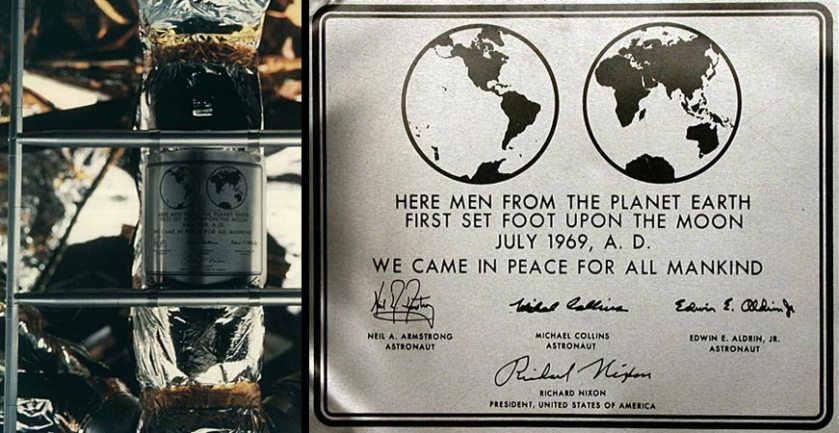
One was a plaque (photo, above) saying “Here men from the Planet Earth first set foot upon the Moon, July 1969 A.D. We came in peace for all mankind.” It bore the signature of the three astronauts –- Neil Armstrong, Edwin (Buzz) Aldrin, Jr., and Michael Collins –- and then US President Richard Nixon. Another was a golden olive branch.
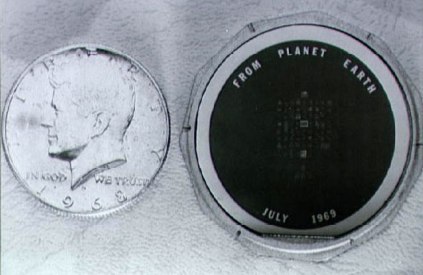
The silicon disc (right) next to a US 50 cents coin for comparison of sizeThese letters were received by NASA during the final weeks running up to the launch on 16 July 1969, yet this disc helped turn the Apollo 11 mission into an international endeavour.
It was only in June 1969 that the US State Department authorised NASA to solicit messages of goodwill from world leaders to be left on the Moon. This triggered a minor diplomatic frenzy, with invitations going out from Thomas O Paine, the NASA Administrator.
In all, 116 countries were contacted through their embassies in Washington DC, but only 73 responded in time. Sri Lanka, then Ceylon, responded. But for some unknown and unexplained reason, then Prime Minister Dudley Senanayake declined to send a message to the Moon.
When I first heard about it about 18 months ago, I was both intrigued and curious. Was it some misplaced geopolitical considerations, or simple diplomatic arrogance that led to Ceylon’s negative decision? After all these years, we might never find out.
I have now written this up in an article titled ‘How Sri Lanka Missed the Moon’, which appears this weekend in the mainstream media and online in two different versions.
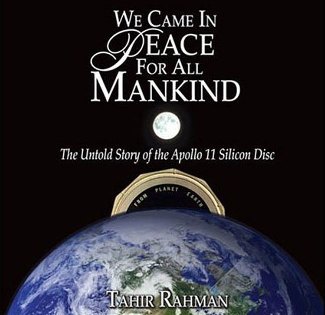
Uncovering forgotten historyThe book documents the full story behind this little known facet of the very widely covered Apollo 11 mission. It also reproduces each of the 73 goodwill messages, as well as those which were received too late for inclusion on the disc.
“I was amazed at how NASA and the State Department rushed to get these messages before launch,” says Rahman. He took two months to locate from the Library of Congress the boxes in which NASA Administrator Paine had preserved the full correspondence.
While researching for this article, I contacted Rahman hoping for some additional insights, but he replied: “I do not have any information about why Sri Lanka did not send an Apollo 11 goodwill message.”
Sir Arthur C Clarke, with whom I worked for over 20 years, was also intrigued by Ceylon’s decision, which he didn’t know about until Rahman’s book reprinted the official letter. His only remark: “Mysterious are the ways governments think and work.”
Reading the messages, whose English translations are available online, is like entering a time capsule. Only two of the world leaders are still holding office (Queen Elizabeth II of Britain, and King of Thailand); most of them are dead. Some countries have since changed names. Others have been subsumed by neighbours, or broken into two or more independent states. Geopolitical map of the world has been completely redrawn.
The story of the Apollo 11 silicon disc is more a history and politics lesson, and less a science story. But I’m glad that I found a little known facet of the very widely covered Apollo missions to write about on its 40th anniversary.
Watch Tahir Rahman interviewed on Fox News network:
Walter Cronkite (1916 - 2009): The man who ruled American airwaves
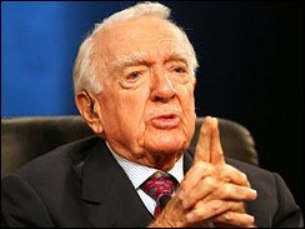
Walter Cronkite, the broadcast journalist and newscaster who redefined television news of his generation, has just signed off for the very last time. A leading light in the history of moving images is gone. What a light…and what a voice.
The New York Times reported the loss as its front page lead: “Walter Cronkite, who pioneered and then mastered the role of television news anchorman with such plain-spoken grace that he was called the most trusted man in America, died Friday at his home in New York. He was 92.”
Cronkite was best known as anchorman for the CBS Evening News for 19 years (1962–81). He was at the helm at a time when television became the dominant news medium of the United States. His influence spread well beyond one network, one medium and one generation.
America's favourite uncle...Danny Schechter, the News Dissector and head of MediaChannel.org, said in a tribute: “He figuratively held the hand of the American public during the civil rights movement, the space race, the Vietnam war, and the impeachment of Richard Nixon.”
His own former network, CBS, noted in a tribute: “Known for his steady and straightforward delivery, his trim moustache, and his iconic sign-off line – ‘That’s the way it is’ – Cronkite dominated the television news industry during one of the most volatile periods of American history. He broke the news of the Kennedy assassination, reported extensively on Vietnam and Civil Rights and Watergate, and seemed to be the very embodiment of TV journalism.”
The New York Times report added: “On the day President John F. Kennedy was assassinated, Mr. Cronkite briefly lost his composure in announcing that the president had been pronounced dead at Parkland Memorial Hospital in Dallas. Taking off his black-framed glasses and blinking back tears, he registered the emotions of millions.”
Walter Cronkite announces death of President John F Kennedy: 22 November 1963
He is especially remembered for publicly opposing the Vietnam War. In 1968, he traveled to Vietnam, where he called the war a stalemate and advocated a negotiated peace. “If I’ve lost Cronkite, I’ve lost middle America,” President Lyndon B. Johnson said after seeing the broadcast, according to Bill Moyers, an aide to the president at the time.
In July 1969, Cronkite anchored the historic 32-hour CBS broadcast that covered the first Moon landing, which became the most widely watched live broadcast event worldwide up to that time. When Neil Armstrong stepped on the moon, Cronkite exclaimed, “Oh, boy!” — another rare show of emotion for the leading anchorman of his era who chose to keep his opinions separate from the news he covered and presented.
Cronkite missed the 40th anniversary of Apollo only by a few days. He will be sadly missed when astronauts and space buffs mark the event.
In this excerpt from for a 4-hour interview filmed for the Archive of American Television in 1998, Cronkite explains the origin of “That’s the way it is”– his signature sign-off:
The true professional he was, he never retired. Long after leaving CBS News, he remained fully active, engaged and supportive of good journalism in the United States and around the world. He lent his name to educational and charitable causes nurturing investigative journalism.
Danny Schechter writes in his blog: “In his later years, Walter Cronkite abandoned the pretense of only being above the fray and started speaking out as an internationalist for arms control and world federalism, and on many other global issues. He supported progressive causes but never too blatantly. He was very conscious of his image and reputation and identification with the media and power elite. He lived up the street from the United Nations and was often a speaker at UN events.”
Reproduced in full below is the endorsement Walter Cronkite gave our friends at MediaChannel.org, an online media activist group that keeps the spotlight on the media. In the dark during our own war, and in the days since the war ended, I have often found solace, inspiration and courage in his words.
* * * * * * Walter Cronkite On The Media And The MediaChannel.
Good evening, I’m Walter Cronkite. I really wanted to be with you in person tonight for Globalvision New Media’s launch of the new Internet site the Media Channel, but unfortunately I was called out of the country. Yet the issues that led to the creation of this unique global resource, and the crisis that’s facing all of us who work in and care about journalism and the media, are so profound that I simply felt compelled to tape this message so that you would know that I am with you in spirit at least.
As you know, I’ve been increasingly and publicly critical of the direction that journalism has taken of late, and of the impact on democratic discourse and principles. Like you, I’m deeply concerned about the merger mania that has swept our industry, diluting standards, dumbing down the news, and making the bottom line sometimes seem like the only line. It isn’t and it shouldn’t be.
We report, you decide...At the same time, I’m impressed that so many other serious and concerned people around the world are also becoming interested in holding media companies accountable and upholding the highest standards of journalism.
The Media Channel will undoubtedly be worth watching and taking part in. I am intrigued by its potential, and its global reach. The idea that so many leading groups and individuals around the whole world have come together to share resources and information about a wide range of media concerns is very promising, and I urge you to make the Media Channel your media ‘bookmark’ and your portal to the Internet.
I’m particularly excited about one aspect of the Media’s Channel’s work: its encouragement to people inside the media to speak up to speak out about their own experiences. Corporate censorship is just as dangerous as government censorship, you know, and self-censorship can be the most insidious form of pulling punches. Pressures to go along, to get along, or to place the needs of advertisers or companies above the public’s need for reliable information distort a free press and threaten democracy itself.
I’m pleased that the Media Channel opens an immediately available resource for media whistle-blowers. Anonymity will be protected, of course if their stories check out, of course. And, of course, are backed up with the facts.
We have all been supportive for years of dissidents around the world who take great risks to stand up for what they believe in. But here at home, in our own industry, we need to make it possible for people to speak out when they feel they’ve been wronged, even if it means shaming newsrooms to do the right thing. Journalists shouldn’t have to check their consciences at the door when they go to work for a media company. It ought to be just the reverse.
As I’ve said on other occasions, the strength of the American system is possible and can be nurtured only if there is lively and provocative dissent. In a healthy environment dissent is encouraged and considered essential to feed a cross-fertilization of ideas and thwart the incestuous growth of stultifying uniformity.
We need to encourage and support those among us who face either overt or covert threats or even a more subtle absence of encouragement to search out the truth. We all know that economic pressures and insecurities within news organizations have reduced the scope and range of investigative reporting. Sometimes projects are spiked with just a simple phrase: “It’s not for us.”
We’re always ready to speak out when journalists are at risk. But today we must speak out because journalism itself is at risk. That’s why I’m speaking out and reaching out to you tonight, to tell you that I like the idea of the Media Channel and want to encourage your participation.
And that’s the way it is.
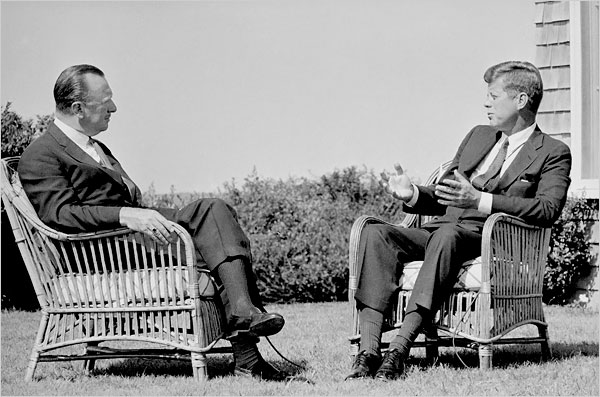
Walter Cronkite interviews President Kennedy - Photo courtesy Associated Press
She couldn't shatter the glass ceiling to space... Exactly 40 years ago, on 16 July 1969, Apollo 11 blasted off carrying three American astronauts to the Moon. Four days later, history was made when Neil Armstrong and Edwin (Buzz) Aldrin, Jr., become the first human beings to set foot on another celestial body, while their colleague Michael Collins circled the Earth.
When Armstrong stepped on the Moon, he said: “That’s one small step for man, one giant leap for mankind“. Man on the Moon was very much the news highlight of 1969, and at the time, the term ‘mankind’ was understood to include women as well. The more gender-neutral term ‘humankind’ would come into popular use some years later.
Beginning with Apollo 11, the Apollo programme landed a dozen astronauts on the Moon, all of who returned safely – as did the astronauts of the disaster-stricken mission, Apollo 13. Without exception, all of them were white and male. While they were all highly qualified, disciplined and trained men who had worked long and hard to earn their places in history, they did not fully represent the diversity of their nation, let along of the planet whose emissaries they were portrayed to be.
Women, celebrated across cultures as holding half the sky, took a long time to travel beyond the sky to outer space.
Although a Russian (Valentina Tereshkova) had become the first woman in space early on in 1963, it took the Americans another 20 years to have their first woman astronaut: Sally Ride, who traveled to Earth orbit on the Space Shuttle in June 1983.
A recent British documentary reveals how America could have sent a woman to the Moon during the Apollo programme. It reveals, belatedly, one of history’s great might-have-beens.
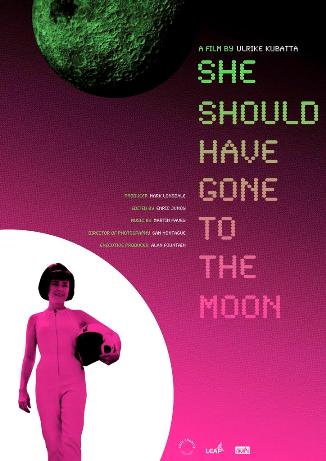
She Should Have gone To The Moon (58 mins, 2008), written and directed by Ulrike Kubatta isn’t quite story that the American space agency NASA would like to be reminded of as it marks Apollo 11’s 40th anniversary.
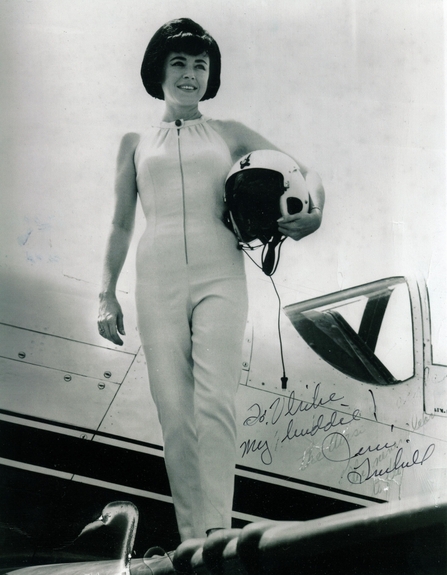
Jerri Truhill, astronaut in training: Not 'monkey enough' for men who ran NASA?The film tells the astonishing story of the pilot and pioneer, Jerri Truhill, who was trained in 1961, as part of NASA’s top secret Mercury 13 programme, to become on of the first woman astronauts. The documentary is a lyrical journey propelled by childhood aspirations, shattered dreams and a lifelong battle against female sterotypes and male prejudice.
Truhill tells how the women outperformed men in all the training tests (including water tank isolation) but how ultimately, the authorities, with the approval of President Johnson, stipulated that they would “rather send monkeys into space than a woman”.
In the film, the tough talking and sharp witted Jerri Truhill looks back at her compelling life via a phone call with the film-maker. This conversation becomes the catalyst for the director’s imagining of key events in Truhill’s potent narrative and inspires a journey to meet the heroine in Texas. Along the way the film-maker places herself in Truhill’s story, first wandering across the surreal landscape of White Sands and then suspended in zero gravity inside a water tank.
Included are staged scenes, dreamt-up moments from Truhill’s story, which evoke the popular melodrama of 1950s American cinema. These fictional moments bridge the gaps of time and distance between the filmmaker and her subject. Their stylised and dreamlike quality is counterpointed by shots from both Truhill’s and NASA’s film archive. The various strands produce the film’s heady timeline, as they circle through real and imagined spaces, past and present.
On LEEDVD.TV’s YouTube channel, I found this segment of another documentary named Rocket Girl, but Google does not bring up too much other info about this film.
Seven of the “Mercury 13” gathered at the Kennedy Space Center in 1995. In the photo below, from left to right, are: Gene Nora Jessen, Wally Funk, Jerrie Cobb, Jerri Truhill, Sarah Rutley, Myrtle Cagle and Bernice Steadman. They came to watch Eileen Collins become the first woman to pilot a space shuttle. NASA has come a long way.
Mercury 13 women reunion in 1995 - NASA image
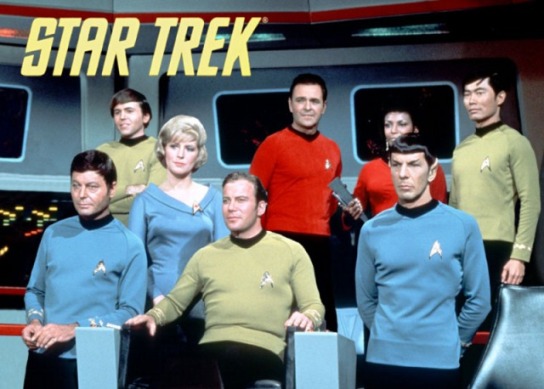
As I wrote in May 2009, the path-breaking TV series Star Trek, which started airing on television in the US in September 1966, was way ahead of reality. When neither the mainstream television nor the space programme reflected America’s true diversity, Star Trek created a multi-ethnic crew for the Starship Enterprise, roaming the universe in the 23rd century. It included an African-American woman, a Scotsman, a Japanese American, and a super intelligent alien, the half-Vulcan Spock.
Reality took a long time catching up. It was only in August 1983 that Guion “Guy” Bluford, Jr., became the first black American astronaut. Another nine years passed before Dr. Mae Jemison became the first African-American woman to go to space, when she joined a Space Shuttle mission in September 1992. In fact, she cited Star Trek character Uhura as an influence in her decision to pursue a career in space.
Multi-cultural crews did not become commonplace until the late 1990s, when the International Space Station became operational. Space travel has yet to reach the utopian ideals of Star Trek.
Images related to ‘She should have gone to the Moon’ courtesy Ulrike Kubatta. Other images courtesy NASA
When Cable News Network – or CNN – was launched in June 1980, it became the first network to provide 24-hour television news coverage, and the first all-news television network in the United States. Most people didn’t believe it would last for long, for they could hardly believe that there was enough news to fill all hours of the day and night.
They had reasons to be skeptical: at the time all major TV channels and networks in North America, Europe and elsewhere carried an hour or two of well-packaged and well-presented news bulletins per day. Viewers looked forward to these bulletins, when able and amiable anchors like Walter Cronkite – ‘the most trusted man in America’ – entered their living rooms for an update and reflection on the day’s events. A leader had to be assassinated or men had to walk on the Moon for this routine to be broken…
CNN founder Ted Turner changed all that. He proved the skeptics wrong, and blazed a new trail in broadcast journalism. In his wake, dozens and now hundreds of all-news channels have emerged, providing a cacophony of coverage and punditry as never before seen.
Saturated with news on TV? Reach out for this relief!
One of the early, unofficial expansions of CNN was ‘covering news needlessly’. This was sometimes necessary to fill 24 hours a day (or 1,440 minutes) and 7 days a week (or 168 hours). The channels say repetition is meant to give the chance for any viewer to catch up on the news whatever time she tunes in. But the question remains: is there so much news to fill not only 24/7 but hundreds of such channels?
The answer is both yes – and no. It all depends on the definition of news, and what each channel considers to be in the public interest. We won’t get into that big debate here. But the fact remains that, at least where the numerous all-news channels in Asia are concerned, they often struggle to fill their air time – and not always very successfully.
And do we have an abundance of such channels. India alone now has more than 60 all-news channels catering to a billion+ audience in dozens of languages…and more keep popping up. Elsewhere in countries such as the Philippines, Pakistan and Thailand, there have been similar channel explosions in recent years. This is partly triggered by media liberalisation which allowed local and foreign private companies to enter the broadcast sector that earlier remained a state monopoly.
Aryn Baker of TIMEBut more channels has not necessarily meant better coverage of news. There was a perceptive observation by Time magazine’s Aryn Baker in a recent essay she wrote in June 2009 about the state of Pakistan’s media. In her essay titled Casualty of War, she noted: “In 2002, the then President, General Pervez Musharraf, permitted private TV stations to broadcast news instead of just the state-owned Pakistan Television Corp. At the time, Musharraf’s deregulation was hailed as a significant step for the nascent free-press movement; indeed, today there are more than 30 nongovernment TV stations in the country. As TV stations proliferated, I argued that increased competition would force the emergence of a strong, ethical and responsible media corps. But there simply aren’t enough well-trained and -informed local journalists to supply the dramatically greater number of media outlets. I also assumed that consumers would gravitate toward truth. Instead the bulk of readers and viewers seem comfortable with sensationalism and xenophobia — as reflected by an April poll conducted by Gallup Pakistan revealing that 76% of Pakistanis “believe Pakistani media [are] unbiased to a great or somewhat extent.” In other words, Pakistanis like their media the way they are.”
Baker cites examples where the print and broadcast media in Pakistan regularly rumour and peddle conspiracy theories as news. She ends with a strong plea: “Pakistan’s press needs to take a hard look at itself and its level of professionalism. Only then will it live up to its potential, and only then will Pakistan get the media it deserves.”
Shooting the news...I couldn’t agree more. Having cheered the collapse of state broadcasting monopolies across Asia in the 1990s, I have very much felt the same way about news channels across the region (here I’m talking about the English language channels only, which are outnumbered in most markets by local language channels). While there are a few news channels that stand above the rest, a majority would come close to what Aryn Baker describes for Pakistan.
Speaking at the 6th World Conference of Science Journalists held in London in early July, I called this the ’24/7 TV Deficit’ in Asia’s broadcast media. In summary, it is this: In the developed world, all-news channels like CNN evolved over time, building capacity and experience along the way. In emerging Asia, news channel explosion hasn’t allowed time for such evolution – so skills and resources are spread too thin. There are genuine limitations of competence and capacity. Sometimes this leads to sensationalism or distortion.
I said: “The long term response to this is to invest in training and capacity building of journalists and producers already working in the media. For the most part, they learn on the job, making mistakes on the air. This is far from ideal.”
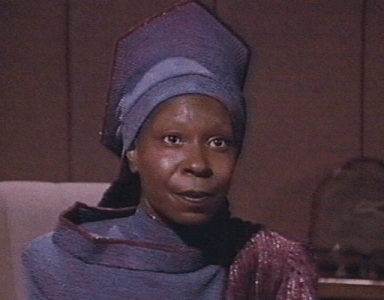
Actress Whoopi Goldberg was a child of 10 when the original series of Star Trek started its first broadcast on NBC in the US in September 1966. The futuristic science fiction series – about a spaceship travelling across space and time in the 23rd century in search of new civilisations – was to leave a lasting impression on many members of her generation.
In Whoopi’s case, it went beyond just general inspiration. Something in the show seemed incredible to the African-American child growing up in a land where colour and race were still divisive factors. She recalls running around the house, screaming: “Hey mom, look! There’s a negro woman on TV — and she ain’t cooking dinner!”.
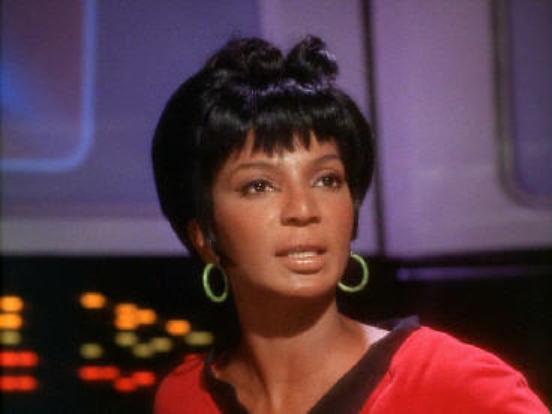
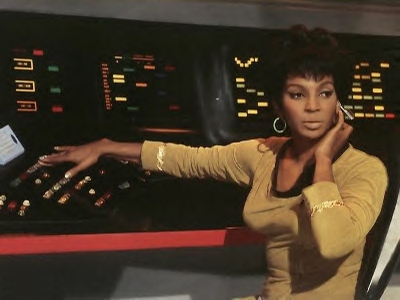
‘That woman’ was the character Nyota Uhura, played by Nichelle Nichols. This anecdote is captured in the 1997 documentary Trekkies, which explored the global fandom inspired by the show, which has gone on to become a franchise covering several TV series, 11 feature films (including the latest ‘origins’ film released on 8 May 2009), an animation series, as well as numerous books, video games and computer games. As Forbes magazine once noted, the allure is comparable only to that of Star Wars.
Sometimes, less is more!Uhura featured as the communications officer on board the USS Enterprise in Star Trek: The Original Series, Star Trek: The Animated Series, and the first six Star Trek films. She is significant as one of the first major black characters on an American television series and for engaging in a then-taboo interracial kiss with Captain James T. Kirk (William Shatner). In the 2009 film, a younger Uhura is portrayed by actress Zoë Saldana.
The inclusion of Uhura, a black woman, in a critical technical position was certainly idealistic in the mid 1960s when the American civil rights movement was still agitating for equal rights for African Americans. She one of the first black women featured in a major television series not playing a servant; her prominent supporting role as a female black bridge officer was unprecedented.
As I’ve just noted in another blog post: “At a time when there were few non-white or foreign roles in American television dramas, Gene Roddenberry created a multi-ethnic crew for the Enterprise, including an African woman, a Scotsman, a Japanese American, and—most notably—an alien, the half-Vulcan Spock. In the second season, reflecting the contemporaneous Cold War, Roddenberry added a Russian crew member.”
But was the character, donning a sexy mini skirt uniform, somewhat tokenistic? Perhaps. But it still had considerable inspirational value – which is never to be under-estimated.
In fact, after the first season of Star Trek, Nichols had become frustrated at her relative lack of lines. At one point, she considered quitting the show, but was talked out of this decision by the civil rights leader Dr Martin Luther King, Jr.. MLK told her that a show that depicted a black woman working alongside whites in a position of importance was important for the goal of racial equality.
Another version of the story has MLK telling Nichols that he was a big fan of the series, and she “could not give up” since she was playing a vital role model for black children and young women across the country. It is also often reported that Dr. King added that “Once that door is opened by someone, no one else can close it again.”
After NBC executives cancelled Star Trek in 1969, Nichols went on to star in other roles — and also worked for NASA in a campaign to encourage African Americans to join the space service. Among those she helped recruit was Dr. Mae Jemison, the first African-American woman to fly aboard the Space Shuttle, in September 1992. Jemison has cited Star Trek as an influence in her decision to pursue a career in space.
Goldberg: From inspiration to a regular roleMeanwhile, things came full circle for actress Whoopi Goldberg, who was to get her own regular role in Star Trek: The Next Generation whose original run lasted from 1987 to 1994. In this successor series, she played the recurring El-Aurian female character Guinan.
Things have also moved on in the real world, where Barack Obama is now the President of the United States, with Michelle Obama as one of the most influential – if not powerful – women in the world. On 28 April 2009, CNN ran a story titled Why Michelle Obama inspires women around the globe. It noted: “Those who focus on Michelle Obama’s impact on America are underestimating her reach. The first lady is inspiring women of color around the globe to look at themselves, and America, in fresh ways.”
There is no linear link between Nyota Uhura and Michelle Obama, and the real world has very far to go to reach the utopian ideals of Star Trek. But the very fact that we have the Obamas where they are is an assurance that things can slowly move towards Gene Roddenberry’s grand vision.
Going where no trekkie has gone before?I’m exactly as old as Star Trek: we were both born a few months apart in 1966 (I’m older by seven months). But because we grew up on opposite sides of planet Earth in the pre-Internet era, our worlds didn’t collide until we were both well into our teens. From then on, I’ve been a Trekkie/Trekker since.
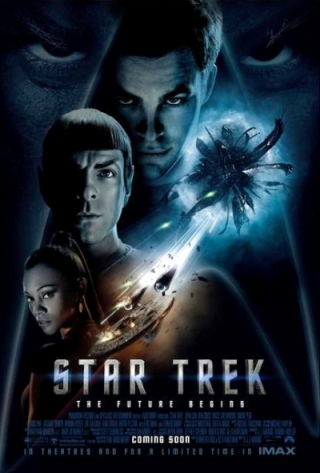
I can’t wait to see the latest (11th) Star Trek movie that opened on 8 May 2009. It’s an ‘origins’ movie – a chronicle of the early days of Captain James T. Kirk and his fellow USS Enterprise crew members. Read plot on Wikipedia.
Our world was very different when the one-time US Army pilot, screenwriter and TV producer Gene Roddenberry created Star Trek, the original series. It started airing on the US network NBC in September 1966. The Space Age was less than a decade old, and only a few men (and a couple of women) had made short trips to near Earth orbit. The great Space Race was in full swing, and NASA was spearheading the largest peace-time operation in history, aimed at landing men on the Moon and getting them safely back before the decade was out.
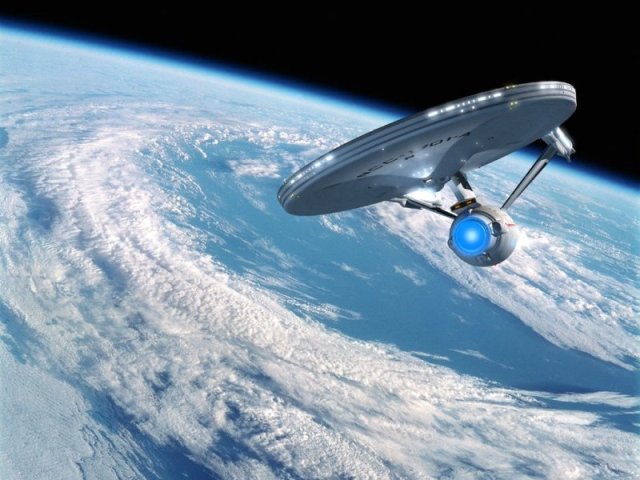
Star Trek, in contrast, offered ambition and hope. Every week at the appointed time, the United Star Ship Enterprise and its intrepid crew took viewers roaming around the universe. The stories appealed as much for insights into the infinite possibilities (and combinations) of life, technology, compassion and power at a cosmic scale, as for its glimpses of the near-Utopian human society in the 23rd century.
As Manohla Dargis, said this week reviewing the latest Star Trek movie (2009) in The New York Times: “Initially aired in 1966, Star Trek was a utopian fantasy of the first order, a vision of the enlightened future in which whites, blacks, Asians and one pokerfaced Vulcan are united by their exploratory mission (“to boldly go”), a prime directive (do no harm) and the occasional dust up.”
According to Dargis, the enduring appeal of Star Trek and the global cult following it inspired is “a testament to television’s power as myth-maker, as a source for some of the fundamental stories we tell about ourselves, who we are and where we came from.”
And, we might add, where we are headed. The show was unique, for its time, for its portrayal of diversity and unity among the wider cast of characters. As the Wikipedia notes: “The show was unique, for its time, for its portrayal of diversity and unity among the wider cast of characters. As the Wikipedia notes: “At a time when there were few non-white or foreign roles in American television dramas, Roddenberry created a multi-ethnic crew for the Enterprise, including an African woman, a Scotsman, a Japanese American, and—most notably—an alien, the half-Vulcan Spock. In the second season, reflecting the contemporaneous Cold War, Roddenberry added a Russian crew member. “
This utopian scenario needs to be contrasted with the prevailing reality of the American Space Programme. No American had ventured beyond near Earth orbit in 1966, and NASA was struggling to catch up with the Russians. Yet, by the time Star Trek original series finished its initial run in September 1969, Neil Armstrong and Edwin Aldrin had returned safely and triumphantly from the Moon. In the event, the Apollo programme landed a dozen astronauts on the Moon, all of who returned safely – as did the astronauts of the disaster-stricken mission, Apollo XIII. Without exception, all of them were white and male.
The journey has only just begun...It took many years for reality to catch up with Star Trek‘s vision, and then, only just. Although a Russian (Valentina Tereshkova) had become the first woman in space early on in 1963, it took the Americans another 20 years to have their first woman astronaut: Sally Ride, who traveled to Earth orbit on the Space Shuttle in June 1983. A few weeks later, in August that year, Guion “Guy” Bluford, Jr., became the first black American astronaut. Multi-cultural crews did not become commonplace until the late 1990s, when the International Space Station became operational.
It wasn’t just racial equality and harmony that Star Trek advocated in its subtext. While bringing intellectually stimulating entertainment, it also celebrated values like compassion and tolerance. In the Cold War world locked into Mutual Assured Destruction (MAD), Star Trek gently reminded viewers that mutual co-existence was a viable option…if only enough effort was invested in it.
As space visionary and science fiction grandmaster Sir Arthur C Clarke noted in a 40th anniversary tribute to the series in 2007: “Appearing at such a time in human history, Star Trek popularised much more than the vision of a space-faring civilisation. In episode after episode, it promoted the then unpopular ideals of tolerance for differing cultures and respect for life in all forms – without preaching, and always with a saving sense of humour.”
He then added, in characteristic style: “Over the years, the sophistication of storylines and special effects has certainly improved, but Star Trek retains its core values – still very much needed in our sadly divided and quarreling world.”
The Enterprise will be cruising the galaxy for centuries to come...











 Open Minds!