Vigil for Lasantha: Challenges of keeping the flame alive

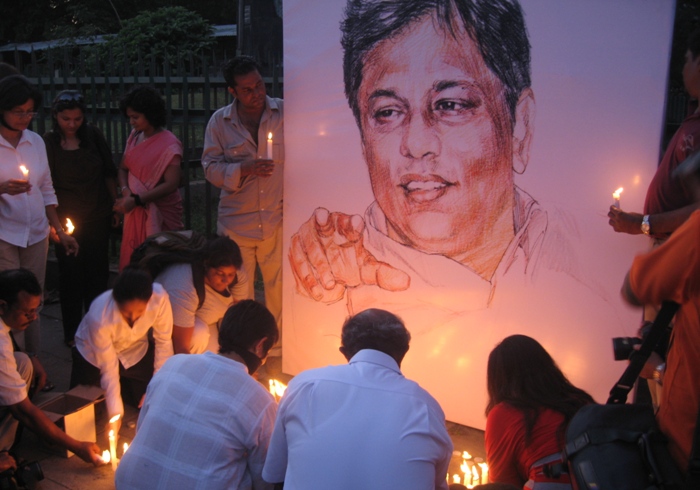
Too little, too late? Civil society candlelight vigil for Lasantha Wickramatunga

This evening, I quietly crossed a personal threshold. For the first time in my 42 years, I joined a street protest: a candlelight vigil for the slain newspaper editor and investigative journalist Lasantha Wickramatunga.

As I have explained elsewhere: “I’m strongly committed to promoting media freedom, but have never been the placard-carrying, slogan-shouting type. Street activism is necessary — but not sufficient. I’ve been more interested in studying trends and conditions, trying to anticipate what the next big threats, challenges and opportunities are, and how best we can respond to them.”

So I went to the vigil more for Lasantha the person and less for any organised effort. The invitation I received by SMS and email from several sources asked us to gather outside Colombo’s Vihara Maha Devi (formerly Victoria) Park at 5.15 pm. It was going to be a ‘joint civil society protest’ against Lasantha’s killing and the erosion of media freedom, democracy and human rights.

It turned out to be a well-intended but poorly-planned event lacking in vision and dynamism, perhaps a bit like our (very) civil society entities themselves. The couple of hundred people who joined it came mainly from Colombo’s high society, the ones who faithfully lapped up every word that Lasantha churned out week after week for nearly 15 years. Ironically, Lasantha and his newspaper were only loosely associated with this kind of (very) civil society – fellow companions on a shared journey, but not necessarily agreeing on priorities or strategies.

Missing from this gathering were the ordinary people and the grassroots end of the civil society spectrum – the ones who are bearing the brunt of our mismanaged economy, pervasive corruption and decaying public institutions. Some of these people turned up on their own initiative at Lasantha’s funeral service and/or the funeral itself, even if the latter event was shamefully hijacked by opportunistic political parties. (As one blogger noted, politicians of all colours and hue love dead bodies.)

I remembered the battered face of an old lady who sat through the entire funeral service – and then left quietly, without even lining up with the rest of the crowd to take one last look at Lasantha as he lay amidst flowers. I remembered the handful of men and women dressed in bright coloured clothes – standing out amidst the sea of white or black clad people – who I later found out came from the Kotahena area and were part of Lasantha’s home town church.
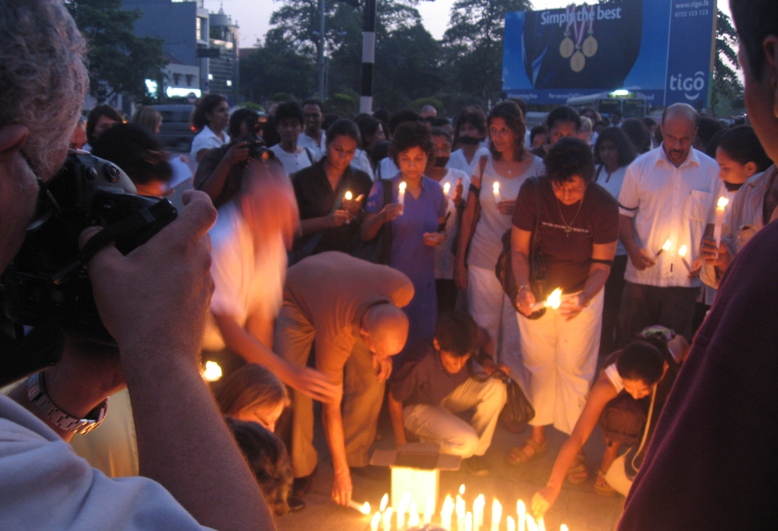
Lighting candles was good. Keeping the flame alive is harder...

No one had sent SMS or emails asking them to turn up. Some of them might not have been readers of English newspapers, which circulate among a numerically small but socially and economically influential section of Lankan society. They came because they felt the fallen man had stood up and spoken out for them.

In comparison, the candlelight vigil was decidedly upmarket. Nothing wrong in that, for the chattering class is very much part of our society and have the same rights to dissent and protest. In some countries, the upper middle class even provides vision, articulation and leadership to mass struggles. Ours, sadly, is more characterised by part-time activists who move more in the cocktail circuits grumbling about everything yet doing precious little to change the status quo. Indeed, some of them in their day jobs benefit personally from the prevailing corruption and nepotism, no matter which political party is in office.

The vigil’s organisers – it wasn’t clear who exactly they were – had painstakingly got the material ready: a large painting of Lasantha, black cloth bands and, of course, candles. But they hadn’t given enough thought to the location. We initially gathered and spent over half an hour on a stretch of road (Green Path) where only motorists passed by, but absolutely no pedestrians. Then someone thought of moving to the nearby roundabout which was a more visible, strategic location.

Not perfect, but better. By then, dusk was beginning to fall. We moved unhurriedly, chatting among ourselves, and slowly converged on a wide pavement. There, one by one, we started planting our candles on the ground in front of Lasantha’s picture. It was a moving moment captured in many still cameras and a handful of video cameras.

There we lingered for another hour or more, chatting with each other — and not necessarily about the lofty or somber matters. I was glad to catch up with several friends or associates active in artistic, journalistic or intellectual circles. I saw everybody else doing the same.

One of them, a human rights activist now turned peacenik, asked me many eager questions about blogging. A columnist for an English daily, he isn’t active online and his organisation is notably inept when it comes to mobilising the web for their cause. In his early 50s, he evidently hasn’t crossed what I call the Other Digital Divide. And he typifies the face of our organised civil society – a motley collection of do-gooders who are liberal, mostly secular, passionate yet largely ineffective in their advocacy for reform and change. They just can’t mobilise people power.
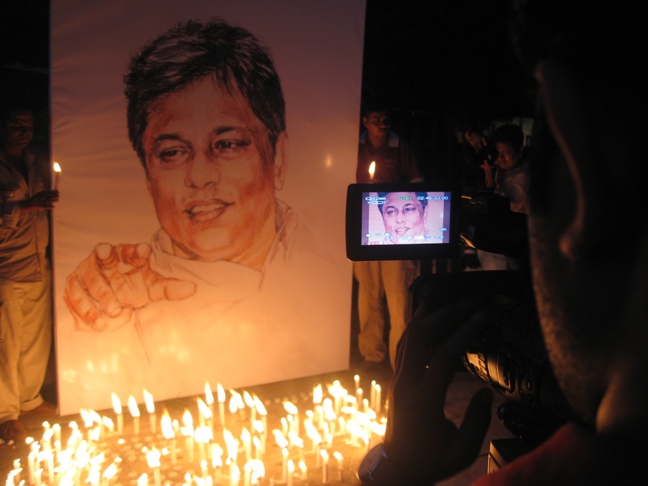
Candles burn out, but the image captured will live for longer...

Admittedly, it’s a quantum leap from the one-way street in op ed pages of mainstream print newspapers to the far less orderly, sometimes near-anarchic and often unpredictable world of the blogosphere. This might explain why a majority of Lankan civil society groups stay within their comfort zone and don’t engage the world of web 2.0

On the other hand, the younger, digitally-empowered activists who engage the web with technical savvy and passion are often too impatient or inexperienced (or both) with the necessarily tedious processes of institutional development – such as legal registration, financial management and putting in place mechanisms for the very ideals they advocate in governments and corporations: proper governance and accountability.

Fortunately, this offline/online divide is blurring, even if only slowly. Groups like Beyond Borders, which originated and found their feet in the new media world, are becoming more institutionalised. If they sustain themselves (and don’t lose their sharp edge), they can bridge the online world with the offline realities and needs.

Meanwhile, as some doggedly persistent citizen journalists and new media activists have shown in the days following Lasantha’s killing, it is now possible to stir up public discussion and debate on issues of rights, freedoms and democracy using dynamic websites, blogs, online video and other tools of web 2.0. See, for example, this reflection by the Editor of Groundviews.

Whether they are active online or offline, committed activists in Sri Lanka have their work cut out for them. If the candlelight vigil for Lasantha is an indication, far more work needs to be done in strategy, unity, networking and technology choices. The old order needs to pause, reflect and change their ways. If they can’t or won’t, at a minimum they must get out of the way. (Remember what happened to those dinosaur species that were vegetarian and harmless? They too went the way of T rex…)

Earlier on in the evening, as we were heading to the roundabout with burning candles in our hands, the wind suddenly picked up. Many of us struggled to keep the flame burning, sometimes shielding it with one palm. It wasn’t quite easy to do this while walking forward, watching our step. Amidst all this, we lost sense of where we were heading. We just followed those immediately in front of us, unsure who – if anyone – was leading. Not smart or strategic.

As I drove home, I realised how symbolic that candle-in-the-wind moment had been. Keeping the flames of truth, justice and fairness alive is hard enough. It becomes that much harder when winds of tribalism threaten to snuff it out. And in the thickening darkness, how do we make sure we are headed in the right direction?

The night is young and storm clouds are still gathering. We have miles to go before we can sleep.

Related posts:
August 2007: People Power: Going beyond elections and revolutions
November 2007: True people’s power needed to fight climate change
November 2007: Protect journalists who fight for social and environmental justice!
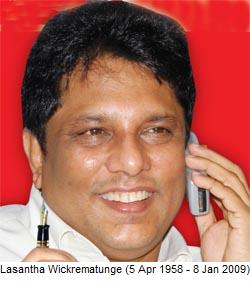
Goodbye, Lasantha Wickramatunga – and long live Siribiris!

No discussion or debate...
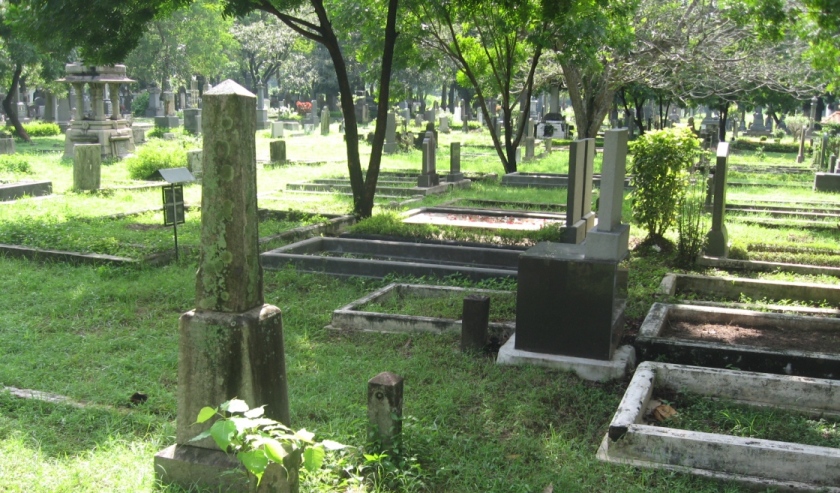
Colombo General Cemetery: No discussion or debate...

This is a view of Colombo’s main cemetery, the final resting place for many residents of Sri Lanka’s capital and its suburbs. I took this photo less than a month ago, when I visited a grave on a quiet morning.

The late Bernard Soysa, a leading leftist politician and one time Minister of Science and Technology, once called it ‘the only place in Colombo where there is no discussion or debate’.

This afternoon, family, friends and many sorrowful admirers of Lasantha Wickramatunga, the courageous Sri Lankan newspaper editor who was brutally slain last week in broad daylight, took him there — and left him behind amidst the quiet company.

But not before making a solemn pledge. All thinking and freedom-loving people would continue to resist sinister attempts to turn the rest of Sri Lanka into a sterile zombieland where there is no discussion and debate. In other words, rolling out the cemetery to cover the rest of the island.

The last laugh?
The last laugh?
Silencing Lasantha was the clear aim of cowardly gunmen who intercepted him on his way to work and shot him at pointblank. Tarzie Vittachi, the first Lankan newspaper editor to be forced into exile 50 years ago for freely expressing his views on politically sensitive issues, once called such attacks ‘censorship by murder’. (Alas, since Tarzie uttered those words in 1990, shooting the messenger has become increasingly common in Sri Lanka.)

Rex de Silva, the first editor that Lasantha worked for (at the now defunct Sun newspaper) in the late 1970s, has just cautioned that Lasantha’s murder is the beginning of ‘the sound of silence’ for the press in Sri Lanka. Can this sound of silence be shattered by the silent, unarmed majority of liberal, peace-loving Lankans who were represented at the funeral service and the Colombo cemetery today?

And would they remember for all time Edmund Burke’s timeless words: “All that is necessary for the triumph of evil is that good men do nothing”?

How many would actually read, absorb and heed the deeply moving words of Lasantha’s one last editorial, copies of which were distributed at the cemetery and the religious service before that?

That editorial, which appeared in The Sunday Leader on 11 January 2009, embodies the best of Lasantha Wickrematunga’s liberal, secular and democratic views.

As I wrote in another tribute published today by Himal Southasian and Media Helping Media: “I have no idea which one – or several – of his team members actually penned this ‘Last Editorial’, but it reads authentic Lasantha all over: passionate and accommodating, liberal yet uncompromising on what he held dear. I can’t discern the slightest difference in style.”

“And there lies our hope: while Lasantha at 51 lies fallen by bullets, his spirit and passion are out there, continuing his life’s mission. That seems a good measure of the institutional legacy he leaves behind. If investigative journalism were a bug, the man has already infected at least a few of his team members…”

Read the full story of The Sunday Leader team’s courage under fire

Read The Sunday Leader‘s tribute to its founding editor on 11 January 2009: Goodbye Lasantha

Much has been written and broadcast in the past 100 or so hours since Lasantha’s journey was brutally cut short by as-yet-unidentified goons who have no respect for the public interest or have no clue how democracies sustain public discussion and debate. I’m sure more will be written – some in outrage and others in reflection – in the coming days and weeks.

puncturing egos for 40 years
Siribiris (left): puncturing egos for 40 years
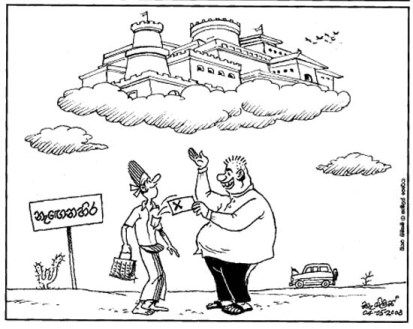
As we leave Lasantha to his rest, I remember Siribiris. For those unfamiliar with the name, Siribiris is an iconic cartoon character created by Camillus Perera, a veteran Sri Lankan political cartoonist who has been in the business as long as I have been alive.
Siribiris represents Everyman, who is repeatedly hoodwinked and taken for granted by assorted politicians and businessmen who prosper at the common man’s expense. The only way poor, unempowered Siribiris can get back at them is to puncture their egos and ridicule them at every turn. And boy, does he excel in that!

It’s no surprise that Lasantha – the bête noire of shady politicians and crooked tycoons – was very fond of Siribiris. Perhaps he saw his own life’s work as extending that of Siribiris in the complex world of the 21st century. That he did it with aplomb and gusto – and had great fun doing it, sometimes tongue stuck out at his adversaries – will be part of Lasantha’s enduring legacy. (As his last editorial reminded us, in 15 years of investigative journalism on a weekly basis, no one has successfully sued the newspaper for defamation or damages.)

So Goodbye, Lasantha. And Long live Siribiris!

Daily Mirror, Sri Lanka
Cartoon by Gihan de Chickera, Courtesy: Daily Mirror, Sri Lanka

Lasantha Wickramatunga: In Memoriam

Read blog post of 12 January 2009: Goodbye Lasantha – and long live Siribiris!

Farewell & fare forward...
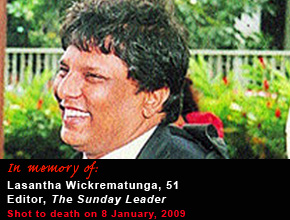
Saluting the memory of courageous newspaper editor, fearless investigative journalist, jovial human being and my former colleague Lasantha Wickramatunga, Editor in Chief of The Sunday Leader, Sri Lanka, shot dead by four gunmen within sight of his newspaper office. Today, we lost the real Leader of the Opposition.

RSF: Outrage at fatal shooting of newspaper editor in Colombo
Daily Mirror, Sri Lanka, news coverage: Lasantha shot dead
Dying for Journalism: TIME pays tribute to its reporter in Sri Lanka

Himal Southasian tribute: Unbowed and Unafraid

For once, I’m at a loss for words. When prose fails, we must turn to verse which is always more potent.
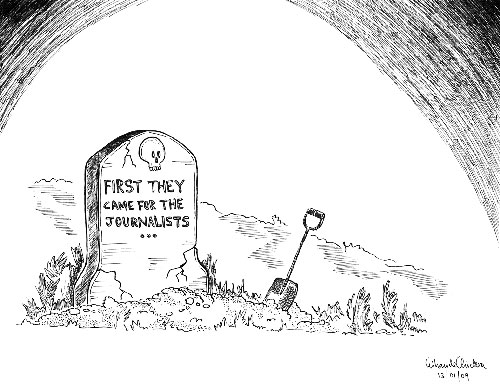
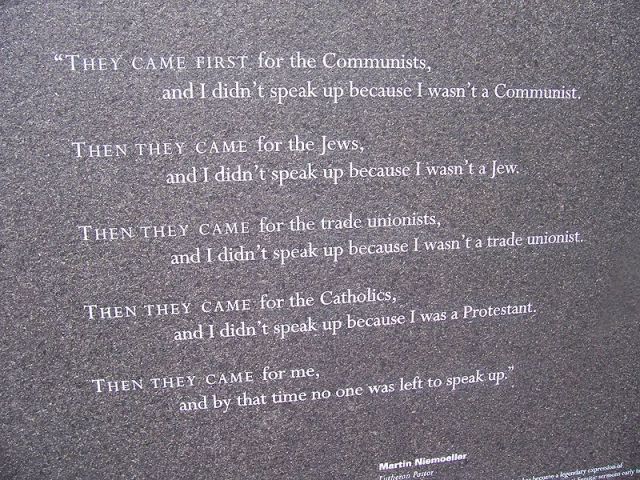
I remember Martin Niemoeller (image, below).
I remember Niyi Osundare (text, below).
I remember Adrian Mitchell.

This is the second time I have had to cite this poem in this dreadful week
This is the second time I have had to cite this poem in this deadful week

Not My Business
by Niyi Osundare

They picked Akanni up one morning
Beat him soft like clay
And stuffed him down the belly
Of a waiting jeep.

What business of mine is it
So long they don’t take the yam
From my savouring mouth?

They came one night
Booted the whole house awake
And dragged Danladi out,
Then off to a lengthy absence.

What business of mine is it
So long they don’t take the yam
From my savouring mouth?

Chinwe went to work one day
Only to find her job was gone:
No query, no warning, no probe –
Just one neat sack for a stainless record.

What business of mine is it
So long they don’t take the yam
From my savouring mouth?

And then one evening
As I sat down to eat my yam
A knock on the door froze my hungry hand.

The jeep was waiting on my bewildered lawn
Waiting, waiting in its usual silence.

Danny Schechter: Moving Images Person of the Year 2008

Moving Images Person of the Year 2008
Danny Schechter: Moving Images Person of the Year 2008

As 2008 – clearly an Annus horribilis for tens of millions around the world – draws to an end, we announce the Moving Images Person of the Year 2008: Danny Schechter.

Nicknamed “The News Dissector,” Danny is a television producer, independent filmmaker, blogger and media critic who writes and lectures frequently about the media in the United States and worldwide.

He has worked in print, radio, local news, cable news (CNN and CNBC), network news magazines (ABC) and as an independent filmmaker and TV producer with the award-winning independent company Globalvision. He is a blogger and editor of Mediachannel.org, a web and blog site that watches and critiques the print and broadcast media.

Another way to introduce Danny is to recall the scary headlines and TV news images that have dominated 2008 – of reputed banks going bust, leading stock markets crashing and these events triggering a global financial meltdown that, for now, has been slowed but not completely averted by unprecedented governmental intervention…by the very governments of the industrialised countries who should have kept a sharper eye on what was going on in their free market economies.

As the carnage on Wall Street and other global financial centres continued, some hard questions were asked: Did anyone see this coming? If so, why weren’t they listened to? What is the real cause of all this chaos? Where was the news media and why weren’t they doing their job of sounding the alarm?

Well, one man who saw it coming and tried very hard to raise the alarm was Danny Schechter. In 2006, as part of this effort, he made a documentary film called In Debt We Trust. In this, he was the first to expose Wall Street’s connection to subprime loans and predicted the global economic crisis.

This hard-hitting documentary investigated why so many Americans – college and high school students in particular – were being strangled by debt. Zeroing in on how the mall has replaced the factory as America’s dominant economic engine, Emmy Award-winning former ABC News and CNN producer Danny Schechter showed how college students were being forced to pay higher interest on loans while graduating, on average, with more than $20,000 in consumer debt.

An inconvenient truth that America ignored for too long...

The film empowers as it enrages, delivering an accessible and fascinating introduction to what former Reagan advisor Kevin Phillips has called “Financialization” — or the “powerful emergence of a debt-and-credit industrial complex.”

Danny and his film have done for global financial meltdown what Al Gore did for global warming with his own film: investigate rigorously, gather and present the evidence of a gathering storm, sound the alarm — and keep badgering until the warnings were heard. In both cases, the inconvenient truths they presented were ignored for too long — and we are paying the massive price for such indifference.

Watch the Trailer of In Debt We Trust:

Deborah Emin, writing in OpEdNews in October 2008, noted: “In Debt We Trust…brought Schechter a lot of grief. Rather than being seen as a prophet of doom, which in and of itself was not so terrible, he should have been lauded for sounding the alarm when it would have been in time. It is truly an amazing fact of American life that the powers that be can so disastrously determine what information we are able to see based on their subjective judgment of what is too negative or too harsh a view of a specific topic. From this perspective, we should judge all these gatekeepers as those on the Titanic who did not want to alarm the passengers that the ship was going down.”

Watch an extract from In Debt We Trust: How did we get into this mess?


Watch In Debt We Trust in full on Google Video

So here’s the trillion-dollar question: if this film was made in 2006, and has since been running to packed houses scaring a lot of thinking and caring people, why was its message not heard in the corridors of power in Washington DC — and elsewhere in the G8 countries’ capitals?

The short answer could be that there have been no thinking and caring people running the American government for the past eight years.

Read all about it!
Read all about it!
The long answer is found in a book that Danny published in mid 2008. Titled Plunder: Investigating Our Economic Calamity and the Subprime Scandal, it’s an outgrowth of – and update on – his 2006 film. It documents with shocking evidence how debt has restructured the American economy and put Americans under a burden that many will never overcome.

Plunder also offers an analysis based on current events, going behind the scenes, identifying the key players and culprits, challenging the financial industry, government deregulation — and the financial and most sections of the mainstream media who have been cheer-leading the financiers as the latter took ever larger risks. Danny also argues that this has been a criminal enterprise — a point only touched on in most media coverage — and of global significance, given the globalization of markets.

Read my Sep 2008 blog post: Financial Meltdown: Putting pieces together of a gigantic whodunnit


On a personal note, I have been a great admirer of Danny Schechter and his work since I first met him 13 years ago. In the Fall of 1995, he gave an inspiring and provocative talk to a group of journalists and producers from the developing world who were on a UN-organised media fellowship in New York. As part of our tour of media and development agencies in the US East Coast, we visited Danny’s GlobalVision productions.

Danny introduced himself as a ‘network refugee’ — one who had worked for the mainstream network television in the US and had left in disgust. From outside, he was trying to find alternative ways of speaking truth to power — the original mandate of the mass media which many corporatised media companies had abandoned, knowingly or otherwise.

In that pre-Internet era, Danny engaged in his media activism through independent filmmaking, through which he supported and often participated in struggles for social justice in his native United States as well as in places like apartheid-ridden South Africa and strife-torn Palestine.

www.newsdissector.com
http://www.newsdissector.com
Danny was one of the early media activists to take advantage of the web. In 2000, he co-founded with Rory O’Connor MediaChannel.org, the first media and democracy supersite on web. Operating on shoe-string budgets, it has sustained critical spotlight on the mainstream media (MSM) for 8 years in which the MSM landscape has been completely transformed. While its scrutiny and chronicling of the political economy of the media is more crucial than ever, and veterans like Walter Cronkite whole-heartedly endorse the effort, the non-profit effort struggles for survival.

Now in his 60s, Danny is simply indefatigable. Besides running MediaChannel and GlobalVision, he blogs every few hours, writes a regular column on Huffington Post, lectures on media, writes books and still has time to make investigative films. He is extremely well informed, witty, funny and completely irreverent. He writes and speaks with justified outrage but no malice. That’s a tough balance to maintain.

Danny visits Wall Street on 20 September 2007 – typical of his funny, incisive reporting:

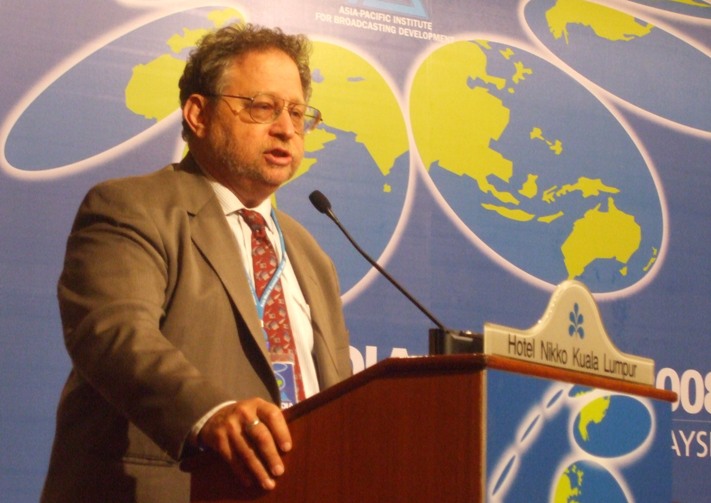
I was delighted to catch up with Danny in May 2008 when we both participated in Asia Media Summit in Kuala Lumpur. He and I were in a small minority of participants who were familiar with the inner works of the mainstream media and transformational potential of the new media. In characteristic style, Danny stirred things up, livening the usually staid proceedings, and I did my best to back him up from the audience. We both enjoyed asking irritating – if not outright annoying – questions from the 400+ media mandarins and press barons who’d come together for the Summit.

One evening, Danny and I had a drink with Malaysiakini’s CEO and leading new media activist Prem Chandran where we talked about the slow but inevitable decline of the mainstream media dinosaurs — or what Michael Crichton called Mediasaurus. The trouble with mediasaurus, we agreed, was that they are taking a long time going extinct and for now, they still command significant numbers of eyeballs and the dollars that follow.

After Prem left, Danny and I continued our chat into the evening. Over a spicy Indian meal, Danny gave me a crash course on subprime crisis (or sub-crime as he calls it) and how that was going to have a domino effect on markets everywhere. I listened with growing comprehension — and deep admiration for the man’s ability to communicate complexities without oversimplification.

Events in the weeks and months that followed have shown how remarkably prescient Danny Schechter was. And what a monumental, global scale mistake it was not to have heeded this man’s cautions in his blogs, films, columns and elsewhere.

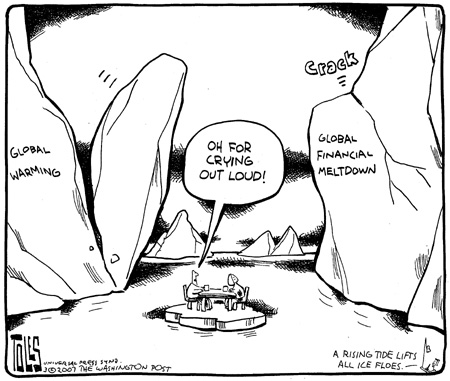
We end 2008 with my cartoon of the year. As I said in a blog post in September 2008: “This cartoon by Pulitzer prize winning Tom Toles first appeared in the Washington Post in 2007 – it brilliantly anticipated the global financial meltdown that we’re now experiencing. Coming in the wake of confirmed global warming, it is a double whammy.

Meltdown 2
Meltdown 2

Remembering the Children of Tsunami, four years later…

Jantakarn Thep-Chuay, known as Beam

For many weeks, Jantakarn Thep-Chuay — nicknamed Beam -– did not understand why her father was not coming home. The eight-year-old girl, in Takuapa in Thailand’s southern district of Phang Nga, had last seen him go to work on the morning of 26 December 2004.

“On that Sunday, the day there was a wave, my dad wore his tennis shoes,” she recalls as she gets into his pair of sandals. “My dad didn’t have to do much work — he just walked around looking after workers.”

Beam’s father Sukaroak –- a construction supervisor at a new beach resort in Khao Lak –- was one of thousands of Thais and foreign tourists killed when the Asian Tsunami hit without warning. His body was never found.

For months, Beam would draw pictures of her family. These, and family photos of happier times, helped her to slowly come to terms with what happened.

The first year was long and hard for the family Sukaroak left behind: Beam, her two-year-old brother Boom, and mother Sumontha, 28. The determined young widow struggled to keep home fires burning -– and to keep her troublesome in-laws at bay.

As if that were not enough, she also had to engage assorted bureaucracies: even obtaining an official death certificate for her late husband entailed much effort.

Just a few weeks after the disaster, the local authorities approached Sumontha suggesting that she gives away one or both her children for adoption. Apparently a foreigner was interested. She said a firm ‘No’.

“Her dad wanted Beam to become an architect. He was hoping for a day when he could build something she draws,” says Sumontha. “If I am still alive, I want to raise my own children. I am their mother. For better or worse, I want to raise them myself.”

The Tsunami destroyed Beam’s school, but she continued to attend a temporary school set up with local and foreign help. Before the year ended, she moved to a brand new ‘Tsunami School’ that the King of Thailand built to guarantee education for all children affected by the disaster.

Sumontha, Beam and Boom are three ordinary Asians who have shown extraordinary courage, resilience and resourcefulness as they coped with multiple challenges of rebuilding their lives after the Tsunami. Theirs is one of eight families that we followed throughout 2005, under our empathetic communication initiative called Children of Tsunami: Rebuilding the Future.

It was a multi-country, multi-media project that tracked how ordinary Asians rebuilt their lives, livelihoods and futures after one of the biggest disasters in recent years. We at TVE Asia Pacific documented on TV, video and web the personal recovery stories of eight affected families in India, Indonesia, Sri Lanka and Thailand for a year after the disaster. Our many media products — distributed on broadcast, narrowcast and online platforms -– inspired wide ranging public discussion on disaster relief, recovery and rehabilitation. In that process, we were also able to demonstrate that a more engaged, respectful kind of journalism was possible when covering post-disaster situations.

where Children of Tsunami stories were filmed for much of 2005
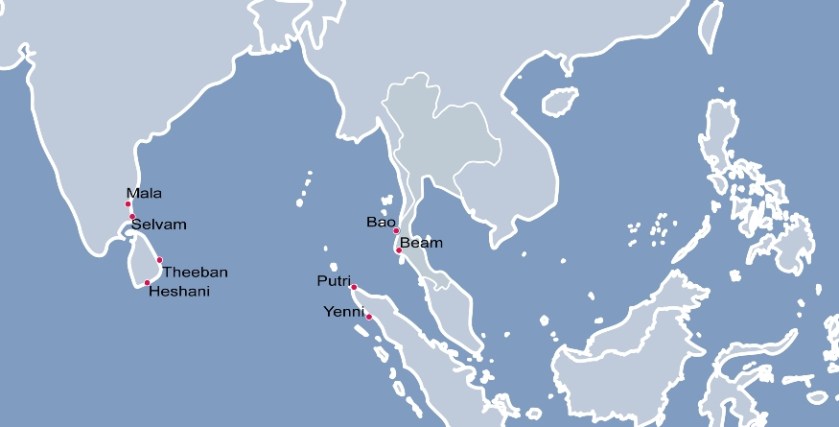
Four countries, eight locations: where Children of Tsunami stories were filmed for much of 2005

Meet the Children of Tsunami

They have never met each other. Yet they were united first in grief, then in survival. Five girls and three boys, between 8 to 16 years of age, living in eight coastal locations in four countries. Their families were impacted by the Asian Tsunami in different ways. Some lost one or both parents -– or other family members. Some had their homes or schools destroyed. Others found their parents thrown out of a job. During the year, these families faced many hardships and challenges in rebuilding their futures.

These remarkable children were our personal heroes for 2005:
Selvam, 13, Muzhukkuthurai, Tamil Nadu state, India
Mala, 11, Kottaikkadu, Tamil Nadu state, India
Putri, 8, Lampaya, Aceh province, Indonesia
Yenni, 15, Meulaboh, Aceh province, Indonesia
Heshani, 13, Suduwella, southern Sri Lanka
Theeban, 14, Karaitivu, eastern Sri Lanka
Bao, 16, Kuraburi, Phang Nga district, Thailand
Beam, 8, Takuapa, Phang Nga district, Thailand

With their trust and cooperation, we captured their unfolding realities unscripted and unprompted.

Read and experience much more on the Children of Tsunami dedicated website

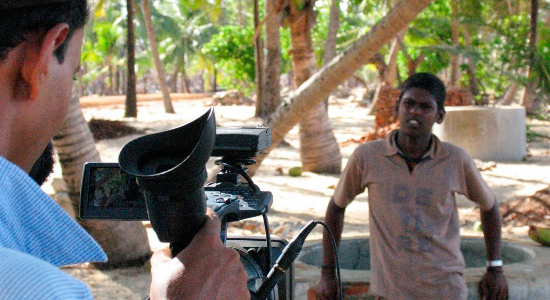
Filming with Theeban in eastern Sri Lanka...now only a memory

As I recalled in early 2007, when we tragically lost one of eight survivor children – Theeban – to Sri Lanka’s civil war: As journalists, we have been trained not to get too attached to the people or subjects we cover, lest they affect our judgment and dilute our objectivity. The four production teams involved in Children of Tsunami initially agreed to follow this norm when we met in Bangkok in early 2005 for our first (and only) planning meeting. We also resolved not to reward our participating families in cash or kind, as they were all participating voluntarily with informed consent.

“But the ground reality was different. 2005, Asia’s longest year, wore on. As survivors slowly patched their lives together again, our film teams found themselves becoming friends of families or playing Good Samaritan. Sometimes our teams would find a survivor family close to starvation and — acting purely as human beings, not journalists — they would buy dry rations or a cooked meal. At other times, finding the children restless or aimless, they would buy them a football, kite or some other inexpensive toy that would produce hours of joy and cheer.

“As commissioners and publishers of Children of Tsunami stories, we didn’t object to these acts of kindness. Journalism with empathy was far preferable to the cold detachment that textbooks recommend.

In 2007, my colleague Manori Wijesekera – who served as production manager of this challenging effort – and I wrote up our definitive account of the project for Communicating Disasters: An Asia Pacific Resource Book. That chapter can be read online here.

Children of Tsunami: The Journey Continues
(25mins) was the end-of-year film that captured the highlights and ‘lowlights’ of our families’ first year following the disaster. It can be viewed online at the Children of Tsunami website.

Children of Tsunami: No More Tears (25 mins) was the shorter version of the end-of-year film that captured the highlights and ‘lowlights’ of our families’ first year following the disaster. We co-produced it with the Singapore-based regional broadcaster Channel News Asia.

Watch the first few minutes on YouTube:

All images courtesy TVE Asia Pacific

Climate change and copyrights: What intellectual property on a dead planet?

Twenty centuries ago, Emperor Nero fiddled while Rome burned. Today, some media companies are squabbling over copyrights while the planet is warming.

This is the main thrust of my latest op ed essay, just published by the Science and Development Network (SciDev.Net) anchored in London, UK. It’s titled: Planet before profit for climate change films.

I have adapted for this commentary some of my ideas initially expressed on this blog – especially the post on 12 Oct 2008: Climate in Crisis and planet in peril – but we’re squabbling over copyrights!

Broadcasting on a warming planet

In writing this essay, I’ve also drawn on the excellent discussions we had last month during the Asia Pacific workshop on Changing Climate and Moving Images in Tokyo.

I’m challenging broadcasters to put their money where their mouth is.

Here’s an excerpt:

“Broadcast mandarins routinely support global struggles against poverty, HIV, corruption and climate change by offering free airtime to carry public interest messages. But few let go of their own products on these very subjects for non-broadcast uses.

“Making climate change a ‘copyright free zone’ for media products would increase the resource materials available to thousands of educators, social activists and trainers struggling to communicate this complex topic to audiences across the world. Moving images would make their task easier.

“The climate crisis challenges everyone to adopt extraordinary measures. Broadcasters and film-makers need to balance their financial interests with planetary survival.

“What use is intellectual property on a dead planet?”

Read my full essay on SciDev.Net: Planet before profit for climate change films.

In September 2006, speaking at the United Nations headquarters (photo below), I called for poverty to be recognised as a copyright free zone. The idea was to have broadcasters and other electronic publishers release copyrights on TV, video and online content relating to poverty and development issues -– at least until (MDG target year of) 2015.

The TV broadcast and film communities have reacted to this proposal with disdain or indifference, but I keep badgering on. If poverty didn’t motivate broadcasters to change business as usual, I hope, the planetary threat posed by climate change would.

Meet the new Pied Pipers of our Global Village: the Media!

In the well known legend, the pied pier of Hamelin played his musical pipe to lure all the rats into the nearby Weser river. When the town reneged on the promised fee, he played a different tune to entice all its children away from the town.

Modern-day pied pipers use smooth talk and convincing images instead of hypnotic musical tunes to lead people astray. And they achieve much greater coverage today — thanks to the modern media.

When the media amplify pied piper tunes, how responsible are they for the resulting damage?

Then and now, we like to follow a tune...

This is the question I raise – and try to answer – in an op ed essay published this week by the Asian website Eye on Ethics.

‘When media amplify pied piper tunes…’ was inspired by a current experience in my native Sri Lanka. For the past few weeks, Sri Lankans have been shocked and dismayed to learn how thousands of middle-class adults have been hoodwinked by a confidence trickster who used paid advertisements in newspapers and on television to boost his image.

Sakvithi Ranasinghe, a populist tutor of English turned businessman, fled the country in mid-September 2008 after duping thousands of unsuspecting people to deposit money in an Ponzi-style investment scheme that offered abnormally high returns.

After the scandal broke, the media have been giving it a great deal of coverage. But most of it falls into follow-the-victim, blame-the-authorities style of journalism.

The main point of my essay: “Amidst the finger-pointing, arm-waving and name-calling, few have noticed the role of the media in promoting Ponzi schemes in the first place. Wittingly or otherwise, the media have helped amplify the mesmerizing tunes of pied pipers, and quietly collected substantial advertising revenue from such racketeers.”

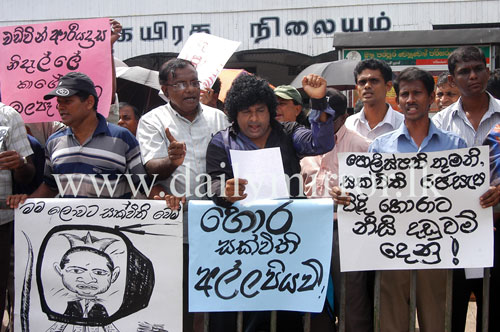
Sakvithi's investment victims protest in Colombo - photo courtesy Daily Mirror

I also comment in this essay the blurring of what used to be a sacred divide in the media – between editorial content and paid advertising. Here’s an excerpt:

“Many people experience media products as a whole, and lack the media literacy to separate news, commentary and paid commercials. Besides, the once clear demarcations have blurred in recent years.

“Television’s seamless blending of news, entertainment and commercials can leave even the most media-literate people somewhat perplexed. News bulletins are sponsored variously by sellers of insurance, milk food or detergents, while current affairs shows are branded by various commercial products or services.

“In newspapers, the steady rise of ‘advertorials’—product promotions neatly dressed up as editorial content—makes it harder to discern where one ends and the other begins.”

Read and comment on my full essay at Eye on Ethics website

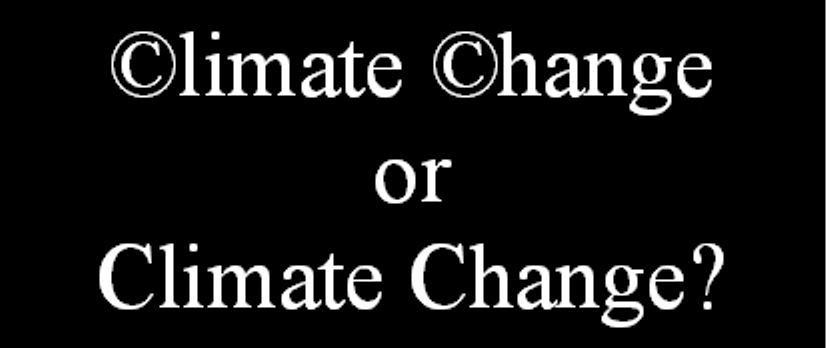
©limate ©hange or climate change? Copyrights on a warming planet

This is the real question!

OK, this is hot off my imaginative mind. I was writing an op ed essay today and turning phrases over in my mind when I came up with this…which neatly sums up what I’ve been saying for a while: confronted with the climate crisis, broadcasters and film-makers need to adopt a more liberal approach to copyrights on their creations.

For discussions on this, see my earlier blog posts:

15 Oct 2008: Standing on Al Gore’s Shoulders: Moving images in the climate debate

13 Oct 2008: ‘Climate Challenge’ marks turning point in Vietnam’s climate concerns

12 Oct 2008: India’s climate change NIMBYsm and middle class apathy

12 Oct 2008: Climate in Crisis and planet in peril – but we’re squabbling over copyrights!

See also these news items appearing on TVE Asia Pacific website:

6 Oct 2008:
Make climate change a ‘copyright free zone’: Asia Pacific TV and film professionals call

4 Oct 2008:
Climate coverage in media needs rational and emotional approaches

‘War for the Whitehouse’: Obama, McCain and The Onion

Onion News Network - for news you can't afford to miss

The American presidential election race is entering its last lap. And the world watches the campaign trail with baited breath.

Democratic presidential candidate Barack Obama enjoys more international support than his Republican rival John McCain, as most people outside the US prefer the Democrat leader to become next US president, according to a BBC poll in September 2008. Most of the people questioned in the global poll conducted by international polling institute GlobeScan believe that US relations with the rest of the world would improve under the presidentship of Obama.

While so much of American and international news media time is being spent on covering the campaign and various opinion polls, some comic relief comes from The Onion – that wickedly funny and innovative website which now produces a steady stream of videos spoofing the news media’s worse excesses.

The Onion calls it the ‘War for the White House’ and has set up its ‘election analysis bunker’ from where its intrepid reporters are bringing us news that you – and major news organisations – have somehow managed to miss. They call is Onion News Network, ONN for short.

They’ve been doing it for the better part of a year, and here are some of my favourites from The Onion YouTube channel:

Caution: There’s a slight bias towards Senator Obama in some of these news reports, but then, he’s been the liberal media’s darling for much of this campaign year.

October 2008: McCain Left On Campaign Bus Overnight
Campaign officials downplayed the incident, saying the senator was fine as soon as he was fed and taken to the bathroom.

October 2008: Gifted Youngster Sells Cookies To Buy Attack Ad
In this installment of Beyond The Facts, a precocious 8-year-old girl participates in grown-up politics by spreading smears and lies.

September 2008: McCains Economic Plan: ‘Everyone Marry A Beer Heiress’
McCain pointed to his personal success in marrying a wealthy beer heiress to prove how the plan could benefit every American.

September 2008: Obama Runs Constructive Criticism Ad On McCain
In response to Republican attacks, Barack Obama unleashed a series of slightly negative ads that gently point out how McCain could be doing a better job.

August 2008: Portrayal Of Obama As Snob Hailed As Step Forward For Blacks
Overjoyed civil rights leaders say that Barack Obama has paved the way for future black politicians to be smeared as country club snobs.

March 2008: Poll: Bullshit Is Most Important Issue For 2008 Voters
For a majority of likely voters, meaningless bullshit will be the most important factor in deciding who they will vote for in 2008.

January 2008: The Onion: More Candidates Court Fat Vote
Presidential candidates are reaching out to fat voters on the campaign trail by eating large amounts of fattening food.

See all election videos of ONN

ONN’s self-introduction says its “style of hard-hitting, on-the-ground coverage of live news events has become a standard in the news industry. The network can be viewed in 92.2 million U.S. households and more than 500,000 American prison cells, making it the most-watched cable network in the world. It can currently be seen in 312 countries, with broadcasts in 52 different languages“.

Wow!

The Onion - The Nation's finest news source...

Financial Meltdown: Putting pieces together of a gigantic whodunnit

this says it all...
My cartoon of the year: this says it all...

This cartoon by Pulitzer prize winning Tom Toles first appeared in the Washington Post in 2007 – it brilliantly anticipated the global financial meltdown that we’re now experiencing. Coming in the wake of confirmed global warming, it is a double whammy.

America has been hit hard by the sub-prime crisis. The social and human cost of financial failure has been enormous. An epidemic of home repossessions has left thousands of houses abandoned and boarded-up: whole suburbs are falling into disrepair and dereliction.

Financial institutions in America and in Britain had poured billions into investments backed by these mortgages. As more and more people have defaulted on their mortgage repayments, financial markets have collapsed, causing a crisis that has rippled across the Atlantic, sending the City of London into turmoil and pulling the plug on one now infamous British bank.

Some call it a financial tsunami not been seen since the Great Depression in the 1930s….a crisis that has forced the US government to step in and save the financial system after trillions were wiped off global stock markets and once revered institutions were swept off the face of Wall Street. Is the US intervention too little, too late to save the economy?

In fact, just a few days ago, the People’s Daily of China warned that a “financial tsunami” was approaching, which recalled the Great Depression in the US. It said: “As the contemporary economy has been integrated globally, American consumption and currency exchange rates will directly influence countries dependent on the US as the main export destination for economic growth and employment”.

The Chinese Communist Party organ complained that the US had unleashed financial “weapons of mass destruction” on the world economy in the form of subprime debts and related financial derivatives.

The world’s media have been scrambling to cover these rapidly unfolding events. In fact, many have been caught napping, or worse, been uncritical cheerleaders of the march of capital and credit. Most of them – even the respected financial journals – just didn’t see the crisis building up…or ignored the tell-tale signs that constituted an inconvenient truth.

Danny Schechter - wasnt crying wolf!
Danny Schechter - wasn't crying wolf!
“This didn’t just happen in the course of a usual business cycle,” insists the American investigative journalist and media analyst Danny Schechter, who has been tracking this issues for many months on his influential News Dissector blog and the MediaChannel that watches and critiques the media.

In his new book, aptly titled Plunder, Danny offers an in-depth investigation into the decline of the economy that’s causing millions to lose jobs and face foreclosures and across-the-board price hikes.

He says: “You wouldn’t know it by relying on our media, but the subprime scandal masks massing looting by Wall Street firms using carefully calculated predatory lending schemes enabled by regulators who don’t regulate and a media that looked the other way. We have lost trillions and dislocated millions with no relief in sight. Every American is paying for the greed of our financiers in the grocery store, gas pump and unemployment line. Bank robberies are not new — but banks doing the robbing is.”

Read the introduction to Danny Schechter’s Plunder.

In 2007, his film IN DEBT WE TRUST was the first to expose Wall Street’s connection to subprime loans, predicting the economic crisis that this book investigates.

I have been watching various news media analysis of the current crisis and want to share two that stood out from the rest: Inside Story by Al Jazeera English, and Dispatches by UK’s Channel 4.

In a special show from New York, Inside Story looks at the financial turbulence that rocked the US last week. Will the emergency measures by the US government be enough to stabilise the markets or has the financial system in the US been changed forever? The introductory report from AJE’s Washington correspondent Reynolds is particularly illuminating – he also writes the story for their website.

Inside Story – The US financial crisis – 21 Sep 2008 – Part 1

Inside Story – The US financial crisis – 21 Sep 2008 – Part 2

From the other side of the Atlantic comes a more investigative, one-hour special that was produced and broadcast in March 2008, when the early signs of the banking crisis were beginning to show – for anybody who cared to notice.

As Channel 4 introduces it: “This is a story about the destructive power of finance: what happens when banks are driven by short-termism; when bankers are rewarded with vast bonuses, free to operate under inadequate regulatory supervision, and with the complicity of a government too in awe of big business to step in.”

Dispatches: How The Banks Bet Your Money UK & US – part 1

In this edition of Dispatches, private equity financier Jon Moulton delivers a stinging rebuke to the banks for causing this financial meltdown and explains why the British taxpayer will now pay the price.

Dispatches: How The Banks Bet Your Money UK & US – part 2

Dispatches: How The Banks Bet Your Money UK & US – part 3

Dispatches: How The Banks Bet Your Money UK & US – part 4

Dispatches: How The Banks Bet Your Money UK & US – part 5