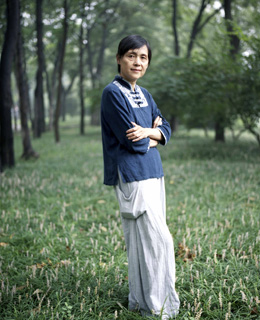
Sheri Liao: From ‘Time for Environment’ to TIME Hero of the Environment 2009

Sheri Liao photographed for TIME by Elisa Haberer

Copyright infringement – or piracy – in video, film and software is a highly contentious issue. I have good friends on both sides of the divide: film maker friends who insist on protecting all their rights to their creations, and open source advocates who want everything to be free and accessible in the public domain.

I can appreciate both points of view, but my own attitude to anyone copying any video films I have helped make or am distributing is: just sit back and enjoy it! After all, the kind of films I make and/or distribute through TVE Asia Pacific are all issue-based and in the public interest. If anyone pirates them, that can only peddle our content and messages to more people…

It’s a pragmatic response to a reality that I can do little to change anyway. Five of the world’s top 10 countries for video piracy are found in the Asia Pacific region, with China at No 2 and India at No 5. If you can’t beat ’em, cheer ’em — and even join ’em!

That’s just what I did in mid 1996, when we received first reports of a Chinese TV presenter making unauthorised use of environmental programming being broadcast on BBC World, the global TV channel. I was then the head of Asia Pacific programme for the non-profit foundation producing Earth Report series, which first aired on BBC and then offered to other TV channels and networks around the world.

Further investigations revealed that the person involved was a woman named Sheri (Xiaoyi) Liao, a former researcher at the Chinese Academy of Social Sciences who had formed an environmental group called Global Village of Bejing, and was presenting a weekly TV show called ‘Time for Environment’. To bring environmental news and views from other parts of the world, she was using Chinese dubbed extracts of Earth Reports recorded straight off the BBC World satellite channel.

By happy coincidence, I was visiting Beijing – for the first time – for a few days in October 1996, to participate in an international conference of rocket scientists (not my usual orbit, but fortuitous in this instance!). I managed to contact Sheri Liao, and one evening I escaped from the conference to meet this woman who was fast becoming the environmental face of Chinese television.
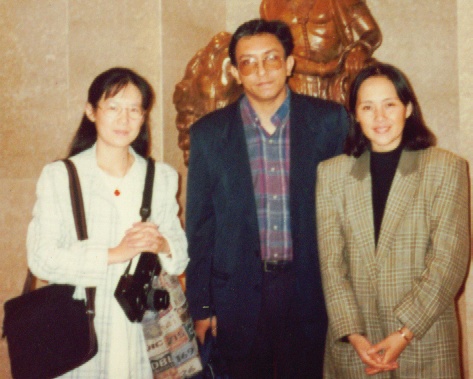
L to R Dr Li Hao, Nalaka Gunawardene & Sheri Liao, Beijing Oct 1996
Sheri Liao came to meet me with Dr Li Hao, a Chinese biologist who had recently returned from Germany and teamed up with Global Village in its quest to raise environmental awareness in China.

In a long chat over drinks and dinner, I found out Sheri had been a visiting scholar on International Environmental Politics at the University of North Carolina, but returned to her homeland to found the Global Village of Beijing earlier that year. She was keen to introduce responsible environmental conduct by Chinese citizens at every level. And early on, she realised the massive power of broadcast television to reach China’s one billion plus people. She approached her work with an obsession bordering on missionary zeal: in that process, she was even willing to ‘pirate’ foreign TV content – all for a good cause.

Soon after that encounter, I negotiated for Sheri Liao to make authorised use of Earth Report films in China. Instead of catching it off the airwaves, she soon started receiving proper master tapes and scripts, so a more professional versioning into Chinese could be done. My then British colleagues, who were initially peeved that a Chinese woman was pirating their programmes, soon became her ardent supporters.

That was also the beginning of many years of my engagement with environmental education and communication work in China. (Li Hao later left Global Village to establish her own non-profit, Beijing Earthview Environment Education and Research Centre).

All this is a long way of saying how delighted I am to see Sheri Liao being named as a Hero of the Environment by TIME Magazine earlier this month. She is one of several Asian leaders, researchers and activists included in this year’s roll call of men and women who are fighting on behalf of our beleaguered plant. Read full list here.
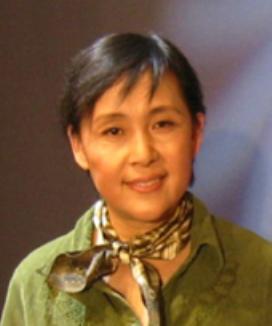
Sheri Liao: Greening the Airwaves of China...
Chronicling her close association with China’s rising levels of environmental awareness and activism, TIME noted: “Liao was helped by the fact that the birth of GVB coincided with China’s economic takeoff in the mid-’90s. The group became active in Beijing neighborhoods, raising environmental awareness on the local level. But in recent years it has expanded its work across the country, and it is now involved in everything from promoting plastic-recycling to encouraging building managers to reduce electricity consumption.”

Our paths have crossed a few times since that first meeting in the Fall of 1996. We have been in workshops and conferences together, where I saw Sheri in action – always intense, with a sense of urgency and resolve.

She has been recognised before. In 2002, she was awarded one of the ‘Ten Outstanding Women in China’ by the magazine Chinese Women. She was also honored as the ‘Green Guide’ by China National Planting Tree Committee in 2003 and became one of the ‘Ten National Outstanding Women’ in 2004. In 2005, she won the ‘Annual Economic Figure Social Commonwealth Award’ by China Central Television (CCTV). In 2006, she was honored Green Chinese Annual Figure.

Sheri also continues to be an unofficial bridge between China and the rest of the world. She works with UN agencies, foreign universities and charities like the Clinton Global Initiative – which honoured her with one of its Global Citizen Awards 2008.

China’s road to environmental salvation is a long and hard one. As TIME noted, “Environmental groups continue to run afoul of the Chinese government, which is wary of any power not concentrated in the hands of the Communist Party. But Liao is well connected — she served as an environmental adviser on the Beijing Organizing Committee for the 2008 Olympic Games — and in China’s tricky political landscape, those who walk a prudent line often travel furthest.”
Radio Sagarmatha: Voice of a Valley and Hope of a nation

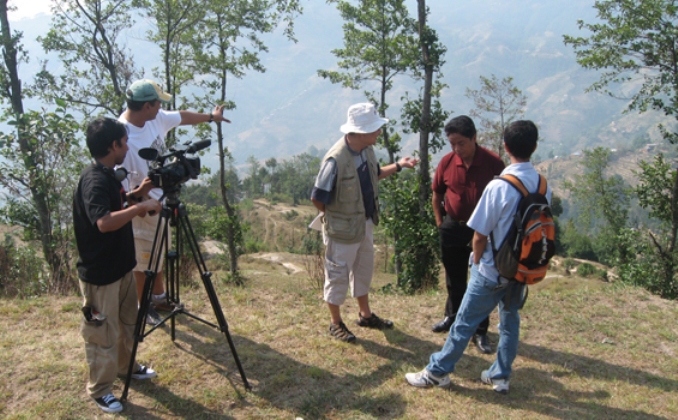
Location filming Saving the Planet in Nepal

I have written more than once in this blog about Radio Sagarmatha of Nepal, the first independent community broadcasting station in South Asia.

In May 2007, on the occasion of their 10th anniversary, I called it Kathmandu Valley’s beacon of hope. I have known and admired the Nepali friends who are running the award-winning, public-spirited radio station.

I’m delighted, therefore, to be able to make a short film about one facet of Radio Sagarmatha: their contribution to education for sustainable development, ESD for short.

Radio Sagarmatha’s path-breaking work in the resort town of Nagarkot is the story in one film of Saving the Planet, TVE Asia Pacific’s new regional TV series showcasing communities thinking globally and acting locally.

The six-episode series, which was 18 months in the making, features outstanding efforts in education for sustainable development in South and Southeast Asia.

It goes in search of answers to these key questions: Can ordinary people help save our planet under siege from multiple environmental crises? How can everyone change attitudes and lifestyles to consume less and generate less waste?

Here’s the official synopsis of the Nepal story, titled Voice of a Valley:

Tourism generates incomes, jobs and markets for the people of Nagarkot, a popular resort close to the Nepali capital Kathmandu. But it had a bumpy start when hoteliers initially bypassed local communities. These tensions were diffused by Radio Sagarmatha, the country’s first independent public radio station, which brought all interested parties together on the air. This example shows how media can do more than just report. By inspiring discussion and debate, media can help communities to find the best solutions or compromises for their development needs.

Watch Saving the Planet: Voice of a Valley

Many thanks to friends at the Nepal Forum of Environmental Journalists (NEFEJ), for their help in making this short film about one of their most outstanding efforts.

Find the full credits of the film here

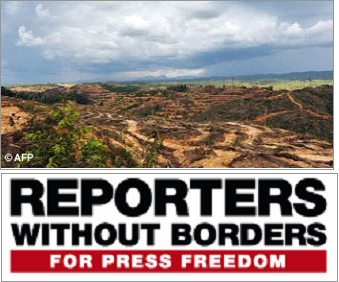
RSF: Who will protect journalists fighting for a better planet?

RSF: We must defend journalists who fight for the planet
In November 2007, I wrote a blog post calling for greater protection for local journalists who cover social and environmental justice issues risking their life and limbs.

I quoted the Filipino academic and social activist Professor Walden Bello, as saying: “Things are pretty savage at the grassroots level in some of our countries. Journalists who investigate and uncover the truth take enormous personal risks – the vested interests hire killers to eliminate such journalists.”

Bello, executive director of the Focus on the Global South, further said: “Journalists living in the provinces and reporting from the grassroots are more vulnerable than those based in the cities. This is precisely why local journalists need greater support and protection to continue their good work.”

Last week, Reporters Without Borders echoed this call, saying: “We must defend journalists who expose attacks on the environment”.

The press freedom activist group released a new report titled “The dangers for journalists who expose environmental issues.” It highlights the indifference – and even complicity – of some governments and local authorities that make little attempt to protect journalists who take risks to investigate attacks on the environment.

The report looks at 13 cases of journalists and bloggers who have been killed, physically attacked, jailed, threatened or censored for reporting on the environment, and highlights the need for a free press to tackle ecological challenges.

In countries such as Russia, Cambodia, Brazil or even Bulgaria, in Europe, journalists run considerable risks when they try to alert the world about the misdeeds of those who prey on the environment.

Read the full report online

Read my June 2007 tribute to Joey Lozano, a courageous Filipino journalist who risked his life to fight for environmental and social justice issues

XYZ Show controversy: Kenyan politicians forgetting ‘Hakuna matata’?

Politics no longer a laughing matter?

“The trouble with political jokes is that they keep getting elected!”

Ayesha, a regular reader of this blog, left that one-liner comment in response to my blog post of 13 August 2009 on an interesting experiment in political satire on Kenyan television that ended its first season on 9 August 2009.

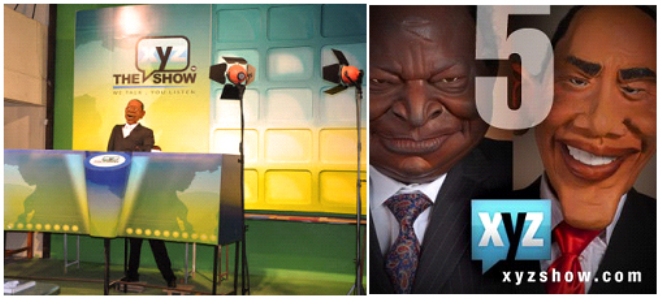
It’s a show called the XYZ Show, broadcast weekly on Kenya’s Citizen TV. Started in mid May 2009, the first season introduced Kenyan viewers to a new form of satire television, with life-sized puppets made to resemble famous persons, mostly politicians.

Now comes the report that the show has riled some Kenyan politicians – surprise, surprise! I have only just come across this Citizen TV news report, broadcast a couple of weeks ago:

Controversy Over The XYZ Show

The satirical puppet show XYZ on Citizen Television every Sunday night, has attracted the attention of non other than the Public Service Minister Dalmas Otieno. The Minister says the caricature show is depicting politicians in bad light. The Director of Communication Ezekiel Mutua avers that, the show is representative of just how free the media is, in Kenya.

Well, what can we say? We thought politicians in general had thicker skins. Perhaps some Kenyan politicians are in danger of forgetting that timeless piece of Swahilian advice: Hakuna matata!

Hakuna matata is a Swahili phrase that is literally translated as “There are no worries”. It is sometimes translated as “no worries”, although is more commonly used similarly to the English phrase “no problem”.

The XYZ Show: New horizon in political satire on African TV, but room to grow?

Anyone can do ABC; it takes effort to make it all the way to XYZ...
Anyone can do ABC; it takes a special effort to make XYZ...


Update on 1 Sep 2009: Controversy over XYZ Show: Kenyan politicians forgetting Hakuna matata?

I ended a recent blog post, News wrapped in laughter, with this thought: “There is another dimension to satirising the news in immature democracies as well as in outright autocracies where media freedoms are suppressed or denied. When open dissent is akin to signing your own death warrant, and investigative journalists risk their lives on a daily basis, satire and comedy becomes an important, creative – and often the only – way to comment on matters of public interest. It’s how public-spirited journalists and their courageous publishers get around draconian laws, stifling regulations and trigger-happy goon squads. This is precisely what is happening right now in countries like Kenya and Sri Lanka, and it’s certainly no laughing matter.

An interesting experiment in political satire on Kenyan television has just ended its first season on 9 August 2009. It’s a show called the XYZ Show, which was broadcast weekly on Kenya’s Citizen TV. Started in mid May 2009, the first season introduced Kenyan viewers to a new form of satire television, with life-sized puppets made to resemble famous persons, mostly politicians.

Gado the Creator
Gado the Creator
The XYZ Show was inspired by famous puppet satire series like the British “Spitting Image” and the French “Les Guignols de l’Info” shows. In the XYZ Show, the puppets commented on news and current events from both Kenya and overseas.

The XYZ Show was developed by a team led by Kenyan cartoonist Godfrey Mwampembwa, alias Gado. He is the most widely syndicated cartoonist in East and Central Africa. He publishes a daily cartoon in The Nation, the largest newspaper in Kenya, and his work has been published in Le Monde (France), Washington Times (US), De Standaard (Belgium) and The Japan Times.

According to its creators, the XYZ Show challenged famous figures from Kenyan high society and politics using humour and satire. It aimed to become a new forum for social and political debate, one that provides room for open discussion.

Watch XYZ Show’s first episode trailer, produced one year ago:

Says the Prince Claus Fund of the Netherlands, which supported the show’s production: “Although freedom of the press is a constitutional right in Kenya, it is difficult for many journalists to practice their profession without interference. Gado and his team hope that the XYZ Show will contribute positively to strengthening freedom of the press and increasing political and social awareness among the people of Kenya. The show provides commentary on current social and political developments and aims to use humour and artistry to reinforce freedom of speech in Kenya.”

From what I’ve been able to watch online, on the show’s YouTube channel and elsewhere, the production values are at a high standard, comparable to such shows made in Europe and East Asia. The puppets are attractive, movements convincing and the pace quick and slick.

Who pulls his strings?
The producers have also tried hard to make XYZ more than just a TV show. The website, in English, shows how the content is being adapted for the web (as webisodes) and mobile phones (as mobisodes). The show’s official blog takes us on to the set and shares with us the story behind the story, and introduces us to the artists and technical geniuses involved. Full marks for trying to engage the audience.

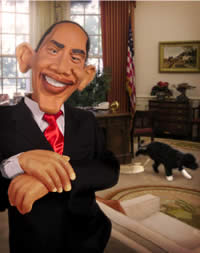
Then there is Barack Obama. Using his Kenyan connections, the show casts him (really, a puppet in his image) in a ‘supporting actor’ role. This has clearly inspired some interest in the show beyond Kenya.

So far, so good. But how does it work with the audience? The show is directed mainly at local audiences, and even if it’s presented in a mix of English and local language, it’s not something a complete outsider like myself can appreciate.

So I ‘crowd-sourced’ by asking a Kenyan reader of my blog, Marion N N, for her opinion. Marion is part of Sojourner, which her blog introduces as “a social enterprise that exists to promote the origination, production and distribution of African viewpoints through visual media. We are passionate about African film-making and seek its viable promotion globally”.

Marion wrote a comment in her blog after watching one episode a few weeks ago. She lives and works in Kenya, and her views are far more valid than my own.

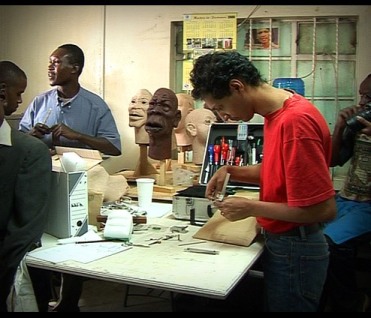
Behind the screen, creators at work...
She wrote: “My first off impression was fascination about the quality of the show in terms of animation which is very new to the local TV production scene in Kenya. Once past the fascination of the animation, I found that the content failed to hold my interest, connect with me or engage me as an audience. As a socio-political spoof show, humor ideally should be the hook that captures audience but in this case, humor comes across as mindless, illogical or simply stupid action on the screen. As if in evidence to this fact, at some point my husband in between laughter remarked ‘This show is really stupid’. I would imagine this would be a compliment to the Production becuase it provoked laughter in a viewer. However beyond that moment, it seemed only natural for us to flick over to more substantial entertainment having enjoyed that brief flight of fancy that failed to arouse an appetite for more.”

Marion also wondered what the show’s intended audience was, and highlighted the many challenges in getting the levels and balances right in doing political satire: “That politicians sometimes (nay, most times) behave ridiculously is not new or fresh. But the treatment, underlying themes, ideas communicated to audiences should be. Why do I suggest this? Because political satire by its nature speaks to an audience that is fairly mature, and exposed. To use childish humor that is poorly developed will not hold the audience’s attention. Infact at some point the content may become a tad irritating to watch. Political satire needs to be treated with a peppering of fact, wit, fresh perspective or take -out: The achievement of some underlying objective and not just mindless visual gimmicks that lead to the feeling of ‘stooping to idiocy; by audiences. This seeming insult of intelligence causes us as an audience to switch off.”

XYZ Show logoIn my own view, The XYZ Show had at least three major challenges. Doing any puppet show is hard enough, and these days the on-air competition is neither local nor fair: it comes from global entertainment corporations like MTV and their regional variations, usually with deep pockets. Doing political satire is even harder, especially if the political culture is intolerant or repressive. To get the look, feel and balances right in a country where such a show is being done locally for the first time is a formidable challenge by itself.

But I’ll let Marion have the last word. In spite of the various concerns, she feels that the XYZ Show has ‘room to grow and conquer the airwaves’. But, as she notes, “The production team have their work cut out for them in pre-production. It’s back to the drawing board and ask who is my audience? What appeals to them? How do I connect with them, define an objective for the show and its audiences? Research facts and opinions about national sentiment on issues then develop scripts and sequences…”

Read Marion’s full comment on her blog

All images used on this blog post are courtesy The XYZ Show.

Cory Aquino (1933 – 2009): Unleashed People Power, still haunting tyrants worldwide

The remains of former Philippine president Corazon Aquino passes through the historical EDSA road with some 300,000 supporters waving to pay their last respect. The road is remembered in 1986 as then anonymous Cory and some 2 million people rallied out the streets to fight a 20-year government dictatorship through peaceful people power revolution. Photo by Arwin Doloricon/ Voyage Film

I know this post appears rather late, but I couldn’t let Cory Aquino’s death on 1 August 2009 pass without comment. The original inspiration for People Power that toppled one of the worst tyrants of the 20th Century, she would now turn the Patron Saint of peaceful democratic struggles everywhere.

Last week, I was reduced to tears reading two links that my Filipino friend Ruth Villarama, who runs Voyage Films in Manila, sent me of new comments posted on their website.

In the first post, A housewife, a leader, an angel in yellow (3 August 2009), Joan Rae Ramirez wrote: “Her death at 3 AM on August 1 has stopped a nation from its apathetic works to once again remember what was once fought by this ordinary housewife. It is on these rarest moments where the oligarchs came down from their kingdoms to pay their respect and mingle with the people who truly represent the real state of the Philippine nation.”

Karen Lim, who works with Voyage Films as a producer and project coordinator, wrote a more personalised piece titled The Famous Anonymous.

It opened with these words: “I see her on TV. In some instances I even covered her for a story. Our relationship did not go deeper than the reporter-subject, or the audience and the watched. Yet I feel a certain affinity to the most revered President. And when she died I got sad, a strange feeling of sadness where the source is unknown.”

Karen was too young to have remembered much of those heady days of the People Power Revolution of February 1986 — a series of nonviolent and prayerful mass street demonstrations in the Philippines that eventually toppled the 20-year autocracy of Ferdinand Marcos. Indeed, a whole generation of Filipinos has been born since. But that doesn’t stop them from relating to the monumental events that unfolded at at Epifanio de los Santos Avenue, known more commonly by its acronym EDSA, in Quezon City, Metropolitan Manila and involved over 2 million ordinary Filipinos as well as several political, military and religious figures.

As Karen wrote in her tribute: “Cory’s life became ours too. We watched her, sometimes we joined her. We experienced her highs and lows. We are her “Mga minamahal kong kababayan”(my beloved fellowman). She did what no stranger did in my family – unite us in prayer for the country, unite us in laughter amidst the uncertainties of those times. I had no personal connection to this lady, but I have now every reason to mourn her passing.”

Woman of the Year 1986
I can only echo her Karen’s words. As a politically curious 19-year-old, I had followed with much interest the daring gamble and eventual triumph of People Power unfolding thousands of kilometres away from my Colombo home. In the pre-Internet era, and before satellite TV channels provided 24/7 coverage across Asia, my sources were daily newspapers, evening news bulletins on local TV and, once every few weeks, the second-hand copies of Time magazine passed on to me by an uncle. The housewife in yellow ended up becoming Time Woman of the Year for 1986, with Pico Iyer writing a suitably reflective piece.

In the years since the return of democracy – with all its imperfections and idiosyncrasies – I have stood at EDSA more than once, and wondered what it must have been like to mobilise millions of ordinary, concerned people in the days before email, Internet and mobile phones — communication tools that today’s political activists, and indeed everyone else, take for granted. There is a thin line between a non-violent struggle and a passionate yet violent mob that, ultimately, works against their own interests. I am amazed that Cory and her activists didn’t cross the line, despite provocations and 20 years of repression.

Of course, it wasn’t just the human numbers that turned the tide in EDSA. Cory Aquino’s charismatic leadership and moral authority persuaded other centres of power – including the Catholic church and sections of the military – to align with the struggle to restore democracy. It was this combination, and the sudden change of mind by the Americans who had backed Marcos all along, that enabled People Power to triumph.

Elsewhere in Asia, where these elements didn’t align as forcefully and resolutely in the years that followed, the outcome was not as dramatic or positive. We’ve seen that, for example, in places as diverse as Tiananmen Square in China (1989), Burma (2007) and most recently, in the streets of Tehran, Iran. In contrast, it did indeed work and ushered in regime change in places like Nepal, even though it entailed more protracted struggles.

What interests me, in particular, is the role played by information and communication technologies (ICTs) in such People Power movements. Alex Magno, a political analyst and professor of sociology in Manila, sees clear links between new communications technologies and political agitation. Interviewed on the Canadian documentary Seeing Is Believing: Handicams, Human Rights and the News (2002), he said: “In the last two decades or so, most of the political upheavals had some distinct link to communications technology. The (1979) Iranian Revolution was closely linked to the audio cassette. The first EDSA uprising in the Philippines was very closely linked to the photocopying machine and so we called it the ‘Xerox Revolution’. Tiananmen, the uprising that failed in China, was called the ‘Fax Revolution’, because the rest of the world was better informed than the rest of the neighbourhood because of the fax machine. The January (2002) uprising in the Philippines represents a convergence between electronic mail and text messaging. And that gave that uprising its specific characteristics.”

Mobile phones' role in People Power II acknowledged in a Manila mural
But it was People Power II in the Philippines that is perhaps the best known example of ICTs fuelling and sustaining a revolution. The ability to send short text messages on cell phones helped spawn that political revolution in early 2001, a full decade and a half after the original wave that swept Cory Aquino into office.

President Estrada was on trial facing charges of bribery, corruption and breach of the public trust. Despite mounting evidence against him, the President was let off the hook. That was the turning point. According to Ramon Isberto, a vice-president at Smart Telecom in the Philippines: “People saw it on television, and a lot of people were revolted. They started text messaging each other, sending each other messages over the Internet, and that thing created a combustion.”

Because of texting and email, within two hours over 200,000 people converged in the main street of Manila demanding the president’s resignation. The vigil lasted for four days and four nights, until President Estrada finally got the message and stepped down. It ended with Gloria Macapagal-Arroyo taking her oath of office in the presence of the crowd at EDSA, becoming the 14th president of the Philippines.

Those events have been documented, analysed and interpreted by many people from various angles. The Cold War had ended and the geopolitical map of the world had been redrawn. By this time, 24/7 satellite television was commonplace in Asia and the mobile phone was already within ordinary people’s reach. Gloria was no Cory, and Estrada wasn’t Marcos. But the forces and elements once again aligned on EDSA, and with history-making results. The role that the humble mobile phone played is acknowledged, among other places, in a mural in Manila.

News wrapped in laughter: Is this the future of current affairs journalism?

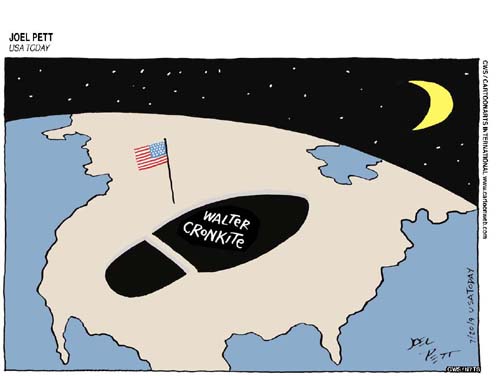
Who can follow these footsteps?
In an excellent op ed essay assessing the lasting value and meaning of Walter Cronkite to the world of journalism, Frank Rich wrote in The New York Times on 26 July 2009:

“What matters about Cronkite is that he knew when to stop being reassuring Uncle Walter and to challenge those who betrayed his audience’s trust. He had the guts to confront not only those in power but his own bosses. Given the American press’s catastrophe of our own day — its failure to unmask and often even to question the White House propaganda campaign that plunged us into Iraq — these attributes are as timely as ever.

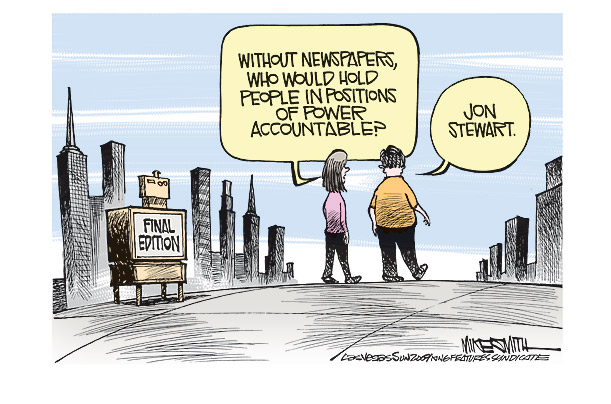
“That’s why the past week’s debate about whether there could ever again be a father-figure anchor with Cronkite’s everyman looks and sonorous delivery is an escapist parlor game. What matters is content, not style. The real question is this: How many of those with similarly exalted perches in the news media today — and those perches, however diminished, still do exist in the multichannel digital age — will speak truth to power when the country is on the line? This journalistic responsibility cannot be outsourced to Comedy Central and Jon Stewart.”

I cannot agree more with the premise and arguments in this essay, which is well worth a careful, slow read by everyone, everywhere who cares for good journalism — either as practitioners or consumers (and in this media saturated age, don’t we all fall into one or both categories?).

At the same time, without detracting from the value of — and the crying need for — investigative, reflective and ‘serious’ journalism, I believe comedy and especially political satire play a key role today in analysing and critiquing politicians, businessmen and others whose decisions and actions impact public policy and public life.

Anchor, anchor, burning bright...
Political satire is nothing new: it’s been around for as long as organised government. Over the centuries, it has manifested in many oral, literary or theatrical traditions, some more memorable and enduring – such as Gulliver’s Travels and Animal Farm. And for over a century, political cartoonists have been doing it with brilliant economy of words – as I have said more than once on this blog, they are among the finest social philosophers of our times.

In the age of electronic media, it’s only natural that the tradition of satire thrives on the airwaves and online. In fact, there is a rich and diverse offering of politically sensitive and/or active satire in the mainstream and online media that we can consider it a genre of its own. Some of it is so clever, authentic and appealing that we might momentarily forget that we are experiencing a work of satire.
Purists might decry this blurring of traditional demarcations between information, commentary and entertainment — but does that really matter?

When we survey the media and cultural scenes in our globalised world, we see things getting hopelessly entangled and mixed up everywhere. Nothing is quite what they seem – or claim – to be anymore. Content that is explicitly labelled as pure news and current affairs is looking more and more like entertainment. My friend Kunda Dixit, who edits the Nepali Times, says this is inevitable when the same mega corporations own both cartoon networks and news channels.

No news is good news -- for whom?
If the mainstream news organisations don’t quite live up to our expectations to gather, analyse and reflect on the current affairs of the day, we should at least be grateful that some comedians are stepping into that void. We must welcome, celebrate and wish their tribe would increase!

The rise and rise of political satire is also being chronicled and analysed. A new book tells us why we now have to take satire TV seriously — it turns out to be the bearer of the democratic spirit for the post-broadcast age. Titled Satire TV: Politics and Comedy in the Post-Network Era, the book is co-edited by Jonathan Gray, Jeffrey Jones and Ethan Thompson (NYU Press, April 2009).

Here’s the blurb introducing the book: “Satirical TV has become mandatory viewing for citizens wishing to make sense of the bizarre contemporary state of political life. Shifts in industry economics and audience tastes have re-made television comedy, once considered a wasteland of escapist humor, into what is arguably the most popular source of political critique. From fake news and pundit shows to animated sitcoms and mash-up videos, satire has become an important avenue for processing politics in informative and entertaining ways, and satire TV is now its own thriving, viable television genre. Satire TV examines what happens when comedy becomes political, and politics become funny.”

The book contains a series of original essays focus on a range of popular shows, from The Daily Show to South Park, Da Ali G Show to The Colbert Report, The Boondocks to Saturday Night Live, Lil’ Bush to Chappelle’s Show, along with Internet D.I.Y. satire and essays on British and Canadian satire. “They all offer insights into what today’s class of satire tells us about the current state of politics, of television, of citizenship, all the while suggesting what satire adds to the political realm that news and documentaries cannot.”

Let me summarise the news so far. Intentionally or otherwise, some news anchors and politicians are increasingly behaving like comedians. Meanwhile, a few professional comedians are talking serious politics and current affairs in a genre of media that is growing in popularity by the day.

Are you confused yet? Well, get used to it. This is the shape of things to come.

In such topsy-turvy times, we need more Jon Stewarts to puncture the bloated egos and images of not only elected and other public officials, but also of our larger-than-life news anchors, editors and media tycoons. I would any day have conscientious comedians doubling as social and political commentators than suffer shallow, glib newscasters trying to be entertainers. That’s what you call laughing for a good cause.

Parting thought: There is another dimension to satirising the news in immature democracies as well as in outright autocracies where media freedoms are suppressed or denied. When open dissent is akin to signing your own death warrant, and investigative journalists risk their lives on a daily basis, satire and comedy becomes an important, creative – and often the only – way to comment on matters of public interest. It’s how public-spirited journalists and their courageous publishers get around draconian laws, stifling regulations and trigger-happy goon squads. This is precisely what is happening right now in countries like Kenya and Sri Lanka, and it’s certainly no laughing matter. More about this soon.

Backgrounder:

The news as you never saw it before...
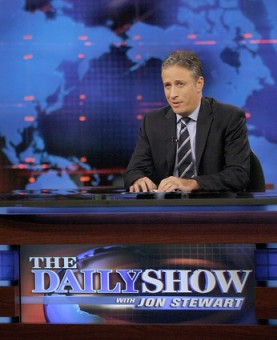
The Daily Show with Jon Stewart, is an American late night satirical television programme, airing on Comedy Central, a cable/satellite channel. The half-hour long show is presented as a (fake) newscast. In their own words, the Daily Show team “bring you the news like you’ve never seen it before — unburdened by objectivity, journalistic integrity or even accuracy.” It “takes a reality-based look at news, trends, pop culture, current events, politics, sports and entertainment with an alternative point of view.”

The show premiered in July 1996, and was initially hosted by Craig Kilborn. Jon Stewart took over as host in January 1999, and made it more strongly focused on politics. In each show, anchorman Jon Stewart and his team of correspondents, comment on the day’s stories, employing actual news footage, taped field pieces, in-studio guests and on-the-spot coverage of important news events.

This is what the Wikipedia says: “The program has grown in popularity since Jon Stewart took over hosting, with organizations such as the Pew Research Center claiming that it has become a primary source of news for many young people, an assertion the show’s staff have repeatedly rejected. Critics, including series co-creator Lizz Winstead, have chastised Stewart for not conducting hard-hitting enough interviews with his political guests, some of whom he may have previously lampooned in other segments; while others have criticized the show as having a liberal bias. Stewart and other Daily Show writers have responded to both criticisms by saying that they do not have any journalistic responsibility and that as comedians their only duty is to provide entertainment.”

OK, The Daily Show may not be intentionally serious journalism, anymore than mainstream news channels are intentionally funny. But a significant number of American TV viewers and TV critics, as well as media researchers, have found the analysis and commentary to be highly insightful and incisive. It has won many awards including an Emmy and Peabody Award. It’s been on the cover of Newsweek for its outstanding elections coverage and serious journalism. It’s not to be laughed off easily.

After the Last Newspaper...

Walter Cronkite (1916 – 2009): And that’s the way it was…

Walter Cronkite (1916 - 2009): The man who ruled American airwaves

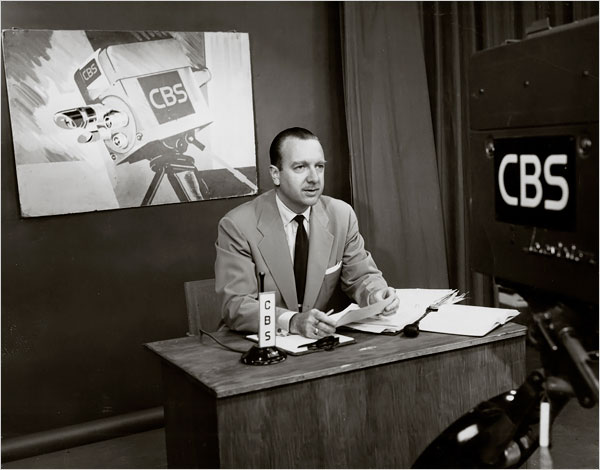
Walter Cronkite, the broadcast journalist and newscaster who redefined television news of his generation, has just signed off for the very last time. A leading light in the history of moving images is gone. What a light…and what a voice.

The New York Times reported the loss as its front page lead: “Walter Cronkite, who pioneered and then mastered the role of television news anchorman with such plain-spoken grace that he was called the most trusted man in America, died Friday at his home in New York. He was 92.”

Cronkite was best known as anchorman for the CBS Evening News for 19 years (1962–81). He was at the helm at a time when television became the dominant news medium of the United States. His influence spread well beyond one network, one medium and one generation.

America's favourite uncle...
Danny Schechter, the News Dissector and head of MediaChannel.org, said in a tribute: “He figuratively held the hand of the American public during the civil rights movement, the space race, the Vietnam war, and the impeachment of Richard Nixon.”

His own former network, CBS, noted in a tribute: “Known for his steady and straightforward delivery, his trim moustache, and his iconic sign-off line – ‘That’s the way it is’ – Cronkite dominated the television news industry during one of the most volatile periods of American history. He broke the news of the Kennedy assassination, reported extensively on Vietnam and Civil Rights and Watergate, and seemed to be the very embodiment of TV journalism.”

The New York Times report added: “On the day President John F. Kennedy was assassinated, Mr. Cronkite briefly lost his composure in announcing that the president had been pronounced dead at Parkland Memorial Hospital in Dallas. Taking off his black-framed glasses and blinking back tears, he registered the emotions of millions.”

Walter Cronkite announces death of President John F Kennedy: 22 November 1963

He is especially remembered for publicly opposing the Vietnam War. In 1968, he traveled to Vietnam, where he called the war a stalemate and advocated a negotiated peace. “If I’ve lost Cronkite, I’ve lost middle America,” President Lyndon B. Johnson said after seeing the broadcast, according to Bill Moyers, an aide to the president at the time.

In July 1969, Cronkite anchored the historic 32-hour CBS broadcast that covered the first Moon landing, which became the most widely watched live broadcast event worldwide up to that time. When Neil Armstrong stepped on the moon, Cronkite exclaimed, “Oh, boy!” — another rare show of emotion for the leading anchorman of his era who chose to keep his opinions separate from the news he covered and presented.

Cronkite missed the 40th anniversary of Apollo only by a few days. He will be sadly missed when astronauts and space buffs mark the event.

In this excerpt from for a 4-hour interview filmed for the Archive of American Television in 1998, Cronkite explains the origin of “That’s the way it is”– his signature sign-off:

New York Times has compiled some of his most memorable TV News moments.

The true professional he was, he never retired. Long after leaving CBS News, he remained fully active, engaged and supportive of good journalism in the United States and around the world. He lent his name to educational and charitable causes nurturing investigative journalism.

Danny Schechter writes in his blog: “In his later years, Walter Cronkite abandoned the pretense of only being above the fray and started speaking out as an internationalist for arms control and world federalism, and on many other global issues. He supported progressive causes but never too blatantly. He was very conscious of his image and reputation and identification with the media and power elite. He lived up the street from the United Nations and was often a speaker at UN events.”

Reproduced in full below is the endorsement Walter Cronkite gave our friends at MediaChannel.org, an online media activist group that keeps the spotlight on the media. In the dark during our own war, and in the days since the war ended, I have often found solace, inspiration and courage in his words.

* * * * * *

Walter Cronkite On The Media­ And The MediaChannel.


Good evening, I’m Walter Cronkite. I really wanted to be with you in person tonight for Globalvision New Media’s launch of the new Internet site the Media Channel, but unfortunately I was called out of the country. Yet the issues that led to the creation of this unique global resource, and the crisis that’s facing all of us who work in and care about journalism and the media, are so profound that I simply felt compelled to tape this message so that you would know that I am with you in spirit at least.

As you know, I’ve been increasingly and publicly critical of the direction that journalism has taken of late, and of the impact on democratic discourse and principles. Like you, I’m deeply concerned about the merger mania that has swept our industry, diluting standards, dumbing down the news, and making the bottom line sometimes seem like the only line. It isn’t and it shouldn’t be.

We report, you decide...
At the same time, I’m impressed that so many other serious and concerned people around the world are also becoming interested in holding media companies accountable and upholding the highest standards of journalism.

The Media Channel will undoubtedly be worth watching and taking part in. I am intrigued by its potential, and its global reach. The idea that so many leading groups and individuals around the whole world have come together to share resources and information about a wide range of media concerns is very promising, and I urge you to make the Media Channel your media ‘bookmark’ and your portal to the Internet.

I’m particularly excited about one aspect of the Media’s Channel’s work: its encouragement to people inside the media to speak up ­to speak out about their own experiences. Corporate censorship is just as dangerous as government censorship, you know, and self-censorship can be the most insidious form of pulling punches. Pressures to go along, to get along, or to place the needs of advertisers or companies above the public’s need for reliable information distort a free press and threaten democracy itself.

I’m pleased that the Media Channel opens an immediately available resource for media whistle-blowers. Anonymity will be protected, of course­ if their stories check out, of course. And, of course, are backed up with the facts.

We have all been supportive for years of dissidents around the world who take great risks to stand up for what they believe in. But here at home, in our own industry, we need to make it possible for people to speak out when they feel they’ve been wronged, even if it means shaming newsrooms to do the right thing. Journalists shouldn’t have to check their consciences at the door when they go to work for a media company. It ought to be just the reverse.

As I’ve said on other occasions, the strength of the American system is possible and can be nurtured only if there is lively and provocative dissent. In a healthy environment dissent is encouraged and considered essential to feed a cross-fertilization of ideas and thwart the incestuous growth of stultifying uniformity.

We need to encourage and support those among us who face either overt or covert threats­ or even a more subtle absence of encouragement to search out the truth. We all know that economic pressures and insecurities within news organizations have reduced the scope and range of investigative reporting. Sometimes projects are spiked with just a simple phrase: “It’s not for us.”

We’re always ready to speak out when journalists are at risk. But today we must speak out because journalism itself is at risk. That’s why I’m speaking out and reaching out to you tonight, to tell you that I like the idea of the Media Channel and want to encourage your participation.

And that’s the way it is.

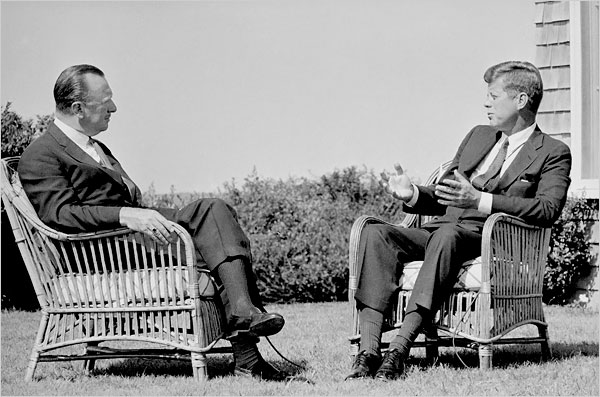
Walter Cronkite interviews President Kennedy - Photo courtesy Associated Press

Reporting disasters: How to keep a cool head when all hell breaks loose

WCSJ London

News by definition looks for the exception. What goes right, and according to plan, is hardly news. Deviations, aberrations and accidents hit the news.

It’s the same with disasters. Reducing a hazard or averting a disaster does not make the news; when that hazard turns into a disaster, that typically tops the news. Yet, as we discussed during a session at the 6th World Conference of Science Journalists held in London from June 30 – July 2, 2009, both aspects are important — and both present many challenges to journalists and the media.

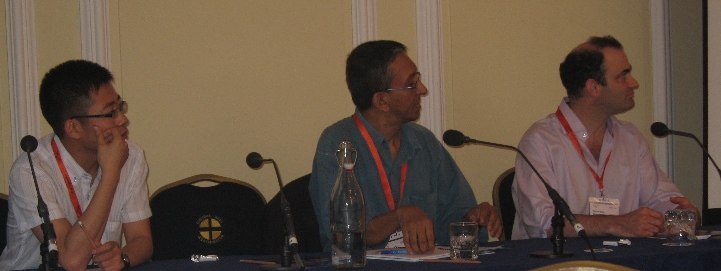
The session, titled Covering a disaster from Sichuan to Sri Lanka, saw three science journalists share their own experiences and insights in covering two major disasters in Asia. Richard Stone (Asia News Editor, Science) and Hujun Li (senior science writer with Caijing magazine, China) both spoke about covering the Sichuan earthquake that occurred on 12 May 2008. I spoke on my experiences in covering the Indian Ocean tsunami of 26 December 2004. The session was chaired by the veteran (and affable) British journalist Tim Radford, who has been The Guardian‘s arts editor, literary editor and science editor.

Covering a disaster from Sichuan to Sri Lanka: L to R: Hujun Li, Nalaka Gunawardene and Richard Stone
I recalled the post-tsunami media coverage in two phases — breaking news phase (first 7 – 10 days) and the aftermath, which lasted for months. When the news broke on a lazy Sunday morning, ‘Tsunami’ was a completely alien term for most media professionals in Sri Lanka. In newspaper offices, as well as radio and TV studios, journalists suddenly had to explain to their audiences what had happened, where and how. This required journalists to quickly educate themselves, and track down geologists and oceanographers to obtain expert interpretation of the unfolding events. We than had to distill it in non-technical terms for our audiences.

My involvement in this phase was as a regular ‘TV pundit’ and commentator on live TV broadcasts of MTV Channels, Sri Lanka’s largest and most popular broadcast network. Night after night on live TV, we talked about the basics of tsunami and earthquakes, and summed up the latest information on what had taken place. We also acknowledged the limits of science -– for example, despite advances in science and technology, there still was no way of predicting earthquakes in advance.

One question we simply couldn’t answer was frequently raised by thousands of people who lost their loved ones or homes: why did it happen now, here — and to us? Was it an act of God? Was it mass scale karma? As science journalists, we didn’t want to get into these debates — we had to be sensitive when public emotions were running high.

There were enough topics during the breaking news phase that had a scientific angle. Clinically cold as it sounded, the mass deaths required the safe, proper and fast burial of bodies with identities established. The survivors had to be provided shelter, food, safe drinking water and counselling. And when rumours were spreading on the possibility of further tsunamis, both officials and public needed credible information from trusted, competent sources.

Tsunami waves lashing Kalutara beach on western Sri Lanka on 26 December 2004: satellite image courtesy DigitalGlobe Quickbird satellite, http://www.digitalglobe.com

After the breaking news phase passed, we had more time to pursue specific stories and angles related to the tsunami. As an environmentally sensitive journalist, I was naturally interested in how the killer waves had impacted coastal ecosystems. Then I heard some interesting news reports – on how some elements of Nature had buffered certain locations from Nature’s own fury.

Within days, such news emerged from almost all Tsunami-affected countries. They talked about how coral reefs, mangroves and sand dunes had helped protect some communities or resorts by acting as ‘natural barriers’ against the Tsunami waves. These had not only saved many lives but, in some cases, also reduced property damage. Scientists already knew about this phenomenon, called the ‘greenbelt effect’. Mangroves, coral reefs and sand dunes may not fully block out tsunamis or cyclones, but they can often reduce their impact.

Researching this led to the production of TVE Asia Pacific‘s regional TV series called The Greenbelt Reports, which was filmed at a dozen tsunami impacted locations in South and Southeast Asia. By the time we released the series in December 2006, sufficient time had passed for the affected countries to derive environmental lessons of the tsunami.

The other big story I closely followed was on early warnings for rapid on-set disasters like tsunamis. Some believed that the tsunami caught Indian Ocean rim countries entirely by surprise, but that wasn’t quite true. While the countries of South and Southeast Asia were largely unprepared to act on the tsunami, the Pacific Tsunami Warning Centre (PTWC) in Hawaii, who had detected the extraordinary seismic activity, did issued a tsunami warning one hour after the undersea quake off western Sumatra. This was received at Sri Lanka’s government-run seismological centre in good time, but went unheeded: no one reacted with the swiftness such information warranted. Had a local warning been issued, timely coastal evacuation could have saved thousands.

Views from Ground Zero of several disasters...
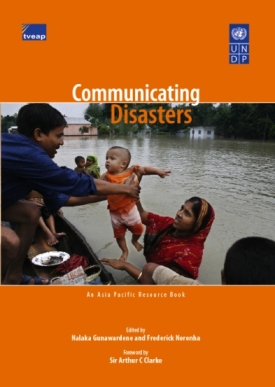
Part of my sustained coverage focused on logistical, technological and socio-cultural challenges in delivering timely, credible and effective early warnings to communities at risk. I did this by writing opinion essays on SciDev.Net and elsewhere, partnering in the HazInfo action research project in Sri Lanka, and leading the Communicating Disasters Asian regional project. A lasting outcome is the multi-author book on Communicating Disasters that I co-edited in December 2007.

All this shows the many and varied science or development stories that journalists can find in the aftermath of disasters. Some of these are obvious and widely covered. Others need to be unearthed and researched involving months of hard work and considerable resources. Revisiting the scenes of disasters, and talking to the affected people weeks or months after the event, often brings up new dimensions and insights.

My own advice to science journalists was that they should leave the strictly political stories to general news reporters, and instead concentrate on the more technical or less self-evident facets in a disaster. During discussion, senior journalist Daniel Nelson suggested that all disaster stories are inherently political as they deal with social disparities and inequalities. I fully agreed that a strict separation of such social issues and science stories wasn’t possible or desirable. However, science journalists are well equipped to sniff out stories that aren’t obviously covered by all members of the media pack that descends on Ground Zero. Someone needs to go beyond body counts and aid appeals to ask the hard questions.

As Hujun Li said recalling the post-Sichuan quake experience, “Politics and science are like twins – we can’t separate the two. What we as science journalists can do is to gather scientific evidence and opinion before we critique official policies or practices.”

Another question we were asked was how journalists can deal with emotions when they are surrounded by so much death and destruction in disaster scenes. Reference was made to trauma that some reporters experience in such situations.

I said: “We are human beings first and journalists next, so it’s entirely normal for us to be affected by what is happening all around us. On more than one occasion in the days following the tsunami, I spoke on live television with a lump in my throat; I know of presenters who broke down on the air when emotions overwhelmed them.”

SciDev.Net blog post: Finding the science in the midst of disaster

And now...the sequels
Summing up, Tim Radford emphasized the need for the media to take more interest in Disaster Risk Reduction (DRR), which basically means preventing disasters or minimising the effects of disasters.

“DRR is perhaps less ‘sexy’ for the media, as it involves lots of policies and practices sustained over time,” he said. “But the potential to do public good through these interventions is enormous.”

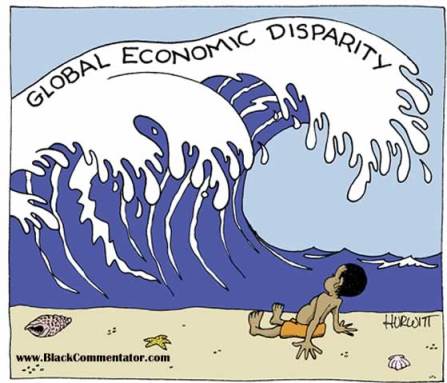
As Tim reminded us, disasters already exact a terrible and enduring toll on the poorest countries. This is set to get worse as human numbers increase and climate change causes extreme weather and creates other adverse impacts. Living with climate change would require sustained investments in DRR at every level.

Read Tim Radford on how disasters hit the poor the hardest (The Guardian, 22 May 2009).

The stories are out there to be captured, analysed and communicated. In the coming years, the best stories may well turn out to be on disasters averted or minimised

Wanted, urgent: Reporters Sans Labels!

DW GMF 2009
A top European Union official recently cautioned against the concept of ‘peace journalism‘, under which journalists actively promote peace as part of their coverage of conflicts. His views resonated much with my own reservations about this particular brand of journalism.

Javier Solana, EU High Representative for the Common Foreign and Security Policy, made the remarks in a written contribution to the Deutsche Welle Global Media Forum, held in Bonn, Germany, from 3 to 5 June 2009. I wasn’t there in person, but have been reading up some of the presentations and media coverage of the event.

Javier Solana
Javier Solana
In his wide-ranging talk, on ‘Conflict prevention in the multi-media age – The EU’s role in the world‘, Solana asked: should we incorporate peace journalism into our conflict prevention strategies? Yes, he said, “if this means striving to give as much impartial, quality information as possible to the press and media, in all their forms”.

The Spanish physicist-turned-politician added: “We all want to promote peace, reconciliation and conflict resolution and we want the media to help us in this. The best way in which they can do this is to inform us. This is the journalist’s fundamental task.”

He then sounded a word of caution: “The reporter is there to report. We should be careful not to weigh down the media with additional responsibilities over and above their primary task of providing information. A healthy media environment is diverse and plural; it is there to explain but not take sides. The profession of journalism needs no justification and no sophisticated qualification.”

Solana also referred to the early notion of ‘development journalism’ that was promoted in the 1970s, which called upon journalists in the developing countries to always support their governments’ development efforts. Such uncritical cheer-leading, which resulted in many ‘sunshine stories’ that glossed over problems, eventually did a lot more harm than good: development journalists became mere propagandists for governments pursuing wrong development models that squandered natural resources and brought misery to millions.

In fact, after having been part of the media and communications profession for over two decades, I no longer like to box myself into any category. For some years during my first decade of working life, I proudly called myself an ‘environmental journalist’. I still cover environmental issues with the same interest and passion, but now question whether the growth of environmental journalism as a media specialisation has, inadvertently, ghettoised environmental issues within the editorial considerations of media organisations. I also feel that at one point we became too ‘green’ for our own good.

Show things as they are!
This is not to argue against journalists specialising in environment or other sectors such as health, gender, peace or human rights. As issues become more complicated, journalists require a great deal of background knowledge, sustained interest and context to do their job well. But it’s poor strategy to leave sustainable development issues entirely in the hands of ‘environmental journalists’. Or coverage of conflict to ‘peace journalists’.

At best, such specialist journalists can only weave part of the much-nuanced, multi-faceted tapestry of sustainable development. To grasp that bigger picture, and to communicate it well, we need the informed and active participation of the entire media industry -– from reporters, feature writers and producers to editors, managers and media owners.

What we lack – and urgently need – is plain good journalism that covers development, conflict and other issues as an integral part of human affairs. Noble intentions of saving the planet, or making world peace, sound good at beauty pageants. But these catch-all lines don’t give anyone the license to engage in shoddy journalism that lacks accuracy, balance and credibility – the core tenets of the profession. It applies equally to mainstream and citizen journalists.

So it’s time to take a few steps back, grasp the bigger picture ourselves, and then show it as is to our audiences. We need Reporters Without Labels.

The only label worth aspiring to is a good journalist. May their tribe increase!