Hans Rosling and Gapminder: Unraveling the Joy of Stats!

Hans Rosling: Information Wizard
If you thought Al Gore was a data-happy geek, you should see Hans Rosling in action.

The Swedish medical researcher has a way with numbers. He brings heavy and dreary statistics into life using a combination of animated graphics and equally animated presentations. With the drama and urgency of a sportscaster, he uses a new presentation tool called Gapminder to debunk various myths about world – economic development, disparities and how well (or poorly) we share our planet’s resources.

Hans Rosling is Professor of International Health at Karolinska Institutet (which awards the Nobel Prize in medicine), but it’s his other role – as Director of the Gapminder Foundation – that he plays ‘statistics guru’ to the whole world. If you’re perplexed by lots of numbers, he’s the man who can make sense of it all.

In some ways, Rosling and Gapminder present in live action – and on video – what the Atlas of the Real World attempted to do in 2D maps: show the world as it is, with little or no distortion or misconceptions. That effort, published in late 2008, uses software to depict the nations of the world, not by their physical size, but by their demographic importance on a range of subjects.

I’ve watched a number of Rosling talks on video online. He makes no attempt to conceal his Scandinavian accent, and his English grammar is not always perfect. But it doesn’t matter: the guy has such mastery over his ideas and statistics, and a great stage presence too. He’s profound and funny at the same time, without being condescending that most experts and especially professors are.

Here’s an example of Rosling at his best: recorded in February 2006 in Monterrey, California:

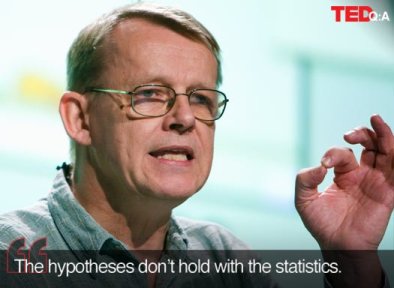
No more boring data: TEDTalks

Rosling’s quest to use numbers to shatter stereotypes of rich and poor countries has brought him global prominence. He was one of the world’s “100 most important global thinkers” of 2009, according to Foreign Policy Magazine.
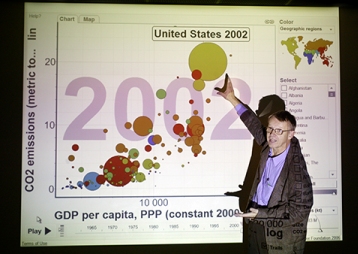
Look, no magic here!
Rosling was honored at #96 on the list for “boggling our minds with paradigm-shattering data“. The list is topped by (1) Ben Bernanke, the chairman of US Federal Reserve for his actions to turn the US depression and (2) President Barack Obama for “for reimagining America’s role in the world.”

Foreign Policy noted: “Rosling is well known for his energetic lectures, in which he narrates mind-blowing statistics on development and public health — as they literally move across a screen. Imagine x-y axes filled with data points, each representing a country. As time passes, the dots move, realigning to show changes in child mortality, percentage of paved roads, unemployment rates, or pretty much any other metric you can imagine.”

Here are some more examples of Rosling magic:

200 years that changed the world (with Hans Rosling)

For the first time, Gapminder can now visualize change in life expectancy and income per person over the last two centuries. In this Gapminder video, Hans Rosling shows you how all the countries of the world have developed since 1809 – 200 years ago.

Hans Rosling on HIV: New facts and stunning data visuals

Hans Rosling unveils new data visuals that untangle the complex risk factors of one of the world’s deadliest (and most misunderstood) diseases: HIV. He argues that preventing transmissions — not drug treatments — is the key to ending the epidemic.

Hans Rosling: Asia’s rise — how and when

This is one of the funniest Rosling talks I’ve watched online so far. Speaking at TEDIndia in November 2009, Rosling recalled how he was a young guest student in India when he first realized that Asia had all the capacities to reclaim its place as the world’s dominant economic force. He graphs global economic growth since 1858 and predicts the exact date that India and China will outstrip the US.

Note:
Rosling and Gapminder developed the Trendalyzer software that converts international statistics into moving, interactive and enjoyable graphics. The aim is to promote a fact-based world view through increased use and understanding of freely accessible public statistics. His lectures using Gapminder graphics to visualise world development have won awards by being humorous yet deadly serious. The interactive animations are freely available from the Foundation’s website. In March 2007 Google acquired the Trendalyzer software with the intention to scale it up and make it freely available for public statistics. Google has since made available as Motion Chart, a Google Gadget.
Do we want a ‘Progress Bar’ for our lives?

I sometimes wish Life came with its own progress bar. [tweetmeme]

You know, that now familiar indicator on computer screens that shows how much of a task is done, and estimates what more remains — and for how long.

Wouldn’t it be interesting to know how much of our life is still left?

I’m not alone in this wish. In fact, whole cottage industries – such as astrology and palmistry – thrive on this universal curiosity to know what’s next, and what’s round the corner for ourselves.

Yet there is no known system of knowledge, or a proven technology, that can give us a customised, accurate answer. Everything that claims to do this is nothing better than a clever guess. Often, it’s not even that and only a complete rip-off…

The Undiscovered Country...
Then again, do we really want to know when we’re going to reach the end of the line (whether or not the mission is accomplished)?

Years ago, I watched a Star Trek episode that involved a world where everyone died at the same age. So all living persons knew how much time they had left, allowing them to sort their lives before it was too late.

I don’t think I’d want to live there. Not knowing how much of my life is left, and what’s in store for me in that remainder, makes living more interesting. Besides, I doubt if the chaos theory and randomness of the universe will ever allow such precise advance knowledge of anyone’s future…

As I turn 44 years today, I Googled for ‘progress bar + life’. Just for the heck and kick of it. I didn’t really expect to find an exact match, but I did. That’s the wonder of the web…

Progress Bar of Life is described as ‘a slightly morbid little web app’. It’s an innovation by an Australian geek named Andrew Ballard.

When I ran the quick and simple app, I received a slightly amusing result. Try it out, and see for yourself.

Always in a hurry?
Perhaps the inspiration came from Top Geek Steve Jobs, who is quoted on this website as saying: “Remembering that I’ll be dead soon is the most important tool I’ve ever encountered to help me make the big choices in life”

Still in the realm of marginally useful web apps, I also discovered timeanddate.com some weeks ago: it allows counting down or counting between any two dates. The result can be in days, hours, minutes or – for those who prefer such precision in their lives – even in seconds.

They tell me that I am exactly 16,071 days old today. Not a neat round figure as being 44 years, but there we are. (I somehow thought I’d lived for more days than that, but a quick manual calculation showed they are right.)

These counts are all very abstract anyway: our days and years are peculiar to the Earth — these measurements have no meaning beyond our home planet. Planetary rotation defines a day, while its revolution around the local star (in our case, the Sun) defines a ‘year’.

Another website, maintained by San Francisco’s excellent Exploratorium, allows me to calculate how old I would be if I lived on other planets of the Solar System where the rotation and revolution are different.

According to them, if I were to travel to the two planets closest to ours, I would be aged: 71.5 Venusian years on Venus; and 23.3 Martian years on Mars.

And if I want to melt my years away, I have to travel further to the outer planets: on Jupiter, I will be 3.7 Jovian years, and I’ll not even be 2 in Saturnian years! Wow…

On second thoughts, I think I’ll just stay on here.

Open Moment, Closed Minds: New essay to mark 250 days of ‘Peace’ in Sri Lanka

Today marks exactly 250 days since Sri Lanka’s civil war officially ended on 18 May 2009.

In a new op ed essay — titled ‘Open Moment’, Closed Minds! — just published on Groundviews.org, I look back and ask some hard questions.

Here’s an excerpt:

“We all knew the hard-won peace had to be nurtured and consolidated. We also realised just how formidable the challenges of healing and rebuilding were. But could anyone have imagined the dramatic turn of political events since?

“Who would have thought that the victors of the war would soon be engaged in a nasty battle for personal glory and power? Who expected the historical feud between ‘lions’ and ‘tigers’ to be replaced so swiftly by a showdown between self-proclaimed ‘patriots’ and ‘traitors’?”

I raise these questions in the context of a fiercely contested presidential election scheduled for 26 January 2010. I note: “The two main contenders both claim to hold a mutually exclusive key to a better future for our land and people. Their dizzy campaigns bombard us with lofty claims and counter-claims 24/7 delivered through broadcast, broadband, mobile and other media.”

I ask whether either of the leading candidates has the open mind needed to seize the historic ‘open moment’ since the war ended. I recall how we completely missed the last such open moment created by the tsunami of December 2004.

I write: “Having missed the tsunami’s open moment, we cannot afford to bungle again. Rebuilding a nation of lasting peace, pluralism and prosperity will require many sections of society to change their mindset. This is especially and urgently needed in our media, much of which has become uncritical cheerleaders for patriotism and tribalism in recent years.”

Despite the many disappointments of the past 250 days, I still remain cautiously optimistic. But for how long?

The origins of this essay can be traced back to a blog post I wrote on 19 May 2009: Us and Them: Sri Lanka’s first landmine on the road to peace…

Read the full essay, and join the conversation at Groundviews.org

Please Help the World: The call to Copenhagen climate conference

Earlier this week, United Nations Climate Change Conference 2009 (COP15) in Copenhagen opened with an apocalyptic video showing the world torn asunder from a variety of disasters.

As one reviewer wrote: “The portrayal sought to play up on the fears of the world should a worst case scenario develop from global warming. The entire video is reminiscent of the recent disaster movie blockbuster, 2012 that was released in movie theatres in recent months.

I haven’t yet seen 2012, now showing in a theatre close to me, so I can’t comment on the comparison. But here’s the video, now playing on COP15 channel on YouTube:

In the video, a child goes to sleep peacefully but wakes to find herself in a desert wasteland. As she sets out to explore, the very land on which she stands begins to crack open and she flees. The girl doesn’t make it far before she looks up to see the world’s largest tornado tearing a city apart and flood waters approaching. The child leaps to a tree branch as the waters overtake her and she screams. It is then that she wakes from what is only a dream and decides to make a home video saying, “Please help the world.”

Will the bickering and myopic leaders of the world heed this call? We shall know in the next few days.

Meanwhile, here are the credits for this film:
Director: Mikkel Blaabjerg Poulsen
Producers: Stefan Fjeldmark and Marie Peuliche
Cinematographer: Dan Laustsen
Production designer: Peter de Neergaard
Editor: Morten Giese
Composer: Davide Rossi
Sound design: Carl Plesner
Production company: Zentropa RamBuk
Advisory consultants: Mogens Holbøll, Bysted A/S and Christian Søndergaard, Attention Film ApS.

For some comparisons, here is the official trailer for 2012:

Taste the Waste: Uncovering a crime against humanity and Nature

Opening the lid...

“How can we explain the fact that one sixth of humanity goes to bed hungry every night, when the world already produces enough food for all?

“The short answer is that there are serious anomalies in the distribution of food. Capricious and uncaring market forces prevent millions of people from having at least one decent meal a day, while others have an abundance of it. For the first time in history, the number of severely malnourished persons now equals the number suffering from over-consumption: about a billion each!”

That was the opening of an article on the future of food, co-authored by Sir Arthur Clarke and myself in 2000. It was circulated by the UN Food and Agriculture Organisation (FAO) to mark World Food Day that year, and was reproduced in 2008 in The Hindu newspaper, India.

Nearly a decade after we wrote those words, the situation hasn’t really improved. There still are a billion people for whom chronic hunger is a grim fact of life. About 25,000 people die of hunger every day. Meanwhile, at the other end of the spectrum, the number of obese people has grown to 1.5 billion.

Talk about a world of contrast and disparity!

Here’s more shocking news: we routinely throw away half of all food produced in this world. Between plough and plate, or from farms to homes, we waste almost as much food as we eat.

Eyes Wide Shut?
Many countries don’t have the slightest idea how much is wasted. Britain made an effort to measure the waste pile and came to a staggering 15 million tons of food a year. This includes 484 million unopened tubs of yoghurt, 1.6 billion untouched apples, bananas worth £370 million and 2.6 billion slices of bread.

In his recent book Waste: Uncovering the Global Food Scandal, Tristram Stuart documented the extent of waste in the food industry worldwide.

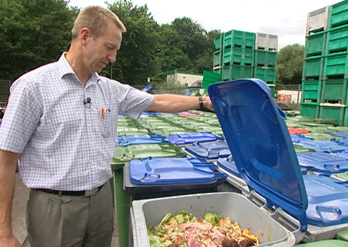
Taste the Waste is a new documentary film linked to an online campaign that shows us what is being thrown away: where, why, when and by whom.

The film maker turned campaigner, Valentin Thurn, has come up with one more reason why we should stem this callous waste: “Cutting food waste is an easy solution to reduce climate emissions and hunger,” he says.

Reducing food waste means a big opportunity to reduce greenhouse gas emissions – if we threw away only half of the avoidable waste, the consequences for the climate would be the same as taking one out of five cars off our roads.

It would also help the hungry, because they also depend on the global food cycle. Cash crops from all over the world are traded on the stock exchange. The agricultural resources on this planet are limited. The farmland taken up to produce the food that we throw away could instead be producing food for them.

Young activists protest against this situation by rescuing the wasted food. People eating rubbish – a habit that sounds disgusting until you see the loads of perfectly edible food in the bins of your supermarket or sandwich shop around the corner.

Thurn’s call to action: “We need your help! Go out, look around and tell us about the food in the bins where you live. Send texts, photos, videos, and help to reveal the huge scandal of how we are wasting food.”

Watch the film’s trailer on YouTube:


According to the latest FAO figures, there are more hungry people in the Asia Pacific (642 million) than all other regions combined. This is followed by Sub-Saharan Africa (265 million), Latin America and the Caribbean (53 million), and the Near East and North Africa (42 million). Sub-Saharan Africa has the highest percentages of people living in hunger, while the Middle East and North Africa saw the most rapid growth in the number of hungry people (13.5%) during 2008.

The UN’s definition of hunger is based on the number of calories consumed. Depending on the relative age and gender ratios of a given country, the cutoff varies between 1,600 and 2,000 calories a day.

Starting in 2008, activist groups worldwide observe 16 October as World Foodless Day. Their argument: World Food Day is a mockery and is much better named World Foodless Day.

It’s a day of global action on the crises that beleaguer the people. The objectives are to: “create public awareness and media attention on the root causes of the food crisis; provide policy recommendations and organize meetings with government officials, opinion makers and leaders; organise activities to raise our voices against neoliberal policies and their impact; and highlight people’s recommendations to respond to the world food crisis.”

Watch PAN-Asia Pacific’s video for World Foodless Day 2008:


Read an excellent review of Tristram Stuart’s book: Watching our wasteline, By Darryl D’Monte

Confessions of a Digital Immigrant: Reflections on mainstream and new media

The Digital Native: Was there a life before the Internet, Dad?

In early August 2009, I talked to a captive audience of media owners, senior journalists and broadcasters in Colombo about the ‘digital tsunami’ now sweeping across the media world. (It has been reported and discussed in a number of blog posts on Aug 6, Aug 7, Aug 8 and Aug 31).

As I later heard, some in my audience had mistakenly believed that I was advocating everything going entirely online. Actually, I wasn’t. I like to think that both the physical and virtual media experiences enrich us in their own ways. Real world is never black and white; it’s always a mix or hybrid of multiple processes or influences.

So I’ve just revisited the topic. I adapted part of the talk, and included more personalised insights, and wrote an essay titled ‘Confessions of a Digital Immigrant‘, which has just been published on Groundviews, the path-breaking citizen journalism initiative.

It opens with these words:

“My daughter Dhara, 13, finds it incredible that I had never seen a working television until I had reached her current age — that’s when broadcast television was finally introduced in Sri Lanka, in April 1979. It is also totally inconceivable to her that my entire pre-teen media experience was limited to newspapers and a single, state-owned radio station.

“And she simply doesn’t believe me when I say — in all honesty and humility — that I was already 20 when I first used a personal computer, 29 when I bought my first mobile phone, and 30 when I finally got wired. In fact, my first home Internet connectivity — using a 33kbps dial-up modem — and our daughter arrived just a few weeks apart in mid 1996. I have never been able to decide which was more disruptive…

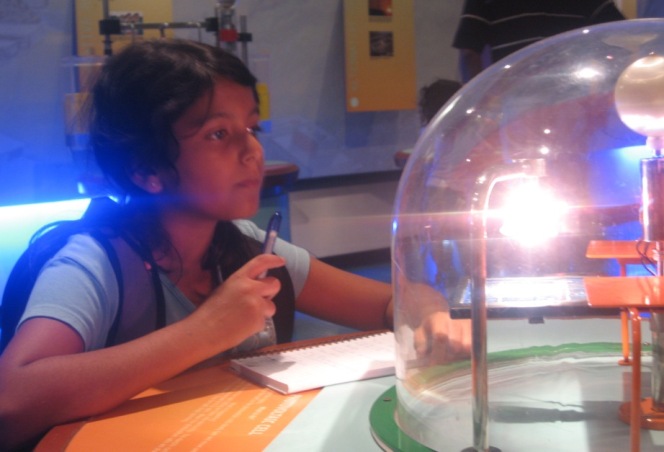
Groundviews: 1,000 posts and counting...“Dhara (photographed above, in mid 2007) is growing up taking completely for granted the digital media and tools of our time. My Christmas presents to her in the past three years have been a basic digital camera, an i-pod and a mobile phone, each of which she mastered with such dexterity and speed. It amazes me how she keeps up with her Facebook, chats with friends overseas on Skype and maintains various online accounts for images, designs and interactive games. Yet she is a very ordinary child, not a female Jimmy Neutron.

“Despite my own long and varied association with information and communication technologies (ICTs), I know I can never be the digital native that Dhara so effortlessly is. No matter how well I mimic the native ‘accent’ or how much I fit into the bewildering new world that I now find myself in, I shall forever be a digital immigrant.”

Read the full essay ‘Confessions of a Digital Immigrant’ on Groundviews…

Internet at 40: Over the hill or real life begins from now?

Where does wireless come in?

When Apollo XI astronauts became the first humans to land on the Moon in July 1969, the whole world knew – and about a quarter of humanity actually watched it live on television. The 40th anniversary of that ‘giant leap for mankind’ was marked a few months ago.

Something else with far-reaching implications happened a few weeks later, but was not noted as significant outside the circles of nerds and geeks. On 2 September 1969, computer scientists at the University of California, Los Angeles, established a network connection between two computers — creating the very first node of what we now know as the Internet.

At the time, engineer and computer scientist Leonard Kleinrock and his colleagues were charged with developing the Advanced Research Projects Agency Network (or ARPANET), a US government-funded research project in global computer communications that eventually grew into the Internet.

Although some celebrated the Internet’s 40th birthday on 2 September 2009, others held that the network didn’t really have ‘life’ until 29 October 1969. On that day, a message was typed by Kleinrock and sent to the second node at Stanford Research Institute. That “was the first breath of life the Internet ever took,” says Kleinrock.

Given the complexity that the Internet has evolved to, it isn’t surprising that the actual birthday is hard to pin down and is the subject of endless discussion among geeks and wonks online. For the rest of us grateful users of the Internet — most of the 1.6 billion people estimated as connected — we can celebrate the Internet’s 40th birthday through the months of September and October 2009.

But as this recent AP story reminds us, goofy videos weren’t on the minds of Len Kleinrock and his team at UCLA when they began tests 40 years ago on what would become the Internet.

Associated Press story, 31 August 2009: Internet Creators Didn’t Foresee Today’s Web

So as the Internet turns 40 – is it downhill from now? Or does life actually begin at 40? (As someone who is three years older than the Internet, I would say yes!).

“The Internet has just reached its teenage years,” Kleinrock said in an interview with Computerworld recently. “It’s just beginning to flex its muscles. The fact that it’s just gotten into its dark side – with spam and viruses and fraud — means that it’s like an [unruly] teenager. That too will pass as it matures.”

British techno-historian and columnist John Naughton (author of ‘A Brief History of the Future: Origins of the Internet‘) describes the Internet as an attempt to answer the following question: How do you design a network that is “future proof”–that can support the applications that today’s inventors have not yet dreamed of? The solution was to devise a network of networks that would not be biased in favor of any particular application. The Internet’s creators didn’t want the network architecture–or any single entity–to pick winners and losers. Because it might pick the wrong ones. Instead, the Internet’s open architecture pushes decision-making and intelligence to the edge of the network–to end users, to the cloud, to businesses of every size and in every sector of the economy, to creators and speakers across the country and around the globe.

In the words of Tim Berners-Lee, the Internet is a “blank canvas”–allowing anyone to contribute and to innovate without permission. It was Berners-Lee, as a young computer scientist, who is credited with inventing the World Wide Web, making the first proposal for it in March 1989. So the web turns 20 this year as the Internet itself passes 40.

Anyone dares to predict what can happen in the next 20 years? Here’s one prophecy I hope will never come to pass…

Back to Year Zero?
Back to Year Zero?

Ozone: Once and Future Story? A tale of two images…

A tale of two iconic images...

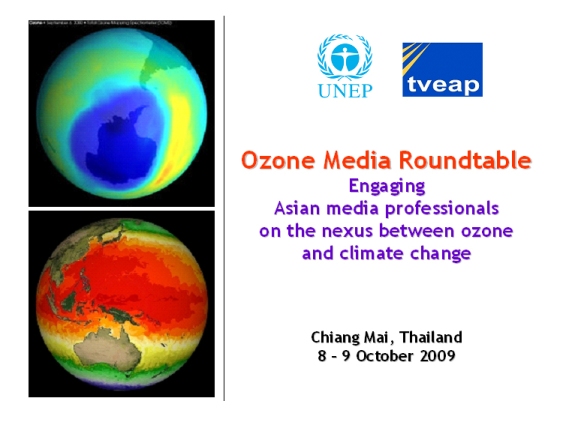
I am in Chiang Mai, northern Thailand, conducting the Ozone Media Roundtable, a high level event to engage Asian media professionals on the nexus between ozone depletion and climate change. The meeting, held on 8 – 9 October 2009, is organised jointly by the United Nations Environment Programme (UNEP) and TVE Asia Pacific for invited senior journalists and broadcasters from the Asia Pacific region.

The past 22 years of implementing the Montreal Protocol, adopted in 1987, hold many relevant lessons and experiences for countries currently trying to negotiate a new multilateral environmental arrangement to succeed the Kyoto Protocol of the UN Framework Convention on Climate Change, UN-FCCC. These insights could be particularly helpful for the inter-governmental negotiations leading to, and during, the 15th conference of parties (COP15) of UN-FCCC in Copenhagen in December 2009.

TVE Asia Pacific and UNEP convened the roundtable meeting in Chiang Mai to explore the ozone/climate nexus from a communications perspective. We brought together a small group of senior journalists and broadcasters who have been covering ozone and/or climate issues. We also invited a few ozone and climate technical experts to discuss the close links between ozone layer protection and climate change mitigation.

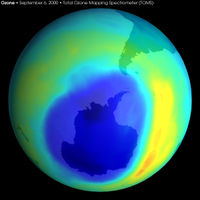
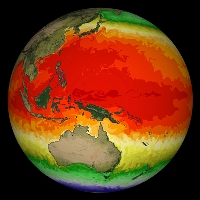
I work with moving images, but I also know the power of still images — especially when they are highly symbolic. Looking for a good visual link between ozone depletion and climate change, I came up with two images of our planet, seen in different ways that represent the two global environmental challenges.

Largest ever Ozone hole, Sept 2000
The first image is better known, and is a colour enhanced satellite image of the Ozone Hole that was discovered in 1985 by British scientists Joesph Farman, Brian Gardiner and Jonathan Shanklin of the British Antarctic Survey. The ozone “hole” is really a reduction in concentrations of ozone high above the earth in the stratosphere. It is defined geographically as the area wherein the total ozone amount is less than 220 Dobson Units.

This discover was largely responsible for galvanising international attention and response to the threat of ozone depletion. After a series of inter-governmental meetings and negotiations, the Montreal Protocol on Substances that Deplete the Ozone Layer was finally agreed upon on 16 September 1987 at the headquarters of the International Civil Aviation Organization in Montreal.

Temperature projection for Year 2100
The second image is not as widely known, but represents an even greater environmental calamity that is currently unfolding: global warming and rapid changes in climate it has triggered. The image is a colour enhanced image of the Earth’s temperatures in 2100 AD (less than a century from now), as projected by the Earth Simulator — one of the world’s most powerful supercomputers — which Japanese scientists use to project the climatic disasters in next 100 years.

The system was developed in 1997 for running global climate models to evaluate the effects of global warming and problems in solid earth geophysics. It has been able to run holistic simulations of global climate in both the atmosphere and the oceans — down to a resolution of 10 km.

Between these two images, we are looking at two of the biggest environmental challenges of our times. How the climate crisis can learn valuable lessons from the ozone crisis is what we discussed at the Ozone Media Roundtable.

More about the meeting’s outcome soon.

Animating and singing our way to a Low Carbon Future…

Low Carbon, High Priority
Some 100 world leaders are due to gather at the United Nations headquarters in New York this week for the highest level summit meeting on climate change ever convened.

As the New York Times reported: “In convening the meeting, the United Nations is hoping that collectively the leaders can summon the will to overcome narrow nationalinterests and give the negotiators the marching orders needed to cut at least the outline of a deal.”

Recognising climate change as one of the greatest social, economic, political and environmental challenges facing our generation, the British Council has launched the Low Carbon Futures project. It has focus on mitigating the effects of climate change in an urban environment. It is part of the British Council’s major global climate security project and India is, along with China, one of the top two priority countries for this work. Sri Lanka, with less than 2% of India’s population and correspondingly lower carbon emissions, is a lower priority.

One strand in the Low Carbon Futures project is to engage communications professionals – journalists, writers and film makers to help them better understand the issues around mitigation and get across key messages to readers/viewers more effectively.

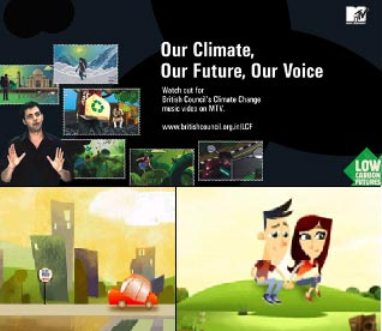
As part of this project, the British Council collaborated with Music Television (MTV) to produce a music video and two viral video animations on climate friendly, low-carbon lifestyles.

British Council’s first Music Video on Climate Change produced by MTV features VJ Cyrus Sahukar. Combining animation, lyrics and melody, the video talks about how small individual actions can help conserve natural resources and save the climate. MTV VJs have a cult following and the video ends with Cyrus Sahukar, MTV’s face in India, encouraging young people to take that first step. The video was launched in New Delhi on 1 June 2009 in the presence of 50 International Climate Champions from across India & Sri Lanka.

According to the British Council India website, “The video has created a flutter and there is growing demand to screen the video on various institutional networks across India and even outside fulfilling higher level objectives of impacting young urban aspirants. Young Indians are an emerging generation who are ambitious and internationally minded with the potential to be future leaders. The MTV video aims to influence this influential group.”

The Low Carbon Futures project has also released two short, powerful, animated messages that are ‘tongue-in-cheek’- making use of everyday events with a touch of humour. “We are hoping that the messages will be seen as creative, funny and innovative to tempt the recipient to forward it to their peer group. As the virus spreads, so will the message. The British High Commission and the The Energy and Resources Institute (TERI) are also promoting these virals to spread the message amongst the staff members and their external audiences,” says the project website.

The first viral video animation is called Green Journey, and shows a little known benefit of car pooling. Its blurb reads, simply: Meet 3 Mr Rights on the wrong side of the road!

The second viral video animation is called Play Cupid, and gives us one more reason to plant more trees! Blurb: Lets leave the young couples in peace and solitude of nature!

Watch out for more interesting videos from British Council India’s YouTube channel.

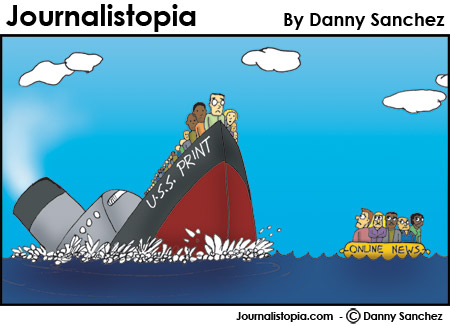
Saving MSM Titanic – or is it lifeboat time for its passengers?

Unthinkable? Not any more...
What is to be done? The innocuous question has probably been asked by so many individuals throughout history. Lenin famously asked it in 1901, and then spent the next few years cooking up a revolution that changed history (for better or worse, depends on where you come from).

What is to be done? I popped this same, unoriginal yet useful question during my recent presentation to an assembled group of media tycoons and senior journalists in Colombo, at the Sri Lanka launch of Asia Media Report 2009.

The context was not sparking revolution, but coping with evolution: how to survive and adapt at a time when mainstream media (MSM) is under siege from technological change, loss of public confidence and economic recession.

Why do I care? Unlike my new media activist friends, who cannot wait to see the MSM ‘mediasaurus’ die, I see value and utility in this ‘species’ that has evolved for over 500 years. Yes, there is much that is not right with them – including greed, arrogance and narcissism. But MSM’s outreach still remains unmatched in many parts of developing Asia, where we simply cannot wait until the online/mobile media to evolve, scale up and establish themselves to completely serve the public interest. I will thus engage the dinosaurs as long as they remain useful…

Besides, not all members of the mediasaurus clan are ferocious and carnivorous; there are also many gentle, ‘vegetarian’ ones among them who have always been empathetic and caring. I see merit in the adaptation of these better MSM, if only so that we don’t have to put all our eggs in the online/mobile media basket…

So I spent part of my talk asking aloud how the MSM – under siege – can adapt fast and increase their survival chances. The overall suggestion was that they move out of denial or resistance, and instead try to ‘exploit the inevitable’ (a pragmatic policy if ever there was one!).

Here are some initial thoughts I offered:
• Prepare for coming calamity, by taking advantage of the likely delay in its arrival in our region and our island.
• Consider it a ‘cleansing’ process, a new beginning to do things better.
• Decide what’s really worth saving, and let go of everything else that is no longer useful or relevant.

Let’s remember, too, that the very term ‘media’ is a plural. That means:
• One size doesn’t fit all; one solution won’t help/save everyone.
• Different ‘lifeboats’ can be found for different media outlets.
• You will only find out what works by trying out a few alternatives.
• No solution is fail-proof or ‘unsinkable’.

In some ways, mainstream media has behaved with the same kind of arrogance of those who built and operated RMS Titanic, and in this instance, the iceberg has already been spotted. At this stage, should MSM be re-arranging furniture on the ship’s deck — or discussing rescue plans?

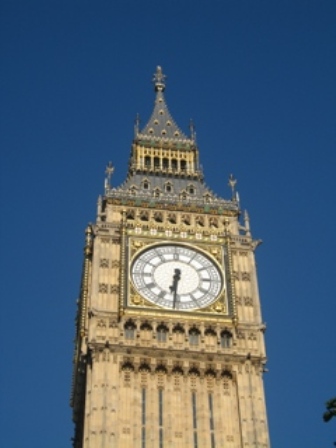
Big Ben at 150: Who'd build one like this today?
When the maritime tragedy happened nearly a century ago, on 14 April 1912, it dominated headlines around the world for many days. But MSM was in such nascent stages at the time, newspapers being the sole dominant mass medium. Radio communication had just been discovered, but radio broadcasting still lay a few years in the future.

To adapt and survive, MSM can also learn from how other industries faced vast challenges. For example, take the time-keeper industry:
• A century ago: people had to go to a post office, railway station or another public place to find the time. Clock Towers and public clocks announced time for all.
• Then came personal clocks (elaborate time pieces) that the wealthy people carried around in pockets or handbags.
• This was followed by wrist watches – personalised, affordable and portable.
• Now, mobile phones tell us the date, time and lot else!

Clock tower makers went out of business, and no one misses them now. Watch makers have adapted with the times, and are still competing with mobile makers. The parallels with the media industry are clear enough.

Back to the ‘unsinkable’ Titanic, I find others have played on this metaphor. Michelle Tripp wrote a particularly insightful commentary in April 2009 – she has no patience for MSM and can’t wait for the troubled ship to sink.

Somebody writing as ‘Global1’ has commented about how the Titanic‘s Band played on to the very end (and went down playing). S/he asks: Could This Be Analogy To The Modern Day MSM? In this analogy, MSM is the band, and their ‘music’ is the news…

Incidentally, the centenary of the Titanic‘s sinking is coming up shortly, in 2012. It would be interesting to see how the MSM/Titanic analogy plays out in the next few years…