Satinder Bindra: It’s the message, stupid (and never mind the UN branding)!

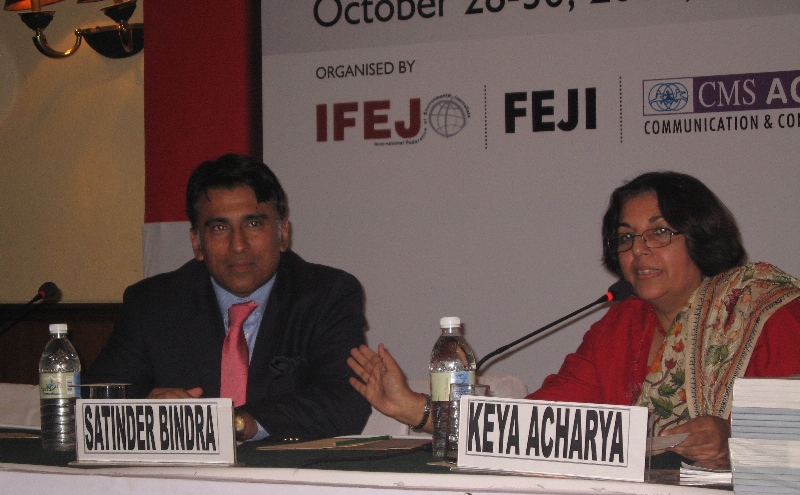
Satinder Bindra (left) and Keya Acharya
Satinder Bindra (left) and Keya Acharya at IFEJ 2009 Congress

Satinder Bindra left active journalism a couple of years ago when he joined the UN Environment Programme (UNEP) as its Director of the Division of Communications and Public Information (DCPI) based at UNEP Headquarters in Nairobi. But thank goodness he still thinks and acts like a journalist.

Satinder, whom I first met in Paris in the summer of 2008 soon after he took up the new post, gave a highly inspiring speech to the latest congress of the International Federation of Environmental Journalists (IFEJ), held at India Habitat Centre in New Delhi from 28 to 30 October 2009.

We have gone beyond the cautionary stage of climate change, and are now acting out ‘Part II’ where we have to focus on what people can do, he said. “Climate change is no longer in doubt, and if anything, the IPCC’s scenarios are turning out to be under-estimates.”

He was referring to the IFEJ congress theme, “Bridging North-South Differences in Reporting Climate Change: Journalists’ role in Reaching an Ambitious Agreement at COP15 in Copenhagen”.

Satinder sounded emphatic when he said: “We have a limited time in which to reach as many people as possible. Environment is the single biggest challenge we face in the world today, and we as journalists have a tremendous responsibility in providing the latest, accurate information to our audiences.”

He added: “There is still a debate among journalists on whether or not we should be advocates for the environment. We should not be scared to push the best science, even if we don’t choose to engage in advocacy journalism.”

Satinder mentioned the “Paris Declaration on Broadcast Media and Climate Change,” adopted by delegates at the first UNESCO Broadcast Media and Climate Change conference held in Paris on 4-5 September 2009. It resolved to “strengthen regional and international collaboration, and encourage production and dissemination of audiovisual content to give a voice to marginalized populations affected by climate change”.

Satinder, who was a familiar face on CNN as its South Asia bureau chief until 2007, acknowledged that the media landscape was evolving faster than ever before. “Thanks to the web and mobile media, our distribution modes and business models are changing. YouTube has emerged as a key platform. Viral is the name of the game.”

His message to broadcasters, in particular, was: “You may be rivals in your work, but when it comes to saving the planet, put those differences aside.”
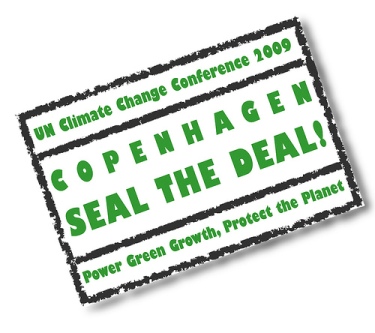
Copy of Seal the Deal
A call to the whole planet...
Satinder is spearheading, on behalf of UNEP, the UN-wide Seal the Deal Campaign which aims to galvanize political will and public support for reaching a comprehensive global climate agreement in Copenhagen in December.

To me at least, the most important part of Satinder’s speech was when he said that he was not seeking to promote or position the UNEP or United Nations branding. His open offer to all journalists and broadcasters: “If you need to use the hundreds of UNEP films, or make use of our footage in your own work, go right ahead. We want you to make journalistic products. There’s no need or expectation to have the UN branding!”

Wow! This is such a refreshing change — and a significant departure — from most of his counterparts at the other UN agencies, who still think in very narrow, individual agency terms. They just can’t help boxing the lofty ideals of poverty reduction, disaster management, primary health care and everything else within the agenda setting and brand promotion needs of their own agencies.

I have serious concerns about this which I have shared on a number of occasions on this blog. See, for example:
May 2007: Feeding Oliver Twists of the world…and delivering UN logos with it!
August 2007: ‘Cheque-book Development’: Paying public media to deliver development agency logos
October 2007: The many lives of PI: Crisis communication and spin doctors
July 2009: Why can’t researchers just pay the media to cover their work?

In a widely reproduced op ed essay published originally on MediaChannel.org in August 2007, I wrote:

“As development organisations compete more intensely for external funding, they are increasingly adopting desperate strategies to gain higher media visibility for their names, logos and bosses.

“Communication officers in some leading development and humanitarian organisations have been reduced to publicists. When certain UN agency chiefs tour disaster or conflict zones, their spin doctors precede or follow them. Some top honchos now travel with their own ‘embedded journalists’ – all at agency expense.

“In this publicity frenzy, these agencies’ communication products are less and less on the issues they stand for or reforms they passionately advocate. Instead, the printed material, online offerings and video films have become ‘logo delivery mechanisms’.”

Let’s sincerely hope that the pragmatic and passionate Satinder Bindra will be able to shake up the communication chiefs and officers of the UN system, and finally get them to see beyond their noses and inflated egos. It’s about time somebody pointed out that vanity does not serve the best interests of international development.

See also April 2007 blog post: MDG: A message from our spin doctors?

Raise your voice on climate change: CNN/YouTube Debate coming up…

Speak up to be heard....

In the environment and development circles, all the roads these days seem to lead to Copenhagen.

That’s because the Danish capital will be hosting the 15th conference of parties (COP15) of the UN Framework Convention on Climate Change, or UN-FCCC from 7 to 18 December 2009.

All sorts of campaigns are underway to raise awareness and build up consensus — a tough call when nations of the world are bickering endlessly as the planet warms up.

Now, CNN and YouTube have created Raise Your Voice campaign: it allows your voice to be amplified to the world leaders at COP15 – the most important climate change conference in a decade.

Here’s the blurb:
As nations seek an agreement to protect the world we want your views from across the spectrum.
What needs to be done?
How do the issues affect you?
Do you agree there needs to be action?

There is a breathtaking short video now on YouTube supporting this call:

Click here to send a video with your views, opinions and questions. The best contributions will be aired during the COP15 CNN/YouTube TV debate on December 15.

One minute to midnight — or just one minute to save the world?

How much can you pack into 60 seconds?

How much can you pack in to one minute, or 60 seconds? That’s a lot of air time, as broadcasters and advertisers know very well.

One Minute to Midnight‘ has been a favourite metaphor of dooms-dayers – and is the title of a 2008 book. It was widely used in relation to the world drawing closer to nuclear war during the second half of the 20th century.

Now, as global climate change surpasses fears of global nuclear war, we are given just one minute to save the world.

One Minute to Save the World is an international short film competition to raise awareness of climate change. Entries are currently being sought from professionals and amateurs, with 31 October 2009 as the deadline. There is also a category for under 18s and for entries shot on mobile phones.

The idea is to enable anyone, anywhere, to deliver a short but powerful message to the world on climate change. The winning films will be sent around the world in November as an online campaign to raise awareness of the Copenhagen Climate Conference in December 2009.

Good planets are hard to find...
British TV presenter and adventurer Bruce Parry, a founder of the competition, says: “Together we will be looking for films that convey a powerful message about how climate change affects you and those around you. Were you a flood victim? Have you seen a change in the plants and wildlife in your garden? How has your world been affected and how can we address it?

He adds: “So, we hope you’ll all get thinking and shooting – whether you’re a seasoned pro or just someone who cares. Your planet needs you and your talents. One minute might not seem like a long time but it’s actually longer than many advertisers spend hundreds of thousands of pounds on. It’s also an easy length of time to hold people’s attention. And that is one of the things we urgently need to do if we’re going to turn things around for our planet before it’s too late.”

The winning entries will be judged by an international panel that includes Parry himself, award-winning director and climate change activist Shekhar Kapur; Franny Armstrong, director of Age of Stupid and The Guardian‘s environment editor John Vidal.

The website will become an online film festival which requires no travel or celebrity status to attend – all you need is access to a computer. “And as everyone knows, the power of the net can make the most unexpected video attract the attention of millions globally,” says Bruce Parry.

Read Bruce Parry on One Minute to Save the World

One Minute to Save the World competition rules and more info

Watch entries on YouTube

Radio Sagarmatha: Voice of a Valley and Hope of a nation

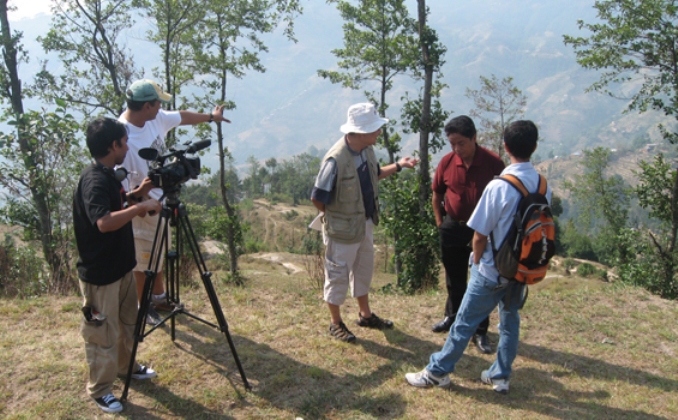
Location filming Saving the Planet in Nepal

I have written more than once in this blog about Radio Sagarmatha of Nepal, the first independent community broadcasting station in South Asia.

In May 2007, on the occasion of their 10th anniversary, I called it Kathmandu Valley’s beacon of hope. I have known and admired the Nepali friends who are running the award-winning, public-spirited radio station.

I’m delighted, therefore, to be able to make a short film about one facet of Radio Sagarmatha: their contribution to education for sustainable development, ESD for short.

Radio Sagarmatha’s path-breaking work in the resort town of Nagarkot is the story in one film of Saving the Planet, TVE Asia Pacific’s new regional TV series showcasing communities thinking globally and acting locally.

The six-episode series, which was 18 months in the making, features outstanding efforts in education for sustainable development in South and Southeast Asia.

It goes in search of answers to these key questions: Can ordinary people help save our planet under siege from multiple environmental crises? How can everyone change attitudes and lifestyles to consume less and generate less waste?

Here’s the official synopsis of the Nepal story, titled Voice of a Valley:

Tourism generates incomes, jobs and markets for the people of Nagarkot, a popular resort close to the Nepali capital Kathmandu. But it had a bumpy start when hoteliers initially bypassed local communities. These tensions were diffused by Radio Sagarmatha, the country’s first independent public radio station, which brought all interested parties together on the air. This example shows how media can do more than just report. By inspiring discussion and debate, media can help communities to find the best solutions or compromises for their development needs.

Watch Saving the Planet: Voice of a Valley

Many thanks to friends at the Nepal Forum of Environmental Journalists (NEFEJ), for their help in making this short film about one of their most outstanding efforts.

Find the full credits of the film here

Saving MSM Titanic – or is it lifeboat time for its passengers?

Unthinkable? Not any more...
What is to be done? The innocuous question has probably been asked by so many individuals throughout history. Lenin famously asked it in 1901, and then spent the next few years cooking up a revolution that changed history (for better or worse, depends on where you come from).

What is to be done? I popped this same, unoriginal yet useful question during my recent presentation to an assembled group of media tycoons and senior journalists in Colombo, at the Sri Lanka launch of Asia Media Report 2009.

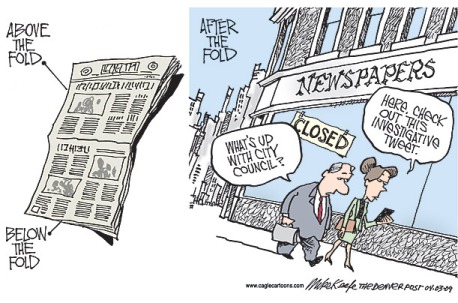
The context was not sparking revolution, but coping with evolution: how to survive and adapt at a time when mainstream media (MSM) is under siege from technological change, loss of public confidence and economic recession.

Why do I care? Unlike my new media activist friends, who cannot wait to see the MSM ‘mediasaurus’ die, I see value and utility in this ‘species’ that has evolved for over 500 years. Yes, there is much that is not right with them – including greed, arrogance and narcissism. But MSM’s outreach still remains unmatched in many parts of developing Asia, where we simply cannot wait until the online/mobile media to evolve, scale up and establish themselves to completely serve the public interest. I will thus engage the dinosaurs as long as they remain useful…

Besides, not all members of the mediasaurus clan are ferocious and carnivorous; there are also many gentle, ‘vegetarian’ ones among them who have always been empathetic and caring. I see merit in the adaptation of these better MSM, if only so that we don’t have to put all our eggs in the online/mobile media basket…

So I spent part of my talk asking aloud how the MSM – under siege – can adapt fast and increase their survival chances. The overall suggestion was that they move out of denial or resistance, and instead try to ‘exploit the inevitable’ (a pragmatic policy if ever there was one!).

Here are some initial thoughts I offered:
• Prepare for coming calamity, by taking advantage of the likely delay in its arrival in our region and our island.
• Consider it a ‘cleansing’ process, a new beginning to do things better.
• Decide what’s really worth saving, and let go of everything else that is no longer useful or relevant.

Let’s remember, too, that the very term ‘media’ is a plural. That means:
• One size doesn’t fit all; one solution won’t help/save everyone.
• Different ‘lifeboats’ can be found for different media outlets.
• You will only find out what works by trying out a few alternatives.
• No solution is fail-proof or ‘unsinkable’.

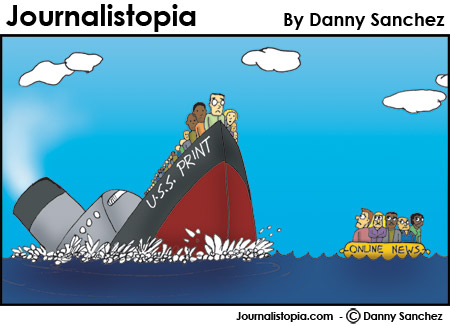
In some ways, mainstream media has behaved with the same kind of arrogance of those who built and operated RMS Titanic, and in this instance, the iceberg has already been spotted. At this stage, should MSM be re-arranging furniture on the ship’s deck — or discussing rescue plans?

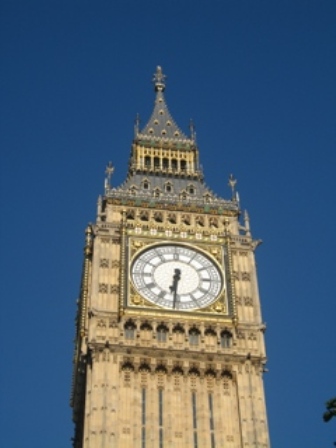
Big Ben at 150: Who'd build one like this today?
When the maritime tragedy happened nearly a century ago, on 14 April 1912, it dominated headlines around the world for many days. But MSM was in such nascent stages at the time, newspapers being the sole dominant mass medium. Radio communication had just been discovered, but radio broadcasting still lay a few years in the future.

To adapt and survive, MSM can also learn from how other industries faced vast challenges. For example, take the time-keeper industry:
• A century ago: people had to go to a post office, railway station or another public place to find the time. Clock Towers and public clocks announced time for all.
• Then came personal clocks (elaborate time pieces) that the wealthy people carried around in pockets or handbags.
• This was followed by wrist watches – personalised, affordable and portable.
• Now, mobile phones tell us the date, time and lot else!

Clock tower makers went out of business, and no one misses them now. Watch makers have adapted with the times, and are still competing with mobile makers. The parallels with the media industry are clear enough.

Back to the ‘unsinkable’ Titanic, I find others have played on this metaphor. Michelle Tripp wrote a particularly insightful commentary in April 2009 – she has no patience for MSM and can’t wait for the troubled ship to sink.

Somebody writing as ‘Global1’ has commented about how the Titanic‘s Band played on to the very end (and went down playing). S/he asks: Could This Be Analogy To The Modern Day MSM? In this analogy, MSM is the band, and their ‘music’ is the news…

Incidentally, the centenary of the Titanic‘s sinking is coming up shortly, in 2012. It would be interesting to see how the MSM/Titanic analogy plays out in the next few years…

Can Citizen Kane and Citizen Journalist join hands in the public interest?

Can this common ground expand?

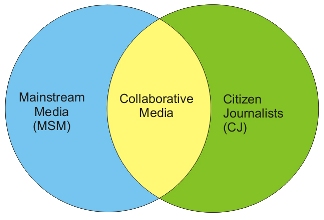
Is there common ground between the mainstream media (MSM) and citizen journalists (CJ) that can be tapped to better serve the public interest?

This is a central question that I explored in some depth during my recent presentation to an assembled group of media tycoons and senior journalists in Colombo earlier this week, at the Sri Lanka launch of Asia Media Report 2009.

MSM have gone from denial to dismissal to apprehension about this murky, distributed phenomenon called citizen journalists. But, as I asked, must MSM and CJ always compete? Must they consider each other mutually exclusive? I don’t think so.

Consider these facts: CJs are not an organised, unionised mass of people. They are a scattered, loosely connected group that is a community of practice across geographical borders and time zones. They rarely agree on anything among themselves. CJs are not out to topple MSM.

Once we get those points clarified, we can move beyond chest-thumping egotism. We can then address the fundamental values of why MSMs and CJs are both doing what they do: for the free flow of information, ideas and opinions.

Indeed, we should see how MSM and CJs can join hands more to serve the public interest. CJs today are not just frustrated poets and writers who never found a public outlet in the past. Today’s plethora of CJs include scientific experts, professionals, retirees with loads of experience and tech-savvy geeks among many others. This is a vast resource that MSM can tap into — especially in these days of leaner budgets and fewer staff.

Must everything be All-or-Nothing? No!
And why not? Many issues these days are just too complex, technical or nuanced for even the most committed full-time, paid journalists to tackle all on their own. The information is often too vast to wade through in time for deadlines. And things are changing faster too. In such situations, can MSM work collaboratively with CJs, sharing the work load, risk and eventually, the credit?

In fact, MSM have historically relied on citizens to provide part of the content – whether they are letters to the editor, or funniest home videos, or news tips from the public that reporters then pursue. Today’s CJs can take this ‘crowd-sourcing’ to a new level.

I recently came across an interesting example of crowd-sourcing in investigative journalism – a component of journalism that is particularly demanding. Over several weeks in April – May 2009, The Telegraph in the UK disclosed the scandal over many exaggerated or false expense claims made by British Members of Parliament. This left the British public furious, and brought worldwide ridicule on the Mother of all Parliaments.

The story still unfolds. Now, The Guardian has involved readers to dig through the several truckloads of MPs’ expense documents to spot claims that merit further investigation because they seem…a tad suspicious. This is more than what a small team of paid journalists can do on their own: a total of 458,832 pages of documents need be manually checked. So far, 23,262 readers had signed up by 2 August 2009. Many hands make light work for The Guardian, whose editors will then decide which claims are to be further probed and queried.

Mobile: the most subversive ICT of all?
Can we expect to see more of such collaborations in time to come? I certainly hope so. Under siege as they are, MSM should be the first one to make the move to search for this common ground – after all, they have everything to gain and little to lose. We can all think of tedious record-scanning, number-crunching tasks that are needed to unearth and/or understand complex stories of our times.

Of course, for such collaborations to work well, the rules of engagement between MSM and CJs need to be clear, transparent and based on mutual trust. That requires some work, but when it works well, everybody stands to gain.

In late 2005, I researched and worked with Sir Arthur C Clarke to write an essay on the rise of citizen journalists, which first appeared in the Indian news weekly Outlook on 17 October 2005. I’m quite proud of how we ended the essay: “There is more than just a generation gap that separates the mainstream media from the increasingly influential online media…Yet one thing is clear: the age of passive media consumption is fast drawing to an end. There will be no turning back on the road from Citizen Kane to citizen journalist.”

Emerging new models of collaboration in media and journalism indicate that this evolutionary road need not be a one-way street. So nearly four years on, I now raise the question that I first put to the media tycoons of Colombo the other day: Can Citizen Kane and Citizen Journalist join hands in the public interest?

I very much hope the answer is a resounding: Yes, We Can!

Hurtling towards Information Society at the speed of light – with nobody in charge?

Who can crack this web 2.0 challenge? Image courtesy i4d magazine
As the 19th Century was drawing to a close, the newspaper publisher William Randolph Hearst (later immortalised in Citizen Kane) cabled a leading astronomer of the day: ‘Is there life on Mars? Please cable one thousand words’.

The scientist replied: ”Nobody knows” – written 500 times.

This would be my answer today, if a modern-day media tycoon were to ask me a different, yet equally compelling question: where are we headed with the bewildering developments in information and communication technologies, in which the mainstream media are a part?

And that would be the easiest 1,000 words I’d have written. But being me, I laboured a lot more in addressing that question in my talk to an assembled group of media tycoons and senior journalists in Colombo earlier this week, at the Sri Lanka launch of Asia Media Report 2009.

If I was too reflective on media futures, I can probably blame it on the venue: the Galle Face Hotel, Colombo’s oldest and grandest, where only a dozen years ago Sir Arthur C Clarke wrote the final chapters of his novel, 3001: The Final Odyssey. A bust of Sir Arthur still stands in the hotel’s lobby.

So, with the Indian Ocean lashing gently on the rocky beach only a few feet away, and under the slightly bemused gaze of Sir Arthur, I took my audience on a quick and rough tour of the near future — the one no one about which nobody is an expert!

Here are some excerpts:

Two waves that started separately have combined to radically change how people generate, access, store and share information: the rolling out of broadband internet, and the phenomenal spread of mobile phones.

The headline figures are impressive. For the first time in history, we now have the technological means to quickly reach out to most of humanity:
More than 4.1 billion mobile phones were in use by end 2008, a majority of them in the developing world.
Nearly a quarter of the world population (over 1.5 billion people) has access to the web, at varying levels of bandwidth.
• Thousands of radio and TV channels saturate the airwaves – these still are the primary source of news and information for billions.

Many of us don’t realise that even the basic mobile phone in use today packs more processing power than did the entire Apollo 11 spaceship that took astronauts to the Moon 40 years ago.

Where this growth in processing power and proliferation of devices might lead us, we can only guess — no one really knows. This can be both exhilarating for some — and very disconcerting for entities that were previously in control of the free flow of information, such as governments, academics – and dare I say it – the mainstream media!

Is that your final answer? Surely not...?
They may not accept this, individual governments, and their collective known as the United Nations, don’t have full control over what is going on. But the ‘information genie’ is now firmly out of the bottle, and evolving by the day that it’s impossible to put it back inside. This is both fascinating and frightening.

If it offers any comfort, even big corporations like Microsoft, Apple or Google are all learning by doing. Everything seems to be permanently in experimental — or beta — mode…

What would emerge from the current chaos? The best brains on the planet are trying to come up with plausible answers.

There is talk about the ‘post-media age’. In the broadcast circles that I move in, they now acknowledge, quietly, that the post-broadcasting age is already dawning.

Is what we hear the death cry of the Old Order…or birth pangs of a new Information Society? Or perhaps both?

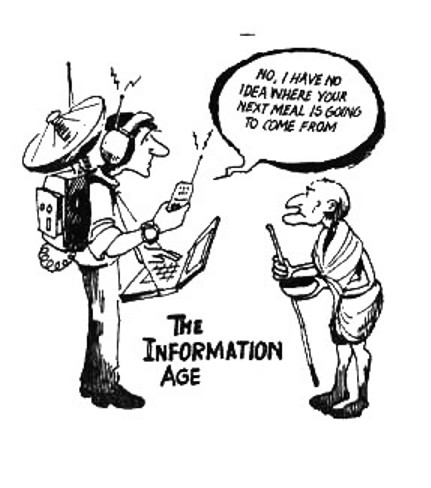
And how inclusive is that information society? As Asia Media Report 2009 reminds us, not everyone is invited to the party. Large sections of Asian society are left out.

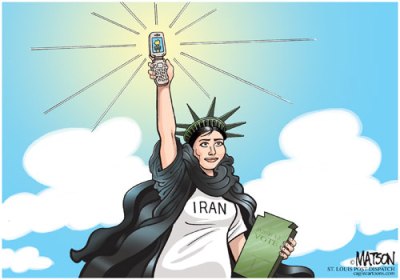
But don’t expect such people to remain excluded for too long. Armed with mobile phones and other ICT tools, they are going to crash the party, whether we like it or not.

Living with diversity: Salad or soup, asks Mallika Sarabhai

Standing up for a pluralistic society

The recently concluded general election in India saw thousands of candidates contest to enter the Indian Parliament. Among the candidates I watched closely were writer Shashi Tharoor (who ran on the Congress ticket and was elected from Kerala state) and dancer Mallika Sarabhai (who ran as an independent candidate in the Gujarat state and didn’t win).

The classical dancer turned social activist had one of the more colourful campaigns in the world’s largest election: her public rallies included dance numbers, and her website (UPDATE in March 2013: no longer online) – featuring interactive elements like blogging, flickr images and online fund raising – was ranked the best by a communication research agency.

But where Mallika – whose performances I have enjoyed watching on successive visits to her home town of Ahmedabad – really stood out was in whom she opposed. She was the independent candidate from Gandhinagar, one of India’s most high-profile constituencies, a state capital that has been polarized along Hindu-Muslim lines since riots in 2002. Her opponent was Lal Krishna Advani, the prime ministerial candidate of the BJP.

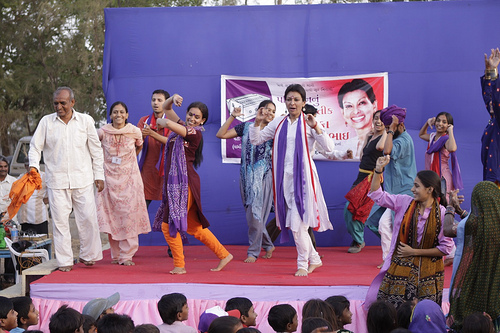
Mallika Sarabhai dances during campaign trail
The two candidates couldn’t have been more different. The 82-year-old veteran politician epitomised Hindu nationalism and majority hegemony with its attendant intolerance of minorities. Mallika, hailing from an upper class Indian family of freedom fighters, industrialists and intellectuals (her father Vikram Sarabhai was father of the Indian space programme), stood for pluralism, non-violence and tolerance. When she entered the fray in March 2009, she described her candidature as a Satyagraha against the politics of hatred.

She didn’t win the election, but lost with grace and dignity. Within days, she wrote in Outlook magazine one of the most remarkable pieces coming out of the cacophonous Indian election. She made it into an open letter addressed it to L K Advani, her main opponent.

“As a proud Hindu and a proud Indian, I feel vilified by you,” she wrote. “You have reduced the great Sanatana philosophy to a Taliban-style Hindutva. As an Indian, you have tried to reduce my identity to a single factor—Hindu or not. You let your goons, saffron-clad terror units wielding lathis and worse, terrorise us and live above the laws of this country.”

For me, the most insightful paragraph is this where she takes on what it means to live with the huge cultural, social and political diversity that makes up India: “I am a post-Independence Indian. I was brought up to value and treasure my unique Indianness, to value our Constitution, which gives equal rights to all Indians, irrespective of belief, culture, practice or language. I learnt to revel in the differences that made us a rainbow country. We are a salad-like melange of cultures and not a soup where all variations get reduced to a homogeneous pulp—this, to me, is our greatest strength.”

Read full text of Dear Shri Advani by Mallika Sarabhai

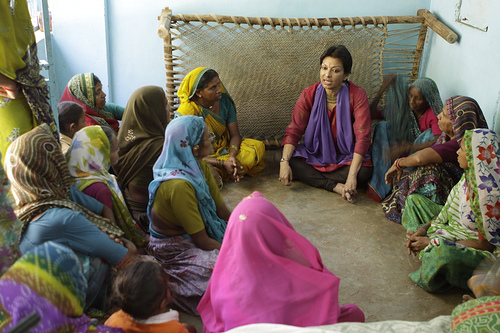
Eschewing grand speeches, microphones, banners and slogans, she just listened to voters
Salad or soup – that’s an interesting way of framing the challenge. And not just in the delightful melting pot that is India, but in many other mixed-up, tossed up cultures and societies of today…not the least in my native Sri Lanka, where we have seen the primitive forces of tribalism over-ride all other considerations in recent years. One released, it’s very hard to put this genie back in the bottle.

And how I wish our own privileged upper middle classes would take to the rough and dirty game of politics, if only to stand up against the peddlers of hatred and hegemony. If only…

Mallika could easily have continued her cultural work through the Darpana Academy of Performing Arts and her social activism. She decided to take the plunge this year because she thought the time had come to get into active politics. She was encouraged by her friends, mainly social activists, united under the banner of Friends of Democracy. Mallika is one of the several petitioners demanding justice in the post-Godhra riot cases. She was quoted in The Times of India as saying she decided not to join any party as she believed that there was no party free of corruption, criminalization and horse-trading.

As the Washington Post reported during her campaign trail: “Sarabhai, one of a handful of professional people running as independents in the upcoming elections, rejects the standard Indian political appeals to caste, religion and linguistic ethnicity, and speaks of empowering voters to unseat corrupt and ineffective politicians. Her campaign, she said, seeks to reclaim the shrinking space left for ordinary people’s voices in a democracy dominated by political parties that too often rely on mudslinging, muscle-flexing and money power.”

She and other courageous Indians have miles to go before they can sleep. Encouragingly, she has pledged that her campaign will continue.

As she says signing off her essay in Outlook: “I may have lost this election, but I will continue to work for the disadvantaged and dispossessed, and to ensure that their voice shall be silenced no more.”

Images courtesy Mallika Sarabhai campaign website and Friends of Democracy Flickr account

Sri Lanka: Memories of War, Dreams of Peace

Sri Lanka: Island of suspended dreams has a second chance...

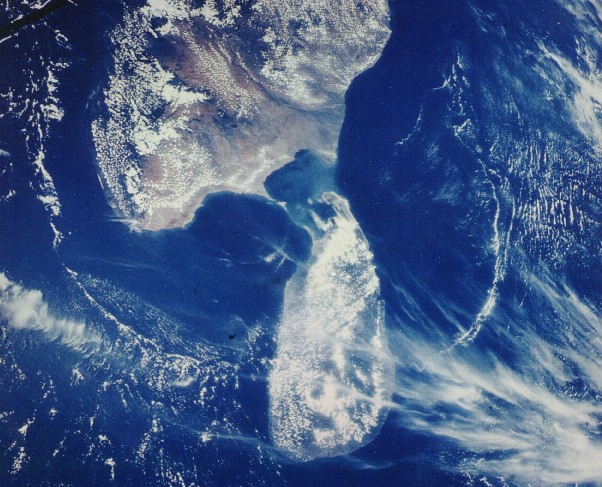
This is one of my favourite images. Showing southern part of India and my native Sri Lanka, it was captured by one of the early US space missions, nearly four decades ago.

Much has happened on the tear-drop shaped island since this image was taken: among other things, we’ve been through a civil war that lasted a generation, and robbed the dreams of at least two generations. That war officially ended on 18 May 2009.

The Day After, on 19 May 2009, I wrote a 1,500-word essay titled Memories of War, Dreams of Peace. The editor of Groundviews, Sri Lanka’s leading citizen journalism website, published it in full, and within minutes of my emailing the text to him.

I’m humbled and gratified that in the past few days, it has been widely read, commented on, quoted online and reproduced. Some have agreed with me; others have dismissed me as a naive dreamer. A writer cannot ask for more.

20 May 2009: MediaChannel.org (New York) reproduces the essay in full


24 May 2009: The Sunday Leader (Colombo) reprints the essay in full

I look back briefly on the brutal and tragic war – not in anger, but in great sadness. I then look forward in a wistful, dreamy mode. My premise was: “Now that the war is officially over, will this mark the beginning of real peace? I want to believe so. I want to audaciously dream of peace. The alternative is too dreadful to consider.”

This is not exactly what I’ve been trained to do. As a science writer and film-maker, I gather and analyse information, which I try to present in logical, coherent and accessible ways. In recent years, I’ve also been writing op ed essays in areas where I have some competence and experience. In writing this essay, I consciously departed from all that. I’m neither political scientist nor activist to engage in ideological or technocratic discussions, which others have already started in earnest. I wrote this at an emotional level, looking back and looking forward.

But my training did come in handy in framing the timely and necessary questions. My chosen ‘author intro’ for this essay thus reads: “Writer Nalaka Gunawardene has been a dreamer for all his 43 years. He asks more questions than he can answer.”

We've doused the flames of war, but much more needs to be done...
If my views come across as naive or idealistic, I shall plead guilty as charged. My emotions this week are best described as cautiously optimistic, but as some readers on Groundviews pointed out in their comments, our high hopes have been betrayed before. But can we afford not to dream privately and publicly at this juncture? I don’t think so. We have suspended our dreams for too long, and it’s time to start dreaming again.

There are as many kinds of dreamers as there are dreams. One of my favourite quotes comes from the British soldier and writer T E Lawrence (of Lawrence of Arabia fame): “All men dream, but not equally…the dreamers of the day are dangerous men, for they may act their dream with open eyes, to make it possible.”

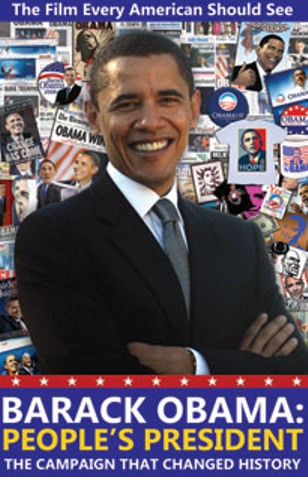
Untold story behind the story: “Barack Obama: People’s President”

A film to reveal what the old media didn't show...
When Barack Obama and his running made Joe Biden won the US Presidential Election held on 4 November 2008, they not only beat the Republican duo McCain-Palin but also a host of other also-rans. It’s too soon to tell, but that date might also mark the beginning of the end for the old media, also called the mediasaurus, who have been dominating the public’s access to news, information and commentary for over a century.

But how did it all happen? Who can tell us the real story as it happened, and why, without filters and biases so rampant among the mediasaurus?

On this blog, we have watched with deep interest and some fascination the rise of Barack Obama from relative obscurity to become the President of the United States. On 6 November 2008, soon after the election results were confirmed, we noted how Obama had just been elected ‘President of the New Media world’. I explained: “Obama’s rise has epitomised change in many ways. Among other things, he is the first elected leader of a major democracy who shows understanding and mastery over the New Media World, which is radically different from the old media order.”

On 20 January 2009, when he was inaugurated, we wrote: “For four or eight years, Obama’s every move, word and gesture will be captured, dissected and debated to exhaustion by admirers and detractors alike. And his administration will be under scrutiny by thousands of citizen journalists who don’t share much except the digital platforms and social networks on which they post their impressions. Welcome to the New Media Presidency. The hard work – and real fun – begin now!”

And now, one of the world’s leading new media activists, Danny Schechter, is about to release a new documentary on how the Obama campaign rode the new media wave to the White House — and more importantly, how the same new media can help the American public to keep Obama Administration accountable.

The film “Barack Obama, People’s President”, (slated for DVD release later this month by ChoiceMedia.net), documents the online and on the ground techniques that were used to win the highest office in the land.

As the film’s advance promo blurb says: The one story that most TV outlets didn’t tell in the 2008 election was the most important one -how did a young and relatively unknown candidate become President? If you voted for Barack Obama or not, this is a story you will want to know because it shows how the face of presidential politics changed forever. Barack Obama used techniques never seen before in a nationwide election — his grassroots mobilization and use of the internet was unprecedented, inspiring and effective. You have seen the rest of the coverage — now see the real story.

The film goes inside the official and unofficial campaign to show how Barack Obama was turned into a political brand to appeal to young first time voters. It shows how social networking on the internet — blogs, Facebook, texting and other techniques — were used carry the message to the masses and to raise tens of millions of dollars for the campaign. Popular online videos such as “Obama Girl”, along with those created by regular yet passionate supporters to engage their own communities, became one of the most important tools in the campaign’s success.

Watch the trailer of “Barack Obama, People’s President” directed by Danny Schechter:

Emmy award winning film-maker Danny Schechter, who is also blogger-in-chief at MediaChannel.org that keeps a critical eye on the media, just wrote this explaining why he made this film:

“It is hard to remember that two years earlier Obama was barely known, registering on the radar screen for just 10% of voters. He was also hardly a brand name as a first term Senator who spent more time in state politics in Illinois than on the national stage. Moreover, he was young and a man of color — not qualities that usually prevail in a presidential arena which tends to draw far older, far whiter, and far more centrist candidates. The thought that he would beat frontrunner Hillary Clinton in the primaries was, quite frankly, unthinkable to most of the elite.

“And yet he prevailed, as he used a phrase appropriated from labor organizer and Latino legend Caesar Chavez. Obama turned the farm workers Spanish language slogan “Si Se Puede” into “Yes We Can.” Rather than focus on specific political issues, he built a campaign on the promise of “Hope.” Rather than just rely on traditional fundraising — although by the end, he was plush with it — he reached out over the internet for smaller donations from millions of donors.

Perils of the New Media Generation...
“Few in the major media gave him a chance, but he was not discouraged because he had created his own grassroots media operation using sophisticated organizing and social networking techniques to build a bottom-up movement, not the usual top-down apparatus. While his campaign ran the show, he encouraged independent initiatives including citizen-generated media, music videos, personalized websites, twittering and texting, etc..

“This is the new direction our politics has taken. It is a story that may be somewhat threatening to old media – and older activists – who prefer a one to many approach to communication, as opposed to forging a more interactive empowering platform. There is no question that young people — especially those mobilized by Obama — prefer online media and that choice is making it harder and harder for traditional outlets to sustain their influence and, in some cases, even their organizations. Old media may be on the way out.

“This is why our film is, in my mind, so important, not just as a record of how Obama won and what happened in 2008, but in what will happen, can happen, and is happening in the future. This is why I believe its critical for Americans to see it — and others in the world as well — to recognize how Obama represents more than just another politician, but a whole new approach to politics. That old adage is worth remembering: “It’s not the ship that makes the wave, it’s the motion of the ocean.”

“Obama, for all his shortcomings, which are becoming more obvious by the day, has pioneered the way change must be won — not by people on the top, but by all of us. It remains for “us” to hold him accountable. We live in a culture of amnesia – it is important to learn the lessons of the recent past.”

Read the full comment: New Film Tells Unreported Story of Obama’s Election on MediaChannel.org