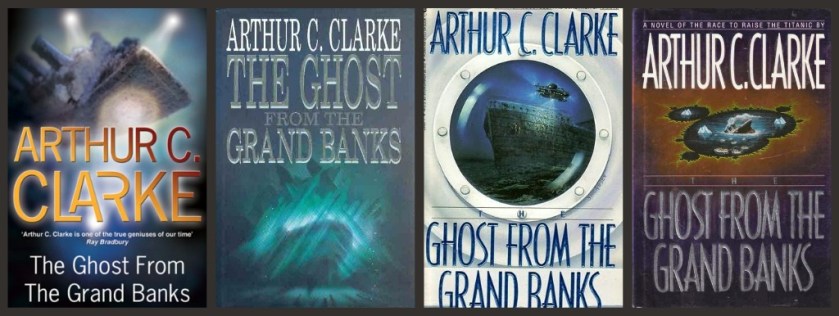
The Ghost from the Grand Banks - many covers, one story
Writing the Foreword to the book on ‘Communicating Disasters‘ that I co-edited in 2007, Sir Arthur C Clarke said: “I was born five years after the biggest maritime disaster the world had known: the sinking of the ‘unsinkable’ RMS Titanic while on her maiden voyage. My home town Minehead, in Somerset, was not more than a couple of hundred kilometres from Southampton, from where the Titanic set off. All my life, I have been intrigued by the Titanic disaster.”
The Titanic — whose wreck not discovered at the time — made a cameo appearance in his 1976 novel, Imperial Earth. For the Quincentennial of the United States, the wreck is raised and carried to New York.
But he continued to be haunted by the mighty ship (as did, and do, many others). He finally had to write a whole novel to exorcise it from his mind.
One day in early 1989, Sir Arthur asked me: “Does ‘Ghost from the Grand Banks’ mean anything to you?”
It didn’t — but that wasn’t surprising as I’d been raised on the other side of the planet, in an entirely different generation.
The Grand Banks of Newfoundland are a group of underwater plateaus southeast of Newfoundland on the North American continental shelf. The cold Labrador Current mixes with the warm waters of the Gulf Stream here — making it one of the richest fishing grounds in the world.
It is also close to where the Titanic sank on the night of 14/15 April 1912, and has served as the launching point of various shipwreck expeditions.
That heralded the genesis of an entirely new Arthur C Clarke novel. For me, it was the beginning of an exhilarating journey across space and time, supporting the creative process of one of the finest science fiction writers of the 20th Century.
I was working as Sir Arthur’s research assistant at the time, two years into my fascinating association with the late author (which lasted 21 years).
Over the next few months, I was to research and/or cross-check all sorts of records, data and other nuggets of information, which Sir Arthur — the master weaver of narratives — then worked into an entirely new novel.
The novel, published in late 1990 as The Ghost from the Grand Banks, was an ocean-based thriller set in the (then) near future. It revolved around rival British-American and Japanese teams trying to raise the legendary ship’s wreck in time for the centenary in 2012. Both teams mobilise mega-bucks and cutting edge technology: while one team relies on 50 billion little glass balls, the other’s ambitious plan involves making the world’s largest ice cube…
Two weeks before the centenary of the Titanic‘s maiden voyage – and its tragic sinking – I re-read the novel. On the information society front, at least, I found that The Ghost from the Grand Banks stands up remarkably well in 2012.
Living as we do at the time when his story culminated, we can now compare Sir Arthur’s ‘extrapolations of the future’ – he carefully avoided labelling any of his ideas as ‘predictions’ – with what has become our reality.
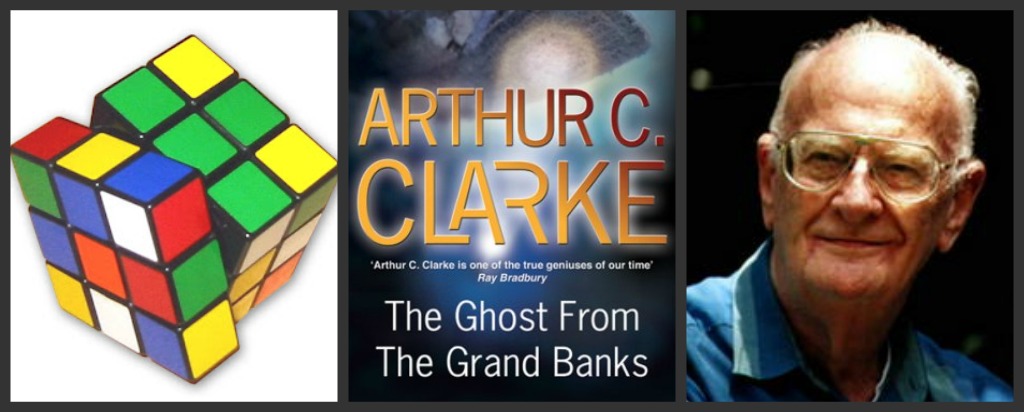
Science fiction writer and futurist Sir Arthur C Clarke knew how closed economies and restrictive cultures stifled innovation. He once said the only memorable invention to emerge from Soviet-dominated Eastern Europe was the Rubik’s Cube!
Rubik’s Cube is a 3D mechanical puzzle invented in 1974 by Hungarian sculptor and professor of architecture, Ernő Rubik. Since then, its huge worldwide success has led to several variations.
I just came across an interesting suggestion for an enhanced Rubik’s Cube, by Arthur Clarke himself, while re-reading his 1990 novel The Ghost from the Grand Banks.
It was an ocean-based thriller set in the (then) near future. It revolved around British-American and Japanese teams competing to raise the Titanic‘s wreck in time for the centenary in April 2012.
In the novel, Sir Arthur talks about the Rubik’s Cube making a comeback 30 years after its first appearance — and in a far more deadly mutation.
As he describes: “Because it was a purely mechanical device, the original Cube had one weakness, for which its addicts were sincerely thankful. Unlike all their neighbours, the six centre squares on each face was fixed. The other forty-eight squares could orbit around them, to create a possible 43,252,003,274,489,856,000 distinct patterns.
“The Mark II had no such limitations; all the fifty-four squares were capable of movement, so there were no fixed centres to give reference to its maddened manipulators. Only the development of microchips and liquid crystal displays had made such a prodigy possible; nothing really moved, but the multicoloured squares could be dragged around the face of the Cube merely by touching them with a fingertip”.
A quick check on the official Rubik website, and a Google search, shows no such device being on the market.
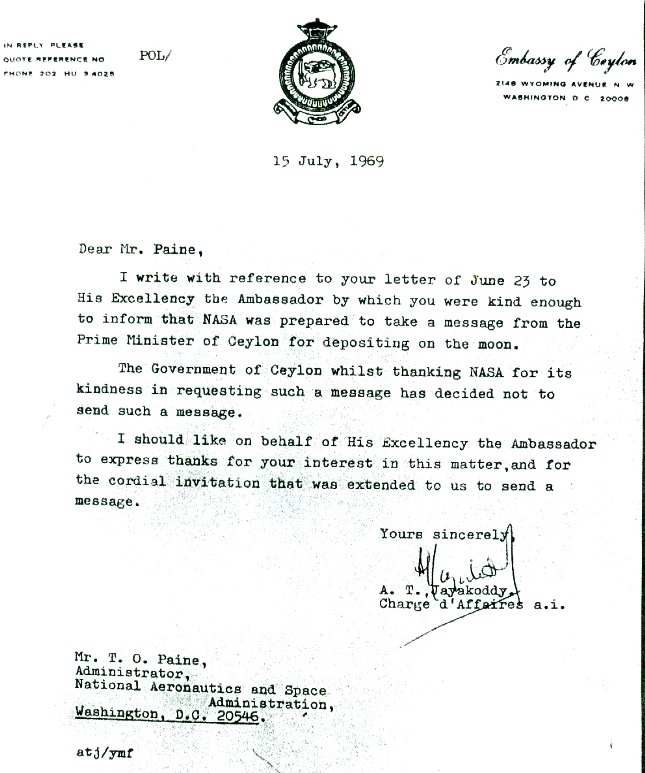
This is the Sinhala text of my Ravaya newspaper column published on 11 March 2012. Today I write about How Sri Lanka Missed the Moon. I wrote an English article in July 2009 covering the same ground, but this is NOT a translation. I don’t do translations.
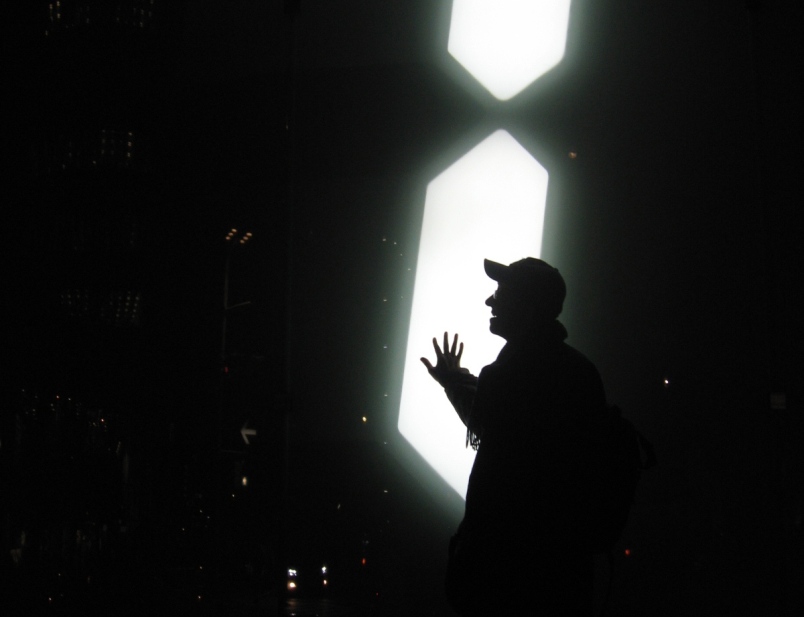
Nalaka G at a giant digital clock in Tokyo: Wandering everywhere with a sense of wonder...
This is the Sinhala text of my weekly column published in Ravaya newspaper for 5 February 2012. Here, I look back at one year of weekly columns and reflect on some reader feedback and their participation in my efforts to make sense of the world in turmoil that is all around me. I say ‘Thank You’ to the few writer friends and public intellectuals who have advised and guided me. I reaffirm my commitment to keep asking questions, connecting dots and following my own simple language style with none of the intellectual pretensions common in Sinhala newspaper writing.
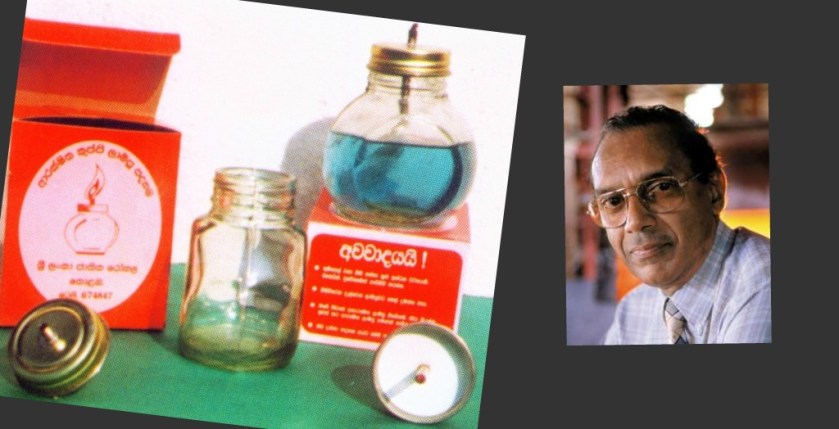
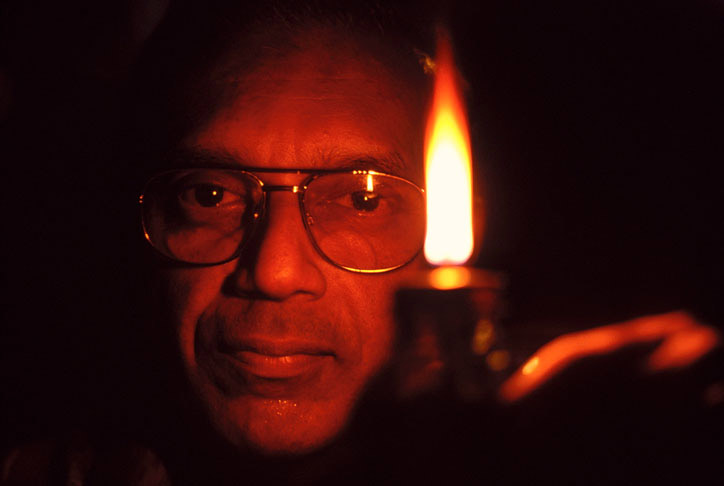
In December 2009, I wrote in a blog post: “It’s easy to curse the darkness, and many among us regularly do. Only a few actually try to light even a small candle to fight it. Dr Wijaya Godakumbura of Sri Lanka is one of them – he literally lights lamps, thousands of them, against the darkness of ignorance and poverty.”
“But his lamps are different, and a great deal safer compared to normal lamps and kerosene, which can start fires risking life and property of users. The design is simple yet effective, inspired in part by the Marmite bottle known the world over: it’s small and squat, with two flat sides – equipped with a safe metal screw cap to hold the wick. It’s quite stable and hard to topple.”
I have written this week’s Ravaya Sinhala science column about Dr Godakumbura and his innovative, life-saving bottle lamp. I also feature him in an interview in MALIMA – the new TV series on science, technology and innovation I host from this month on Sri Lanka’s national TV Rupavahini.
The inventive doctor and his life-saving bottle lamp
In December 2003, on the eve of the World Summit on the Information Society (WSIS), I did a wide-ranging interview with Sir Arthur Clarke on satellite TV, internet, censorship and other challenges of emerging information societies. It was published in One World South Asia on 5 December 2003.
I adapted into Sinhala parts of that interview for my Ravaya Sunday newspaper column last week (18 Dec 2011),making the point that much of what he said about satellite TV at the time is now equally relevant to the rapid spread of the Internet.
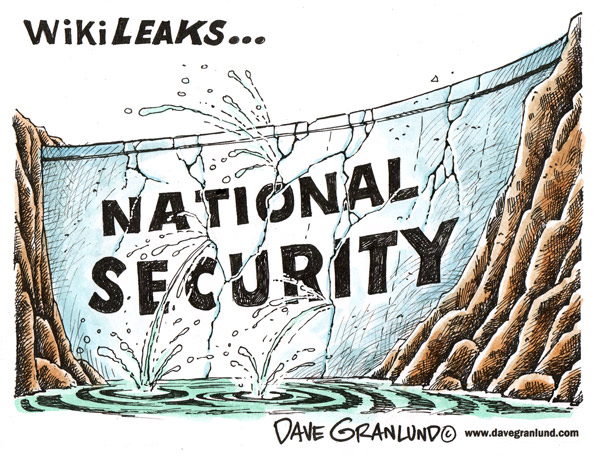
For this week’s column, appearing in the print edition for 25 Dec 2011, I have adapted more segments of that interview covering topics such as: violence in society and media’s role; educational potential of television; does satellie TV spread cultural imperialism; and how technology – not politicians or generals – now determine the free flow of information across borders. This cartoon, drawn by David Granlund a year ago, aptly captures that last point!
A welcome dam breach, this one! - cartoon by Dave Granlund
As I have often said on this blog, Television used to be the favourite whipping boy of those who love to criticise communication technologies and consumer gadgets — until the Internet and mobile phones came along.
When it finally arrived in Asia in 1991, direct TV broadcasting by satellite scared the daylights out of many Asian governments and self-appointed guardians of culture and public morals. How can the unexposed (i.e. ‘unspoilt’) hundreds of millions of Asians cope with massive volumes of information and entertainment beaming down from the skies, they asked. Their real concern was the loss of control over what the public watched, which governments and ruling elites had tightly controlled for decades since radio and TV emerged as mass media.
So, for much of that decade, we witnessed howls of protests from them — but their worst fears never materialised. Satellite TV found its niche alongside terrestrial transmissions, and Asian broadcasters soon mastered the medium. Today, global broadcasters like CNN, BBC and Al Jazeera compete with hundreds of Asian satellite TV channels and the audiences have a far greater choice.
As I wrote in September 2008: “In 1990, most Asian viewers had access to an average of 2.4 TV channels, all of them state owned. This has changed dramatically — first with the advent of satellite television over Asia in 1991, and then through the gradual (albeit partial) broadcast liberalisation during the 1990s. Asian audiences, at last freed from the unimaginative, propaganda-laden state channels, exercised their new-found choice and quickly migrated to privately owned, commercially operated channels.”
Sir Arthur Clarke was the man who triggered this satellite communication revolution. In 1945, while still in his late 20s, he was the first to propose the concept of using a network of satellites in the geo-synchronous orbit for television and telecommunications. His vision became a reality in the mid 1960s, and within a generation, humankind has come to rely critically on the network of comsats placed, in what is now called the Clarke Orbit, some 22,300 miles above the earth.
In December 2003, on the eve of the World Summit on the Information Society (WSIS) and days before his 86th birthday, I did a wide-ranging interview with Sir Arthur Clarke on satellite TV, internet, censorship and other challenges of information societies. It was published in One World South Asia on 5 December 2003.
For my Ravaya column this week (18 Dec 2011), I have adapted parts of that interview into Sinhala, making the point that much of what he said about satellite TV at the time is now equally relevant to the rapid spread of the Internet. It’s also a nice way to mark his 94th birth anniversary this week.
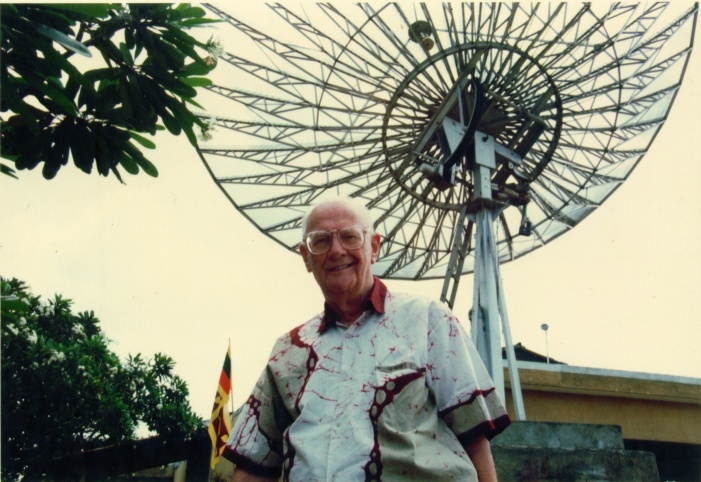
Sir Arthur C Clarke: Opened up the heavens as part of information superhighway...
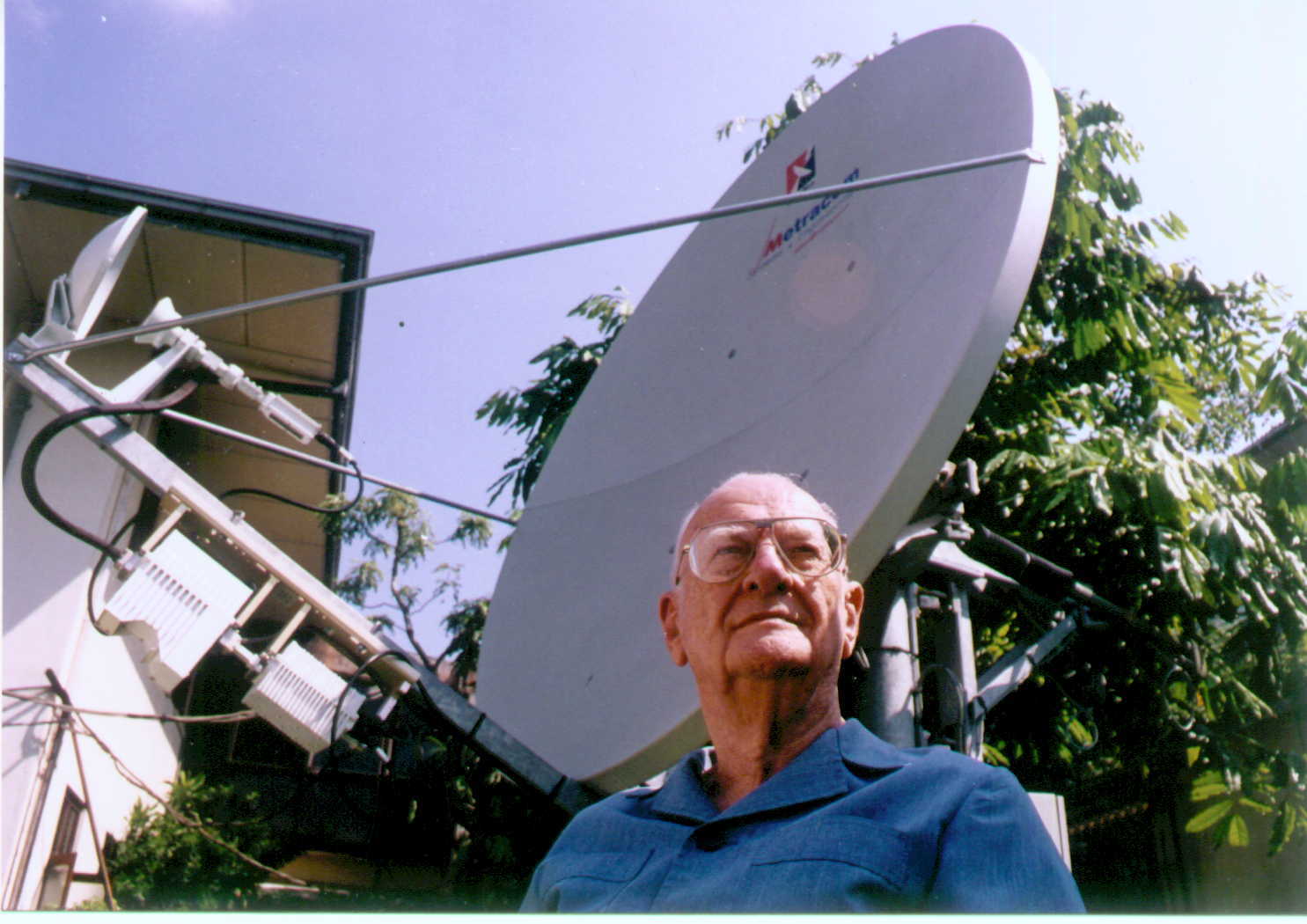
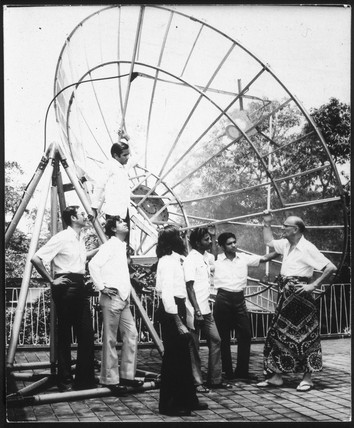
Arthur C Clare (extreme right) with Indian ISRO engineers who installed satellite antenna at his Colombo home, in 1975හොඳම උදාහරණය ලැඛෙන්නේ දකුණු අප්රිකාවෙන්. 1960 දශකය වන විට ලෝකයේ ඉසුරුබර රාජ්යයන් අතුරෙන් ටෙලිවිෂන් සේවාවක් අරඹා නොතිබූ එක ම රට වූයේ දකුණු අපිකාවයි. එවකට එහි පැවති සුදු පාලකයන්ගේ රජයේ සන්නිවේදන අමාත්යවරයා එරට ටෙලිවිෂන් සේවාවක් ඇරඹීමට කිසිසේත් එකග වූයේ නැහැ. ‘ටෙලිවිෂන් තමයි අප්රිකාවේ සුදු මිනිසාගේ පාලනය හමාර කරන්නේ’ යයි ඔහු කළ ප්රකාශයෙහි ලොකු අරුතක් ගැබ් වී තිබුණා. ^‘Television will mean the end of the white man in Africa.’)
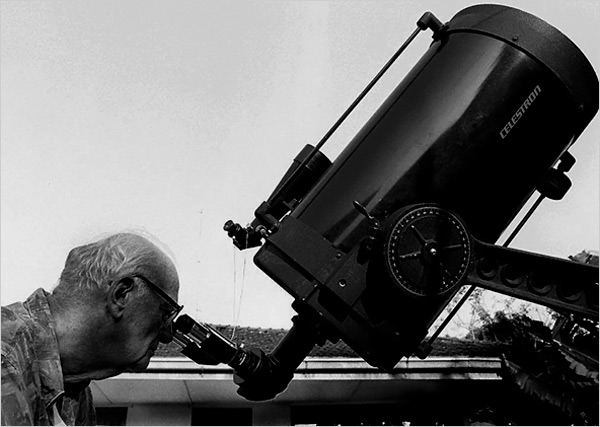
This is the Sinhala text of my weekly column in Ravaya newspaper, issue for 9 Oct 2011. In this, I discuss the plight of two telescopes in Sri Lanka – a private one used by Sir Arthur C Clarke, and another gifted to the government by Japan that is located in the wrong place and grossly underused.
Sir Arthur C Clarke at the ACCIMT in better times For many years, I’ve been explaining and clarifying to everyone that I worked with the late Sir Arthur C Clarke in his personal office in Colombo, which was completely separate from a government entity named the Arthur C Clarke Institute for Modern Technologies in Moratuwa, Sri Lanka. This is not just an institutional demarcation; the latter body set up by the government of Sri Lanka in 1984 and sustained since then with public funding has completely under-served its founding ideals and remains mediocre and unproductive after a quarter century. I have no wish to be associated, even mistakenly, with such an entity.
I remained quiet about this for as long as Sir Arthur was alive, as it was not tactful for me – as part of his team – to criticise a state entity named in his honour. A year after his death, I broke that silence and wrote a media article which was published in the current affairs magazine Montage in April 2009.
That elicited some strange ‘reader comments’ on the magazine’s website — several of which alleged that I was a ‘traitor’ who was out to discredit the hard-working (‘Sinhala Buddhist’) engineers and managers of this institute! I could not fathom how and why the staff’s ethnicity or religious faith was relevant.
Beyond such vitriol, these pseudonymous ‘readers’ never once responded to my specific questions about the public-funded institute’s scientific productivity and public accountability.
Unfortunately, Montage went out of publication and its website, which was located at http://www.montagelanka.com, is also no longer available online. So in the public interest, I’m reproducing my article below, unedited as it appeared in print in April 2009. Alas, I never saved the online comments so those are probably lost forever…
As always, this blog is open to a rational discussion of the core issues raised below, as all the concerns still remain valid. And there are no ‘sacred cows’ in my book!
Monument for Sir Arthur C Clarke: Time to ask some tough questions
By Nalaka Gunawardene
As the first death anniversary of Sir Arthur C Clarke approaches, Lankans are still debating how best to cherish the memory of the celebrated author and visionary who called the island his home for more than half a century.
Ours is a land where private individuals — and governments –- just love to put up ostentatious and often superfluous structures to honour the departed. We typically don’t assess their cost-effectiveness or utility. Neither do we pause to ask how the person being honoured would have felt about it.
The Telecommunications Regulatory Commission of Sri Lanka (TRCSL) recently announced plans to launch the country’s first satellite, which is to be named after Sir Arthur. According to news reports, it will be launched into low earth orbit (LEO) at an estimated cost around US$ 20 million.
Would naming Sri Lanka’s first satellite be a fitting tribute to Sir Arthur, universally acclaimed as inventor of the communications satellite (comsat)? Or should a monument to this ‘one man cheering squad for Sri Lanka’ be more rooted in the Lankan soil, where people can see and feel its presence everyday? And, by the way, what about the state technical institute in Moratuwa that already bears the Arthur Clarke name?
Sir Arthur, with whom I worked closely for 21 years as an aide and a decade as spokesman, would surely have wanted an open and frank debate on this matter. He opted for rational, evidence-based decisions based on cost-benefit analysis. He frowned upon grandiose plans made for their own sake, whether their implementation was going be paid for by public or private funds.
Besides, he already had an asteroid, dinosaur species and a geostationary comsat named after him during his lifetime. Topping that without going over the top would be a challenge indeed.
A living legacy
The tussle for the Clarke legacy started within hours of his death on 19 March 2008. He had left clear written instructions for his funeral to be held on a strictly secular and austere basis. He didn’t want any decorations, and explicitly disallowed official involvement by British or Lankan governments.
As this news spread, it fell on me to explain to government officials why offers of a state funeral and other types of state patronage could not be accommodated. This raised some eyebrows and dashed hopes of some who wanted to turn the sombre event into a carnival. In the end, the state appealed for a symbolic radio silence of two minutes to coincide with the funeral.
In the weeks and months that followed, many have asked me what kind of monument was being planned in Sir Arthur’s memory. The answer, as far as the Arthur Clarke Estate is concerned, is none –- and this seems to surprise many.
Yet it is entirely consistent with Sir Arthur’s personality and vision: he never sought personal edifices in his honour or memory. When a journalist once asked him about a monument, he said: “Go to any well-stocked library, and look around…”
That evokes memories of the well known epitaph for Sir Christopher Wren, one of the greatest architects of all time, who significantly changed London’s skyline: “Lector, Si Monumentum Requiris Circumspice”(“Reader, if you seek his monument, look around”). It also begs the question why Sir Arthur chose not to make any mention of the physical entity that already bore his name: the Arthur C Clarke Institute for Modern Technologies (ACCIMT).
Indeed, the ACCIMT is today a perfect example of a good idea gone astray, becoming a disgrace to the very man it was meant to honour. How did things go wrong to the point where Sir Arthur Clarke distanced himself from the Arthur Clarke Institute in the last few years of his life? These thorny questions need to be asked now that we are discussing matters of legacy.
The world was very different, and aspirations were very high, when ACCIMT was established in 1984 by an Act of Parliament to help transfer and adopt modern technologies in five areas: computers, telecommunications, energy, robotics and space technology. The Institute, initially called the Arthur Clarke Centre, was to undertake research and development as well as train technical professionals in ways that would accelerate economic development and advance the quality of life.
Several leading Lankan professionals were associated with its creation. Among them were civil servant (later Minister) Dr Sarath Amunugama and diplomat (now academic) Dr Naren Chitty. In 1985, President J R Jayewardene appointed the eminent biochemist (and his science advisor) Professor Cyril Ponnamperuma as its founder director.
As patron, Sir Arthur had no executive functions or responsibilities, but generously provided advice, guidance and some funding to the fledgling institute. He donated US$ 35,000 received for the 1982 Marconi Fellowship. Just as importantly, he mobilised his far-flung network of international contacts in scientific, technological and engineering circles. The Arthur Clarke ‘fan club’ stretched far and wide -– from the White House to the Kremlin, and from elite academia to geeky Silicon Valley. Carrying this unique calling card, ACCIMT had access to a global reservoir of goodwill, partnerships and external funding.
Tragically, despite this head start and advantages, the Institute reaped little benefit. While it did show some early promise, it has failed to consolidate itself as a credible and productive technical institute. Its founding aim of becoming a centre of excellence for the developing world also flopped. When assessed using universally accepted measures of scientific productivity -– such as research publications in refereed international journals, peer citations and patents for innovation — it shows a dismally poor track record.
For sure, it has been dabbling with a few everyday technologies such as traffic lights, telephone locks and domestic gas leak alarms. Useful as these applications are in specific situations, they cannot justify 25 years of substantial investment of Lankan tax payer money as well as international donor funds.
March of ICTs
Perhaps an institute with this kind of lofty mandate could have been more influential at the apex policy level. The past 25 years have seen Sri Lanka adopting many new information and communication technologies or ICTs (e.g. mobile telephony in 1989, commercial internet connectivity in 1995). There has been an unprecedented and phenomenal growth in the coverage of telecom services. These developments have thrown up many policy and regulatory challenges for the state and private sector players.
Alas, ACCIMT has not kept up with the rapid evolution of information society, and failed to carve out a clear niche for itself even as Sri Lanka engages the Global Village through a multitude of ICTs. Its voice is neither heard nor heeded in key debates on bridging the digital divide, and on how best to prepare our youth to ‘exploit the inevitable’ in a globalised marketplace. These concerns were very dear to Sir Arthur, who continued to talk and write perceptively about them to the very end of his life. But ACCIMT is still stuck in the obsolete analog concerns of the 1980s.
Peer acceptance and recognition are indicators of any technical institute’s standing. ACCIMT would struggle to demonstrate its worth on these criteria. It is routinely bypassed by state policy making mechanisms and agencies. It is curious how the telecom industry regulator is spearheading the government’s newly announced satellite project. Why is ACCIMT, with a statutory mandate in this subject, not playing a more prominent role in such plans and discussions?
When the rest of government ignores the institute, it’s not surprising that technology-based industries don’t turn to it for advice either. The institute’s principal activity these days is conducting training courses in electronics — useful, no doubt, but for which purpose there already are several dedicated vocational training centres.
For much of its 25 years, the Arthur Clarke institute has taken cover behind its famous patron to avoid adequate public scrutiny. Large sections of society, including many in the media, harboured a misconception that Sir Arthur Clarke was personally involved in its management and research; in practice, he had none.
Early sparks
Things didn’t always look this bleak. For a while, it seemed as if the institute would live up to its founders’ expectations. For example, it was the first to downlink and relay CNN broadcasts in Sri Lanka. CNN founder Ted Turner‘s respect for Sir Arthur made this possible. The institute was also involved designing low-cost dish antennae for households to directly capture satellite TV transmissions in the 1980s when only two terrestrial channels were available. March of technology and commerce later made these services redundant.
One far-sighted activity that Professor Ponnamperuma started was the Science for Youth programme. On a national and competitive basis, 25 of the brightest high school leavers were selected and introduced to modern technologies over six consecutive weekends. Out of that exercise eventually emerged the Young Astronomers’ Association and Computer Society of Sri Lanka, the latter now a professional body.
As part of the 1986 batch, I can personally vouch for the insights and inspiration Science for Youth gave me in those pre-Internet days. I was especially fascinated by the outspoken views of inventor and aviator Ray Wijewardene. The friendship I formed with him has lasted for over two decades and enriched me enormously. Later, as a young science journalist, I used to cover the institute’s public events hosting of visiting tech pioneers and Russian cosmonauts. For a while, ACCIMT was a ‘happening place’.
Then, sometime in the 1990s, the institute abandoned most of its public engagement and outreach activities. This inward looking attitude didn’t change even after the government decided to locate the country’s largest optical telescope (donated by Japan) at the institute. I remember how exasperated Sir Arthur was to hear schools being told that they may visit and look at the telescope during the working hours from 9 am to 5 pm!
But by then, he was not going to intervene. After he turned 80 in 1997, Sir Arthur adopted a policy of ‘benign neglect’ towards the institute on which he had pinned such high hopes only years earlier. Ever conscious of his ‘resident guest’ status, he chose not to criticise the institute in public, although he shared his dismay and disappointment in private.
As we debate how best to preserve Sir Arthur’s illustrious legacy, we cannot afford to continue such ‘benign neglect’ on the publicly-funded Arthur Clarke Institute. A good starting point would be to belatedly ask tough questions and engage in some serious introspection.
Sir Arthur would have expected nothing less.
About the writer: Science writer Nalaka Gunawardene worked for Sir Arthur Clarke’s personal office, which was totally separate from the Arthur Clarke Institute. The views in this article are entirely those of the author.
Photographs courtesy Rohan de Silva, Arthur C Clarke Estate.
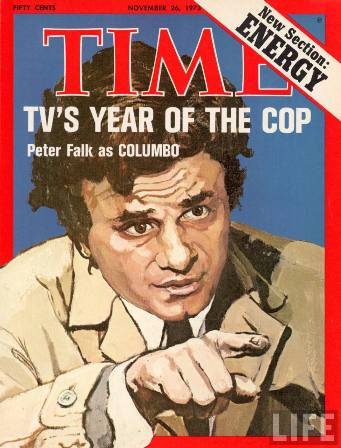
Peter Falk (1927-2011)Actor Peter Falk, who just died aged 83, was truly an icon of globalised popular culture. With no props besides his rumpled jacket and raspy voice, he held a whole generation spell-bound with intelligent television (and showed why the term need not be an oxymoron).
Columbo’s creators, Richard Levinson and William Link, modeled the character after the crazy-like-a-fox sleuth in the French classic “Les Diaboliques’’ (1955). But it was Peter Falk who brought the character alive and gave it a unique flavour.
It turns out that Falk didn’t originate the role of Lieutenant Columbo of the Los Angeles police. Bert Freed had first played Columbo in a 1960 teleplay. Falk wasn’t even the front-runner for the part when NBC wanted to revive the character in 1968 for a made-for-television movie, “Prescription: Murder.’’ The network had hoped to cast entertainer Bing Crosby for that program.
“An agent called and said that Crosby was scheduled to play golf and couldn’t turn it down to go over and talk’’ to the show’s creators, Falk told The Washington Post in 1990.
“He did love golf,’’ Mr. Falk said. “I play, too, but I went over and talked to them.’’
‘Just One More Thing’: Remembering Peter Falk, TV’s ‘Columbo’
Columbo could elicit an inadvertent confession from a suspect by prefacing his question with a seemingly harmless, “Just one more thing” – the phrase that became synonymous with his character and the title of the actor’s 2006 memoir.
Falk once described the character he played for 30 years in these words: “He’s unique — if he were up for auction, he would be described as ‘one of a kind, a human with the brain of Sherlock Holmes who dresses like the homeless.’ ’’
Arthur C Clarke once complained, good-naturedly, that Falk was the reason why most Americans couldn’t correctly spell the capital of Sri Lanka. (I have my own theories on geographically challenged Americans, but those can wait.)
Growing up in suburban Colombo in the 1980s, when we had just two (state-owned) TV channels and limited international fare, Columbo gave me hours of stimulating, enriching entertainment. So this is one ardent fan saying Thank You and Goodbye from…Colombo.


 Open Minds!