Warning: Is climate change the new HIV of our times?

From www.sprattiart.com
From http://www.sprattiart.com


Is climate change the new HIV of our times?

I asked this question when addressing a group of television journalists and film-makers from the Asia Pacific last week. I was making introductory remarks to an Asia Pacific Workshop and Open Film Screening on ‘Changing Climate and Moving Pictures‘ held on 3 – 4 October 2008 in Tokyo, Japan. It was organised by TVE Japan in collaboration with TVE Asia Pacific, and supported by the Japan Fund for Global Environment.

I acknowledged that climate change was not just another environmental issue or even the latest planetary scare. “This time we’re in deep trouble – and still finding out how deep,” I said.

Climate change has brought into sharp focus the crisis in:
• how we grow economically;
• how we share natural resources and energy; and
• how we relate to each other in different parts of the world.

In that sense, I noted, climate change is acting like a prism — helping to split our worldly experience into individual issues, concerns and problems that combine to create it. Just like an ordinary prism splits sunlight into the seven colours (of the rainbow) that it’s made of.

“Climate shows up the enormous development disparities within our individual societies and also between them. When this happens, we realise that climate is not just a scientific or environmental problem, but one that also has social, political, security, ethical and human rights dimensions,” I added.
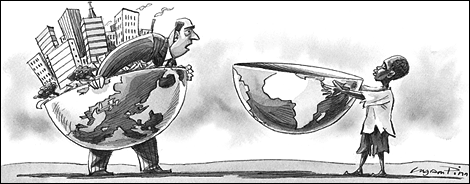
Climate change in an uneven world

I then outlined some parallels between the current climate crisis and the HIV/AIDS pandemic that emerged some 25 years ago.

Consider these similarities:
• When HIV was first detected, it was considered a medical issue affecting specific sections of society.
• It took years for the wider societal, development and human rights aspects of HIV to be understood and then accepted.
• Some countries and cultures wasted precious years in HIV denial; a few are still in this mode.
• It took overwhelming impact evidence and mounting pressure from affected persons for states and international community to respond.
• Then…everybody jumped the bandwagon and HIV became a fundable, profitable enterprise.

I have been commenting in this blog about this ugly side of HIV/AIDS in my own country Sri Lanka, where some NGOs and charities have turned HIV activism into a self-serving, lucrative industry. There are fierce ‘turf wars’ to claim persons living with HIV as their institutional ‘property’. Some have appropriated HIV as their own virus, and would rather not allow others to work in this area.

And it’s not just NGOs who are riding the HIV gravy train. The United Nations programme for AIDS, or UNAIDS, created by the UN system in response to the global crisis, has evolved into a behemoth whose efficacy and relevance are now being widely questioned.

UNAIDS “is obsolete and an obstacle to improving healthcare in developing countries” claims Roger England, an international health expert. Writing in the British Medical Journal in May 2008, England pointed out that HIV causes 3.7 per cent of mortality and kills fewer people than pneumonia or diabetes, yet it received 25 per cent of all international healthcare aid and a big chunk of domestic expenditure. This has resulted in wasting vast sums of funding on esoteric disciplines instead of beefing up public health capacity. Despite this criticism, UNAIDS is calling for huge increases in its funding — from its current US$9 billion to US$54 billion by 2015.

All this makes me wonder: is climate the new HIV of our times? This is the question I raised in Tokyo.

I added: “If so, I sincerely hope it does not evolve in the same manner that HIV crisis did. There are worrying signs that the drive towards a low carbon economy is being exploited by various groups – including some in civil society – for self gain.”

Certain development agencies and ‘think tanks’ are clearly exploiting climate change to make money. Suddenly, everybody is ‘climate-proofing’ their activities — meaning they are talking about climate change no matter what they do, whether it is teacher training or micro-credit.

In the run up to the Bali climate conference in late 2007, I wrote a blog post titled ‘Beware of bad weather friends’ about a London-based NGO engaging in some media training on climate issues, but deriving its legitimacy from a dubious survey. This post apparently irked the party concerned a great deal.

In Tokyo, a workshop participant confirmed that this was already happening in his country.

“Every crisis today is being turned into a business opportunity – and not just by the corporate sector,” said Pradip Saha, associate director of the Centre for Science and Environment in India.

He added: “Consultancy companies and some NGOs have realised there is big money to be made in climate related areas like carbon offsets and the Clean Development Mechanism. They are already riding the climate bandwagon!”.

Read the full text of my introductory remarks to the Tokyo workshop.changing-climate-moving-images-nalaka-gunawardene-intro-3-oct-2008

NHK: A public broadcaster that cares for its public

NHK is Japan's sole public broadcaster

My regular readers know the disdain with which I hold the so-called public broadcasters in my part of the world. In developing Asia, which lacks sufficient checks and balances to ensure independence of state broadcasters, the only thing ‘public’ about such channels is that they are often a drain on public money collected through taxes. Their service and loyalties are entirely to whichever political party, coalition or military dictator heading the government in office. A few months ago, I described Burmese TV as a good example.

I was delighted, therefore, to visit the headquarters of Japan’s sole public broadcaster NHK this week and find out how exceptional they are in being a public broadcaster that really cares for its funding and viewing public.

Nippon Hōsō Kyōkai has always identified itself to its audiences by the English pronunciation of its initials, NHK. Started as a radio service in 1926, it added television in 1953. Today, NHK runs two terrestrial TV channels, three satellite channels and three radio services – and has started offering more content online and for mobile devices as well. It also has international offerings in TV, radio and web through NHK World.

This massive broadcast operation is financed primarily by a license fee (called ‘receiving fee’ in Japan) paid by each Japanese household that owns a television set. Its TV channels don’t carry any advertising, although the corporation exploits its massive archive and often repurposes its products for commercial gain.

As NHK’s website says, “This (license) system enables the Corporation to maintain independence from any governmental and private organisation, and ensures that the opinions of viewers and listeners are assigned top priority.”

NHK’s license fee system is not unanimously endorsed by the Japanese public, and I later found out that growing numbers of households are declining to pay what currently works out to around US$30 per month (or a dollar a day). This debate has been sustained for several years, with public calls for administrative reform at NHK.

NHK Studio Park entrance

But NHK’s eagerness to engage the public is clearly evident, even to a visitor like myself who spent only an afternoon at NHK’s Studio Park in Shibuya. This is where the corporation’s production facilities are opened to the public every week day from 10 am to 5.30 pm.

NHK Studio Park is a living exhibit – the corporation’s executives and technical staff carry on with their real work amidst (mostly Japanese public) visitors who get to see how TV content is made. Part of the attraction is a museum of TV 55 years of TV broadcasting in Japan.

You're in our bigger picture!
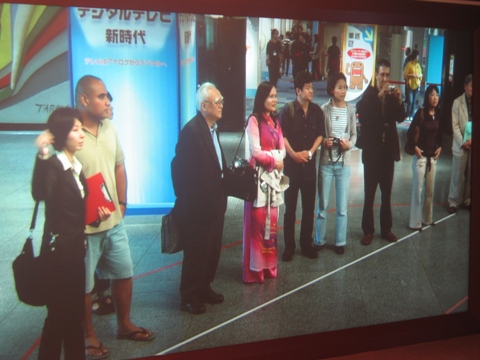
Welcome to NHK: You're in our bigger picture!

Every visitor is welcomed by being captured by a TV camera with the image being projected live on to a giant screen at the reception. The camera zoomed in on each one in our tour party of ten – and gave us our 10 seconds of fame!

From then on, it offers various displays and interactive opportunities to find out how TV broadcasting has evolved, where it is today – and glimpses of where it is headed. NHK has been an industry leader in technological innovation. It launched digital satellite TV broadcasting in December 2000 and introduced digital terrestrial broadcasts in December 2003. The core technology is Hi-Vision (HDTV), which delivers clear, vivid pictures and CD-quality sound. More than 90% of the programming on NHK is now produced and aired in Hi-Vision.

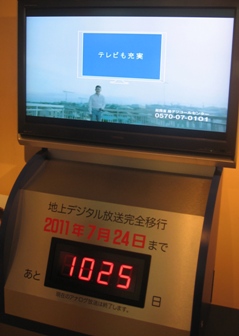
Japan's countdown to analog switch-off

In fact, Japan will be fully switching on to digital and switching off all analog TV transmissions on 24 July 2011. The countdown has already started and on the day I visited NHK (2 October 2008), it was 1,025 days away.

Studio Park makes good use of corridor space for varied displays of photos and archival videos on memorable moments in Japanese and world broadcasting history. Highlights of NHK’s most enduring productions in news, current affairs, culture programming and sports are also shared.

Some of NHK’s cultural and entertainment programmes have been exported successfully to other parts of Asia, offering some counterbalance to the western TV content. One that I recognised was Oshin, a serial drama of 297 episodes made in the early 1980s that has since been aired in close to 60 countries.

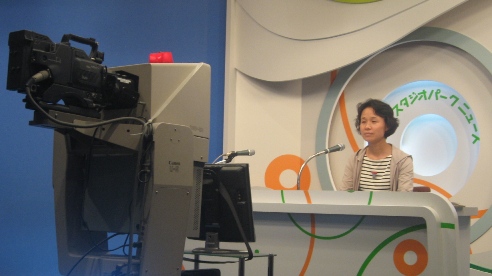
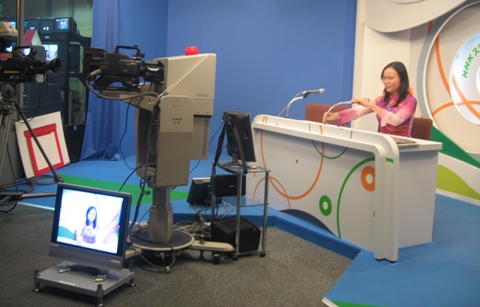
One of Studio Park’s star attractions offers to make a star of any visitor for a few minutes. It’s a newscasting studio where the visitor may sit and face the live camera and read a few lines suggested by the teleprompter – the device that enables news readers to look at their audience while sticking to a flowing text. The teleprompter text is available in Japanese and several other Asian languages.

Hu Jincao of China faces NHK camera
Pham Thuy Trang from Vietnam reads NHK news

Two members of our tour party took this news challenge (photos above), and being broadcast professionals, they performed admirably! While it was fun and games for us who are familiar with the medium’s inner working, I can imagine the educational and public relations value of this for people who only consume what television delivers every day and night.

We were also treated to a screening of what was called the world’s first 3D television without special glasses. It was a breathtaking film of about 10 minutes showing underwater scenes. In the dimly lit theatre, the screen felt more like a fish tank – the 3D effect was very real. Not being a techie, I don’t know how to verify the claim of this being a world first, but when this catches on, watching television will never be the same again…

As visitors move in and out of these interesting offerings, it was another day at work for NHK’s staff who carried on with their real productions in studios we passed by. We were allowed to photograph everything except across the viewing glass inside a studio when a recording was underway (lest the camera flashlights disturb it). The freedom to explore and experience, helped by the eternally courteous tour guides, was refreshing.

And what a contrast to many so-called public broadcast stations elsewhere in Asia which are more like battle fortresses with armed guards firmly keeping the public out (I suppose they expect their irate public to attack the stations because of the truly dreadful content they carry?).

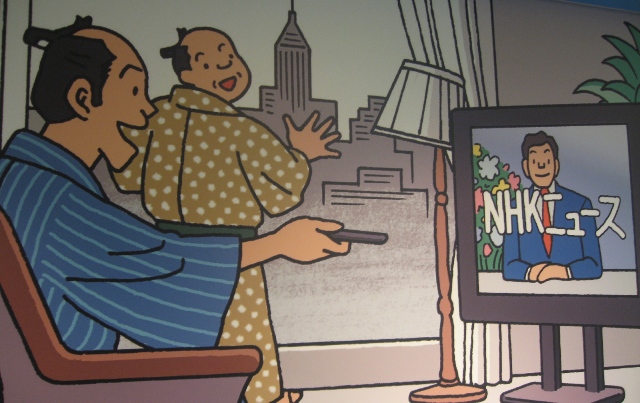
Well, at least NHK seems to know who their masters are – the paying public. And as this image in one exhibit shows, NHK is aware of that little gadget in every viewer’s hand that can instantly nullify all the irinvestment, technology and creativity. If wielded for long enough by sufficient numbers, this can put mighty broadcasters out of business.

It’s a message that Asia’s other broadcasters – public and private – would do well to remember.

NHK knows who its bosses are...

Note: My visit to Tokyo did not involve NHK funding in any manner. I was the guest of our partner TVE Japan, who paid for our admission tickets to enter NHK Studio Park.

Explore 50 years of NHK Television online

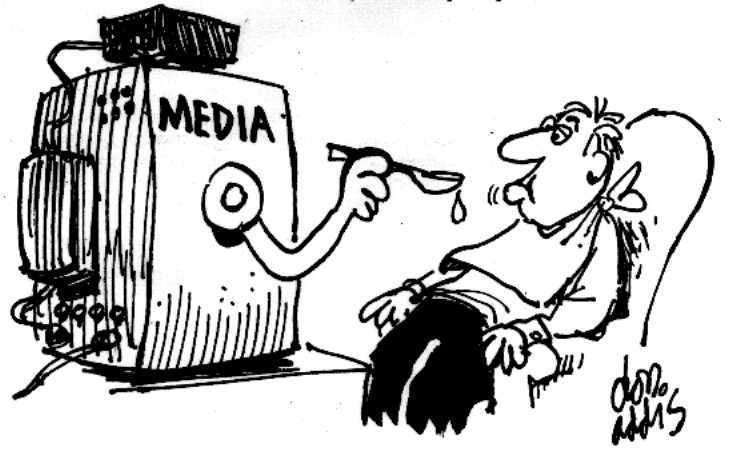
Do you believe everything you see on TV? Some do!

It's easy to be lulled by TV...

“I invested Rs. 2 million (US$ 18,550) of my money after seeing him on TV. I basically believe what I see on the TV and so was misled.”

I read this remark, by a hapless woman victim of an investment scam, in a Sri Lankan newspaper report last week. It got me thinking: where is our media literacy?

Sakvithi Ranasinghe, a populist tutor of English turned millionaire businessman, had just fled the country after duping thousands of unsuspecting people to deposit their life’s savings in his investment firm. Media reports have variously placed the number of victims between 1,500 and 4,000 — and some estimates place the total worth of his loot to be a whopping Rs. Nine billion (over USD 83.5 million).

This local scam may seem insignificant in the current global context when established and well respected banks and financial houses are collapsing one after the other in capitalism’s biggest crisis in decades. But for the several thousand victims, the effects are devastating.

The woman quoted in the news report is not an isolated case. Too many people, it seems, were mesmerised into parting with their money due to a deviously persuasive media campaign. For several years, Sakvithi ran English teaching programmes on Sri Lanka’s national television and other channels. On the guise of teaching English (which he didn’t do very well), Sakvithi manufactured a larger than life image for himself. He also ran regular newspaper advertisements in the highest circulating weekend newspapers. Some were in full colour, occupying an entire broadsheet page. These too reinforced his image as a benevolent, enterprising young Sinhala businessman doing social good.

Not everyone, it seems, heeds the common sense advice, ‘Don’t believe everything you read/hear in the media’. Indeed, the Sakvithi scandal once again brings into sharp focus the media’s — especially television’s — perceived role as the great authenticator of our times.

I have just written an op ed essay for the citizen journalism website Groundviews, where I suggest that the mainstream media outlets that repeatedly sold airtime or newspaper space to this man must now share part of the blame for misleading the public. I also argue that besides timely regulatory action and proper law enforcement, we also need greater vigilance by the media, and higher levels of media literacy in everyone to safeguard society from this kind of media manipulation.

Media illiteracy creates this!

Here’s an extract:

“I find it more than a tad ironic that the same media outlets are now peddling the tales of woe of the thousands of men and women tricked by their former, big-time customer. Knowingly or otherwise, these media have amplified the mesmerising tune of this pied piper of Nugegoda who lulled thousands into parting with their money.

“Their journalists would no doubt protest innocence, reminding us of the divide between editorial and advertising operations. And they are right: media practitioners and editorial gatekeepers don’t have much (or any) control over what fills up the commercially sold advertising space. But how many of their readers or viewers can distinguish the difference?

“Most people experience media products as a whole, and lack even the basic media literacy to separate news, commentary and paid commercials. Besides, with the rise of ‘advertorials’ — product promotions neatly dressed up as editorial content — it’s becoming harder to discern which is which.

Read the full essay on Groundviews.

Prudent banking 101: A lesson from Mary Poppins…

Mary Poppins...a movie/musical that every banker must see!

I can never pronounce Supercalifragilisticexpialidocious as well – or as fast – as my 12-year-old daughter, but I have always been fond of Mary Poppins. At least the 1964 Walt Disney movie, which I have watched over a dozen times (ah, the delightful perils of fatherhood!).

And being one who never likes or trusts bankers very much, I make it a point to tell them that every banker must see Mary Poppins at least once. For it holds a very important and fundamental lesson for their profession: the need to win every customer’s trust and confidence.

Mary Poppins story is set in London in 1910. It revolves around the household – especially the young son and daughter – of aloof Mr. Banks, who works at (where else?) a leading bank, and believes that a British household ought to be run with the strict authority of a British bank. The new nanny Mary Poppins has very different ideas and finally Mr Banks meets someone he can’t bully into submission…

Jane and Michael
Jane and Michael
A movie to be seen again and again...
The movie has many interesting scenes, but one that is directly relevant to bankers is when Mr Banks takes his daughter Jane and son Michael to his work place, the Dawes Tomes Mousley Grubbs Fidelity Fiduciary Bank to give its full name. Mr. Dawes, the bank’s elderly chairman, aggressively tries to persuade Michael to invest his modest savings (all of two pence or tuppence) in the bank. Here’s the song that extols the virtues of what banks do with people’s savings:

If you invest your tuppence
Wisely in the bank
Safe and sound
Soon that tuppence,
Safely invested in the bank,
Will compound

And you’ll achieve that sense of conquest
As your affluence expands
In the hands of the directors
Who invest as propriety demands

You see, Michael, you’ll be part of
Railways through Africa
Dams across the Nile
Fleets of ocean greyhounds
Majestic, self-amortizing canals
Plantations of ripening tea

All from tuppence, prudently
Fruitfully, frugally invested
In the, to be specific,
In the Dawes, Tomes
Mousely, Grubbs
Fidelity Fiduciary Bank!

Read the full lyrics

Watch the song from Mary Poppins movie:

But young Michael has other plans: he wants to feed the street pigeons with his money, which the bankers dismiss with utter contempt (“If you feed birds, you get fat birds!”). As the song continues, the pressure is on Michael and Jane’s father, a clerk at the bank, to sway Michael. When Michael refuses to give the Elder Mr. Dawes the tuppence, Dawes takes it from him.

Michael protests very loudly and screams: “Give it back! Gimme back my money!

Other customers hear this and misunderstand – if this is the kind of bank that refuses to give back tuppence to a little kid, they reason, can anyone’s money be safe here?

Client 1: There’s something wrong. The bank won’t give someone their money!

Client 2: Well, I’m going to get mine! I want every penny!

Client 3: And mine too!

Client 4: And give me mine too!

That starts a run on the bank that soon forces them to suspend business…

When I encounter arrogance or indifference at my own banks, I sometimes wish I could play little Michael’s part and trigger a bank run. After all, I have handed a little more than tuppence to these banks…

In almost a century since that fictitious in Mary Poppins incident took place, banking has modernised but the core values remain the same. Banks peddle other people’s money in trust, whether accepting deposits or giving those deposited funds out again as loans. Banking is a necessary service in modern society, but unless bankers engender trust, their industry cannot function.

When the film was made in the 1960s, this financial event seemed positively quaint, but it has returned to spook us a year ago in September 2007: a bank run (on Northern Rock), something not seen in London since 1866.

Commenting on 19 September 2007, and tracing the history of bank runs over the centuries, Jon Henley of the UK Guardian also referred to Mary Poppins: “The enduring popularity of this film might be seen as evidence of a popular lack of confidence in the banking system”.

A few days later, on 24 September 2007, Niall Ferguson wrote in the Los Angeles Times in a commentary titled ‘Mary Poppins economics’: “Recent events on both sides of the Atlantic have made it not merely desirable but imperative that the world’s leading bankers and their clients watch this movie – if, that is, they want to avoid Banks’ fate. For it has not only been Northern Rock, the British mortgage lender, that has been menaced by a loss of customer confidence…”

And we now know how the troubled Northern Rock bank heralded the massive financial crisis and meltdown of banks and mortgage companies that has come to light in the past few weeks.

Customer confidence in individual banks and the banking system as a whole has now reached the lowest in more than two generations. The over-paid and over-ambitious bankers are belatedly realising that the biggest virtue in their profession is the trust that individual depositors place in them. When that is gone, everything collapses.

It takes calamities for some people to realise the value of keeping fundamentals intact. Let’s hope the banks and bankers, as they pick up their pieces in the coming weeks and months, will never again forget the basic lesson of Mary Poppins: robbing a little boy of his tuppence is bad for business.

Let’s end this post with these are scenes from Mary Poppins of the song with the longest title of filmed musicals history: Supercalifragilisticexpialidocious

Financial Meltdown: Putting pieces together of a gigantic whodunnit

this says it all...
My cartoon of the year: this says it all...

This cartoon by Pulitzer prize winning Tom Toles first appeared in the Washington Post in 2007 – it brilliantly anticipated the global financial meltdown that we’re now experiencing. Coming in the wake of confirmed global warming, it is a double whammy.

America has been hit hard by the sub-prime crisis. The social and human cost of financial failure has been enormous. An epidemic of home repossessions has left thousands of houses abandoned and boarded-up: whole suburbs are falling into disrepair and dereliction.

Financial institutions in America and in Britain had poured billions into investments backed by these mortgages. As more and more people have defaulted on their mortgage repayments, financial markets have collapsed, causing a crisis that has rippled across the Atlantic, sending the City of London into turmoil and pulling the plug on one now infamous British bank.

Some call it a financial tsunami not been seen since the Great Depression in the 1930s….a crisis that has forced the US government to step in and save the financial system after trillions were wiped off global stock markets and once revered institutions were swept off the face of Wall Street. Is the US intervention too little, too late to save the economy?

In fact, just a few days ago, the People’s Daily of China warned that a “financial tsunami” was approaching, which recalled the Great Depression in the US. It said: “As the contemporary economy has been integrated globally, American consumption and currency exchange rates will directly influence countries dependent on the US as the main export destination for economic growth and employment”.

The Chinese Communist Party organ complained that the US had unleashed financial “weapons of mass destruction” on the world economy in the form of subprime debts and related financial derivatives.

The world’s media have been scrambling to cover these rapidly unfolding events. In fact, many have been caught napping, or worse, been uncritical cheerleaders of the march of capital and credit. Most of them – even the respected financial journals – just didn’t see the crisis building up…or ignored the tell-tale signs that constituted an inconvenient truth.

Danny Schechter - wasnt crying wolf!
Danny Schechter - wasn't crying wolf!
“This didn’t just happen in the course of a usual business cycle,” insists the American investigative journalist and media analyst Danny Schechter, who has been tracking this issues for many months on his influential News Dissector blog and the MediaChannel that watches and critiques the media.

In his new book, aptly titled Plunder, Danny offers an in-depth investigation into the decline of the economy that’s causing millions to lose jobs and face foreclosures and across-the-board price hikes.

He says: “You wouldn’t know it by relying on our media, but the subprime scandal masks massing looting by Wall Street firms using carefully calculated predatory lending schemes enabled by regulators who don’t regulate and a media that looked the other way. We have lost trillions and dislocated millions with no relief in sight. Every American is paying for the greed of our financiers in the grocery store, gas pump and unemployment line. Bank robberies are not new — but banks doing the robbing is.”

Read the introduction to Danny Schechter’s Plunder.

In 2007, his film IN DEBT WE TRUST was the first to expose Wall Street’s connection to subprime loans, predicting the economic crisis that this book investigates.

I have been watching various news media analysis of the current crisis and want to share two that stood out from the rest: Inside Story by Al Jazeera English, and Dispatches by UK’s Channel 4.

In a special show from New York, Inside Story looks at the financial turbulence that rocked the US last week. Will the emergency measures by the US government be enough to stabilise the markets or has the financial system in the US been changed forever? The introductory report from AJE’s Washington correspondent Reynolds is particularly illuminating – he also writes the story for their website.

Inside Story – The US financial crisis – 21 Sep 2008 – Part 1

Inside Story – The US financial crisis – 21 Sep 2008 – Part 2

From the other side of the Atlantic comes a more investigative, one-hour special that was produced and broadcast in March 2008, when the early signs of the banking crisis were beginning to show – for anybody who cared to notice.

As Channel 4 introduces it: “This is a story about the destructive power of finance: what happens when banks are driven by short-termism; when bankers are rewarded with vast bonuses, free to operate under inadequate regulatory supervision, and with the complicity of a government too in awe of big business to step in.”

Dispatches: How The Banks Bet Your Money UK & US – part 1

In this edition of Dispatches, private equity financier Jon Moulton delivers a stinging rebuke to the banks for causing this financial meltdown and explains why the British taxpayer will now pay the price.

Dispatches: How The Banks Bet Your Money UK & US – part 2

Dispatches: How The Banks Bet Your Money UK & US – part 3

Dispatches: How The Banks Bet Your Money UK & US – part 4

Dispatches: How The Banks Bet Your Money UK & US – part 5

A J Gunawardana: Remembering a lost colleague…and discovering online gaps

A J Gunawardana with film director Lester James Peries
A J Gunawardana (left) with film director Lester James Peries

I have just written a 2,000-word essay recalling my times with a senior colleague and fellow media-watcher, the late Dr A J Gunawardana.

AJ, as he was affectionately known, was an outstanding university teacher, writer/journalist, cinema personality and art critic. When he died in September 1998 at the relatively young age of 65, we lost a rare intellectual who had his feet firmly on the ground, and constantly built bridges linking media, culture and society.

We shared more than our surname and involvement in the media. In fact, when I was beginning to be noticed for my journalistic writing in late 1980s and early 1990s, people kept asking me if I was AJ’s son, or at least a relation. I had to disappoint them.

My association with him was in the last decade of his life. His junior by a generation, I related to the genial professor as a fellow writer and occasional partner in mischief in the domains of media and popular culture. These are the times I have recalled in the tribute, just published on Groundviews citizen journalism website.

AJ started his career as a journalist with the then privately owned flagship of Sri Lankan journalism, Ceylon Daily News, where he was a noted arts and culture correspondent in the 1960s. He went on to obtain a doctorate in performing arts from New York University. Upon return, he pursued a career in academia as a professor of English at the Vidyodaya University (later University of Sri Jayawardenapura) and was closely associated with film and media education. He chaired a Presidential Committee of Inquiry on the Sri Lankan film industry, which issued its report in 1985.

In the arts world, he is perhaps best remembered for the screenplays he wrote for three films by Sri Lanka’s best known director Lester James Peries: Baddegama (1980), Kaliyugaya (1982) and Yuganthaya (1985). The latter two are included among the best of Sri Lankan cinema as compiled by the British Film Institute.

At the time of his death, AJ was working on a biography of the doyen of the Sri Lankan cinema, which was posthumously published in 2005 as LJP: Lester James Peries: Life and Work.

Read my full tribute:
Remembering A J Gunawardana: A creative public intellectual

In researching for this essay, I wanted to verify some biographical and filmographical specifics about AJ. The usually reliable Encyclopaedia of sri Lanka (2006) edition, compiled by Charles Gunawardena (note how we all spell our same surname differently!) had no entry on AJ, which is a bit disappointing considering the far more obscure personalities featured in this reference.

My next step was Googling for A J, using the various spellings for his and my shared surname. (Don’t ask me how and why different clans spell it differently – which must drive foreigners crazy – but it matters to us). Considering AJ published most of his journalistic writing before commercial Internet connectivity became widely available and newspapers started publishing their web editions, I wasn’t surprised by how little I could find online. I didn’t come across a single piece of AJ’s incisive writing online, although perhaps a specialised search might yet unearth a few from some depth of an archive.

This highlights an unmet need where many Asian newspapers and magazines are concerned: their archives only go back to a decade or a dozen years. Even when publishers are willing to unlock their archives and make it available, the sheer logistics involved must daunt them. This could change in time to come, with Google’s recently announced initiative to digitise newspaper archives. The search giant has begun scanning microfilm from some newspapers’ historic archives to make them searchable online, first through Google News and eventually on the papers’ own Web sites.

An aside: I remember making the same point to assembled ITU, UNESCO and other UN worthies at the WSIS Asia Preparatory Meeting in Tokyo in January 2003. In a world where search for information and records is moving increasingly to the web, I said, the old sources of Asia’s news, information and culture need to be progressively placed online. This is a huge undertaking even if we just consider only the newspaper archives. But if not done, these valuable sources may soon begin to be ignored as references.

I then turned to the Internet Movie Database, IMDB, for some specifics and was disappointed again. AJ’s main entry on IMDB listed only one of his three films, and there was no other information about him, at least in the areas allowed for free access. It was only later that I stumbled upon another IMDB entry for AJ, where the last two letters of his surname are lopped off, which keeps it out of most searches.

When the two entries are put together, one begins to get an idea of AJ’s cinematic accomplishments, but it still completely leaves out his work as a film critic.

These gaps are not unique to AJ. In fact, even though IMDb is said to be “one of the largest accumulation of data about films, television programs, direct-to-video products, and video games, reaching back to each medium’s respective beginning”, I imagine a large number of film industry creations and professionals from outside the mainstream English language cinema is currently missing or poorly indexed on it.

Clearly, there is work to be done – by film buffs from Asia, whose want their cinematic traditions and professionals featured adequately on IMDB. Although I occasionally edit entries on the Wikipedia, I haven’t figured out how to do it on IMDB.

In this era of user-generated content, we can’t just sit back and complain that the web is biased towards the English speaking west. It’s still the case, but web 2.0 allows us the opportunity and tools to go and do something about it.

Go ahead, just say the word: Condom! Now say it again…

not an easy task...
Acting out condoms in broad daylight in India: not an easy task...

Condom!

No one is certain how or where the word originated, but it has become one of those ubiquitous items in modern society.

It’s a two syllable word, fairly easy to pronounce. Then how come so many people – at least in South Asia, home to a fifth of humanity – get their tongues tied or twisted in saying it?

That’s because it’s to do with sex! That’s not a subject that many South Asians still feel comfortable in talking about, in public or even private.

Sex may be a very private matter, but individuals’ sexual behaviour has direct and serious public health implications. Especially today when the world is still struggling to contain and overcome the spread of HIV that causes AIDS.

Condoms originally came into wide use to help prevent unwanted pregnancies and the spread of sexually transmitted diseases (STDs). In the past quarter century, condoms have become a major weapon against HIV.

Despite this, condoms still remain a hush-hush topic among many grown ups, even as the younger generation warms up to them. Across South Asia, we still have some hurdles to clear in normalising condoms – or making it socially and culturally acceptable for people to talk about condom use, and to go out and buy them without fear or shame.

They come in all colours and shapes!

This is the challenge that various communication groups have taken up, especially in India. According to a 2007 survey by UNAIDS and India’s National AIDS Control Organisation (NACO), at least 2.5 million people live with the HIV virus in India, placing the country third in the world after South Africa and Nigeria. However, AIDS prevention in the country is not an easy job. Many people, especially in rural areas, cling on to preconceived taboos about sex — and are often hesitant to use condoms.

In recent weeks, I’ve heard from two campaigns that are trying to change this. One is the BBC World Service Trust working with Indian broadcasters and other partners to normalise condom use through a campaign. I’ll be writing a separate blog post on that effort.

Last month, I received en email from someone called ‘Spread Word for a Better World’, who shared with me web links on a socio-cultural group based in Hyderabad, who are using the performing arts to promote condom awareness.

For over a decade, the Nrityanjali Academy has been singing and dancing their way to the glorification of condom use. They see it as a crucial fight in their central region, where 2 per cent of the population is HIV positive.

P Narsingh Rao, director of Nrityanjali, recently told France 24 online: “Our main target groups are people vulnerable to the HIV virus like sex workers, transsexuals or truck drivers. We tour villages in mobile video vans to show the film. The screening is followed by a question and answer session about condom use and sexually transmitted diseases.”

He added: “We also encourage the use of female condoms, a relatively new concept. We tell the women to negotiate the use of female condoms with their male partners: for men with little sex education, the insertion of the female condom in the vagina can in itself be an erotic act.”

Here are some YouTube videos showcasing their work:

This is an entertaining and educational video in Telugu language on Condom usage, to prevent from sexually transmitted infections and HIV:

A more instructional video on how to use condoms properly:

And finally, an HIV/AIDS song in Telugu – with all the fast-beat music, gyrating and riot of colours we typically associate Bollywood movies and songs with:

The videos speak for themselves. They are matter of fact, engaging and presented by ordinary people (trained entertainers) rather than by jargon-totting medical doctors or health workers. There is none of the awkwardness typically associated with conversations of this subject. No one is tip-toeing around perceived or real cultural taboos. They just get on with it.

Importantly, they involve both men and women, both in performances and in their audiences.

Training young men on just how to do it right...

Related blog posts:

July 2007: The Three Amigos: Funny condoms with a serious mission

April 2007: Beware of Vatican Condoms – and global warming!

Images courtesy France 24’s The Observers.

Thailand’s people power gets a boost from satellite TV

Street protests in Bangkok - image from DayLife

Thailand, which had built up a reputation as a relatively stable country, has been under siege for much of this year. Confrontations between the coalition government, elected in December 2007, and the anti-government People’s Alliance for Democracy (PAD) have affected civil administration, law enforcement and economy, especially tourism.

On 10 September 2008, Thai prime minister Samak Sundaravej was forced to step down when a court found him guilty of accepting money from a TV station to host a popular cooking show. Bizarre as this reason was for his ouster, it has only added to the confusion that currently dominates Thai life.

Although I have been visiting Thailand regularly for the past 20 years, I don’t claim to understand the murky world of Thai politics. But until recently, Thais had somehow managed to keep their politics and business separate, allowing the latter to continue largely unaffected.


Pro-democracy struggles are not new to Thai people. But this time around, there is a new player involved: Asia Satellite Television (ASTV) a relatively new entrant into Thailand’s TV world which is dominated by commercial TV stations that offer a staple of light talk shows, soap operas and gossip programmes.

ASTV’s programmes, since May 2008, has consisted of speeches beamed from a stage set up at the site of a Bangkok protest rally, led by the PAD.

In early September 2008, around 200 PAD supporters banded together to guard the ASTV station and Manager newspaper offices on Phra Athit road amid rumours Prime Minister Samak Sundaravej was going to take the cable TV channel off the air.

In an interesting news analysis filed from Bangkok, Inter Press Service (IPS) noted on 5 September: “ASTV makes little effort to hide its political mission as the principle broadcaster of the PAD. After all, its founder, Sondhi Limthongkul, a fiery speaker, is one of the PAD’s leaders. His sustained attacks on the government and Thai democracy — that the prevailing elections system does not work, and the country needs a largely appointed parliament — have resonated with the thousands drawn to the PAD rallies after first hearing them on ASTV.”

Much of the PAD’s mass mobilisation has been possible due to ASTV’s reach, which is currently estimated at 20 million viewers. ‘’Our audience has doubled since 2006, when we had 10 million viewers, because we present the political side of the news that is not available on national TV,” the article quoted Chadaporn Lin, managing editor of the station’s English-language channel, as saying.

The Manager owns ASTV
Viewers who cannot access the station through a satellite dish or a provincial cable company turn to the website of ‘Manager,’ the newspaper produced by ASTV’s parent company. The site has seen the number of regular visitors rise and is now placed third among the top 10 Thai-language websites.

Read the full IPS article: THAILAND: Satellite TV Boosts Anti-Gov’t Protests By Marwaan Macan-Markar

To make sense of what’s going on, I turned to Pipope Panitchpakdi, a Thai friend who has worked in the broadcast media industry for many years:

Pipope Panitchpakdi, independent Thai journalist

He says: “It’s just too bad that the ideology behind the ASTV movement is identified by many as right-winged and nationalistic. For me, the movement itself is quite progressive in its post-modernistic use of everything that works to topple the existing government. In a way, it’s going back to the muckraking days of partisan journalism, which may be in need when mainstream media are no longer functioning during Thaksin/Samuk’s administration (with his equally keen media strategist team).”

Pipope adds: “Few mentioned that ASTV is self sponsoring through viewers’ subscriptions. That’s, to me, says a lot about the station. In my opinion what is unacceptable is when NBT (National Broadcasting Television) starts to give air time to government politician to bash the ASTV and to report heavily distorted news on the anti-government movement. They said it is the counter measure to what the ASTV is doing.”

He continues: “NBT, which is a free to air TV, funded by tax money and has a nation wide coverage, now becomes the state propaganda in the true sense of the word and by being such, there is no telling what kind of political fervor the NBT can stir.”

The argument of using NBT to project government view is a familiar one in other fragile or immature democracies across Asia. To understand it, we need to recall how rapidly broadcasting has changed in the past two decades.

In 1990, most Asian viewers had access to an average of 2.4 TV channels, all of them state owned. This has changed dramatically — first with the advent of satellite television over Asia in 1991, and then through the gradual (albeit partial) broadcast liberalisation during the 1990s. Asian audiences, at last freed from the unimaginative, propaganda-laden state channels, exercised their new-found choice and quickly migrated to privately owned, commercially operated channels. Soon, state owned TVs and radios found themselves with ever-shrinking audiences and declining revenue. For the past decade, most have survived only because governments infused them with massive amounts of tax payer money. Their public service remit is long forgotten.

In recent years, some governments have taken the view that since a growing number of private channels provide an outlet to political opposition and other dissenting views, the state channels are justified in peddling the ruling party (or ruling military junta) view – often exclusively. This convenient argument overlooks the fact that Pipope points out: state channels are funded mostly or wholly by tax payer money (as many lack the entrepreneurial skill to compete in a market environment). They have a moral and legal obligation to serve the public interest — and that does not coincide with the ruling party’s or junta’s self interest.

There are some who accuse ASTV of Thailand, and its equivalents such as courageous Geo TV of Pakistan (which stood up to the once mighty, now fallen general Musharaf), of being partisan. Perhaps they are, and in ASTV’s case it unashamedly and openly is. But in my view, they offer a much-needed counter balance to the disgusting excesses of state TV that prostitute the airwaves.

Supinya Klangnarong
Supinya Klangnarong

Supinya Klangnarong, deputy head of the Campaign for Popular Media Reform (CPMR), an independent local group lobbying for media rights, told IPS: “ASTV is offering knowledge and political information and new ideas that have never been seen on Thai TV. They have opened a new space for TV. There is 100 percent media freedom. You can say anything against the elected government and get away.’’

But she warned that while such a media agenda has tapped into an older audience that has felt left out by the dominant trends on the existing commercial stations, where youth is the focus, it is also creating a following that could become increasingly intolerant. “They are creating a culture of hate by the one-sided opinions being broadcast. They are promoting very conservative and very nationalistic ideas.’’

She added: “And if it attracts more people, ASTV may take over the role that has always been played by Thai newspapers of setting the political agenda for the country. That will be a win for those who say that Thailand has become too liberal, open and globalised… like my mother’s generation.’’

PAD protests hold Thai capital under siege - image from DayLife

Thailand’s TV chef PM ousted: Is this how to serve democracy?

Elected political leaders are driven out of office by various factors – ranging from military coup de’tat and popular revolt to corruption or sex scandals. But it’s not common for a head of government to lose his job for appearing on television.

But that’s just what happened on 9 September 2008 to Thailand’s prime minister…and the headline writers worldwide couldn’t resist every imaginable cooking cliche at his expense: “Cooking show lands Thai PM in hot water”, “Thai PM grilled over cooking show”, “Thai PM in a soup”, etc.

Prime Minister Samak Sundaravej was forced from office along with his Cabinet after Thailand’s Constitutional Court ruled that he had broken a conflict-of-interest law by hosting TV cooking shows while in office.

Samak Sundaravej has hosted Tasting and Complaining cooking show for years on Thai TV
Samak Sundaravej has hosted "Tasting and Complaining" cooking show for years on Thai TV

The court judgment, broadcast live on television and radio, was greeted with loud cheers and claps from Samak’s opponents who have occupied his office compound since Aug. 26 to demand his resignation. Some protesters wept with emotion.

The 73-year-old Samak, who has cooked for visiting leaders, hosted a popular television cooking show — “Tasting and Complaining” — for seven years before becoming prime minister in early 2008 after his his People Power Party (PPP) and five others won a general election. He returned Thailand to civilian rule after the army had captured power in September 2006, ousting the former populist prime minister Thaksin Shinawatra.

Some say this is the first time a professional chef has become prime minister anywhere. Samak had made several TV appearances after taking office, which the court held was breaking a constitutional prohibition on private employment while in office.

Tasting and Complaining on air
To serve the Kingdom of Thailand...medium rare?

The defiant PPP, whose government is facing stiff opposition by supporters of the People’s Alliance for Democracy (PAD), initially tried to renominate Samak as PM. But they dropped the idea like a hot potato in just a couple of days. Samak also bowed out as leader of the PPP.

As of this writing, the ruling coalition is trying to find a political leader who can form a government. The street demonstrators, one of whose main demands was the resignation of PM Samak, are watching developments with a sharp eye.

In recent weeks Samak’s government, though duly elected, has been under siege from PAD which draws its strength from among city dwellers and the elite. Although I have been visiting Thailand for 20 years, I don’t claim to understand the murky world of Thai politics. But until recently, Thais had somehow managed to keep their politics and business separate, allowing the latter to continue largely unaffected.

In the end, Samak lost his job not for any substantive lapses of governance – his opponents had lined up a long list of these – but on a legal technicality.

Samaks TV show branding
Samak's TV show branding
Samak has been involved in Thai politics for over 30 years, and since the 1990s has been promoting the art of Thai cooking on both radio and television. He started cooking at the age of 7, and his popular cookbook Chimpai Bonpai (“Tasting, Complaining”) is now in it’s 9th edition. One innovative Samak recipe: he makes pork leg stew with coca-cola.

Surely, Samak is not the first or last politician to sustain a parallel second career on television – the most dominant mass medium in most parts of Asia. Serving and aspiring leaders across Asia have deals with popular television networks that help boost their image and help their approval ratings. And in immature democracies, state-owned TV networks are grossly abused by politicians of ruling parties for outright propaganda.

Samak’s mistake was not so much continuing his TV career, but getting paid for it while holding public office. He should have just stuck to the publicity value. After all, with Thai cuisine among the most popular in the world, he could have gone far combining his culinary talents with hosting TV shows. Instead, he cooked up an avoidable storm…

Here’s the bright side: if Samak leaves politics, he has a choice of at least two lucrative careers.

Celebrity Thai chefs, anyone?

Watch the ousted Thai PM cooking in this news report on ITN News (UK):

Would the Samak cooking saga make a good film? Find out what the Guardian’s film blogger thinks!

Remembering Anita Roddick, a year after her hasty departure

September 10 marked a year since Anita Roddick left us in hurry, with so much unfinished business.

At the end of our last encounter in the summer of 2003, she autographed for me a copy of her latest book with these words: “Remember me!”.

She remains one of the most remarkable people I have met. Especially in the past year, which has been eventful and tumultuous for me, I have often thought of Anita’s long and colourful journey from working class mom to one of the most successful entrepreneurs of our time….and onward to become an outspoken and passionate activist for social justice, human rights and the environment.

As she has written, it was not an easy ride to do well in the male-dominated world of business, nor was it any easier to do good in the greed-dominated world at large. But she not only did it, but had great fun doing so.

What would Anita do? I find myself asking this question every now and then when I seem to be struggling against enormous odds (which is increasingly often). I don’t always find the answers I’m looking for, but it’s always a useful reflection.

I now find that others have been asking this question. Visiting Anita Roddick’s official website this week, I read a moving post by Brooke Shelby Biggs, who worked with Anita for 8 years. She writes:
“I’ve lived most of this past year having conversations with Anita in my mind. What would she say when I told her about considering a move back to magazine journalism? How should I handle my role in the Free the Angola 3 movement? How would she get on with my new romantic interest? Should I move back to my parents’ home town to help care for my ailing mother? I’ve tried to spend this time living according to the philosophy of What Would Anita Do (WWAD?). It was a lot easier when I could ask her myself. But some part of me knows she gave me a lot of tools to figure the hard stuff out on my own. Sometimes I just wish I had her courage.”

website inspired by Anita Roddick
I am an activist: website inspired by Anita Roddick

Brooke links to a website called I am an Activist that draws information and inspiration from Anita’s many and varied struggles in support of various local and global causes. Prominently displayed on the home page are Anita’s now famous words: “This is no dress rehearsal. You’ve got one life, so just lead it and try and be remarkable.”

Well, we can honestly say that she’s one person who practised what she preached.

‘I am an Activist’ is also the sub-title of a DVD that celebrates the life of Dame Anita Roddick, which is available for sale and/or download from Anita Roddick.com. It compiles footage gathered on 23 October 2007, when thousands of thinkers, artists, activists, and other heroic saboteurs of the status quo gathered to celebrate the remarkable life and legacy of Anita Roddick. According to the blurb, it features key people from groups like Amnesty International, Greenpeace, Reprieve, The Body Shop, as well as family and close friends, as they laugh and cry and ultimately take to the streets to launch.

Anita’s daughter Sam is quoted as saying in her tribute: “My mother treated life like each day was her last, and this gave her the permission for incredible bravery. … Tonight I am personally pledging that I Am An Activist, and within that, I also will have a lot of fun, and I also will be silly. I will not be polite and I will never, ever, ask for permission.”

In the weeks and months since Anita’s death, more video material featuring her public talks and interviews have been shared on YouTube by individuals and organisations. I have this week watched several of them, and felt there still isn’t sufficiently good moving images about her. In her time she must have done hundreds or thousands of interviews for broadcast television, corporate audiences as well as community groups. At least some of these must have been recorded and archived. But we still don’t see enough out there, at least in easily accessible public video platforms like YouTube.

Here are two that I did find which are interesting:

Anita speaks on the lessons she learnt from running her own home business, which she started in 1976 to augment her family income. She talks about how she had absolutely no business training, faced many odds and put up with male sarcasm:

From University of California Television comes this video of Anita delivering the Nuclear Peace Age’s third annual Frank K. Kelly Lecture on Humanity’s Future in Feb 2004.