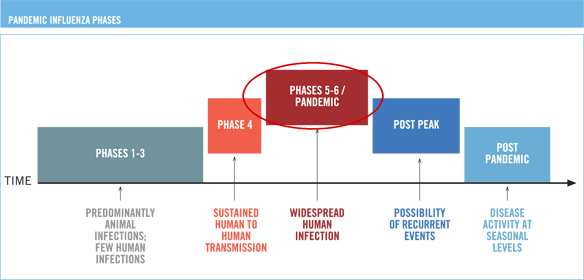
So this is how it REALLY started...The World Health Organization (WHO) said this week that the global spread of swine flu was highly likely, and raised its alert level to Phase 5 — the next-to-highest level in the worldwide warning system. It also offered advice on prevention, caring for persons with the flu and how to seek medical help.
“Wash your hands when you shake hands, cover your mouth when you cough,” he said. “It sounds trivial, but it makes a huge difference. If you are sick, stay home. If your child is sick, take them out of school. If you are feeling certain flu symptoms, don’t get on an airplane.”
That’s the basic preventive message that needs amplification and repetition all over the world. While medical doctors and researchers spearhead the public health response, we need the mass media and all communications professionals to support the public awareness response. Flu shots and hospitals alone cannot win this battle.
For the first time in history, we have the means of rapid access to most of humanity. What we now need is clarity of message, credible messengers and sustained delivery.
I see this as an interesting – even if very risky – social experiment on the preventive powers of our 24/7 media and information devices. More than four billion mobile phones are in use, most of them in the developing world. Over one billion people connect to the web. We also have hundreds of radio and TV channels saturating the airwaves. Can these media peddle the right kind of awareness and inspire preventive action faster than the flu virus propagates itself? This is the classic race between education and catastrophe that H G Wells wrote about many decades ago!
We in Asia have some useful experiences from 2003 when the Severe Acute Respiratory Syndrome (SARS) affected much of the region. On that occasion, the media led a parallel front against the pandemic, delivering both preventive messages and helping care for those already infected.
Precisely because rapid response is vital in a situation like SARS and swine flu, it’s the broadcast and online media that can provide timely and up-to-date coverage. It’s too early and too soon to compare media’s role in this crisis with SARS and other rapid-spread public health crisis of the past. Print media can also play a part in spreading general awareness, but they don’t have the speed and 24/7 outreach that we need for covering a crisis like this. Besides, in many parts of the world, newspapers and magazines are struggling to stay in business, coping with a terminal malady affecting their industry.
October 8 is the International Day for Disaster Reduction. The United Nations system observes the day ‘to raise the profile of disaster risk reduction, and encourage every citizen and government to take part in building more resilient communities and nations’.
Disaster risk reduction (abbreviated as DRR) is the common term for many and varied techniques that focus on preventing or minimising the effects of disasters. DRR measures either seek to reduce the likelihood of a disaster occurring, or strengthen the people’s ability to respond to it.
DRR is not just another lofty piece of developmentspeak. Unlike many other development measures that are full of cold statistics and/or hot air, this one directly (and quietly) saves lives, jobs and properties.
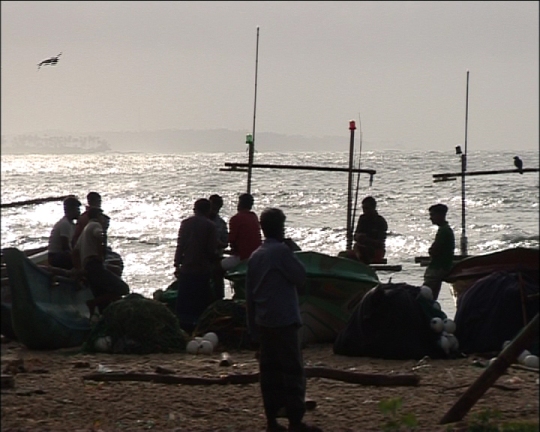
And it gives people peace of mind – we can’t put a value on that. That was the point I made in a blog post written in December 2007, on the third anniversary of the Indian Ocean Tsunami. Taking the personal example of J A Malani, an ordinary Sri Lankan woman living in Hambantota, on the island’s southern coast, I talked about how she has found peace of mind from a DRR initiative.
Recently, IDRC’s inhouse series ‘Research that Matters’ has published an article about the project. Titled “For Easy Sleep Along the Shore: Making Hazard Warnings More Effective” its blurb reads: “In Sri Lanka, a grassroots pilot study combines advanced communication technologies with local volunteer networks to alert coastal villages to danger coming from the sea.”
TVE Asia Pacific also made a short video film in late 2007. Called The Long Last Mile, it can be viewed on YouTube in two parts:
The Long Last Mile, part 1 of 2:
The Long Last Mile, part 2 of 2:
The recent IDRC article ends with this para: “A related challenge concerns the shortness of any society’s attention span. In the absence of frequent crises and alerts, how can a nation — or even a village — sustain the continuing levels of preparedness essential to ensure that, when the next big wave comes rolling in and the sirens sound, its people will have the motivation and the capacity to act? The follow-up project seeks to address this worry by preparing the hotels and villages to respond to different types of hazards, rather than only to the relatively rare tsunamis.”
Did anybody hear of the senior UN official who finally started blogging? He wrote perceptively and expressively – with some help from his speech writers – but a vital element was missing in his blog: no one could comment on his posts as he completely disabled that function.
Then there is the Red Cross chief who started her own Facebook account but remained completely ‘friendless’ for months – because she didn’t accept anyone seeking to join her social networking effort!
These are just two among many examples I have come across in recent months. They are all symptoms of a major challenge that development and humanitarian communities are grappling with: how to engage the latest wave of Information and Communication Technologies, or ICTs.
My thrust is something regular readers of this blog would be familiar with. In fact, in this essay I consolidate and expand on ideas that were initially discussed in various blog posts over the past many months.
The new wave of Internet, collectively known as Web 2.0, opens up new opportunities for us in the development and humanitarian communities to reach out and engage millions of people – especially the youth who make up the majority in most developing countries of Asia. But it also challenges us as never before.
This time around, it’s much more demanding than simply engaging the original web. It involves crossing what I call the ‘Other Digital Divide‘, one that separates (most members of) the development community from ‘Digital Natives‘- younger people who have grown up taking the digital media and tools completely for granted.
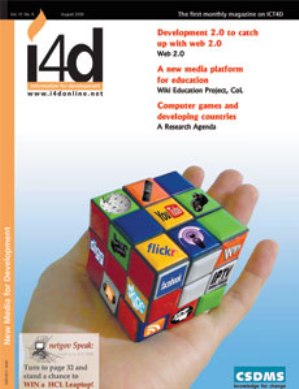
I have identified four key challenges involved in crossing the Other Digital Divide:
– Leave the comfort zone of paper
– Let go of control
– Invest less money but more time
– Recognise information needs and wants
I argue: “There are no authorities on this fast-changing subject: everyone is learning, some faster than others. Neither is there a road map to the new media world. From Rupert Murdoch and Steve Jobs downwards, every media mogul is working on this challenge. For those who get it right, there is potential to make corporate fortunes, and also to serve the public interest in innovative, effective ways.“
I end the essay with a challenge to the development community: “To face challenges of web 2.0, we need to come up with development 2.0!”
This is the title of my latest op ed essay, published this week on Groundviews, the leading citizen journalism website in Sri Lanka.
In this, I try to place in a social and cultural context a series of discriminatory laws, regulations and taxes that my native Sri Lanka has introduced – or threatened – in the past few months all aimed at mobile phones, and only mobiles.
This, despite the fact that the proliferation of mobiles has brought telecom services within reach of millions of Sri Lankans in the past decade, helping raise the country’s overall tele-density (mobiles+fixed phones) to 54 telephones per 100 population. With over 11 million SIMs issued, mobiles today outnumber fixed phones by three to one.
In my essay, I cite specific examples, and ask the crucial questions:
Why is this already licensed and regulated technology often targeted for ‘special treatment’ by different arms of government?
Where is this wide-spread suspicion and hostility towards mobiles coming from?
I argue that it is rear-guard action by the traditional elite and bureaucracy who’d rather not allow such digital empowerment to spread. And this has historical parallels.
Here’s the crux of it:
“There is a numerically small (but influential) privileged class that resents information and communication access becoming universal. They might talk glibly in public on using ICTs for social development or poverty reduction. But back inside the corridors of power, they make policies and regulations to undermine the very utility of these tools. This is no accident.
“The mobile phone is the biggest social leveller in Sri Lankan society since the trouser became ubiquitous (initially for men, and belatedly for women). Our elders can probably recall various arguments heard 30 or 40 years ago on who should be allowed to wear the western garb: it was okay for the educated and/or wealthy mahattayas, but not for the rest. Absurd and hilarious as these debates might seem today, they were taken very seriously at the time.
“Make no mistake: the mobile is the trouser of our times –- and thus becomes the lightning rod for class tensions, petty jealousies and accumulated frustrations of an elite that sees the last vestiges of control slipping away.”
On World Press Freedom Day 3 May 2008, I wrote a blog post titled Who is Afraid of Citizen Journalists. The answer included the usual suspects: tyrannical governments, corrupt military and business interests, and pretty much everybody else who would like to suppress the free flow of information and public debate.
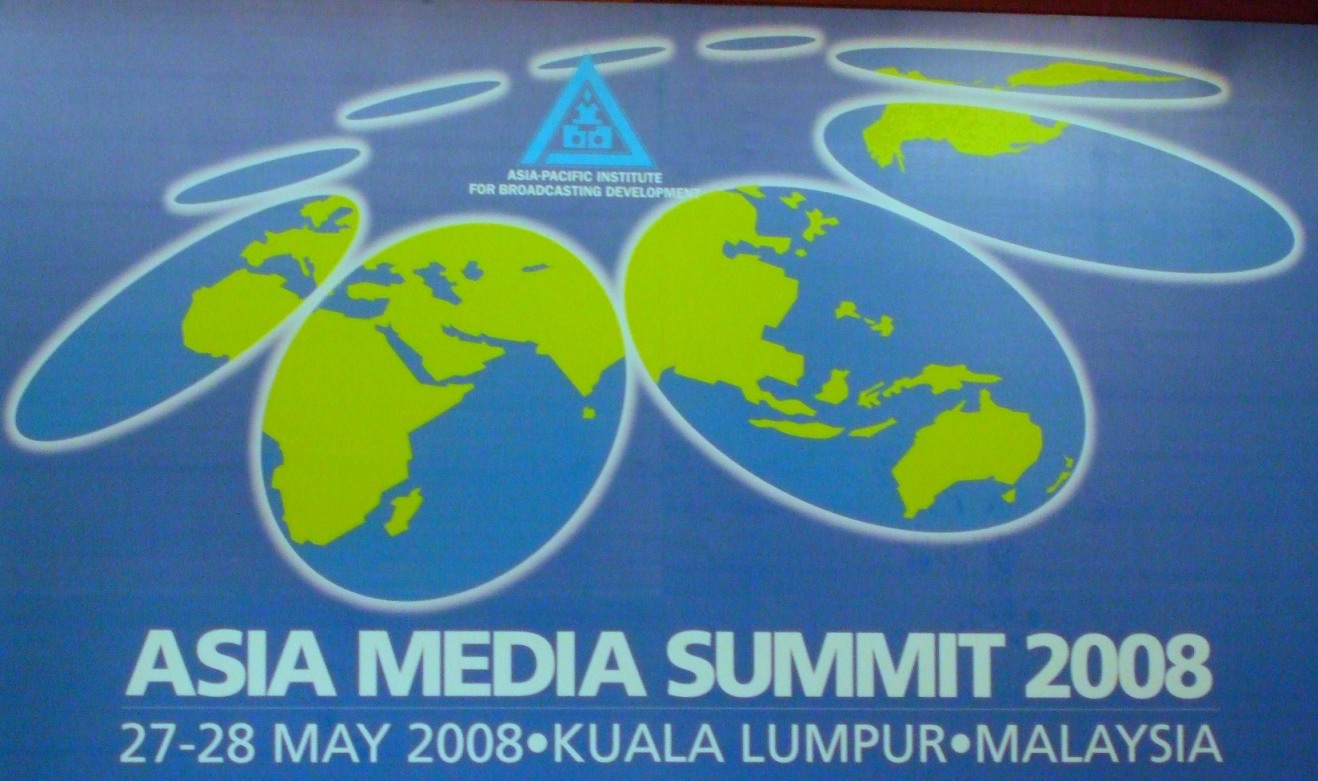
By end May, I realised that some people in the mainstream media (abbreviated MSM, and less charitably called old media or dinonaur media) are also afraid of citizen journalists. That was one insight I drew from attending Asia Media Summit 2008 in Kuala Lumpur, Malaysia (27-28 May 2008).
The two day event drew 530 broadcast CEOs, managing directors, media experts and senior representatives of development and academic institutions from more than 65 countries in Asia, Europe and the Middle East. Over eight plenary sessions and twice as many pre-summit events, they examined ‘new visions and new strategies broadcasters need to pursue to address the demands of new technologies, stiff competition, media liberalization and globalization’.
As I shared in my first impressions from the Summit, this annual event is still warming up to the new media. That’s understandable considering that most participants are those who work in MSM/OM/DM. Some, like myself, have been flirting or experimenting with new media in recent years, but even my own organisation, TVE Asia Pacific, still works largely with television broadcasters going out on terrestrial, cable or satellite platforms.
While the death of MSM/OM/DM has been greatly hyped, it’s a fact that they face more competition today than ever before. And instead of competing for eyeballs (and other sensory organs) with better content and higher levels of product customisation, some sections of MSM/OM/DM are trying to impose their own, obsolete mindset on the new media.
A session on ‘Regulations and New Media Models’ brought this into sharp focus. The session raised questions such as: Should we apply some principles from traditional media (meaning MSM) to the new media? Should we adopt some minimum rules to allow for sufficient legal space for new media businesses to find their niche in the market and evolve to fit the needs of consumers? What are the policy implications of User-Generated Content (UGC) with regard to copyright infringement, information accuracy and content quality?
The panel comprised three Europeans and one American, all working in MSM or academia (it wasn’t immediately clear if any of them blogged personally). For the most part, they said predictably nice and kind things about new media. It was interesting to see how these professionals or managers – who have had their careers entirely or mostly working in or studying about MSM – were trying to relate to a new and different sector like the new media.
But the panel’s cautious attitude about the new media went overboard on the matter of regulation. This is where matters are highly contentious and hotly debated: while most of us agree that there should be some basic regulation to ensure cyber security and to keep a check on content that is widely deemed as unacceptable – for example, hate speech – there is no consensus on what content should be regulated by whom under which guiding principles.
Ruling unanimously in Reno v. ACLU, the US Supreme Court declared the Internet to be a free speech zone in 1997, saying it deserved at least as much First Amendment protection as that afforded to books, newspapers and magazines. The government, the Court said, can no more restrict a person’s access to words or images on the Internet than it could be allowed to snatch a book out of a reader’s hands in the library, or cover over a statue of a nude in a museum.
It was during question time that the discussion took a cynical – even hostile – attitude on the new media. Some members of the audience engaged Dr Venkat Iyer, a legal academic from University of Ulster in the UK, in a narrowly focused discussion on how and where bloggers may be sued for the opinions expressed on their blogs. The issue of multiple jurisdictions came up, along with other aspects of cyber libel and how those affected by criticism made online by individual bloggers (as opposed to companies or organisations producing online content) may ‘seek justice’.
From the floor, I remarked that I was disturbed by the tone and narrow vision of this discussion, which merely repeated new media bashing by those who failed to understand its dynamics. Acknowledging the need for restraint where decency and public safety were concerned, I argued that it is a big mistake to analyse the new media from the business models or regulatory frameworks that suit the old media.
There are mischief makers and anti-social elements using the new media just as there have always been such people using the old media. Their presence, which is statistically small, does not warrant a knee-jerk reaction to over-regulate or over-legislate all activity online, as some Summit participants were advocating. To do that would be akin to throwing the baby out with the bathwater.
I continued: “This is not a healthy attitude to adopt, especially when we look at the bigger picture. In many countries where freedom of expression and media freedom are threatened or suppressed by intolerant governments and/or other vested interests, new media platforms have become the only available opportunity for citizens to organise, protest and sustain struggles for safeguarding human rights, better governance and cleaner politics. In countries where the mainstream media outlets are either state owned or under pressure from government (or military), and where newspapers, radio and TV have already been intimidated into silence, citizen journalists are the last line of defence…”
I also noted with interest that on this panel was Mogens Schmidt, UNESCO’s Deputy Assistant Director-General for Communication and Information (in charge of freedom of expression), and said that this was not the kind of rolling back of freedoms of expression that UNESCO was publicly advocating. In a brief response immediately afterwards, Schmidt said that he fully agreed with my views, and that this was UNESCO’s position as well.
Another panel member, Dr Jacob van Kokswijk, secretary of the International Telecom User Group in the Netherlands, noted that the new media required a totally new thinking and approach where its content is concerned – the rules that have worked for the old media can’t be applied in the same manner. He added that only 3 to 4 per cent of Internet content could be considered as ‘bad’ (by whatever definition he was using), and that should not blind us to seizing the potential of new media.
Another panel member, Joaquin F Blaya, a Board member of Radio Free Asia (RFA), made a categorical statement saying he was opposed to any and all forms of censorship. He knows what that means – RFA says its mission is ‘to provide accurate and timely news and information to Asian countries whose governments prohibit access to a free press’.
By the end of the session, I was relieved to see a more balanced view on the new media emerging in our discussion, with more moderate voices taking to the floor. No, we didn’t resolve any of the tough issues of new media regulation during the 90 mins of that session, but we at least agreed that the old media mindset of command-and-control was not going to work in the new media world.
From its inception in 2003, the annual Asia Media Summit has been very slow to come to terms with this reality, but this year the event moved a bit closer to that ideal – partly because they invited leading new media activist Danny Schechter to be a speaker.
The theme for this year’s World Environment Day (WED), being marked on 5 June 2008, is Kick the Habit! Towards a Low Carbon Economy.
Responding to worldwide concerns on climate change, the UN Environment Programme (UNEP) is asking countries, companies and communities to focus on greenhouse gas emissions and how to reduce them. UNEP says it plans to “highlight resources and initiatives that promote low carbon economies and life-styles, such as improved energy efficiency, alternative energy sources, forest conservation and eco-friendly consumption”.
All this is well and good — except that the United Nations does not practise what it preaches. UNEP or any other part of the UN system telling the world to kick the carbon habit is a bit like a heavily drunken person extolling the virtues of staying off liquor. It just doesn’t sound credible.
Let me explain. Having been a UN-watcher and critical cheer-leader of the UN system (though not always of individual agencies), I have personally seen how carbon thrift – or indeed, any kind of thrift – is not a strong point in that system.
Consider these well known facts.
The UN has long been known as a formidable ‘paper factory’ because of the millions of documents it cranks out every year. On an average, it produces over 700 million printed pages every year (2005 figures). The cost of printing documents in its New York and Geneva offices is over 250 million dollars annually. IPS May 2005 story: World’s celebrated paper factory tries to save forests
And despite recent claims of trying to become carbon neutral, the UN system – including specialised agencies – convene thousands of international meetings every year. Only a few of them produce tangible outputs (some merely agree to meet again!) and even fewer are covered in the public media. But beneath media’s radar and public scrutiny, the UN officials and their buddies (mostly) in governments continue to huddle together in key world cities and some exotic locations.
It would be worth investigating if the number and magnitude of numerous meetings convened by the UN system have shown any marked decrease since climate concerns rose to the top of the public agenda during the past couple of years.
Similarly, with the rise of electronic means of information storage and distribution, it would be interesting to find out if the UN’s endless churning out of paper-based documents has been reduced.
I doubt if either has happened, but we can keep looking for some evidence.
What I have noticed in recent months is the proliferation of meetings – convened or endorsed by the UN system – that address different aspects of climate change. That has become the latest excuse for the development set and its academic friends to have endless physical meetings.
The contradictions and incongruities reach dizzy heights when agencies like the International Telecommunications Union – keeping track of the world’s telecom and ICT developments – convene meeting after meeting to discuss how ICTs can help mitigate climate change.
On this World Environment Day, let’s turn things around — and ask the United Nations secretariat and its specialised agencies (especially UNEP) to heed their own clarion call. Let change begin with them, and let’s see how (and if) the UN sets an example for the rest of the world.
So here’s a modest proposal that can have far-reaching benefits for the planet. Adopt and strictly observe for a year or two a moratorium on all large UN gatherings (no matter what they are called – Summits, conferences, symposia, meetings, etc.) that involve more than 500 persons. In this day and age of advanced telecommunications, it is possible to consult widely without always bringing people physically together.
It’s not just the carbon emissions of air travel that I’m talking about (aviation accounts for less than 5% of worldwide carbon emissions). Much more important is the message such UN austerity would send out to the world. Practising what you preach has a strong moral persuasive power — even if it goes against addictive habits formed for over 60 years of the UN’s history.
After all, the UN wants everyone on the planet to ‘kick the habit’. So let the ladies and gentlemen of the UN Secretariat and agencies lead by personal and institutional example — kicking their own addiction for meetings, more meetings and more paper.
PS: Don’t be too shy to turn up at Hydrocarbons Anonymous.
Declaration of interest: I have attended my share of UN meetings in the past 20 years, but the last mega event I joined was WSSD in Johannesburg in mid 2002. In 2007, I declined three sponsored invitations to go to Bali, and now selectively attend very few small meetings that promise clear focus and output.
The book, co-edited by Rohan Samarajiva (in photo, below) and Ayesha Zainudeen, is published jointly by Sage Books and Canada’s IDRC. It is based largely on the work of my friends and colleagues at LIRNEasia.
Although the book showcases recent telecom and ICT reform experiences in five economies in South and Southeast Asia (Bangladesh, India, Indonesia, Nepal and Sri Lanka), my review takes a closer look at the Sri Lankan situation partly because I live and work there, and because the review was intended more at a Sri Lankan readership.
Here’s my opening:
“In the early 1990s, I had to wait for nearly six years for my first (fixed) telephone – I refused to pay bribes or use ‘connections’ to bypass thousands of others on the notorious waiting list. Earlier this year, when I bought an extra mobile phone SIM from Dialog GSM, it took six hours for the company to connect it. I found that a bit too long.
“How things have changed! Connectivity without (social) connections, and practically off-the-shelf, is now possible in most parts of Sri Lanka. Telecommunications is the fastest growing sector in the economy, recording 47 per cent growth in 2007 (and 58 per cent in 2006). The country’s tele-density (number of telephones per 100 persons) jumped to 54 in 2007, from 36 at the end of 2006 -– thanks largely to the phenomenal spread of mobile phones, which now outnumber fixed phones by three to one.”
In my review, I make the point: “It was a stark reminder, if any were needed, of the turbulent settings and often paranoid times in which telecom liberalisation has been taking place in many parts of emerging Asia.”
And I return to the larger political reality in my conclusion, as follows: “Now that the ICT genie has been set loose, it’s impossible to push it back into the dusty lamp of the monopolist past, even under that much-abused bogey of ‘national security’ (or its new, freshly squeezed version, ‘war against terror’). Despite this, the officialdom and its ultra-nationalist cohorts don’t give up easily. While this book was in ‘state custody’, Sri Lankans experienced the first government-sanctioned blocking of mobile phone SMS – ironically on the day marking 60 years of political independence.”
Photo below shows several contributing authors at the book’s launch in Chennai in December 2007
No, this had nothing to do with religion, a notion Clarke publicly dismissed as a dangerous ‘mind virus’. Rather, it’s the prospect of life elsewhere in the cosmos – an idea that always fascinated him, and on which he wrote many stimulating stories and essays.
“I would like to see some evidence of extra-terrestrial life,” Clarke said, wistfully. “I have always believed that we are not alone in the universe. But we are still waiting for ETs to call us – or give us some kind of a sign. We have no way of guessing when this might happen – I hope sooner rather than later!”
Watch the video on TVE Asia Pacific channel on YouTube:
That ultimate ‘call’ never arrived in time for Clarke. And we have no way of telling which of his wishes would materialize first (the other two being adopting clean energy sources worldwide, and achieving peace in Sri Lanka, where he lived for over half a century).
When it came to ETs, Clarke had a good idea of the probabilities of a positive result in his own lifetime. He knew how it had eluded at least four generations of seekers, including the inventor of radio telegraph itself.
Accepting the Marconi Prize and Fellowship in 1982, Clarke recalled how Guglielmo Marconi had been interested in this prospect. He quoted from a letter he (Clarke) had written to the editor of the BBC’s weekly magazine, The Listener, in February 1939: “…On other planets of other stars there must be consciousness; on them there must be beings with minds…some far more developed than our own. Wireless messages from such remote conscious beings must be possible.”
The letter, sent via the then fledgling British Interplanetary Society, ended as follows: “The only time I met Marconi, he told me of his search for such messages. So far, we have failed to find them.”
After a century of radio and 60 years since its inventor’s death, such proof has yet to be found. However, as Carl Sagan – possibly the best known proponent of the subject – was fond of saying, the absence of evidence is not evidence of absence.
Clarke himself is widely attributed as saying: “Sometimes I think we’re alone in the universe, and sometimes I think we’re not. In either case the idea is quite staggering.”
Clarke not only wrote and talked passionately about the subject for decades, but also supported – in cash and kind – various groups engaged in the search for extra-terrestrial intelligence, or SETI.
“SETI is the most important quest of our time, and it amazes me that governments and corporations are not supporting it sufficiently,” he said in a 2006 letter supporting public donations to the SETI@Home project at the University of California, Berkeley.
In the early 1990s, he applauded Steven Spielberg, director of ET: The Extra-Terrestrial (1982) for donating US$ 100,000 to SETI efforts. “It seems only appropriate that Steven…should put his money where his mouth is,” Clarke noted.
Clarke welcomed ET‘s box office success, as it departed from the Hollywood tradition of depicting aliens as malevolent. By showing a highly intelligent being as both benign and vulnerable, the movie stretched the public’s imagination to consider other possibilities. Not all aliens would arrive here to take over our world -– or to serve humanity, medium rare…
But Clarke realised how the vastness of space would make inter-stellar travel difficult and infrequent. It was more likely that signals from advanced alien civilisations would roam the universe at the speed of light.
Together with his long-time friend Carl Sagan, Clarke explored the philosophical implications of SETI – and its eventual success. It should be the concern of every thinking person, he said, “because it deals with one of the most fundamental questions that can possibly be asked: what is the status of Homo sapiens in the cosmic pecking order?”
Clarke believed the detection of intelligent life beyond the Earth would forever change our outlook on the Universe. “At the very least, it would prove that intelligence does have some survival value – a reassurance that is well worth having after a session with the late night news.”
Clarke speculated that ETs may be continuously broadcasting an easily decoded “Encyclopaedia Galactica” for the benefit of their less advanced neighbours. “It may contain answers to almost all the questions our philosophers and scientists have been asking for centuries, and solutions to many of the practical problems that beset mankind.”
He was sometimes ambivalent about the value of such an influx of new knowledge, noting that even the most well intentioned contacts between cultures at different levels of development can have disastrous results – especially for the less advanced ones. He recalled how a tribal chief once remarked, when confronted with the marvels of modern technology: ‘You have stolen our dreams’.
But Arthur C Clarke the perennial optimist continued: “I believe that the promise of SETI is far greater than its perils. It represents the highest possible form of exploration. And when we cease to explore, we’ll cease to be human.”
Clarke’s interest in ETs remained undiminished to the end. In his last media interview, given to IEEE Spectrum in January 2008 from his hospital bed in Colombo, Sri Lanka, he said: “I’m sure the ETs are all over the place. I’m surprised and disappointed they haven’t come here already… Maybe they are waiting for the right moment to come.”
He added, with a chuckle: “And I hope they are not hungry!”
On this World Telecommunication and Information Society Day (May 17), I have a confession to make. I carry a murder weapon on my person every day and night, and I go to bed with it next to me within easy reach. I rely on it for my work, my leisure and my pleasure. And I won’t part with it under any circumstances.
I’m talking about the humble and increasingly ubiquitous mobile phone, now the world’s most widely used and fastest spreading consumer technology item.
And if any paranoid law enforcement agency worries about its murder potential…relax, people – we are talking figuratively here!
How come it’s a murder weapon when it has no sharp edges and is too light weight to do much damage?
What the mobile has already stabbed, and is in the process of effectively finishing off, is the development sector’s over-hyped and under-delivered phenomenon called the ‘telecentre’.
For those outside the charmed development circles (which is most of humanity), the Wikipedia describes telecentre as “a public place where people can access computers, the Internet and other digital technologies that enable people to gather information, create, learn and communicate with others while they develop essential 21st century digital skills.”
So how is the mobile phone slowly killing the telecentres, into which governments, the United Nations agencies and other development organisations have pumped tens of millions of dollars of development aid money in the past decade?
Well, it’s rapidly making telecentres redundant by putting most or all of their services into literally pocket-sized units. If everyone could carry around a miniaturised, personalised gadget that has the added privacy value, why visit a community access point?
At least this is the persuasive point made by LIRNEasia researcher Helani Galpaya, who made a presentation in September 2007 at the Annenberg School for Communication in the US.
She argued that, although telecentres, which have become the bright “stars” in many e-development programs in Asian countries, do have a role to play in providing ‘higher’-end citizen services to people at the bottom of the pyramid (BOP) in India, Sri Lanka, Pakistan, Philippines and Thailand, telephones are the cheaper, immediate and ubiquitous tool for Asian governments to inform, transact and interact with almost 400 million of their most needy citizens.
And in these emerging Asian economies, when we talk of telephones it’s predominantly mobiles. In my native Sri Lanka, for example, there were 10.7 million phone subscribers by end 2007 – of them, almost 8 million were mobile users. Mobiles outnumber fixed phones by 3 to 1, and the disparity continues to widen.
The song has been the subject of various parodies, and Helani’s isn’t the first or last. But in this instance, I would heartily cheer the rapid demise of the telecentre, which is both conceptually and operationally flawed in many developing countries where it has been tried out. (While at it, let me repeat something that baffles me: how is it that not a single development donor or UN agency foresaw the phenomenal rise of mobile phones in the majority world, and instead bet all their ICT money on computers and internet? And why can’t some of them still appreciate the potential of mobiles, keep harping on obsolete telecentres and other troubled initiatives like One Laptop Per Child?).
It’s also worth noting that hard core development activists were initially against mobile phones, arguing instead for more public payphones, especially in rural areas. Only very recently have they started acknowledging that, just maybe, mobile phone can create or improve jobs, generate incomes and move millions out of poverty. In the humanitarian sector, as I wrote in October 2007, aid workers are still uncertain how to make best use of mobiles in their relief work.
Why are mobile phones somehow not ‘sexy enough’ for these men and women in suits who typically look at our real world problems from 33,000 feet above the ground?
But hey, why bother with doomed concepts like telecentres, when we can instead discuss about the lively and vibrant mobiles? (When the telecentres finally die after being kept on life support by gullible aid donors for a few more years, I hope to write a suitable obituary.)
Meanwhile, who’s afraid of mobile phones except the failed prophets of development and unimaginative humanitarian workers? There’s a handful of crusty, old fashioned people, usually those who can’t figure out just how to use the new fangled devices that do a lot more than just talk. Then there are tyrannical governments who fear the power of instant communication being in the hands of their own people.
The rest of us have now adjusted to Life After the Mobile Arrived. We may love it, or love to hate it — but can we imagine life without it?
The film’s synopsis reads:
With the next billion telecom users expected mainly from the emerging markets, we urgently need to understand telecom use, especially at the bottom of the pyramid. Who is using what devices for which purposes — and how much are they willing or able to pay? Capturing highlights of LIRNEasia’s 2006 survey in India, Pakistan, the Philippines, Sri Lanka and Thailand, this film shows that when it comes to phone use, the poor are not very different from anyone else.
Teleuse@BOP Part 1 of 2
Teleuse@BOP Part 2 of 2
And now, just when you think I’m a harmless mobile junkie, here’s my real confession:
I own more than one mobile phone (hey, doesn’t everybody?) and stashed away in my travel bag I have a collection of SIM cards with active mobile accounts in half a dozen Asian countries that I visit regularly.
One day soon, when there are enough people like myself moving across jealously guarded political borders, those ITU statistics on ICTs would become seriously skewed….
In his 1992 book How the World Was One, Sir Arthur C Clarke described a dream: one day in the near future, CNN founder (and then owner) Ted Turner is offered the post of World President, but he politely turns it down – because he didn’t want to give up power!
Just three years later, the then Secretary General of the UN suggested that CNN should be the 16th member of the Security Council. Sir Arthur was fond of quoting this, and once famously told Turner: “You owe me 10 per cent of your income”.
“With the death of Sir Arthur C Clarke, TVE Asia Pacific has lost a long-standing friend and supporter,” the tribute says.
It adds: “Since our establishment in 1996, Television for Education Asia Pacific – to use our full name – has been engaged in pursuing Sir Arthur’s vision of using the potential of moving images to inform and educate the public. Our founders chose to focus on covering development and social issues, with emphasis on the Asia Pacific region – home to half of humanity and where Sir Arthur spent the last half century of his life.”
Although he never held a formal position at TVEAP, Sir Arthur was an informal adviser and mentor to the regional media organisation whose work across Asia Pacific is only possible thanks to the comsat that invented and the web that he inspired.
By the time TVEAP was created in the mid 1990s, the satellite TV revolution was well underway in the Asia Pacific region, and the internet revolution was just taking off. In informal discussions, Sir Arthur advised us to always keep our eyes open on what’s coming up. In the ICT sector, he cautioned, being too closely wedded to one technology or system could lead to rapid obsolescence.
We also talk about Sir Arthur’s concerns about using information and communication technologies (ICTs) to benefit the poor and other disadvantaged groups – a process that he aptly described as ‘geek to meek’.








 Open Minds!