Small Islands, Big Impact: Film from the frontlines of climate change impact…

A short film, 20 years in the making...

Some films, like certain books, are in the making for years or decades. My latest film, Small Islands, Big Impact, just released online by TVE Asia Pacific, is quite short: slightly under 6 minutes long. But it has been forming in my mind for the past 20 years.

As a science journalist, I have been covering its story since 1989: how the Indian Ocean archipelago of the Maldives – Asia’s smallest country by area and population – is on the ‘frontline’ of climate change impact.

The Maldives packs 325,000 people into a combined land area just under 300 square kilometres spread over 1,192 islands and islets. With an average ground level of 1.5 metres (5 feet) above sea level, it is also the lowest country on the planet. When I first visited the Maldives in late 1988, they were still recovering from a massive storm surge in 1987. Although the damage was limited, the experience showed how vulnerable the Maldives can be to even a small rise in sea levels – this prompted the then President Maumoon Abdul Gayoom to take up the issue internationally. (It was President Gayoom who took up climate crusading at statesman level, well before Al Gore turned up on the scene.)

Interestingly, my first encounter with President Gayoom had nothing to do with climate – it concerned a celestial phenomenon: the Maldives was witnessing an annual solar eclipse and the President wanted to observe it in the company of amateur astronomers from their nearest neighbour, Sri Lanka. So he invited a couple of us over (I was active in the Young Astronomers’ Association of Sri Lanka at the time.)
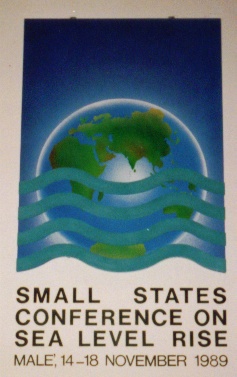
Small states conference on sea level rise logoI returned to the Maldives in November 1989, that time as a member of the international media covering the first ever small states conference on sea level rise. Held at the Kurumba island resort, it was one of the earliest international gatherings on climate impacts on low lying states, a topic that was to gain public interest and momentum in the years to come. Among the participants were delegates from practically all the small states in different parts of the world (defined as those with less than 1 million population), and scientists from disciplines such as oceanography, climatology, meteorology and geology.

This was one of the first international scientific events that I covered as an eager young science journalist. I was a foreign correspondent for Asia Technology, a monthly magazine on Asian science and technology published from Hong Kong (now defunct), and freelancing for The Island daily newspaper in Sri Lanka. (There’s nothing online from that coverage as it was in the pre-web era!)

The conference had technical sessions where experts debated scenarios and implications, and a political segment where delegations made their official statements. In the end, they issued the Malé Declaration on Global Warming and Sea Level Rise, which urged for inter-governmental action on the issue.

Our Maldivian hosts knew that scientists and officials alone couldn’t send out a powerful message to the world on what climate change meant for low lying islands of the world – many of them mere specks on the world map, barely registering in media’s radar. So on the last day of the conference, we were taken to the Maldivian capital of Malé, where a demonstration and public rally were held by school children and ordinary people.

That turned out to be the most striking moment of the whole week. I had been listening to experts and officials talk about impacts, scenarios and mitigation measures for several days, on which I’d filed several stories. But unless I go back to my personal archives, I can no longer remember those details. My lingering memories of this event are in a few photos I took, showing school children telling delegates – and the world – what it means to be living on the front lines of climate change impact.

This was the most striking photo – three more are found in an earlier blog post:
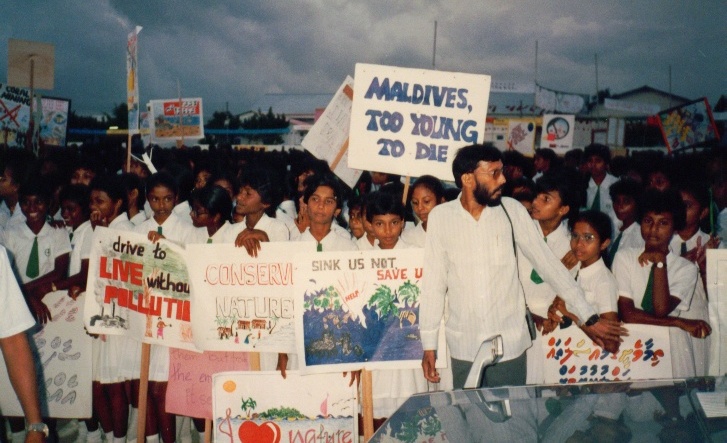
maldives-too-young-to-die-say-school-children-nov-1989.jpg

After 1989, I visited the Maldives on a couple of occasions for professional purposes during the 1990s. After I started working with TVE Asia Pacific in 1996, I was keen to return to the story of the Maldives and climate change – this time, in moving images – but I never had the chance until this year.

But I was covering the bigger story of climate change and its impact on the Asia Pacific from other locations. For example, in 2002, I commissioned and executive produced Voices from the Waves, the first-ever documentary on climate change in the South Pacific made by a native Pacific islander. Directed by Fijian film-maker Bernadette Masianini, the story revolved around two teenagers growing up on Fiji and Kiribati, each facing an uncertain future because of climate change.

In November 2007, the Maldives once again hosted representatives from small island states to discuss climate change. Eighteen years after the original meeting, the subject was no longer a fringe concern; it was now on everybody’s agenda. The meeting urged the the human dimension of global climate change to be included in the agenda of UN Climate Change Summit in Bali (December 2007), and sought the international community’s commitment “to protect people, planet and prosperity by taking urgent action to stabilize the global climate change”.

This time, the Male’ Declaration on the Human Dimension of Global Climate Change called for the UN High Commissioner for Human Rights to assess the human rights implications of climate change and “to conduct a study into the effects of climate change on the full enjoyment of human rights”. It also requested the UN Human Rights Council to convene a debate on human rights and climate change.

I wasn’t present at the 2007 meeting, but followed the process online. While climate change emerged as a major global concern, political change and reforms were underway in the Maldives. The country moved to a multi-party democracy, and in November 2008, the Maldivian Democratic Party‘s candidate Mohamed Nasheed won the presidential election.
Science News cover - 28 Feb 2009
President Nasheed continues the climate advocacy that President Gayoom had sustained for nearly a quarter of a century. President Nasheed has emerged as an outspoken and pragmatic voice speaking on behalf of his and other small island states, grouped under the Alliance of Small Island States (AOSIS).

In early 2009, President Nasheed announced that the Maldives would become the world’s first fully carbon-neutral nation within a decade. To accomplish this, they would vigorously pursue renewable energies and green energy sources to replace current dependence on fossil fuels.

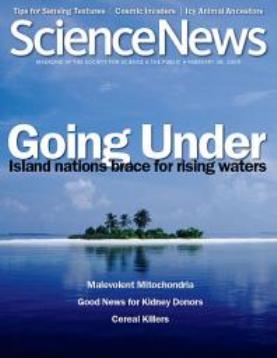
The final inspiration for Small Islands, Big Impact came in February 2009, when Science News magazine in the United States carried a cover feature on the challenges faced by Kiribati and the Maldives because of climate change. Written by senior science writer Cristine Russell, the article noted: “The Maldives and Kiribati highlight a hidden challenge for coping with climate change. It’s not just about slowing the emissions of greenhouse gases. It’s also about figuring out what to do for localities threatened with the possibility of extinction from rising ocean waters.”

My original plan was to film interviews with President Anote Tong of Kiribati, and President Nasheed. While sharing the same overall concerns, the two leaders (and their governments) have adopted somewhat different responses to the challenges posed by climate change. Unfortunately, the interview with President Tong did not come through in time, even though I had a Kiribati TV crew standing by to film it. So I decided to go ahead with the film focusing solely on the Maldives.
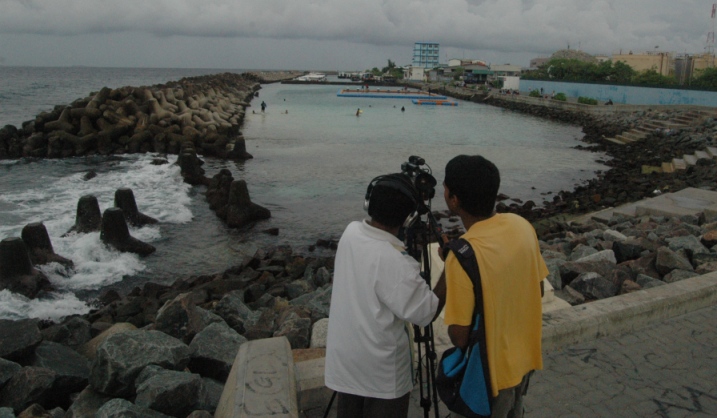
Location filming in Male - Hussein Makzoom (left) and Ibrahim Yasir

As with all TVEAP films, I was keen to make it with a local crew. Mariam Niuma, an engaging young Maldivian woman who had worked for nearly two years with us as an intern, helped me find a very capable crew in Ibrahim Yasir and his colleague Hussein Makzoom.

Niuma had been urging us to make a film about her country and was delighted that we were finally able to take it up. She helped us in numerous ways with local knowledge, introductions and advice. She also took time off her work with a local charity to show me around the Male’ island – which I was returning after a dozen years, in which time it had changed almost beyond recognition. (Male’ is one of the most crowded places on Earth – every one in four Maldivians lives on the tiny capital island.)

Small Islands, Big Impact was filmed on location over a few days in late August in Male’ and the nearby island of Vilingili. Our tiny production budget didn’t allow us to spend longer or venture further into the more remote islands and atolls (coral island formations, 26 of which make up the Maldives).
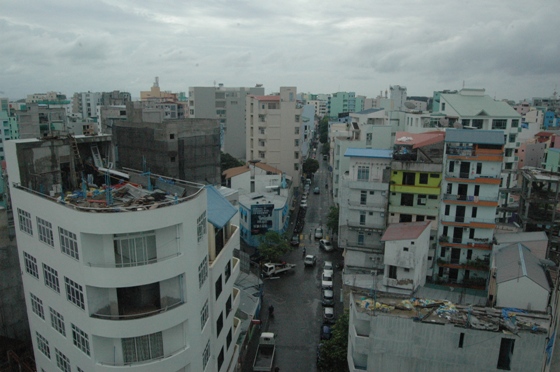
Overcrowded Malé, capital of the Maldives
The timing wasn’t ideal either – the Monsoon was still active, and rain often interrupted our filming. There was some irony that a climate film was being shot in inclement weather. Sometimes we filmed in spite of the rain – one ferry ride we took from Male’ to Vilingili island had to cross very choppy seas that made me (a land lubber!) quite nervous. For our Maldivian crew, however, it was all in a day’s work…

President Nasheed’s media team had been quick and supportive in accommodating our interview request, but when actually filming it, we faced an unexpected challenge which I’ve described in an earlier blog post. (Clue: In addition to inclement weather, we had to deal with a nasty influenza virus). With the month-long Ramadan fast period about to begin, which would significantly affect the pace of work in the 100% islamic Maldives, we had no choice but to persist with our filming, improvising as we went along.

I returned to Colombo with five camera tapes rich in footage, one of which contained a 15-minute interview with the amiable and technocratic President Nasheed. Over the next few weeks, I worked with our editor Umesha Fernando in distilling this material into a short, compact film less than six minutes. It took a good deal of time and effort — especially since I chose not to have any narration and to let President Nasheed tell the story in his own voice, interspersed with text-supported transitions.

Because of this style, soundtrack mattered a great deal, and we agonised over custom-composing the music. As I put everything this together, I kept recalling the wise words of senior Australian film-maker Bruce Moir: “Film is a lousy medium to communicate information. It works best at the emotional level.”

In the end, we barely met our self-imposed deadline: the film was released online just in time for the International Day of Climate Action. At the same time, I released the full interview (in text) on TVEAP website and the Groundviews citizen journalism website.

I can’t judge my own film, but I have tried hard to strike a balance between its intellectual and emotional appeal. My team and I set out to tell a compelling story about a country on the frontlines of climate impact. No less a person than its dynamic head of state stars in our modest effort, made on an incredibly tiny budget.

So here it is, a film that has been 20 years in the making – Small Islands, Big Impact!

Note: Small Islands, Big Impact was produced on an editorially independent basis by TVE Asia Pacific in collaboration with COM+ Alliance of Communicators for Sustainable Development. As with all other TVEAP productions, this series comes without license fees, where only copying and dispatch costs are payable. To order broadcast master tapes, please contact:

It may also be ordered in high resolution on DVD (without regional coding) from TVEAP’s e-shop.
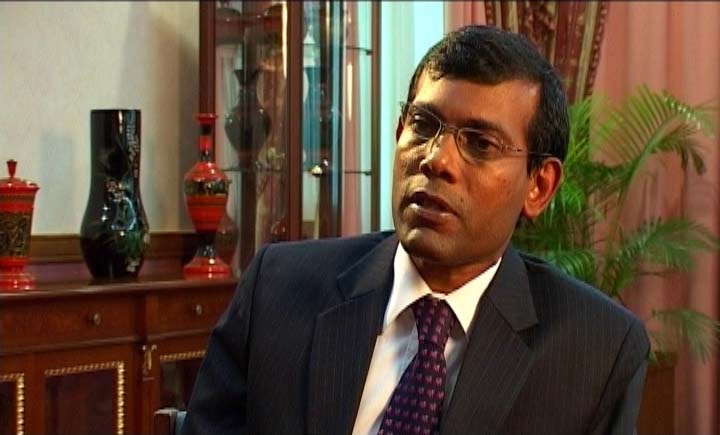
President Mohamed Nasheed: Encounter with a genial climate crusader…

President Mohamed Nasheed: Stop pointing fingers!

It had taken many days to set up the interview, but in the end we got only 15 minutes of the promised 30. President Mohamed Nasheed turned up more than an hour late, lagging behind in his day’s schedule. While waiting, his staff had repeatedly asked me to cut down the interview as the President was already late for a state function. I had nodded half-heartedly.

President Nasheed (known among his people as ‘Anni’) walked in, beaming and apologising for keeping us waiting for over a day. We had set up our lights and video camera the previous day, only to find that the President had cancelled all his appointments that day to be with his young daughter hospitalised with the ‘flu. As a father myself, I could fully understand – even if it affected our filming plans.

I introduced myself and crew, and asked how his sick daughter was doing. She is not in any danger, he said, and should be home soon. That was a relief.

I ushered President Nasheed to the simple chair we’d chosen for him to occupy during our interview, being filmed in the stately room where the President normally receives high level state guests. As the crew pinned up the mic and adjusted the lights, I quickly explained who we were, and what the interview was for – a short film that would be globally distributed highlighting the vulnerability of his island nation to climate change impact.

There was not an air of pomposity around him. He exchanged a few words in Divehi with my Maldivian film crew – Ibrahim Yasir and Hussein Makzoom. As I would soon find out in the interview, he was also very well informed, articulate and passionate. (I remembered interviewing former President Maomoon Abdul Gayoom nearly 20 years ago when I covered the Small States Conference on Sea Level Rise he convened in Nov 1989. Gayoom was expressive in his own way but had an air of scholarly superiority about him.)

In the 15 minutes that we had, I asked a total of 10 questions. I had sent in advance a baker’s dozen questions to his media staff. I don’t know if they briefed him, but clearly President Nasheed was in his element. He didn’t have any notes, and yet answered my questions perceptively, genuinely and always eagerly. The one-time journalist and human rights activist was very media savvy.

Read my full interview on TVE Asia Pacific website and on Groundviews citizen journalism website (where a discussion is unfolding)

He must have been asked some or most of these questions many times before. Yet with each answer, he found his comfort levels with me and by about the fifth minute, we were nicely chatting along. I had to keep reminding myself that I was really talking to one of Asia’s youngest heads of state. At that moment, he sounded every bit a chatty technocrat.

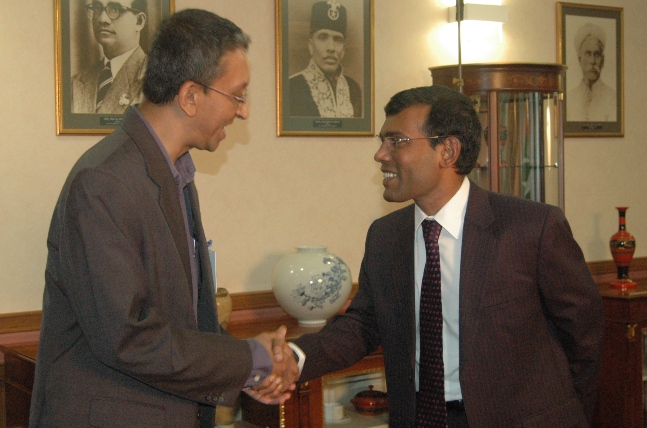
Nalaka Gunawardene (left) with President Mohamed Nasheed of the Maldives

President Nasheed had lot to say, and knew just how to say it. I had prepared for days, reading his recent speeches and op ed essays. I had figured out what to ask to elicit the kind of answers I was hoping for. He didn’t disappoint me. If his staff had not interrupted our interview, we could have easily gone on for half an hour or longer.

But I knew he had already given good ‘soundbites’ that we could excerpt in a short film. For example, how many heads of state would engage in plain talk like this when asked for his core message to the upcoming climate summit in Copenhagen: “In a nutshell, I’d like to say what has already been said: ‘Don’t be stupid!’. Going on and on about who did it is not going to save us. This is the time to realise that the deed is done. So let’s see how we may be able to proceed from here…

Earlier in the interview, he sounded grave when he outlined the prospects for his nation, the lowest-lying country on the planet, now on the frontline of climate change impact. “We will die if this goes on, and therefore, we have a fundamental right for life. If that is challenged, we have to link it be a human rights issue, and not just an environmental issue.”

The next minute, his tone became more resolute when talking on coping with massive changes already unfolding as a result of global warming. He stressed the value of democracy, good governance and people’s right to information as vital elements in adaptation – the difficult task of living with climate change.

Responding to my questions, President Nasheed talked about plans to make the Maldives carbon-neutral within a decade, and said the ‘sovereign wealth fund’ he announced soon after his election was already saving money “so that we will have something when the going gets very bad….”.

Sinking slowly in the East?
We also wanted to film President Nasheed at work, to establish him as an engaged political leader – the first democratically elected President of the Indian Ocean archipelago of 325,000 people. But there was no time. We then hoped to film his daily walk home after work. But the rain and delayed schedule meant he went home by car – and after dark. So we had to rely on stock footage instead.

The mix of democrat and technocrat in President Nasheed makes him an extraordinary personality and the world is taking note. The New York Times Magazine did a full length profile in May 2009 with the title ‘Wanted: A New Home for My Country’. A Hollywood film company is currently tracking the President as he travels the world, calling for urgent climate action that goes beyond mere words. (In fact, with my consent, they filmed me filming the President.)

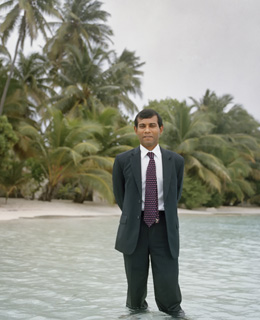
A month after my interview, TIME Magazine named him an Environmental Hero of 2009 – the only serving head of state so honoured this year. I was delighted to see this, but TIME’s chosen photograph made me very jealous. I had dearly wanted to shoot our interview outdoors, but a combination of bad weather and presidential schedule ruled that out. Evidently, TIME photographer Chiara Goia had better luck: President in full business suit standing about a foot deep in the calm, azure waters of the Maldives.

The same waters that he and his team are trying desperately hard to keep at bay, for as long as possible.

Read my full interview with President Mohamed Nasheed on TVEAP website and on Groundviews

Watch the short film, Small Islands, Big Impact:


Blog post January 2008: Little voices from the waves: Maldives too young to die!

A, B, C and E of good journalism: Reporting as if the planet and people mattered

Candid weather reporting?

“Environmental journalism would be a whole lot better if it had more of the three Ss: science, substance and (good) stories. First and last, it has to be good journalism, and that requires accuracy, balance and credibility. Trying to save the world – as some environmental journalists claim to do – does not give them a license to indulge in sloppy journalism, or to peddle conspiracy theories or half-truths.”

This has been my view on environmental journalism for sometime. Several years ago, my good friend (and former editor, The Times of India) Darryl D’Monte quoted me as saying this in UNEP’s Our Planet magazine while surveying the environmental coverage in the media in developing countries.

I reiterated these views today in a talk given to an international group of environmental journalists. The occasion was the 18th APFEJ Congress of Environmental Journalists being held in Colombo, Sri Lanka, from 19 to 21 October 2009.

My topic was a familiar one: Changing climate and moving images. I used it as a spring board from which to explore some broader issues that concerns every journalist who cares for life on Earth.

I returned to the time-honoured core values of good journalism – Accuracy, Balance and Credibility – and suggested we need one more letter, E – for Empathy. Without this latter attribute, our reportage and analysis would remain clinically cold while the planet warms up, I cautioned.

I also reflected on what it means to be an ‘environmental journalist’ in our troubled times.

For several years, I proudly called myself an ‘environmental journalist’. But I now question whether the growth of environmental journalism as a media specialisation has, inadvertently, ghettoised environmental issues within the editorial considerations of media organisations.

This is not to argue against media professionals specialising in environment or other development sectors such as health, gender or human rights. As issues become more complicated, journalists require sufficient background knowledge, sustained interest and some specialisation to do their job well. But it’s poor strategy to leave sustainable development issues entirely in the hands of ‘environmental journalists’.

At best, they can only weave part of the much-nuanced, multi-faceted tapestry of sustainable development. To grasp that bigger picture, and to communicate it well, we need the informed and active participation of the entire media industry -– from reporters, feature writers and producers to editors, managers and media owners.

Climate change, rapidly emerging as the charismatic mega-issue of our troubled times, could become a rallying call to unify the media and communication industries for this purpose.

Already, there is recognition of climate change’s far-reaching impacts. the UN’s Inter-governmental Panel on Climate Change urged a couple of years ago for the global issue to be ‘re-branded’ as a development problem rather than an environmental one.

In this scenario, we urgently need more good journalism that covers sustainable development concerns as an integral part of the mainstream of human affairs. Noble intentions of saving endangered species or ecosystems do not give anyone the license to engage in shoddy journalism.

The pursuit of plain good journalism will make us:
• rigorous in our field investigations and amassing of facts;
• balanced in our analysis of issues, impacts, choices and alternatives;
• committed to staying with evolving, fast-moving stories; and
• adaptable to accommodating new perspectives and knowledge.

It will also give us the courage of our convictions to question conventional ‘wisdom’, challenge established notions and take unfashionable positions when we have to.

April 2007 blog post: Can journalists save the planet?

UK Nepal Climate Change Film Competition: We’re toast in 3 minutes!

Tell a climate story in just 180 seconds...

In July 2007, we had an interesting discussion on this blog on the shrinking durations of Nature and environment films and TV programmes. The moving images community is divided on this, with some purists holding out that to pack complex, nuanced messages into a few minutes is akin to dumbing everything down. Noted film-makers like Neil Curry disagreed.

I revisited this topic in August 2008, saying: “But there’s no argument of the sheer power of well produced public service announcements (PSAs) to move people with a specific, short message. Nothing can beat them for the economy of time and efficacy of delivery.”

Kathmandu to Copenhagen - in three minutes?
The trend to make ever shorter films has been fuelled by the growth of online video, where the dominant value seems to be: less is certainly more! This is the premise, for example, of the current competition One Minute to Save the World.

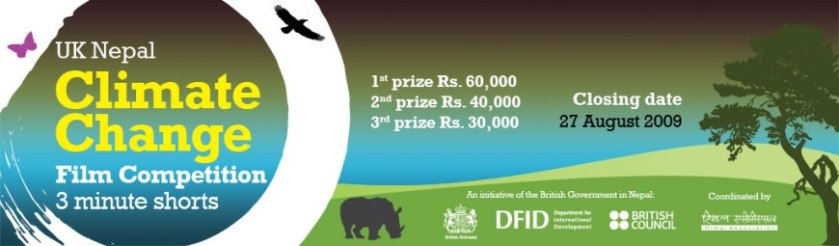
In Nepal, they were more generous — and allowed three minutes. I recently came across the winners of the UK Nepal Climate Change Film Competition, where Nepali film makers were invited to “make short, effective films of up to 3 minutes on the theme of Climate Change”. The submitted films had to be original in concept, innovative and highly motivational – no restrictions were set in terms of discipline or genre. It was organised by our friends at Himal Association, better known for sustaining Film South Asia festival for a decade.

The winning films were screened at an awards ceremony in September 2009 at the Regional Climate Change Conference in Kathmandu. They will also be screened at Kathmandu International Mountain Film Festival 2009 (10-14 December) and will be broadcast on television.

The winning film, Act locally think globally, was directed by Santoshi Nepal and Ishu Lama:

First runner-up, Jeopardy, is an animation directed by Shiva Sharan Koirala:

Second runner-up, 3 Cs of Climate Change, directed by Binod K Dhami and Padam Raj Paneru:

The competition attracted an impressive 124 entries. Angelo D’Silva, an educationist and media critic in Kathmandu, recently reviewed the entries in Himal Southasian special issue on climate change. He wrote: “In cash-strapped times, these contests focusing on climate change prove to be a cost-effective strategy in generating content. With no funding directed to the filmmaker for production, and prize money amounting to NPR 130,000 (USD 1700) for the three winners, the climate-change film contest is a way to make a splash on the cheap.”

He added: “While the filmmakers, all of whom were Nepali, exhibited an impressive range and quality, it was a range obscured by the selection of some fairly typical public-service-announcement-type finalists. Hopefully, however, two sets among the entries will soon see the light of day: those documenting the effects of climate change on Nepali communities, and those exploring (and exploiting) anxieties and fears about the burgeoning climate crisis.”

Read full review here.

I have only seen the three winning entries that are available online, so it would be unfair to comment on other entries. But I found the three winners predictably text-bookish. For sure, simple awareness raising is always helpful, but much more is needed – and urgently so – to deal with climate change. Film can be a powerful force for changing lifestyles, and not all of them have to be feature film length in Al Gore style.

Douglas Varchol: Secret of keeping ‘perfectly cool’ in a warming world…

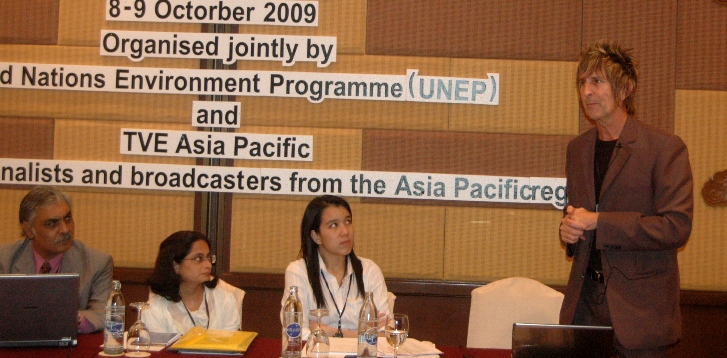
Douglas Varchol (standing, extreme right) speaking at Ozone Media Roundable, 8 Oct 2009

With his wild hair and trendy suits, Douglas J Varchol can pass for a rock star. He is actually an accomplished independent film-maker, currently operating out of Bangkok, Thailand, covering a variety of science and environmental stories in Asia.

Last week, he participated in the Ozone Media Roundtable that TVE Asia Pacific and UNEP organised in Chiang Mai, northern Thailand. After showing his latest documentary film on ozone, titled Earth Report: Perfectly Cool, which was first broadcast on BBC World News in September 2009, he talked about his experience in making the film.

Perfectly Cool is a 22 minute film looking at the challenges faced in trying to phase out a chemical called Hydrochlorofluorocarbons (HCFCs for short), a coolant gas used in air conditioners across the developing world. As chemicals go, it’s a double hazard: this ozone depleting substance also contributes to climate change by acting as a greenhouse gas.

But non-specialist viewers watch broadcast television for good stories, not science lessons. The challenge for journalists and film makers is to ‘sugarcoat’ the technicalities by wrapping it up in human interest stories. Douglas recalled how he did this: combining imagination, hard work and luck.

First, here’s the official synopsis of the film which sums up the story:
Air conditioners are damaging the environment. One widely used coolant gas, HCFC, damages the ozone layer. With booming sales of domestic ACs around the world, the problem has grown in recent years, despite vigorous international efforts to reduce ozone depleting chemicals. Under the international agreement known as the Montreal Protocol, HCFC will be phased out worldwide by 2030. An ozone-friendly replacement gas – HFC – is now used in Europe, but that gas is a potent greenhouse gas — which means it contributes to global warming. However, an answer may be at hand. Earth Report travels to China, centre of the global AC industry, to investigate the cost of cool and meets the industry representatives working on a solution – and Sa DingDing, a musician with extreme views on air conditioners.

Watch the first 4 mins of Earth Report – Perfectly Cool

Humanising science stories is hard enough, and when the subject is something people can’t see or feel, it becomes harder. As I wrote a few days ago, the Ozone Layer – located between 10 and 50 kilometres above the Earth, and invisible to the naked eye – is not something tangible like cuddly animals or endangered plants. Moving ordinary people to care for something they can’t see or touch is tough, even if all life on Earth depends critically on it (the Ozone Layer absorbs most of the Sun’s harmful ultra-violet days).

Douglas had his work cut out for him. Throw into this mix the fact that the editorially independent film was being made pooling funds from six development agencies – each with their own agenda – and that the story was filmed in China where filming permission still involve a lot of paperwork, it’s a small miracle Perfectly Cool was completed. And as we saw, Douglas tells a good story without compromising accuracy or balance.

So did he keep perfectly cool during the making of this film, I asked. He revealed that there were moments of panic and despair, although in the end everything fell into place. While the editors at BBC World were satisfied with the film, some technical specialists consulted for the script had felt it was over-simplified.

Ah, I do know that feeling! When I made a film on ozone in 2006 (Return of the Ozone Layer: Are We There Yet?) it took us 18 months to finish, and went through endless revisions. The UN system seems to just love making films by committee…

With his film, Douglas faced additional hurdles. For example, he takes us inside the Gree company‘s factory producing air conditioners. In 2004, Gree became the largest AC manufacturer in the world, but they had never before allowed television cameras inside their plant. That took lots of time and effort to set up.

Sometimes, things not going according to plans actually helps. When on location, Douglas serendipitously came across elements that were not in the original story treatment but enhanced the human interest: for example, a modern day wedding where the new couple gifted reusable chop sticks to all their guests. That was good environmental conduct – but then they headed off to choose air conditioners for their new apartment…

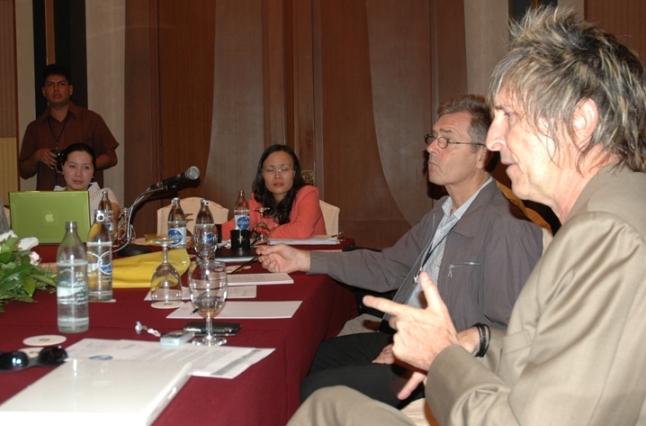
Douglas Varchol (extreme right) makes a point during Ozone Media Roundtable

Douglas paid a tribute to his Chinese researcher Lihong Shi and crew, without whose local knowledge and contacts he couldn’t have made the film.

In the end, Douglas pulls it off. Despite its seemingly esoteric and complex subject, Perfectly Cool is perfectly watchable — and not just for science buffs like myself.

Douglas, who once worked with Wired Science making science programmes for American PBS, said he set out to make a film on HCFCs that even his mom (a high school teacher) could understand. I can’t speak for her, but those of us who watched it in Chiang Mai were enthralled.

Rising from the Ashes: The Ayta’s struggle to preserve their heritage

Rising from the Ashes, teh Ayta struggle to keep their traditions alive
Rising from the Ashes, the Ayta struggle to keep their traditions alive

This weekend, Tropical Storm Ketsana triggered the worst flooding in decades in the Philippine capital Manila and nearby provinces.

The Philippines, an archipelago nation comprising some 7,000 islands, is one of the world’s most disaster-prone countries. It leads a World Bank list of nations most in danger of facing frequent and more intense storms because of climate change. In 2008, it was one of three countries that experienced the most disasters, according to the Brussels-based Centre for Research on the Epidemiology of Disasters.

Apart from the typhoons that blow in from the Pacific Ocean, the Philippines also sits on the Pacific Rim of Fire where periodic earthquakes occur, and active volcanoes are found.

Disasters not only kill or injure people and cause property damage; they also disrupt livelihoods and cultural practices. That’s what happened when the volcanic Mount Pinatubo erupted in 1991, its lava and ashes destroyed many surrounding villages – including the traditional homeland of the Ayta, indigenous people descending from the first inhabitants of the Philippines. They had fled to the hills from the lowlands during the protracted Spanish conquest of the Philippines which first commenced in 1565.

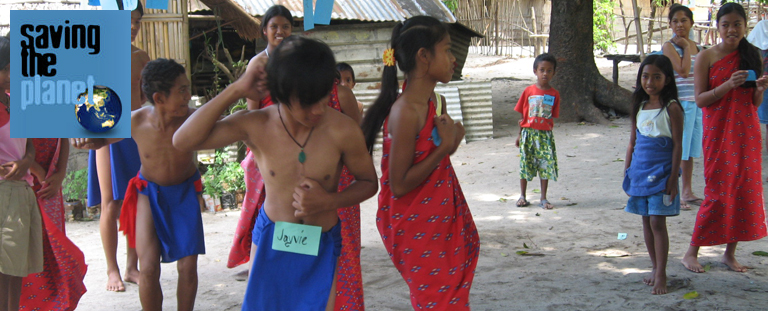
Today, resettled elsewhere on Luzon island, the Ayta are trying to preserve their traditional culture and community integrity through education and theatre. These efforts are supported by the Ayta organisation PBAZ, part of the Education for Life Foundation. Going back to the abandoned village is one way of keeping memories alive.

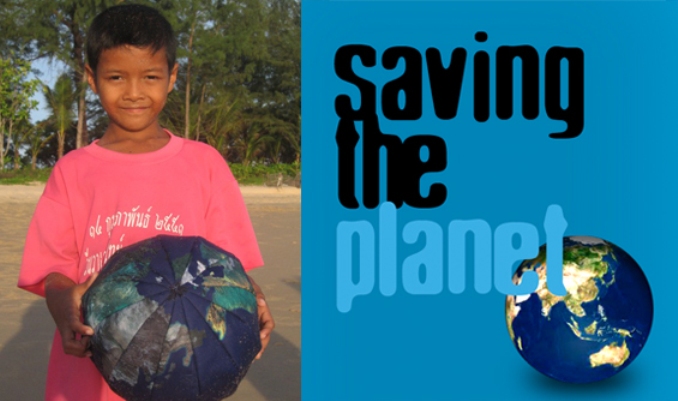
This is the story of Rising from the Ashes, one film in Saving the Planet, TVE Asia Pacific’s new regional TV series showcasing Asian communities thinking globally and acting locally.

Passing the buck or passing the planet? Saving the Planet is everybody’s business!

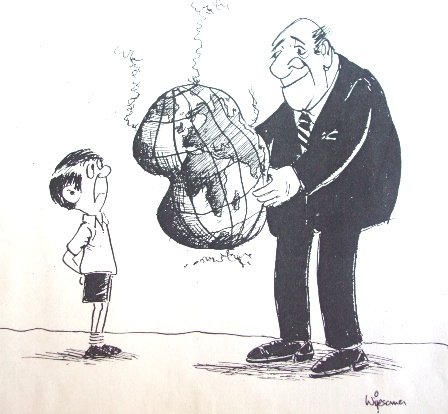
Passing the buck? Cartoon by W R Wijesoma
This was one of the most memorable cartoons drawn by W.R. Wijesoma, Sri Lanka’s pre-eminent political cartoonist (and my one-time colleague). If I remember right, it first appeared sometime in the late 1980s in ‘Mihikatha’, Sri Lanka’s first all-environmental newspaper.

Alas, both Mihikatha and Wijesoma are no more among us. But the message in this cartoon is more timely than ever before.

“Is this what we are going to hand over to our future generations? Please……no!” was the emphatic message from Yugratna Srivastava, a 13-year-old Indian girl who addressed over 100 world leaders gathered at the United Nations headquarters on 22 September 2009 for the historic Summit on Climate Change.

Passing the ball – or buck – is something that governments are good at. Most governments are so narrowly focused on the now and here, and sometimes rightfully so, that they have neither the time nor interest for medium to long term scenarios. As I wrote earlier this week, “it’s going to take many more meetings, bickering and hard bargaining before the leaders begin to think in terms of the next generation.”

This is where citizen action comes in. Governments are not going to save this planet from environmental catastrophes; if at all, it would be the ordinary people. This is the premise of TVE Asia Pacific’s latest Asian TV series, Saving the Planet.

Where does the buck stop?

Governments, experts and big corporations alone cannot solve all these problems. Real change requires changing how each and every human being lives and works. Education becomes the biggest key to achieving environmentally sustainable development at local and global levels.

Filmed in six countries in South and Southeast Asia, Saving the Planet profiles groups working quietly and relentlessly to spread knowledge, understanding and attitudes that inspire action that will help humans to live in harmony with the planet. They often work without external funding and beyond the media spotlight. They have persisted with clarity of vision, sincerity of purpose and sheer determination. Their stories inspire many others to pursue grassroots action for a cleaner and safer planet.

We tried out a creative idea for the series opening sequence (20 seconds), an extended version of which became the series trailer (see below). It was planned and filmed in all the six countries where the stories came from — Cambodia, India, Laos, Nepal, the Philippines and Thailand. In each country, our roving director-producers filmed different individuals – young and old, men and women, in all their Asian diversity – passing around an inflated ball made to look like planet Earth.

I know my colleagues had fun filming these sequences, and back in our studio, it was also great fun to mix and match these various shots to create the apparently seamless passing around of our planet in peril. (Who said planet saving cannot be fun?)

Watch Saving the Planet trailer (1 minute):

Now it can be revealed: our original inspiration came from an unexpected source: the world’s largest media corporation, Google! In one brainstorming, our then production coordinator Buddhini Ekanayake remembered an open challenge that Google had made online just before introducing their email service, GMail. Google asked people to “imagine how an email message travels around the world” using a video camera.

In all, Google received over 1,100 clips from fans in more than 65 countries around the world — each one of them a different creative idea, playing with the iconic Gmail M-velope.

“The clips you submitted were amazing and it was hard to choose selections for the final video,” Google said when releasing the outcome of this collaborative video project.

See Gmail: Behind the Scenes (Final Cut)

Read more about the GMail collaborative video on Google’s blog

Watch all submissions Google received for its GMail promo video.

As Oscar Wilde once said, “Talent borrows. Genius steals.” You can decide which of these we have done!

Timeless Gandhian advice: Be the change you wish to see in the world…

Biggest gap: between rhetoric and practice!
It happened a decade ago, but I still remember the incident.

I was visiting London while the British Isles were having their typically limited experience with summer. My then colleague and I had gone for a business meeting, and were returning by Tube, or the London underground railway. Being the afternoon rush hour, the trains were packed to capacity.

My colleague didn’t say much on the journey, but I noticed her look of dismay. As we emerged from the tube station, she finally spoke: “Gosh, it’s another world down there, isn’t it? I didn’t know people smell so much!”

The warm and sweaty summer would surely have added to the experience, but as Londoners know well, the tube is the best mode of transport to get around quickly and inexpensively in that metropolis. It was only then that I realised my liberal, bleeding-heart colleague was not a regular user of public transport. She either uses taxis or drives around in her own Volvo car. She doesn’t normally commute with the Great Unwashed…

Yet, the same snooty ex-colleague speaks and writes so passionately on the virtues of public transport and mass transit systems as a means to better manage urban challenges in the developing world. Listening to her, one could hardly imagine her disdain for using public transport in her own city.

Practise what you preach. That’s a simple yet profound piece of advice for everyone promoting public interest causes in development, conservation or anything else. Or, as Mahatma Gandhi put it: you must be the change you wish to see in the world.

Saving the Planet: Living the Change

‘Living the change’ is also the title, and underlying message, of one film in Saving the Planet, TVE Asia Pacific’s new regional TV series showcasing communities thinking globally and acting locally.

The series features outstanding efforts in education for sustainable development (ESD) in South and Southeast Asia. It goes in search of answers to these key questions:
• What can ordinary people do for our planet, now under siege from multiple environmental crises?
• How can we change attitudes and lifestyles to consume less and generate less waste?

Here’s the synopsis of the India story:

For people in Dindigul in India’s Tamil Nadu state, waste isn’t really a problem – it’s just a resource in the wrong place. School children and housewives have been at the forefront in collecting household and market waste to turn them into compost. They have not only cleaned up the streets, but also persuaded people to grow organic food. As the word spreads, more towns and villages are emulating this example set by CLEAN India project and Gandhigram Trust.

Watch Saving the Planet: Living the Change

Read more information on this effort on Saving the Planet website.

Full credits and acknowledgements here

Radio Sagarmatha: Voice of a Valley and Hope of a nation

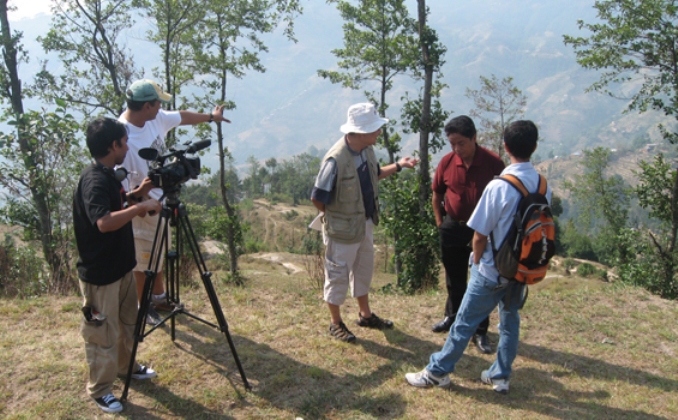
Location filming Saving the Planet in Nepal

I have written more than once in this blog about Radio Sagarmatha of Nepal, the first independent community broadcasting station in South Asia.

In May 2007, on the occasion of their 10th anniversary, I called it Kathmandu Valley’s beacon of hope. I have known and admired the Nepali friends who are running the award-winning, public-spirited radio station.

I’m delighted, therefore, to be able to make a short film about one facet of Radio Sagarmatha: their contribution to education for sustainable development, ESD for short.

Radio Sagarmatha’s path-breaking work in the resort town of Nagarkot is the story in one film of Saving the Planet, TVE Asia Pacific’s new regional TV series showcasing communities thinking globally and acting locally.

The six-episode series, which was 18 months in the making, features outstanding efforts in education for sustainable development in South and Southeast Asia.

It goes in search of answers to these key questions: Can ordinary people help save our planet under siege from multiple environmental crises? How can everyone change attitudes and lifestyles to consume less and generate less waste?

Here’s the official synopsis of the Nepal story, titled Voice of a Valley:

Tourism generates incomes, jobs and markets for the people of Nagarkot, a popular resort close to the Nepali capital Kathmandu. But it had a bumpy start when hoteliers initially bypassed local communities. These tensions were diffused by Radio Sagarmatha, the country’s first independent public radio station, which brought all interested parties together on the air. This example shows how media can do more than just report. By inspiring discussion and debate, media can help communities to find the best solutions or compromises for their development needs.

Watch Saving the Planet: Voice of a Valley

Many thanks to friends at the Nepal Forum of Environmental Journalists (NEFEJ), for their help in making this short film about one of their most outstanding efforts.

Find the full credits of the film here

Animating and singing our way to a Low Carbon Future…

Low Carbon, High Priority
Some 100 world leaders are due to gather at the United Nations headquarters in New York this week for the highest level summit meeting on climate change ever convened.

As the New York Times reported: “In convening the meeting, the United Nations is hoping that collectively the leaders can summon the will to overcome narrow nationalinterests and give the negotiators the marching orders needed to cut at least the outline of a deal.”

Recognising climate change as one of the greatest social, economic, political and environmental challenges facing our generation, the British Council has launched the Low Carbon Futures project. It has focus on mitigating the effects of climate change in an urban environment. It is part of the British Council’s major global climate security project and India is, along with China, one of the top two priority countries for this work. Sri Lanka, with less than 2% of India’s population and correspondingly lower carbon emissions, is a lower priority.

One strand in the Low Carbon Futures project is to engage communications professionals – journalists, writers and film makers to help them better understand the issues around mitigation and get across key messages to readers/viewers more effectively.

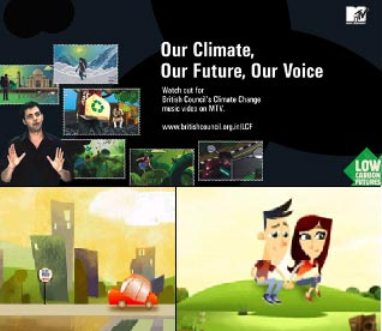
As part of this project, the British Council collaborated with Music Television (MTV) to produce a music video and two viral video animations on climate friendly, low-carbon lifestyles.

British Council’s first Music Video on Climate Change produced by MTV features VJ Cyrus Sahukar. Combining animation, lyrics and melody, the video talks about how small individual actions can help conserve natural resources and save the climate. MTV VJs have a cult following and the video ends with Cyrus Sahukar, MTV’s face in India, encouraging young people to take that first step. The video was launched in New Delhi on 1 June 2009 in the presence of 50 International Climate Champions from across India & Sri Lanka.

According to the British Council India website, “The video has created a flutter and there is growing demand to screen the video on various institutional networks across India and even outside fulfilling higher level objectives of impacting young urban aspirants. Young Indians are an emerging generation who are ambitious and internationally minded with the potential to be future leaders. The MTV video aims to influence this influential group.”

The Low Carbon Futures project has also released two short, powerful, animated messages that are ‘tongue-in-cheek’- making use of everyday events with a touch of humour. “We are hoping that the messages will be seen as creative, funny and innovative to tempt the recipient to forward it to their peer group. As the virus spreads, so will the message. The British High Commission and the The Energy and Resources Institute (TERI) are also promoting these virals to spread the message amongst the staff members and their external audiences,” says the project website.

The first viral video animation is called Green Journey, and shows a little known benefit of car pooling. Its blurb reads, simply: Meet 3 Mr Rights on the wrong side of the road!

The second viral video animation is called Play Cupid, and gives us one more reason to plant more trees! Blurb: Lets leave the young couples in peace and solitude of nature!

Watch out for more interesting videos from British Council India’s YouTube channel.