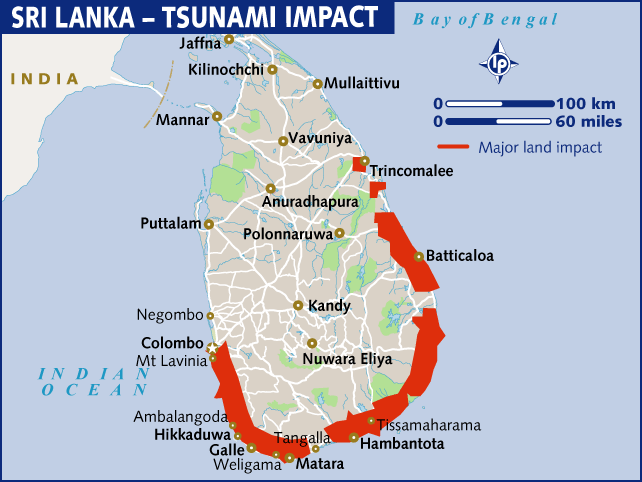
The undersea quake that triggered the Indian Ocean tsunami on 26 December 2004 was so powerful that it was felt around the globe, as far away as Alaska. Likewise, the killer waves that hammered the coasts of South and Southeast Asia left such a trail of destruction that it was like a lasting, unceasing wave.
On the eve of the mega-disaster’s fifth anniversary, I’ve been busy writing, talking and reflecting on what it meant for me personally, and my media profession and fellow Asians in general. I recently filmed an interview for Thai Public Television (TPBS), where my friend Pipope Panitchpakdi is doing a tsunami+5 documentary.
He was in Sri Lanka at the time of the tsunami, and spent two weeks working as a freelance reporter covering the aftermath for the western media. His piece sums up the mixed bag of lessons and recovery efforts that Sri Lanka, one of the hardest hit countries, has accomplished in the half decade this that momentous day.
An excerpt: “Five years later, life in the affected countries has resumed, and the world has learned immensely valuable lessons about responding to catastrophe. But as with any human endeavor, some opportunities have also been lost.”
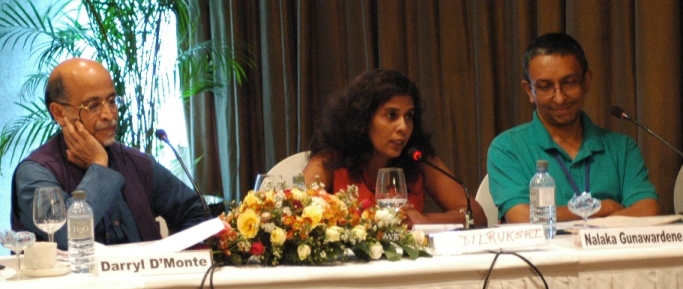
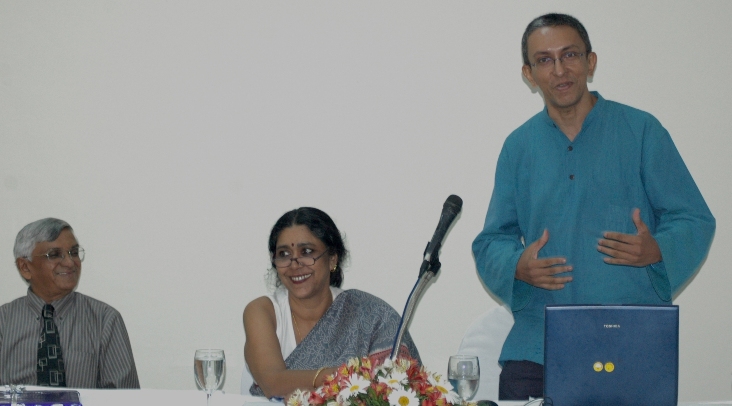
L to R - Darryl D'Monte, Dilrukshi Handunnetti, Nalaka Gunawardene Who’s afraid of Pee and Poop?
That’s the innocent but slightly provocative question I posed to a South Asian Conclave on sanitation that I addressed today at the Colombo Hilton.
My audience was a group of South Asians – drawn mainly from Bangladesh, India, Pakistan and Sri Lanka – working in government, mainstream media or development agencies, all sharing an interest in water supply and sanitation (wat-san) issues.
I was asked to speak about Telling the Sanitation Story using Moving Images. But after listening to the fairly staid and often technocratic discussions preceding my presentation, I changed it. In doing so, I said that especially in broadcast television, the window of opportunity to attract the viewer is a tight one – it used to be 45 seconds, but these days more likely 30 seconds.
Sanitation is both an issue that is both urgent and important. As I noted on World Toilet Day marked on 19 Nov 2009, 2.5 billion people do not have somewhere safe, private or hygienic to go to the toilet.
And as C. Ajith Kumar of the Water and Sanitation Program (WSP) – convenors of the Conclave – reminded us at the outset, South Asia is where most of these people live. Lacking any alternative, more than a billion (yes, 1,000 million) South Asians defecate in the open on a daily basis.
That’s a lot of poop, folks — and it’s completely untreated, uncovered and responsible for too many preventable illnesses and deaths.
Despite this dire emergency at individual and society levels, officials and activists concerned with wat-san issues continue to tip-toe around this poop. Or so it seemed to me — after two days, not once had the words poop or shit been mentioned in discussions. Instead, everyone was using the more politically correct terms such as faeces, excreta and excrement.
“Most of those billion people pooping in the open are not going to understand the lofty terms used in the charmed development circle,” I said. “You’ve got to talk in a language that ordinary, real people can and will understand – that’s the first step in effective communication.”
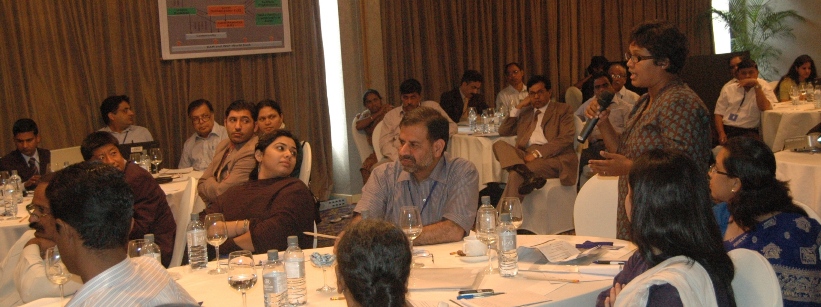
South Asian Conclave on Sanitation in Colombo, 8 Dec 2009The meeting had already acknowledged that improving sanitation involved a lot more than providing running water or building toilets. The development experience in the past three decade shows that infrastructure alone does not, automatically, lead to better sanitation. The biggest challenge remains in promoting hygienic practices among all – and that requires behaviour change, a slow and gradual process in any society.
I reminded everyone that when it comes to sanitation, the command-and-control approach that our South Asian governments are so used to adopting just won’t work. There are at least three aspects of life where choices and conduct are strictly personal: what happens in the bed room, bath room (toilet) and the shrine room.
As I summed it up in these words that I asked my audience to reflect on: Governments don’t defecate; people do.
“Please remember this if you really want to reach out and engage ordinary people who are living, breathing and pooping everyday in the real, harsh world.”
More of my presentation will be shared on this blog in the coming days.
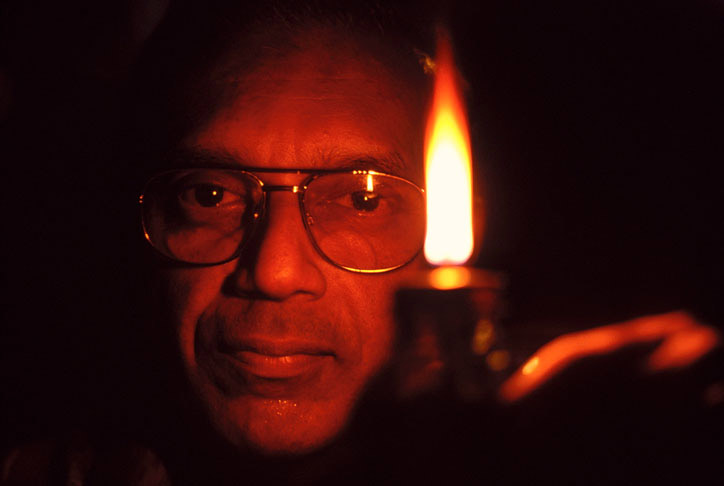
Dr Wijaya Godakumbura holding his invention - Photo courtesy Rolex Awards/Tomas Bertelsen
It’s easy to curse the darkness, and many among us regularly do. Only a few actually try to light even a small candle to fight it. Dr Wijaya Godakumbura of Sri Lanka is one of them – he literally lights lamps, thousands of them, against the darkness of ignorance and poverty.
But his lamps are different, and a great deal safer compared to normal lamps and kerosene, which can start fires risking life and property of users. The design is simple yet effective, inspired in part by the Marmite bottle known the world over: it’s small and squat, with two flat sides – equipped with a safe metal screw cap to hold the wick. It’s quite stable and hard to topple.
Surgeon turned inventor and social activist, Dr Godakumbura founded and runs the Safe Bottle Lamp Foundation which distributes safe, virtually unbreakable kerosene lamps to those who can’t afford electricity. For these untiring efforts that have saved hundreds of lives, the good doctor and his organisation have just been selected the overall global winner in the 5th annual World Challenge awards conducted jointly by BBC World News and Newsweek, together with Shell.
The Safe Bottle Lamp Foundation received a $20,000 grant from Shell to invest in the future of the project. The winner and runners-up were felicitated at an awards ceremony in the City of The Hague on 1 December 2009.
Now in its fifth year, World Challenge 2009 is a global competition aimed at finding projects or small businesses from around the world that have shown enterprise and innovation at a grass roots level. World Challenge is brought to you by BBC World News and Newsweek, in association with Shell, and is about championing and rewarding projects and business which really make a difference.
A record breaking 900 plus nominations were received this year and from these, twelve finalists were chosen by a panel of expert judges. BBC World News viewers and Newsweek readers then selected their favourite from these dozen unique and inspiring entries by casting more than 127,800 votes at http://www.theworldchallenge.co.uk.
Watch short film featuring the Safe Bottle Lamp when it emerged a finalist this year:
BBC/Shell World Challenge series producer is my former colleague Robert Lamb, who has blazed many new trails in broadcast television and development communication. He specialises in telling complex environmental stories in engaging terms using moving images, and now runs his own independent film production company One Planet Pictures in the UK.
At the beginning of the World Challenge 2009 process, Robert wrote in the producer’s blog: “World Challenge is now in its fifth year. Over that time we have received thousands of nominations. Sadly, we have only been able to film a small selection. But it’s enough to know that there are millions of points of light out there. Watching the news is easy to forget that the vast majority of people go about their lives peacefully and productively.
“Our aim In World Challenge is briefly to bring stories of modest scale sustainable enterprise to the screens. Every year has thrown up big surprises. The diverse ways that ordinary people go about making a living without taxing the Earth’s resources is uplifting. This year we feature the most diverse crop of stories yet…And the really good news is that they are still going strong and proving that ‘sustainable’ is a term with a lot of meaning.”
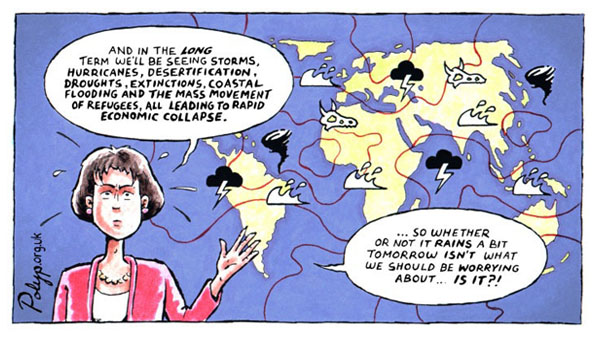
I’ve also argued that, when it comes to commenting on our topsy-turvy times, no one can beat cartoonists for their economy of words. They offer us popular social philosophy that is piercing, witty and hilarious – all in an amazingly tiny space.
The British Council and the Ken Sprague Fund of UK are currently running a cartoon contest on climate change open to Sri Lankan citizens from 18 to 35 years. They offer attractive prizes for those who can be seriously funny about this global crisis. The award winning and commended entries are to be exhibited in Colombo and Kandy in March 2010.
The deadline for submitting entries is 7 December 2009. More details here.
Declaration of interest: As a long time admirer of cartoons, I have agreed to be on the national selection panel.
“Environmental journalism would be a whole lot better if it had more of the three Ss: science, substance and (good) stories. First and last, it has to be good journalism, and that requires accuracy, balance and credibility. Trying to save the world – as some environmental journalists claim to do – does not give them a license to indulge in sloppy journalism, or to peddle conspiracy theories or half-truths.”
This has been my view on environmental journalism for sometime. Several years ago, my good friend (and former editor, The Times of India) Darryl D’Monte quoted me as saying this in UNEP’s Our Planet magazine while surveying the environmental coverage in the media in developing countries.
I reiterated these views today in a talk given to an international group of environmental journalists. The occasion was the 18th APFEJ Congress of Environmental Journalists being held in Colombo, Sri Lanka, from 19 to 21 October 2009.
My topic was a familiar one: Changing climate and moving images. I used it as a spring board from which to explore some broader issues that concerns every journalist who cares for life on Earth.
I returned to the time-honoured core values of good journalism – Accuracy, Balance and Credibility – and suggested we need one more letter, E – for Empathy. Without this latter attribute, our reportage and analysis would remain clinically cold while the planet warms up, I cautioned.
I also reflected on what it means to be an ‘environmental journalist’ in our troubled times.
For several years, I proudly called myself an ‘environmental journalist’. But I now question whether the growth of environmental journalism as a media specialisation has, inadvertently, ghettoised environmental issues within the editorial considerations of media organisations.
This is not to argue against media professionals specialising in environment or other development sectors such as health, gender or human rights. As issues become more complicated, journalists require sufficient background knowledge, sustained interest and some specialisation to do their job well. But it’s poor strategy to leave sustainable development issues entirely in the hands of ‘environmental journalists’.
At best, they can only weave part of the much-nuanced, multi-faceted tapestry of sustainable development. To grasp that bigger picture, and to communicate it well, we need the informed and active participation of the entire media industry -– from reporters, feature writers and producers to editors, managers and media owners.
Climate change, rapidly emerging as the charismatic mega-issue of our troubled times, could become a rallying call to unify the media and communication industries for this purpose.
In this scenario, we urgently need more good journalism that covers sustainable development concerns as an integral part of the mainstream of human affairs. Noble intentions of saving endangered species or ecosystems do not give anyone the license to engage in shoddy journalism.
The pursuit of plain good journalism will make us:
• rigorous in our field investigations and amassing of facts;
• balanced in our analysis of issues, impacts, choices and alternatives;
• committed to staying with evolving, fast-moving stories; and
• adaptable to accommodating new perspectives and knowledge.
It will also give us the courage of our convictions to question conventional ‘wisdom’, challenge established notions and take unfashionable positions when we have to. April 2007 blog post: Can journalists save the planet?
Low Carbon, High PrioritySome 100 world leaders are due to gather at the United Nations headquarters in New York this week for the highest level summit meeting on climate change ever convened.
As the New York Times reported: “In convening the meeting, the United Nations is hoping that collectively the leaders can summon the will to overcome narrow nationalinterests and give the negotiators the marching orders needed to cut at least the outline of a deal.”
Recognising climate change as one of the greatest social, economic, political and environmental challenges facing our generation, the British Council has launched the Low Carbon Futures project. It has focus on mitigating the effects of climate change in an urban environment. It is part of the British Council’s major global climate security project and India is, along with China, one of the top two priority countries for this work. Sri Lanka, with less than 2% of India’s population and correspondingly lower carbon emissions, is a lower priority.
One strand in the Low Carbon Futures project is to engage communications professionals – journalists, writers and film makers to help them better understand the issues around mitigation and get across key messages to readers/viewers more effectively.
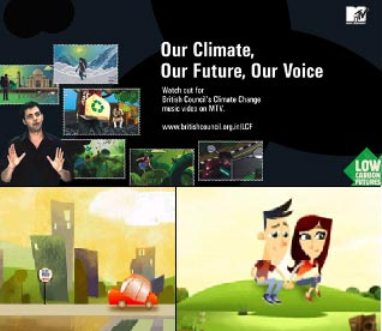
As part of this project, the British Council collaborated with Music Television (MTV) to produce a music video and two viral video animations on climate friendly, low-carbon lifestyles.
British Council’s first Music Video on Climate Change produced by MTV features VJ Cyrus Sahukar. Combining animation, lyrics and melody, the video talks about how small individual actions can help conserve natural resources and save the climate. MTV VJs have a cult following and the video ends with Cyrus Sahukar, MTV’s face in India, encouraging young people to take that first step. The video was launched in New Delhi on 1 June 2009 in the presence of 50 International Climate Champions from across India & Sri Lanka.
According to the British Council India website, “The video has created a flutter and there is growing demand to screen the video on various institutional networks across India and even outside fulfilling higher level objectives of impacting young urban aspirants. Young Indians are an emerging generation who are ambitious and internationally minded with the potential to be future leaders. The MTV video aims to influence this influential group.”
The Low Carbon Futures project has also released two short, powerful, animated messages that are ‘tongue-in-cheek’- making use of everyday events with a touch of humour. “We are hoping that the messages will be seen as creative, funny and innovative to tempt the recipient to forward it to their peer group. As the virus spreads, so will the message. The British High Commission and the The Energy and Resources Institute (TERI) are also promoting these virals to spread the message amongst the staff members and their external audiences,” says the project website.
The first viral video animation is called Green Journey, and shows a little known benefit of car pooling. Its blurb reads, simply: Meet 3 Mr Rights on the wrong side of the road!
The second viral video animation is called Play Cupid, and gives us one more reason to plant more trees! Blurb: Lets leave the young couples in peace and solitude of nature!
I have just been very lucky. I addressed a select gathering of media owners, publishers, editors and senior journalists — almost all of them working in the mainstream print or broadcast media in Sri Lanka — and virtually called them dinosaurs, and compared their industry to the supposedly unsinkable Titanic.
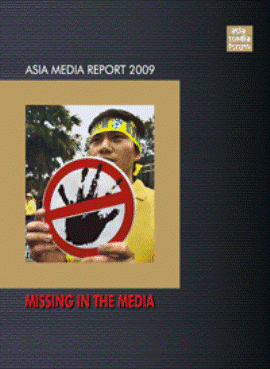
The nice people they all were, they actually let me get away with it! The occasion was the Sri Lanka launch of Asia Media Report 2009, held at the now-renovated Galle Face Hotel in Colombo.
Shining a light at a spot rarely probed...Coordinated, produced and published by the Asia Media Forum with the assistance of Actionaid, the report is a quick survey of the state of media in 20 Asian countries, written mostly by working journalists and broadcasters. It focuses on how the media throughout Asia reports on marginalised people and communities in their respective societies, from the very poorest countries to the richest.
‘Missing in the Media’ is the theme of Asia Media Report 2009, and I used this as the point of departure for my talk, illustrated with many cartoons some of which have appeared on this blog. I fully agreed with the editor and contributors of the report – six of whom I know – that there are many elements missing or lacking in Asia’s mainstream media today. But instead of adding to that list, I asked a more fundamental question: at a time when the mass media as we know it is under threat of mass extinction, how do we save and nurture at least a few good things that we hold dear?
In that process, I had to do some plain speaking and tell my audience that they cannot continue business as usual and expect to remain relevant, or even solvent for too long. I referred to the famous mediasaurus essay by Michael Crichton, and traced what happened since its appearance in 1993. I also compared the media’s arrogance to that of the Titanic‘s builders, who believed the ship was unsinkable.
I don’t do this kind of big picture talk too often, and mind my own business most of the time (which is a hands full these days). In fact, the last two occasions I spoke my mind to assorted worthies of the Sri Lankan media, the reaction was much harsher.
The Coming Ka-Boom? L to R: Vijitha Yapa and Sharmini Boyle seem to be amused as Nalaka Gunawardene speaksFirst was when I talked about the press freedom in the digital age to large gathering of Sri Lankan journalists and editors was the World Press Freedom Day Colombo observance in 2001. When I referred to the potential of new communications technologies – especially the (then still emergent) Internet and mobile phones – for safeguarding media freedoms, I was practically shouted down by a section of the audience. They felt I was talking about ‘western trends’ and ‘concerns too far removed from their bread-and-butter issues and survival issues’. Yet, the past few years have amply proved that if anything, I was too conservative in what I anticipated as technology’s role in promoting media freedom.
The second occasion was in mid 2004, when I was asked to speak at a Colombo meeting to mark the launch of a scholarly volume (in Sinhala) looking back at the first 25 years of television broadcasting in Sri Lanka. I was one of two dozen contributors, from diverse backgrounds of culture, science and journalism, who were brought together by the Catholic Media Centre of Sri Lanka which has a (secular) media monitoring programme. Having expressed my reflective views in the book chapter, in my speech I discussed my aspirations for the next 25 years — hoping there would be greater innovation and experimentation in an industry that seemed to be running short of both. This irked a certain local pioneer of television, who spoke after me and spent half of his given time attacking me personally and ideologically. Talk about pioneer’s syndrome. That definitely was a mediasaurus breathing fire, and I don’t want to meet one of these beasts on a dark night…
On both occasions, the event organisers apologised to me for the hostile reactions, but I was cool. By now, I’m used to reactions of all kinds in the public sphere. Given this history, yesterday’s encounter was far more reassuring that there still are good people even in an industry that is under siege in more ways than one.
I’m so fortunate to be welcomed by both media practitioners and media researchers across Asia. I’m no longer a card-carrying member of either group (if I ever was!), but I have great fun hobnobbing with both, occasionally telling them some home truths. This is what Irish journalist-cum-academic Conor Cruise O’Brien once called ‘having a foot in both graves’!
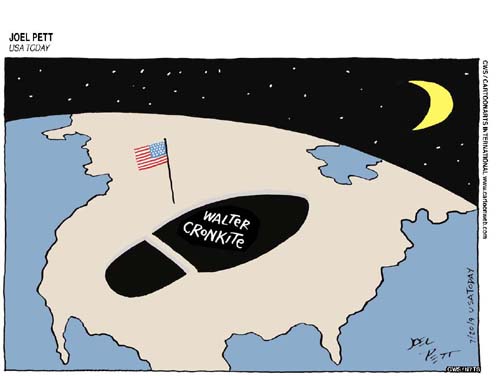
“What matters about Cronkite is that he knew when to stop being reassuring Uncle Walter and to challenge those who betrayed his audience’s trust. He had the guts to confront not only those in power but his own bosses. Given the American press’s catastrophe of our own day — its failure to unmask and often even to question the White House propaganda campaign that plunged us into Iraq — these attributes are as timely as ever.
“That’s why the past week’s debate about whether there could ever again be a father-figure anchor with Cronkite’s everyman looks and sonorous delivery is an escapist parlor game. What matters is content, not style. The real question is this: How many of those with similarly exalted perches in the news media today — and those perches, however diminished, still do exist in the multichannel digital age — will speak truth to power when the country is on the line? This journalistic responsibility cannot be outsourced to Comedy Central and Jon Stewart.”
I cannot agree more with the premise and arguments in this essay, which is well worth a careful, slow read by everyone, everywhere who cares for good journalism — either as practitioners or consumers (and in this media saturated age, don’t we all fall into one or both categories?).
At the same time, without detracting from the value of — and the crying need for — investigative, reflective and ‘serious’ journalism, I believe comedy and especially political satire play a key role today in analysing and critiquing politicians, businessmen and others whose decisions and actions impact public policy and public life.
Anchor, anchor, burning bright...Political satire is nothing new: it’s been around for as long as organised government. Over the centuries, it has manifested in many oral, literary or theatrical traditions, some more memorable and enduring – such as Gulliver’s Travels and Animal Farm. And for over a century, political cartoonists have been doing it with brilliant economy of words – as I have said more than once on this blog, they are among the finest social philosophers of our times.
In the age of electronic media, it’s only natural that the tradition of satire thrives on the airwaves and online. In fact, there is a rich and diverse offering of politically sensitive and/or active satire in the mainstream and online media that we can consider it a genre of its own. Some of it is so clever, authentic and appealing that we might momentarily forget that we are experiencing a work of satire.
Purists might decry this blurring of traditional demarcations between information, commentary and entertainment — but does that really matter?
When we survey the media and cultural scenes in our globalised world, we see things getting hopelessly entangled and mixed up everywhere. Nothing is quite what they seem – or claim – to be anymore. Content that is explicitly labelled as pure news and current affairs is looking more and more like entertainment. My friend Kunda Dixit, who edits the Nepali Times, says this is inevitable when the same mega corporations own both cartoon networks and news channels.
No news is good news -- for whom?If the mainstream news organisations don’t quite live up to our expectations to gather, analyse and reflect on the current affairs of the day, we should at least be grateful that some comedians are stepping into that void. We must welcome, celebrate and wish their tribe would increase!
The rise and rise of political satire is also being chronicled and analysed. A new book tells us why we now have to take satire TV seriously — it turns out to be the bearer of the democratic spirit for the post-broadcast age. Titled Satire TV: Politics and Comedy in the Post-Network Era, the book is co-edited by Jonathan Gray, Jeffrey Jones and Ethan Thompson (NYU Press, April 2009).
Here’s the blurb introducing the book: “Satirical TV has become mandatory viewing for citizens wishing to make sense of the bizarre contemporary state of political life. Shifts in industry economics and audience tastes have re-made television comedy, once considered a wasteland of escapist humor, into what is arguably the most popular source of political critique. From fake news and pundit shows to animated sitcoms and mash-up videos, satire has become an important avenue for processing politics in informative and entertaining ways, and satire TV is now its own thriving, viable television genre. Satire TV examines what happens when comedy becomes political, and politics become funny.”
The book contains a series of original essays focus on a range of popular shows, from The Daily Show to South Park, Da Ali G Show to The Colbert Report, The Boondocks to Saturday Night Live, Lil’ Bush to Chappelle’s Show, along with Internet D.I.Y. satire and essays on British and Canadian satire. “They all offer insights into what today’s class of satire tells us about the current state of politics, of television, of citizenship, all the while suggesting what satire adds to the political realm that news and documentaries cannot.”
Let me summarise the news so far. Intentionally or otherwise, some news anchors and politicians are increasingly behaving like comedians. Meanwhile, a few professional comedians are talking serious politics and current affairs in a genre of media that is growing in popularity by the day.
Are you confused yet? Well, get used to it. This is the shape of things to come.
In such topsy-turvy times, we need more Jon Stewarts to puncture the bloated egos and images of not only elected and other public officials, but also of our larger-than-life news anchors, editors and media tycoons. I would any day have conscientious comedians doubling as social and political commentators than suffer shallow, glib newscasters trying to be entertainers. That’s what you call laughing for a good cause.
Parting thought: There is another dimension to satirising the news in immature democracies as well as in outright autocracies where media freedoms are suppressed or denied. When open dissent is akin to signing your own death warrant, and investigative journalists risk their lives on a daily basis, satire and comedy becomes an important, creative – and often the only – way to comment on matters of public interest. It’s how public-spirited journalists and their courageous publishers get around draconian laws, stifling regulations and trigger-happy goon squads. This is precisely what is happening right now in countries like Kenya and Sri Lanka, and it’s certainly no laughing matter. More about this soon.
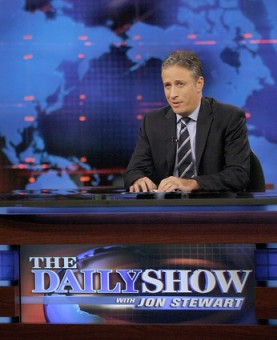
Backgrounder: The news as you never saw it before...The Daily Show with Jon Stewart, is an American late night satirical television programme, airing on Comedy Central, a cable/satellite channel. The half-hour long show is presented as a (fake) newscast. In their own words, the Daily Show team “bring you the news like you’ve never seen it before — unburdened by objectivity, journalistic integrity or even accuracy.” It “takes a reality-based look at news, trends, pop culture, current events, politics, sports and entertainment with an alternative point of view.”
The show premiered in July 1996, and was initially hosted by Craig Kilborn. Jon Stewart took over as host in January 1999, and made it more strongly focused on politics. In each show, anchorman Jon Stewart and his team of correspondents, comment on the day’s stories, employing actual news footage, taped field pieces, in-studio guests and on-the-spot coverage of important news events.
This is what the Wikipedia says: “The program has grown in popularity since Jon Stewart took over hosting, with organizations such as the Pew Research Center claiming that it has become a primary source of news for many young people, an assertion the show’s staff have repeatedly rejected. Critics, including series co-creator Lizz Winstead, have chastised Stewart for not conducting hard-hitting enough interviews with his political guests, some of whom he may have previously lampooned in other segments; while others have criticized the show as having a liberal bias. Stewart and other Daily Show writers have responded to both criticisms by saying that they do not have any journalistic responsibility and that as comedians their only duty is to provide entertainment.”
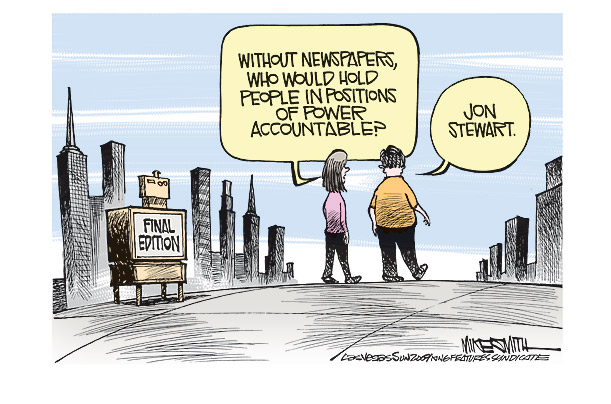
OK, The Daily Show may not be intentionally serious journalism, anymore than mainstream news channels are intentionally funny. But a significant number of American TV viewers and TV critics, as well as media researchers, have found the analysis and commentary to be highly insightful and incisive. It has won many awards including an Emmy and Peabody Award. It’s been on the cover of Newsweek for its outstanding elections coverage and serious journalism. It’s not to be laughed off easily. After the Last Newspaper...
When Apollo 11 astronauts landed on the Moon 40 years ago this week, they were more than just Americans taking that historic first step on to another celestial body.
Yes, they planted the US flag there – after all, it was the American tax payers who financed the massive operation. But they left on the Moon other items that signified the universal nature of their mission.
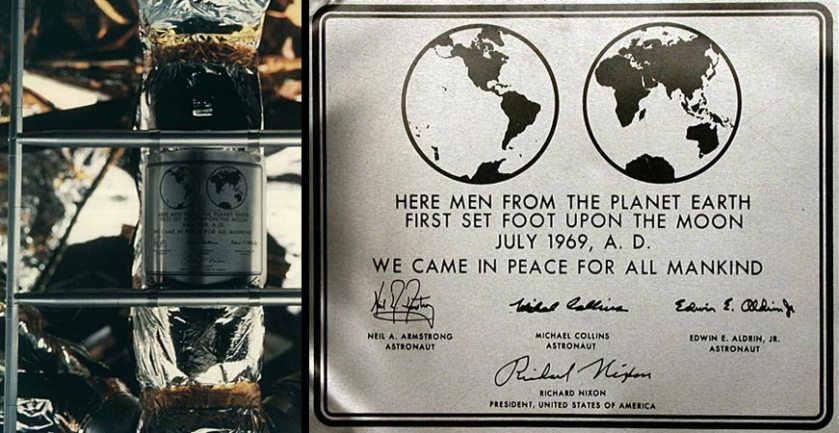
One was a plaque (photo, above) saying “Here men from the Planet Earth first set foot upon the Moon, July 1969 A.D. We came in peace for all mankind.” It bore the signature of the three astronauts –- Neil Armstrong, Edwin (Buzz) Aldrin, Jr., and Michael Collins –- and then US President Richard Nixon. Another was a golden olive branch.
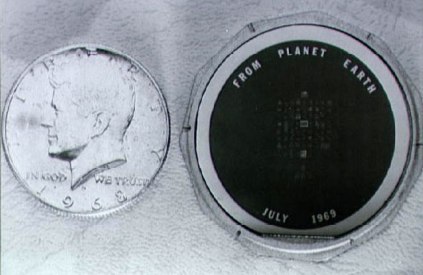
The silicon disc (right) next to a US 50 cents coin for comparison of sizeThese letters were received by NASA during the final weeks running up to the launch on 16 July 1969, yet this disc helped turn the Apollo 11 mission into an international endeavour.
It was only in June 1969 that the US State Department authorised NASA to solicit messages of goodwill from world leaders to be left on the Moon. This triggered a minor diplomatic frenzy, with invitations going out from Thomas O Paine, the NASA Administrator.
In all, 116 countries were contacted through their embassies in Washington DC, but only 73 responded in time. Sri Lanka, then Ceylon, responded. But for some unknown and unexplained reason, then Prime Minister Dudley Senanayake declined to send a message to the Moon.
When I first heard about it about 18 months ago, I was both intrigued and curious. Was it some misplaced geopolitical considerations, or simple diplomatic arrogance that led to Ceylon’s negative decision? After all these years, we might never find out.
I have now written this up in an article titled ‘How Sri Lanka Missed the Moon’, which appears this weekend in the mainstream media and online in two different versions.
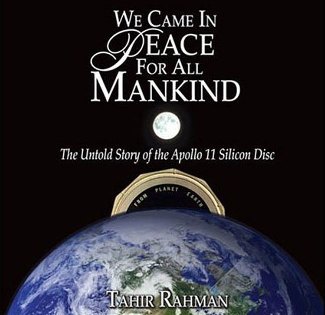
Uncovering forgotten historyThe book documents the full story behind this little known facet of the very widely covered Apollo 11 mission. It also reproduces each of the 73 goodwill messages, as well as those which were received too late for inclusion on the disc.
“I was amazed at how NASA and the State Department rushed to get these messages before launch,” says Rahman. He took two months to locate from the Library of Congress the boxes in which NASA Administrator Paine had preserved the full correspondence.
While researching for this article, I contacted Rahman hoping for some additional insights, but he replied: “I do not have any information about why Sri Lanka did not send an Apollo 11 goodwill message.”
Sir Arthur C Clarke, with whom I worked for over 20 years, was also intrigued by Ceylon’s decision, which he didn’t know about until Rahman’s book reprinted the official letter. His only remark: “Mysterious are the ways governments think and work.”
Reading the messages, whose English translations are available online, is like entering a time capsule. Only two of the world leaders are still holding office (Queen Elizabeth II of Britain, and King of Thailand); most of them are dead. Some countries have since changed names. Others have been subsumed by neighbours, or broken into two or more independent states. Geopolitical map of the world has been completely redrawn.
The story of the Apollo 11 silicon disc is more a history and politics lesson, and less a science story. But I’m glad that I found a little known facet of the very widely covered Apollo missions to write about on its 40th anniversary.
Watch Tahir Rahman interviewed on Fox News network:
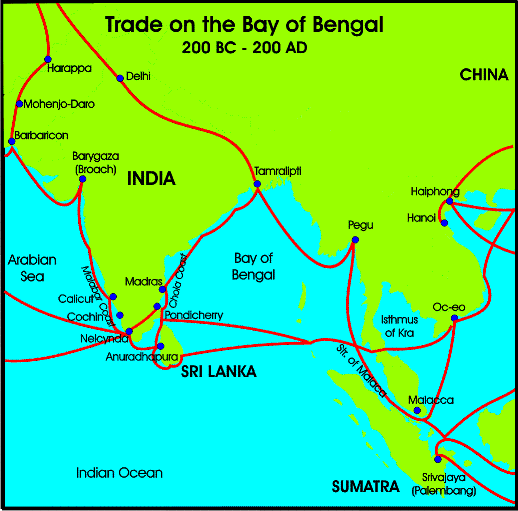
Ancient Lanka: Open and engaged with the world - image courtesy http://nabataea.net
I am neither a historian nor chef, but have a healthy interest in the subject areas of both. The two rarely come together, except when one goes in search of culinary history. I have just written an essay titled ‘Sri Lanka: Spice Island or Bland Nation?’ which blends the two in a social commentary highlighting a challenge we face as we rebuild our island nation after the war.
“Located strategically in the Indian Ocean, Sri Lanka was a hub in the maritime silk and spice routes for millennia. It drew traders from the east and west for both business and pleasure. Notable among the attractions were spices, whose many aromas and flavours formed an integral part of the tropical paradise experience.
“The traditional Lankan curry contained up to 13 spices and herbs. Most plants were not native – cardamom came from South India, cloves from Indonesia and chilli all the way from the Americas. Cinnamon was Sri Lanka’s unique contribution to this delightful mix. The origins didn’t really matter: the islanders knew just how to mix the native and the foreign to achieve legendary results.
“As Sri Lanka embarks on national integration after three decades of highly divisive war, it is worth recalling these aspects of its heritage. For the war not only devastated our economy and blighted the prospects of a generation; it also nurtured high levels of insecurity, insularity and mutual suspicion. In recent years, democratic dissent has become ‘unpatriotic’. Everything foreign is suspect – especially if from the west.
“Suddenly, the spice island is in danger of turning into a ‘bland’ nation with xenophobia the only condiment in use.”
Both versions of the essay end with an ardent plea for a return to pluralistic, cacophonic society we have been for much of our long and well-chronicled history.
“Throughout history, the spice island nurtured plurality without losing its identity or integrity. It withstood numerous invasions, colonialism and tsunamis. Sri Lanka is more resilient than many of its citizens think — and more vibrant and diverse than it appears at first glance. That’s the legacy of good geography and open frontiers.
“Let genes, ideas and spices flow freely again! We have nothing to lose – except our temporary blandness.”









 Open Minds!