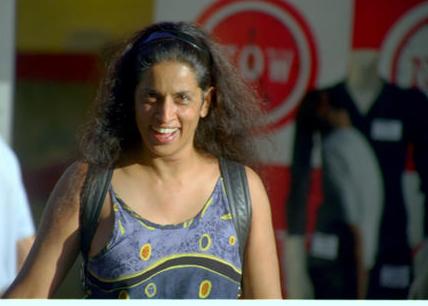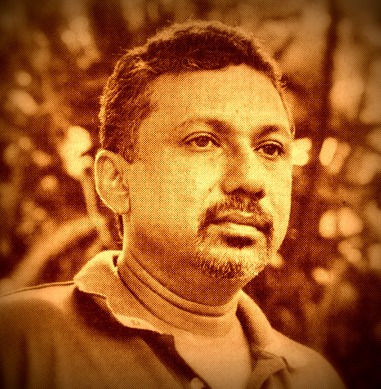
Palitha Lakshman de Silva (1959 – 2010): Animator, stilled.

Palitha Lakshman de Silva, 1959-2010
For the second time in just over three months, I went to the Colombo general cemetery to bid farewell to a fellow traveller. This is becoming a worrying habit.

Those of us who’ve opted for the path less travelled don’t expect crowds or accolades. At least we have each other for company and inspiration. Suddenly it’s getting a bit lonely: long-standing friends and colleagues are dropping dead in the prime of their lives.

First, it was environmentalist, journalist and public intellectual Piyal Parakrama who left in early March. Now, it’s Palitha Lakshman de Silva — journalist, photographer, cartoonist, puppet animator and television professional among other pursuits and talents.

Uncannily, what I wrote upon hearing Piyal’s death applies – word by word – to Palitha too. I just have to change the name and date: Palitha died so suddenly and unexpectedly on the evening of June 11 that it’s hard to believe that he is no longer among us. Another public-spirited individual has left the public space all too soon…

Both men had just passed 50, and were leading active, productive and busy lives. They had no known ailments, and were in apparent good health. Yet in the end, it was the unseen, gradual clogging of the heart’s arteries that struck them both down: the first heart attack was swift and fatal. Neither man reached the nearest hospital alive.

I had known Palitha for twice as long as I worked with him (in the past decade). Although we weren’t close friends, we shared a passionate, life-long interest in using broadcast television and narrowcast video to communicate public interest messages. Some call it non-formal education, but we avoided the e-word for it reminds some people of school that they didn’t enjoy. We believed – and demonstrated too – that the audio-visual medium can blend information with entertainment in ways that make learning effortless and painless.

Having started his career as a reporter and photojournalist at a leading newspaper, Palitha later moved on to TV, where he blazed new trails in cartoon animation, puppetry and documentary making. He was part of Sri Lanka’s first generation of television and video professionals who experimented with the medium, and found new ways of combining education, information and entertainment.

All this made Palitha a natural ally and partner in my work at TVE Asia Pacific. I just wrote a more official tribute tracing our collaborations over a decade, which the TVEAP website published: Tribute to Palitha Lakshman de Silva (1959 – 2010): Photojournalist and cartoon animator

I’ll write more reflectively once I recover from the shock of another colleague signing off for good. For now, I can only echo the lyrical sentiments in this leaflet distributed at Palitha’s funeral by his artistically-inclined friends. The English approximation (below) is mine, and not particularly good (though bilingual, I’m a lousy translator). I’m glad, however, that the original verse captures one intrinsic quality of Palitha: his gentle, soft-spoken nature which often concealed the creative genius inside him.
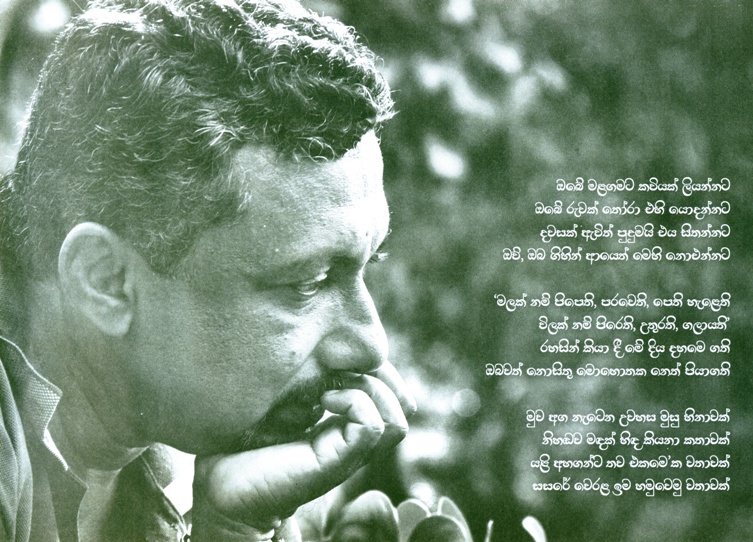
Goodbye, Palitha Lakshman de Silva

The day has arrived
Suddenly and shockingly
When you’ve gone away
Leaving us alone
All by ourselves
To write a verse
And choose an image
In your fond memory.

Flowers bloom and wither
Lakes flourish and drain
Such is the Circle of Life
Which your hasty exit
Once again reminds us
With a soft, little whisper.

We’ll travel to the end of time
If can we see, just once more,
Your gentle and soothing smile,
And listen to your stories
That you told us so gently.

Just once more…
When green stories make some see red: who protects the reporters?

Who says environment is a ‘safe’ subject for journalists and broadcasters to cover?

Journalist colleagues who work on conflict, security and political topics often have an illusion that environmental reporting is a ‘cosy and comfortable beat’ – one that allows reporters to travel to exotic locations, see cuddly animals, relax in pristine environments and generally take things easy.

That might have been the case some years ago, in another century that’s now receding in our memories. But not any longer: there’s as much conflict, intrigue and complexity in many of today’s environmental topics, and covering them can often be hazardous to the courageous journalists who go after them.

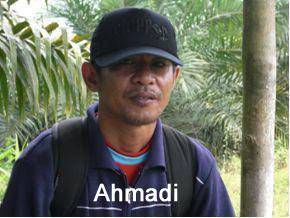
Ahmadi: Beaten up for expose
Just ask Ahmadi, a journalist working for Harian Aceh in Indonesia. Together with a fellow journalist, working for News Investigasi in Medan, he recently investigated a flood that had taken place in the Alapan district in April 2010. During their journey, they met some people cutting up logs. The journalists asked workers who owned these logs and were told that they belonged to the Alapan District Police Station and the Alapan Military Sub-District Command. Hmm…

When confronted with this information, a high ranking military officer reacted quickly and sharply: he wanted the whole story suppressed. In defiance, Harian Aceh published the story on 21 May 2010 — which resulted in Ahmadi being assaulted and threatened with death by the same officer.

“Ahmadi joins the long list of journalists who have been targeted for shedding light on deforestation, which is responsible for at least 18 per cent of the world’s greenhouse gas emissions,” says Reporters Without Borders (RSF), the international watchdog on media freedom.

It says attacks on journalists and bloggers who try to cover any kind of environmental damage are growing steadily all over the world. Among them, those who investigate industrial pollution or the destruction of forests are particularly at risk.

No longer a cosy beat...
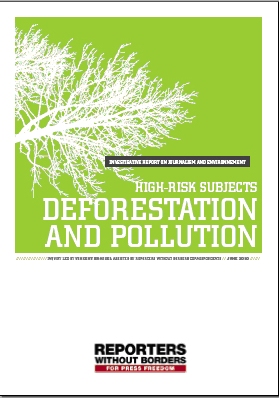
This week, on the eve of World Environment Day (5 June), RSF released a new report titled Deforestation and pollution: High-risk subjects. It makes grim reading for all of us who are committed to journalism as if the planet mattered.

It follows and echoes their call last year: “We must defend journalists who expose attacks on the environment”.

The new report, the second of its kind within just a few months from RSF, was prepared with the help of its worldwide network of correspondents. They gathered information about incidents in Indonesia, Argentina, El Salvador, Gabon, India, Azerbaijan, China and Morocco. Behind each of these threats and attacks, there were big corporations, criminal gangs or government officials who had been corrupted by money from mining or logging.

Asia features prominently in the report, which condemns the responsibility of the Vietnamese and Chinese governments in serious press freedom violations that deprive the public of crucial information about cases of pollution or deforestation.

The report describes, for example, the way the government in Hanoi has tried to suppress any debate about the environmental impact of bauxite mines being operated by a Chinese company. A field investigation in Argentina established that journalists are under pressure from both supporters and opponents of a mining project.

Mining companies (Aluminium Corp of China, China Metallurgical Group and the Canadian companies Yamana Gold and Pacific Rim), oil companies (Shell, Addax and Synopec), wood pulp companies (Sinar Mas and Riau Andalan Pulp and Paper) and two French multinationals (Bollor and Areva) are all identified in this report as having a direct or indirect role in cases of intimidation or censorship.

This is the second report that RSF has published on this subject. In September 2009, a report titled “The dangers for journalists who expose environmental issues.“, looked at 15 cases of journalists and bloggers who had been killed, attacked, jailed, threatened or censored for covering environmental problems in Russia, Cambodia, Bulgaria and Brazil.

RSF this week reiterated the appeal it launched during last December’s Copenhagen Summit: The media are needed to gather information and disseminate it to the public. Where climate change was concerned, it reminded everyone one, it was the media who helped to establish credible, independent diagnoses of the state of our planet. Their analyses continue to play a crucial role in helping decision-makers to adopt policies and rules that will lead to the desired changes.

On this blog, we have consistently highlighted the need for safeguarding journalists who pursue environmental stories that threaten vested interests within and across borders. For example:

September 2009: Who will protect journalists fighting for a better planet?

November 2007: Protect journalists who fight for social and environmental justice!

In April 2007, we asked: Can journalists save the planet? Yes, they can be front-runners in the world’s attempts to save species, habitats and entire ecosystems. But only if the rest of society protects and stands by them. When our planetary house is on fire, shooting the messenger isn’t going to save anyone.

7 ‘ups’: A rough guide to engaging social media in the public interest

Depictions of social media: Conversations Prism (left) and Social Media Starfish

As I wrote in an earlier blog post, in the of social media, we need to be as daring and adventurous as Sinbad. Like the legendary sailor of Baghdad, we have to take our chances and venture into unknown seas. Instead of maps or GPS or other tools, we must rely on our ingenuity, intuition and imagination.

During his seven voyages in the Indian Ocean, Sinbad had fantastic adventures going to magical places, surviving assorted monsters, and encountering a host of supernatural phenomena. Armed simply with his guts, wits and wanderlust, he sailed to places where no man had gone before, and certainly none had returned alive from!

Preparing for my Beijing session last week on using social media to communicate in the public interest, I did a good deal of web browsing and online reading. I came across many attempts to map or visually depict the social media (including two shown above). I also found some interesting lists and guidelines – my favourite so far is 10 Things Your Grandmother can Teach You about Social Media.

This inspired me to come up with my own rough guide to get you started and keep you going. As a salute to Sinbad’s seven voyages, I call it the 7-‘ups’.

Turn up. As Woody Allen famously remarked, eighty per cent of success is just…showing up. You won’t get anywhere by simply observing or critiquing from the sidelines. You have to wade in and set sail — for better or worse.

• Once we join the planetary conversation, we need to do some catch up. Find your feet – and niche – in the online world. The Internet turned 40 in 2009, and its graphical interface – the World Wide Web – is now 20. So much has happened in that time – and a lot has also been superseded. You need to know what’s on, and what’s not.

What's your winning combination?
• After catching up, we also need to keep up — at least with the mega trends. Large companies like Google – as well as hundreds of individual geeks – keep releasing new applications frequently, many for free use. Popular websites (such as Wired, Mashable and their local equivalents) help us navigate through these depths and currents.

• Next one is harder. We have to give up our baggage of old habits and attitudes picked up over the years. For many Digital Immigrants, leaving the comfort zone of paper was scary enough. How can we let go of complete control over our communication products and processes? But that’s just what the social media demand. It’s not a choice, but an imperative.

• It’s also helpful – though not quite essential – if we are less glum, prim, exacting and academic in how we relate to others in social media. In short, ease up, mate! There are some basic norms for online behaviour, but crusty intellectuals or matronly bureaucrats don’t gain much traction. Keep things short, focused and simple. And hey, it’s okay to be funny, cheeky and irreverent…

• Conversations in this realm can last for weeks, months or longer. Some topics and discussions tend to have ‘long tails’. When we start something online, we have to be clear when to engage whom and how. Equally important is knowing when to shut up. (A bore is a bore, offline or online!).

• And if all this is making you feel dizzy…just cheer up: there are no real experts in this field. No one is an authority. Everything is ‘in beta’. We are all learning by doing. Neither is there a definitive road map to the social media world. In fact, in this partly Undiscovered Country, there is plenty of scope to explore, innovate and be original.

Are you a land-lubber who doesn’t trust any seas? Let me then offer you another metaphor. Think of this as hitchhiking or back-packing online. Take your chances. Be adventurous. Discover a whole new world!

We have some advantages over Sinbad. The virtual world poses no real danger to our lives. But beware: social media can be very time-consuming and even addictive.

You have been warned.

Here, for some edu-tainment, is an interesting video on social media that I found on…YouTube:

A more compact version of the 7-Ups appears in MediaHelpingMedia

Sinbad in Beijing: How to tame the many-headed hydra called Social Media

Sinbad: The legend endures, entertains...and inspires!

I have always been intrigued by the tales of Sinbad the legendary sailor. My interest is heightened by living in Serendib, destination of Sinbad’s sixth journey, which is modern-day Sri Lanka.

Being a professional story teller, I always try to connect the old world with the new. So in Beijing this week, I proposed: In the brave new world of social media, we need to be as daring and adventurous as Sinbad.

Like the legendary sailor of Baghdad, we have to take our chances and venture into unknown seas. Instead of maps or GPS or other tools, we must rely on our ingenuity, intuition and imagination.

And we have to be prepared for a potentially perilous journey where we may be lost, shipwrecked or even sunk. On the other hand, with careful planning, hard work and some luck, we may well sail into calmer seas and discover new lands and treasures – just like Sinbad did.

One thing is for sure: it’s not for the faint-hearted. There are no guarantees of success, and certainly no travel insurance…Are we ready to take the plunge?

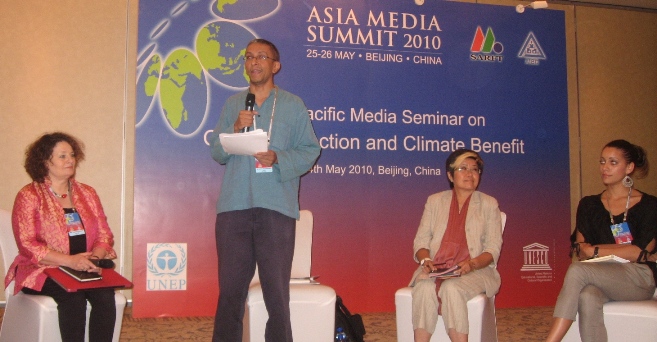
This was the thrust of my opening remarks to a panel on social media that I moderated at the Asia Media Summit 2010 in Beijing, China, this week. The panel was part of the Asia-Pacific Media Seminar on Ozone Protection and Climate Benefit, one of several pre-Summit events held on 24 May 2010.

L to R: Pauline Couture, Nalaka Gunawardene (speaking), Chutharat Thanapaisarnkit and Minna Epps

My enthusiasm for social media was not dampened by the fact that some key social media platforms were not accessible from the Chinese capital because they are officially blocked. Ah, if we aren’t allowed to walk the talk, we story tellers can still talk the talk, right?

In my opening remarks, I added:

Those of us working on development, humanitarian or social issues always have plenty of public interest messages to communicate. We are also keen to amplify grassroots voices so that policy-makers and business leaders would get a reality check.

The social media present many opportunities for all this. They offer us the potential for not just outreach, but sustained engagement. The development community has long wished for more interactive and participatory communications tools. The social media do precisely this! There’s no longer any excuse for not jumping in…

I then added the caution: It’s a big pond, and keeps getting bigger and deeper by the day. Social media is a basket that includes a lot more than (the more visible and controversial) Facebook and YouTube. According to the Wikipedia (itself an example), social media is a collective term to describe online media that is based on two key attributes: conversations, and interactions between people.

One of the many strange creatures that Sinbad encountered on his journeys was the Hydra — a many-headed serpent (or dragon). Chop one off, and two would grow instantly — a bit like how new social media applications are popping up these days!

Modern-day Sinbads have plenty of new horizons and uncharted waters to explore. Yes, it can be cacophonous, confusing, dizzy and even a bit frivolous at times. Hey, so is the real world! We need discernment in both worlds.

Social media started with the geeks, but soon spilled over to involve the rest of us. How can we — the non-geeks — come to terms with this new realm? How do we find our niche that makes us more effective communicators and agents of social change? The key to engaging this bewildering world of social media is to…just do it. And see what works.

I also introduced my own rough guide to get started and keep going in using social media for communicating public interest content. As a salute to Sinbad’s seven voyages, I call it the 7-‘ups’.

MediaHelpingMedia has just published my 7-Ups Rough Guide to using social media.

Appeal to climate reporters everywhere: Don’t follow the Climate Circus!

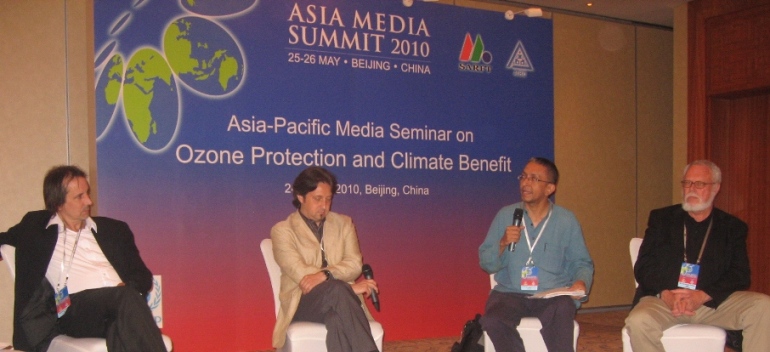
L to R: Sam Labudde (EIA); Eric Soulier (Canal France International); Nalaka Gunawardene (speaking); and Durwood Zaelke (IGSD)

Every year, a couple of weeks before Christmas, a big Climate Circus takes place. The venue city keeps changing, but the process is always the same: it attracts thousands of people – from government officials and scientists to activists and journalists – who huddle in various corners, chat endlessly and gripe often during two chaotic weeks. Then they disperse, rather unhappy with the process…only to return to more of the same a year later.

This is how I see the annual Conference of Parties (COP) of the UN Climate Convention, or UNFCCC. Their last big ‘circus’ was in Copenhagen, Denmark — when the world held its breath for a breakthrough in measures to reduce greenhouse gas emissions that warm up the planet. But, as with many previous conferences, Copenhagen over-promised and under-delivered.

The next COP is to take place in Cancún, Mexico, in December 2010. We can expect more of the same.

I’m not always this cynical. I’m certainly not a climate skeptic or climate change denialist. But I came to this conclusion after covering climate change stories for over 20 years, and having seen the kind of distraction the annual Climate Circus can produce on the media coverage and fellow journalists.

My contention: COPs were intended for treaty-signing governments to come together, bicker among themselves and make slow, painful and incremental progress on what needs to be done to address the massive problems of global climate change. While the core of these conferences remains just that, over the years they have gathered so much else — side events that now completely outweigh the political conference, and often overshadow it. I’m not convinced that this is where the real climate stories are, for discerning journalists.

I made these observations in some plain speaking done during a panel at the Asia Media Summit 2010 in Beijing, China, this week. The occasion was the Asia-Pacific Media Seminar on Ozone Protection and Climate Benefit, one of several pre-Summit events held on 24 May 2010 — and the only one on an environmental issue or topic.

I was on the last panel for the day, which looked at the next “hot” ozone and climate related stories. We were asked to give our views on: what are the great stories on the road to COP16 in Mexico at the end of the year?

Forget Cancun, I said. We already know how little it’s going to change the status quo. Why bother with that promises to be a non-event? Must we be this concerned with non-stories in our media coverage? In fact, I suggested: we should give the entire UNFCCC processes a couple of years of benign neglect. The real climate stories are not in the unmanageable chaos that the annual Climate Circuses have become. They are out there in the real world.

In the real world where frontline states and communities are already bearing the brunt of extreme weather…where green energy is making rapid advances…where communities and economies are trying to figure out how to live with climate change impacts even as they reduce their greenhouse gas emissions.

There are plenty of climate stories out there, covering the full range of journalistic interests: human interest, human enterprise, innovation, scientific research, community resilience and others. The challenge to journalists and other climate communicators is to go out there, unearth the untold stories, and bring them out in whatever media, forum or other platform.

I have nothing against climate COPs per se, and hope they can be restored to their original purpose of climate negotiations and working out acceptable, practical ways forward. (And this is certainly not a case of sour grapes: I’ve turned down all-expenses-paid invitations to COPs more than once.)

But we need to be concerned about the Climate Circus Effect on media, activist and educator groups, who seem to dissipate a good deal of their limited energies and resources in turning up at these mega-events. Copenhagen is said to have attracted over 17,000 persons (over 3,000 among them accredited journalists). How much of fruitful interaction and sharing can happen in such a setting? And when all the major news networks and wire services are covering the key negotiations and activities in considerable detail, what more can individual journalists capture and report to their home audiences?

Living as we do on a warming planet, we are challenged on many fronts to question old habits, and change our business-as-usual. The media pack has been running after the Climate Circus for over a dozen years. We need to pause, take stock and ask ourselves: is this the best way to cover the climate story?

And while at it, here’s something else for the UN, conveners of the annual Climate Circus. On World Environment Day 2008, whose theme was ‘CO2: Kick the Habit’, I asked the UN to kick its own CO2 habit. I suggested: “Adopt and strictly observe for a year or two a moratorium on all large UN gatherings (no matter what they are called – Summits, conferences, symposia, meetings, etc.) that involve more than 500 persons. In this day and age of advanced telecommunications, it is possible to consult widely without always bringing people physically together….Practising what you preach has a strong moral persuasive power — even if it goes against addictive habits formed for over 60 years of the UN’s history.”

PS: A global, comprehensive and legally-binding agreement on climate change is unlikely to be delivered at this year’s (Cancun) conference as well, the outgoing head of the UNFCCC, Yvo de Boer, was reported as saying on 27 May, just a few days after our Beijing seminar. See what I mean?

What’s the point? Taking a break in search of answers…

This Blogger has gone in search of answers. Back...whenever

“The long run is a misleading guide to current affairs. In the long run we are all dead.” – John Maynard Keynes

I’m taking a break from blogging and other forms of public engagement. When I come up for fresh air, I might occasionally tweet – see the twitter feed on the right hand column for such output, but again, don’t bank on it. I have to sort out some Big Ideas in my mind, and seek answers to compelling questions.

Every blogger needs a break. This is mine. We’ll be back as soon as….inspiration permits.

Meanwhile, read this essay that asks – and answers – the Big Question: Is Life Worth Living?

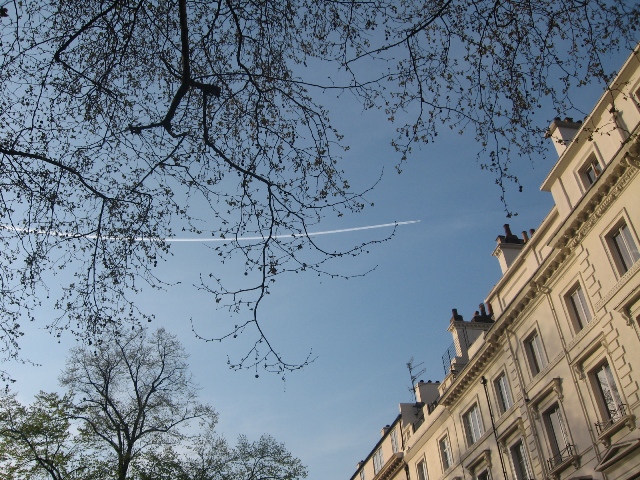
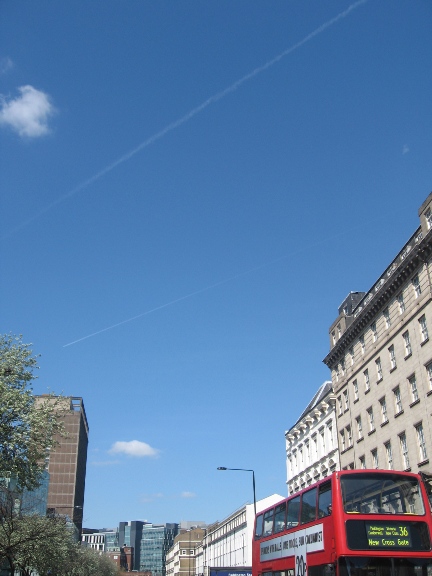
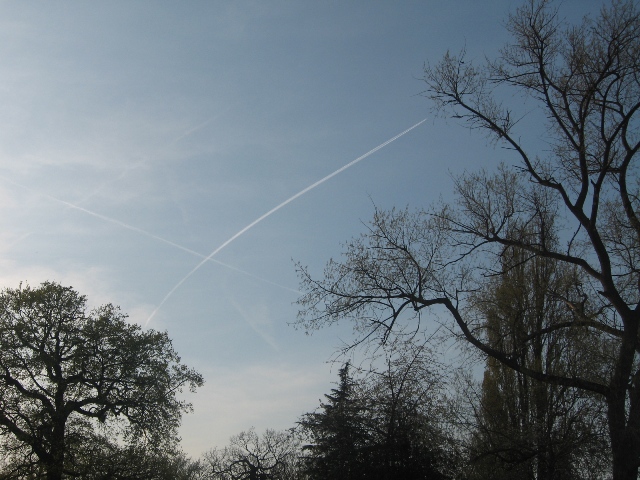
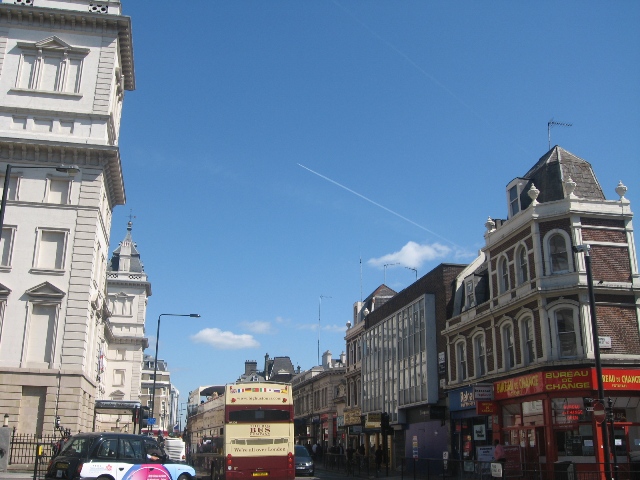
London: The skies are alive again with…planes and vapour trails!

With the British air space being reopened last night for flying after six days, the skies over London roared back to life today, 21 April 2010. It was the first full day of flight operations since the airborne ash from Eyjaffjalljokull (a glacial volcano in Iceland) triggered the first ever shut down of air space over Britain – and later several other countries in western Europe.

Stranded with tens of thousands of other air travellers in London, I’ve been watching the situation unfold and following the debate between airlines, British Met Office and the aviation regulator (which ordered the shut down on safety grounds on April 16).

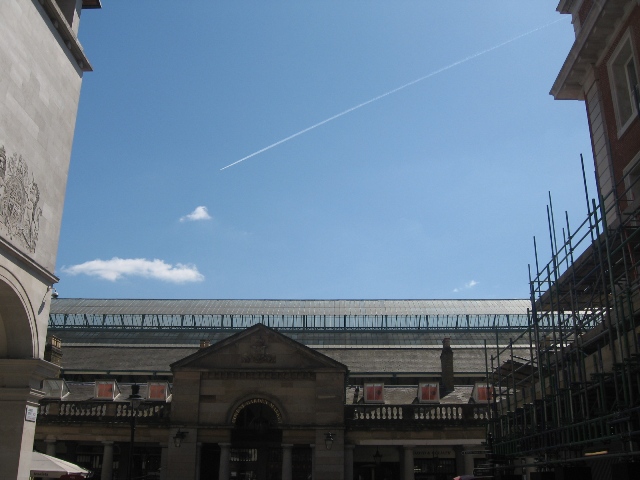
London (and much of Britain) rolled out near-perfect Spring weather in the past few days — clear blue skies and warm, sunny days. But one thing was conspicuously missing: no aeroplanes flying overhead, and no vapour trails drawing temporary lines in the sky.

Vapour trails mark the return of flights to London skies, 21 April 2010
Contrails (“condensation trails”) or vapour trails are artificial ‘clouds’ made by condensed water from the exhaust of aircraft engines. As the hot exhaust gases cool in the surrounding air, they sometimes (but not always) produce a ‘cloud’ of microscopic water droplets.

Today, the planes and their vapour trails were back in abundance. It looked almost as if the trails were the airline industry’s way of sticking their tongue out at the aviation regulator, who is now under immense public and media pressure over its conduct in this incident.

The Evening Standard today ran its front page photo of Andrew Haines, head of the British Civil Aviation Authority whose decision is estimated to have caused losses totalling over one billion Pounds to travel industry and others dependent on air travel services. Their headline: “The man who shut the skies: Aviation chief accused of flights ban blunder”

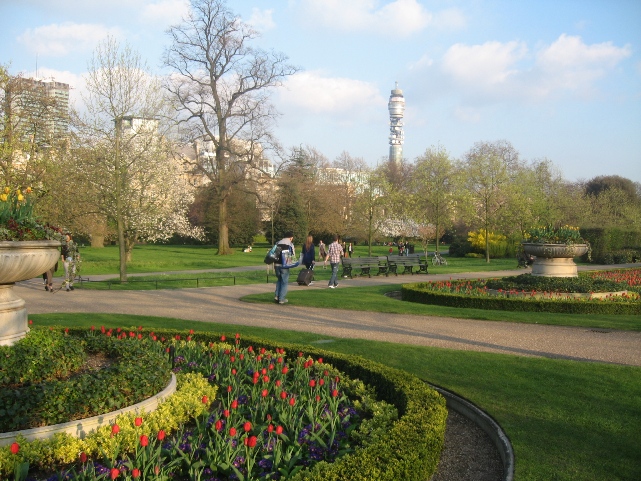
That debate will rage on for many days to come. Meanwhile, I’m hoping I can fly back home, belatedly yet soon. While waiting to hear that news, I walked around Central London today clicking images of life on the ground and vapour trails across the lovely blue skies. Here are a few — taken in Leicester Square, Convent Garden, Paddington and Hyde Park.

Vapour trails over Hyde Park London, 21 April 2010
London skies over Paddington, 21 April 2010
London skies over Convent Garden, 21 April 2010

Remembering Saneeya Hussain of Absurdistan, five years on…

Saneeya Hussain (1954 - 2005)
Exactly five years ago today, journalist and activist Saneeya Hussain left us. Hers was a needless death that left a deep impression in numerous friends she had around the world. We still remember.

We remember Saneeya as a journalist who took a special interest in environment and human rights issues. All her working life, she campaigned tirelessly for a cleaner, safer and more equitable society for everyone, everywhere.

We remember Saneeya as one who supported pluralism – not just in her own country Pakistan, but everywhere. She hated autocrats and military dictators. She spoke out and wrote against unfair domination and agenda setting by a handful of (usually graying) men. She had the courage to suggest re-naming her country as Absurdistan!

We remember Saneeya as a fun-loving, easy-going if slightly absent-minded friend. She wasn’t the most organised person, but was diligent and relentless on causes and issues that she passionately believed in.

Saneeya’s worldwide network of friends have keep her flame alive, and this blog post is as much a tribute to them as it is for Saneeya. Officially, the Saneeya Hussain Trustcontinues her vision and mission.

In fact, the chairperson of the trust (and Saneeya’s mother) Najma Hussain just wrote us a group email, saying: “Let’s share happy memories of Saneeya and celebrate her life.”

She asked: “If you have any anecdotes to share with us please write back. We will love to hear from you.” Saneeya Hussain Trust can be contacted here.

Read my blog post written on Saneeya’s second death anniversary, 20 April 2007, for more of my own memories

Our mutual friend Beena Sarwar has made a 14-minute documentary called Celebrating Saneeya. Here’s the shorter version available on YouTube:

Celebrating Saneeya (August 2005; 14 mins; language: English; Filmed in Karachi, Pakistan, with archives and footage from Brazil, South Africa and Nepal)

Synopsis: Saneeya, with her joyful laugh, lightness of spirit, striking height and long hair, embodied “feminism” and “women’s rights” in the most un-dogmatic way. Living life on her own terms, she countered the trends that militate against women’s individual freedoms in Pakistan. During the repressive years of military dictator General Ziaul Haq she worked as a journalist and was active in the women’s movement that defied the military rule. She also pioneered environmental journalism in Pakistan. Later, while working with the World Commission on Dams in South Africa she met a Brazilian geographer eleven years her junior. Their love story transcended age, culture, religion and nationalities.

In 2004, a severe allergic reaction stopped Saneeya’s breathing and her breathing stopped during a traffic jam in Sao Paulo, preventing her from reaching the hospital in time and sending her into a coma. This documentary is a celebration of her life and all that she stood for, through interviews with her husband, family and friends, and archive material. Sticker on Saneeya’s fridge: “Life is uncertain, eat dessert first”.

Read more about Saneeya Hussain on the trust website

Prisoners of Volcano Eyjaffjalljokull: ‘Tectonic Terror’ grounds much of Europe

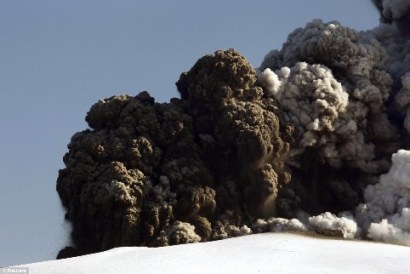
Eyjaffjalljokull erupting away in Iceland
Call it the cough heard around the world.

And boy, what a cough – and with what consequences!

A week ago, most of us had never heard of Eyjaffjalljokull (a glacial volcano in Iceland) — and we’re still struggling to pronounce its name even as it keeps tens of millions of people completely grounded and held ‘hostage’ with its incessant and powerful coughing.

My daughter Dhara and I are currently ‘trapped’ in London: a volcanic ash cloud from Iceland shut down all flights in and over the British Isles on Thursday 15 April 2010. The siege has continued on to the fifth day now, disrupting travel plans of so many people, and causing massive losses to the travel industry. With over 150,000 Britons stranded abroad unable to fly back, the UK is now going into emergency mode to deal with the crisis.

It’s annoying to have an unknown – and unpronounceable! – natural factor crop up and change our carefully laid plans. But things could have been much worse. As I tweeted earlier, as natural disasters go, volcanic ash has been highly disruptive but with no casualties except economic (at least so far).

Life goes on in London: Regent's Park, 17 April 2010
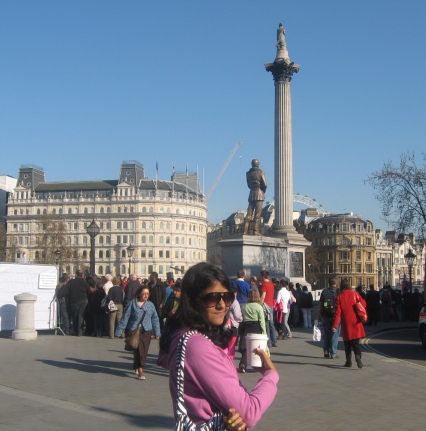
Life in London goes on with no visible signs of concern. Dhara and I walked around absorbing the sights, sounds and smells of London, and people were going about with life – and welcoming Spring. Joggers in Hyde Park and Regent’s Park, babies being strolled around, and weekend revelers at Camden Town and Trafalgar Square.

We mixed into all these crowds – it’s Dhara’s first time, so she’s wondering what the fuss is all about! (If you’ve traveled with an energetic teenager, you know what I’m coping with.) Yes, we are being ‘held hostage’, but by an ever-so-gentle force that’s invisible to the naked eye: as if in compensation, London has rolled out sunny blue skies (long may they last!). On balance, I’d rather be caught in this kind of situation than in a devastating earthquake or tsunami…

The British media are covering the unfolding situation in great detail, but I haven’t yet seen an estimate of the number of visitors to the UK forced to stay on as there is no current escape from these islands, at least by air. But that number must be significant – and each one has his or her story to tell, some more desperate than others.

Take, for example, my friend Nadia El-Awady, who was in London for the same annual board meeting of SciDev.Net (and now grounded with the rest of the Board!). She has four young children waiting for her at home, in Cairo. She’s been blogging and tweeting about her plight, which in many ways mirrors my own.

Nadia is being adventurous (or just taking her chances). She is planning to take train or ferry or any other means to France, and then catch a train to southern Europe whose airspace is not yet affected by volcanic ash. Her determination is admirable – she just won’t allow this remote volcano to keep her hostage (she call it Eyja: “Do not expect me to ever know its full name. What kind of parent names their son Eyjafjallajoekull?”).

Dhara at Trafalgar Square, 18 April 2010
Meanwhile, Dhara and I will hold out for a couple of days more to see if the skies will clear up and the aviation regulators will ease up. As time passes and the flight suspension begins to bite hard, more and more aviation industry professionals are questioning the complete no-fly ban. Some are calling it a regulatory over-reaction.

Richard North, co-author of Scared To Death – From BSE To Global Warming: Why Scares Are Costing Us The Earth, had an excellent piece in The Mail on Sunday this weekend. He wrote: “What we are witnessing here is not a natural law, enshrined since time immemorial but a policy drawn up by the International Civil Aviation Organisation (ICAO) and then interpreted and enforced by the UK’s National Air Traffic Service (NATS). And that interpretation requires some scrutiny.”

He adds: “The blanket ban under clear blue skies and glorious sunshine is making some wonder whether this ‘one-size-fits-all’ regulation is appropriate to a situation that the regulations did not foresee…In the final analysis, despite the scares, no one has actually been killed in a volcano incident – something which cannot be said for the much more hazardous drive to the airport.”

Meanwhile, the journal Science has unearthed (no pun intended) from its archives an article published in November 2004 about an enormous volcanic eruption from Iceland’s past — and what it means for the country’s future. It looks at researchers studying one of the largest and least appreciated eruptions in recorded history: volcano Laki that killed 10,000 Icelanders in 1783, and according to recent studies, its billowing plumes led to extreme weather and extensive illness that may have claimed thousands more lives in Britain and on the European continent.

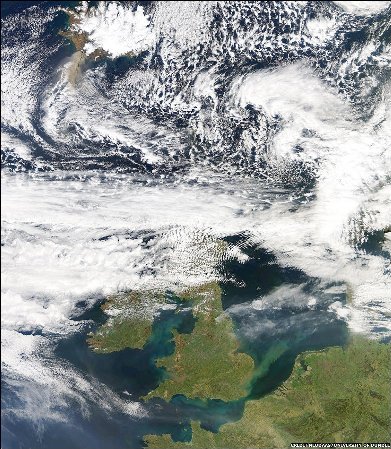
An image made available by NEODAAS/University of Dundee which shows the volcanic ash plume from Iceland, top left, to northern France as pictured by Nasa\'s Terra Satellite on 17 April 2010. Photo courtesy NEODAAS/University of Dundee/AP
It’s not exactly a comforting thought to read how much worse a volcanic eruption could be. The piece was written by science writer Richard Stone (currently their Asia News Editor, and my fellow panelist at the science journalists conference last Summer in London). Interestingly, the headline I gave to that blog post was: Reporting disasters: How to keep a cool head when all hell breaks loose.

Well, easier said than done! It’s challenging for us journalists to keep a level head and report or comment on a mega-disaster for our media. But it’s even harder being caught up and personally affected by forces of Nature (and according Richard North, regulatory over-reaction). I’ve had my house flooded out, and was close enough to ground zero of the 2004 Asian Tsunami. On both occasions, the impact was brutal and immediate.

Eyja’s persistent coughing is different. It’s a distributed, slowly unfolding phenomenon with zero casualties so far, yet affecting millions. At one level, local residents can continue life’s routines with no threat of basic amenities of life being shattered. We travelers can grumble and remain nervous when we can get home, but at the streets of London are nothing like what the doomsday scenario shows in The Children of Men, placed in a near-future London of 2027.

But as Eyja’s strangely gentle yet firm siege continues – succeeding in closing down Britain’s air space in a way that Hitler and Bin Laden couldn’t – we are reminded of who is really in charge.

When Avatar (creator) meets Amazon (tribes)…

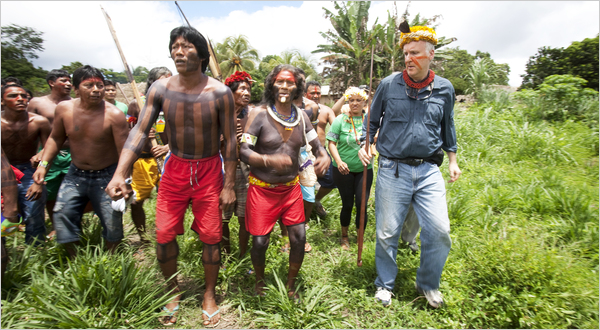
James Cameron in the Amazon - Photo by André Vieira for The New York Times

This encounter was bound to happen: Hollywood movie director James Cameron, creator of the blockbuster movie Avatar, meets a group of indigenous tribes in the Brazilian Amazon.

But this wasn’t part of a movie plot or promotional stunt: Cameron took time off to make his first ever visit to the Amazon because of a real world environmental cause.

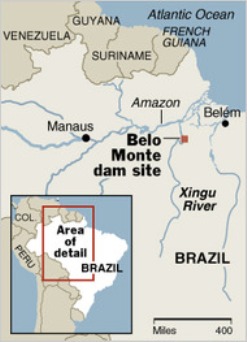
He was visiting Volta Grande Do Xingu last week to discuss the Belo Monte dam being planned by the Brazilian government. According to The New York times: “It would be the third largest in the world, and environmentalists say it would flood hundreds of square miles of the Amazon and dry up a 60-mile stretch of the Xingu River, devastating the indigenous communities that live along it. For years the project was on the shelf, but the government now plans to hold an April 20 auction to award contracts for its construction.”

Map courtesy The New York Times
The dam is a “quintessential example of the type of thing we are showing in ‘Avatar’ — the collision of a technological civilization’s vision for progress at the expense of the natural world and the cultures of the indigenous people that live there,” the newspaper quotes Cameron as saying.

Cameron had derived inspiration from decades long struggles to save the Amazon, but he didn’t know of this specific project until recently. Apparently he first became aware of the issue in February 2010, when he was presented with a letter from advocacy organizations and Native American groups saying they wanted Mr. Cameron to highlight “the real Pandoras in the world”.

Read the full story in The New York Times, 10 April 2010: Tribes of Amazon Find an Ally Out of ‘Avatar’

As I noted in my first comments on Avatar in January 2010: “It looks as if Cameron has made the ultimate DIY allegory movie: he gives us the template into which any one of us can add our favourite injustice or underdog tale — and stir well. Then sit back and enjoy while good triumphs over evil, and the military-industrial complex is beaten by ten-foot-tall, blue-skinned natives brandishing little more than bows and arrows (and with a little help from Ma Nature). If only it works that way in real life…”

A few days later, I followed up with another post I titled Avatar unfolds in the Amazon – a comparison with an investigative documentary, Crude: The Real Price of Oil, made by Joe Berlinger, which chronicles the epic battle to hold oil giant Chevron (formerly Texaco) accountable for its systematic contamination of the Ecuadorian Amazon – an environmental tragedy that experts call “the Rainforest Chernobyl.”

And now, within weeks, the Avatar-maker and Amazon-savers have joined hands!

Watch this space…

See also October 2009 blog post: Adrian Cowell and ‘The Decade of Destruction’: A film can make a difference!