Remastered Star Trek – The Original Series (TOS): A treasure worth waiting for!

I haven’t been blogging much during April. One reason is that I’ve been travelling across space — and time.

I was in London for 10 days, and with its lovely Spring weather, I had every reason to be offline. I’ve also been spending a good deal of time back in 1966-67, and having a great deal of fun doing so. (The 1960s had a charm of their own that’s never been repeated…)

Let me explain. I’ve been watching the digitally remastered original Star Trek episodes, which had their first broadcast in that now far-away year — the same year I was born. And what an exhilerating experience to go back to these superbly crafted stories: they offer me both timeless mental stimulation and a sentimental journey to my own childhood/boyhood.

I’d heard of the digitally remastered DVDs’ release a couple of years ago, and was delighted when I found the last copy of Season 2 in a DVD store in Amsterdam in late March. The remastered episodes look and sound crisp, thanks to digitally restored imagery and audio. But the more daring work involved updating the shows’ visual effects with CGI to bring them more in line with the look and quality of later Trek efforts. That’s proving to be a real treasure – well worth waiting for…

As the promotional blurb reads on Amazon.com: “Star Trek, the NBC series that premiered on 6 September 1966, has become a touchstone of international popular culture. It struggled through three seasons that included cancellation and last-minute revival, and turned its creator, Gene Roddenberry, into the progenitor of an intergalactic phenomenon. Eventually expanding to encompass five separate TV series, an ongoing slate of feature films, and a fan base larger than the population of many third-world countries, the Star Trek universe began not with a Big Bang but with a cautious experiment in network TV programming. Even before its premiere episode (“The Man Trap”) was aired, Star Trek had struggled to attain warp-drive velocity, barely making it into the fall ’66 NBC lineup.”
To boldly go where no man has gone before...

As I’ve said before, I’m as old as Star Trek: we were born a few months apart in 1966 (I’m older by seven months). But because we grew up on opposite sides of planet Earth in the pre-Internet era, our worlds didn’t collide until we were both well into our teens.

I have vivid memories of that delightful first encounter, which changed the course of my life forever. In mid or late 1982, Sri Lanka’s newly launched national TV channel Rupavahini started airing a space adventure series called Star Trek. Although I was already familiar with Star Wars movies (of which two had been made by then), I’d not heard about Star Trek until the publicity accompanying the local broadcast.

Star Trek (the original series, now abbreviated as TOS) aired on my local TV – we had just two channels back then – on Wednesdays from 7 to 8 pm, which was prime time just before the evening news at 8. I remember the series ran for at least a year, during which time around 50 episodes were broadcast. I managed to watch most of them.

That wasn’t as easy as it sounds. Our household didn’t yet have a television set, so I had to go across to my aunt’s house next door to watch Star Trek. My school teacher parents took a long time to warm up to the new medium – we didn’t acquire a TV set until early 1983, almost four years after TV was introduced to Sri Lanka in April 1979. And because they placed such emphasis on studies, I was allowed only an hour of television per week. I have absolutely no regrets that while it lasted, I devoted my entire weekly TV quota for Star Trek.

So every week at the appointed time, the United Star Ship Enterprise and its intrepid crew took my young mind roaming around the universe, providing me a welcome escape from the dull and monotonous routine of my teenhood. Even today, hundreds of movies and many thousands of TV hours later, I can just close my eyes and instantly replay in my mind the evocative theme narration and music of Star Trek TOS:

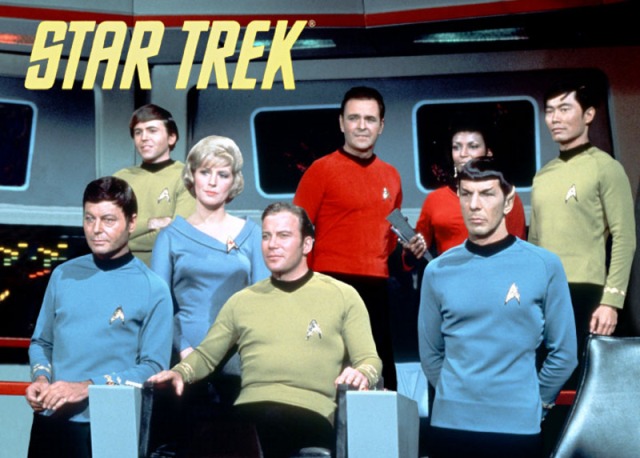
I sat awestruck by the adventures of Captain James T Kirk (played by William Shatner), First Officer Spock (Leonard Nimoy), chief engineer Lieutenant Commander Montgomery Scott (James Doohan), Dr. Leonard “Bones” McCoy (DeForest Kelley), Communications Officer Uhura (Nichelle Nichols) and others. The stories appealed to me as much for insights into the infinite possibilities (and combinations) of life, technology and power at a cosmic scale, as for the glimpses of the near-Utopian human society in the 23rd century.

See May 2009 blog post: Star Trek: Advocating a world of equality, tolerance and compassion

The series was already 15 years old, and it was showing signs of age. It had the faded Technicolor look and feel of films and TV programmes made in the 1960s and 1970s. The sets were basic and special effects appeared simple — computer-generated images (CGI) was not yet invented. On such technical merits, Star Trek TOS appears elementary when compared to the original Star Wars movie that would roll out just a decade later, in 1977. (A decade is a very long time in the entertainment industry.)

But what the series lacked in looks, the show more than made up in its brilliant story lines and rich imagination. Inadequacies in production values didn’t really matter to me — or to millions of other ‘Trekkies‘ scattered across the planet. The storylines were entertaining and mind-stretching, frequently carrying concepts distilled from the finest in science fiction literature (in fact, some of the genre’s accomplished writers were involved in writing stories for the series, e.g. Robert Bloch, Normal Spinrad, Harlan Ellison and Theodore Sturgeon). The characters were strong, diverse and played by actors who soon developed global fan clubs of their own.

And now, I can relive those journeys again — this time at my leisure, packing as many, or as few, into my private screening schedule. No broadcaster or parent holds me captive any more.

Here’s how the digitally remastered version of the same series opens (aficionados, please spot the differences):

And here are a couple of comparisons between the old and remastered versions that fans have done and released on YouTube:

Of course, remastering a series held in such awe and regard by millions of fans worldwide was a calculated risk.

As Wired noted in a December 2008 story: When Star Trek designer Mike Okuda began remastering the original Star Trek episodes for a series of DVD releases, there was a chance that the show’s more devoted fans would want him beamed to a Klingon prison planet for altering the 1960s classic. To guard against this, Okuda insisted that the new effects would have to be closely based on the originals to retain the visual spirit of the ’60s series.

Wired, December 2008: Star Trek Tweaker Talks Perils of Remastering Original Series

We’re grateful to Mike Okuda and everyone else on the remastering team for giving us the best of both worlds.

Star Trek designer Mike Okuda

Desiderata: Happiness is a journey, not just a destination…

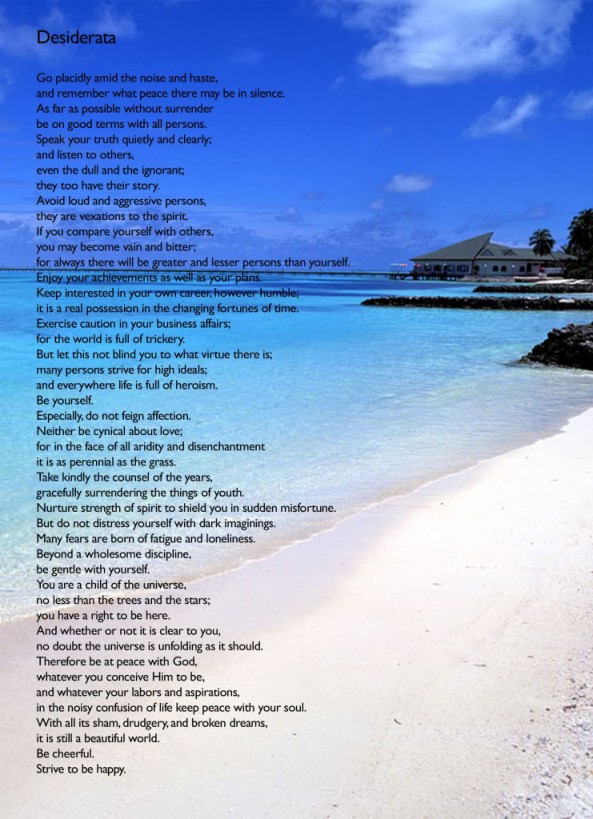
“Desiderata” is Latin for “desired things”, and the plural of desideratum. Desiderata is also the title of a famous prose poem written by Max Ehrmann an American spiritual writer and attorney.

It captures his thoughts about attaining happiness in life. Its universal and timeless sentiments have resonated with people all over the world. As with the ‘Chief Seattle speech‘, another urban legend has emerged suggesting that this poem was “found” at Old St. Paul’s Church in Baltimore and is as old as 1692.

But in this instance, the Church itself has clarified Ehrmann actually wrote it himself and copyrighted it in 1927.

None of this takes away from the beauty and profundity of the poem. Living in a world full of clutter and noise, I find much comfort in this. Here’s one illustrated version I found online:

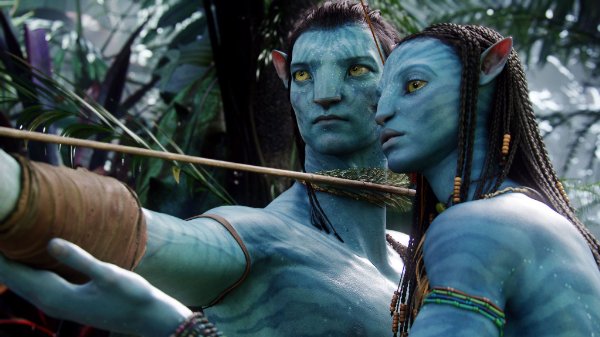
‘Avatar’ unfolds in the Amazon: Find out the Real Price of Oil!

This is no Avatar: It's Real!
A few days ago, reviewing the blockbuster movie Avatar, I wrote: “Film critics and social commentators around the world have noticed the many layers of allegory in the film. Interestingly, depending on where you come from, the movie’s underlying ‘message’ can be different: anti-war, pro-environment, anti-Big Oil, anti-mining, pro-indigenous people, and finally, anti-colonial or anti-American. Or All of the Above…”

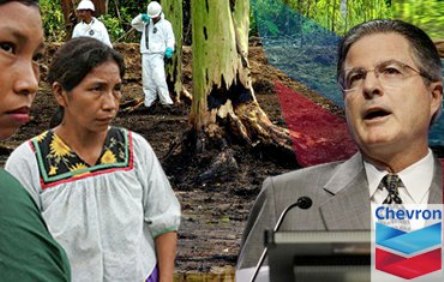
Indeed, an Avatar-like struggle is unfolding in the Amazon forest right now. The online campaigning group Avaaz have called it a ‘Chernobyl in the Amazon’. According to them: “Oil giant Chevron is facing defeat in a lawsuit by the people of the Ecuadorian Amazon, seeking redress for its dumping billions of gallons of poisonous waste in the rainforest.”

From 1964 to 1990, Avaaz claims, Chevron-owned Texaco deliberately dumped billions of gallons of toxic waste from their oil fields in Ecuador’s Amazon — then pulled out without properly cleaning up the pollution they caused.

In their call to action, they go on to say: “But the oil multinational has launched a last-ditch, dirty lobbying effort to derail the people’s case for holding polluters to account. Chevron’s new chief executive John Watson knows his brand is under fire – let’s turn up the global heat.”

Avaaz have an online petition urging Chevron to clean up their toxic legacy, which is to be delivered directly to the company´s headquarters, their shareholders and the US media. I have just signed it.

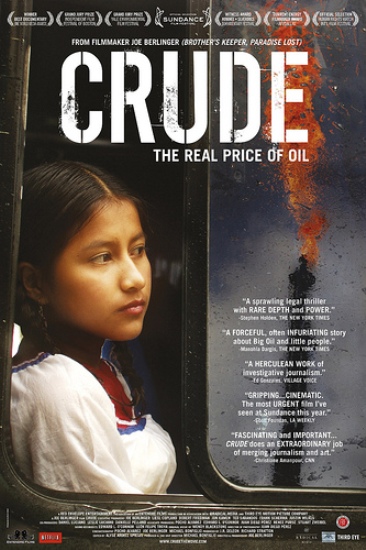
Others have been highlighting this real life struggle for many months. Chief among them is the documentary CRUDE: The Real Price of Oil, made by Joe Berlinger.

The award-winning film, which had its World Premiere at the 2009 Sundance Film Festival, chronicles the epic battle to hold oil giant Chevron (formerly Texaco) accountable for its systematic contamination of the Ecuadorian Amazon – an environmental tragedy that experts call “the Rainforest Chernobyl.”

Here’s the official blurb: Three years in the making, this cinéma-vérité feature from acclaimed filmmaker Joe Berlinger is the epic story of one of the largest and most controversial legal cases on the planet. An inside look at the infamous $27 billion Amazon Chernobyl case, CRUDE is a real-life high stakes legal drama set against a backdrop of the environmental movement, global politics, celebrity activism, human rights advocacy, the media, multinational corporate power, and rapidly-disappearing indigenous cultures. Presenting a complex situation from multiple viewpoints, the film subverts the conventions of advocacy filmmaking as it examines a complicated situation from all angles while bringing an important story of environmental peril and human suffering into focus.

Watch the official trailer of Crude: The Real Price of Oil

According to Amazon Watch website: “With key support from Amazon Watch and our Clean Up Ecuador campaign, people are coming together to promote (and see) this incredible film, and then provide ways for viewers to support the struggle highlighted so powerfully by the film.”

They go on to say: “A victory for the Ecuadorian plaintiffs in the lawsuit will send shock waves through corporate boardrooms around the world, invigorating communities fighting against injustice by oil companies. The success of our campaign can change how the oil industry operates by sending a clear signal that they will be held financially liable for their abuses.”

While Avatar‘s story unfolds in imaginary planet Pandora — conjured up by James Cameron’s imagination and created, to a large part, with astonishing special effects, the story of Crude is every bit real and right here on Earth. If one tenth of those who go to see Avatar end up also watching Crude, that should build up much awareness on the equally brutal and reckless conduct of Big Oil companies.

Civilisation's ultimate addiction?

Others have been making the same point. One of them is Erik Assadourian, a Senior Researcher at Worldwatch Institute, whom I met at the Greenaccord Forum in Viterbo, Italy, in November 2009.

He recently blogged: “The Ecuadorians aren’t 10-feet tall or blue, and cannot literally connect with the spirit of the Earth (Pachamama as Ecuadorians call this or Eywa as the Na’vi call the spirit that stems from their planet’s life) but they are as utterly dependent—both culturally and physically—on the forest ecosystem in which they live and are just as exploited by those that see the forest as only being valuable as a container for the resources stored beneath it.”

Erik continues: “Both movies were fantastic reminders of human short-sightedness, one as an epic myth in which one of the invading warriors awakens to his power, becomes champion of the exploited tribe and saves the planet from the oppressors; the other as a less exciting but highly detailed chronicle of the reality of modern battles—organizers, lawyers, and celebrities today have become the warriors, shamans, and chieftains of earlier times.”

Avatar: Blockbuster film as socio-political and green allegory?


“Pictures are for entertainment, messages should be delivered by Western Union.”

Those words by American film producer and studio founder Sam Goldwyn (1879-1974) sum up Hollywood’s attitude to movie-making for the past many decades.

As I watched James Cameron’s latest blockbuster movie Avatar, I kept wondering how the master film maker managed to subvert this so completely. Beneath the 3D, special effects and riot of other worldly colours, the movie is one long (2 hrs 40 mins) and powerful commentary on why might is not right when it comes to exploiting resources — belonging to other countries, people, or as in this case, other worlds.

This is not just another worthy indie movie made by an idealistic movie maker defiant of Hollywood traditions and big money. James Cameron is one of the most commercially successful directors in the mainstream film industry – and perhaps one of the very few who can get away with this kind of stunt. At a budget of over US$ 300 million , Avatar is one of the most expensive films ever made, and the costliest ever for 20th Century Fox.

The big gamble is certainly paying off. On 26 January 2010 came the news that Avatar has surpassed Titanic as the highest-grossing movie worldwide. According to the studio, worldwide box office total for Avatar at that point stood at US$1.859 billion, beating the US$1.843 billion racked up by Cameron’s romantic drama in 1997-98. Avatar broke that record in a little over six weeks.

Part of the reason for such appeal is the extraordinary special effects: it’s an action-packed thriller where good and evil battle it out on another planet. The strange landscapes give it a video game like feel, but no small screen can match the theatrical experience, especially if you watch it in IMAX 3D (I didn’t). And for a change, this time the aliens inhabiting planet Pandora are benign, while it’s the humans who are ruthless invaders and brutal killers. Well, at least most of the time…

Here’s the official blurb: “Avatar takes us to a spectacular world beyond imagination, where a reluctant hero embarks on an epic adventure, ultimately fighting to save the alien world he has learned to call home. James Cameron, the Oscar-winning director of Titanic, first conceived the film 15 years ago, when the means to realize his vision did not exist yet. Now, after four years of production, AVATAR, a live action film with a new generation of special effects, delivers a fully immersive cinematic experience of a new kind, where the revolutionary technology invented to make the film disappears into the emotion of the characters and the sweep of the story.”

And here’s AVATAR – Official International Launch Trailer (HD)

Film critics and social commentators around the world have noticed the many layers of allegory in the film. Interestingly, depending on where you come from, the movie’s underlying ‘message’ can be different: anti-war, pro-environment, anti-Big Oil, anti-mining, pro-indigenous people, and finally, anti-colonial or anti-American. Or All of the Above…

It looks as if Cameron has made the ultimate DIY allegory movie: he gives us the template into which any one of us can add our favourite injustice or underdog tale — and stir well. Then sit back and enjoy while good triumphs over evil, and the military-industrial complex is beaten by ten-foot-tall, blue-skinned natives brandishing little more than bows and arrows (and with a little help from Ma Nature). If only it works that way in real life…

But the multi-purpose allegory is apparently working well. Take these two from opposite sides of the planet:

Thomas Eddlem wrote in The New American: “Avatar, is a visually stunning epic that is a perfect allegory for any of a dozen or more Indian wars in American history. From King Philip’s War in New England to Tippecanoe in Indiana to Horseshoe Bend in Alabama — and all the way across the American continent, for that matter — the story was the same. Colonists simply take land from the natives, as the Sully explains: ‘This is how it’s done. When people are sitting on something that you want, you make them your enemy so that you can drive them out.’

Mayank Shekhar wrote in The Hindustan Times newspaper: “Between a green worldview and the globe’s war over a natural resource, James Cameron’s twin analogies of present-day politics are fairly complete. They lend his science fiction ‘event picture’ a certain soul, even if not much of a story line.”

So did Cameron set out trying to send a message? Or was it all an incidental byproduct? Listen to the director himself in these two online video stories:

James Cameron’s Vision Featurette

CBS Interview with James Cameron: From Titanic to Avatar

The most compelling social commentary on Avatar I have so far read comes from Naomi Wolf, the American political activist, author and social critic. In an op ed essay written for Project Syndicate, she sees two revealing themes in Avatar: “the raw, guilty template of the American unconscious in the context of the ‘war on terror’ and late-stage corporate imperialism, and a critical portrayal of America – for the first time ever in a Hollywood blockbuster – from the point of view of the rest of the world.”

She adds: “In the Hollywood tradition, of course, the American hero fighting an indigenous enemy is innocent and moral, a reluctant warrior bringing democracy, or at least justice, to feral savages. In Avatar , the core themes highlight everything that has gone wrong with Americans’ view of themselves in relation to their country’s foreign policy.”

Does the box office triumph of Avatar make James Cameron one of the most effective campaigners for social justice on the planet (comparable, in some ways, to Michael Jackson having been one of the biggest environmental communicators of his time)?

And is Avatar the most expensive piece of info-tainment or edu-tainment ever made, just like the Lord of the Rings trilogy was one long (even if unintended) commercial for the breathtaking sights and sounds of New Zealand?

Certainly, mixing messages with entertainment is such a difficult and delicate art that most people who dabble in it fall between the two stools. The entertainment value of Cameron’s latest flick is not in question. Granted, it’s not as heart-breaking as Titanic, and the storyline is oh-so-predictable. But 3D and SFX magic alone can’t hold today’s audiences gripped for 160 long minutes. And if the underlying story starts movie-goers thinking and talking about many parallels between the fictional world of Pandora and our own Earth, he’s certainly getting somewhere.

As Naomi Wolf says: “Ironically, Avatar will probably do more to exhume Americans’ suppressed knowledge about the shallowness of their national mythology in the face of their oppressive presence in the rest of the world than any amount of editorializing, college courses, or even protest from outside America’s borders. But I am not complaining about this. Hollywood is that powerful. But, in the case of Avatar , the power of American filmmaking has for once been directed toward American self-knowledge rather than American escapism.”

Perhaps this wasn’t part of the script, but would the executives at 20th Century Fox care as they laugh all the way to their bank?

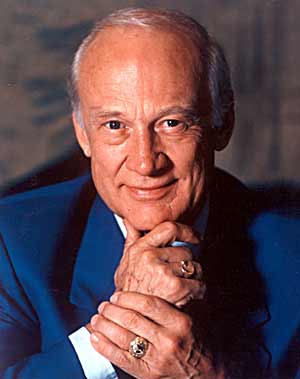
Buzz Aldrin at 80: Still blasting off imagination everyday

Moonwalker No 2

This is one of history’s most famous photographs – and also one that is frequently misidentified. The man behind the space mask is a pioneer Moon walker – but it’s not Neil Armstrong. It’s the Buzz Aldrin, the second Man on the Moon.

According to space historians, all the famous photos from the first Moon landing are actually of Aldrin, with Armstrong reflected in the visor. This is an occupational hazard for those who take photos!

Buzz, who celebrated his 80th birthday on January 20, remains active and publicly engaged as he has been for most of the past 40 years since the first Moon landing in July 1969.

I’m following Buzz on his Twitter feed, from which I find that he’s just back from a trip to Antarctica with a National Geographic cruise, was at the premiere for the movie Avatar in mid December, and is now busy promoting his latest autobiography, Magnificent Desolation.

On his 80th birthday, Buzz asked fans to donate US$8 ot 80 to the Clinton-Bush Haiti Fund. And he will soon launch my iPhone App, Buzz Aldrin Portal to Science and Space Exploration.

This contrasts with Neil Armstrong, who is notoriously shy. He rarely speaks in public, turns down all media interviews and has also refused autograph requests since 1994.

Trained as an engineer, the two-time space traveller Buzz has been keeping up with new media pretty well. He has his own website, and launched his own YouTube channel only a month ago, where we can see his latest broadcast and film appearances. Through these and other means, he continues to promote causes like space exploration, science education and nurturing imagination.

To mark his 80th birthday, we present some of the many Buzz Aldrin videos available online.

First, here’s the moment when Buzz Aldrin set foot on the Moon, in a partial restoration by NASA Video

Here’s the DVD Promo Overview of the latest Buzz video:

On the 40th anniversary of the Apollo 11 crew landing on the moon, former astronaut Buzz Aldrin shares his experience and predicts where man will go in the future. (Assciated Press video, 20 July 2009)

Buzz has long years of close association with popular culture. For example, the popular space ranger character Buzz Lightyear, in Pixar’s Toy Story movie series, is named after him. Apparently the film’s makers felt that he has “the coolest name of any astronaut.”

NASA video: Follow Buzz Lightyear on Spaceship Discovery

Finally, for comic relief, here’s the 2003 interview Buzz did with Ali G (Sacha Baron Cohen) in the British comedy series Ali G in da USA, during which Ali G referred to him as Buzz Lightyear:

P.S.: If you prefer a more detached look at the man and his career:
The Guardian, July 2009: The Man who fell to Earth

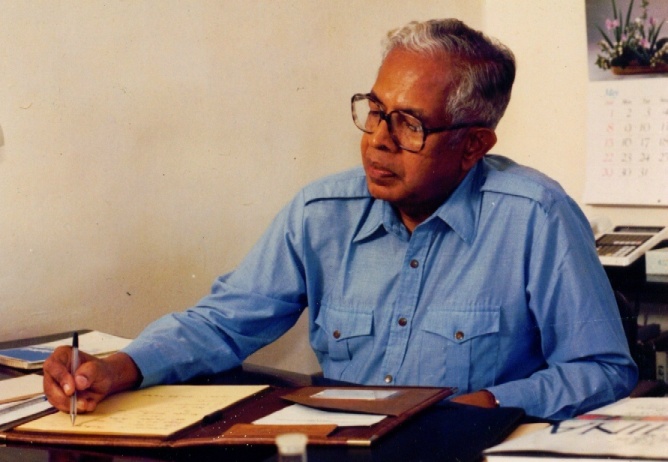
Remembering Dr Cyril Ponnamperuma: Inspirational maverick of Sri Lankan science

Dr Cyril Ponnamperuma: erudite, cultured and articulate

On 20 December 2009, we mark the 15th death anniversary of Professor Cyril Ponnamperuma, one of the best known scientists produced by Sri Lanka during the Twentieth Century.

I grew up reading about him in school text books as a living icon of modern science: a developing country scientist whose brilliance and hard work took him to the highest echelons of global science, and one who was respected in the West and East.

He was both an internationally recognised researcher on the origins of life on Earth, and an early promoter of science and technology for development. His interests and involvements transcended his own discipline and homeland. He worked closely with the Pakistani Nobel laureate Dr Abdus Salam to promote science and infrastructural facilities in developing countries.

I focus on the few years from 1984 to 1990, when he served as science and technology advisor to two Presidents of Sri Lanka. Concurrently, he served as director of the Institute of Fundamental Sciences (IFS) from 1984 to 1990, and was also founder director of the Arthur C Clarke Centre for Modern Technologies (ACCCMT) from 1984 to 1986. In these positions, he worked simultaneously on several fronts covering science policy, institutional building, fund raising, capacity building and public engagement.

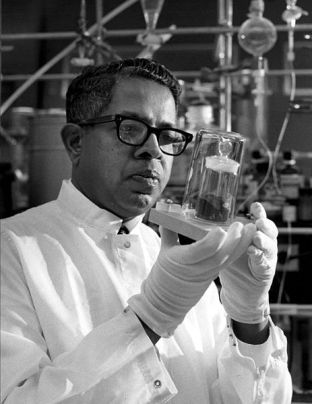
Dr Cyril Ponnamperuma analyzing a moon sample at NASA
I’ve just written a tribute, recalling my own interactions with him in the last 1980s, when he was dividing time between Sri Lanka and the US. It’s published online at Groundviews website.

As I note: “Erudite, cultured and articulate, Ponnamperuma was a journalist’s dream: he could sum up complex issues in simple and engaging terms and metaphors — but these were more than mere soundbites. He was full of insights and anecdotes that humanised both science and its practitioners.”

After looking back at his accomplishments and failures of his Sri Lanka years, I contend: “His biggest accomplishment — and lasting legacy — was not so much buildings, laboratories or institutions, but sparking off the interest in science among thousands of young people. That is much harder to achieve, and also impossible to quantify in Rupee or Dollar terms…”

In this essay, I recall both his accomplishments and failures. I ask why his passion for public science was not shared by many fellow scientists in Sri Lanka, who wanted to remain aloof of non-scientists and the community. Ponnamperuma’s tried to bridge this gap, and for this sin he was harassed and driven out of Sri Lanka and back to the United States where he returned to his research and teaching to the very end of his life.

“Chemistry is the ‘other woman’ in my life,” Ponnamperuma used to joke. It was while working at his university office in the US that he suffered cardiac arrest and rushed to a Washington hospital, where he passed away on 20 December 1994. He was 71. His sudden death came as a shock to all those whose lives and careers were touched, influenced and inspired by him.

Read my full essay:
Dr. Cyril Ponnamperuma (1923-1994): A Passionate Champion of Public Science

BigShot: A little camera with a Big potential — inspired by a film!

BigShot: Inspiration with every click?
“Build a better mousetrap, and the world will beat a path to your door.” This remark is attributed to one of my favourite essayists and philosophers, Ralph Waldo Emerson.

That was probably true for the 19th century in which he lived and died, but it takes a bit more than a mousetrap to generate a buzz these days. But simple and elegant inventions are still the best. BigShot is one of these.

It’s still in testing stage, but already being hailed as “a camera that could improve the way children learn about science and one another”.

BigShot is an innovation by Indian-born Shree K. Nayar, now the T. C. Chang Professor of Computer Science at Columbia University in New York, USA.

As his university’s newspaper reports: “He came up with a prototype as sleek as an iPod and as tactile as a Lego set: the Bigshot digital camera. It comes as a kit, allowing children as young as eight to assemble a device as sophisticated as the kind grown-ups use—complete with a flash and standard, 3-D and panoramic lenses—only cooler. Its color palette is inspired by M&Ms, a hand crank provides power even when there are no batteries and a transparent back panel shows the camera’s inner workings.”

With the BigShot, Nayar wants to not only empower children and encourage their creative vision, but also get them excited about science. Each building block of the camera is designed to teach a basic concept of physics: why light bends when it passes through a transparent object, how mechanical energy is converted into electrical energy, how a gear train works.

Watch Professor Shree Nayar talk about the purpose and development of the Bigshot camera project.

Nayar would like to roll out the camera, now in prototype form, along the lines of the One Laptop Per Child campaign: For each one sold at the full price of around $100, several would be donated to underprivileged schools in the United States and abroad. He will soon begin looking for a partner—a company or nonprofit—to help put Bigshot into production.

Life inspires innovation...
Wired magazine wrote in a recent review: “(It) is a super-simple digicam from the Computer Vision Lab at Columbia University. It comes in parts, ready to be assembled (by kids, but I can’t wait to get my hands on one), and teaches you along the way how these things work. It’s not quite the transparent view you get from making an old analog camera, where you can see how everything works, but it’s as close as you can get from a machine that uses circuit boards.”

Interestingly, the initial inspiration for BigShot came from a documentary: Born into Brothels (85 mins, 2004), a film about the children of prostitutes in Sonagachi, Kolkata’s red light district. The widely acclaimed film, written and directed by Zana Briski and Ross Kauffman, won a string of accolades including the Academy Award for Documentary Feature made in 2004.

I saw that film during the AIDS Film Festival I helped organise in Bangkok in July 2004. In this film, the film maker, British photographer Zana Briski, gave 35 mm film cameras to eight children and watched as those cameras transformed their lives.

“The film reaffirmed something I’ve believed for a long time, which is that the camera, as a piece of technology, has a very special place in society,” says Nayar. “It allows us to express ourselves and to communicate with each other in a very powerful way.”

Watch an overview of Born into Brothels, featuring the film makers:

‘Small Islands – Big Impact’ film making waves in the world’s Biggest Polluter…

Dilrukshi Handunnetti
Dilrukshi Handunnetti: Making waves
My good friend Dilrukshi Handunnetti, a leading investigative journalist in Sri Lanka, is currently on a Jefferson Fellowship traveling in the United States. She is one of a dozen journalists from the Asia Pacific who have been competitively chosen to participate in this prestigious programme, which in 2009 is focusing on the theme, The Right Climate for Confronting Climate Change?

I finished my latest climate film, Small Islands – Big Impact, only the day before Dilrukshi left for Hawaii, her first stop in the multi-destination, intensive programme. Given her long standing coverage of the Maldivian political affairs as well as Asian/global environmental issues, I gave her a DVD of the film to take along.

I’m delighted to hear that she has been showing Small Islands – Big Impact in various presentations, often producing a…big impact wherever it was shared. It’s always good to have such feedback — here’s an excerpt from an email she has just sent me from Boulder, Colorado:

“I liked presenting your short film and the response it generated. The film generated a discussion on promoting the concept of (climate) adaptation as a human right – just as I felt it would be such a catch phrase here. I also had the (media coverage of) the underwater Cabinet meeting with me. So Maldives got a lot of attention despite not having a Maldivian here.

“Several wanted to know about the actual risk level of the Maldives and the possibility of the islands being submerged. They also asked about purchasing land elsewhere and whether the Maldives had the financial capability to do that. Others wanted to know about depleting fish catch President Nasheed spoke about as this was a common concern to Indonesia, Southern India and Vietnam.

President Nasheed
President Nasheed: Stop pointing fingers, extend a helping hand...
“Some queried whether President Nasheed was going to Copenhagen to state his case. Two others asked whether lobby groups were behind his thinking. Several found, including American, Chinese and Indian participants, that President Nasheed’s call to end the blame game should be heeded by all. There was collective agreement that others’ behaviour impacted on the likes of President Nasheed and vulnerable communities.

“Interestingly, everyone found his interview a STORY. Something that they would want to report on in their respective media. We continue to discuss the same on our tours and walkathons from venue to venue for various meetings. In fact, I had the American participant asking our resource persons (IPCC types, no less!) whether they were willing to acknowledge the concept of climate refugees directly in relation to the Maldives.

“I think the movie served a great purpose of awakening the minds of many to the threat level faced by some communities on low lying coastal nations – like the pacific Islands and the Maldives. A senior broadcaster from the Tonga Broadcasting Corporation personally thanked me for wanting to highlight their plight as a small island nation.”

You can watch Small Islands – Big Impact online here:

Read the full text of my interview with President Nasheed on TVEAP website

As with all TVEAP films, this one too is available free of license fees and copyright restrictions to broadcast, civil society and educational users anywhere in the world. It’s now a year since I wrote a widely reproduced op ed essay on Planet before profit for climate change films — I practise what I preach!

A journalist for over 17 years, Dilrukshi Handunnetti has extensively covered politics, the environment, culture, and history and gender issues. In her current role, she writes the parliamentary column for the newspaper in addition to writing and editing investigative stories carried in her publication. Dilrukshi has also covered the ethnic conflict from a non-military perspective and written extensively on issues of good governance, graft and corruption. Dilrukshi is the recipient of many national journalism awards in Sri Lanka, including: the Young Reporter of the Year 2001, Best Environment Reporter of the year 2002, Best Environment Reporter of the year 2003, Best English Journalist of the Year 2004 (Merit) Award and D B Dhanapala Award for the Best English Journalist of the Year 2005, all presented by the Editors’ Guild of Sri Lanka.

In this extract from our 2005 film Deep Divide, Dilrukshi talks about Sri Lanka’s coastal resource development challenges before and after the 2004 Asian Tsunami:

Restored GAMPERALIYA: A cultural treasure saved from the elements

Gamperaliya-changement_au_village
Gamperaliya (1964): A Sri Lankan film classic
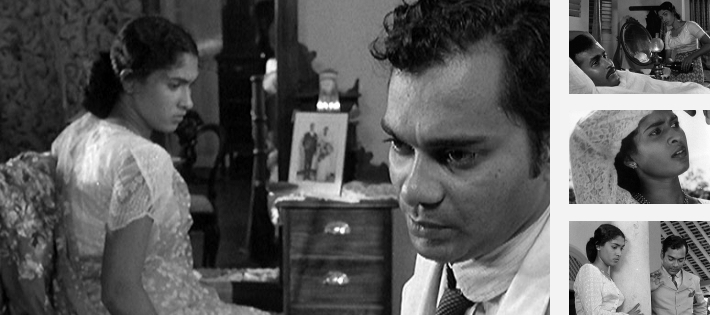
Last evening, at the gala opening of the European Film Festival in Colombo, I sat two rows in front of a living treasure of the Asian cinema and watched his recently restored 1964 cinematic masterpiece, a cultural treasure in its own right.

The doyen of the Lankan cinema, Lester James Peries, made Gamperaliya (Changes in the Village, 35mm, 108 minutes) based on the Sinhala novel of the same name, written by Martin Wickremasinghe, himself a leading light of Lankan literature during the 20th century.

The movie was groundbreaking in Sinhala cinema, and was shot entirely outside of a studio using one lamp and hand held lights for lighting (at a time when most films were still being made within studios). Although not an immediate commercial success, it was critically and internationally acclaimed, and won the Golden Peacock at the Grand Prix International Film Festival in India and the Golden Head of Palenque in Mexico, both in 1965. It was one of the first Lankan films to be internationally recognised.

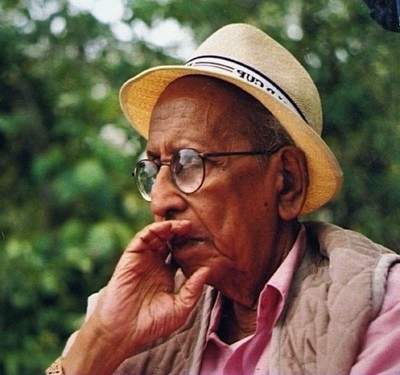
Lester James Peries
Lester: 20 feature films in a 50-year career...
Gamperaliya was the first independent film made in Sri Lanka. There was no film studio involvement, and the film maker and friends invested Lankan Rupees 170,000 to make it (roughly USD 30,000 at the time, although today the same amount of the much weaker Rupee converts to less than USD 1,500).

Critic David Chute wrote: “Gamperaliya launched a revolution, not only in the way films were made but also in content…[director] Peries sought an alternative to the Bollywood-influenced melodramas that dominated commercial cinema…With an elegant narrative style comparable to Satyajit Ray’s Apu Trilogy, [the film’s] aesthetic choices also have a moral dimension.”

Gamperaliya is two years older than myself, and although I’d watched it on television, I had never seen it in a cinema on a large screen with proper sound. It was a real treat. For nearly two hours, I was transported back to two periods of recent history: the newly independent Dominion of Ceylon (not yet renamed Sri Lanka) in the early 1960s when the film was made, and the early 20th century colonial Ceylon where the actual story takes place. To engage in such time travel in the company of the maestro film maker himself was a unique experience.

However, it was sobering to reflect how many who were involved in the creative effort to make Gamperaliya are no longer with us. Among them are screenplay writer Regi Siriwardena, actor Gamini Fonseka and co-producer Anton Wickremasinghe. It was only a few months ago that Tissa Abeysekera, who started his long and colourful association with the Lankan cinema by working as a dialogue writer and assistant director in Gamperaliya, abruptly departed.

Lester, who turned 90 in April 2009, was making a rare public appearance. We were told that this is only the second time he has ventured out since he retired from film-making two years ago. He looked a bit frail, but walked up and down the isle supported by his wife Sumitra Peries, his partner both in life and cinema.

In some ways, cine film is even more prone to the decay of elements than humans. Gamperaliya was almost totally lost. Last evening’s celebrated reunion of the master and his masterpiece was the outcome of a major restoration that involved substantial efforts and investments by concerned cinephiles on both sides of the Atlantic.

Gamperaliya was rescued from the brink of disaster. A few years ago, UNESCO launched a project to collate a World Heritage of cinema and selected another film of Lester’s, Nidhanaya (Treasure, 1972) as a work of art that should be preserved for future generations. But when Lester and UNESCO representatives went to the Sarasavi studio in Dalugama, north of Colombo, where almost all the films made in Lankan cinema are kept, they found that the master Negative (the Mother Copy from which fresh copies could be made) was burnt due to vinegar syndrome – a condition when negatives start deteriorating.

“This was not due to the failure of anybody in Dalugama studio or the National Film Corporation but due to the failure of all governments that came to power since 1956. The late journalist Ajith Samaranayake and many others fought for a film archive but we were not able to persuade any government,” the disappointed film maker was quoted as saying at the time.

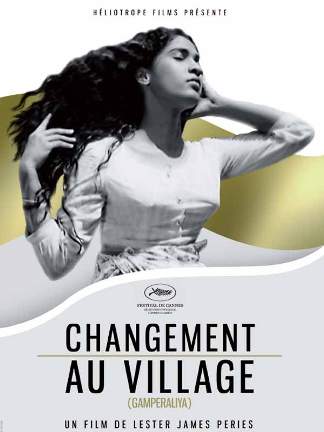
Gamperaliya French poster

This news reached Pierre Rissient, a French national and a guardian of Lankan cinema who is attached to ‘Pathe’ one of the biggest film companies in the world. He urged Lester to help restore the equally important film Gamperaliya, which was also in a state of decay but could still be salvaged.

In one email, Rissient wrote to Lester: “Dear Lester you made a great masterpiece, not only of the cinematography of your country but also universally. It is your duty to make possible this restoration; it is not for your friend Pierre, but for the world.”

So Pierre Rissient pursued this and arranged for it to be carried out at the film restoration unit of the University of California in Los Angeles (UCLA). The UCLA Film and Television Archive is the largest university-based collection of film and television materials in the world,

Some 14 sound reels and 14 picture reels of Gamperaliya, weighing 60 kilos, were couriered to UCLA in May 2007. The film was restored to the visual and audio perfection by Rob Stone and Jere Guldin. The restoration with latest digital sound and visual quality will enable the film to be shown all over the world after 45 years.

In May 2008, the restored Gamperaliya was screened at the Cannes Film Festival under the section ‘Restored Classics’.

At the time, Lester wrote to Pierre Rissient: “It is a tremendous campaign that made it possible for Gamperaliya to survive and your incredible faith in our film that made this miracle possible. We do hope and pray that there is no serious deterioration that will destroy any chances of a glorious restoration. Sumithra and I thank you and are joined by the Sri Lanka film industry for your valiant effort.”

And all of us movie lovers in Sri Lanka and across the world join them in this gratitude, for saving the cultural treasure that is Gamperaliya.

Essay by D B S Jeyaraj, April 2009: Lester James Peries – Liberator of Sinhala Cinema

New-and-improved Tinker Bell: UN’s latest Honorary Ambassador of Green

Tinker Bell and the Lost Treasure
Now she's green inside and out!

I always thought Tinker Bell was a bit green — with envy, that is. Peter Pan’s faithful fairy sidekick was far too possessive of him: every time another female appeared to get close, Tink would try to chase her away. She typifies the Jealous Female.

And now, Tinker Bell is very officially green, too: The United Nations has just named the Disney animated character Tinker Bell an “Honorary Ambassador of Green” to help promote environmental awareness among children.

The announcement came just prior to a screening at UN Headquarters in New York of the world premiere of the Walt Disney animated film, “Tinker Bell and the Lost Treasure.”

In the new movie, being released on DVD and BluRay on 27 October 2009, the feisty fairy first seen in 1953’s Peter Pan classic animation movie finally gets a makeover for her journey away from the magical land of Pixie Hollow.

The new and improved Tink looks more tomboyish: more of her body is covered in clothes, yet she still retains her curvy figure. “We wanted to make Tink as real as possible in Lost Treasure,” says director Klay Hall. “It made sense she was going to put on a jacket, leggings and boots. This is sort of a new phase for Tink, and the look brings her up to the current feeling we are trying to convey,” such as the belt she uses to carry items she needs.

Tomboyish yet curvy...“We’re delighted Tinker Bell has agreed to be our Honorary Ambassador of Green,” said Kiyo Akasaka, Under-Secretary-General for Communications and Public Information. “This beloved animated character can help us inspire kids and their parents to nurture nature and do what they can to take care of the environment.”

The UN event was intended to promote environmental awareness in the lead-up to the UN climate change conference in Copenhagen in December, where countries will aim to ‘seal the deal’ on a new global agreement to curb greenhouse gas emissions.

Protecting the environment is an underlying theme of the Tinker Bell movies, according to the UN Department of Public Information (DPI), which finds that the Walt Disney Company uses its storytelling to inspire a love of nature and spirit of conservation in its audience.

In the latest film, Tinker Bell’s greatest adventure takes place in autumn, as the fairies in Pixie Hollow are busy changing the colours of the leaves, tending to pumpkin patches and helping geese fly south for the winter. When Tinker Bell accidentally puts all of Pixie Hollow in jeopardy, she must venture out on a secret quest to set things right.

Tinker Bell Director Klay Hall, Producer Sean Lurie and cast members Mae Whitman (Tinker Bell) and Raven Symoné (Iridessa) were among those attending the premiere, hosted by DPI as part of the Secretary-General’s Creative Community Outreach Initiative.

The Initiative links the UN and producers, directors, writers and new media professionals seeking a working relationship with the world body with the goal of raising awareness of critical global issues.

Well, I can think of one Big Challenge for the creative community worldwide: find some way, any way, to ‘animate’ (i.e. bring to life!) the chronically dull and dour Ban Ki-Moon, Secretary General of the UN, who in his own admission is often invisible!

But hey, some feats are beyond even the most creative people! So just enjoy these two online videos…

Tinker Bell and The Lost Treasure: First 6 Minutes

Disney’s TinkerBell Named UN “HONORARY AMBASSADOR OF GREEN”