Being the fourth monkey?“Historically, organised and commercialised mass media have existed only in the past five centuries, since the first newspapers — as we know them — emerged in Europe. Before the printing press was invented, all news was local and there were few gatekeepers controlling its flow. Having evolved highly centralised systems of media for half a millennium, we are now returning to a second era of mass media — in the true sense of that term. Blogs, wikis and citizen journalism are all signs of things to come.”
This is how Sir Arthur C Clarke and I summed up the transformative change that is currently taking place in the world of mass media, in an essay we co-wrote for the Indian news magazine Outlook in October 2005.
We’d given it the title ‘From Citizen Kane to Citizen Journalist’ – a formulation that I’m still proud of – but the editors changed it to ‘Arise, Citizen Journalist!’. Of course, our original title made evocative sense only for those who knew the popular culture reference to the movie Citizen Kane.
I recently had a chance to revisit these issues and explore them further in a half-hour, in-depth TV interview with media researcher/activist and fellow citizen journalist Sanjana Hattotuwa. This was part of The Interview series produced by Young Asia Television, and broadcast on two Sri Lankan TV channels, TNL and ETV during the second week of February 2009.
Sanjana covered a wide range in his questions. Starting with a brief reflection on my 21-year association with Sir Arthur Clarke, we moved on to the bewildering world of new media and its co-existence with the mainstream media. We discussed the fragmentation of audience and the concern that some current and would-be bloggers harbour: is anyone listening or reading?
And more importantly, how do we get conversations started and going. I look back on my own experience as an active blogger for almost two years, and assert that if we have something new and worthwhile to say, and know how to express it well, we can slowly build up an audience. There’s no blueprint or road map – everything is in ‘beta’ mode, and the name of the game is try-it-and-see!
Here’s that full interview on YouTube, broken into four parts:
Sanjana Hattotuwa talks to Nalaka Gunawardene – Part 1 of 4:
Sanjana Hattotuwa talks to Nalaka Gunawardene – Part 2 of 4:
Sanjana Hattotuwa talks to Nalaka Gunawardene – Part 3 of 4:
Sanjana Hattotuwa talks to Nalaka Gunawardene – Part 4 of 4:
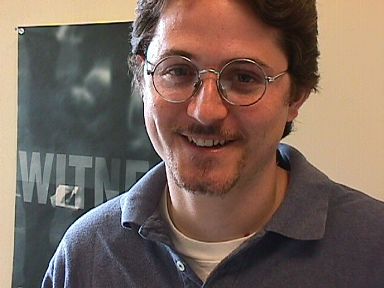
Sam Gregory“It’s an immensely exciting time for people working with video. More and more people creating and using video, more places to share it, more ways to place it in front of people who can make a difference.
“It raises challenges too: saturation of images and compassion-fatigue, finding your place to be heard, and the safety and security and consent issues that arise when many more people are filming each other.
“But overall I think we’re seeing a really powerful moment for individual expression but also collective accountability being supported via image-making.”
So says Sam Gregory programme director of Witness, a human rights organisation which uses video and online technologies to open the eyes of the world to human rights violations. The New York-anchored organisation works around the world to ’empower people to transform personal stories of abuse into powerful tools for justice, promoting public engagement and policy change’.
http://www.witness.orgSam recalls how he was once making films and also involved in activism, and ‘frustrated at how the two didn’t fit together’.
He adds: “In the traditional TV documentary world, the advocacy purpose of film was under-utilized. The fact that you got 500,000 viewers for a TV broadcast told you nothing about whether that turned into action. So I started looking for ways to really make the video fit as a tool for real advocacy and change-making, and came upon WITNESS.”
We at TVE Asia Pacific worked closely with Sam in 2002-2004, when we implemented a collaborative Asian regional project called Truth Talking where Witness was a partner. It was through Witness that I met courageous info activists like Joey R B Lozano.
Uncommon move, once again!This allows others to download, share, remix, subtitle and eventually rebroadcast (or webcast) the material originally gathered by Al Jazeera’s own reporters or freelancers. It has the potential to revolutionise how the media industry gathers and uses TV news and current affairs footage – a lucrative market where there are only a very few suppliers operating at global scale.
Al Jazeera’s uncommon sharing has started with the network’s coverage of the conflict in the Gaza strip, Palestine. Each day they plan to add the latest footage coming from Gaza. Additional Gaza footage from the start of the war is to be made available shortly.
This is the first time that video footage produced by a news broadcaster is released under the ‘Creative Commons 3.0 Attribution’ license which allows for commercial and non-commercial use.
“We have made available our exclusive Arabic and English video footage from the Gaza Strip produced by our correspondents and crews” says the introductory text in Al Jazeera Creative Commons Repository. “The ongoing war and crisis in Gaza, together with the scarcity of news footage available, make this repository a key resource for anyone.”
Gaza in darknessThe website adds: “This means that news outlets, filmmakers and bloggers will be able to easily share, remix, subtitle or reuse our footage.”
Under the Creative Commons framework, Al Jazeera seeks no payment (licensing fees) of any kind. Users are free to reuse the material with acknowledgement to Al Jazeera. This means such users must attribute the footage to Al Jazeera (“but not in any way that suggests that we endorse you or your use of our work”). They are also required to leave the Al Jazeera logos intact, give reference to the Al Jazeera Creative Commons Repository, and the ‘Creative Commons 3.0 Attribution’ license itself.
Says Joi Ito, CEO of Creative Commons: “Video news footage is an essential part of modern journalism. Providing material under a Creative Commons license to allow commercial and amateur users to share, edit, subtitle and cite video news is an enormous contribution to the global dialog around important events. Al Jazeera has set the example and the standard that we hope others will follow.”
Gaza under siege...Professor Lawrence Lessig, founder of Creative Commons, has hailed this initiative: “Al Jazeera is teaching an important lesson about how free speech gets built and supported. By providing a free resource for the world, the network is encouraging wider debate, and a richer understanding.”
Al Jazeera – which means ‘the island’ or ‘the peninsula’ in Arabic – started out in 1995 as the first independent Arabic news channel in the world dedicated to providing comprehensive television news and live debate for the Arab world. Al Jazeera English, the 24-hour English-language news and current affairs channel, was launched in 2006 and is headquartered in Doha, Qatar. The organisation is the world’s first global English language news channel to be headquartered in the Middle East.
Screams, amplified by media?But we have no hesitation in applauding their sharing of news footage. This move makes it easier for many television stations, websites and bloggers to access authentic moving images from the frontlines of news — we certainly hope Gaza marks only the beginning of AJ’s sharing.
It would also make commercial distributors of news and current affairs footage a bit nervous, for such material trades in hundreds or thousands of dollars per second. The logistical difficulties in gathering such footage, and sometimes the enormous risks involved to the news crews, partly explains the high cost. But the small number of suppliers and syndicators has made it possible for high prices to be maintained. If Al Jazeera sustains its sharing, that could mark the beginning of the end for another pillar of the mainstream media industry.
All images used in this blog post are courtesy Al Jazeera websites
A race against time: Moji Riba capturing living cultural heritage before it's too late...
When young Moji Riba started taking an interest in video cameras and filming, his father was a bit concerned.
“I don’t want my son to end up as a cameraman,” he said, reflecting on the fact that a videographer was considered to be no more than a skilled worker in some sections of Indian society.
He need not have worried. Moji went on to become both a well respected film maker and a teacher of mass communications. But more importantly, he has turned his skill into capturing and preserving the highly diverse cultures and traditions of his home state of Arunachal Pradesh in India’s north-east.
Working below the mainstream media’s radar and improvising with available resources, Moji has been engaged in this pursuit passionately and diligently for nearly a dozen years. These efforts finally came into global spotlight in November 2008 when he was selected for a prestigious Rolex Award for Enterprise.
Rolex recognised Moji for ‘helping to preserve and document the rich cultural heritage of India’s Arunachal Pradesh tribes’. He was among the 10 winners of the 2008 Rolex Awards, which for more than 30 years have supported pioneering work in science and medicine, technology and innovation, exploration and discovery, the environment and cultural heritage.
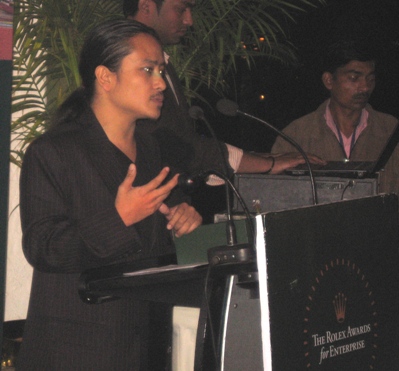
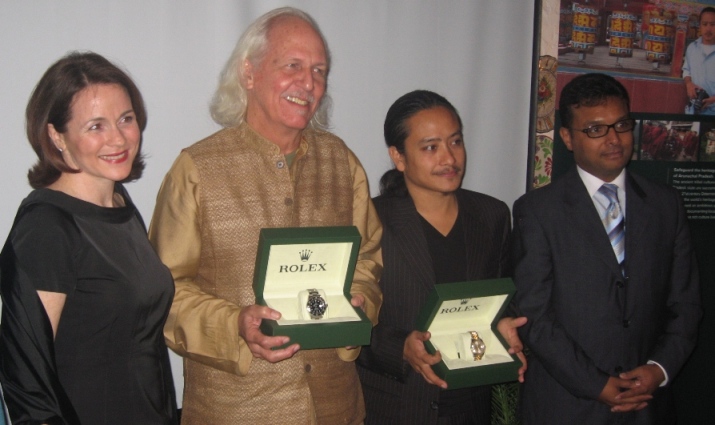
Moji Riba accepting Rolex Award 2008 in DelhiThe award was presented to him at a simple ceremony held in New Delhi on 22 January 2009. I was glad to be a ‘fly on the wall’ on that joyous occasion, when Moji and fellow winner Romulus Whitaker were felicitated.
Accepting his award certificate and Rolex chronometer, Moji said: “In the end, this award is not about material rewards. Our most important gain was the process of the application and evaluation which were so intense and demanding that we have had to go through a lot of introspection.”
He added: “That process made us pause and ask ourselves: why are we doing our work, are we doing it right and what results are we going to achieve. That was worth a great deal for us.”
In his short and witty acceptance speech, Moji thanked everyone who has believed and supported his team’s work. His wife Purnima and two young children were there, along with several friends some of who had especially flown in for the occasion. Moji acknowledged his father, who, alas, didn’t live to share this proud moment.
Through a rigorous and discerning selection process, Rolex Awards support path-breaking work in progress, giving laureates new momentum and recognition. In the 2008 award cycle, Moji was one of 10 enterprising individuals chosen from among nearly 1,500 applicants in 127 countries by an independent panel of scientists, educators, economists and other experts.
L to R: Barbara Geary of Rolex Awards secretariat, Romulus Whitaker, Moji Riba & Yogesh Shah, CEO of Rolex India
Enthused by the Rolex Award, Moji will return to pursue his most ambitious project yet to preserve the living cultural heritage of Arunachal Pradesh, home to 26 major tribal communities. Each one has its own distinctive dialect, lifestyle, faith, traditional practices and social mores. They live side by side with about 30 smaller communities. Moji sees this richness “like a wonderful shawl woven in a myriad of colours and patterns”.
In recent years, this heritage has come under pressure from economic development, improved means of communication, the exodus of the young and the gradual renunciation of animist beliefs for mainstream religions. Instead of challenging these larger processes beyond anybody’s control, Moji is trying to harness digital technology to capture at least the essence of it for posterity.
That’s the basic idea behind the Mountain Eye Project, an unconventional initiative of his Centre for Cultural Research and Documentation (CCRD) based in Naharlagun. Magic Eye aims to create a ‘cinematic time capsule’ documenting a year in the life of 15 different ethnic groups.
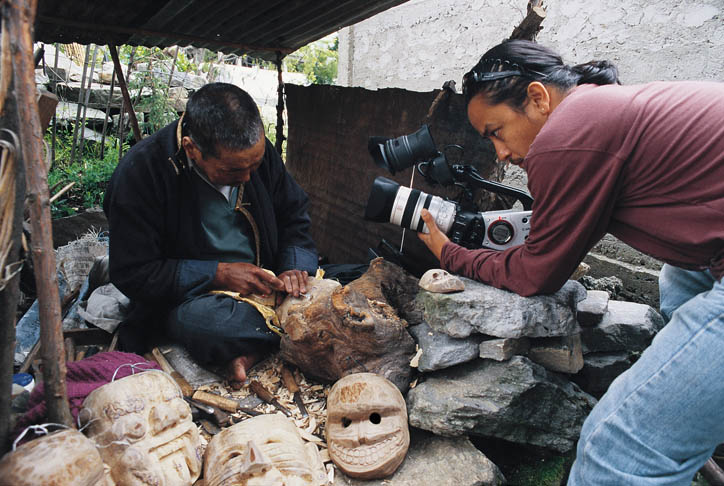
Moji will train young people from each community to do the filming. This gives him access to enough film-makers as well as access to people with an intimate understanding of village life. Beginning in early 2009, these novice film-makers will capture a broad range of the tribes’ oral histories, as well as the rituals, ceremonies and festivals that take place over a year in their villages.
Moji expects to collect about 300 hours of film per village, all of which will be recorded and archived in their native languages. He believes that the resulting 4,000+ hours of video will provide an invaluable record of life as it has been lived in his state for centuries. The project will also engage scholars belonging to the 15 tribes from the Rajiv Gandhi University at Itanagar to analyse and translate this vast amount of data and organize it in a publicly accessible database.
This innovative work epitomises the spirit of Rolex Awards, which nurture excellence in individuals who often work against many odds — determined women and men lighting a few candles on their own, instead of just cursing the darkness…
As I enjoyed the company of Moji, Romulus and their many admirers well into Delhi’s chilly evening, these words the Malaysian social and environmental activist Anwar Fazal kept turning in my mind: “In a world that is increasingly violent, wasteful and manipulative, every effort at developing islands of integrity, wells of hope and sparks of action must be welcomed, multiplied and linked…”
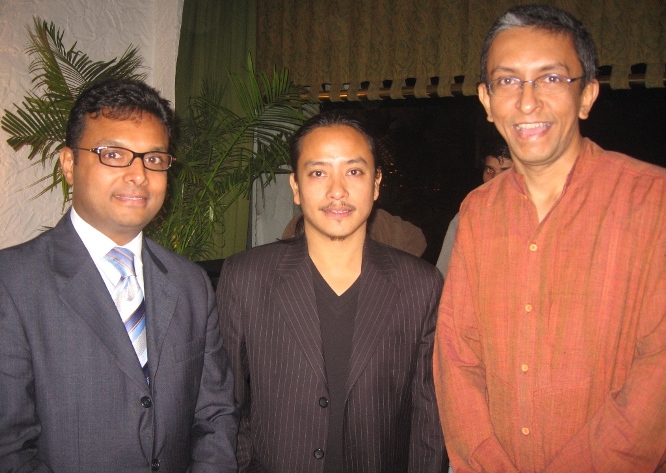
One more shot: L to R - Yogesh Shah, Moji Riba, Nalaka Gunawardene
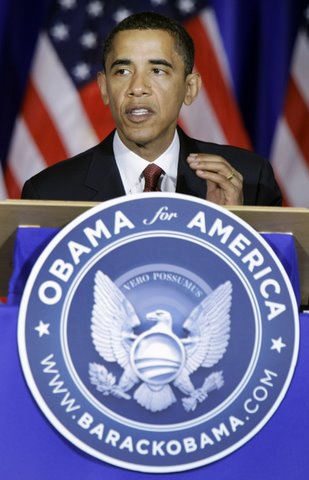
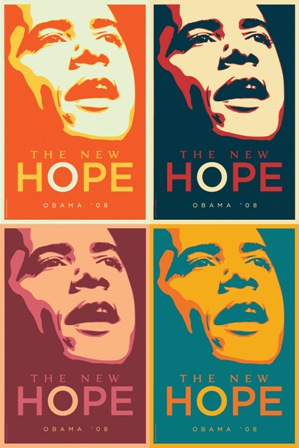
His own brand...Inauguration Day is finally here! Today, 20 January 2009, Barack Obama will be sworn in as the 44th President of the United States of America.
Obama campaigned – and won – on the core promise of change. And even before he moved into the White House, he achieved many firsts. Among them was being the first American leader to understand the power of new media and to use it effectively to harness both campaign contributions and, eventually, votes.
On 6 November 2008, soon after the election results were confirmed, we noted how Obama had just been elected ‘President of the New Media world’. I explained: “Obama’s rise has epitomised change in many ways. Among other things, he is the first elected leader of a major democracy who shows understanding and mastery over the New Media World, which is radically different from the old media order.”
Of course, others had different takes on the same outcome. One of the funniest was by The Onion, which proclaimed: Black Man Given Nation’s Worst Job.’ It read, in part: “African-American man Barack Obama, 47, was given the least-desirable job in the entire country Tuesday when he was elected president of the United States of America. In his new high-stress, low-reward position, Obama will be charged with such tasks as completely overhauling the nation’s broken-down economy, repairing the crumbling infrastructure, and generally having to please more than 300 million Americans and cater to their every whim on a daily basis.”
The sheer magnitude of Obama’s challenges has become clearer in the weeks following the historic election. While the economy will certainly dominate his agenda, he will also have to live up to the many expectations of hope that his campaign sparked off in hundreds of millions of people — and not just in the United States.
How will the ‘President of the New Media world’ remain engaged with the millions of conversations taking place 24/7 on the web and through mobile devices? Is this realistically possible given his roles as the chief executive of beleaguered America, Inc., and commander-in-chief of the world’s only superpower?
The new face of HopeMore to the point, how long will the mainstream media’s honeymoon with the new President last? And how will citizen journalists, many of who cheerled Obama in his long and arduous campaign, now relate to their man in Washington DC? Can the Obama Administration strike deals with citizen journalists as every administration has done with the mainstream media over the decades? Outside the strict security cocoon of the White House, will this presidency ever be able to have any moments ‘off the record’ with every digitally connected person being a potential citizen journalist?
Remember how his comments about “bitter” small-town Americans clinging to their guns and religion — uttered at a ticket-only and supposedly no-media San Francisco fund-raiser during the campaign — came to be publicised? And that, too, by a pro-Obama blogger writing on the openly pro-Democratic blogger site Huffington Post!
Then there’s the power of moving images moving around online as broadband rolls out across the planet, and speeds improve to support real time video-watching. The day Americans went to the polls to elect Obama, we recalled the hugely popular Obama Girl (‘I got a crush on Obama’) – an internet viral video, first posted on YouTube in June 2007 – and asked Can this little video change history? We had our answer within 24 hours.
While Obama Girl was a well-edited, slick campaign-boosting video released online, the thousands of citizen-filmed videos being posted online are not. And yet, in that no-frills mode, some bring out public interest concerns that have implications for public policy debates and/or law enforcement.
President Obama arrives at the White House to lead the executive of a nation that is unlike any his predecessors faced. His inauguration will be the most digitised, but that’s only the beginning. For four or eight years, Obama’s every move, word and gesture will be captured, dissected and debated to exhaustion by admirers and detractors alike. And his administration will be under scrutiny by thousands of citizen journalists who don’t share much except the digital platforms and social networks on which they post their impressions.
Welcome to the New Media Presidency. The hard work – and real fun – begin now!
As I have explained elsewhere: “I’m strongly committed to promoting media freedom, but have never been the placard-carrying, slogan-shouting type. Street activism is necessary — but not sufficient. I’ve been more interested in studying trends and conditions, trying to anticipate what the next big threats, challenges and opportunities are, and how best we can respond to them.”
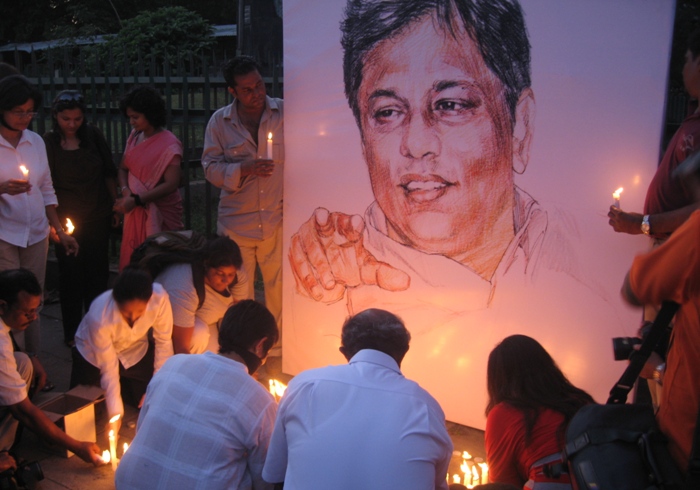
So I went to the vigil more for Lasantha the person and less for any organised effort. The invitation I received by SMS and email from several sources asked us to gather outside Colombo’s Vihara Maha Devi (formerly Victoria) Park at 5.15 pm. It was going to be a ‘joint civil society protest’ against Lasantha’s killing and the erosion of media freedom, democracy and human rights.
It turned out to be a well-intended but poorly-planned event lacking in vision and dynamism, perhaps a bit like our (very) civil society entities themselves. The couple of hundred people who joined it came mainly from Colombo’s high society, the ones who faithfully lapped up every word that Lasantha churned out week after week for nearly 15 years. Ironically, Lasantha and his newspaper were only loosely associated with this kind of (very) civil society – fellow companions on a shared journey, but not necessarily agreeing on priorities or strategies.
I remembered the battered face of an old lady who sat through the entire funeral service – and then left quietly, without even lining up with the rest of the crowd to take one last look at Lasantha as he lay amidst flowers. I remembered the handful of men and women dressed in bright coloured clothes – standing out amidst the sea of white or black clad people – who I later found out came from the Kotahena area and were part of Lasantha’s home town church.
Lighting candles was good. Keeping the flame alive is harder...
No one had sent SMS or emails asking them to turn up. Some of them might not have been readers of English newspapers, which circulate among a numerically small but socially and economically influential section of Lankan society. They came because they felt the fallen man had stood up and spoken out for them.
In comparison, the candlelight vigil was decidedly upmarket. Nothing wrong in that, for the chattering class is very much part of our society and have the same rights to dissent and protest. In some countries, the upper middle class even provides vision, articulation and leadership to mass struggles. Ours, sadly, is more characterised by part-time activists who move more in the cocktail circuits grumbling about everything yet doing precious little to change the status quo. Indeed, some of them in their day jobs benefit personally from the prevailing corruption and nepotism, no matter which political party is in office.
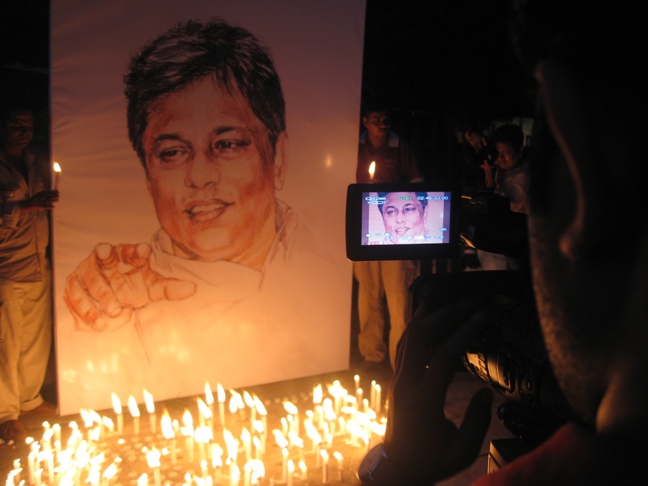
The vigil’s organisers – it wasn’t clear who exactly they were – had painstakingly got the material ready: a large painting of Lasantha, black cloth bands and, of course, candles. But they hadn’t given enough thought to the location. We initially gathered and spent over half an hour on a stretch of road (Green Path) where only motorists passed by, but absolutely no pedestrians. Then someone thought of moving to the nearby roundabout which was a more visible, strategic location.
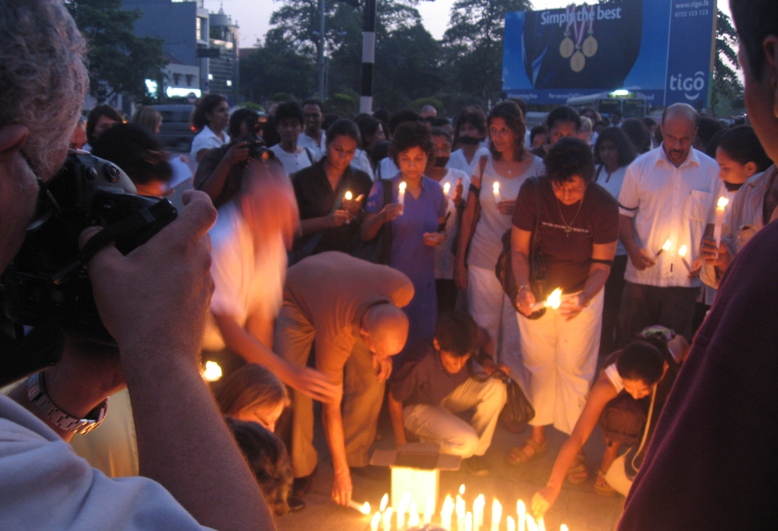
Not perfect, but better. By then, dusk was beginning to fall. We moved unhurriedly, chatting among ourselves, and slowly converged on a wide pavement. There, one by one, we started planting our candles on the ground in front of Lasantha’s picture. It was a moving moment captured in many still cameras and a handful of video cameras.
There we lingered for another hour or more, chatting with each other — and not necessarily about the lofty or somber matters. I was glad to catch up with several friends or associates active in artistic, journalistic or intellectual circles. I saw everybody else doing the same.
One of them, a human rights activist now turned peacenik, asked me many eager questions about blogging. A columnist for an English daily, he isn’t active online and his organisation is notably inept when it comes to mobilising the web for their cause. In his early 50s, he evidently hasn’t crossed what I call the Other Digital Divide. And he typifies the face of our organised civil society – a motley collection of do-gooders who are liberal, mostly secular, passionate yet largely ineffective in their advocacy for reform and change. They just can’t mobilise people power.
Candles burn out, but the image captured will live for longer...
Admittedly, it’s a quantum leap from the one-way street in op ed pages of mainstream print newspapers to the far less orderly, sometimes near-anarchic and often unpredictable world of the blogosphere. This might explain why a majority of Lankan civil society groups stay within their comfort zone and don’t engage the world of web 2.0
On the other hand, the younger, digitally-empowered activists who engage the web with technical savvy and passion are often too impatient or inexperienced (or both) with the necessarily tedious processes of institutional development – such as legal registration, financial management and putting in place mechanisms for the very ideals they advocate in governments and corporations: proper governance and accountability.
Fortunately, this offline/online divide is blurring, even if only slowly. Groups like Beyond Borders, which originated and found their feet in the new media world, are becoming more institutionalised. If they sustain themselves (and don’t lose their sharp edge), they can bridge the online world with the offline realities and needs.
Meanwhile, as some doggedly persistent citizen journalists and new media activists have shown in the days following Lasantha’s killing, it is now possible to stir up public discussion and debate on issues of rights, freedoms and democracy using dynamic websites, blogs, online video and other tools of web 2.0. See, for example, this reflection by the Editor of Groundviews.
Whether they are active online or offline, committed activists in Sri Lanka have their work cut out for them. If the candlelight vigil for Lasantha is an indication, far more work needs to be done in strategy, unity, networking and technology choices. The old order needs to pause, reflect and change their ways. If they can’t or won’t, at a minimum they must get out of the way. (Remember what happened to those dinosaur species that were vegetarian and harmless? They too went the way of T rex…)
Earlier on in the evening, as we were heading to the roundabout with burning candles in our hands, the wind suddenly picked up. Many of us struggled to keep the flame burning, sometimes shielding it with one palm. It wasn’t quite easy to do this while walking forward, watching our step. Amidst all this, we lost sense of where we were heading. We just followed those immediately in front of us, unsure who – if anyone – was leading. Not smart or strategic.
As I drove home, I realised how symbolic that candle-in-the-wind moment had been. Keeping the flames of truth, justice and fairness alive is hard enough. It becomes that much harder when winds of tribalism threaten to snuff it out. And in the thickening darkness, how do we make sure we are headed in the right direction?
The night is young and storm clouds are still gathering. We have miles to go before we can sleep.
Danny Schechter: Moving Images Person of the Year 2008
As 2008 – clearly an Annus horribilis for tens of millions around the world – draws to an end, we announce the Moving Images Person of the Year 2008: Danny Schechter.
Nicknamed “The News Dissector,” Danny is a television producer, independent filmmaker, blogger and media critic who writes and lectures frequently about the media in the United States and worldwide.
He has worked in print, radio, local news, cable news (CNN and CNBC), network news magazines (ABC) and as an independent filmmaker and TV producer with the award-winning independent company Globalvision. He is a blogger and editor of Mediachannel.org, a web and blog site that watches and critiques the print and broadcast media.
Another way to introduce Danny is to recall the scary headlines and TV news images that have dominated 2008 – of reputed banks going bust, leading stock markets crashing and these events triggering a global financial meltdown that, for now, has been slowed but not completely averted by unprecedented governmental intervention…by the very governments of the industrialised countries who should have kept a sharper eye on what was going on in their free market economies.
As the carnage on Wall Street and other global financial centres continued, some hard questions were asked: Did anyone see this coming? If so, why weren’t they listened to? What is the real cause of all this chaos? Where was the news media and why weren’t they doing their job of sounding the alarm?
Well, one man who saw it coming and tried very hard to raise the alarm was Danny Schechter. In 2006, as part of this effort, he made a documentary film called In Debt We Trust. In this, he was the first to expose Wall Street’s connection to subprime loans and predicted the global economic crisis.
This hard-hitting documentary investigated why so many Americans – college and high school students in particular – were being strangled by debt. Zeroing in on how the mall has replaced the factory as America’s dominant economic engine, Emmy Award-winning former ABC News and CNN producer Danny Schechter showed how college students were being forced to pay higher interest on loans while graduating, on average, with more than $20,000 in consumer debt.
An inconvenient truth that America ignored for too long...
The film empowers as it enrages, delivering an accessible and fascinating introduction to what former Reagan advisor Kevin Phillips has called “Financialization” — or the “powerful emergence of a debt-and-credit industrial complex.”
Danny and his film have done for global financial meltdown what Al Gore did for global warming with his own film: investigate rigorously, gather and present the evidence of a gathering storm, sound the alarm — and keep badgering until the warnings were heard. In both cases, the inconvenient truths they presented were ignored for too long — and we are paying the massive price for such indifference.
Watch the Trailer of In Debt We Trust:
Deborah Emin, writing in OpEdNews in October 2008, noted: “In Debt We Trust…brought Schechter a lot of grief. Rather than being seen as a prophet of doom, which in and of itself was not so terrible, he should have been lauded for sounding the alarm when it would have been in time. It is truly an amazing fact of American life that the powers that be can so disastrously determine what information we are able to see based on their subjective judgment of what is too negative or too harsh a view of a specific topic. From this perspective, we should judge all these gatekeepers as those on the Titanic who did not want to alarm the passengers that the ship was going down.”
Watch an extract from In Debt We Trust: How did we get into this mess?
So here’s the trillion-dollar question: if this film was made in 2006, and has since been running to packed houses scaring a lot of thinking and caring people, why was its message not heard in the corridors of power in Washington DC — and elsewhere in the G8 countries’ capitals?
The short answer could be that there have been no thinking and caring people running the American government for the past eight years.
Read all about it!The long answer is found in a book that Danny published in mid 2008. Titled Plunder: Investigating Our Economic Calamity and the Subprime Scandal, it’s an outgrowth of – and update on – his 2006 film. It documents with shocking evidence how debt has restructured the American economy and put Americans under a burden that many will never overcome.
Plunder also offers an analysis based on current events, going behind the scenes, identifying the key players and culprits, challenging the financial industry, government deregulation — and the financial and most sections of the mainstream media who have been cheer-leading the financiers as the latter took ever larger risks. Danny also argues that this has been a criminal enterprise — a point only touched on in most media coverage — and of global significance, given the globalization of markets.
Read my Sep 2008 blog post: Financial Meltdown: Putting pieces together of a gigantic whodunnit
On a personal note, I have been a great admirer of Danny Schechter and his work since I first met him 13 years ago. In the Fall of 1995, he gave an inspiring and provocative talk to a group of journalists and producers from the developing world who were on a UN-organised media fellowship in New York. As part of our tour of media and development agencies in the US East Coast, we visited Danny’s GlobalVision productions.
Danny introduced himself as a ‘network refugee’ — one who had worked for the mainstream network television in the US and had left in disgust. From outside, he was trying to find alternative ways of speaking truth to power — the original mandate of the mass media which many corporatised media companies had abandoned, knowingly or otherwise.
In that pre-Internet era, Danny engaged in his media activism through independent filmmaking, through which he supported and often participated in struggles for social justice in his native United States as well as in places like apartheid-ridden South Africa and strife-torn Palestine.
http://www.newsdissector.comDanny was one of the early media activists to take advantage of the web. In 2000, he co-founded with Rory O’Connor MediaChannel.org, the first media and democracy supersite on web. Operating on shoe-string budgets, it has sustained critical spotlight on the mainstream media (MSM) for 8 years in which the MSM landscape has been completely transformed. While its scrutiny and chronicling of the political economy of the media is more crucial than ever, and veterans like Walter Cronkite whole-heartedly endorse the effort, the non-profit effort struggles for survival.
Now in his 60s, Danny is simply indefatigable. Besides running MediaChannel and GlobalVision, he blogs every few hours, writes a regular column on Huffington Post, lectures on media, writes books and still has time to make investigative films. He is extremely well informed, witty, funny and completely irreverent. He writes and speaks with justified outrage but no malice. That’s a tough balance to maintain.
Danny visits Wall Street on 20 September 2007 – typical of his funny, incisive reporting:
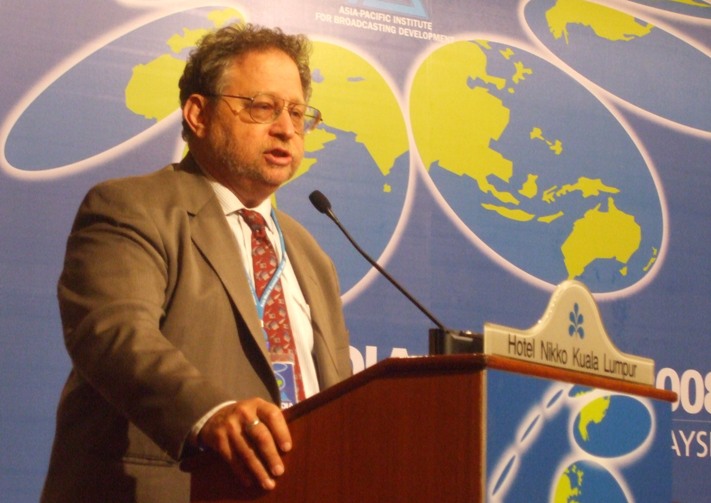
I was delighted to catch up with Danny in May 2008 when we both participated in Asia Media Summit in Kuala Lumpur. He and I were in a small minority of participants who were familiar with the inner works of the mainstream media and transformational potential of the new media. In characteristic style, Danny stirred things up, livening the usually staid proceedings, and I did my best to back him up from the audience. We both enjoyed asking irritating – if not outright annoying – questions from the 400+ media mandarins and press barons who’d come together for the Summit.
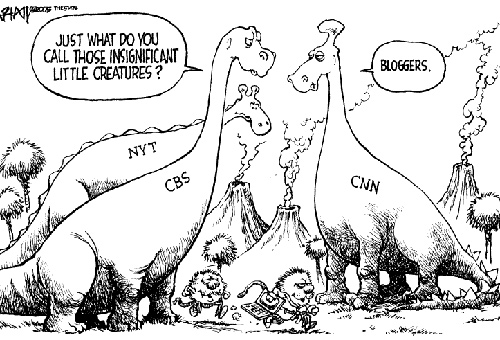
One evening, Danny and I had a drink with Malaysiakini’s CEO and leading new media activist Prem Chandran where we talked about the slow but inevitable decline of the mainstream media dinosaurs — or what Michael Crichton called Mediasaurus. The trouble with mediasaurus, we agreed, was that they are taking a long time going extinct and for now, they still command significant numbers of eyeballs and the dollars that follow.
After Prem left, Danny and I continued our chat into the evening. Over a spicy Indian meal, Danny gave me a crash course on subprime crisis (or sub-crime as he calls it) and how that was going to have a domino effect on markets everywhere. I listened with growing comprehension — and deep admiration for the man’s ability to communicate complexities without oversimplification.
Events in the weeks and months that followed have shown how remarkably prescient Danny Schechter was. And what a monumental, global scale mistake it was not to have heeded this man’s cautions in his blogs, films, columns and elsewhere.
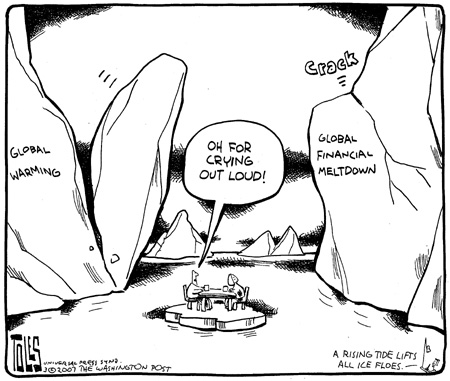
We end 2008 with my cartoon of the year. As I said in a blog post in September 2008: “This cartoon by Pulitzer prize winning Tom Toles first appeared in the Washington Post in 2007 – it brilliantly anticipated the global financial meltdown that we’re now experiencing. Coming in the wake of confirmed global warming, it is a double whammy. Meltdown 2
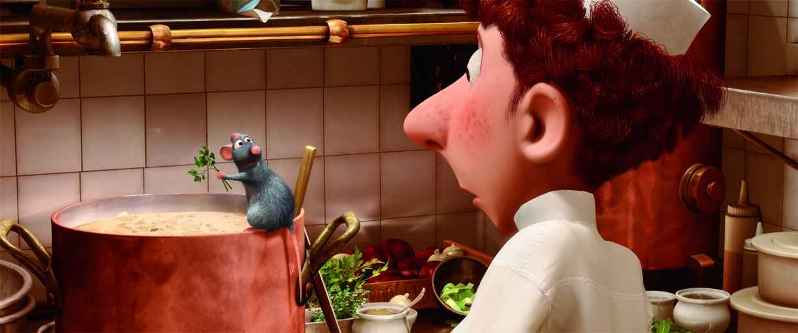
I really enjoyed the Disney/Pixar film Ratatouille (2007), which won the year’s best animated feature film Oscar award and deserved it.
Here’s the plot summary from IMDB: Remy is a young rat in the French countryside who arrives in Paris, only to find out that his cooking idol is dead. When he makes an unusual alliance with a restaurant’s new garbage boy, the culinary and personal adventures begin despite Remy’s family’s skepticism and the rat-hating world of humans. Read full synopsis on IMDB
The movie opens with a TV show featuring Chef Auguste Gusteau, owner of the best restaurant in Paris, talking about his bestselling cookbook, which proudly bears his mantra “Anyone Can Cook!”
Well, that’s heretical to the fine artistes of gourmet. But it’s revived the age old debate between fully-trained professionals and new-entrant amateurs, and inspired some interesting discussions online. One blogger thought: “Remy the rat is a perfect metaphor for the non-expert Web 2.0 knowledge maker. He has no credentials and must prove himself through his actual knowledge and application of knowledge rather than through credentials.”
He added: “What’s the moral of the story? Even without being an acknowledged expert on a topic, if you work hard to express your ideas in clever ways, you too can be respected for what you know.”
I’ve only just read these views, but they resonate with what I felt when I watched the movie in late 2007. The story certainly reminded me of a heated debate in my own field of moving images: can anybody and everybody make video, now that the tech barriers and costs have come down? If this is the case, what’s the point of having highly trained, better paid professionals who do it for a living?
I shan’t try to resolve that debate here. But here’s an interesting take on the debate from the Onion News Network. They report: YouTube is offering a cash prize to the first user to upload a video with a shred of originality or artistic merit.
Death has no sense of timing, but it sometimes leaves traces of irony. The day Americans were electing an energetic and articulate senator from Chicago as their next president, one of Chicago’s most celebrated citizens lost his battle with cancer.
Michael Crichton, who died on 4 November 2008, was trained as a medical doctor but played several roles in the creative arts world. He was a prolific author of science fiction and medical fiction, whose books have sold over 150 million copies worldwide. He also produced and directed techno-thriller movies, and was the creator of the highly successful medical drama series on television, ER (Emergency Room), now in its 15th season.
In the domain of popular culture, Crichton was best known for writing Jurassic Park (1990). This cautionary tale on unrestrained biological tinkering was turned into a blockbuster movie by Steven Spielberg in 1993. It became the highest earning film up until that time.
Before and since, Crichton used his technical training, vivid imagination and mastery of English to spin some of the most enjoyable – and scary – stories that often depicted scientific advancements going awry, resulting in the worst-case scenarios. A notable recurring theme in Crichton’s plots is the pathological failure of complex systems and their safeguards, whether biological (Jurassic Park), military/organizational (The Andromeda Strain), technical (Airframe) or cybernetic (Westworld).
Crichton was also a talented essayist who wrote perceptive pieces of non-fiction about science, society and culture – including the role of media. It is one such essay that I would like to recall in his memory.
The media world was very different when, in 1993, Crichton riled the news business with an essay titled “Mediasaurus“. In this essay, written for the newly launched Wired magazine, he prophesied the death of the mass media — specifically the New York Times and the American commercial TV networks.
“To my mind, it is likely that what we now understand as the mass media will be gone within ten years. Vanished, without a trace,” he wrote.
Building on his credentials as the author of a best-seller on dinosaurs, Crichton called this endangered beast ‘mediasaurus’.
Mediasaurus - courtesy Slate He added: “There has been evidence of impending extinction for a long time. We all know statistics about the decline in newspaper readers and network television viewers. The polls show increasingly negative public attitudes toward the press – and with good reason.”
He talked about technological advances — “artificial intelligence agents roaming the databases, downloading stuff I am interested in, and assembling for me a front page” — that would drive the mediasaurus to their inevitable doom.
Only those nimble, adaptable media products would survive, he said, noting that CNN and C-SPAN were steps in the right direction, giving viewers direct access to events as they happen.
But he had no sympathy for the media. “The media are an industry, and their product is information. And along with many other American industries, the American media produce a product of very poor quality. Its information is not reliable, it has too much chrome and glitz, its doors rattle, it breaks down almost immediately, and it’s sold without warranty. It’s flashy but it’s basically junk. So people have begun to stop buying it.”
Like most people who dabble in the imperfect art of foreseeing the future, Crichton got the trend right but the timing somewhat wrong. The mainstream media (MSM) were indeed on the decline but not at the dramatic rate that he envisaged.
In February 2002, Jack Shafer wrote a piece in the online magazine Slate titled “Who You Calling Mediasaurus?” Its subtitle was: “The New York Times dodges Michael Crichton’s death sentence”. It asked and tried an answer the question: Where did Crichton go wrong?
Shafer wrote: “Fables of the near future have a way of never materializing, whether they be fevered dreams of nuclear energy too cheap to meter or fossil fuels too expensive to burn. To be fair, Crichton wasn’t the only one to get puking drunk on the new media moonshine. Many of us spent a lost weekend—sometimes months—in a stupor after reading early issues of Wired. But instead of blotting out conventional media, the emerging Infotopia seems only to have made the conventional media more ubiquitous.”
Shafer asked: “Who would have predicted in 1993 that America’s great dailies (minus the Wall Street Journal) and the news networks would dodge both extinction and irrelevance by erecting Web sites overnight and giving their content away? That they would use their Web sites to keep us informed 24-hours-a-day in a way that we take for granted today but that would have astonished us nine years ago?”
In an email interview with Shafer at the time, Crichton acknowledged his own limitations: “I don’t have a lot invested in whether my predictions are right or wrong; I assume that nobody can predict the future well. But in this particular case, I doubt I’m wrong, it’s just too early.”
In that interview, Crichton said he wished he had foreseen “the effect of big media conglomerates combined with the universal decision to make news into entertainment. It’s all headlines and chat now. Factual content is way down, accuracy has vanished (it’s not even a goal any longer), and public confidence in media is at an astonishing low. Not surprisingly, audiences are shrinking.”
Crichton admitted at the time that the personalized ‘infotopia’ he envisioned in 1993 had yet to arrive. He scoffed at the Web for being too slow. “Its page metaphor, too limiting. Design, awful. Excessive hypertexting, too distracting. Noise-to-signal ratio, too high.”
Who succeeds mediasaurus?Now fast-forward to May 2008. The same Jack Shafer, once again writing in Slate, published a piece titled “Michael Crichton, Vindicated”. It was introduced as: “His 1993 prediction of mass-media extinction now looks on target”.
In this essay, Shafer wrote: “As we pass his prediction’s 15-year anniversary, I’ve got to declare advantage Crichton. Rot afflicts the newspaper industry, which is shedding staff, circulation, and revenues. It’s gotten so bad in newspaperville that some people want Google to buy the Times and run it as a charity! Evening news viewership continues to evaporate, and while the mass media aren’t going extinct tomorrow, Crichton’s original observations about the media future now ring more true than false. Ask any journalist.”
Read Jack Shafer’s full interview with Michael Crichton in Slate, May 2008
Revealed: the weapon that killed MediasaurusBy this time, Crichton was more positive about the web. He noted that the Web has “made it far easier for the inquisitive to find unmediated information, such as congressional hearings.” It’s much faster than it used to be, and more of its pages are professionally assembled.
Crichton suggested that readers and viewers could more objectively measure the quality of the news they consume by pulling themselves “out of the narcotizing flow of what passes for daily news.” Look at a newspaper from last month or a news broadcast.
“Look at how many stories are unsourced or have unnamed sources. Look at how many stories are about what ‘may’ or ‘might’ or ‘could’ happen,” he said. “Might and could means the story is speculation. Framing as I described means the story is opinion. And opinion is not factual content.”
He summed it up with something we already know: “The biggest change is that contemporary media has shifted from fact to opinion and speculation.”
It was interesting to note how mainstream media outlets paid tributes to Crichton this week. He was remembered for the entertaining story teller he truly was, and some even questioned his mixed legacy, for example being an ardent skeptic of global warming – thus batting for the fossil fuel cartels even if only inadvertently.
But I could find few references to his perceptive critique of the mass media.
Who says media likes to turn the spotlight on itself?
President Obama and the call at 3 am... “Congratulations for restoring sanity and intelligence to Washington…and giving the world its first President. Real hard work begins now. Look after him!”
This was my brief message to American friends soon after they elected Barack Obama as the 44th President of the United States of America.
It was entirely appropriate that I sent this message via mobile phone text (SMS). For Obama’s trail-blazing campaign to the White House used the new media innovatively while also using the old media (such as broadcast television) in a complementary manner.
Obama’s rise has epitomised change in many ways. Among other things, he is the first elected leader of a major democracy who shows understanding and mastery over the New Media World, which is radically different from the old media order.
As AFP reported in a story titled ‘Obama surfs the web to the White House‘: “Social networks and Twitter messages may have helped but analysts agree it was the Democrat’s impressive online organization and Internet fund-raising that fueled his victory over Republican John McCain in Tuesday’s election.”
It quoted Julie Germany, director of George Washington University’s Institute for Politics Democracy & the Internet, as saying: “No one’s going to say Obama won the election because of the Internet but he wouldn’t have been able to win without it. From the very beginning the Obama campaign used the Internet as a tool to organize all of its efforts online and offline. It was like the central nervous system of the campaign.”
Both Obama and McCain campaigns had slick websites and TV campaigns. But additionally, Obama inspired thousands of web-savvy volunteers to extend his message way beyond the official outreach. Doing so risked diluting the campaign or losing tight control, but that gamble paid off.
Al Gore, US vice president from 1992 to 2000, also understood the potential of new media, especially the transformative nature of the Internet. But at the time he was in office, the new media tools were not being used by sufficiently large numbers of people for it to make a difference in political campaigning or citizen engagement.
Both the timing and technologies favoured Obama, who successfully tapped into Digital Natives — those relatively younger people who have grown up with digital technology such as computers, the Internet, mobile phones and MP3. (In contrast, Digital Immigrants are those individual who grew up without digital technology and adopted it later.)
But as many commentators are pointing out, the real fight has just begun. It remains to be seen how Obama and his team use New Media tools, platforms and potential to deliver the promise of change.
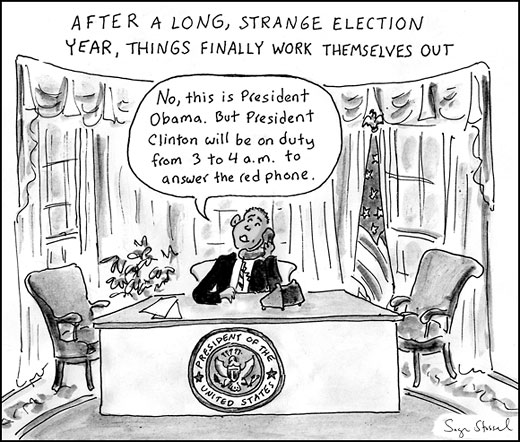
Meanwhile, my own favourite cartoon of Obama election is the one above – and funnily enough, it concerns a piece of old technology: the good old fixed phone. If you recall, in long-drawn campaign for Obama to secure Democratic Party nomination, his rival Hillary Clinton ran this TV commercial which peddled her credentials for being familiar with the corridors of power.
It’s 3 AM and your children are safe and asleep. But there’s a phone in the White House and it’s ringing.
Something’s happening in the world. Your vote will decide who answers that call…
Hillary’s original ad:
Obama’s official response:
There were various unofficial spoofs created by Digital Natives who love to play with new media tools. Just run a search for ‘3 am’ or ‘red phone’ on YouTube and you can watch many of these online!
By the way, isn’t it time that the old-fashioned Red Phone in the White House – the American President’s Hotline to save the world – was replaced with a more modern looking instrument? One more thing for the New Media President Obama…





 Open Minds!