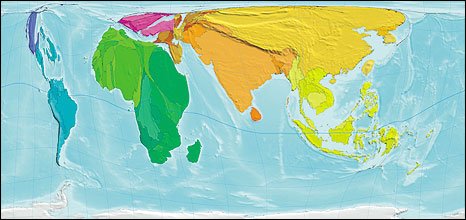
Who speaks for most of the world’s poor people…living in Asia?

World map of human poverty...shows Asia harbouring over half

Take a close look at this map. What’s happened to our familiar world?

This is the map of human poverty — showing the proportion of poor people living in each country.

The size of each country/territory shows the overall level of poverty, quantified as the population of the territory multiplied by the Human Poverty Index. The index is used by the UNDP to measure the level of poverty in different territories. It attempts to capture all elements of poverty, such as life expectancy and adult literacy.

This map is from the recently released new book, Atlas of the Real World. It uses software to depict the nations of the world, not by their physical size, but by their demographic importance on a range of subjects.

It carries maps constructed to represent data, such as population, migration and economics. But instead of a conventional map being coloured in different shades, for instance, the maps in this Atlas are differently sized. For instance, a country with twice as many people as another is shown twice the size; a country three times as rich as another is three times the size. And so on.

When depicted in this manner, a very different view of our real world emerges. The one on the distribution of poverty, shown above, reminds us something often overlooked: there are more poor people in Asia than anywhere else in the world.

It takes a map like this to drive home such a basic fact. In most discussions on international development or poverty reduction, it is Africa that dominates the agenda. Even those organisations and activists who claim to be evidence-based don’t always realise that when it comes to absolute numbers, and not just percentages, poverty and under-development affects far more Asians than Africans.

Atlas of the Real World, which I haven’t yet seen except through glimpses offered by The Telegraph (UK) and BBC Online, offers many such insights on what our topsy-turvey world is really like.

Their map of human poverty draws on the same data that this standard depiction does, in a map I found on Wikipedia sourcing the UN Human Development Report 2007/2008.
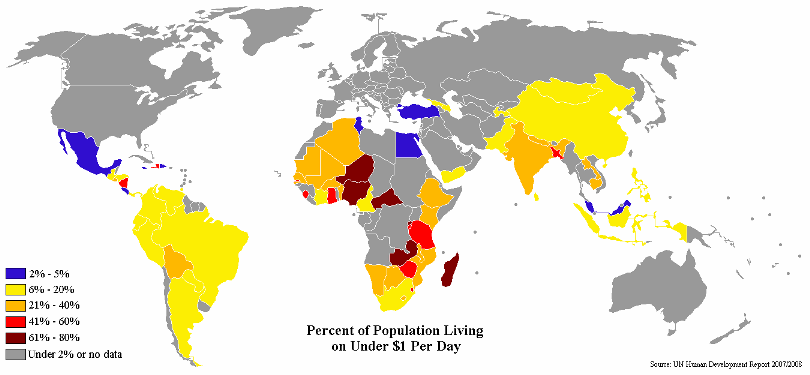
UN)
Percentage population living on less than 1 dollar day 2007-2008 (Source: UN)

There are many ways of measuring income poverty, and experts don’t always agree on methods and outcome. But we will leave those technicalities to them. Global Issues is a good website that discusses these issues without too much jargon.

Accurately drawing a two-dimensional map of our spherical world has been a challenge for centuries. Today’s most widely used Mercator projection represents our usual view of the world – with north at the top and Europe at the centre. People in other parts of the world may not always agree with this view.

The Peters Projection World Map is one of the most stimulating, and controversial, images of the world. Introduced in the early 1970s, it was an attempt to correct many imbalances and distortions in the Mercator map.

An example: in the traditional Mercator map, Greenland and China look to be the same size but in reality, China is almost 4 times larger! Peters map shows the two countries in their relative sizes.

Atlas of the Real World also carries one map where the size of each territory represents exactly its land area in proportion to that of the others, giving a strikingly different perspective from the Mercator projection most commonly used. It is very similar to the Peters map of the world.
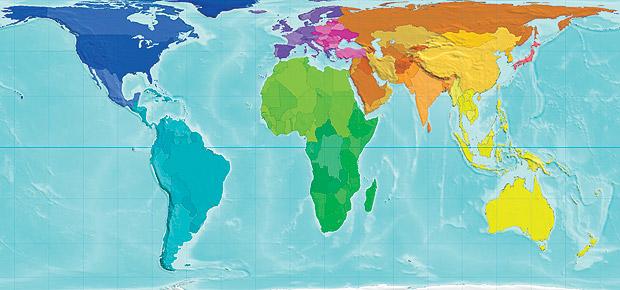
Our world depicted by each country's land area

The UNDP has been producing its influential Human Development Report since 1990. As far as I can discern, the HDR always uses conventional (Mercator?) maps, depicting data using the standard colour-coding or gray tones. The one I have reproduced in this post is an example.
Indeed, the UN’s Cartographic Section seems to favour these.

When would the UNDP – and other members of the UN family – start using more innovative ways such as those used in Atlas of the Real World? How much more effective can the UN’s analysis be if they move out of the comfort zone of Mercator?

Climate in Crisis and planet in peril – but we’re squabbling over copyrights!

Climate in Crisis - a global documentary

On my recent visit to Tokyo for a regional workshop on changing climate and moving images, I watched a number of excellent documentary films on the subject. One of them was Crude: The Incredible Journey of Oil, the excellent Australian film that I wrote about in March.

Another was Climate in Crisis, an outstanding global documentary in two parts (2 x 52 mins) co-produced in 2006 by Japan’s public broadcaster NHK together with The Science Channel and ALTOMEDIA/France 5.

Directed by Fujikawa Masahiro, the film draws heavily on the Earth Simulator — one of the world’s most powerful supercomputers — which Japanese scientists used to project the climatic disasters in next 100 years. The system was developed in 1997 for running global climate models to evaluate the effects of global warming and problems in solid earth geophysics. It has been able to run holistic simulations of global climate in both the atmosphere and the oceans — down to a resolution of 10 km.

NEC Earth Simulator in Japan

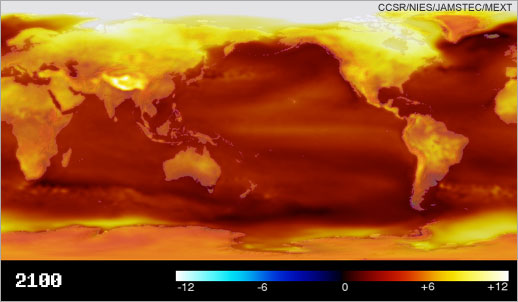
The results, captured in this documentary, are truly mind-boggling. Atmospheric temperatures may rise by as much as 4.2 degrees Celsius, more hurricanes may attack and deserts may spread from Africa to southern Europe, and half of the Amazon rainforest may be gone. Climate in Crisis shows a severe projection on environmental destruction based on rigorous scientific data and considers whether humankind can avoid this.

This film, made in the same year as Al Gore’s Oscar-winning film An Inconvenient Truth, has won several awards including the Earth Vision Award at the 15th Earth Vision Tokyo Global Environmental Film Festival.

I was curious why this excellent film – in my view, better made than Al Gore’s one – hasn’t been more widely seen, talked about and distributed. To be honest, I’d not even heard of this one until my Japan visit — and I try to keep myself informed on what’s new in my field of endeavour.

The reasons soon became apparent: copyright restrictions! The co-producers are keeping the rights so tight that only the highest bidders will be allowed to acquire it on a license fee.

This is a standard broadcast industry practice that didn’t surprise me. But I was taken aback by how jealously the rights are guarded. All other films that were part of our event, including high budget commercial productions like Crude, were screened to the public at the Parthenon in Tama New Town in Tokyo.

Not so with Climate in Crisis, which we – the overseas participants to the workshop – had to watch at a theatre inside NHK’s Tokyo headquarters. No public screening was possible. As we later heard, NHK itself was willing to allow a public screening (after all, it draws a good part of its income from the Japanese public), but their international co-producing partners, especially the Science Channel, would simply not agree to it. Wow.

Twenty centuries ago, emperor Nero fiddled while Rome burned. Today, some people are squabbling over copyrights while the whole planet is in peril.

Earth in 2100 - as seen by Earth Simulator

Our workshop participants came from solid backgrounds in broadcasting or independent film-making, and we are not naive activists asking hard-nosed broadcasters to let go of their precious rights which generates vital income. But we would have expected them to allow films such as Climate in Crisis to circulate a bit more freely in everybody’s interest.

This reminded me of correspondence I had last year with the Canadian producers of another outstanding climate film titled The Great Warming. The initial discussions with its director were promising, but when the distribution people started talking about ‘revenue optimising’, our negotiations stalled.

It also reminded me of similar experiences of other environment and natural history film makers, such as South Africa’s Neil Curry. He had a long struggle with the BBC to clear the non-broadcast use rights of his own film that he wanted to take back to the locations in Botswana where it was filmed.

Many broadcast and production companies in the west don’t realise that TV broadcasters in developing Asia operate on a very different basis. Talking about broadcast ‘pre-sales’ or ‘commissions’ loses meaning when many stations are operating on tiny budgets — or in some cases, no budgets — for factual content. Many are struggling to survive in tough, emerging economies.

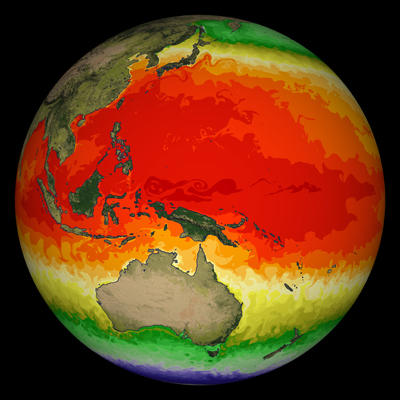
Is this our future?
Is this our future?

TVE Asia Pacific operates a regional film distribution service that brings environment and development films within reach of such broadcasters. We operate without getting mired in license fees or royalties.

Our 2-day workshop called for climate change to be recognised as a ‘copyright free zone’. This would enable audio-visual media content on the subject to move freely across borders and to be used widely for broadcast and narrowcast purposes.

Here’s the full reference from our statement of concern:

“Prevailing copyright regimes prevent the sharing and wider use of outstanding TV programmes and video films on climate and development issues. We are deeply concerned that even content developed partly or wholly with public funding (government grants, donor funds or lottery funds) remain unfairly locked into excessive copyright restrictions. Sometimes film-makers and producers themselves are willing but unable to allow their creations to be used for non-commercial purposes by educational, civil society and advocacy groups. We appreciate the media industry’s legitimate needs for intellectual property management and returns on investment. At the same time, the climate crisis challenges us to adopt extraordinary measures, one of which can and should be recognising climate change as a ‘copyright free zone’. Such agreement would encourage media organisations and independent producers to share content across borders, and with entities outside the media industry engaged in climate education, advocacy and activism.”

Here’s the simple question I raised during the workshop, which is worth being posed to all those who hesitate to even discuss this issue:

Can anyone manage their intellectual property rights on a dead planet?

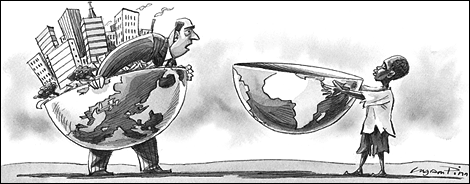
This is the real question!

Warning: Is climate change the new HIV of our times?

From www.sprattiart.com
From http://www.sprattiart.com


Is climate change the new HIV of our times?

I asked this question when addressing a group of television journalists and film-makers from the Asia Pacific last week. I was making introductory remarks to an Asia Pacific Workshop and Open Film Screening on ‘Changing Climate and Moving Pictures‘ held on 3 – 4 October 2008 in Tokyo, Japan. It was organised by TVE Japan in collaboration with TVE Asia Pacific, and supported by the Japan Fund for Global Environment.

I acknowledged that climate change was not just another environmental issue or even the latest planetary scare. “This time we’re in deep trouble – and still finding out how deep,” I said.

Climate change has brought into sharp focus the crisis in:
• how we grow economically;
• how we share natural resources and energy; and
• how we relate to each other in different parts of the world.

In that sense, I noted, climate change is acting like a prism — helping to split our worldly experience into individual issues, concerns and problems that combine to create it. Just like an ordinary prism splits sunlight into the seven colours (of the rainbow) that it’s made of.

“Climate shows up the enormous development disparities within our individual societies and also between them. When this happens, we realise that climate is not just a scientific or environmental problem, but one that also has social, political, security, ethical and human rights dimensions,” I added.

Climate change in an uneven world

I then outlined some parallels between the current climate crisis and the HIV/AIDS pandemic that emerged some 25 years ago.

Consider these similarities:
• When HIV was first detected, it was considered a medical issue affecting specific sections of society.
• It took years for the wider societal, development and human rights aspects of HIV to be understood and then accepted.
• Some countries and cultures wasted precious years in HIV denial; a few are still in this mode.
• It took overwhelming impact evidence and mounting pressure from affected persons for states and international community to respond.
• Then…everybody jumped the bandwagon and HIV became a fundable, profitable enterprise.

I have been commenting in this blog about this ugly side of HIV/AIDS in my own country Sri Lanka, where some NGOs and charities have turned HIV activism into a self-serving, lucrative industry. There are fierce ‘turf wars’ to claim persons living with HIV as their institutional ‘property’. Some have appropriated HIV as their own virus, and would rather not allow others to work in this area.

And it’s not just NGOs who are riding the HIV gravy train. The United Nations programme for AIDS, or UNAIDS, created by the UN system in response to the global crisis, has evolved into a behemoth whose efficacy and relevance are now being widely questioned.

UNAIDS “is obsolete and an obstacle to improving healthcare in developing countries” claims Roger England, an international health expert. Writing in the British Medical Journal in May 2008, England pointed out that HIV causes 3.7 per cent of mortality and kills fewer people than pneumonia or diabetes, yet it received 25 per cent of all international healthcare aid and a big chunk of domestic expenditure. This has resulted in wasting vast sums of funding on esoteric disciplines instead of beefing up public health capacity. Despite this criticism, UNAIDS is calling for huge increases in its funding — from its current US$9 billion to US$54 billion by 2015.

All this makes me wonder: is climate the new HIV of our times? This is the question I raised in Tokyo.

I added: “If so, I sincerely hope it does not evolve in the same manner that HIV crisis did. There are worrying signs that the drive towards a low carbon economy is being exploited by various groups – including some in civil society – for self gain.”

Certain development agencies and ‘think tanks’ are clearly exploiting climate change to make money. Suddenly, everybody is ‘climate-proofing’ their activities — meaning they are talking about climate change no matter what they do, whether it is teacher training or micro-credit.

In the run up to the Bali climate conference in late 2007, I wrote a blog post titled ‘Beware of bad weather friends’ about a London-based NGO engaging in some media training on climate issues, but deriving its legitimacy from a dubious survey. This post apparently irked the party concerned a great deal.

In Tokyo, a workshop participant confirmed that this was already happening in his country.

“Every crisis today is being turned into a business opportunity – and not just by the corporate sector,” said Pradip Saha, associate director of the Centre for Science and Environment in India.

He added: “Consultancy companies and some NGOs have realised there is big money to be made in climate related areas like carbon offsets and the Clean Development Mechanism. They are already riding the climate bandwagon!”.

Read the full text of my introductory remarks to the Tokyo workshop.changing-climate-moving-images-nalaka-gunawardene-intro-3-oct-2008

Thailand’s people power gets a boost from satellite TV

Street protests in Bangkok - image from DayLife

Thailand, which had built up a reputation as a relatively stable country, has been under siege for much of this year. Confrontations between the coalition government, elected in December 2007, and the anti-government People’s Alliance for Democracy (PAD) have affected civil administration, law enforcement and economy, especially tourism.

On 10 September 2008, Thai prime minister Samak Sundaravej was forced to step down when a court found him guilty of accepting money from a TV station to host a popular cooking show. Bizarre as this reason was for his ouster, it has only added to the confusion that currently dominates Thai life.

Although I have been visiting Thailand regularly for the past 20 years, I don’t claim to understand the murky world of Thai politics. But until recently, Thais had somehow managed to keep their politics and business separate, allowing the latter to continue largely unaffected.


Pro-democracy struggles are not new to Thai people. But this time around, there is a new player involved: Asia Satellite Television (ASTV) a relatively new entrant into Thailand’s TV world which is dominated by commercial TV stations that offer a staple of light talk shows, soap operas and gossip programmes.

ASTV’s programmes, since May 2008, has consisted of speeches beamed from a stage set up at the site of a Bangkok protest rally, led by the PAD.

In early September 2008, around 200 PAD supporters banded together to guard the ASTV station and Manager newspaper offices on Phra Athit road amid rumours Prime Minister Samak Sundaravej was going to take the cable TV channel off the air.

In an interesting news analysis filed from Bangkok, Inter Press Service (IPS) noted on 5 September: “ASTV makes little effort to hide its political mission as the principle broadcaster of the PAD. After all, its founder, Sondhi Limthongkul, a fiery speaker, is one of the PAD’s leaders. His sustained attacks on the government and Thai democracy — that the prevailing elections system does not work, and the country needs a largely appointed parliament — have resonated with the thousands drawn to the PAD rallies after first hearing them on ASTV.”

Much of the PAD’s mass mobilisation has been possible due to ASTV’s reach, which is currently estimated at 20 million viewers. ‘’Our audience has doubled since 2006, when we had 10 million viewers, because we present the political side of the news that is not available on national TV,” the article quoted Chadaporn Lin, managing editor of the station’s English-language channel, as saying.

The Manager owns ASTV
Viewers who cannot access the station through a satellite dish or a provincial cable company turn to the website of ‘Manager,’ the newspaper produced by ASTV’s parent company. The site has seen the number of regular visitors rise and is now placed third among the top 10 Thai-language websites.

Read the full IPS article: THAILAND: Satellite TV Boosts Anti-Gov’t Protests By Marwaan Macan-Markar

To make sense of what’s going on, I turned to Pipope Panitchpakdi, a Thai friend who has worked in the broadcast media industry for many years:

Pipope Panitchpakdi, independent Thai journalist

He says: “It’s just too bad that the ideology behind the ASTV movement is identified by many as right-winged and nationalistic. For me, the movement itself is quite progressive in its post-modernistic use of everything that works to topple the existing government. In a way, it’s going back to the muckraking days of partisan journalism, which may be in need when mainstream media are no longer functioning during Thaksin/Samuk’s administration (with his equally keen media strategist team).”

Pipope adds: “Few mentioned that ASTV is self sponsoring through viewers’ subscriptions. That’s, to me, says a lot about the station. In my opinion what is unacceptable is when NBT (National Broadcasting Television) starts to give air time to government politician to bash the ASTV and to report heavily distorted news on the anti-government movement. They said it is the counter measure to what the ASTV is doing.”

He continues: “NBT, which is a free to air TV, funded by tax money and has a nation wide coverage, now becomes the state propaganda in the true sense of the word and by being such, there is no telling what kind of political fervor the NBT can stir.”

The argument of using NBT to project government view is a familiar one in other fragile or immature democracies across Asia. To understand it, we need to recall how rapidly broadcasting has changed in the past two decades.

In 1990, most Asian viewers had access to an average of 2.4 TV channels, all of them state owned. This has changed dramatically — first with the advent of satellite television over Asia in 1991, and then through the gradual (albeit partial) broadcast liberalisation during the 1990s. Asian audiences, at last freed from the unimaginative, propaganda-laden state channels, exercised their new-found choice and quickly migrated to privately owned, commercially operated channels. Soon, state owned TVs and radios found themselves with ever-shrinking audiences and declining revenue. For the past decade, most have survived only because governments infused them with massive amounts of tax payer money. Their public service remit is long forgotten.

In recent years, some governments have taken the view that since a growing number of private channels provide an outlet to political opposition and other dissenting views, the state channels are justified in peddling the ruling party (or ruling military junta) view – often exclusively. This convenient argument overlooks the fact that Pipope points out: state channels are funded mostly or wholly by tax payer money (as many lack the entrepreneurial skill to compete in a market environment). They have a moral and legal obligation to serve the public interest — and that does not coincide with the ruling party’s or junta’s self interest.

There are some who accuse ASTV of Thailand, and its equivalents such as courageous Geo TV of Pakistan (which stood up to the once mighty, now fallen general Musharaf), of being partisan. Perhaps they are, and in ASTV’s case it unashamedly and openly is. But in my view, they offer a much-needed counter balance to the disgusting excesses of state TV that prostitute the airwaves.

Supinya Klangnarong
Supinya Klangnarong

Supinya Klangnarong, deputy head of the Campaign for Popular Media Reform (CPMR), an independent local group lobbying for media rights, told IPS: “ASTV is offering knowledge and political information and new ideas that have never been seen on Thai TV. They have opened a new space for TV. There is 100 percent media freedom. You can say anything against the elected government and get away.’’

But she warned that while such a media agenda has tapped into an older audience that has felt left out by the dominant trends on the existing commercial stations, where youth is the focus, it is also creating a following that could become increasingly intolerant. “They are creating a culture of hate by the one-sided opinions being broadcast. They are promoting very conservative and very nationalistic ideas.’’

She added: “And if it attracts more people, ASTV may take over the role that has always been played by Thai newspapers of setting the political agenda for the country. That will be a win for those who say that Thailand has become too liberal, open and globalised… like my mother’s generation.’’

PAD protests hold Thai capital under siege - image from DayLife

Remembering Anita Roddick, a year after her hasty departure

September 10 marked a year since Anita Roddick left us in hurry, with so much unfinished business.

At the end of our last encounter in the summer of 2003, she autographed for me a copy of her latest book with these words: “Remember me!”.

She remains one of the most remarkable people I have met. Especially in the past year, which has been eventful and tumultuous for me, I have often thought of Anita’s long and colourful journey from working class mom to one of the most successful entrepreneurs of our time….and onward to become an outspoken and passionate activist for social justice, human rights and the environment.

As she has written, it was not an easy ride to do well in the male-dominated world of business, nor was it any easier to do good in the greed-dominated world at large. But she not only did it, but had great fun doing so.

What would Anita do? I find myself asking this question every now and then when I seem to be struggling against enormous odds (which is increasingly often). I don’t always find the answers I’m looking for, but it’s always a useful reflection.

I now find that others have been asking this question. Visiting Anita Roddick’s official website this week, I read a moving post by Brooke Shelby Biggs, who worked with Anita for 8 years. She writes:
“I’ve lived most of this past year having conversations with Anita in my mind. What would she say when I told her about considering a move back to magazine journalism? How should I handle my role in the Free the Angola 3 movement? How would she get on with my new romantic interest? Should I move back to my parents’ home town to help care for my ailing mother? I’ve tried to spend this time living according to the philosophy of What Would Anita Do (WWAD?). It was a lot easier when I could ask her myself. But some part of me knows she gave me a lot of tools to figure the hard stuff out on my own. Sometimes I just wish I had her courage.”

website inspired by Anita Roddick
I am an activist: website inspired by Anita Roddick

Brooke links to a website called I am an Activist that draws information and inspiration from Anita’s many and varied struggles in support of various local and global causes. Prominently displayed on the home page are Anita’s now famous words: “This is no dress rehearsal. You’ve got one life, so just lead it and try and be remarkable.”

Well, we can honestly say that she’s one person who practised what she preached.

‘I am an Activist’ is also the sub-title of a DVD that celebrates the life of Dame Anita Roddick, which is available for sale and/or download from Anita Roddick.com. It compiles footage gathered on 23 October 2007, when thousands of thinkers, artists, activists, and other heroic saboteurs of the status quo gathered to celebrate the remarkable life and legacy of Anita Roddick. According to the blurb, it features key people from groups like Amnesty International, Greenpeace, Reprieve, The Body Shop, as well as family and close friends, as they laugh and cry and ultimately take to the streets to launch.

Anita’s daughter Sam is quoted as saying in her tribute: “My mother treated life like each day was her last, and this gave her the permission for incredible bravery. … Tonight I am personally pledging that I Am An Activist, and within that, I also will have a lot of fun, and I also will be silly. I will not be polite and I will never, ever, ask for permission.”

In the weeks and months since Anita’s death, more video material featuring her public talks and interviews have been shared on YouTube by individuals and organisations. I have this week watched several of them, and felt there still isn’t sufficiently good moving images about her. In her time she must have done hundreds or thousands of interviews for broadcast television, corporate audiences as well as community groups. At least some of these must have been recorded and archived. But we still don’t see enough out there, at least in easily accessible public video platforms like YouTube.

Here are two that I did find which are interesting:

Anita speaks on the lessons she learnt from running her own home business, which she started in 1976 to augment her family income. She talks about how she had absolutely no business training, faced many odds and put up with male sarcasm:

From University of California Television comes this video of Anita delivering the Nuclear Peace Age’s third annual Frank K. Kelly Lecture on Humanity’s Future in Feb 2004.

Banishing poverty to a museum: The grand vision of Muhammad Yunus

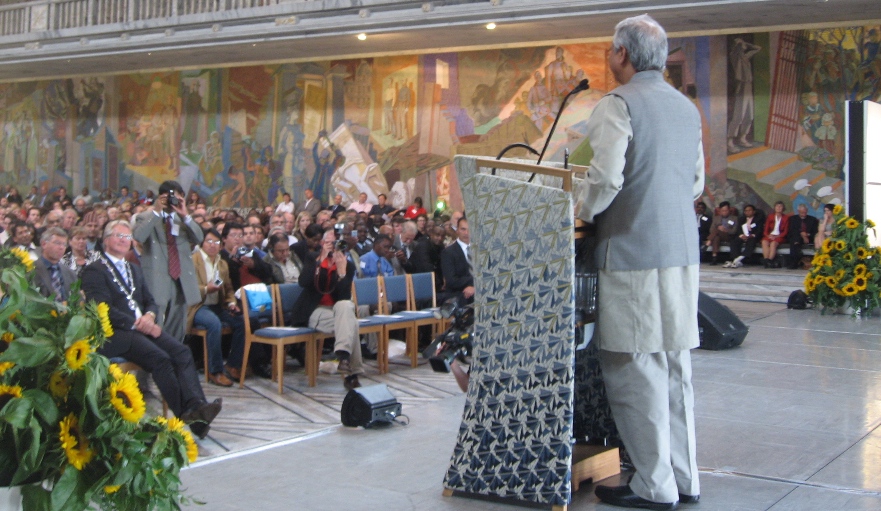
Muhammad Yunus speaking at Oslo City Hall on 4 Sep 2008

The celebrated Bangladeshi economist and anti-poverty activist Muhammad Yunus returned to Oslo’s City Hall today, more than one and a half years after he accepted the 2006 Nobel Peace Prize there. In a passionate, insightful talk to a full house of over 900 people, he revisited his favourite topic: how to banish poverty from our planet.

The occasion was 2008 North-South Forum, convened and hosted by Fredskorpset, the Norwegian peace corp, together with the city council of Oslo. I was among the 350 international participants who have come from 50 countries to participate in this event.

In his talk, the founder of the Grameen Bank reiterated the central message in his recent book, Creating a World Without Poverty: Social Business and the Future of Capitalism.

“We can and must chip away at poverty, and get rid of it – just like what they did to the Berlin Wall,” he said. “I’m dreaming of the day when there is no more poverty on this planet…the day when our future generations would have to visit a museum to see what it was like to live in poverty.”

Wistfully, he added: “I would then want to offer a million dollar prize to anyone who can find a poor person.”

He tempered this idealistic vision with the economist’s strong realism: to overcome poverty, we first need to understand and come to terms with factors that cause and sustain it.

“There is nothing intrinsically wrong with poor people,” Yunus said. “They are ordinary people like you and me – many of them talented and capable. But they have never had the opportunity to do well in life. Poverty is not created by poor people, but by the (social and economic) system we have created around us.”

Banishing poverty is not just a matter of social justice – it is also an ‘insurance’ against social disintegration and other major problems of our times like crime and terrorism.

Prof Yunus made the same points in this interview with the Nobel Prize website:

See full interview on Nobel website

For several years, Yunus has been voicing concerns about the so-called war on terror diverting much needed attention and resources away from the war on poverty. In his Nobel Prize lecture delivered in the same hall on 10 December 2006, he said: “I believe terrorism cannot be won over by military action. Terrorism must be condemned in the strongest language. We must stand solidly against it, and find all the means to end it. We must address the root causes of terrorism to end it for all time to come. I believe that putting resources into improving the lives of the poor people is a better strategy than spending it on guns.”

When Yunus speaks, he sounds far more like an amiable story teller than the professor of economics that he once was. He appeals to the heart and mind of his listeners, in that order. He did not dazzle his audience with endless facts and figures. There were no fancy Power Points or endless charts – the essential tools of poverty researchers. And, mercifully, he never once referred to the dubious millennium development goals or MDGs, the favourite mantra of assorted UN types. (They started off as a well-intended set of targets, but have become self-limiting, self-serving distractions for the development community.)

Instead, he drew from the practical, real life experiences of the Grameen Bank that he founded in 1976, when working as a professor at the University of Chittagong in Bangladesh. Grameen’s three decades of work providing small loans to the poorest of the poor is ample evidence, he said, that the vicious cycles of poverty, debt and misery can be broken by ‘tiny interventions, sustained over time’. Grameen started with 27 poor people in a single village. Today, it has over 7 million participating in its micro credit programes, 97 per cent of them women.

Read Shahidul Alam’s account of Grameen and its founder

Yunus offers a grand vision without grandiose claims or pomposity. He is fond of the word ‘tiny’ – using it to describe the various initiatives he and his team have been taking to attack poverty from many different fronts. The results are anything but tiny.

In his new book, Professor Yunus describes the role of business in promoting social reform and his vision for an innovative business model that would combine the power of free markets with a quest for a more humane, egalitarian world that could help alleviate world poverty, inequality, and other social problems. He calls it ‘social business’ – a hybrid of the profit-maximising corporate sector and charitable non-profit sector.

Listen to Muhammad Yunus speak at Google New York City campus on 10 January 2008 about ideas captured in his new book:

In 2006, the Nobel Peace Prize was awarded to Muhammad Yunus and Grameen Bank for their efforts to create economic and social development from below. In doing so, the Norwegian Nobel Committee noted: “Lasting peace can not be achieved unless large population groups find ways in which to break out of poverty. Micro-credit is one such means. Development from below also serves to advance democracy and human rights.” Read full statement

Watch an indepth interview with Yunus by the US journalist and doyen of TV interviewers, Charlie Rose:

Vulnerability Exposed: Micro films on how climate change affects YOU!

Vulnerability Exposed!

Never underestimate the power of moving images. Al Gore tipped the balance in the long-drawn climate change debate with his Oscar-winning film, An Inconvenient Truth. The rest is recent history.

Thanks to the film – and sustained advocacy of hundreds of scientists and activists – climate change is no longer a speculative scenario; it’s widely accepted. The challenge now is to understand how it impacts different people in a myriad ways.

Now the World Bank wants people to use their video cameras to capture how climate change may already be affecting their ways of living and working. The Bank’s Social Development Department has just announced the launch of a worldwide documentary competition that will highlight the social aspects of climate change as experienced and/or observed by the film-maker(s).

Called Vulnerability Exposed, the contest is open to anyone anywhere in the world who wishes to have their voice heard. The submitted films should innovatively illustrate the consequences of climate change through one of the following theme categories: conflict, migration, the urban space, rural institutions, drylands, social policy, indigenous peoples, gender, governance, forests, and/or human rights. The submission period ends on 24 October 2008.

Caroline Kende-Robb, Acting Director, Social Development Department, said, “There is a need to see climate change as an issue of global social justice. The rights, interests and needs of those affected by climate change must be acknowledged.”

Watch the Bank’s short video, where she explains further:

The contest has two award categories:
1) Social Dimensions of Climate Change Award (general category) – open to professional and amateur; and
2) Young Voices of Climate Change (youth category) – open to entries submitted by filmmakers under 24 years old.

Award winners will be chosen through a combination of public voting and a judging panel. The film with the most public votes in each theme category will receive honorable mention.

Judging process
Vulnerability Exposed film competition: Judging process

This contest indicates that the World Bank is slowly but surely opening up to the currently untapped communication potential of web 2.0 – the very point I made in a recent op ed essay.

There are several noteworthy aspects in this competition, some more positive than others. I offer this critique in the spirit of improving a commendable initiative.

Three cheers to the bank for accommodating both amateurs and professionals. It’s about time those who don’t video film for a living (some of who are no less talented in the craft) had more opportunities to showcase their products.

It’s good to see the preference for shorter films, in this contest defined between 2 and 5 mins in duration. This certainly resonates with TVE Asia Pacific’s experience with Asian broadcasters, many of who now prefer shorter films. Longer films have their place, of course, but shorter ones are clear favourites of 24/7 news channels and also online.

Most film contests are judged exclusively by an all-powerful jury (I’ve been on several over the years), but here the online public have a chance to vote for their favourite entries. Let’s hope the judges will consider the story telling power of entries as the most important deciding factor. (The examples in the YouTube film given above are misleading – they all seem extracts from expensively made documentaries.)

The big challenge for many aspiring contestants would be to relate climate change to daily realities in their societies. Despite global headlines and the development community’s current frenzy about it, climate change as a phrase and concept still isn’t clearly understood in all its ramifications. If science now knows 100 facts about the murky processes of climate change, the average public knows less than 25 and understands even less. So it will be interesting to see how entries relate the big picture to their individual small pictures.

I’m a bit disappointed that the World Bank is not offering any cash prize to the winners. Instead, “the winners will receive an all expenses paid trip to Washington, DC for a screening of their film and will have the opportunity to attend a series of networking and learning events organized by…the World Bank in December 2008.” This is all useful, but video – even at the low end – is not exactly cheap, and even labour of love creations cost money to make. We are currently running a comparable the Asia Pacific Rice Film Award – which seeks entries no longer than 10 mins on any aspect of rice – and despite being a non-profit, civil society initiative we have a prize of US$ 2,000 to the winner. And we wish we could offer more.

But my biggest concern is the unequal, unfair terms of copyrights found in the small print of the competition rules. This is where the lawyers have done their usual handiwork, and with the usually lopsided results. The World Bank wants all contestants to make absolutely sure that all material used is fully owned by the contestants, or properly licensed. That’s fine. But tucked away on page 7, under section 12 titled Entrant’s permission to the organiser, is a set of conditions which will allow all affiliated institutions of the World Bank group to use the submitted material for not just promoting this contest (a standard clause in most competitions), but for ‘climate change work program of the organiser’.

What this means, in simpler terms, is that without offering a single dollar in prize money, the World Bank is quietly appropriating the unlimited user rights for any and all the submitted material. These are the core materials in the moving images industry, and nothing is more precious to their creators.

I have long advocated a more balanced, equitable and liberal approach to managing copyrights and intellectual property by both the broadcast television industry and development community — especially where public funded creations are concerned. I have nothing but contempt for lawyers and accountants who often determine the copyrights policies in large broadcast and development organisations. They set out terms that may be justified in strict legal terms, but are totally unfair, unjust and, in the end, counterproductive to the development cause and process. It seems that while our friends in the social and communication divisions were not looking, the Bank’s lawyers have done their standard hatchet job.

While this doesn’t detract from the overall value of Vulnerability Exposed, it diminishes its appeal and potential. Many professional video film-makers who value their footage – gathered with much trouble and expense – may not want to sign future user rights away for simply entering this contest. And worse, the unsuspecting enthusiasts who don’t necessarily earn their living from making films – but are entitled to the same fair treatment of their creations – would be giving away material whose industrial value they may not even fully appreciate.

It’s certainly necessary and relevant for development organisations like the World Bank and the UN system to engage web 2.0. But they must be careful not to import or impose rigid, one-sided and outdated copyright regimes of the past on this new media.

I hope the Bank would consider revising these unfair copyright terms, and treat the submitted material with greater discretion and respect. If not, all entrants risk seeing their material popping out of bluechip films produced by top-dollar production companies in North America and Europe who have ‘mining rights’ to the Bank’s video archives.

Vulnerability Exposed can have more meanings than one. We’d rather not consider some.

UNEP’s search for God: Here’s the way forward to save the planet!

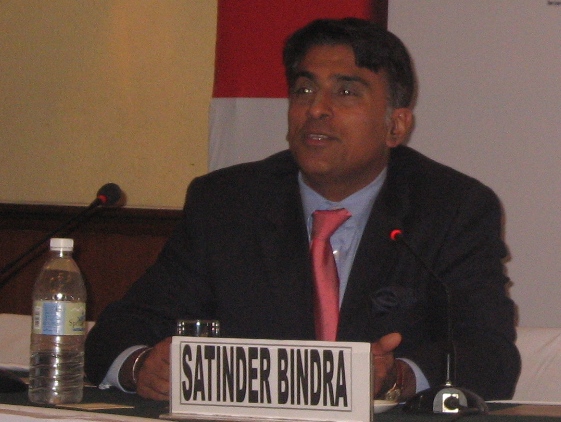
Satinder Bindra
Satinder Bindra: Voice of the Planet?

“Content is king — but distribution is God!”

With these words, UNEP’s newly appointed Director of Communications and Public Information, Satinder Bindra (photo, above), engaged my attention at a meeting in Paris earlier this week.

I almost jumped up in total agreement — this is just what we’ve been saying for years, especially to those who support information, education and communication activities in UN agencies.

Unlike many career UN officials, Satinder knows what he’s talking about. He comes to UNEP with over two decades of wide and varied experience in journalism and broadcasting – the last 10 years spent as a Senior International Correspondent/South Asia Bureau Chief for CNN based in New Delhi, India.

In the hard headed and hard nosed world of international news and current affairs television, distribution and outreach can make or break any content provider. This is something that the two leading news channels BBC World and CNN International know very well — and the more recent entrant Al Jazeera English is still finding out.

Satinder’s remark, in this instance, was more to do with how to get information and analysis on sustainable development out to as many people as possible in all corners of the planet. This is part of UNEP’s core mission since its founding in 1972 — and as chief of communication and public information, Satinder now takes on this formidable challenge.

In Paris, he was listening, taking notes and talking to everyone in the small group who’d come together for the annual partner meeting of the Com Plus Alliance of Communicators for Sustainable Development.

Com+ is a “partnership of international organizations and communications professionals from diverse sectors committed to using communications to advance a vision of sustainable development that integrates its three pillars: economic, social and environmental”. TVE Asia Pacific was admitted to the partnership a few months ago.

As I’m sure Satinder realises, at stake in his new assignment is a lot more than audience ratings, market share or revenue stream of a single broadcaster. Those are important too, but not in the same league as ensuring life on Earth – in all its diversity and complexity – continues and thrives.

Satinder struck me as a practical and pragmatic journalist who wants to get the job done efficiently. We can only hope the rest of UNEP will keep up with him — or at least they don’t get too much in his way!

As he finds his way around the globally spread, multidisciplinary and sometimes heavily bureaucratic UN organisation, Satinder will come across some incongruities, cynicism and institutional inertia all of which have held UNEP back from being the dynamic global leader in our pursuit of elusive sustainable development.

At the big picture level, communication at UNEP has often been defined narrowly as institutional promotion – delivering UNEP logo to the news media of the world, or boosting the image of its executive director and other senior officials. We don’t grudge anyone enjoying their 15 minutes of fame, but a technical agency like UNEP has so much more to offer — in terms of rigorous science, multiple perspectives, wide ranging consultation and bringing diverse players to a common platform.

The Nobel Peace Prize winning Inter-governmental Panel on Climate Change (IPCC), co-supported by UNEP and World Meteorological Organisation, is a good recent example of how solid science, communicated through the media, can inspire governments, industry and rest of society to find solutions to a major global challenge.

The 20-year success of the Montreal Protocol to save the ozone layer is another example. Again, UNEP was a key player in this accomplishment, and is still engaged in the race to phase out the use of a basket of chemicals that damage the protecting ozone layer in the upper atmosphere.

There’s a lot more good science and tons of good stories lurking inside UNEP — if only its experts know how to get these out, and if only its bean-counters won’t stand in the way.

Ironically, elsewhere in the same UNEP Paris building that we were having the Com Plus meeting, the adorable cartoon character Ozzy Ozone (below) was being holed up by excessive rules and regulations. He is one of the best known public communication products to come out of the organisation. Yet, as I wrote earlier this year, he is bottled up and kept captive by an unimaginative UN system.

Then there is the whole scandalous situation where UNEP-funded environmental films are released with needlessly excessive copyright restrictions. As I have been saying, this is the big mismatch in environment and development film-making: many films are made using donor (i.e. public or tax payer) funds, but due to the ignorance or indifference of funders, the copyrights are retained by private individuals or companies involved in the production.

In UNEP’s case, for years it has been commissioning (and sometimes funding) a London-based production company, with a charitable arm, to produce environmental films. That’s certainly a choice for UNEP if the agency feels it continues to get value for its money. But tragically, the producers jealously guard all the copyrights, releasing these only under rigid conditions to a select few.

Whatever outreach figures they might claim, these cannot match what the same films would achieve if the copyrights were not so restrictive. Freed from crushing rights, such environmental films – made with UNEP funding or blessings or both – could benefit thousands of groups engaged in awareness, advocacy, activism, education and training.

For sure, we’ve heard the arguments in favour of tight copyright regimes. Film-makers have every right to be acknowledged for their creative efforts, but public funded products must not be locked up by greedy lawyers and accountants — or even by selfish film-making charities. And millions of users around the world should be able to access such products without having to get through the eye of the copyright needle first.
July 2007 blog post: Lawyers who locked up the butterfly tree

Can Satinder Bindra overcome these hurdles that have for so long inhibited UNEP from reaching its potential? We just have to wait and see.

When he talks about distribution being God, we have to readily agree. But he will soon find some elements within UNEP – or in crony partnerships with UNEP – that stand between him and this God.

To be fair, there’s only so much that an inter-governmental agency like UNEP – beholden to its member governments – can really accomplish. That’s why it needs partners from corporate, civil society, activist and academic spheres. Some of us can easily say and do things that UNEP would, in all sincerity, like to — but cannot.

Satinder sounds like he can forge broad alliances that go beyond monopolist partnerships. Here’s wishing him every success….for everyone’s sake!

Photo courtesy UNEP Climate Neutral Network

Who’s Afraid of Citizen Journalists 2: Reflections from Asia Media Summit 2008

On World Press Freedom Day 3 May 2008, I wrote a blog post titled Who is Afraid of Citizen Journalists. The answer included the usual suspects: tyrannical governments, corrupt military and business interests, and pretty much everybody else who would like to suppress the free flow of information and public debate.

By end May, I realised that some people in the mainstream media (abbreviated MSM, and less charitably called old media or dinonaur media) are also afraid of citizen journalists. That was one insight I drew from attending Asia Media Summit 2008 in Kuala Lumpur, Malaysia (27-28 May 2008).

Asia Media Summit 2008

The two day event drew 530 broadcast CEOs, managing directors, media experts and senior representatives of development and academic institutions from more than 65 countries in Asia, Europe and the Middle East. Over eight plenary sessions and twice as many pre-summit events, they examined ‘new visions and new strategies broadcasters need to pursue to address the demands of new technologies, stiff competition, media liberalization and globalization’.

As I shared in my first impressions from the Summit, this annual event is still warming up to the new media. That’s understandable considering that most participants are those who work in MSM/OM/DM. Some, like myself, have been flirting or experimenting with new media in recent years, but even my own organisation, TVE Asia Pacific, still works largely with television broadcasters going out on terrestrial, cable or satellite platforms.

While the death of MSM/OM/DM has been greatly hyped, it’s a fact that they face more competition today than ever before. And instead of competing for eyeballs (and other sensory organs) with better content and higher levels of product customisation, some sections of MSM/OM/DM are trying to impose their own, obsolete mindset on the new media.

A session on ‘Regulations and New Media Models’ brought this into sharp focus. The session raised questions such as: Should we apply some principles from traditional media (meaning MSM) to the new media? Should we adopt some minimum rules to allow for sufficient legal space for new media businesses to find their niche in the market and evolve to fit the needs of consumers? What are the policy implications of User-Generated Content (UGC) with regard to copyright infringement, information accuracy and content quality?

The panel comprised three Europeans and one American, all working in MSM or academia (it wasn’t immediately clear if any of them blogged personally). For the most part, they said predictably nice and kind things about new media. It was interesting to see how these professionals or managers – who have had their careers entirely or mostly working in or studying about MSM – were trying to relate to a new and different sector like the new media.

But the panel’s cautious attitude about the new media went overboard on the matter of regulation. This is where matters are highly contentious and hotly debated: while most of us agree that there should be some basic regulation to ensure cyber security and to keep a check on content that is widely deemed as unacceptable – for example, hate speech – there is no consensus on what content should be regulated by whom under which guiding principles.

Ruling unanimously in Reno v. ACLU, the US Supreme Court declared the Internet to be a free speech zone in 1997, saying it deserved at least as much First Amendment protection as that afforded to books, newspapers and magazines. The government, the Court said, can no more restrict a person’s access to words or images on the Internet than it could be allowed to snatch a book out of a reader’s hands in the library, or cover over a statue of a nude in a museum.

It was during question time that the discussion took a cynical – even hostile – attitude on the new media. Some members of the audience engaged Dr Venkat Iyer, a legal academic from University of Ulster in the UK, in a narrowly focused discussion on how and where bloggers may be sued for the opinions expressed on their blogs. The issue of multiple jurisdictions came up, along with other aspects of cyber libel and how those affected by criticism made online by individual bloggers (as opposed to companies or organisations producing online content) may ‘seek justice’.

These discussions were more than academic, especially in view of worrying trends in host Malaysia and neighbouring Singapore where bloggers have been arrested or are being prosecuted in recent weeks.
Asia Media Forum: Restrictions follow critics to cyber space
IHT: Malaysian blogger jailed over article


From the floor, I remarked that I was disturbed by the tone and narrow vision of this discussion, which merely repeated new media bashing by those who failed to understand its dynamics. Acknowledging the need for restraint where decency and public safety were concerned, I argued that it is a big mistake to analyse the new media from the business models or regulatory frameworks that suit the old media.

There are mischief makers and anti-social elements using the new media just as there have always been such people using the old media. Their presence, which is statistically small, does not warrant a knee-jerk reaction to over-regulate or over-legislate all activity online, as some Summit participants were advocating. To do that would be akin to throwing the baby out with the bathwater.

I continued: “This is not a healthy attitude to adopt, especially when we look at the bigger picture. In many countries where freedom of expression and media freedom are threatened or suppressed by intolerant governments and/or other vested interests, new media platforms have become the only available opportunity for citizens to organise, protest and sustain struggles for safeguarding human rights, better governance and cleaner politics. In countries where the mainstream media outlets are either state owned or under pressure from government (or military), and where newspapers, radio and TV have already been intimidated into silence, citizen journalists are the last line of defence…”

I also noted with interest that on this panel was Mogens Schmidt, UNESCO’s Deputy Assistant Director-General for Communication and Information (in charge of freedom of expression), and said that this was not the kind of rolling back of freedoms of expression that UNESCO was publicly advocating. In a brief response immediately afterwards, Schmidt said that he fully agreed with my views, and that this was UNESCO’s position as well.

Another panel member, Dr Jacob van Kokswijk, secretary of the International Telecom User Group in the Netherlands, noted that the new media required a totally new thinking and approach where its content is concerned – the rules that have worked for the old media can’t be applied in the same manner. He added that only 3 to 4 per cent of Internet content could be considered as ‘bad’ (by whatever definition he was using), and that should not blind us to seizing the potential of new media.

Another panel member, Joaquin F Blaya, a Board member of Radio Free Asia (RFA), made a categorical statement saying he was opposed to any and all forms of censorship. He knows what that means – RFA says its mission is ‘to provide accurate and timely news and information to Asian countries whose governments prohibit access to a free press’.

By the end of the session, I was relieved to see a more balanced view on the new media emerging in our discussion, with more moderate voices taking to the floor. No, we didn’t resolve any of the tough issues of new media regulation during the 90 mins of that session, but we at least agreed that the old media mindset of command-and-control was not going to work in the new media world.

From its inception in 2003, the annual Asia Media Summit has been very slow to come to terms with this reality, but this year the event moved a bit closer to that ideal – partly because they invited leading new media activist Danny Schechter to be a speaker.

We just have to wait and see if this momentum can be sustained next year when the Summit is hosted by the Macau Special Administrative Region of China.

I’m going to keep an open mind about this — but won’t bet on it…

3 May 2008: Who’s afraid of citizen journalists? Thoughts on World Press Freedom Day

Message to the UN on World Environment Day: Kick your own CO2 habit!

World Environment Day 2008 logo

The theme for this year’s World Environment Day (WED), being marked on 5 June 2008, is Kick the Habit! Towards a Low Carbon Economy.

Responding to worldwide concerns on climate change, the UN Environment Programme (UNEP) is asking countries, companies and communities to focus on greenhouse gas emissions and how to reduce them. UNEP says it plans to “highlight resources and initiatives that promote low carbon economies and life-styles, such as improved energy efficiency, alternative energy sources, forest conservation and eco-friendly consumption”.

UNEP has suggested 12 steps to help kick the CO2 habit. It also lists a series of examples of how groups or countries have reduced their carbon emissions. This emphasis on Carbon Dioxide is because it’s an important greenhouse gas that traps the Sun’s heat and warms up our planet.

All this is well and good — except that the United Nations does not practise what it preaches. UNEP or any other part of the UN system telling the world to kick the carbon habit is a bit like a heavily drunken person extolling the virtues of staying off liquor. It just doesn’t sound credible.

Let me explain. Having been a UN-watcher and critical cheer-leader of the UN system (though not always of individual agencies), I have personally seen how carbon thrift – or indeed, any kind of thrift – is not a strong point in that system.

Consider these well known facts.

The UN has long been known as a formidable ‘paper factory’ because of the millions of documents it cranks out every year. On an average, it produces over 700 million printed pages every year (2005 figures). The cost of printing documents in its New York and Geneva offices is over 250 million dollars annually.
IPS May 2005 story: World’s celebrated paper factory tries to save forests

And despite recent claims of trying to become carbon neutral, the UN system – including specialised agencies – convene thousands of international meetings every year. Only a few of them produce tangible outputs (some merely agree to meet again!) and even fewer are covered in the public media. But beneath media’s radar and public scrutiny, the UN officials and their buddies (mostly) in governments continue to huddle together in key world cities and some exotic locations.

A random example is Bali, Indonesia, which hosted a massive climate change conference in December 2007 that reportedly attracted over 12,000 participants from all over the world – most of who flew thousands of kilometres to get there. Yes, the meeting’s organisers claimed all their carbon emissions will be offset, and let us presume that they indeed kept their word (even if we question the measurable outcome of the mega-event for long-term climate change coping strategies).

But the mega talk shop in Bali (photo, below) did nothing to restore the UN’s already damaged credibility. How can the UN expect the ordinary people to adopt austere, low-carbon lifestyles when its own operations display such profligacy where resources and energy are concerned?

It would be worth investigating if the number and magnitude of numerous meetings convened by the UN system have shown any marked decrease since climate concerns rose to the top of the public agenda during the past couple of years.

Similarly, with the rise of electronic means of information storage and distribution, it would be interesting to find out if the UN’s endless churning out of paper-based documents has been reduced.

I doubt if either has happened, but we can keep looking for some evidence.

What I have noticed in recent months is the proliferation of meetings – convened or endorsed by the UN system – that address different aspects of climate change. That has become the latest excuse for the development set and its academic friends to have endless physical meetings.

The contradictions and incongruities reach dizzy heights when agencies like the International Telecommunications Union – keeping track of the world’s telecom and ICT developments – convene meeting after meeting to discuss how ICTs can help mitigate climate change.

Our regular readers know we’ve been pushing a simple yet effective slogan for this: Don’t commute; communicate!. Alas, that’s the very message that ITU and the world’s leading telecom/ICT companies managed to miss in Bali last December.

So what is to be done?

On this World Environment Day, let’s turn things around — and ask the United Nations secretariat and its specialised agencies (especially UNEP) to heed their own clarion call. Let change begin with them, and let’s see how (and if) the UN sets an example for the rest of the world.

So here’s a modest proposal that can have far-reaching benefits for the planet. Adopt and strictly observe for a year or two a moratorium on all large UN gatherings (no matter what they are called – Summits, conferences, symposia, meetings, etc.) that involve more than 500 persons. In this day and age of advanced telecommunications, it is possible to consult widely without always bringing people physically together.

It’s not just the carbon emissions of air travel that I’m talking about (aviation accounts for less than 5% of worldwide carbon emissions). Much more important is the message such UN austerity would send out to the world. Practising what you preach has a strong moral persuasive power — even if it goes against addictive habits formed for over 60 years of the UN’s history.

After all, the UN wants everyone on the planet to ‘kick the habit’. So let the ladies and gentlemen of the UN Secretariat and agencies lead by personal and institutional example — kicking their own addiction for meetings, more meetings and more paper.

PS: Don’t be too shy to turn up at Hydrocarbons Anonymous.

March 2007 blog post: Kicking the oil addiction: Miles to go

Declaration of interest: I have attended my share of UN meetings in the past 20 years, but the last mega event I joined was WSSD in Johannesburg in mid 2002. In 2007, I declined three sponsored invitations to go to Bali, and now selectively attend very few small meetings that promise clear focus and output.