Arthur C Clarke: My Vision for Sri Lanka in 2048

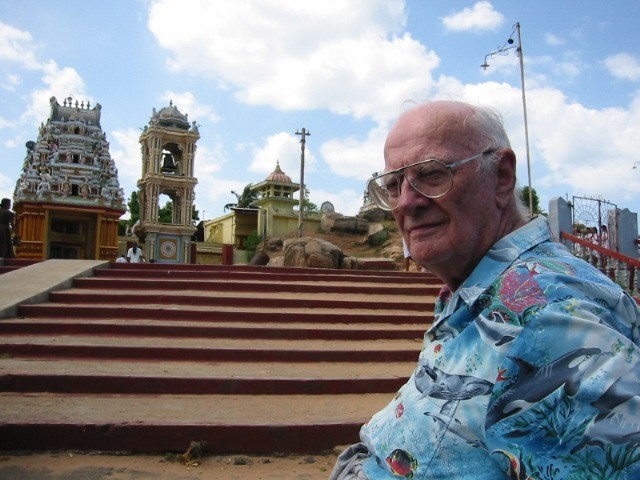
sir-arthur-clarke-with-sigiriya-in-background-photo-by-rohan-de-silva.jpg

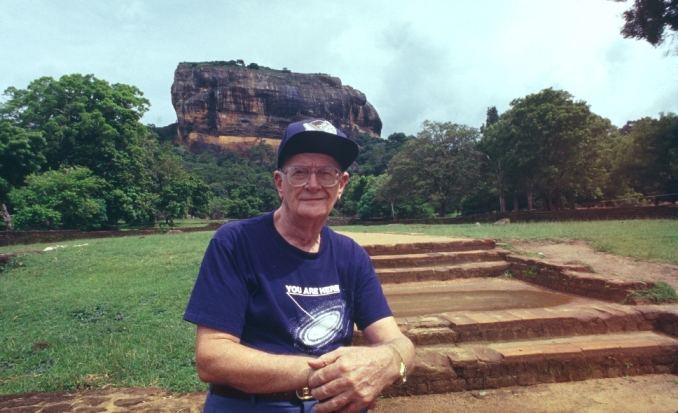
Sir Arthur Clarke, who died last week, was buried at Colombo general cemetery at his request. That ended a 52-year-long association the author had with his adopted home.

His interest in diving and underwater exploration led him to Ceylon (now Sri Lanka), where he settled down in 1956. He pioneered diving and underwater tourism in Sri Lanka through his company Underwater Safaris, and played an active role as a public intellectual and as a patron of art, science and higher education. He served as Chancellor of Sri Lanka’s technological University of Moratuwa from 1979 to 2002.

Although he became the island nation’s first Resident Guest in 1975, Sir Arthur always remained a British citizen. The Sri Lankan government presented him the Lankabhimanya (‘Pride of Lanka’), the country’s highest civilian honour, in 2005. In December 2007, government officials, scientists, artistes and diplomats came together to felicitate Sir Arthur on his 90th birthday.

During the past few days, there was a good deal of coverage, editorialising and reminiscing in the Sri Lankan media about Sir Arthur, whom a former foreign minister once called a ‘one man cheering squad for Sri Lanka’. Most of this coverage looked back to recall the highlights and anecdotes of the sarong-clad, table tennis playing, myth-busting icon.

As Sir Arthur would have said, that was necessary – but not sufficient. His business was talking about the future and helping to shape it. So I dug up from my own archives a 1,100-word essay that I had written for The Sunday Observer in Sri Lanka a decade ago, for a series titled Sri Lanka in 2048. There, leading artistes, scientists and other public figures were asked to outline their personal vision for the year Sri Lanka would complete 100 years of political independence (the series marked the Golden Jubilee of this event).

Upon re-reading the essay, which was in Sir Arthur’s first person narrative, I found that it was still fully valid, and even more relevant a decade later than when it was first written. So I passed this on to Pramod de Silva, editor of The Daily News, the sister newspaper of the Observer, which ran it on 22 March 2008 – the day of Sir Arthur’s funeral. I found that quite appropriate – the physical remains were going on their final odyssey, but Sir Arthur’s vision would – hopefully – propel Sri Lanka to a better future for decades to come.

sir-arthur-clarke-at-swami-rock-trincomalee-sri-lanka-by-rohan-de-silva.jpg

Here’s how he opened the essay, My Vision for Sri Lanka in 2048:

“A guest must be careful about what he says of the host: contrary to popular perception, I am not a Sri Lankan citizen — only a resident guest. Yet, having lived here for 41 of my 80 years, I now regard this alone as home, and have visions and hopes for my adopted land.

“Half of all Sri Lankans alive today were not even born when, in December 1954, I had my first glimpse of the then Ceylon — when the P&O liner Himalaya carrying me to the Great Barrier Reef paused at the Colombo harbour for half a day. What I saw on a single afternoon tempted me to come back a year later to explore, and by the end of the 1950s, I had developed a life long love affair with the island.”

Taking stock of Sri Lanka’s already high human development indicators, Sir Arthur noted:
“It has been said that the biggest remaining challenge in terms of human health and welfare is not so much to add years to life, but to add life to years. For a country like Sri Lanka that has already achieved high levels of life expectancy and other impressive social indicators, this is indeed the next major challenge. The vision for the next fifty years should be to develop ways of improving the quality of life of all Sri Lankans. Difficult though it certainly is, such development will have meaning only if it is socially and environmentally sound.”

He then talked about two areas that were crucial for the socio-economic development of his adoptive land: energy and telecommunications. But he knew these physical improvements would not, by themselves, create a better society until and unless lasting peace could be achieved:
“The biggest challenge for all Sri Lankans in the coming century would be achieving better communications and understanding among the different ethnic, religious and cultural groups and sub-groups all of who call this their motherland. For material progress and economic growth would come to nothing if we allow the primitive forces of territoriality and aggression to rule our minds.

Read the full essay on the Daily News website

Related essay: Rebuilding after Tsunami: Sri Lanka’s challenges by Arthur C Clarke, January 2005

Photos by Rohan de Silva, Sir Arthur’s personal photographer

Half the sky, most of the suffering…and seeking everyone’s attention!

What’s one of the biggest reasons for suffering from violence?

Is it War? Racism? Extremism?

Or simply being born a woman?

One in 3 women is a victim of violence.

This is the powerful message in this one-minute-long public service announcement (PSA), which can be viewed here:

It was produced by the London-based advertising agency Leo Burnett for UNIFEM, the United Nations Development Fund for Women. With a striking series of images, it reveals that violence against women is one of the most common forms of violence in the world.

This PSA is part of a new global campaign on this scourge.

As UNIFEM says: “Violence against women and girls is a problem of pandemic proportions. At least one out of every three women around the world has been beaten, coerced into sex, or otherwise abused in her lifetime — with the abuser usually someone known to her. Perhaps the most pervasive human rights violation that we know today, it devastates lives, fractures communities, and stalls development.”

The campaign has elements on awareness raising as well as a call to action. The latter includes an online signature campaign that seeks to collect at least 100,000 signatures from those who oppose violence against women.

The online ‘signature book’ opened for signatures on 26 November 2007 with an appeal from actress and UNIFEM Goodwill Ambassador Nicole Kidman. She called the violence many women worldwide face “an appalling human rights violation that can be stopped”, and asked everyone to add their names to a growing number of supporters saying “NO” to violence against women at http://www.saynotoviolence.org.

She added: “The more names we collect, the stronger our case to make ending violence against women a top priority for governments everywhere.”

Watch her appeal on YouTube:

The UN Trust Fund to End Violence against Women , established in 1996, will receive US$ 100,000 from the United Nations Foundation for 100,000 signatures

I have just signed up, on this leap day 29 February 2008. Three months since the campaign was launched in New York, it has so far gathered a little over 58,500 signatures.

It’s certainly commendable – but not nearly enough, and still more than 40,000 needed to reach the modest target of 100,000.

Not that it’s just a numbers game, of course. The quality and sincerity of commitment matter a great deal. At the same time, UNIFEM and other UN agencies trying to engage the public through online interactive methods should study how successful activist groups do the same — with much better and faster results.

Avaaz.org is a leader among these. It is a new global web movement with a simple democratic mission: to close the gap between the world we have, and the world most people everywhere want. Set up in early 2007, it has quickly evolved into online community through which hundreds of thousands of concerned people are taking action together on urgent issues like climate change, poverty, human rights and the crises in the Middle East and Burma.

In October 2007, I joined Avaaz in its signature campaign to focus global attention on the political violence and gross abuse of human rights in Burma. In just four days, thousands of Avaaz members donated over $325,000 online to support the Burmese people’s efforts to peacefully promote political change and tell the world about their struggle.

The Burmese junta may not care for millions of people protesting or donating online, but the leaders of the democratic world – pondering their response to the atrocities in Burma – would find it hard to ignore this surge of public concern.

But it’s a long leap from Burma to the bed room or backyard. A major difficulty faced by those campaigning to focus on violence against women: they are countering actions that are widely distributed, pervasive and sustained over time. Much of it happens at personal and family level, necessarily beyond the public and media’s glare. Incidents flare up only occasionally to spill over to the public space to become news events or talking points.

So, as in many similar instances, out of sight often means out of mind.

The big challenge is how to raise public awareness on a wide-spread issue of violence that happens, to a large extent, in private. The facts and figures are compelling as they are alarming and depressing. The campaigners have lined up some of the biggest celebrities (like Nicole Kidman) and enlisted big guns like UN Secretary General Ban Ki-Moon.

All necessary, but not sufficient.

The campaign needs more than just star power or the UN’s clout to galvanize mass action. For a start, UN agencies need to get out of their fondness for coining and using endless acronyms. Even with my regular forays into the development community’s acronym jungle (read my post on the alphabet soup), I was recently puzzled when a film-maker colleague referred to GBV in an email without explaining it. It took me full five minutes to realise that she meant gender-based violence.

And some imaginative ways of raising the public profile would also help. Browsing on YouTube, I came across this video from Ireland. As one article described it:
“The ghosts and spirits of the millions of women who have been murdered, violated, oppressed, excluded, driven into exile, denied freedom of speech, denied participation in any decisions concerning their lives, because of war, religion, race, culture, age, disability, sexuality, poverty, bonded slavery, domestic violence or bureaucracy, glided in and out of the shoppers of Galway on 7 December 2007.”

Governments, disasters and communication: Lead, follow or get out of the way!

The Association for Progressive Communications (APC) has just published a good review of the book I recently co-edited titled Communicating Disasters: An Asia Pacific Resource Book.

The review is written by two academics. Dr Malathi Subramanian is Former Principal, Daulat Ram College, University of Delhi, India, while Dr. Anupama Saxena is Head, Department of Political Science, Guru Ghasidas University, Bilaspur, Chhattisgarh, India.

As they remark: “The book has articles contributed by authors who do not engage in mere theoretical discussions. They draw on their rich and varied experiences working in either preparing disaster resilient communities or responding to humanitarian emergencies triggered by specific disasters in different parts of the globe.”

They add: “The eminently readable book provides first hand information about the real life situations of disaster, richly illustrated with case studies and use of professional images….The book is written in a manner that successfully sensitises the reader to the complexity of the issue of disaster management and its various nuances. After reading the book one is sure to echo the spirit of one of the contributors, Sanjana Hattotuwa: ‘We cannot prevent or predict all disasters. However, we can plan for, react to and learn from disasters when they do occur’.

In preparation of this review, Malathi and Anupama did an email interview with me where they posed half a dozen questions on some key issues we have addressed in the book. Here is the full interview, which brings out my personal views interspersed with those of some other contributors to our multi-author book.

Question: In developing countries the governments are considered to be the nodal agencies for disaster management. In this context do you think that there is a need to advocate the integration of the National disaster management policy with the national ICT Policy to exploit the potential of ICTs before, during and after a disaster?

Yes, that certainly is the ideal, desirable scenario. But I’m not sure how soon this can become a reality, given how many of our governments think of these sectors as separate compartments – or ‘silos’ – with little or no integration. In the real world, however, these are all mixed up: people who use ICTs are affected by various disasters and the first responders – including relief workers and journalists – use various ICT tools in their work. Increasingly, we are seeing disaster affected people themselves using ICTs, especially mobile phones, to communicate with family, friends, aid officials and others from the scenes of disaster. We have documented specific instances of all this in our book and pointed out that the typical hapless, uninformed affected person is being replaced by a digitally empowered one. So the integration of disaster management and ICTs has been happening on the ground for some time, whether or not policy-makers acknowledge it!

At policy and regulatory level, governments can play an enabling role by easing the various bottlenecks that currently hold back optimum use of ICTs in disaster preparedness, early warning or response. This is so lacking and badly needed in my own country Sri Lanka. One example: amateur radio enthusiasts played a key role in establishing emergency communication with some coastal areas badly hit by the 2004 tsunami. When everything was dead, short wave was alive. Yet, barely months later, the government blocked any new amateur radio equipment being brought into the country as someone felt it was a threat to national security!

But in my view, misguided policies are worse than no policies at all. That’s when I feel like quoting Rabindranath Tagore’s words which every southern government should heed: ‘If you can lead, lead. If you cannot, follow. If you can do neither, then get out of the way’.

tveap-image-archive.jpg

Question: Participatory Modes of communications form a very important part of a comprehensive strategy aiming at creating disaster resilient communities. What type of policies and frameworks the national governments should adopt to facilitate this?

Living with disasters – or developing resilience to disasters – is fast becoming a necessary strategy of day-to-day survival. Communication plays a role in this. In our book, we have an entire chapter on this written by Chin Saik Yoon, who has been researching and documenting participatory communication processes in development. He identifies communication as one of four necessary steps towards recovery from a disaster. Survivors need to maintain communication with family, friends, and counsellors in order to share their experiences. They need to tell their stories about the disaster, and listen to others as they tell theirs. This helps survivors to collectively release their stress.

To continue in his own words: “Participatory communication processes work best here. This is where survivors assume the role of both the ‘initiator’ as well as the ‘receiver’ of communication. No expert or government official should be there to decide what is to be discussed by the survivors. They need only facilitate the process. The participatory processes ensure that communication occurs at the pace that communities are comfortable with and address issues only when survivors are ready to deal with them.”

This makes eminent sense, but it is precisely this kind of thoughtful, sensitive approach that many governments are unable or unwilling to adopt. For too long, governments have been seen as the sole decider, provider and protector – and governments do have a responsibility in all these. But in today’s world, the role of government has to be reviewed and redefined. As Chin says, government officials may facilitate, but governments must get out of the historical habit and temptation of playing Big Mama (or worse, Big Brother!) by doing such communication themselves.

For our quest for disaster resilience to succeed, we need a transformation in governmental policies, attitudes and practices. In a world experiencing a growing number and intensity of multiple hazards, no government – however powerful or well intended – can reach out and protect every citizen. That illusion was shattered forever by hurricane Katrina. There is no need for such governmental omnipresence either! The smart option is to allow, encourage and empower individuals and communities to do part of it on their own. Governments, researchers, aid agencies and charities still have to be part of this – but first they have to break free from the ‘Let’s-Do-It-All-Ourselves’ mentality.

Question: It is evident from the many case studies in the book that participatory non-media modes of communications have been quite useful in dealing with disasters. Such efforts however, need constant involvement of a wider group of people on voluntary basis over a long period of time for creating resilience for disasters. How to develop this spirit and, more important, sustain it.

Yes, participatory communication efforts have to sustain the community engagement over weeks, months and sometimes years. As one of our contributing authors, Buddhi Weerasinghe, has written in the book: “The big challenge is to sustain disaster preparedness interventions over time. This is helped by the creation of informal leadership within the community through participatory action.”

Since no two communities are alike, it’s very hard to generalise on how to develop the necessary conditions and ‘spirit’, but some generic lessons can be drawn from documented examples. The right kind of community leadership helps, as does external help that is neither over-bearing nor fleeting. Assistance from aid agencies needs to be delivered at a pace the communities can absorb, integrate and use.

Disasters are often the latest (and highly disruptive) layer over existing multiple layers in a community. Even if a shared plight and grief temporarily unite a community, that alone cannot hold people together for too long, especially if there are deep divides in that community. So community cohesion and unity become very important factors in the success of participatory communication. There is no single formula that can work for everyone.

cartoon-noahs-doubters.gif

Question: The book describes many successful interventions based on non-media participatory mode of communications for disaster management. Which of these interventions do you think can be cited for the most optimal use of non media participatory mode of communications?

In our introduction to the book, Frederick Noronha and I wrote: “Media-based communication is vitally necessary, but not sufficient, in meeting the multiple information needs of disaster risk reduction and disaster management. Other forms of participatory, non-media communications are needed to create communities that are better prepared and more disaster resilient.”

These non-media communication methods range from basic inter-personal communication and small group discussions to participatory rural appraisal techniques. The methods are not new or unique; they are being customised to meet disaster preparedness and/or response needs.

It’s more than mere talk. Some methods involve experiential learning – or learning by doing. An example is participatory hazard mapping. First, community members are divided into a few groups and asked to map their neighbourhoods – they have to capture the roads, footpaths, rivers, hillocks, houses, schools, temples and other key landmarks. Then they mark the areas that have been affected historically with different disasters such as tsunami, floods or cyclones. This helps identify relatively safer areas as well as safety routes in case a new disaster demands quick evacuation. Admittedly this is communication plus social mobilisation, but that’s what it takes in the real world – communication is only part of the solution.

As Buddhi Weerasinghe has written in his chapter, “This exercise allows informal leaderships to emerge. Encouraging this leadership and recognizing their inputs can motivate them and enable sustainability of interventions. The process of hazard mapping also imparts a sense of ownership.”

Question: To what extent is it really practicable to achieve the ‘disaster resilience’ in communities?

Disasters are all about resilience – how we pick ourselves up after a tragedy and slowly return to normalcy. And also how we take repeated battering from a multitude of disasters and still carry on with living. There is no single recipe for success in building disaster resilient communities. Everyone needs to approach this with open and flexible minds, and see what works for whom under which conditions. Disaster resilience is not a slogan like halving poverty by 2015 or writing off majority world’s debt. It’s a long-drawn, incremental process and will always remain a work in progress because both community dynamics and the nature of hazards change over time.

In many cases, the community has information and insights that help achieve resilience, but it needs to be brought out – that’s where participatory communication helps. But let’s not romanticise matters too much – some communities need external guidance, and most can benefit from external facilitation in their quest for resilience.

In a chapter called ‘Bridging the Long Last Mile’, I have described the experience of a community-based disaster preparedness and early warning dissemination effort undertaken by Sarvodaya, LIRNEasia and other partners in Sri Lanka. The project studied which ICTs and community mobilisation methods could work effectively in disseminating information on hazards faced by selected coastal communities all of which were battered by the Indian Ocean tsunami of December 2004.

hazinfo-project-meeting-at-sarvodaya.jpg

Sri Lanka – Last Mile Hazard Info project planning meeting: Photo courtesy Sarvodaya

I would refer you to the chapter for details, but the key lessons may be summed up as follows:
• Trusted technology: Use ICTs that are reliable in performance, accessible at the local levels and trusted by the people.
• Complementary redundancy: Always have at least two different ICTs delivering information, to minimise transmission failures.
• Credible information: Tap only the most authentic sources of information at national and international level, reducing room for misinformation and rumour.
• Right mix: Achieve the appropriate combination of technology, training and institutional arrangements at the grassroots.
• Be prepared: Raise localised awareness and provide experiential training so community know what to do when crisis occurs.

book-cover-final.jpg

Fighting for our right to ‘shoot’: A struggle in New York…and Colombo!

Courtesy AP

Photojournalists usually bear witness to unfolding events, and then share it with the rest of us. It’s not everyday that they make the news themselves.

This photojournalist, Gemunu Amarasinghe working for Associated Press in Sri Lanka, just did. Earlier this week, he was detained, questioned and released by police — all for taking photographs near a well-known Colombo school.

According to news reports, Gemunu was apprehended by a group of parents who formed the school’s civil defence committee. They had handed him over to soldiers on duty near by, and he was briefly detained by the Narahenpita police. Sri Lanka’s Free Media Movement has already protested to the police chief on this – the latest in a series of worrying incidents.

This might seem a minor incident in the context of highly dangerous conditions in which Sri Lankan journalists operate today. It was only a few days earlier that the World Association of Newspapers ranked Sri Lanka as the third deadliest place for journalists (6 killed in 2007), behind only Iraq and Somalia.

In an op ed essay published today on the citizen journalism website Groundviews, I have discussed the far reaching implications of this latest trend – when misguided citizens turn on professional or citizen journalists simply taking photos in public places. That’s still not illegal in Sri Lanka, where many liberties have been curtailed in the name of anti-terrorism.

Read my full essay: Endangered – Our Right to ‘Shoot’ in Public

As I write: “Gemunu’s experience is highly significant for two reasons. Firstly, it is depressing that some members of the public have resorted to challenging and apprehending journalists lawfully practising their profession which responds to the public’s right to know. Battered and traumatised by a quarter century of conflict, Sri Lankan society has become paranoid. Everything seems to be ‘high S’: practically every city corner a high security place; every unknown person deemed highly suspicious; and everybody, highly strung.

Courtesy Daily Mirror - Sri Lanka Cartoon from Daily Mirror, Sri Lanka

“Secondly, far from being an isolated incident, this seems to be part of a disturbing new trend. Anyone with a still or video camera in a public place is suspected – and presumed guilty until proven otherwise. This endangers everyone’s basic right to click for personal or professional purposes.”

I mention some examples of this cameraphobia. In recent months, pedestrians who filmed public bomb attacks on their mobile phones have been confronted by the police. One citizen who passed on such footage to an independent TV channel was later vilified as a ‘traitor’. Overly suspicious (or jealous?) neighbours called the police about a friend who was running his video editing business from home in suburban Colombo.

None of these individuals had broken any known law. Yet each one had to protest their innocence.

It may not be illegal, but it sure has become difficult and hazardous to use a camera in public in Sri Lanka today. Forget political demonstrations or bomb attacks that attract media attention. Covering even the most innocuous, mundane aspects of daily life can be misconstrued as a ‘security threat’.

I stress the point that, unlike journalists working in the mainstream media, citizen journalists lack trade unions or pressure groups to safeguard their interests. The citizen journalist in Sri Lanka is very much a loner — and very vulnerable.

And it’s not just in war-torn Sri Lanka that the right to take photos or film video is under siege. I cite a recent example from what is supposed to be a more liberal democracy: in the US, where New York city officials last year proposed new regulations that could have forced tourists taking snapshots in Times Square and filmmakers capturing street scenes to obtain permits and $1 million in liability insurance. The plans were shelved only in the face of strong public protests, spearheaded by an Internet campaign that included an online petition signed by over 31,000 and a rap video that mocked the new rules. Photographers, film-makers and the New York Civil Liberties Union played a lead role in this campaign, which asked people to ‘picture New York without pictures of New York’.

Read my full essay: Endangered – Our Right to ‘Shoot’ in Public

Sep 2007 blog post: Kenji Nagai (1957 – 2007): Filming to the last moment

Dec 2007 blog post: Asian tsunami – A moving moment frozen in time

Engaging new media: prepare to lose control!

The development community never tires of talking about the value of participatory, two-way communication. Every workshop, report and discussion has a dose of this mantra sprinkled all over.

Yet when it comes to actually practising communication, most development agencies I know are so concerned with complete control – they want to edit endlessly, fine-tune their messages to the last letter and comma, and regulate how and where the message is disseminated.

There’s no harm in being organised and focused. But when communication officers are pushed into becoming publicity agents (or worse, spin doctors!) for their agencies, controlling the message becomes obsessive.

I’ve had more than my fair share of this. One example was when working on a documentary for a leading UN agency in Asia that my organisation, TVE Asia Pacific, was commissioned to produce. Now, films cannot be made by committees, but UN agencies never stop trying. At one point, over-zealous agency officials were tinkering with the post-shooting script so much that they edited even the interview clips included in the draft.

That only stopped when I pointed out that hey, those are transcribed verbatim from interviews we’d already filmed!

So imagine how hard it would be for such organisations to let go of the Complete Control over communications that they’ve aspired to perfect for so long.

And yet, as I told a small meeting convened by UNEP in Bangkok last week to plan their next ozone communication strategy for Asia Pacific, that’s not a choice, but an imperative with today’s new media.

In the four years since we worked on the last ozone communication strategy and action plan for the Asia Pacific, we have seen the emergence of web 2.0 – which is really a catch-all term that covers many second generation, interactive platforms and opportunities that have emerged using the global Internet.

Among these are blogs, wikis, social networking sites (e.g. MySpace, Facebook), social bookmarking (e.g. del.icio.us), video exchange platforms (e.g. YouTube), online games and mobile applications.

These and other new media tools enable development communicators to reach out to, and engage, many people – especially the youth who make up more than half of all Asians.

web-20-illustrationsvg.png

But that’s part of the challenge, I said, referring to what I call the ‘Other Digital Divide’ – one that separates (most members of) the development community from ‘Digital Natives’, young people who have grown up taking these digital media and tools completely for granted.

I referred to my remarks at the IUCN Asia Conservation Forum in Kathmandu in September 2007, where I stressed the urgent need for the conservation and development communities to cross this divide if they want to reach out to the dominant demographic group in our vast region, home to half of humanity.

Engaging new media is not just setting up a Facebook account, taking a YouTube channel or opening a blog that’s infrequently updated. All that’s useful, for sure, but they represent only the tentative first steps to the wide and varied new media world.

As with the more established print and broadcast media, development organisations need to have a strategy and a plan based on some research, analysis and reflection.

And willing to let go of that control – so cherished by so many development professionals – is an essential part of that adjustment to the new media reality.

Failure to adjust can result in future shocks – and in the very near future! Perhaps I should also have drawn their attention to what I wrote in October 2007: New media tsunami hits global humanitarian sector; rescue operations now on

We didn’t spend too much time talking about new media at the Bangkok meeting, but I did caution that there is a lot of digital hype out there. I’m no expert on this (is anyone, really?) but my team at TVEAP and I keep trying new ways of doing things with the new media. So here are a few quick insights I offered the UNEP meeting:

• New media lot more interactive, which means they demand a lot of time and effort to engage the audience – which in turn generates huge capacity requirements for any development organisation venturing into such media.

• You can’t always control your messages on new media! This unnerves many development agencies and professionals who are so used to exercising such control – in the new media world, they just have to learn to let go!

• A core value is user-generated content (USG). You need to find creative ways to allow your audiences to generate part of the content. Control lost again!

• Citizen journalists have now established themselves online as text and/or video bloggers. Governments and corporations have acknowledged their presence — serious bloggers have recently been granted media accreditation to the UN. What does this mean for future ozone media training and journalists engagement?

• There are many companies and agencies claiming to have cracked the new media challenge – and don’t believe them! Everyone is learning, some admittedly faster than others, but there’s no substitute to actually doing it.

• And there’s no road map to the new media world, which is being created every day and night by an army of geeks and enthusiasts. There are only a few rough guides and travellers’ tales from some like ourselves who have ventured into this realm.

Note: I am grateful to my colleagues at TVE Asia Pacific who have developed and/or tested out some ideas in this blog post: Manori Wijesekera, Indika Wanniarachchi and Nadeeja Mandawala. I stand on their shoulders, hopefully lightly!

When the Waves Came – the story behind the verse

I am a word-smith. Trained as a journalist and writer, I play with words (and occasionally make an honest living of it ) — but almost all of my published output over more than 20 years has been in prose. Not yet a creative writer (maybe someday!), I write mostly fact-based analysis or opinions.

One rare exception was when the Asian Tsunami struck three years ago in the last week of 2004. Extraordinary situations prompt extraordinary responses – and I went on to write the only verse I have so far published: When the waves came.

I was recovering from chicken pox when the mega-disaster that struck on 26 December 2004. The killer waves spared the Colombo city on the western part of coastal Sri Lanka where I live – and we were extremely lucky. But with close to 40,000 persons dead or missing (which was 1 in 500 of us), it was not a time to heave sighs of relief. We all knew people who were directly affected in one way or another: losing loved ones, suffering property damage, or seeing their jobs go up in the waves.

In the days following the disaster, the entire country was a giant funeral house. For a short while, at least, our utterly divided nation of Lanka was united — first in horror and then in grief.

creating-disaster-resilience-everywhere.jpg

I first heard about the disaster on local television – whose newscasters were struggling to make sense of what was happening. Tsunamis were not known in the Indian Ocean until then, and most people had not even heard of the term. Broadcast journalists had to improve with terms like ‘ferocious wave action’, ‘seas flooding land’ and ‘seas spilling over to coastal areas’, etc.

As the international news media started reporting the extent of devastation from all over South Asia and Southeast Asia, we realised that Sri Lanka was not alone – even though it had been battered very badly.

By Monday 27 December, the scale of the disaster was clearer, and the Sri Lankan death toll was already past 25,000 -– and counting. Search and rescue efforts were now underway, and relief agencies were continually updating their assessments of damage. The grim statistics kept rising by the hour.

The global family first watched in shock — and then started to react. Around the world, hundreds of caring people were dropping everything they had lined up for their Seasonal holidays and rushing to volunteer in Sri Lanka and other disaster hit countries. Inspired by the saturation media coverage, especially on television, caring women and men in far away corners of our planet were donating generously for disaster relief support. Children were breaking open their tills in which they’d carefully saved small change for months or years. Church congregations had special collections. Performing artistes were getting ready to have Tsunami aid concerts. Spurred and partly embarrassed by these citizen actions, governments belatedly started pledging massive volumes of aid. The worldwide response to Asia’s tragedy was deeply moving (the bickering and swindling came later).

My office (TVE Asia Pacific) was closed that week for Seasonal holidays, but I decided to go in and follow the disaster’s news coverage online (I didn’t have ADSL at home then.) Websites were often giving better coverage than TV channels, and the bloggers were rising to the challenge from many locations in impacted Asia.

I spent most of December 27 and 28 in my office. Weakened as I was by chicken pox, I didn’t rush out to help with relief efforts. I knew my limits. Instead, I was emailing regular updates to our friends and partners from many parts of the world who were concerned and anxious about our safety and well-being. Not being a blogger myself then, I was doing it on a one-to-one basis.

I slowly came to terms with a deep anguish that had built up since I first heard the dreadful news. I was badly shaken and numbed by the unfolding human tragedy and humanitarian crisis all around myself. No, I didn’t lose a loved one, or suffer personal property damage, but it was impossible not to be moved by the carnage and destruction all around. And at a scale that was unprecedented in my lifetime.

For hours on 28 December 2004, I watched the ‘doom and gloom’ television news coverage and monitored news updates online. At that stage, with little news yet emerging from Aceh, Indonesia, Sri Lanka had reported the highest death toll and the greatest damage. It was the biggest disaster in the island’s living memory.

When I finally gathered enough sense and wits, I wrote a verse ‘When the waves came’ – it was one way of coming to terms with the calamity. Its basic premise was that the killer waves had been a brutal ‘equaliser’ of all men and women. It no longer mattered on which side of law, morality, economics or social class they stood.

To drive home the point, I sprinkled the words of William Makepeace Thackeray throughout the verse:
“Good or bad, guilty or innocent —
they are all equal now.”

The verse was not meant for publication, and was only privately circulated for a few days. One friend who received it, Bircan Unver in New York, wanted to publish it on her Light Millennium website. After some persuasion, I agreed.

tsunami-survivor-children-return-to-the-sea-in-suduwella-southern-sri-lanka.jpg

I wrote this verse with tears running down both my cheeks. I kept on typing, without wiping my face, as words poured out from my grief-stricken mind. This was the least I could do, as my tribute to everyone who perished or suffered by nature’s incredible fury.

Writing this verse was cathartic for me. Three years after it happened, I can now disclose what followed my writing of this verse: I closed the laptop, sat down on the floor, and completely broke down.

I have no idea for how long I cried: it must have been 20 or 30 minutes. There was no one in the office that day so I didn’t have to subdue myself. Of course, my tears were nowhere near as abundant as those who lost their loved ones to the tsunami. But they were no less sincere.

Looking back, I suspect that during those hours of sorrowful solitude, Children of Tsunami was conceived.

But that’s another story.

Photos courtesy TVE Asia Pacific

Communicating Disasters: Lessons From Titanic to Asian Tsunami by Arthur C Clarke

What do the RMS Titanic, which sank on her maiden voyage in April 1912, and the Asian Tsunami of December 2004 have in common?

Both were maritime disasters and, when they happened, both shook the world as few others did before or since.

And now, Sir Arthur C Clarke has linked the two tragedies that happened 92 years apart: he says they both illustrate how communications failures can compound the impact of a disaster.

Writing a foreword to Communicating Disasters: An Asia Pacific Resource Book (co-edited by myself and Frederick Noronha, and just released), the inventor of the communications satellite revisits the two disasters that left deep impressions in his mind.

communicating-disasters-an-asia-pacific-resource-book-by-tveap-and-undp.jpg sir-arthur-clarke-by-shahidul-alam.jpg

Arthur C Clarke was born five years after the sinking of the ‘unsinkable’ RMS Titanic while on her maiden voyage. His home town Minehead, in Somerset, was not more than a couple of hundred kilometres from Southampton, from where the Titanic set off, he says, adding: “All my life, I have been intrigued by the Titanic disaster.”

He is particularly interested in what happened to the Titanic’s distress call after she hit the iceberg at 11.40 pm on the night of 14 April 1912. “A series of unfortunate factors compounded the disaster. The most ironic among them was that the wireless operator on the Californian, located closest to the Titanic, had shut down for the day just 30 minutes before the first distress call was sent out. Had the Californian been listening, it could have responded hours before the Carpathia, the eventual rescue vessel.”

The Titanic disaster prompted the shipping community to introduce a 24-hour radio watch on all ships at sea. It also consolidated the role of maritime radio in distress signalling and rescue operations.

But, as fate would have it, the absence of a timely warning once again characterised the second disaster to touch Sir Arthur’s life. Arriving 10 days after his 87th birthday, the Asian Tsunami of December 2004 left a massive trail of destruction in his adopted country Sri Lanka and several other countries bordering the Indian Ocean.

He reflects:
“Astonishingly, a full century after the invention of radio, the Tsunami arrived without any public warning. The disaster’s death toll could have been drastically reduced if its occurrence — already known to scientists — was disseminated quickly and effectively to millions of coastal dwellers living on its predictable path. Even a half hour’s notice would have allowed people to run away from the coast, and in many affected locations there was just enough time to get to safety. But alas, that didn’t happen — and tens of thousands perished.

“It was appalling that our sophisticated local and global communications systems completely failed us that fateful day. The communications satellites that I invented, and the global Internet that one of my stories inspired, could have spread the warning, with the hundreds of radio and television channels across coastal Asia amplifying it.

“It is now known that the failures were human, not technological. To ensure better results next time, we need to achieve an optimum mix of technology, management systems and community preparedness — not just for tsunamis, but for many other hazards that we live with. We have to remember that delivering credible early warnings to those who are most at risk is both an art and a science.”

copy-of-tsunamis-legacy-in-southern-sri-lanka.jpg

In his foreword, Sir Arthur sees the Asian Tsunami as a turning point for citizen journalism – ordinary people armed with digital tools bearing witness to unfolding events and then sharing it with others. He writes: “On 26 December 2004, many holiday-makers on affected beaches were armed with video cameras, and it was their ‘amateur’ images that later showed us the full force and fury of the unfolding disaster. Because it was distributed over a large area and occurred during peak holiday season, the Asian Tsunami was probably the most widely filmed disaster in history.”

This was not the first disaster that ‘citizen journalists’ covered, says Sir Arthur, but it marked a turning point in the growing phenomenon enabled by information and communications technologies (ICTs). “The post-Tsunami coverage showed that the professional and amateur divide had now blurred; there is a clear (and complementary) role that each can play.”

ICTs can do much in good times and bad, but as Sir Arthur recalls, the Tsunami also reminded us how disasters can make our information society vulnerable. “When electricity and telephone services — both fixed and mobile – went down in the worst affected areas, a century old technology came to the rescue: amateur radio enthusiasts restored the first communication links with the outside world, sometimes using the Morse Code to economise the power of car batteries.”

He quotes the President of the Radio Society of Sri Lanka as saying, “When all else is dead, short wave is alive.”

Sir Arthur’s perceptive foreword is a sobering counterpoint to the post-tsunami frenzy that we witnessed in the Indian Ocean rim countries. Yes, lacking a tsunami warning system – such as the one Pacific Ocean countries have – is a big gap that needed to be filled. But governments and development donors have rushed into setting up high tech, high cost early warning systems without due consideration for social, cultural and political realities of the intended beneficiary countries.

As we saw with some subsequent undersea quakes – such as the one off the resort town of Pangandaran, Java, on 17 July 2006, and the one off off Bengkulu, Sumatra, on 12 September 2007 – we have yet to achieve the right mix of technology, management systems and community preparedness in most coastal countries in Asia.

Governments, donors and UN agencies would do well do heed the wise words of Sir Arthur Clarke, who concludes his Foreword with these words:

“Communicating disasters — before, during and after they happen — is fraught with many challenges. Today’s ICT tools enable us to be smart and strategic in gathering and disseminating information. But there is no silver bullet that can fix everything. We must never forget how even high tech (and high cost) solutions can fail at critical moments. We can, however, contain these risks by addressing the cultural, sociological and human dimensions — aspects that this book explores in some depth and detail, from the perspective of both media professionals and disaster managers.

“The lessons of history are clear: if we are not careful, we can easily lull ourselves into the same kind of false confidence that doomed the Titanic.”

Read the full text of “Communicating Disasters: A Century of Lessons”, By Sir Arthur C Clarke
communicating-disasters-a-century-of-lessons-by-arthur-c-clarke.pdf

Or download foreword as contained in the printed book

From KL to Bali: Why were ICT and climate change debates worlds apart?

The timing of the Third Global Knowledge Conference or GK3 last week just couldn’t have been worse in terms of international media attention and coverage.

Some 1,700 people from all over the world – representing academia, civil society, governments and industry – gathered in the Malaysian capital of Kuala Lumpur from 9 to 13 December 2007 for this platform of events meant for everyone interested in using information and communications technologies (ICTs) for the greater good – to solve real world problems of poverty, under-development, illiteracy and various other disparities that afflict our world.

The organisers, a network called the Global Knowledge Partnership, called it ‘Event on the Future’. They had worked for almost two years on planning the event, and spent a huge amount of development funding to drum up global interest in the event.

As things turned out, GK3 was a complete non-event for the world’s media, whose attention was much more engaged by another event that was crucial for the future of all life on this planet – the UN Climate Change conference taking place in neighbouring Indonesia’s Bali island.

pic-iht-ad.jpg

That coincidence of events was very unfortunate, especially since GK3 also discussed and debated important issues that shape our common future. Yes, the substance at GK3 was immersed in — and sometimes buried under — massive volumes of hype and spin, but for the discerning participants there were occasional gem stones amidst the numerous gravel.

I have written up my impressions of GK3 as a series of missed opportunities. In my view, the biggest missed opportunity was GK3’s failure to position itself as part of the smart response to global climate change that scientists now confirm is happening and is largely human-induced.

After 20 years working in the media, I can understand why the news media ignored GK3. Yes, bad timing was one factor. But the bigger lapse was that the GK3 organisers and participants failed to find and articulate their common ground with the bigger global process that was unfolding in Nusa Dua, Bali island.

In the real world, Bali is not all that far from KL. But sadly, the two were worlds apart as parallel processes took place with little confluence.

It need not have been that way. There is much that ICTs can do in reducing carbon emissions that are warming up the planet.

The biggest ‘digital dividend’ from ICTs is how they can help reduce needless travel. Dependent as we still are on fossil fuels of oil and coal for most of our transport, even a few percentage points of travel that we can realistically cut down can yield major savings in emissions of carbon dioxide.

In a blog post written in August 2007, I cited Sir Arthur C Clarke’s slogan that sums this up very well: Don’t commute; communicate!

I quoted from an essay Sir Arthur had written for the UK’s Climate Group in 2005, included as part of a global exhibit on climate issues, where he noted: “….Meanwhile, other technologies enable us to adjust our work and lifestyles. For example, mobile phones and the Internet have already cut down a lot of unnecessary travel – and this is only the beginning. We should revive a slogan I coined in the 1960s: ‘Don’t commute – communicate!’”

My friend and academic colleague Dr Rohan Samarajiva, who heads the regional ICT research organisation LIRNEasia, has given this some further thought.

More and easier use of telecom should theoretically lead to less need to travel. But nothing is ever that simple, he says. “It is not realistic to think that improved telecom-based connectivity will immediately lead to a reduction in demand for transport and a reduction in greenhouse gases. But it is clearly a necessary action that will yield good results over time.”

For telecom to make a real contribution to reducing demand for transport, Rohan says several things need to happen:
• Most people need to have easy and convenient access to telecom, for sending as well as receiving messages and for retrieving as well as publishing information;
• All offices and business establishments must be reachable through telecom;
• They must change their business processes to reduce the need for people to physically come to their locations; and
• The ancillary infrastructures such as energy, payment and delivery systems must change accordingly.

These, then, are important goals that are worth pursuing not only for the achieving information societies but also for saving the planet from the current slow baking. That’s the message that GK3ers failed to grasp or convey to Bali.

Instead, we heard from the movers and shakers of the IT and ICT companies how they are working to achieve greater energy efficiency in the manufacture and use of their products. Their sincerity and commitment were not in question. But I didn’t hear anyone emphatically make the point that helping people to avoid needless transport use is the biggest climate benefit ICTs can deliver. (I was yearning to stand up and say ‘It’s avoided transport, stupid!’ in one plenary but we ran out of time.)

The industry mandarins were not alone. Even the International Telecommunications Union (ITU), which sets standards and keeps an eye on ICT trends and conditions, missed this point. In a statement delivered to the Bali climate conference, ITU talked about lots of small contributions that ICTs can make to find solutions to the climate crisis.

To quote from their 12 December 2007 press release:

“ITU pointed out that the proliferation of ICT products in homes and offices, and their deployment throughout the world, places an increasingly heavy burden on energy consumption. The late night glow in homes and offices emanating from computers, DVD players, TVs and battery chargers is all too familiar. And the move to “always-on” services, like broadband or mobile phones on standby, has greatly increased energy consumption compared with fixed-line telephones, which do not require an independent power source. Energy demands caused by high-tech lifestyles in some countries are now being replicated in others.”

It’s always good to improve energy efficiency, if only to keep the bills in check. But can ICT industry and ITU please stop apologising for the relatively minor contribution their sector makes to global warming — and instead become a much bigger part of the solution? In other words, stop rearranging chairs on the Titanic’s deck, and instead get in the engine room to help steer the planetary Titanic from heading straight into that iceberg looming large.

We don’t need further studies, expert groups or conferences to deliver this category of carbon-saving, climate-friendly benefits: just keep rolling out telecom coverage worldwide and also make the services affordable and dependable. The markets will do the rest.

earth-at-night-off-website.jpg

This point was also lost in Bali. Obsessed as they were with a mechanism to succeed the imperfect Kyoto Protocol, the delegates failed to fully appreciate tried and tested solutions that can begin to roll out now and here. Let the diplomats and lobbysts bicker for years to come, but don’t ignore what markets can do in the meantime.

Even some champions of climate change have yet to realise the ICT potential for their planet-saving crusade. Al Gore, being both ICT-savvy and green, is an exception. Sir Nicholas Stern is not.

In October 2006, the UK government published a 579-page report on the economics of climate change by Sir Nicholas Stern, a former chief economist at the World Bank. Despite the massive size, scope and authority of the report, the Stern Report had no reference to the role that the ICT sector could play in helping to reduce energy demand, mitigate CO2 emissions and help to save the planet.

Fortunately, as I wrote in August 2007, telecom operators are begining to taking note. Among them is the European Telecommunications Network Operators’ Association (ETNO), which issued a report — incidentally, in the same month as the Stern Report — titled Saving the climate @ the speed of light: ICT for CO2 reductions.

It was a joint publication with the World Wide Fund for Nature, WWF. Its introduction read: “A wider usage of ICT-based solutions can play an important role in reducing CO2 emissions. This joint WWF-ETNO road map proposes a concrete way forward for a better consideration and inclusion of ICT’s in EU and national strategies to combat climate change.

Read the full report here.

So it seems that part of the climate response answer is literally in the air – or the airwaves. The emergence of information societies — where more electrons (carrying information) are moved than atoms (people, goods) — can help the pursuit of climate-neutral or, even better, climate friendly lifestyles. To use a currently fashionable UN term, that’s a co-benefit!

For these co-benefits to be appreciated and seized, it’s essential that we look at the bigger picture and not just work in individual sectors such as ICT and sustainable development. The ITUs and UNEPs of this world have to meet and talk more often — and also listen to each other more seriously.

I chose to attend the ICT event of GK3 in KL in spite of receiving three separate (and sponsored) invitations to join various activities in Bali. After last week, I have mixed feelings about that choice, but there’s no doubt at all in my mind about the massive potential that ICTs hold for mitigating the worsening of climate change.

But the ICT sector has to put its money where its mouth is, and practise what it advocates. It’s not good enough to endlessly meet and talk about all things ‘e’. Just as the world has to kick its serious addiction to oil and coal, we in the development sector have to wean ourselves away from our obsession with paper. Lots and lots of it.

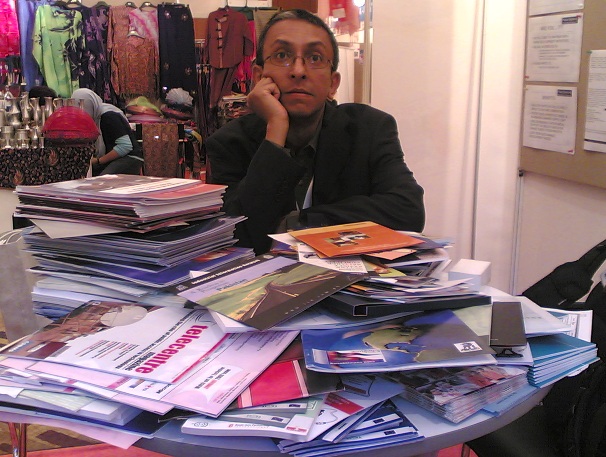
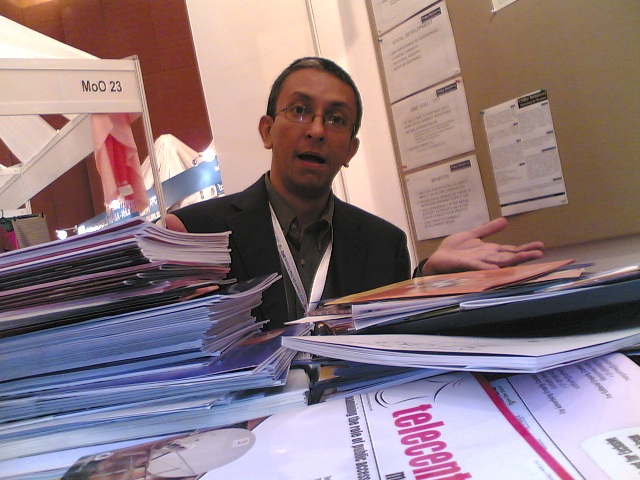
In the last hour of the final day, I walked around GK3’s exhibition area, with the ridiculous name MoO. I was stunned by the massive volumes of paper lying around everywhere. The week’s events were drawing to an end, and it was unlikely there would be too many more takers for all that paper. In that week, I saw very little digital media being used to peddle institutional messages or deliver their logos. It was 95% paper-based.

My colleague Manori captured on her mobile phone this image of an exasperated me surrounded by mountains of paper.

all-this-paper-at-the-end-of-an-ict-event.jpg

The MoO exhibitors were not alone in their profligacy and wastefulness – the GK3 secretariat easily wins the prize for producing the greatest volume of glossy, expensive paper-based promotional material for at least a year preceding the event.

Clearly both ICT and climate camps have some urgent rethinking to do. Together, we can find win-win, now-and-here solutions for slowing down processes of disruptive climate change already underway.

Or we can keep pushing bits of paper all around, all year round. The choice is ours – and the planet is at stake.

– Nalaka Gunawardene


Read my overall impressions of GK3: All geek but very little meek…and at what high cost?

Impressions of GK3: All geek but very little meek…and at what high cost?

I spent a good part of my last week (9 – 13 December 2007, both days inclusive) in the Malaysian capital of Kuala Lumpur participating in the Third Global Knowledge Conference or GK3.

GK3 was organised by a network called the Global Knowledge Partnership, as a platform for those interested in using information and communications technologies (ICTs) for the greater good – to solve real world problems of poverty, under-development, illiteracy and various other disparities that afflict our world.

Those within the GKP call it ICT for Development, abbreviated as ICT4D. I prefer the more catchy phrase ‘Geek2Meek’ (or using geeks’ tools/toys to serve the needs of the meek).

In the spirit of spawning endless acronyms and abbreviations that contribute to the Alphabet Soup, I will compress this as G2M.

GK3 was meant to showcase the best of G2M products, practices and processes in every area of human endeavour — education, health, natural resource management, poverty reduction, empowering youth and women, promoting enterprise, etc.
klcc-gk3-03.jpg nalaka-gunawardene-at-gk3.jpg

After spending a good deal of my time and energy sampling many of GK3’s offerings, my cumulative impression was: there was a lot of geek for sure, but very little of the meek.

And the nexus between geek (tools) and meek (needs) was hopelessly lost in the incredible volume of hype, PR and spin generated by the platform organisers. What a missed opportunity it was for everyone!

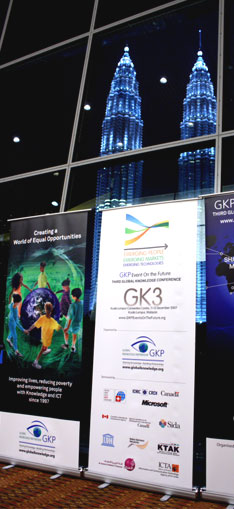
To be fair, GK3 was not a single conference, but a whole platform of events sharing the large physical space of the KL Convention Centre and spread through the week of 9 to 13 December 2007. During that time and using that space, various groups organised diverse events and activities — ranging from the usual talk sessions and workshops to training, exhibitions, quiz shows, a TV debate and a documentary film festival. There were also several social events that provided many hours networking among individuals and organisations.

Event platforms like GK3 mean very different things to different people. Some turn up mainly to show and tell (or share) what they are doing. Some attend simply to find out what’s going on. Others look for markets, partners or opportunities. With some planning and work, most participants get to take away something in the end.

All this certainly happened during GK3 to one extent or another. It brought together hundreds of people from all over the world who share an interest in G2M — according to official figures, a total of 1,766 registered participants from 135 countries, comprising 19% from public sector, 21% from private sector, 29% from civil society, 20% from international organisations, 5% from media and 6% from academia. Among them, 82% of participants were from developing countries. And half of all participants were from Asia, which was not surprising given their easier access to KL.

These participants — most of them eager, energetic and creative individuals — talked and mixed in a myriad combinations around the overall platform theme: how the threads of emerging people, markets and technologies will intertwine to deliver the future. There was discussion, debate, sharing and networking.

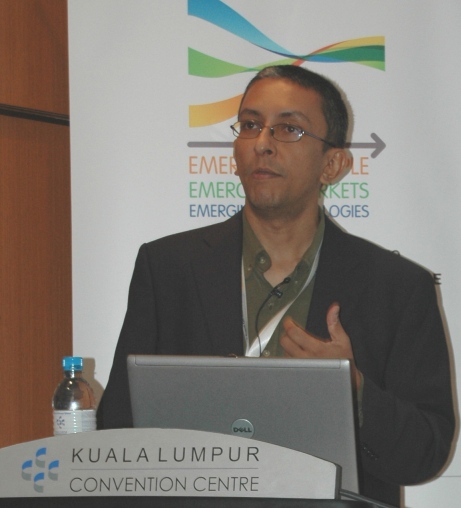
I myself did all of this. I attended part of the 3rd World Electronic Media Forum, joined the GKP’s 10th birthday celebration, sat through some plenary and parallel sessions and moderated two sessions myself. Some TVE Asia Pacific documentary films that I had scripted or directed were screened at the i4d film festival, a key side event. The week also saw the release of two Asian regional books that I was involved in creating (one I co-edited, and the other I wrote a chapter for).

But being the professional skeptic that I am, I don’t buy the GK3 secretariat’s post-event claim that “An overwhelming number of participants indicated that GK3 is the only event of its kind, is absolutely critical and worthwhile.” I have no doubt that a statistically higher number of people made nice and kind remarks about the week’s offerings, as many such people are wont to, especially if their participation was supported by travel scholarships. (I would be interested to know how many of the 1,700 people came on their own steam, as I did.)

In fact, style (and hype) over substance characterised the entire GK3 platform — the hype had actually started months before the event, with all registered participants being bombarded by endless promotional emails that I found simply intolerable. (And no, the organisers didn’t offer us the option of unsubscribing.) So much time, energy and donor funds were spent – nay, squandered – on dressing it up and inflating everything to the point of losing all credibility. If anyone was laughing all the way to their banks after GK3, it must be the assorted spin doctors!
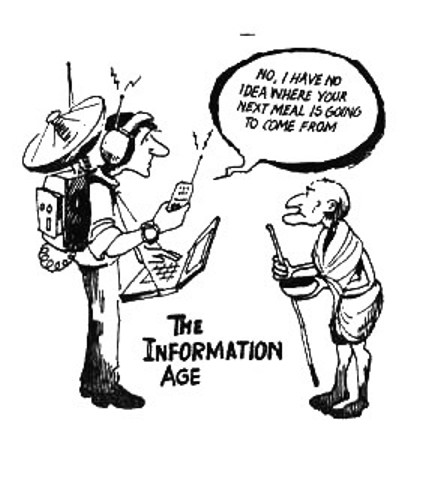
copy-of-all-inf-no-solutions.jpg
As I have written and spoken (for example in an op ed article in i4d magazine, June 2006), the gulf between the (expensive) hype and reality in ICT circles can be wide and shocking. What is worth investigating is the development effectiveness of this whole platform, and the value for money it delivered.

Take, for example, an email circular sent out by the GK3 organisers days after the platform ended. Under ‘key initial findings’, they list the following for emerging technologies, the area that interests me the most (verbatim reproduction here):

Four future-oriented outlook involving technologies were highlighted – media, cybersecurity, low cost devices, and green technologies.
* Increased convergence of different media allows single broadcasting (one to many) to be complemented by social broadcasting (many to many), and in turn increases interactivity in the exchange of information.
* Cybersecurity, cybercrimes and cyberwaste are becoming real dangers which deserve special attention.
* More new low cost devices are needed to facilitate affordable access to information, knowledge, communication and new forms of learning.
* Demand for innovative green technologies is welcomed and growing.

I don’t see how any of this can be labelled as ‘findings’ — these are not even articulate expressions of already known trends, conditions or challenges. Is this how the ‘Event of the Future’ going to be recorded for posterity? Surely, GK3 achieved more than this – probably below the radar of its spin doctors?

GK3 to me was more evidence of the disturbing and very unhealthy rise of spin in international development circles, where both development organisations and development donors are increasingly investing in propagandistic, narcissistic communications products and processes. While publicity in small doses does little harm, it is definitely toxic in the large volume doses that are being peddled whether in relation to MDGs or humanitarian assistance or, as with GK3, in relation to Geek2Meek. Full-page, full-colour paid advertisements in the International Herald Tribune don’t come cheap — but they come at the expense of the poor and marginalised.

I was also struck by how web 1.0 the GK3 organising effort was — all official statements, images and communication products (and even social events) were so carefully crafted, orchestrated, controlled. Whatever spontaneous action came not from the Big Brotherly organisers but from some free-spirited participants who seized the opportunity to express or experiment. The defining characteristics of web 2.0 – of being somewhat anarchic, highly participatory and interactive – were not the hallmarks of GK3. Again, a missed opportunity.

Then there was the ridiculously named Moooooooooooooo – sorry, it was actually MoO, an abbreviation for ‘Marketplace of Opportunities’, which GK3 was supposed to create or inspire for all those engaged in Geek2Meek work.

The MoO turned out to be just another exhibition where two or three dozen organisations put up their ware to show and tell (and a few did brag and sing, but that’s allowed at places like this). Strangely for an ICT gathering, there was so much paper floating around — posters, leaflets, booklets, books, postcards, you name it! And very few CDs, DVDs and electronic formats being distributed.

Oct 2007 Blog post: Say Moooooooooo – Mixing grassroots and iCT in KL

In the last hour of the final day, I walked around the MoO (I must admit I was half curious to see if the cows have come home!). I was stunned by the massive volumes of mixed up paper lying around everywhere. The week’s events were drawing to an end, and it was unlikely there would be too many more takers for all this paper. My colleague Manori captured on her mobile phone this image of an exasperated me surrounded by mountains of paper.
nalaka-gunawardene-sinking-in-a-sea-of-paper-at-gk3-dec-2007.jpg

The MoO exhibitors were not alone in their profligacy and wastefulness – the GK3 secretariat easily wins the prize for producing the greatest volume of glossy, expensive paper-based promotional material for at least a year preceding the event. These were often sent in multiple copies to heaven knows how many thousands of people all over the planet.

All this happened in a year (2007) when scientific confirmation of global climate change prompted governments, industry and civil society to realise that business as usual cannot continue, and more thrifty ways to consume energy and resources must be adopted. Ironically, GK3 was largely ignored by the world’s news media who focused much more attention on the UN Climate Change conference underway in neighbouring Indonesia’s Bali island.

I have commented separately on the missing link between KL and Bali. It is highly questionable what value-for-money benefit an ICT event like GK3 could derive from the abundance of paper-based materials produced to promote it. It’s revealing that the GKP’s oft-repeated claims of attracting 2,000 participants to GK3 were under-achieved despite excessive promotion.

Writing in October 2007, I said: “An informed little bird saysGK3 has milked development donors well and truly for this 3-day extravaganza. I hope someone will calculate the cost of development aid dollars per ‘Mooo’…”
poor-hungry-boy-cartoon.jpg

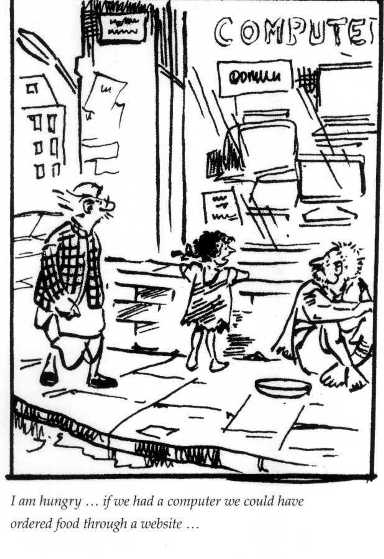
Well, now is the time to ask those difficult questions. The donor agencies of several developed countries — and from Canada and Switzerland in particular — invested heavily in the GK3 extravaganza. These are public funds collected through taxes, given in trust to these agencies for rational and prudent spending. And it’s fair to say that most of this official development assistance (ODA) money is given with the noble aim of reducing poverty, suffering and socio-economic disparities in the majority world.

The GK3 organisers — that is, the GKP Secretariat — often talk in lofty terms about good governance, extolling the virtues of accountability and transparency. Here’s your chance to practise what you preach to the governments and corporations of the world: disclose publicly how much in total was collected for GK3 (from development donors, corporate sponsors, hefty registration fees), and how this money was spent. In sufficient detail, please!

We will then decide for ourselves whether GK3 provided value for money in the truest sense of that concept, and assess if GK3 was ‘absolutely critical and worthwhile’ as the organisers so eagerly claim.

It’s easy for like-minded people to become buddies and get cosy in international development networks. It’s also common to engage in self congratulatory talk and mutual back-slapping at and after gatherings like GK3. But too much manufactured (spun?) consensus and applause can blind our collective vision and lead us astray.

If we genuinely want to engage in Geek2Meek (or, ICT4D), we have to keep repeating the vital questions: what is the value addition that ICTs bring to the development process, and what is the value addition that mega-events like GK3 provide for turning geek tools to serve the meek? Answers must be honest, evidence-based and open to discussion (and dissension, if need be).

In not sharing the euphoria of GK3 organisers, I probably sound like that little boy who dared to point out that the mighty emperor had no clothes. If nobody talks these inconvenient truths and asks some uncomfortable questions, we would be going round and round in our cosy little grooves till the cows come home.

Did someone say Mooooooooooooo?

Read my November 2005 op ed essay written just after WSIS II: Waiting for pilots to land in Tunis

From KL to Bali: Why were ICT and climate change debates worlds apart?
Communicating Disasters in digitally empowered Asia: A tale of two books

I have just spent a hectic week in Kuala Lumpur, and am just coming up for fresh air. That explains why this blog was silent for a few days.

I was at the Third Global Knowledge Conference (GK3) held in the Malaysian capital from 11 to 13 December 2007. With several related events preceding the main conference, my week was completely full.

GK3 was a global platform for all those engaged in using ICTs (information and communication technologies) for meeting the real world’s needs and solving its problems — to reduce poverty, increase incomes, create safer communities, create sustainable societies and support youth enterprise, etc. (Read my impressions of GK3 in this blog post.)

The week’s assorted events saw two separate video films produced by TVE Asia Pacific being screened as integral components of two sessions. These were The Long Last Mile (on community-based warning of rapid onset disasters) and Teleuse@BOP (on telephone use patterns among low income groups in five emerging Asian economies).

That wasn’t surprising because we produce and distribute films that capture Asia’s quest for improving lives through sustainable development. But unusually for myself, I also had two books coming out during the week — one that I had edited, and another that carried a chapter I had written.

communicating-disasters-an-asia-pacific-resource-book-by-tveap-and-undp.jpg

The first was Communicating Disasters: An Asia Pacific Resource Book, which I co-edited with Indian journalist Frederick Noronha. It was the culmination of a year-long process that began with an Asian brainstorming meeting on Communicating Disasters that TVEAP convened in December 2006 in Bangkok. That meeting, attended by three dozen participants drawn from media and disaster management sectors, identified the need for a handbook that can strengthen cooperation of these two communities before, during and after disasters.

The book, comprising 19 chapters contributed by 21 authors, has a foreword written by Sir Arthur C Clarke, inventor of the communication satellite. Pulling together these contributions from the specialist authored scattered across the globe was no easy task for co-editor Fred and myself.

The book’s blurb reads as follows:

“Where there is no camera, there is no humanitarian intervention,” said Bernard Kouchner, co-founder of Medecins Sans Frontieres who later became the Foreign Minister of France. Disaster managers and relief agencies acknowledge the mass media’s key role at times of distress. Yet, the relationship between media practitioners and those managing disasters can often be stressful, difficult and fraught with misunderstandings. Communicating about disasters sometimes ends up as communication disasters.

How can these mishaps be minimised, so that the power of conventional and new media can be harnessed to create more disaster resilient communities? What value addition can the new information and communication technologies (ICTs) bring in? In this book, media and development professionals from across the Asia Pacific share their views based on decades of experience in covering or managing a variety of disasters – cyclones, droughts, earthquakes, floods, landslides and tsunamis.

This book is aimed at journalists, disaster managers and civil society groups who want to use information and communication to create safer societies and communities.

The other book that came out in KL was Digital Review of Asia Pacific, 2007-2008 edition. It was launched during a workshop on Emerging Knowledge Opportunities (The Progress of ICT in Asia-Pacific and Other Parts of the World) on 12 December 2007.

The completely updated edition of the Digital Review of Asia Pacific contains authoritative reports on how 31 economies are using ICT in business, government and civil society written by senior authors who live and work in the region.

I have written the Sri Lanka chapter for the book, continuing a tradition I started back in 2003 with the first edition of the book. I was only sorry that I missed the session during GK3 where the book was launched — because I was moderating another session exactly at the same time in another room. But I was glad to join at least part of the post-launch reception and to meet with some fellow authors who were attending GK3.

Both books are multi-author books, and both have been in the making for a year or longer. It was quite a challenge to get 20 other contributors to come up with their chapters for Communicating Disasters. They were genuinely interested and supportive, but everyone being so busy, it took time and effort to pull together all the strands.

I was not the only common author in these books. My colleague and one-time co-author Chanuka Wattegama (now with LIRNEasia) has written two distinctive chapters on ICTs and disaster communication for the two books.

Many years ago, my friend (now international expert on terrorism and widely published academic author) Rohan Gunaratna told me that writing a book was like waging a small war. I don’t normally use military metaphors, because I deplore all things military, but I can’t resist extending Rohan’s analogy to say that compiling a multi-author book is a bit like waging a mini-war with a coalition of the willing!