A friend of mine recently shared a wonderful quote by the French poet and film maker Jean Cocteau (1889 – 1963): “Mirrors should reflect a little before throwing back images.”
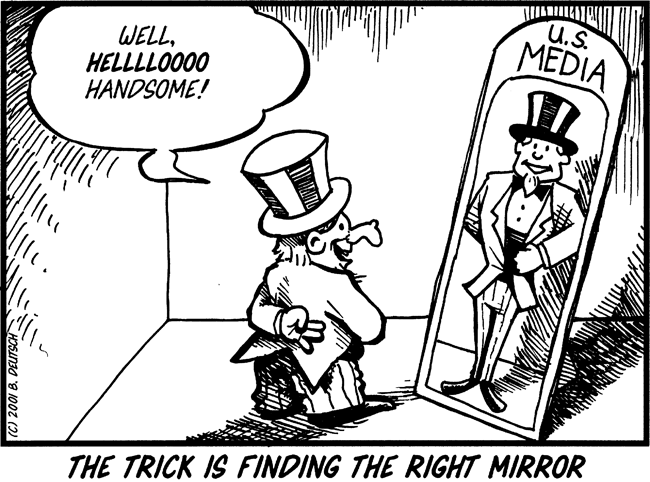
That ideal could very well serve as an aspiration for the industry I have been part of, in one way or another, for over 20 years: the public media. At the very basic, the media are expected to reflect our society and our times.
The reality is, there are many different kinds of mirrors:
• Some mirrors show us things exactly as they are – we might call them true mirrors.
• There are some ‘funny mirrors’ that distort – showing us as too thin, too fat, or elongated!
• There are concave and convex mirrors used in everyday situations from rear view mirrors in cars to shaving mirrors in bathrooms.
• Then there are a few mirrors that have cracked, which now give out a totally warped reflection.
Of course, the properties and behaviour of these mirrors are determined the laws of physics.
But must the public media behave just like glass mirrors do, throwing back images without some inner reflection?
Going where no trekkie has gone before?I’m exactly as old as Star Trek: we were both born a few months apart in 1966 (I’m older by seven months). But because we grew up on opposite sides of planet Earth in the pre-Internet era, our worlds didn’t collide until we were both well into our teens. From then on, I’ve been a Trekkie/Trekker since.
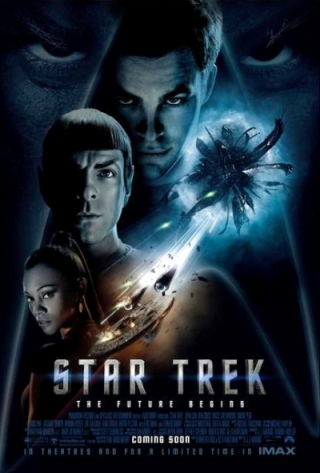
I can’t wait to see the latest (11th) Star Trek movie that opened on 8 May 2009. It’s an ‘origins’ movie – a chronicle of the early days of Captain James T. Kirk and his fellow USS Enterprise crew members. Read plot on Wikipedia.
Our world was very different when the one-time US Army pilot, screenwriter and TV producer Gene Roddenberry created Star Trek, the original series. It started airing on the US network NBC in September 1966. The Space Age was less than a decade old, and only a few men (and a couple of women) had made short trips to near Earth orbit. The great Space Race was in full swing, and NASA was spearheading the largest peace-time operation in history, aimed at landing men on the Moon and getting them safely back before the decade was out.
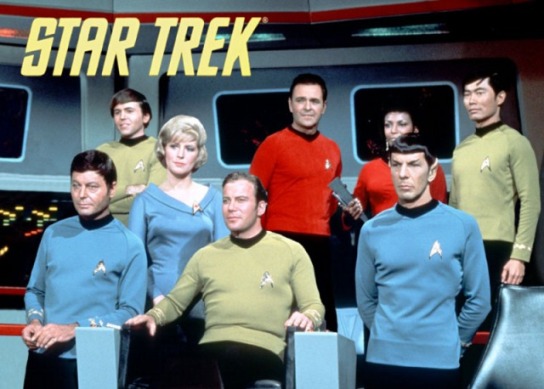
Star Trek, in contrast, offered ambition and hope. Every week at the appointed time, the United Star Ship Enterprise and its intrepid crew took viewers roaming around the universe. The stories appealed as much for insights into the infinite possibilities (and combinations) of life, technology, compassion and power at a cosmic scale, as for its glimpses of the near-Utopian human society in the 23rd century.
As Manohla Dargis, said this week reviewing the latest Star Trek movie (2009) in The New York Times: “Initially aired in 1966, Star Trek was a utopian fantasy of the first order, a vision of the enlightened future in which whites, blacks, Asians and one pokerfaced Vulcan are united by their exploratory mission (“to boldly go”), a prime directive (do no harm) and the occasional dust up.”
According to Dargis, the enduring appeal of Star Trek and the global cult following it inspired is “a testament to television’s power as myth-maker, as a source for some of the fundamental stories we tell about ourselves, who we are and where we came from.”
And, we might add, where we are headed. The show was unique, for its time, for its portrayal of diversity and unity among the wider cast of characters. As the Wikipedia notes: “The show was unique, for its time, for its portrayal of diversity and unity among the wider cast of characters. As the Wikipedia notes: “At a time when there were few non-white or foreign roles in American television dramas, Roddenberry created a multi-ethnic crew for the Enterprise, including an African woman, a Scotsman, a Japanese American, and—most notably—an alien, the half-Vulcan Spock. In the second season, reflecting the contemporaneous Cold War, Roddenberry added a Russian crew member. “
This utopian scenario needs to be contrasted with the prevailing reality of the American Space Programme. No American had ventured beyond near Earth orbit in 1966, and NASA was struggling to catch up with the Russians. Yet, by the time Star Trek original series finished its initial run in September 1969, Neil Armstrong and Edwin Aldrin had returned safely and triumphantly from the Moon. In the event, the Apollo programme landed a dozen astronauts on the Moon, all of who returned safely – as did the astronauts of the disaster-stricken mission, Apollo XIII. Without exception, all of them were white and male.
The journey has only just begun...It took many years for reality to catch up with Star Trek‘s vision, and then, only just. Although a Russian (Valentina Tereshkova) had become the first woman in space early on in 1963, it took the Americans another 20 years to have their first woman astronaut: Sally Ride, who traveled to Earth orbit on the Space Shuttle in June 1983. A few weeks later, in August that year, Guion “Guy” Bluford, Jr., became the first black American astronaut. Multi-cultural crews did not become commonplace until the late 1990s, when the International Space Station became operational.
It wasn’t just racial equality and harmony that Star Trek advocated in its subtext. While bringing intellectually stimulating entertainment, it also celebrated values like compassion and tolerance. In the Cold War world locked into Mutual Assured Destruction (MAD), Star Trek gently reminded viewers that mutual co-existence was a viable option…if only enough effort was invested in it.
As space visionary and science fiction grandmaster Sir Arthur C Clarke noted in a 40th anniversary tribute to the series in 2007: “Appearing at such a time in human history, Star Trek popularised much more than the vision of a space-faring civilisation. In episode after episode, it promoted the then unpopular ideals of tolerance for differing cultures and respect for life in all forms – without preaching, and always with a saving sense of humour.”
He then added, in characteristic style: “Over the years, the sophistication of storylines and special effects has certainly improved, but Star Trek retains its core values – still very much needed in our sadly divided and quarreling world.”
The Enterprise will be cruising the galaxy for centuries to come...
Today, 3 May, is once again World Press Freedom Day. It is recognised by the UN, and observed by media professionals and media activists worldwide to ‘draw attention to the role of independent news and information in society, and how it is under attack’.
By happy coincidence, today also marks the 90th birthday of Pete Seeger, American folk singer and a pioneer of protest music. Since media freedom is inseparable from the democratic rights to dissent and protest, I will devote this blog post to salute Pete and his many decades of music for worthy causes — ranging from the American civil rights movement and opposing the Vietnam war to saving the environment and nuclear disarmament.
Pete is a hero for at least three generations of music lovers and freedom lovers around the world who believe in human rights, human dignity and democratic freedoms. Armed with nothing more than his banjo and melodious voice, and driven by the courage of his conviction, this small, gentle man has stood up to mighty leaders, generals and officials.
Never underestimate the power of one determined man...Pete is celebrated as much for his artistic and cultural achievements as for standing resolutely for his political beliefs and for lending his voice and music in support of causes be believed in. In 1955, he was called before the now infamous House Un-American Activities Committee, but refused to name personal and political associations on the grounds that this would violate his First Amendment rights. He said: “”I am not going to answer any questions as to my association, my philosophical or religious beliefs or my political beliefs, or how I voted in any election, or any of these private affairs. I think these are very improper questions for any American to be asked, especially under such compulsion as this.”
This defiance resulted in sustained harassment, persecution and professional isolation. As his recent PBS biography noted, “Standing strong for deeply-held beliefs, Seeger went from the top of the pop charts to the top of the blacklist and was banned from American commercial television for more than 17 years. This determined singer/songwriter made his voice heard and encouraged the people of the world to sing out along with him.”
‘If you love your country, you’ll find ways to somehow to speak out, to do what you think is right,” Pete says in this powerful documentary looking back at over half a century of activist singing and music.
Watch opening segment of PBS AMERICAN MASTERS series: Pete Seeger: The Power of Song, directed by Jim Brown and first aired in February 2008
Having pleaded under the First Amendment during the communist witch days of the 1950s, Pete repeatedly paid tribute to the far-sighted American pioneers who introduced the First Amendment guaranteeing the freedom of speech.
“As some judge said, if there is any fixed star in our firmament, that is the First Amendment,” he says in a talk-cum-performance at the Ford Hall Forum. In this audio-only piece, he talks the privilege of living under the First Amendment. He recalls his experience being questioned by the House Unamerican Activities Committee, encounters with censorship, and his relationship with fellow singer Woody Guthrie. It runs for nearly an hour, but is worth every second.
For someone like Pete Seeger who sang alongside Dr Martin Luther King, Jr., and other civil rights movement leaders and activists, it must have been deeply moving to be able to sing at the concert to mark President Barack Obama’s inauguration on 20 January 2009 at the Lincoln Memorial.
Watch Bruce Springsteen sing along with Pete Seeger on Woody Guthrie’s “This Land Is Your Land”. As he often does, Pete invites the euphoric audience to sing along!
One of my favourite Pete Seeger songs is “Turn! Turn! Turn! (to Everything There is a Season)”, often abbreviated to “Turn! Turn! Turn!”. It’s a song adapted entirely from the the Book of Ecclesiastes in the Bible (with the exception of the last line) and composed to music by Pete Seeger in 1959. Seeger waited until 1962 to record it,
Pete Seeger tells how he came to write “Turn Turn Turn.”
I have always believed that we have to get creative and resourceful when the basic freedoms of conscience and freedom of expression are under siege from despotic rulers and fanatical extremists. When we are not allowed to express in factual prose, we must turn to creative prose. And when prose fails, we still have verse, lyrics, satire and drama — the possibilities are only limited by our imagination. This is why I celebrate activist artistes like Pete Seeger, and invoke the memory of activist-poets like Adrian Mitchell and Ken Saro-wiwa. When the barbarians are at our gates and we feel surrounded by the unrelenting forces of hatred, intolerance and tribalism, they remind us that Another World is Possible — but we have to believe in it, stay the course and find ways to sing, dance and laugh our way out of gloom.
And here’s Pete singing another one of my personal favourites, a song that powered the civil rights movement and has since inspired and sustained struggles for social justice around the world: We Shall Overcome.
The power of three...to do good!Just imagine…
You do a favour that really helps someone, and tell him/her not to pay it back…
Instead, you ask that it be paid FORWARD to three other people who, in turn, must each pay it forward to three more…and so on.
Impossible? Well, not quite – if you believe (as I do) in the essential goodness of human beings, no matter what their class, race and other divisive factors are.
This idea is known as ‘Pay it forward’. It is really simple: it asks that a good turn be ‘repaid’ by having it done to others instead. Paying it forward has been around as a concept for more than two millennia, from the time of ancient Greece. It was rediscovered in modern times by Benjamin Franklin and later, by Ralph Waldo Emerson, one of my favourite essayists.
In his 1841 essay titled ‘Compensation’, Emerson wrote: “In the order of nature we cannot render benefits to those from whom we receive them, or only seldom. But the benefit we receive must be rendered again, line for line, deed for deed, cent for cent, to somebody.”
During the Twentieth Century, science fiction author Robert A Heinlein popularised the concept in his book Between Planets (1951). It formed the central theme of Pay It Forward (2000), a novel by Catherine Ryan Hyde, which was soon turned into a movie by the same name.
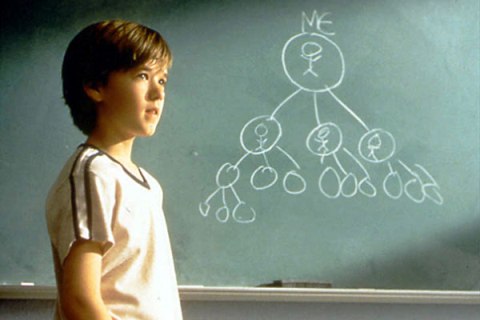
In that story, a thoughtful teacher challenges his seventh grade students with ‘an assignment to save the world’. One perceptive student devices a scheme where one has to carry out three good deeds for others as repayment of a good deed received. Such good deeds should be things that the beneficiaries cannot accomplish on their own.
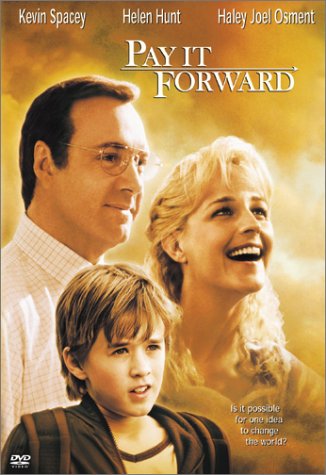
It was through Pay It Forward the movie, made in 2000 and directed by Mimi Leder, that I first came cross the idea. It’s one of those simple and elegant ideas that packs so much power to change people and the world. Its implementation requires trust, honour and imagination, which most human beings can muster in sufficient quantity when challenged.
Then I realised that, without a conscious plan and not labelling it as such, I was already ‘paying it forward’ myself — and not just to three new people, but many. That was the least I could do for the many breaks, blessings and opportunities I had received in my professional life.
More about that in a minute. First, take a look at the official trailer for Pay it Forward:
And this is how it all started in the movie, with one thoughtful class teacher challenging his seventh grade pupils with ‘an assignment to save the world’:
Here’s an extended, unofficial trailer remixed by a fan using the official trailer, some scenes from the movie and a few interviews with the key stars:
Journalism – especially the industrialised, mainstream version of it – is by definition a highly collaborative business: newspapers, magazines, as well as TV/radio broadcasts are produced by several or many people working together, each playing a specified part.
And because the media are a mirror on our society and our times, the stories we journalists produce just won’t be possible unless our sources share their information, experiences and insights. This is why Bill Moyers, one of the most respected and credible voices in American broadcasting (a land where such professionals are endangered), says: “We journalists are simply beachcombers on the shores of other people’s knowledge, other people’s experience, and other people’s wisdom. We tell their stories.”
During the early years of my career as a science writer and journalist, I was enormously lucky in both respects. I had kind, indulgent, nurturing senior colleagues who showed me the ropes, expecting nothing in return except good stories. And I benefited much from the kindness and thoughtfulness of many accomplished men and women – mostly in the worlds of science, environment and development – who took the time and trouble to talk to me, clarify even basics to a rookie like myself, and allow me to attribute information or quotes them. I was a complete stranger to many of them, yet they cared enough in spite of busy schedules (there were also a few didn’t, but that’s only to be expected).
Then there were opportunities, some competitively earned, others bestowed on me. In those formative years, the opportunities for training, mentoring and other influences sharpened my skills and shaped my worldview. It was easy to grow up angry with the world and seeing conspiracies everywhere; it was much harder to acquire a balanced view of the world and to become a skeptical enquirer without turning into an incurable cynic.
Among those early influences were:
• Working with the Centre for Science and Environment (CSE) in India, under the late Anil Agarwal and his worthy successor Sunita Narain
• Regional and international training programmes, organised by various UN agencies and other entities such as the Abdus Salam International Centre for Theoretical Physics in Trieste, Italy
• Invaluable support from the International Science Writing Association (ISWA), which leverages far more benefits than its modest resources would indicate at first glance (again, the power of networking!)
• Editorial training and global syndication from Panos, which provided my first outlet to publish internationally through Panos Features (sadly, no more).
Then there was my mentor Sir Arthur C Clarke, who gave me the rare privilege of spending 21 years as his research assistant — a long and unique apprenticeship that enriched me so much.
These and others helped fill gaps in my formal training in science journalism. And such exposure was worth so much more in the days before commercial internet connectivity. There was no Google or YouTube, and early versions of email were just beginning to roll out.
Just do it, and hope others will keep doing it too...And now it’s my turn to ‘pay it forward’. It’s plain and simple; there’s no grand pledge or plan. No one asked me to sign up to any binding agreement. There is no spiritual or intellectual compulsion. I just do it, because that’s a good thing to do.
This is also why I spent a good part of my recent Easter/New Year holidays putting together a detailed response to a young script writer who is passionately promoting a film project related to climate change. I have never met him in person, and until a few weeks ago, I’d never heard of him. A cynical British colleague used to caution me that any crazy nut sitting under a banyan tree can write a letter (or more likely an email these days) claiming to be anything he wasn’t. There’s always that risk. But I’m taking my chances.
Years ago I stopped counting the favours I paid forward, and I no longer even keep track of the people that I give little nudges along the way. Being a secular rationalist with no absolutely religious belief of any kind, I don’t collect brownie points for any ‘next world account’. I just do these little good deeds to make this world a little better place.
If further justification were needed, I cannot say it better than Steven Grellet, a prominent French Quaker missionary who once said (and I quote him for its secular essence): “I expect to pass through this world but once; any good thing therefore that I can do, or any kindness that I can show to any fellow creature, let me do it now; let me not defer or neglect it, for I shall not pass this way again.”
In his long years of journalism in India, my friend Darryl D’Monte had faced all sorts of questions and situations. But this was one question that stunned and left him speechless for a while.
A visiting Canadian TV crew made this request in the 1970s, when Darryl was resident editor of The Times of
India. He was giving them some insights on the extent of poverty in his city of Bombay, since renamed as Mumbai. The crew had heard of the deliberate maiming of street children, before being employed as beggars. A disabled child would evoke more sympathy, increasing the daily collection for gangsters operating them from behind the scenes.
Darryl wasn’t willing to be associated with this ‘staging’. “Well, it’s going to happen anyway,” was the film crew’s cynical answer.
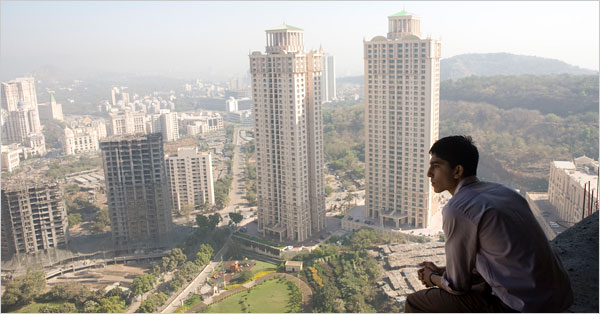
Now, fast forward 30 years to the present. At one point in the British-Indian movie Slumdog Millionaire, we see a young girl being blinded by a gangster who shelters and feeds a small army of children — all unleashed on Mumbai on a daily basis to tug at the heart strings of its teeming millions.
The film’s protagonist Jamal escapes the same fate by making a mad dash for freedom with his brother, Salim. But years later, they cross the gangster’s path again, with devastating results – for him.
Vikas Swarup: Look what I've started...Set and filmed in India, Slumdog Millionaire is the story of a young uneducated man from the slums of Mumbai who appears on the Indian TV’s version of Who Wants to Be a Millionaire? (Kaun Banega Crorepati) and does so well to reach the final question that the game show host and the police suspect him of cheating.
Some Indians feel their country’s ugly underbelly has been magnified by locating and filming part of the story in the slums of Mumbai. But director Danny Boyle, who sees his film as a Dickensian tale, says he shot in real, gritty locations “to show the beauty and ugliness and sheer unpredictability” of the city.
Indian diplomat Vikas Swarup, who wrote the 2005 novel Q and A on which the movie is based, has a similar view. “This isn’t social critique,” he told The Guardian in an interview. “It’s a novel written by someone who uses what he finds to tell a story. I don’t have firsthand experience of betting on cricket or rape or murder. I don’t know if it’s true that there are beggar masters who blind children to make them more effective when they beg on the streets. It may be an urban myth, but it’s useful to my story.”
To me, Slumdog Millionaire feels like a cross between the acclaimed Brazilian slum movie City of God (Portuguese name: Cidade de Deus, 2002) and Quiz Show, the 1994 American historical drama film about TV quiz scandals in the 1950s.
City of God (2002) was filmed in the favelas of Rio de Janeiro
City of God is a Brazilian crime drama film directed by Fernando Meirelles and Kátia Lund, released in its home country in 2002 and worldwide in 2003. It was adapted by Bráulio Mantovani from the 1997 novel of the same name written by Paulo Lins.
The film’s depiction of narcotic drug rings, hold-ups, street violence and police corruption may not have been what the upper middle class Brazilians wanted to showcase to the rest of the world, but the film’s stark if grisly authenticity resonated with movie audiences around the world. Most of the actors were residents of favelas (slums) of Rio de Janeiro, such as Vidigal and the Cidade de Deus itself. City of God became one of the highest-grossing foreign films released in the United States up to that time.
The makers of Slumdog Millionaire adopted a similar approach. Its co-director Loveleen Tandan says she likes to get as close to reality as possible. This drove her to the slums of East Bandra to look for young children who resembled the protagonists in the story.
As she recalled in a recent interview with Tehelka: “I was very keen to get real slum kids, which is why I convinced them (producers) to do one-third of the scenes in Hindi. I made a scratch tape with real street kids. The team was surprised that Hindi actually made it brighter and more alive.”
Indeed, Slumdog doesn’t feel like a ‘foreign film’ despite it having a fair number of English subtitles, which only enhance the overall cinematic experience.
But how realistic should films try to become, before the local realities are distorted or local sensibilities are affected? Where does documentary end and drama begin? These questions will continue to be debated across India and elsewhere while Slumdog enthralls millions on its first theatrical release.
Feature film makers can exercise their creative license far more than factual film makers. I doubt if the creators of authentic, close-to-the-ground movies like City of God and Slumdog Millionaire set out with any specific social agenda. They are in the business of entertainment, and just happen to find plenty of drama in real life in places like urban slums. We might argue that in the right hands, dramatised movies can draw mass attention to development issues and challenges far more effectively than the often dull and dreary documentaries.
Kalpana Sharma: Eyes wide open“If through (the movie) the world gets a peek at an India inhabited by millions of people who continue to live their lives without clean water, sanitation or electricity, what is the problem?” asks another Indian friend and long-time Mumbai resident Kalpana Sharma.
In a perceptive essay titled Shantytowns of the Mind, written in The Indian Express in early January 2009 before she saw the film, Kalpana flagged important concerns: “Slumdog Millionaire’s success raises some deeper questions. How do we depict poverty as writers, filmmakers, journalists? Is it fair to expect us all the time to give a full, balanced, sensitive portrayal? Or is it inevitable that we write, film, for our audiences? And if, as a byproduct, people are sensitized, so be it. Also, if they are annoyed, so be it. If we are considered exploitative, so be it.”
Kalpana speaks with authority, and not just because she lives in the megacity of Mumbai (population: 13 million and rising) which, she points out, is half made up of slums. In 2000, she wrote a book titled Rediscovering Dharavi: Stories from Asia’s Largest Slum. Far from being a cold, clinical analysis of facts, figures and trends, it’s a book about the extraordinary people who live there, “many of whom have defied fate and an unhelpful State to prosper through a mix of backbreaking work, some luck and a great deal of ingenuity”.
Kalpana ends her essays with these words: “In the end you realise as a writer, a journalist or a filmmaker, that the best you can do is to shine a torch, a searchlight, on an entrenched problem. But the solution will not be found merely by that illumination. For that, there are many more steps to be taken.
“Slumdog Millionaire has focused its lens on the children of India’s slums through a work of fiction. What we do to change their future is the non-fiction that has yet to be written.”
Uncommon move, once again!This allows others to download, share, remix, subtitle and eventually rebroadcast (or webcast) the material originally gathered by Al Jazeera’s own reporters or freelancers. It has the potential to revolutionise how the media industry gathers and uses TV news and current affairs footage – a lucrative market where there are only a very few suppliers operating at global scale.
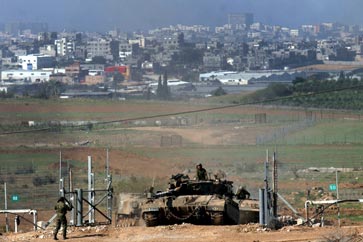
Al Jazeera’s uncommon sharing has started with the network’s coverage of the conflict in the Gaza strip, Palestine. Each day they plan to add the latest footage coming from Gaza. Additional Gaza footage from the start of the war is to be made available shortly.
This is the first time that video footage produced by a news broadcaster is released under the ‘Creative Commons 3.0 Attribution’ license which allows for commercial and non-commercial use.
“We have made available our exclusive Arabic and English video footage from the Gaza Strip produced by our correspondents and crews” says the introductory text in Al Jazeera Creative Commons Repository. “The ongoing war and crisis in Gaza, together with the scarcity of news footage available, make this repository a key resource for anyone.”
Gaza in darknessThe website adds: “This means that news outlets, filmmakers and bloggers will be able to easily share, remix, subtitle or reuse our footage.”
Under the Creative Commons framework, Al Jazeera seeks no payment (licensing fees) of any kind. Users are free to reuse the material with acknowledgement to Al Jazeera. This means such users must attribute the footage to Al Jazeera (“but not in any way that suggests that we endorse you or your use of our work”). They are also required to leave the Al Jazeera logos intact, give reference to the Al Jazeera Creative Commons Repository, and the ‘Creative Commons 3.0 Attribution’ license itself.
Says Joi Ito, CEO of Creative Commons: “Video news footage is an essential part of modern journalism. Providing material under a Creative Commons license to allow commercial and amateur users to share, edit, subtitle and cite video news is an enormous contribution to the global dialog around important events. Al Jazeera has set the example and the standard that we hope others will follow.”
Gaza under siege...Professor Lawrence Lessig, founder of Creative Commons, has hailed this initiative: “Al Jazeera is teaching an important lesson about how free speech gets built and supported. By providing a free resource for the world, the network is encouraging wider debate, and a richer understanding.”
Al Jazeera – which means ‘the island’ or ‘the peninsula’ in Arabic – started out in 1995 as the first independent Arabic news channel in the world dedicated to providing comprehensive television news and live debate for the Arab world. Al Jazeera English, the 24-hour English-language news and current affairs channel, was launched in 2006 and is headquartered in Doha, Qatar. The organisation is the world’s first global English language news channel to be headquartered in the Middle East.
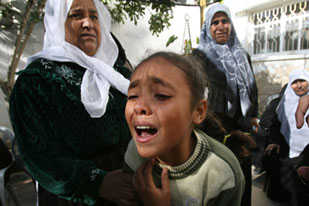
Screams, amplified by media?But we have no hesitation in applauding their sharing of news footage. This move makes it easier for many television stations, websites and bloggers to access authentic moving images from the frontlines of news — we certainly hope Gaza marks only the beginning of AJ’s sharing.
It would also make commercial distributors of news and current affairs footage a bit nervous, for such material trades in hundreds or thousands of dollars per second. The logistical difficulties in gathering such footage, and sometimes the enormous risks involved to the news crews, partly explains the high cost. But the small number of suppliers and syndicators has made it possible for high prices to be maintained. If Al Jazeera sustains its sharing, that could mark the beginning of the end for another pillar of the mainstream media industry.
All images used in this blog post are courtesy Al Jazeera websites
“The attack on Mumbai by ten highly trained gunmen on the night of Wednesday, November 26, and the drama that followed over the next 60 hours, was physically confined to one corner of a very big city. But it extended its ambit to the rest of the city, the country and the world because of the non-stop media coverage.
“For two days and three nights, television channels gave blanket coverage to the drama around the siege of two hotels, the Taj Mahal Palace and Towers, and the Oberoi and Trident Hotels, as well as Nariman House in Colaba, a synagogue and centre for a Jewish sect. And the entire country watched in horror and fascination.”
This is how my friend Kalpana Sharma, one of the most respected journalists in India, looks back at the momentous events that took place in her home city of Mumbai from 26 to 30 November 2008. In a thought-provoking analysis published on Tehelka.com, Kalpana assesses 60 hours of continuous media coverage of the Mumbai crisis and notes the significant gaps.
As Mumbai and India recover from the daring attack, the media continue to play the dramatic images over and over. I was in Hyderabad, in southern India (more than 700 km away from Mumbai) for a few days from November 30 and saw this first hand – especially on India’s several dozen 24/7 TV news channels in English and many local languages. Even before arriving in India, I was following the unfolding events on India’s leading English news channel NDTV 24/7 and their website.
Kalpana SharmaI could see that the high adrenaline that every channel and reporter drew on during the 60 hours of drama has now changed into a mix of patriotism, jingoism and an incredible suspension of journalistic ethics and norms. This makes Kalpana’s reflections extremely timely and important.
She is not an armchair critic of the media, and understands the tough challenges that reporters and their gatekeepers face on a daily basis. “When such developments hit a city, it is understandable that there is a time lag before the media, particularly the electronic media, can react,” she acknowledges in her essay, and asks: “The electronic media, in particular, has to ask whether at a time when they were the only source of information for most of the city, and indeed the country, there should have been some restraint placed on information given out.”
I have met some professors of mass communication who have never been inside a news room and well-meaning media activists whose naive idealism makes me laugh. Kalpana, in contrast, counts over three decades of mainstream media experience and retired last year as Deputy Editor of The Hindu newspaper.
Read Kalpana’s full essay here: Unpacking The Pixel
Breaking News 24/7?
Others inside and outside India are also offering critical analysis of media’s role in the siege of Mumbai, or India’s 26/11 as it’s being called. One is by Anjali Deshpande and S K Pande of the Delhi Union of Journalists who have written an interesting commentary in the South Asian mediawatch website, The Hoot.
They acknowledge how “24×7 reporting of terror has indeed been has also been a traumatic experience for our colleagues” and go on to say that “Some of them really did a good job under the circumstances”. But their piece is are less charitable than Kalpana when they say: “If there is one thing the electronic media helped in particular to do in the last three days was to bolster the confidence of terrorists and to give them a sense of achievement far greater than their action may have provided them.”
They note: “The initial role of some of the media was to grab the eyeballs rather than ask questions and reflect all facets of life as they unfold without adding to the tension strife and trauma in such situations. In some cases the ethics evolved over the years was thrown into the dustbin. Add to it all the fact, that when some restraint began more than a touch of jingoism took over.”
They add: “The media behaved as if the country was so terrified it came to a standstill. As if Madhya Pradesh did not go to polls, as if Delhi did not vote, as if a former Prime Minister, V P Singh did not pass away, as if nothing else happened in the country.” Read the full essay in The Hoot: Three Days of Mumbai terror reporting.
There are dozens of other debates underway in the passionately argumentative Indian society, some of which are being conducted in the newspapers, news magazines, on the air and online. One that especially interested me was the role elitism played in how the media covered the siege of Mumbai.
The attacks took place at multiple locations in the heart of Mumbai, which included two leading hotels, a synagogue and Jewish centre and the main train station. But not all attacks lasted as long, and certainly not all of them received equal coverage.
Gnani Sankaran, a writer based in Tamil Nadu, southern India, asks some pertinent questions in a blog post titled Hotel Taj: Icon of whose India? “Watching at least four English news channels surfing from one another during the last 60 hours of terror strike made me feel a terror of another kind. The terror of assaulting one’s mind and sensitivity with cameras, sound bites and non-stop blabbers. All these channels have been trying to manufacture my consent for a big lie called — Hotel Taj the icon of India.
He adds: “It is a matter of great shame that these channels simply did not bother about the other icon that faced the first attack from terrorists – the Chatrapathi Shivaji Terminus (CST) railway station. CST is the true icon of Mumbai. It is through this railway station hundreds of Indians from Uttar Pradesh, Bihar, Rajasthan, West Bengal and Tamilnadu have poured into Mumbai over the years, transforming themselves into Mumbaikars and built the Mumbai of today along with the Marathis and Kolis
Chatrapathi Shivaji (Victoria) Terminus - the true icon of Mumbai
“But the channels would not recognise this. Nor would they recognise the thirty odd dead bodies strewn all over the platform of CST. No Barkha Dutt went there to tell us who they were. But she was at Taj to show us the damaged furniture and reception lobby braving the guards. And the TV cameras did not go to the government-run JJ hospital to find out who those 26 unidentified bodies were. Instead they were again invading the battered Taj to try in vain for a scoop shot of the dead bodies of the Page 3 celebrities.
Gnani Sankaran“In all probability, the unidentified bodies could be those of workers from Bihar and Uttar Pradesh migrating to Mumbai, arriving by train at CST without cell phones and PAN cards to identify them. Even after 60 hours after the CST massacre, no channel has bothered to cover in detail what transpired there.” Read his full blog post: Whose India, whose icon?
He echoes the same point as Gnani Sankaran about the Victoria Terminus being much more iconic than the Taj hotel, and comes to the same conclusion: “I can’t remember the last time that social class so clearly defined the coverage of a public event, or one in which people spoke so unselfconsciously from their class positions. The English news channels became mega-churches in which hotel-going Indians found catharsis and communion. Person after person claimed the Taj as home. Memories of courtship, marriage, celebration, friendship, the quick coffee, the saved-up-for snack, the sneaked lavatory visit, came together to frame the burning Taj in a halo of affection.”
In his closing para, Kesavan also touches on how the foreign media covered the Mumbai attacks: “English and American papers treated the terror attack as an assault on the West. The terrorists had, after all, specifically looked for American and British citizens to murder. Ironically, even as NDTV, CNN-IBN and Times Now put hotel guests at the heart of the horror and bumped train commuters to its periphery, older English-speaking peoples counted their dead and dimly regretted all Indian casualties as collateral damage. In that residual category, if nowhere else, the Indian dead remained one People.”
Another dimension in the media coverage following the Mumbai attacks is how it is affecting the relations between India and Pakistan, both nuclear powers. As The Hindu reported on 1 December 2008: “The escalating tensions between India and Pakistan over the Mumbai attacks have led to the declaration of hostilities in unexpected quarters – Pakistani media has declared a virtual war on Indian media for its ‘knee-jerk’ finger-pointing across the border, and its unquestioning acceptance of the Indian government’s ‘Pakistan-link’ theory.”
Moderate journalists and media-watchers across South Asia are calling for more restraint, self-reflection and plain common sense. On 4 December 2008, Himal Southasian – the independent and outspoken voice of South Asia – ran a special editorial which opened with these words:
“There is an attempt on to generate mass hysteria in India as television channels compete for ratings. The channels are using the Bombay attacks of last week in a dangerous game of TRP-upmanship which can well derail the political process and set back the India-Pakistan peace train. Going far beyond what is required of them even in times of crisis, some media houses are leading campaigns to get citizens to take pledges of patriotism. They are pushing a brittle, monochromatic vision of the resilient country we know as India.”
Beena Sarwar“Media might have brought the people closer but when nationalism rears its head, the beast of 24-hour television news also fuels conflict. This is where the commercial aspect comes in. When something big happens, the public seeks answers. The channels which cater to this need improve their ratings. Sensation sells. With viewers glued to the screens, channels keep them there with a continuous virtual reality show. They fill the time with speculative commentary, ‘expert’ guests and whatever footage is available. Sometimes such footage is repeated ad nauseum — like when the Twin Towers were destroyed on 9/11, when the Marriott hotel was attacked, when the FIA building in Lahore was struck.”
She adds: “Some Indian channels are running the Pakistan factor like a movie trailer, complete with sound effects and watch-for-the-next-episode commentary. This obviously fuels Pakistani indignation. However, this indignation could be tempered by being less reactive and empathising with the Indians’ pain and grief that many Pakistanis share. Zealous commentators could also recall the times that their own media houses sensationalised an issue.
“Journalists may argue that they are just the messenger, reflecting official or public opinion. But the media must also question, and get people to think. The stakes are high in our nuclear-armed countries, in a post-9/11 world where the major players include armed and trained men around the world who subscribe to the ideology of Al Qaeda and the Taliban.”
Ordinary people outside the media industry have also started expressing their concern.
“Media on both sides of the border has stopped reporting and started indulging in senseless rants. The media, particularly in India seems to have thrown logic to the wind,” wrote Anand Bala from Bangalore, in a letter to the South Asian mediawatch website The Hoot. “The screaming for war on the Indian side has reached a din. The media is manufacturing consent for a war and manufacturing consent for the very people who they are blaming – the politicians.”
I would give the last word to Kalpana Sharma: “Media rarely pauses to analyse itself as it hurtles from one breaking story to another. But the Mumbai terror attack shows us that it is essential that reporters be trained to handle such extraordinary situations, that they learn the importance of restraint and cross-checking as at such times the media is the main source of information. Professionalism and accuracy will ensure that we don’t contribute to prejudice and panic.”
In the well known legend, the pied pier of Hamelin played his musical pipe to lure all the rats into the nearby Weser river. When the town reneged on the promised fee, he played a different tune to entice all its children away from the town.
Modern-day pied pipers use smooth talk and convincing images instead of hypnotic musical tunes to lead people astray. And they achieve much greater coverage today — thanks to the modern media.
When the media amplify pied piper tunes, how responsible are they for the resulting damage?
Then and now, we like to follow a tune...
This is the question I raise – and try to answer – in an op ed essay published this week by the Asian website Eye on Ethics.
‘When media amplify pied piper tunes…’ was inspired by a current experience in my native Sri Lanka. For the past few weeks, Sri Lankans have been shocked and dismayed to learn how thousands of middle-class adults have been hoodwinked by a confidence trickster who used paid advertisements in newspapers and on television to boost his image.
Sakvithi Ranasinghe, a populist tutor of English turned businessman, fled the country in mid-September 2008 after duping thousands of unsuspecting people to deposit money in an Ponzi-style investment scheme that offered abnormally high returns.
After the scandal broke, the media have been giving it a great deal of coverage. But most of it falls into follow-the-victim, blame-the-authorities style of journalism.
The main point of my essay: “Amidst the finger-pointing, arm-waving and name-calling, few have noticed the role of the media in promoting Ponzi schemes in the first place. Wittingly or otherwise, the media have helped amplify the mesmerizing tunes of pied pipers, and quietly collected substantial advertising revenue from such racketeers.”
I also comment in this essay the blurring of what used to be a sacred divide in the media – between editorial content and paid advertising. Here’s an excerpt:
“Many people experience media products as a whole, and lack the media literacy to separate news, commentary and paid commercials. Besides, the once clear demarcations have blurred in recent years.
“Television’s seamless blending of news, entertainment and commercials can leave even the most media-literate people somewhat perplexed. News bulletins are sponsored variously by sellers of insurance, milk food or detergents, while current affairs shows are branded by various commercial products or services.
“I invested Rs. 2 million (US$ 18,550) of my money after seeing him on TV. I basically believe what I see on the TV and so was misled.”
I read this remark, by a hapless woman victim of an investment scam, in a Sri Lankan newspaper report last week. It got me thinking: where is our media literacy?
The woman quoted in the news report is not an isolated case. Too many people, it seems, were mesmerised into parting with their money due to a deviously persuasive media campaign. For several years, Sakvithi ran English teaching programmes on Sri Lanka’s national television and other channels. On the guise of teaching English (which he didn’t do very well), Sakvithi manufactured a larger than life image for himself. He also ran regular newspaper advertisements in the highest circulating weekend newspapers. Some were in full colour, occupying an entire broadsheet page. These too reinforced his image as a benevolent, enterprising young Sinhala businessman doing social good.
Not everyone, it seems, heeds the common sense advice, ‘Don’t believe everything you read/hear in the media’. Indeed, the Sakvithi scandal once again brings into sharp focus the media’s — especially television’s — perceived role as the great authenticator of our times.
I have just written an op ed essay for the citizen journalism website Groundviews, where I suggest that the mainstream media outlets that repeatedly sold airtime or newspaper space to this man must now share part of the blame for misleading the public. I also argue that besides timely regulatory action and proper law enforcement, we also need greater vigilance by the media, and higher levels of media literacy in everyone to safeguard society from this kind of media manipulation.
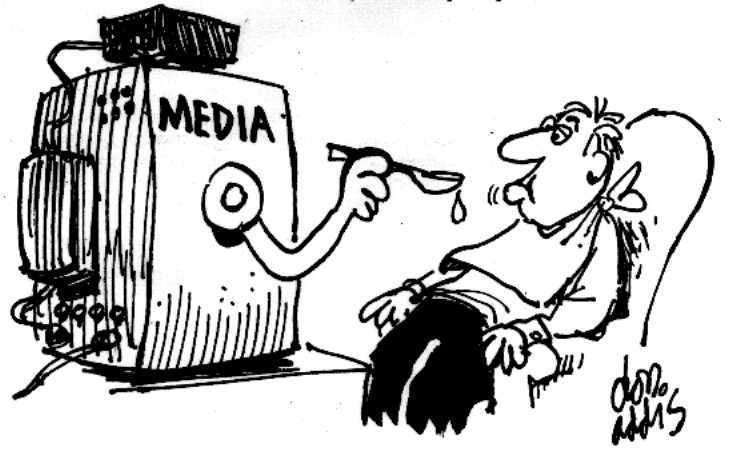
Media illiteracy creates this!
Here’s an extract:
“I find it more than a tad ironic that the same media outlets are now peddling the tales of woe of the thousands of men and women tricked by their former, big-time customer. Knowingly or otherwise, these media have amplified the mesmerising tune of this pied piper of Nugegoda who lulled thousands into parting with their money.
“Their journalists would no doubt protest innocence, reminding us of the divide between editorial and advertising operations. And they are right: media practitioners and editorial gatekeepers don’t have much (or any) control over what fills up the commercially sold advertising space. But how many of their readers or viewers can distinguish the difference?
“Most people experience media products as a whole, and lack even the basic media literacy to separate news, commentary and paid commercials. Besides, with the rise of ‘advertorials’ — product promotions neatly dressed up as editorial content — it’s becoming harder to discern which is which.
This cartoon by Pulitzer prize winning Tom Toles first appeared in the Washington Post in 2007 – it brilliantly anticipated the global financial meltdown that we’re now experiencing. Coming in the wake of confirmed global warming, it is a double whammy.
America has been hit hard by the sub-prime crisis. The social and human cost of financial failure has been enormous. An epidemic of home repossessions has left thousands of houses abandoned and boarded-up: whole suburbs are falling into disrepair and dereliction.
Financial institutions in America and in Britain had poured billions into investments backed by these mortgages. As more and more people have defaulted on their mortgage repayments, financial markets have collapsed, causing a crisis that has rippled across the Atlantic, sending the City of London into turmoil and pulling the plug on one now infamous British bank.
Some call it a financial tsunami not been seen since the Great Depression in the 1930s….a crisis that has forced the US government to step in and save the financial system after trillions were wiped off global stock markets and once revered institutions were swept off the face of Wall Street. Is the US intervention too little, too late to save the economy?
In fact, just a few days ago, the People’s Daily of China warned that a “financial tsunami” was approaching, which recalled the Great Depression in the US. It said: “As the contemporary economy has been integrated globally, American consumption and currency exchange rates will directly influence countries dependent on the US as the main export destination for economic growth and employment”.
The Chinese Communist Party organ complained that the US had unleashed financial “weapons of mass destruction” on the world economy in the form of subprime debts and related financial derivatives.
The world’s media have been scrambling to cover these rapidly unfolding events. In fact, many have been caught napping, or worse, been uncritical cheerleaders of the march of capital and credit. Most of them – even the respected financial journals – just didn’t see the crisis building up…or ignored the tell-tale signs that constituted an inconvenient truth.
Danny Schechter - wasn't crying wolf!“This didn’t just happen in the course of a usual business cycle,” insists the American investigative journalist and media analyst Danny Schechter, who has been tracking this issues for many months on his influential News Dissector blog and the MediaChannel that watches and critiques the media.
In his new book, aptly titled Plunder, Danny offers an in-depth investigation into the decline of the economy that’s causing millions to lose jobs and face foreclosures and across-the-board price hikes.
He says: “You wouldn’t know it by relying on our media, but the subprime scandal masks massing looting by Wall Street firms using carefully calculated predatory lending schemes enabled by regulators who don’t regulate and a media that looked the other way. We have lost trillions and dislocated millions with no relief in sight. Every American is paying for the greed of our financiers in the grocery store, gas pump and unemployment line. Bank robberies are not new — but banks doing the robbing is.”
In 2007, his film IN DEBT WE TRUST was the first to expose Wall Street’s connection to subprime loans, predicting the economic crisis that this book investigates.
I have been watching various news media analysis of the current crisis and want to share two that stood out from the rest: Inside Story by Al Jazeera English, and Dispatches by UK’s Channel 4.
In a special show from New York, Inside Story looks at the financial turbulence that rocked the US last week. Will the emergency measures by the US government be enough to stabilise the markets or has the financial system in the US been changed forever? The introductory report from AJE’s Washington correspondent Reynolds is particularly illuminating – he also writes the story for their website.
Inside Story – The US financial crisis – 21 Sep 2008 – Part 1
Inside Story – The US financial crisis – 21 Sep 2008 – Part 2
From the other side of the Atlantic comes a more investigative, one-hour special that was produced and broadcast in March 2008, when the early signs of the banking crisis were beginning to show – for anybody who cared to notice.
As Channel 4 introduces it: “This is a story about the destructive power of finance: what happens when banks are driven by short-termism; when bankers are rewarded with vast bonuses, free to operate under inadequate regulatory supervision, and with the complicity of a government too in awe of big business to step in.”
Dispatches: How The Banks Bet Your Money UK & US – part 1
In this edition of Dispatches, private equity financier Jon Moulton delivers a stinging rebuke to the banks for causing this financial meltdown and explains why the British taxpayer will now pay the price.
Dispatches: How The Banks Bet Your Money UK & US – part 2
Dispatches: How The Banks Bet Your Money UK & US – part 3
Dispatches: How The Banks Bet Your Money UK & US – part 4
Dispatches: How The Banks Bet Your Money UK & US – part 5



















 In his new book, aptly titled
  Open Minds!