Protect journalists who fight for social and environmental justice!

In June 2007, I wrote about the late Joey R B Lozano, a courageous Filipino journalist and activist who fought for human rights and environmental justice at tremendous risk to his life.

For three decades, Joey survived dangerous missions to defend human rights using his video camera in the Philippines, a country known for one of the highest numbers of journalists killed in the line of duty. Joey went into hiding numerous times, and he dodged two assassination attempts.

Last week, a leading Filipino academic and social activist called for greater protection for local level journalists who cover social and environmental justice issues risking their life and limbs.

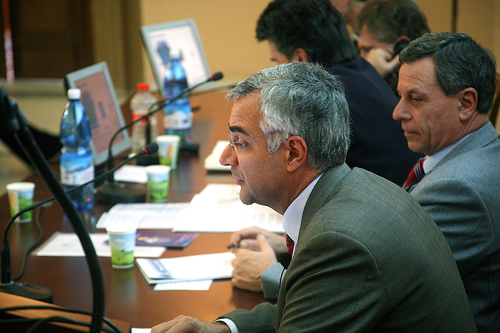
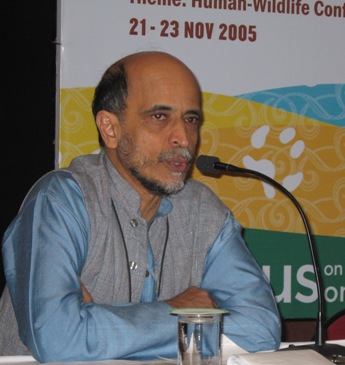
“Things are pretty savage at the grassroots level in some of our countries. Journalists who investigate and uncover the truth take enormous personal risks – the vested interests hire killers to eliminate such journalists,” said Professor Walden Bello, executive director of the Focus on the Global South (photo, below).

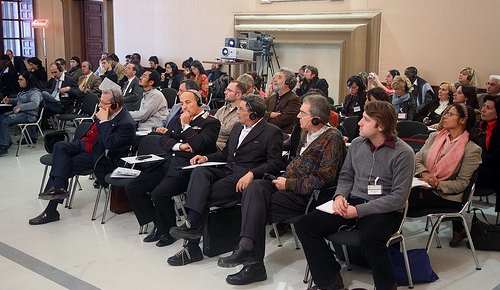
He was speaking at the Greenaccord Media Forum on 10 November 2007 in Frascati, Rome, where several dozen journalists covering environmental issues had gathered for a four-day meeting.

He delivered an insightful survey of social movements across Asia on environmental and public health issues
, where he questioned the role of elites in the global South in standing up for what is right and fair for all people.

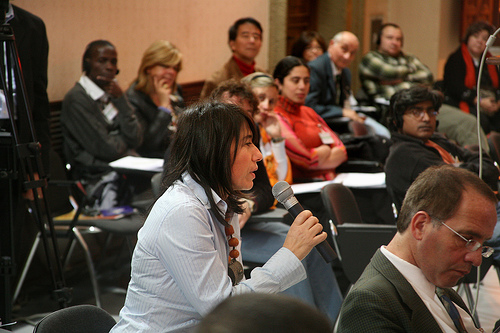
During question time, I asked him how he saw the media playing a role in social movements that he’d just described. It varied from country to country, he said, and gave several examples.

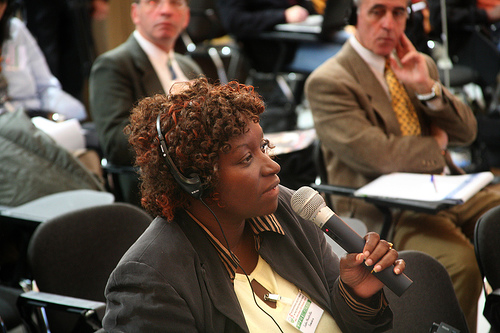
zadie-neufville-from-jamaica-makes-a-point.jpg

In China, most environmental exposes in recent years have been made by ‘very brave journalists’. Their investigations have compelled the local and central authorities to address the massive incidents of pollution and environmental degradation resulting from China’s economic march forward.

In South Asia, the record is uneven. Indian publications like The Hindu newspaper and Frontline magazine are at the forefront in reporting and analysing ‘almost exhaustively’ on environmental struggles in the world’s largest democracy.

In contrast, Singapore and Malaysia have no critical mass media to turn the spotlight on excesses or lapses, he said. In these countries, journalists as well as activists have turned to the web to express themselves — but even they are under pressure from their governments.

In Thailand, the two English language newspapers The Nation and Bangkok Post have both have a long tradition of covering environmental issues and supporting mass movements. A number of Thai language newspapers also have sustained coverage.

In his native Philippines, Prof Bello singled out the Philippine Daily Enquirer for persisting with environmental coverage and exposing environment related scandals. But that comes with its own risks.

“At the local levels, journalists who take up these issues face many threats, including the very real risk of extra-judicial killings. The Philippines is one of the most dangerous countries in the world today for independent journalists and human rights activists,” he added.

Journalists living in the provinces and reporting from the grassroots are more vulnerable than those based in the cities. This is precisely why local journalists need greater support and protection to continue their good work.

The local elites and officials would much rather silence such journalists. International solidarity for such journalists could make a big difference, Prof Bello said.

He had a suggestion for his hosts, Greenaccord, which annually organises what is now the world’s largest annual gathering of journalists and activists concerned about the environment: Invite and involve more local level journalists in the future forums.

That will give them a voice, and strengthen their resolve to continue the very important work they do.

Read April 2007 blog post: Can journalists save the planet?


Meeting photos courtesy Adrian Gilardoni’s Flickr account

True ‘People Power’ needed to fight climate change

Dealing with climate change – the biggest environmental threat faced by the planet today – requires building up a mass movement at the grassroots across the developing countries of the global South.

Such a movement might be unpopular not only with the Southern elite but also with sections of the urban-based middle class sectors that have been the main beneficiaries of the high-growth economic strategy that has been pursued since the early 1990s, a leading southern activist cautioned in Rome last week.

Speaking at the Greenaccord Media Forum on 10 November 2007, Walden Bello, Filipino academic and executive director of the Focus on the Global South (seen in photo below, on the right), dismissed the notion that Asian masses are inert elements that uncritically accept the environmentally damaging high-growth export-oriented industrialisation models promoted by their governing elites.

“It is increasingly clear to ordinary people throughout Asia that the model has wrecked agriculture, widened income inequalities, led to increased poverty after the Asian financial crises, and wreaked environmental damage everywhere,” he said.

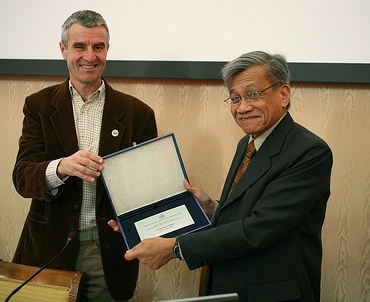
prof-walden-bello-receives-plaque-from-andrea-masullo-of-greenaccord.jpg

People in the South are open to an alternative to a model of growth that has failed both the environment and society, he said. For instance, in Thailand, a country devastated by the Asian financial crisis of 1997 and wracked by environmental problems, globalization and export-oriented growth are now bad words.

He added: “Thais are more and more receptive to the idea of a ‘sufficiency economy‘ promoted by popular monarch King Bhumibol, which is an inward-looking strategy that stresses self-reliance at the grassroots and the creation of stronger ties among domestic economic networks, along with ‘moderately working with nature'”.

But the southern countries cannot and must not rely on their elite to provide leadership, he said. “What is clear is that in most other places in the South, one cannot depend on the elites and some sections of the middle class to decisively change course. At best, they will procrastinate.”

The fight against global warming will need to be propelled mainly by an alliance between progressive civil society in the North and mass-based citizens’ movements in the South.

Delivering the Lectio Magistralis to conclude the 4-day international gathering of journalists, activists and experts concerned about the environment, Prof Bello traced the evolution of social movements on environment and public health in East Asia, Southeast Asia and South Asia over the past few decades.

Read the test of a similar talk given by Walden Bello at the Trans National Institute in October 2007.

Prof Bello acknowledged that the environmental movements in the South and North have seen their ebbs and flows. “As with all social movements, it takes a particular conjunction of circumstances to bring an environmental movement to life after being quiescent for some time or to transform diverse local struggles into one nationwide movement.”

The challenge facing activists in the global North and the global South is to bring about those circumstances that will trigger the formation of a global mass movement that will decisively confront the most crucial challenge of our times.

And climate challenge is one among several challenges we confront today.

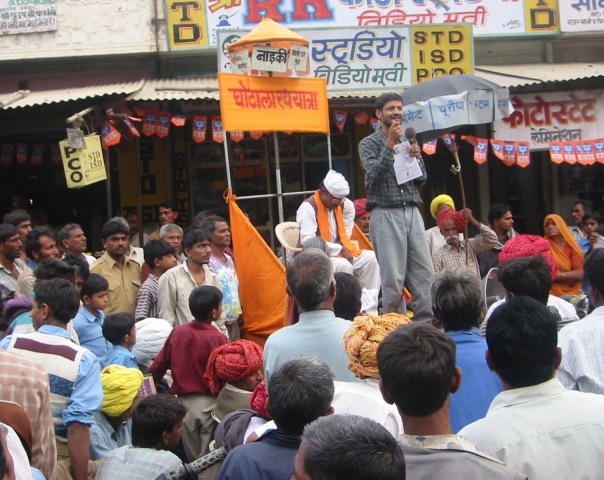
campaigning-for-clean-elections-in-rajastan-india.jpg


Meeting photos courtesy Adrian Gilardoni’s Flickr account

People power India photo courtesy TVEAP image archive

Beyond coffee and bananas: We need fair trade in international media!

Fair trade is gaining momentum worldwide. More products are coming within the scope of fair trade in more countries.

That’s certainly good news in a world full of exploitation, inequality and unfairness at various levels.

But are we, in the mass media whose business it is to gather and deliver news and information, yet part of this good news ourselves? In other words, isn’t it high time there was fair trade in international media products too?

This is the simple question I raised this week at the V Greenaccord International Media Forum on the Protection of Nature, held from 7 to 11 Novmeber 2007 at the historic Villa Mondragone in Frascati, some 20km southeast of Rome.

During the 3.5 day international gathering of journalists and scientists concerned about the environment, we had several speakers referring to fair trade in Europe and at a global level. As more consumers become aware of environmental and social justice considerations, they are doing something about it in their buying of goods that are fairly traded, we heard.

The Wikipedia describes fair trade as ‘an organised social movement and market-based model of international trade which promotes the payment of a fair price as well as social and environmental standards in areas related to the production of a wide variety of goods.’

The movement focuses in particular on exports from developing countries to developed countries, most notably handicrafts, coffee, cocoa, tea, bananas, honey, cotton, wine and fresh fruit.

Fair trade is all about creating opportunities for small scale producers in the developing countries to get organised and supply directly to consumers in different parts of the world. When they sell direct, with few or no intermediaries, they can earn three or four times more, and that money will enhance their incomes, living standards and societies.

Read more about fair trade at Oxfam website, Make Trade Fair

Fair trade is certainly a cherished ideal, but it’s mired in complex economic and political realities. The globalised march of capital, profit-maximising corporations and developed country farm subsidies are among many factors that make fair trade difficult to achieve.

Fair trade activists are well aware of these realities. Their success is built on connecting producers with individual consumers. The proliferation of new media – especially the Internet – has made it easier to sustain such communications.

But the fair trade movement is still largely rooted in goods, not services. In my view, this is necessary but not sufficient in a modern world economy where nearly two thirds of global GDP comes from the services sector. (The Wikipedia’s breakdown for global GDP is agriculture 4%; industry 32%; services 64%).

I can’t immediately find how much the print, broadcast and online media contribute to that 64%, but it must be significant in the media saturated world today. And certainly the flow of media products — text, audio, photographs, moving images, online content and derivatives of these — has become more globalised in the past two decades.

So why not begin to agitate for fair trade in media products when they cross borders? Why aren’t we practising fair trade in our own media industry even as we cover fair trade as a story in our editorial content?

I didn’t get a very clear answer from fair trade activists that I posed this question to this week. While agreeing with me that the same fair trade principles can be applied to the media sector, they acknowledged that each sector has its own dynamics and must develop realistic ways to accomplish fair trade.

So it’s up to us who produce, distribute and manage assorted media products to begin this transformation from within.

Let’s not kid ourselves about what we are taking on. As I wrote in a blog post in September 2007:

“In the media-rich, information societies that we are now evolving into, media and cultural products are an important part of our consumption — and therefore, more of these have to be produced. In the globalised world, more television and film content is being sourced from the majority world — or is being outsourced to some developing countries where the artistic and technical skills have reached global standards.

“But in a majority of these media production deals, the developing country film and TV professionals don’t enjoy any fair terms of trade or engagement. Their creativity and toil are being exploited by those who control the global flow of entertainment, news and information products.

“This is why the top talent in the global South become assistants, helpers and ‘fixers’ to producers or directors parachuting in to our countries to cover our own stories for the Global Village. Equitable payments and due credits are hardly ever given.”

In the same commentary, I added:
“Unfair trade in film and TV is also how the unsung, unknown creative geniuses contribute significantly to the development of new cartoon animation movies or TV series, as well as hip video games that enthrall the global market. Lacking the clout and skill to negotiate better terms, freelancers and small companies across the global South remain the little elves who toil through the night to produce miracles. They work for tiny margins and even tinier credit lines. Some don’t get acknowledged at all.”

Read my blog post: Wanted: Fair trade in film and television!

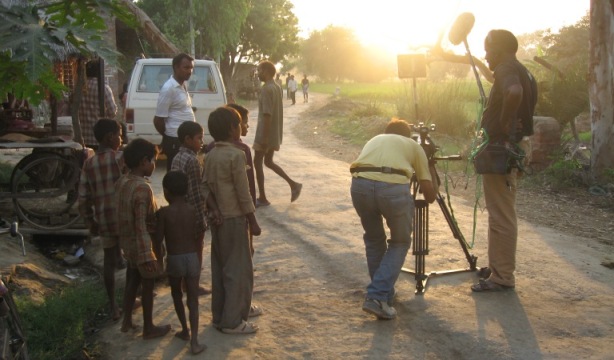
tveap-camera-crew-in-lucknow-india.jpg

Raising this amidst 60 journalists and producers from Africa, Asia, Europe, Latin America and the Caribbean attending the annual Greenaccord meeting, I pointed out that many of us were keen to contribute to media outlets beyond the countries where we are based. It gives us a chance to tell our stories to a bigger audience, and to have our voices heard about a range of issues and topics important to our communities.

And yes, the additional income that such work brings in is quite useful too, thank you.

Heads were nodding when I pointed out how hard it is for a talented, hard working journalist based in the majority world to break into the tightly controlled international media outlets. Even when they make an occasional breakthrough, they are often exploited by being paid lower professional fees for the same output and quality of work.

Or worse, majority world journalists are slighted and insulted for being where they are and who they are, rather than be judged on the merit of their work. As I wrote in a commentary published by SciDev.Net in November 2005: “Media gatekeepers in the North often dismiss the better-informed and equally competent Southern professionals — saying, insultingly, that ‘they don’t have the eye’! And for years, I have resisted the widespread practice of Northern broadcasters and filmmakers using the South’s top talent merely as ‘fixers’ and assistants.”

greenaccord-v-forum-in-progress-nov-2007.jpg

All this makes it imperative for us in the globalised media — in the developed North and developing South — to begin agitating for fair trade in media products and services. As in other products, we are not looking for charity or tokenism or a lowering of standards. We must strive for fairness and equality while working on building the capacity of southern journalists to generate world class media products.

And as my friend Darryl D’Monte — whom we missed dearly at this year’s Greenaccord forum — has been saying for years, publishing each other’s stories is one great step forward.

Mahatma Gandhi put it this way: we must be the change we wish to achieve.

Note: My own organisation, TVE Asia Pacific, practises what I preach here, and always engages local camera crews when we film TV stories across Asia. We will be taking up Fair Trade in Film and Television (FTinFT) as a campaign from 2008.

Read other related blog posts:

Images from the Majority World: Global South telling its own stories

Wanted: Fair trade in film and television!

Image of camera crews courtesy Pamudi Withanaarachchi of TVEAP.

Meeting photos courtesy Adrian Gilardoni’s Flickr account

Beyond press release journalism: Digging up an environmental business story

“Don’t reproduce press releases from companies, or accept their corporate PR. To get to the real stories, journalists have to dig deeper and work a bit harder.”

Paolo Pietrogrande
, Chairman of Atmos Holding, offered this piece of advice when talking to an international group of journalists at the V Greenaccord International Media Forum on the Protection of Nature, held from 7 to 11 Novmeber 2007 in Rome, Italy.

Pietrogrande (seen speaking in photo, below) was talking on ‘new investment scenarios in renewable energy sources’ during a session on sustainable economic mechanisms. A New York based Italian businessman with past experience in Ducati Motor, General Electric, Bain&Company and Ryanair, he suggested that many positive environmental business stories were being overlooked by the media.

paolo-pietrogrande-addressing-greenaccord-v-meeting-nov-2007.jpg

According to him, there are billions to be made in clean energy and clean technology sectors in the coming years — and venture capitalists and other investors have already recognised this potential. Real Money is now being invested in these sectors, often below the media’s radar and without any fanfare.

This is not corporate social responsibility (CSR), philanthropy or ‘greenwashing’ PR. These are hard-nosed investors who fully expect good and dependable returns on what they put in. They do due diligence and take expert advice before putting in their billions into such emerging sectors.

Yet, immersed in peddling doom and gloom stories – especially on climate change these days – most media outlets miss out on these stories which have significant business and environmental angles.

His advice to journalists included these tips:
* Don’t look at press/media sections on corporate websites, which is usually full of PR. Even CSR reports are carefully crafted to give a rosy picture. The real stories lie elsewhere.
* Instead, read the annual reports of companies, especially the CEO’s letter to shareholders. That’s a carefully crafted statement and analysis which contains a good deal of information.
* Stop replying on press releases, and certainly don’t get into the habit of recycling them in news stories. Instead, look at public disclosure documents of companies for leads and insights.

The environment has moved way beyond CSR and corporate PR, he said. More and more companies realise how environmental compliance increases their efficiency and thus profitability. Whole new business areas and opportunities are opening up for those working on clean energy and clean technologies. The impetus has come from concerns on global climate change.

greenaccord-v-forum-in-progress-nov-2007.jpg

If Pietrogrande sounded a bit like Carl Sagan – talking of billions and billions – that is understandable. He sees vast potential in clean energies and clean technologies that can help reduce carbon emissions causing global warming. Industry has traditionally made profit emitting carbon, and now there is money – and profit – to be made cleaning it up.

Investors are lining up with the money, but good ideas and projects are in short supply, he said.

Which reminded me of something that the American engineer, architect and visionary Buckminster Fuller once said: “There is no shortage of energy on this planet. There is, however, a serious shortage of intelligence”.


Meeting photos courtesy Adrian Gilardoni’s Flickr account

Journalists and scientists seeking Green Accord

Can journalists save the planet?

This was the question I raised in a blog post written in April 2007. Arguing that environmental journalists alone cannot adequately address the multitude of complex environmental challenges faced today, I wrote: “We urgently need more good journalism that covers sustainable development as an integral part of mainstream human affairs.”

For the past five years, an Italian non-profit cultural association named Greenaccord has been attempting just this. In the (northern hemisphere) Fall of each year, they invite and host 50 – 60 journalists and scientists from all over the world to discuss how the media can be an integral part of society’s response to today’s environmental crises. In fact, they believe the media must play a path-finder role in our search for solutions.

During this week, I have been attending the V Greenaccord International Media Forum on the Protection of Nature, held from 7 to 11 Novmeber 2007 at the historic Villa Mondragone in Frascati, some 20km south east of Rome.

It has been a time to meet old friends again and to make new ones. I have been part four of the five Greenaccord media forums since the first one was held in Rapolane Terme, in the Tuscany valley in northern Italy in 2002.

Greenaccord is the only regular (annual) meeting that I know of where practising journalists and media gatekeepers come together from all regions of the world to discuss the state of the planet and state of their profession.

Each year, we have some ‘regulars’ returning while new participants join the growing network. As some old hands noted this week, it is evolving into an extended family.

That family consists mainly of print and broadcast media journalists from Africa, Asia, Europe, Latin America and the Caribbean. Many are engaged in ‘deadline journalism’ of news and current affairs, while a few of us, like myself, have moved on to more reflective and analytical kind of journalism. We also have a few researchers, activists and public information officers among us, enriching our discussions with a diversity of perspectives.

To engage this group of participants over three and a half days, Greenaccord invites a dozen or so scientific or industry experts from different regions of the world and different disciplines. This year’s theme, ‘Capitalising on the Environment’, was explored by business leaders, fair trade activists, economists and a number of technical experts specialising in fields such as clean energy, clean technology and organic farming.

greenaccord-v-forum-in-progress-nov-2007.jpg

As with all meetings, some speakers were far more interesting than others. And some sessions were blessed with competent chairpersons who kept overenthusiastic speakers in check and allowed meaningful discussion and debate to happen.

Sitting through such meetings is a bit like gem mining. One has to sift through a lot of gravel to find a rare precious gem. When that happens, it’s well worth the hassle.

Well, I’ve had my share of gravel moments (zzzzzzzzzzzzzzzzz!) and precious moments (Eureka!) this week. I’ll write separate blog posts on some of the latter. They are indeed worth sharing.

The real stars (or gems if you like) in this whole exercise are the participants themselves. We come from such diverse backgrounds – the sessions are supported by simultaneous interpretation in English, Spanish and Italian, with an occasional remark in French – that we enrich each other by simply being there.

emanuela-gasbarroni-from-tve-med-intervenes.jpg

Some of us can barely contain our passion for what we do, and keep making comments or asking questions at every available opportunity. Others are more quiet during sessions but expressive during the many hours of networking and socialising over fine Italian wine, coffee and gastronomical treats. All these are part of Greenaccord’s cultural diversity that we contribute to, and then celebrate.

Even if we don’t take ourselves too seriously, we do discuss sobering issues. On the one hand, the planet is in peril, largely thanks to human bungling over generations. On the other, mass media itself is in crisis in many countries — under siege from oppressive governments, grappling with limitations of money and skills, and facing competition from new media platforms grabbing audiences and revenue.

For example, a colleague from Cameroon found the government closing down his privately owned FM radio station just a couple of days before he left for Rome. Others had worrying tales to share about official censorship, physical violence unleashed on media organisations and journalists, and the tension between media owners’ interests and the public interest.

We expressed solidarity and support for all Greenaccord colleagues currently experiencing difficulties of various kinds. The spirit of camaraderie in this network is strong – and keeps growing.

So is all this networking and meeting hopping a distraction from real work, which each one of us have to perform at our desks, or in our studios, on an individual basis? I don’t think so. Far from being a drag on my time, I find gatherings like Greenaccord inspiring and energising. They also remind me that I’m not alone in the daily struggle and drudgery of deadlines, government bureaucracies, funding crises and a never-ending race to keep up with new media technologies.

A planet in peril and a media in crisis need more platforms like this to connect and support many more of our kind who weren’t in Rome this week. Greenaccord isn’t perfect (we’re working on it), but it has lit more than a few candles against the looming darkness.

– Nalaka Gunawardene, Frascati, Rome: 10 November 2007

zilia-castrillon-speaking-at-greenaccord-v-nov-2007.jpg


Meeting photos courtesy Adrian Gilardoni’s Flickr account

The Al and Pachy Show: Climate Change gains public momentum

Compared to former US Vice President and climate campaigner Al Gore, the name Rajendra K Pachauri might not be as widely recognised. In fact, I wonder how many Americans can even pronounce the name correctly.

But Dr Pachauri is a scientific heavyweight himself, and is the other half of this year’s Nobel Peace Prize. He chairs the UN’s Inter-governmental Panel on Climate Change (IPCC), which was announced as joint and equal winner.

He may be less glamorous than Gore, but Pachauri is just as ardent an advocate for the world to seriously tackle global warming. It was Pachauri’s dedicated work ethic and “ability to build and inspire a team” that helped the IPCC to win the world’s most coveted prize.

Read Rajendra Pachauri’s first reaction to the Nobel Peace Prize announcement

In a profile of the Indian engineer turned scientist-diplomat, The Christian Science Monitor noted: “If Gore is the frontman of the crusade against global warming, then Pachauri runs the engine room.”

Like Gore, Pachauri is a global-warming pioneer. Since the late 1980s, the former industrial engineer has sought to use science to convince skeptics and CEOs of the need of reducing mankind’s atmospheric imprint. Now, he warns that if the problem is not addressed, developing nations will bear the brunt of the crisis, suffering for a situation they did not create because they have not the resources to mitigate it.

In their profile, The Christian Science Monitor quoted Tulsi Tanti, a friend and founder of Suzlon, Asia’s largest manufacturer of wind turbines, as saying: “He has been one of the pioneers and voices of reason in the field, not just calling attention to an environment in peril but creating solutions by bridging the gap between academia, business, policymakers, and the public.”

Read full profile from The Christian Science Monitor of 15 October 2007

I first met and interviewed Dr Pachauri in October 1990, during the Second World Climate Conference in Geneva. That was one of the first international scientific conferences that I covered as a journalist, and Pachauri was kind enough to grant me a long interview. We spoke less of climate and more about energy security and innovative energy solutions. At that time he was head of India’s Tata Energy Research Institute, which was later renamed as The Energy and Resources Institute, still abbreviated as TERI.

Our paths have occasionally crossed since, in different parts of the world, and Dr Pachauri has always remained accessible and articulate. I last met him in Rome in the fall of 2003, during the annual GreenAccord Media Forum on Protecting Nature organised by the Italian organisation GreenAccord.

Read Dr Rajendra Pachuri’s speech at GreenAccord 2003 meeting.

Pachauri was his characteristic modest when reacting to the news of the Nobel Prize. ”I was not expecting any awards for my efforts. I feel privileged to share it with Al Gore. I am only a symbolic recipient but it is the organisation which has been awarded,” he said.

He added: ”With this award to the committee, the issue of climate change will come to the fore. It places a larger responsibility on me and I will ensure that more will be done.”

In a phone call soon after the announcement, he reportedly told Al Gore: “This is Pachy. I am so delighted and so privileged to have the IPCC share with you. I will be your follower and you will be my leader.”

The IPCC set up in 1988 comprises 3,000 atmospheric scientists, oceanographers, ice specialists, economists and other experts and is the world’s top scientific authority on global warming and its impact.

Wikipedia on the IPCC and its track record

Wikipedia on Rajendra K Pachuri

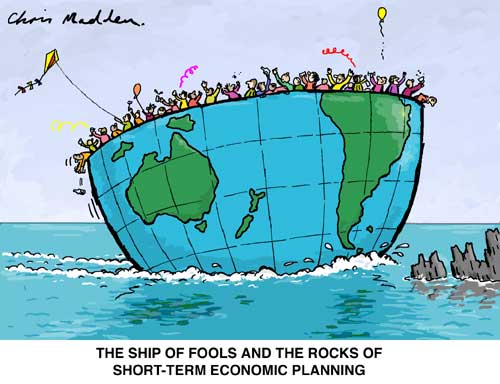
Running the planet without a user-guide

There is a best-selling small book titled Everything Men Know About Women. It’s authored by Cindy Cashman, writing under the pseudonym Dr. Alan Francis.

The book is revealing as it’s simple: every page is completely blank.

I was reminded of this little book while listening to some of the world’s leading environmental scientists and conservationists speak this week during the 4th IUCN Asia Conservation Forum, held in the Nepali capital of Kathmandu, 10 – 13 September 2007.

Expert after expert admitted how limited our understanding still was of the planet’s intricate and inter-linked natural systems. Some processes — such as how climate change would impact different geographical regions, natural cycles and ecosystems — are only just beginning to be understood. We know more about the surface of the Moon than about the bottom of the oceans on our planet. We have only had a few recent glimpses into the large and complex world of micro organisms.

In short, many pages of our planet’s ‘operations manual’ or user guide are still completely blank!

Read related post: Talking Big Foot in YetiLand – Got a spare planet, mate?

Yet the ecological threats are real, and they are here. The pressures we humans exert on our environment is increasing by the day. Deferring action until we have better knowledge and understanding is no longer an option.

Instead, we now have to use a combination of the best current knowledge, common sense and intuition to address a multitude of formidable environmental issues including the growing piles of our waste, intensification of disasters, march of desertification, changing climate as well as the poisoning of our freshwater, seas and the air. Some of these degradation factors feed on each other, producing more damage – and rude shocks – than each one could on their own.

ship-of-fools.jpg

In this scenario, the conservation community — in Asia and elsewhere — faces three major challenges:

First, they just have to doggedly persist in gathering new knowledge, and deriving understanding and insights on how our planet works. This is not research for its own sake, or mere academic theorising. It’s now a pre-requisite for survival.

Second, they have to find smart and strategic ways to fill up the ‘blank pages’ in our planet’s user-guide. In the 1970s, they used to say we have been handed over a planet without that manual and it seemed we had time to figure things out. The truth is, time is running out and we have to write that manual as we go along.

Third, it’s vital that the user-guide is widely shared using every available advocacy and dissemination method, tool and medium. Staying within comfort zones and talking to each other in technical jargon is not enough. This is the point I personally stressed at the meeting: use modern ICT tools to discuss, debate and engage everyone in changing their ways where needed.

The current conservation imperative reminds me of what H G Wells said: History is a race between education and catastrophe. Right now, it seems, we are just staying ahead to avoid disaster.

Thanks to initiatives like the Millennium Ecosystem Assessment, those blank pages in the Earth’s user guide are filling up.

Strange as it sounds, the book’s already filled pages have to be be peddled far and wide even as the other pages are being written.

Talk about a race between education and catastrophe!

Crossing the other Digital Divide: Challenge to conservation community

Digital Divide refers to the gap between those who have regular, easy access to modern information and communication technologies (ICTs) and those who don’t. In the past decade, the IT industry and development community have launched various initiatives to bridge this divide. The One Laptop Per Child project is among the better known examples.

As digital technologies and media gain momentum and wider coverage than ever before, another kind of digital divide has emerged. This week in Kathmandu, during the Fourth Asian Conservation Forum, some of us have been talking about this new divide — between the Digital Natives and Digital Immigrants.

This latter divide is mainly a product of age, not socio-economics. Market research and sociological studies now confirm that today’s younger people – raised on a diet of mobile phones, video games and mp3 (music) players – have radically different ways of accessing, receiving and coping with information.

Recognising this new Digital Divide is vital for communication and advocacy work of conservation groups, such as IUCN – The World Conservation Union, conveners of the Kathmandu forum.

For nearly 60 years, IUCN has been an effective platform for knowledge-based advocacy. Using scientific evidence and reasoning, it has influenced conservation policies, laws and practices at country and global levels. The world would be a worse place to live in if not for this sustained advocacy work by thousands of experts and activists who were mobilised by IUCN.

Much of that work has been accomplished through the classical advocacy tools: scientific papers, books, conferences and, in recent years, ‘policy dialogues’ — meetings where experts and activists would sit down and talk things through with those who make policy in governments and industry.

IUCN continues to pursue all these methods, with creditable impact. IUCN’s Red List of Threatened Species, whose latest edition is being released today (12 September 2007), is among the best known examples of how the Union’s work informs and inspires urgent action for saving the world’s animals and plants driven to the edge by human activity.

To remain similarly effective in the coming years, IUCN — and the rest of the conservation community — need to evolve and adapt to changing realities in human society. One such reality is the proliferation of ICTs in the past two decades.

The International Telecommunications Union (ITU) announced recently that the world’s telephone connections had passed four billion. Largely thanks to the explosion of mobile phones in the majority world, the total number of telephones (fixed and mobile) had quadrupled in the past decade.

While exact figures are hard to come by, it is estimated that around 1.17 billion people (almost 1 in 6 persons) have access to the Internet, even though varying levels of quality.

These are the more widely quoted figures, but the media mix keeps diversifying even as the size of the overall ‘ICT pie’ keeps increasing. For example, the 1990s saw a channel explosion in both FM radio and television across much of Africa, Asia Pacific and Latin America, hugely increasing viewers’ choice and enhancing the outreach of broadcasting. The popularity of video games (and now, online games) has spawned trans-boundary subcultures that were inconceivable even a decade ago.

It is this bewilderingly media-enriched world that IUCN’s members and experts are trying to engage, hoping to persuade everyone — from governments and industry to communities and individuals — to live and work as if the planet mattered.

In Kathmandu this week, I argued that scientific merit and rational (and often very articulate) reasoning alone won’t win them enough new converts to achieve significant changes in lifestyles, attitudes and practices. To be heard and heeded in the real world outside the charmed development and conservation circles, we need to employ a multitude of platforms, media and ICT tools. And we have to talk in the language of popular culture.

We have come a long way since the 1980s, with the new ICTs evolving parallel to our own understanding of sustainability.

When we were involved in processes leading up to the Earth Summit in Rio de Janeiro, back in 1992, most of us were still using fax and snailmail to exchange information. Email was confined to academic circles and the web was not even conceived.

By the time Johannesburg Summit was held a decade later, email had come into wide use and static websites were being used to disseminate information and opinions. E-commerce and music file sharing were gaining momentum.

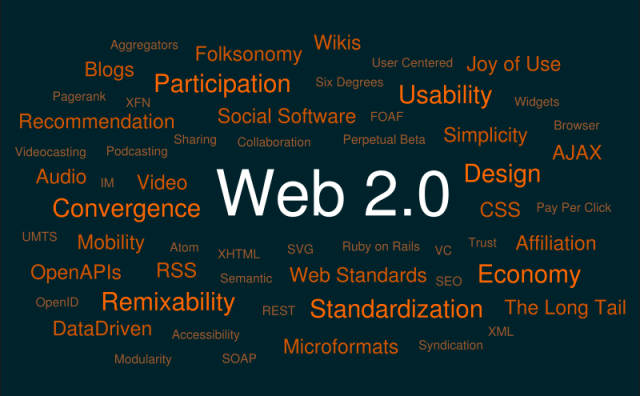
Just five years on, the rapidly evolving web 2.0 offers us more tools and platforms to not just engage in one-way dissemination, but to truly communicate with a two-way flow. Wikis allow participatory document drafting. Web logs or blogs enable faster, easier expression and discussion. YouTube and other platforms have suddenly made sharing of moving images much simpler (assuming we have sufficient bandwidth).

In fact, connectivity is improving in many parts of the world, though there still are many gaps, frustrations and cost issues to be resolved. Young people, under 25 years, are leading the charge in entering and ‘colonising’ the new media. Social networking platforms such as MySpace and FaceBook are only the tip of this cyber iceberg. And virtual worlds — such as Second Life, with over 8 million online members — are moving in from the periphery to occupy a clear niche in our new digital world.
800px-web_20_mapsvg.png

Every indication is that these trends will continue. IUCN and other conservationists, with their rigorous scientific analysis expressed in technical papers, print publications and the occasional op ed article in a broadsheet newspaper, have to navigate in this whirlpool — and it’s not easy. But their choice is between engagement and marginalisation. The planet cannot afford the latter.

I’m not suggesting that conservation scientists and organisations must drop their traditional advocacy methods and rush to embrace the new ICT tools. But they need to survey the new media landscape with an open mind and identify opportunities to join the myriad global conversations.

A good part of that is what intellectuals might see as chatter, or tabloid culture. It’s precisely this mass tabloid audience that needs to be engaged for conservation.

There are inspiring examples of how other sections of the development spectrum are seizing new media opportunities:

* Some humanitarian groups now use Google Earth online satellite maps for their information management and advocacy work, for example in Darfur, Sudan, and the Central African Republic.

* In an attempt to name and shame offenders, human rights activists are using YouTube to post incriminating video evidence of human rights abuses worldwide. The influential Foreign Affairs journal recently called this the YouTube Effect.

Fortunately, at least a few Asian conservation leaders already appreciate this enormous new media potential. In Kathmandu, Surendra Shrestha, UNEP’s regional director for Asia Pacific, echoed my views.

“My young kids spend several hours each weekend in virtual worlds. We need to get in there and engage them with our content,” he said. “To do that, we have to get inside their minds, and speak their language.”

Shrestha mentioned how UNEP in Asia is attempting this with ICT-based projects for youth, such as e-generation which, according to him, has involved half a million young people.

Such initiatives are beginning to happen, thanks to a few conservationists who are pragmatic enough to exploit the inevitable. But much more needs to be done to make conservation ‘cool’ and hip for Asia’s youthful population, half of them under 35, and many of them Digital Natives.

For sustainability measures to have a chance of success, these upwardly mobile, spend-happy youth have to be reached, touched and persuaded. If it takes tabloid tactics to achieve this, so be it.

And given Asia’s growing economic clout and ecological impact – with China and India leading the way – the fate of the planet will be decided by what is done, or not done, in our region.

While they debate the finer points of conservation strategies and activities in Kathmandu, Bangkok and other cities across our massive region, Asia’s conservation community must quickly cross the new Digital Divide that currently separates them from Digital Natives.

Declaration of interest: I was part of IUCN Sri Lanka Secretariat (1992-1994), where I started its communication division, and have been a member of IUCN Commission on Education and Communication since 1991.

Read my April 2007 post: Do ICTs make a difference?

“Can you help us to film a child’s leg being broken?”

“Can you help us to film a child’s leg being broken?”

This question, posed by a visiting Canadian TV crew in the 1970s, startled my good friend Darryl D’Monte, one of the most senior journalists in India and former editor of the Times of India.

Darryl was having a chat with the crew, giving them some insights on the extent of poverty in his home city of Bombay, since renamed as Mumbai. It is routine for visiting journalists to have such chats with their local counterparts to get context and advice.

It was when the conversation turned to beggars, that this western TV crew asked if they could film the intentional breaking of a poor child’s leg — a brutal practice that was believed to exist so that maimed children could be employed as beggars. A disabled child would evoke more sympathy, and consequently, more alms.

darryl-dmonte-speaking-at-ifej-2005-congress.jpg

The articulate Darryl must have expressed his exasperation in strong terms. But even he couldn’t have anticipated the response.

“It’s going to happen anyway,” was how the film crew rationalised their bizarre request.

So why not be there, capture it on film, and get a great story out of it — which can be packaged as the brutal side of India’s poverty! This must have been the crew’s line of reasoning. Maybe their editors had exerted pressure to come back with something out of the ordinary.

I quoted this incident in my essay, Ethical newsgathering challenge for Al Jazeera International, published in November 2006. It was a plea for the newest entrant to international TV newsgathering to play by a different, and more ethical, set of rules.

These and worse practices are certainly not confined to India, or to TV crews originating from any single country. And sadly, these have not been abandoned after the 1970s. In fact, the emergence of 24/7 satellite news channels since the 1980s has inspired much more competition in the TV newsgathering industry, creating an alarming race to the bottom.

Such journalists’ only operating guideline seems to be: get the story, no matter what — or who gets hurt in that process.

In filming wildlife documentaries, film-makers sometimes have to make a choice: do they interfere in the processes of Nature, such as a predator setting on a hapless prey? There is an unwritten rule that things must be allowed to happen, with humans only capturing actuality on film.

But when it comes to filming wild life of our species in our cities and villages, the ethical dilemmas are not so easily resolved. This is why all journalists and film-makers, especially those in newsgathering, need a strong ethical framework for their work.

Journalists represent the public’s right to know, which is extremely important. Media coverage and exposes can trigger much needed aid, reform or public outcry on certain issues. But that is not a justification for getting the story by any means.

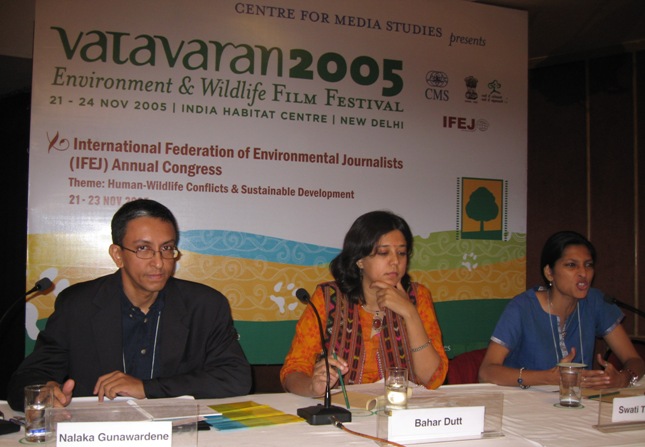
Darryl D’Monte shared the above story at panel discussion on ‘Does TV do a better job on environmental reporting?’ which I chaired during the annual congress of the International Federation of Environmental Journalists (IFEJ), held in New Delhi, India, in November 2005. That year it was part of the Vatavaran 2005, the national environmental film festival of India.

panel-discussion-at-ifej-2005-congress-new-delhi.jpg

I was reminded of this story because the 4th CMS Vatavaran film festival is round the corner: it will be in New Delhi from 12 to 16 September 2007. I won’t be there in person; my colleague Manori Wijesekera is representing TVEAP this time.

TVE Asia Pacific News: Environmental film-makers call for ethical framework

Read official report of IFEJ Congress in 2005

Related blog posts:

Al Jazeera: Looking hard for the promised difference

Wanted: Ethical sourcing of international TV news

Cheque-book Development: Paying public media to deliver development agency logos

Joey R B Lozano: The legacy continues…at Silverdocs

I met Joey R B Lozano only once, but he left a deep impression.

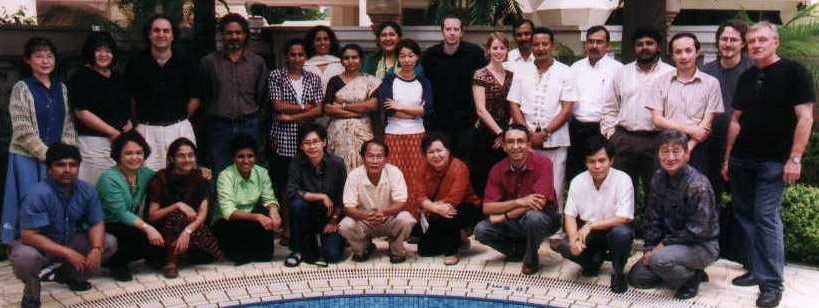
A small-made man with passionate zeal and tons of energy, he was every inch an activist-journalist-campaigner. We had invited him to a regional workshop of factual video producing and distributing partners from across Asia that we held in Singapore in November 2002.

We hadn’t worked with Joey earlier. He came recommended by our international partner Witness, which uses video-based advocacy and activism for promoting and safeguarding human rights worldwide.

Joey R B Lozano Joey R B Lozano Joey R B Lozano

Joey used his personal video camera to assert indigenous land rights, and to investigate corruption and environmental degradation in his native Philippines. Joey was an independent human rights activist and also one of the country’s leading investigative reporters.

He freelanced for the Philippine Daily Inquirer, covering Indigenous peoples’ rights and the environment, considered the two most dangerous beats in the Philippines. But years earlier, he had moved out of the capital Manila, and committed his life and career to stories and issues at the grassroots that many of his city-based colleagues had no time or patience in covering on an on-going basis.

Trained as a print journalist, Joey mastered new media and technologies whose potential he quickly realised. He moved into television and video media with ease, and later became an active blogger.

Joey’s TV investigations began in 1986, when he helped ABC’s 20/20 to uncover the “Tasaday hoax”, a highly successful fraud to pass off local tribespeople as a newly discovered Stone Age culture.

He soon embarked on his own investigations and started digging into illegal logging, gold mining and land-grabbing. In turn, his exposes quickly earned him repeated assassination and abduction attempts, in a country that is one of the more dangerous places to practice journalism.

When he came to Singapore, Joey had recently ‘starred’ in a major Canadian documentary titled Seeing is Believing: Human Rights, Handicams and The News, which looked at how committed, passionate individuals were using new communication technologies to change the world.

participants-at-tveap-partner-workshop-singapore-nov-2002.jpg

Photo of Singapore TVEAP workshop participants: Joey Lozano is 6th from left on the frontmost row

Follow Seeing is Believing storyboard on the film’s website

We screened the film, made by Katerina Cizek and Peter Wintonick, and heard first hand from Joey on what his struggles entailed. The film followed Joey as he delivers a new “Witness” donated video camera to Nakamata, a coalition of Indigenous groups in Central Bukidnon. Together, Nakamata and Joey begin documenting a dangerous land claims struggle, and it doesn’t take long for tragedy to unfold in front of the camera.

Watching the film and then listening to Joey — and his Witness colleague Sam Gregory — describe the on-going struggle, was one highlight of our week-long workshop. Some of us saw in Joey the activist-campaigner that we wanted to be, but were too scared or too polite to really become.

Not everyone shared that view. The cynicism — sometimes bordering on disdain — of a fellow Filipino from Metro Manila was palpable. No wonder Joey moved away from the city.

We at TVE Asia Pacific were extremely keen to distribute Seeing is Believing, for it held such a powerful and relevant message for our region, but it was not to be. Our enquiries showed that like most documentaries, it was tied up in too many copyrights restrictions and commercial distribution deals.

Following the Singapore workshop, I did keep a watchful eye on what Joey Lozano was up to. The film’s website provided occasional updates, and sometimes blog posts from Joey himself.

Our paths never crossed again. Almost three years after our single encounter came the news that Joey had passed away. It wasn’t the assorted goons who hated his guts that finally got him. His own body turned against him.

His tribute on the film’s website started as follows:

Joey Lozano defied the odds. For three decades, he survived dangerous missions to defend human rights using his video camera, in the Philippines, a country that ranks high, year after year, for most journalists killed. Joey went into hiding numerous times, and he dodged two assassination attempts. Once, bullets whizzed past his ear as he made his escape on motorbike.
But Joey couldn’t beat the odds of cancer. He died in his sleep on September 16, 2005 – at home and surrounded by his family.

Joey R B Lozano - image courtesy Seeing is Believing

The spirit and legacy of Joey R B Lozano live on. He inspired a large number of journalists and activists to stand up for what is right and just — and to be smart about it in using modern information and communication technologies, or ICTs.

Joey and other Witness activists were pioneers in different parts of the world who turned handicams away from weddings and birthday parties to capture less cheerful sights and sounds the world must see — and then act on. They were at it years before mobile phone cameras, YouTube and user-generated content in the mainstream media.

And now, Witness has established an award at the Silverdocs film festival. The WITNESS Award in Memory of Joey R.B. Lozano will be awarded to the qualifying SILVERDOCS filmmaker of a feature-length film who has produced a well-crafted and compelling documentary about a human rights violation or social justice issue. The winning filmmaker will also have a thoughtful, creative, and feasible outreach plan to use their film as a tool to raise awareness of the human rights or social justice issue explored in the film with a goal to bring about change.

The inaugural award was announced on June 17 — and has been won by “The Devil Came on Horseback” by Annie Sundberg and Ricki Stern.

Joey was a Witness partner and board member. He co-produced many films and collaborated on others that helped raise awareness about threats to indigenous people’s rights in the Philippines from corporations, and the complicity of the government in the abuses. Witness was founded in 1991 by musician peter Gabriel and the Lawyer’s Committee for Human Rights to put new technologies into the hands of local activists around the world.

Joey R B Lozano with his handycam

Read International Wildlife May 1999: Why Joey Lozano Is A Marked Man – investigative reporter works for the environment

Read about and watch Rule of the Gun in Sugarland