What might happen if we suddenly found ourselves in a borderless world? Or at least in a world where free movement across political borders was allowed? Which places would see a mass exodus, and to where might people be attracted the most?
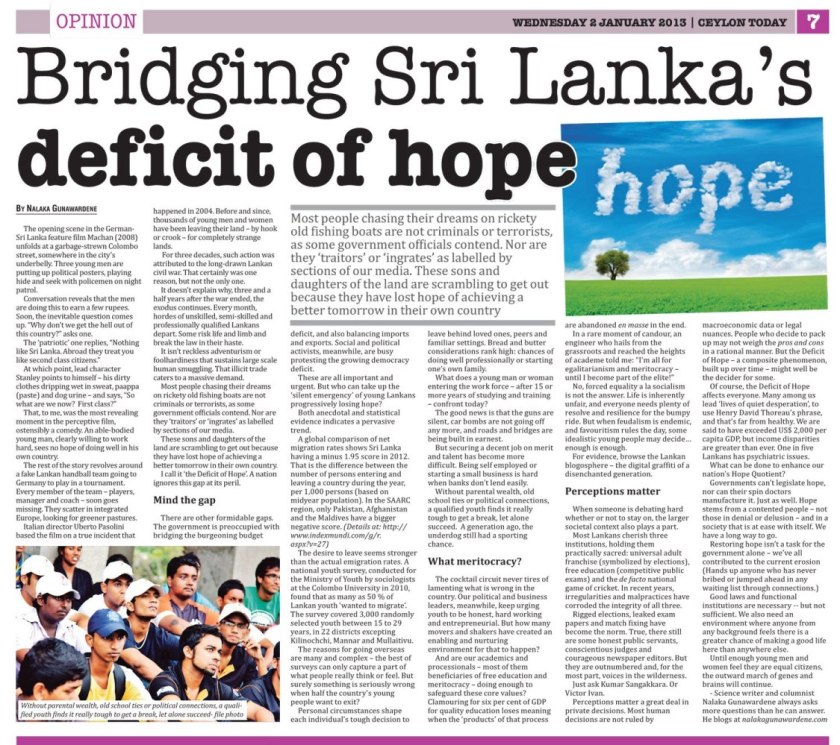
I very nearly included the old Soviet joke in my latest op-ed essay titled ‘Bridging Sri Lanka’s Deficit of Hope’ that is published today by Groundviews.org.
It asks WHY many thousands of young men and women of Sri Lanka have been leaving their land — by hook or crook – for completely strange lands. This has been going on for over a generation.
Here’s an excerpt:
For three decades, such action was attributed to the long-drawn Lankan civil war. That certainly was one reason, but not the only one.
It doesn’t explain why, three and a half years after the war ended, the exodus continues. Every month, hordes of unskilled, semi-skilled and professionally qualified Lankans depart. Some risk life and limb and break the law in their haste.
It isn’t reckless adventurism or foolhardiness that sustains large scale human smuggling. That illicit trade caters to a massive demand.
Most people chasing their dreams on rickety old fishing boats are not criminals or terrorists, as some government officials contend. Nor are they ‘traitors’ or ‘ingrates’ as labelled by sections of our media.
These sons and daughters of the land are scrambling to get out because they have lost hope of achieving a better tomorrow in their own country.
I call it the Deficit of Hope. A nation ignores this gap at its peril.
As usual, I ask more questions than I can answer on my own. But I believe it’s important to raise these uncomfortable questions.
Towards the end, I ask: What can be done to enhance our nation’s Hope Quotient?
“Governments can’t legislate hope, nor can their spin doctors manufacture it. Just as well. Hope stems from a contented people — not those in denial or delusion — and in a society that is at ease with itself. We have a long way to go.”
For much of 2012, a large section of the print and broadcast media in Sri Lanka behaved like the proverbial chicken who panicked himself and the rest of the jungle claiming the sky was falling.
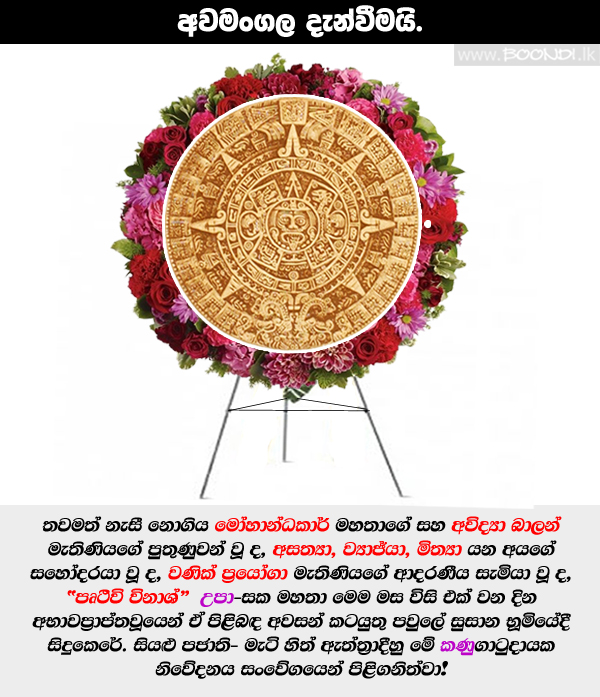
They uncritically and sometimes gleefully peddled the completely unsubstantiated and imaginary prophecies of doom and gloom – specifically, about the world ending on 21 December 2012.
And just like Chicken Little did, our media too had plenty of uncritical followers – a case of the blind leading the blind. They worked themselves into a misplaced frenzy, imagining all sorts of scenarios for the world’s end.
In this week’s Ravaya column (in Sinhala), I take a critical look at our uncritical and fear-mongering media, especially broadcast media. Appears in print issue of 30 Dec 2012.
The much touted ‘Doomsday’ has finally arrived: today is 21 December 2012.
According to the assorted peddlers of doom and gloom, the world should be ending today. Hmm…
Perhaps THEIR WORLD of myth and fantasy would indeed end today — and not a moment too soon!
For the rest of us, however, it’s another day. And from today, I would call the misguided “star-readers” ass-trologers.
Ass-trologers and other dabblers in pseudo-science and non-science will now have a lot of explaining to do. The religious zealots, of course, would probably claim that their pious conduct and non-stop prayers earned us a stay of execution…
The US space agency NASA was so sure that the world won’t come to an end on 21 Dec 2012, that last week they released this simple explanatory video for “the day after”. It has already been seen by over 2 million viewers on YouTube:
Here’s an excerpt: “Doomsday prophecies may not be the most dangerous part of the problem. But as they are bound to collide always so harshly with the continued existence of the world after zero hour, they allow us a glimpse at a process – here in fast motion – that normally would play out too slowly to be understood. It is a process of immunization against reason…”
Read my 4 Nov 2012 Sunday column: End-of-the-World, Inc.
This week, my Ravaya column (in Sinhala) is about why we in Sri Lanka should re-read Arthur C Clarke, author of 100 books and over 1,000 essays of both fiction and non-fiction. This marks his 95th birth anniversary that falls on 16 Dec 2012.
As a science writer, Sir Arthur wrote on many and varied topics. Here, I single out two aspects: human violence and human gullibility, both of which continue to affect societies around the world.
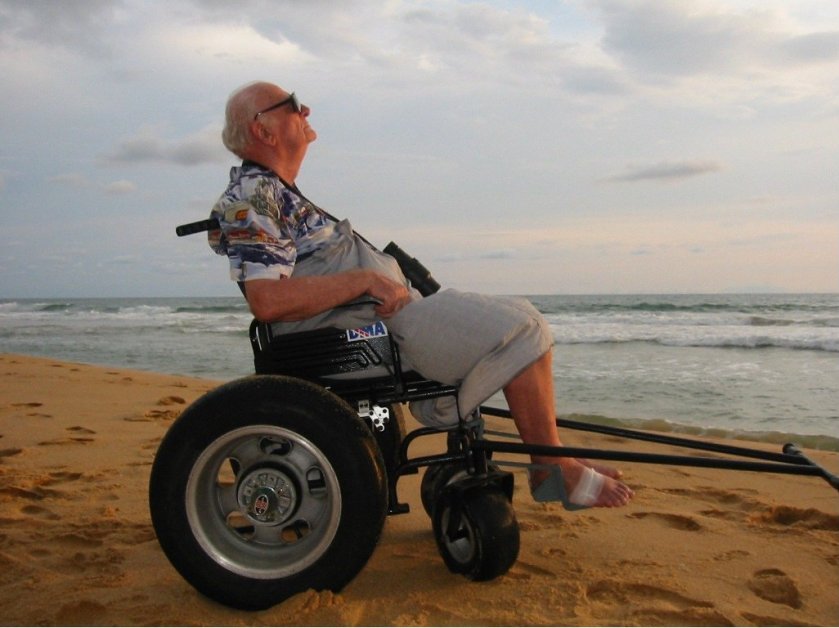
Sir Arthur Clarke revisits Hikkaduwa beach in souther Sri Lanka in his custom-made Dune Roller, circa 2005 ශ්රීමත් ආතර් සී. ක්ලාක්ගේ 95 වන ජන්ම සංවත්සරය අදට යෙදෙනවා.
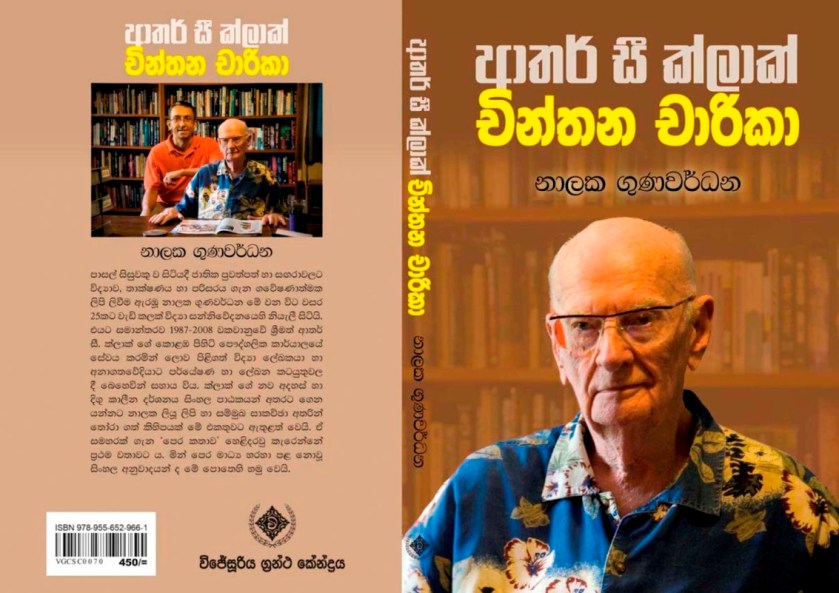
Arthur C Clarke Chintana Charika – Sinhala Book of essays and interviews by Nalaka Gunawardene (Wijesooriya Book Centre, Colombo, 2012). Cover photos by Shahidul Alam, Drik
In a literary career spanning over six decades, Sir Arthur C Clarke (1917 – 2008) wrote 100 books and more than 1,000 short stories and essays. He was the first to propose geostationary communications satellites, and inspired the World Wide Web.
To mark his 95th birth anniversary which falls this month, science writer Nalaka Gunawardene is releasing a new Sinhala book offering a quick tour of Clarke’s imagination, analyses and extrapolations on the world’s current challenges and our choice of futures.
Titled ‘Arthur C Clarke Chintana Charika’ (Mind Journeys with Arthur C Clarke), the book is a collection of Nalaka’s articles, media columns and interviews based on the late author and visionary’s formidable intellectual output. Some have appeared in Lankan newspapers or magazines during the past 25 years, while others are coming out in print for the first time.
“These are not translations, and most are not even adaptations. Instead, I have distilled Sir Arthur’s ideas and imagination and presented them in simple Sinhala,” says Nalaka, who worked with Clarke for 21 years as research associate at his personal office in Colombo.
Indicative of Clarke’s diverse career and interests, the book is divided into five sections: highlights of his illustrious life; astronomy and space travel; information and communications technology; futuristic visions; and his long association with Sri Lanka.
“Sir Arthur cheered and promoted Sri Lanka for half a century – in both good times and bad. The section on Sri Lanka captures his visions and hopes for his adopted homeland: on how we may overcome the burdens of evolution and history to create a truly peaceful and prosperous island for all,” says Nalaka.
The book contains Clarke’s advice on rebuilding Sri Lanka after the 2004 tsunami, the story of the first Sinhala feature film in colour (Ran Muthu Duwa, 1962) that Clarke financed, and the text of his 90th birthday video, which eventually became his public farewell.
Other essays focus on Clarke’s cautious optimism for information society and the future of artificial intelligence, his hopes of developing clean energy sources to end humanity’s addiction to fossil fuels, and his advocacy of a world free of nuclear weapons.
Nalaka reiterates that the best way to celebrate the legacy of Arthur C Clarke is to adapt his ideas for a better world based on knowledge, ethics, compassion and imagination.
The 280-page book, published by Wijesooriya Grantha Kendraya (Wijesooriya Book Centre), will be launched at 3 pm on Tuesday, 18 December 2012 at the National Library Services and Documentation Board, 14, Independence Avenue, Colombo 7. The main speaker will be Prof Rohan Samarajiva, Chair and CEO of LIRNEasia. Copies will be sold on discount at the launch.
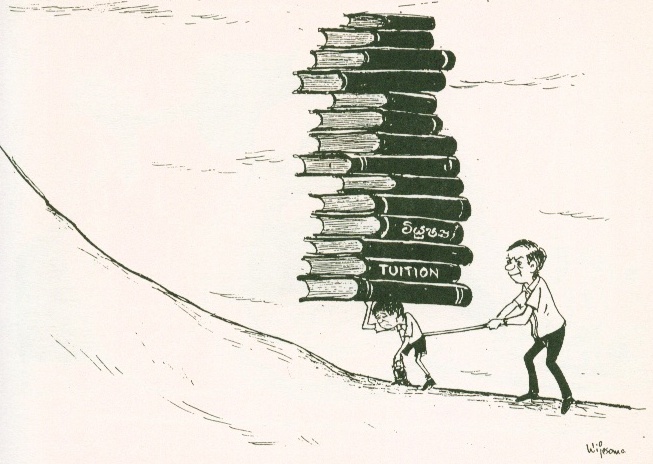
In this week’s Ravaya column (in Sinhala), I discuss the brutal, almost inhuman pressures the formal education system — schools, teachers and most parents — exert on our children.
My daughter was six at the time, and I was hoping she would be spared the worst of the Lankan educational system as she grew up. Alas, things have only become worse in that decade. I’ve tried to buffer her from the worst excesses: while she does not have parental pressure to ‘get ahead at any cost’, she is being driven by her school to ‘perform’ so as to ‘maintain the school’s glory’!
In this week’s Ravaya column (in Sinhala), published on 30 September 2012, I discuss how to nurture a culture of innovation in Sri Lanka — a topic that I’ve been writing and talking about for over two decades.
On the eve of the first major national exhibition of inventions, I discuss the role of Sri Lanka Inventors’ Commission (SLIC), state agency mandated to promote innovation, and talk to its head, Deepal Sooriyaarachchi.
I revive a question first asked when Apple co-founder Steve Jobs departed one year ago: how do we nurture innovation in our kind of conformist and hierarchical societies don’t give mavericks a fleeting chance. Our cultures instead suppress individualism and iconoclasts. What is to be done?
Sahasak Nimawum: Sri Lanka’s national exhibition of inventions and inventors
Quizzing is a well established hobby as well as a mind sport around the world. Participants engage in a friendly tussle using quick wits and sharp memories.
Also known as general knowledge competitions, quizzing has been a popular programme type on Lankan radio and TV for several decades. Recently, reality quiz shows on TV have renewed interest in this activity.
Now, a group of quiz enthusiasts have launched named Serendib Quiz, a live quizzing event to nurture a serious quizzing culture in Sri Lanka.
The first Serendib Quiz will be held on Sunday, 29 July 2012 at 2.00 pm at Galadari Hotel, Colombo 1.
The quiz, in English, will involve 50 questions from all areas of knowledge, both local and global. It will be compiled and conducted by Nalaka Gunawardene, one of the most versatile quizzing professionals in Sri Lanka who has over 30 years of experience as a quiz kid turned quizmaster.
Participation in this team event is open to all educational institutions (schools, universities, training institutes), public and private establishments, banks and other financial institutions, as well as groups of private individuals.
Prizes worth a total of Rs. 225,000 can be won by the highest performing teams at this quiz, organised by Quiz World (Pvt) Limited, an educational services company dedicated to promoting quizzing as a mind sport. http://quizworldlanka.com
Serendib Quiz is sponsored by Commercial Credit PLC in partnership with Sarasavi Bookshop (Pvt) Limited and Fast Ads (Pvt) Limited. The media sponsors are Daily News, Sunday Observer and TV Derana.
Prior registration is required (by or before 24 July 2012). More information, along with the Entry Form, are available on request from Vindana Ariyawansa, phone 0773 996 096; Email: Vindana@gmail.com
A scene from The Anthropocene film
In March, I wrote about the high impactful short film called Welcome to the Anthropocene that launched the Planet Under Pressure conference, London 26-29 March 2012.
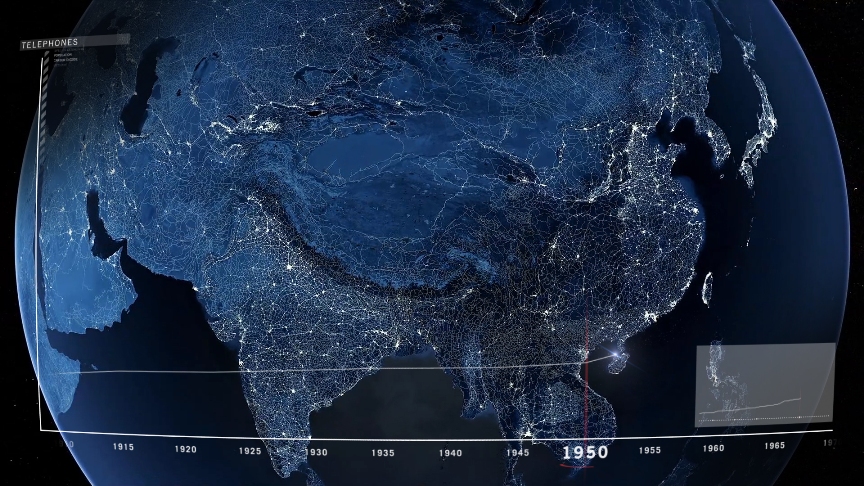
It is a three-minute blast through the last few centuries of Earth’s history, starting in 1750 and finishing at the Rio+20 Summit. It graphically depicts how one species has transformed Earth and shows why many scientists now say we have entered a new geological epoch, the Anthropocene.
Produced by the International Geosphere-Biosphere Programme (IGBP) and partners, it opened the United Nations Rio+20 summit today in Rio de Janeiro.
This information is found in a media notice released by IGBP today:
The data visualization, which is already an online viral hit with over 700,000 views, demonstrates that while we have had a dramatic impact on Earth for many thousands of years, it has only been since the 1950s we have grown into a colossal global force.
“The Anthropocene changes our relationship with the planet. We have a new responsibility and we need to determine how to meet that responsibility,” says co-director of the film, Owen Gaffney, director of communications at the International Geosphere-Biosphere Programme (IGBP), based in Stockholm.
“The Rio+20 summit is the largest UN event ever held and the first major international gathering on global sustainability since the concept of the Anthropocene was first popularised,” added Mr Gaffney.
The film opens at the beginning of the Industrial Revolution. As the camera swoops over Earth, viewers watch the planetary impact of humanity: cities, roads, railways, pipelines, cables and shipping lanes until finally the world’s planes spin a fine web around the planet. The film is produced as part of the world’s first educational portal on the Anthropocene.
The film was co-directed by Canadian data visualization expert and anthropologist Felix Pharand-Deschenes from the education organization GLOBAIA.
Pharand-Deschenes said: “Data visualization is a powerful tool to help us view the world and our place in it and to help foster the global awareness needed to support global sustainability and governance. Science can make use of these tools to help bring research to more people.”
The film was commissioned for a major international science conference, Planet Under Pressure, held in March 2012. The conference was designed to provide scientific leadership in support of the Rio+20 summit.
Conference co-chair Dr Mark Stafford Smith from CSIRO in Australia, said: “The film picks up the main theme of the Planet Under Pressure conference: the risks we face are global, urgent and interconnected. Our search for solutions must take this into account.”
The film was produced by the International Geosphere-Biosphere Programme and Globaia. It is part of the website, Anthropocene.info which is co-sponsored by IGBP; Globaia, CSIRO, Stockholm Resilience Centre, Stockholm Environment Institute, International Human Dimensions Programme.

 ලෝක විනාශ මිථ්යාවක් මතු වූ ප්රථම වතාව මෙය නොවෙයි. එහෙත් මෙතරම් ලෝක ව්යාප්ත මට්ටමින් මෙබඳු මුලාවක් හා භීතියක් මෙවර හට ගත්තේ ජනමාධ්ය හා තොරතුරු තාක්ෂණය හරහා මේ ප්රබන්ධය අති විශාල ජනකායක් අතරට ඉක්මනින් පැතිරුණු නිසයි. තොරතුරු සමාජය හා මාධ්ය චර්යාව ගැන නෙත් යොමා සිටින මට මේ ගැන නිරීක්ෂණ හා අත්දැකීම් කිහිපයක් තිබෙනවා.

 Open Minds!