India’s climate change NIMBYsm and middle class apathy

Pradip Saha in Tokyo

The global climate is indeed changing, but not everyone is equally affected by it – or bothered about it either. Take, for example, the majority of India’s 300 million+ middle class, which is roughly the size of the entire population of the United States.

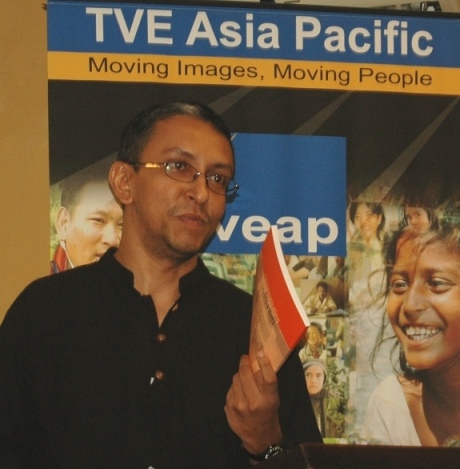
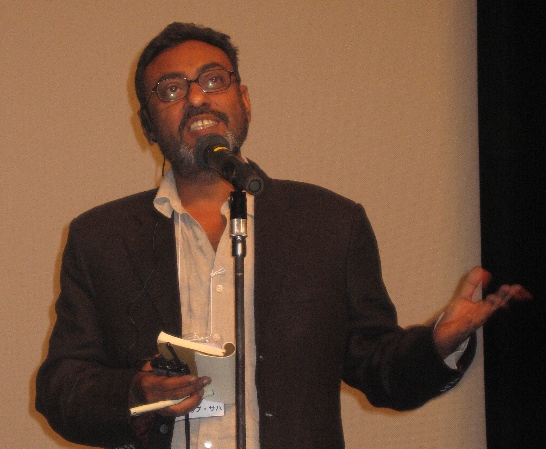
According to environmental activist and independent film-maker Pradip Saha, it’s not a question of ignorance, but apathy.

“Our educated middle classes understand what’s happening, but they are also big contributors to the problem – with their frenzy to burn oil and coal. They look for any excuses for not acting on this issue,” Pradip said during a recent regional workshop in Tokyo, Japan.

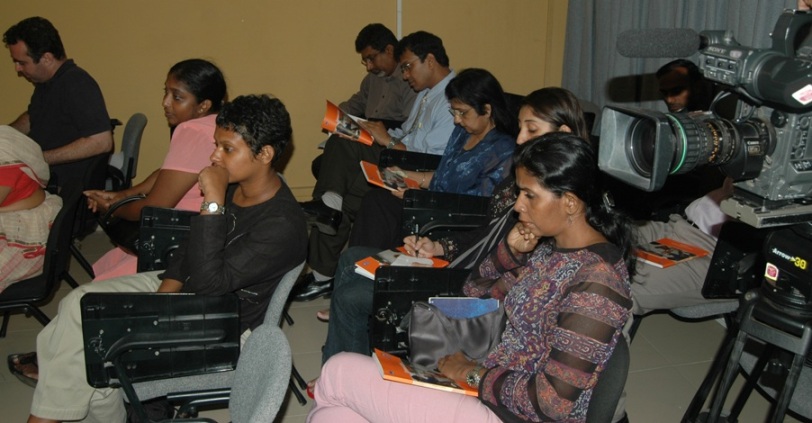
The Asia Pacific workshop on ‘Changing Climate and Moving Images’, held in Tama New Town, Tokyo, was organised by TVE Japan in collaboration with TVE Asia Pacific and supported by Japan Fund for Global Environment.

Pradip, associate director of the Centre for Science and Environment – a leading research and advocacy organisation – has been tracking climate change issues for two decades. He sees this Big Issue in three ways: science of climate change, politics of climate change and feelings of climate change.

To fully understand how the complex Indian society perceives and responds to the climate crisis, all three dimensions need to be studied, he says. And particular attention must be paid to the plight of those who are already experiencing changes in their local climate.

From the Himalayan mountains to the small islands in the Bay of Bengal, millions of Indians are living and coping with climate change. “Large sections of our poor feel it, and are among the worse impacted.”

Many such affected people may never have heard of climate change. They are bewildered by rapid changes in rainfall, river flows, sunshine and other natural phenomena.

Pradip drew an example from the Sundarban delta region in the Bay of Bengal. With 10,000 square kilometres of estuarine mangrove forest and 102 islands, it is the world’s largest delta. Here, some islands are slowly being eroded and submerged by rising sea levels. Three small islands have already gone underwater. Others are experiencing problems of salt water intrusion, posing major difficulties for the local people.

Sundarban delta as seen from space

Analysis of surface data near Sagar island in the Sundarbans reveals a temperature increase of 0.9 degree celsius per year. Experts are of the opinion that this is one of the first regions bearing the brunt of climate change.

But the islanders – like most other poor people in India – don’t have enough or any voice to express their concerns to the policy makers, civil society groups and captains of industry. For these members of the middle class, the Sundarbans mean just one thing: the Royal Bengal Tiger.

And most of them probably have never heard of Sagar island. They might just shrug it off, saying: It’s Not In My Backyard (NIMBY).

During the past few months, Pradip has been filming on these islands trying to capture the unfolding human and environmental crisis. He was inspired by an investigative story that appeared in early 2008 in the Down to Earth science and environmental magazine where he is managing editor.

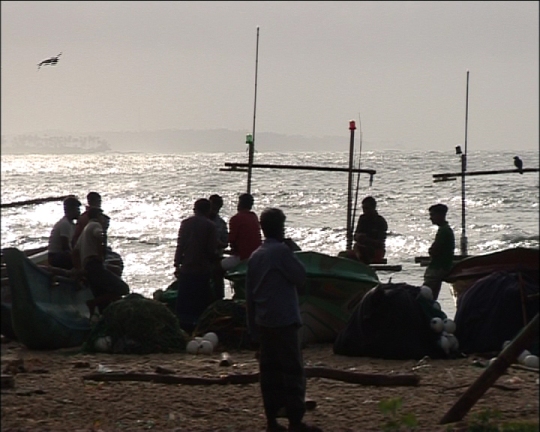
Pradip screened the 64-minute long film, aptly titled Mean Sea Level, at our workshop. The few of us thus became the first outsiders to see the film which I found both deeply moving and very ironic. With minimal narration, he allows the local people to tell their own story. There’s only one expert who quickly explains just what is going on in this particularly weather-prone part of the world.

Confronted with middle class apathy and indifference, activists and journalists like Pradip Saha face an uphill task. “Knowledge is not turning into action because those who know (about climate change causes and responses) are also the biggest culprits,” he says.

To make matters worse, government policies are not formulated with adequate public consultations. Sections of central and state governments in India have also started responding to individual effects of climate change without understanding the bigger picture. Such piecemeal solutions can do more harm than good.

Then there is India’s obsession with motor cars – a topic on which Pradip has already made a short film.

Pradip’s views on climate change activism in India resonates with those of the Filipino academic-activist Walden Bello. Speaking at the Greenaccord international media forum in Rome in November 2007, he called for a mass movement at the grassroots across the developing countries of the global South to deal with climate change – the biggest environmental threat faced by the planet today.

As I quoted him saying, such a movement might be unpopular not only with the Southern elite but also with sections of the urban-based middle class sectors that have been the main beneficiaries of the high-growth economic strategy that has been pursued since the early 1990s.
Read my April 2007 post: Fossil Fools in India

Sleeping easy along the shore: Going the Last Mile with hazard warnings

creating-disaster-resilience-everywhere.jpg

October 8 is the International Day for Disaster Reduction. The United Nations system observes the day ‘to raise the profile of disaster risk reduction, and encourage every citizen and government to take part in building more resilient communities and nations’.

Disaster risk reduction (abbreviated as DRR) is the common term for many and varied techniques that focus on preventing or minimising the effects of disasters. DRR measures either seek to reduce the likelihood of a disaster occurring, or strengthen the people’s ability to respond to it.

DRR is not just another lofty piece of developmentspeak. Unlike many other development measures that are full of cold statistics and/or hot air, this one directly (and quietly) saves lives, jobs and properties.

And it gives people peace of mind – we can’t put a value on that. That was the point I made in a blog post written in December 2007, on the third anniversary of the Indian Ocean Tsunami. Taking the personal example of J A Malani, an ordinary Sri Lankan woman living in Hambantota, on the island’s southern coast, I talked about how she has found peace of mind from a DRR initiative.

‘Evaluating Last Mile Hazard Information Dissemination Project’ (HazInfo project for short) was an action research project by LIRNEasia to find out how communication technology and training can be used to safeguard grassroots communities from disasters. It involved Sarvodaya, Sri Lanka’s largest development organisation, and several other partners including my own TVE Asia Pacific. It was supported by International Development Research Center (IDRC) of Canada.

Recently, IDRC’s inhouse series ‘Research that Matters’ has published an article about the project. Titled “For Easy Sleep Along the Shore: Making Hazard Warnings More Effective” its blurb reads: “In Sri Lanka, a grassroots pilot study combines advanced communication technologies with local volunteer networks to alert coastal villages to danger coming from the sea.”

The article has adapted a lot of the information and quotes I originally compiled for a project introductory note in April 2006.

The outcome of the project’s first phase, which ended in mid 2007, is well documented. My own reflective essay on this project is included as a chapter in our book Communicating Disasters: An Asia Pacific Resource Book, published by TVE Asia Pacific and UNDP in December 2007.

TVE Asia Pacific also made a short video film in late 2007. Called The Long Last Mile , it can be viewed on YouTube in two parts:

The Long Last Mile, part 1 of 2:

The Long Last Mile, part 2 of 2:

The recent IDRC article ends with this para: “A related challenge concerns the shortness of any society’s attention span. In the absence of frequent crises and alerts, how can a nation — or even a village — sustain the continuing levels of preparedness essential to ensure that, when the next big wave comes rolling in and the sirens sound, its people will have the motivation and the capacity to act? The follow-up project seeks to address this worry by preparing the hotels and villages to respond to different types of hazards, rather than only to the relatively rare tsunamis.”

Watch this space.

Download pdf of IDRC’s Research That Matters profile on Last Mile Hazard Warning Project

Warning: Is climate change the new HIV of our times?

From www.sprattiart.com
From http://www.sprattiart.com


Is climate change the new HIV of our times?

I asked this question when addressing a group of television journalists and film-makers from the Asia Pacific last week. I was making introductory remarks to an Asia Pacific Workshop and Open Film Screening on ‘Changing Climate and Moving Pictures‘ held on 3 – 4 October 2008 in Tokyo, Japan. It was organised by TVE Japan in collaboration with TVE Asia Pacific, and supported by the Japan Fund for Global Environment.

I acknowledged that climate change was not just another environmental issue or even the latest planetary scare. “This time we’re in deep trouble – and still finding out how deep,” I said.

Climate change has brought into sharp focus the crisis in:
• how we grow economically;
• how we share natural resources and energy; and
• how we relate to each other in different parts of the world.

In that sense, I noted, climate change is acting like a prism — helping to split our worldly experience into individual issues, concerns and problems that combine to create it. Just like an ordinary prism splits sunlight into the seven colours (of the rainbow) that it’s made of.

“Climate shows up the enormous development disparities within our individual societies and also between them. When this happens, we realise that climate is not just a scientific or environmental problem, but one that also has social, political, security, ethical and human rights dimensions,” I added.

Climate change in an uneven world

I then outlined some parallels between the current climate crisis and the HIV/AIDS pandemic that emerged some 25 years ago.

Consider these similarities:
• When HIV was first detected, it was considered a medical issue affecting specific sections of society.
• It took years for the wider societal, development and human rights aspects of HIV to be understood and then accepted.
• Some countries and cultures wasted precious years in HIV denial; a few are still in this mode.
• It took overwhelming impact evidence and mounting pressure from affected persons for states and international community to respond.
• Then…everybody jumped the bandwagon and HIV became a fundable, profitable enterprise.

I have been commenting in this blog about this ugly side of HIV/AIDS in my own country Sri Lanka, where some NGOs and charities have turned HIV activism into a self-serving, lucrative industry. There are fierce ‘turf wars’ to claim persons living with HIV as their institutional ‘property’. Some have appropriated HIV as their own virus, and would rather not allow others to work in this area.

And it’s not just NGOs who are riding the HIV gravy train. The United Nations programme for AIDS, or UNAIDS, created by the UN system in response to the global crisis, has evolved into a behemoth whose efficacy and relevance are now being widely questioned.

UNAIDS “is obsolete and an obstacle to improving healthcare in developing countries” claims Roger England, an international health expert. Writing in the British Medical Journal in May 2008, England pointed out that HIV causes 3.7 per cent of mortality and kills fewer people than pneumonia or diabetes, yet it received 25 per cent of all international healthcare aid and a big chunk of domestic expenditure. This has resulted in wasting vast sums of funding on esoteric disciplines instead of beefing up public health capacity. Despite this criticism, UNAIDS is calling for huge increases in its funding — from its current US$9 billion to US$54 billion by 2015.

All this makes me wonder: is climate the new HIV of our times? This is the question I raised in Tokyo.

I added: “If so, I sincerely hope it does not evolve in the same manner that HIV crisis did. There are worrying signs that the drive towards a low carbon economy is being exploited by various groups – including some in civil society – for self gain.”

Certain development agencies and ‘think tanks’ are clearly exploiting climate change to make money. Suddenly, everybody is ‘climate-proofing’ their activities — meaning they are talking about climate change no matter what they do, whether it is teacher training or micro-credit.

In the run up to the Bali climate conference in late 2007, I wrote a blog post titled ‘Beware of bad weather friends’ about a London-based NGO engaging in some media training on climate issues, but deriving its legitimacy from a dubious survey. This post apparently irked the party concerned a great deal.

In Tokyo, a workshop participant confirmed that this was already happening in his country.

“Every crisis today is being turned into a business opportunity – and not just by the corporate sector,” said Pradip Saha, associate director of the Centre for Science and Environment in India.

He added: “Consultancy companies and some NGOs have realised there is big money to be made in climate related areas like carbon offsets and the Clean Development Mechanism. They are already riding the climate bandwagon!”.

Read the full text of my introductory remarks to the Tokyo workshop.changing-climate-moving-images-nalaka-gunawardene-intro-3-oct-2008

Financial Meltdown: Putting pieces together of a gigantic whodunnit

this says it all...
My cartoon of the year: this says it all...

This cartoon by Pulitzer prize winning Tom Toles first appeared in the Washington Post in 2007 – it brilliantly anticipated the global financial meltdown that we’re now experiencing. Coming in the wake of confirmed global warming, it is a double whammy.

America has been hit hard by the sub-prime crisis. The social and human cost of financial failure has been enormous. An epidemic of home repossessions has left thousands of houses abandoned and boarded-up: whole suburbs are falling into disrepair and dereliction.

Financial institutions in America and in Britain had poured billions into investments backed by these mortgages. As more and more people have defaulted on their mortgage repayments, financial markets have collapsed, causing a crisis that has rippled across the Atlantic, sending the City of London into turmoil and pulling the plug on one now infamous British bank.

Some call it a financial tsunami not been seen since the Great Depression in the 1930s….a crisis that has forced the US government to step in and save the financial system after trillions were wiped off global stock markets and once revered institutions were swept off the face of Wall Street. Is the US intervention too little, too late to save the economy?

In fact, just a few days ago, the People’s Daily of China warned that a “financial tsunami” was approaching, which recalled the Great Depression in the US. It said: “As the contemporary economy has been integrated globally, American consumption and currency exchange rates will directly influence countries dependent on the US as the main export destination for economic growth and employment”.

The Chinese Communist Party organ complained that the US had unleashed financial “weapons of mass destruction” on the world economy in the form of subprime debts and related financial derivatives.

The world’s media have been scrambling to cover these rapidly unfolding events. In fact, many have been caught napping, or worse, been uncritical cheerleaders of the march of capital and credit. Most of them – even the respected financial journals – just didn’t see the crisis building up…or ignored the tell-tale signs that constituted an inconvenient truth.

Danny Schechter - wasnt crying wolf!
Danny Schechter - wasn't crying wolf!
“This didn’t just happen in the course of a usual business cycle,” insists the American investigative journalist and media analyst Danny Schechter, who has been tracking this issues for many months on his influential News Dissector blog and the MediaChannel that watches and critiques the media.

In his new book, aptly titled Plunder, Danny offers an in-depth investigation into the decline of the economy that’s causing millions to lose jobs and face foreclosures and across-the-board price hikes.

He says: “You wouldn’t know it by relying on our media, but the subprime scandal masks massing looting by Wall Street firms using carefully calculated predatory lending schemes enabled by regulators who don’t regulate and a media that looked the other way. We have lost trillions and dislocated millions with no relief in sight. Every American is paying for the greed of our financiers in the grocery store, gas pump and unemployment line. Bank robberies are not new — but banks doing the robbing is.”

Read the introduction to Danny Schechter’s Plunder.

In 2007, his film IN DEBT WE TRUST was the first to expose Wall Street’s connection to subprime loans, predicting the economic crisis that this book investigates.

I have been watching various news media analysis of the current crisis and want to share two that stood out from the rest: Inside Story by Al Jazeera English, and Dispatches by UK’s Channel 4.

In a special show from New York, Inside Story looks at the financial turbulence that rocked the US last week. Will the emergency measures by the US government be enough to stabilise the markets or has the financial system in the US been changed forever? The introductory report from AJE’s Washington correspondent Reynolds is particularly illuminating – he also writes the story for their website.

Inside Story – The US financial crisis – 21 Sep 2008 – Part 1

Inside Story – The US financial crisis – 21 Sep 2008 – Part 2

From the other side of the Atlantic comes a more investigative, one-hour special that was produced and broadcast in March 2008, when the early signs of the banking crisis were beginning to show – for anybody who cared to notice.

As Channel 4 introduces it: “This is a story about the destructive power of finance: what happens when banks are driven by short-termism; when bankers are rewarded with vast bonuses, free to operate under inadequate regulatory supervision, and with the complicity of a government too in awe of big business to step in.”

Dispatches: How The Banks Bet Your Money UK & US – part 1

In this edition of Dispatches, private equity financier Jon Moulton delivers a stinging rebuke to the banks for causing this financial meltdown and explains why the British taxpayer will now pay the price.

Dispatches: How The Banks Bet Your Money UK & US – part 2

Dispatches: How The Banks Bet Your Money UK & US – part 3

Dispatches: How The Banks Bet Your Money UK & US – part 4

Dispatches: How The Banks Bet Your Money UK & US – part 5

Free us from our addiction to oil: New PSAs from Al Gore’s climate campaign

In July 2007, we had an interesting discussion on this blog on the shrinking durations of nature and environment films and TV programmes. The moving images community is divided on this, with some purists holding out that to pack complex, nuanced messages into a few minutes is akin to dumbing everything down. Noted film-makers like Neil Curry disagreed.

But there’s no argument of the sheer power of well produced public service announcements (PSAs) to move people with a specific, short message. Nothing can beat them for the economy of time and efficacy of delivery.

During August 2008, Al Gore’s ‘We’ campaign for climate change activism released two new PSAs, both appealing to Americans to change their energy habits, especially their addiction to oil. This follows and promotes the challenge Al Gore posed to America in July 2008 “to commit to producing 100 percent of our electricity from renewable energy and truly clean carbon-free sources within 10 years”.

Make the Switch, Repower America

Real change can happen real fast. We can strengthen our economy, lower fuel costs, free ourselves from our addiction to oil, and help solve the climate crisis. We can do this by switching to clean, free energy sources like the wind and sun — and to do it within 10 years. Meeting this ambitious goal would create millions of new jobs, lead to permanently lower energy costs for families and help America lead the fight against global warming. William H. Macy narrates in this ad which premiered on network TV in the US during the 2008 Beijing Olympics coverage.

To Our Leaders: Give Us 100% Clean Electricity in 10 Years

We must save our economy, lower fuel costs, free ourselves from our addiction to oil, and solve the climate crisis. To do this, we must demand that we Repower America with 100% clean electricity within 10 years.

The We Campaign is a project of The Alliance for Climate Protection — a nonprofit, nonpartisan effort founded by Nobel laureate former Vice President Al Gore. Its ultimate aim is to halt global warming

Wanted: Development 2.0 to catch up with web 2.0!

i4d magazine August 2008 issue

Did anybody hear of the senior UN official who finally started blogging? He wrote perceptively and expressively – with some help from his speech writers – but a vital element was missing in his blog: no one could comment on his posts as he completely disabled that function.

Then there is the Red Cross chief who started her own Facebook account but remained completely ‘friendless’ for months – because she didn’t accept anyone seeking to join her social networking effort!

These are just two among many examples I have come across in recent months. They are all symptoms of a major challenge that development and humanitarian communities are grappling with: how to engage the latest wave of Information and Communication Technologies, or ICTs.

With these words, I open my latest essay, titled “Wanted: Development 2.0 to catch up with web 2.0” in the August 2008 issue of i4d magazine, published from New Delhi, India.

My thrust is something regular readers of this blog would be familiar with. In fact, in this essay I consolidate and expand on ideas that were initially discussed in various blog posts over the past many months.

The new wave of Internet, collectively known as Web 2.0, opens up new opportunities for us in the development and humanitarian communities to reach out and engage millions of people – especially the youth who make up the majority in most developing countries of Asia. But it also challenges us as never before.

This time around, it’s much more demanding than simply engaging the original web. It involves crossing what I call the ‘Other Digital Divide‘, one that separates (most members of) the development community from ‘Digital Natives‘- younger people who have grown up taking the digital media and tools completely for granted.

I have identified four key challenges involved in crossing the Other Digital Divide:
– Leave the comfort zone of paper
– Let go of control
– Invest less money but more time
– Recognise information needs and wants

I argue: “There are no authorities on this fast-changing subject: everyone is learning, some faster than others. Neither is there a road map to the new media world. From Rupert Murdoch and Steve Jobs downwards, every media mogul is working on this challenge. For those who get it right, there is potential to make corporate fortunes, and also to serve the public interest in innovative, effective ways.

I end the essay with a challenge to the development community: “To face challenges of web 2.0, we need to come up with development 2.0!”

Read the full essay on i4d magazine website

Lakshani: A child of the sea travels beyond the seas…

Lakshani photo by TVEAP

Our teacher said our country is small and is surrounded by the sea….she showed it on the globe.”

With these words, young Lakshani Fernando (photo, above) begins telling us the compact story of her short life.

Lakshani, 9, has lived by the sea (Indian Ocean) from the time she was born. When she was just six, the Asian Tsunami of December 2004 destroyed their beachfront house in Koralawella, Moratuwa, on Sri Lanka’s western coast. More than three years later, when my colleague Buddhini Ekanayake met Lakshani in March 2008, the family was still struggling to raise their heads from that massive blow.

A day in Lakshani’s life is the story of a short, 3-minute film that Buddhini produced for TVE Asia Pacific a few weeks ago. It’s part of an Asian and African television co-production project that is about, for and by children.

In the film, Lakshani shares the highlights of a typical day. That includes going for a walk on the polluted beach with her fisherman father, spending a few hours at the nearby school and playing with neighbourhood children. While at it, she tells us her wishes for a cleaner beach and a better neighbourhood.

Buddhini called Lakshani a ‘Child of the Sea’. Even the cruel waves of the tsunami didn’t scare Lakshani away for too long.

I love to play with waves…” Lakshani says towards the end of the film. Then she looks far out at the horizon, and talks again. “There are ships far out at sea. That’s all there is…

She might not yet imagine lands beyond ships and waves, but last week, her story travelled across the seas. Over 500 broadcast media managers, journalists and researchers from around the world, who’d gathered in Kuala Lumpur, Malaysia, for Asia Media Summit 2008, had a glimpse of Lakshani when the first 90 seconds of the film was screened during plenary.

Elizabeth Smith, secretary general of the Commonwealth Broadcasting Association (CBA), chose an extract from Lakshani’s story to introduce the media initiative. Sitting in the audience, I immediately texted the news to Buddhini.

Watch “I am A Child of the Sea”:

This film forms part of a series that has 20 TV producers from 13 countries engaging in a co-production of a short programmes series (mini documentaries) about and for children. The series is the outcome of a regional project organised by the Asia Pacific Institute for Broadcasting Development (AIBD) in collaboration with the French Ministry of Foreign affairs, the Commonwealth Broadcasting Association (CBA), Thomson Foundation, Prix Jeunesse, Children and Broadcasting Foundation for Africa and RTM-IPTAR of Malaysia.

The project tries to capture cultural diversity through the eyes of children. When its concept first reached us, it was defined very narrowly in terms of ethnicity and/or religion. TVE Asia Pacific being a strictly secular organisation, we couldn’t fit into such a tight range. Besides, we realised that many modern day children have a self identity that goes above and beyond the race and religion that blind chance of birth assigned to them.

So we took an editorial decision: instead of doing a story that highlights factors that utterly and bitterly divide humanity (such as race and religion, both of which fuel the long-drawn war in Sri Lanka), we would look for a unifying factor. The tsunami’s killer waves, when they rolled in, didn’t care for our petty human divisions. For a few days and weeks following the tragedy, Sri Lanka was united in shock and grief in a manner I have never seen in my 42 years of living here. (Then we went back to killing each other again.)

The result of our search was Lakshani and her story captured in ‘I am a Child of the Sea’.

Buddhini chose to feature Lakshani after interviewing 10 children from different localities and a diversity of cultural backgrounds. (Never once did she ask for the child’s religion, which unlike ethnicity is not always apparent from the name.) There was some significance in featuring a child who identifies herself closely with the Sea in a country where tens of thousands of tsunami-affected people have still not come to terms with the sea. Even after the tsunami destroyed their home, Lakshani’s family moved to a ‘temporary’ shelter within sight of the sea. Thus, her story had a close association with the sea which formed part of her lifestyle, environment and culture.

Buddhini developed the script after several leisurely chats with Lakshani, based partly on the child’s own writing about herself. Filming the story took place in early March 2008, with the full consent of her parents, extended family and neighbours. Read more about the making of this film on TVEAP website and on Buddhini’s own blog.

TVEAP crew filming Lakshani's story

Lakshani’s story is symbolic at another level. It reveals how, despite receiving a massive outpouring of donations from all over the world, some tsunami-affected families are still struggling to put together their shattered lives. The litany of woes, missed opportunities and sometimes outright plundering of donations came out strongly in the first hand accounts of affected people (in India, Indonesia, Sri Lanka and Thailand) who spoke to us during the Children of Tsunami media project. Read our reflections on the project in Communicating Disasters book published in 2007.

Lakshani’s family is not typical of Sri Lanka’s tsunami affected persons. Unlike most such families, the Fernandos live on the western coast, relatively close to Colombo. Although wave action destroyed or damaged beachfront homes in these areas, most attention was focused on areas in the south, east and north of the island that were hit much harder. So those affected and living on the west coast have often been overlooked or dismissed lightly. In this sense, Lakshani’s family has some parallels with what I called ‘step-children of tsunami’.

There is a bit more cheerful post-script to this story. During several visits to Lakshani and family for researching, filming and editing this film, Buddhini (who has a daughter aged four herself) bonded with the girl. It became more than a mere film-making venture, and has led to a lasting relationship. Meanwhile, young voice artiste Shanya Fernando, who rendered Lakshani’s Sinhala voice into English for an international audience, has also felt an attachment to the ‘star’ of our film.

While the film was made with the informed consent of Lakshani’s family who received no material benefits for their participation, both Buddhini and Shanya have since presented some basic educational gifts to Lakshani — who is certainly in need of such help. And who am I to stand in the way of such gestures of human kindness?

Producer BUddhini with Lakshani

Photos by Amal Samaraweera, TVE Asia Pacific

Amitav Ghosh on Cyclone Nargis: High tech alone can’t save us!

Whenever Burma hits the international news headlines, I think of author Amitav Ghosh. His 2002 historical novel, The Glass Palace, was my introduction to Burma’s recent history. It describes – with historical accuracy and detail – how the British colonised a land of prosperity in 1824 and left it an impoverished nation in 1948.

I was intrigued, therefore, to read an excellent op ed essay by Amitav Ghosh in The New York Times of 10 May 2008. Titled When Death Comes Ashore, it is a commentary on the aftermath of Cyclone Nargis that particularly hit Burma in recent days. Ghosh offers both comfort and worry.

The bad news, as he puts it, is that “for the rapidly growing countries that surround the Bay of Bengal there is an increasing urgency to find a way to protect themselves. They have experienced some of the world’s most devastating storms.”

Courtesy Wikipedia

He makes a strong call for cooperation among the countries who surround the Bay of Bengal, which means Bangladesh, Burma, India, (part of) Indonesia and Thailand.

As he says: “Nation-states tend to see their interests as being confined within their own borders. But the reality is that the people who live around the Bay of Bengal have a vital interest in common that they do not share with their compatriots in the hinterlands: they are joined by the furies (and let it be said also, the blessings) of that body of water.”

To me, the most important point he makes is about disaster preparedness, a topic we covered in some depth and detail in Communicating Disasters: An Asia Pacific Resource Book that I co-edited last year.

“Recent experience has demonstrated in spectacular ways that rich, technologically advanced nations are not invulnerable to extreme weather. What has also been demonstrated, but more quietly, is that a nation need not be wealthy or technologically advanced to be well prepared for natural disasters.”

Ghosh talks about Mauritius, a small Indian Ocean island that meteorologists call a ‘cyclone factory’, which has “evolved a sophisticated system of precautions, combining a network of cyclone shelters with education (including regular drills), a good early warning system and mandatory closings of businesses and schools when a storm threatens.

He adds: Mauritius is a country that has learned, through trial and experience, that early warnings are not enough — preparation also demands public education and political will. In an age when extreme weather events are clearly increasing in frequency, the world would do well to learn from it.”

Let’s hope the Indian Ocean rim countries – especially those that share the Bay of Bengal’s blessings and lashings – would heed the celebrated Indian author’s call. After the 2004 tsunami, we saw a flurry of activity to set up high-tech and high cost early warning systems for future tsunamis. The United Nations and development donors huddled together in various exotic locations of our region to work out the details.

But I wrote in a SciDev.Net opinion piece in December 2005: “Setting up a state-of-the-art, high tech and high cost system is not a solution by itself. Because the most advanced early warning system in the world can only do half the job: alert governments and other centres of power (e.g. military) of an impending disaster. The far bigger challenge is to disseminate that warning to large numbers of people spread across vast areas in the shortest possible time“.

I called it the Long Last Mile (sorry, metric fans, it just doesn’t read right to say the last kilometre!), a phrase that I also used in the book chapter and the short film that I scripted for TVE Asia Pacific in 2007.

LIRNEasia’s National early warning system for Sri Lanka

LIRNEasia’s 2006-2007 project to Evaluate the Last Mile Hazard Information Dissemination

Read the full essay: Death Comes Ashore, By AMITAV GHOSH, in The New York Times, 10 May 2008
(requires free registration to read online)

Burmese television: Meet Asia’s model public broadcaster!

Photo courtesy Associated Press

In the wake of Cyclone Nargis that wreaked havoc in Burma, the world has once again realised the brutality and ruthlessness of the military regime that runs the country.

And as the United Nations and aid agencies struggle with the incredibly uncaring Burmese bureaucracy to get much needed emergency relief for the affected Burmese people, the media outside Burma are having great difficulty accessing authentic information and images.

Despite the massive disaster and resulting tragedy, Burma remains closed to foreign journalists, especially the visual media. No doubt the memories of the monk-led pro-democracy protests of late 2007 are still fresh in the minds of the ruling junta and their propagandists. The few courageous foreign reporters who managed to get in at the time ran enormous personal risks, and Japanese photojournalist Kenji Nagai was shot dead by a Burmese soldier while filming demonstrations.

Unable to report from the multiple scenes of disaster, and lacking a wide choice of reliable local sources willing to go on the record, international news agencies and broadcasters have been forced to quote the government-owned Burmese television station, MRTV.

Global news leaders like Al Jazeera, BBC and CNN have all used MRTV visuals to illustrate their news and current affairs reportage. A recent example from Al Jazeera, posted on 8 May 2008:

The image monopoly by MRTV wouldn’t have mattered so much if they at least provided an accurate account of the unfolding events in its own country. But that seems far too much to expect of this mouthpiece of the Rangoon regime. In Burma’s darkest hour in recent memory, MRTV would much rather peddle the official propaganda – never mind the millions made homeless by the recent disaster.

Here’s an insight from the Inter Press Service, the majority world’s own news agency, reporting from their Asia Pacific headquarters in Bangkok, Thailand:

BURMA: Cyclone Nargis Exposes Junta’s Anti-People Attitude
By Larry Jagan, IPS

Worse, there is evidence emerging that the military authorities had ample warning of a storm brewing in the Bay of Bengal but chose to ignore, or even suppress, it.

The Indian Meteorological Department (IMD) which keeps a close track of geo-climatic events in the Bay of Bengal and releases warnings not only to provinces on the Indian east coast but also to vulnerable littoral countries said it warned Burmese authorities of Cyclone Nargis’ formation and possible approach as early as on Apr. 26.

“We continuously updated authorities in Myanmar (as Burma is officially called) and on Apr. 30 we even provided them a details of the likely route, speed and locations of landfall,’’ IMD director B.P. Yadav told IPS correspondent in New Delhi, Ranjit Devraj.

Burma’s meteorology department did post a warning on its official website on Apr. 27 but no effort was made to disseminate information to the people, much less to carry out evacuations along the coastline or from the islands on the Irrawaddy Delta.

By the time state-run media, which has been continuously spewing propaganda and exhorting the public to vote ‘yes’ to Saturday’s constitution referendum, issued its first cyclone alert on Friday afternoon it was too late for the hapless residents of Rangoon.

courtesy Reuters

Elsewhere in the report, IPS says:

Pictures of soldiers removing fallen trees and clearing roads in Rangoon on the state-run television have further infuriated many in the city. “This is pure propaganda and it’s far from the truth,” e-mailed a Burmese journalist, asking not to be identified for fear of the consequences. “Why do foreign broadcasters show them too –Burmese government propaganda is a disgrace enough to journalism,” he fumed.

“I saw some soldiers getting onto a truck yesterday,” said a 50-year-old resident. “They had no sweat on their shirts, despite what was shown on TV!”

“My wife saw three truckloads of soldiers parked in front of a fallen tree, none of them got down to remove it,” he added.

And here is what Dinyar Godrej has to say on the website of New Internationalist, another pro-South, liberal media outlet. In a post titled ‘Seeing but not believing’, he says:

“Burma is shut off from foreign journalists (unless they are invited in by the military regime to cover specific showpiece events). Western news channels have had to rely on state run television for their moving images.

“So while the death toll is now officially 22,000 (unofficially up to 50,000), with 40,000 people missing and a million homeless; and while the regime is coming in for bitter criticism for its foot-dragging over opening up to international aid and the utter incompetence of its own relief effort so far (which has reached only a tiny fraction of the people affected), we are watching on our television screens soldiers handing over food parcels. We can see nothing of the grief or rage of the people going hungry and thirsty (many water sources are too contaminated to use). They do not talk on camera. Instead they sit obediently in the state TV images, taking what’s given to them. And we watch them, while listening to the numbers and being told of the heightening crisis.”

Appalling as these revelations are, they don’t surprise us. Indeed, MRTV is not alone in this kind of shameless abuse and prostitution of the airwaves, a common property resource. A vast majority of the so-called ‘public’ broadcasters in Asia behave in exactly the same callous manner. This is why I don’t use the term ‘public broadcaster’ to describe these government propaganda channels – because, whatever lofty ideals their founding documents might have, most of them are not serving the public interest any more (if they ever did).

As I commented in Feb 2008: “In developing Asia, which lacks sufficient checks and balances to ensure independence of state broadcasters, the only thing public about such channels is that they are often a drain on public money collected through taxes. Their service and loyalties are entirely to whichever political party, coalition or military dictator in government. When the divide between governments and the public interest is growing, most ‘public’ channels find themselves on the wrong side. No wonder, then, that discerning views have abandoned them.”

Read Feb 2008 post: Why do development Rip van Winkles prefer ‘Aunties’ without eyeballs?

I don’t hold a grudge against the hapless staff of MRTV, who simply must remain their Masters’ Voice at all times to stay alive. Those working for government channels in countries with greater levels of democratic freedom can’t take refuge in this excuse. They must be held accountable for their continuing propagandising and the disgusting pollution of the airwaves.

And the incredibly naive and sycophantic UN agencies – especially UNESCO – also share the blame for their feeble yet persistent defence of the so-called public broadcasters. Years ago, I stopped attending meetings discussing public service broadcasting (PSB) in Asia, which these agencies equate with what the government channels are doing. I see yet another of these exercises in futility being lined up as part of the Asia Media Summit 2008 coming up in a few days in Kuala Lumpor.

As I wrote in February, if these development agencies are seriously interested in broadcasting that serves the public interest, they must engage the privately-owned, commercially operated TV channels, which are the market leaders in much of Asia.

Except, that is, in tightly controlled, closed societies like Burma, where government channels are the only terrestrial TV available for the local people.

Images courtesy AP and Reuters, as published by The New York Times online

Communicating Disasters book launched among communicators

TVE Asia Pacific’s latest publication, Communicating Disasters: An Asia Pacific Resource Book, had its Sri Lankan launch on 19 February 2008.

The multi-author book focusing on how information, education and communication can help create disaster resilient communities across the Asia Pacific was released at the auditorium of Sri Lanka Press Institute (SLPI) in Colombo.

We had invited all contributing authors who are based in Sri Lanka. Six of our 21 contributors currently live in Greater Colombo, and four of them made it: Patrick Fuller, Buddhi Weerasinghe, Manori Wijesekera and myself. We missed Sanjana Hattotuwa (who is overseas) and Chanuka Wattegama.

The news story on the launch event can be read on TVEAP website.

Here are some additional photographs of the event, attended by close to 50 persons working in media, communication and humanitarian sectors.

copy-of-communicating-disaster-book-launch25.jpg

Above and below: Nalaka Gunawardene introduces the what, why and how of the new book

communicating-disaster-book-launch.jpg

copy-of-communicating-disaster-book-launch48.jpg

Contributing authors (L to R) Patrick Fuller, Nalaka Gunawardene, Buddhi Weerasinghe and Manori Wijesekera talk about their chapters in the book.

communicating-disaster-book-launch-buddhi-weerasinghe-speaks.jpg

Buddhi Weerasinghe responds to an audience question

manori-wijesekera.jpg

Above: Manori Wijesekera talks about Children of Tsunami

copy-of-communicating-disaster-book-launch58.jpg

Above and below: Sections of the audience

communicating-disaster-book-launch96.jpg

Photos courtesy: Indika Wanniarachchi and Wipula Dahanayake, TVE Asia Pacific