Message placement: Gates Foundation discovers TV soaps are good for health!

There's still time for TV to redeem itself...
In the developing (or majority) world, we have been doing it for years: embedding subtle messages on health, environment, family planning or civic behaviour in popular, highly-rated entertainment shows on television.

In parts of Asia, Africa and Latin America, there is a long history of collaboration among non-formal educators, advocacy groups and broadcast companies to mix entertainment with public education — a difficult balance to achieve without putting off viewers who tune in for entertainment. See, for example, my coverage of the BBC World Service Trust’s work in India.

Now, it seems, this ‘edu-tainment‘ approach is also being tried out seriously in the home of ‘soap operas’ or television drama: the United States.

A recent report in the New York Times describes how the Bill and Melinda Gates Foundation is working with video production companies and broadcast networks to shape story lines and insert health-related messages into popular entertainment like the television shows “ER,” “Law & Order: SVU” and “Private Practice.”

Already, the foundation’s messages on HIV prevention, surgical safety and the spread of infectious diseases have found their way into these shows.

The report, written by Tim Arango and Brian Stelter, said: “Now the Gates Foundation is set to expand its involvement and spend more money on influencing popular culture through a deal with Viacom, the parent company of MTV and its sister networks VH1, Nickelodeon and BET.”

They called it “message placement”: the social or philanthropic corollary to product placement deals in which marketers pay to feature products in shows and movies. Instead of selling Coca-Cola or G.M. cars, they promote education and healthy living.

Some viewers in television-saturated US might say: it’s about time! In the past, many American companies producing entertainment content have resisted approaches from social activists to use the mass medium for public good.

In the late 1980s, when I shared some Asian experiences of mixing television drama and public education at an international science communication conference in Spain, American academics and journalists in the audience were intrigued. “But this can never happen in the United States…we keep our education and entertainment separate, and with good reason!” one of them said during question time.

Clearly, those hard attitudes have been changing slowly. As the NYT article says: “The efforts of philanthropies to influence entertainment programming is not new…. The Kaiser Family Foundation, which focuses on health issues, has been doing such work for a dozen years. It has worked story lines about H.I.V. and AIDS into programs on CBS and UPN (now known as the CWnetwork), including the reality show “America’s Next Top Model.”
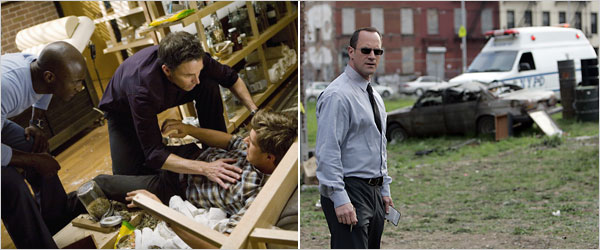
Left, ABC’s “Private Practice,” and NBC’s “Law & Order: SVU.” The story lines of both shows have spread the health-related messages of the Gates Foundation. Images courtesy ABC & NBC

The Norman Lear Center at the University of Southern California’s Annenberg School for Communication is at the forefront of blending entertainment with public education. “There’s a lot of research that shows that when a character in a series says, ‘I’m going to be an organ donor,’ it’s effective, more effective than giving out a pamphlet,” said Martin Kaplan, director of the Centre.

The Centre has a Hollywood, Health & Society programme that provides entertainment industry professionals with accurate and timely information for health storylines. It organises meetings between health specialists and script writers for entertainment shows – not just drama, but also reality and variety shows.

“Our view is you don’t have to sacrifice entertainment value to be accurate,” Kaplan is quoted as saying in the NYT article.

That’s a view – and experience – shared by TV writers, producers and programme managers from Mexico to South Africa, and from India to the Philippines. In fact, this is an approach the Gates Foundation should consider rolling out in the majority world countries where they are already a key player in selected areas of health and development. Despite the recent spread of broadband internet, broadcast television is still the dominant mass medium – and primary source of news and entertainment – for most people in much of the developing world. That’s billions of eyeballs we’re talking about – and the cost of producing quality entertainment (even with education subtly embedded in some places) is significantly less than in the west.

In short, Gates can get a bigger bang for its bucks on the airwaves in the global South. And there’s really no need to convince TV industry gate-keepers and producers on how edu-tainment works: they’ve been at it for years, using whatever resources they can find.

Read full article: Messages With a Mission, Embedded in TV Shows, NYT 2 April 2009
Mekong: A river to watch as climate change impacts Asia’s water tower

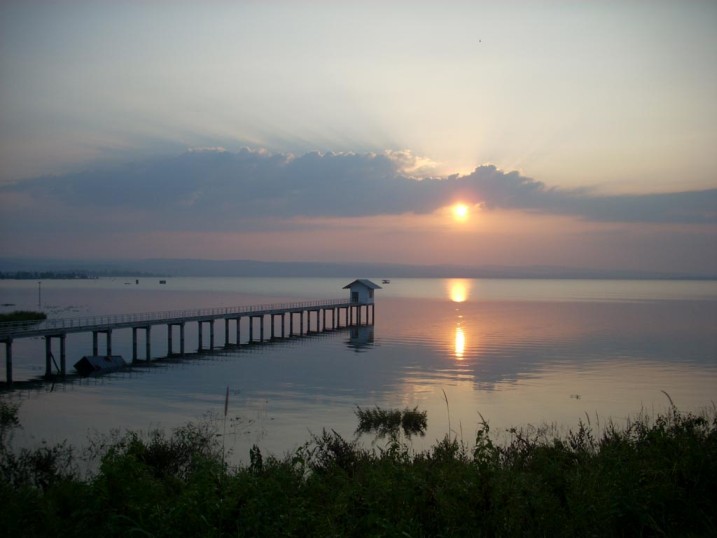
Calm now, turbulent tomorrow? View of Upper Mun Reservoir on the Mekong in northern Thailand: image courtesy TVE Asia Pacific
The Greater Himalaya region is known as the water tower of Asia: the continent’s nine largest rivers emerging from its ice-capped mountains provide 1.5 billion people with water and 3 billion people with their food and power.

With more ice stored here than anywhere outside the Arctic and Antarctic, the region has even been called the earth’s third pole. But the ice fields of the Himalayas are melting, and at a faster pace than anywhere else on the planet.

A river that is going to be affected is the Mekong – one of Asia’s major rivers, and the twelfth longest in the world. TVE Asia Pacific has just produced a short film looking at how current and anticipated environmental changes could impact water users in the six countries of Southeast Asia which share its waters. We released it online this week, just in time for World Water Day 2009, March 22.

Mekong: Watch that River!

Along its journey of nearly 5,000 kilometres (3,000 miles), the Mekong nurtures a great deal of life in its waters – and in the wetlands, forests, towns and villages along its path. Starting in the Tibetan highlands, it flows through China’s Yunan province, and then across Myanmar, Thailand, Laos and Cambodia…before entering the sea from southern Vietnam.

The Mekong River Basin is the land surrounding all the streams and rivers that flow into it. This covers a vast area roughly the size of France and Germany combined. The basin supports more than 65 million people who share Mekong waters for drinking, farming, fishing and industry. Along the way, the river also generates electricity for South East Asia’s emerging economies.

The Mekong has sustained life for thousands of years. But growing human demands are slowly building up environmental pressures on the river. A new study, commissioned by the UN Environment Programme (UNEP), cautions that climate change could add to this in the coming years.

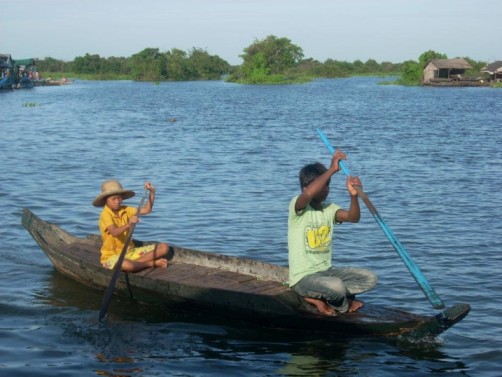
Fishing on the Tonle Sap lake in Cambodia: An 'ecological hot spot' on the Mekong
The study, carried out under a project named “Vulnerability Assessment of Freshwater Resources”, was headed by Dr Mukand Babel at the Asian Institute of Technology (AIT) in Bangkok. It probed how climate change can impact the river from the highlands to the delta….affecting the survival and prosperity of millions.

Dr Babel says on the film: “Climate change would affect…the amount of rainfall which is received. Under climate change conditions, we expect less rainfall to be observed and that would bring less flows in the river which would affect the water users in the downstream areas.”

He adds: “At the same time, the sea level rise which is an associated impact of climate change, would bring more sea water intrusion into the river systems and groundwater systems in the delta in Vietnam.”

Salt water could go upstream by 60 to 70 kilometres, degrading the land and water in the Mekong delta. This would add to pressures already coming from growing human numbers, expanding economies and disappearing forests.

So the Mekong will be affected at both ends, by different processes that are triggered by climate change.

To find out how these changes could affect the Mekong’s millions, my colleagues filmed in two
‘ecological hot spots’ in the river basin identified by the study: the Upper Mun River, a tributary of the Mekong, and the Tonlé Sap lake in Cambodia.

The UNEP-AIT study recommends Mekong river countries to improve how they manage their water and land. This needs better policies, institutions and systems.

Dr. Young-Woo Park, Regional Director, UNEP, says on the film: “Countries sharing the Mekong river…have to act together and they have to develop the policies on how to conserve and how to conserve the Mekong river and also how to properly manage the Mekong river.”

The study found the Mekong river basin ‘moderately vulnerable’ to environmental changes. There aren’t any major water shortages in this river basin as yet. For now, the Mekong is holding up despite many pressures.
But all this can change if less water is flowing down the river and the demand for water keeps growing.

That’s why we named this film ‘Mekong: Watch that River!’

Channel News Asia at 10: Making of a pan-Asian news channel

Asian voice in a global village
“We’re the messenger for all the stories that might not have been told…that’s our job,” says Glenda Chong, the Shanghai-based China correspondent (and former anchor) of Channel NewsAsia (CNA), the Singapore-based Asian regional news broadcaster that just turned 10.

For a decade, CNA has covered Asia for Asians and the rest of the world. It has uncovered stories missed – or ignored – by other, global news channels. Just as important, it has also found the Asian voices and angles in mega stories originating from Asia that gripped the world’s attention — such as the outbreak of SARS, Indian Ocean tsunami, earthquakes in Sichuan and Kashmir.

Started on 1 March 1999 and owned by Singapore’s MediaCorp, CNA is now a major Asian news broadcaster with programmes telecast to more than 20 Asian countries and territories. Visit CNA’s 10th anniversary website for a look back…and forward.

“In the early days, when we talked about a news channel from Singapore, you could cut the cynicism with a knife,” said Woon Tai Ho, managing director of MediaCorp News.

That was inevitable for any media venture anchored in Singapore, ranked currently at 144 out of 173 countries in the World Press Freedom Index. But CNA has shown that geography need not be destiny.

Asians telling their own story
In 10 years, it has emerged as a primary source of news in Asia, and along the way, has picked up a plethora of high-profile awards — including two silver medals at the New York Festivals 2009 and three awards at Asia Television Awards 2008.

Channel News Asia turns 10 – article in Today newspaper, Singapore: 2 March 2009

Started as a business news channel at the tail end of the Asian financial crisis of 1997, CNA later evolved into a fully-fledged news and current affairs channel covering all facets, aspects and territories of Asia – the world’s largest region, home to half of humanity. Map showing CNA geographical coverage

Ironically, CNA enters double-digits chronicling the region once again in the midst of a financial crisis, this time of global proportions and repercussions.

Unlike Al Jazeera English (AJE), the global news channel launched from Qatar in November 2006, CNA has relied on Asian talent for anchoring and reporting. While AJE has shamelessly and desperately tried to ape the BBC, CNA has forged its own identity in offering a world class product.

Whereas AJE tries so hard to please its audiences in Europe and North America (is it so anxious for western acceptance?), CNA has focused its energies in telling the myriad stories of emerging Asia primarily for Asia’s upwardly mobile, burgeoning middle classes.

For example, when an interviewee gives his/her views in a language other than English, Channel NewsAsia does not voice-over the original audio with an anglo-saxon voice like other major news channels do. Instead, an English subtitle appears, preserving and complementing the original audio.

At TVE Asia Pacific, we have had a positive experience of engaging this regional broadcaster. In late 2005, we were looking for a broadcast partner to co-produce a documentary looking back at the first year after the Indian Ocean tsunami through the eyes of eight survivor families – in India, Indonesia, Sri Lanka and Thailand – that we had tracked on video under the Children of Tsunami project. We had a mass of professionally and ethically filmed material, and a unique collection of stories we were keen to be amplified to the world.

When we approached Channel NewsAsia through a friend, they immediately welcomed the collaboration. They invested their time, resources and talent to edit Children of Tsunami: No More Tears, a half hour that distilled some of the stories that we had painstakingly captured for a year. No money changed hands. Legalities were kept to a minimum. CNA saw we had a story that was relevant and important for their viewers. They found the story authentic, as captured by local crews who spoke the language in each country and who lived through the traumas of the tsunami themselves (no ‘parachute film crews’ were involved). So CNA just did it — with none of the airs of pomposity and self importance that so characterise the BBC in any collaboration.

CNA producer Joanne Teoh Kheng Yau shared her experience in telling this story at a regional event we organised in December 2006. The full experience is now documented in a chapter in our book, Communicating Disasters: An Asia Pacific Resource Book.

Children of Tsunami: No More Tears was first broadcast globally on Channel NewsAsia in the last week of December 2005 to mark the tsunami’s first anniversary with this intro: “Young survivors of the Asian tsunami let us into their lives to personalise the mass of statistics, aid pledges and recovery plans. ‘Children of Tsunami’ is a tapestry of intimate stories, woven by voices of individual and collective resilience, heroism and recovery.”

Children of Tsunami: No More Tears Part 1:

Remembering the Children of Tsunami, four years later…

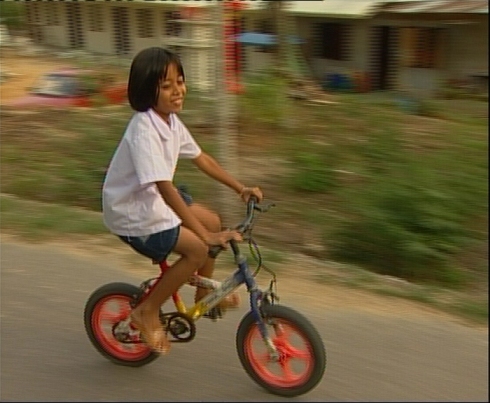
Jantakarn Thep-Chuay, known as Beam

For many weeks, Jantakarn Thep-Chuay — nicknamed Beam -– did not understand why her father was not coming home. The eight-year-old girl, in Takuapa in Thailand’s southern district of Phang Nga, had last seen him go to work on the morning of 26 December 2004.

“On that Sunday, the day there was a wave, my dad wore his tennis shoes,” she recalls as she gets into his pair of sandals. “My dad didn’t have to do much work — he just walked around looking after workers.”

Beam’s father Sukaroak –- a construction supervisor at a new beach resort in Khao Lak –- was one of thousands of Thais and foreign tourists killed when the Asian Tsunami hit without warning. His body was never found.

For months, Beam would draw pictures of her family. These, and family photos of happier times, helped her to slowly come to terms with what happened.

The first year was long and hard for the family Sukaroak left behind: Beam, her two-year-old brother Boom, and mother Sumontha, 28. The determined young widow struggled to keep home fires burning -– and to keep her troublesome in-laws at bay.

As if that were not enough, she also had to engage assorted bureaucracies: even obtaining an official death certificate for her late husband entailed much effort.

Just a few weeks after the disaster, the local authorities approached Sumontha suggesting that she gives away one or both her children for adoption. Apparently a foreigner was interested. She said a firm ‘No’.

“Her dad wanted Beam to become an architect. He was hoping for a day when he could build something she draws,” says Sumontha. “If I am still alive, I want to raise my own children. I am their mother. For better or worse, I want to raise them myself.”

The Tsunami destroyed Beam’s school, but she continued to attend a temporary school set up with local and foreign help. Before the year ended, she moved to a brand new ‘Tsunami School’ that the King of Thailand built to guarantee education for all children affected by the disaster.

Sumontha, Beam and Boom are three ordinary Asians who have shown extraordinary courage, resilience and resourcefulness as they coped with multiple challenges of rebuilding their lives after the Tsunami. Theirs is one of eight families that we followed throughout 2005, under our empathetic communication initiative called Children of Tsunami: Rebuilding the Future.

It was a multi-country, multi-media project that tracked how ordinary Asians rebuilt their lives, livelihoods and futures after one of the biggest disasters in recent years. We at TVE Asia Pacific documented on TV, video and web the personal recovery stories of eight affected families in India, Indonesia, Sri Lanka and Thailand for a year after the disaster. Our many media products — distributed on broadcast, narrowcast and online platforms -– inspired wide ranging public discussion on disaster relief, recovery and rehabilitation. In that process, we were also able to demonstrate that a more engaged, respectful kind of journalism was possible when covering post-disaster situations.

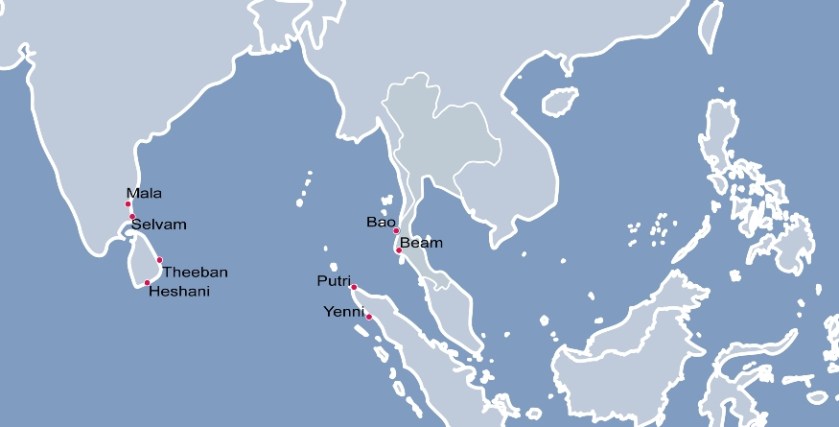
where Children of Tsunami stories were filmed for much of 2005
Four countries, eight locations: where Children of Tsunami stories were filmed for much of 2005

Meet the Children of Tsunami

They have never met each other. Yet they were united first in grief, then in survival. Five girls and three boys, between 8 to 16 years of age, living in eight coastal locations in four countries. Their families were impacted by the Asian Tsunami in different ways. Some lost one or both parents -– or other family members. Some had their homes or schools destroyed. Others found their parents thrown out of a job. During the year, these families faced many hardships and challenges in rebuilding their futures.

These remarkable children were our personal heroes for 2005:
Selvam, 13, Muzhukkuthurai, Tamil Nadu state, India
Mala, 11, Kottaikkadu, Tamil Nadu state, India
Putri, 8, Lampaya, Aceh province, Indonesia
Yenni, 15, Meulaboh, Aceh province, Indonesia
Heshani, 13, Suduwella, southern Sri Lanka
Theeban, 14, Karaitivu, eastern Sri Lanka
Bao, 16, Kuraburi, Phang Nga district, Thailand
Beam, 8, Takuapa, Phang Nga district, Thailand

With their trust and cooperation, we captured their unfolding realities unscripted and unprompted.

Read and experience much more on the Children of Tsunami dedicated website

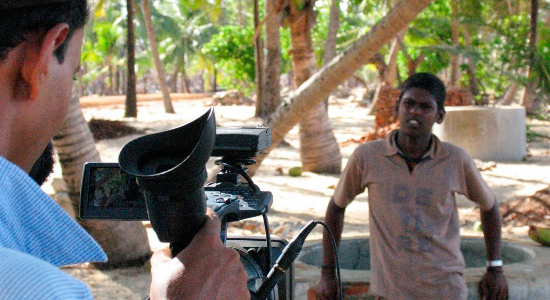
Filming with Theeban in eastern Sri Lanka...now only a memory

As I recalled in early 2007, when we tragically lost one of eight survivor children – Theeban – to Sri Lanka’s civil war: As journalists, we have been trained not to get too attached to the people or subjects we cover, lest they affect our judgment and dilute our objectivity. The four production teams involved in Children of Tsunami initially agreed to follow this norm when we met in Bangkok in early 2005 for our first (and only) planning meeting. We also resolved not to reward our participating families in cash or kind, as they were all participating voluntarily with informed consent.

“But the ground reality was different. 2005, Asia’s longest year, wore on. As survivors slowly patched their lives together again, our film teams found themselves becoming friends of families or playing Good Samaritan. Sometimes our teams would find a survivor family close to starvation and — acting purely as human beings, not journalists — they would buy dry rations or a cooked meal. At other times, finding the children restless or aimless, they would buy them a football, kite or some other inexpensive toy that would produce hours of joy and cheer.

“As commissioners and publishers of Children of Tsunami stories, we didn’t object to these acts of kindness. Journalism with empathy was far preferable to the cold detachment that textbooks recommend.

In 2007, my colleague Manori Wijesekera – who served as production manager of this challenging effort – and I wrote up our definitive account of the project for Communicating Disasters: An Asia Pacific Resource Book. That chapter can be read online here.

Children of Tsunami: The Journey Continues
(25mins) was the end-of-year film that captured the highlights and ‘lowlights’ of our families’ first year following the disaster. It can be viewed online at the Children of Tsunami website.

Children of Tsunami: No More Tears (25 mins) was the shorter version of the end-of-year film that captured the highlights and ‘lowlights’ of our families’ first year following the disaster. We co-produced it with the Singapore-based regional broadcaster Channel News Asia.

Watch the first few minutes on YouTube:

All images courtesy TVE Asia Pacific

Early Warning for Planet Earth: How to avoid mother of all Tsunamis!

Next tsunami could begin with this...

Today marks the 4th anniversary of the Indian Ocean Tsunami of December 2004.

The tsunami was triggered by a massive quake that erupted off the coast of Sumatra, and 6 miles deep under the Indian Ocean’s seabed. The estimated 9.1 to 9.3 magnitude earthquake was the strongest in 40 years and the fourth largest in a century. The U.S. Geological Survey later estimated that the amount of energy released was equivalent to the energy of 23,000 Hiroshima-type atomic bombs.

Despite a lag of up to several hours between the earthquake and the impact of the tsunami, nearly all affected people were taken completely by surprise. There were no tsunami warning systems in the Indian Ocean to detect tsunamis or to warn those living on the Indian Ocean rim areas. This cost the lives of over 225,000 people in 11 countries — many of who could have lived if only they had a timely warning to rush inland.

In the past four years, there have been various efforts to set up such early warning systems – as well as effective ways to deliver credible warnings to large numbers of people quickly. These are meant to provide 24/7 coverage to Indian Ocean countries in the same way the Pacific Tsunami Warning Centre has been covering Pacific Ocean countries for many years.

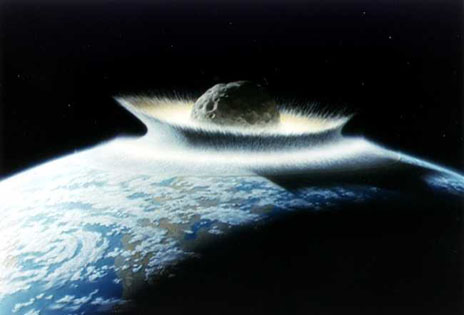
All this is necessary – but not sufficient – to guard ourselves against future tsunamis. For it’s not just earthquakes undersea that can trigger tsunamis. An asteroid impact could trigger the mother of all tsunamis that can impact coastal areas all over the planet.

An asteroid that struck the Earth 65 million years ago wiped out the dinosaurs and 70 per cent of the species then living on the planet. The destruction of the Tunguska region of Siberia in June 1908 – whose centenary was marked this year – is known to have been caused by the impact of a large extraterrestrial object.

Space artist David Hardy's vision...
When discussing the possible consequences of asteroid impacts on Earth, more attention has been given to the destruction it can cause by such a falling piece of the sky hitting inhabited areas of land. Some people seem to be comforted by the fact that two thirds of the planet’s surface is ocean — thus increasing changes that an impact would likely happen at sea.

In fact, we should worry more. Duncan Steel, an authority on the subject, has done some terrifying calculations. He took a modest sized space rock, 200 metres in diameter, colliding with Earth at a typical speed of 19 kilometres per second. As it is brought to a halt, it releases kinetic energy in an explosion equal to 600 megatons of TNT — 10 times the yield of the most powerful nuclear weapon tested (underground). Even though only about 10 per cent of this energy would be transferred to the tsunami, such waves will carry this massive energy over long distances to coasts far away. They can therefore cause much more diffused destruction than would have resulted from a land impact. In the latter, the interaction between the blast wave and the irregularities of the ground (hills, buildings, trees) limits the area damaged. On the ocean, the wave propagates until it runs into land.

Scientists have been talking about asteroid impact danger for decades. Arthur C Clarke suggested – in his 1973 science fiction novel Rendezvous with Rama – that as soon as the technology permitted, we should set up powerful radar and optical search systems to detect Earth-threatening objects. The name he suggested was Spaceguard, which, together with Spacewatch, has now been widely accepted.

In November 2008, a group of the world’s leading scientists urged the United Nations to establish an international network to search the skies for asteroids on a collision course with Earth. The spaceguard system would also be responsible for deploying spacecraft that could destroy or deflect incoming objects.

The group – which includes the Royal Society president Sir Martin Rees and environmentalist Sir Crispin Tickell – said that the UN needed to act as a matter of urgency. Although an asteroid collision with the planet is a relatively remote risk, the consequences of a strike would be devastating.

Not if, but when...
Not if, but when...
The International Panel on Asteroid Threat Mitigation, chaired by former American astronaut Russell Schweickart, urged: “The international community must begin work now on forging three impact prevention elements – warning, deflection technology and a decision-making process – into an effective defence against a future collision.”

Read more media coverage and commentary at:
The Guardian, 7 Dec 2008: UN is told that Earth needs an asteroid shield
World Changing, 10 Dec 2008: Giant asteroids and international security

This is exactly the message in an excellent documentary called Planetary Defence made by Canadian filmmaker M Moidel, who runs the Space Viz production company. Over the past many months, the film has been screened at the United Nations, on various TV channels and at high level meetings of people who share this concern.

Its main thrust: Scientists and the military have only recently awakened to the notion that asteroid impacts with Earth do happen. Planetary Defense meets with both the scientific and military communities to study our options to mitigate an impact. It makes the pivotal point: “Civilization is ill prepared for the inevitable. It’s not if an impact will happen with the Earth, it’s when!”

In such an event, the film asks, who will save Earth? The 48 minute documentary explores the efforts underway to detect and mitigate an impact with Earth from asteroids and comets, collectively known as NEO’s (Near Earth Objects).

Watch the trailer of Planetary Defence on YouTube:

Neil deGrasse Tyson, Astrophysicist and Director, American Museum of Natural History, in New York, says: “Planetary Defense, the film, is a documentary that explores how ill-prepared we are to prevent our own extinction from asteroid and comet impacts. Filmmaker M Moidel interviewed all the right people, asked them all the right questions, and leaves the viewer scared for our future, but empowered to do something about it.”

Read more about the film at Space Viz Productions website

Although we have never met, I have been in email contact with M Moidel for several years. I know how deeply committed he is to each of his documentary projects. Working on incredibly tight budgets and performing multiple tasks on his own, this brilliant Canadian has made some eminently accessible, timely and captivating documentaries on ‘big picture’ topics such as the search for intelligent life in the universe, the future of space exploration and, of course, coping with asteroid impacts.

Sir Arthur C Clarke, interviewed on some of Moidel’s films, including Planetary Defence, has highly commended his efforts.

Sir Arthur, whose Sri Lankan diving school was destroyed by the 2004 tsunami, wrote a few days after the disaster:

“Contrary to popular belief, we science fiction writers don’t predict the future — we try to prevent undesirable futures. In the wake of the Asian tsunami, scientists and governments are scrambling to set up systems to monitor and warn us of future hazards from the sea.

“Let’s keep an eye on the skies even as we worry about the next hazard from the depths of the sea.”

Iodised Salt: How to make the world smarter, faster?

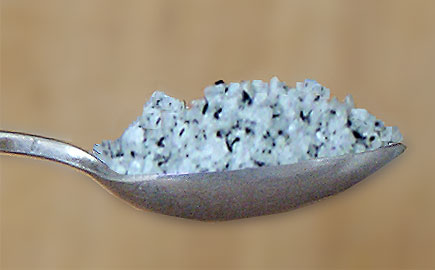
A miracle powder?
A miracle substance to get smarter?
One of the earliest video films I helped distribute at TVE Asia Pacific, soon after it was set up in 1996, was called Ending Hidden Hunger.

This 20 minute film, made in 1992 by Bedford Films of UK and narrated by Sir Peter Ustinov, described how the UN children’s agency UNICEF was working toward eliminating micronutrient deficiencies from iron, vitamin A and iodine in different parts of the developing world. Examples are taken from Africa and Asia to both illustrate the extent of the problem as well as steps being taken to reduce these deficiencies that cause mass-scale disability and death.

The main premise of the film was simple: those lacking micro-nutrients in their regular diet often don’t show immediate signs of starvation. This deprivation builds up over time and causes slow – sometimes irreparable – damage.

Nicholas Kristof
Nicholas Kristof
I was reminded of this film — and its still very relevant message — when reading an excellent essay by Nicholas Kristof in International Herald Tribune a few days ago. He is a columnist for the New York Times who travels the world reporting from the various frontlines of survival and struggle.

In Raising the World’s I.Q., dispatched from Rawalpindi, Pakistan, Kristof was talking about ‘a miracle substance that is cheap and actually makes people smarter’: iodised salt.

Here’s the context, as he put it:

“Almost one-third of the world’s people don’t get enough iodine from food and water. The result in extreme cases is large goiters that swell their necks, or other obvious impairments such as dwarfism or cretinism. But far more common is mental slowness.

“When a pregnant woman doesn’t have enough iodine in her body, her child may suffer irreversible brain damage and could have an I.Q. that is 10 to 15 points lower than it would otherwise be. An educated guess is that iodine deficiency results in a needless loss of more than 1 billion I.Q. points around the world.”

In nearly all countries, the best strategy to control iodine deficiency is iodisation of salt — one of the most cost-effective ways to contribute to economic and social development. Especially in these hard times, development professionals are looking for smart ways to get the biggest bang for their limited (and still shrinking) bucks. Investing in micronutrients – such as iodine – can provide some of the biggest bangs possible.

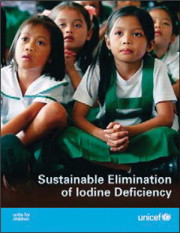
UNICEF Report 2008
UNICEF Report 2008
In June 2008, UNICEF published Sustainable elimination of iodine deficiency, a new report on progress since 1990 when the world’s governments set the target to eliminate iodine-deficiency disorders worldwide.

In October 2008, The Lancet, one of the world’s leading medical journals, published a report that noted: “Iodine deficiency is the most common cause of preventable mental impairment worldwide.”

The medical, public health and development communities have known and talked about iodine and other micronutrients for over 30 years. Significant progress has been made – for example, UNICEF says by 2006, more than 120 countries were implementing salt iodisation programmes, and 34 countries had managed to get rid of iodine deficiency among their people through this smart strategy.

But there still are major gaps — which continue to cause preventable damage to tens of millions of people including children.

Nicholas Kristof navigates through the heavy, jargon-ridden developmentspeak and churns out an eminently readable, accessible piece. It’s written in first person narrative from a part of the world where illiteracy, superstition – and their erstwhile companion, religious fanaticism – are trying to prevent people at risk from using iodised salt. This is science writing at its finest: anecdotal, personalised and purposeful.

And he’s absolutely right when he says iodised salt lacks glamour, doesn’t have too many stars or starlets singing its praise and (almost) no one writing about it despite its potential to improve lives for so many people.

I should know: one of the earliest topics I tackled as a young science reporter – getting started in the late 1980s – was salt iodisation. I struggled to put together a readable, engaging piece — which I then had to push through jaded editors who wondered what all this fuss was about.

I have only one (minor) bone to pick with Kristof. He pokes fun at Canada for hosting and supporting the Micronutrient Initiative, “an independent, not-for-profit organization committed to promoting simple cost-effective solutions for hidden hunger and developing innovative new solutions where needed.”

He calls Canada “earnest and dull, just like micronutrients themselves”. It’s a personal view – perhaps expressed with his tongue firmly in his cheek. Having travelled a fair amount in North America, and having good friends in both countries, I think that the nation north of the US-Canada border is a tad more civilised, certainly more caring and better engaged with the rest of the world.

But then, that too is a personal view. I’m darn lucky that I get enough iodine in my diet so that I can think for myself, keep asking lots of annoying questions…and occasionally even get some answers right.

Two billion people – almost a third of humanity – aren’t so lucky.

Read Raising the world’s I.Q. by Nicholas Kristof

Salt iodisation is not universally hailed. Read an alternative point of view that appeared in India’s Frontline magazine in 2006: Imposing iodine

Climate Neros: Films chained, unchained…

down-to-earth

“Twenty centuries ago, Emperor Nero fiddled while Rome burned. Today, some media companies are squabbling over copyrights while the planet is warming.”

These words, which I first uttered during an Asian workshop on moving images and changing climate in Tokyo in early October 2008, have resonated with many journalists, producers and activists concerned about climate change.

The latest outlet to carry my views is Down to Earth, the fortnightly magazine on science and environment published from New Delhi, India. They have included a condensed version of my remarks in their issue for 15 December 2008, under the heading: Films chained, unchained

It’s part of a special issue to mark the 14th Conference of Parties to the United Nations Framework Convention on Climate Change (UNFCCC) and the fourth meeting of Parties to the Kyoto Protocol, being held in the Polish city of Poznan from 1 to 12 December 2008.

In fact, Down to Earth editor Pradip Saha was part of our Tokyo workshop which called for climate change to be recognised as a copyright free zone.

When Down to Earth editors first mooted the idea of carrying my views, they suggested a catchy headline: Climate’s Niros. I rather liked that…but that didn’t survive their copyediting. Ah, well…

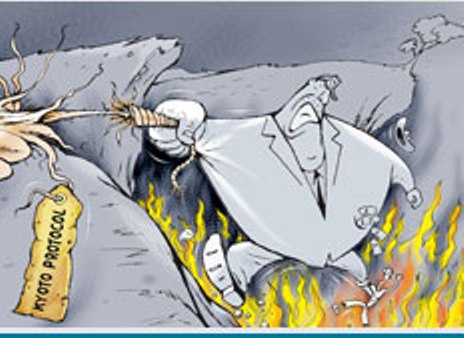
Last chance for Kyoto Protocol? Courtesy Down to Earth
Last chance for Kyoto Protocol?
In its preamble to the special climate change issue, Down to Earth editors say:
“Eleven years after the Kyoto Protocol was signed — only to be consigned to irrelevance over the subsequent decade — nations are meeting in Poland to negotiate post-2012 action.

“The realities of climate change are clearer than ever, and the cost of action is mounting. Rich countries, historically responsible for climate change, are proposing new mechanisms to share the burden. Leading developing countries such as India and China need to negotiate hard as well and make a big push for renewables…” Read full story

On 5 November 2008, SciDev.Net published my op ed essay:
Planet before profit for climate films

On 7 November 2008, Asia Media Forum published a longer version of this essay:
Climate Change or (c)limate (c)hange: Guarding copyrights on a warming planet

These have been linked to, or commented upon, by various blogs and websites. Interestingly, the big time TV/video production companies and broadcasters have been keeping quiet in this debate.

Perhaps they are too busy counting their money accruing from license fees?

Climate change and copyrights: What intellectual property on a dead planet?

Twenty centuries ago, Emperor Nero fiddled while Rome burned. Today, some media companies are squabbling over copyrights while the planet is warming.

This is the main thrust of my latest op ed essay, just published by the Science and Development Network (SciDev.Net) anchored in London, UK. It’s titled: Planet before profit for climate change films.

I have adapted for this commentary some of my ideas initially expressed on this blog – especially the post on 12 Oct 2008: Climate in Crisis and planet in peril – but we’re squabbling over copyrights!

Broadcasting on a warming planet

In writing this essay, I’ve also drawn on the excellent discussions we had last month during the Asia Pacific workshop on Changing Climate and Moving Images in Tokyo.

I’m challenging broadcasters to put their money where their mouth is.

Here’s an excerpt:

“Broadcast mandarins routinely support global struggles against poverty, HIV, corruption and climate change by offering free airtime to carry public interest messages. But few let go of their own products on these very subjects for non-broadcast uses.

“Making climate change a ‘copyright free zone’ for media products would increase the resource materials available to thousands of educators, social activists and trainers struggling to communicate this complex topic to audiences across the world. Moving images would make their task easier.

“The climate crisis challenges everyone to adopt extraordinary measures. Broadcasters and film-makers need to balance their financial interests with planetary survival.

“What use is intellectual property on a dead planet?”

Read my full essay on SciDev.Net: Planet before profit for climate change films.

In September 2006, speaking at the United Nations headquarters (photo below), I called for poverty to be recognised as a copyright free zone. The idea was to have broadcasters and other electronic publishers release copyrights on TV, video and online content relating to poverty and development issues -– at least until (MDG target year of) 2015.

The TV broadcast and film communities have reacted to this proposal with disdain or indifference, but I keep badgering on. If poverty didn’t motivate broadcasters to change business as usual, I hope, the planetary threat posed by climate change would.

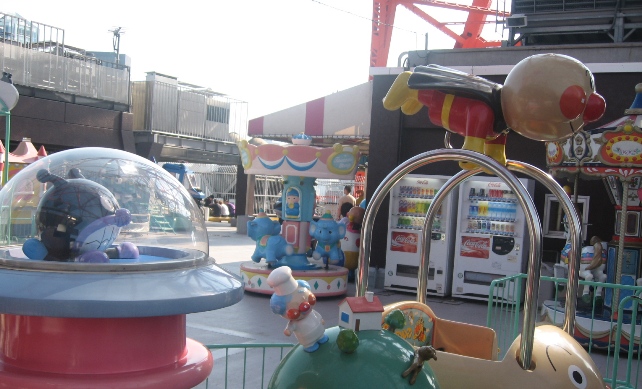
Encounter with Anpanman: A superman made of bread!

Anpanman is one of the most popular anime cartoon series in Japan

Last month, on my way to the Tokyo headquarters of NHK, Japan’s public broadcaster, I stopped at the Tokyo Tower for a bit of sight-seeing.

A communications tower located in Shiba Park, Minato, Tokyo, the Tokyo Tower is 332.6 meters (1,091 ft) tall – which makes it the tallest self-supporting steel structure in the world. Built in 1958, this Eiffel Tower-like structure supports an antenna that broadcasts television and radio signals for important Japanese media outlets including NHK, TBS and Fuji TV.

At the base of the tower, I had an unexpected encounter with an old friend. I know him as Gnana Katha Malliya, the name given to him in the Sinhalese adaptation that I watch on Sri Lankan television.

But everyone in Japan knows him by his original name: Anpanman. He is one of the most popular anime cartoon series (manga) in Japan. It is produced by Nippon Television Network Corporation.

Anpanman is the creation of Takashi Yanase, a Japanese writer of children’s stories. Each animated cartoon is approximately 24 minutes long, split into 2 episodes of approximately 12 minutes each.

Yanase has been writing Anpanman since 1968. He became inspired by the idea of Anpanman while struggling to survive as a soldier in World War II. He had frequently faced the prospect of starvation which made him dream about eating a bean-jam filled pastry called Anpan.

Anpanma is indeed a superman made by a baker. His head is a bun made by Jam Ojisan, a kind-hearted baker. He was created when a shooting star landed in Jam Ojisan’s oven while he was baking.

Anpanma’s name comes from the fact that he is a man with a head made of bread that is filled with bean jam called an anpan. His weakness is water or anything that makes his head dirty. He regains his health and strength when Jam Ojisan bakes him a new head and it is placed on his shoulders. Anpanman’s damaged head, with Xs in his eyes, flies off his shoulders once a new baked head lands.

The most endearing attribute of Anpanman is his sense of sacrifice. When he comes across a starving creature or person, he lets the unfortunate creature or person eat part of his head. Jam Ojisan has to keep baking an endless supply of heads for our hero.

And it gives a whole new meaning to the phrase ‘eat my head off’.

Baikinman is the villain in the stories. He comes from the “Germ World” and is the leader of the viruses. His name means “Germ Man”, and his ambition is to destroy Anpanman and turn the planet into another “Germ World”.

Read about other characters in Anpanma

Anpanman (R) and Baikinman at the Tokyo Tower

According to the Wikipedia, as of September 2006, Anpanman’s books had collectively sold over 50 million copies in Japan.

The Anpanman television series is called Soreike! Anpanman (meaning ‘Go! Anpanman’) – it has been on the air in Japan since 1988. More than 800 episodes have been made to date. There are also 18 cinematic films featuring the characters.

According to the Japanese toy company Bandai, Anpanma is the most popular fictional character from age 0 to 12 years in Japan.

As I found out, Anpanman is such a cultural icon in Japan that his images adorn railway carriages, and there is an Anpanman museum opened in Yokohama in 2007.

Anpanman is also popular in many countries across Asia. He has a large following in China and Korea, where the comics and TV series have been a popular Japanese cultural export for years.

And, as it turns out, I’d been enjoying his exploits on Sri Lankan television for years without even knowing his original Japanese name! This reinforces the point I made in Feb 2008, writing about another favourite character Madeline – originally French, but whom I encountered on a visit to Manila and Los Banos in January this year.

I wrote: “It’s becoming impossible to discern or define what is ‘local’ anymore in this rapidly globalising and integrating world. Sociologists and communication researchers who split hairs about preserving ‘local content’ have a romanticised notion that is hard to find in the real world.”


Read my Feb 2008 blog: What’s local in our mixed up, globalised world?


Watch a sample story: Anpanman to Hamigakiman

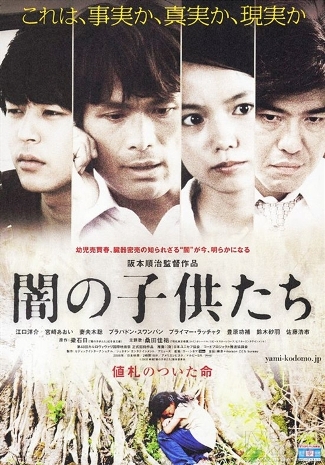
Thai audiences in the dark about ‘Children of the Dark’

Yami no kodomotachi (Children of the Dark) movie poster

Human trafficking – peddling and trading of human beings for slavery, sexual exploitation and servitude – has grown to alarming proportions in recent years. It’s among the top five illicit trades in the world, whose net annual worth is believed to be between 9 billion and 42 billion US dollars. The truth is, nobody knows exactly how big it is, but human rights activists and development agencies agree the problem is pervasive.

Of the estimated 2.5 million persons trafficked worldwide, more than half are in the Asia Pacific. At the UN General Assembly for Children in August 2007, it was reported that about 1.8 million children became victims of commercial sex trade in 2000. About one million children in Southeast Asia are said to be involved – Thailand is one centre of this shady trade, drawing on misery in its rural hinterlands as well as poorer neighbouring countries like Burma, Cambodia and Laos.

So what happens when someone goes to the trouble of studying the issue in depth, and then pools talent and resources to make a feature film that exposes international connections that sustain the child sex industry in Thailand? Instead of being welcomed as part of the effort to counter this scourge, the film gets banned.

Yami no kodomotachi (Children of the Dark, 138 mins, original Japanese) is a Japanese-Thai film made in 2008 about child sex slavery. It has been banned in Thailand on the grounds that it was ‘inappropriate’ and touched on a ‘sensitive’ issue.

Watch the official trailer of the film (Japanese soundtrack, Thai captions):

I haven’t seen the film, but according to one reviewer who did, Junji Sakamoto‘s film is based on a novel by Yan Sogil and scripted by Sakamoto himself, shows, with a documentary-like directness, how children caught in the web of a Thai prostitution ring are exploited, abused and, in some cases, murdered when they are no longer sexually salable.

Mark Schilling, writing in The Japan Times in August 2008, noted: “…In being so visually graphic — particularly in the sex scenes in the Thai brothel — Sakamoto treads a dangerous line between hard-hitting social drama and stomach-turning exploitation. He takes care never to show his young actors (whose average age looks to be about 10) and their adult ‘clients’ in the same explicit shot, but he films them engaged in sexual acts or their aftermath. Sakamoto may defend these scenes in the name of realism, but could he have filmed similar ones in Japan, using Japanese children? The short answer is “no.”

The Thai ban prevented ‘Children of the Dark’ from being screened at the Bangkok International Film Festival, held in the Thai capital from 23 – 30 September 2008.

“The ban puts under the spotlight the country’s – or at least its higher-ups’ – seeming unwillingness to let go of the Film Act of 1930, when Thailand was still under absolute monarchy. That law gave a Board of Censors the power to impose cuts or to ban a film it deems inappropriate,” writes my friend and colleague Lynette Lee Corporal in an article just published on Asia Media Forum.

Thailand in denial about its Children of the Dark
She quotes my Thai colleague and documentary filmmaker Pipope Panitchpakdi as saying: “Authorities always think that viewers need to be protected and shielded from real issues. They still have that kind of sentiment that the media should function as a gatekeeper. That is, let the good stories in and the bad ones out. It’s okay in certain circumstances but not when talking about real, serious issues.”

Pipope adds: “This country has no problem with hypocrisy; we don’t see anything wrong with double standards. We have sex workers in corners of the city, but we can’t watch people kissing.”

A Bangkok-based journalist who calls himself Wise Kwai, writing in his blog, asks: “When will they (Thai authorities) learn that when they ban or censor a film, the ensuing stink that’s raised causes more problems than if the film had been allowed to quietly unspool? Perhaps if people had seen it, they might criticise it, but they’d also talk about the problems in society that allow children to be exploited.”

Read the full article: Film Censorship Leaves Viewers in the Dark by Lynette Lee Corporal

My Sep 2007 post: MTV Exit: Entertainment TV takes on human trafficking